

User Perceptions of Virtual Consultations and Artificial Intelligence Assistance: A Mixed Methods Study

 ,
,  , and
, and
Abstract

1. Introduction
2. Materials and Methods
2.1. Ethics Statement
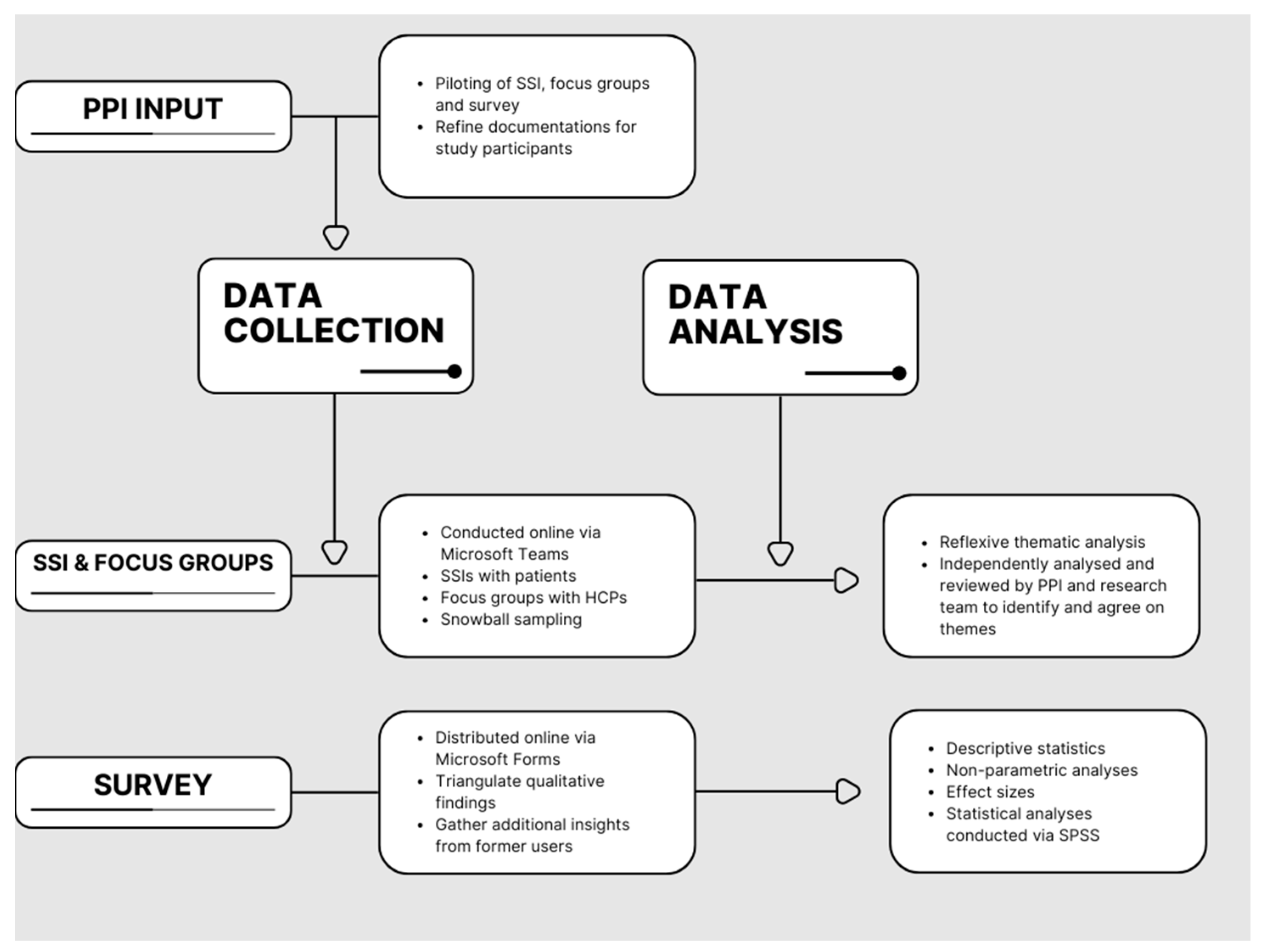
2.2. Qualitative Data Collection and Data Analysis
2.3. Survey Data Collection and Analysis
2.4. Research Group Characteristics and Reflexivity
3. Results
3.1. Qualitative Results
3.1.1. Participant Characteristics
3.1.2. Integrated Qualitative Findings
Theme 1: Convenient and Continuous Care Through Video Consultations
“I think it would take an awful lot of way, of the stress away. Because if you’re trying to explain on the phone and you know the person can’t see it, and if you are in pain, it’s hard to even think… You can’t. It’s hard to communicate, like. So I think that the fact that you could, you could actually show would be… Would take a lot of the stress away, to be honest.”(Patient 4, aged 50–55, female, rheumatoid arthritis)
“Whereas if you call somebody and they don’t answer, you know you can always call the next person. Uhm, whereas if you’re waiting for scheduled visits and they don’t show up, that can be an hour and a half of your day. Uhm, and that can be very frustrating. So at least with the virtual call, it’s more flexible.”(HCP-1d, senior respiratory physiotherapist, aged 35–40, female)
“They’re following a pathway, so they’re not just dropped.”(HCP-2b, clinical nurse specialist, aged 45–50, female)
Theme 2: Optional, Hybrid Models with Familiar, Empathetic HCPs
“So it is great as little as possible not to have to attend the hospital, but on the on the other point of view, sometimes I think it is necessary for the healthcare professional to actually see how is the patient doing and to actually eyeball them to actually see them physically.”(Patient 5, aged 65–70, female, rheumatoid arthritis)
“People don’t watch, engage with technology and, uh, they they, you come up with a bit of resistance, even though you’re explaining the benefits.”(HCP-2c, clinical nurse specialist, aged 40–45, female)
“Yes, the first time was in person. And which was good because I got to meet them. You got to know them. You build a sort of rapport with them and everything and like and it was all good. And then everything else was virtual […]”(Patient 1, aged 55–60, female, COPD)
“The girl who called me for the four or five days, I’ve never met her before. It was a phone call. Just you know, and I was thinking to myself: “It’d be nice to have met her”, you know, to know who I’m talking to.”(Patient 8, aged 65–70, male, COPD)
“Fear of inaccurate findings just placed on visual consultation. Face to face consultation more reassuring.”(Survey participant ID 1, aged 65–74, female patient, rheumatoid arthritis)
“discharged from virtual ward”(Survey participant ID 82, aged 55–64, male patient, COPD)
“I believe face to face creates a better therapeutic relationship with your medical provider.”(Survey participant ID 18, aged 55–64, female patient, chronic gynaecological conditions)
“A hybrid model of virtual and Face to Face appointments is probably the future”(Survey participant ID 11, aged 45–54, female HCP)
Theme 3: Technological Ease and Optimisation for Holistic Virtual Care
“Say, some kind of a diary that they could keep as regards the influence or the effect of their medication on their mood, and that would be helpful, then in further follow up, virtual follow-up with their healthcare worker.”(Patient 5, aged 65–70, female, rheumatoid arthritis)
“And that whole mental health thing needs to be looked at as much as giving you the tablet to get rid of that, uh, chest infection.”(Patient 3, aged 70–75, male, COPD)
“Yeah, because if they didn’t come to show me […] I wouldn’t be able to manage it, like.”(Patient 9, aged 65–70, male, COPD)
“they do all the teaching of the technology and they’re there as a support when things don’t go just to plan”(HCP-2a, advanced nurse practitioner, aged 55–60, female)
Theme 4: Cautious and Transparent AI Integration in Virtual Consultations
“I’m very nervous about invasion and privacy… invasion of people’s privacy and just the way the way intelligence, AI can be used.”(Patient 7, aged 55–60, male, psoriatic arthritis)
“It may kind of frustrate rather when you wouldn’t get talking to a person at themselves. You know a person, a real person.”(Patient 4, aged 50–55, female, rheumatoid arthritis)
“I suppose you’ll be concerned about errors”(HCP-3a, occupational therapist, aged 40–45, female)
“I don’t want it to replace my interactions with my nurses”(Survey participant ID 92, aged 65–74, female patient, COPD)
“Possibly useful as a diagnostic tool where diagnosis is unclear. Could input all investigations and signs/symptoms so far, to aid in considering other potential rare causes when common are outruled.”(Survey participant ID 7, aged 35–44, male HCP)
Theme 5: Potential AI Roles in Virtual Consultations
“And particularly the ability to get information and save it and record it and save it. And you know, summarise it and then… It has it, it helps the patient to focus on on their problem and and their own responsibility for helping themselves in the problem in, in the whole disease, chronic disease.”(Patient 5, aged 65–70, female, rheumatoid arthritis)
“Some sort of software that if you were having a flare up in the middle of the night that would help you calm down.”(Patient 1, aged 55–60, female, COPD)
“Sometimes when you’re put on a new drug, maybe if an AI education on that drug rather than the, you know, the doctor giving you the lowdown on it, or whatever it might be, you know, good to be able to ask questions and relate like that from, you know, just just find out the background of the drugs and the, you know, what they hope to achieve, and the side, well and the side effects too.”(Patient 6, aged 70–75, female, rheumatoid arthritis)
“If they were mentioning like a condition to you that you didn’t know or haven’t heard about before, that it would be, uh, helpful that it would be able to generate information on that condition for you instantaneously, I suppose.”(HCP-1d, senior respiratory physiotherapist, aged 35–40, female)
“Some sort of dictation, you know, where our consultation could be, maybe all presented back to us so that we could sign off on it.”(HCP-2a, advanced nurse practitioner, aged 55–60, female)
Theme 6: Quality of Virtual Interactions and Assessments Is Not Satisfactory
“face to face definitely gets a more accurate, from a clinical assessment, you get a better, a better picture of what’s going on.”(HCP-3e, advanced nurse practitioner, aged 50–55, female)
“And I suppose the other thing with the kind of frustrations of the virtual is when you don’t see them walking on the door, like you can tell an awful lot about a patient even watching them as they walk from the chair and to your consultation room.”(HCP-1d, senior respiratory physiotherapist, aged 35–40, female)
Theme 7: Nuanced and Paradoxical Perceptions of AI
“You know, it’s more advanced than maybe some humans are, like. Yeah, that’s scary, right? That’s scary. You don’t know, you know. Is that the whole world gonna be looking at me doing this, doing that, you don’t know. You can’t trust it at the minute, can you?”(Patient 2, male, aged 70–75, COPD)
“My biggest concern, Prans, is, uhm, safety. People’s safety of the information that the AI has on you and it has access to. Uhm, and you know, that is my big concern that anyone would come to harm like via using AI.”(Patient 7, aged 55–60, male, psoriatic arthritis)
“I just find it hard to get my head around AI.”(Patient 6, aged female, 70–75, rheumatoid arthritis)
“I don’t have any concerns about what you’re talking about […] I would have, I would have concerns about maybe the processes of developing the modern robot type thing that’s going to take over the world.”(Patient 3, male, aged 70–75, COPD)
“This wasn’t too invasive, I would definitely go for it, like.”(Patient 2, male, aged 70–75, COPD)
“The virtual ward is great but am not sure how we would use AI, but I don’t know much about AI”(Survey participant ID 93, aged 75–84, female patient, COPD)
“AI—this is all new to me, I think the nurses would know more”(Survey participant ID 87, aged 75–84, male patient, COPD)
3.2. Quantitative Results
3.2.1. Participant Characteristics of the Quantitative Component
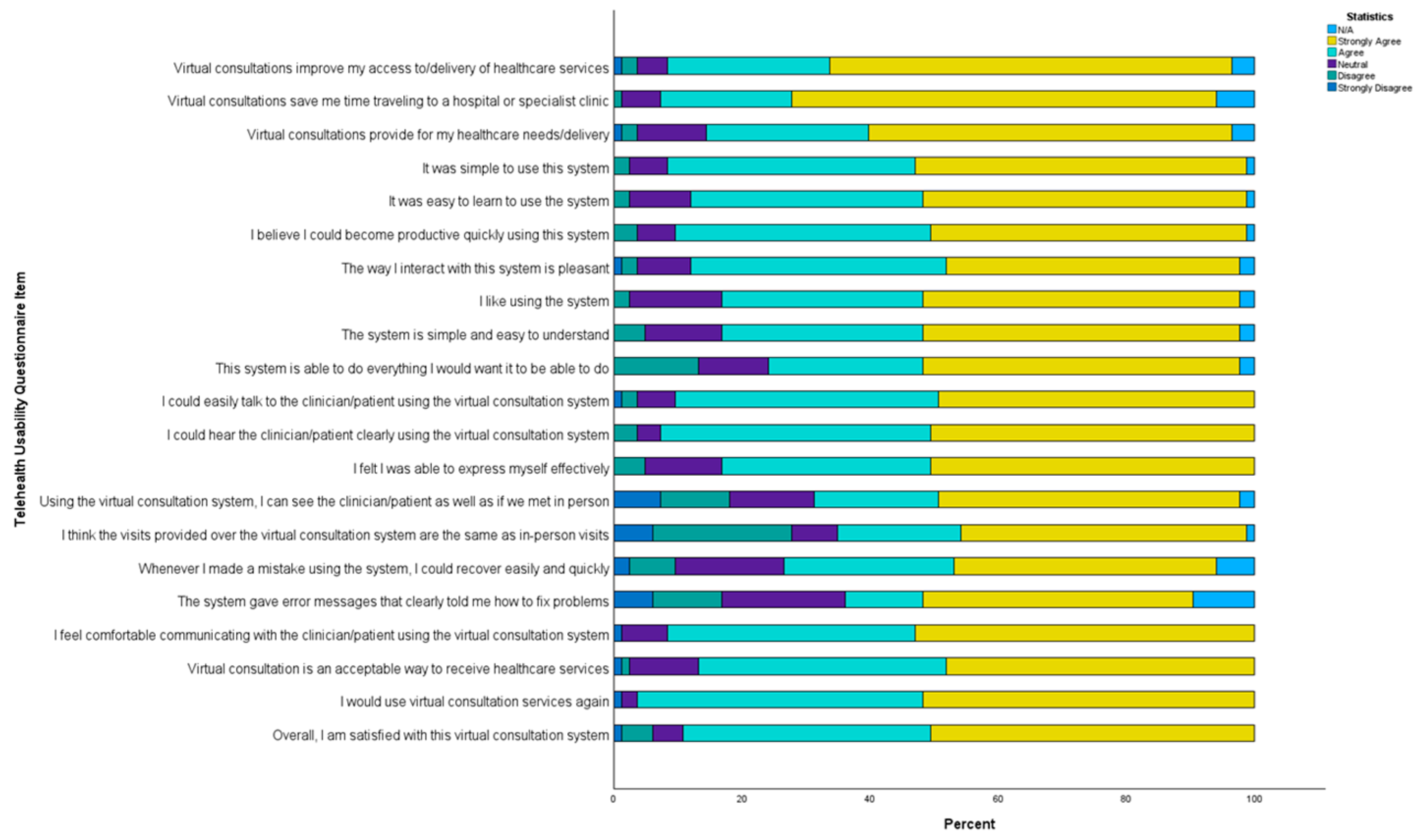
3.2.2. TUQ Analyses
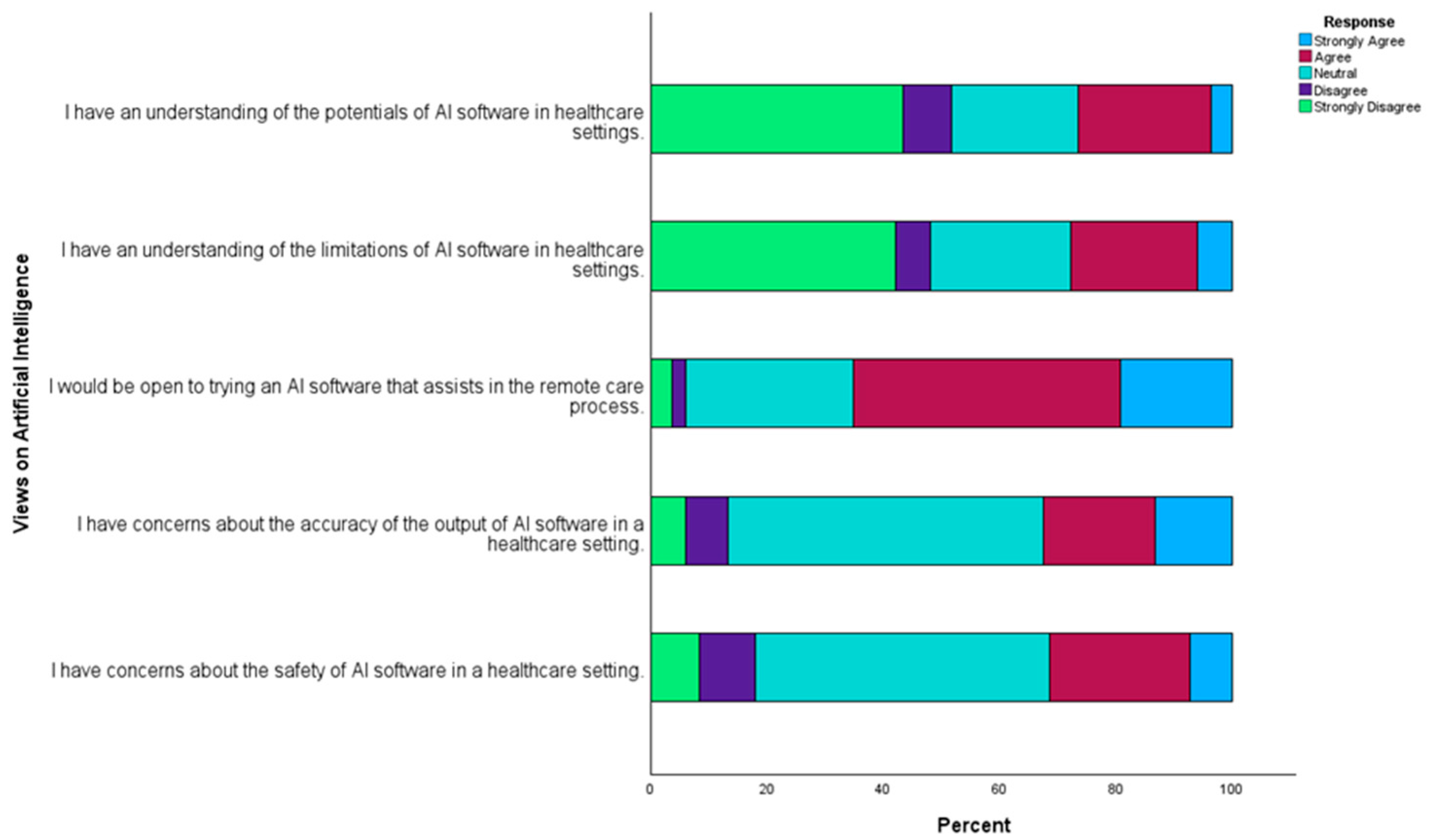
3.2.3. Views on AI Assistance
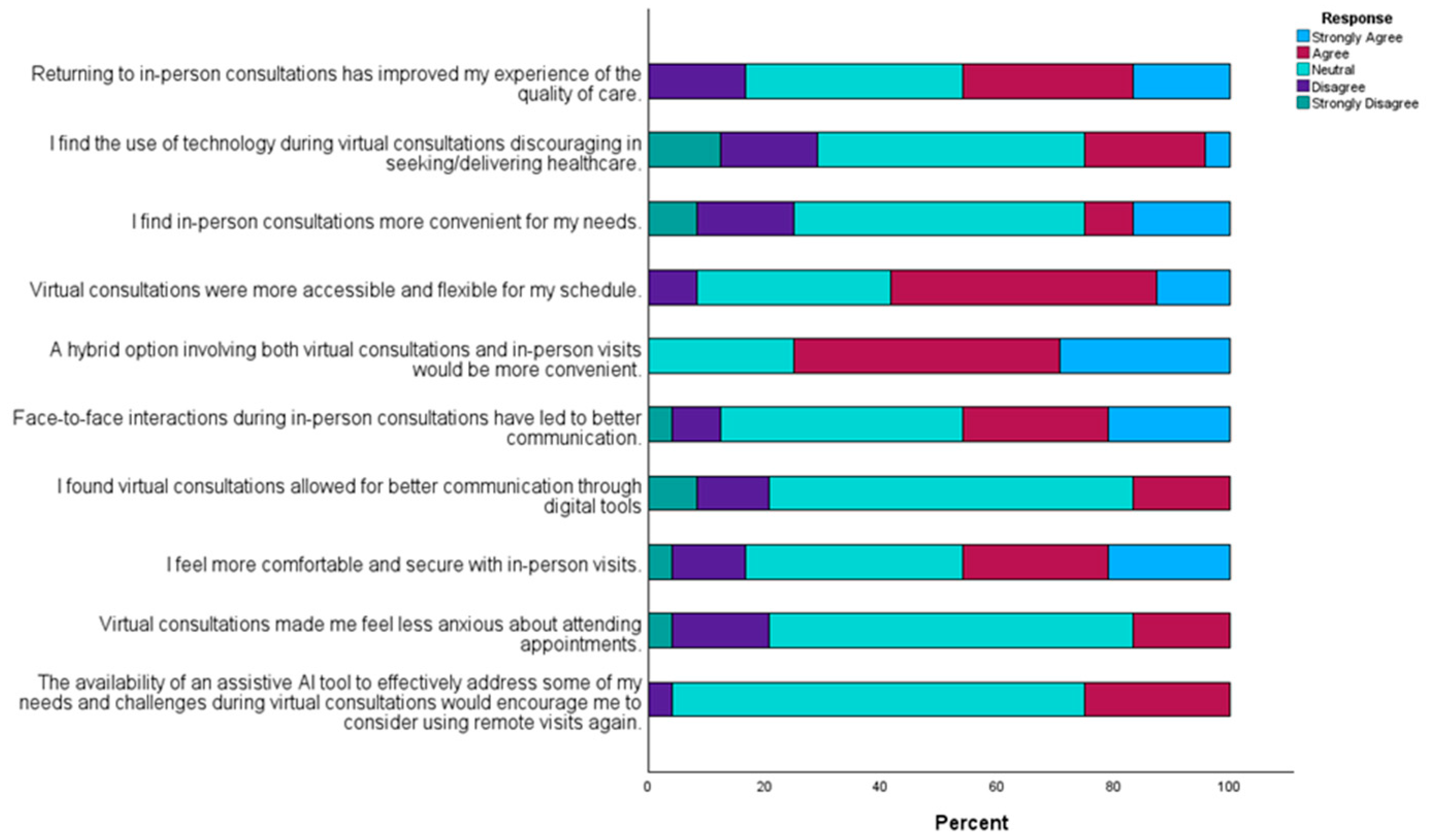
3.2.4. Perspectives of Former Virtual Consultation Users
4. Discussion
4.1. User Experience of Virtual Consultations
4.2. User Needs and Suggested Improvements to Enhance Virtual Interactions
4.3. Views on Artificial Intelligence Supplements in Virtual Consultations
4.4. Future Research and Recommendations
4.5. Limitations
5. Conclusions
Supplementary Materials
Author Contributions
Funding
Institutional Review Board Statement
Informed Consent Statement
Data Availability Statement
Acknowledgments
Conflicts of Interest
Abbreviations
| AI | Artificial intelligence |
| COPD | Chronic obstructive pulmonary disease |
| HCI | Human–computer interaction |
| HCP | Healthcare professional |
| PPI | Public and Patient Involvement |
| SD | Standard deviation |
| SSI | Semi-structured interview |
| TUQ | Telehealth Usability Questionnaire |
| UTAUT | Unified Theory of Acceptance and Use of Technology |
References
- Campbell, K.; Greenfield, G.; Li, E.; O’BRien, N.; Hayhoe, B.; Beaney, T.; Majeed, A.; Neves, A.L. The impact of virtual consultations on the quality of primary care: Systematic review. J. Med. Internet Res. 2023, 25, e48920. [Google Scholar] [CrossRef]
- Martin-Khan, M.; Freeman, S.; Adam, K.; Betkus, G. The evolution of telehealth. In Mobile e-Health; Springer International Publishing: Cham, Switzerland, 2017; pp. 173–198. [Google Scholar]
- Wosik, J.; Fudim, M.; Cameron, B.; Gellad, Z.F.; Cho, A.; Phinney, D.; Curtis, S.; Roman, M.; Poon, E.G.; Ferranti, J.; et al. Telehealth transformation: COVID-19 and the rise of virtual care. J. Am. Med. Inform. Assoc. 2020, 27, 957–962. [Google Scholar] [CrossRef]
- Jain, S.; Macon, C.; Patton, K. Telehealth Demand: An Update After the COVID-19 Pandemic. Trilliant Health. 9 June 2024. Available online: https://www.trillianthealth.com/market-research/studies/telehealth-demand-an-update-four-years-after-the-onset-of-the-covid-19-pandemic (accessed on 30 December 2025).
- Armitage, R. Are Video/Online Appointments Becoming More Popular Among Patients? BJGP Life. 26 December 2023. Available online: https://bjgplife.com/are-video-online-appointments-becoming-more-popular-among-patients/ (accessed on 30 December 2025).
- Hvidt, E.A.; Atherton, H.; Keuper, J.; Kristiansen, E.; Lüchau, E.C.; Norberg, B.L.; Steinhäuser, J.; Heuvel, J.v.D.; van Tuyl, L. Low adoption of video consultations in post–COVID-19 general practice in northern Europe: Barriers to use and potential action points. J. Med. Internet Res. 2023, 25, e47173. [Google Scholar] [CrossRef]
- Rutledge, G.W.; Wood, J.C. Virtual health and artificial intelligence: Using technology to improve healthcare delivery. In Human-Machine Shared Contexts; Academic Press: Cambridge, UK, 2020; pp. 169–175. [Google Scholar]
- Kuziemsky, C.; Maeder, A.J.; John, O.; Gogia, S.B.; Basu, A.; Meher, S.; Ito, M. Role of artificial intelligence within the telehealth domain. Yearb. Med. Inform. 2019, 28, 35–40. [Google Scholar] [CrossRef] [PubMed]
- Benjamens, S.; Dhunnoo, P.; Meskó, B. The state of artificial intelligence-based FDA-approved medical devices and algorithms: An online database. NPJ Digit. Med. 2020, 3, 118. [Google Scholar] [CrossRef]
- Ueda, D.; Kakinuma, T.; Fujita, S.; Kamagata, K.; Fushimi, Y.; Ito, R.; Matsui, Y.; Nozaki, T.; Nakaura, T.; Fujima, N.; et al. Fairness of artificial intelligence in healthcare: Review and recommendations. Jpn. J. Radiol. 2024, 42, 3–15. [Google Scholar] [CrossRef]
- Cabitza, F.; Rasoini, R.; Gensini, G.F. Unintended consequences of machine learning in medicine. JAMA 2017, 318, 517–518. [Google Scholar] [CrossRef]
- Price, W.N.; Cohen, I.G. Privacy in the age of medical big data. Nat. Med. 2019, 25, 37–43. [Google Scholar] [CrossRef]
- Venkatesh, V.; Morris, M.G.; Davis, G.B.; Davis, F.D. User acceptance of information technology: Toward a unified view. MIS Q. 2003, 27, 425–478. [Google Scholar] [CrossRef]
- Fennelly, O. HSE Telehealth Roadmap 2024–2027: Building Blocks for the Embedding & Expansion of Telehealth. Health Service Executive. 1 December 2023. Available online: https://healthservice.hse.ie/staff/procedures-guidelines/digital-health/hse-telehealth-roadmap-2024-2027/ (accessed on 30 December 2025).
- Kolluri, S.; Stead, T.S.; Mangal, R.K.; Coffee, R.L., Jr.; Littell, J.; Ganti, L. Telehealth in response to the rural health disparity. Health Psychol. Res. 2022, 10, 37445. [Google Scholar] [CrossRef] [PubMed]
- Central Statistics Office. Census of Population 2022 Profile 1—Population Distribution and Movements. CSO Statistical Publication. 29 June 2023. Available online: https://www.cso.ie/en/releasesandpublications/ep/p-cpp1/censusofpopulation2022profile1-populationdistributionandmovements/populationdistribution/ (accessed on 30 December 2025).
- Doherty, A.; Keatings, V.; Valentelyte, G.; Murray, M.; O’Toole, D. Community virtual ward (CVW+ cRR) proof-of-concept examining the feasibility and functionality of partnership-based alternate care pathway for COPD patients-empowering patients to become partners in their disease management. Int. J. Nurs. Heal. Care Res. 2022, 5, 1364. [Google Scholar]
- Dhunnoo, P.; Kemp, B.; McGuigan, K.; Meskó, B.; O’rOurke, V.; McCann, M. Evaluation of telemedicine consultations using health outcomes and user attitudes and experiences: Scoping review. J. Med. Internet Res. 2024, 26, e53266. [Google Scholar] [CrossRef] [PubMed]
- Vodrahalli, K.; Ko, J.; Chiou, A.S.; Novoa, R.; Abid, A.; Phung, M.; Yekrang, K.; Petrone, P.; Zou, J.; Daneshjou, R. Development and clinical evaluation of an artificial intelligence support tool for improving telemedicine photo quality. JAMA Dermatol. 2023, 159, 496–503. [Google Scholar] [CrossRef] [PubMed]
- Tao, W.; Yu, X.; Shao, J.; Li, R.; Li, W. Telemedicine-enhanced lung cancer screening using mobile computed tomography unit with remote artificial intelligence assistance in underserved communities: Initial results of a population cohort study in Western China. Telemed. e-Health 2024, 30, e1695–e1704. [Google Scholar] [CrossRef] [PubMed]
- Sharma, S.; Rawal, R.; Shah, D. Addressing the challenges of AI-based telemedicine: Best practices and lessons learned. J. Educ. Health Promot. 2023, 1, 338. [Google Scholar] [CrossRef]
- Vilela, M.A.P.; Arrigo, A.; Parodi, M.B.; Mengue, C.d.S. Smartphone eye examination: Artificial intelligence and telemedicine. Telemed. e-Health 2024, 30, 341–353. [Google Scholar] [CrossRef]
- Dhunnoo, P.; Meskó, B.; O’Rourke, V.; McGuigan, K.; McCann, M. Protocol for a Mixed-methods Investigation of Patient Healthcare Professional’s Perceptions of Virtual Consultations Artificial Intelligence Assistance. OSF 2024. [Google Scholar] [CrossRef]
- Bryman, A. Social Research Methods; Oxford University Press: Oxford, UK, 2016. [Google Scholar]
- Coupe, N.; Mathieson, A. Patient and public involvement in doctoral research: Impact, resources and recommendations. Health Expect. 2020, 23, 125–136. [Google Scholar] [CrossRef]
- Dhunnoo, P.; Wetzlmair, L.-C.; O’Carroll, V. Extended reality therapies for anxiety disorders: A systematic review of patients’ and healthcare professionals’ perspectives. Sci 2024, 6, 19. [Google Scholar] [CrossRef]
- Dhunnoo, P.; Meskó, B.; O’rOurke, V.; McGuigan, K.; McCann, M. Towards Enhanced Virtual Chronic Care: Artificial Intelligence-Human Computer Interaction Integration in Synchronous Virtual Consultations. In Proceedings of the Intelligent Systems Conference, Amsterdam, The Netherlands, 29–30 August 2024; Springer: Cham, Switzerland, 2024; pp. 16–23. [Google Scholar]
- Walker, R.C.; Tong, A.; Howard, K.; Palmer, S.C. Clinicians’ experiences with remote patient monitoring in peritoneal dialysis: A semi-structured interview study. Perit. Dial. Int. 2020, 40, 202–208. [Google Scholar] [CrossRef]
- Metcalfe, C.; Leonard, C.; Muzaffar, J.; Coulson, C. Patient perceptions of a remote assessment pathway in otology: A qualitative descriptive analysis. Eur. Arch. Oto-Rhino-Laryngol. 2023, 280, 2173–2180. [Google Scholar] [CrossRef] [PubMed]
- Palinkas, L.A.; Horwitz, S.M.; Green, C.A.; Wisdom, J.P.; Duan, N.; Hoagwood, K. Purposeful sampling for qualitative data collection and analysis in mixed method implementation research. Adm. Policy Ment. Health Ment. Health Serv. Res. 2015, 42, 533–544. [Google Scholar] [CrossRef]
- Macefield, R. How to specify the participant group size for usability studies: A practitioner’s guide. J. Usability Stud. 2009, 5, 34–45. [Google Scholar]
- Ufholz, K.; Sheon, A.; Bhargava, D.; Rao, G. Telemedicine preparedness among older adults with chronic illness: Survey of primary care patients. JMIR Form. Res. 2022, 6, e35028. [Google Scholar] [CrossRef]
- Heyer, A.; Granberg, R.E.; Rising, K.L.; Binder, A.F.; Gentsch, A.T.; Handley, N.R. Medical oncology professionals’ perceptions of telehealth video visits. JAMA Netw. Open 2021, 4, e2033967. [Google Scholar] [CrossRef] [PubMed]
- Nadarzynski, T.; Miles, O.; Cowie, A.; Ridge, D. Acceptability of artificial intelligence (AI)-led chatbot services in healthcare: A mixed-methods study. Digit. Health 2019, 5, 2055207619871808. [Google Scholar] [CrossRef] [PubMed]
- Fusch, P.I.; Ness, L.R. Are we there yet? Data saturation in qualitative research. Qual. Rep. 2015, 20, 1408–1416. [Google Scholar] [CrossRef]
- DeJonckheere, M.; Vaughn, L.M. Semistructured interviewing in primary care research: A balance of relationship and rigour. Fam. Med. Community Health 2019, 7, e000057. [Google Scholar] [CrossRef]
- Guest, G.; Namey, E.; Taylor, J.; Eley, N.; McKenna, K. Comparing focus groups and individual interviews: Findings from a randomized study. Int. J. Soc. Res. Methodol. 2017, 20, 693–708. [Google Scholar] [CrossRef]
- Braun, V.; Clarke, V. Using thematic analysis in psychology. Qual. Res. Psychol. 2006, 3, 77–101. [Google Scholar] [CrossRef]
- Braun, V.; Clarke, V.; Hayfield, N.; Davey, L.; Jenkinson, E. Doing reflexive thematic analysis. In Supporting Research in Counselling and Psychotherapy: Qualitative, Quantitative, and Mixed Methods Research; Springer International Publishing: Cham, Switzerland, 2023; pp. 19–38. [Google Scholar]
- O’Brien, B.C.; Ilene, B.H.; Beckman, T.J.; Reed, D.A.; Cook, D.A. Standards for reporting qualitative research: A synthesis of recommendations. Acad. Med. 2014, 89, 1245–1251. [Google Scholar] [CrossRef] [PubMed]
- Smith, J.A. Qualitative Psychology: A Practical Guide to Research Methods; SAGE Publications Ltd.: Thousand Oak, CA, USA, 2024; pp. 1–100. [Google Scholar]
- Norberg, B.L.; Getz, L.O.; Johnsen, T.M.; Austad, B.; Zanaboni, P. General practitioners’ experiences with potentials and pitfalls of video consultations in Norway during the COVID-19 lockdown: Qualitative analysis of free-text survey answers. J. Med. Internet Res. 2023, 25, e45812. [Google Scholar] [CrossRef] [PubMed]
- Chuen, V.L.; Dholakia, S.; Kalra, S.; Watt, J.; Wong, C.; Ho, J.M.W. Geriatric care physicians’ perspectives on providing virtual care: A reflexive thematic synthesis of their online survey responses from Ontario, Canada. Age Ageing 2024, 53, afad231. [Google Scholar] [CrossRef]
- Bavngaard, M.V.; Lüchau, E.C.; Hvidt, E.A.; Grønning, A. Exploring patient participation during video consultations: A qualitative study. Digit. Health 2023, 9, 20552076231180682. [Google Scholar] [CrossRef] [PubMed]
- Wasti, S.P.; Simkhada, P.; van Teijlingen, E.; Sathian, B.; Banerjee, I. The growing importance of mixed-methods research in health. Nepal J. Epidemiol. 2022, 12, 1175. [Google Scholar] [CrossRef]
- Tripepi, G.; Jager, K.J.; Dekker, F.W.; Zoccali, C. Selection bias and information bias in clinical research. Nephron Clin. Pract. 2010, 115, c94–c99. [Google Scholar] [CrossRef]
- Parmanto, B.; Lewis, A.N., Jr.; Graham, K.M.; Bertolet, M.H. Development of the telehealth usability questionnaire (TUQ). Int. J. Telerehabilitation 2016, 8, 3–10. [Google Scholar] [CrossRef]
- Hajesmaeel-Gohari, S.; Bahaadinbeigy, K. The most used questionnaires for evaluating telemedicine services. BMC Med. Inform. Decis. Mak. 2021, 21, 36. [Google Scholar] [CrossRef]
- Albers, C.; Lakens, D. When power analyses based on pilot data are biased: Inaccurate effect size estimators and follow-up bias. J. Exp. Soc. Psychol. 2018, 74, 187–195. [Google Scholar] [CrossRef]
- Kasim, H.F.; Salih, A.I.; Attash, F.M. Usability of telehealth among healthcare providers during COVID-19 pandemic in Nineveh Governorate, Iraq. Public Health Pract. 2023, 5, 100368. [Google Scholar] [CrossRef]
- Sayed, S.H.; Aldailami, D.A.; El Aziz, M.M.A.; Elsayed, E.A. Perceived Telehealth Usability for Personalized Healthcare Among the Adult Population in Saudi Arabia: A Cross-Sectional Study in the Post-COVID-19 Era. Healthcare 2025, 13, 62. [Google Scholar] [CrossRef]
- Noceda, A.V.G.; Acierto, L.M.M.; Bertiz, M.C.C.; Dionisio, D.E.H.; Laurito, C.B.L.; Sanchez, G.A.T.; Loreche, A.M. Patient satisfaction with telemedicine in the Philippines during the COVID-19 pandemic: A mixed methods study. BMC Health Serv. Res. 2023, 23, 277. [Google Scholar] [CrossRef]
- Lersten, I.; Fought, A.; Yannetsos, C.; Sheeder, J.; Roeca, C. Patient perspectives of telehealth for fertility care: A national survey. J. Assist. Reprod. Genet. 2023, 40, 1369–1376. [Google Scholar] [CrossRef]
- Jain, E.; Gupta, S.; Yadav, V.; Kachnowski, S. Assessing the Usability and Effectiveness of an AI-Powered Telehealth Platform: Mixed Methods Study on the Perspectives of Patients and Providers. JMIR Form. Res. 2024, 8, e62742. [Google Scholar] [CrossRef]
- Alkaabi, A.; Elsori, D. Navigating digital frontiers in UAE healthcare: A qualitative exploration of healthcare professionals’ and patients’ experiences with AI and telemedicine. PLoS Digit. Health 2025, 4, e0000586. [Google Scholar] [CrossRef]
- Rea, L.M.; Parker, R.A. Designing and Conducting Survey Research: A Comprehensive Guide; John Wiley & Sons: Hoboken, NJ, USA, 2014. [Google Scholar]
- Aldakhil, R.; Greenfield, G.; Lammila-Escalera, E.; Laranjo, L.; Hayhoe, B.W.J.; Majeed, A.; Neves, A.L. The impact of virtual consultations on quality of care for patients with type 2 diabetes: A systematic review and meta-analysis. J. Diabetes Sci. Technol. 2025. [Google Scholar] [CrossRef]
- Quinn, L.M.; Davies, M.J.; Hadjiconstantinou, M. Virtual consultations and the role of technology during the COVID-19 pandemic for people with type 2 diabetes: The UK perspective. J. Med. Internet Res. 2020, 22, e21609. [Google Scholar] [CrossRef] [PubMed]
- Keating, S.E.; Barnett, A.; Croci, I.; Hannigan, A.; Elvin-Walsh, L.; Coombes, J.S.; Campbell, K.L.; Macdonald, G.A.; Hickman, I.J. Agreement and reliability of clinician-in-clinic versus patient-at-home clinical and functional assessments: Implications for telehealth services. Arch. Rehabil. Res. Clin. Transl. 2020, 2, 100066. [Google Scholar] [CrossRef] [PubMed]
- Cottrell, M.A.; O’LEary, S.P.; Swete-Kelly, P.; Elwell, B.; Hess, S.; Litchfield, M.-A.; McLoughlin, I.; Tweedy, R.; Raymer, M.; Hill, A.J.; et al. Agreement between telehealth and in-person assessment of patients with chronic musculoskeletal conditions presenting to an advanced-practice physiotherapy screening clinic. Musculoskelet. Sci. Pract. 2018, 38, 99–105. [Google Scholar] [CrossRef] [PubMed]
- Howick, J.; Moscrop, A.; Mebius, A.; Fanshawe, T.R.; Lewith, G.; Bishop, F.L.; Mistiaen, P.; Roberts, N.W.; Dieninytė, E.; Hu, X.-Y.; et al. Effects of empathic and positive communication in healthcare consultations: A systematic review and meta-analysis. J. R. Soc. Med. 2018, 111, 240–252. [Google Scholar] [CrossRef]
- Budd, G.; Griffiths, D.; Howick, J.; Vennik, J.; Bishop, F.L.; Durieux, N.; Everitt, H.A. Empathy in patient-clinician interactions when using telecommunication: A rapid review of the evidence. PEC Innov. 2022, 1, 100065. [Google Scholar] [CrossRef]
- Botrugno, C. Information technologies in healthcare: Enhancing or dehumanising doctor–patient interaction? Health 2021, 25, 475–493. [Google Scholar] [CrossRef]
- Duffy, L.V.; Evans, R.; Bennett, V.; Hady, J.M.; Palaniappan, P. Therapeutic relational connection in telehealth: Concept analysis. J. Med. Internet Res. 2023, 25, e43303. [Google Scholar] [CrossRef]
- Hendy, A.; Abdelaliem, S.M.F.; Zaher, A.; Sadek, B.N.; Nashwan, A.J.; Al-Jabri, M.M.A.; Ahmeda, A.; Hendy, A.; Alabdullah, A.A.S.; Sinnokrot, S.M. Telehealth satisfaction among patients with chronic diseases: A cross-sectional analysis. PeerJ 2025, 13, e19245. [Google Scholar] [CrossRef] [PubMed]
- Maruf, R.I.; Tou, S.; Izukura, R.; Sato, Y.; Nishikitani, M.; Kikuchi, K.; Yokota, F.; Ikeda, S.; Islam, R.; Ahmed, A.; et al. An evaluation of the commonly used portable medical sensors performance in comparison to clinical test results for telehealth systems. Comput. Methods Programs Biomed. Update 2024, 5, 100147. [Google Scholar] [CrossRef]
- Huang, Y.; Loux, T.; Huang, X.; Feng, X. The relationship between chronic diseases and mental health: A cross-sectional study. Ment. Health Prev. 2023, 32, 200307. [Google Scholar] [CrossRef]
- Perle, J.G.; Nierenberg, B. How psychological telehealth can alleviate society’s mental health burden: A literature review. J. Technol. Hum. Serv. 2013, 31, 22–41. [Google Scholar] [CrossRef]
- Lambert, S.I.; Madi, M.; Sopka, S.; Lenes, A.; Stange, H.; Buszello, C.-P.; Stephan, A. An integrative review on the acceptance of artificial intelligence among healthcare professionals in hospitals. NPJ Digit. Med. 2023, 6, 111. [Google Scholar] [CrossRef] [PubMed]
- Richardson, J.P.; Smith, C.; Curtis, S.; Watson, S.; Zhu, X.; Barry, B.; Sharp, R.R. Patient apprehensions about the use of artificial intelligence in healthcare. NPJ Digit. Med. 2021, 4, 140. [Google Scholar] [CrossRef]
- Rosen, J.E.; Agrawal, N.; Flum, D.R.; Liao, J.M. Unrealistic optimism about treatment risks for acute appendicitis. Br. J. Surgery. 2022, 109, 405–407. [Google Scholar] [CrossRef]
- OECD. The COVID-19 Pandemic and the Future of Telemedicine; OECD Health Policy Studies; OECD Publishing: Paris, France, 2023. [Google Scholar] [CrossRef]
- van Kolfschooten, H.; van Oirschot, J. The EU artificial intelligence act (2024): Implications for healthcare. Health Policy 2024, 149, 105152. [Google Scholar] [CrossRef] [PubMed]
- Sanders, E.B.-N.; Stappers, P.J. Co-creation and the new landscapes of design. Co-Design 2008, 4, 5–18. [Google Scholar] [CrossRef]
- Phuong, J.; Ordóñez, P.; Cao, J.; Moukheiber, M.; Moukheiber, L.; Caspi, A.; Swenor, B.K.; Naawu, D.K.; Mankoff, J. Telehealth and digital health innovations: A mixed landscape of access. PLoS Digit. Health 2023, 2, e0000401. [Google Scholar] [CrossRef]
- Anawati, A.; Fleming, H.; Mertz, M.; Bertrand, J.; Dumond, J.; Myles, S.; Leblanc, J.; Ross, B.; Lamoureux, D.; Patel, D.; et al. Artificial intelligence and social accountability in the Canadian health care landscape: A rapid literature review. PLoS Digit. Health 2024, 3, e0000597. [Google Scholar] [CrossRef]
- Sanz, M.F.; Acha, B.V.; García, M.F. Co-design for people-centred care digital solutions: A literature review. Int. J. Integr. Care. 2021, 21, 16. [Google Scholar] [CrossRef]
- Czeisler, M.É.; Wiley, J.F.; Czeisler, C.A.; Rajaratnam, S.M.; Howard, M.E. Uncovering survivorship bias in longitudinal mental health surveys during the COVID-19 pandemic. Epidemiol. Psychiatr. Sci. 2021, 30, e45. [Google Scholar] [CrossRef] [PubMed]



| Patients | Healthcare Professionals |
|---|---|
| Aged 18 and above. | Qualified HCP aged 18 and above. |
| Diagnosed with at least one noncommunicable, nonmalignant chronic condition. | Currently employing real-time virtual consultation (audio and/or video) for patients with communicable conditions in a secondary care setting. |
| Currently employing real-time virtual consultation (audio and/or video) for secondary care with HCPs. | Able to engage in online focus groups. |
| Not in need of urgent medical care. | Able to provide their fully informed consent. |
| Able to engage in online SSI. | |
| Able to provide their fully informed consent. |
| TUQ Measure | Currently Using (n = 66) | Stopped Use (n = 17) | Kruskal–Wallis H (df = 3) | p-Value | ε2 |
|---|---|---|---|---|---|
| Usefulness score (mean [standard deviation]) | 13.9 [1.9] | 13.4 [2.8] | 2.6 | 0.4 | 0.032 |
| Ease of use and learnability score (mean [standard deviation]) | 13.2 [2.1] | 13.2 [2.1] | 1.0 | 0.8 | 0.012 |
| Interface quality score (mean [standard deviation]) | 17.1 [3.3] | 17.4 [3.8] | 1.1 | 0.8 | 0.013 |
| Interaction quality score (mean [standard deviation]) | 17.0 [3.1] | 17.1 [4.3] | 1.8 | 0.6 | 0.022 |
| Reliability score (mean [standard deviation]) | 12.0 [3.4] | 11.8 [4.1] | 0.2 | 1.0 | 0.003 |
| Satisfaction and future use score (mean [standard deviation]) | 17.6 [2.5] | 17.1 [4.1] | 0.2 | 1.0 | 0.002 |
| Views on AI Assistance Measure | Currently Using (n = 66) | Stopped Use (n = 17) | Kruskal–Wallis H (df = 3) | p-Value | ε2 |
|---|---|---|---|---|---|
| “I have an understanding of the potentials of AI software in healthcare settings.” score (mean [standard deviation]) | 2.4 [1.3] | 2.0 [1.5] | 3.3 | 0.3 | 0.041 |
| “I have an understanding of the limitations of AI software in healthcare settings.” score (mean [standard deviation]) | 2.5 [1.3] | 2.0 [1.5] | 5.3 | 0.1 | 0.065 |
| “I would be open to trying an AI software that assists in the remote care process.” score (mean [standard deviation]) | 3.8 [0.9] | 3.5 [1.0] | 1.6 | 0.6 | 0.020 |
| “I have concerns about the accuracy of the output of AI software in a healthcare setting.” score (mean [standard deviation]) | 3.3 [1.0] | 3.3 [0.9] | 0.4 | 0.9 | 0.005 |
| “I have concerns about the safety of AI software in a healthcare setting.” score (mean [standard deviation]) | 3.1 [1.0] | 3.2 [0.8] | 1.0 | 0.8 | 0.012 |
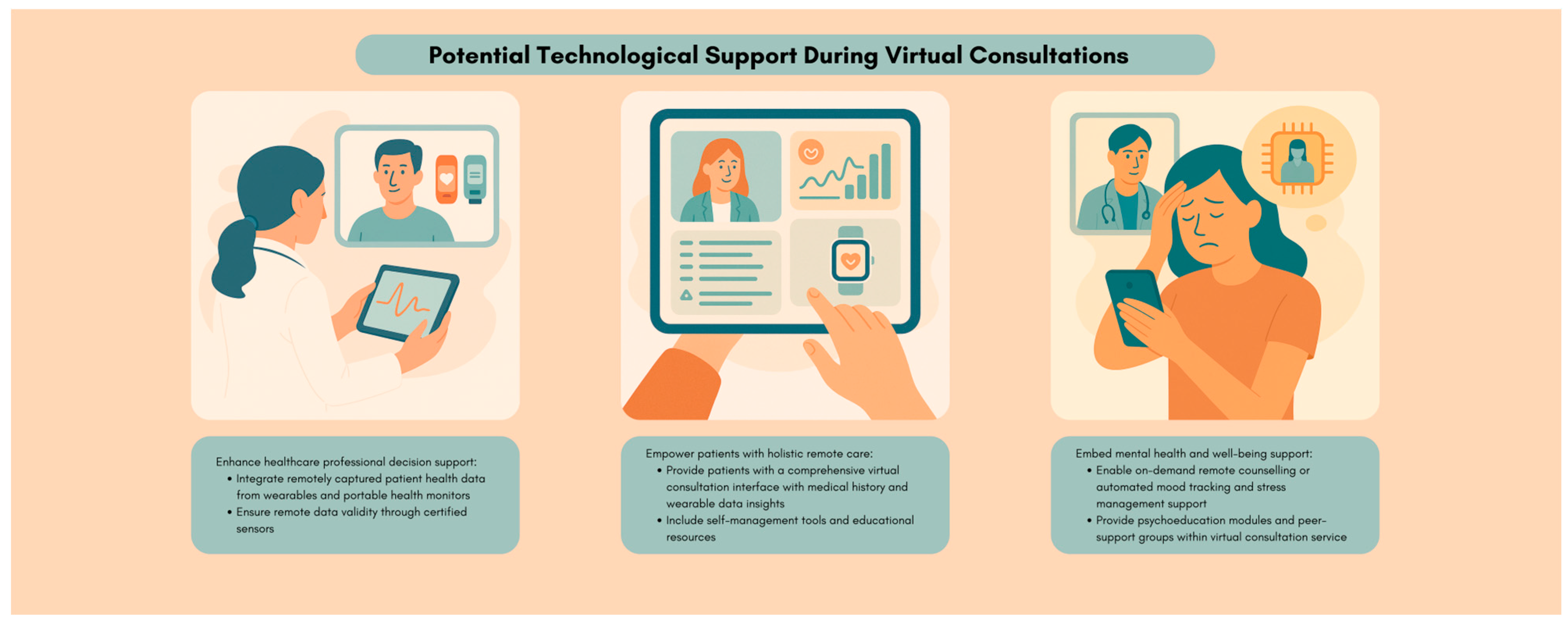
| Potential AI Assistance Feature | Description of AI Feature | Target User | Supporting Theme and Quotes |
|---|---|---|---|
| Medical assessment suggestions | Based on individual consultations, real-time prompts suggest assessments/queries to improve comprehensiveness of consultations. | HCPs | Quality of virtual interactions and assessments is not satisfactory. “face to face definitely gets a more accurate, from a clinical assessment, you get a better, a better picture of what’s going on.” “And I suppose the other thing with the the kind of frustrations of the virtual is when you don’t see them walking on the door, like you can tell an awful lot about a patient even watching them as they walk from the chair and to your consultation room.” |
| Conversational prompts | HCPs unfamiliar with a patient receive personalised conversational prompts based on an individual patient profile to improve virtual interaction quality and build rapport/empathy. | HCPs | Optional, hybrid models with familiar, empathetic HCPs. “Uh, the ideal experience then is, uh, speaking with someone who I have met before and who I’m familiar with and who… Who I know cares about me and my care, has empathy.” “That they would show concern and that they would ask me, you know, relevant questions that will draw me out and, you know, highlight my problems and my conditions as well and what they can do to help.” “You can establish more of a relationship when you see somebody, uh, in person.” “As clinicians, we are people to, you know, person to person.” |
| Condition-specific resources and recommendations | Based on the context of a virtual consultation and individual medical history, personalised condition updates (medication/side effects, research), lifestyle advice, and educational materials are provided to patients. | Patients | Potential AI roles in virtual consultations. “I would be definitely interested in in what would be happening, uh, regarding research and medications and devices that you could wear” “sometimes when you’re put on a new drug, maybe if an AI education on that drug rather than the, you know, the doctor giving you the lowdown on it, or whatever it might be, you know, good to be able to ask questions and relate like that from, you know, just just find out the background of the drugs and the, you know, what they hope to achieve, and the side, well and the side effects too.” “Uh, I say, advice on on lifestyle, lifestyle balance and prompts for, you know, maybe, you know, exercise, go for you know and I would just say” |
| Mental wellbeing support | Mental wellbeing and emotional support and resources are shared with patients after each consultation based on individual psychological needs. | Patients | Potential AI roles in virtual consultations. “Some sort of software that if you were having a flare up in the middle of the night that would help you calm down.” “Why not, why not take part in something that’s, you know, going to give you a bit of maybe peace of mind. As for want of a better word.” |
| Additional health status insights | Analysis from wearables and past medical records can provide HCPs with more insights and patients can better understand their status for self-management. | HCPs and patients | Technological ease and optimisation for holistic virtual care. “to me all them kind of gadgets, to me, should be linked to the virtual” “And maybe if you could monitor it then that that would be helpful to the person that was seeing you virtually. If you notice something yourself, you could just say say it to them maybe.” “I suppose my ideal, like if you’re doing something virtually, is that you know you have a good background. […] So you’re not going in kind of blind.” |
| Automated consultation summaries | Based on transcripts, summaries of consultations are provided, highlighting key discussions and clarifying terms. | HCPs and patients | Potential AI roles in virtual consultations. “some sort of dictation, you know, where our consultation could be, maybe all presented back to us so that we could sign off on it.” “if they were mentioning like a condition to you that you didn’t know or haven’t heard about before, that it would be, uh, helpful that it would be able to generate information on that condition for you instantaneously, I suppose.” “sometimes there’s words used that, and sometimes if you’re having a flare up, you can’t remember half the things that’s told to you.” “And sometimes too, if you go into, see a consultant, or that you, you might come out and not remember rightly what was said. Whereas, if you had a virtual meeting, I don’t know if you could play back a virtual meeting” |
Disclaimer/Publisher’s Note: The statements, opinions and data contained in all publications are solely those of the individual author(s) and contributor(s) and not of MDPI and/or the editor(s). MDPI and/or the editor(s) disclaim responsibility for any injury to people or property resulting from any ideas, methods, instructions or products referred to in the content. |
© 2026 by the authors. Licensee MDPI, Basel, Switzerland. This article is an open access article distributed under the terms and conditions of the Creative Commons Attribution (CC BY) license.
Share and Cite
Dhunnoo, P.; McGuigan, K.; O’Rourke, V.; Meskó, B.; McCann, M. User Perceptions of Virtual Consultations and Artificial Intelligence Assistance: A Mixed Methods Study. Future Internet 2026, 18, 84. https://doi.org/10.3390/fi18020084
Dhunnoo P, McGuigan K, O’Rourke V, Meskó B, McCann M. User Perceptions of Virtual Consultations and Artificial Intelligence Assistance: A Mixed Methods Study. Future Internet. 2026; 18(2):84. https://doi.org/10.3390/fi18020084
Chicago/Turabian StyleDhunnoo, Pranavsingh, Karen McGuigan, Vicky O’Rourke, Bertalan Meskó, and Michael McCann. 2026. "User Perceptions of Virtual Consultations and Artificial Intelligence Assistance: A Mixed Methods Study" Future Internet 18, no. 2: 84. https://doi.org/10.3390/fi18020084
APA StyleDhunnoo, P., McGuigan, K., O’Rourke, V., Meskó, B., & McCann, M. (2026). User Perceptions of Virtual Consultations and Artificial Intelligence Assistance: A Mixed Methods Study. Future Internet, 18(2), 84. https://doi.org/10.3390/fi18020084