
A Secure and Efficient Sharing Framework for Student Electronic Academic Records: Integrating Zero-Knowledge Proof and Proxy Re-Encryption


Abstract
1. Introduction
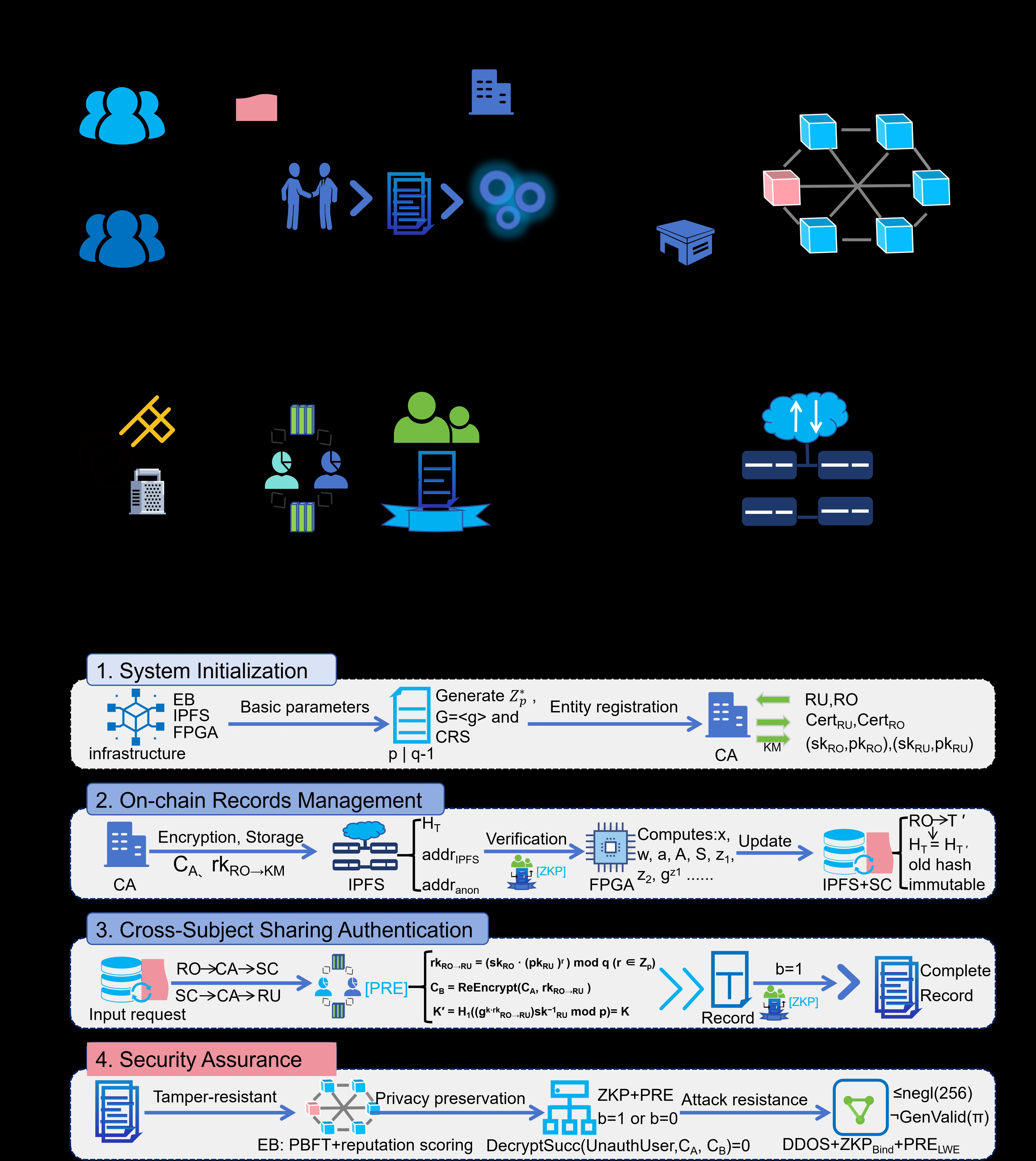
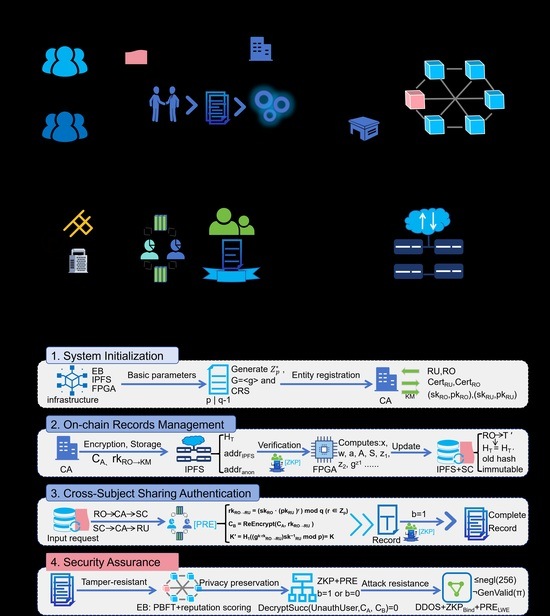
- Enhance the security of archive sharing: In the data storage phase, the IPFS is used to store record data, preventing illegal theft or tampering. In the data-sharing phase, PRE technology ensures that only legally authorized users can obtain decrypted data, and that the data remains encrypted during transmission, avoiding the risk of data interception during transmission. In the identity verification phase, ZKP technology is used to enhance system security and prevent information leakage during the verification process. Targeting privacy risks in cross-institutional SEARs transmission, this security mechanism prevents unauthorized access to sensitive academic data such as transcripts and Grade Point Average (GPA).
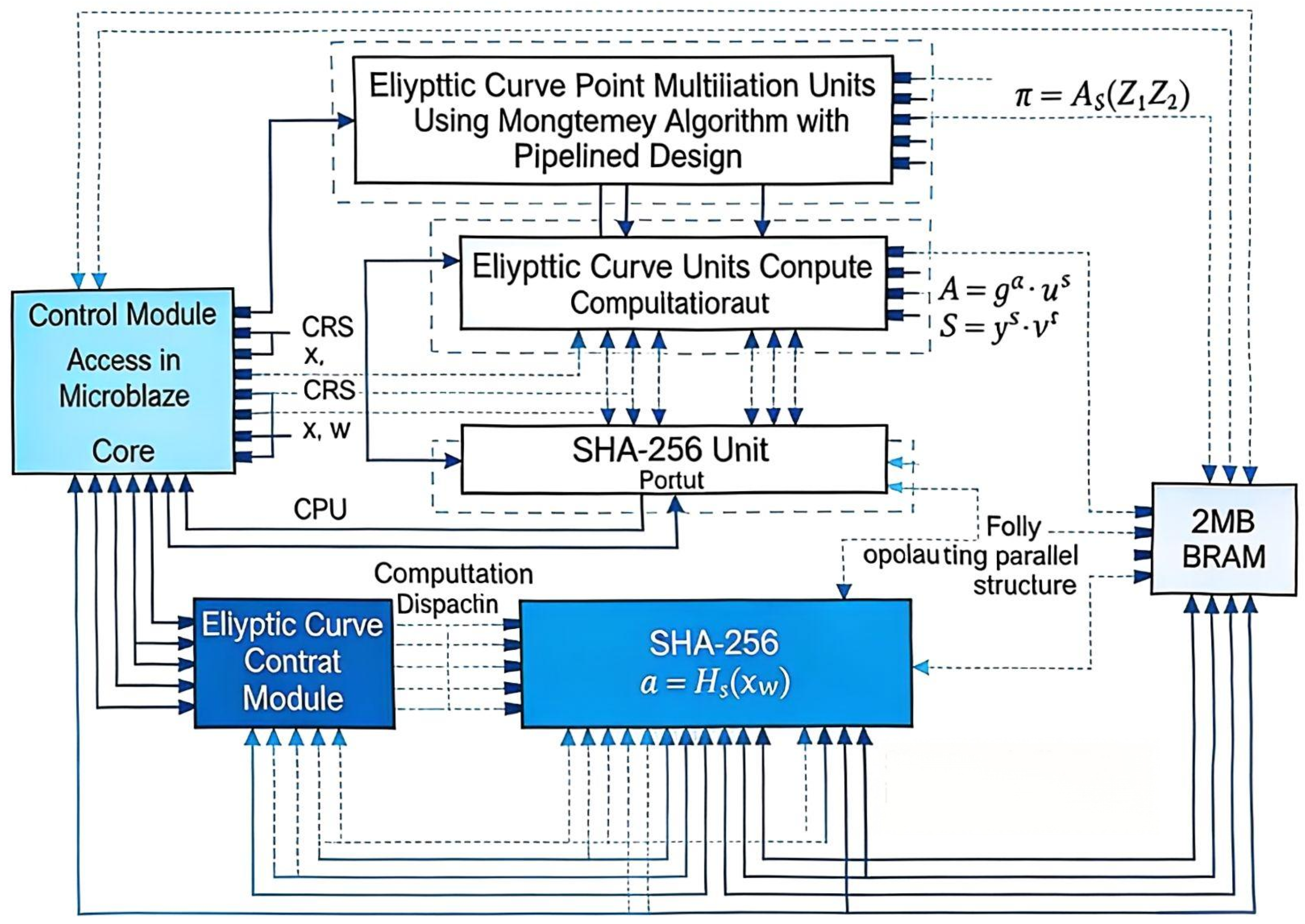
- Improve archive sharing efficiency: PRE technology is used to achieve direct conversion and sharing of Ciphertext, significantly reducing sharing time. At the same time, by improving gate circuit merging, constant folding technology, FPGA hardware acceleration, and adopting a more efficient Bulletproofs algorithm model, the generation time of ZKP is greatly reduced. Adapted to employers’ batch verification needs for SEARs, the optimized ZKP supports over 10,000 daily verifications, meeting the high-frequency demand in talent recruitment scenarios.
- It facilitates long-term archive storage: The distributed storage attribute based on IPFS solves the problem of insufficient blockchain storage capacity, and the compliance verification logic of the “Provisional Regulations on the Administration of Electronic Registration of Academic Certificates” and the “Information Protection Law” is embedded into SC. Addressing the 50-year long-term storage requirement of SEARs, the IPFS-blockchain integration ensures data durability while complying with education-specific archiving regulations.
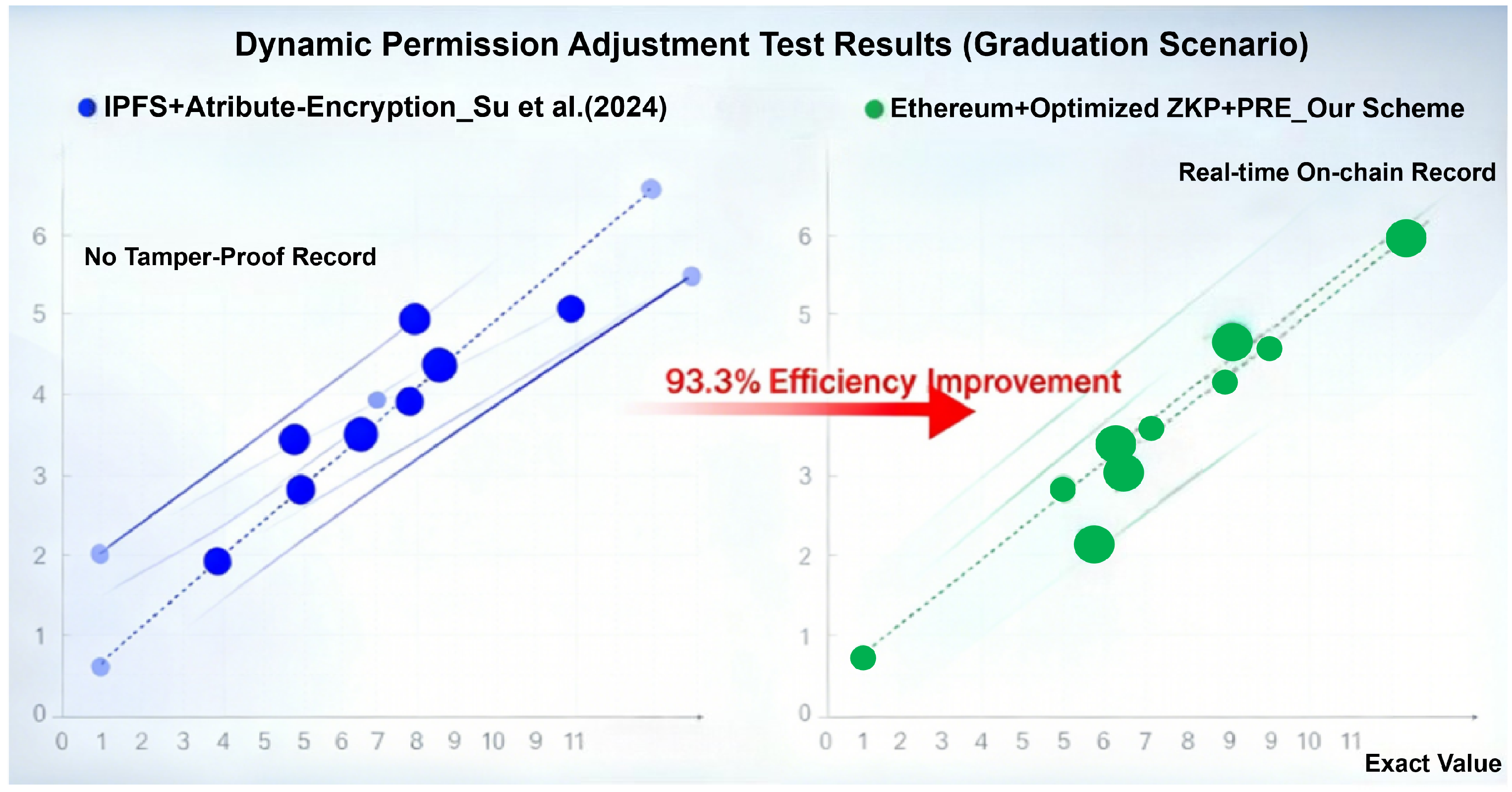
- It supports dynamic permissions adjustment: Through ZKP technology, the authenticity of archive information can be verified without disclosing the specific content of academic records. Meanwhile, PRE technology makes the authorization and sharing of academic records more secure and flexible. The entire process supports dynamic permissions adjustments, adapting to the privacy protection needs of archive records throughout their full lifecycle. Matching the dynamic permission changes of SEARs across lifecycles, this function adapts to the scenario-specific permission demands of students.
2. Related Work
2.1. Analysis of Authentication Mechanism
2.2. Privacy Protection Technology Analysis
2.3. Authentication, Privacy Protection, and Efficiency Analysis
3. Preliminary Work
3.1. System Mode
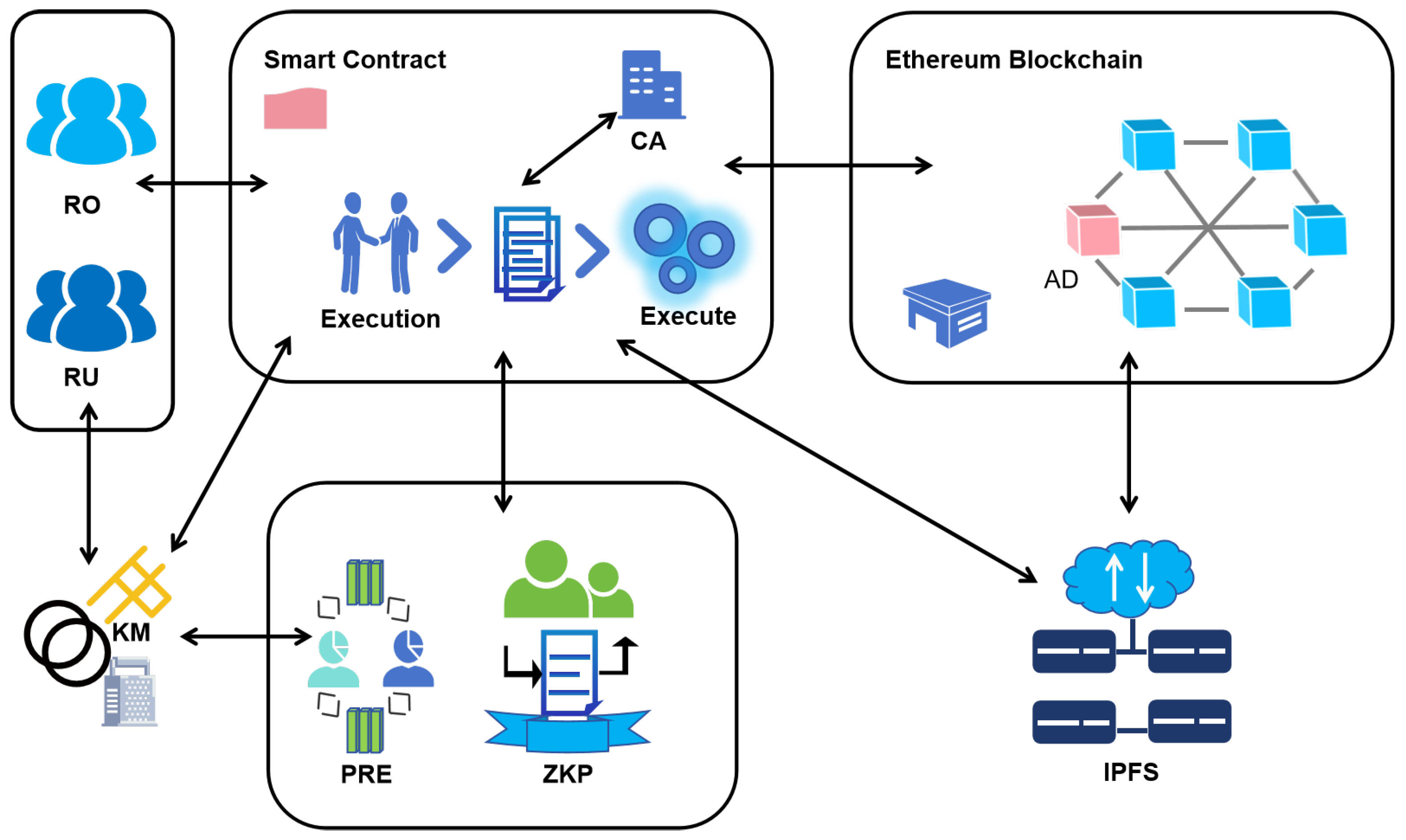
- EB: Responsible for providing a decentralization, secure, and tamper-proof platform for storing the hash values of academic records and access control information. It uses SC to automate Authentication, Permissions management, and data access control, thereby ensuring secure archive sharing and privacy protection of electronic records. The EB achieves decentralization through three types of nodes—supervisory nodes, storage nodes, and validation nodes.
- IPFS: IPFS is adopted for storing and distributing electronic academic records in a decentralized manner. Integrated with blockchain technology, it provides a solid data foundation for ZKP and PRE.
- SC: Automate critical functions such as access control rules, authentication, PRE management, data integrity verification, and transaction recording, while providing transparent and auditable operation records.
- Certification Authority (CA): Verifies user identities and issues digital certificates, ensuring the authenticity and legitimacy of user identities within the system. As part of the public key infrastructure (PKI), it manages keys and certificates, providing a trust basis and compliance guarantee for the secure sharing of academic records.
- Key Manager (KM): Responsible for generating, distributing, storing, updating, and revoking encryption keys, supporting the PRE process, and integrating with SC to automate key management.
- Record Owner (RO): Provides and manages the sharing of electronic academic records, including setting permissions, encrypting data, participating in ZKP verification processes, performing PRE, and monitoring and auditing record access.
- Record User (RU): Initiates access requests for electronic academic records, authenticates through ZKP to gain permissions, decrypts records using keys received from the key manager, and uses these records within a compliance framework while participating in the system’s feedback and auditing mechanisms.
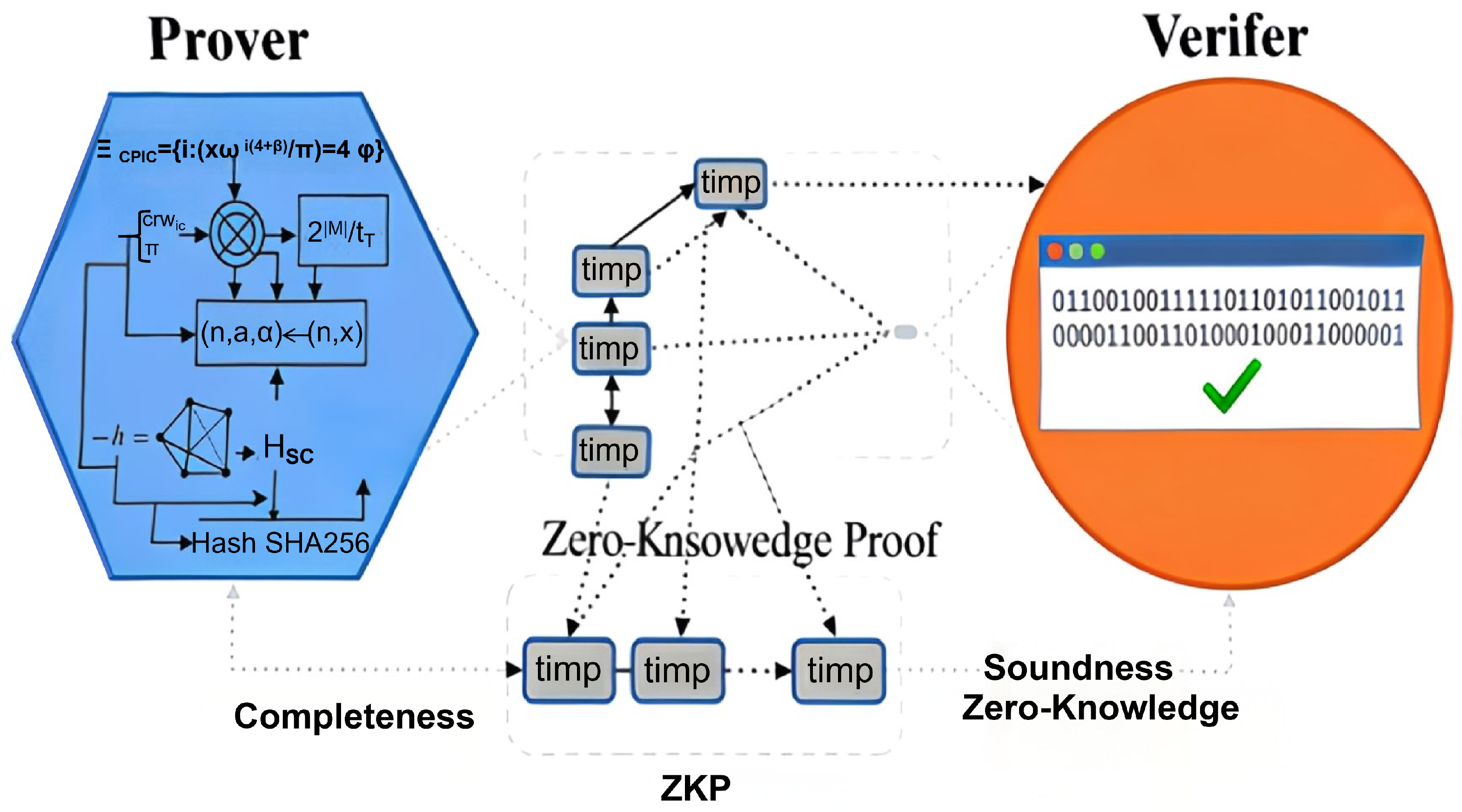
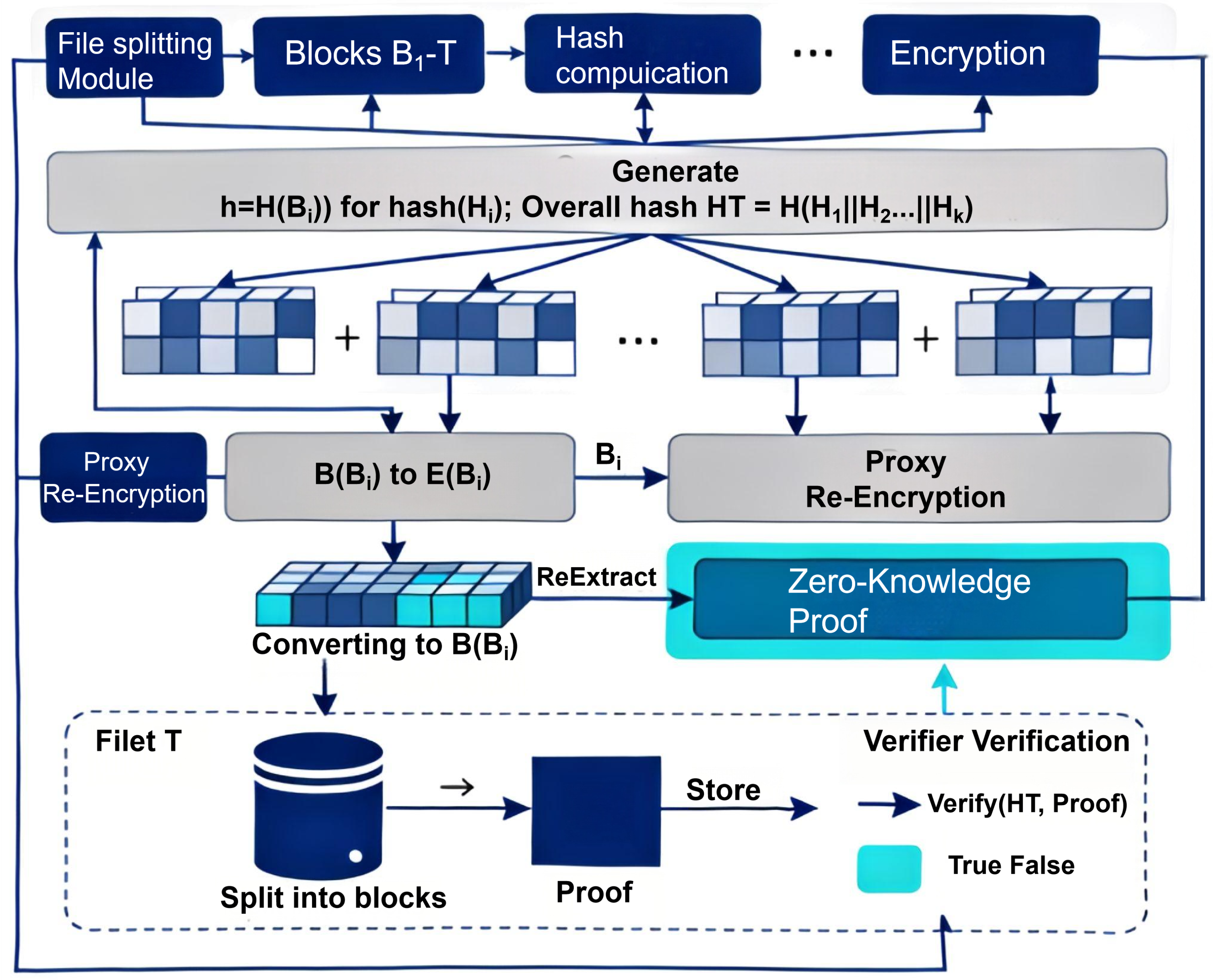
- ZKP: ZKP technology provides an efficient and privacy-preserving verification mechanism, allowing users to prove their identity or knowledge of data without revealing any sensitive information, thereby enhancing security and trust in the sharing process of electronic academic records.
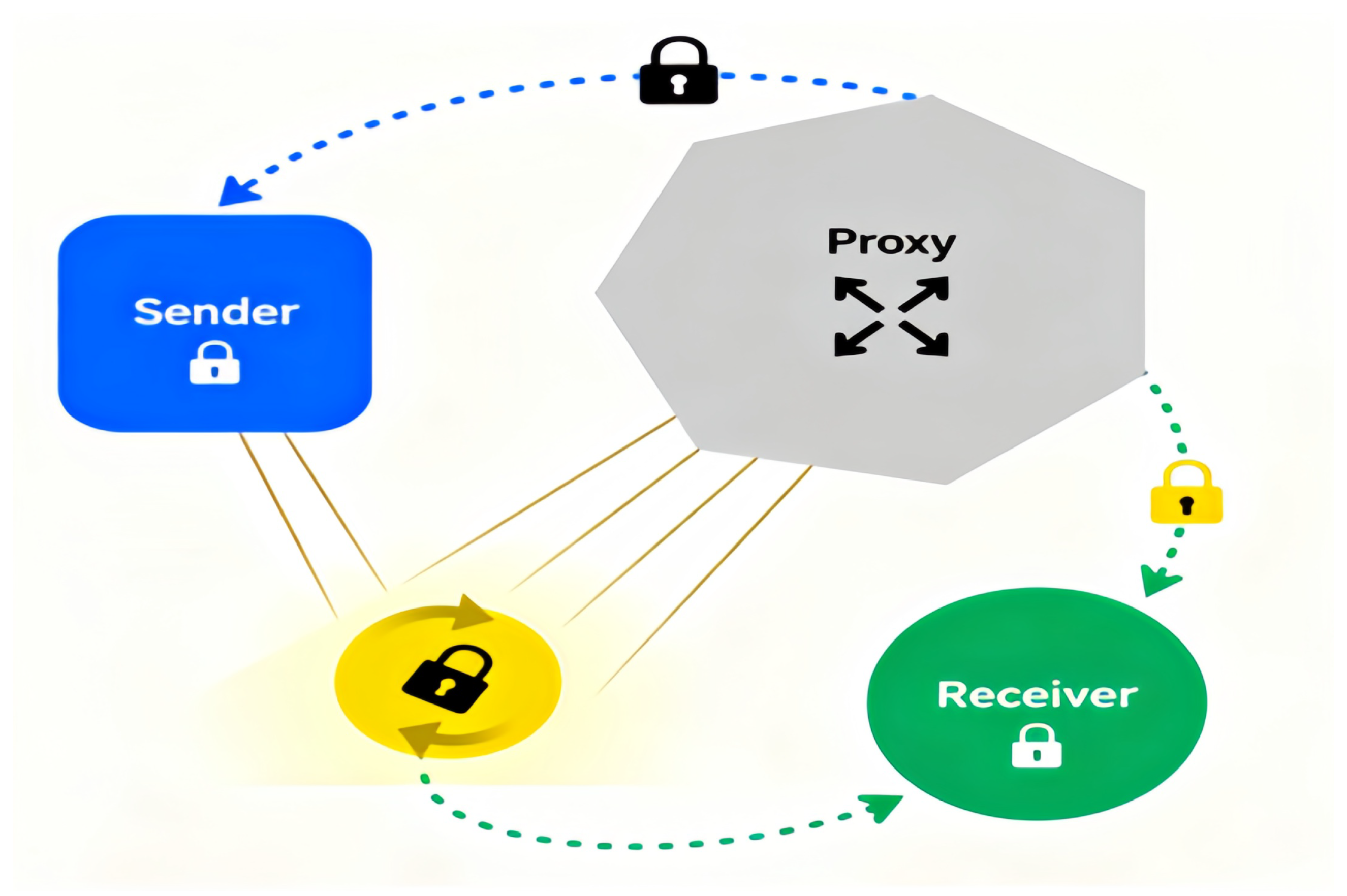
- PRE: PRE technology is responsible for implementing a secure and flexible data access mechanism. It allows data owners to re-encrypt encrypted academic records through a trusted proxy and grant authorization to designated users without directly sharing keys.
3.2. Design Goals
- Identity Anti-Forgery: Ensure a strong binding between user identity and academic records, preventing unauthorized entities from gaining access to others’ academic records by forging digital certificates and tampering with identity information.
- Conditional Anonymity: While ensuring that users’ core identity information is not disclosed, support authorized entities in tracing the source of archive operations in compliance scenarios.
- Data Privacy Protection: While completing the Authenticity verification of academic records, ensure that sensitive content in the records is not accessed by unauthorized entities. Through ZKP technology, users can complete the verification process without disclosing any sensitive information.
- Integrity: Ensure that the content of SEARs is not maliciously tampered with throughout the entire process from generation, storage, and sharing to long-term archiving, and that tampering behavior can be detected in real time.
- Unlinkability: Prevent attackers from associating multi-dimensional behavioral patterns of the same user by analyzing archive operation records in different scenarios, thereby protecting user privacy boundaries.
- Distributed storage: Utilize the distributed storage characteristics of the IPFS, combined with the secure access control mechanism of Ethereum SC, to solve the problem of insufficient blockchain storage capacity and achieve efficient and secure data storage.
3.3. Background Technology
3.3.1. Proxy Re-Encryption
3.3.2. Zero-Knowledge Proof
3.3.3. Hardware Acceleration with FPGA
3.3.4. InterPlanetary File System
3.3.5. Interaction Logic of Core Components
3.4. Threat Model
3.4.1. Security Assumptions and Attacker Types Summary
Security Assumptions
- The network follows the semi-honest model, allowing data monitoring but prohibiting tampering, forgery, or replay of transmitted data.
- The proportion of malicious nodes in the blockchain does not exceed 1/3, with honest nodes forming the majority.
- The CA and KM are trusted entities, with their private keys stored securely without leakage.
- Core credentials (e.g., private keys) of RO and RU are securely stored on their terminals.
- Core cryptographic primitives (AES-256, SHA-256, LWE, Bulletproofs) provide computational security.
3.4.2. Attack Scenarios, Defense Mechanisms, and Limitations
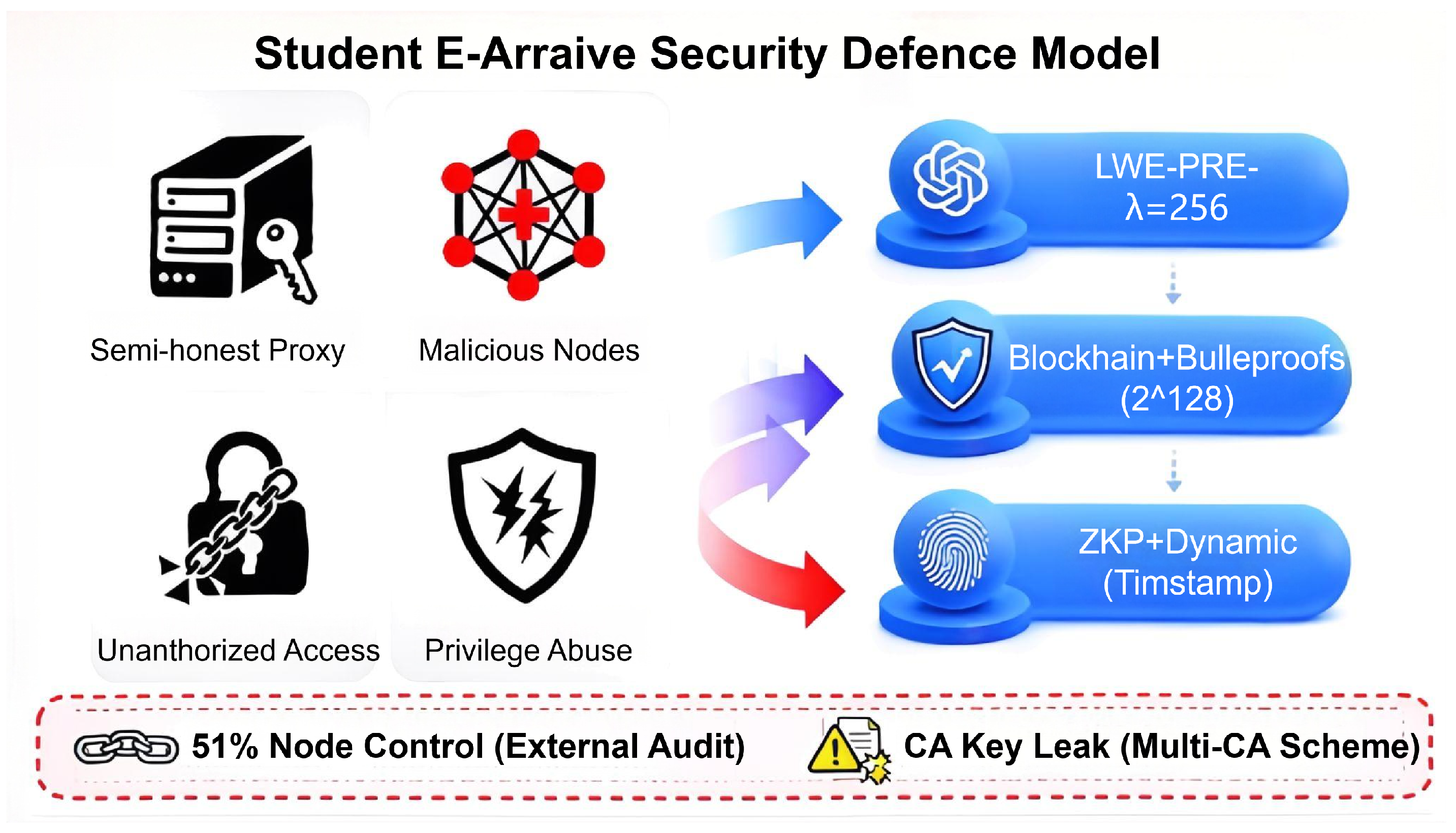
- Semi-Honest Proxy Attack: Although the proxy node complies with regulations and completes the ciphertext domain conversion based on the attribute-based PRE process, it passively records the re-encryption key and ciphertext pairs. Attackers attempt to derive plaintext records such as transcripts and student IDs through statistical correlation analysis or side-channel information, thereby compromising data confidentiality.
- Malicious Blockchain Node Attack: Compromised nodes deviate from the Practical Byzantine Fault Tolerance (PBFT) and reputation scoring hybrid consensus mechanism, tamper with on-chain record hash values, forge ZKPs to pass SC verification, or initiate distributed denial-of-service (DDoS) attacks to block tens of thousands of batch verification requests from employers every day, thereby compromising data integrity and system availability.
- External Unauthorized Attacks: Attackers without legitimate authorization intercept ciphertext transmission data through network eavesdropping or obtain user private keys through social engineering, attempting to decrypt unauthorized records or forge identities to bypass the compliance verification of the “Provisional Regulations on the Electronic Registration Management of Student Status in Universities”, threatening data privacy and access legitimacy.
- Permissions Abuse Attacks: Low-permissions personnel such as university student status administrators exploit permission vulnerabilities to tamper with access control policies or delete on-chain permission change records to evade regulatory audits.
- Controlling attacks exceeding 51% of high-reputation nodes: Under the hybrid consensus mechanism, the node voting weight consists of 30% static equity and 70% dynamic reputation. If an attacker simultaneously controls over 51% of the equity and 80% of the high-reputation nodes, it may disrupt global data consistency.
- Complete leakage of the certificate authority (CA) private key: As the root of trust for identity authentication, the leakage of the CA private key will allow attackers to forge legitimate digital certificates in batches and then generate fraudulent academic identities. This issue needs to be resolved through a multi-CA threshold signature architecture, which is beyond the scope of this solution.
4. System Design
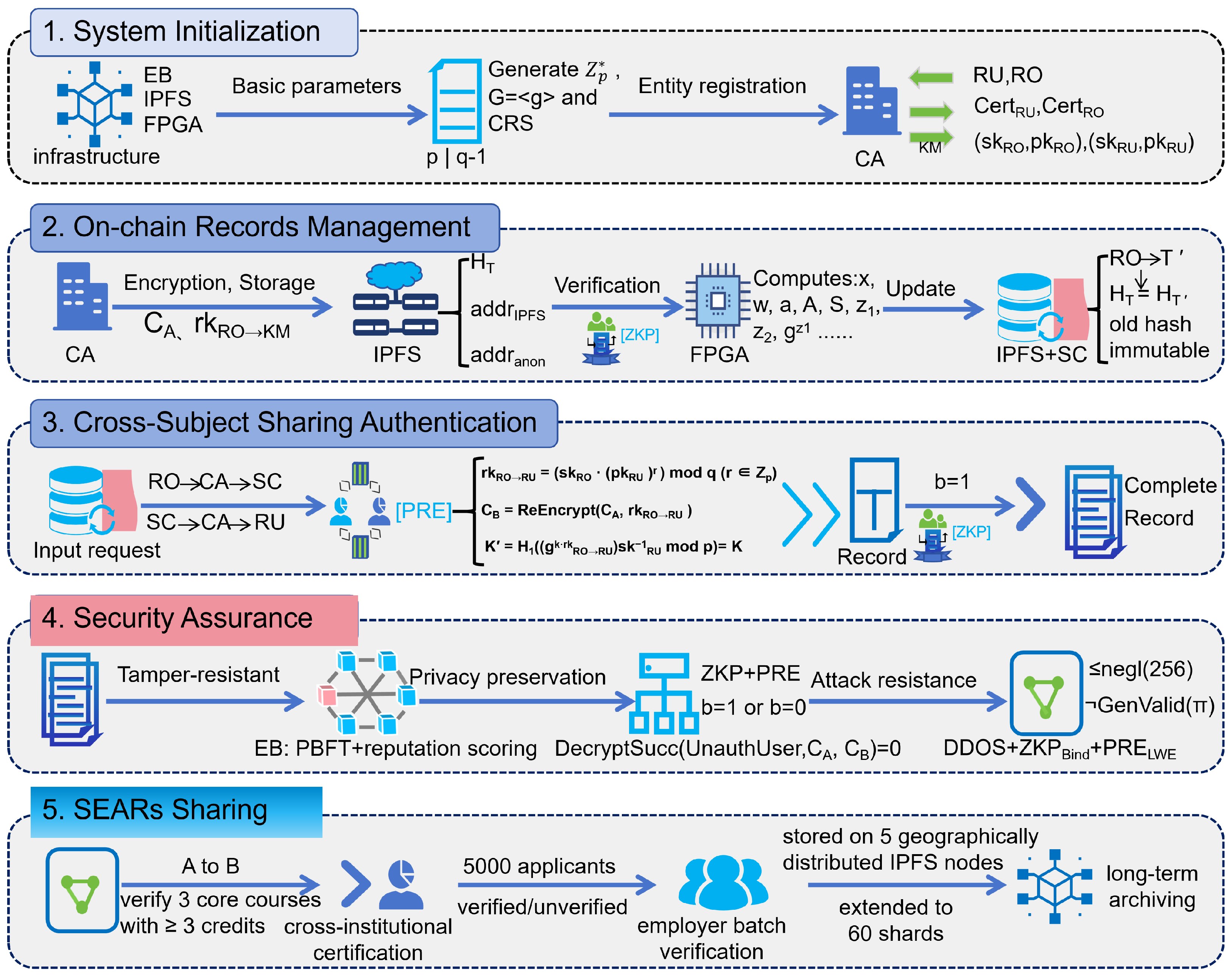
4.1. System Initialization
4.1.1. General Configuration
4.1.2. Principal Registration
4.1.3. Key Lifecycle Management
4.2. On-Chain Records Management
4.2.1. File Encryption and Storage
4.2.2. File Verification and Update
4.3. Cross-Subject Sharing Authentication
4.3.1. Cross-Subject Retrieval
4.3.2. Authorization and Decryption Process
4.4. Dynamic Permission Adjustment and Security Assurance
4.4.1. Dynamic Permission Update
4.4.2. Core Security Mechanisms
4.5. SEARs Sharing Implementation for Key Scenarios
4.5.1. Implementation for Cross-Institutional Academic Certification
4.5.2. Implementation for Employer Batch Degree Verification
4.5.3. Implementation for Long-Term Archiving and Regulatory Auditing
5. Security Analysis
5.1. Threat Defense Mechanism Analysis
5.2. Security of Technical Components
5.2.1. Security Analysis of ZKP
5.2.2. Security Analysis of PRE
5.2.3. Security of Integrated Architecture
- Tamper Resistance: The EB stores the hash of academic records and CRS, and any tampering with the on-chain data will be detected by the consensus mechanism. IPFS stores the complete academic record ciphertext, and its content-addressable feature ensures that tampered ciphertexts have different hashes, which will not match the on-chain hash. ZKP verifies the integrity of academic records during verification, preventing the use of tampered plaintext records to generate valid proofs.
- Privacy Protection: ZKP ensures that the verifier only obtains the verification result without accessing the plaintext record. PRE ensures that only authorized data users can obtain the symmetric key to decrypt the record. The anonymous identity in x protects the real identity of and .
- Compliance with Regulations: The scheme complies with the “Personal Information Protection Law” by minimizing the collection and disclosure of personal information. The use of threshold key management and SC access control meets the requirements of the “Network Security Law” for data security and access control. The audit trail provided by the blockchain meets the audit requirements of educational administrative departments.
5.3. Privacy Protection Capability
5.4. Experimental Verification and Quantitative Analysis
6. Performance Evaluation
6.1. Ethereum Platform
6.2. Performance Analysis of Optimized ZKP and PRE
6.2.1. Communication Overhead Analysis
6.2.2. Storage Cost Analysis
6.3. Academic Record Scenario Adaptability Test
6.4. End-to-End Performance Evaluation
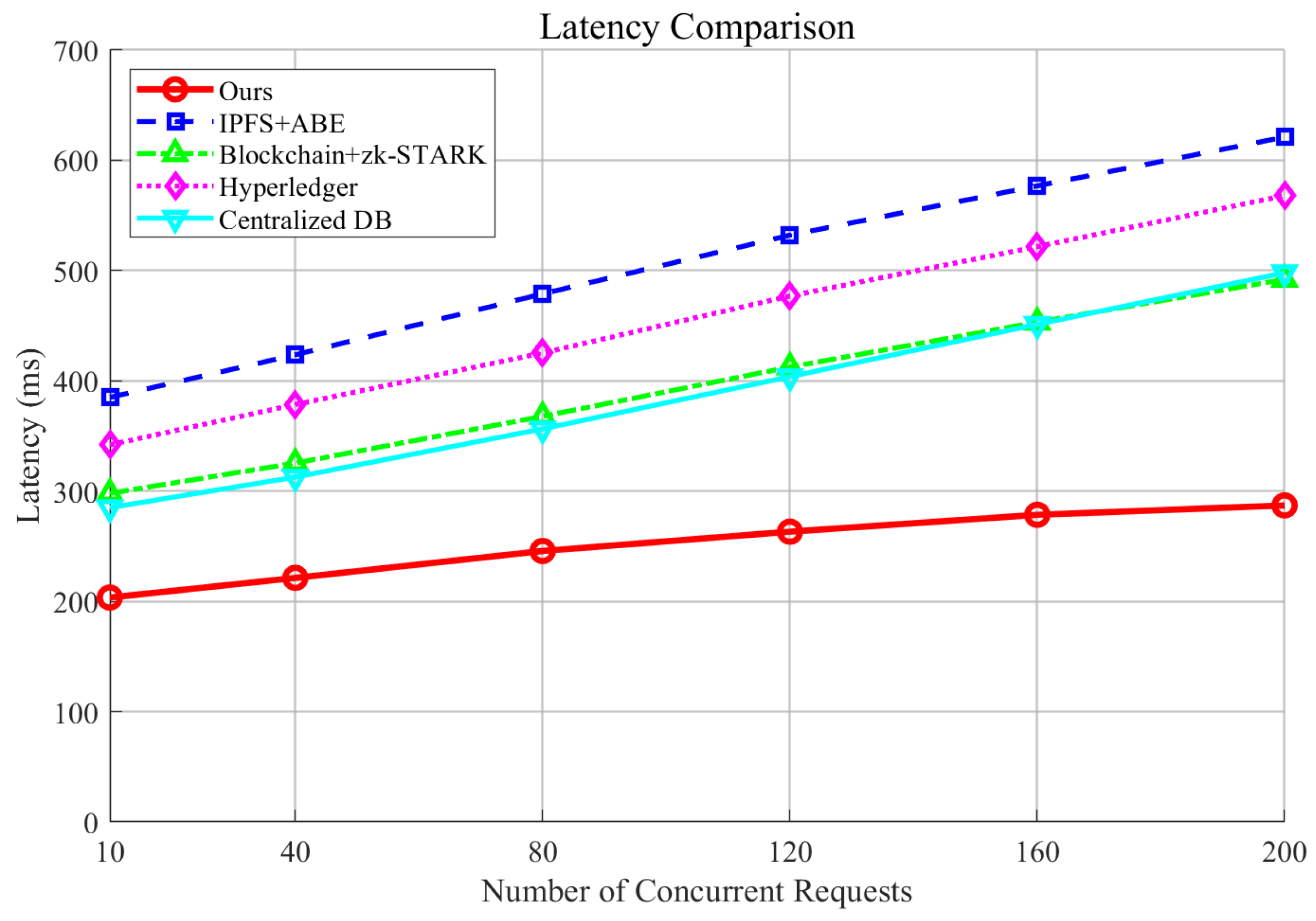
6.4.1. Latency Analysis
- The IPFS+ABE scheme [18] exhibits 385 ms latency at 10 requests (47.2% higher than the proposed scheme) and 621 ms at 200 requests (61.4% growth);
- The Blockchain+zk-STARK scheme [16] shows 298 ms (31.6% higher) and 492 ms (52.1% growth);
- The centralized DB+RBAC scheme(GB/T 39784) has 285 ms (31.7% higher) and 498 ms (52.7% growth).
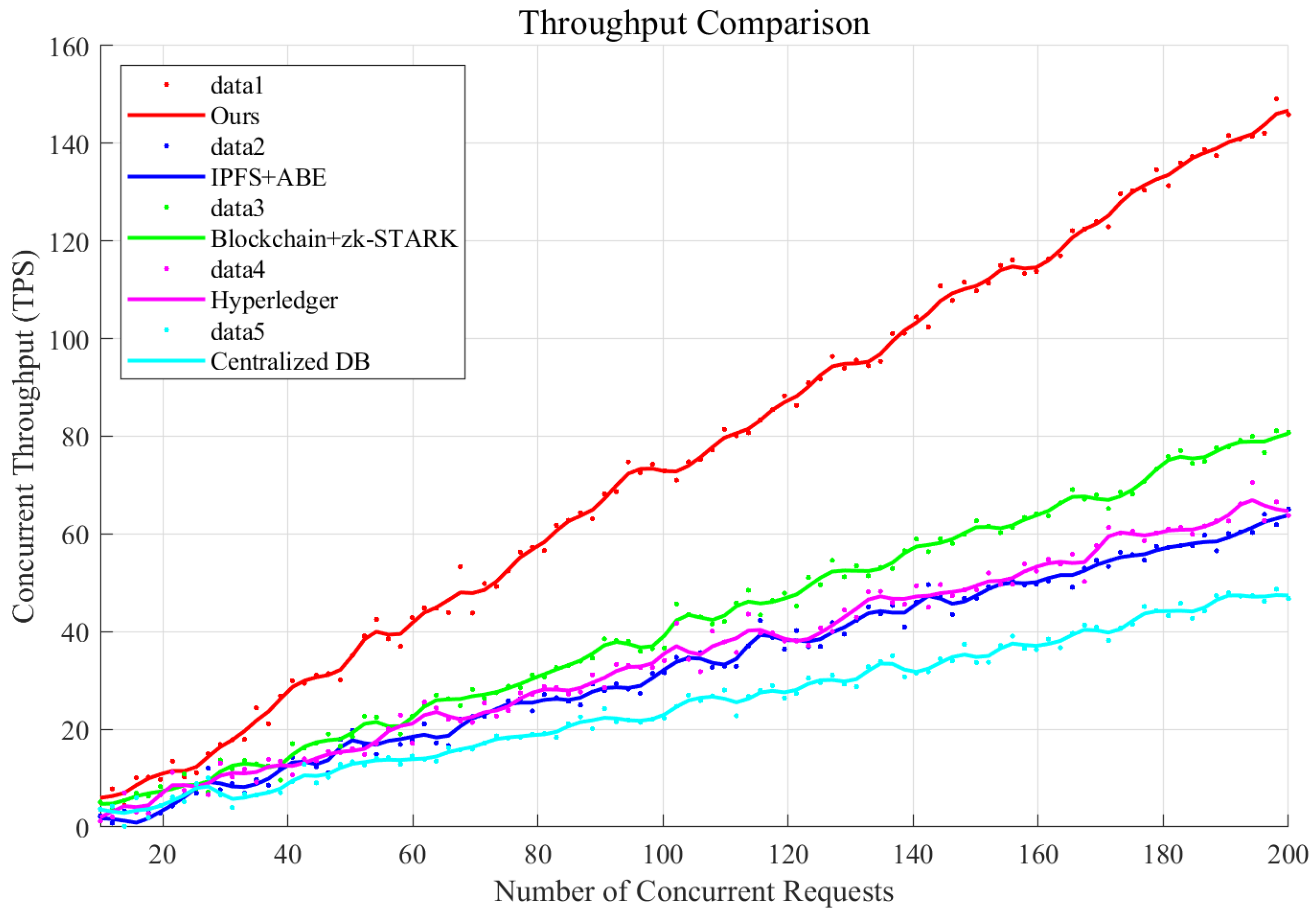
6.4.2. Throughput Analysis
- 2.3× higher than the IPFS+ABE scheme;
- 1.8× higher than the Blockchain+zk-STARK scheme;
- 3.1× higher than the centralized DB+RBAC scheme.
- Parallel processing of ZKP proof generation (FPGA multi-core architecture) and PRE re-encryption;
- IPFS distributed storage reduces data retrieval latency, supporting efficient batch data access.
7. Conclusions
Supplementary Materials
Author Contributions
Funding
Institutional Review Board Statement
Informed Consent Statement
Data Availability Statement
Conflicts of Interest
References
- Guo, J.; Zhao, K.; Liang, Z.; Min, K. Efficient and Secure EMR Storage and Sharing Scheme Based on Hyperledger Fabric and IPFS. Appl. Sci. 2024, 14, 5005. [Google Scholar] [CrossRef]
- Daraghmi, E.-Y.; Daraghmi, Y.-A.; Yuan, S.-M. UniChain: A Design of Blockchain-Based System for Electronic Academic Records Access and Permissions Management. Appl. Sci. 2019, 9, 4966. [Google Scholar] [CrossRef]
- Becke, M.; Padberg, J. Der Weg zur digitalen Arbeitsmappe: Digitales Prüfungswesen mit Zertifizierung. arXiv 2024, arXiv:2408.09184. [Google Scholar] [CrossRef]
- Bawane, D.H.; Sudke, Y.S.; Pore, Y.N. Educational Record Authentication Using Decentralized Consortium Blockchain Technology. Int. J. Res. Appl. Sci. Eng. Technol. 2023, 11, 52379. [Google Scholar] [CrossRef]
- Dhinakaran, D.; Selvaraj, D.; Dharini, N.; Raja, S.E.; Priya, C.S.L. Towards a Novel Privacy-Preserving Distributed Multiparty Data Outsourcing Scheme for Cloud Computing with Quantum Key Distribution. arXiv 2024, arXiv:2407.18923. [Google Scholar]
- Zhang, R.; Xue, R.; Liu, L. Security and Privacy on Blockchain. ACM Comput. Surv. 2019, 52, 51. [Google Scholar] [CrossRef]
- Ma, W.; Wei, X.; Wang, L. A Security-Oriented Data-Sharing Scheme Based on Blockchain. Appl. Sci. 2024, 14, 6940. [Google Scholar] [CrossRef]
- Qi, F.; He, D.B.; Zeadally, S.; Khan, M.K.; Kumar, N. A survey on privacy protection in blockchain system. J. Netw. Comput. Appl. 2019, 126, 45–58. [Google Scholar] [CrossRef]
- Gabbay, M.J. Decentralised collaborative action: Cryptoeconomics in space. arXiv 2025, arXiv:2504.12493. [Google Scholar] [CrossRef]
- Zhang, J.Y.; Guo, R.X.; Shi, Y.F.; Tang, W.T. An anti-impersonation attack electronic health record sharing scheme based on proxy re-encryption and blockchain. Math. Biosci. Eng. 2024, 21, 6167–6189. [Google Scholar] [CrossRef]
- Fang, Y.; Bi, W.B.; Cao, N.; Luo, J.; An, D.T.; Ding, L.Q.; Higgs, R. Research on Multi-Blockchain Electronic Archives Sharing Model. Comput. Mater. Contin. 2023, 76, 3921–3931. [Google Scholar] [CrossRef]
- Su, H.Q.; Li, J.W.; Guo, L.; Wang, W.S.; Yang, Y.J.; Wen, Y.; Li, K.; Mo, P.Y. Massive Data HBase Storage Method for Electronic Archive Management. Int. J. Netw. Manag. 2024, 35, e2308. [Google Scholar] [CrossRef]
- Li, J.W.; Su, H.Q.; Guo, L.; Wang, W.S.; Yang, Y.J.; Wen, Y.; Li, K.; Mo, P.Y. Security Protection Method for Electronic Archives Based on Homomorphic Aggregation Signature Scheme in Mobile Network. Int. J. Netw. Manag. 2024, 35, e2316. [Google Scholar] [CrossRef]
- Liu, X.; Chen, W.T.; Peng, L.; Luo, D.; Jia, L.K.; Xu, G.; Chen, X.B.; Liu, X.M. Secure computation protocol of Chebyshev distance under the malicious model. Sci. Rep. 2024, 14, 17115. [Google Scholar] [CrossRef]
- Al-Khasawneh, M.A.; Faheem, M.; Alarood, A.A.; Habibullah, S.; Alzahrani, A. A secure blockchain framework for healthcare records management systems. Healthc. Technol. Lett. 2024, 11, 461–470. [Google Scholar] [CrossRef]
- Alahmari, S.; Alshardan, A.; Al-Wesabi, F.N.; Sorour, S.; Alghushairy, O.; Alsini, R.; Khadidos, A.O.; Al Duhayyim, M. A decentralized and privacy-preserving framework for electronic health records using blockchain. Alex. Eng. J. 2025, 126, 196–203. [Google Scholar] [CrossRef]
- Guo, C.J.; You, L.; Li, X.Y.; Hu, G.G.; Wang, S.G.; Cao, C.T. A novel biometric authentication scheme with privacy protection based on SVM and ZKP. Comput. Secur. 2024, 144, 103995. [Google Scholar] [CrossRef]
- Sun, J.; Yao, X.M.; Wang, S.P.; Wu, Y. Blockchain-Based Secure Storage and Access Scheme for Electronic Medical Records in IPFS. IEEE Access 2020, 8, 59389–59401. [Google Scholar] [CrossRef]
- Wang, B.; Tian, Z.; Liu, X.R.; Xia, Y.J.; She, W.; Liu, W. A multi-center federated learning mechanism based on consortium blockchain for data secure sharing. Knowl.-Based Syst. 2025, 310, 112962. [Google Scholar] [CrossRef]
- Wang, Y.; Ismail, E.S. A Review on the Advances, Applications, and Future Prospects of Post-Quantum Cryptography in Blockchain and IoT. IEEE Access 2025, 13, 112962–112977. [Google Scholar] [CrossRef]
- Kan, J.; Zhang, J.; Liu, D.; Huang, X. Proxy Re-Encryption Scheme for Decentralized Storage Networks. Appl. Sci. 2022, 12, 4260. [Google Scholar] [CrossRef]
- Sun, X.Q.; Yu, F.R.; Zhang, P.; Sun, Z.W.; Xie, W.X.; Peng, X. A Survey on Zero-Knowledge Proof in Blockchain. IEEE Netw. 2021, 35, 198–205. [Google Scholar] [CrossRef]
- Bünz, B.; Bootle, J.; Boneh, D.; Poelstra, A.; Wuille, P.; Maxwell, G. Bulletproofs: Short Proofs for Confidential Transactions and More. IEEE Symp. Secur. Priv. 2018. Available online: https://eprint.iacr.org/2017/1066.pdf (accessed on 15 November 2025).
- Weng, K.K.; Yang, K.; Katz, J.; Wang, X. Wolverine: Fast, Scalable, and Communication-Efficient Zero-Knowledge Proofs for Boolean and Arithmetic Circuits. IEEE Symp. Secur. Priv. 2021. Available online: http://eprint.iacr.org/2020/1169.pdf (accessed on 15 November 2025).
- Groth, J. On the Size of Pairing-Based Non-Interactive Arguments. ASIACRYPT 2016. Available online: https://eprint.iacr.org/2016/260.pdf (accessed on 16 November 2025).
- Ben-Sasson, E.; Bentov, I.; Horesh, Y.; Riabzev, M. Scalable, Transparent, and Post-Quantum Secure Computational Integrity. CRYPTO 2018. Available online: https://eprint.iacr.org/2018/046.pdf (accessed on 16 November 2025).
- Regev, O. On Lattices, Learning with Errors, Random Linear Codes, and Cryptography. In Proceedings of the Thirty-Seventh Annual ACM Symposium on Theory of Computing (STOC ’05), Baltimore, MD, USA, 22–24 May 2005; Association for Computing Machinery: New York, NY, USA, 2005; pp. 84–93. [Google Scholar] [CrossRef]
- Benet, J. IPFS—Content Addressed, Versioned, P2P File System. arXiv 2014, arXiv:1407.3561. [Google Scholar]
- Goldwasser, S.; Micali, S.; Rackoff, C. The Knowledge Complexity of Interactive Proof Systems. SIAM J. Comput. 1989, 18, 186–208. [Google Scholar] [CrossRef]
- Damascevicius, R.; Bacanin, N.; Nayyar, A. Blockchain technology for a trustworthy social cblackit system: Implementation and enforcement perspectives. Clust. Comput. 2025, 28, 162. [Google Scholar] [CrossRef]
- Guo, C.; Peng, W.J.; Wu, J.; Fang, Y.X.; Ye, K.K.; Xin, Y.S. A blockchain-based proxy re-encryption scheme with conditional privacy protection and auditability. China Commun. 2024, 21, 267–277. [Google Scholar] [CrossRef]
- Wu, G.F.; Wang, H.P.; Lai, X.; Wang, M.M.; He, D.J.; Chan, S. A comprehensive survey of smart contract security: State of the art and research directions. J. Netw. Comput. Appl. 2024, 226, 103882. [Google Scholar] [CrossRef]
- Chen, C.; Li, Y.C.; Wu, Z.P.; Mai, C.Y.; Liu, Y.M.; Hu, Y.M.; Kang, J.W.; Zheng, Z.B. Privacy computing meets metaverse: Necessity, taxonomy and challenges. Ad Hoc Netw. 2024, 158, 103457. [Google Scholar] [CrossRef]
- FIPS PUB 180-4; Federal Information Processing Standards Publication; Secure Hash Standard (SHS). National Institute of Standards and Technology: Gaithersburg, MD, USA, 2015. Available online: https://nvlpubs.nist.gov/nistpubs/FIPS/NIST.FIPS.180-4.pdf (accessed on 18 November 2025).
- Yang, Y.K.; Lu, Z.Y.; Zeng, J.W.; Liu, X.G.; Qian, X.H.; Yu, Z.B. Falic: An FPGA-Based Multi-Scalar Multiplication Accelerator for Zero-Knowledge Proof. IEEE Trans. Comput. 2024, 73, 2791–2804. [Google Scholar] [CrossRef]
- Yang, J.C.; Li, L.; Gu, Y.W.; Wu, H.Q. Fast Authenticated and Interoperable Multimedia Healthcare Data over Hybrid-Storage Blockchains. arXiv 2025, arXiv:2510.13318. [Google Scholar] [CrossRef]
- GB/T 39784-2021; General Functional Requirements for Electronic Archive Management Systems. State Administration for Market Regulation: Beijing, China, 2021.
- Wang, S.; Luo, N.; Xing, B. Blockchain-based proxy re-encryption access control method for biological risk privacy protection of agricultural products. Sci. Rep. 2024, 14, 20048. [Google Scholar] [CrossRef] [PubMed]





| Attacker Type | Core Characteristics | Attack Target |
|---|---|---|
| Semi-Honest Proxy | Follows protocols, passively records re-encryption keys and ciphertext pairs | Derive plaintext, compromise confidentiality |
| Malicious Blockchain Node | Deviates from consensus, tampers data, forges proofs or launches DDoS attacks | Compromises data integrity and system availability |
| External Unauthorized Attacker | No legitimate permissions; obtains resources via eavesdropping or social engineering | Steals data; forges identity for access |
| Permissions Abuse Attacker | Legitimate low-privilege account; abuses vulnerabilities for unauthorized operations | Evade audits; expand access permissions |
| Notation | Description |
|---|---|
| ZKP | Zero-Knowledge Proof, a privacy-preserving verification technique |
| PRE | Proxy Re-Encryption, a secure authorized ciphertext transfer technique |
| IPFS | InterPlanetary File System, a distributed file storage |
| LWE | Learning With Errors, the security foundation of the PRE algorithm |
| AES-256 | Symmetric encryption algorithm, used to generate K and encrypt T |
| SHA-256 | Hash function, generates file hashes and verification tags |
| Common Reference String for ZKP | |
| Large primes, used to construct finite fields and prime subgroups | |
| Finite field modulo prime p | |
| G | q-order prime subgroup of |
| g | Generator of subgroup G |
| Security parameter, set to 256 bits | |
| Asymmetric key pair of entity X | |
| Digital certificate of entity X | |
| T | Plaintext file of student electronic academic records |
| Initial ciphertext of entity A/Re-encrypted ciphertext | |
| K | AES-256 symmetric encryption key |
| Globally unique hash value of record T | |
| Storage address of encrypted records in IPFS | |
| Anonymous Ethereum address | |
| RO/RU | Record Owner/Record User |
| CA/KM | Certification Authority/Key Manager |
| Verification condition initiated by the record user | |
| Public statement/Witness in ZKP | |
| Final proof of ZKP | |
| Intermediate operation parameters in ZKP | |
| c | Challenge value in ZKP |
| Proof verification parameters in ZKP |
| Category | Measure | Results |
|---|---|---|
| Threat Defense | 51% Attack Defense | 0/ |
| Parameter Centralization Risk | < | |
| Semi-Honest Proxy Attack | 42 ms | |
| Identity Forgery | 2/ | |
| Technical Security | ZKP | 90 ms, 20 ms |
| PRE | ||
| Blockchain + IPFS | 99.99% | |
| Privacy Protection | ZKP for Verification | 0 |
| Experimental Analysis | Simulation Attacks | 3/, 2/ |
| Attack Types | 51%, Semi-Honest, Forgery |
| Function | Gas Usage | Actual Cost (in Ether) |
|---|---|---|
| Contract Creation | 918,608 | 0.008267 |
| Add Issuer | 44,828 | 0.000403 |
| Remove Issuer | 14,925 | 0.000134 |
| Add Index (5 entries) | 345,630 | 0.002765 |
| Add Index (10 entries) | 691,260 | 0.00553 |
| Add Index (15 entries) | 1,036,890 | 0.008295 |
| Add Index (20 entries) | 1,382,520 | 0.01106 |
| Operation Type | Time (ms) | Traditional Time (ms) | Note |
|---|---|---|---|
| Proof Generation | 120.35 | 500.24 | Gate Merging and Constant Folding Optimization |
| Proof verification | 20.18 | 30.16 | Verify the Authenticity and Integrity of the Archive |
| FPGA Hardware Acceleration | 90.47 | 120.35 | Proof Generation Time Significantly reduced |
| Scheme | Communication Overhead (GB/h) | Advantage/ Disadvantage | Reference |
|---|---|---|---|
| Centralized DB+RBAC | 6.85 | Low complexity, high overhead | GB/T 39784 |
| IPFS+ABE | 7.05 | High privacy, high communication cost | [18] |
| Blockchain+zk-STARK | 5.43 | High security, large proof size | [16] |
| Proposed Scheme | 3.72 | Balanced efficiency and privacy | - |
| Scheme | Initial Deployment Cost (USD) | Annual Operation Cost (USD) | Cost per SEAR (USD) |
|---|---|---|---|
| IPFS+ABE | 12,900 | 130,000 | 1.30 |
| Blockchain+zk-STARK | 10,500 | 138,000 | 1.38 |
| Centralized DB+RBAC | 20,000 | 95,000 | 0.95 |
| Proposed Scheme | 8000 | 80,000 | 0.80 |
Disclaimer/Publisher’s Note: The statements, opinions and data contained in all publications are solely those of the individual author(s) and contributor(s) and not of MDPI and/or the editor(s). MDPI and/or the editor(s) disclaim responsibility for any injury to people or property resulting from any ideas, methods, instructions or products referred to in the content. |
© 2026 by the authors. Licensee MDPI, Basel, Switzerland. This article is an open access article distributed under the terms and conditions of the Creative Commons Attribution (CC BY) license.
Share and Cite
Li, X.; Tan, M.; Tian, W. A Secure and Efficient Sharing Framework for Student Electronic Academic Records: Integrating Zero-Knowledge Proof and Proxy Re-Encryption. Future Internet 2026, 18, 47. https://doi.org/10.3390/fi18010047
Li X, Tan M, Tian W. A Secure and Efficient Sharing Framework for Student Electronic Academic Records: Integrating Zero-Knowledge Proof and Proxy Re-Encryption. Future Internet. 2026; 18(1):47. https://doi.org/10.3390/fi18010047
Chicago/Turabian StyleLi, Xin, Minsheng Tan, and Wenlong Tian. 2026. "A Secure and Efficient Sharing Framework for Student Electronic Academic Records: Integrating Zero-Knowledge Proof and Proxy Re-Encryption" Future Internet 18, no. 1: 47. https://doi.org/10.3390/fi18010047
APA StyleLi, X., Tan, M., & Tian, W. (2026). A Secure and Efficient Sharing Framework for Student Electronic Academic Records: Integrating Zero-Knowledge Proof and Proxy Re-Encryption. Future Internet, 18(1), 47. https://doi.org/10.3390/fi18010047