
Article

A Two-Stage Multi-Objective Cooperative Optimization Strategy for Computation Offloading in Space–Air–Ground Integrated Networks

1
School of Computer, Qinghai Normal University, Xining 810008, China
2
The State Key Laboratory of Tibetan Intelligent Information Processing and Application, Qinghai Normal University, Xining 810008, China
*
Author to whom correspondence should be addressed.
Future Internet 2026, 18(1), 43; https://doi.org/10.3390/fi18010043
Submission received: 6 December 2025 / Revised: 31 December 2025 / Accepted: 6 January 2026 / Published: 9 January 2026

Abstract

With the advancement of 6G networks, terrestrial centralized network architectures are evolving toward integrated space–air–ground network frameworks, imposing higher requirements on the efficiency of computation offloading and multi-objective collaborative optimization. However, existing single-decision strategies in integrated space–air–ground networks find it difficult to achieve coordinated optimization of delay and load balancing under energy tolerance constraints during task offloading. To address this challenge, this paper integrates communication transmission and computation models to design a two-stage computation offloading model and formulates a multi-objective optimization problem under energy tolerance constraints, with the primary objectives of minimizing overall system delay and improving network load balance. To efficiently solve this constrained optimization problem, a two-stage computation offloading solution based on a Hierarchical Cooperative African Vulture Optimization Algorithm (HC-AVOA) is proposed. In the first stage, the task offloading ratio from ground devices to unmanned aerial vehicles (UAVs) is optimized; in the second stage, the task offloading ratio from UAVs to satellites is optimized. Through a hierarchical cooperative decision-making mechanism, dynamic and efficient task allocation is achieved. Simulation results show that the proposed method consistently maintains energy consumption within tolerance and outperforms PSO, WaOA, ABC, and ESOA, reduces the average delay and improves load imbalance, demonstrating its superiority in multi-objective optimization.

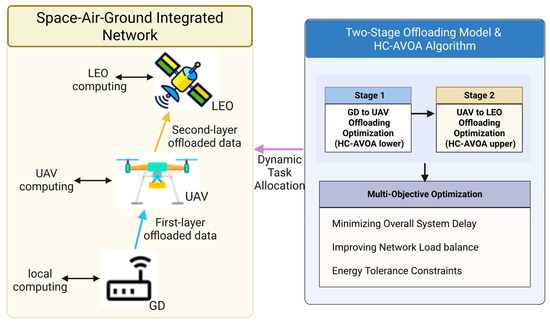
Graphical Abstract

1. Introduction

Against the backdrop of global connectivity becoming a fundamental societal demand, traditional terrestrial networks face significant challenges in coverage capability and deployment cost in remote areas, maritime regions, and aerial corridors [1,2]. The Space–Air–Ground Integrated Network (SAGIN) fully leverages the complementary strengths of space, aerial, and terrestrial segments to enable the efficient utilization of diverse resources [3], providing an effective solution for achieving seam-less coverage and high-quality services [4,5]. Remote areas, constrained by geographical and economic conditions, often have low deployment density of terrestrial cellular base stations or lack them entirely [6]. Moreover, the sparse distribution of user devices within the area makes it difficult for traditional terrestrial communication networks to meet basic connectivity requirements [7]. Therefore, it is necessary to construct a SAGIN to achieve seamless full-area coverage. From the perspective of supplementing communication infra-structure, unmanned aerial vehicles (UAVs) and low Earth orbit (LEO) satellites in SAGIN can effectively compensate for coverage gaps in terrestrial networks. UAVs can provide computational capabilities when ground networks are limited [8], while LEO satellites can provide continuous cloud computing services to the target area [9], providing reliable services to remote areas [10,11].
Existing studies have investigated computation offloading in space–air–ground integrated networks, with most focusing on a single-stage offloading model, where tasks are offloaded only once to either ground devices or UAVs. Such single offloading strategies often lead to increased delay or higher energy consumption under uneven task distribution or resource bottlenecks. By introducing a second-stage offloading decision, higher decision accuracy can be achieved, enabling more appropriate offloading choices and reducing delay within acceptable energy consumption limits. Dual-stage offloading jointly optimizes the first and second offloading decisions, resulting in more precise strategies that allow tasks to be assigned to more suitable offloading nodes within a three-layer heterogeneous network. In scenarios where UAVs act as intermediate offloading nodes, tasks may be excessively concentrated on a single UAV, resulting in single-point overload and resource waste. Therefore, load balancing optimization at the UAV layer becomes a key factor in enhancing overall system performance and robustness [12,13]. Therefore, determining how to efficiently allocate ground tasks among multiple UAVs and regulate the extent to which these UAVs offload tasks to satellites is one of the key focuses of this study.
In addition, regarding algorithm design, although meta-heuristic methods such as PSO, GA, and ABC have been widely applied to offloading decision-making, these approaches often encounter bottlenecks, such as susceptibility to local optima, slow convergence, and weak global search capability, when dealing with two-stage decision structures and multi-objective collaborative optimization problems. To overcome this limitation, this paper investigates a hierarchical cooperative African Vulture Optimization Algorithm based on a two-stage offloading model (Hierarchical Cooperative African Vulture Optimization Algorithm, HC-AVOA). The proposed algorithm exhibits strong global exploration capability and a dynamically contracting local search mechanism, enabling effective adaptation to the multi-stage task offloading process in the two-stage offloading decision framework, while avoiding convergence to local optima. By optimizing the offloading model, the algorithm achieves finer-grained offloading decisions, reduces computation delay and energy consumption, and ensures load balancing at the UAV layer.
The research objectives of this paper are as follows: To optimize offloading strategies in integrated space–air–ground networks, a cross-layer two-stage offloading model is proposed, in which tasks are first offloaded from ground devices to unmanned aerial vehicles (UAVs), and the UAVs then offload a certain proportion of tasks to satellites according to system requirements. To efficiently solve this problem, we develop a hierarchical cooperative African Vulture Optimization Algorithm. The main contributions of this study are as follows:
(1) A two-stage offloading model is proposed, formulating the two-stage decision process in which tasks are first offloaded from ground devices to UAVs and then from UAVs to satellites. A multi-objective optimization problem is defined to reduce delay within energy-tolerance constraints while ensuring load balancing.
(2) A load-imbalance model is introduced, and by optimizing the offloading decisions of ground devices and UAVs, the task volume handled by each UAV becomes more uniform. This significantly improves UAV resource utilization, reduces resource waste, and ensures load balancing at the UAV layer.
(3) A hierarchical cooperative African Vulture Optimization Algorithm is proposed, in which two AVOA processes are used to optimize the offloading decisions. The ground-layer AVOA determines the offloading choices between ground devices and UAVs, while the UAV-layer AVOA further optimizes the offloading paths from UAVs to higher layers. By independently optimizing the decisions at each layer, the algorithm enhances overall search efficiency.
(4) Simulation results demonstrate that the proposed two-stage offloading model achieves a higher total reward compared with single-stage offloading, and the algorithm can significantly reduce computation delay and improve load balancing within the energy-tolerance constraints.
In summary, this study conducts a comprehensive investigation of the two-stage computation offloading problem within the SAGIN architecture, encompassing problem modeling, algorithm design, and experimental validation, thereby providing a feasible computation offloading solution for practical application scenarios.
The remainder of this paper is organized as follows: Section 2 reviews the current research on computation offloading and optimization methods. Section 3 presents the system modeling of the SAGIN scenario, including the network architecture, offloading model, and communication and computation models for task offloading. Section 4 presents the formulation of the two-stage offloading optimization problem; Section 5 proposes a hierarchical cooperative African Vulture Optimization Algorithm to solve the two-stage offloading optimization problem; and Section 6 validates the effectiveness and superiority of the proposed two-stage offloading model and algorithm through a series of simulation experiments.

2. Related Work

In recent years, SAGIN has emerged as a key research direction in edge computing due to its advantages of wide coverage and high flexibility. Within the SAGIN architecture, computation offloading involves multidimensional challenges, including task allocation, resource scheduling, cross-layer coordination, and uncertainty management. Based on research focus and methodological differences, the related work is categorized into two main areas: (1) the current state of computation offloading research, which emphasizes offloading strategies, decision-making frameworks, and system architecture design; and (2) the current state of optimization methods, which focuses on algorithms and optimization tools for solving offloading and resource allocation problems.

2.1. Literature Search and Screening Methodology

To ensure a systematic review of related work, this paper conducts a literature search and screening around computation offloading and resource optimization in space–air–ground integrated networks (SAGIN). The databases searched include IEEE Xplore, the ACM Digital Library, Web of Science, Scopus, and Google Scholar. Journal and conference papers are prioritized.
Keywords and search strings: Core keywords include SAGIN, satellite–UAV–terrestrial, computation offloading, task offloading, edge computing, UAV, LEO satellite, multi-objective optimization, and delay.
Inclusion criteria: Studies that involve SAGIN scenarios, or at least cooperation across two of the three layers (satellite, aerial platform, terrestrial), where the core problem includes computation offloading decisions, resource allocation, or cross-layer collaborative scheduling. Full texts must be accessible, with relatively complete method descriptions and experimental results.
Exclusion criteria: Works that only discuss architecture, coverage, or protocols without addressing offloading or resource optimization; single-layer MEC studies with weak relevance to space–air–ground cross-layer collaboration; duplicate publications; or brief abstract-only papers.

2.2. Research on Computation Offloading

Based on the above search and screening results, such studies primarily focus on developing effective offloading strategies in SAGIN, constructing offloading decision frameworks, and achieving cross-layer task coordination. The research encompasses reinforcement learning-based dynamic offloading, game-theory-driven offloading decisions, coupled scheduling in satellite–terrestrial integrated mobile edge computing (MEC), distributed offloading strategies for privacy preservation and heterogeneous data flows, as well as quality-of-service optimization oriented toward user quality of experience (QoE).
Chen et al. [14] by addressing insufficient UAV coverage and high task delay in remote areas, the joint optimization of UAV trajectories and computation offloading strategies significantly improves coverage and task completion rates while reducing average delay. Zhang et al. [15] by introducing a game-theoretic model, the dynamic offloading interactions between users and resource nodes were studied, and offloading strategies were optimized using deep reinforcement learning. This approach reduces the weighted cost of delay and energy while ensuring convergence speed. Although it demonstrates good policy stability, the handling of trade-offs in multi-objective optimization remains relatively coarse. Liu et al. [16] to address limited network coverage in remote areas and insufficient energy at satellites and terminals, a three-layer edge computing architecture was developed, modeling task offloading as a Stackelberg game. This approach improves offloading efficiency while reducing total system delay and energy consumption. Huang et al. [17] a coupled optimization framework for offloading and resource allocation in satellite–ground integrated MEC networks was proposed, using mathematical modeling and approximation algorithms to coordinate their interdependencies, thereby enhancing system offloading efficiency and demonstrating high practical applicability. For distributed offloading of heterogeneous data streams, Rahmati et al. [18] a user experience-oriented offloading algorithm was designed to enhance service quality and resource utilization with UAV assistance, achieving higher task completion rates while simultaneously reducing delay and energy consumption.
The aforementioned studies advance SAGIN offloading strategy design across different dimensions; However, existing studies mainly focus on single-stage offloading decisions and lack systematic modeling and evaluation of a two-stage cooperative offloading structure, in which tasks are offloaded from ground devices to UAVs and then from UAVs to satellites. Cross-layer coordination of computational and communication resources, as well as load balancing, has not been sufficiently explored.

2.3. Research on Optimization Methods

Among the included optimization-oriented studies, such studies primarily focus on providing effective solution methods for offloading and resource allocation problems in SAGIN, encompassing multi-agent reinforcement learning, joint optimization frameworks, MDP-based decision models, and various heuristic and robust optimization algorithms.
To address the challenges of multi-objective resource management, Zhou et al. [19] centralized and distributed multi-agent deep deterministic policy gradient algorithms have been employed to achieve Pareto-optimal trade-offs among network slice throughput, delay, and coverage. Nguyen et al. [20] an integrated optimization framework was proposed, jointly modeling computation offloading, UAV trajectory control, wireless resource allocation, and edge–cloud collaboration. Alternating optimization and continuous convex approximation methods were employed to solve non-convex subproblems, achieving a trade-off between energy consumption and delay to a certain extent. Akhter et al. [21] service deployment in SAGIN was modeled as a multi-objective optimization problem, addressing the trade-off between service delay and host resource overhead. A dynamic weight-configurable Harris Hawks Optimization (DW-HHO) algorithm was introduced, which strengthens global search capability and effectively enhances resource utilization and service delivery efficiency across various application scenarios, reducing delay while ensuring efficient resource use. Li et al. [22] to address the potential increase in ground terminal energy consumption when offloading computation tasks to satellite servers, a multi-agent deep reinforcement learning algorithm with global rewards (MADDPG) was proposed. Each satellite is treated as an agent, improving overall system storage and computational efficiency across multiple dimensions.
The aforementioned work encompasses a range of optimization methods, from reinforcement learning and MDP/DQN to continuous optimization, heuristic global search, and risk-aware robust optimization, demonstrating strong adaptability to complex, dynamic, and uncertain SAGIN scenarios. However, there remain shortcomings in simultaneously addressing uncertainties such as node availability, transmission delay fluctuations, and load balancing.
In summary, current research on SAGIN offloading strategies has achieved notable progress, employing techniques such as game theory, deep learning, reinforcement learning, and optimization algorithms, and has contributed to reductions in delay, energy consumption, and improvements in resource allocation efficiency to varying degrees. However, most existing studies focus on single offloading paths or single-stage device interactions, lacking systematic exploration of two-stage offloading structures in which ground devices offload tasks to UAVs and UAVs subsequently offload tasks to satellites. Moreover, load balancing for UAVs in SAGIN remains insufficiently addressed. Therefore, this paper proposes a SAGIN offloading strategy framework that integrates a two-layer offloading mechanism with load balancing optimization, coordinating resources across heterogeneous computing nodes to further enhance overall system responsiveness and service quality.

3. System Model

This section aims to provide the modeling and solution foundation for the two-stage offloading and load balancing optimization framework studied in this paper. It presents the three-layer SAGIN architecture, communication models, offloading models, computation models, and the load imbalance model.

3.1. SAGIN Architecture

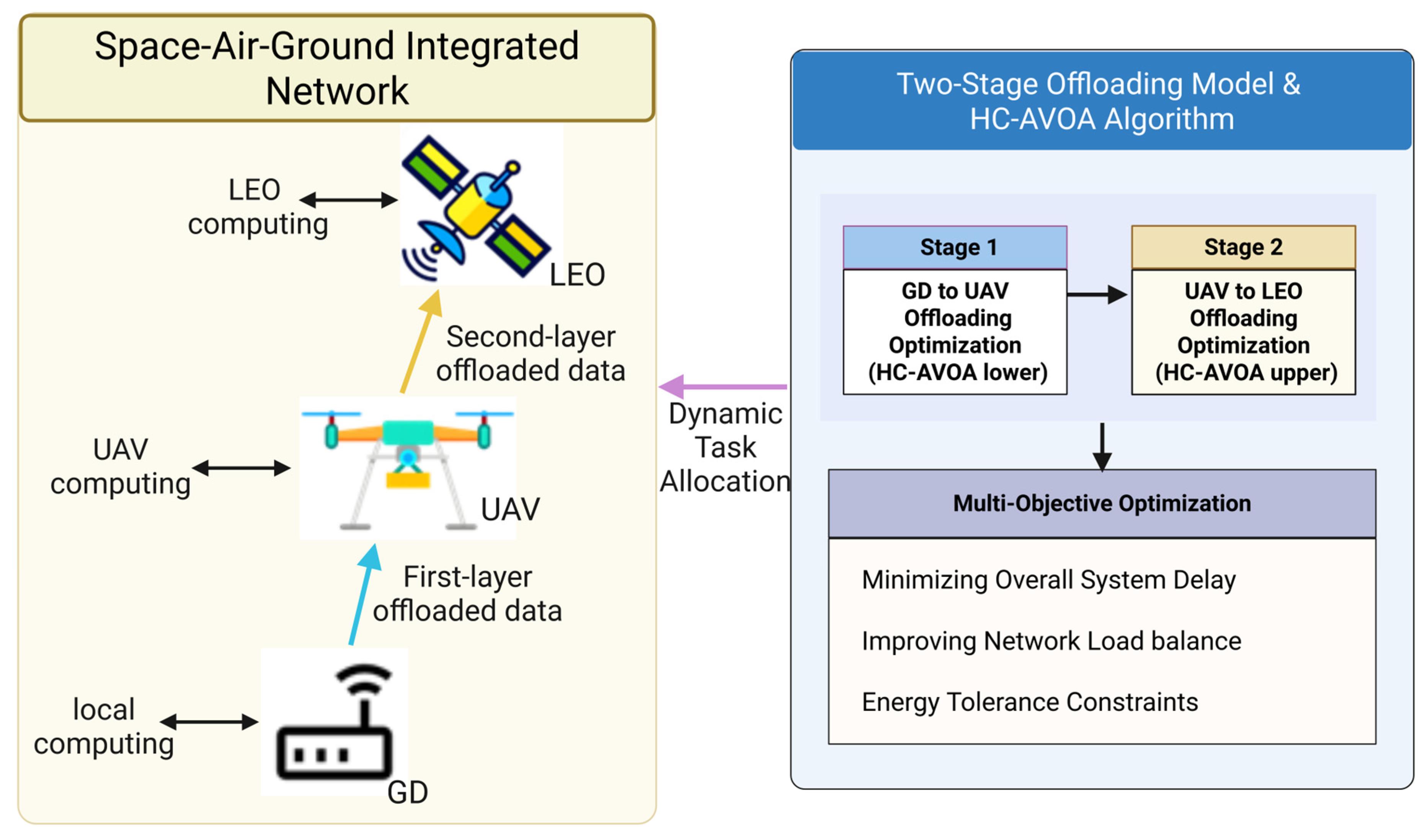
The space–air–ground integrated network architecture can provide ubiquitous network coverage for IoT devices [23] and it can deliver high-quality and reliable service to all covered devices [24]. The overall structure of the SAGIN is illustrated in Figure 1.
The network used in this study is a three-layer hierarchical structure: the space layer, the aerial layer, and the ground layer. It is assumed that the ground layer contains multiple IoT devices, all of which are stationary and located at ground level (zero altitude). These devices are represented by the set M:M = {1, 2, 3, …, m}, the tasks generated by the ground devices are denoted by the set Z = {1, 2, 3, …, z}. The first-layer offloading decisions are made by the ground devices to better serve users and enhance user experience, determining whether each task is processed locally on the IoT device or offloaded to a UAV. It is assumed that the aerial layer consists of multiple rotary-wing UAVs, all flying at the same altitude along predefined trajectories. The UAVs hover over the IoT devices and provide edge computing assistance, represented by the set U = {1, 2, 3, …, u} Similarly, to further improve user experience, the satellite layer consists of a single low Earth orbit (LEO) satellite, which provides full coverage for the IoT devices [25], Let (s) denote the satellite, which can cover all UAVs and ground devices. This study considers a discrete time-slot system (T), which is divided into (t) sub-slots of equal duration.

3.2. Communication Model

(1) The achievable transmission rate over the communication links between the UAVs and the satellite
R u , s = B u , s log 2 1 + P u h u , s N u , s ,
where h u , s denotes the channel gain from the UAV to the satellite, N u , s is the noise power on the UAV–satellite link, and P u is the UAV’s transmit power, constrained by the power budget P u min P u P u max . B u , s represents the bandwidth allocated to the UAV–satellite link, subject to B u , s min B u , s B u , s max .
(2) The transmission rate of the communication link between the ground devices and the UAVs
R m , u = B m , u log 2 1 + P m 10 [ L m , u ] 10 N m , u ,
where L m , u = 32.45 + 20 lg d m , u + 20 lg f m , u .
The transmission rate is primarily based on the model presented in [26]. Here, B m , u denotes the bandwidth allocated to the link from the ground device to the UAV, constrained by B m , u min B m , u B m , u max . P m is the transmit power of the ground device, determined by its power budget P m min P m P m max . L m , u represents the free-space path loss between the ground device and the UAV, and N m , u is the noise power on this link, f ( m , u ) denotes the center frequency, and d m , u denotes the distance between the ground device and the UAV.

3.3. Two-Stage Computation Offloading Model

This paper proposes a two-stage offloading framework in which tasks are first offloaded from ground devices to UAVs in a proportional manner, and then further offloaded from UAVs to the satellite. Once a task is generated at a ground device, the system must make the first offloading decision: whether to process the task locally at the device or offload it to a UAV. After the task is offloaded to a UAV and successfully received, a second offloading decision is required: whether to process the task locally at the UAV or offload it to the satellite. Accordingly, a two-layer offloading decision scheme, denoted by X and Y, is introduced to describe the processing mode. It is assumed that the state of each device in the system is shared, enabling tasks to be proportionally assigned based on the state of each UAV.
(1) First offloading decision: whether a task should be processed locally on the IoT device or offloaded to a UAV.
Offloading Decision:
X = X m , Ground local task ratio , X = X ( m , u ) , UAV offload ratio ,
During the first offloading decision, X m + X ( m , u ) = 1 , ensuring that all tasks are allocated to appropriate computing nodes.
(2) Second offloading decision: whether a task should be processed locally on the UAV or offloaded to the satellite.
Offloading Decision:
Y = Y u , UAV local task ratio , Y ( u , s ) , Satellite offload ratio ,
During the second offloading decision, Y u + Y ( u , s ) = 1 , ensuring that all tasks are allocated to appropriate computing nodes.

3.4. Computation Model

(1) Local Computation at Ground Devices
(a) Computation delay
D m C ( t ) = Z m · X m M · J · G f m ,
where Z m represents the total number of tasks generated by the ground device. G denotes the task complexity. X m is the proportion of tasks offloaded to the ground device for local processing, so Z m · X m represents the total number of tasks processed locally. J is the size of a single task. f m is the CPU frequency of the ground device, with a budget constraint f m min f m f m max .
(b) Computation Energy Consumption
E m C = r · f m 2 · Z m · X m M · J · G ,
Only the local computation energy consumption of the ground device is considered. Here, r is a constant dependent on the effective switching capacitance of the chip architecture [27].
(2) Aerial UAV Layer
(a) Total delay for Tasks Offloaded to UAVs
The total delay includes the transmission delay to the UAV and the computation delay at the UAV. Since the UAVs are relatively close to the ground, the propagation delay after computation can be neglected. The total number of tasks offloaded to the UAVs is: Z u = m M Z m X ( m , u )
Transmission Delay
D m , u O ( t ) = Z u · J R m , u ,
where Z u is the number of tasks offloaded from the IoT devices to the UAV, and R m , u is the transmission rate from the ground device to the UAV.
Computation Delay
D m , u C = Z u · Y u · J · G f u ,
where Z u · Y u represents the total number of tasks that remain for local computation on the UAV after the second offloading decision. f u is the CPU frequency of the UAV, with a budget constraint f u min f u f u max .
Total delay for Tasks Offloaded to UAVs
D m , u ( t ) = D m , u C ( t ) + D m , u O ( t ) ,
(b) UAV Communication and Computation Energy Consumption
Communication Energy
E u O = P m · D m , u O ,
where P m is the transmit power of the IoT device.
Computation Energy
E u C = r · f u 2 · Z u · Y u · J · G ,
The total energy consumption of the UAV layer is: E u = E u O + E u C
First-stage offloading energy consumption: E 1 = E m C + E u O
(3) Space Satellite Layer
(a) Total delay for Tasks Offloaded to the Satellite
LEO satellites are located at a considerable distance from the Earth, so offloading tasks to the satellite introduces significant transmission delay. First, the channel between the LEO satellite and UAVs is modeled.
The total number of tasks offloaded to the satellite is: Z s = u U Z u Y ( u , s )
Transmission Delay
D u , s t ( t ) = Z s · J R u , s ,
where Z s is the amount of task data offloaded from the UAV to the satellite, and R u , s is the transmission rate between the UAV and the satellite.
D m C ( t ) = Z s · Y ( u , s ) · J · G f s ,
where Z s · Y ( u , s ) represents the total tasks computed at the satellite, J is the size of a single task, and f s is the CPU frequency of the satellite, constrained by f s min f s f s max .
The total delay for tasks offloaded from the UAV to the satellite includes the transmission delay to the satellite and the computation delay at the satellite. The propagation delay after computation is negligible.
D u , s ( t ) = D u , s C ( t ) + D u , s O ( t ) ,
The overall system delay is: D = D m C ( t ) + D m , u ( t ) + D u , s ( t )
(b) Communication and Computation Energy Consumption of the Satellite Layer
Communication Energy
E s O = P u · D u , s t ,
where P u is the transmit power of the UAV.
Computation Energy
E s C = r · f s 2 · Z s · Y u s · J · G ,
The total energy consumption of the satellite layer is: E s = E s O + E s C
First-stage offloading energy consumption: E 2 = E m C + E u O + + E s
The total system energy consumption is: E = E m C + E u + E s

3.5. Load Imbalance Model

To prevent some UAVs from being overloaded while others have underutilized resources, a load imbalance metric is introduced to evaluate whether the number of tasks received by each UAV is balanced, thereby improving task processing efficiency. Through a load balancing mechanism, the computing tasks in the UAV layer are allocated and managed. The total number of tasks that each UAV needs to process locally is: Z u j = m = 1 M Z m X ( m , u ) Y u , where X ( m , u ) is the proportion of tasks offloaded from the ground layer to the UAV, and Y u is the proportion of tasks that the UAV decides to process locally.
The average number of tasks each UAV in the layer needs to process is: D = U = 1 u Z u j u
The load imbalance degree is defined as
V = U = 1 u | Z u j D | u ,
A load imbalance closer to 0 indicates a more balanced load, while a larger indicates greater load imbalance. In practical application scenarios, a higher degree of load balancing enables tasks to be allocated more reasonably across servers, resulting in faster content caching. Under high-load conditions, tasks can be distributed among multiple servers, and offloading decisions can be made according to the load status of each server, thereby improving resource utilization and overall system performance, reducing user waiting time, and enhancing user experience. Conversely, if the load imbalance value is excessively high, uneven load distribution may occur, potentially causing slow user response times and delayed data processing.

4. Problem Analysis

The problem addressed in this paper involves first optimizing the offloading ratio from ground devices to UAVs, and then optimizing the offloading ratio from UAVs to the satellite. The goal is to balance the UAV load while minimizing the delay of both UAVs and the satellite within the energy tolerance. Ultimately, through a two-layer collaborative mechanism, the objective is to find the optimal offloading strategy under multi-objective constraints, reducing the total system delay and improving load balancing while remaining within the energy budget.
P : min ( X , Y ) t = 1 T ( D , V ) s . t . C 1 : X m { 0 , 1 } , C 2 : Y u { 0 , 1 } , C 3 : E m min E m E m max , C 4 : E u min E u E u max , C 5 : f m min f m f m max , C 6 : f u min f u f u max , C 7 : f s min f s f s max , C 8 : P m min P m P m max , C 9 : P u min P u P u max , C 10 : B m , u min B m , u B m , u max , C 11 : B u , s min B u , s B u , s max , C 12 : Z s Z s max , C 13 : E 1 E 1 max , C 14 : E 2 E 1 max , C 15 : X m + X ( m , u ) = 1 , C 16 : Y u + Y ( u , s ) = 1 .
The optimization objective is to reduce the total delay and achieve balanced load while keeping the total energy consumption within the allowed tolerance, outperforming other benchmark schemes. The constraints include: C1, ensuring that each task in the first offloading decision is assigned either to a local or UAV computing node; C2, ensuring that each task in the second offloading decision is assigned either to a UAV or the satellite; Constraint C3 represents the energy tolerance of the first-stage offloading, indicating that the energy consumption of the first offloading process is limited; C4 denotes the energy tolerance of the second-stage offloading, indicating that the energy consumption of the second offloading process is limited; C5 specifies the constraint on the amount of tasks generated by ground devices; C5 to C7 impose upper and lower bounds on the computing capacities of ground devices, UAVs, and satellites, respectively; C8 to C9 define the transmission power constraints for the ground device–to–UAV link and the UAV–to–satellite link, respectively; C10 to C11 specify the bandwidth constraints for the ground device–to–UAV link and the UAV–to–satellite link, respectively; C12 represents the satellite resource constraint; C13 denotes the energy consumption constraint of the first-stage offloading; C14 denotes the energy consumption constraint of the second-stage offloading; C15 is the task integrity constraint for the first-stage offloading, ensuring that all tasks are correctly assigned to either ground devices or UAVs; and C16 is the task integrity constraint for the second-stage offloading, ensuring that all tasks are correctly assigned to either UAVs or satellites.

5. Construction of the African Vulture Optimization Algorithm Based on the Two-Stage Offloading Architecture

From problem P, the two-stage offloading problem studied in this paper is a multi-objective, multi-constraint non-convex optimization problem. It is non-convex and NP-hard, requiring joint optimization of offloading decisions for ground devices and UAVs. Due to the high-dimensional search space and conflicts among objectives, traditional deterministic and analytical methods struggle to obtain satisfactory solutions. The African Vultures Optimization Algorithm (AVOA) [28], by simulating the dual-leader mechanism and hunger rate adjustment in vulture foraging behavior, achieves a dynamic balance between global exploration and local exploitation, making it suitable for solving such complex multi-objective optimization problems. Therefore, a Hierarchical Cooperative African Vulture Optimization Algorithm (HC-AVOA) is constructed, in which the dual-leader mechanism simultaneously utilizes information from both the global best and the second-best solutions, effectively enhancing search capability and global convergence performance.

5.1. Two-Stage Offloading Decision Process

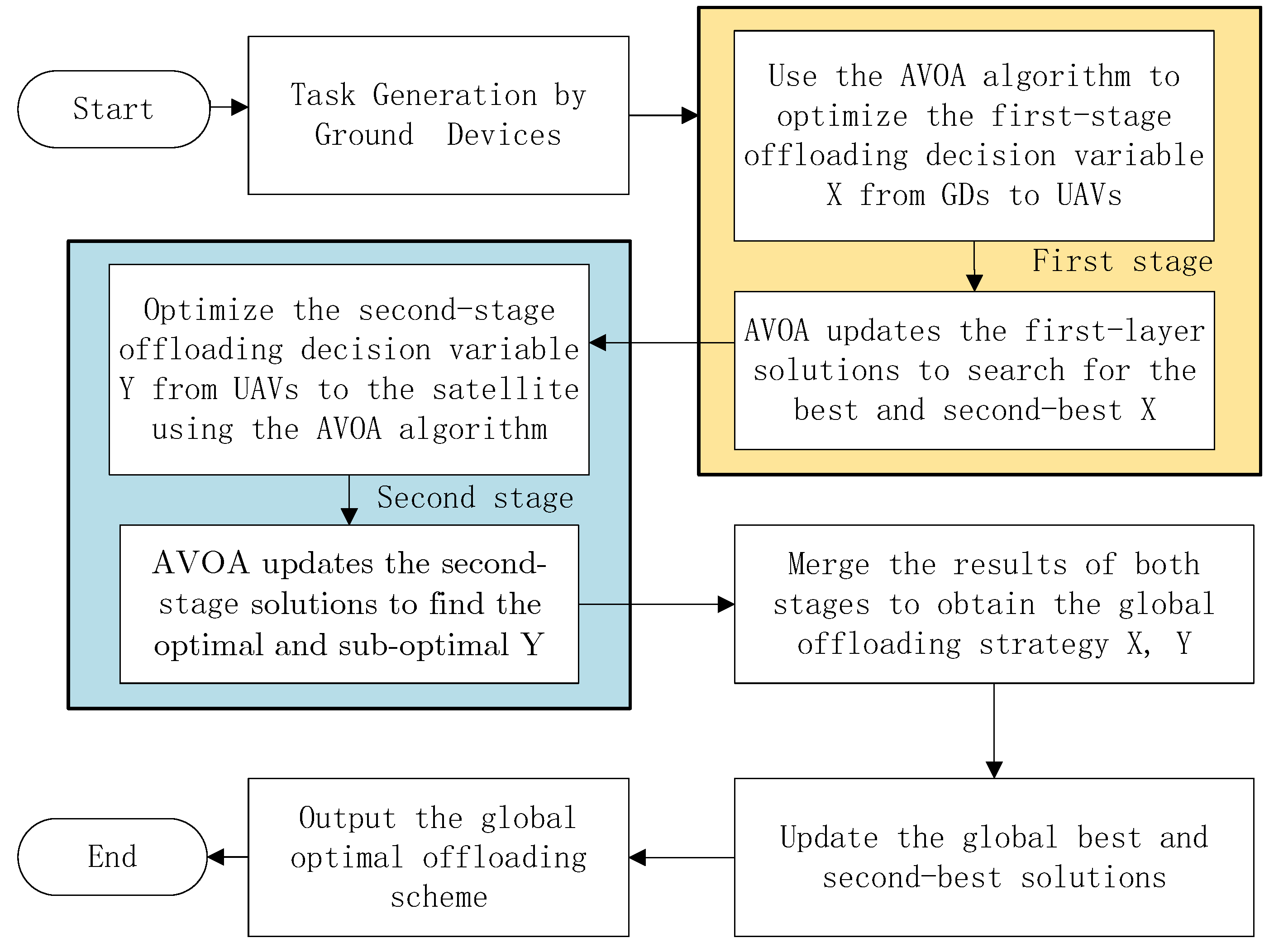
First, the AVOA algorithm is used to optimize the task offloading ratios from ground devices to UAVs, determining the task allocation scheme between the ground layer and UAVs. Then, based on the results of the first layer, the AVOA algorithm is applied again to optimize the offloading ratios from UAVs to the satellite, aiming to further reduce system delay within the energy tolerance while maintaining load balance among UAVs. Through this sequential two-layer offloading optimization, a two-layer optimization framework based on the HC-AVOA algorithm is established. Finally, tasks are processed according to the obtained optimal offloading strategy, the global best and second-best solutions are updated, and the global optimal offloading scheme under the two-layer structure is output.Two-Stage Decision Offloading Flowchart, as shown in Figure 2.

5.2. Design of the Hierarchical Cooperative African Vulture Optimization Algorithm for the Two-Layer Offloading Architecture

Based on the proposed two-stage offloading model, the AVOA is applied separately to optimize task offloading from ground devices to UAVs and from UAVs to the satellite. In the first stage, the algorithm determines the proportion of ground tasks offloaded to UAVs to reduce delay and energy consumption; in the second stage, it further optimizes the UAV-to-satellite offloading ratio to reduce delay and energy consumption while maintaining load balance. Since both layers use task offloading ratios as the core decision variables, a unified solution framework can be employed. Through iterative two-layer optimization, a dynamic trade-off among multiple objectives can be achieved while ensuring system performance. Compared with traditional single-stage optimization methods, HC-AVOA can more accurately capture the hierarchical structure of SAGIN, providing effective offloading decisions for low-delay and high-reliability communication within energy tolerance.
(1) Population Initialization. Each vulture individual represents a potential offloading decision. An initial population of N candidate solutions is randomly generated for each ground device or UAV, where each solution is a position vector representing a set of offloading decision variables, including ground-to-UAV and UAV-to-satellite offloading ratios. After population initialization, the composite values of delay, energy consumption, and load balance are calculated for each individual. The individual with the best composite value is selected as the global best vulture B e s t V 1 , the second-best as B e s t V 2 , and the remaining individuals determine their following direction using a roulette wheel method (Equations (20)). The fitness values of the population are recalculated in each iteration to ensure that the best individuals are always consistent with the current population state.
R ( i ) = B e s t V 1 , i f p i = L 1 , B e s t V 2 , i f p i = L 2 ,
p i = F i i = 1 n F i ,
Here, F i corresponds to B e s t V 1 and B e s t V 2 , with L 1 + L 2 = 1 and L 1 , L 2 [ 0 , 1 ] , controlling the probability of an individual following the two leaders. The dual-leader mechanism effectively avoids premature convergence and enhances global search capability.
(2) Second Stage: Calculating the Vulture Population’s Hunger Rate
Based on the energy state differences in vulture foraging behavior, a hunger rate model is constructed to enable dynamic switching between exploration and exploitation phases. The algorithm favors global exploration in early iterations and local fine-tuning in later iterations.
t = h sin w π I i 2 · m a x + cos π I i 2 · m a x 1 ,
F = 2 · r a n d 1 + 1 · z · I i m a x + t ,
Here, F represents the satiety rate, which dynamically changes over iterations; I i is the current iteration number, m a x is the maximum iteration number, z [ 1 , 1 ] , h [ 1 , 1 ] , and r a n d 1 [ 0 , 1 ] .
The model overall shows a decreasing trend simulating energy depletion over time. In early iterations, when | F | > 1 , AVOA enters the exploration phase: vultures are satiated, energy is sufficient, and they perform long-range, dispersed foraging, exploring different combinations of ground-to-UAV and UAV-to-satellite offloading ratios to avoid missing global optima. In later iterations, when | F | < 1 , AVOA enters the exploitation phase: vultures are hungry, energy is limited, and they focus on fine-grained search around high-quality food sources. At this stage, the offloading ratios are finely adjusted to reduce local fluctuations in delay, energy consumption, and load balancing.
(3) Third Stage: Exploration Phase
The exploration phase simulates vultures using their keen eyesight to judge the environment and forage over long distances. Two random-area search strategies are designed to enhance the coverage of the solution space during exploration. Before the search operation, a preset parameter Q 1 [ 0 , 1 ] is assigned for strategy selection.
Different offloading ratio combinations are generated by the two strategies according to:
P ( i + 1 ) = R ( i ) D ( i ) · F , i f Q 1 r a n d p 1 , P ( i + 1 ) = R ( i ) F + r a n d 2 · ( u b l b ) · r a n d 3 + l b , e l s e ,
D ( i ) = | X · R ( i ) P ( i ) | ,
where D ( i ) represents the distance between the current individual and the leader, r a n d 2 and r a n d 3 [ 0 , 1 ] , and l b and u b are the lower and upper bounds of decision variables.
A random number r a n d p 1 [ 0 , 1 ] is generated for offloading decision selection. If r a n d p 1 P 1 , the individual adjusts its position based on the optimal individual, with D ( i ) · F controlling the adjustment magnitude. Larger F values lead to wider adjustments, rapidly exploring offloading ratios near the “optimal individual” to suit both “ground-to-UAV” and “UAV-to-satellite” scenarios, reducing delay and energy while avoiding UAV overload or underload. Otherwise, a random search strategy based on the solution space boundaries is applied, with r a n d 2 · ( u b l b ) · r a n d 3 + l b introducing randomness, exploring offloading ratios “far from the optimal individual” to prevent excessive offloading causing delay or energy spikes. Random switching between the two strategies ensures coverage of scenarios like “local computation-dominant,” “UAV offloading-dominant,” and “mixed offloading,” providing high-quality candidate solutions balancing delay, energy, and load for the subsequent exploitation phase.
(4) Fourth Stage: Exploitation Phase
The exploitation phase is divided into two sub-stages corresponding to different search strategies:
(a) First Sub-Stage:
When 0.5 < | F | < 1 , AVOA enters the first sub-stage, simulating the vulture’s rotating flight and encircling behavior. If r a n d p 2 P 2 , encircling is performed, with D ( i ) · ( F + r a n d 4 ) controlling the approach magnitude to the optimal offloading strategy. Smaller F results in finer adjustments of ground-to-UAV and UAV-to-satellite offloading ratios. If r a n d p 2 < P 2 , the rotating flight strategy is applied, simulating vulture circling around the optimal strategy, approaching it while performing small-range exploration to avoid missing potentially better solutions nearby. The update formula is:
P ( i + 1 ) = R ( i ) ( S 1 + S 2 ) , i f Q 2 < r a n d p 2 , P ( i + 1 ) = D ( i ) · ( F + r a n d 4 ) R ( i ) P ( i ) , e l s e ,
S 1 = R ( i ) · r a n d 5 · P 1 2 π · cos P ( i ) ,
S 2 = R ( i ) · r a n d 5 · P 1 2 π · sin P ( i ) ,
where P 2 [ 0 , 1 ] , r a n d p 2 [ 0 , 1 ] , r a n d 4 [ 0 , 1 ] , r a n d 5 [ 0 , 1 ] .
(b) Second Sub-Stage: When | F | < 0.5 , AVOA enters the second sub-stage, simulating vultures gathering at food sources and engaging in aggressive encircling and competition. If Q 3 r a n d p 3 , the strategy is guided by dual-optimal individuals:
p ( i + 1 ) = A 1 + A 2 2 , A 1 = B e s t V 1 ( i ) B e s t V 1 ( i ) · P ( i ) B e s t V 1 ( i ) · P ( i ) 2 · F , A 2 = B e s t V 2 ( i ) B e s t V 2 ( i ) · P ( i ) B e s t V 2 ( i ) · P ( i ) 2 · F ,
Otherwise,
p ( i + 1 ) = R ( i ) | d ( t ) | · F · L e v y ( d ) , d ( t ) = R ( i ) P ( i ) ,
where P 3 [ 0 , 1 ] , r a n d p 3 [ 0 , 1 ] ; A 1 and A 2 guide the vulture’s motion, d ( t ) quantifies the approach toward advantageous offloading strategies, and L e v y ( d ) is the Lévy flight function. If P 3 r a n d p 3 , the two best-performing strategies A 1 and A 2 are fused, generating A 1 + A 2 2 as a new strategy combining their advantages. Otherwise, small random perturbations via Lévy flight are introduced to avoid local optima. This stage simulates vulture gathering and competition at food sources, achieving further optimization of offloading decisions through dual-leader guidance and random disturbance.

5.3. Time Complexity Analysis of Hierarchical Cooperative African Vulture Optimization Algorithm

In the first-stage optimization of the HC-AVOA algorithm, each solution consists of m u variables. During the initialization phase, n solutions need to be generated, resulting in a time complexity of O ( n · m u ) . In the iterative phase, each loop includes position updates and fitness evaluations, with a single-iteration complexity of O ( n · m u ) . After t iterations, the overall time complexity of the first-stage optimization is O ( t · n · m u ) . In the second-stage optimization, each solution has u s variables, and the initialization complexity is O ( n · u s ) . Each iteration in the main loop similarly involves solution updates and fitness computations, with a cost of O ( n · u s ) . After t iterations, the total time complexity of the second-stage optimization is O ( t · n · u s ) . In summary, the time complexity of the HC-AVOA algorithm for completing the entire two-stage optimization process can be expressed as: O ( t · n · ( m u + u s ) ) , where n is the population size, t is the maximum number of iterations, and m u and u s represent the number of decision variables for ground-to-UAV and UAV-to-satellite offloading, respectively.

6. Simulation Experiments

To validate the effectiveness of the HC-AVOA algorithm for the two-stage task offloading strategy in SAGIN, multiple comparative simulation experiments are designed around the core optimization objectives of total delay reduction and UAV load balancing under total energy consumption constraints. The performance of HC-AVOA is compared with Particle Swarm Optimization (PSO), Walrus Optimization Algorithm (WaOA), Egret Swarm Optimization Algorithm (ESOA), and Artificial Bee Colony (ABC) to demonstrate the advantages of AVOA in multi-objective cooperative optimization and analyze its performance in SAGIN task offloading scenarios.

6.1. Simulation Settings

The simulations are implemented on a computer with an Intel i5 processor running Python 3.8. The constructed SAGIN scenario includes ten ground devices, four UAVs, and one Low Earth Orbit (LEO) satellite. To simulate real-world service fluctuations, the CPU frequency, bandwidth, and transmit power of the ground devices, UAVs, and satellite have variable ranges. Each experimental data point is obtained by averaging over 16 time slots.
The system parameters are summarized in Table 1. The parameters used in this paper are referenced from [29].
To verify the effectiveness of the proposed algorithm, comparisons are conducted with the following algorithms.
Particle Swarm Optimization (PSO) [30]: By simulating collective cooperative behavior for continuous-space search, it features a simple structure and fast convergence and is often used as a classic benchmark algorithm in computation offloading and resource allocation problems. Additionally, by simulating cooperative group movement and individual position update mechanisms, it balances global exploration and local exploitation during the search process and is suitable for solving nonlinear optimization problems with complex constraints.
Egret Swarm Optimization Algorithm (ESOA) [31]: By combining rapid target localization with locally intensified search, it improves optimization efficiency and is suitable for nonlinear multi-constrained optimization problems.
Artificial Bee Colony (ABC) [32]: It is a swarm intelligence optimization algorithm that simulates the cooperative foraging behavior of honeybees, featuring strong stochastic search capability and robustness, and is widely applied in constrained optimization and offloading decision problems.
Walrus Optimization Algorithm(WaOA) [33]: is a swarm intelligence optimization algorithm inspired by walrus group behavior, featuring a simple structure, strong global search capability, and stable convergence performance, making it suitable for complex optimization problems.

6.2. Simulation Analysis

(1) Comparison of Reward Performance Between Single-Stage and Two-Stage Offloading Models
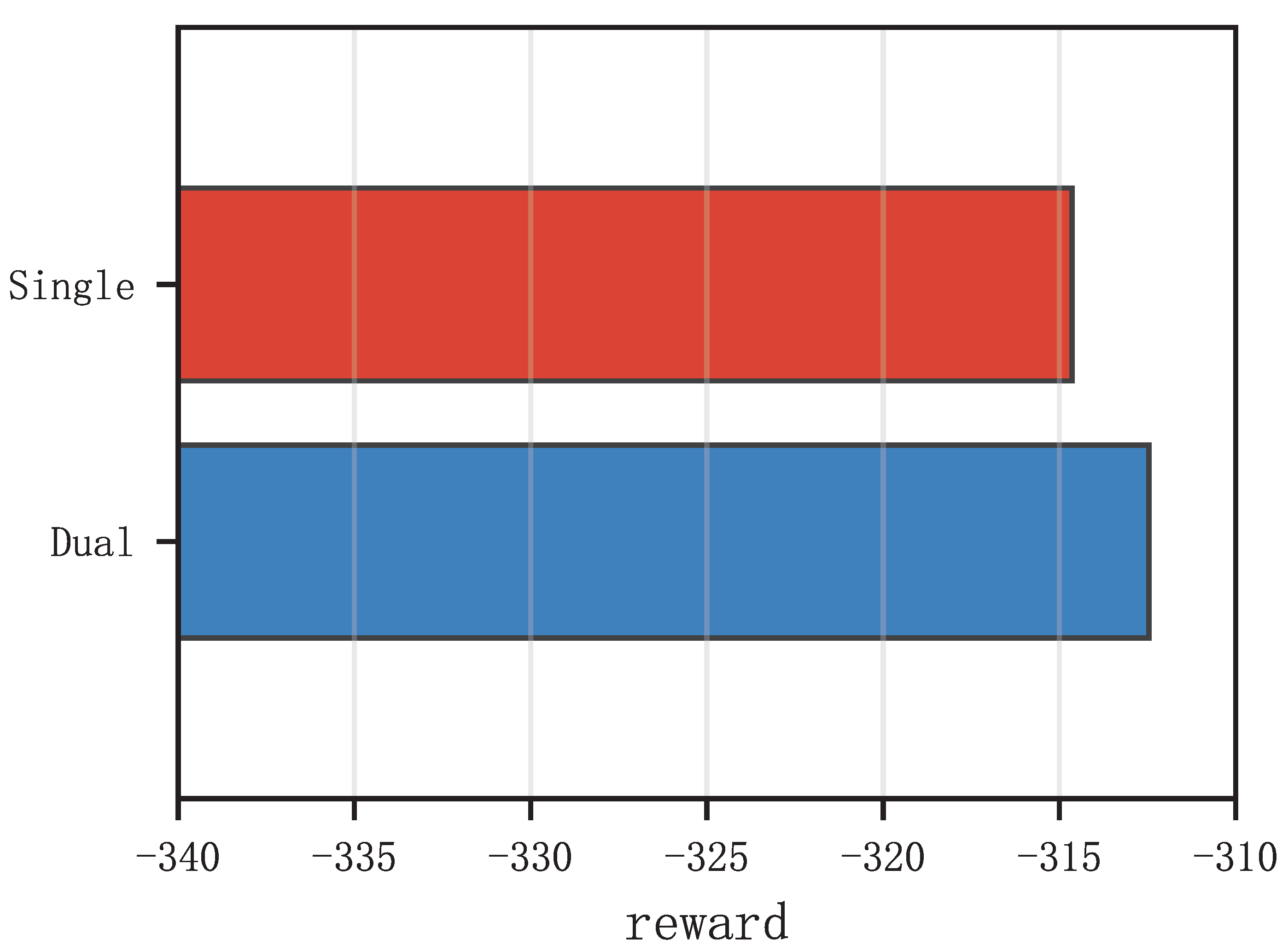
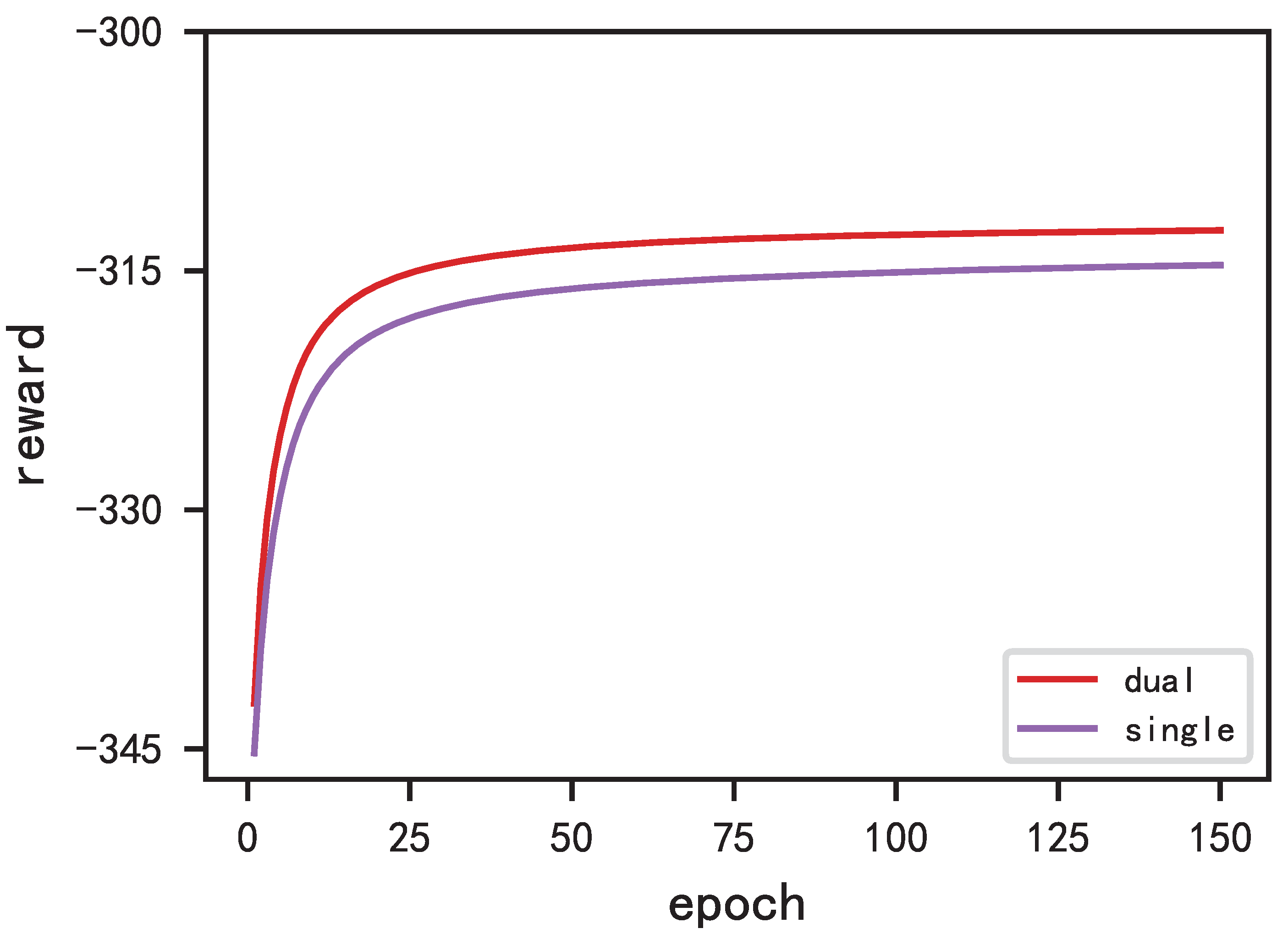
To validate the effectiveness of the proposed two-layer offloading model, the model offloading tasks from UAVs to satellites is defined as the single-layer model, while the model offloading tasks from ground devices to UAVs and then from UAVs to satellites is defined as the two-layer model. For a fair comparison, the same African Vulture Optimization Algorithm (AVOA) parameters were applied to solve both models, and compares their convergence behavior of the cumulative reward values as well as the reward performance. The experimental results are shown in Figure 3 and Figure 4.
As shown in Figure 3, with the increase in the number of iterations, both offloading models are able to converge, indicating that each can stably learn effective strategies. Compared with the single-stage offloading model, the two-stage offloading model exhibits faster reward improvement in the early training phase and maintains higher reward values under the same number of epochs. This demonstrates that the two-stage offloading model achieves better sample efficiency and faster convergence. Moreover, its final convergence plateau is slightly higher, reflecting superior policy performance. As illustrated in Figure 4, the reward values of the two-stage offloading model are consistently higher than those of the single-stage offloading model. Since the reward represents the overall performance that jointly considers delay and load balancing, a higher reward value indicates better system performance. The proposed two-stage offloading model outperforms the single-stage offloading model in terms of reward value and overall performance. This is because the single-layer offloading model only considers offloading from UAVs to satellites and fails to fully exploit the task allocation advantages between ground devices and UAVs, resulting in suboptimal collaborative optimization. In contrast, the two-stage offloading model performs optimization through two offloading decisions across two layers, enabling better coordination of computational resource allocation among ground devices, UAVs, and satellites, and achieving a more favorable trade-off between delay and load balancing. Consequently, the two-stage model attains higher reward values, validating the effectiveness of the proposed model.
(2) Comparative analysis of average delay between the single-stage offloading model and the two-stage offloading model
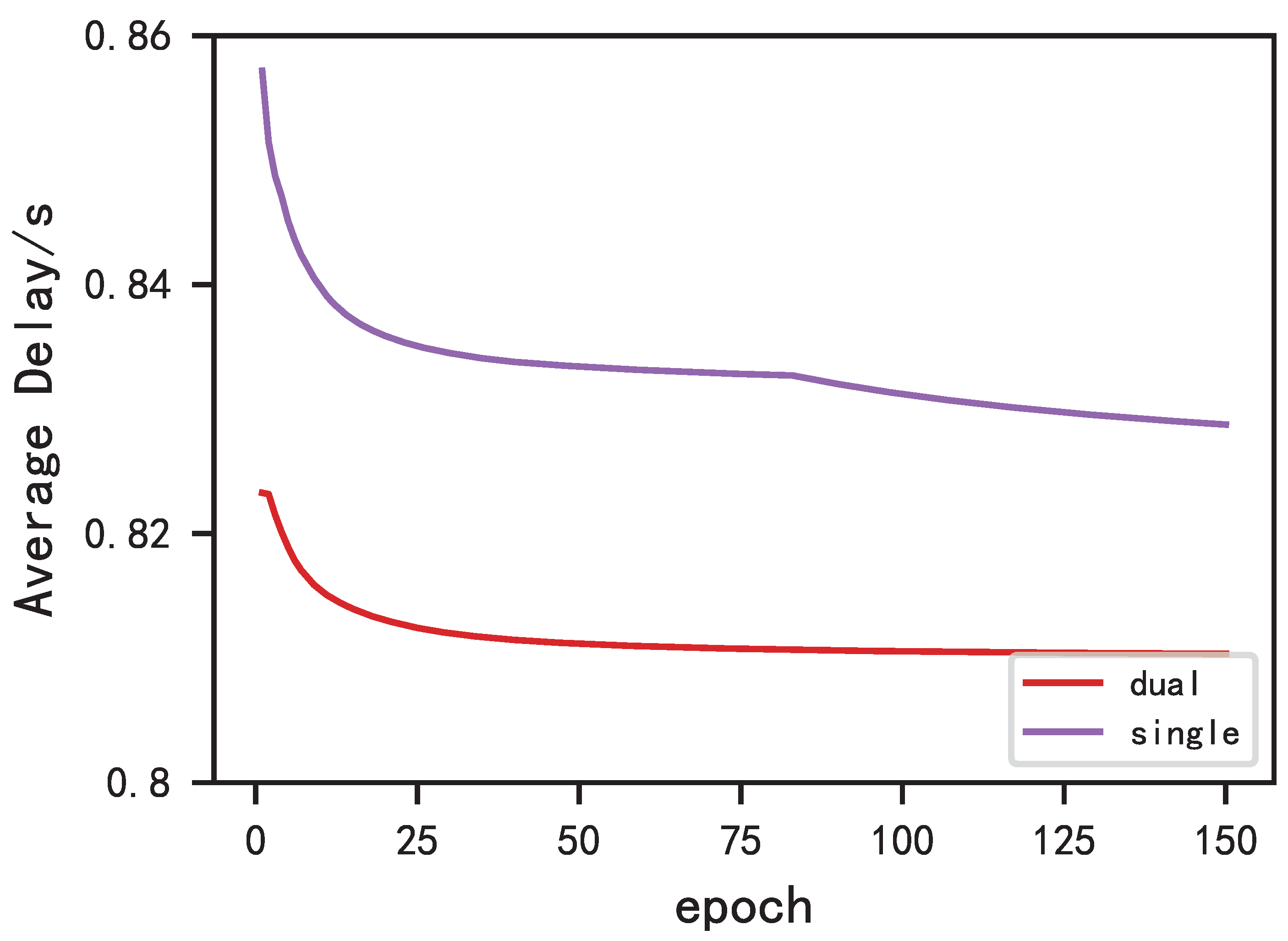
To evaluate the average delay performance of the two-stage offloading model in comparison with the single-stage offloading model, this paper compares the average delay achieved under the single-stage and two-stage offloading models.
As shown in Figure 5, with the increase in the number of iterations, the average delay of both offloading models first decreases rapidly and then gradually stabilizes, indicating that the adopted optimization algorithm can effectively converge under both models. Compared with the single-stage offloading model, the two-stage offloading model achieves lower average delay and converges faster, demonstrating its superior performance in terms of delay reduction. This is because, compared with the single-stage offloading model, the two-stage offloading model enables more flexible task allocation across different layers with higher decision accuracy, allowing it to more efficiently and rapidly identify suitable offloading strategies. By quickly obtaining an effective offloading optimization solution, the two-stage offloading model achieves lower computation task delay.
(3) Comparative analysis of load imbalance between the single-stage offloading model and the two-stage offloading model.
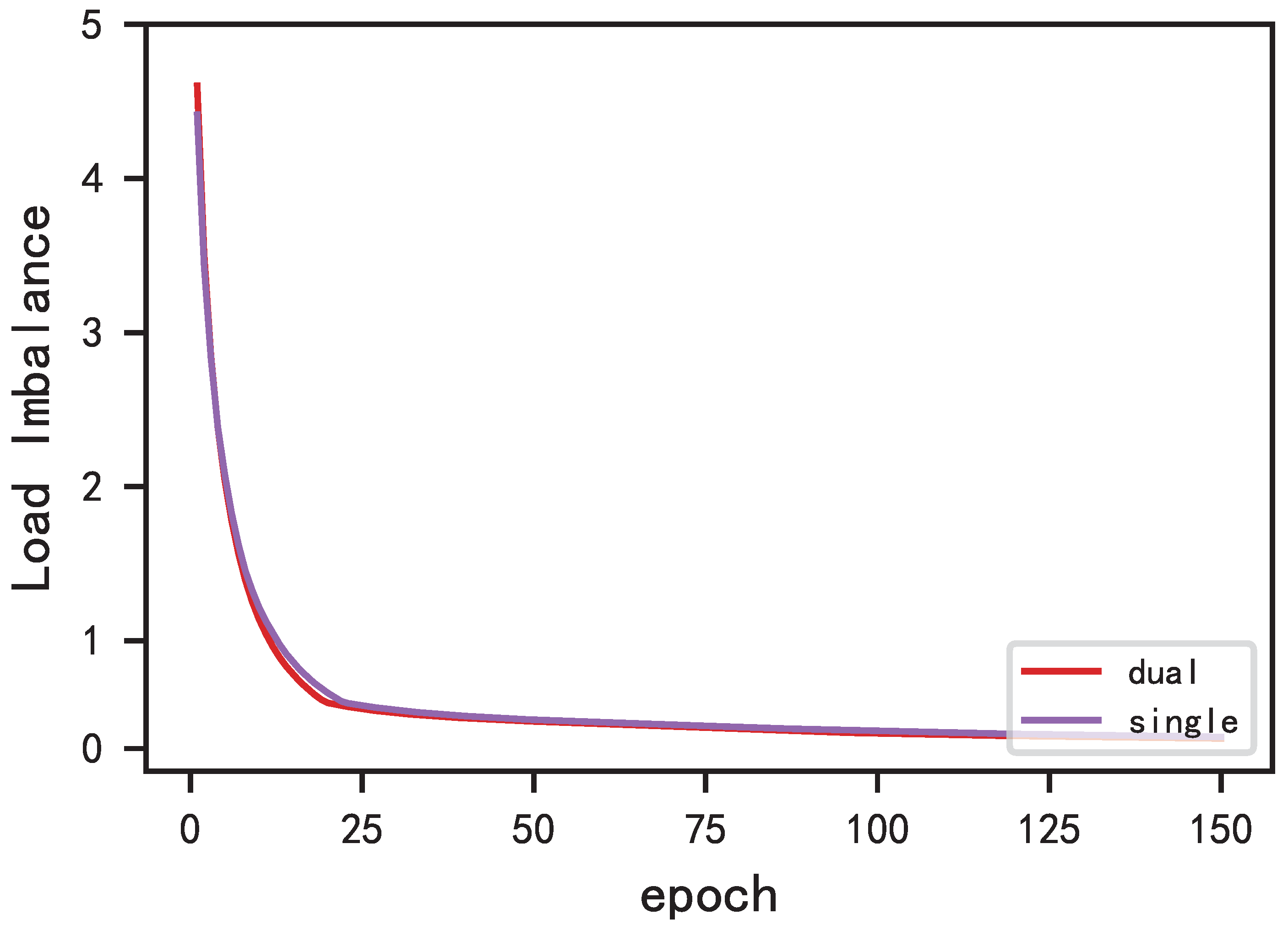
Figure 6 presents the iterative convergence comparison of the load imbalance metric between the single-stage offloading model and the two-stage offloading model.
As observed in Figure 6, both the single-stage offloading model and the two-stage offloading model exhibit a rapid decline as the number of iterations increases and eventually converge to a stable level, indicating that both models can achieve effective load balancing. However, the two-stage offloading model converges faster and can identify the optimal offloading decisions more quickly, resulting in higher efficiency. This is because the two-stage offloading strategy provides more fine-grained task diversion and adjustment capability. Ground devices first perform preliminary task allocation between local processing and UAVs, and the UAV layer can further conduct secondary offloading based on its own load conditions and satellite status. As a result, load balancing can be achieved more rapidly with reduced allocation oscillations, making this approach more suitable for delivering highly reliable and fast user service experiences.
(4) Comparison of Reward Values Between HC-AVOA and PSO, WaOA, ESOA, ABC
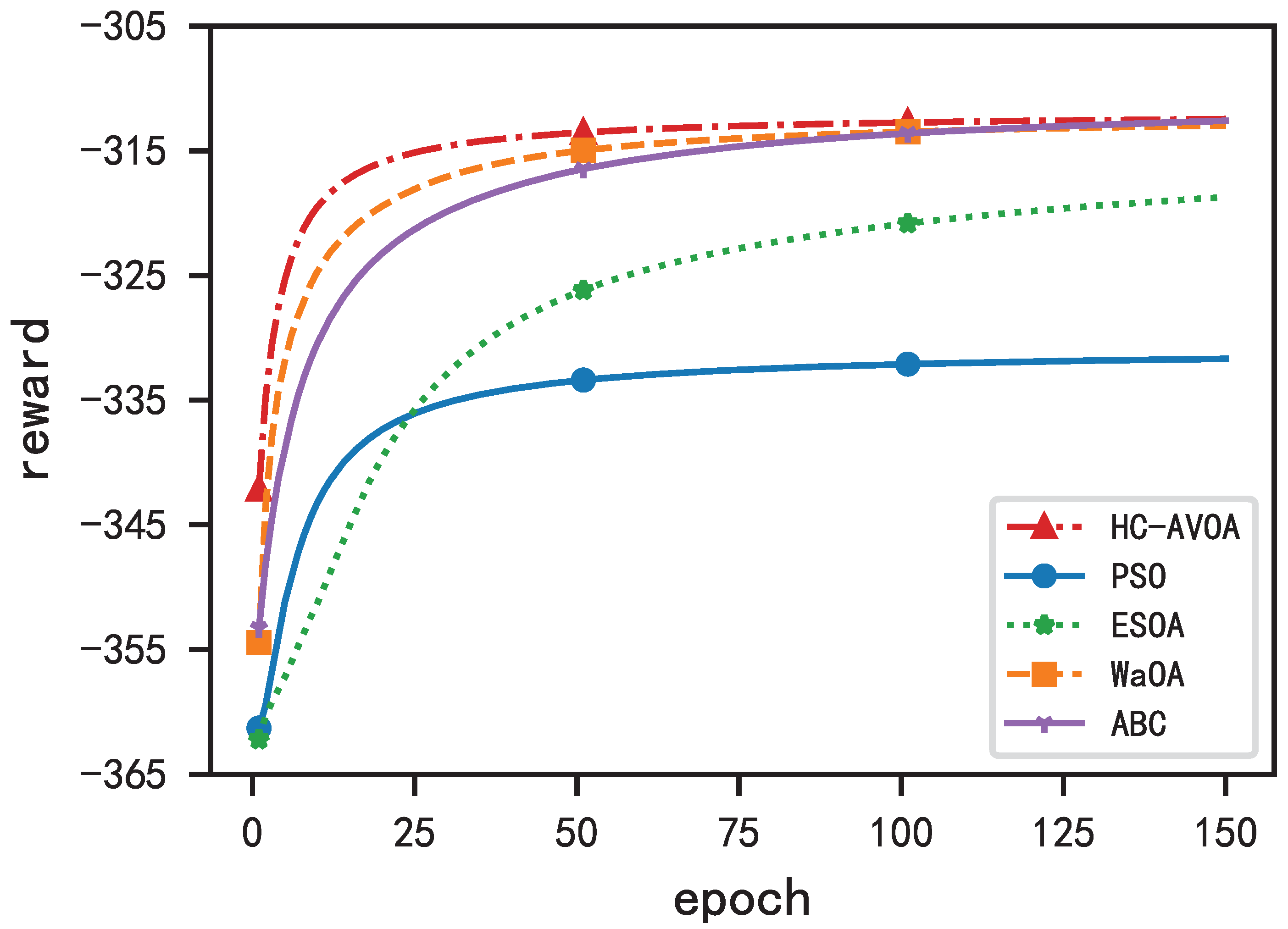
To evaluate the performance advantage of the proposed algorithm in multi-objective optimization, the reward values of HC-AVOA were compared with those of PSO, WaOA, ESOA, and ABC under the two-layer offloading model. The experimental results are shown in Figure 7.
The reward value is calculated based on three indicators: delay, energy consumption, and load balancing, providing a comprehensive reflection of the system’s overall optimization performance. A higher reward value indicates better overall algorithm performance. As shown in Figure 7, the HC-AVOA algorithm consistently achieves higher reward values and faster convergence compared to the other algorithms. This advantage is attributed to its two-layer optimization structure and dynamic search mechanism, which effectively balance global exploration and local exploitation, demonstrating stronger multi-objective optimization capability and convergence stability. In contrast, PSO and WaOA possess certain global search abilities but lack sufficient local refinement, The ESOA algorithm exhibits limited development capability and struggles to achieve stable and efficient search performance, while the ABC algorithm suffers from strong randomness in its search process, making it difficult to adapt to complex constraints. As a result, their overall performance is relatively poor, and they fail to quickly and accurately identify optimal offloading solutions.
(5) Comparison of Average Delay
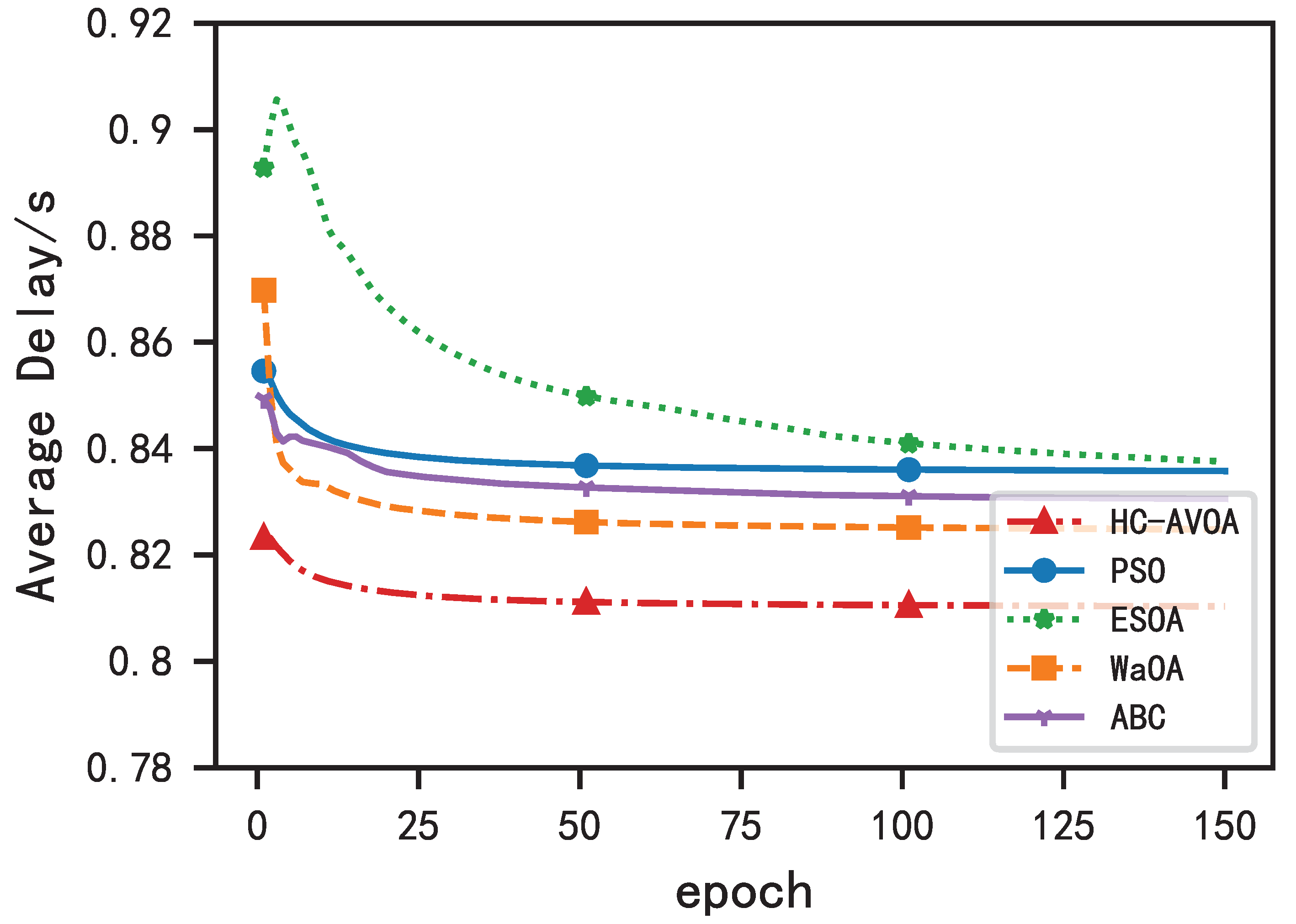
To evaluate performance in terms of delay optimization, the average delay of HC-AVOA was compared with that of other algorithms under the two-layer offloading model. The experimental results are shown in Figure 8.
The average delay variation of the proposed HC-AVOA algorithm under the two-layer decision framework is shown in Figure 8. The figure compares the changes in average delay as the number of iterations increases. It can be observed that the delays of HC-AVOA and the other four algorithms stabilize as iterations progress. Moreover, the delay achieved by the ESOA algorithm fluctuates significantly with the increase in the number of iterations, which is mainly due to its insufficient local search capability and low convergence accuracy in the early stages, and eventually a higher delay than HC-AVOA. In contrast, HC-AVOA converges faster and achieves the lowest final delay among all five algorithms. This advantage is mainly attributed to HC-AVOA’s dual-leader mechanism, which maintains a dynamic balance between global exploration and local exploitation, indicating stronger convergence performance and better delay optimization in multi-objective problems.
(6) Comparison of Load Imbalance
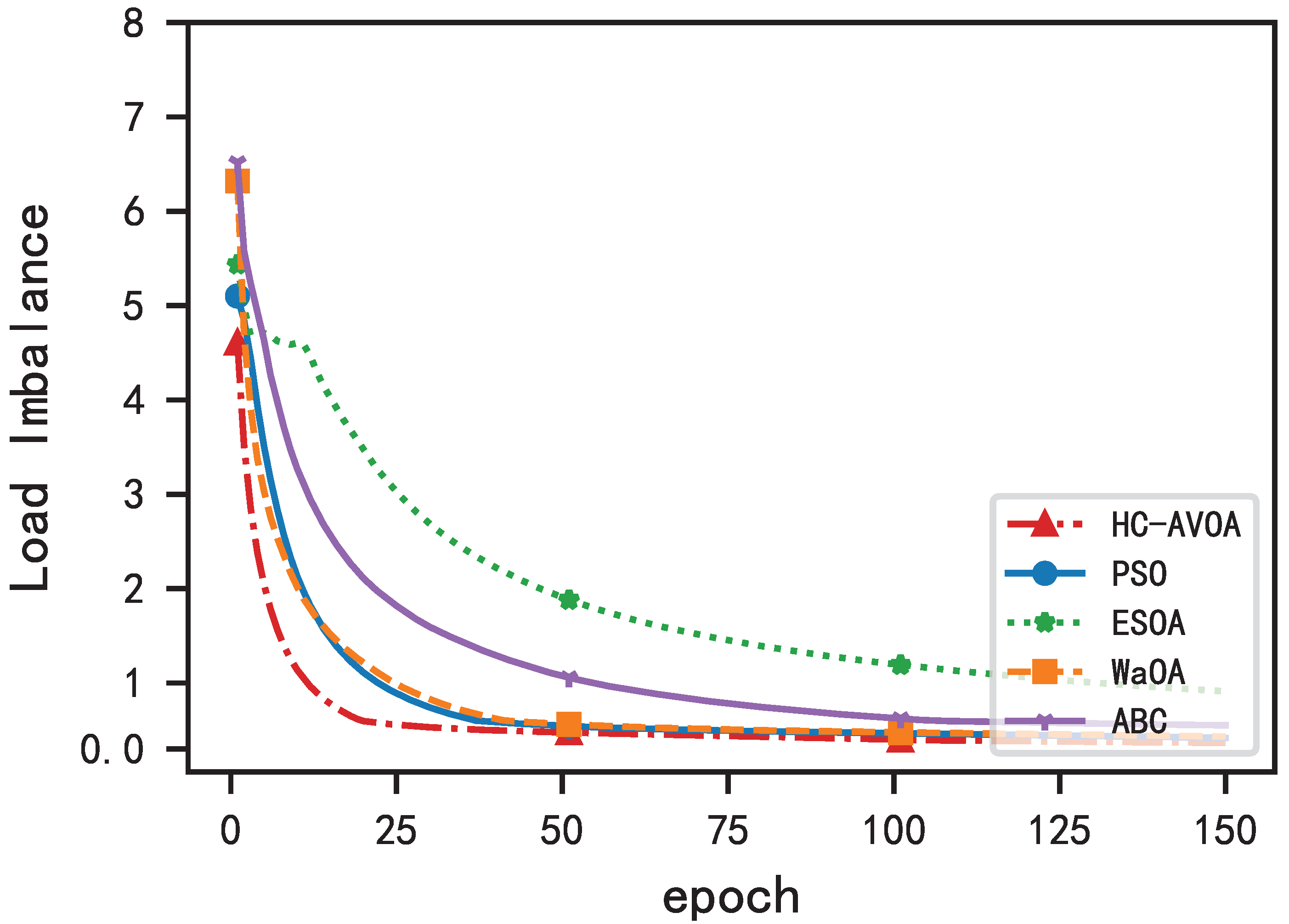
Figure 9 compares the changes in load imbalance as the number of iterations increases. The load imbalance is dynamically calculated based on the number of computing tasks assigned to each UAV, with values closer to 0 indicating better load balance.
As shown in Figure 9, As the number of iterations increases, the HC-AVOA algorithm enables the load imbalance metric to converge more rapidly and achieves the optimal load imbalance value. Although the PSO and WaOA algorithms are also able to reach favorable load balancing performance, their convergence speeds are relatively slow. In contrast, the other two algorithms perform poorly in terms of load balancing due to strong randomness in their search processes. The load imbalance value directly affects the load balancing performance at the UAV layer. In contrast, the proposed HC-AVOA algorithm can quickly identify a more reasonable task allocation scheme within fewer iterations, achieving a more balanced task processing among UAVs and demonstrating the best load balancing performance. This advantage is attributed to HC-AVOA’s dual-leader mechanism and dynamic search strategy, which effectively balance global exploration and local exploitation, thereby optimizing delay while maintaining UAV layer load balance.
(7) Comparative analysis of load imbalance under different task quantities
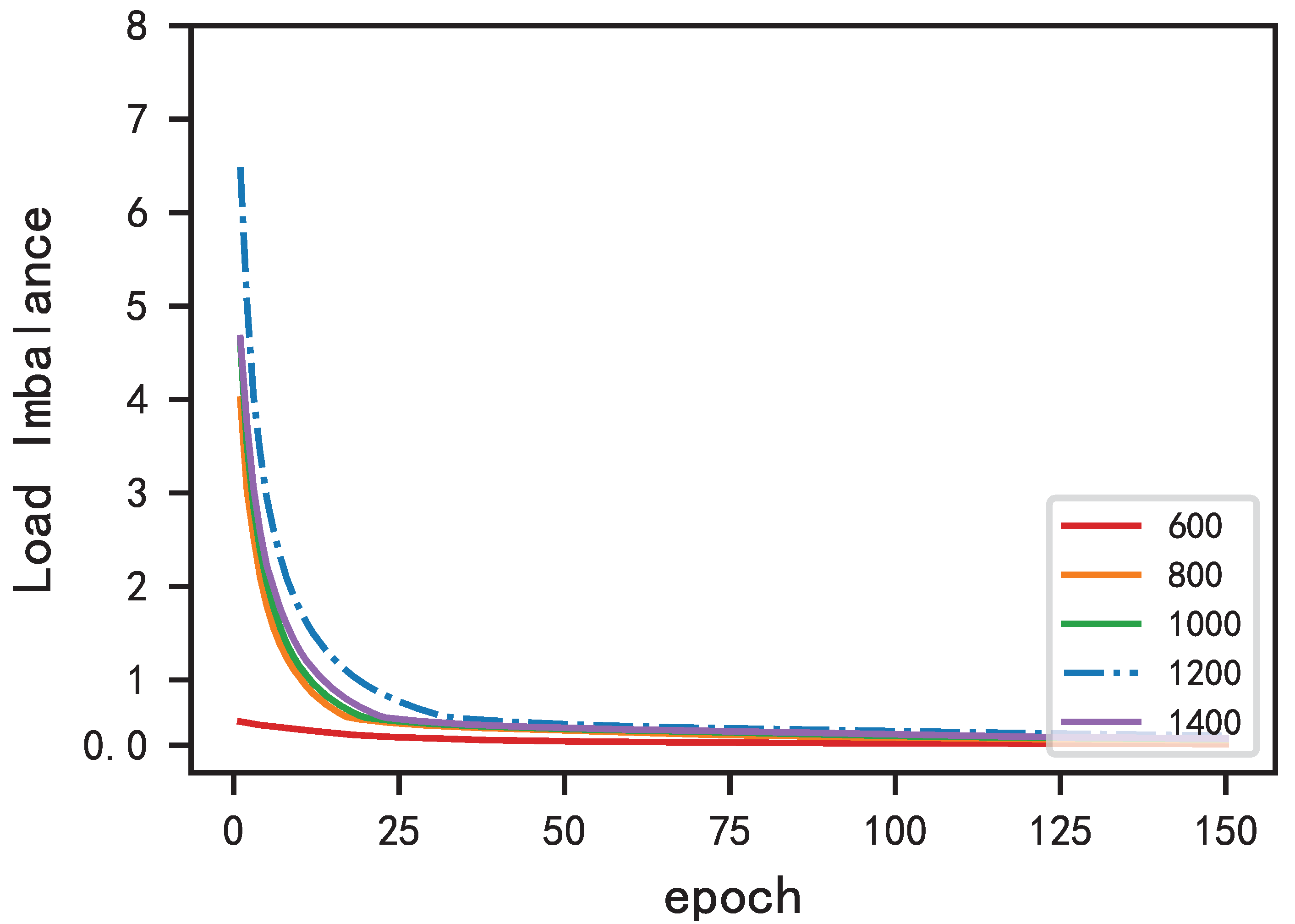
Figure 10 compares the variations in load imbalance achieved by the HC-AVOA algorithm under the proposed two-layer model as the number of tasks generated by ground devices increases from 600 to 1400.
As shown in Figure 10, when the number of tasks is relatively small, the load imbalance metric converges more rapidly to the optimal value, indicating that the system can more easily achieve load balancing under light-load conditions. As the task volume increases, the load balancing optimization mechanism dynamically adjusts the offloading ratios from ground devices to UAVs and from UAVs to satellites through two-stage cooperative decision-making. Although the convergence speed becomes slightly slower, the load imbalance metric can still reach its optimal value. The load balancing mechanism is thus fully activated, effectively distributing tasks among multiple UAVs, ensuring proper utilization of UAV resources under heavy task loads. Consequently, the overall system load distribution approaches an ideal state, maintaining better balance and avoiding resource waste and single-point overload.
(8) Comparative analysis of delay under different task quantities
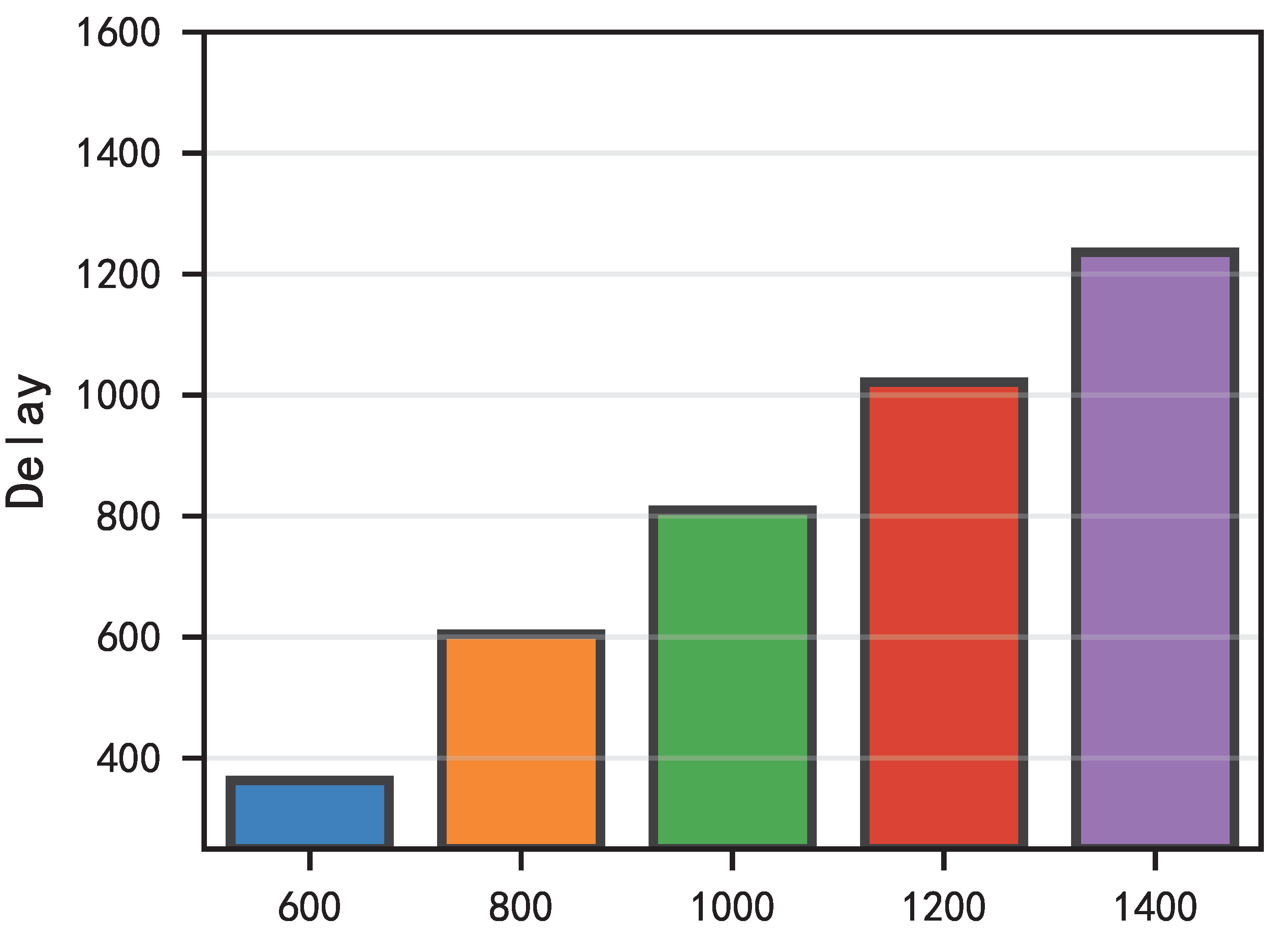
Figure 11 compares the variations in delay achieved by the HC-AVOA algorithm under the proposed two-layer model as the number of tasks generated by ground devices increases from 600 to 1400.
As shown in Figure 11, the total delay increases with the growth in the number of tasks, as processing a larger number of tasks requires correspondingly more time. When the task volume is small, the computational resources of ground devices, UAVs, and satellites are relatively sufficient, allowing the system to process the generated tasks quickly and maintain a low overall delay. As the number of tasks increases, each task must be processed under a high-load condition, requiring more time to handle the computational workload, which leads to an increase in totaldelay. Through the two-stage cooperative offloading mechanism, tasks are dynamically distributed among different computing nodes, effectively alleviating the computational burden on individual nodes. As a result, even as the task volume increases, the system is able to maintain a relatively stable delay growth trend, demonstrating strong task processing capability under varying task loads.
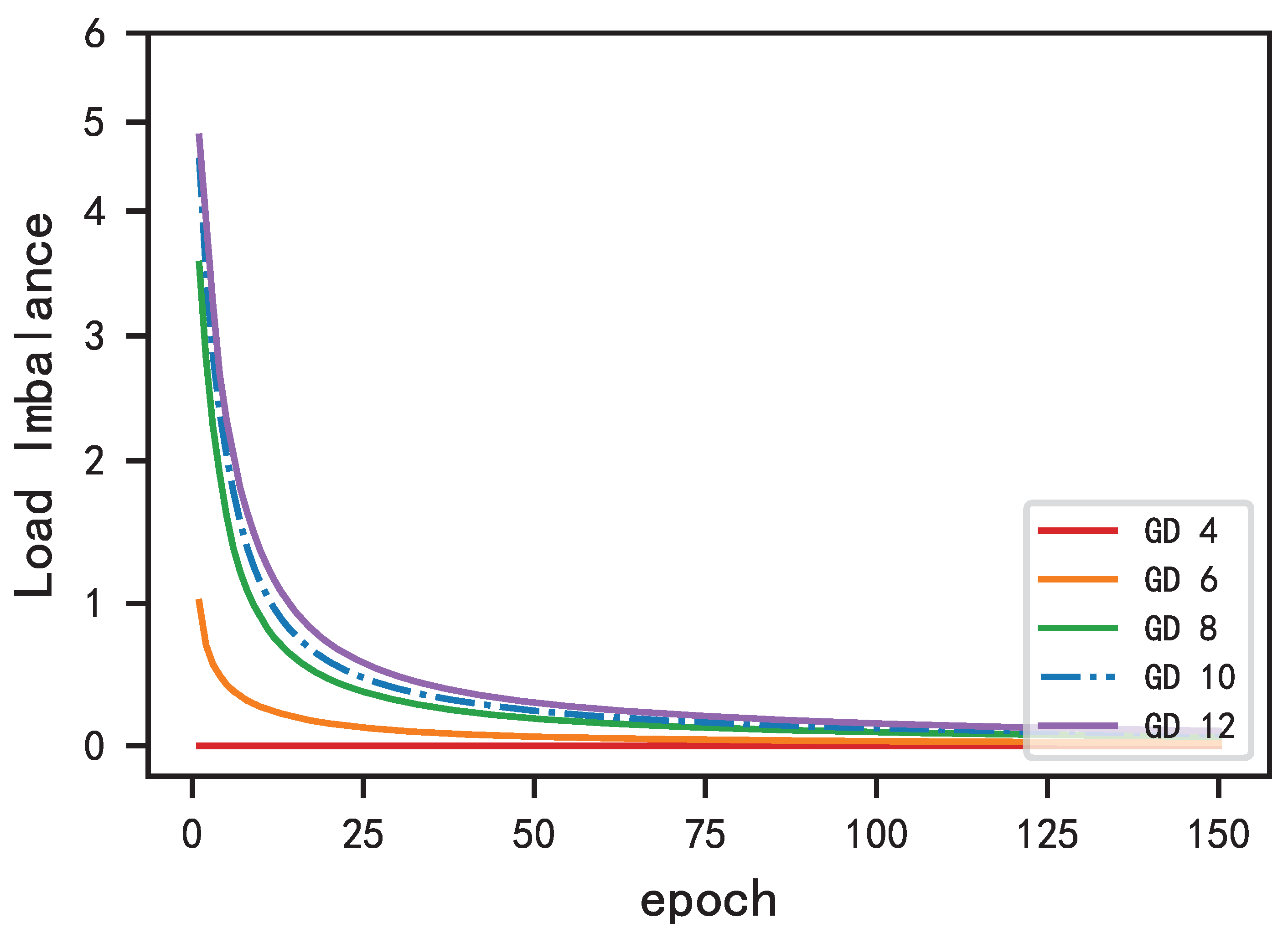
(9) Comparative analysis of load imbalance under different numbers of ground devices
To investigate the impact of the number of ground devices on delay and load imbalance, the number of ground devices is set to 4, 6, 8, 10, and 12, respectively. Figure 12 compares the variation trends of the load imbalance metric with respect to the number of iterations under the proposed two-stage offloading model, as the number of ground devices increases from 4 to 12.
As shown Figure 12, with the increase in the number of users, the initial load imbalance metric rises significantly and the convergence process becomes relatively slower; however, the load imbalance metric is ultimately able to converge in all cases, with differences only in convergence speed. This is because the proposed method can rapidly correct severe load imbalance in the early stages and perform fine-grained optimization of task allocation in later stages. As the number of ground devices increases, the number of generated tasks also grows, and the dimensionality of offloading decisions correspondingly increases. The combinations of task allocation among computing nodes become more complex, making the initial solutions more prone to local overload and resulting in higher initial load imbalance. Consequently, more iterations are required to adjust the offloading ratios and eliminate load imbalance, leading to differences in convergence speed. Nevertheless, all cases eventually converge to near-optimal solutions.
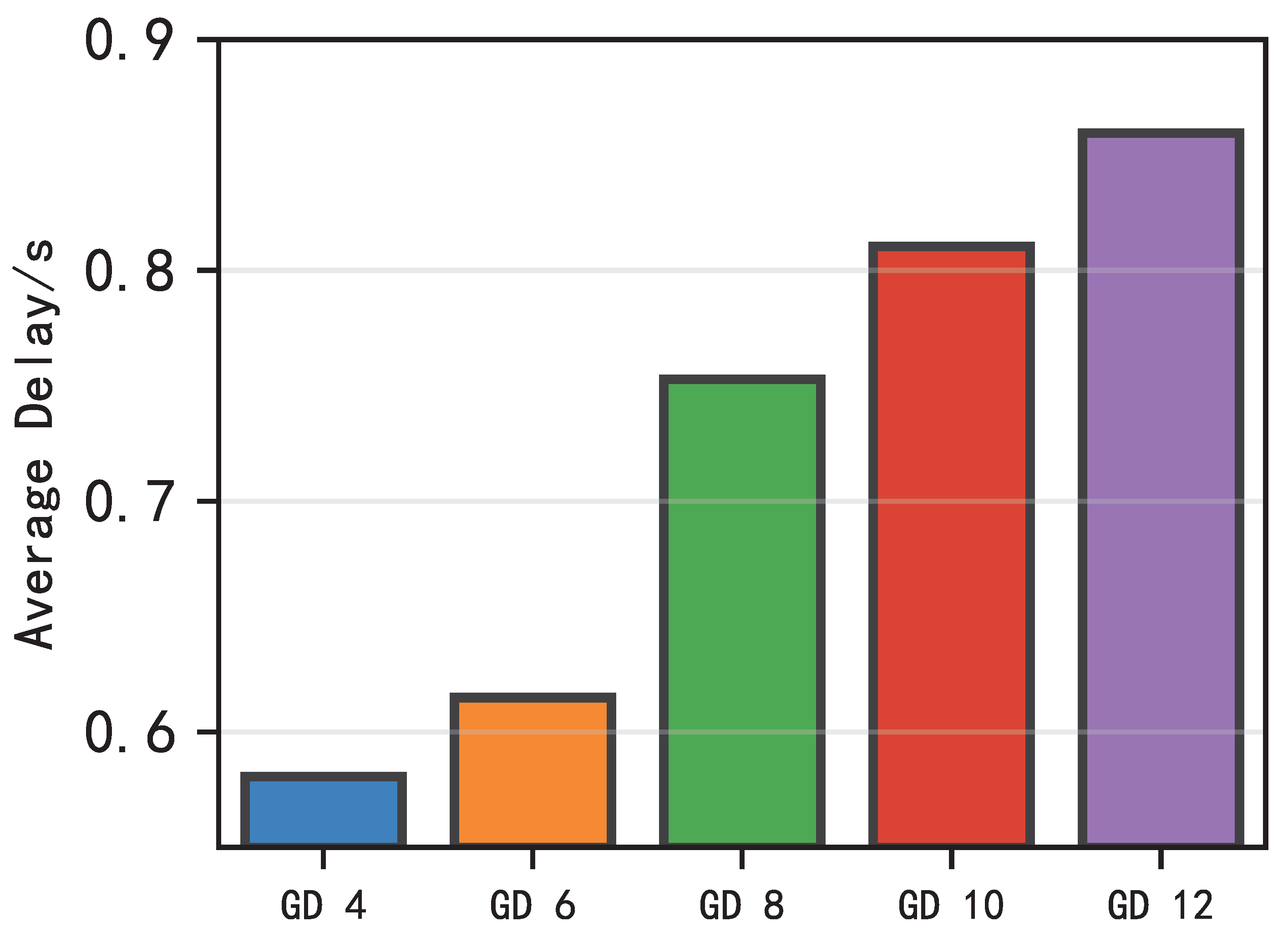
(10) Comparative analysis of average delay under different numbers of ground devices
Figure 13 compares the variations in average delay achieved by the HC-AVOA algorithm under the proposed two-stage offloading model as the number of ground devices increases from 4 to 12.
As shown in Figure 13, the average system delay increases steadily as the number of ground devices grows, although the growth trend remains relatively moderate. This is because an increase in the number of ground devices leads to a corresponding increase in the number of generated tasks, thereby enlarging the overall computational workload. In addition, to maintain load balancing, extra time is required to trade off processing delay and load distribution. As the task volume increases, the load balancing mechanism needs to be more actively engaged, which further contributes to delay. Moreover, while the number of ground devices increases, the computational resources of UAVs and satellites remain fixed. Consequently, the increased number of tasks requires more time to be processed, resulting in higher average delay. Nevertheless, all tasks can still be processed normally and efficiently.

6.3. Optimization Performance Discussion

HC-AVOA employs a hunger-rate-driven exploration–exploitation switching mechanism, enabling strong global exploration in early iterations and gradual convergence to a stable solution region in later stages, thereby ensuring convergence toward high-quality solutions. In addition, the dual-leader mechanism simultaneously incorporates information from the global best and suboptimal solutions, guiding the population toward multiple promising regions of the search space. This effectively reduces the risk of premature convergence caused by single-leader information bias and increases the probability of obtaining superior solutions.
Experimental results further verify that the proposed two-stage offloading model performs offloading decisions twice: first from ground devices to UAVs, and then from UAVs to satellites. Through cooperative optimization of these offloading strategies, the model effectively reduces task execution delay while improving UAV load balancing. HC-AVOA achieves a dynamic balance between global exploration and local refinement, demonstrating superior delay performance and convergent load balancing. Moreover, it maintains stable and reliable performance under varying task loads and different numbers of ground devices, indicating robust and practical service capability.

7. Conclusions

This paper addresses scenarios with scarce communication resources and proposes a SAGIN task offloading strategy that integrates a double-stage offloading mechanism with load balancing optimization. In the double-stage offloading model, the proposed Hierarchical Cooperative African Vulture Optimization Algorithm (HC-AVOA) makes two offloading decisions, optimizing task offloading from ground devices to UAVs and from UAVs to satellites. Within the energy consumption tolerance, it reduces computational task delay and achieves load balancing among UAVs. Experimental results demonstrate that HC-AVOA, tailored for the double-layer offloading model, exhibits superior performance in multi-objective cooperative optimization compared to traditional optimization algorithms. To further enhance the SAGIN system, future research will explore task characteristic modeling in complex, dynamic, and heterogeneous environments, aiming to improve the system’s adaptability and robustness in real-world scenarios.

Author Contributions

Conceptualization, H.R. and Y.T.; methodology, H.R. and Y.T.; software, H.R.; validation, H.R.; formal analysis, H.R.; investigation, H.R.; resources, H.R.; data curation, H.R.; writing—original draft preparation, H.R.; writing—review and editing, H.R.; visualization, H.R.; supervision, H.R. and Y.T.; project administration, Y.T.; funding acquisition, Y.T. All authors have read and agreed to the published version of the manuscript.

Funding

This work was supported by the Qinghai Province Applied Basic Research Program (Grant No. 2023-ZJ-713).

Data Availability Statement

The system code in the article has been released to https://gitee.com/trfdtfgt/SAGIN.git (accessed on 30 December 2025).

Conflicts of Interest

The authors declare no conflicts of interest.

Abbreviations

The following abbreviations are used in this manuscript:
6GSixth-generation
SAGINSpace–Air–Ground Integrated Network
IoTInternet of Things
UAVUnmanned aerial vehicle
UAVsUnmanned Aerial Vehicles
LEOLow Earth orbit
CPUCentral Processing Unit
PSOParticle Swarm Optimization
WaOAWalrus Optimization Algorithm
ESOAEgret Swarm Optimization Algorithm
ABCArtificial Bee Colony
AVOAAfrican Vulture Optimization Algorithm
HC-AVOAHierarchical Cooperative African Vulture Optimization Algorithm

References

  1. Wang, E.; Li, D.; Dong, B.; Zhou, H.; Zhu, M. Flat and hierarchical system deployment for edge computing systems. Future Gener. Comput. Syst. 2020, 105, 308–317. [Google Scholar] [CrossRef]
  2. Ye, J.; Dang, S.; Shihada, B.; Alouini, M.S. Space-air-ground integrated networks: Outage performance analysis. IEEE Trans. Wirel. Commun. 2020, 19, 7897–7912. [Google Scholar] [CrossRef]
  3. Qi, F.; Mang, G.; Zhang, S.; Liu, L. A multi-layer architecture for space-air-ground network and IoT services. In Proceedings of the 2021 International Wireless Communications and Mobile Computing (IWCMC), Harbin City, China, 28 June–2 July 2021; IEEE: Piscataway, NJ, USA, 2021; pp. 1809–1813. [Google Scholar] [CrossRef]
  4. Liu, Y.; Jiang, L.; Qi, Q.; Xie, K.; Xie, S. Online computation offloading for collaborative space/aerial-aided edge computing toward 6G system. IEEE Trans. Veh. Technol. 2023, 73, 2495–2505. [Google Scholar] [CrossRef]
  5. Nguyen, M.D.; Le, L.B.; Girard, A. Computation offloading, UAV placement, and resource allocation in SAGIN. In Proceedings of the 2022 IEEE Globecom Workshops (GC Wkshps), Rio de Janeiro, Brazil, 4–8 December 2022; IEEE: Piscataway, NJ, USA, 2022; pp. 1413–1418. [Google Scholar] [CrossRef]
  6. Fang, X.; Feng, W.; Chen, Y.; Ge, N.; Jin, S.; Mao, S. 6G Space–Air–Ground Integrated Networks for Unmanned Operations: Closed-Loop Model and Task-Oriented Approach. Engineering 2025. [Google Scholar] [CrossRef]
  7. Tang, F.; Wen, C.; Chen, X.; Kato, N. Federated learning for intelligent transmission with space-air-ground integrated network toward 6G. IEEE Netw. 2022, 37, 198–204. [Google Scholar] [CrossRef]
  8. McEnroe, P.; Wang, S.; Liyanage, M. A survey on the convergence of edge computing and AI for UAVs: Opportunities and challenges. IEEE Internet Things J. 2022, 9, 15435–15459. [Google Scholar] [CrossRef]
  9. Li, J.; Xue, K.; Wei, D.S.; Liu, J.; Zhang, Y. Energy efficiency and traffic offloading optimization in integrated satellite/terrestrial radio access networks. IEEE Trans. Wirel. Commun. 2020, 19, 2367–2381. [Google Scholar] [CrossRef]
  10. Zhu, X.; Jiang, C. Integrated satellite-terrestrial networks toward 6G: Architectures, applications, and challenges. IEEE Internet Things J. 2021, 9, 437–461. [Google Scholar] [CrossRef]
  11. Shen, Z.; Jin, J.; Tan, C.; Tagami, A.; Wang, S.; Li, Q.; Zheng, Q.; Yuan, J. A survey of next-generation computing technologies in space-air-ground integrated networks. ACM Comput. Surv. 2023, 56, 1–40. [Google Scholar] [CrossRef]
  12. Zhu, S.; Hu, J.; Yang, C.; Chai, Z. Offloading Decision Optimization in the Cloud Edge Collaborative Computing Scenario of Smart City Early Warning System. J. Beijing Univ. Technol. 2023, 49, 1007–1015. [Google Scholar] [CrossRef]
  13. Xu, X.; Huang, Q.; Yin, X.; Abbasi, M.; Khosravi, M.R.; Qi, L. Intelligent offloading for collaborative smart city services in edge computing. IEEE Internet Things J. 2020, 7, 7919–7927. [Google Scholar] [CrossRef]
  14. Chen, Y.; Tong, Y. Joint Optimization of UAV Trajectories and Computational Offloading for Space-Air-GroundIntegrated Networks. Comput. Sci. 2025, 52, 74–84. [Google Scholar] [CrossRef]
  15. Zhang, J.; Zhang, J.; Shen, F.; Yan, F.; Bu, Z. DOGS: Dynamic Task Offloading in Space-Air-Ground Integrated Networks with Game-Theoretic Stochastic Learning. IEEE Internet Things J. 2024, 12, 1655–1672. [Google Scholar] [CrossRef]
  16. Liu, L.; Mao, W.; Li, W.; Tan, S.; Jin, T. Task Offloading Strategy Based on Game Theory in the Space-Air-Ground Integrated Edge Computing Networks. Comput. Eng. 2025, 51, 238–249. [Google Scholar] [CrossRef]
  17. Huang, C.; Chen, G.; Xiao, P.; Xiao, Y.; Han, Z.; Chambers, J.A. Joint offloading and resource allocation for hybrid cloud and edge computing in SAGINs: A decision assisted hybrid action space deep reinforcement learning approach. IEEE J. Sel. Areas Commun. 2024, 42, 1029–1043. [Google Scholar] [CrossRef]
  18. Rahmati, I.; Shah-Mansouri, H.; Movaghar, A. QECO: A QoE-Oriented Computation Offloading Algorithm based on Deep Reinforcement Learning for Mobile Edge Computing. IEEE Trans. Netw. Sci. Eng. 2025, 12, 3118–3130. [Google Scholar] [CrossRef]
  19. Zhou, G.; Zhao, L.; Zheng, G.; Song, S.; Zhang, J.; Hanzo, L. Multiobjective optimization of space–air–ground-integrated network slicing relying on a pair of central and distributed learning algorithms. IEEE Internet Things J. 2023, 11, 8327–8344. [Google Scholar] [CrossRef]
  20. Nguyen, M.D.; Le, L.B.; Girard, A. Integrated computation offloading, UAV trajectory control, edge-cloud and radio resource allocation in SAGIN. IEEE Trans. Cloud Comput. 2023, 12, 100–115. [Google Scholar] [CrossRef]
  21. Akhter, N.; Mahmud, R.; Jin, J.; But, J.; Ahmad, I.; Xiang, Y. Configurable harris hawks optimisation for application placement in space-air-ground integrated networks. IEEE Trans. Netw. Serv. Manag. 2024, 21, 1724–1736. [Google Scholar] [CrossRef]
  22. Li, H.; Yu, J.; Cao, L.; Zhang, Q.; Song, Z.; Hou, S. Multi-agent reinforcement learning based computation offloading and resource allocation for LEO Satellite edge computing networks. Comput. Commun. 2024, 222, 268–276. [Google Scholar] [CrossRef]
  23. Chen, Q.; Meng, W.; Han, S.; Li, C. Service-oriented fair resource allocation and auction for civil aircrafts augmented space-air-ground integrated networks. IEEE Trans. Veh. Technol. 2020, 69, 13658–13672. [Google Scholar] [CrossRef]
  24. Cui, H.; Zhang, J.; Geng, Y.; Xiao, Z.; Sun, T.; Zhang, N.; Liu, J.; Wu, Q.; Cao, X. Space-air-ground integrated network (SAGIN) for 6G: Requirements, architecture and challenges. China Commun. 2022, 19, 90–108. [Google Scholar] [CrossRef]
  25. Lin, Z.; Lin, M.; Wang, J.B.; De Cola, T.; Wang, J. Joint beamforming and power allocation for satellite-terrestrial integrated networks with non-orthogonal multiple access. IEEE J. Sel. Top. Signal Process. 2019, 13, 657–670. [Google Scholar] [CrossRef]
  26. Li, Z.; Chen, P. Risk-aware distributionally robust optimization for mobile edge computation task offloading in the space–air–ground integrated network. Sensors 2023, 23, 5729. [Google Scholar] [CrossRef]
  27. Burd, T.D.; Brodersen, R.W. Processor design for portable systems. J. VLSI Signal Process. Syst. Signal Image Video Technol. 1996, 13, 203–221. [Google Scholar] [CrossRef]
  28. Abdollahzadeh, B.; Gharehchopogh, F.S.; Mirjalili, S. African vultures optimization algorithm: A new nature-inspired metaheuristic algorithm for global optimization problems. Comput. Ind. Eng. 2021, 158, 107408. [Google Scholar] [CrossRef]
  29. Chen, Y.; Tong, Y. Computation Offloading in Space–Air–Ground Integrated Networks for Diverse Task Requirements with Integrated Reliability Mechanisms. Future Internet 2025, 17, 542. [Google Scholar] [CrossRef]
  30. Kennedy, J.; Eberhart, R. Particle swarm optimization. In Proceedings of the ICNN’95—International Conference on Neural Networks, Perth, Australia, 27 November–1 December 1995; IEEE: Piscataway, NJ, USA, 1995; Volume 4, pp. 1942–1948. [Google Scholar] [CrossRef]
  31. Chen, Z.; Francis, A.; Li, S.; Liao, B.; Xiao, D.; Ha, T.T.; Li, J.; Ding, L.; Cao, X. Egret swarm optimization algorithm: An evolutionary computation approach for model free optimization. Biomimetics 2022, 7, 144. [Google Scholar] [CrossRef]
  32. Basturk, B. An artificial bee colony (ABC) algorithm for numeric function optimization. In Proceedings of the IEEE Swarm Intelligence Symposium, Indianapolis, IN, USA, 12–14 May 2006; pp. 1–12. [Google Scholar]
  33. Trojovský, P.; Dehghani, M. Walrus optimization algorithm: A new bio-inspired metaheuristic algorithm. Res. Sq. 2022. [Google Scholar] [CrossRef]
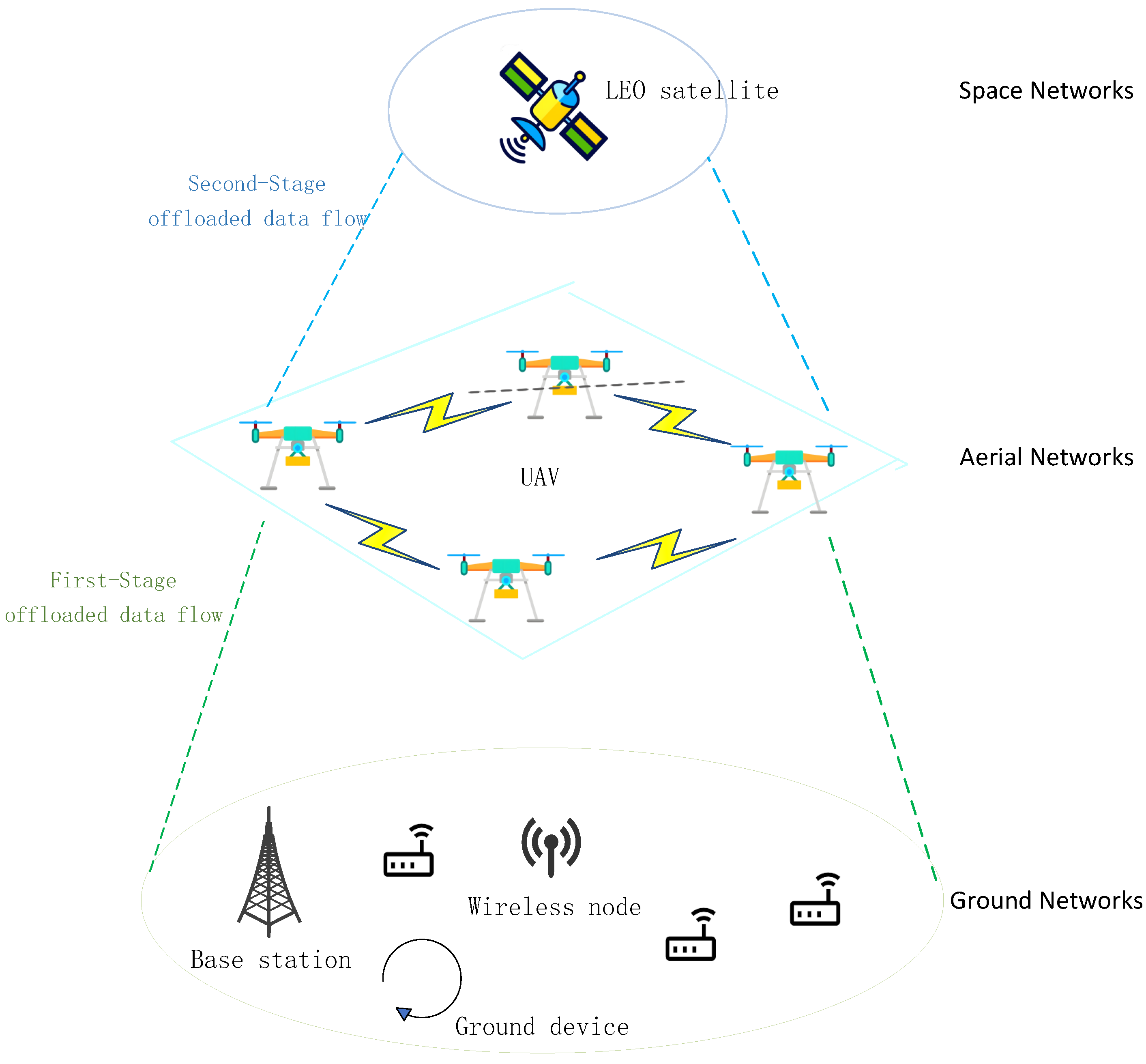
Figure 1. SAGIN Three-Tier Framework.
Futureinternet 18 00043 g001
Figure 2. Two-Stage Decision Offloading Flowchart.
Futureinternet 18 00043 g002
Figure 3. Convergence comparison between the two-stage offloading model and the single-stage offloading model.
Futureinternet 18 00043 g003
Figure 4. Comparison of reward values between the two-stage offloading model and the single-stage offloading model.
Futureinternet 18 00043 g004
Figure 5. Average delay comparison between the two-stage offloading model and the single-stage offloading model.
Futureinternet 18 00043 g005
Figure 6. Load imbalance comparison between the two-stage offloading model and the single-stage offloading model.
Futureinternet 18 00043 g006
Figure 7. Comparison of HC-AVOA with PSO, WaOA, ESOA, and ABC reward values.
Futureinternet 18 00043 g007
Figure 8. Comparison of average delay for HC-AVOA with PSO, WaOA, ESOA, and ABC.
Futureinternet 18 00043 g008
Figure 9. Comparison of load imbalance for HC-AVOA with PSO, WaOA, ESOA, and ABC.
Futureinternet 18 00043 g009
Figure 10. Load imbalance comparison under different task quantities.
Futureinternet 18 00043 g010
Figure 11. Delay comparison under different task quantities.
Futureinternet 18 00043 g011
Figure 12. Load imbalance comparison under different ground devices.
Futureinternet 18 00043 g012
Figure 13. Average delay comparison under different ground devices.
Futureinternet 18 00043 g013
Table 1. Simulation Parameters.
ParameterValue
Number of ground devices m10
Number of UAVs u4
Ground device bandwidth B m , u ≈1 MHz
UAV bandwidth B u , s ≈5 MHz
Ground device transmit power P m 0.1 W
UAV transmit power P u ≈1 W
Ground device computing capability f m 0.3 GHz
UAV computing capability f u 0.5 GHz
Satellite computing capability f s ≈1 GHz
Disclaimer/Publisher’s Note: The statements, opinions and data contained in all publications are solely those of the individual author(s) and contributor(s) and not of MDPI and/or the editor(s). MDPI and/or the editor(s) disclaim responsibility for any injury to people or property resulting from any ideas, methods, instructions or products referred to in the content.