This is an early access version, the complete PDF, HTML, and XML versions will be available soon.
Article

Synergistic Phishing Intrusion Detection: Integrating Behavioral and Structural Indicators with Hybrid Ensembles and XAI Validation


1
School of Information Technology, University of Cincinnati, Cincinnati, OH 45221, USA
2
Information Technology and Analytics Center (ITAC), School of Information Technology, University of Cincinnati, Cincinnati, OH 45221, USA
*
Author to whom correspondence should be addressed.
Future Internet 2026, 18(1), 30; https://doi.org/10.3390/fi18010030
Submission received: 23 November 2025 / Revised: 18 December 2025 / Accepted: 31 December 2025 / Published: 4 January 2026
(This article belongs to the Special Issue Anomaly and Intrusion Detection in Networks)

Abstract

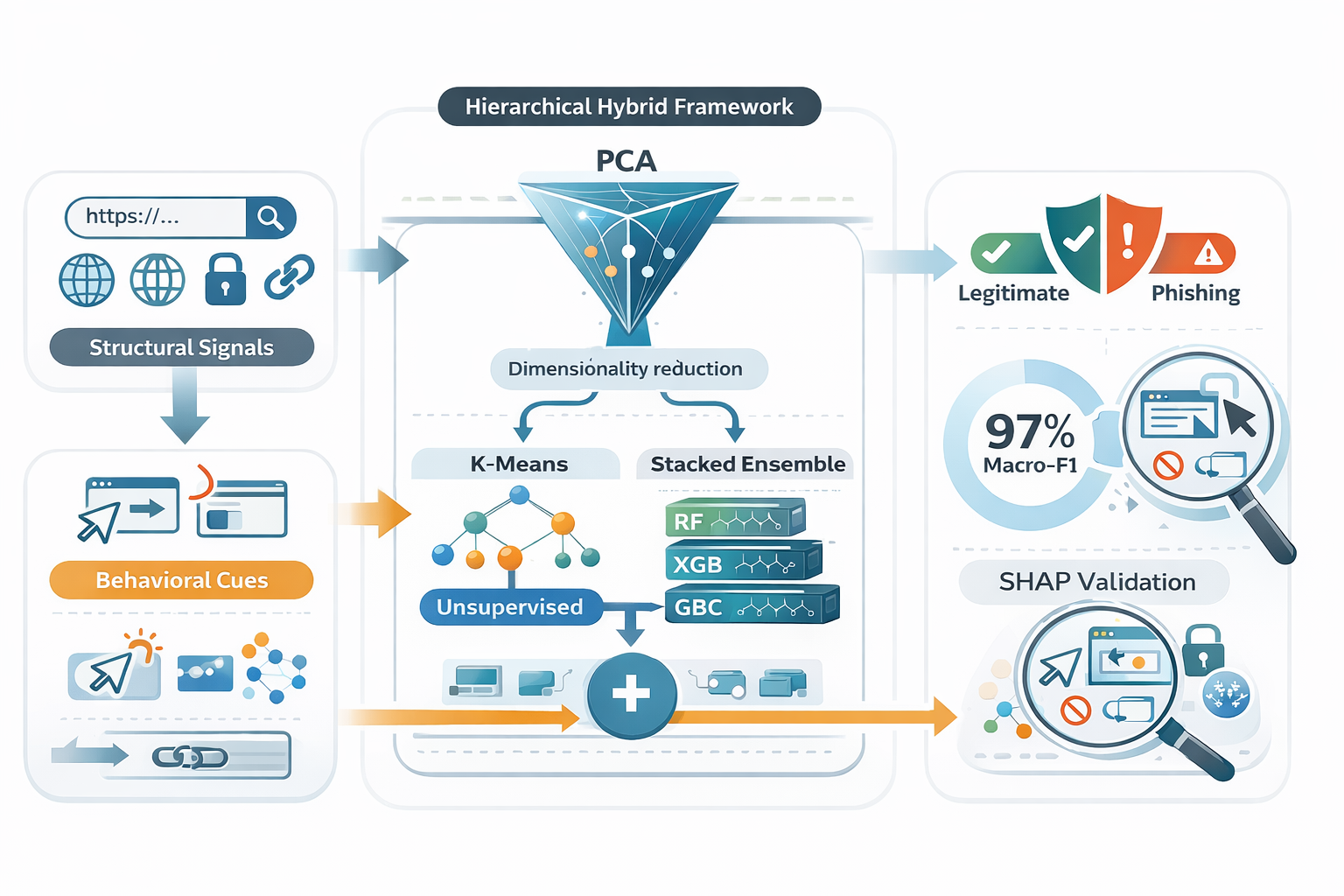
Phishing websites continue to evolve in sophistication, making them increasingly difficult to distinguish from legitimate platforms and challenging the effectiveness of current detection systems. In this study, we investigate the role of subtle deceptive behavioral cues such as mouse-over effects, pop-up triggers, right-click restrictions, and hidden iframes in enhancing phishing detection beyond traditional structural and domain-based indicators. We propose a hierarchical hybrid detection framework that integrates dimensionality reduction through Principal Component Analysis (PCA), phishing campaign profiling using K Means clustering, and a stacked ensemble classifier for final prediction. Using a public phishing dataset, we evaluate multiple feature configurations to quantify the added value of behavioral indicators. The results demonstrate that behavioral indicators, while weak predictors in isolation, significantly improve performance when combined with conventional features, achieving a macro F1 score of 97 percent. Explainable AI analysis using SHAP confirms the contribution of specific behavioral characteristics to model decisions and reveals interpretable patterns in attacker manipulation strategies. This study shows that behavioral interactions leave measurable forensic signatures and provides evidence that combining structural, domain, and behavioral features offers a more comprehensive and reliable approach to phishing intrusion detection.
Keywords: phishing detection; behavioral features; ensemble learning; explainable artificial intelligence (XAI); cybersecurity phishing detection; behavioral features; ensemble learning; explainable artificial intelligence (XAI); cybersecurity
Graphical Abstract