Article

Ontology-Driven Emotion Multi-Class Classification and Influence Analysis of User Opinions on Online Travel Agency

by
Putri Utami Rukmana
1,
Muharman Lubis
1,*,
Hanif Fakhrurroja
1,2,*,
Asriana
1 and
Alif Noorachmad Muttaqin
1
1
Master of Information System Study Program, School of Industrial Engineering, Telkom University, Main Campus (Bandung Campus), Jl. Telekomunikasi no. 1, Bandung 40257, West Java, Indonesia
2
Research Center for Smart Mechatronics, National Research and Innovation Agency, Jl. Sangkuriang, Dago, Bandung 40135, West Java, Indonesia
*
Authors to whom correspondence should be addressed.
Future Internet 2025, 17(12), 582; https://doi.org/10.3390/fi17120582
Submission received: 13 October 2025 / Revised: 20 November 2025 / Accepted: 20 November 2025 / Published: 17 December 2025

Abstract

The rise in social media has transformed Online Travel Agencies (OTAs) into platforms where users actively share their experiences and opinions. However, conventional opinion mining approaches often fail to capture nuanced emotional expressions or connect them to user influence. To address this gap, this study introduces an ontology-driven opinion mining framework that integrates multi-class emotion classification, aspect-based analysis, and influence modeling using Indonesian-language discussions from the social media platform X. The framework combines an OTA-specific ontology that formally represents service aspects such as booking support, financial, platform experience, and event with fine-tuned IndoBERT for emotion recognition and sentiment polarity detection, and Social Network Analysis (SNA) enhanced by entropy weighting and TOPSIS to quantify and rank user influence. The results show that the fine-tuned IndoBERT performs strongly with respect to identification and sentiment polarity detection, with moderate results for multi-class emotion classification. Emotion labels enrich the ontology by linking user opinions to their affective context, enabling the deeper interpretation of customer experiences and service-related issues. The influence analysis further reveals that structural network properties, particularly betweenness, closeness, and eigenvector centrality, serve as the primary determinants of user influence, while engagement indicators act as discriminative amplifiers that highlight users whose content attains high visibility. Overall, the proposed framework offers a comprehensive and interpretable approach to understanding public perception in Indonesian-language OTA discussions. It advances opinion mining for low-resource languages by bridging semantic ontology modeling, emotional understanding, and influence analysis, while providing practical insights for OTAs to enhance service responsiveness, manage emotional engagement, and strengthen digital communication strategies.

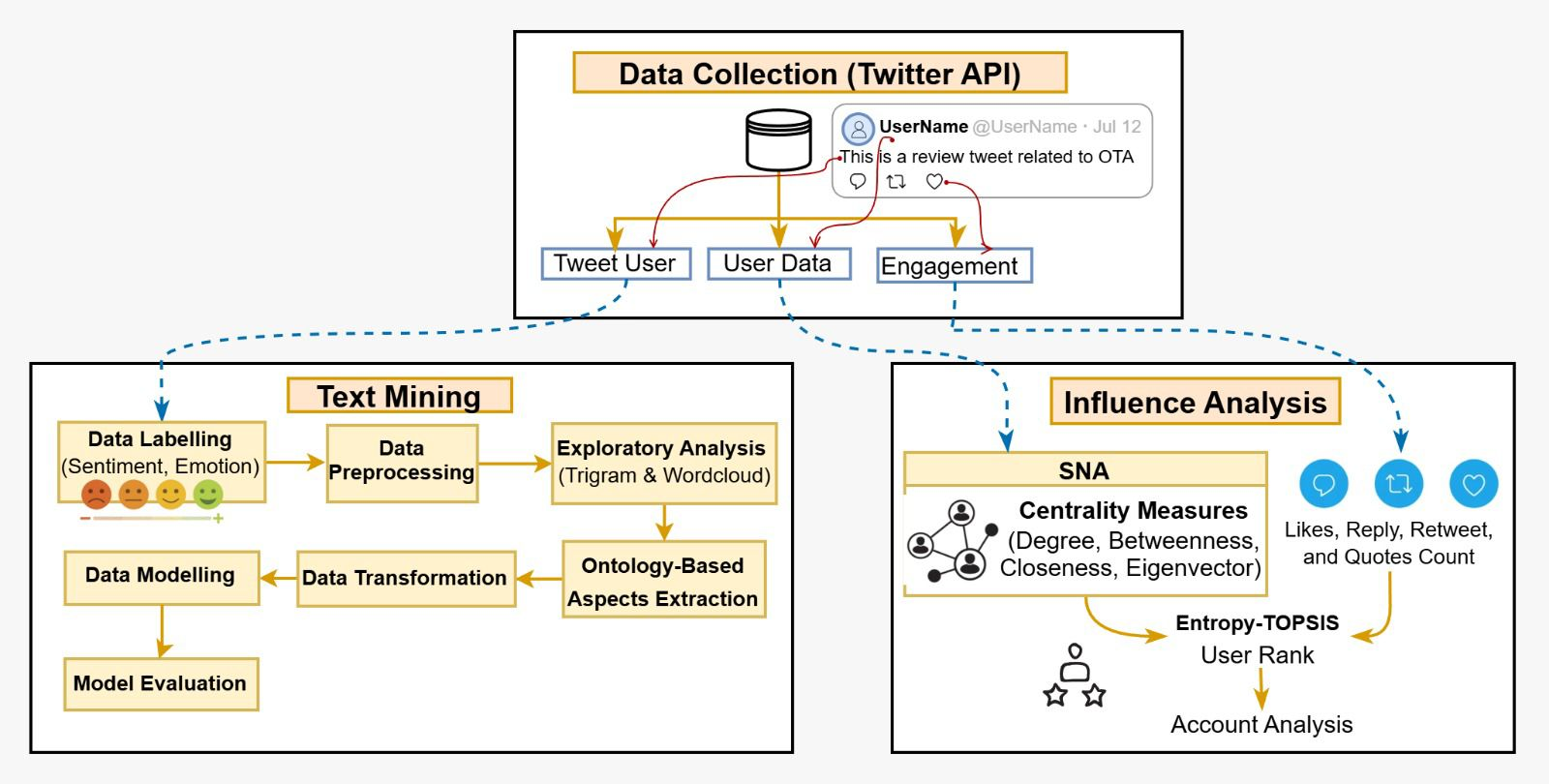
Graphical Abstract

1. Introduction

The exponential growth of user-generated content on social media has fundamentally changed how organizations monitor and respond to public opinion. Platforms of social media such as X (formerly Twitter) have evolved into rich repositories of real-time customer feedback, providing insights into user satisfaction, service quality, and brand perception [1,2,3]. In the highly competitive Online Travel Agency (OTA) sector, where service differentiation is often limited, understanding customer emotions and influence dynamics has become essential for sustaining competitiveness and improving service delivery. In Indonesia, major OTAs such as Traveloka, Tiket.com, and Agoda [4] somehow collectively serve millions of users and generate massive volumes of social media interactions. These interactions often contain emotionally charged expressions that reflect user experiences with booking processes, customer support, payment systems, refunds, and promotional offers. However, conventional sentiment analysis approaches commonly based on keyword matching or binary positive and negative polarity classification of [5,6,7,8] struggle to capture nuanced emotional states such as anger, joy, sadness, fear, surprise, and kind of disgust [9,10].
Recent advancements in Natural Language Processing (NLP), ontology engineering, and Social Network Analysis (SNA) offer new opportunities for more comprehensive opinion mining. The opinion mining presented here is performed at the aspect level, concentrating on the emotional dimension of user opinions. These analyzed opinions are user-generated expressions on X concerning three key OTA service categories: Financial, Booking and Support, and Platform Experience. The analysis covers critical sub-aspects such as refunds, application errors, customer service, and ticket orders. Ontologies are fundamental representations for modeling a knowledge domain [11]. They are formal knowledge structures that define concepts and their relationships, enabling the capture of nuance and meaning in richer contexts [12]. Transformer-based models such as IndoBERT have demonstrated strong capabilities in capturing semantic and contextual nuances in Indonesian texts [13]. Meanwhile, SNA techniques allow for the quantification of user influence within a network using metrics such as degree, betweenness, closeness, and eigenvector centrality [8,14,15,16,17].
The SNA employed in this study is a form of structural influence detection, specifically focused on quantifying user influence within the OTA conversation network on X. This analysis is constructed from reply and mention relationships among users. In this context, user influence is defined as the combined impact of a user’s structural position within the network and their engagement intensity in conversations. Structural influence is measured through a combination of centrality metrics, including degree, betweenness, closeness, and eigenvector, while interaction influence is captured through engagement indicators such as retweets, replies, quotes, and favorites. To drive an objective, data-driven influence scores representing each user’s relative capacity to disseminate opinions and shape public perception, these heterogeneous indicators are integrated using a Multi-Criteria Decision Analysis (MCDA) framework specifically Technique for Order Preference by Similarity to Ideal Solution (TOPSIS) and entropy weighting, these metrics can be aggregated into a robust influence score [15,16,18].
Despite these advancements, integrated research that combines ontology-based emotion classification, SNA, and MCDA for the Indonesian OTA domain remains scarce. Existing studies often focus solely on sentiment [5,6,7,8] or emotion classification without considering the network structure [19,20,21,22] or conduct SNA without incorporating the emotional dimension of user-generated content [5,7,8,23,24,25,26,27]. This lack of integration limits the ability to gain a holistic understanding of what users feel and how their opinions propagate within online social networks. To address this gap, this study proposes an integrated framework that unifies three core components: (1) the development of an OTA-specific ontology to formally map service aspects such as booking support, financial, platform experience, and event to emotion categories derived from Ekman’s model, and (2) the incorporation of Social Network Analysis metrics, combined with TOPSIS and entropy weighting, to quantify and rank user influence in OTA-related online conversations. By integrating semantic aspect mapping, fine-grained emotion recognition, and influence measurement, the proposed approach provides OTA service providers with actionable intelligence to improve customer engagement strategies, prioritize high-impact service issues, and enhance brand competitiveness in the dynamic digital marketplace.

2. Related Work

2.1. Ontology-Based Text Mining

The term ontology originated in 1613, introduced by philosophers Rudolf Gockel (Goclenius) and Jacob Lorhard (Lorhardus), and was later recorded in the Oxford English Dictionary as “an account of being in the abstract”, referring to the classification of definitive and complete entities across domains [28]. Its modern application in computer science, particularly in the Semantic Web, is formalized through the Ontology Web Language (OWL), a W3C-recommended standard built upon RDF and RDFS. OWL enables formal and structured domain knowledge representation using classes, relations, instances, and logical axioms, allowing for semantic reasoning [29,30,31].
In text mining, ontology serves as a bridge between unstructured language and structured semantic frameworks, supporting feature extraction, aspect mapping, and emotion classification [11,12,32,33]. Ontology-based sentiment analysis has been applied to social media contexts where domain-specific vocabularies and varied emotional expressions demand richer semantic representation. One notable approach is TweetOntoSense [34], which integrates three interconnected ontologies covering social media messages, discussed entities, and expressed emotions. Linked through semantic relations such as isExpressedBy and hasEmotion. This design enables context-aware sentiment detection by capturing not only the textual content but also its relational and emotional dimensions. Prior studies have demonstrated several ontology-based applications: (1) domain-specific feature extraction to enhance aspect-based classification [1,35,36,37], (2) semantic representation by embedding domain knowledge into classification pipelines [1,19,36], (3) ontology-driven emotion classification grounded in psychological theories [19,20,22,37], and (4) ontology enrichment to address variations in semantic expressions [20]. Despite these advances, most studies remain limited to basic sentiment polarity labels (positive, negative, and neutral) and rarely integrate psychological emotion theories in a systematic manner, especially in the context of Indonesian-language datasets. This study addresses these gaps by integrating ontology, emotion theory, and domain-specific aspect modeling for Online Travel Agency (OTA) services, enabling more nuanced, semantically grounded sentiment analysis of social media content.

2.2. Social Network Analysis for Influencer Detection

Social Network Analysis (SNA) has been widely applied to identify network structures and influential actors across various domains. Fundamental centrality measures such as degree, betweenness, and closeness, are among the most frequently used metrics [5,7,23]. However, many studies apply these indicators in isolation, without integrating them into a structured evaluation framework. More recent approaches incorporate user interaction and tweet engagement metrics including retweets, replies, likes, and quotes into influence assessments [25,26]. Yet, these remain largely descriptive and lack systematic weighting methods. To address this gap, Multi-Criteria Decision Making (MCDM) techniques, particularly TOPSIS combined with entropy weighting, have proven effective in producing objective and comprehensive influencer rankings. TOPSIS enables the aggregation of multiple centrality and engagement indicators into a single influence score, while entropy weighting assigns data-driven weights based on the informational variance of each metric [18,38].
In principle, SNA models networks as graphs in which nodes (e.g., individuals, teams, organizations, or concepts) are connected by edges representing relationships or interactions [39]. This structure allows for quantifying and qualifying contributions to a domain over time through graph-theoretic measures [40]. In social media contexts, the process of influence refers to the ability of a user to disseminate information, shape opinions, and trigger reactions within an online network. It is not limited to follower count but emerges from two complementary dimensions: structural influence, reflected in a user’s position and connectivity within the network (degree, betweenness, closeness, and eigenvector centrality) and interaction influence, reflected in engagement metrics such as retweets, replies, quotes, and favorites. This study combines both dimensions through Multi-Criteria Decision Analysis (MCDA) using the entropy weighting and TOPSIS methods to derive a composite, objective influence score.

3. Methodology

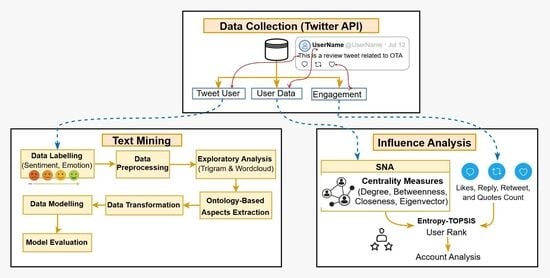
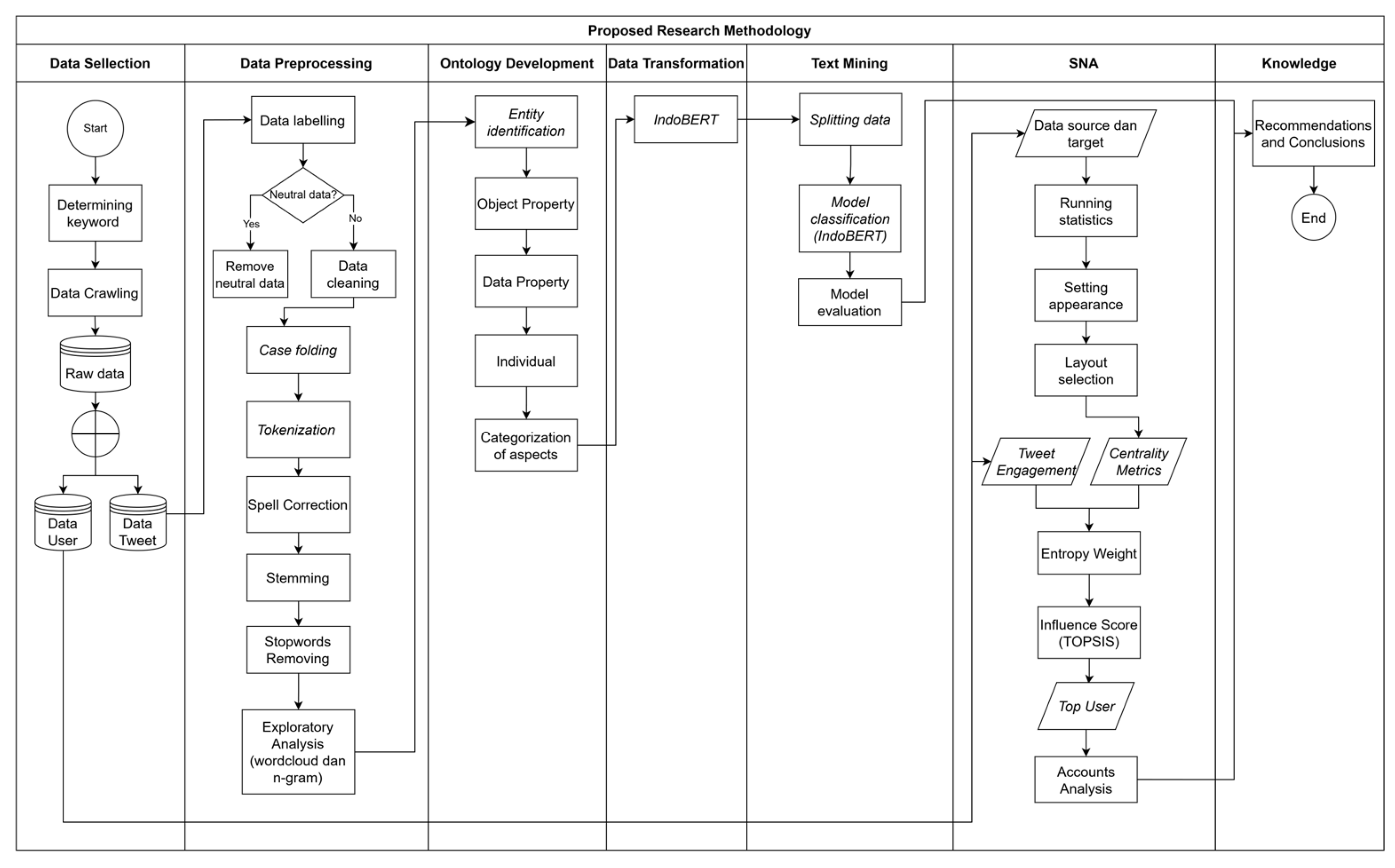
The overall research workflow is illustrated in figure below, outlining the sequential integration of ontology construction, text mining, and SNA.
Figure 1 presents the stages proposed in this study step by step, which include data selection, preprocessing, ontology development, data transformation, text mining, and social network analysis leading to knowledge generation.

3.1. Data Selection

This research focuses on the user review data such as tweets from the social media platform X with regard to Traveloka, Tiket.com, and Agoda, which are the three major Indonesian Online Travel Agencies (OTAs). The data were collected using Tweet Harvest via the Twitter API, with retrieval parameters customized based on language and time period. Only tweets written in Indonesian language were included by applying the language filter “id”, and the collection period was defined from 1 January to 31 December 2023. This data set was used to conduct both ontology-based sentiment analysis and Social Network Analysis (SNA).

3.2. Data Preprocessing

This stage plays a critical role in ensuring data quality prior to further analytical processing. It involves a series of preprocessing techniques, including sentiment and emotion labeling, data cleaning, case folding, tokenization, spell correction, stopword removal, and stemming. Then, emotion and sentiment labels were initially assigned using a semi-automatic approach. Label definitions were first established based on Ekman’s emotion categories and binary sentiment polarity. A Generative AI model (GPT-5) was employed under a new and isolated account to generate initial label suggestions according to these predefined criteria. The model generated preliminary labels, which were manually reviewed and validated by two human annotators to ensure consistency and contextual accuracy. To assess the reliability of the human-validation process, the Inter-Annotator Agreement (IAA) was measured using Cohen’s kappa. The resulting agreement scores for both sentiment and emotion categories are presented in Table 1.
Table 1 presents the IAA scores computed using Cohen’s Kappa for both sentiment and emotion-labeling tasks. The sentiment labels achieved a kappa value of 0.73, indicating substantial agreement, which is expected given the clearer polarity boundary between positive and negative sentiments. In contrast, the emotion labels obtained a lower kappa score of 0.58, reflecting moderate agreement due to the higher conceptual overlap among negative emotions such as anger, sadness, and fear as well the nuanced linguistic expressions, which commonly found in informal Indonesian social media text. The overall average kappa score is 0.65 (65%), demonstrating that the annotation process is reliable and meets acceptable standards for downstream model training, while also highlighting the inherent complexity of fine-grained emotion annotation in low-resource language contexts. Meanwhile, Table 2 presents the number of total tweets collected, tweets retained after the data cleaning stage which excluded neutral sentiment tweets, and the subsequent preprocessing steps including case folding, spell correction, and stemming. Traveloka shows the highest number of tweets across all stages, followed by Tiket.com and Agoda. The total token count and average tokens per tweet are relatively similar across platforms, indicating consistent tweet length. The number of unique tokens decreases after the stemming stage for all platforms, reflecting the normalization of word forms during text preprocessing.
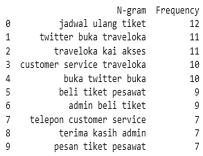
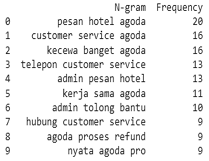
An exploratory analysis is conducted to gain initial insights into the structure and thematic tendencies of the dataset. This analysis employs two main approaches: word frequency visualization using word clouds and sequential analysis using n-gram (trigrams) models. Based on the findings from these methods, the data are then categorized into several fundamental thematic groups that reflect the dominant topics within user reviews. Finally, the data are segmented by OTA platform for each identified category. Thus, the results of the exploratory analysis for each OTA are summarized in Table 3.
The findings from the exploratory analysis served as the basis for defining the service aspect categories that would be used in the subsequent stages of analysis. In this phase, the goal was to identify and conceptualize the most relevant categories in the context of OTA user reviews. Four primary categories were identified as the most frequently discussed issues:
  • Financial: A high frequency of keywords such as “refund”, “payment”, and “money” in the word cloud, along with trigram patterns like “uang customer tiketcom” (customer money tiket.com), “tiketcom penuh refund” (tiket.com full refund), and “agoda proses refund” (Agoda refund process), highlighting significant user complaints regarding financial matters. This category encompasses user statements related to service pricing, promotional offers, refund processes, delays in fund disbursement, and other financial issues. The sub-aspects grouped under this category include the following: pricing, payment, discount, and refund.
  • Booking and support: The presence of keywords such as “customer service”, “booking”, “buy ticket”, and “admin” in the word cloud, as well as trigrams like “customer service Traveloka”, “beli tiket kereta” (buy train ticket), “pesan hotel agoda” (book hotel Agoda), “jadwal ulang tiket” (reschedule ticket), and “telepon customer service” (call customer service), reflects concerns centered around the booking process and interactions with customer support. This category covers discussions related to ticket booking, cancelations or rescheduling, and various forms of user contact with support services. The identified sub-aspects within this group include the following: ticket booking, customer service, and cancelation.
  • Platform experience: The emergence of keywords such as “error”, “system”, “application”, and “feature” in the word cloud, as well as trigrams like “kecewa banget agoda” (very disappointed with Agoda) and “twitter buka Traveloka” (Twitter opens Traveloka), indicate user dissatisfaction related to the functionality and usability of the platform. This category includes reviews about system errors, bugs, crashes, or general feedback regarding the ease of use of the application. Accordingly, the sub-aspects defined here are as follows: application errors, usability, and access speed.
  • Event: This category specifically captures tweets related to ticket purchases for entertainment events, such as concerts. The reviews range from the ease of buying event tickets and user experiences during the event, to problems encountered in the ticketing process. This aspect was identified due to the prevalence of concert-related reviews, especially on Tiket.com, where keywords like “war” appeared frequently in the word cloud referring to high competition in purchasing concert tickets. Therefore, the event category is treated as a distinct theme, predominantly observed within the context of Tiket.com.
These categories were later formalized as ontology classes representing the key dimensions of OTA services. Through this ontological structure, each tweet could later be automatically associated with its corresponding service aspect, providing a semantic foundation for the integration of aspect-based emotion and sentiment analysis.

3.3. Ontology Development

An ontology was developed as a semantic representation framework for the Online Travel Agency (OTA) domain to map service aspects and contextualize user opinions and emotions expressed in Indonesian-language discussions on X. This stage goes through several process stages, as follows:
  • Domain and objective identification. This stage defined the research domain focusing on the user reviews of three OTA platforms—Traveloka, Tiket.com, and Agoda. The primary goal of the ontology is to establish a semantic structure that enables the organization of user opinions according to relevant service aspects.
  • Entity and relationship definition. Key concepts and their relationships within the OTA domain were identified. Each entity was connected through object properties that define semantic relationships between aspects.
  • Ontology structuring. The ontology was developed using a bottom-up approach, where class hierarchies and relationships were derived directly from data analysis of user-generated content. This approach ensured that the resulting ontology accurately reflected real user opinions and language use patterns. The ontology structure was implemented using the Web Ontology Language (OWL) format in Protégé, with classes, subclasses, and object properties organized progressively from data-level observations to conceptual abstraction.
  • Integration with aspect classification. The completed ontology was integrated into the classification pipeline as a semantic structure for aspect mapping. Each tweet was automatically associated with one or more service aspects represented in the ontology, allowing for context-aware and multi-label classification. The resulting aspect mappings were subsequently used as labeled data to train the machine learning models for emotion and sentiment classification.
Through these steps, the ontology acts as a bridge between semantic knowledge representation and data-driven modeling, enhancing interpretability and ensuring that the classification results align with the real contextual meanings of OTA-related user opinions.

3.4. Data Tranformation

The full IndoBERT model, including all Transformer encoder layers and classification heads, was fine-tuned jointly on the target datasets to adapt its pre-trained representations to domain-specific linguistic patterns in Indonesian. IndoBERT is a Transformer-based model pre-trained specifically on large-scale Indonesian corpora, enabling it to handle linguistic phenomena such as affixation, reduplication, and code-switching commonly found in social media text [13]. Implemented in Python 3.10 with HuggingFace Transformers and Scikit-learn, the process involved the following:
  • Tokenization with WordPiece: Tweets were segmented into WordPiece subwords using the IndoBERT vocabulary (indobenchmark/indobert-base-p2), with [CLS] prepended and [SEP] appended.
  • Insertion of Special Tokens: In addition to WordPieces, custom tokens such as [CLS] (Class Token) are added at the beginning of each input sequence and [SEP] (Separator Token) at the end of a sentence. An input sequence refers to the series of tokens (subwords) fed into the model after tokenization, including special tokens such as [CLS] at the beginning and [SEP] at the end. This differs from a natural sentence, which is a raw textual form before preprocessing or token segmentation.
  • Conversion to Numeric ID: Each WordPiece and custom token is then converted into a unique numeric ID based on the vocabulary that has been trained. The Embeddings token is further obtained by mapping these numerical IDs into solid vectors stored in a pre-trained embedding table. Each vector represents the initial lexical meaning of the WordPiece or related token. The following is an example of a process:
    Input Text: Pelayanan hotel sangat ramah dan cepat.
    WordPiece Tokenization: pelayan, ## an, hotel, sangat, ramah, dan, cepat.
    Custom Tokens: [CLS], pelayan, ## an, hotel, sangat, ramah, dan, cepat, [SEP].
    Numeric ID: [CLS] = 101, pelayan = 2345, ## an = 123, hotel = 6789, sangat = 4321, ramah = 987, dan = 54, cepat = 3210, [SEP] = 102. IDs 101 and 102 are the standard IDs for [CLS] and [SEP] in BERT.
4.
Embedding Construction: For each token, three embeddings are retrieved and summed elementwise:
E i n p u t = E t o k e n + E s e g m e n t + E p o s i t i o n
where E t o k e n represents the lexical meaning of the token; E s e g m e n t indicates the sentence origin of the token (segment ID 0 or 1); and E p o s i t i o n encodes the absolute position of the token in the sequence.
5.
Label Encoding: For the emotion classification task, categorical labels were converted into integer indices using the LabelEncoder class from the Scikit-learn library. In contrast, for the multi-label aspect classification task, the MultiLabelBinarizer class was employed to transform each set of aspect labels into a binary vector, where each dimension represents the presence (1) or absence (0) of a particular aspect category.
6.
Attention Mask Creation: Binary masks marked valid tokens (1) and padding tokens (0) to optimize encoder computation.
The output was a set of input_ids, attention_mask, and encoded labels in a HuggingFace Dataset format.

3.5. Data Modeling

IndoBERT’s Transformer encoders generated contextual embeddings, which were passed to task-specific classification [41]. Three classification heads were trained separately for emotion, sentiment, and service aspect (multi-label) prediction. IndoBERT employs stacked Transformer encoder layers capable of capturing contextual dependencies between subwords in Indonesian language text. Meanwhile, Softmax activation was applied for single-label tasks, while sigmoid was used for the multi-label task. Cross-entropy loss was employed for emotion and sentiment classification, and binary cross-entropy was used for aspect detection. The model was fine-tuned using the AdamW optimizer with a learning rate of 5 × 10⁻⁵, batch size of 16, and a maximum sequence length of 64 tokens for 50 epochs. All experiments were conducted using the HuggingFace Transformers library in Python. This setup enables the domain adaptation of IndoBERT to OTA-related Indonesian-language data, allowing the model to effectively learn emotion nuances, sentiment polarity, and aspect-specific expressions within social media contexts.

3.6. Social Network Analysis

This study applies SNA to explore network structures related to OTAs on the social media platform X. The analysis maps user relationships, identifies interaction patterns, and determines the influence of key users. The network’s topology was constructed primarily from reply relationships. To capture the varying strengths of these interactions, retweet, quote, favorite, and reply counts were incorporated as interaction weights, reflecting how widely each user’s opinions were amplified or endorsed within the network. These engagement-based weights were integrated with structural centrality metrics such as degree, betweenness, closeness, and eigenvector centrality to provide a comprehensive representation of influence. The combined indicators are then evaluated through an MCDA framework using entropy weighting and TOPSIS methods, ensuring that users with high engagement-based visibility are proportionally represented despite their limited structural connectivity.

3.6.1. SNA with Gephi

In this study, Gephi version 0.10.1 was employed as the primary tool to map and examine interaction networks derived from Twitter data.
  • Selecting relevant crawled data, extracting source (initiator) and target (recipient) users from the username and in_reply_to_screen_name fields, forming a directed graph (G) (V:E) where nodes V represent users such as individuals, organizations, or other entities and edges (E) indicate reply relationships [42,43].
  • The dataset was then imported into Gephi for network statistics computation, including the following: Average Weighted Degree provided insight into the strength of interactions; Network Diameter measured the furthest distance between users in the network; and Modularity revealed the extent to which the network could be divided into distinct communities. A higher modularity score indicated more clearly separated user clusters, often aligning with topic-specific discussions.
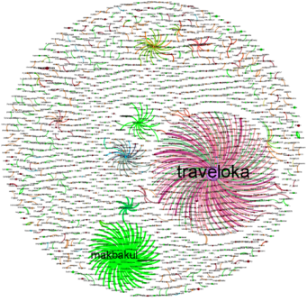
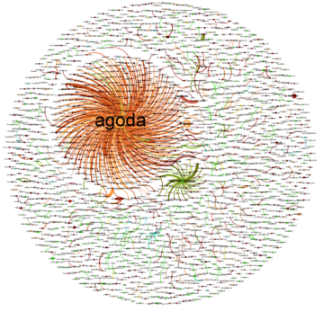
  • Network Visualization. Node colors were assigned not only according to modularity classes but also to the dominant emotion expressed, green and blue signifying positive tones (joy and positive surprise), while red, orange, and yellow marked negative expressions (anger, sadness, fear, disgust, and negative surprise). This dual color coding allowed for sentiment patterns within communities to be quickly recognized. Node sizes were scaled by weighted degree, making highly connected or influential actors more visually prominent. To optimize layout clarity, the Yifan Hu algorithm was first applied to group related nodes and minimize visual clutter [31], followed by Fruchterman Reingold to further balance spatial distribution and reduce overlaps [44,45].
  • Centrality measures. In this study, four basic centrality (degree, betweenness, closeness, and eigenvector) metrics are analyzed [42].
    • Degree centrality identifies accounts with the highest interaction activity, calculated as the sum of in-degree k i i n and out-degree k i o u t [46]. It is calculated as [47]:
      k i = k i i n + k i o u t = j a j i + j a i j
      Here, a j i equals 1 if an edge exists from j to i . The term j a j i represents the total incoming edges to i (in-degree), and j a i j represents the total outgoing edges from i (out-degree).
    • Betweenness Centrality: Measures how often a node serves as a bridge in the shortest paths among other nodes [3,12,13]. The more often a node is passed in the shortest path between other pairs of nodes, the higher the value of its centrality [48,49]. It is calculated [47], as follows:
      η v = i , j ϵ V σ i , j v σ i , j
      where σ i , j is the total number of shortest paths from node i to node j and σ i , j v is the number of those paths that pass through node v.
    • Closeness Centrality: Calculates the average of the shortest distance from one node to all other nodes. Nodes with high values have the ability to efficiently spread information throughout the network [5] with the formula used in the equation below [47]:
      C i = 1 j ϵ V d i , j
      where d i , j is the shortest distance from node i to node j and V is the set of all nodes in the network.
    • Eigenvector Centrality: Measures a node’s influence based on connections with other nodes that also have an effect. Nodes with high values play a role in strengthening the flow of information [13,14]. The metric is calculated as [47,48,50]:
      x i = 1 λ j = 1 N a i j x j
      where x i is the centrality of node i ,   x j which is the centrality value of the nodes connected to a i j which represents the element of the adjacency matrix (1 if a link exists, 0 otherwise), and λ is the largest eigenvalue of the matrix. This ensures that a node’s score is proportional to the sum of its neighbors’ centrality scores, scaled by the principal eigenvalue.

3.6.2. Influence Score

Following the network structure analysis in Gephi, centrality metrics were combined with tweet engagement features based on usernames. The merger used an outer joiner to ensure that users appearing in only one dataset were still included, with missing values (NaN) replaced by 0, indicating no recorded activity for that feature.
Entropy Weight
1.
Normalization Process: Because these features have different value ranges, normalization was applied to ensure comparability and avoid bias from high-range variables. Using MinMaxScaler, all values were rescaled to the [1] interval before weighting, using the following:
x i j = x i j min x j max x j min x j
where x i j is the value of feature j for user i. This process produced a normalized dataset in which each metric contributed equally prior to the entropy weight calculation.
2.
Entropy Weighting: The entropy weighting method was applied to determine the objective weight of each feature, encompassing both centrality and tweet engagement metrics. This method is preferred as it evaluates the diversity of information in each criterion, ensuring that features with greater variability across users are assigned higher weights. This approach minimizes subjective bias in the evaluation process [51].
  • Feature probability ( p i j ): The first step involves transforming normalized feature values into probabilities, representing the proportion of a user’s contribution to a given feature relative to all users. This is calculated by dividing the normalized value ( x i j ) by the total of that feature across all users, as shown in Equation [5,38,51,52]:
    p i j = x i j i = 1 n x i j +
    where   =   10 12 is a small constant to avoid division by zero.
  • Entropy per feature ( E j ) : Entropy, E j , measures uncertainty in feature j using the following:
    E j = 1 ln n   i = 1 n p i j ln p i j +
    Higher entropy indicates that feature values are evenly distributed across users (less informative), while a lower entropy suggests concentration on a few users (more informative). Here, p i j is the probability distribution for user I on feature j, n is the number of users, and   =   10 12 is a small constant added to avoid undefined logarithmic values [5,38,51,52].
  • Information Diversity ( d j ) : The information diversity score, d j , is obtained by converting the entropy value of feature j into an information utility measure, using the following:
    d j = 1 E j
    A high entropy value ( E j ) indicates that data are evenly distributed across users, resulting in low diversity ( d j ), whereas low entropy reflects concentrated values and thus higher diversity [38,51,52,53].
  • Entropy Weight ( w j ) : Once the diversity scores are obtained, entropy weighting is applied to determine each feature’s relative contribution to the final influence score, using the following equation [38,51]:
    w j = d j k = 1 m d k
    Here, m is the total number of features. Each d j is divided by the sum of all diversity scores to normalize the weights so that w j = 1 .   Features with higher diversity values indicating greater variability and informativeness are assigned larger weights. This weighting ensures that both network structure metrics and engagement indicators are proportionally represented in the influence score calculation, with features containing more discriminative information receiving greater emphasis.
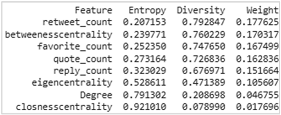
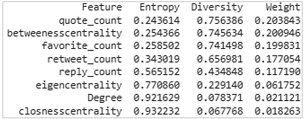
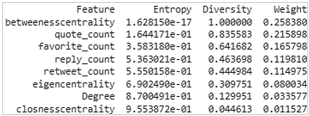
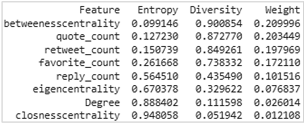
Based on the computation process described above, the resulting entropy weights for each feature in the original dataset are obtained as follows:
  • Traveloka
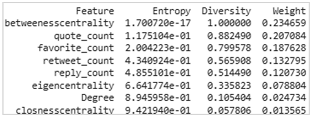
The entropy-based evaluation of all centrality and engagement indicators for the Traveloka dataset is summarized in Table 4, which highlights the relative discriminative contribution of each feature.
In the Traveloka dataset, the entropy analysis reveals that retweet count, betweenness centrality, and favorite count consistently hold the highest weights, reflecting high data diversity and strong discriminatory power in determining influence scores. Conversely, closeness centrality and degree centrality showed higher entropy values and lower weights, indicating more uniform distributions and limited capacity to distinguish influential users. Although engagement-related indicators such as retweet, favorite, and quote counts display high entropy-based weights, these should be interpreted not as direct determinants of influence, but as discriminative amplifiers that highlight users whose content exhibits viral or concentrated audience attention. Structural features such as betweenness centrality continue to serve as the core determinants of influence, capturing the users’ bridging and positional importance within the OTA communication network.
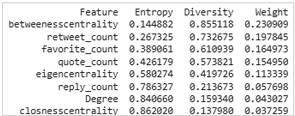
A complete overview of the entropy weighting computation for the Tiket.com network is provided in Table 5, detailing how each criterion contributes to the construction of the influence score.
For Tiket.com, quote count and betweenness centrality consistently emerged as the most informative indicators, supported by their low entropy values, which reflect high variability and discriminatory strength in ranking users. Other metrics, including favorite, reply, and retweet counts, held moderate weights, still contributing to the differentiation of user influence. In contrast, closeness and degree centralities repeatedly recorded low weights (<0.03) and high entropy values, suggesting structural homogeneity in this network.
2.
Agoda
The entropy weighting outcomes for the Agoda conversation network are reported in Table 6, reflecting the variability and informativeness of each metric across users.
Similarly, in the Agoda dataset, engagement-based metrics, particularly retweet, favorite, and quote counts showed high discriminative capacity across categories such as Booking and Support and Financial, revealing users whose content attracted extensive attention. However, Platform Experience emphasized betweenness centrality as the top feature, underscoring that users occupying strategic network positions continue to play a pivotal role in opinion diffusion.
Across all OTA networks, engagement-based features demonstrated high entropy diversity, signifying their value as effective discriminators of viral or highly interactive content, whereas structural network measures, especially betweenness and eigenvector centrality, remain the fundamental indicators of user influence. In essence, variability in engagement reflects amplification dynamics rather than causal influence. The entropy-weighting process effectively distinguishes between these two dimensions, highlighting that influence in OTA-related social networks arises from a combination of structural centrality and interaction-driven visibility, with the former defining potential reach and the latter amplifying observed impact.
Influence Score (TOPSIS)
After determining the entropy weights for each feature, the final influence score was calculated using the Technique for Order Preference by Similarity to Ideal Solution (TOPSIS). This method integrates multiple criteria into a single composite score, representing each user’s closeness to the positive ideal solution (most influential user). The positive and negative ideal distances were calculated as [1,38,39,40,41,54]
D i + = j = 1 m v i j v j + 2   ,   D i = j = 1 m v i j v j 2
where v i j is the normalized and weighted score of user i under criterion j, v j + is the maximum value for criterion j (positive ideal), and v j is the minimum value (negative ideal). The final preference value was then computed as
C i = D i D i + + D i
The C i value approaching 1 indicates proximity to the positive ideal, whereas values near 0 indicate closeness to the negative ideal.
This approach enables the identification of accounts that not only occupy strategic positions within the network but also demonstrate high levels of interaction with other users, thus providing a more accurate depiction of key actors in the OTA social media ecosystem on X. Accounts with the highest influence scores are further examined by reviewing their X account details, including account creation year, number of followers, number of followings, and account type, which was classified as personal, professional, business, spam, news, or viral [55]. These accounts are then categorized into influencer types as outlined below [25,55,56]:
  • A-lister Influencers: The highest tier with global influence, typically international celebrities or prominent industry figures with over one million followers, frequently collaborating with major brands, and capable of shaping public opinion and consumer trends.
  • Mega Influencers: Generally possessing one million or more followers, but with influence segmented within specific domains. This group often includes business professionals, brokers, or news broadcasters, characterized by high centrality and active information dissemination.
  • Macro Influencers: Having between 100,000 and one million followers, they act as a bridge between mass media and niche audiences, often including local celebrities, expert bloggers, or viral content creators, with the potential to transition into mega influencers.
  • Micro Influencers: Users with 10,000–100,000 followers, typically exhibiting lower engagement and centrality, with interaction patterns focused on entertainment or educational content.
  • Nano Influencer: Users with fewer than 100,000 followers, often consisting of acquaintances or local networks. Despite smaller reach, they possess high accessibility and authenticity, fostering strong personal connections.

4. Results and Discussion

4.1. Exploratory Data Analysis

4.1.1. Traveloka Exploratory Analysis

The distribution of emotions across all service aspects in the Traveloka dataset is presented in Table 7, offering a detailed breakdown of emotional tendencies within each category.
Across Traveloka’s service aspects, Joy dominates in Ticket Orders (1899), Discounts (1371), and Customer Service (514), indicating that core transactions and promotional offers are consistently perceived as smooth and rewarding, fostering user trust. In contrast, Payments, Refunds, and Cancelations display higher proportions of Sadness and Anger, particularly in Refunds, signaling dissatisfaction likely tied to delays or unmet expectations. Technical aspects such as Application Errors and Access Speed show elevated negative sentiment, reflecting frustration with stability and performance issues. Usability records strong Joy (559) but also the highest Disgust (23), suggesting design elements that polarize user perceptions. Overall, while Traveloka excels in transaction efficiency and promotions, technical reliability and refund handling remain key areas for improvement.

4.1.2. Tiket.com Exploratory Analysis

A comprehensive breakdown of emotion occurrences across Tiket.com’s service aspects is shown in Table 8, enabling a comparative view of user sentiment patterns.
In Tiket.com, the emotional landscape is more polarized compared to Traveloka, with certain aspects dominated by negative sentiment. Anger is notably high in Customer Service (232), Ticket Orders (583), and Concert (254), suggesting user frustration with service responsiveness, ticketing processes, and event-related experiences possibly due to high demand, system strain, or perceived service gaps during peak periods. Cancelations and Refunds show elevated Anger (53 and 150) relative to Joy, indicating dissatisfaction with post-purchase processes, likely linked to delays or restrictive policies. Transactional aspects such as Payments and Application Errors display significant Anger (198 and 97) alongside substantial Sadness, pointing to friction in payment processing and technical reliability. Even in Access Speed and Usability, where Joy (63 and 184) is present, high Anger (121 and 208) and Disgust (2 and 21) suggest that performance and interface design remain divisive. While Discounts and Prices generate predominantly positive emotions, their scale is modest compared to the negative sentiment observed in operational and technical aspects. Overall, Tiket.com’s data indicates that operational efficiency, technical stability, and event management are key areas requiring improvement to balance the strong demand with consistent user satisfaction.

4.1.3. Agoda Exploratory Analysis

The emotional landscape for the Agoda dataset is summarized in Table 9, illustrating how each service aspect corresponds to varying emotional intensities
On Agoda, negative sentiment is strongly pronounced, with Anger peaking in Customer Service (463), Refunds (417), and Ticket Orders (334), suggesting considerable dissatisfaction with service responsiveness, refund processes, and booking experiences. These patterns point to systemic issues in post-purchase support and transactional reliability, possibly amplified by communication gaps or delays in issue resolution. Sadness is particularly high in Refunds (257), Customer Service (222), and Payments (153), reinforcing the view that financial and service recovery processes are critical points of pain. Disgust also appears prominently in Customer Service (91), Ticket Orders (283), and Prices (182), indicating that user dissatisfaction extends beyond operational challenges to perceived value and pricing fairness. Positive emotions, though present in categories like Prices (182) and Discounts (149), are overshadowed by the scale of negative sentiment. Even in areas where Joy is relatively high, such as Ticket Orders (283) and Usability (76), negative emotions (Anger and Disgust) remain substantial, reflecting polarized user experiences. Overall, Agoda’s data suggests that service quality, refund efficiency, and perceived value are the most pressing areas for improvement, as sustained high-intensity negative emotions in these domains can significantly erode user trust and long-term platform loyalty.

4.2. IndoBERT Evaluation

In the multi-class emotion classification task, among all evaluated models, the fine-tuned IndoBERT model achieved the best overall performance and was therefore selected as the primary model for detailed analysis and discussion. The fine-tuned IndoBERT model reached an overall accuracy of 68% (weighted F1 = 0.68), outperforming all comparative baselines, including IndoBERT (Data Transformation) + BiLSTM + SMOTE (0.57), IndoBERT (Data Transformation) + SVM (0.61), and classical classifiers such as TF-IDF + SVM (0.59) and TF-IDF + SVM + SMOTE (0.56). These results confirm that fine-tuning IndoBERT yields superior contextual representations and better generalization for Indonesian-language emotion classification compared to shallow or feature-based approaches.
The fine-tuned IndoBERT model demonstrated strong performance for high-frequency emotion classes such as Joy (F1 = 0.87) and Anger (F1 = 0.61), while minority emotions including Disgust (F1 = 0.30), Surprise (F1 = 0.35), and Fear (F1 = 0.47) recorded substantially lower scores. Misclassification patterns indicate that Anger and Sadness often overlap (84 and 96 cases, respectively), reflecting shared linguistic cues in negative expressions. Similarly, Fear and Disgust were frequently misclassified into Anger or Sadness, suggesting difficulty in learning fine-grained emotional boundaries when data are limited. Surprise also tended to be confused with Joy or Sadness, emphasizing its dependence on contextual sentiment cues. Overall, the fine-tuned IndoBERT model effectively recognizes dominant and well-represented emotions but faces challenges in differentiating semantically overlapping or low-frequency classes.
In the binary sentiment classification task, the fine-tuned IndoBERT model achieved 87% accuracy (F1 = 0.87 for both macro and weighted averages), with balanced performance across negative (F1 = 0.89) and positive (F1 = 0.86) classes. Most negative instances (n = 903) and positive instances (n = 683) were correctly classified, with relatively low misclassification rates (113 negative tweets predicted as positive and 118 positive tweets predicted as negative). This balanced precision and recall indicate that IndoBERT effectively captures polarity cues in text and performs consistently across both sentiment types. The lower error rate compared to the multi-class emotion task reflects the reduced complexity of sentiment polarity detection, where category boundaries are more clearly defined and data distribution is more balanced.
The multi-label aspect classification task demonstrated the strongest results, with the fine-tuned IndoBERT model achieving a weighted F1-score of 0.97 across all categories. Core aspects such as Cancelations, Prices, Payments, and Refunds reached near-perfect precision and recall (false positives and false negatives ≤ 3). High recall values (≥0.96) for Customer Service, Ticket Orders, and Discount indicate that the model effectively captures frequently discussed service topics, supported by their rich representation in the dataset. Less frequent categories such as Application Errors, Access Speed, and Concert still achieved robust F1-scores (>0.83), suggesting strong generalization even with smaller sample sizes. The Usability category attained a high F1-score (0.92) but showed slightly higher false positives (31) and false negatives (27), likely due to semantic overlaps with other experience-related aspects. Overall, IndoBERT demonstrated strong discriminative capability in handling both high- and low-frequency service aspects with minimal misclassification, confirming its suitability for multi-label aspect detection in OTA-related social media data.
A comparative overview of the three classification tasks highlights notable performance variations. The multi-label aspect classification achieved the highest accuracy (F1 = 0.97), benefiting from clearly defined category boundaries and domain-specific vocabulary. Sentiment classification also performed strongly (F1 = 0.87) due to its binary structure and broader semantic cues. In contrast, emotion classification recorded the lowest score (F1 = 0.68), achieving strong performance for dominant emotions such as Joy but weaker results for minority or semantically overlapping categories. This discrepancy is mainly attributed to class imbalance across emotion categories and the subtle linguistic variations commonly found in informal Indonesian-language social media text. Overall, the findings suggest that IndoBERT performs strongly when category boundaries are well-defined and lexical cues are explicit, remains reliable for binary sentiment prediction, but continues to face challenges in distinguishing fine-grained emotional expressions within low-resource and contextually nuanced environments.

4.3. Ontology for OTAs

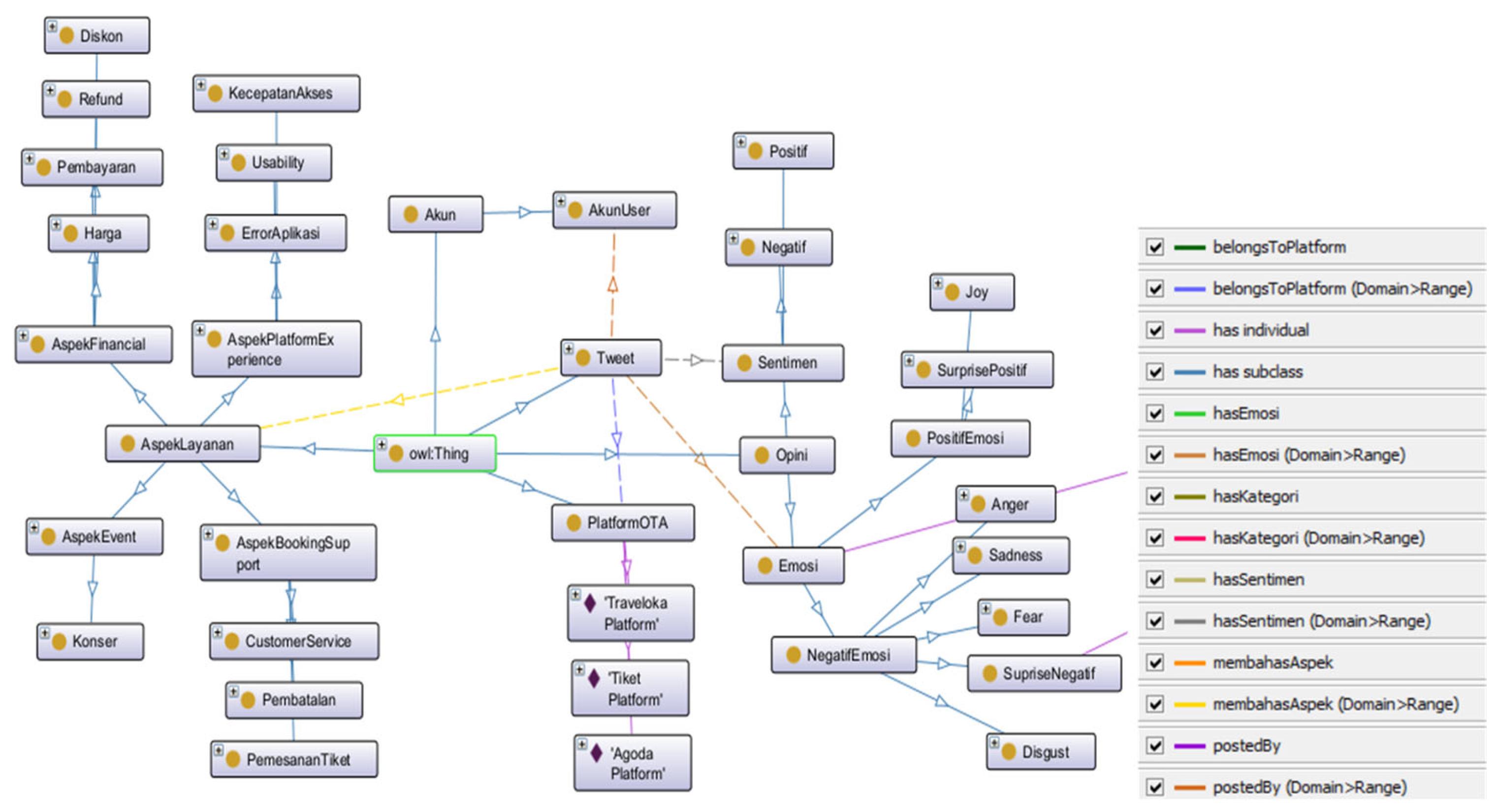
The conceptual structure of the OTA ontology, including its classes, subclasses, object properties, and semantic relations, is shown in Figure 2, illustrating the domain model constructed in this study.
The Figure 2 shows the OTA ontology formed in this study, as for the details of the ontology that is constructed, they are as follows:

4.3.1. Class and Subclass

A class is used to represent a group of entities that share common characteristics within a given domain. In Protégé, these classes are arranged hierarchically under owl–Thing [30,31]. The full class hierarchy constructed for the OTA ontology is detailed in Table 10, delineating all major classes and their respective subclasses.
The ontology class hierarchy is designed to structure domain knowledge in a clear and systematic way, particularly for service aspects, sentiment categories, and emotional classifications. Each class represents a conceptual entity such as AspekFinancial, AspekBookingSupport, Emosi, or Sentimen, while the subclasses provide more specific semantic distinctions including Refund, CustomerService, EmosiPositif, and EmosiNegatif. This structure establishes clear inheritance relationships that support automated reasoning. For instance, when a tweet is classified as an instance of Joy, a reasoner will automatically infer that it also belongs to the EmosiPositif (Positive Emotion) and Emosi (Emotion) classes. Likewise, tweets categorized under Anger, Fear, or Sadness will be inferred as members of EmosiNegatif (Negative Emotion). This capability enables efficient information retrieval, as users can extract all individuals under broader categories such as AspekLayanan or EmosiNegatif without listing each subclass individually. Overall, the hierarchy enhances semantic consistency, supports flexible inference processes, and strengthens the reliability of the knowledge representation within the OTA domain.

4.3.2. Object Property

An Object property describes the relationship between two individuals within an ontology. As a form of relation, each object property is defined with a domain (the class of the individual subject) and a range (the class of the individual object). The object properties defined in the ontology are summarized in Table 11.
The above object properties are used in building explicit connections between various entities, such as user-related tweets, OTAs, and specific categories.

4.3.3. Data Property

Data Property describes the relationship between an individual and a literal value (e.g., string, number, and date). Data property is a component of ontology, namely a function. Each property data have a domain (the class of individuals who own this property) and a range (the data type of the property’s value). The complete list of data properties is shown in Table 12.
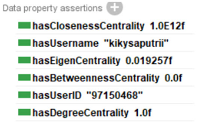
The above property data are used to store all the important attributes of the tweet and user account, including centrality metrics and the number of interactions.

4.3.4. Axiom

Axioms in ontology serve as formal rules or constraints to ensure the consistency and validity of the knowledge structure. These axioms may be implicitly defined through the use of rdf:type and rdfs:subClassOf, as well as the specification of domain and range in RDF/OWL. Examples from this study include:
  • Class: ota:AkunUser, SubClassOf: ota:Akun: This axiom states that every entity classified as AkunUser inherently belongs to the Akun class, reflecting the logical hierarchy in which all users are considered account entities.
  • DatatypeProperty: ota:hasFullText, Domain: ota:Tweet, Range: xsd:string: This axiom defines the hasFullText property used to store the complete text content of a tweet. It applies only to individuals of the tweet class, with values restricted to the string data type.
  • ObjectProperty: ota:membahasAspek, Domain: ota:Tweet, Range: ota:AspekLayanan: This axiom specifies the relationship between a tweet and the AspekLayanan category it addresses, allowing for the representation of tweets that relate to one or more specific service aspects.

4.3.5. Instances by Class

This illustrates how a concrete instance (individual) is classified into a predefined class or subclass within the ontology. The process serves as a representation of actual data incorporated into the ontology in accordance with its established structure and definitions. Representative instances for each ontology class are listed in Table 13.
In the ontology, each class and subclass follows OWL’s naming conventions using CamelCase for class identifiers (e.g., PlatformOTA and AspekFinancial) and lowercase or structured IDs for individuals (e.g., User_xxx and Tweet_xxx). For example, PlatformOTA has three individuals (Agoda_Platform, Tiket_Platform, and Traveloka_Platform), while aspect-related classes such as AspekFinancial contain individuals like RefundAspectInstance or PriceAspectInstance. Emotion classes are divided into PositifEmosi and NegatifEmosi, each populated with the respective emotional instances (joy and anger, etc.). This systematic instance naming ensures that all entities can be semantically queried and reasoned over in compliance with OWL standards.

4.3.6. SPARQL

To analyze specific patterns in the OTA-related tweets, SPARQL queries were executed on the populated ontology. The queries were designed to extract tweets with specific emotional expressions, engagement thresholds, and platform constraints. SPARQL queries were executed on the populated OWL ontology to extract insights. For instance, we identified (i) tweets expressing fear with the highest retweet counts across all OTAs and (ii) anger tweets on Traveloka with retweets exceeding 100.
  • Retrieving tweets with the fear emotion and highest retweet counts. The query searches for tweets labeled with the fear emotion, orders them by retweet count, and includes related metadata such as platform, category, and username. The SPARQL query used to retrieve these tweets is shown below:
    SELECT ?tweet ?fullText ?retweetCount ?platformName
    WHERE {
    ?tweet rdf:type ota:Tweet .
    ?tweet ota:hasEmosi ota:fear .
    ?tweet ota:hasRetweetCount ?retweetCount .
    ?tweet ota:belongsToPlatform ?platformUri .
    }
    ORDER BY DESC(?retweetCount)
    LIMIT 10
    Most tweets related to fear involved scam alerts and fraudulent refund requests, particularly targeting Traveloka and Agoda users.
2.
Retrieving anger tweets on Traveloka with >100 retweets. Filters tweets expressing anger from Traveloka’s dataset, focusing on those exceeding 100 retweets. The SPARQL query used to retrieve these tweets is shown below:
SELECT ?fullText ?retweetCount
WHERE {
?tweet rdf:type ota:Tweet .
?tweet ota:hasEmosi ?emotionInstance .
?emotionInstance rdf:type ota:Anger .
?tweet ota:belongsToPlatform ota:TravelokaPlatform .
FILTER (?retweetCount > 100) .
}
ORDER BY DESC(?retweetCount)
High-retweet anger tweets were often about delayed refunds, accidental purchases, and scams under “Travel Expert” branding.

4.3.7. Consistency Evaluation

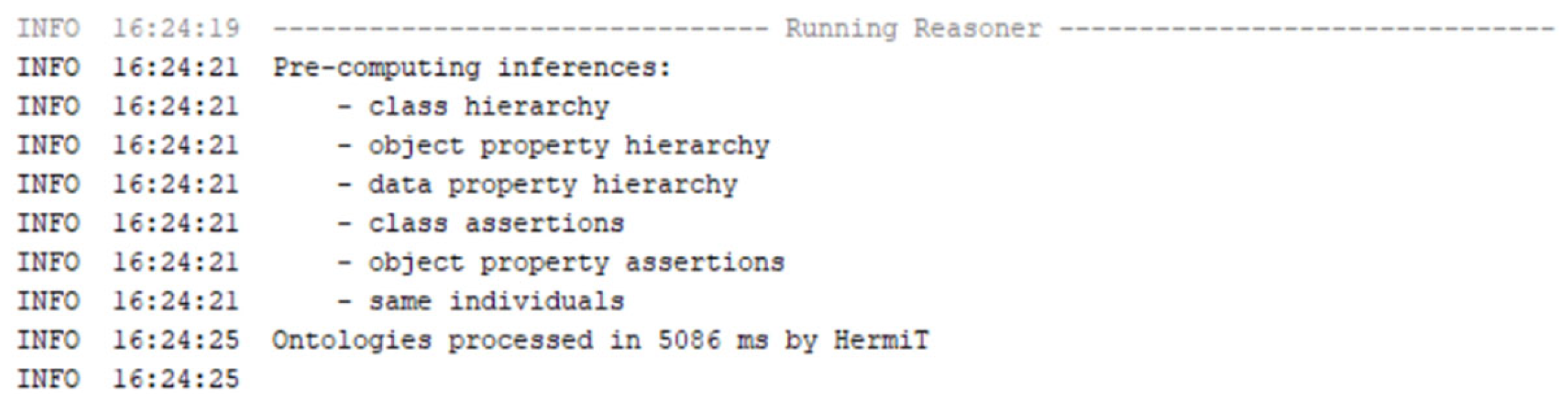
To ensure logical coherence within the constructed ontology, a consistency evaluation using the HermiT Reasoner was conducted and the results are shown in Figure 3, confirming that no contradictions or structural conflicts were detected.
To ensure the logical consistency and semantic validity of the developed ontology, we performed a reasoning process using the HermiT Reasoner integrated within Protégé. The reasoning task involved pre-computing several inference components, including (i) class hierarchy generation, (ii) object property hierarchy construction, (iii) data property hierarchy verification, (iv) class assertions checking, (v) object property assertions verification, and (vi) same individual identification. As shown in the execution log, the HermiT Reasoner successfully processed the ontology in 5086 ms without reporting any errors or inconsistencies. The absence of conflict or contradiction in the reasoning output confirms that the ontology’s class structure, properties, and instance assertions are logically consistent. This step not only validates the ontology’s formal correctness but also ensures its readiness for semantic querying, automated reasoning, and integration with text mining processes.

4.4. SNA

4.4.1. Traveloka Social Network Analysis

A summary of the Traveloka network structure is reported in Table 14, providing insight into interaction patterns within the platform.
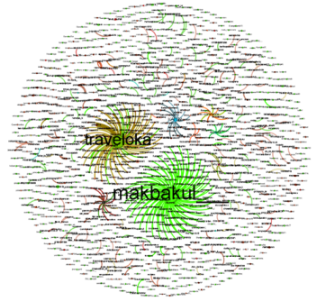
Based on the table above, Traveloka’s discussion network on X exhibits diverse structural characteristics across topics. The overall user interaction is strong, especially in Financial and Booking and Support discussions, reflecting high connectivity and rapid information dissemination. The Platform Experience category shows a slightly larger network diameter, indicating broader but less concentrated interactions. Community modularity remains high, with segmentation varying by topic; notably, financial discussions form more flexible clusters than others. In this case, Traveloka’s official account (@traveloka) and accounts such as (@makbakul___) play an important role as central actors in the conversational network.
The influence rankings for key users in the Booking and Support category on Traveloka are presented in Table 15.
Based on the results, in the Booking and Support category, central actors such as @traveloka and @makbakul__ occupy key network positions, combining high betweenness centrality with strong engagement visibility. Users like @Frimawan and @claudiasilvinia display lower centrality yet attract substantial engagement through retweets and favorites, suggesting that their influence derives from content virality rather than structural prominence. Accounts such as @Widino demonstrate balanced centrality and engagement, acting as communication bridges between user clusters. Therefore, Traveloka can leverage the power of viral content by studying the success patterns of these accounts, establishing closer relationships with central and connecting influencers, and considering the involvement of influencers from various levels according to campaign goals.
The Financial category influence results for Traveloka are summarized in Table 16, revealing the relative influence levels of prominent accounts within financial-related discussions.
An analysis of Traveloka’s overall discussion network in the financial category shows that @aldapstr accounts stand out, actively interact, and can reach the entire network quickly. The engagement rate is also very high, reflected and his status as a verified micro influencer further strengthens his credibility. In addition, @Widino accounts although the centrality value is lower but shows a good level of engagement and has influence as a verified micro influencer. The existence of these two accounts indicates that there are key figures on social media who are actively involved and responded to by the community regarding Traveloka’s financial issues. Conversely, users such as @hhaijuli, @waudira, and @zakahats show lower engagement despite moderate network reach, implying opportunities to enhance message relevance and content strategy. This indicates an opportunity to increase the relevance or attractiveness of content shared by accounts with potential reach but low engagement.
A detailed overview of influence patterns in the Platform Experience category is provided in Table 17.
The analysis of Traveloka’s discussion network in the Platform Experience category highlights macro influencers such as @makbakul__ and @Frimawan, who dominate conversations through distinct interaction styles. @makbakul__ actively engages in direct discussions and replies, while @Frimawan focuses on producing widely shared and liked content. These complementary patterns illustrate how central users shape discourse through structural connectivity, while viral content amplifies message visibility. In contrast, accounts such as @Vita_Anjell and @caramlecchiato, despite their proximity to many users and potential reach, have not generated comparable audience interaction, indicating limited engagement resonance. The dominance of macro influencers underscores their critical role in shaping public perception and extending Traveloka’s message reach. To enhance platform-related engagement, Traveloka can establish strategic partnerships with these central influencers, strengthen high-reach accounts through content optimization, and tailor communication strategies to leverage different influencer interaction styles. Such collaboration can help expand audience coverage and reinforce a positive brand image of the platform’s experience.

4.4.2. Tiket.com Social Network Analysis

The structural characteristics of Tiket.com’s discussion networks are shown in Table 18, which outlines the structural characteristics of the network.
Overall, based on the above, discussion networks on Tiket.com show very fast information dissemination characteristics characterized by low network diameter. However, the high modularity and large number of communities indicate a high level of fragmentation across categories. The average interaction between users tends to be low, reflected in the small weighted degree value. This indicates that while information can be widespread in a short period of time, building deeper engagement and discussion is a challenge due to low cohesion between communities. The influence ranking results for Tiket.com’s Booking and Support category are reported in Table 19, combining centrality and engagement features to identify dominant actors.
Analysis of Tiket.com’s discussion networks, particularly in the Booking and Support category, shows that @officialJKT48, despite relatively low centrality values, records high influence scores and are categorized as an A-Lister influencer, supported by a large follower base and moderate engagement through quotes and replies. @kikysaputrii, identified as a verified macro influencer, demonstrates slightly lower influence scores yet maintains consistent engagement across multiple interaction types, underscoring her relevance in discussions surrounding booking and customer service. In contrast, users such as @indiiikk, @AkhidIhsanudin, and @aesple exhibit low centrality, engagement, and influence values, classifying them as nano influencers. These variations highlight a distinct influence hierarchy, where macro influencers amplify visibility while nano influencers sustain niche conversations within the booking and support ecosystem. A detailed influence analysis for Tiket.com’s Financial conversations is summarized in Table 20, outlining key accounts and their relative prominence within the network.
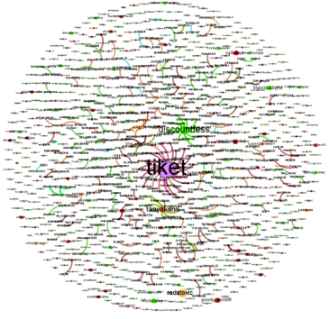
In an analysis of Tiket.com’s discussion networks in the Financial category, it is seen that the influence landscape differs markedly. The account @discountfess, categorized as a verified business macro influencer, dominates with the highest degree centrality and influence score. High engagement through retweets and favorites indicates their role as a source of information or promotion that attracts the attention of the audience related to financial issues. Conversely, accounts such as @rararsmn, @kyomiethurr, and @twelvefordks are classified as nano influencers with a small number of followers and minimal centrality and engagement values, indicating limited organic participation from regular users in financial discussions. Interestingly, the @TrinityTravele account, despite being a macro influencer with a large follower base, exhibits low engagement and influence within this category, though their relatively high eigenvector centrality suggests indirect connectivity to more active financial nodes. The lack of involvement of nano influencers in these financial discussions may indicate that this topic is not widely discussed organically among regular users. Nonetheless, Tiket.com still needs to monitor conversations to identify potential negative sentiments or questions that may arise regarding the financial aspects of their services.
The discussion network of Tiket.com in Table 21 related to the Platform Experience category on X shows that influence is distributed across multiple influencer tiers. Account @kikysaputrii, a verified macro influencer with wide reach and consistent engagement, dominates as a central figure driving public conversations about user experience. Furthermore, the account @dlayyyyyyyy, categorized as a micro influencer, demonstrates high proximity to various users and serves as a potential bridge for information flow and feedback exchange. In contrast, nano influencers such as @crescentbin have limited reach potential but lack public interaction, while @afnanboma10 and @naim_pasha exhibit limited audience interaction and minimal influence scores. These variations reflect the presence of a diverse influencer ecosystem, where each tier contributes differently to discussion visibility and engagement. From a communication perspective, Tiket.com can leverage @kikysaputrii’s broad influence to strengthen public perception and brand visibility, while optimizing @dlayyyyyyyy’s intermediary role to gather user insights and disseminate platform updates. Meanwhile, monitoring feedback from nano influencers provides valuable organic perspectives on user satisfaction and pain points. Adopting this multi-tier engagement approach can help Tiket.com cultivate a responsive and user-centered communication strategy for its platform experience.
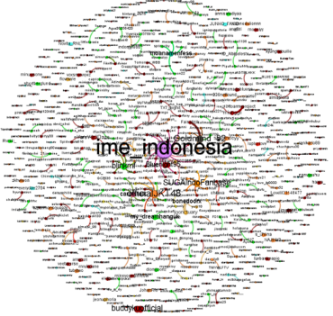
Analysis of discussion networks Tiket.com in the Event category in Table 22 highlights @officialJKT48, identified as an A-Lister influencer, who holds the top position with the highest centrality and influence score, supported by substantial engagement that indicates wide audience reach in event promotion. The @miunggi account, a verified micro influencer, demonstrates strong influence within their specific audience segment despite not being structurally central in the broader network. Similarly, @ime_indonesia, a micro business influencer representing an event partner, occupies a central structural position but records limited public engagement. Meanwhile, nano influencers such as @naim_pasha and @nmrubyjane exert minimal impact on event-related conversations. Strategically, collaboration with @miunggi offers potential to reach niche communities that actively engage with event-related content, while ongoing monitoring of nano influencers remains relevant for identifying organic discussions and gauging grassroots interest in events. This layered engagement model enables Tiket.com to balance large-scale visibility through macro influencers with authentic, community-driven interaction at the micro and nano levels.

4.4.3. Agoda Social Network Analysis

A comprehensive overview of Agoda’s network structure for each service category is provided in Table 23 with detailed explanation of the interaction patterns.
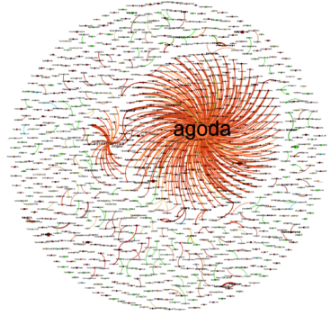
Agoda’s discussion network shows very strong interaction between users across categories. The dissemination of information is fast, although a little slower in the Financial category. The structure of the community varies; In the Booking and Support category, the community appears to be more flexible and integrated, while in the Community Experience platform category, it tends to be more segmented. The financial category has the largest number of communities, with fairly clear boundaries but still allowing for interactions between groups. Agoda’s official account (@agoda) emerged as a key actor connecting these various communities, reinforcing its central role in the network.
In the Booking and Support category in Table 24, Agoda’s discussion network highlights the dominance of the personal micro influencer @DeanOrDeen, who records the highest influence score supported by moderate degree centrality, high closeness centrality, and strong engagement levels. This pattern indicates the account’s ability to attract attention and stimulate interaction within booking and support discussions, even without occupying a structurally central position. In contrast, @txtrdigital, a micro media influencer with a larger follower base, exhibits considerably lower influence and engagement levels. Meanwhile, nano influencers such as @sidhanty, @wdrtdewi, and @HayatiJunia display minimal centrality and engagement, reflecting their limited reach and impact. For Agoda, @DeanOrDeen represents a valuable voice within booking and support-related conversations, where high engagement suggests strong audience resonance and message relevance.
Agoda’s discussion network analysis of the Financial category in Table 25, highlights the central role of @eddthinksdesign, which emerges as the most dominant figure, achieving the highest influence and engagement levels, despite not being the most structurally central node. This suggests that informational and visually appealing content drives interaction in financial discussions. Conversely, @novirahayuni_, a nano influencer, shows lower yet consistent activity within smaller audience segments. Interestingly, @DeanOrDeen, previously influential in booking-related topics, records a notable drop in influence and engagement in this category, indicating that an influencer’s prominence can be highly topic-dependent. Other nano influencers, such as @novafah_ and @tamabicara, have minimal impact, emphasizing that financial discussions tend to be dominated by credible or professional voices rather than organic user interactions.
In the Platform Experience category in Table 26, Agoda’s network is largely composed of nano influencers with varying engagement levels. @cheesenuttie achieves the highest influence score, supported by moderate degree and good closeness centrality, suggesting active participation and close ties with other users. @twt_lutfi also demonstrates notable influence through frequent retweets and favorites despite low centrality, showing that non-central users can still generate attention through shareable content. Similarly, @FoxyriaR records moderate influence and engagement, while @cvtejeen maintains the highest degree centrality in this category, indicating active two-way interactions but only moderate overall influence. In contrast, @berisikok ranks lowest in both influence and engagement metrics despite moderate reply and quote activity. Overall, the absence of dominant macro influencers in Agoda’s network indicates that discussions around the platform are driven mainly by smaller, community-based users. To enhance communication strategies, Agoda can nurture relationships with active micro and nano influencers, encouraging them to share positive user experiences and constructive feedback. This grassroots engagement strategy can strengthen authenticity, improve user satisfaction insights, and support the continuous enhancement of the platform’s public perception.

4.4.4. Spearman

In this study, SNA was carried out by combining centrality metrics with tweet engagement. It was integrated with the TOPSIS method, especially entropy weight. The results obtained are in the form of an influence score to obtain the key players. Results evaluation uses Spearman correlation calculations to see the relationship between features such as retweets, replies, and degree centrality and the final score of the TOPSIS method. The following are the results of the correlation between the TOPSIS score and each feature of centrality metrics and tweet engagement.
Spearman Correlation for Traveloka
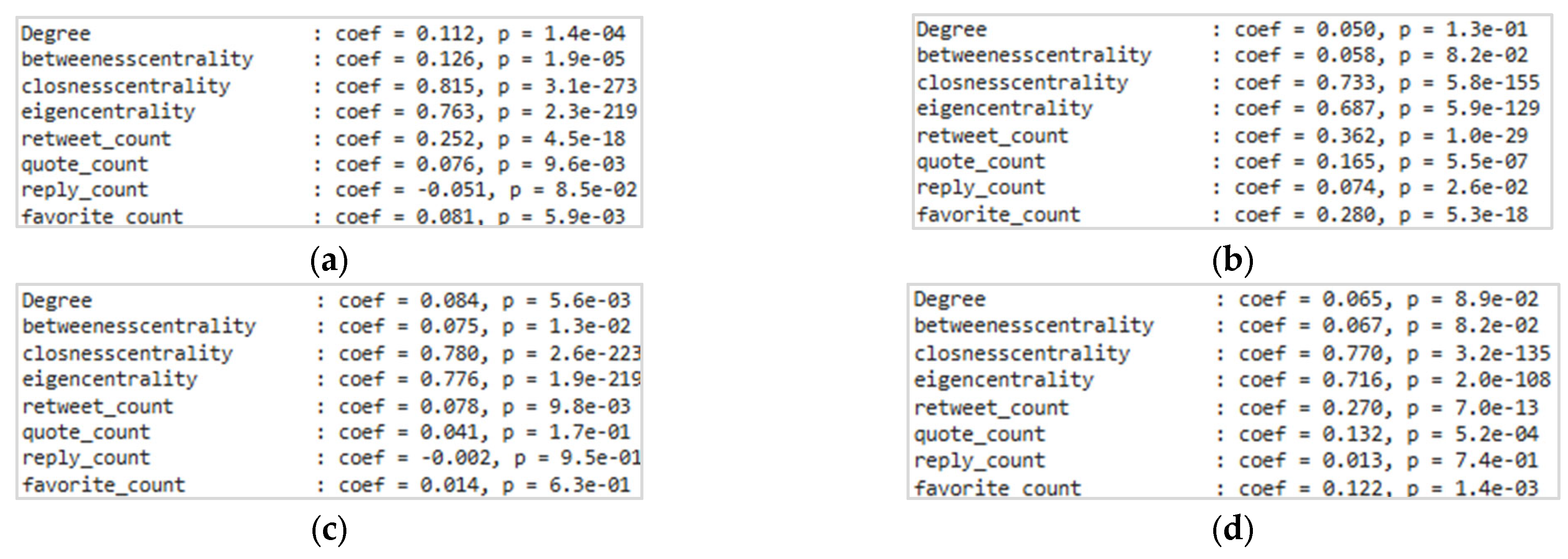
The Spearman correlation results for the Traveloka dataset are shown in Figure 4, covering Booking & Support, Financial, and Platform Experience.
Based on Figure 4, Traveloka spearman’s correlation analysis reveals distinct patterns across topics. In Booking and Support, closeness centrality (ρ = 0.871) emerges as the strongest contributor to TOPSIS scores, followed by degree (ρ = 0.600) and reply count (ρ = 0.471), indicating that structural proximity and conversational engagement outweigh popularity metrics such as retweets or favorites (ρ < 0.2). In Financial, closeness centrality (ρ = 0.858) and eigenvector centrality (ρ = 0.664) are dominant, while degree centrality shows a slightly negative correlation (ρ = –0.108), suggesting that direct connections do not necessarily reflect influence financial discussions. In Platform Experience, closeness (ρ = 0.860) and eigenvector centrality (ρ = 0.715) remain the most influential features, whereas engagement metrics contribute minimally, with reply counts not reaching statistical significance. Overall, these results highlight that, for Traveloka, strategic network position, especially proximity and influence within the structure, plays a greater role in determining user influence than content-level engagement.
Spearman Correlation for Tiket.com
The Spearman correlations for the Tiket.com dataset are presented in Figure 5, illustrating variations across its main service categories.
As shown in Figure 5, Tiket.com spearman’s correlation results consistently highlight the dominance of structural metrics over engagement features. In Booking and Support, closeness centrality (ρ = 0.815) and eigenvector centrality (ρ = 0.733) are the strongest determinants of influence, indicating that users positioned close to key nodes hold greater conversational power. Engagement indicators such as retweets (ρ = 0.252) and favorites (ρ = 0.081) show only weak contributions, while reply count (ρ = 0.084) is negligible. In Financial, closeness (ρ = 0.837) and eigenvector centrality (ρ = 0.687) again dominate, with favorite count showing only limited relevance (ρ = 0.280) and degree/betweenness centrality remaining insignificant. In Platform Experience, closeness (ρ = 0.780) and eigenvector centrality (ρ = 0.700) retain strong predictive power, whereas engagement metrics contribute minimally or not at all, underscoring the primacy of network position over content interaction. In Event, closeness (ρ = 0.793) and eigenvector centrality (ρ = 0.716) remain key influence drivers, with retweets (ρ = 0.270) playing a minor but significant role, suggesting that while content spread matters in event contexts, structural network advantages are still the primary determinant of influence.
Spearman Correlation for Agoda
The Spearman correlation patterns for the Agoda dataset are displayed in Figure 6, summarizing the key relationships among centrality and engagement metrics.
As shown in Figure 6, Agoda spearman’s correlation results reaffirm the dominant role of structural network metrics across categories. In Booking and Support, closeness centrality (ρ = 0.835) and eigenvector centrality (ρ = 0.661) strongly influence user scores, highlighting the advantage of being structurally close to many others and linked to key nodes. Engagement features (retweets, quotes, replies, and favorites) show only very weak-to-weak correlations (ρ < 0.2), indicating that influence here is driven more by network position than content popularity. In Financial, closeness (ρ = 0.807) and eigenvector centrality (ρ = 0.663) again lead, with favorites (ρ = 0.176) and quotes (ρ = 0.215) offering limited additional relevance, while degree and retweets remain negligible, underscoring structural dominance in financial discussions. In Platform Experience, closeness (ρ = 0.778) and eigenvector centrality (ρ = 0.600) still dominate but engagement features such as replies (ρ = 0.312) and favorites (ρ = 0.278) show relatively higher, though still weak, influence, suggesting a slightly greater role for user responses and content appreciation in shaping influence within technical experience discussions.

5. Conclusions

This study proposed an ontology-driven framework for multi-class emotion classification and influence analysis of user opinions on Online Travel Agencies (OTAs) using Indonesian-language discussions from the social media platform X. The framework integrates ontology-based aspect mapping, emotion and sentiment classification using fine-tuned IndoBERT, and Social Network Analysis (SNA) enhanced with Multi-Criteria Decision Analysis (MCDA) through entropy weighting and TOPSIS. This integration enables a holistic understanding of how emotional expressions, service aspects, and user interactions collectively shape public opinion and influence dynamics in online environments.
The fine-tuned IndoBERT model outperformed all comparative baselines, achieving the best results in multi-label aspect detection (F1 = 0.97) and sentiment classification (F1 = 0.87), and moderate performance in multi-class emotion recognition (F1 = 0.68). While class imbalance limited emotion-level precision, the emotion labels nevertheless enhanced the semantic richness of the ontology. By linking classified emotions with aspect categories defined in the ontology, the framework enabled a deeper interpretation of user experiences distinguishing not only positive and negative sentiments, but also the emotional intensity and context behind each service-related issue. Platform-specific analyses also demonstrated that Traveloka discussions were cohesive and largely positive, Tiket.com networks were fragmented yet polarized around event and operational issues, and Agoda conversations were dominated by negative narratives linked to refunds and customer service.
The influence analysis revealed that structural network properties, especially betweenness, closeness, and eigenvector centrality, remain the primary determinants of user influence, whereas engagement indicators (retweets, quotes, and favorites) function as discriminative amplifiers that highlight users whose content gains high visibility within OTA-related discussions. This finding clarifies that social influence arises from both users’ structural positions and the amplification effects of audience interactions. From a practical standpoint, the combined ontology–emotion–SNA framework allows OTAs to identify critical service aspects associated with high emotional engagement and to map influential users who shape these conversations. Such insights support more empathetic, data-driven communication strategies, enabling platforms to respond promptly to emerging issues and strengthen customer trust.
In summary, this research demonstrates that integrating ontology-based semantics, emotion classification through fine-tuned IndoBERT, and influence modeling using entropy–TOPSIS provides a robust and interpretable framework for analyzing Indonesian-language user opinions on X. The approach advances computational social science by connecting the emotional, semantic, and social dimensions of digital interaction, offering valuable implications for both academic research and real-world online service management. Practically, the results deliver actionable insights for OTA providers to identify critical service issues, prioritize user concerns, and collaborate with influential users to strengthen engagement and trust. To the best of our knowledge, this is the first study to integrate these approaches in the Indonesian OTA context, and the framework has the potential to be extended beyond OTAs as a generalizable model for analyzing sentiment and influence in other service industries where customer perception and opinion diffusion are equally decisive.

Author Contributions

Conceptualization, P.U.R. and M.L.; methodology, P.U.R. and H.F.; software, A.N.M.; validation, P.U.R., M.L. and H.F.; formal analysis, M.L.; investigation, H.F.; resources, A.; data curation, A.; writing—original draft preparation, A.N.M.; writing—review and editing, P.U.R. and M.L.; visualization, A.; supervision, M.L. and H.F.; project administration, M.L. All authors have read and agreed to the published version of the manuscript.

Funding

This research received no external funding.

Data Availability Statement

The dataset analyzed in this research was collected through the Twitter API and cannot be publicly shared due to platform restrictions. Access to processed data may be requested from the corresponding author upon reasonable request.

Conflicts of Interest

The authors declare no conflict of interest.

References

  1. Sarmast Hasan Kiadeh, Z.; Shokouhyar, S.; Omarzadeh, A.; Shokoohyar, S. Warranty Operation Enhancement through Social Media Knowledge: A Deep-Learning Methods. INFOR 2024, 62, 273–311. [Google Scholar] [CrossRef]
  2. Teresa Borges-Tiago, M.; Arruda, C.; Tiago, F.; Rita, P. Differences between TripAdvisor and Booking.Com in Branding. Co-Creation. J. Bus. Res. 2021, 123, 380–388. [Google Scholar] [CrossRef]
  3. Lubis, A.R.; Fachrizal, F.; Lubis, M. The Effect of Social Media to Cultural Homecoming Tradition of Computer Students in Medan. Procedia Comput. Sci. 2017, 124, 423–428. [Google Scholar] [CrossRef]
  4. Nurhayati, H. Most Popular Online Travel Agencies Among Consumers in Indonesia as of June 2023; Statista: Hamburg, Germany, 2023. [Google Scholar]
  5. Butar, J.B.; Lusa, S.; Handayani, S.; Yusuf, A.A. Analyzing Abstention Discourse in Presidential Elections: Knowledge Discovery in X Using ML, LDA and SNA. Int. J. Adv. Sci. Eng. Inf. Technol. 2024, 14, 1144–1151. [Google Scholar] [CrossRef]
  6. Bahra, M.; Fennan, A. Smart City: An Advanced Framework for Analyzing Public Sentiment Orientation toward Recycled Water. Int. J. Electr. Comput. Eng. 2024, 14, 1015–1026. [Google Scholar] [CrossRef]
  7. Pratiwi, H.; Benkő, R.; Kusuma, I.Y. Navigating the Asthma Network on Twitter: Insights from Social Network and Sentiment Analysis. Digit. Health 2024, 10, 20552076231224075. [Google Scholar] [CrossRef]
  8. Rueger, J.; Dolfsma, W.; Aalbers, R. Mining and Analysing Online Social Networks: Studying the Dynamics of Digital Peer Support. MethodsX 2023, 10, 102005. [Google Scholar] [CrossRef]
  9. Ekman, P. An Argument for Basic Emotions. Cogn. Emot. 1992, 6, 169–200. [Google Scholar] [CrossRef]
  10. Ekman, P.; Sorenson, E.R.; Friesen, W.V. Pan-Cultural Elements in Facial Displays of Emotion. Science 1969, 164, 86–88. [Google Scholar] [CrossRef]
  11. Sam, K.M.; Chatwin, C.R. Ontology-Based Sentiment Analysis Model of Customer Reviews for Electronic Products. In Proceedings of the 2012 IEEE International Conference on Management of Innovation & Technology (ICMIT), Bali, Indonesia, 11–13 June 2012; pp. 226–231. [Google Scholar] [CrossRef]
  12. Mentaruk, I.; Herdiani, A.; Puspandari, D. Analisis Sentimen Twitter Transportasi Online Berbasis Ontologi (Studi Kasus: Go-Jek). e-Proceeding Eng. 2019, 6, 2029–2047. [Google Scholar]
  13. Koto, F.; Rahimi, A.; Lau, J.H.; Baldwin, T. IndoLEM and IndoBERT: A Benchmark Dataset and Pre-Trained Language Model for Indonesian NLP. In Proceedings of the 28th International Conference on Computational Linguistics (COLING 2020), Online, 8–11 December 2020; pp. 757–770. [Google Scholar] [CrossRef]
  14. Ahmad, A.; Ahmad, T.; Bhatt, A. HWSMCB: A Community-Based Hybrid Approach for Identifying Influential Nodes in the Social Network. Phys. A Stat. Mech. Its Appl. 2020, 545, 123590. [Google Scholar] [CrossRef]
  15. Ait Rai, K.; Agouti, T.; Machkour, M.; Antari, J. Identification of Complex Network Influencer Using the Technology for Order Preference by Similarity to an Ideal Solution. J. Phys. Conf. Ser. 2021, 1743, 012004. [Google Scholar] [CrossRef]
  16. Qian, Y.; Pan, L. Data-Driven Influential Nodes Identification in Dynamic Social Networks. In Proceedings of the 17th EAI International Conference on Collaborative Computing: Networking, Applications and Worksharing, Suzhou, China, 16–17 October 2021; ISBN 9783030926373. [Google Scholar]
  17. Al Zaabi, H.; Bashir, H. Modeling and Analyzing Project Interdependencies in Project Portfolios Using an Integrated Social Network Analysis-Fuzzy TOPSIS MICMAC Approach. Int. J. Syst. Assur. Eng. Manag. 2020, 11, 1083–1106. [Google Scholar] [CrossRef]
  18. Wang, C.; Yang, H. A Social Network Analysis in Dynamic Evaluate Critical Industries Based on Input-Output Data of China. PLoS ONE 2022, 17, e0266697. [Google Scholar] [CrossRef]
  19. Jain, D.K.; Qamar, S.; Sangwan, S.R.; Ding, W.; Kulkarni, A.J. Ontology-Based Natural Language Processing for Sentimental Knowledge Analysis Using Deep Learning Architectures. ACM Trans. Asian Low-Resour. Lang. Inf. Process. 2024, 23, 1–17. [Google Scholar] [CrossRef]
  20. Jaradeh, A.; Kurdy, M.B. ArEmotive Bridging the Gap: Automatic Ontology Augmentation Using Zero-Shot Classification for Fine-Grained Sentiment Analysis of Arabic Text. IEEE Access 2023, 11, 81318–81330. [Google Scholar] [CrossRef]
  21. Ma’aly, A.N.; Pramesti, D.; Fathurahman, A.D.; Fakhrurroja, H. Exploring Sentiment Analysis for the Indonesian Presidential Election Through Online Reviews Using Multi-Label Classification with a Deep Learning Algorithm. Information 2024, 15, 705. [Google Scholar] [CrossRef]
  22. Noh, Y.; Kim, M.; Hong, S.H. Identification of Emotional Spectrums of Patients Taking an Erectile Dysfunction Medication: Ontology-Based Emotion Analysis of Patient Medication Reviews on Social Media. J. Med. Internet Res. 2023, 25, e50152. [Google Scholar] [CrossRef]
  23. Bahri, M.T. Evidence of the Digital Nomad Phenomenon: From “Reinventing” Migration Theory to Destination Countries Readiness. Heliyon 2024, 10, e36655. [Google Scholar] [CrossRef]
  24. Chai, J.; Ye, J.H. A Social Network Analysis of College Students’ Online Learning during the Epidemic Era: A Triadic Reciprocal Determinism Perspective. Heliyon 2024, 10, e28107. [Google Scholar] [CrossRef]
  25. Essameldin, R.; Ismail, A.A.; Darwish, S.M. Quantifying Opinion Strength: A Neutrosophic Inference System for Smart Sentiment Analysis of Social Media Network. Appl. Sci. 2022, 12, 7697. [Google Scholar] [CrossRef]
  26. Essameldin, R.; Ismail, A.A.; Darwish, S.M. An Opinion Mining Approach to Handle Perspectivism and Ambiguity: Moving Toward Neutrosophic Logic. IEEE Access 2022, 10, 63314–63328. [Google Scholar] [CrossRef]
  27. Kusuma, I.Y.; Suherman, S. The Pulse of Long COVID on Twitter: A Social Network Analysis. Arch. Iran. Med. 2024, 27, 36–43. [Google Scholar] [CrossRef] [PubMed]
  28. Smith, B. The Furniture of the World: Essays in Ontology and Metaphysics, 9th ed.; Hurtado, G., Nudler, O., Eds.; Brill: Berkeley, CA, USA, 2012; ISBN 9789401207799. [Google Scholar]
  29. Antoniou, G.; Harmelen, F.V. A Semantic Web Primer, 2nd ed.; The MIT Press: Cambridge, MA, USA, 2008; Volume 24, ISBN 9780262012423. [Google Scholar]
  30. Slimani, T. A Study Investigating Typical Concepts and Guidelines for Ontology Building. J. Emerg. Trends Comput. Inf. Sci. 2014, 5, 1–7. [Google Scholar]
  31. Jia, L.; Jin, Y.; Liu, Y.; Lv, J. Ontological Method for the Modeling and Management of Building Component Construction Process Information. Buildings 2023, 13, 2065. [Google Scholar] [CrossRef]
  32. Lubis, A.R.; Prayudani, S.; Lubis, M.; Nugroho, O. Sentiment Analysis on Online Learning During the Covid-19 Pandemic Based on Opinions on Twitter Using KNN Method. In Proceedings of the 2022 1st International Conference on Information System & Information Technology (ICISIT), Yogyakarta, Indonesia, 27–28 July 2022; pp. 106–111. [Google Scholar]
  33. Lubis, F.S.; Lubis, M.; Hakim, L.; Fakhrurroja, H. The Text Mining Analysis Approach for Electronic Information and Transaction (ITE) Implementation Based on Sentiment in the Social Media; Springer: Berlin/Heidelberg, Germany, 2023; pp. 263–271. [Google Scholar]
  34. Cotfas, L.-A.; Delcea, C.; Roxin, I.; Paun, R. Twitter Ontology-Driven Sentiment Analysis. In New Trends in Intelligent Information and Database Systems; Springer International Publishing: Cham, Switzerland, 2015; Volume 598, pp. 131–139. [Google Scholar] [CrossRef]
  35. Sharma, S.; Saraswat, M. A Robust Approach for Aspect-Based Sentiment Analysis Using Deep Learning and Domain Ontologies. Electron. Libr. 2024, 42, 498–518. [Google Scholar] [CrossRef]
  36. Durmaz, A.R.; Thomas, A.; Mishra, L.; Murthy, R.N.; Straub, T. An Ontology-Based Text Mining Dataset for Extraction of Process-Structure-Property Entities. Sci. Data 2024, 11, 1112. [Google Scholar] [CrossRef]
  37. Ali, F.; El-Sappagh, S.; Kwak, D. Fuzzy Ontology and LSTM-Based Text Mining: A Transportation Network Monitoring System for Assisting Travel. Sensors 2019, 19, 234. [Google Scholar] [CrossRef]
  38. Liu, C.F.; Jiang, Q. Evaluation of Regional Innovation Capacity Based on Social Network Analysis and Entropy-Based GC-TOPSIS. Discret. Dyn. Nat. Soc. 2024, 2024, 3149746. [Google Scholar] [CrossRef]
  39. Lamba, M.; Madhusudhan, M. Text Mining for Information Professionals; Springer Nature: Delhi, India, 2022; ISBN 9783030850845. [Google Scholar]
  40. Leppink, J.; Pérez-Fuster, P. Social Networks as an Approach to Systematic Review. Health Prof. Educ. 2019, 5, 218–224. [Google Scholar] [CrossRef]
  41. Baharuddin, F.; Naufal, M.F. Fine-Tuning IndoBERT for Indonesian Exam Question Classification Based on Bloom’s Taxonomy. J. Inf. Syst. Eng. Bus. Intell. 2023, 9, 253–263. [Google Scholar] [CrossRef]
  42. Gandhi, M.; Muruganantham, A. Potential Influencers Identification Using Multi-Criteria Decision Making (MCDM) Methods. Procedia Comput. Sci. 2015, 57, 1179–1188. [Google Scholar] [CrossRef][Green Version]
  43. Zhou, Y. Social Network Analysis: Studying Social Interactions and Relations in the Workplace. In Methodological Approaches for Workplace Research and Management; Routledge: New York, NY, USA, 2023; pp. 144–157. ISBN 9781000892628. [Google Scholar][Green Version]
  44. Fruchterman, T.M.J.; Reingold, E.M. Graph Drawing by Force-Directed Placement. Softw. Pract. Exp. 1991, 21, 1129–1164. [Google Scholar] [CrossRef]
  45. Jacomy, M.; Venturini, T.; Heymann, S.; Bastian, M. ForceAtlas2, a Continuous Graph Layout Algorithm for Handy Network Visualization Designed for the Gephi Software. PLoS ONE 2014, 9, e98679. [Google Scholar] [CrossRef] [PubMed]
  46. El Koufi, N.; Belangour, A. Toward a Recommender System for Assisting Customers at Risk of Churning in E-Commerce Platforms Based on a Combination of Social Network Analysis (SNA) and Deep Learning. J. Open Innov. Technol. Mark. Complex. 2024, 10, 100425. [Google Scholar] [CrossRef]
  47. Omar, Y.M.; Plapper, P. A Survey of Information Entropy Metrics for Complex Networks. Entropy 2020, 22, 1417. [Google Scholar] [CrossRef]
  48. Litterio, A.M.; Nantes, E.A.; Larrosa, J.M.; Gómez, L.J. Marketing and Social Networks: A Criterion for Detecting Opinion Leaders. Eur. J. Manag. Bus. Econ. 2017, 26, 347–366. [Google Scholar] [CrossRef]
  49. Leng, Z.; Sun, H.; Cheng, J.; Wang, H.; Yao, Z. China’s Rare Earth Industry Technological Innovation Structure and Driving Factors: A Social Network Analysis Based on Patents. Resour. Policy 2021, 73, 102233. [Google Scholar] [CrossRef]
  50. Fakhrurroja, H.; Atmaja, M.N.; Panjaitan, J.N.C.G.; Alamsyah, A.; Munandar, A. Crisis Communication on Twitter: A Social Network Analysis of Christchurch Terrorist Attack in 2019. In Proceedings of the 2019 International Conference on ICT for Smart Society(ICISS), Bandung, Indonesia, 19–20 November 2019. [Google Scholar] [CrossRef]
  51. Huang, J. Combining Entropy Weight and TOPSIS Method for Information System Selection. In Proceedings of the 2008 IEEE International Conference on Cybernetics and Intelligent Systems, Chengdu, China, 21–24 September 2008; pp. 1281–1284. [Google Scholar] [CrossRef]
  52. Jahan, A.; Edwards, K.L.; Bahraminasab, M. Multiattribute Decision-Making for Ranking of Candidate Materials. In Multi-criteria Decision Analysis for Supporting the Selection of Engineering Materials in Product Design; Butterworth-Heinemann: Oxford, UK, 2016; pp. 43–82. ISBN 978-0-08-100536-1. [Google Scholar]
  53. Qi, J.; Li, W.; Li, X.; Yuan, L. Research on Entropy-Weighting TOPSIS Method Basedon Shanghai Digital Economy Index System. In Proceedings of the 2022 International Conference on Computer Science, Information Engineering and Digital Economy (CSIEDE 2022), Guangzhou, China, 28–30 October 2022; Volume 103, pp. 656–662. [Google Scholar] [CrossRef]
  54. Nguyen, P.N.; Kim, H. Analyzing the International Connectivity of the Major Container Ports in Northeast Asia. Marit. Bus. Rev. 2022, 7, 332–350. [Google Scholar] [CrossRef]
  55. Uddin, M.M.; Imran, M.; Sajjad, H. Understanding Types of Users on Twitter. arXiv 2024, arXiv:1406.1335. [Google Scholar]
  56. Campbell, C.; Farrell, J.R. More than Meets the Eye: The Functional Components Underlying Influencer Marketing. Bus. Horiz. 2020, 63, 469–479. [Google Scholar] [CrossRef]
Figure 1. Proposed research methodology.
Futureinternet 17 00582 g001
Figure 2. Ontology structure for OTA.
Futureinternet 17 00582 g002
Figure 3. Ontological consistency check.
Futureinternet 17 00582 g003
Figure 4. The Spearman values in the Traveloka dataset: (a) Booking and Support dataset; (b) Financial dataset; (c) Platform Experience dataset.
Futureinternet 17 00582 g004
Figure 5. The Spearman values in the Tiket.com dataset: (a) Booking and Support dataset; (b) Financial dataset; (c) Platform Experience dataset; (d) Event dataset.
Futureinternet 17 00582 g005
Figure 6. The Spearman values in the Agoda dataset: (a) Booking and Support dataset; (b) Financial dataset; (c) Platform Experience dataset.
Futureinternet 17 00582 g006
Table 1. Results of IAA score with Cohen’s kappa.
Cohen’s KappaResults
Sentiment Label0.73
Emotion Label0.58
Average Cohen’s Kappa0.65
Percentage Cohen’s Kappa65%
Table 2. Summary of data preprocessing statistics.
Detail Preprocessing StageTravelokaTiket.comAgoda
Total Tweets19,03717,2206899
Tweet After Data Cleaning402526052479
Tweets Processed (Case Folding Stage)338319481595
Total Token Count76,38050,55946,376
Average Tokens per Tweet18.919.418.7
Tweets Processed (Spell Correction Stage)346721382026
Unique Tokens (Pre-Stemming)747162315662
Unique Tokens (Post-Stemming)607151654700
Table 3. Word cloud and trigram results.
OTATrigramWord Cloud
TravelokaFutureinternet 17 00582 i001Futureinternet 17 00582 i002
Tiket.comFutureinternet 17 00582 i003Futureinternet 17 00582 i004
AgodaFutureinternet 17 00582 i005Futureinternet 17 00582 i006
Table 4. Entropy-weighted results in Traveloka.
DataEntropy Weight Result
Booking and SupportFutureinternet 17 00582 i007
FinancialFutureinternet 17 00582 i008
Platform ExperienceFutureinternet 17 00582 i009
Table 5. Entropy-weighted results on Tiket.com.
DataEntropy Weight Result
Booking and SupportFutureinternet 17 00582 i010
FinancialFutureinternet 17 00582 i011
Platform ExperienceFutureinternet 17 00582 i012
EventFutureinternet 17 00582 i013
Table 6. Entropy-weighted results on Agoda.
DataEntropy Weight Result
Booking and SupportFutureinternet 17 00582 i014
FinancialFutureinternet 17 00582 i015
Platform ExperienceFutureinternet 17 00582 i016
Table 7. Distribution of emotions in each category on Traveloka.
AspectJoySadnessAngerFearPositive SurpriseNegative SurpriseDisgust
Booking and SupportCustomer Service514294212167181313
cancelations163705822114
Ticket Orders1899400213100472618
FinancialDiscounts13715730151951
Prices32099651425125
Payments23116110889866
Refunds1871009635655
Platform ExperienceApplication Errors10643210170
Access Speed67605814416
Usability559130972791423
Table 8. Distribution of emotions in each category on Tiket.com.
AspectJoySadnessAngerFearPositive SurpriseNegative SurpriseDisgust
Booking and SupportCustomer Service2061752324022812
Cancelations1533537314
Ticket Orders700429583116813637
EventConcert1461252545135913
FinancialDiscounts21739348923
Prices299427671854
Payments7964198251343
Refunds70561508503
Platform ExperienceApplication Errors34559715434
Access Speed635812113802
Usability184982083719821
Table 9. Distribution of emotions in each category on Agoda.
AspectJoySadnessAngerFearPositive SurpriseNegative SurpriseDisgust
Booking and SupportCustomer Service912224637361391
Cancelations1198193353811
Ticket Orders2832003341071836283
FinancialDiscounts14935641398149
Prices1823153161417182
Payments691532961031869
Refunds58257417514758
Platform ExperienceApplication Errors114526001
Access Speed21426271421
Usability761061193434876
Table 10. Description of class and subclass.
ClassSubclass Of
Class: ota:AkunSubClassOf: owl:Thing
Class: ota:AkunUserSubClassOf: ota:Akun
Class: ota:PlatformOTASubClassOf: owl:Thing
Class: ota:TweetSubClassOf: owl:Thing
Class: ota: AspekLayananSubClassOf: owl:Thing
Class: ota:AspekFinancialSubClassOf: ota:AspekLayanan
Class: ota:AspekBookingSupportSubClassOf: ota:AspekLayanan
Class: ota:AspekPlatformExperienceSubClassOf: ota:AspekLayanan
Class: ota:AspekEventSubClassOf: ota:AspekLayanan
Class: ota:DiskonSubClassOf: ota:AspekFinancial
Class: ota:RefundSubClassOf: ota:AspekFinancial
Class: ota:PembayaranSubClassOf: ota:AspekFinancial
Class: ota:HargaSubClassOf: ota:AspekFinancial
Class: ota:CustomerServiceSubClassOf: ota:AspekBookingSupport
Class: ota:PembatalanSubClassOf: ota:AspekBookingSupport
Class: ota:PemesananTiketSubClassOf: ota:AspekBookingSupport
Class: ota:KecepatanAksesSubClassOf: ota:AspekPlatformExperience
Class: ota:UsabilitySubClassOf: ota:AspekPlatformExperience
Class: ota:ErrorAplikasiSubClassOf: ota:AspekPlatformExperience
Class: ota:KonserSubClassOf: ota:AspekEvent
Class: ota:OpiniSubClassOf: owl:Thing
Class: ota:SentimenSubClassOf: ota:Opini
Class: ota:EmosiSubClassOf: ota:Opini
Class: ota:PositifSubClassOf: ota:Sentimen
Class: ota:NegatifSubClassOf: ota:Sentimen
Class: ota:PositifEmosiSubClassOf: ota:Emosi
Class: ota:JoySubClassOf: ota:PositifEmosi
Class: ota:SurprisePositifSubClassOf: ota:PositifEmosi
Class: ota:NegatifEmosiSubClassOf: ota:Emosi
Class: ota:AngerSubClassOf: ota: NegatifEmosi
Class: ota:SadnessSubClassOf: ota: NegatifEmosi
Class: ota:FearSubClassOf: ota: NegatifEmosi
Class: ota:DisgustSubClassOf: ota: NegatifEmosi
Class: ota:SurpriseNegatifSubClassOf: ota: NegatifEmosi
Table 11. Description of Object property.
Object PropertyDescription
ObjectProperty: ota:belongsToPlatform
Domain: ota:Tweet
Range: ota:PlatformOTA
Connecting a tweet to the OTA platform mentioned or associated with the tweet.
ObjectProperty: ota:hasEmosi
Domain: ota:Tweet
Range: ota: Emosi
Connecting a tweet to the emotions expressed in an opinion.
ObjectProperty: ota:hasSentimen
Domain: ota:Tweet
Range: ota:Sentimen
Connecting a tweet to the overall sentiment (positive/negative) expressed.
ObjectProperty: ota:postedBy
Domain: ota:Tweet
Range: ota:AkunUser
Connect a tweet to the account of the user who posted it.
ObjectProperty: ota:membahasAspek
Domain: ota:Tweet
Range: ota:AspekLayanan
Linking a tweet to the topic category contained in the tweet related to the specific service aspect being discussed (e.g., Refunds, Pricing, and CS, etc.)
ObjectProperty: ota:hasMainAspectCategory
Domain: ota:Tweet
Range: ota:AspekLayanan
To show the categories of key service aspects that are discussed or relevant to the tweet.
Table 12. Description of Data property.
Data PropertyDescription
DatatypeProperty: ota:hasUserID
Domain: ota:AkunUser
Range: xsd:string
Storing a unique ID from a user account.
DatatypeProperty: ota:hasUsername
Domain: ota:AkunUser
Range: xsd:string
Save your username from your account.
DatatypeProperty: ota: hasFullText
Domain: ota:Tweet
Range: xsd:string
Save the full text of a tweet.
DatatypeProperty: ota:hasLabelManual
Domain: ota:Tweet
Range: xsd:string
Keeping sentiment labels on tweets.
DatatypeProperty: ota:hasReplyCount
Domain: ota:Tweet
Range: xsd:integer
Save the number of replies for tweets.
DatatypeProperty: ota:hasRetweetCount
Domain: ota:Tweet
Range: xsd:integer
Save the number of retweets for a tweet.
DatatypeProperty: ota: hasQuoteCount
Domain: ota:Tweet
Range: xsd:integer
Save the number of quotes for tweets.
DatatypeProperty: ota:hasFavoriteCount
Domain: ota:Tweet
Range: xsd:integer
Save the number of likes or favorites for a tweet.
Table 13. Instances.
Class or SubclassInstancesDescription
PlatformOTAAgoda Platform
Tiket Platform
Traveloka Platform
Individuals representing each OTA.
AspekBookingSupportBookingInstances that represent the Booking topic in the ontology.
AspekFinancialFinancialInstances that represent the Financial topic.
AspekPlatformExperiencePlatform ExperienceThis instance represents the Platform experience topic.
AspekEventEventThis instance represents the Event topic.
AspekLayanan{AspekName}Aspect InstanceIndividuals created for each specific service aspect.
NegatifEmosianger, disgust, fear, sadness, surprise_negatifEmotion instances classified as negative emotions.
PositifEmosijoy, surprise_positifEmotion instances classified as positive emotions.
AkunUserUser_{id}
, e.g., User_1f10ab2de3857c4d23dca2892112a80d
Futureinternet 17 00582 i017
TweetTweet_{OTA}_{AspekLayanan}_{id}
, e.g., Tweet_Tiket_PlatformExperience_511
Futureinternet 17 00582 i018
Table 14. Network Analysis of Traveloka.
CategoryNetworkResultsDescription
Booking and
Support
GraphFutureinternet 17 00582 i019The discussion about booking and support at Traveloka involved several different communities with a high weighted degree of interaction in it. Information can spread relatively quickly (low network diameter). The existence of the “traveloka” and “makbakul” accounts as prominent nodes indicates their important role in this discussion network either as information centers or frequently interacting parties.
Average Weighted Degree0.895
Network Diameter3
Modularity0.823
Communities320
FinancialGraphFutureinternet 17 00582 i020Discussions about the financial category on Traveloka has the highest weighted degree value among all categories, characterized by a very strong and intensive interaction between users. Although the dissemination of information may be a little slower, it is characterized by higher network diameter values than others. Although high in communities, the boundaries between communities are not very strict, allowing for more interaction between groups in discussing financial issues.
Average Weighted Degree0.953
Network Diameter4
Modularity0.716
Communities401
Platform ExperienceGraphFutureinternet 17 00582 i021Discussions about the platform experience on Traveloka show the rapid dissemination of information, but with a very separate community and interactions that tend to occur within groups. The prominent account “makbakul” shows its significant role in this discussion, perhaps as the main source of feedback or opinions regarding the platform.
Average Weighted Degree0.768
Network Diameter2
Modularity0.888
Communities214
Table 15. Influence score and Account Information in Traveloka’s Booking and Support category.
AccountCentrality MetricsCounts of Tweet EngagementInfluence ScoreAccount YearFollowersFollowingAccount TypesInfluencer Types
DCBCCCECRTQTRPFV
Frimawan00.000000.000.0000137030094012,1900.50162010212.3K911PersonalMacro Influencer
makbakul___2160.000000.000.6384258040714020200.47732018126.1K3641Personal (v)Macro Influencer
Widino360.000050.750.131312010426700.35222010193.4K1140Personal (v)Micro Influencer
chillinfangurl20.000020.000.0368000.00.00.14062019291452PersonalNano Influencer
claudiasilvinia30.000000.000.0080660229,9960.1021201056.9K554PersonalMicro Influencer
DC = Degree Centrality; BC = Betweenness Centrality; CC = Closeness Centrality; EC = Eigenvector Centrality; RT = Retweet Count; QT = Quote Count; RP = Reply Count; FV = Favorite Count.
Table 16. Influence score and Account Information in Traveloka’s Financial category.
AccountCentrality MetricsCounts of Tweet EngagementInfluence ScoreAccount YearFollowersFollowingAccount TypesInfluencer Types
DCBCCCECRTQTRPFV
aldapstsr300.000011.00000.064116,490380850117,6500.63182017198.6K1870Personal (v)Micro Influencer
Widino110.000000.00000.021217,6801560364031,2700.55102010193.4K1140Personal (v)Micro Influencer
hhaijuli70.000010.56520.004600510.3123201495662978PersonalNano Influencer
waudira90.0000041.00000.01511002000.2031201340.2K2359Personal (v)Micro Influencer
zakahats40.0000040.48150.0027000600.203120111057778PersonalNano Influencer
DC = Degree Centrality; BC = Betweenness Centrality; CC = Closeness Centrality; EC = Eigenvector Centrality; RT = Retweet Count; QT = Quote Count; RP = Reply Count; FV = Favorite Count.
Table 17. Influence score and Account Information in Traveloka’s Platform Experience category.
AccountCentrality MetricsCounts of Tweet EngagementInfluence ScoreAccount YearFollowersFollowingAccount TypesInfluencer Types
DCBCCCECRTQTRPFV
Frimawan10.000000.00.0081137030094012,1900.49432010212.3K911PersonalMacro Influencer
makbakul___1230.000000.01.0000258040714020200.49432018126.1K3641Personal (v)Macro Influencer
Vita_ANJell50.000011.00.032500000.35972009105208PersonalNano Influencer
caramlecchiato20.0000021.00.008101200.1146201214972113PersonalNano Influencer
rzkynduls20.0000021.00.008100100.114520101521833PersonalNano Influencer
DC = Degree Centrality; BC = Betweenness Centrality; CC = Closeness Centrality; EC = Eigenvector Centrality; RT = Retweet Count; QT = Quote Count; RP = Reply Count; FV = Favorite Count.
Table 18. Network analysis of Tiket.com.
CategoryNetworkResultsDescription
Booking and SupportGraphFutureinternet 17 00582 i022In the Booking and Support network, the interaction between users in this network is on average not very intense (low weighted degree). Information can spread quickly (low diameter), booking and support discussions in Tiket.com tend to be fragmented in many small communities that are less connected to each other (high modularity) which suggests that interactions tend to occur within individual groups, with little interaction between groups. This is also shown by the large value of communities. Prominent “ticket” accounts and official accounts serve as a central repository for questions or complaints from these various separate communities.
Average Weighted Degree0.663
Network Diameter2
Modularity0.982
Communities0.663
FinancialGraphFutureinternet 17 00582 i023Discussions on the topic of Finance in Tiket.com are also characterized by strong community fragmentation (high modularity) and low intensity of interaction (low weighted degree). Communities are less evident than Booking and Support, but still show significant fragmentation. Although information can spread quickly, conversations tend to take place in relatively isolated groups. Similarly to the previous category, several different color groups are visible, with the “tickets” and “discountfess” nodes prominent.
Average Weighted Degree0.665
Network Diameter2
Modularity0.972
Communities225
Platform ExperienceGraphFutureinternet 17 00582 i024Discussions about the platform experience in Tiket.com are also highly fragmented in many small communities that are less connected and have relatively low interaction (high modularity and low weighted degree). The emergence of the “officialJKT48” and “KAI21” accounts as important actors shows that there is a discussion on the experience platform related to the JKT 48 group event and a discussion of services or products in collaboration with KAI.
Average Weighted Degree0.667
Network Diameter2
Modularity0.982
Communities280
GraphFutureinternet 17 00582 i025Discussions about events in Tiket.com show high community fragmentation with the lowest average interaction intensity. The emergence of the promoter of the event “ime_indonesia” and the related parties of the event “officialJKT48” as important actors shows the focus of the discussion on the promotion and information related to the event.
Average Weighted Degree0.653
EventNetwork Diameter2
Modularity0.981
Communities192
Table 19. Influence score and Account Information in Tiket.com’s Booking and Support category.
AccountCentrality MetricsCounts of Tweet EngagementInfluence ScoreAccount YearFollowersFollowingAccount TypesInfluencer Types
DCBCCCECRTQTRPFV
officialJKT4830.000000.00.057821914030335380.574520114.9M260FanbaseA-Listers Influencer
kikysaputrii10.000000.00.019314424329913890.51692009290.7K462Personal (v)Macro Influencer
indiiikk40.0000011.00.305400200.36942010590185PersonalNano Influencer
AkhidIhsanudin20.0000011.00.019301570.3694201912593PersonalNano Influencer
aesple20.0000011.00.019300420.36862021931442PersonalNano Influencer
DC = Degree Centrality; BC = Betweenness Centrality; CC = Closeness Centrality; EC = Eigenvector Centrality; RT = Retweet Count; QT = Quote Count; RP = Reply Count; FV = Favorite Count.
Table 20. Influence score and Account Information in Tiket.com’s Financial category.
AccountCentrality MetricsCounts of Tweet EngagementInfluence ScoreAccount YearFollowersFollowingAccount TypesInfluencer Types
DCBCCCECRTQTRPFV
discountfess130.000000.00.371412827336318310.50332020702.3K14.8KBusiness (v)Macro Influencer
rararsmn00.000000.00.0000434246290.1464201034821309Personal (v)Nano Influencer
kyomiethurr00.000000.00.000063197440.10172012729855PersonalNano Influencer
twelvefordks00.000000.00.00005412370.08202022401572PersonalNano Influencer
TrinityTravele20.000000.00.46471501860.06062009272.9K1052PersonalMacro Influencer
DC = Degree Centrality; BC = Betweenness Centrality; CC = Closeness Centrality; EC = Eigenvector Centrality; RT = Retweet Count; QT = Quote Count; RP = Reply Count; FV = Favorite Count.
Table 21. Influence score and Account Information in Tiket.com’s Platform Experience category.
AccountCentrality MetricsCounts of Tweet EngagementInfluence ScoreAccount YearFollowersFollowingAccount TypesInfluencer Types
DCBCCCECRTQTRPFV
kikysaputrii00.0000000.00.00001264702978630.45942009290.7K462Personal (v)Macro Influencer
dlayyyyyyyy20.0000031.00.0179201160.3902202211.1K849PersonalMicro Influencer
crescentbin20.0000031.00.017900100.38942017868875PersonalNano Influencer
afnanboma1040.0000000.01.000000000.1072201920271710Personal (v)Nano Influencer
naim_pasha20.0000000.00.50008131090.0621201223245333PersonalNano Influencer
DC = Degree Centrality; BC = Betweenness Centrality; CC = Closeness Centrality; EC = Eigenvector Centrality; RT = Retweet Count; QT = Quote Count; RP = Reply Count; FV = Favorite Count.
Table 22. Influence score and Account Information in Tiket.com’s Event category.
AccountCentrality MetricsCounts of Tweet EngagementInfluence ScoreAccount YearFollowersFollowingAccount TypesInfluencer Types
DCBCCCECRTQTRPFV
officialJKT4880.0000000.00.158621914030335380.548620114.9M260Fanbase (v)A-Listers Influencer
miunggii20.0000061.00.019800000.4452202014.1K4304Personal (v)Micro Influencer
ime_indonesia210.0000000.01.000000000.1110201777.2K58BusinessMicro Influencer
naim_pasha20.0000000.00.60348131100.0718201223245333PersonalNano Influencer
rnrubyjane20.0000000.00.603420210.06942016436444PersonalNano Influencer
DC = Degree Centrality; BC = Betweenness Centrality; CC = Closeness Centrality; EC = Eigenvector Centrality; RT = Retweet Count; QT = Quote Count; RP = Reply Count; FV = Favorite Count.
Table 23. Network analysis of Agoda.
CategoryNetworkResultsDescription
Booking and SupportGraphFutureinternet 17 00582 i026In the booking and support network, Agoda has an average value. The weighted degree is high; the intensity of conversations between users in the discussion network is very strong. The network is relatively small in diameter, indicating that the longest path between two users in this network is only four steps. This implies a fairly rapid dissemination of information. Low modularity values indicate unclear boundaries between communities and high potential for interaction. Agoda’s official account “agoda” plays a central role in this network.
Average Weighted Degree0.995
Network Diameter4
Modularity0.576
Communities230
FinancialGraphFutureinternet 17 00582 i027In the Agoda financial network, a high weighted degree value indicates a strong and intensive interaction between users. A larger diameter than Booking and Support indicates a slightly slower dissemination of information or more intermediaries. In addition, the modularity value is moderate, showing a clearer boundary between communities than Booking and Support, but not a very firm one. There is a tendency to form more specific groups but there is still interaction between groups. The “agoda” node is still seen as the main actor with many connections. The number of communities is the largest, showing a variety of discussion groups related to financial issues.
Average Weighted Degree0.934
Network Diameter6
Modularity0.744
Communities392
Platform ExperienceGraphFutureinternet 17 00582 i028The weighted degree value is high, indicating a fairly strong interaction between users in the discussion of the platform’s experience. The relatively small diameter, shows a fairly fast dissemination of information related to the platform’s experience. The value of modularity is quite high, indicating that the boundaries between communities that are quite clear and that interactions are more likely to occur within each group. In addition, the number of communities is the least, indicating fewer discussion groups
Average Weighted Degree0.877
Network Diameter3
Modularity0.834
Communities125
Table 24. Influence score and Account Information in Agoda’s Booking and Support category.
AccountCentrality MetricsCounts of Tweet EngagementInfluence ScoreAccount YearFollowersFollowingAccount TypesInfluencer Types
DCBCCCECRTQTRPFV
DeanOrDeen40.0000021.00.008894,0402230690178,7200.7342202017.5K820PersonalMicro Influencer
txtdrdigital60.0000071.00.01320030100.2755202247.8K429MediaMicro Influencer
sidhanty40.0000070.81.0000003000.275420091269387PersonalNano Influencer
wdrtdewi30.0000041.00.0088002000.17652009530304PersonalNano Influencer
HayatiJunia40.0000021.00.008801011000.09512020065PersonalNano Influencer
DC = Degree Centrality; BC = Betweenness Centrality; CC = Closeness Centrality; EC = Eigenvector Centrality; RT = Retweet Count; QT = Quote Count; RP = Reply Count; FV = Favorite Count.
Table 25. Influence score and Account Information in Agoda’s Financial category.
AccountCentrality MetricsCounts of Tweet EngagementInfluence ScoreAccount YearFollowersFollowingAccount TypesInfluencer Types
DCBCCCECRTQTRPFV
eddthinksdesign00.0000000.000.000053,340391091086,2500.7253201421.7K741ProfessionalMicro Influencers
novirahayuni__30.0000040.750.00390108000.23342019465028PersonalNano Influencer
DeanOrDeen70.0000031.000.015626003013600.1866202017.5K820PersonalMicro Influencer
novafah_60.0000030.600.007101012000.1855202224PersonalNano Influencer
tamabicara60.0000030.780.0031005000.18542020532PersonalNano Influencer
DC = Degree Centrality; BC = Betweenness Centrality; CC = Closeness Centrality; EC = Eigenvector Centrality; RT = Retweet Count; QT = Quote Count; RP = Reply Count; FV = Favorite Count.
Table 26. Influence score and Account Information in Agoda’s Platform Experinece category.
AccountCentrality MetricsCounts of Tweet EngagementInfluence ScoreAccount YearFollowersFollowingAccount TypesInfluencer Types
DCBCCCECRTQTRPFV
cheesenuttie140.0000451.000.111600000.45702023162182PersonalNano Influencer
twt_lutfi10.0000001.000.000022003014300.4222201418671668PersonalNano Influencer
FoxyriaR00.0000000.000.000027020704700.40932022950866PersonalNano Influencer
cvtejeen160.0000000.000.13741702038000.29462021456531PersonalNano Influencer
berisikok00.0000000.000.0000070220100.277320124947PersonalNano Influencer
DC = Degree Centrality; BC = Betweenness Centrality; CC = Closeness Centrality; EC = Eigenvector Centrality; RT = Retweet Count; QT = Quote Count; RP = Reply Count; FV = Favorite Count.
Disclaimer/Publisher’s Note: The statements, opinions and data contained in all publications are solely those of the individual author(s) and contributor(s) and not of MDPI and/or the editor(s). MDPI and/or the editor(s) disclaim responsibility for any injury to people or property resulting from any ideas, methods, instructions or products referred to in the content.