
You are currently viewing a new version of our website. To view the old version click .
Future Internet
  • Article
  • Open Access

9 May 2022

Adaptive User Profiling in E-Commerce and Administration of Public Services
,
and
Department of Informatics and Telecommunications, University of Peloponnese, 221 00 Tripoli, Greece
*
Author to whom correspondence should be addressed.
This article belongs to the Special Issue Automating Process of Big Data Analytics Using Service Composition

Abstract

The World Wide Web is evolving rapidly, and the Internet is now accessible to millions of users, providing them with the means to access a wealth of information, entertainment and e-commerce opportunities. Web browsing is largely impersonal and anonymous, and because of the large population that uses it, it is difficult to separate and categorize users according to their preferences. One solution to this problem is to create a web-platform that acts as a middleware between end users and the web, in order to analyze the data that is available to them. The method by which user information is collected and sorted according to preference is called ‘user profiling‘. These profiles could be enriched using neural networks. In this article, we present our implementation of an online profiling mechanism in a virtual e-shop and how neural networks could be used to predict the characteristics of new users. The major contribution of this article is to outline the way our online profiles could be beneficial both to customers and stores. When shopping at a traditional physical store, real time targeted “personalized” advertisements can be delivered directly to the mobile devices of consumers while they are walking around the stores next to specific products, which match their buying habits.

1. Introduction

The Internet today is a technological and social phenomenon. It affects everyone’s daily life and has had significant social impacts. Huge amounts of data and information are being uploaded to the internet every day. Businesses want to maximize their profits by advertising their services or products to targeted customers, while Internet users want to avoid receiving irrelevant information from Internet search results. It is necessary to predict users’ needs to improve their browsing experience and provide them with valuable data. The solution to both problems described above is web personalization via user profiling [1,2,3].
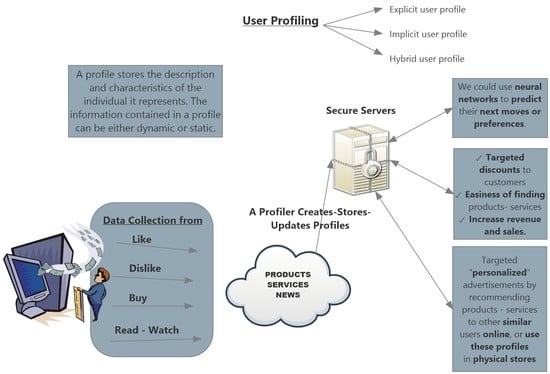
A User Profile is a group of items and/or patterns used to describe the user briefly. User Profiling is an especially critical procedure for e-business systems that captures online users’ attributes, knows online users, provides tailor-made goods and services, and therefore improves user satisfaction.
To conduct our research, we contacted the major superstores in Greece, asking for information on the way they have created their online user profiles. Our results show that while stores do allow users to register and create new profiles, there are times when customers provide false data. This problem can occur when no online verification process is in place. So, a question we must investigate is: which registered customers are supplying accurate online information?
“User profiling techniques have widely been applied in various e-business applications, e.g., online customer segmentation, web user identification, adaptive web site, fraud/intrusion detection, personalization, e-market analysis, recommendation, as well as personalized information retrieval and filtering” [4].
User Profiling can be defined as the course of pinpointing the data about a user interest domain [5,6]. This data can be used by the system to grasp more about the user and be further utilized to better meet the user’s needs.
In this article, we propose the implementation of an online profiling mechanism in a virtual e-shop, its success rates, and how neural networks could be used to predict the characteristics of new users. We also indicate the way our online profiles could be of benefit both to customers and stores through real time “personalized” advertisements targeted at customers shopping in physical stores. The proposal of this article is significant since it could redefine the way we shop at physical stores. If the real online profiles of the consumers are known, then we could use them to promote in real time, specific products to certain customers while shopping. A lot of research has already been conducted both on the techniques of user profiling in online shops and the techniques of user profiling in physical shopping, so the main objective of this article is to fill in this research gap by joining these approaches in order to increase the profits of businesses and the affordability for customers through personalized price offers.
The rest of this paper is organized as follows. Section 2 reviews some related work and introduces the theoretical basis. Section 3 describes our proposed model, and Section 4 describes the experimental setup as well as the results. Finally, Section 5 concludes the paper.

3. Our Proposed Implementation

Artificial intelligence is radically changing our lives and has been around for a long time. Through the COVID-19 pandemic, it has been given a new impetus, since public and private lives are now largely played out online. Any registration system primarily aims at collecting information on site visitors, not only to determine who is coming to the site, but also to facilitate informed decisions concerning the site design and content.
Marketers pay critical attention to customer profile data, which are used to better understand their audience, how they use the website, what products they like, their offline interests, and who is on their social media. The value of the database depends on the quality of the data it contains, and 88% of customers admit that traditional registration forms provide incomplete or incorrect information, so the database does not contain the required quality of data. Poor data quality can result in lost sales, ineffective direct marketing, administrative costs and a loss of 10–20% of annual revenue in avoidable distribution errors [33].
Users need a platform that checks and verifies data provided upon signing up. This will boost the profitability of the business and give consumers a sense of uniqueness by receiving targeted advertising—discounts—and recommended products on the site’s specially designed “personal” page. Generally, users who are already registered do not meddle with updating their profile, since they have already received access to the platform. Additionally, many users who are concerned about their personal information do not include their real personal data online. They intentionally (in most cases) give incorrect information. These fake profiles can be modified or updated with more data using the methods for unregistered users. Given the above, we created a “user profile extraction engine” called Profiler for a virtual web shop. Through this implementation, we can track users’ movements and create their profiles accordingly. Our primary goal was to create and edit a profile for e-commerce purposes.

3.1. The Database

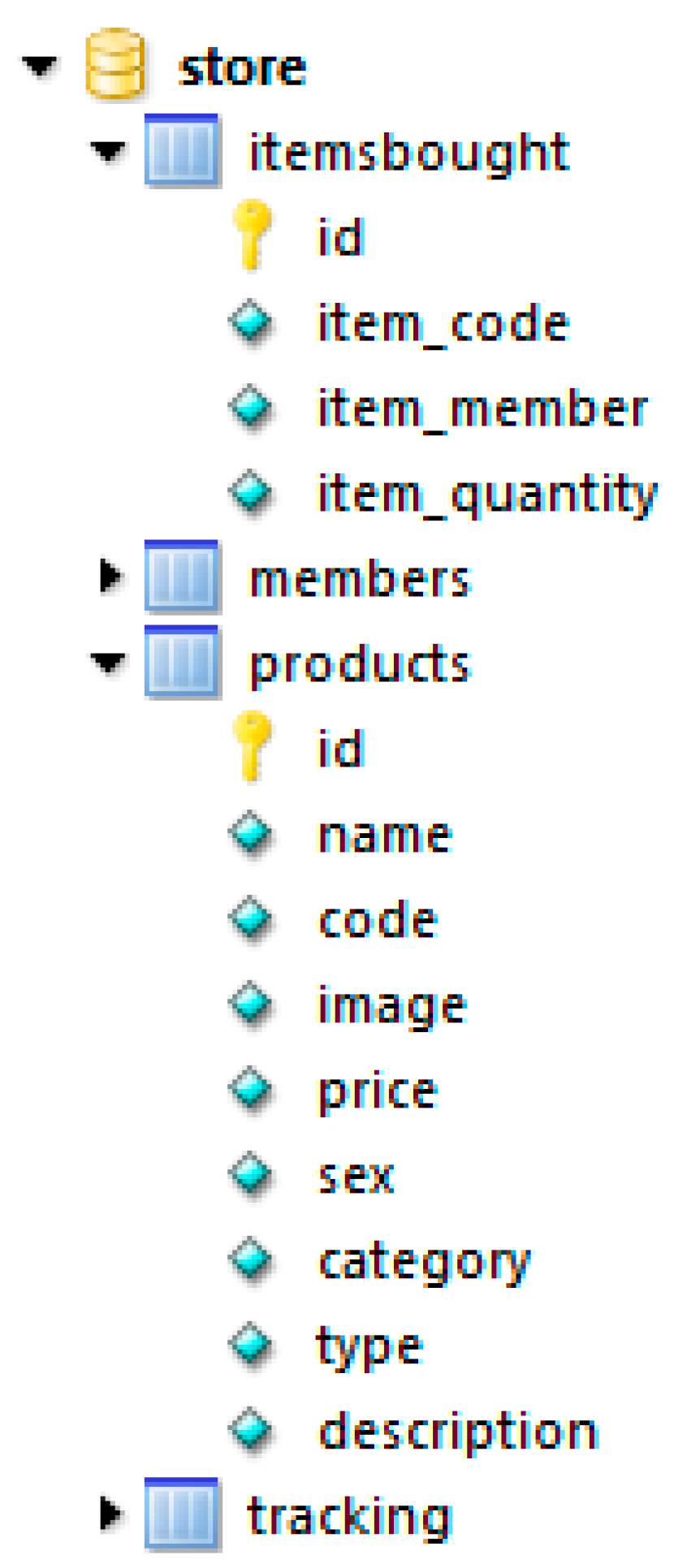
The database is used for the static data of the users entered during registration, the dynamic data entered during their navigation and for the products. The database consists of four tables: members (users), products (products), tracking (tracking) and item bought (purchases).
The users table consists of only three elements: the username, password and an ID for each user. This ID is unique for each user and is the key that connects this table to the tracking table.
The tracking table contains data that attempt to determine whether the user is male or female, whether they have children and what their hobbies are. It also keeps a record of when they last logged in, how many times they have shopped at the store, how much money they have spent and other personal information, if any.
The product table contains one-by-one information and images of the products as well as information that helps the system to categorize the products and answer the queries received from the user during the shopping process.
Finally, the shopping table (items bought) contains information about the purchases made by each user. Figure 4 shows the tables and some of the elements and keys that make up the system’s database.
Figure 4. Database tables.

3.2. User Tracking Technique

The process of user tracking is also the point where profiles are dynamically ‘built’. Every time a user makes a query in the database, the database displays the appropriate products and at the same time notes, by editing the user’s profile, the categories of interest.
PHP was used for server-side scripting and database communication. The dynamic editing of the profile is not visible to the ordinary user but only to the administrator of the website and cannot be edited unless the information in the database is ‘tampered with’.
We mentioned in Section 2.2.1 the ways in which it is possible to monitor profiles. In this application, the ideal way is the second one, i.e., monitoring through the user’s actions. In this way, by observing the recurring patterns of users, the system can adapt to changes in the user’s interests, likes, routines and targets. The only downside is that “building” a complete profile can take some time, and if not given enough time to create some recurring patterns by the user, the data may appear incomplete.
More specifically, the way a profile is tracked has to do with the pages visited in the application. That is, if a user visits men’s products very often, the system will know this and will increase the number of times this user has visited men’s products. All this information is stored and tracked in our system’s databases and not in cookies for various reasons as we showed in Section 2.2.2. By observing the user for some time, the system will have enough information about him/her so that the administrator can distinguish him/her from the others. Similarly, if users are browsing and constantly searching for products or information on pages of our online store that contain items for infants or children, our system also classifies them as potential parents. Thus, our system creates a profile for each registered user, constantly updating it with information related to gender, age, and financial and family status.

3.3. Data Analysis and Display Technique

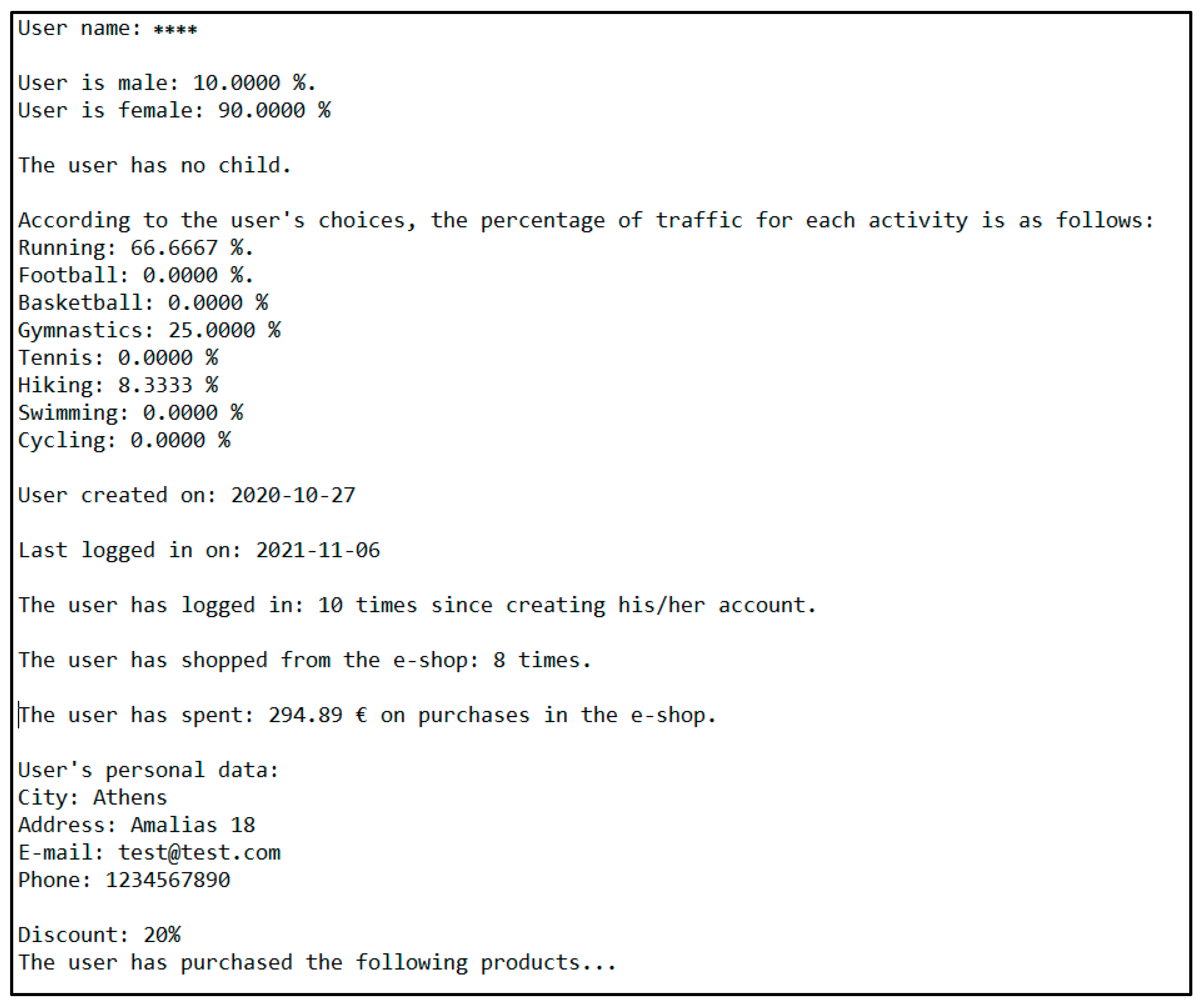
The final stage is to calculate and display statistics according to the preferences of each individual user. This option is only visible to the application administrator and allows the administrator to search for a user. The application, in turn, searches for the user in the database and all the data that make up the user. It then calculates the data and displays it so that it can be understood by the administrator. The analysis is the process in which the system takes the information where the user was looking at men’s, women’s or parent’s products and their categories and calculates them as percentages according to their choices. The data are displayed through tables where all the categories are displayed, and the administrator can clearly see the demographics and interests of the user.
More specifically, as is shown in Figure 5, the system administrator can see detailed information for each user, such as their username, statistical data on the user’s gender, his/her likes and much more personal information. For example, the user in this example, based on his/her statistical analysis, is 10% male and 90% female, so she is probably a female. There is also a prediction regarding whether this user has or does not have a child. According to the user’s navigations and the percentage of traffic of each sport activity, the administrator can see in percentages whether he/she likes running, football, basketball, gymnastics, tennis, hiking, swimming or cycling. The system administrator also has access to additional information about each user, such as what date the account was created, when the user last logged in, how many times he/she has logged in to the online store since creating the account, how many times he/she has shopped in the store and how much money he/she has spent in total. The personal details of each user are also presented, for example, in which city he/she lives, at which address, his/her e-mail address, telephone number and other address details. Additionally, the administrator can see if there are any discount coupons in his/her profile and a table of all the products he/she has bought in the past. So, the administrator has a complete overview of each user.
Figure 5. Data analysis and display technique of a user.

4. Results and Discussion

4.1. Testing of the Application with Real Users, Analysis of the Results through Questionnaires and SPSS

As mentioned in Section 3, a profiler prototype has been designed and implemented that takes information and interprets it as logical clusters, which are capable of being interpreted by humans and other appropriate programs that will monitor them.
The application represents an online store (e-shop) of sporting goods. Users log into the system and make their purchases. As users navigate through the e-shop, the system tracks the users’ movements and records them individually. In this way, we are able to understand some preferences of each user and even some personal data, such as their age, their gender or even if they are parents.
At the end of the visit of the users or potential buyers of the online shop, the users are asked to fill in a questionnaire. The questionnaire contains the same questions for all users and helps us to verify and check the validity of the information and data extracted by the user analysis system.

4.2. European Data Protection Regulation

The information collected is very personal and there is a risk of violation of the user’s privacy. There are legal and ethical issues regarding the surveillance of people’s privacy. The Data Protection Authority, also known as the General Data Protection Regulation (GDPR), is a constitutionally independent administrative authority. It was established by a law for the protection of every person from the processing of data concerning personal data, which incorporates a European Directive into Greek law [34]. This directive sets certain rules for the protection of personal data in all member countries belonging to the European Union. In our developed system, we respect and protect the privacy and the free development of the personality of each user, since this is a primary objective of any democratic society.
Any electronic application should maintain and establish a level of security and protection that is on a par with that of existing services, but at the same time capable of ensuring that personal data is used in a lawful and transparent manner in the interest of citizens–consumers. Due to the provision of electronic services, citizens who use them disclose personal data; thus, there is electronic collection and processing of important information about each citizen, which can be used to create an extensive profile or help unauthorized persons to access all the information. As Lopes H, Pires IM, Sánchez San Blas H, García-Ovejero R, Leithard write in their article, “Data privacy has had a vast prominence in society. Several approaches are taken to realize the dream of one day. There could be a world in which there is a real state of privacy for the individual” [35].
All online applications of any institution must inspire security during transactions, as it is vital that citizens/business users have confidence in the systems used by the public. Trust is consolidated by the existence of appropriate mechanisms for user identification, security and protection of personal data. Users should be made aware of how their personal data are protected and how risks arising from malicious actions by third parties are addressed, such as in cases of hacking of personal data, unauthorized use of services, unauthorized access to data, etc.
Directly intertwined with the security of Public Websites is their reliability and their acceptance by visitors–users. They should provide satisfactory security and reliability, ensuring the following parameters:
-
Integrity: which refers to ensuring that the information that is handled, published, stored and processed remains unchanged.
-
Identification: which refers to the identification of the user’s identity;
-
Confidentiality: which refers to access to information only by those who have the appropriate authorization.
-
Authentication: refers to the specific action that ensures that the identity declared by the user actually corresponds to the user.
-
Authorization: which refers to ensuring that each entity has access to those system resources to which it has been granted access.
-
Availability: relating to the availability of information whenever an authorized user attempts to access it.
-
Non-repudiation: which refers to the inability of a user to deny that he/she has performed an action related to accessing, entering and processing information. The security of public websites consists of a complex set of guidelines and rules relating to the organization of the website operator and the hosting provider, the procedures it applies, the services it provides, the technical infrastructure at its disposal and, finally, the legal framework for the protection of personal data and the security of communications.
Unfortunately, however, the preceding analysis has shown that, from a legal point of view, there are many different issues that need to be addressed immediately and specifically. Among the most important issues are undoubtedly those relating to data security and, more specifically, the issues relating to the authentication of the identity of the communicating parties, the integrity of the data transmitted, the confidentiality of the data from possible unwanted disclosure to third parties and the non-derogability of the data.
In order for any public or private agency to proceed with lawful processing of citizens’ personal data, it should, for example, have collected the data in a fair and lawful manner, for clear and defined purposes, the data should not be more than necessary and should be accurate and up to date. In conclusion, we must point out that if the challenges are overcome, Data Security–Legal Aspects will evolve the World Wide Web into a Web with many new possibilities and will greatly affect many of the activities of our daily lives.

4.3. Statistical Analysis of Data

For the purposes of this article, the statistical program SPSS was used to group, compare and draw conclusions about the quality and reliability of the information produced by the user analysis system.
In our sports e-shop, the adaptive profiling system that we created holds information and analyzes and makes predictions regarding the following categories:
-
Hiking
-
Swimming
-
Running
-
Cycling
-
Football
-
Basketball
-
Gym
-
Tennis
-
Sex (Male or Female?)
-
Parent (Is this user a parent?)
Accordingly, variables for the same categories were used for the “real” data provided to us through the questionnaires. One hundred adults from all educational levels completed the questionnaires after having made some virtual purchases in our online store. The questionnaire consists of 11 questions, and provides data about respondents from different points of view, such as sex, age, interests, parenthood, education, etc. The selection of these individuals was random. The purpose of this survey was to collect, per user, his/her personal data and his/her interests and to subsequently compare these data with those recorded and predicted by our online profiling system. The results of the survey were very encouraging and showed that our system in most cases worked extremely well. Detailed examples are presented below. More specifically, the questions they were asked to answer were:
  • Question: Which username did you use when you registered?
    This question was asked to know exactly which username he/she used when he/she created the account in our system so that we can compare our findings for that specific user.
  • Question: What is your gender?
    According to the replies to the questionnaires, 57 were males and 43 were females. Our online profiling system successfully predicted the gender for 84 of those users (47 males and 37 females). This means that the success rate of our system for the gender reached a percentage of 84%. In Table 2, the success rate of the gender prediction is presented.
    Table 2. Gender analysis.
  • Question: Are you a parent?
    Of the participants, 32 replied that they were parents and 68 replied that they were not. Based on the findings of our system, it predicted the correct parenthood for 49 of those users. In Table 3, the success rate of the Parenthood prediction is presented.
    Table 3. Parenthood analysis.
  • Question: What are your interests? Choose the ones that interest you (Running, Football, Basketball, Gymnastics, Tennis, Hiking, Swimming, Cycling)
    In this question, users had the choice to pick any activities that they really like. For each one of these activities and for every user, we analyzed the findings of our profiling system. It turned out that the system worked very well and made accurate predictions. In the following tables the success rates of each activity is presented.
In Table 4, the success rate of the Running activity prediction is presented.
Table 4. Running activity.
In Table 5, the success rate of the Football activity prediction is presented.
Table 5. Football activity.
In Table 6, the success rate of the Basketball activity prediction is presented.
Table 6. Basketball activity.
In Table 7, the success rate of the Gymnastics activity prediction is presented.
Table 7. Gymnastics activity.
In Table 8, the success rate of the Tennis activity prediction is presented.
Table 8. Tennis activity.
In Table 9, the success rate of the Hiking activity prediction is presented.
Table 9. Hiking activity.
In Table 10, the success rate of the Swimming activity prediction is presented.
Table 10. Swimming activity.
In Table 11, the success rate of the Cycling activity prediction is presented.
Table 11. Cycling activity.
The following are generic questions that we included in our questionnaire targeting to analyze how concerned the users are for their online profiles. Critical assumptions emerged from their answers.
  • Question: Would you be comfortable if you knew that an online store records your movements on it, and “creates” your shopping profile, in order to offer you in the future better services and special individual offers for your needs? e.g., to offer you a big discount on certain products that it “knows” you like?
    Of the responders, 49% said that they would feel comfortable knowing that their movements are recorded in their online shopping profile and 37% replied that they maybe would be. This means that almost 85% of us are aware that all of our online transactions are recorded and stored in our profiles. It is very important for all this personal information to be used for the right purposes. Nonetheless, it is that risk of violation of the user’s privacy that made the remaining 15% feel uncomfortable about the exposure of their online profiles.
  • Question: How much money per visit are you willing to spend on an online store per visit?
    Of the users that replied, 32% that they would spend more than 50 and less than 100 euro for their online purchases. Another 24% responded that they would spend more than 100 and less than 150 euro, and 23% responded that they would spend less than 50 euro. This means that online customers are afraid of spending a lot of money online to buy their goods. This is probably because they are afraid that their personal data and their credit card details will be exposed.
  • Question: How often would you buy from an online store?
    In this case, 44% of the users replied that they often buy from online stores. Another 26% said very often, 28% not often and only 2% replied that they would never buy from an online store, which means that the majority of the people today are using the Internet to buy products.
  • Question: Do you have any concerns when shopping online?
    In response to this question, 56% said no, and 44% said yes. If the risk of users’ privacy violation is reduced, then it is certain that more customers will be less concerned when shopping online.
  • Question: How many times have you purchased products online in the last year?
    In response to this question, 37% replied that they’ve made fewer than 10 purchases over the last year, 31% more than 10 and fewer than 20 and 15% responded that they have bought more than 50 times online. These numbers are expected to increase, since we will all find relevant products at better prices through profiling systems.
  • Question: Age in years?
    Among the users, 39% were in the 18–29 age group, 27% were between 30 and 39 years old, 16% were more than 40 and less than 50 and the rest were above 50. Younger people tend to use the Internet more often for all their transactions.
  • Question: Educational Profile?
    Of the users, 26% were high school graduates, 27% were university graduates, 16% were graduates of TEI (Technological Educational Institute), 12% possessed a master’s degree and 9% were PhD graduates. The remaining 10% possessed lower levels of education, such as high school or primary school. The majority of our users were adequately educated.

4.4. Use Neural Networks in Predictions of Our Users

Predicting user preferences with neural networks is a new trend in e-commerce systems. We could check and verify the data given from our users during their registration in our systems and, of course, we could alter their data. Marketers also find value in customer profile data, which they can use to interpret their buyers’ mode, how they are using the website, what goods they like, their interests while being offline, and who is partaking in their social networks [36]. This will enhance the revenue of the store and individuals will receive targeted advertisements for discounts and recommended products on their personal designed site, so that they can have a unique experience. A registered user will not update their profile for various reasons. They already have access to the required platforms, so they do not need to update their profiles. In addition, many users who are concerned about their privacy do not sign up with their actual personal data online. They deliberately (in most cases) provide false information.
Thus, neural networks can be used to alter or even complement these fake profiles. “A neural network is a network or circuit of neurons, or in a modern sense, an artificial neural network, composed of artificial neurons or nodes. Thus a neural network is either a biological neural network, made up of biological neurons, or an artificial neural network, for solving artificial intelligence (AI) problems” [37].
“Computer scientists have long been inspired by the human brain. In 1943, Warren S. McCulloch, a neuroscientist, and Walter Pitts, a logician, developed the first conceptual model of an artificial neural network. In their paper, “A logical calculus of the ideas imminent in nervous activity”, they define the concept of a neuron as a single cell living in a network of cells that receives inputs, processes those inputs, and generates an output” [31].
“One of the key elements of a neural network is its ability to learn. A neural network is not just a complex system, but a complex adaptive system, meaning it can change its internal structure based on the information flowing through it. Typically, this is achieved through the adjusting of weights. Each connection has a weight, a number that controls the signal between two neurons. If the network generates good output, there is no need to adjust the weights. If the network generates poor output then the system adapts in order to improve subsequent results” [38].

4.4.1. Steps in Implementing a Neural Network

A neural network is carried out in two steps:
  • Feed forward:
In a feed-forward neural network, there is a group of data on features and some random weights. As such, we take these random weights which we optimize by back propagation.
  • Back propagation:
In backward propagation, we compute the errors between the estimated output and the target output, and then we update the weight values using an algorithm (gradient descent).

4.4.2. Why Is Back Propagation Needed?

When designing neural networks, a model must first be trained and a specific weight assigned to each of these inputs. This weight determines how important this feature is to our predictions. The higher the weight, the greater the importance. However, we initially cannot know the specific weight required for these inputs. Therefore, we designate a random weight to our inputs, enabling our model to measure the prediction error. Consequently, we revise our weight values and run the code of the neural network again.

4.4.3. Sigmoid Function

The sigmoid function acts as an activation function during training of the neural network. Typically, we use neural networks for classification. In binary classification, there are two types, 0 and 1. However, the resulting value can be any possible number from the formula we use. We use the sigmoid function to solve this problem. As for the classification, we want our output values to be 0 or 1. The sigmoid function changes our output values from 0 to 1. A sigmoid function is a mathematical function that has the characteristic equation S or the sigmoid curve.

4.4.4. Coding and Training a Neural Network

We used Python and NumPy, a popular and powerful computing library for Python, to do the math and write the required code. First of all, we pass data-info to our system. Training of the system comes next, and then we check and verify some scenarios. Based on mathematical and statistical operations, the system replies if an assumption can be given or not. For the purposes of this article, we only tested for the parenthood of our users and their gender (male or female). Similarly, we could write code to test all the other characteristics of our users, i.e., whether they like sports or what their age is.
The behavior of an artificial neural network depends on the weights and input/output functions assigned to the cells. The output of the sigmoid cells is constantly changing with the input, but it is not simple. Sigmoid units are more like real neurons than linear or threshold units, but these units should be considered a rough approximation. You can use the following procedures to teach a tertiary network to perform specific tasks:
  • Determine how close the actual neuron is to the output of the network and compare it to the applicable output.
  • Change the weights of each connection so that the network produces a better approximation of the desired output.
  • To train a neural network to perform a specific function, it is necessary to adjust the weights of each unit to minimize the error between the expected output and the actual one.

4.4.5. Key Points of the Code and Screenshots of the Outcomes

The logistic sigmoid function defined as (1/(1 + e−x)) takes an input x of any real number and returns an output value in the range of −1 and 1.
# Sigmoid activation function: f(x) = 1/(1 + e−x)
return 1/(1 + np.exp(−x))
The derivative of the sigmoid function is:x
# Derivative of sigmoid: f′(x) = f(x) × (1 − f(x))
fx = sigmoid(x)
return fx × (1 − fx)
After the feeding forward of our neural network and the training, we updated the weights and the biases, and after calculating the total loss of each cycle inside our neuron, some predictions can be made, such as the following:
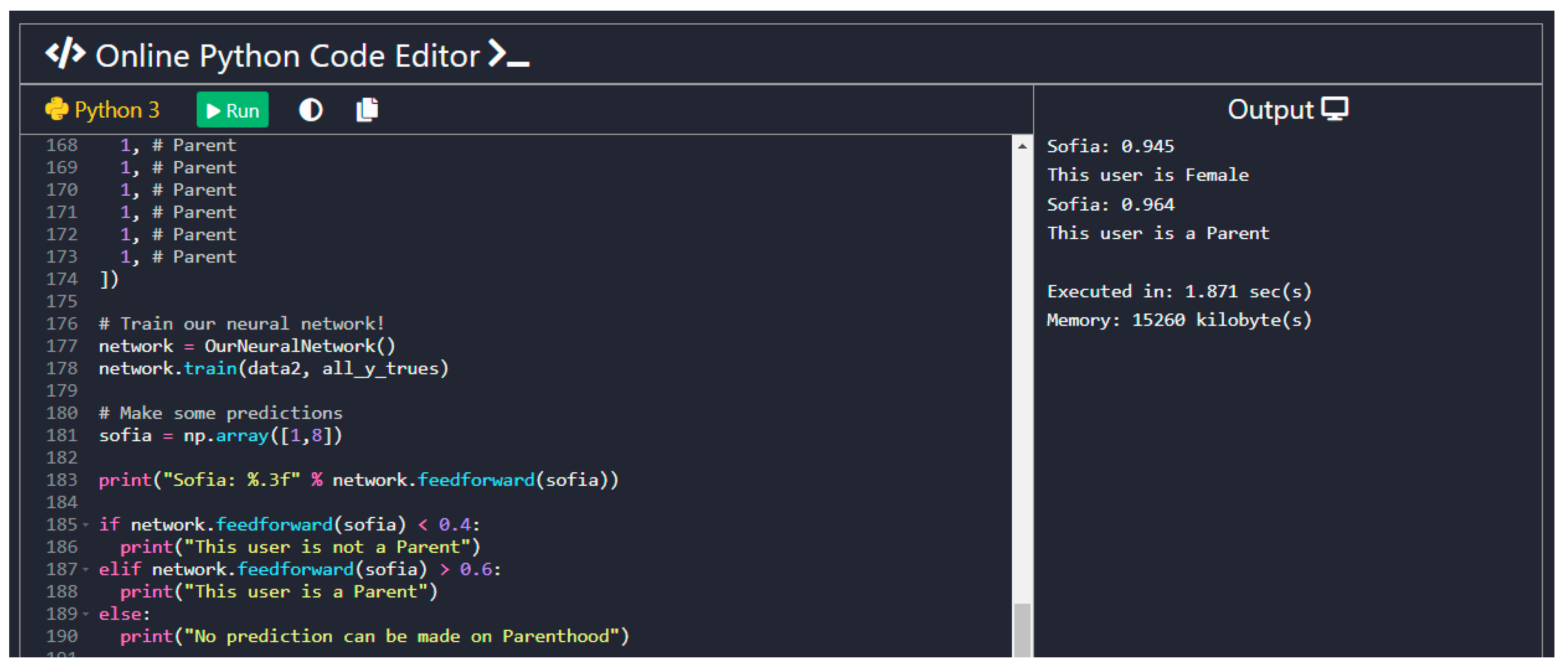
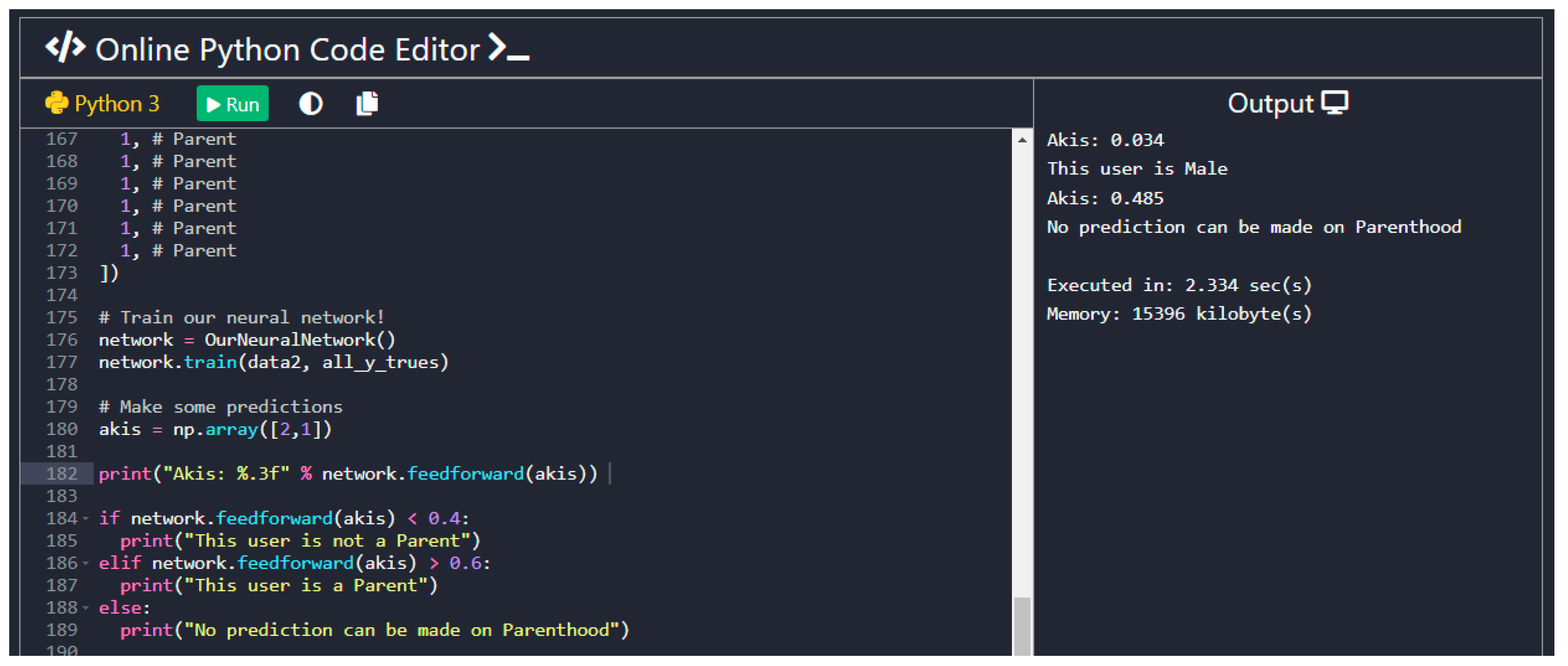
In Figure 6, it is shown how two users were tested for their gender, and in Figure 7, it is shown if any assumptions can be made regarding their parenthood.
Figure 6. Prediction for a user. This user is a female and a Parent.
Figure 7. Prediction for a user. This user is a Male and a no prediction can be made for his parenthood, so probably he is not a parent.
To be more precise, for each new user that enters our system, we could, after having recorded some of his/her movements, determine whether this user is a man or a woman or a parent, respectively. Our system could dynamically show relevant pages that pertain to that user only and not generic pages that we would show to an unknown user. We have defined in our code and trained our neural network when it calculates values less than 0.4 to assume that this user is male, and if it calculates values greater than 0.6 to assume that this user is female, and for values in between, not to make any prediction. Similarly, it works for the case of whether a user is a parent or not. It is implied that the closer to 0 or 1 the prediction is, the stronger it gets. That is, in the above example shown in Figure 6, the prediction for user “Sofia” resulted in 0.945, which is very close to 1, so this user is almost certainly a female. Similarly, for user “Akis”, the result from the neural network calculations showed 0.034, which is very close to 0, so this is also a strong and rather confident prediction. In case the outcome is about in the middle, as we can see in Figure 7, which shows that the parenthood of user “Akis” is 0.485, the system cannot make any predictions with the data recorded so far for him/her, based on his/her movements and choices. Since all this is done dynamically, in the future we could also predict whether this user is a parent or not when we have more data recorded for him/her.
Summarizing this chapter of this article, we could say that we presented the way of implementation and structure of our electronic application. We also showed how we tested it for the quality of its results by using condensed questionnaires. Our analysis of these showed that it does indeed work successfully and produces significant and accurate results for user profiling. Finally, we showed how neural networks could improve and automate the system’s user analysis processes. The users in our questionnaires showed that about 85% of them know that their movements and purchases in online stores are recorded, which means that now we all feel comfortable with it. In our question about whether they have concerns when they are shopping online, 56% said no and 44% said yes. If the risk of users’ privacy violation is reduced, then it is certain that more customers will be less concerned, and this is something we should all strive for in our future surveys [39].
Other scientists have shown in their research that user profiles can be used in e-commerce recommendation systems [9,40], for intelligent travel recommendation systems for individual and group users [41] and for inferring satisfaction in public information access services [42]. They could also be used in other platforms such as Recommendation System for E-Learning [43] and for the security of social networks [44], which have come to so dominate our lives [45,46]. User profiling could also be used to convert physical stores of smart cities into an open, geographically distributed mall by providing the logical consistency needed for conducting centralized searches over independent physical stores [47].

5. Conclusions and Future Work

In the near future, this profile may be expanded to include more features that will be used for personal purchases using new technologies such as mobile phones. After downloading the Store app on their mobile phone and entering the physical store, the user will continue to receive offer tips on the mobile screen according to their online profile [48].
As mobile’s GPS continually improves, in the near future the precise corridor that a customer is walking down may be calculable. This means that we could send him/her new targeted personal discounts as he/she walks through the store’s corridors, primarily based on the merchandise that is applicable to him and are close by and may focus on his profile. iBeacon technology can now be used. With the iBeacon network, any app or platform retailer can understand exactly where they are in a brick-and-mortar environment. The case will be like this. The consumer goes to the store with a smartphone. The application installed on the user’s smartphone listens to iBeacons. When an application hears iBeacon, it provides the server with the relevant information that triggers the operation. If the store knows the true online profile of a user and knows which aisle he/she is walking down in the store, they could promote targeted discounts on his/her mobile phone, exclusively for him/her, while he/she is standing next to a product. So, he/she would almost certainly buy that product and there would be an increase in product sales. Moreover, the user would “feel” like he/she won, since he/she bought a product that he/she likes and fits his/her profile at a better price without having to wander around the store to find it.
Furthermore, face recognition techniques could be applied to make these profiles more accurate in the future. All physical stores have cameras in their facilities nowadays. Through face recognition, the profiles that customers have in their online activities could be encased [49]. Gender, age and race are some of the characteristics of the online profiles that could easily be verified through the physical shopping of the consumers. By using the cameras in the physical stores, the technique proposed above could be implemented more easily and more economically, since it would not be necessary to use additional technologies such as iBeacons [50]. By making use of the cameras in the stores and discovering from the face who the particular consumer is who walks next to certain products and knowing his/her online profile, it could boost the sales rates of the stores. Targeted ads and offers individually for each consumer in real time using automated techniques would be available. User profiles could even be enriched with the stops consumers make next to specific products in the store, since even simple stops and checking out products would show their interests. So, we could in the future integrate the profiles from online stores with the profiles we have as consumers in physical stores [51]. This would mean almost absolute knowledge of shopping preferences, hence targeted results in our online searches and targeted individual advertisements and offers in the physical stores.
In this article, we have presented all the aspects of online user profiles. We showed what profiles are, how they are created and the benefits that consumers and citizens in general receive from them—e.g., what is the point of doing a search on a search engine to receive exactly the same results as another user? After all, you are probably not the same, you do not have the same interests, you are not the same gender, age, weight, height, etc. So, would it not be better and more constructive to receive information only relevant to us? Why should you receive millions of generic results when you are looking to buy a product and not a few hundred that targeted and fully relevant to you?
We also showed how a user profile could be created and how to “fix” a user profile through our virtual online store. We also investigated the success rates of our own engine’s predictions through the comparison of user questionnaires. We still saw that after knowing some things about our users, we could use neural networks to predict their next moves or wants [52]. Finally, we proposed a real time user-scenario when shopping in a physical store through real time targeted “personalized” advertisements as a customer walks through the corridors.

Author Contributions

Conceptualization, K.G.G., N.D.T. and I.D.M.; Investigation, K.G.G. and N.D.T.; Methodology, K.G.G., N.D.T. and I.D.M.; Software, K.G.G.; Validation, K.G.G.; Writing—original draft, K.G.G., N.D.T. and I.D.M.; Writing—review & editing, K.G.G., N.D.T. and I.D.M. All authors have read and agreed to the published version of the manuscript.

Funding

This research received no external funding.

Data Availability Statement

Not applicable. The study does not report any data.

Conflicts of Interest

The authors declare no conflict of interest.

Abbreviations

The following abbreviations are used in this manuscript:
CATSCollaborative Advisory Travel System
TEITechnological Educational Institute
GRSGroup recommender system
GDPRGeneral Data Protection Regulation
GPSGlobal Positioning System
IDIdentity document
PCAHTRSPersonalized Context-Aware Hybrid Travel Recommender System
PHPHypertext Preprocessor
SPSSStatistical Package for the Social Sciences
PHDDoctor of Philosophy

References

  1. Wagh, R.; Patil, J. Enhanced web personalization for improved browsing experience. Adv. Comput. Sci. Technol. 2017, 10, 1953–1968. [Google Scholar]
  2. Abri, S.; Abri, R.; Cetin, S. A classification on different aspects of user modelling in personalized web search. In Proceedings of the 4th International Conference on Natural Language Processing and Information Retrieval, Seoul, Korea, 18–20 December 2020; pp. 194–199. [Google Scholar] [CrossRef]
  3. Bakaev, M.A.; Pogorelova, A.O. Profiling of Website Visitors Based on Dimensions of User Experience. In Proceedings of the 2021 XV International Scientific-Technical Conference on Actual Problems Of Electronic Instrument Engineering (APEIE), Berdsk, Russia, 19–21 November 2021; pp. 1–6. [Google Scholar] [CrossRef]
  4. Kanoje, S.; Girase, S.; Mukhopadhyay, D. User Profiling for Recommendation System. arXiv 2015, arXiv:1503.06555. [Google Scholar]
  5. Kanoje, S.; Girase, S.; Mukhopadhyay, D. User profiling trends, techniques and applications. arXiv 2015, arXiv:1503.07474. [Google Scholar]
  6. Li, J.; Zhang, X.; Wang, K.; Zheng, C.; Tong, S.; Eynard, B. A personalized requirement identifying model for design improvement based on user profiling. AI EDAM 2020, 34, 55–67. [Google Scholar] [CrossRef]
  7. User Profile. Wikipedia, the Free Encyclopedia. 2022. Available online: https://en.wikipedia.org/wiki/User_profile (accessed on 5 April 2022).
  8. Farid, M.; Elgohary, R.; Moawad, I.; Roushdy, M. User Profiling Approaches, Modeling, and Personalization. In Proceedings of the 11th International Conference on Informatics & Systems (INFOS 2018), Cairo, Egypt, 10–12 December 2018; Available online: https://ssrn.com/abstract=3389811 (accessed on 5 April 2022).
  9. Gu, Y.; Ding, Z.; Wang, S.; Yin, D. Hierarchical user profiling for e-commerce recommender systems. In Proceedings of the 13th International Conference on Web Search and Data Mining, Houston, TX, USA, 3–7 February 2020; pp. 223–231. [Google Scholar] [CrossRef] [Green Version]
  10. Hawashin, B.; Lafi, M.; Kanan, T.; Mansour, A. An efficient hybrid similarity measure based on user interests for recommender systems. Expert Syst. 2020, 37, e12471. [Google Scholar] [CrossRef]
  11. Zhao, S.; Li, S.; Ramos, J.; Luo, Z.; Jiang, Z.; Dey, A.K.; Pan, G. User profiling from their use of smartphone applications: A survey. Pervasive Mob. Comput. 2019, 59, 101052. [Google Scholar] [CrossRef]
  12. Kyriazanos, D.M.; Olesen, H.; Hammershøj, A.D.; Heinze, E.K.S.; Bessler, S.; Zeiss, J.; Patrikakis, C.Z.; Nikolakopoulos, G.; Amundsen, S.; Thuvesson, H.; et al. Specification of User Profile, Identity and Role Management for PNs and Integration to the PN Platform; IST Project MAGNET Beyond (My Personal Adaptive Global Net and Beyond) No. Deliverable D4.3.2 (D1.2.2) IST-027396; Aalborg Universitetsforlag: Aalborg, Denmark, 2007. [Google Scholar]
  13. Olesen, H.; Noll, J.; Hoffmann, M.; Hammershøj, A.; Sapuppo, A.; Iqbal, Z.; Elahi, N.; Chowdhury, M.; Heikkinen, S.; Sutterer, M.; et al. User Profiles, Personalization and Privacy: WWRF Outlook Series. 2009; pp. 22–23. Available online: https://vbn.aau.dk/en/publications/user-profiles-personalization-and-privacy-wwrf-outlook (accessed on 5 April 2022).
  14. Wachter, S. Normative challenges of identification in the Internet of Things: Privacy, profiling, discrimination, and the GDPR. Comput. Law Secur. Rev. 2018, 34, 436–449. [Google Scholar] [CrossRef]
  15. Johnson, A.; Taatgen, N. User Modeling. In Handbook of Human Factors in Web Design; Lawrence Erlbaum Associates: Mahwah, NJ, USA, 2005; pp. 424–439. ISBN 9780805846119. [Google Scholar]
  16. Dhelim, S.; Aung, N.; Ning, H. Mining user interest based on personality-aware hybrid filtering in social networks. Knowl.-Based Syst. 2020, 206, 106227. [Google Scholar] [CrossRef]
  17. Xing, L.; Song, Z.; Ma, Q. User interest model based on hybrid behaviors interest rate. Appl. Res. Comput. 2016, 3, 661–664. [Google Scholar]
  18. Peng, J.; Choo, K.K.R.; Ashman, H. User profiling in intrusion detection: A review. J. Netw. Comput. Appl. 2016, 72, 14–27. [Google Scholar] [CrossRef]
  19. O’Neil, C.; Schutt, R. Statistical Inference, Exploratory Data Analysis, and the Data Science Process, Doing Data Science. In Doing Data Science; O’Reilly Media, Inc.: Sevastopol, CA, USA, 2014; Chapter 2; pp. 17–50. ISBN 9781449358655. [Google Scholar]
  20. Adèr, H.J. Phases and initial steps in data analysis. In Advising on Research Methods: A Consultant’s Companion; Adèr, H.J., Mellenbergh, G.J., Hand, D.J., Eds.; Johannes van Kessel Pub.: Huizen, The Netherlands, 2008; Chapter 14; pp. 333–356. ISBN 9789079418015. [Google Scholar]
  21. User Modeling. Wikipedia, the Free Encyclopedia. 2022. Available online: https://en.wikipedia.org/wiki/User_modeling (accessed on 5 April 2022).
  22. Fischer, G. User Modeling in Human–Computer Interaction. User Modeling User-Adapt. Interact. 2001, 11, 65–86. [Google Scholar] [CrossRef]
  23. Kostolányová, K.; Klubal, L. Use of user modeling for personalization. In AIP Conference Proceedings; AIP Publishing LLC: Melville, NY, USA, 2018; Volume 1978, p. 060017. [Google Scholar] [CrossRef]
  24. Brusilovsky, P. Adaptive hypermedia. User Modeling User-Adapt. Interact. 2001, 11, 95–97. [Google Scholar] [CrossRef]
  25. Abu-Naser, S.S.; Alamawi, W.W.; Alfarra, M.F. Rule Based System for Diagnosing Wireless Connection Problems Using SL5 Object. 2016. Available online: https://philpapers.org/go.pl?aid=ABURBS (accessed on 5 April 2022).
  26. Ricci, F.; Rokach, L.; Shapira, B. Introduction to Recommender Systems Handbook. In Recommender Systems Handbook; Ricci, F., Rokach, L., Shapira, B., Kantor, P., Eds.; Springer: Boston, MA, USA, 2011. [Google Scholar] [CrossRef]
  27. Nielsen, J. Usability Engineering; Academic Press Inc.: Cambridge, MA, USA, 1994; p. 165. ISBN 978-0-12-518406-9. [Google Scholar]
  28. Clifton, C. Encyclopedia Britannica: Definition of Data Mining. Available online: http://www.britannica.com/technology/data-mining (accessed on 5 April 2022).
  29. Ghorbani, A.; Zhang, J. GUMSAWS: A Generic User Modeling Server for Adaptive Web Systems. In Proceedings of the Fifth Annual Conference on Communication Networks and Services Research (CNSR ‘07), Frederlcton, NB, USA, 14–17 May 2007; pp. 117–124. [Google Scholar] [CrossRef]
  30. McCarthy, K.; Salamó, M.; Coyle, L.; McGinty, L.; Smyth, B.; Nixon, P. Cats: A synchronous approach to collaborative group recommendation. In Proceedings of the Florida Artificial Intelligence Research Society Conference (FLAIRS), Melbourne Beach, FL, USA, 11–13 May 2006; pp. 86–91. Available online: https://www.aaai.org/Papers/FLAIRS/2006/Flairs06-015.pdf (accessed on 5 April 2022).
  31. Logesh, R.; Subramaniyaswamy, V. Exploring hybrid recommender systems for personalized travel applications. In Cognitive Informatics and Soft Computing; Springer: Singapore, 2019; pp. 535–544. [Google Scholar] [CrossRef]
  32. Álvarez Márquez, J.O.; Ziegler, J. Hootle+: A group recommender system supporting preference negotiation. In Cyted-Ritos International Workshop on Groupware; Springer: Cham, Switzerland, 2016; pp. 151–166. [Google Scholar] [CrossRef]
  33. To Login or to Social Login. Available online: https://www.linkedin.com/pulse/login-social-scout-stevenson (accessed on 5 April 2022).
  34. Directive 95/46/EC. Available online: https://eur-lex.europa.eu/legal-content/EN/TXT/?uri=celex%3A31995L0046 (accessed on 5 April 2022).
  35. Lopes, H.; Pires, I.M.; Sánchez San Blas, H.; García-Ovejero, R.; Leithardt, V. PriADA: Management and Adaptation of Information Based on Data Privacy in Public Environments. Computers 2020, 9, 77. [Google Scholar] [CrossRef]
  36. Trends in Online Shopping. A Global Nielsen Consumer Report. June 2010. Available online: https://www.nielsen.com/wp-content/uploads/sites/3/2019/04/Q1-2010-GOS-Online-Shopping-Trends-June-2010.pdf (accessed on 5 April 2022).
  37. Neural Network. Available online: https://en.wikipedia.org/wiki/Neural_network (accessed on 5 April 2022).
  38. Neural Networks. Chapter 10. Available online: https://natureofcode.com/book/chapter-10-neural-networks (accessed on 5 April 2022).
  39. Gatziolis, K.G.; Boucouvalas, A.C. Discovering the impact of user profiling in e-services. In Proceedings of the 2014 International Conference on Telecommunications and Multimedia (TEMU), Heraklion, Greece, 28–30 July 2014. [Google Scholar] [CrossRef]
  40. Chaudhuri, A.; Samanta, D.; Sarma, M. Modeling user behaviour in research paper recommendation system. arXiv 2021, arXiv:2107.07831. [Google Scholar] [CrossRef]
  41. Logesh, R.; Subramaniyaswamy, V.; Vijayakumar, V.; Li, X. Efficient user profiling based intelligent travel recommender system for individual and group of users. Mob. Netw. Appl. 2019, 24, 1018–1033. [Google Scholar] [CrossRef]
  42. Flores, A.M.; Pavan, M.C.; Paraboni, I. User profiling and satisfaction inference in public information access services. J. Intell. Inf. Syst. 2022, 58, 67–89. [Google Scholar] [CrossRef]
  43. Kulkarni, T.; Kabra, M.; Shankarmani, R. User Profiling Based Recommendation System for E-Learning. In Proceedings of the 2019 IEEE 16th India Council International Conference (Indicon), Rajkot, India, 13–15 December 2019; pp. 1–4. [Google Scholar] [CrossRef]
  44. EEke, C.I.; Norman, A.A.; Shuib, L.; Nweke, H.F. A survey of user profiling: State-of-the-art, challenges, and solutions. IEEE Access 2019, 7, 144907–144924. [Google Scholar] [CrossRef]
  45. Mamun, M.; Al-Digeil, M.; Ahmed, S.S. Profiling Online Users: Emerging Approaches and Challenges. In Securing Social Networks in Cyberspace; CRC Press: Boca Raton, FL, USA, 2021; pp. 221–240. ISBN 9781003134527. [Google Scholar]
  46. Utami, E.; Mihuandayani, M.; Raharjo, S.; Hartanto, A.D.; Adi, S. A Review on Social Media Based Profiling Analysis. In Proceedings of the 2020 International Seminar on Application for Technology of Information and Communication (iSemantic), Semarang, Indonesia, 19–20 September 2020; pp. 442–448. [Google Scholar] [CrossRef]
  47. Bourg, L.; Chatzidimitris, T.; Chatzigiannakis, I.; Gavalas, D.; Giannakopoulou, K.; Kasapakis, V.; Konstantopoulos, C.; Kypriadis, D.; Pantziou, G.; Zaroliagis, C. Enhancing shopping experiences in smart retailing. J. Ambient. Intell. Humaniz. Comput. 2021, 12, 1–19. [Google Scholar] [CrossRef] [PubMed]
  48. Aivalis, C.J.; Gatziolis, K.G.; Boucouvalas, A.C. Innovations in E-Systems for E-Commerce. In Innovations in E-Systems for Business and Commerce; Apple Academic Press: Palm Bay, FL, USA, 2017; pp. 301–337. ISBN 9781771885645. [Google Scholar]
  49. Jung, S.G.; An, J.; Kwak, H.; Salminen, J.; Jansen, B.J. Assessing the accuracy of four popular face recognition tools for inferring gender, age, and race. In Proceedings of the Twelfth international AAAI conference on Web and Social Media, Palo Alto, CA, USA, 25–28 June 2018. [Google Scholar]
  50. Boucouvalas, A.C.; Aivalis, C.J.; Gatziolis, K.G. Integrating retail and e-commerce using Web Analytics and intelligent sensors. In Proceedings of the International Conference on E-Business and Telecommunications, Seoul, Korea, 3–5 August 2015; Springer: Cham, Switzerland, 2015. [Google Scholar] [CrossRef]
  51. Aivalis, C.J.; Gatziolis, K.G.; Boucouvalas, A.C. Evolving analytics for e-commerce applications: Utilizing big data and social media extensions. In Proceedings of the 2016 International Conference on Telecommunications and Multimedia (TEMU), Heraklion, Greece, 25–27 July 2016. [Google Scholar] [CrossRef]
  52. Chen, Y.; He, J.; Wei, W.; Zhu, N.; Yu, C. A Multi-Model Approach for User Portrait. Future Internet 2021, 13, 147. [Google Scholar] [CrossRef]
Publisher’s Note: MDPI stays neutral with regard to jurisdictional claims in published maps and institutional affiliations.

Article Metrics

Citations

Article Access Statistics

Multiple requests from the same IP address are counted as one view.