


Abstract
Future vehicles are becoming more like driving partners instead of mere machines. With the application of advanced information and communication technologies (ICTs), vehicles perform driving tasks while drivers monitor the functioning states of vehicles. This change in interaction requires a deliberate consideration of how vehicles should present driving-related information. As a way of encouraging drivers to more readily accept instructions from vehicles, we suggest the use of social rules, such as politeness, in human-vehicle interaction. In a 2 × 2 between-subjects experiment, we test the effects of vehicle politeness (plain vs. polite) on drivers’ interaction experiences in two operation situations (normal vs. failure). The results indicate that vehicle politeness improves interaction experience in normal working situations but impedes the experience in failure situations. Specifically, in normal situations, vehicles with polite instructions are highly evaluated for social presence, politeness, satisfaction and intention to use. Theoretical and practical implications on politeness research and speech interaction design are discussed.
1. Introduction
Driving or the control of a motor vehicle, is fundamentally a social activity. Drivers and vehicles interact closely with each other. Drivers use a steering wheel, pedals and various switches to control vehicles. Vehicles, in response, present the necessary information to drivers on an information display. They also support drivers and offer a convenient driving experience with advanced driver-assistance systems (ADAS) whose primary purpose is to reduce drivers’ needs to actively control vehicles [1]. With advanced information and communication technologies (ICTs), future vehicles will engage with drivers more actively. Vehicles equipped with intelligent support systems can actively initiate interactions with drivers, in addition to mere mechanical responses to drivers’ inputs. Moreover, autonomous driving systems—which can completely or partially replace drivers’ involvement—are being introduced at an increasing speed. Future vehicles will alleviate drivers of the burden of constantly manoeuvring their cars. Accordingly, the main role of future drivers will be to supervise their vehicles’ functioning status. As a result, vehicles will be more like interaction partners instead of simple machines waiting to be controlled.
As drivers delegate driving tasks to vehicles, they have to take a new role in observing traffic conditions and the status of the vehicles. To address this emerging role of drivers, the concept of shared authority between vehicles and drivers has been proposed in a series of reports from the US Department of Transportation [2,3,4]. According to the concept, vehicles perform driving tasks while drivers monitor the functioning state of vehicles. Human operators are identified as a key actor despite the high degree of automation advancement [5].
Future vehicles are required to support the new role of drivers. In addition to taking over part of the driving tasks, vehicles should convey the performance statuses to drivers. The amount and importance of vehicle-initiated interactions will increase and fluent communication with intelligent vehicles will become a central part of future vehicle use. This change in interaction between drivers and vehicles requires careful consideration of how information can be communicated to the driver so as to facilitate acceptance. Frequent instructions by a vehicle, for example, can be seen as distractions. Moreover, drivers have to take specific actions to follow the instructions. Due to these constraints, inconsiderate messages of vehicles are not likely to meet the new model of human-vehicle interaction.
This study will investigate a method of enhancing cooperation between drivers and vehicles. As discussed above, instructions of vehicles need to be smoothly accepted by drivers. To achieve the purpose, the current study will draw insights from one of the major principles of human cooperation, politeness. In this study, we apply and test the politeness principle in the design of intelligent driving assistants.
2. Related Works
2.1. Vehicles as Driving Partners
Vehicles are becoming more like driving partners instead of mere machines. Automakers have introduced various types of AI-based driving companions. Toyota, for example, unveiled artificial intelligence, named YUI in Consumer Electronics Show (CES) 2017. It is designed to learn about drivers and to provide friendly driving experience [6]. In CES 2019, BMW suggested a personal driving assistant that optimizes daily travel plans. Moreover, the assistant is expected to make suggestions for various digital services for the driver [7]. Many new vehicles possess artificial intelligence and actively provide necessary information to drivers. In turn, drivers have to attend to the information while performing their necessary tasks. Voice interface, which utilizes the interaction mode of human conversation, is widely accepted to be used in vehicle systems for delivering messages without interfering with drivers’ behaviours. Vehicles will need artificial intelligence and be able to communicate fluently to be regarded as partners of driving.
Interaction with vehicles as driving partners can be improved with the application of interpersonal communication principles. According to the Computers Are Social Actors (CASA) paradigm, people have a virtual social experience during interactions with machines. The virtual experience is not different from the actual social experience during communication with real people [8,9,10,11]. For example, people have been observed to show positive responses when they are praised by machines [9,12]. Even if the compliments from machines are in fact flatteries, people react as if they were receiving praise from other people. In addition, the provision of contextual information about the expertise of machines has similar effects as that of human specialists. Systems that are specialized for specific purposes are considered to be more reliable than general-purpose systems [9]. Similarly, the application of human-like characteristics to vehicles has been suggested to improve human-vehicle interaction. Anthropomorphism in an autonomous vehicle is reported to improve trustworthiness of the vehicle [13]. Specifically, human-like appearance and higher autonomy increase vehicle evaluations including perceived safety and affective trust [14]. Another study suggested that eye-gaze tracking technologies can increase the perceived reliability of an autonomous vehicle [15]. People naturally utilize social principles of human-to-human interaction during their interactions with vehicles.
2.2. Politeness for Cooperation
People are polite to each other in order to cooperate and form relationships. Politeness stems from an innate human ability to give consideration to other people. Humans, being social animals, have psychological mechanisms to form relationships and cooperate with one another. One of the premises of social relations is that people seek benefits through interactions. People form relationships to achieve greater goals more efficiently. For a cooperation to occur, all members of the cooperation should value practical benefits of the cooperation highly. If the benefits are one-sided, the other side may respond passively to the cooperation or even reject the relationship. As people are sensitive to the utility of cooperation, they naturally project that others also seek benefits from the relationship. Thus, people have a sophisticated sense of recognizing the benefits to both themselves and their cooperation partners. Politeness is the mutual respect people have for each other to ensures cooperation.
Politeness theory [16] explains this reciprocal consideration in terms of face-saving intentions, which reflects the respect for each other’s ideal social self. The theory assumes that people have an ideal social self, the face, which they wish to be respected by others. Every individual has a desire to maintain the face. Since people have natural social capabilities, people can easily make sense of whether they are treated well by their interaction partners. Even when the partners are machines, people are still sensitive about the machines’ politeness. If machines are polite to users by respecting their face, the users can expect more benefits from the relationships.
Politeness of computers has been widely studied and has been found to enhance the interaction experience [17,18,19,20,21,22,23,24]. In general, a machine following the politeness rule tends to be perceived as a better interaction partner. To be specific, Whitworth suggested a way of improving interaction by maximizing user’s choice with the openness of computer request [20]. Forcing users to only accept error messages would be impolite, so it is not recommended. In addition, the etiquette of computers can increase their credibility, as people have more trust in a person with a decent etiquette. Another study argued that people had more trust in a system that did not interfere with human operations [19]. Therefore, vehicle politeness can positively influence drivers’ user experience (UX) and promote their intentions to cooperate with the vehicle. Based on the above discussion, we suggest the following hypothesis.
Hypothesis 1:
Drivers using a polite driving assistant will show more positive evaluations of the system than drivers using a plain assistant.
The theory also suggests that people choose speech strategies by considering both a speaker’s wants and a listener’s burden. The magnitude of imposition posed by requests is a huge determinant of choosing a strategy. As the burden of requests increased, a speaker would choose a strategy with a higher degree of politeness. They can simply express appreciation, emphasize relationships or offer future rewards. They also can try to be indirect or apologetic for making the requests. Following that, it is a logical assumption that there will be an increased requirement of vehicle politeness as situations demand a heavier burden of requests. With this rationale, the following hypothesis is proposed.
Hypothesis 2:
Effects of vehicle politeness will be higher in task failure situations than normal working situations.
The voice interface is the platform for conveying vehicle politeness. In general, it is recommended that speech interfaces give short instructions to ensure efficient interaction [25]. Given the unfriendly nature of driving instructions, however, the pursuit of mere efficiency can lead drivers to feel antipathy towards dominant instructions. That might be the reason why some instructions contain treatments that may lower efficiency but may help to mitigate the unpleasant nature of the instructions [26]. Still, conversations that are too lengthy may hinder interaction experience. It is unclear if the use of politeness in vehicles is suitable in all situations. The conflict between efficiency and politeness leads to the following research question.
Research Question 1:
Is a vehicle that is always polite regardless of situations better than a vehicle that is selectively polite depending on situations?
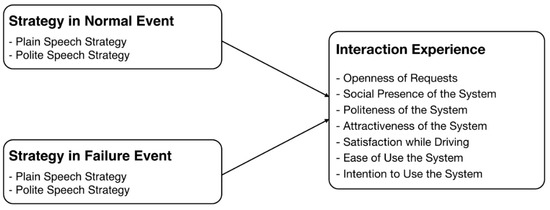
Figure 1 summarized the research model of this study. The proposed hypotheses and research question will be tested with a lab experiment.
Figure 1.
Research Model.
3. Method
3.1. Participants
A total of 56 participants were recruited at a large private university in S. Korea. They were undergraduate and graduate students and their average age was 23.25 (SD = 2.38). Of the participants, 27 were male and 29 were female and 30 of them had driving licenses. Regardless of the possession of the driving license, most participants lack driving experience. To compensate for the lack of driving experience, sufficient practice sessions were provided to all participants so that all participants had equal simulator driving skills.
3.2. Research Design
3.2.1. Experimental Condition
The experiment employed a 2 × 2 between-subjects factorial design. The conditions consist of a combination of a vehicle’s speech strategies (plain vs. polite) in different driving events (normal vs. failure). The first independent variable is vehicle politeness in normal events and the second one is vehicle politeness in failure events. For the four experimental conditions, a total of four script sets were installed to the vehicle information system respectively. While driving, participants used a system that gives instructions with an assigned politeness strategy.
3.2.2. Experimental Environment
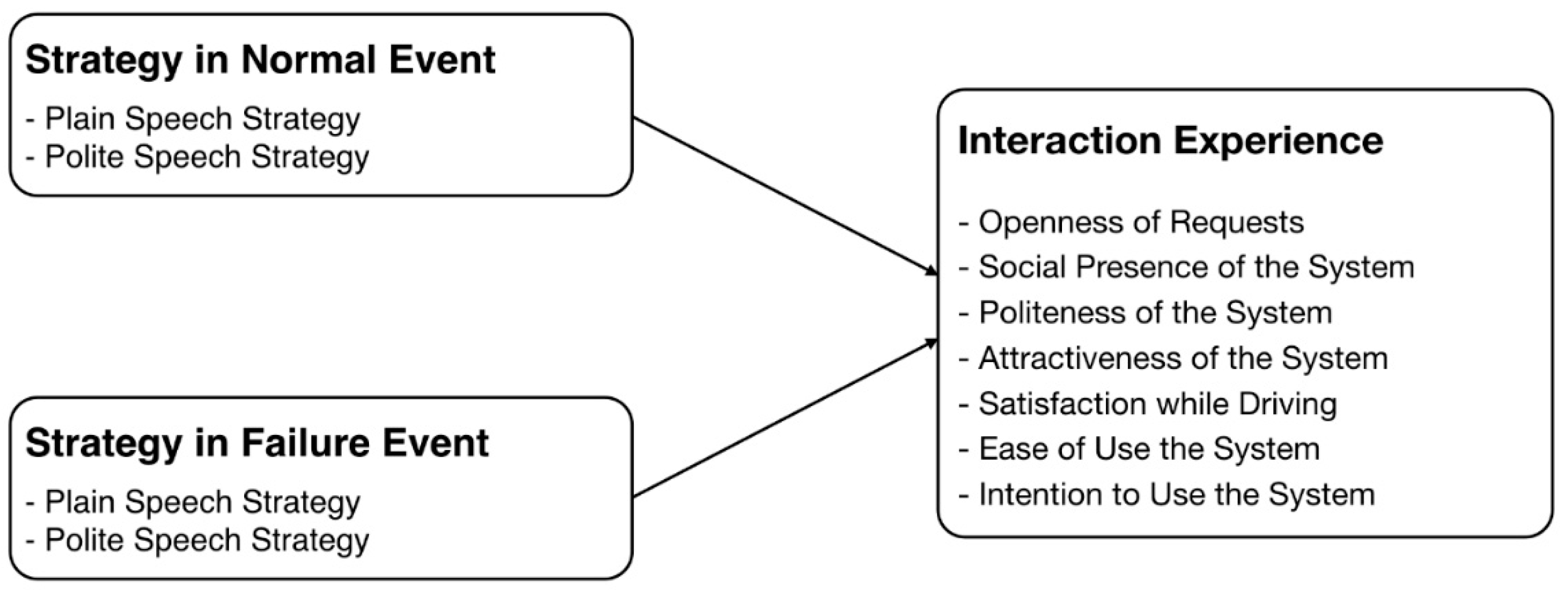
A commercial driving simulator, which is widely used for driving license training, was used in this study. The simulator (i.e., Model No. GDS-SEDAN-2014-D) was commercially developed by Gridspace. Inc. (http://gridspace.co.kr) and allowed drivers to experience realistic driving situations. The simulator has three 55-inch displays to represent the simulated traffic environment. It also has real pedals, a steering wheel and a dashboard. A driving course was developed to resemble a real urban area of Seoul. While driving, drivers can change to autonomous driving mode. In the autonomous driving mode, the control of the vehicle was transferred to a trained driver in a separate room. Participants did not know the existence of the separate room, nor did they know that someone would control the control the vehicle on their behalf.
An intelligent driving assistant was developed to give instructions to drivers. Eight instructions were written in accordance with the different driving situations. All instructions were developed into two versions: one using the plain strategy and the other using the polite strategy. Plain instructions simply stated the functioning status. Polite instructions, on the other hand, contained selected politeness factors [16,27,28]. It expressed the vehicles’ apologies for the burden imposed on drivers as well as the vehicles’ appreciation to drivers for accepting the requests. The polite instructions also delivered the messages indirectly, including an effort of vehicles to minimize drivers’ burden. For example, a plain instruction that a vehicle asks drivers to take control due to heavy traffic was written as following, “Due to heavy traffic, autonomous driving cannot continue. Drive manually.” In the polite version, the request sentence of “Drive manually,” was replaced with “Sorry for your inconvenience but manual driving for a moment would be appreciated. Autonomous driving will be possible again after leaving this area.” Half of the instructions were for normal situations (e.g., road sign detection success, successful functioning, etc.) while other half were for failure situations (e.g., voice recognition failure, road sign detection failure, etc.). The system was installed to a tablet PC and provided the assigned instructions following the progress of the driving course (see Figure 2).
Figure 2.
Experimental Environment with Simulator and Intelligent Driving Assistant.
3.3. Measurements
In this study, a driver’s cooperative driving experience was measured with a series of 10-point Likert scale items. Participants were asked to indicate their level of agreement to each item addressing interaction experience, including openness of requests, social presence, politeness, attractiveness of the system, ease of use, intention to use the system and satisfaction of driving with the system (see Appendix A for details).
3.4. Procedure
Upon arrival at the lab, participants were welcomed by the experimenter and were sufficiently briefed about the experiment. With pre-driving training, they acquired the necessary knowledge and driving skills before participating in the experiment. Next, they drove a course with an intelligent driving assistant. The assistant gave instructions to the participants according to assigned experimental conditions. Instruction order was mixed with failure and normal events so that all participants could experience an identical driving situation. Before starting to drive, the assistant requested participants to wear a seatbelt. After that, the participants entered their destinations and started driving. The first trial of destination input was deliberately designed to fail. After the initial failure, the assistant correctly indicated the destination. While driving, the assistant successfully detected road sign of child protection zone and guided drivers to decrease vehicle speed. Subsequently, another failure event was given that the vehicle could not detect a speed bump. In this situation, vehicle informed about the lack of traffic information. At the midpoint of the driving course, the driving mode was changed to autonomous driving. The assistant informed participants of the successful functioning status and requested drivers’ attention on traffic environment. Also, another normal event was produced in which the system successfully played a song that drivers demanded. Finally, a severe stagnation zone was placed to create another failure event. In this situation, the vehicle could not continue to engage in the autonomous driving mode. As a result, the system requested drivers to change the mode to manual driving. The driving took approximately 10 minutes to finish. Finally, participants’ perceptions of the experience were recorded in an electronic questionnaire. At the end of the experiment, participants were given $3 as a reward for participation.
4. Results
4.1. Initial Comparison of Politeness Strategies
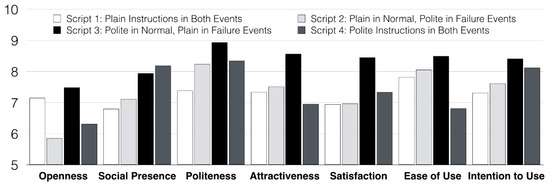
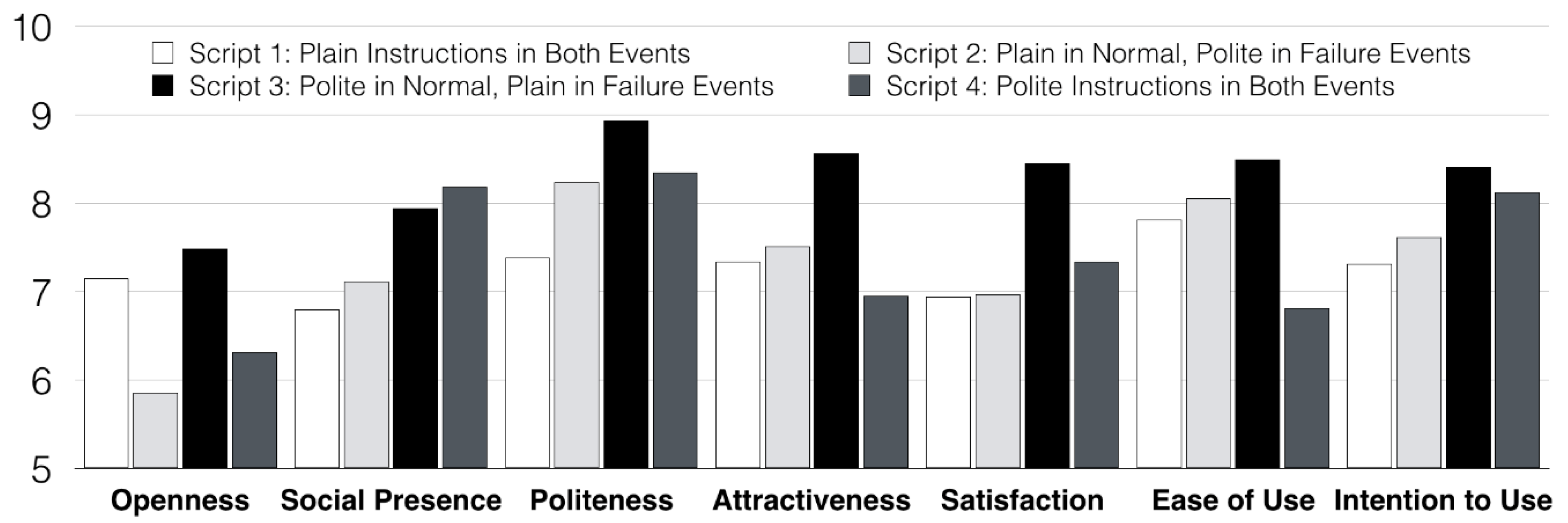
Figure 3 describes participants’ interaction experience depending on the speech strategies. Surprisingly, the third script set that gives plain instructions in failure events and informs politely in normal events, has the highest values for most of the interaction experience. In a general sense, drivers would like to use the system that informs politely in normal events, not in failures. Though it is insufficient to conclude at this moment, the third strategy seems to the most preferred speech style. A series of one-way analysis of variance and Tukey HSD post-hoc comparison was followed to test statistical significance of differences among script sets. The test revealed that drivers felt more freedom of choice for requests when vehicles politely instruct in normal events as compared to when the vehicle uses politeness strategy in failure events. Vehicles’ social presence was different between vehicles of the first script set and the fourth set. Vehicles that politely instruct in normal events only were highly evaluated for politeness than vehicles using plain strategy all the time. Drivers felt more attractiveness and ease of use when they used vehicles employing politeness strategy in normal events only than when they used vehicles using polite strategy in both situations. The results show that the effects of politeness strategy were different depending on the situations. Subsequent analyses were followed to reveal the detailed relationships between vehicle politeness and situations.
Figure 3.
Interaction Experience of Each Instruction Strategy.
4.2. Hypothesis Testing
A two-way multivariate analysis of variance (MANOVA) was conducted to assess the main effects of polite strategies in different situations on interaction experience. A multivariate test confirmed the validity of the research model. Politeness strategy in normal events had significant main effects on interaction experience, F(7,46) = 4.07, p < 0.01, ηp2 = 0.38, for all test results (i.e., Wilks’ lambda = 0.618, Pillai’s trace = 0.382, Hotelling’s trace = 0.619, Roy’s largest root = 0.619). In failure situations, the tests (i.e., Wilks’ lambda = 0.656, Pillai’s trace = 0.344, Hotelling’s trace = 0.525, Roy’s largest root = 0.525) also revealed significant main effects, F(7,46) = 3.45, p < 0.01, ηp2 = 0.34, for all measured variables. The interaction effect between vehicle politeness in different situations was not significant, F(7,46) = 2.15, p < 0.1, ηp2 = 0.25, when considering all variables together (i.e., Wilks’ lambda = 0.754, Pillai’s trace = 0.246, Hotelling’s trace = 0.326, Roy’s largest root = 0.326). Still, polite strategy in different situations may influence each other in specific interaction experience. Including the interaction effects, the main effects of vehicle politeness in respective events on each experience were tested for drawing detailed implications.
Table 1 shows the main effects of politeness strategy on each experience in different situations. In normal events, in which the vehicle functions appropriately, polite instruction strategy was found to enhance the interaction experience. Drivers felt a stronger social presence from a polite vehicle in normal events, F(1,52) = 9.65, p < 0.01, ηp2 = 0.16. They also evaluated the vehicle as more polite, F(1,52) = 4.42, p < 0.05, ηp2 = 0.08, when it gave polite instructions in that events. In addition, drivers were more satisfied while driving with the vehicle of employing politeness strategy in normal events, F(1,52) = 5.42, p < 0.05, ηp2 = 0.09 and showed a higher intention to use the vehicle, F(1,52) = 4.66, p < 0.05, ηp2 = 0.08. There were no significant differences in openness, attractiveness, ease of use for polite instructions in normal events.
Table 1.
Results of MANOVA Testing.
In failure situations, however, politeness strategy could not enhance the interaction experience. Instead, it hindered the experience in some respects. Openness of requests was decreased by vehicle politeness in failure events, F(1,52) = 8.32, p < 0.01, ηp2 = 0.14. It shows that drivers were somewhat reluctant to follow polite instructions in failure events. They also felt more difficulty in using the vehicle which provided polite instructions in failure events, F(1,52) = 4.25, p < 0.05, ηp2 = 0.08. Other experience aspects were not influenced by vehicle politeness in failure events.
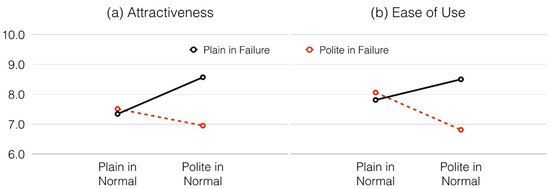
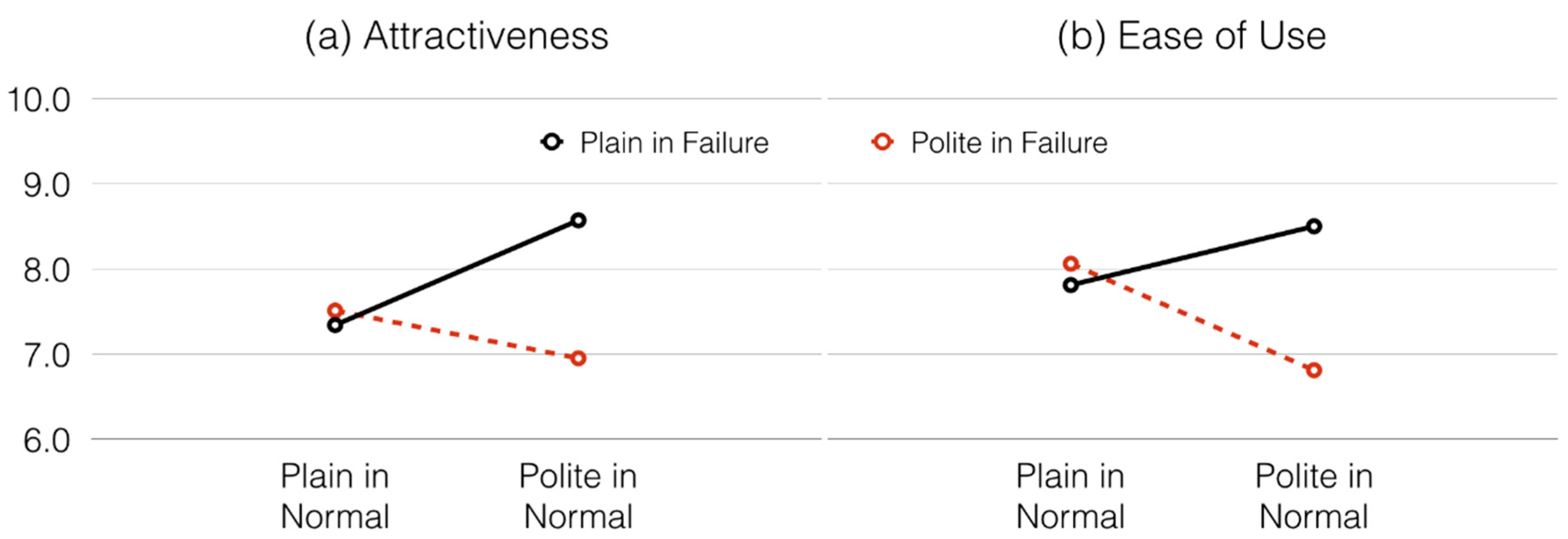
Table 1 also shows the interaction effects of politeness strategy in respective events on specific experience variables. With regard to attractiveness and ease of use, polite instructions showed different effects depending on situations (see Figure 4). Politeness instructions improve the interaction experience aspects of attractiveness and ease of use. The enhanced effects, however, only worked when the vehicle employed plain instructions in failure events. Applying politeness strategy in failure events cancelled out the effects or changed the effects to negative directions (e.g., attractiveness, ease of use).
Figure 4.
Interaction Effects between Politeness Strategies in Different Situations on Experience Components, (a) attractiveness and (b) ease of use.
The results indicate the limited validity of the proposed research model. Vehicle politeness improves interaction experience in normal working situations while impeding the experience in failure situations. With the results, hypothesis 1 is partially accepted and hypothesis 2 is not confirmed. A vehicle that is polite all the time does not provide a superior interaction experience. The results show that the best interaction strategy for a vehicle is to communicate with drivers politely in normal events, yet interact with them plainly in failure events. Drivers evaluate a vehicle more favourably when the vehicle uses the politeness strategy only in normal working situations. Thus, the answer to the research question is that vehicles adopting the selective politeness strategy are perceived better than vehicles using the permanent polite strategy regardless of situations.
In order to control possible effects of participants’ gender, age and possession of driving license, we also conducted two-way multivariate analyses of covariance (MANCOVAs). The results showed no significant covariate effects of gender, F(7,43) = 0.26, age, F(7,43) = 1.62 and driving license, F(7,43) = 0.31.
5. Conclusions
This study investigated vehicle politeness in different situations. The results revealed the positive effects of politeness strategy on interaction experience, especially in normal working situations. Similar with human communication, vehicles can improve interaction by implementing politeness, a social principle of human interaction. The study extends the politeness research to the field of human vehicle interaction and gives practical insights for the development of vehicle voice interfaces. Vehicles with polite instructions are highly evaluated for social presence, politeness, satisfaction and intention to use especially in normal working situations. The negative effects of politeness in failure situations, however, reveal that the selective politeness strategy works better than the permanent polite strategy. Why the politeness strategy does not work in failure situations? One possible explanation is that drivers might feel that polite messages in failure situations are nothing more than unnecessary excuses. Complex traffic environments causing failures would make drivers prefer immediate solutions. A fast recovery to normal situations is a critical determinant of drivers’ positive experience in failure situations. Moreover, a simple statement of failures can be evaluated as more honest. People trust honest people more than they do bluffers. In a similar vein, a previous study demonstrated that drivers prefer an honest vehicle that admits its own limitations [29]. They had more trust and showed more intention to cooperate with a candid vehicle. Subsequent studies should investigate more the conflicting effects of politeness and honesty in diverse driving situations.
The observed effects of vehicle politeness were stable even after controlling some demographic factors such as age, gender and the possession of driving license. Yet, we should be careful in generalizing these results to non-college student population especially population with a long history real driving experience. Given that less than 1 percent of vehicles in Seoul are owned by twenties [30], we believe that most of our participants have very limited actual driving experience on the road. This homogeneous nature of the college student participant pool should be taken into consideration for the generalization of the results to other demographic groups. More specifically, we suggest that future studies should test how well-seasoned drivers respond to vehicle politeness in different situations. We also recommend investigating the appropriate level of vehicle politeness and effects of various linguistic expressions (e.g., flattery, blame, insult) in human-vehicle interaction.
Author Contributions
Conceptualization, K.M.L. and J.-G.L.; methodology, J.-G.L.; software, J.-G.L.; investigation, J.-G.L.; formal analysis, J.-G.L. and S.-H.R.; writing—original draft preparation, J.-G.L.; writing—review and editing,K.M.L.; supervision, K.M.L.; project administration, S.-H.R.; funding acquisition, K.M.L. and S.-H.R.
Funding
This work was supported by the National Research Foundation of Korea Grant funded by the Korean Government (NRF-2017S1A3A2066149) and SUG (Interaction Science and User Experience Lab) Grant awarded to Kwan Min Lee.
Acknowledgments
We thank Gridspace (http://gridspace.co.kr) for their supports in building the driving simulation stimuli.
Conflicts of Interest
The authors declare no conflict of interest.
Appendix A
Table A1.
Questionnaire of Cooperative Driving Experience.
References
- Takada, Y.; Boer, E.R.; Sawaragi, T. Driver Assist System for Human-Machine Interaction. Cogn. Tech. Work 2017, 19, 819–836. [Google Scholar] [CrossRef] [Scilit]
- Marinik, A.; Bishop, R.; Fitchett, V.L.; Morgan, J.F.; Trimble, T.E. Human Factors Evaluation of Level 2 and Level 3 Automated Driving Concepts: Concepts of Operation. 2014. Available online: https://www.nhtsa.gov/sites/nhtsa.dot.gov/files/812043_hf-evaluationlevel2andlevel3automateddrivingconceptsv2.pdf (accessed on 25 December 2018).
- Blanco, M.; Atwood, J.; Vasquez, H.M.; Trimble, T.E. Human Factors Evaluation of Level 2 and Level 3 Automated Driving Concepts. 2015. Available online: https://www.nhtsa.gov/sites/nhtsa.dot.gov/files/812182_humanfactorseval-l2l3-automdrivingconcepts.pdf (accessed on 25 December 2018).
- Guo, C.; Sentouh, C.; Popieul, J.-C.; Haué, J.-B.; Langlois, S.; Loeillet, J.-J.; Soualmi, B.; That, T.N. Cooperation Between Driver and Automated Driving System: Implementation and Evaluation. Transp. Res. Part F Psychol. Behav. 2018, 1–12. [Google Scholar] [CrossRef] [Scilit]
- Parasuraman, R.; Wickens, C.D. Humans: Still Vital After All These Years of Automation. Hum. Factors 2008, 50, 511–520. [Google Scholar] [CrossRef] [Scilit] [PubMed]
- Toyota. Available online: https://www.toyota.com/concept-i/ (accessed on 25 December 2018).
- BMW. Available online: https://www.press.bmwgroup.com/global/article/detail/T0288983EN/bmw-group-at-the-ces-2019-in-las-vegas-virtual-drive-in-the-bmw-vision-inext?language=en (accessed on 25 December 2018).
- Nass, C.; Steuer, J.; Tauber, E.R. Computers Are Social Actors; ACM Press: New York, NY, USA, 1994; p. 204. [Google Scholar]
- Reeves, B.; Nass, C. The Media Equation - How People Treat Computers, Television and New Media Like Real People and Places; University of Chicago Press: Chicago, IL, USA, 1996. [Google Scholar]
- Nass, C.; Moon, Y. Machines and Mindlessness: Social Responses to Computers. J. Soc. Issues 2000, 56, 81–103. [Google Scholar] [CrossRef] [Scilit]
- Lee, K.M. Presence, Explicated. Commun. Theory 2004, 14, 27–50. [Google Scholar] [CrossRef]
- Johnson, D.; Gardner, J.; Wiles, J. Experience as a Moderator of the Media Equation: The Impact of Flattery and Praise. Int. J. Human-Comput. Stud. 2004, 61, 237–258. [Google Scholar] [CrossRef] [Scilit]
- Waytz, A.; Heafner, J.; Epley, N. The Mind in the Machine: Anthropomorphism Increases Trust in an Autonomous Vehicle. J. Exp. Soc. Psychol. 2014, 52, 113–117. [Google Scholar] [CrossRef] [Scilit]
- Lee, J.-G.; Kim, K.J.; Lee, S.; Shin, D. Can Autonomous Vehicles Be Safe and Trustworthy? Effects of Appearance and Autonomy of Unmanned Driving Systems. Int. J. Human-Comput. Interact. 2015, 31, 682–691. [Google Scholar] [CrossRef] [Scilit]
- Karatas, N.; Tamura, S.; Fushiki, M.; Okada, M. The Effects of Driving Agent Gaze Following Behaviors on Human-Autonomous Car Interaction. In Proceedings of the 10th International Conference on Social Robotics 2018, Qingdao, China, 28–30 November 2018; pp. 541–550. [Google Scholar]
- Brown, P.; Levinson, S.C. Politeness: Some Universals in Language Usage; Cambridge University Press: New York, NY, USA, 1987. [Google Scholar]
- Miller, C.A. Human-Computer Etiquette: Managing Expectations with Intentional Agents. Commun. ACM 2004, 47, 31–34. [Google Scholar]
- Nass, C. Etiquette Equality: Exhibitions and Expectations of Computer Politeness. Commun. ACM 2004, 47, 35–37. [Google Scholar] [CrossRef] [Scilit]
- Parasuraman, R.; Miller, C.A. Trust and Etiquette in High-Criticality Automated Systems. Commun. ACM 2004, 47, 51–55. [Google Scholar] [CrossRef] [Scilit]
- Whitworth, B. Polite Computing. Behav. Inf. Tech. 2005, 24, 353–363. [Google Scholar] [CrossRef] [Scilit]
- Wang, N.; Johnson, W.L.; Mayer, R.E.; Rizzo, P.; Shaw, E.; Collins, H. The Politeness Effect: Pedagogical Agents and Learning Outcomes. Int. J. Human-Comput. Stud. 2008, 66, 98–112. [Google Scholar] [CrossRef] [Scilit]
- Hayes, C.C.; Miller, C.A. Human-Computer Etiquette: Cultural Expectations and the Design Implications They Place on Computers and Technology; CRC Press: Boca Raton, FL, USA, 2010. [Google Scholar]
- Dorneich, M.C.; Ververs, P.M.; Mathan, S.; Whitlow, S.; Hayes, C.C. Considering Etiquette in the Design of an Adaptive System. J. Cogn. Eng. Decision Mak. 2012, 6, 243–265. [Google Scholar] [CrossRef] [Scilit]
- Torrey, C.; Fussell, S.R.; Kiesler, S. How a Robot Should Give Advice; IEEE: Piscataway, NJ, USA, 2013; pp. 275–282. [Google Scholar]
- Amazon. Available online: https://developer.amazon.com/designing-for-voice/what-alexa-says/#be-brief (accessed on 25 December 2018).
- Kellermann, K.; Shea, B.C. Threats, Suggestions, Hints and Promises: Gaining Compliance Efficiently and Politely. Commun. Q. 1996, 44, 145–165. [Google Scholar] [CrossRef] [Scilit]
- LIM, T.-S.; BOWERS, J.W. Facework Solidarity, Approbation and Tact. Hum. Commun. Res. 1991, 17, 415–450. [Google Scholar] [CrossRef] [Scilit]
- Danescu-Niculescu-Mizil, C.; Sudhof, M.; Jurafsky, D.; Leskovec, J.; Potts, C. A Computational Approach to Politeness with Application to Social Factors. arXiv, 2013; arXiv:1306.6078.
- Beller, J.; Heesen, M.; Vollrath, M. Improving the Driver–Automation Interaction. Hum. Factors 2013, 55, 1130–1141. [Google Scholar] [CrossRef] [Scilit] [PubMed]
- The Seoul Research Data Service. Available online: http://data.seoul.go.kr/dataService/ (accessed on 28 January 2019).

© 2019 by the authors. Licensee MDPI, Basel, Switzerland. This article is an open access article distributed under the terms and conditions of the Creative Commons Attribution (CC BY) license (http://creativecommons.org/licenses/by/4.0/).