Pharmacogenomics of Rivaroxaban: Association of CYP3A4, CYP3A5, CYP2J2, ABCB1, and ABCG2 Variants with Bleeding and Thrombotic Outcomes in Real-World Clinical Practice †

 ,
,  , , , , , , , ,
  and
and
Abstract
1. Introduction
2. Materials and Methods
2.1. Study Outline
2.2. Patients, Patient Management and Follow-Up
2.3. Genotyping
2.4. Statistical Analysis
3. Results
3.1. Cohort Characteristics
3.2. Bleeding Events
3.3. Occlusive Events
4. Discussion
5. Conclusions
Supplementary Materials
Author Contributions
Funding
Institutional Review Board Statement
Informed Consent Statement
Data Availability Statement
Acknowledgments
Conflicts of Interest
References
- Heestermans, M.; Poenou, G.; Hamzeh-Cognasse, H.; Cognasse, F.; Bertoletti, L. Anticoagulants: A Short History, Their Mechanism of Action, Pharmacology, and Indications. Cells 2022, 11, 3214. [Google Scholar] [CrossRef] [PubMed]
- Van Gelder, I.C.; Rienstra, M.; Bunting, K.V.; Casado-Arroyo, R.; Caso, V.; Crijns, H.J.G.M.; De Potter, T.J.R.; Dwight, J.; Guasti, L.; Hanke, T.; et al. 2024 ESC Guidelines for the management of atrial fibrillation developed in collaboration with the European Association for Cardio-Thoracic Surgery (EACTS). Eur. Heart J. 2024, 45, 3314–3414. [Google Scholar] [CrossRef] [PubMed]
- Konstantinides, S.V.; Meyer, G.; Becattini, C.; Bueno, H.; Geersing, G.J.; Harjola, V.P.; Huisman, M.V.; Humbert, M.; Jennings, C.S.; Jiménez, D.; et al. 2019 ESC Guidelines for the diagnosis and management of acute pulmonary embolism developed in collaboration with the European Respiratory Society (ERS). Eur. Respir. J. 2019, 54, 1901647. [Google Scholar] [CrossRef] [PubMed]
- Mueck, W.; Stampfuss, J.; Kubitza, D.; Becka, M. Clinical Pharmacokinetic and Pharmacodynamic Profile of Rivaroxaban. Clin. Pharmacokinet. 2014, 53, 1–16. [Google Scholar] [CrossRef] [PubMed]
- Kreutz, R. Pharmacodynamic and pharmacokinetic basics of rivaroxaban. Fundam. Clin. Pharmacol. 2012, 26, 27–32. [Google Scholar] [CrossRef] [PubMed]
- Spear, B.B.; Heath-Chiozzi, M.; Huff, J. Clinical application of pharmacogenetics. Trends Mol. Med. 2001, 7, 201–204. [Google Scholar] [CrossRef] [PubMed]
- Ayalew, M.B.; Tegegn, H.G.; Abdela, O.A. Drug Related Hospital Admissions; A Systematic Review of the Recent Literatures. Bull. Emerg. Trauma 2019, 7, 339–346. [Google Scholar] [CrossRef] [PubMed]
- Ahmed, S.; Zhou, Z.; Zhou, J.; Chen, S.Q. Pharmacogenomics of Drug Metabolizing Enzymes and Transporters: Relevance to Precision Medicine. Genom. Proteom. Bioinform. 2016, 14, 298–313. [Google Scholar] [CrossRef] [PubMed]
- Zhou, Y.; Lauschke, V.M. The genetic landscape of major drug metabolizing cytochrome P450 genes-an updated analysis of population-scale sequencing data. Pharmacogenom. J. 2022, 22, 284–293. [Google Scholar] [CrossRef] [PubMed]
- Shenfield, G.M. Genetic polymorphisms, drug metabolism and drug concentrations. Clin. Biochem. Rev. 2004, 25, 203–206. [Google Scholar] [PubMed]
- Caudle, K.E.; Dunnenberger, H.M.; Freimuth, R.R.; Peterson, J.F.; Burlison, J.D.; Whirl-Carrillo, M.; Scott, S.A.; Rehm, H.L.; Williams, M.S.; Klein, T.E.; et al. Standardizing terms for clinical pharmacogenetic test results: Consensus terms from the Clinical Pharmacogenetics Implementation Consortium (CPIC). Genet. Med. 2017, 19, 215–223. [Google Scholar] [CrossRef] [PubMed]
- Wu, T.; Wu, S.; Li, L.; Xiang, J.; Wang, N.; Chen, W.; Zhang, J. The impact of ABCB1, CYP3A4/5 and ABCG2 gene polymorphisms on rivaroxaban trough concentrations and bleeding events in patients with non-valvular atrial fibrillation. Hum. Genom. 2023, 17, 59. [Google Scholar] [CrossRef] [PubMed]
- Li, X.; Gu, Z.; Wang, Z.; Xu, Q.; Ma, C.; Lv, Q. Mutant CYP3A4/5 Correlated with Clinical Outcomes by Affecting Rivaroxaban Pharmacokinetics and Pharmacodynamics in Patients with Atrial Fibrillation. Cardiovasc. Drugs Ther. 2024, 38, 1315–1325. [Google Scholar] [CrossRef] [PubMed]
- Kim, H.; Song, T.J.; Yee, J.; Kim, D.H.; Park, J.; Gwak, H.S. ABCG2 Gene Polymorphisms May Affect the Bleeding Risk in Patients on Apixaban and Rivaroxaban. Drug Des. Dev. Ther. 2023, 17, 2513–2522. [Google Scholar] [CrossRef] [PubMed]
- Wang, F.; Li, Z.; Huang, Y.; Liu, Q.; Zhao, L.; Wang, H.; Gao, H.; Chen, M.; Lin, Y.; Li, X.; et al. Effect of ABCB1 SNP polymorphisms on the plasma concentrations and clinical outcomes of rivaroxaban in Chinese NVAF patients: A population pharmacokinetic-based study. Front. Pharmacol. 2025, 16, 1574949. [Google Scholar] [CrossRef] [PubMed]
- Ma, Y.; Song, Z.; Li, X.; Jiang, D.; Zhao, R.; Yi, Z. Toward Genetic Testing of Rivaroxaban? Insights from a Systematic Review on the Role of Genetic Polymorphism in Rivaroxaban Therapy. Clin. Pharmacokinet. 2024, 63, 279–291. [Google Scholar] [CrossRef] [PubMed]
- Nakagawa, J.; Kinjo, T.; Iizuka, M.; Ueno, K.; Tomita, H.; Niioka, T. Impact of gene polymorphisms in drug-metabolizing enzymes and transporters on trough concentrations of rivaroxaban in patients with atrial fibrillation. Basic Clin. Pharmacol. Toxicol. 2021, 128, 297–304. [Google Scholar] [CrossRef] [PubMed]
- Wang, L.; Chen, G.; Hu, W.; Chen, J.; He, Y. Effect of Gene Polymorphism on the Pharmacokinetics and Clinical Outcomes of Rivaroxaban: State-of-the-Art Review. Drug Des. Dev. Ther. 2025, 19, 7321–7331. [Google Scholar] [CrossRef] [PubMed]
- Campos-Staffico, A.M.; Dorsch, M.P.; Barnes, G.D.; Zhu, H.J.; Limdi, N.A.; Luzum, J.A. Eight pharmacokinetic genetic variants are not associated with the risk of bleeding from direct oral anticoagulants in non-valvular atrial fibrillation patients. Front. Pharmacol. 2022, 13, 1007113. [Google Scholar] [CrossRef] [PubMed]
- Božina, T.; Ganoci, L.; Šimičević, L.; Kirhmajer, M.V.; Mucalo, I.; Samardžić, J.; Palić, J.; Slišković, A.M.; Trkulja, V. Pharmacogenomics in the prediction of adverse effects of cardiovascular drugs: The PGx-CardioDrug project. Croat. Med. J. 2025, 66, 446–455. [Google Scholar] [CrossRef] [PubMed]
- Lloberas, N.; Elens, L.; Llaudó, I.; Padullés, A.; van Gelder, T.; Hesselink, D.A.; Colom, H.; Andreu, F.; Torras, J.; Bestard, O.; et al. The combination of CYP3A4*22 and CYP3A5*3 single-nucleotide polymorphisms determines tacrolimus dose requirement after kidney transplantation. Pharmacogenet. Genom. 2017, 27, 313–322. [Google Scholar] [CrossRef] [PubMed]
- Levey, A.S.; Stevens, L.A.; Schmid, C.H.; Zhang, Y.L.; Castro, A.F., 3rd; Feldman, H.I.; Kusek, J.W.; Eggers, P.; Van Lente, F.; Greene, T.; et al. A new equation to estimate glomerular filtration rate. Ann. Intern Med. 2009, 150, 604–612. [Google Scholar] [CrossRef] [PubMed]
- Elovic, A.; Pourmand, A. Lexicomp App Review. J. Digit. Imaging 2020, 33, 17–20. [Google Scholar] [CrossRef] [PubMed]
- Wishart, D.S.; Feunang, Y.D.; Guo, A.C.; Lo, E.J.; Marcu, A.; Grant, J.R.; Sajed, T.; Johnson, D.; Li, C.; Sayeeda, Z.; et al. DrugBank 5.0: A major update to the DrugBank database for 2018. Nucleic Acids Res. 2018, 46, D1074–D1082. [Google Scholar] [CrossRef] [PubMed]
- Schulman, S.; Kearon, C.; The Subcommittee on Control of Anticoagulation of the Scientific and Standardization Committee of the International Society on Thrombosis and Haemostasis. Definition of major bleeding in clinical investigations of antihemostatic medicinal products in non-surgical patients. J. Thromb. Haemost. 2005, 3, 692–694. [Google Scholar] [CrossRef] [PubMed]
- Kaatz, S.; Ahmad, D.; Spyropoulos, A.C.; Schulman, S. Definition of clinically relevant non-major bleeding in studies of anticoagulants in atrial fibrillation and venous thromboembolic disease in non-surgical patients: Communication from the SSC of the ISTH. J. Thromb. Haemost. 2015, 13, 2119–2126. [Google Scholar] [CrossRef] [PubMed]
- Gerifer, N. WeightIt: Weighting for Covariate Balance in Observational Studies Package Version 1.5.2026. Available online: https://ngreifer.github.io/WeightIt/ (accessed on 5 March 2026).
- Goodrich, B.; Gnaby, J.; Ali, I.; Brilleman, S. Rstanarm. Bayesian Applied Regression Modeling via Stan. R Package 2.32.2 2025. Available online: https://mc-stan.org/rstanarm/ (accessed on 5 March 2026).
- van Schaik, R.H.; van der Heiden, I.P.; van den Anker, J.N.; Lindemans, J. CYP3A5 Variant Allele Frequencies in Dutch Caucasians. Clin. Chem. 2002, 48, 1668–1671. [Google Scholar] [CrossRef]
- Birdwell, K.; Decker, B.; Barbarino, J.; Peterson, J.; Stein, C.; Sadee, W.; Wang, D.; Vinks, A.; He, Y.; Swen, J.; et al. Clinical Pharmacogenetics Implementation Consortium (CPIC) Guidelines for CYP3A5 Genotype and Tacrolimus Dosing. Clin. Pharmacol. Ther. 2015, 98, 19–24. [Google Scholar] [CrossRef] [PubMed]
- Wang, H.; Jiang, Y.; Liu, Y.; Lin, C.; Cheng, G.; Chen, X.; Hao, B.; Tan, W.; Lin, D.; He, F. CYP2J2*7 single nucleotide polymorphism in a Chinese population. Clin. Chim. Acta 2006, 365, 125–128. [Google Scholar] [CrossRef] [PubMed]
- Božina, T.; Ganoci, L.; Karačić, E.; Šimičević, L.; Vrkić-Kirhmajer, M.; Klarica-Domjanović, I.; Križ, T.; Sertić, Z.; Božina, N. ABCG2 and SLCO1B1 gene polymorphisms in the Croatian population. Ann. Hum. Biol. 2022, 49, 323–331. [Google Scholar] [CrossRef] [PubMed]
- Hira, D.; Terada, T. BCRP/ABCG2 and high-alert medications: Biochemical, pharmacokinetic, pharmacogenetic, and clinical implications. Biochem. Pharmacol. 2018, 147, 201–210. [Google Scholar] [CrossRef] [PubMed]
- Jeannesson, E.; Albertini, L.; Siest, G.; Gomes, A.; Ribeiro, V.; Aslanidis, C.; Schmitz, G.; Visvikis-Siest, S. Determination of ABCB1 polymorphisms and haplotypes frequencies in a French population. Fundam. Clin. Pharmacol. 2007, 21, 411–418. [Google Scholar] [CrossRef] [PubMed]
- Prathap, R.; Kirubha, S.; Rajan, A.T.; Manoharan, S.; Elumalai, K. The increasing prevalence of cancer in the elderly: An investigation of epidemiological trends. AGING Med. 2024, 7, 516–527. [Google Scholar] [CrossRef] [PubMed]
- Edwina, A.E.; Dia, N.; Dreesen, E.; Vanassche, T.; Verhamme, P.; Spriet, I.; Van der Linden, L.; Tournoy, J. Insights into the Pharmacokinetics and Pharmacodynamics of Direct Oral Anticoagulants in Older Adults with Atrial Fibrillation: A Structured Narrative Review. Clin. Pharmacokinet. 2023, 62, 351–373. [Google Scholar] [CrossRef] [PubMed]
- Benamouzig, R.; Guenoun, M.; Deutsch, D.; Fauchier, L. Review Article: Gastrointestinal Bleeding Risk with Direct Oral Anticoagulants. Cardiovasc. Drugs Ther. 2022, 36, 973–989. [Google Scholar] [CrossRef] [PubMed]
- Mulder, T.A.M.; van Eerden, R.A.G.; de With, M.; Elens, L.; Hesselink, D.A.; Matic, M.; Bins, S.; Mathijssen, R.H.J.; van Schaik, R.H.N. CYP3A4∗22 Genotyping in Clinical Practice: Ready for Implementation? Front. Genet. 2021, 12, 711943. [Google Scholar] [CrossRef] [PubMed]
- Berlin, D.S.; Sangkuhl, K.; Klein, T.E.; Altman, R.B. PharmGKB summary: Cytochrome P450, family 2, subfamily J, polypeptide 2: CYP2J2. Pharmacogenet. Genom. 2011, 21, 308–311. [Google Scholar] [CrossRef] [PubMed]
- Sychev, D.A.; Sokolov, A.V.; Reshetko, O.V.; Fisenko, V.P.; Sychev, I.N.; Grishina, E.A.; Bochkov, P.O.; Shevchenko, R.V.; Abdullaev, S.P.; Denisenko, N.P.; et al. Influence of ABCB1, CYP3A5 and CYP3A4 gene polymorphisms on prothrombin time and the residual equilibrium concentration of rivaroxaban in patients with non-valvular atrial fibrillation in real clinical practice. Pharmacogenet. Genom. 2022, 32, 301–307. [Google Scholar] [CrossRef] [PubMed]
- Lähteenmäki, J.; Vuorinen, A.; Pajula, J.; Harno, K.; Lehto, M.; Niemi, M.; van Gils, M. Pharmacogenetics of Bleeding and Thromboembolic Events in Direct Oral Anticoagulant Users. Clin. Pharmacol. Ther. 2021, 110, 768–776. [Google Scholar] [CrossRef] [PubMed]
- Gouin-Thibault, I.; Delavenne, X.; Blanchard, A.; Siguret, V.; Salem, J.E.; Narjoz, C.; Gaussem, P.; Beaune, P.; Funck-Brentano, C.; Azizi, M.; et al. Interindividual variability in dabigatran and rivaroxaban exposure: Contribution of ABCB1 genetic polymorphisms and interaction with clarithromycin. J. Thromb. Haemost. 2017, 15, 273–283. [Google Scholar] [CrossRef] [PubMed]
- Guo, L.; Sun, X.; Bo, Q.; Bai, W.; Du, Y.; Song, H. Effects of ABCG2 > A genetic polymorphism on the pharmacokinetics of rivaroxaban in healthy Chinese subjects. Xenobiotica 2025, 55, 445–453. [Google Scholar] [CrossRef] [PubMed]
- dos Santos, A.F.; Francisco, Q.A.S.; Nunes, J.B.; Colombo, F.A.; Boralli, V.B. ABCG2 polymorphism and rivaroxaban pharmacokinetics in healthy individuals after a single dose. Braz. J. Med. Biol. Res. 2024, 57, e13257. [Google Scholar] [CrossRef] [PubMed]
- Li, H.; He, X.; Guan, Y.; Lu, Q.; Fang, J.; Bian, X. Association of Genetic Variants with Rivaroxaban Pharmacokinetics and Pharmacodynamics and Hemorrhage Risk Factors in Patients with Venous Thromboembolism. J. Am. Heart Assoc. 2025, 14, e040698. [Google Scholar] [CrossRef] [PubMed]
- Castellucci, L.A.; Chen, V.M.; Kovacs, M.J.; Lazo-Langner, A.; Greenstreet, P.; Kahn, S.; Côté, B.; Schulman, S.; de Wit, K.; Douketis, J.; et al. Bleeding Risk with Apixaban vs. Rivaroxaban in Acute Venous Thromboembolism. N. Engl. J. Med. 2026, 394, 1051–1060. [Google Scholar] [CrossRef] [PubMed]
- Cichewicz, A.; Jawla, S.; Zuchinali, P.; Akin-Fajiye, M.; Massierer, D.; Porto, I.; Garcia-Moll, X. Real-world evidence comparing oral anticoagulants for NVAF in Europe: A systematic review and network meta-analysis. Future Cardiol. 2025, 21, 371–390. [Google Scholar] [CrossRef] [PubMed]
- Pisters, R.; Lane, D.A.; Nieuwlaat, R.; de Vos, C.B.; Crijns, H.J.G.M.; Lip, G.Y.H. A novel user-friendly score (HAS-BLED) to assess 1-year risk of major bleeding in patients with atrial fibrillation: The Euro Heart Survey. Chest 2010, 138, 1093–1100. [Google Scholar] [CrossRef] [PubMed]
- Liu, X.; Wang, S.; He, W.; Guo, L. HAS-BLED vs. ORBIT scores in anticoagulated patients with atrial fibrillation: A systematic review and meta-analysis. Front. Cardiovasc. Med. 2022, 9, 1042763. [Google Scholar] [CrossRef] [PubMed]



| CYP Enzymes | n (%) | Transporters | n (%) |
|---|---|---|---|
| CYP3A4*1B (rs2740574) genotype | ABCG2 c.421C>A (rs2231142) | ||
| *1/*1 | 371 (96.4) | C/C | 314 (81.5) |
| *1/*3 | 13 (3.4) | C/A | 68 (17.7) |
| *3/*3 | 1 (0.2) | A/A | 3 (0.8) |
| Variant allele frequency | 1.9% | Variant allele frequency | 9.6% |
| CYP3A4*22 (rs35599367) genotype | ABCG2 phenotype per rs2231142 | ||
| *1/*1 | 361 (93.8) | Normal activity | 314 (81.5) |
| *1/*22 | 23 (6.0) | Reduced activity | 71 (18.5) |
| *22/*22 | 1 (0.2) | ABCB1 c.1236C>T (rs1128503) | |
| Variant allele frequency | 3.2% | C/C | 124 (32.2) |
| CYP3A4 phenotype | C/T | 183 (47.5) | |
| Normal metabolizer (NM) | 361 (93.8) | T/T | 78 (20.3) |
| Intermediate metabolizer (IM) | 23 (6.0) | Variant allele frequency | 44.0% |
| Poor metabolizer (PM) | 1 (0.2) | ABCB1 c.2677G>T/A (rs2032582) | |
| CYP3A5*3 (rs776746) genotype | G/G | 158 (41.0) | |
| *1/*1 | 2 (0.5) | G/T or G/A | 145 (37.7) |
| *1/*3 | 38 (9.9) | T/T or T/A or A/A | 82 (21.3) |
| *3/*3 | 345 (89.6) | Variant allele frequency | 40.1% |
| Variant allele frequency | 94.5% | ABCB1 c.3435C>T (rs1045642) | |
| CYP3A5*3 phenotype | C/C | 89 (23.1) | |
| Enzyme expressors | 40 (10.4) | C/T | 177 (46.0) |
| Non-expressors | 345 (89.6) | T/T | 119 (30.9) |
| CYP3A combined phenotype | Variant allele frequency | 53.9% | |
| Poor metabolizer (PM) | 24 (6.2) | ABCB1 phenotype per rs1045642 | |
| Intermediate metabolizer (IM) | 322 (83.6) | Normal function | 266 (69.1) |
| Rapid metabolizer (RM) | 39 (10.1) | Reduced function | 119 (30.9) |
| CYP2J2*7 (rs890293) genotype | ABCB1 c.2482-2236G>A (rs4148738) | ||
| *1/*1 | 339 (88.1) | G/G | 109 (28.3) |
| *1/*7 | 46 (11.9) | G/A | 184 (47.8) |
| *7/*7 | 0 | A/A | 92 (23.9) |
| Variant allele frequency | 6.0% | Variant allele frequency | 47.8% |
| CYP2J2*7 phenotype | ABCB1 phenotype per rs4148738 | ||
| Normal activity | 339 (88.1) | Normal activity | 109 (28.3) |
| Reduced activity | 46 (11.9) | Increased/extensive activity | 276 (71.7) |
| CYP2J2 c.A>T (rs11572325) | |||
| A/A | 302 (78.4) | ||
| A/T | 79 (20.5) | ||
| T/T | 4 (1.0) | ||
| Variant allele frequency | 11.3% |
| Cases (Bleeding) | Controls (No Bleeding) | |
|---|---|---|
| N | 71 | 314 |
| Demographics and renal function | ||
| Age (years) | 74 (67–80; 30–88) | 66 (57–72; 26–98) |
| Males | 41 (57.8) | 197 (62.7) |
| eGFR (mL/min/1.73 m2) | 69 (47–85; 10–104) | 76 (60–90; 15–125) |
| Indication of rivaroxaban | ||
| Nonvalvular atrial fibrillation/atrial flutter | 57 (80.3) | 227 (72.3) |
| Peripheral artery disease | 12 (16.9) | 56 (17.8) |
| Venous thromboembolism | 12 (16.9) | 40 (12.7) |
| Ischemic stroke/TIA | 7 (9.9) | 50 (15.9) |
| Coronary heart disease/acute myocardial infarction | 23 (32.4) | 72 (22.9) |
| Thrombus in the left atrial apex/appendage | 2 (2.8) | 7 (2.2) |
| Adult congenital heart disease | 0 | 6 (1.9) |
| Thrombophilia | 2 (2.8) | 6 (1.9) |
| Daily rivaroxaban dose | ||
| 1 × 20 mg | 41 (57.8) | 232 (73.9) |
| 1 × 15 mg | 20 (28.2) | 33 (10.5) |
| 1 × 10 mg | 7 (9.9) | 5 (1.6) |
| 2 × 2.5 mg (total 5 mg) | 3 (4.2) | 44 (14.0) |
| Comorbidities | ||
| Hypertension | 64 (90.1) | 253 (80.6) |
| Dyslipidemia | 46 (64.8) | 222 (70.7) |
| GI disease (peptic ulcer/diverticulosis/polyps/IBD) | 32 (45.1) | 24 (7.6) |
| Malignancy (solid organ/hematological) | 20 (28.1) (16 + 4) | 51 (16.3) (41 + 10) |
| Diabetes mellitus | 14 (19.7) | 71 (22.6) |
| Anxious or depressive disorder | 9 (12.7) | 30 (9.6) |
| Systemic inflammatory disease | 4 (4.6) | 7 (2.2) |
| Musculoskeletal pain syndromes | 3 (4.2) | 18 (5.7) |
| Cases (Bleeding) | Controls (No Bleeding) | |
|---|---|---|
| N | 71 | 314 |
| Proton pump inhibitors | 49 (69.0) | 226 (72.0) |
| Platelet aggregation inhibitors | 15 (21.1) | 67 (21.1) |
| Dual antiplatelet therapy | 5 (7.0) | 10 (3.2) |
| CYP3A4 inhibitors | ||
| 0 | 47 (66.7) | 186 (59.2) |
| At least 1 (1 to 3) | 24 (33.8) | 128 (40.8) |
| CYP3A4 substrates | ||
| 0 | 3 (4.2) | 21 (6.7) |
| 1–2 | 30 (42.3) | 125 (39.8) |
| 3 or more | 38 (53.5) | 168 (53.5) |
| CYP3A5 inhibitors | ||
| 0 | 64 (90.1) | 269 (85.7) |
| At least 1 (1–2) | 7 (9.9) | 45 (14.3) |
| CYP3A5 substrates | ||
| 0 | 26 (36.6) | 123 (39.2) |
| 1–2 | 40 (56.3) | 159 (50.6) |
| 3 or more | 5 (7.1) | 32 (10.2) |
| CYP2J2 inhibitors | ||
| 0 | 55 (77.5) | 241 (76.8) |
| 1–2 | 16 (22.5) | 73 (23.2) |
| ABCB1 inhibitors | ||
| 0 | 4 (5.6) | 30 (9.5) |
| 1–2 | 40 (56.3) | 164 (52.3) |
| 3 or more | 27 (38.1) | 120 (38.2) |
| ABCB1 inducers | ||
| 0 | 64 (90.1) | 279 (88.8) |
| 1–2 | 7 (9.9) | 35 (11.2) |
| ABCB1 substrates | ||
| 0 | 4 (5.6) | 24 (7.6) |
| 1–2 | 43 (60.6) | 182 (58.0) |
| 3 or more | 24 (33.7) | 108 (34.4) |
| ABCG2 inhibitors | ||
| 0 | 24 (33.8) | 92 (29.3) |
| 1 | 47 (66.2) | 222 (70.7) |
| ABCG2 substrates | ||
| 0 | 13 (18.3) | 28 (8.9) |
| 1–2 | 53 (74.6) | 254 (80.9) |
| 3 or more | 5 (7.1) | 32 (10.2) |
| Cases (Bleeding) | Controls (No Bleeding) | |
|---|---|---|
| N | 71 | 314 |
| CYP3A phenotype | ||
| Rapid/intermediate metabolizer | 68 (95.8) | 294 (93.6) |
| Poor metabolizer | 4 (4.2) | 20 (6.4) |
| CYP2J2 phenotype (according to CYP2J*7) | ||
| Normal function | 66 (93.0) | 273 (86.9) |
| Reduced function | 5 (7.0) | 41 (13.1) |
| CYP2J2 A>T (rs11572325) | ||
| Wild type | 60 (84.5) | 242 (77.1) |
| Variant allele carrier | 11 (15.5) | 72 (22.9) |
| ABCG2 c.421C>A | ||
| Wild type | 55 (77.5) | 259 (82.5) |
| Variant allele carrier | 16 (22.5) | 55 (17.5) |
| ABCB1 c.1236C>T | ||
| Wild type | 24 (33.8) | 100 (31.8) |
| Variant allele carrier | 47 (66.2) | 214 (68.2) |
| ABCB1 2677G>T/A | ||
| Wild type | 28 (39.4) | 129 (41.1) |
| Variant allele carrier | 43 (60.6) | 185 (58.9) |
| ABCB1 3435C>T | ||
| Wild type | 19 (26.8) | 70 (22.3) |
| Variant allele carrier | 52 (73.2) | 244 (77.7) |
| ABCB1 2482-2236G>A | ||
| Wild type | 17 (23.9) | 92 (29.3) |
| Variant allele carrier | 54 (76.1) | 222 (70.7) |
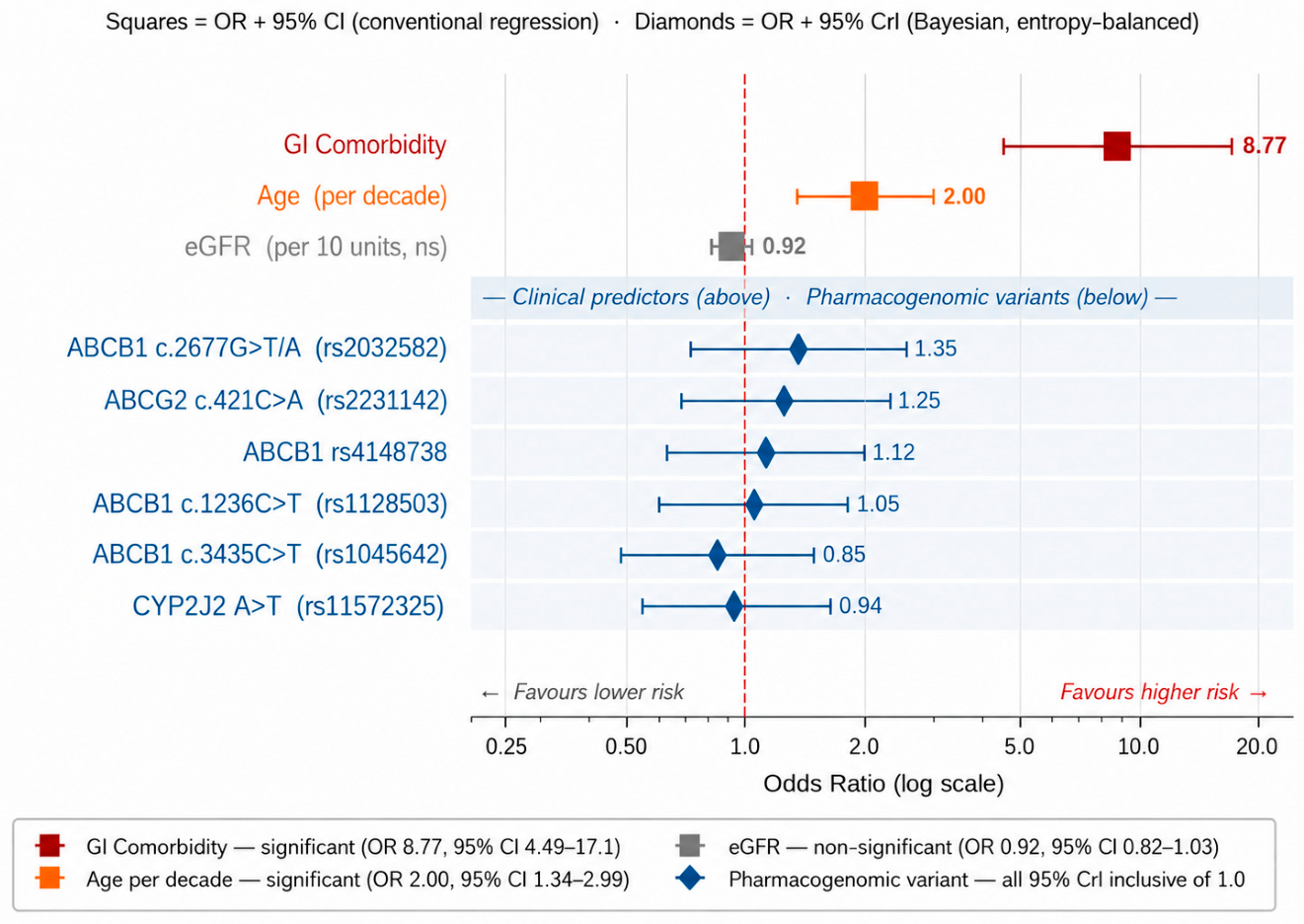
| Variant | Raw Data OR (95% CrI) | Balanced Data OR (95% CrI) |
|---|---|---|
| CYP2J2 c.A>T variant allele vs. wild type | 0.80 (0.50–1.38) | 0.94 (0.55–1.65) |
| ABCG2 c.421C>A variant allele vs. wild type | 1.16 (0.70–1.88) | 1.25 (0.76–2.12) |
| ABCB1 c.1236C>T variant allele vs. wild type | 1.12 (0.70–1.75) | 1.05 (0.59–1.90) |
| ABCB1 c.2677G>T/A variant allele vs. wild type | 1.20 (0.76–1.95) | 1.35 (0.81–2.07) |
| ABCB1 c.3435C>T variant allele vs. wild type | 1.04 (0.76–1.88) | 0.85 (0.49–1.51) |
| ABCB1 c.rs4148738 variant allele vs. wild type | 1.20 (0.76–1.95) | 1.12 (0.66–2.01) |
| Study (Year) | N | Design | Main Variants | Key Finding | Consistency with Present Study |
|---|---|---|---|---|---|
| Wu et al. 2023 [12] | 95 | Prospective multicenter | CYP3A4/5, ABCB1, ABCG2 | No bleeding association | Yes |
| Wang et al. 2025 [18] | SR | Systematic review | 25 loci | Insufficient evidence for implementation | Yes |
| Li et al. 2024 [13] | 165 | Prospective | CYP3A4/5 | CYP3A4 variants associated with bleeding | Partial |
| Wang et al. 2025 [15] | 228 | Prospective PK research | ABCB1 c.3435C>T, c.1236C>T, c.2677G>T/A | c.3435 T/T: higher VTE risk | No |
| Kim et al. 2023 [14] | 293 | Case-control | ABCG2, ABCB1 | ABCG2 rs3114018, ABCB1 rs1045642 assoc. with bleeding | No |
| Campos-Staffico 2022 [19] | 2364 | Retrospective cohort | 8 PK variants ABCB1, ABCG2, CYP2J2, CYP3A4/5 | No PGx–DOAC bleeding association | Yes |
| Present study (2026) | 385 | Nested case-control | 10 SNPs (5 genes) | No PGx signal; age + GI comorbidity dominate | — |
Disclaimer/Publisher’s Note: The statements, opinions and data contained in all publications are solely those of the individual author(s) and contributor(s) and not of MDPI and/or the editor(s). MDPI and/or the editor(s) disclaim responsibility for any injury to people or property resulting from any ideas, methods, instructions or products referred to in the content. |
© 2026 by the authors. Licensee MDPI, Basel, Switzerland. This article is an open access article distributed under the terms and conditions of the Creative Commons Attribution (CC BY) license.
Share and Cite
Slišković, A.M.; Trkulja, V.; Ganoci, L.; Božina, T.; Pašara, V.; Vrkić Kirhmajer, M.; Palić, J.; Strikić, D.; Narančić, M.; Sopek Merkaš, I.; et al. Pharmacogenomics of Rivaroxaban: Association of CYP3A4, CYP3A5, CYP2J2, ABCB1, and ABCG2 Variants with Bleeding and Thrombotic Outcomes in Real-World Clinical Practice. Pharmaceutics 2026, 18, 884. https://doi.org/10.3390/pharmaceutics18070884
Slišković AM, Trkulja V, Ganoci L, Božina T, Pašara V, Vrkić Kirhmajer M, Palić J, Strikić D, Narančić M, Sopek Merkaš I, et al. Pharmacogenomics of Rivaroxaban: Association of CYP3A4, CYP3A5, CYP2J2, ABCB1, and ABCG2 Variants with Bleeding and Thrombotic Outcomes in Real-World Clinical Practice. Pharmaceutics. 2026; 18(7):884. https://doi.org/10.3390/pharmaceutics18070884
Chicago/Turabian StyleSlišković, Ana Marija, Vladimir Trkulja, Lana Ganoci, Tamara Božina, Vedran Pašara, Majda Vrkić Kirhmajer, Jozefina Palić, Dominik Strikić, Marino Narančić, Ivana Sopek Merkaš, and et al. 2026. "Pharmacogenomics of Rivaroxaban: Association of CYP3A4, CYP3A5, CYP2J2, ABCB1, and ABCG2 Variants with Bleeding and Thrombotic Outcomes in Real-World Clinical Practice" Pharmaceutics 18, no. 7: 884. https://doi.org/10.3390/pharmaceutics18070884
APA StyleSlišković, A. M., Trkulja, V., Ganoci, L., Božina, T., Pašara, V., Vrkić Kirhmajer, M., Palić, J., Strikić, D., Narančić, M., Sopek Merkaš, I., Merćep, I., Bulum, J., & Šimičević, L. (2026). Pharmacogenomics of Rivaroxaban: Association of CYP3A4, CYP3A5, CYP2J2, ABCB1, and ABCG2 Variants with Bleeding and Thrombotic Outcomes in Real-World Clinical Practice. Pharmaceutics, 18(7), 884. https://doi.org/10.3390/pharmaceutics18070884