Nanomaterial-Enhanced Corneal Cross-Linking: Engineering Strategies for Transforming Keratoconus Management

Abstract
1. Introduction
Terminology and Benchmark Standardization
2. Current Challenges in CXL
2.1. Transepithelial Riboflavin Permeation Barrier
2.2. Oxygen Supply Limitation in A-CXL
2.3. Corneal Thickness Limitation
3. Emerging Nanotechnology Paradigms in CXL
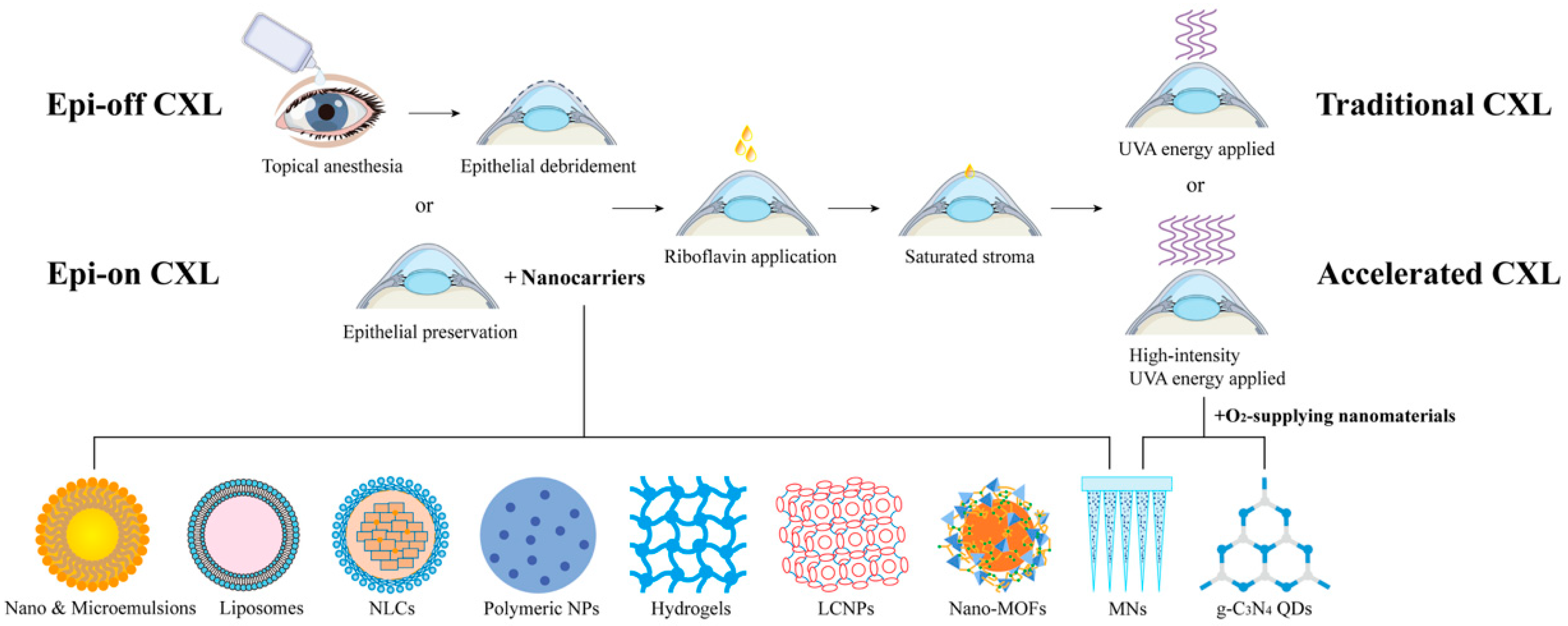
3.1. Advanced Delivery Platforms for Stromal Penetration
3.1.1. Emulsified and Lipid-Based Nanosystems
3.1.2. Polymeric Nanoparticles and Hydrogels
3.1.3. Highly Ordered and Structural Penetration Platforms
3.1.4. Comparative Analysis of Delivery Routes: Balancing Efficacy, Safety, and Feasibility
3.1.5. Payload Pairing: Structural and Physicochemical Alignment with Diverse Biomolecules
3.2. Overcoming Stromal Hypoxia: In Situ Oxygen-Generating Nanomaterials and Oxygen-Carrying Microneedles
3.3. Bypassing Corneal Thickness Constraints: Visible-Light Paradigms and High-Precision Photonic Strategies
3.3.1. Exploratory Paradigms: Visible-Light Photosensitizers, Hyperoxic Optimization, and Theoretical Nano-Amplifiers
3.3.2. High-Precision Photonic Strategies
3.4. The Pharmacological Landscape: Expanding APIs Beyond Riboflavin
4. Challenges and Future Directions
4.1. Challenges
4.1.1. Biological and Toxicological Hurdles
4.1.2. Translational and Regulatory Barriers
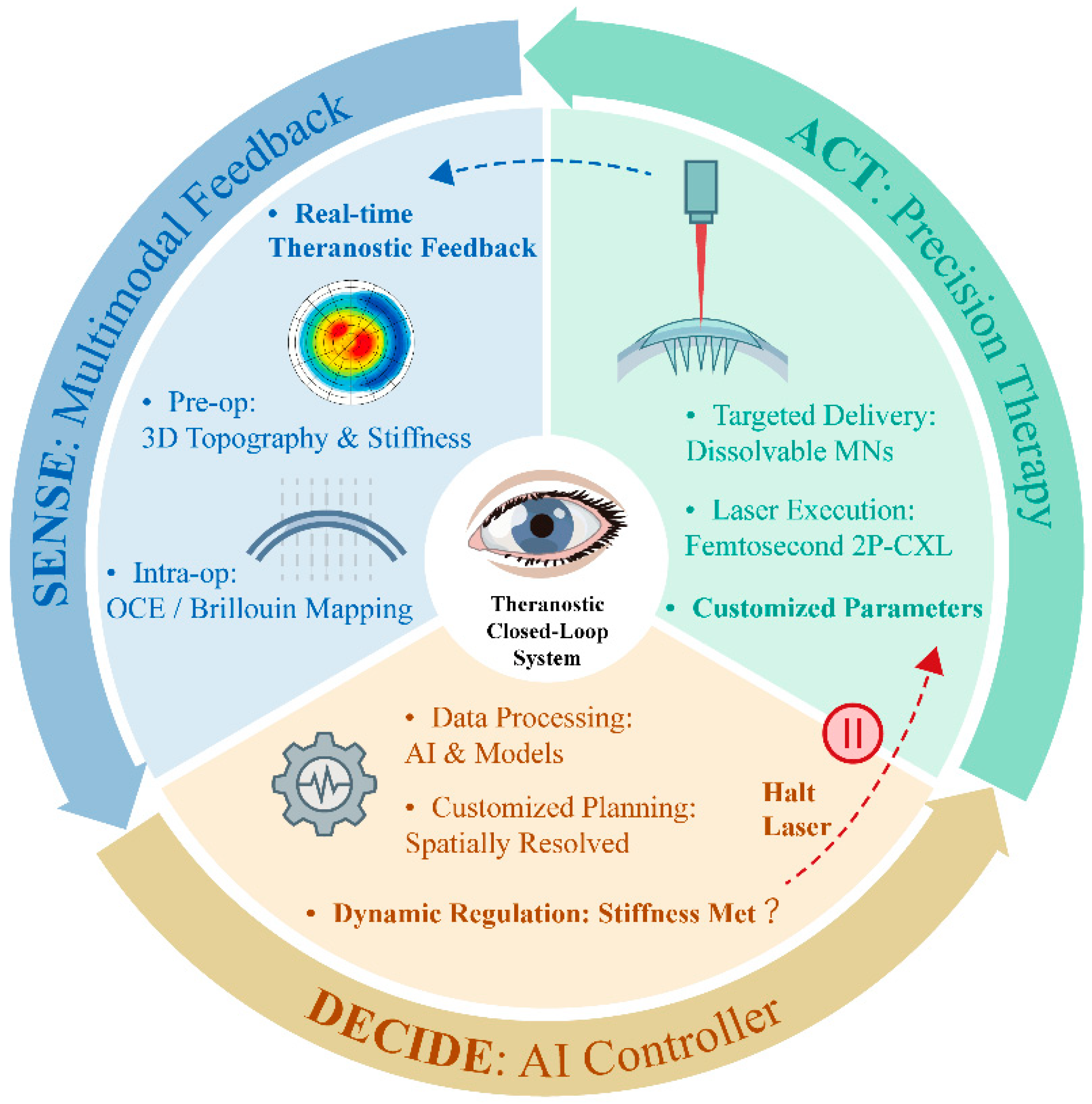
4.2. Future Directions: Towards a Theoretical “Sense–Decide–Act” Framework
5. Conclusions
Author Contributions
Funding
Institutional Review Board Statement
Informed Consent Statement
Data Availability Statement
Acknowledgments
Conflicts of Interest
References
- Singh, R.B.; Koh, S.; Sharma, N.; Woreta, F.A.; Hafezi, F.; Dua, H.S.; Jhanji, V. Keratoconus. Nat. Rev. Dis. Primers 2024, 10, 81. [Google Scholar] [CrossRef] [PubMed]
- Olivares Jiménez, J.L.; Guerrero Jurado, J.C.; Bermudez Rodriguez, F.J.; Serrano Laborda, D. Keratoconus: Age of Onset and Natural History. Optom. Vis. Sci. 1997, 74, 147–151. [Google Scholar] [CrossRef] [PubMed]
- Kennedy, R.H.; Bourne, W.M.; Dyer, J.A. A 48-Year Clinical and Epidemiologic Study of Keratoconus. Am. J. Ophthalmol. 1986, 101, 267–273. [Google Scholar] [CrossRef] [PubMed]
- Hashemi, H.; Heydarian, S.; Hooshmand, E.; Saatchi, M.; Yekta, A.; Aghamirsalim, M.; Valadkhan, M.; Mortazavi, M.; Hashemi, A.; Khabazkhoob, M. The Prevalence and Risk Factors for Keratoconus: A Systematic Review and Meta-Analysis. Cornea 2020, 39, 263–270. [Google Scholar] [CrossRef] [PubMed]
- Andreassen, T.T.; Simonsen, A.H.; Oxlund, H. Biomechanical Properties of Keratoconus and Normal Corneas. Exp. Eye Res. 1980, 31, 435–441. [Google Scholar] [CrossRef] [PubMed]
- Daxer, A.; Fratzl, P. Collagen Fibril Orientation in the Human Corneal Stroma and Its Implication in Keratoconus. Investig. Ophthalmol. Vis. Sci. 1997, 38, 121–129. [Google Scholar] [PubMed]
- Balasubramanian, S.A.; Pye, D.C.; Willcox, M.D.P. Are Proteinases the Reason for Keratoconus? Curr. Eye Res. 2010, 35, 185–191. [Google Scholar] [CrossRef] [PubMed]
- Dudakova, L.; Liskova, P.; Trojek, T.; Palos, M.; Kalasova, S.; Jirsova, K. Changes in Lysyl Oxidase (LOX) Distribution and Its Decreased Activity in Keratoconus Corneas. Exp. Eye Res. 2012, 104, 74–81. [Google Scholar] [CrossRef] [PubMed]
- Wollensak, G.; Spoerl, E.; Seiler, T. Riboflavin/Ultraviolet-a-Induced Collagen Crosslinking for the Treatment of Keratoconus. Am. J. Ophthalmol. 2003, 135, 621–627. [Google Scholar] [CrossRef] [PubMed]
- Chen, X.; Wu, J.; Lin, X.; Wu, X.; Yu, X.; Wang, B.; Xu, W. Tacrolimus Loaded Cationic Liposomes for Dry Eye Treatment. Front. Pharmacol. 2022, 13, 838168. [Google Scholar] [CrossRef] [PubMed]
- Yang, B.; Li, G.; Liu, J.; Li, X.; Zhang, S.; Sun, F.; Liu, W. Nanotechnology for Age-Related Macular Degeneration. Pharmaceutics 2021, 13, 2035. [Google Scholar] [CrossRef] [PubMed]
- Pei, K.; Georgi, M.; Hill, D.; Lam, C.F.J.; Wei, W.; Cordeiro, M.F. Review: Neuroprotective Nanocarriers in Glaucoma. Pharmaceuticals 2024, 17, 1190. [Google Scholar] [CrossRef] [PubMed]
- Yang, M.; Xu, W.; Chen, Z.; Chen, M.; Zhang, X.; He, H.; Wu, Y.; Chen, X.; Zhang, T.; Yan, M.; et al. Engineering Hibiscus-like Riboflavin/ZIF-8 Microsphere Composites to Enhance Transepithelial Corneal Cross-Linking. Adv. Mater. 2022, 34, e2109865. [Google Scholar] [CrossRef] [PubMed]
- Yang, M.; Chen, T.; Chen, X.; Pan, H.; Zhao, G.; Chen, Z.; Zhao, N.; Ye, Q.; Chen, M.; Zhang, S.; et al. Development of Graphitic Carbon Nitride Quantum Dots-Based Oxygen Self-Sufficient Platforms for Enhanced Corneal Crosslinking. Nat. Commun. 2024, 15, 5508. [Google Scholar] [CrossRef] [PubMed]
- Ng, S.M.; Ren, M.; Lindsley, K.B.; Hawkins, B.S.; Kuo, I.C. Transepithelial versus Epithelium-off Corneal Crosslinking for Progressive Keratoconus. Cochrane Database Syst. Rev. 2021, 3, CD013512. [Google Scholar] [CrossRef] [PubMed]
- Baiocchi, S.; Mazzotta, C.; Cerretani, D.; Caporossi, T.; Caporossi, A. Corneal Crosslinking: Riboflavin Concentration in Corneal Stroma Exposed with and without Epithelium. J. Cataract Refract. Surg. 2009, 35, 893–899. [Google Scholar] [CrossRef] [PubMed]
- Vinciguerra, P.; Montericcio, A.; Catania, F.; Fossati, G.; Raimondi, R.; Legrottaglie, E.F.; Vinciguerra, R. New Perspectives in Keratoconus Treatment: An Update on Iontophoresis-Assisted Corneal Collagen Crosslinking. Int. Ophthalmol. 2021, 41, 1909–1916. [Google Scholar] [CrossRef] [PubMed]
- Buzzonetti, L.; Petrocelli, G.; Valente, P.; Iarossi, G.; Ardia, R.; Petroni, S.; Parrilla, R. Iontophoretic Transepithelial Collagen Cross-Linking versus Epithelium-off Collagen Cross-Linking in Pediatric Patients: 3-Year Follow-Up. Cornea 2019, 38, 859–863. [Google Scholar] [CrossRef] [PubMed]
- Bikbova, G.; Bikbov, M. Standard Corneal Collagen Crosslinking versus Transepithelial Iontophoresis-Assisted Corneal Crosslinking, 24 Months Follow-up: Randomized Control Trial. Acta Ophthalmol. 2016, 94, e601–e606. [Google Scholar] [CrossRef] [PubMed]
- Hafezi, F. Corneal Cross-Linking: Epi-On. Cornea 2022, 41, 1203–1204. [Google Scholar] [CrossRef] [PubMed]
- Moiseev, R.V.; Morrison, P.W.J.; Steele, F.; Khutoryanskiy, V.V. Penetration Enhancers in Ocular Drug Delivery. Pharmaceutics 2019, 11, 321. [Google Scholar] [CrossRef] [PubMed]
- Kissner, A.; Spoerl, E.; Jung, R.; Spekl, K.; Pillunat, L.E.; Raiskup, F. Pharmacological Modification of the Epithelial Permeability by Benzalkonium Chloride in UVA/Riboflavin Corneal Collagen Cross-Linking. Curr. Eye Res. 2010, 35, 715–721. [Google Scholar] [CrossRef] [PubMed]
- Chen, S.; Chan, T.C.Y.; Zhang, J.; Ding, P.; Chan, J.C.K.; Yu, M.C.Y.; Li, Y.; Jhanji, V.; Wang, Q. Epithelium-on Corneal Collagen Crosslinking for Management of Advanced Keratoconus. J. Cataract Refract. Surg. 2016, 42, 738–749. [Google Scholar] [CrossRef] [PubMed]
- Bilgihan, K.; Uysal, B.S.; Özmen, M.C.; Eskalen, O.; Gurelik, G. Transepithelial Diluted Alcohol and Iontophoresis-Assisted Corneal Crosslinking for Progressive Keratoconus in Adults: 4-Year Clinical Results. Cornea 2022, 41, 462–469. [Google Scholar] [CrossRef] [PubMed]
- Ostacolo, C.; Caruso, C.; Tronino, D.; Troisi, S.; Laneri, S.; Pacente, L.; Del Prete, A.; Sacchi, A. Enhancement of Corneal Permeation of Riboflavin-5′-Phosphate through Vitamin E TPGS: A Promising Approach in Corneal Trans-Epithelial Cross Linking Treatment. Int. J. Pharm. 2013, 440, 148–153. [Google Scholar] [CrossRef] [PubMed]
- Di Colo, G.; Zambito, Y.; Zaino, C. Polymeric Enhancers of Mucosal Epithelia Permeability: Synthesis, Transepithelial Penetration-Enhancing Properties, Mechanism of Action, Safety Issues. J. Pharm. Sci. 2008, 97, 1652–1680. [Google Scholar] [CrossRef] [PubMed]
- Richoz, O.; Hammer, A.; Tabibian, D.; Gatzioufas, Z.; Hafezi, F. The Biomechanical Effect of Corneal Collagen Cross-Linking (CXL) with Riboflavin and UV-a Is Oxygen Dependent. Transl. Vis. Sci. Technol. 2013, 2, 6. [Google Scholar] [CrossRef] [PubMed]
- Kamaev, P.; Friedman, M.D.; Sherr, E.; Muller, D. Photochemical Kinetics of Corneal Cross-Linking with Riboflavin. Investig. Ophthalmol. Vis. Sci. 2012, 53, 2361–2367. [Google Scholar] [CrossRef] [PubMed]
- Seiler, T.G.; Komninou, M.A.; Nambiar, M.H.; Schuerch, K.; Frueh, B.E.; Büchler, P. Oxygen Kinetics during Corneal Cross-Linking with and without Supplementary Oxygen. Am. J. Ophthalmol. 2021, 223, 368–376. [Google Scholar] [CrossRef] [PubMed]
- Aydın, E.; Aslan, M.G. The Efficiency and Safety of Oxygen-Supplemented Accelerated Transepithelial Corneal Cross-Linking. Int. Ophthalmol. 2021, 41, 2993–3005. [Google Scholar] [CrossRef] [PubMed]
- Thaware, O.C.; Huang, D. Enrichment of Oxygen Concentration over Simulated Corneal Surface through Noncontact Oxygen Delivery Device. J. Refract. Surg. 2020, 36, 613–616. [Google Scholar] [CrossRef] [PubMed]
- Sinha, R.; Sabir, M.; Asif, M.I.; Kalra, N.; Kumar, K.R.; Sinha, R. A Novel Low-Cost Indigenous Goggle Design for Oxygen Delivery in Oxygen Supplemented Accelerated Corneal Collagen Cross-Linking. Eur. J. Ophthalmol. 2022, 33, 11206721221128862. [Google Scholar] [CrossRef] [PubMed]
- Diakonis, V.F.; Likht, N.Y.; Yesilirmak, N.; Delgado, D.; Karatapanis, A.E.; Yesilirmak, Y.; Fraker, C.; Yoo, S.H.; Ziebarth, N.M. Corneal Elasticity after Oxygen Enriched High Intensity Corneal Cross Linking Assessed Using Atomic Force Microscopy. Exp. Eye Res. 2016, 153, 51–55. [Google Scholar] [CrossRef] [PubMed]
- Gore, D.M.; Leucci, M.T.; Koay, S.-Y.; Kopsachilis, N.; Nicolae, M.N.; Malandrakis, M.I.; Anand, V.; Allan, B.D. Accelerated Pulsed High-Fluence Corneal Cross-Linking for Progressive Keratoconus. Am. J. Ophthalmol. 2021, 221, 9–16. [Google Scholar] [CrossRef] [PubMed]
- Mazzotta, C.; Bagaglia, S.A.; Sgheri, A.; Di Maggio, A.; Fruschelli, M.; Romani, A.; Vinciguerra, R.; Vinciguerra, P.; Tosi, G.M. Iontophoresis Corneal Cross-Linking with Enhanced Fluence and Pulsed UV-a Light: 3-Year Clinical Results. J. Refract. Surg. 2020, 36, 286–292. [Google Scholar] [CrossRef] [PubMed]
- Abdel-Radi, M.; Abdelmohsen, N.; Abdelmotaal, H.; Abd El-Moneim, M.T. The Effect of Accelerated Pulsed High-Fluence Corneal Cross-Linking on Corneal Endothelium; a Prospective Specular Microscopy Study. BMC Ophthalmol. 2023, 23, 163. [Google Scholar] [CrossRef] [PubMed]
- Fasciani, R.; Scartozzi, L.; Bruzio, S.; Di Stefano, G.; Mosca, L.; Guccione, L.; Ciardiello, A.; Rizzo, S. High-Fluence Epithelium-off Accelerated Pulsed Corneal Cross-Linking (15 mW/Cm2; 7.2 J/Cm2) for Pediatric Keratoconus: A 3-Year Retrospective Analysis. J. Refract. Surg. 2024, 40, e148–e155. [Google Scholar] [CrossRef] [PubMed]
- Qureshi, M.; Watson, S.L.; Kandel, H. Pulsed Corneal Crosslinking in the Treatment of Keratoconus: A Systematic Review and Meta-Analysis. Graefe’s Arch. Clin. Exp. Ophthalmol. 2025, 263, 589–601. [Google Scholar] [CrossRef] [PubMed]
- Chen, X.; Stojanovic, A.; Eidet, J.R.; Utheim, T.P. Corneal Collagen Cross-Linking (CXL) in Thin Corneas. Eye Vis. 2015, 2, 15. [Google Scholar] [CrossRef] [PubMed]
- Hafezi, F.; Mrochen, M.; Iseli, H.P.; Seiler, T. Collagen Crosslinking with Ultraviolet-a and Hypoosmolar Riboflavin Solution in Thin Corneas. J. Cataract Refract. Surg. 2009, 35, 621–624. [Google Scholar] [CrossRef] [PubMed]
- Wollensak, G.; Spörl, E. Biomechanical Efficacy of Corneal Cross-Linking Using Hypoosmolar Riboflavin Solution. Eur. J. Ophthalmol. 2019, 29, 474–481. [Google Scholar] [CrossRef] [PubMed]
- Hafezi, F. Limitation of Collagen Cross-Linking with Hypoosmolar Riboflavin Solution: Failure in an Extremely Thin Cornea. Cornea 2011, 30, 917–919. [Google Scholar] [CrossRef] [PubMed]
- Jacob, S.; Kumar, D.A.; Agarwal, A.; Basu, S.; Sinha, P.; Agarwal, A. Contact Lens-Assisted Collagen Cross-Linking (CACXL): A New Technique for Cross-Linking Thin Corneas. J. Refract. Surg. 2014, 30, 366–372. [Google Scholar] [CrossRef] [PubMed]
- Kling, S.; Richoz, O.; Hammer, A.; Tabibian, D.; Jacob, S.; Agarwal, A.; Hafezi, F. Increased Biomechanical Efficacy of Corneal Cross-Linking in Thin Corneas Due to Higher Oxygen Availability. J. Refract. Surg. 2015, 31, 841–846. [Google Scholar] [CrossRef] [PubMed]
- Mazzotta, C.; Ramovecchi, V. Customized Epithelial Debridement for Thin Ectatic Corneas Undergoing Corneal Cross-Linking: Epithelial Island Cross-Linking Technique. Clin. Ophthalmol. 2014, 8, 1337–1343. [Google Scholar] [CrossRef] [PubMed]
- Torres-Netto, E.A.; Kling, S.; Hafezi, N.; Vinciguerra, P.; Randleman, J.B.; Hafezi, F. Oxygen Diffusion May Limit the Biomechanical Effectiveness of Iontophoresis-Assisted Transepithelial Corneal Cross-Linking. J. Refract. Surg. 2018, 34, 768–774. [Google Scholar] [CrossRef] [PubMed]
- Deshmukh, R.; Hafezi, F.; Kymionis, G.D.; Kling, S.; Shah, R.; Padmanabhan, P.; Sachdev, M.S. Current Concepts in Crosslinking Thin Corneas. Indian J. Ophthalmol. 2019, 67, 8–15. [Google Scholar] [CrossRef] [PubMed]
- Jaiswal, M.; Dudhe, R.; Sharma, P.K. Nanoemulsion: An Advanced Mode of Drug Delivery System. 3 Biotech 2015, 5, 123–127. [Google Scholar] [CrossRef] [PubMed]
- Üstündag-Okur, N.; Gökçe, E.H.; Eğrilmez, S.; Özer, Ö.; Ertan, G. Novel Ofloxacin-Loaded Microemulsion Formulations for Ocular Delivery. J. Ocul. Pharmacol. Ther. 2014, 30, 319–332. [Google Scholar] [CrossRef] [PubMed]
- Bottos, K.M.; Oliveira, A.G.; Bersanetti, P.A.; Nogueira, R.F.; Lima-Filho, A.A.S.; Cardillo, J.A.; Schor, P.; Chamon, W. Corneal Absorption of a New Riboflavin-Nanostructured System for Transepithelial Collagen Cross-Linking. PLoS ONE 2013, 8, e66408. [Google Scholar] [CrossRef] [PubMed]
- Lidich, N.; Wachtel, E.J.; Aserin, A.; Garti, N. Water-Dilutable Microemulsions for Transepithelial Ocular Delivery of Riboflavin Phosphate. J. Colloid Interface Sci. 2016, 463, 342–348. [Google Scholar] [CrossRef] [PubMed]
- Lidich, N.; Garti-Levy, S.; Aserin, A.; Garti, N. Potentiality of Microemulsion Systems in Treatment of Ophthalmic Disorders: Keratoconus and Dry Eye Syndrome—In Vivo Study. Colloids Surf. B Biointerfaces 2019, 173, 226–232. [Google Scholar] [CrossRef] [PubMed]
- Kandzija, N.; Khutoryanskiy, V.V. Delivery of Riboflavin-5′-Monophosphate into the Cornea: Can Liposomes Provide Any Enhancement Effects? J. Pharm. Sci. 2017, 106, 3041–3049. [Google Scholar] [CrossRef] [PubMed]
- Iqbal, M.A.; Md, S.; Sahni, J.K.; Baboota, S.; Dang, S.; Ali, J. Nanostructured Lipid Carriers System: Recent Advances in Drug Delivery. J. Drug Target. 2012, 20, 813–830. [Google Scholar] [CrossRef] [PubMed]
- Aytekin, E.; Öztürk, N.; Vural, İ.; Polat, H.K.; Çakmak, H.B.; Çalış, S.; Pehlivan, S.B. Design of Ocular Drug Delivery Platforms and in Vitro—In Vivo Evaluation of Riboflavin to the Cornea by Non-Interventional (Epi-on) Technique for Keratoconus Treatment. J. Control. Release 2020, 324, 238–249. [Google Scholar] [CrossRef] [PubMed]
- Akhter, M.H.; Ahmad, I.; Alshahrani, M.Y.; Al-Harbi, A.I.; Khalilullah, H.; Afzal, O.; Altamimi, A.S.A.; Najib Ullah, S.N.M.; Ojha, A.; Karim, S. Drug Delivery Challenges and Current Progress in Nanocarrier-Based Ocular Therapeutic System. Gels 2022, 8, 82. [Google Scholar] [CrossRef] [PubMed]
- Singh, J.; Sharma, M.; Jain, N.; Aftab, I.; Vikram, N.; Singh, T.P.; Sharma, P.; Sharma, S. Lactoferrin and Its Nano-Formulations in Rare Eye Diseases. Indian J. Ophthalmol. 2022, 70, 2328–2334. [Google Scholar] [CrossRef] [PubMed]
- Varela-Fernández, R.; García-Otero, X.; Díaz-Tomé, V.; Regueiro, U.; López-López, M.; González-Barcia, M.; Isabel Lema, M.; Otero-Espinar, F.J. Mucoadhesive PLGA Nanospheres and Nanocapsules for Lactoferrin Controlled Ocular Delivery. Pharmaceutics 2022, 14, 799. [Google Scholar] [CrossRef] [PubMed]
- Labate, C.; Lombardo, M.; Lombardo, G.; De Santo, M.P. Biomechanical Strengthening of the Human Cornea Induced by Nanoplatform-Based Transepithelial Riboflavin/UV-a Corneal Cross-Linking. Investig. Ophthalmol. Vis. Sci. 2017, 58, 179–184. [Google Scholar] [CrossRef] [PubMed]
- Khosravimelal, S.; Mobaraki, M.; Eftekhari, S.; Ahearne, M.; Seifalian, A.M.; Gholipourmalekabadi, M. Hydrogels as Emerging Materials for Cornea Wound Healing. Small 2021, 17, e2006335. [Google Scholar] [CrossRef] [PubMed]
- Li, M.; Wei, R.; Liu, C.; Fang, H.; Yang, W.; Wang, Y.; Xian, Y.; Zhang, K.; He, Y.; Zhou, X. A “T.E.S.T.” Hydrogel Bioadhesive Assisted by Corneal Cross-Linking for in Situ Sutureless Corneal Repair. Bioact. Mater. 2023, 25, 333–346. [Google Scholar] [CrossRef] [PubMed]
- Aytekin, E.; Kaya, M.Z.; İlkar, G.E.; Polat, H.K.; Öztürk, N.; Vural, İ.; Çakmak, H.B.; Çelebier, M.; Palaska, E.; Çalış, S.; et al. Optimizing Riboflavin Delivery with Co-Crystal and in Situ Hydrogel Formulations for Management of Keratoconus: A Comprehensive Investigation with in Vitro, Ex Vivo and in Vivo Studies. Int. J. Pharm. 2025, 674, 125435. [Google Scholar] [CrossRef] [PubMed]
- Leu, J.S.L.; Teoh, J.J.X.; Ling, A.L.Q.; Chong, J.; Loo, Y.S.; Mat Azmi, I.D.; Zahid, N.I.; Bose, R.J.C.; Madheswaran, T. Recent Advances in the Development of Liquid Crystalline Nanoparticles as Drug Delivery Systems. Pharmaceutics 2023, 15, 1421. [Google Scholar] [CrossRef] [PubMed]
- Achouri, D.; Hornebecq, V.; Piccerelle, P.; Andrieu, V.; Sergent, M. Self-Assembled Liquid Crystalline Nanoparticles as an Ophthalmic Drug Delivery System. Part I: Influence of Process Parameters on Their Preparation Studied by Experimental Design. Drug Dev. Ind. Pharm. 2015, 41, 109–115. [Google Scholar] [CrossRef] [PubMed]
- Achouri, D.; Sergent, M.; Tonetto, A.; Piccerelle, P.; Andrieu, V.; Hornebecq, V. Self-Assembled Liquid Crystalline Nanoparticles as an Ophthalmic Drug Delivery System. Part II: Optimization of Formulation Variables Using Experimental Design. Drug Dev. Ind. Pharm. 2015, 41, 493–501. [Google Scholar] [CrossRef] [PubMed]
- Cai, W.; Wang, J.; Chu, C.; Chen, W.; Wu, C.; Liu, G. Metal-Organic Framework-Based Stimuli-Responsive Systems for Drug Delivery. Adv. Sci. 2019, 6, 1801526. [Google Scholar] [CrossRef] [PubMed]
- Wang, D.; Wu, Q.; Ren, X.; Niu, M.; Ren, J.; Meng, X. Tunable Zeolitic Imidazolate Framework-8 Nanoparticles for Biomedical Applications. Small Methods 2024, 8, e2301270. [Google Scholar] [CrossRef] [PubMed]
- Kumar, V.B.; Sher, I.; Rencus-Lazar, S.; Rotenstreich, Y.; Gazit, E. Functional Carbon Quantum Dots for Ocular Imaging and Therapeutic Applications. Small 2023, 19, 2205754. [Google Scholar] [CrossRef] [PubMed]
- Xu, T.; Liu, Y.; Zhang, W.; Jiang, Q.; Jin, Y.; Lin, L.; Wang, L.; Gu, Z.; Lin, M.; Chen, S. N, S Co-Doped Carbon Quantum Dots-Riboflavin Composite Photosensitizers for Enhanced Iontophoresis-Assisted Corneal Cross-Linking. Adv. Sci. 2026, e10396. [Google Scholar] [CrossRef] [PubMed]
- Glover, K.; Mishra, D.; Gade, S.; Vora, L.K.; Wu, Y.; Paredes, A.J.; Donnelly, R.F.; Singh, T.R.R. Microneedles for Advanced Ocular Drug Delivery. Adv. Drug Deliv. Rev. 2023, 201, 115082. [Google Scholar] [CrossRef] [PubMed]
- Hu, X.; Kong, B.; Wang, Y.; Zhao, Y.; Li, M.; Zhou, X. Responsive Porous Microneedles with Riboflavin Ocular Microinjection Capability for Facilitating Corneal Crosslinking. J. Nanobiotechnol. 2024, 22, 588. [Google Scholar] [CrossRef] [PubMed]
- Yang, M.; Pan, H.; Chen, T.; Chen, X.; Ning, R.; Ye, Q.; Chen, A.; Li, J.; Li, S.; Zhao, N.; et al. Customized Corneal Cross-Linking with Microneedle-Mediated Riboflavin Delivery for Keratoconus Treatment. Adv. Mater. 2024, 36, e2408136. [Google Scholar] [CrossRef] [PubMed]
- Ye, L.; Bei, Z.; Yang, T.; Xu, Y.; Pan, M.; Deng, H.; Li, X.; Liu, L.; Qian, Z. A Dissolving Microneedle Patch Enables Minimally Invasive Riboflavin Delivery and Enhances Corneal Crosslinking in Keratoconus Therapy. J. Mater. Chem. B 2025, 13, 5343–5357. [Google Scholar] [CrossRef] [PubMed]
- Koller, T.; Mrochen, M.; Seiler, T. Complication and Failure Rates after Corneal Crosslinking. J. Cataract Refract. Surg. 2009, 35, 1358–1362. [Google Scholar] [CrossRef] [PubMed]
- Ristroph, K.D.; Prud’homme, R.K. Hydrophobic Ion Pairing: Encapsulating Small Molecules, Peptides, and Proteins into Nanocarriers. Nanoscale Adv. 2019, 1, 4207–4237. [Google Scholar] [CrossRef] [PubMed]
- Chen, Y.; Wang, X.; Duan, Y.; Liu, L.; Chen, R.; Huang, Y.; Tan, Y.; Lu, Q.; Lin, Q.; Shen, L. Fluorinated ROS-Responsive Polycation Enables Noninvasive siRNA Delivery for the Treatment of Corneal Neovascularization. Acta Biomater. 2026, 212, 754–769. [Google Scholar] [CrossRef] [PubMed]
- Li, D.; Ji, J.; Li, X.; Xie, Y.; Huang, Y.; Qin, J.; Ding, X.; Wang, L.; Fan, Y. LNP-Encapsulated miRNA29b for Corneal Repair: A Novel Approach to Combat Fibrosis. Mater. Today Bio 2025, 32, 101695. [Google Scholar] [CrossRef] [PubMed]
- Sun, D.; Lu, Z.-R. Structure and Function of Cationic and Ionizable Lipids for Nucleic Acid Delivery. Pharm. Res. 2023, 40, 27–46. [Google Scholar] [CrossRef] [PubMed]
- Teplensky, M.H.; Fantham, M.; Poudel, C.; Hockings, C.; Lu, M.; Guna, A.; Aragones-Anglada, M.; Moghadam, P.Z.; Li, P.; Farha, O.K.; et al. A Highly Porous Metal-Organic Framework System to Deliver Payloads for Gene Knockdown. Chem 2019, 5, 2926–2941. [Google Scholar] [CrossRef]
- Danhier, F.; Ansorena, E.; Silva, J.M.; Coco, R.; Le Breton, A.; Préat, V. PLGA-Based Nanoparticles: An Overview of Biomedical Applications. J. Control. Release 2012, 161, 505–522. [Google Scholar] [CrossRef] [PubMed]
- Chung, H.J.; Park, T.G. Self-Assembled and Nanostructured Hydrogels for Drug Delivery and Tissue Engineering. Nano Today 2009, 4, 429–437. [Google Scholar] [CrossRef]
- Kim, Y.C.; Grossniklaus, H.E.; Edelhauser, H.F.; Prausnitz, M.R. Intrastromal Delivery of Bevacizumab Using Microneedles to Treat Corneal Neovascularization. Investig. Ophthalmol. Vis. Sci. 2014, 55, 7376–7386. [Google Scholar] [CrossRef] [PubMed]
- Lin, X.; Hu, W.; Yuan, J.; Liu, S.; Ge, Z.; Liu, S.; Cong, J.; Feng, Q.; Li, H.; Feng, C.; et al. Oxygen-Releasing Microneedles Enhance the Therapeutic Effect of Corneal Ectasia by Increasing Corneal Oxygen Content and Riboflavin Concentration during Cross-Linking. Mater. Today Bio 2025, 32, 101779. [Google Scholar] [CrossRef] [PubMed]
- Thangavel, N.; Jayakumar, I.; Ravichandran, M.; Vaidyanathan Ganesan, V.; Nair, B.U. Photocrosslinking of Collagen Using Ru(II)-Polypyridyl Complex Functionalized Gold Nanoparticles. Spectrochim. Acta. A Mol. Biomol. Spectrosc. 2019, 215, 196–202. [Google Scholar] [CrossRef] [PubMed]
- Gulzar, A.; Yıldız, E.; Kaleli, H.N.; Nazeer, M.A.; Zibandeh, N.; Malik, A.N.; Taş, A.Y.; Lazoğlu, I.; Şahin, A.; Kizilel, S. Ruthenium-Induced Corneal Collagen Crosslinking under Visible Light. Acta Biomater. 2022, 147, 198–208. [Google Scholar] [CrossRef] [PubMed]
- Gulzar, A.; Kaleli, H.N.; Köseoğlu, G.D.; Hasanreisoğlu, M.; Yıldız, A.; Şahin, A.; Kizilel, S. A Unique and Biocompatible Corneal Collagen Crosslinking in Vivo. Sci. Rep. 2024, 14, 25042. [Google Scholar] [CrossRef] [PubMed]
- Cherfan, D.; Verter, E.E.; Melki, S.; Gisel, T.E.; Doyle, F.J.; Scarcelli, G.; Yun, S.H.; Redmond, R.W.; Kochevar, I.E. Collagen Cross-Linking Using Rose Bengal and Green Light to Increase Corneal Stiffness. Investig. Ophthalmol. Vis. Sci. 2013, 54, 3426–3433. [Google Scholar] [CrossRef] [PubMed]
- Wertheimer, C.M.; Elhardt, C.; Kaminsky, S.M.; Pham, L.; Pei, Q.; Mendes, B.; Afshar, S.; Kochevar, I.E. Enhancing Rose Bengal-Photosensitized Protein Crosslinking in the Cornea. Investig. Ophthalmol. Vis. Sci. 2019, 60, 1845–1852. [Google Scholar] [CrossRef] [PubMed]
- Gao, R.; Chen, M.; Xing, W.; Jiang, Q.; Meek, K.M.; Wang, Q.; Yu, A.-Y.; Huang, J. The Efficacy and Safety of Oxygen-Enriched Rose Bengal and Green Light Corneal Crosslinking. Transl. Vis. Sci. Technol. 2025, 14, 22. [Google Scholar] [CrossRef] [PubMed]
- Huang, Y.-Y.; Choi, H.; Kushida, Y.; Bhayana, B.; Wang, Y.; Hamblin, M.R. Broad-Spectrum Antimicrobial Effects of Photocatalysis Using Titanium Dioxide Nanoparticles Are Strongly Potentiated by Addition of Potassium Iodide. Antimicrob. Agents Chemother. 2016, 60, 5445–5453. [Google Scholar] [CrossRef] [PubMed]
- Ghamarpoor, R.; Fallah, A.; Jamshidi, M. Investigating the Use of Titanium Dioxide (TiO2) Nanoparticles on the Amount of Protection against UV Irradiation. Sci. Rep. 2023, 13, 9793. [Google Scholar] [CrossRef] [PubMed]
- Xue, C.; Wu, J.; Lan, F.; Liu, W.; Yang, X.; Zeng, F.; Xu, H. Nano Titanium Dioxide Induces the Generation of ROS and Potential Damage in HaCaT Cells under UVA Irradiation. J. Nanosci. Nanotechnol. 2010, 10, 8501–8507. [Google Scholar] [CrossRef] [PubMed]
- Chai, D.; Juhasz, T.; Brown, D.J.; Jester, J.V. Nonlinear Optical Collagen Cross-Linking and Mechanical Stiffening: A Possible Photodynamic Therapeutic Approach to Treating Corneal Ectasia. J. Biomed. Opt. 2013, 18, 38003. [Google Scholar] [CrossRef] [PubMed]
- Kwok, S.J.J.; Kuznetsov, I.A.; Kim, M.; Choi, M.; Scarcelli, G.; Yun, S.H. Selective Two-Photon Collagen Crosslinking in Situ Measured by Brillouin Microscopy. Optica 2016, 3, 469–472. [Google Scholar] [CrossRef] [PubMed]
- Chang, L.; Zhang, L.; Cheng, Z.; Zhang, N.; Wang, C.; Wang, Y.; Liu, W. Effectiveness of Collagen Cross-Linking Induced by Two-Photon Absorption Properties of a Femtosecond Laser in Ex Vivo Human Corneal Stroma. Biomed. Opt. Express 2022, 13, 5067. [Google Scholar] [CrossRef] [PubMed]
- Cheng, Z.; Zhang, N.; Chang, L.; Qi, P.; Zhang, L.; Lin, L.; Wang, Y.; Liu, W. Two-Photon Collagen Crosslinking in Ex Vivo Human Corneal Lenticules Induced by near-Infrared Femtosecond Laser. J. Biophotonics 2023, 16, e202200160. [Google Scholar] [CrossRef] [PubMed]
- Steven, P.; Hovakimyan, M.; Guthoff, R.F.; Hüttmann, G.; Stachs, O. Imaging Corneal Crosslinking by Autofluorescence 2-Photon Microscopy, Second Harmonic Generation, and Fluorescence Lifetime Measurements. J. Cataract Refract. Surg. 2010, 36, 2151–2159. [Google Scholar] [CrossRef] [PubMed]
- Batista, A.; Breunig, H.G.; Hager, T.; Seitz, B.; König, K. Early Evaluation of Corneal Collagen Crosslinking in Ex-Vivo Human Corneas Using Two-Photon Imaging. Sci. Rep. 2019, 9, 10241. [Google Scholar] [CrossRef] [PubMed]
- Batista, A.; Guimarães, P.; Domingues, J.P.; Quadrado, M.J.; Morgado, A.M. Two-Photon Imaging for Non-Invasive Corneal Examination. Sensors 2022, 22, 9699. [Google Scholar] [CrossRef] [PubMed]
- Niazi, S.; Doroodgar, F.; Pflugfelder, S.; Bayat, K.; Mohammadi, S.-F.; Mazloomi, M.; Alió del Barrio, J.L.; Moshirfar, M.; Alió, J.L. The Microenvironment of Ocular Surface in Keratoconus: A Systematic Review. Eye Vis. 2025, 12, 37. [Google Scholar] [CrossRef] [PubMed]
- Di Martino, E.; Ali, M.; Inglehearn, C.F. Matrix Metalloproteinases in Keratoconus—Too Much of a Good Thing? Exp. Eye Res. 2019, 182, 137–143. [Google Scholar] [CrossRef] [PubMed]
- Dursun, D.; Kim, M.C.; Solomon, A.; Pflugfelder, S.C. Treatment of Recalcitrant Recurrent Corneal Erosions with Inhibitors of Matrix Metalloproteinase-9, Doxycycline and Corticosteroids. Am. J. Ophthalmol. 2001, 132, 8–13. [Google Scholar] [CrossRef] [PubMed]
- Gugleva, V.; Titeva, S.; Rangelov, S.; Momekova, D. Design and in Vitro Evaluation of Doxycycline Hyclate Niosomes as a Potential Ocular Delivery System. Int. J. Pharm. 2019, 567, 118431. [Google Scholar] [CrossRef] [PubMed]
- Pokharkar, V.; Patil, V.; Mandpe, L. Engineering of Polymer–Surfactant Nanoparticles of Doxycycline Hydrochloride for Ocular Drug Delivery. Drug Deliv. 2015, 22, 955–968. [Google Scholar] [CrossRef] [PubMed]
- Lucero, H.A.; Kagan, H.M. Lysyl Oxidase: An Oxidative Enzyme and Effector of Cell Function. Cell. Mol. Life Sci. CMLS 2006, 63, 2304–2316. [Google Scholar] [CrossRef] [PubMed]
- Yu, H.S.; Pastor, S.A.; Lam, K.W.; Yee, R.W. Ascorbate-Enhanced Copper Toxicity on Bovine Corneal Endothelial Cells in Vitro. Curr. Eye Res. 1990, 9, 177–182. [Google Scholar] [CrossRef] [PubMed]
- Hia, E.M.; Jang, S.R.; Maharjan, B.; Park, J.; Park, C.H.; Kim, C.S. Construction of a PEGDA/Chitosan Hydrogel Incorporating Mineralized Copper-Doped Mesoporous Silica Nanospheres for Accelerated Bone Regeneration. Int. J. Biol. Macromol. 2024, 262, 130218. [Google Scholar] [CrossRef] [PubMed]
- Pontremoli, C.; Boffito, M.; Fiorilli, S.; Laurano, R.; Torchio, A.; Bari, A.; Tonda-Turo, C.; Ciardelli, G.; Vitale-Brovarone, C. Hybrid Injectable Platforms for the in Situ Delivery of Therapeutic Ions from Mesoporous Glasses. Chem. Eng. J. 2018, 340, 103–113. [Google Scholar] [CrossRef]
- Sall, K.; Stevenson, O.D.; Mundorf, T.K.; Reis, B.L. Two Multicenter, Randomized Studies of the Efficacy and Safety of Cyclosporine Ophthalmic Emulsion in Moderate to Severe Dry Eye Disease1. Ophthalmology 2000, 107, 631–639. [Google Scholar] [CrossRef] [PubMed]
- Regueiro, U.; López-López, M.; Varela-Fernández, R.; Otero-Espinar, F.J.; Lema, I. Biomedical Applications of Lactoferrin on the Ocular Surface. Pharmaceutics 2023, 15, 865. [Google Scholar] [CrossRef] [PubMed]
- Aksungur, P.; Demirbilek, M.; Denkbaş, E.B.; Vandervoort, J.; Ludwig, A.; Unlü, N. Development and Characterization of Cyclosporine a Loaded Nanoparticles for Ocular Drug Delivery: Cellular Toxicity, Uptake, and Kinetic Studies. J. Control. Release Off. J. Control. Release Soc. 2011, 151, 286–294. [Google Scholar] [CrossRef] [PubMed]
- Diez-Pascual, A.M.; Rahdar, A. Functional Nanomaterials in Biomedicine: Current Uses and Potential Applications. ChemMedChem 2022, 17, e202200142. [Google Scholar] [CrossRef] [PubMed]
- Wollensak, G.; Spoerl, E.; Wilsch, M.; Seiler, T. Keratocyte Apoptosis after Corneal Collagen Cross-Linking Using Riboflavin/UVA Treatment. Cornea 2004, 23, 43–49. [Google Scholar] [CrossRef] [PubMed]
- Zhou, W.; Subasinghe, S.K.; de Ribot, F.M.; Ogbuehi, K.C.; Dias, G.J. Transepithelial Corneal Cross-Linking: A Review. Int. Ophthalmol. 2026, 46, 62. [Google Scholar] [CrossRef] [PubMed]
- Li, L.; Jia, F.; Wang, Y.; Liu, J.; Tian, Y.; Sun, X.; Lei, Y.; Ji, J. Trans-Corneal Drug Delivery Strategies in the Treatment of Ocular Diseases. Adv. Drug Deliv. Rev. 2023, 198, 114868. [Google Scholar] [CrossRef] [PubMed]
- Xie, J.; Wu, Y.; Chen, Z.; Zheng, M.; Yang, Q.; Mo, M.; Liu, J.; Chen, L. Ocular Toxicity and Potential Mechanism of Nanomaterials: An Issue Worthy of Investigation. Ecotoxicol. Environ. Saf. 2025, 303, 118997. [Google Scholar] [CrossRef] [PubMed]
- Feliu, N.; Docter, D.; Heine, M.; Del Pino, P.; Ashraf, S.; Kolosnjaj-Tabi, J.; Macchiarini, P.; Nielsen, P.; Alloyeau, D.; Gazeau, F.; et al. In Vivo Degeneration and the Fate of Inorganic Nanoparticles. Chem. Soc. Rev. 2016, 45, 2441–2457. [Google Scholar] [CrossRef] [PubMed]
- Paliwal, R.; Babu, R.J.; Palakurthi, S. Nanomedicine Scale-up Technologies: Feasibilities and Challenges. AAPS PharmSciTech 2014, 15, 1527–1534. [Google Scholar] [CrossRef] [PubMed]
- Ma, Z.; Li, B.; Peng, J.; Gao, D. Recent Development of Drug Delivery Systems through Microfluidics: From Synthesis to Evaluation. Pharmaceutics 2022, 14, 434. [Google Scholar] [CrossRef] [PubMed]
- Rodríguez-Gómez, F.D.; Monferrer, D.; Penon, O.; Rivera-Gil, P. Regulatory Pathways and Guidelines for Nanotechnology-Enabled Health Products: A Comparative Review of EU and US Frameworks. Front. Med. 2025, 12, 1544393. [Google Scholar] [CrossRef] [PubMed]
- Li, J.-P.O.; Maile, H.P.; Bunce, C.; Kandakji, L.; Leucci, M.T.; Allan, B.D.; Tuft, S.J.; Pontikos, N.; Gore, D.M. A Comparison of Keratoconus Progression Following Collagen Cross-Linkage Using Standard or Personalised Keratometry Thresholds. Eye 2024, 38, 1681–1686. [Google Scholar] [CrossRef] [PubMed]
- Hafezi, F.; Kling, S.; Gilardoni, F.; Hafezi, N.; Hillen, M.; Abrishamchi, R.; Gomes, J.A.P.; Mazzotta, C.; Randleman, J.B.; Torres-Netto, E.A. Individualized Corneal Cross-Linking with Riboflavin and UV-a in Ultrathin Corneas: The Sub400 Protocol. Am. J. Ophthalmol. 2021, 224, 133–142. [Google Scholar] [CrossRef] [PubMed]
- Vandevenne, M.M.; Favuzza, E.; Veta, M.; Lucenteforte, E.; Berendschot, T.T.; Mencucci, R.; Nuijts, R.M.; Virgili, G.; Dickman, M.M. Artificial Intelligence for Detecting Keratoconus. Cochrane Database Syst. Rev. 2023, 11, CD014911. [Google Scholar] [CrossRef] [PubMed]
- Du, K.; Peng, R.; Chen, Y.; Yuan, B.; Wu, H.; Chen, T.; Zhu, J.; Zu, X.; Wang, J.; Cui, J.; et al. Enhancing Early Keratoconus Detection with Multimodal Machine Learning: Integrating Tomography, Biomechanics, and Clinical Risk Factors. Am. J. Ophthalmol. 2025, 280, 334–346. [Google Scholar] [CrossRef] [PubMed]
- Abdelmotaal, H.; Taneri, S.; Salouti, R.; Nowroozzadeh, M.H.; Al-Timemy, A.H.; Lavric, A.; Daho, M.E.H.; Takahashi, H.; Hazarbassanov, R.M.; Yousefi, S. Artificial Intelligence-Derived Biomechanical Index for Early Corneal Ectasia Detection: Advancing beyond Tomography. Ophthalmol. Sci. 2026, 6, 100952. [Google Scholar] [CrossRef] [PubMed]
- Kling, S.; Hafezi, F. An Algorithm to Predict the Biomechanical Stiffening Effect in Corneal Cross-Linking. J. Refract. Surg. 2017, 33, 128–136. [Google Scholar] [CrossRef] [PubMed]
- Lombardo, M.; Serrao, S.; Bernava, G.M.; Mencucci, R.; Fruschelli, M.; Lombardo, G. Real-Time Monitoring of Riboflavin Concentration Using Different Clinically Available Ophthalmic Formulations for Epi-off and Epi-on Corneal Cross-Linking. Graefe’s Arch. Clin. Exp. Ophthalmol. 2024, 262, 2569–2577. [Google Scholar] [CrossRef] [PubMed]
- Roszkowska, A.M.; Scorcia, V.; Mencucci, R.; Giannaccare, G.; Lombardo, G.; Alunni Fegatelli, D.; Vestri, A.; Bifezzi, L.; Bernava, G.M.; Serrao, S.; et al. Assessment of the Predictive Ability of Theranostics for Corneal Cross-Linking in Treating Keratoconus: A Randomized Clinical Trial. Ophthalmology 2024, 131, 1403–1415. [Google Scholar] [CrossRef] [PubMed]
- Frigelli, M.; Büchler, P.; Kling, S. Dynamic Evaluation of Corneal Cross-Linking and Osmotic Diffusion Effects Using Optical Coherence Elastography. Sci. Rep. 2024, 14, 16614. [Google Scholar] [CrossRef] [PubMed]



| Advanced Delivery Platforms | Delivery Efficiency | Biocompatibility | Current Research Stage | Key Advantage | Major Limitations |
|---|---|---|---|---|---|
| Nanoemulsions | High | Moderate (Surfactant irritation risk) | Preclinical (In vitro/Ex vivo) | Overcomes lipophilic epithelial barrier | Poor stability |
| Microemulsions | Moderate | Good | Preclinical (In vivo) | Sequential interfacial controlled release | Suboptimal sustained biomechanical stiffening |
| Liposomes | Low | Excellent | Preclinical (In vitro/Ex vivo) | High ocular safety | Low encapsulation efficiency |
| NLCs | High | Good | Preclinical (In vivo) | High payload capacity via disordered matrix | Unverified long-term epithelial safety |
| Polymeric NPs | High | Good (Polymer-dependent) | Preclinical (In vitro/Ex vivo) | Mucoadhesion and high structural plasticity | Insufficient deep stromal penetration |
| Nanocomposite and Nanostructured Hydrogels | High | Excellent | Preclinical (In vivo defect repair) | Biomimetic nanocomposite network | Enhancer-associated cytotoxicity |
| LCNPs | Moderate | Good | Preclinical (In vitro) | Bicontinuous lipid-water fusogenic networks | Constrained water-soluble payload |
| Nano-MOFs | Extremely High | Good | Preclinical (In vivo) | High riboflavin loading; targeted release | Constituent metal ion toxicity |
| CQDs | High (via iontophoresis) | Good | Preclinical (In vivo) | ROS amplification; halves UVA exposure time | long-term stromal accumulation risks |
| MNs | High | Good | Preclinical (In vivo) | Topographically customizable | Unverified long-term biocompatibility of complex composites |
| Clinical Limitation (Section 2) | Conventional Workaround | Advanced Interventions (Section 3) | Representative Nanomaterials and Exploratory Paradigms | Mechanism of Action |
|---|---|---|---|---|
| Epithelial Barrier | Iontophoresis Chemical enhancers | Transepithelial penetration | NLCs LCNPs Nano-MOFs CQDs MNs | Lipid partitioning Dynamic phase adaptation Surface charge and specific topology Electrostatic repulsion and ROS amplification Physical micro-puncture |
| Stromal Hypoxia (in A-CXL) | Pulsed UVA Supplemental O2 | Intrastromal oxygen supply | g-C3N4 QDs O2RF@MNs | Photocatalytic O2 generation Physical pre-loaded O2 release |
| Thin Corneas (<400 µm) | Hypo-osmolar swelling CACXL EI-CXL | High-precision spatial confinement | 2P-CXL RGX | Strictly confined 3D modulation Shallow anterior stromal confinement |
| Endothelial Vulnerability to UVA | Reduced exposure time | Visible-light shifting UVA amplification | Ru(II) complexes RGX TiO2 NPs | Shifting activation threshold to 430 nm blue light Shifting activation threshold to 532 nm green light ROS yield during ultra-short UVA exposure |
| Nanocarrier Type | Ideal Payload Type | Preferred Delivery Route | Cross-Linking Mechanistic Synergy |
|---|---|---|---|
| Lipid-Based Systems (Liposomes, NLCs, LCNPs) | Small Molecules: Cyclosporine A, Doxycycline salts. Nucleic Acids: siRNA/miRNA. | Non-invasive: Topical instillation. | Epithelial Partitioning: Permeates the hydrophobic epithelium, enhancing solubility and bioavailability of lipophilic agents. |
| Polymeric NPs and Hydrogels (PLGA, Nanocomposites) | Small Molecules: Doxycycline salts, Cu2+. Peptides/Proteins: LF. | Non-invasive: Topical instillation/In situ gelation. | Sustained Residence and Shielding: Mucoadhesion prolongs tear film retention; polymeric matrices physically shield fragile biologics from enzymatic cleavage. |
| Rigid Nanoplatforms (Nano-MOFs, MSNs, CQDs) | Small Molecules: Riboflavin, Cu2+. Nucleic Acids: siRNA. | Non-invasive: Topical instillation. | Geometric Confinement: Bypasses lipid barriers by trapping hydrophilic payloads in porous networks; facilitates electrically driven trans-epithelial transport. |
| MNs | Small Molecules: Riboflavin. Antibodies: Intact therapeutic antibodies. | Minimally invasive: Stromal micro-penetration. | Physical Barrier Disruption: Breaches the epithelium for precise stromal deposition of diverse payloads from small molecules to massive biologics bypassing molecular weight limits. |
| Nanoplatform | Primary Biomechanical/Therapeutic Benefit | Safety Liabilities and Clinical Risks | Translational Maturity and Industrial Feasibility |
|---|---|---|---|
| Nanoemulsions | Breaks lipophilic epithelial barrier; drives rapid transepithelial flux. | Surfactant-induced epithelial irritation; unverified stiffening efficacy. | In vitro/Ex vivo: Poor thermodynamic stability; sterilization may lead to phase separation. |
| Microemulsions | Dilution-triggered drug release; thermodynamically stable. | Hardening effect remains suboptimal compared to epi-off standard. | In vivo: High reproducibility via self-assembly; low cost; requires GMP scale-up optimization. |
| Liposomes | High ocular safety and excellent biocompatibility. | Fails to secure sufficient payload for stromal saturation. | In vitro/Ex vivo: Classic liposomal manufacturing is mature, but inefficient for this specific hydrophilic payload. |
| NLCs | Disordered matrix enables high payload capacity. | Dose-dependent cytotoxicity from chemical enhancers. | In vivo: Scalable synthesis; requires precise batch-to-batch quality control. |
| Polymeric NPs | Enhanced bioadhesion; prolonged retention; accommodates biologics. | Formulation-dependent burst release risks; potential byproduct cytotoxicity. | In vitro/Ex vivo: High structural plasticity; polymer-dependent sterilization |
| Nanocomposite and Nanostructured Hydrogels | Recapitulates extracellular matrix; seals stromal defects. | Highly biocompatible, but lacks direct transepithelial flux without enhancers. | In vivo: Viable for GMP sutureless patch production; shelf-life and sterile packaging challenges. |
| LCNPs | Bicontinuous channels provide immense surface area and high payload capacity. | Long-term stromal retention and in vivo CXL safety remain unverified. | In vitro: Scalable synthesis; structural phase highly sensitive to temperature/pressure, complicating batch control. |
| Nano-MOFs | Immense surface area; shortened release pathways via specific topology. | Long-term stromal accumulation risks; potential surface-charge toxicity. | In vivo: Intricate synthesis; poor scalability; high cost and batch variation. |
| CQDs | Drives rapid iontophoresis-assisted flux; amplifies ROS to halve UVA exposure time. | Potential long-term stromal accumulation. | In vivo: Low-cost precursors and scalable synthesis; requires rigorous purification optimization. |
| MNs | Direct intra-stromal dual-delivery; topographically customizable. | Inherent risk of mechanical micro-trauma and epithelial micro-injury. | In vivo: Biocompatible polymers (HA/SFMA) match ophthalmic standards; high replication cost and scalability bottlenecks. |
| Oxygen-Supplying QDs | Continuous in situ photocatalytic oxygen generation; reverses hypoxia. | Unelucidated stromal clearance and metabolic fate of inorganic dots. | In vivo: Complex purification; low reproducibility; strict regulatory definition barriers. |
| Visible-Light Photosensitizers | Shifts activation threshold to 430 nm/532 nm visible light; eliminates UVA phototoxicity. | Heavy metal (Ruthenium) clearance pathways and systemic toxicity unverified. | In vivo: High chemical stability; high material cost; lacks standardized clinical dosimetry. |
| TiO2 Amplifiers | Dramatically intensifies ROS yield; functions as a physical UVA shield. | Excess ROS burst triggers unintended endothelial and keratocyte apoptosis. | Conceptual: Low-cost inorganic synthesis; unverified ophthalmic compatibility and shelf life. |
Disclaimer/Publisher’s Note: The statements, opinions and data contained in all publications are solely those of the individual author(s) and contributor(s) and not of MDPI and/or the editor(s). MDPI and/or the editor(s) disclaim responsibility for any injury to people or property resulting from any ideas, methods, instructions or products referred to in the content. |
© 2026 by the authors. Licensee MDPI, Basel, Switzerland. This article is an open access article distributed under the terms and conditions of the Creative Commons Attribution (CC BY) license.
Share and Cite
Huang, L.; Fu, Y.; Li, F. Nanomaterial-Enhanced Corneal Cross-Linking: Engineering Strategies for Transforming Keratoconus Management. Pharmaceutics 2026, 18, 778. https://doi.org/10.3390/pharmaceutics18070778
Huang L, Fu Y, Li F. Nanomaterial-Enhanced Corneal Cross-Linking: Engineering Strategies for Transforming Keratoconus Management. Pharmaceutics. 2026; 18(7):778. https://doi.org/10.3390/pharmaceutics18070778
Chicago/Turabian StyleHuang, Liqin, Yao Fu, and Fang Li. 2026. "Nanomaterial-Enhanced Corneal Cross-Linking: Engineering Strategies for Transforming Keratoconus Management" Pharmaceutics 18, no. 7: 778. https://doi.org/10.3390/pharmaceutics18070778
APA StyleHuang, L., Fu, Y., & Li, F. (2026). Nanomaterial-Enhanced Corneal Cross-Linking: Engineering Strategies for Transforming Keratoconus Management. Pharmaceutics, 18(7), 778. https://doi.org/10.3390/pharmaceutics18070778