Phenotype-Guided Nanotherapeutic Strategies for Carbapenem-Resistant Acinetobacter baumannii: Toward Precision Antimicrobial Intervention


Abstract
1. Introduction
2. Phenotypic Determinants of Resistance and Persistence
2.1. Biofilm-Associated Structural Complexity
2.2. Efflux-Mediated Drug Extrusion
2.3. Outer Membrane Remodeling and Reduced Permeability
2.4. Persister Cell Formation and Transient Tolerance
3. Pharmacological Limitations of Current Antimicrobial Therapies
3.1. Toxicity Constraints of Last-Resort Agents
3.2. Inadequate Pharmacokinetics and Tissue Penetration
3.3. Heteroresistance and Phenotypic Survival
3.4. Absence of Phenotype-Oriented Drug Design
4. Nanotherapeutic Platforms for Antimicrobial Delivery
4.1. Lipid-Based Nanocarriers
4.2. Polymeric NPs
4.3. Metallic NPs
4.4. Stimuli-Responsive Nanoplatforms
5. Phenotype-Guided Precision Nanotherapeutics
5.1. Targeting Biofilm-Driven Structural Barriers
5.2. Overcoming Efflux-Driven Drug Extrusion
5.3. Addressing Permeability-Restricted Entry
5.4. Eliminating Persister-Associated Survival
5.5. Integrated Phenotype-Oriented Therapeutic Design
5.6. Clinical Translation of Phenotype-Guided Nanotherapy
6. Drug Repurposing Integrated with Nanotechnology
6.1. Rationale for Drug Repurposing in Resistant Infections
6.2. Repurposed Drug Classes with Antimicrobial Activity
6.3. Nanoformulation to Enhance Targeting and Reduce Toxicity
7. Nano-Enabled Diagnostics and AI-Assisted Therapeutic Optimization
7.1. Nano-Enabled Rapid Diagnostic Platforms
7.2. AI for Resistance Prediction and Therapy Optimization
7.3. Linking Diagnostic Outputs to Nanotherapeutic Design
8. Host-Directed and Microenvironment-Responsive Strategies
8.1. Immune Modulation to Enhance Bacterial Clearance
8.2. Microenvironment-Responsive Nanotherapeutics
8.3. Microbiome-Oriented Interventions
9. Translational and Regulatory Considerations in Nanomedicine
9.1. NP Toxicity and Biodistribution
9.2. Manufacturing, Scalability, and Reproducibility
9.3. Regulatory Frameworks for Nanomedicine-Based Antimicrobials
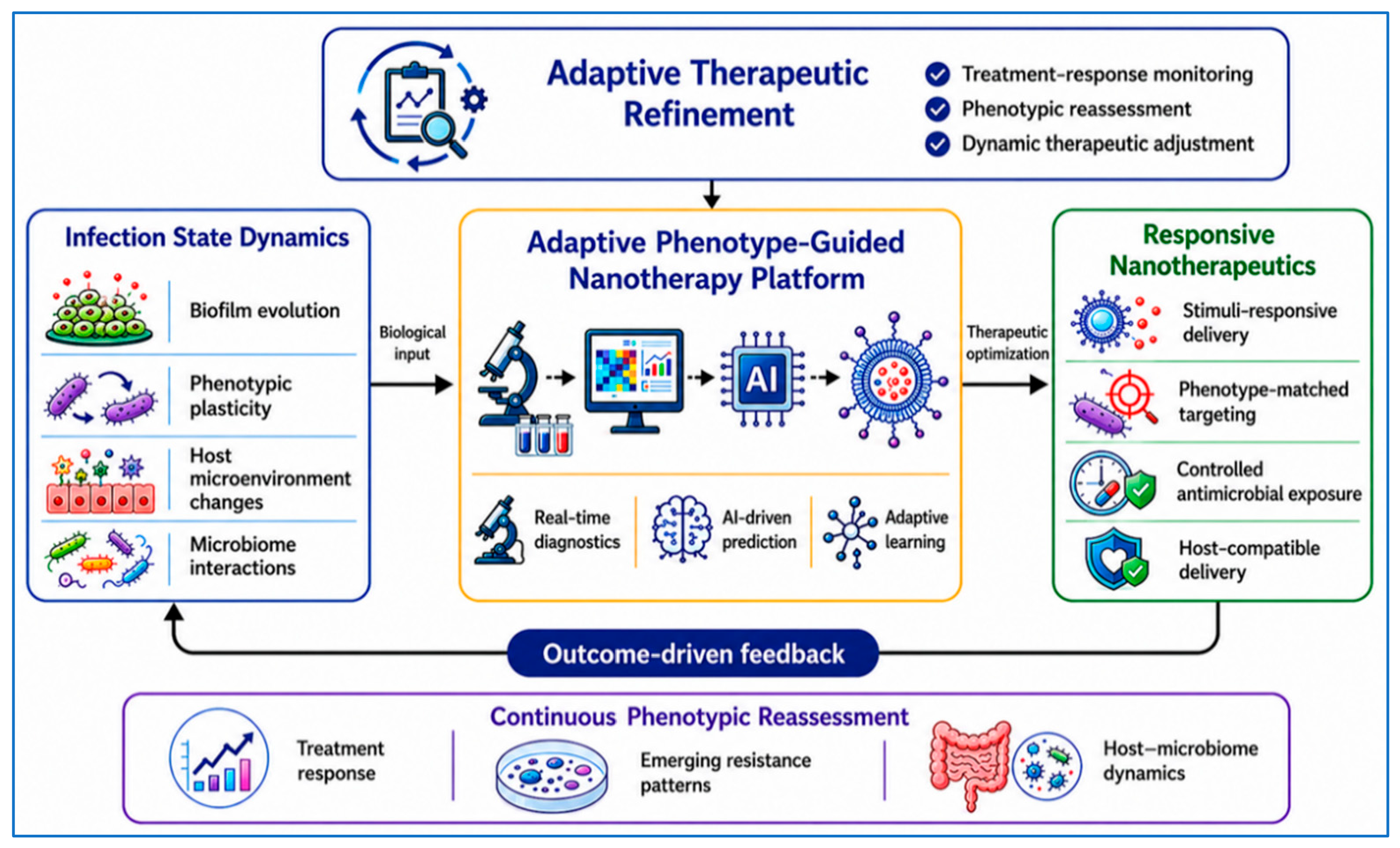
10. Future Perspectives: Toward Adaptive Phenotype-Guided Nanomedicine
10.1. Phenotype-Responsive Therapeutic Models
10.2. Integration of Diagnostics, Nanotechnology, and AI
10.3. Emerging Next-Generation Antimicrobial Platforms
11. Conclusions
Author Contributions
Funding
Institutional Review Board Statement
Informed Consent Statement
Data Availability Statement
Acknowledgments
Conflicts of Interest
References
- Salam, M.A.; Al-Amin, M.Y.; Salam, M.T.; Pawar, J.S.; Akhter, N.; Rabaan, A.A.; Alqumber, M.A. Antimicrobial resistance: A growing serious threat for global public health. Healthcare 2023, 11, 1946. [Google Scholar] [CrossRef]
- Coque, T.M.; Cantón, R.; Pérez-Cobas, A.E.; Fernández-de-Bobadilla, M.D.; Baquero, F. Antimicrobial resistance in the global health network: Known unknowns and challenges for efficient responses in the 21st century. Microorganisms 2023, 11, 1050. [Google Scholar] [CrossRef] [PubMed]
- Medina, M.-J.; Legido-Quigley, H.; Hsu, L.Y. Antimicrobial resistance in one health. In Global Health Security: Recognizing Vulnerabilities, Creating Opportunities; Springer: Cham, Switzerland, 2020; pp. 209–229. [Google Scholar]
- World Health Organization. Resistencia a los Antibióticos. 2020. Available online: https://www.who.int/es/news-room/fact-sheets/detail/antibiotic-resistance (accessed on 1 April 2026).
- Ahuatzin-Flores, O.E.; Torres, E.; Chávez-Bravo, E. Acinetobacter baumannii, a multidrug-resistant opportunistic pathogen in new habitats: A systematic review. Microorganisms 2024, 12, 644. [Google Scholar] [CrossRef]
- Abed, A.S.; Al Hussein, T.M.A. Molecular genotyping survey for blaIMP virulence gene of Acinetobacter baumannii isolates, Iraq. Plant Arch. 2019, 19, 3862. [Google Scholar]
- Hayajneh, W.A.; Al-Azzam, S.; Yusef, D.; Lattyak, W.J.; Lattyak, E.A.; Gould, I.; López-Lozano, J.-M.; Conway, B.R.; Conlon-Bingham, G.; Aldeyab, M.A. Identification of thresholds in relationships between specific antibiotic use and carbapenem-resistant Acinetobacter baumannii (CRAB) incidence rates in hospitalized patients in Jordan. J. Antimicrob. Chemother. 2021, 76, 524–530. [Google Scholar] [CrossRef] [PubMed]
- World Health Organization. WHO Publishes List of Bacteria for Which New Antibiotics Are Urgently Needed. 27 February 2017. Available online: https://www.who.int/news/item/27-02-2017-who-publishes-list-of-bacteria-for-which-new-antibiotics-are-urgently-needed (accessed on 1 April 2026).
- Russo, A.; Serapide, F. The multifaceted landscape of healthcare-associated infections caused by carbapenem-resistant Acinetobacter baumannii. Microorganisms 2025, 13, 829. [Google Scholar] [CrossRef]
- Li, X.; Gui, S.; Gui, R.; Li, J.; Huang, R.; Hu, M.; Luo, X.-J.; Nie, X. Multifunctional clustered regularly interspaced short palindromic repeats (CRISPR)-Cas9-based nanobomb against carbapenem-resistant Acinetobacter baumannii infection through cascade reaction and amplification synergistic effect. Acs Nano 2023, 17, 24632–24653. [Google Scholar] [CrossRef]
- Pillai, G.; Jankie, S. Nanovesicular Drug Delivery Systems for Overcoming Antibiotic Resistance. Cureus 2025, 17, e98926. [Google Scholar] [CrossRef] [PubMed]
- Zhang, J.; Leifer, F.; Rose, S.; Chun, D.Y.; Thaisz, J.; Herr, T.; Nashed, M.; Joseph, J.; Perkins, W.R.; DiPetrillo, K. Amikacin liposome inhalation suspension (ALIS) penetrates non-tuberculous mycobacterial biofilms and enhances amikacin uptake into macrophages. Front. Microbiol. 2018, 9, 915. [Google Scholar] [CrossRef]
- Lewis, K. Persister cells, dormancy and infectious disease. Nat. Rev. Microbiol. 2007, 5, 48–56. [Google Scholar] [CrossRef]
- Brauner, A.; Fridman, O.; Gefen, O.; Balaban, N.Q. Distinguishing between resistance, tolerance and persistence to antibiotic treatment. Nat. Rev. Microbiol. 2016, 14, 320–330. [Google Scholar] [CrossRef]
- Serretiello, E.; De Prisco, M.; Di Siervi, G.; Cosimato, I.; Dell’Annunziata, F.; Santoro, E.; Vozzella, E.A.; Boccia, G.; Folliero, V.; Franci, G. A Nine-Year Review of Acinetobacter baumannii Infections Frequency and Antimicrobial Resistance in a Single-Center Study in Salerno, Italy. Pathogens 2025, 14, 1165. [Google Scholar] [CrossRef] [PubMed]
- de Souza, J.; D’Espindula, H.R.S.; Ribeiro, I.d.F.; Gonçalves, G.A.; Pillonetto, M.; Faoro, H. Carbapenem resistance in Acinetobacter baumannii: Mechanisms, therapeutics, and innovations. Microorganisms 2025, 13, 1501. [Google Scholar] [CrossRef]
- Flemming, H.-C.; Wingender, J.; Szewzyk, U.; Steinberg, P.; Rice, S.A.; Kjelleberg, S. Biofilms: An emergent form of bacterial life. Nat. Rev. Microbiol. 2016, 14, 563–575. [Google Scholar] [CrossRef]
- Flemming, H.-C.; Wuertz, S. Bacteria and archaea on Earth and their abundance in biofilms. Nat. Rev. Microbiol. 2019, 17, 247–260. [Google Scholar] [CrossRef] [PubMed]
- Adeyemi, F.M.; Akinlade, E.A.; Yusuf-Omoloye, N.A.; Ajigbewu, O.H.; Dare, A.P.; Wahab, A.A.; Oyedara, O.O.; Isiaka, H.S.; Usamat, A.O. Carbapenem-resistance in Acinetobacter baumannii: Prevalence, antibiotic resistance profile and carbapenemase genes in clinical and hospital environmental strains. BMC Infect. Dis. 2025, 25, 786. [Google Scholar] [CrossRef] [PubMed]
- Tacconelli, E.; Carrara, E.; Savoldi, A.; Harbarth, S.; Mendelson, M.; Monnet, D.L.; Pulcini, C.; Kahlmeter, G.; Kluytmans, J.; Carmeli, Y.; et al. Discovery, research, and development of new antibiotics: The WHO priority list of antibiotic-resistant bacteria and tuberculosis. Lancet Infect. Dis. 2018, 18, 318–327. [Google Scholar] [CrossRef]
- Van Belkum, A.; Dunne, W.M., Jr. Next-generation antimicrobial susceptibility testing. J. Clin. Microbiol. 2013, 51, 2018–2024. [Google Scholar] [CrossRef]
- Bonomo, R.A.; Burd, E.M.; Conly, J.; Limbago, B.M.; Poirel, L.; Segre, J.A.; Westblade, L.F. Carbapenemase-producing organisms: A global scourge. Clin. Infect. Dis. 2018, 66, 1290–1297. [Google Scholar] [CrossRef]
- World Health Organization. Prioritization of Pathogens to Guide Discovery, Research and Development of New Antibiotics for Drug-Resistant Bacterial Infections, Including Tuberculosis; WHO/EMP/IAU/2017.12; World Health Organization: Geneva, Switzerland, 2017; Available online: https://www.who.int/publications/i/item/WHO-EMP-IAU-2017.12 (accessed on 1 April 2026).
- Pelgrift, R.Y.; Friedman, A.J. Nanotechnology as a therapeutic tool to combat microbial resistance. Adv. Drug Deliv. Rev. 2013, 65, 1803–1815. [Google Scholar] [CrossRef]
- Wang, L.; Hu, C.; Shao, L. The antimicrobial activity of nanoparticles: Present situation and prospects for the future. Int. J. Nanomed. 2017, 12, 1227–1249. [Google Scholar] [CrossRef] [PubMed]
- Baptista, P.V.; McCusker, M.P.; Carvalho, A.; Ferreira, D.A.; Mohan, N.M.; Martins, M.; Fernandes, A.R. Nano-strategies to fight multidrug resistant bacteria—“A Battle of the Titans”. Front. Microbiol. 2018, 9, 1441. [Google Scholar] [CrossRef] [PubMed]
- Abdallah, O.M.; Shebl, H.R.; Abdelsalam, E.; Mehrez, S.I. The impact and safety of encapsulated nanomaterials as a new alternative against carbapenem resistant bacteria. a systematic review. World J. Microbiol. Biotechnol. 2024, 40, 72. [Google Scholar] [CrossRef]
- Shawky, M.; Kalaba, M.H.; El-Sherbiny, G.M. Tackling carbapenem-resistant Acinetobacter baumannii (CRAB) and their virulence factors using biosynthesized silver nanoparticles combined with imipenem. Biotechnol. Notes 2025, 6, 183–195. [Google Scholar] [CrossRef]
- Farha, M.A.; Brown, E.D. Drug repurposing for antimicrobial discovery. Nat. Microbiol. 2019, 4, 565–577. [Google Scholar] [CrossRef]
- Stone, N.R.; Bicanic, T.; Salim, R.; Hope, W. Liposomal amphotericin B (AmBisome®): A review of the pharmacokinetics, pharmacodynamics, clinical experience and future directions. Drugs 2016, 76, 485–500. [Google Scholar] [CrossRef]
- Kyriakidis, I.; Vasileiou, E.; Pana, Z.D.; Tragiannidis, A. Acinetobacter baumannii antibiotic resistance mechanisms. Pathogens 2021, 10, 373. [Google Scholar] [CrossRef]
- Lin, M.-F.; Lan, C.-Y. Antimicrobial resistance in Acinetobacter baumannii: From bench to bedside. World J. Clin. Cases 2014, 2, 787. [Google Scholar] [CrossRef]
- Nikaido, H.; Takatsuka, Y. Mechanisms of RND multidrug efflux pumps. Biochim. Biophys. Acta (BBA)-Proteins Proteom. 2009, 1794, 769–781. [Google Scholar] [CrossRef]
- Coyne, S.; Courvalin, P.; Périchon, B. Efflux-mediated antibiotic resistance in Acinetobacter spp. Antimicrob. Agents Chemother. 2011, 55, 947–953. [Google Scholar] [CrossRef]
- Baruah, J.; Singh, L.S.; Salvia, T.; Bhowmik, D. Escalating threat of Acinetobacter baumannii: Resistance mechanisms and mitigation strategies a perspective. J. Lab. Physicians 2025, 17, 235. [Google Scholar] [CrossRef]
- Salaja, A.T.; Suryaletha, K.; Thomas, S.; Raneshan, A.C.; Thankappan, D.; Darjees, D.; Rajendran, S.A. Acinetobacter baumannii: Insights into Epidemiology, Pathogenicity and Drug Resistance. Microbe 2025, 9, 100598. [Google Scholar] [CrossRef]
- Lima, P.H.M.; Lopes, C.F.; Freire, J.P.C.; Feliciano, L.D.; Amorim, R.C.O.; Mota, M.L.; Cirqueira, F.F.; Lemos, F.F.B.; Pedroso, S.H.S.P.; Melo, F.F.d. Integrative review on Acinetobacter baumannii as a multidrug-resistant pathogen: Resistance mechanisms and therapeutic perspectives in the context of nosocomial infections. Rev. Soc. Bras. Med. Trop. 2025, 58, e0268-2025. [Google Scholar] [CrossRef]
- Mohamed, E.A.; Raafat, M.M.; Samir Mohamed, R.; Ali, A.E.E. Acinetobacter baumannii biofilm and its potential therapeutic targets. Future J. Pharm. Sci. 2023, 9, 82. [Google Scholar] [CrossRef]
- Roy, S.; Chowdhury, G.; Mukhopadhyay, A.K.; Dutta, S.; Basu, S. Convergence of biofilm formation and antibiotic resistance in Acinetobacter baumannii infection. Front. Med. 2022, 9, 793615. [Google Scholar] [CrossRef] [PubMed]
- Eze, E.C.; Chenia, H.Y.; El Zowalaty, M.E. Acinetobacter baumannii biofilms: Effects of physicochemical factors, virulence, antibiotic resistance determinants, gene regulation, and future antimicrobial treatments. Infect. Drug Resist. 2018, 11, 2277–2299. [Google Scholar] [CrossRef]
- Qi, L.; Li, H.; Zhang, C.; Liang, B.; Li, J.; Wang, L.; Du, X.; Liu, X.; Qiu, S.; Song, H. Relationship between antibiotic resistance, biofilm formation, and biofilm-specific resistance in Acinetobacter baumannii. Front. Microbiol. 2016, 7, 483. [Google Scholar] [CrossRef] [PubMed]
- Shenkutie, A.M.; Yao, M.Z.; Siu, G.K.-h.; Wong, B.K.C.; Leung, P.H.-m. Biofilm-induced antibiotic resistance in clinical Acinetobacter baumannii isolates. Antibiotics 2020, 9, 817. [Google Scholar] [CrossRef] [PubMed]
- Vergoz, D.; Dé, E.; Loutelier-Bourhis, C.; Alexandre, S. Antibiotic Persister Cells in Acinetobacter baumannii: Overview of Molecular Mechanisms and Removal Strategies. Environ. Microbiol. 2025, 27, e70207. [Google Scholar] [CrossRef]
- Lewis, K. Persister cells. Annu. Rev. Microbiol. 2010, 64, 357–372. [Google Scholar] [CrossRef]
- Niu, C.; Clemmer, K.M.; Bonomo, R.A.; Rather, P.N. Isolation and characterization of an autoinducer synthase from Acinetobacter baumannii. J. Bacteriol. 2008, 190, 3386–3392. [Google Scholar] [CrossRef]
- Bhargava, N.; Sharma, P.; Capalash, N. Quorum sensing in Acinetobacter: An emerging pathogen. Crit. Rev. Microbiol. 2010, 36, 349–360. [Google Scholar] [CrossRef]
- Miller, K.P.; Wang, L.; Benicewicz, B.C.; Decho, A.W. Inorganic nanoparticles engineered to attack bacteria. Chem. Soc. Rev. 2015, 44, 7787–7807. [Google Scholar] [CrossRef]
- Yoon, E.-J.; Courvalin, P.; Grillot-Courvalin, C. RND-type efflux pumps in multidrug-resistant clinical isolates of Acinetobacter baumannii: Major role for AdeABC overexpression and AdeRS mutations. Antimicrob. Agents Chemother. 2013, 57, 2989–2995. [Google Scholar] [CrossRef]
- Vila, J.; Martí, S.; Sanchez-Céspedes, J. Porins, efflux pumps and multidrug resistance in Acinetobacter baumannii. J. Antimicrob. Chemother. 2007, 59, 1210–1215. [Google Scholar] [CrossRef]
- Du, D.; Wang-Kan, X.; Neuberger, A.; Van Veen, H.W.; Pos, K.M.; Piddock, L.J.; Luisi, B.F. Multidrug efflux pumps: Structure, function and regulation. Nat. Rev. Microbiol. 2018, 16, 523–539. [Google Scholar] [CrossRef]
- Sun, J.-R.; Perng, C.-L.; Lin, J.-C.; Yang, Y.-S.; Chan, M.-C.; Chang, T.-Y.; Lin, F.-M.; Chiueh, T.-S. AdeRS combination codes differentiate the response to efflux pump inhibitors in tigecycline-resistant isolates of extensively drug-resistant Acinetobacter baumannii. Eur. J. Clin. Microbiol. Infect. Dis. 2014, 33, 2141–2147. [Google Scholar] [CrossRef]
- Yan, X.; He, B.; Liu, L.; Qu, G.; Shi, J.; Hu, L.; Jiang, G. Antibacterial mechanism of silver nanoparticles in Pseudomonas aeruginosa: Proteomics approach. Metallomics 2018, 10, 557–564. [Google Scholar] [CrossRef]
- Lara, H.H.; Ayala-Núñez, N.V.; Ixtepan Turrent, L.d.C.; Rodríguez Padilla, C. Bactericidal effect of silver nanoparticles against multidrug-resistant bacteria. World J. Microbiol. Biotechnol. 2010, 26, 615–621. [Google Scholar] [CrossRef]
- Marchand, I.; Damier-Piolle, L.; Courvalin, P.; Lambert, T. Expression of the RND-type efflux pump AdeABC in Acinetobacter baumannii is regulated by the AdeRS two-component system. Antimicrob. Agents Chemother. 2004, 48, 3298–3304. [Google Scholar] [CrossRef]
- He, X.; Szewczyk, P.; Karyakin, A.; Evin, M.; Hong, W.-X.; Zhang, Q.; Chang, G. Structure of a cation-bound multidrug and toxic compound extrusion transporter. Nature 2010, 467, 991–994. [Google Scholar] [CrossRef]
- Saxena, D.; Maitra, R.; Bormon, R.; Czekanska, M.; Meiers, J.; Titz, A.; Verma, S.; Chopra, S. Tackling the outer membrane: Facilitating compound entry into Gram-negative bacterial pathogens. npj Antimicrob. Resist. 2023, 1, 17. [Google Scholar] [CrossRef]
- Zhu, L.J.; Chen, X.Y.; Hou, P.F. Mutation of CarO participates in drug resistance in imipenem-resistant Acinetobacter baumannii. J. Clin. Lab. Anal. 2019, 33, e22976. [Google Scholar] [CrossRef] [PubMed]
- Uppalapati, S.R.; Sett, A.; Pathania, R. The outer membrane proteins OmpA, CarO, and OprD of Acinetobacter baumannii confer a two-pronged defense in facilitating its success as a potent human pathogen. Front. Microbiol. 2020, 11, 589234. [Google Scholar] [CrossRef] [PubMed]
- Benmahmod, A.B.; Said, H.S.; Ibrahim, R.H. Prevalence and mechanisms of carbapenem resistance among Acinetobacter baumannii clinical isolates in Egypt. Microb. Drug Resist. 2019, 25, 480–488. [Google Scholar] [CrossRef] [PubMed]
- Kester, J.C.; Fortune, S.M. Persisters and beyond: Mechanisms of phenotypic drug resistance and drug tolerance in bacteria. Crit. Rev. Biochem. Mol. Biol. 2014, 49, 91–101. [Google Scholar] [CrossRef]
- Harms, A.; Maisonneuve, E.; Gerdes, K. Mechanisms of bacterial persistence during stress and antibiotic exposure. Science 2016, 354, aaf4268. [Google Scholar] [CrossRef]
- Thacharodi, A.; Vithlani, A.; Hassan, S.; Alqahtani, A.; Pugazhendhi, A. Carbapenem-resistant Acinetobacter baumannii raises global alarm for new antibiotic regimens. iScience 2024, 27, 111367. [Google Scholar] [CrossRef]
- Serapide, F.; Guastalegname, M.; Gullì, S.P.; Lionello, R.; Bruni, A.; Garofalo, E.; Longhini, F.; Trecarichi, E.M.; Russo, A. Antibiotic treatment of carbapenem-resistant Acinetobacter baumannii infections in view of the newly developed β-lactams: A narrative review of the existing evidence. Antibiotics 2024, 13, 506. [Google Scholar] [CrossRef]
- Rangel, K.; Chagas, T.P.G.; De-Simone, S.G. Understanding the harmful impact of Polymyxins on Acinetobacter baumannii. In Acinetobacter baumannii-The Rise of a Resistant Pathogen; IntechOpen: London, UK, 2023. [Google Scholar]
- Yu, Z.; Hu, H.; Liu, X.; Liu, J.; Yu, L.; Wei, A.; Xin, C.; Gan, Y.; Lei, S.; Zhuang, L.; et al. Clinical outcomes and pharmacokinetics/pharmacodynamics of intravenous polymyxin B treatment for various site carbapenem-resistant gram-negative bacterial infections: A prospective observational multicenter study. Antimicrob. Agents Chemother. 2025, 69, e01859-24. [Google Scholar] [CrossRef]
- Satlin, M.; Shields, R.K.; Torres, A.; Tillotson, G. Turning the Tide Against Carbapenem-resistant Acinetobacter baumannii: Advancing Care With Sulbactam–Durlobactam. Open Forum Infect. Dis. 2025, 12, ofaf618. [Google Scholar] [CrossRef]
- Dubashynskaya, N.V.; Skorik, Y.A. Polymyxin delivery systems: Recent advances and challenges. Pharmaceuticals 2020, 13, 83. [Google Scholar] [CrossRef]
- Wallace, S.J.; Li, J.; Nation, R.L.; Prankerd, R.J.; Boyd, B.J. Interaction of colistin and colistin methanesulfonate with liposomes: Colloidal aspects and implications for formulation. J. Pharm. Sci. 2012, 101, 3347–3359. [Google Scholar] [CrossRef]
- Peralta-Cuevas, E.; Degollado-Hernández, N.Y.; Martínez-Ortiz, I.C.; Gutierrez-Onofre, A.J.; Garcia-Atutxa, I.; Villanueva-Flores, F. How do nanoparticle properties shape pharmacokinetics and pharmacodynamics? A mechanistic review. Front. Pharmacol. 2026, 16, 1704814. [Google Scholar] [CrossRef]
- Dehbanipour, R.; Maleki, V.T.Z.; Ghalavand, Z. Colistin heteroresistance, mechanisms, diagnostic methods, and therapeutic options: A review. Germs 2025, 15, 166. [Google Scholar] [CrossRef]
- Novović, K.; Jovčić, B. Colistin resistance in Acinetobacter baumannii: Molecular mechanisms and epidemiology. Antibiotics 2023, 12, 516. [Google Scholar] [CrossRef]
- Xu, L.; Mo, X.; Zhang, H.; Wan, F.; Luo, Q.; Xiao, Y. Epidemiology, mechanisms, and clinical impact of bacterial heteroresistance. npj Antimicrob. Resist. 2025, 3, 7. [Google Scholar] [CrossRef]
- Hematian, A.; Karami-Zarandi, M.; Rahdar, H.A.; Heidari, H.; Kazemian, H. Investigation of colistin heteroresistance in multidrug-resistant Acinetobacter baumannii clinical isolates. New Microbes New Infect. 2025, 67, 101633. [Google Scholar] [CrossRef]
- Kamoshida, G.; Yamada, N.; Yamaguchi, D.; Yahiro, K.; Morita, Y. Colistin resistance in Acinetobacter baumannii: Basic and clinical insights. Biol. Pharm. Bull. 2025, 48, 213–221. [Google Scholar] [CrossRef]
- Li, Y.; Zhou, M.; Xu, Y. Progress in the study of polymyxin heteroresistance molecular mechanisms. Med. J. Peking Union Med. Coll. Hosp. 2024, 16, 177–183. [Google Scholar]
- Shi, J.; Cheng, J.; Liu, S.; Zhu, Y.; Zhu, M. Acinetobacter baumannii: An evolving and cunning opponent. Front. Microbiol. 2024, 15, 1332108. [Google Scholar] [CrossRef]
- Yuan, W.; Yu, T.; Yang, X.; Lin, T.; Guo, T.; Wang, X.; Li, G.; Gong, K.; Liu, W. Neutral plasma-activated solution reverses polymyxin to inhibit polymyxin-resistant Acinetobacter baumannii by promoting the release of ROS and destroying the outer membrane in vitro. mSystems 2025, 10, e00784-25. [Google Scholar] [CrossRef]
- Kubin, C.J.; Garzia, C.; Uhlemann, A.-C. Acinetobacter baumannii treatment strategies: A review of therapeutic challenges and considerations. Antimicrob. Agents Chemother. 2025, 69, e01063-24. [Google Scholar] [CrossRef]
- Tan, Y.; Su, J.; Fu, M.; Zhang, H.; Zeng, H. Recent advances in phage-based therapeutics for multi-drug resistant Acinetobacter baumannii. Bioengineering 2022, 10, 35. [Google Scholar] [CrossRef]
- Alisigwe, C.V.; Ikpa, C.S.; Otuonye, U.J. Examining alternative approaches to antibiotic utilisation: A critical evaluation of phage therapy and antimicrobial peptides combination as potential alternatives. Microbe 2025, 6, 100254. [Google Scholar] [CrossRef]
- Ghazaei, C. The role of bacteriophages and CRISPR-Cas in combating multidrug-resistant bacteria. Nat. Prod. Bioprospect. 2026, 16, 14. [Google Scholar] [CrossRef]
- Fortaleza, J.A.G.; Cabuhat, K.S.P.; Kim, S.; Mortel, F.A.; Bacalzo, G.D.; Nuevo, J.J.M. Bacteriophages targeting Acinetobacter baumannii in the era of antibiotic failure: A review. Front. Microbiol. 2026, 17, 1778984. [Google Scholar] [CrossRef]
- Obeid, M.A.; Alyamani, H.; Alenaizat, A.; Tunc, T.; Aljabali, A.A.; Alsaadi, M.M. Nanomaterial-based drug delivery systems in overcoming bacterial resistance: Current review. Microb. Pathog. 2025, 203, 107455. [Google Scholar] [CrossRef]
- Aslam, A.; Alvi, S.; Qureshi, A.; Zain, A.; Ahmed, H.A.; Umar, M. Clinical Efficacy of Nanoparticle-Based Antibiotic Delivery Systems in Drug-Resistant Bacterial Infections: A Systematic Review. J. Health Wellness Community Res. 2026, 4, 1–13. [Google Scholar] [CrossRef]
- Ghosh, R.; De, M. Liposome-based antibacterial delivery: An emergent approach to combat bacterial infections. ACS Omega 2023, 8, 35442–35451. [Google Scholar] [CrossRef]
- Zou, W.; McAdorey, A.; Yan, H.; Chen, W. Nanomedicine to overcome antimicrobial resistance: Challenges and prospects. Nanomedicine 2023, 18, 471–484. [Google Scholar] [CrossRef]
- Bhattacharjee, S.; de Haan, L.H.; Evers, N.M.; Jiang, X.; Marcelis, A.T.; Zuilhof, H.; Rietjens, I.M.; Alink, G.M. Role of surface charge and oxidative stress in cytotoxicity of organic monolayer-coated silicon nanoparticles towards macrophage NR8383 cells. Part. Fibre Toxicol. 2010, 7, 25. [Google Scholar] [CrossRef]
- Sun, H.; Jiang, C.; Wu, L.; Bai, X.; Zhai, S. Cytotoxicity-related bioeffects induced by nanoparticles: The role of surface chemistry. Front. Bioeng. Biotechnol. 2019, 7, 414. [Google Scholar] [CrossRef]
- Ahmed, R.M.; Mahmood, T.H.; Al-Tarawneh, Z.S.; Alazzawi, Q.K.; Al-Samydai, A.M. Nano-Liposomal Delivery Systems and their Applications in Bacterial Resistance. Al Mustansiriyah J. Pharm. Sci. 2025, 25, 592–627. [Google Scholar] [CrossRef]
- Amini, M.S.; Baseri Salehi, M.; Bahador, N. Evaluating the antibacterial effect of meropenem-loaded chitosan/sodium tripolyphosphate (TPP) nanoparticles on Acinetobacter baumannii isolated from hospitalized patients. BMC Infect. Dis. 2024, 24, 631. [Google Scholar] [CrossRef]
- Haripriyaa, M.; Suthindhiran, K. Pharmacokinetics of nanoparticles: Current knowledge, future directions and its implications in drug delivery. Future J. Pharm. Sci. 2023, 9, 113. [Google Scholar] [CrossRef]
- Allemailem, K.S. Enhanced activity of Ellagic acid in lipid nanoparticles (EA-liposomes) against Acinetobacter baumannii in immunosuppressed mice. Saudi J. Biol. Sci. 2023, 30, 103707. [Google Scholar] [CrossRef]
- Faivre, C.; Imtiyaz, F.D.; Buyck, J.M.; Marchand, S.; Marcotte, M.; Henry, T.; Anton, N.; Collot, M.; Tewes, F. (E, E)-farnesol and myristic acid-loaded lipid nanoparticles overcome colistin resistance in Acinetobacter baumannii. Int. J. Pharm. 2024, 667, 124907. [Google Scholar] [CrossRef]
- Cui, Z.; Li, Y.; Qin, Y.; Li, J.; Shi, L.; Wan, M.; Hu, M.; Chen, Y.; Ji, Y.; Hou, Y.; et al. Polymyxin B-targeted liposomal photosensitizer cures MDR A. baumannii burn infections and accelerates wound healing via M1/M2 macrophage polarization. J. Control. Release 2024, 366, 297–311. [Google Scholar] [CrossRef]
- Richardson, L.; Yang, T.-Y.; Chen, Y.-W.; Lin, S.-Y.; Wang, Y.-T.; Lu, P.-L.; Chan, Y.-H.; Lin, H.-C. In Silico Design of Antimicrobial Peptides against Carbapenem-Resistant Acinetobacter baumannii Infections with Enhanced Activity by Nanoformulation. ACS Appl. Bio Mater. 2025, 8, 6121–6131. [Google Scholar] [CrossRef]
- Hao, J.; Yang, R.; Ma, X. Combatting Acinetobacter baumannii pneumonia by multidrug codelivery of curcumin nanosuspensions and sulfamethoxazole with polymyxin B for targeted pediatric pulmonary inflammation and disease management. Microb. Pathog. 2025, 203, 107454. [Google Scholar] [CrossRef]
- Jayathilaka, E.T.; Han, J.; De Zoysa, M.; Whang, I. Antimicrobial Peptide Octoprohibitin-Encapsulated Chitosan Nanoparticles Enhanced Antibacterial Activity against Acinetobacter baumannii. Pharmaceutics 2024, 16, 1245. [Google Scholar] [CrossRef]
- Du, X.; Xue, J.; Jiang, M.; Lin, S.; Huang, Y.; Deng, K.; Shu, L.; Xu, H.; Li, Z.; Yao, J.; et al. A multiepitope peptide, rOmp22, encapsulated in chitosan-PLGA nanoparticles as a candidate vaccine against Acinetobacter baumannii infection. Int. J. Nanomed. 2021, 6, 1819–1836. [Google Scholar] [CrossRef]
- Gholizadeh, A.; Shapoury, R.; Pakzad, P.; Mahdavi, M.; Danafar, H. Evaluation of PLGA nanoparticles containing outer membrane proteins of Acinetobacter baumannii bacterium in stimulating the immune system in mice. Res. Pharm. Sci. 2022, 17, 360–371. [Google Scholar] [CrossRef]
- Abdel Khalek, M.A.; Abdelhameed, A.M.; Abdel Gaber, S.A. The use of photoactive polymeric nanoparticles and nanofibers to generate a photodynamic-mediated antimicrobial effect, with a special emphasis on chronic wounds. Pharmaceutics 2024, 16, 229. [Google Scholar] [CrossRef]
- Rai, M.; Yadav, A.; Gade, A. Silver nanoparticles as a new generation of antimicrobials. Biotechnol. Adv. 2009, 27, 76–83. [Google Scholar] [CrossRef]
- Panáček, A.; Smékalová, M.; Kilianová, M.; Prucek, R.; Bogdanová, K.; Večeřová, R.; Kolář, M.; Havrdová, M.; Płaza, G.A.; Chojniak, J.; et al. Strong and nonspecific synergistic antibacterial efficiency of antibiotics combined with silver nanoparticles at very low concentrations showing no cytotoxic effect. Molecules 2015, 21, 26. [Google Scholar] [CrossRef]
- Gurunathan, S.; Han, J.W.; Kwon, D.-N.; Kim, J.-H. Enhanced antibacterial and anti-biofilm activities of silver nanoparticles against Gram-negative and Gram-positive bacteria. Nanoscale Res. Lett. 2014, 9, 373. [Google Scholar] [CrossRef]
- Niño-Martínez, N.; Salas Orozco, M.F.; Martínez-Castañón, G.-A.; Torres Méndez, F.; Ruiz, F. Molecular mechanisms of bacterial resistance to metal and metal oxide nanoparticles. Int. J. Mol. Sci. 2019, 20, 2808. [Google Scholar] [CrossRef]
- McNeilly, O.; Mann, R.; Hamidian, M.; Gunawan, C. Emerging concern for silver nanoparticle resistance in Acinetobacter baumannii and other bacteria. Front. Microbiol. 2021, 12, 652863. [Google Scholar] [CrossRef]
- Makadia, H.K.; Siegel, S.J. Poly lactic-co-glycolic acid (PLGA) as biodegradable controlled drug delivery carrier. Polymers 2011, 3, 1377–1397. [Google Scholar] [CrossRef]
- Danhier, F.; Ansorena, E.; Silva, J.M.; Coco, R.; Le Breton, A.; Préat, V. PLGA-based nanoparticles: An overview of biomedical applications. J. Control. Release 2012, 161, 505–522. [Google Scholar] [CrossRef]
- Hall, C.W.; Mah, T.-F. Molecular mechanisms of biofilm-based antibiotic resistance and tolerance in pathogenic bacteria. FEMS Microbiol. Rev. 2017, 41, 276–301. [Google Scholar] [CrossRef]
- Stewart, P.S.; Franklin, M.J. Physiological heterogeneity in biofilms. Nat. Rev. Microbiol. 2008, 6, 199–210. [Google Scholar] [CrossRef]
- Blanco-Cabra, N.; Alcàcer-Almansa, J.; Admella, J.; Arévalo-Jaimes, B.V.; Torrents, E. Nanomedicine against biofilm infections: A roadmap of challenges and limitations. Wiley Interdiscip. Rev. Nanomed. Nanobiotechnol. 2024, 16, e1944. [Google Scholar] [CrossRef]
- Beitelshees, M.; Hill, A.; Jones, C.H.; Pfeifer, B.A. Phenotypic variation during biofilm formation: Implications for anti-biofilm therapeutic design. Materials 2018, 11, 1086. [Google Scholar] [CrossRef]
- Yan, J.; Bassler, B.L. Surviving as a community: Antibiotic tolerance and persistence in bacterial biofilms. Cell Host Microbe 2019, 26, 15–21. [Google Scholar] [CrossRef]
- Ding, M.; Zhao, W.; Song, L.-J.; Luan, S.-F. Stimuli-responsive nanocarriers for bacterial biofilm treatment. Rare Met. 2022, 41, 482–498. [Google Scholar] [CrossRef]
- Li, W.; Ding, Q.; Li, M.; Zhang, T.; Li, C.; Qi, M.; Dong, B.; Fang, J.; Wang, L.; Kim, J.S. Stimuli-responsive and targeted nanomaterials: Revolutionizing the treatment of bacterial infections. J. Control. Release 2025, 377, 495–523. [Google Scholar] [CrossRef]
- Roberts, J.A.; Abdul-Aziz, M.H.; Lipman, J.; Mouton, J.W.; Vinks, A.A.; Felton, T.W.; Hope, W.W.; Farkas, A.; Neely, M.N.; Schentag, J.J.; et al. Individualised antibiotic dosing for patients who are critically ill: Challenges and potential solutions. Lancet Infect. Dis. 2014, 14, 498–509. [Google Scholar] [CrossRef]
- Abdul-Aziz, M.H.; Alffenaar, J.-W.C.; Bassetti, M.; Bracht, H.; Dimopoulos, G.; Marriott, D.; Neely, M.N.; Paiva, J.-A.; Pea, F.; Sjovall, F.; et al. Antimicrobial therapeutic drug monitoring in critically ill adult patients: A Position Paper# MH Abdul-Aziz et al. Intensive Care Med. 2020, 46, 1127–1153. [Google Scholar]
- Mouton, J.W.; Ambrose, P.G.; Canton, R.; Drusano, G.L.; Harbarth, S.; MacGowan, A.; Theuretzbacher, U.; Turnidge, J. Conserving antibiotics for the future: New ways to use old and new drugs from a pharmacokinetic and pharmacodynamic perspective. Drug Resist. Updates 2011, 14, 107–117. [Google Scholar] [CrossRef]
- Rapacka-Zdonczyk, A. Beyond Resistance: Phenotypic Plasticity in Bacterial Responses to Antibiotics, Oxidative Stress and Antimicrobial Photodynamic Inactivation. Molecules 2026, 31, 567. [Google Scholar] [CrossRef]
- Ackermann, M. A functional perspective on phenotypic heterogeneity in microorganisms. Nat. Rev. Microbiol. 2015, 13, 497–508. [Google Scholar] [CrossRef]
- Singh, R.; Nadhe, S.; Wadhwani, S.; Shedbalkar, U.; Chopade, B.A. Nanoparticles for control of biofilms of Acinetobacter species. Materials 2016, 9, 383. [Google Scholar] [CrossRef]
- Wences, M.; Wolf, E.R.; Li, C.; Singh, N.; Bah, N.; Tan, X.; Huang, Y.; Bulman, Z.P. Combatting planktonic and biofilm populations of carbapenem-resistant Acinetobacter baumannii with polymyxin-based combinations. Antibiotics 2022, 11, 959. [Google Scholar]
- Mohammadinejat, M.; Sepahi, A.A.; Alipour, E. Antibacterial and Anti-Biofilm Activities of Silver Nano Particles Conjugated to Chitosan Against Multi-Drug Resistant Bacteria. Clin. Lab. 2023, 69, 60–67. [Google Scholar] [CrossRef]
- Govindan, R.; Chackaravarthi, G.; Ramachandran, G.; Chelliah, C.K.; Muthuchamy, M.; Quero, F.; Mothana, R.A.; Noman, O.M.; Siddiqui, N.A.; Li, W.-J. Effective removal of biofilm formation in Acinetobacter baumannii using chitosan nanoparticles loaded plant essential oils. J. King Saud Univ.-Sci. 2022, 34, 101845. [Google Scholar]
- Hetta, H.F.; Al-Kadmy, I.M.; Khazaal, S.S.; Abbas, S.; Suhail, A.; El-Mokhtar, M.A.; Ellah, N.H.A.; Ahmed, E.A.; Abd-Ellatief, R.B.; El-Masry, E.A.; et al. Antibiofilm and antivirulence potential of silver nanoparticles against multidrug-resistant Acinetobacter baumannii. Sci. Rep. 2021, 11, 10751. [Google Scholar] [CrossRef]
- Chen, M.; Yu, X.; Huo, Q.; Yuan, Q.; Li, X.; Xu, C.; Bao, H. Biomedical Potentialities of Silver Nanoparticles for Clinical Multiple Drug-Resistant Acinetobacter baumannii. J. Nanomater. 2019, 2019, 3754018. [Google Scholar] [CrossRef]
- Abdi, S.N.; Ghotaslou, R.; Ganbarov, K.; Mobed, A.; Tanomand, A.; Yousefi, M.; Asgharzadeh, M.; Kafil, H.S. Acinetobacter baumannii efflux pumps and antibiotic resistance. Infect. Drug Resist. 2020, 13, 423–434. [Google Scholar] [CrossRef]
- Xu, C.; Bilya, S.; Xu, W. adeABC efflux gene in Acinetobacter baumannii. New Microbes New Infect. 2019, 30, 100549. [Google Scholar] [CrossRef]
- Wieczorek, P.; Sacha, P.; Hauschild, T.; Zórawski, M.; Krawczyk, M.; Tryniszewska, E. Multidrug resistant Acinetobacter baumannii—The role of AdeABC (RND family) efflux pump in resistance to antibiotics. Folia Histochem. Cytobiol. 2008, 46, 257–267. [Google Scholar] [CrossRef] [PubMed]
- Li, X.-Z.; Plésiat, P.; Nikaido, H. The challenge of efflux-mediated antibiotic resistance in Gram-negative bacteria. Clin. Microbiol. Rev. 2015, 28, 337–418. [Google Scholar] [PubMed]
- Shakib, P.; Saki, R.; Zolfaghari, M.R.; Goudarzi, G. Efflux Pump and Biofilm Inhibitory Activity of Nanoparticles in Acinetobacter baumannii: A Systematic Review. Clin. Lab. 2023, 69, 2040–2046. [Google Scholar] [CrossRef] [PubMed]
- Behdad, R.; Pargol, M.; Mirzaie, A.; Karizi, S.Z.; Noorbazargan, H.; Akbarzadeh, I. Efflux pump inhibitory activity of biologically synthesized silver nanoparticles against multidrug-resistant Acinetobacter baumannii clinical isolates. J. Basic Microbiol. 2020, 60, 494–507. [Google Scholar] [CrossRef]
- Madhi, M.; Hasani, A.; Mojarrad, J.S.; Rezaee, M.A.; Zarrini, G.; Davaran, S.; Alizadeh, E.; Sheikhalizadeh, V. Impact of chitosan and silver nanoparticles laden with antibiotics on multidrug-resistant Pseudomonas aeruginosa and Acinetobacter baumannii. Arch. Clin. Infect. Dis. 2020, 15, e100195. [Google Scholar] [CrossRef]
- Chakraborty, N.; Jha, D.; Roy, I.; Kumar, P.; Gaurav, S.S.; Marimuthu, K.; Ng, O.-T.; Lakshminarayanan, R.; Verma, N.K.; Gautam, H.K. Nanobiotics against antimicrobial resistance: Harnessing the power of nanoscale materials and technologies. J. Nanobiotechnol. 2022, 20, 375. [Google Scholar]
- Kakian, F.; Arasteh, N.; Mirzaei, E.; Motamedifar, M. Study of MIC of silver and zinc oxide nanoparticles, strong and cost-effective antibacterial against biofilm-producing Acinetobacter baumannii in Shiraz, Southwest of Iran. BMC Infect. Dis. 2024, 24, 593. [Google Scholar]
- Al-Kadmy, I.M.; Aziz, S.N.; Rheima, A.M.; Abid, S.A.; Suhail, A.; Hamzah, I.H.; Naji, E.N.; Besinis, A.; Hetta, H.F. Anti-capsular activity of CuO nanoparticles against Acinetobacter baumannii produce efflux pump. Microb. Pathog. 2023, 181, 106184. [Google Scholar] [CrossRef]
- Zahn, M.; Bhamidimarri, S.P.; Baslé, A.; Winterhalter, M.; Van den Berg, B. Structural insights into outer membrane permeability of Acinetobacter baumannii. Structure 2016, 24, 221–231. [Google Scholar] [CrossRef]
- Abdullah, F.; Azmy, A.F.; Eldin, Z.E.; Ahmed, M.E.; Molham, F. Carbapenemase-mediated resistance in Acinetobacter baumannii clinical isolates: Molecular epidemiology and antimicrobial potential of chitosan nanoparticles. BMC Microbiol. 2026, 26, 160. [Google Scholar] [CrossRef]
- Montini, V.H.; Buso, L.S.; Takata, P.H.; Santos, G.H.M.; Gonçalves, B.C.; Endo, T.H.; Santos, M.H.d.M.; Vespero, E.C.; Kobayashi, R.K.T.; Nakazato, G. Revisiting the Fight Against Acinetobacter baumannii: Emerging Non-Antibiotic Strategies. Antibiotics 2026, 15, 281. [Google Scholar] [CrossRef] [PubMed]
- Scribano, D.; Cheri, E.; Pompilio, A.; Di Bonaventura, G.; Belli, M.; Cristina, M.; Sansone, L.; Zagaglia, C.; Sarshar, M.; Palamara, A.T.; et al. Acinetobacter baumannii OmpA-like porins: Functional characterization of bacterial physiology, antibiotic-resistance, and virulence. Commun. Biol. 2024, 7, 948. [Google Scholar] [CrossRef] [PubMed]
- Manke, A.; Wang, L.; Rojanasakul, Y. Mechanisms of nanoparticle-induced oxidative stress and toxicity. BioMed Res. Int. 2013, 2013, 942916. [Google Scholar] [CrossRef]
- Wang, Y.-L.; Lee, Y.-H.; Chou, C.-L.; Chang, Y.-S.; Liu, W.-C.; Chiu, H.-W. Oxidative stress and potential effects of metal nanoparticles: A review of biocompatibility and toxicity concerns. Environ. Pollut. 2024, 346, 123617. [Google Scholar] [CrossRef] [PubMed]
- Zheng, C.; Li, M.; Ding, J. Challenges and opportunities of nanomedicines in clinical translation. BIO Integr. 2021, 2, 57. [Google Scholar] [CrossRef]
- Foulkes, R.; Man, E.; Thind, J.; Yeung, S.; Joy, A.; Hoskins, C. The regulation of nanomaterials and nanomedicines for clinical application: Current and future perspectives. Biomater. Sci. 2020, 8, 4653–4664. [Google Scholar] [CrossRef]
- Abdullah, M.; Obayedullah, M.; Shuvo, M.S.I.; Khair, M.A.; Hossain, D.; Islam, M.N. A review on multifunctional applications of nanoparticles: Analyzing their multi-physical properties. Results Surf. Interfaces 2025, 21, 100635. [Google Scholar] [CrossRef]
- Faria, M.; Björnmalm, M.; Thurecht, K.J.; Kent, S.J.; Parton, R.G.; Kavallaris, M.; Johnston, A.P.; Gooding, J.J.; Corrie, S.R.; Boyd, B.J.; et al. Minimum information reporting in bio–nano experimental literature. Nat. Nanotechnol. 2018, 13, 777–785. [Google Scholar] [CrossRef]
- Niu, H.; Gu, J.; Zhang, Y. Bacterial persisters: Molecular mechanisms and therapeutic development. Signal Transduct. Target. Ther. 2024, 9, 174. [Google Scholar] [CrossRef]
- Hosseini, M.; Hosseini, F.; Amirmozafari, N.; Sepahy, A.A. In vitro assessment of an antimicrobial peptide against Acinetobacter baumannii persister cells. Sci. Rep. 2025, 16, 3226. [Google Scholar] [CrossRef] [PubMed]
- Distéfano, A.M.; López, G.A.; Bauer, V.; Zabaleta, E.; Pagnussat, G.C. Ferroptosis in plants: Regulation of lipid peroxidation and redox status. Biochem. J. 2022, 479, 857–866. [Google Scholar] [CrossRef]
- Slavin, Y.N.; Asnis, J.; Häfeli, U.O.; Bach, H. Metal nanoparticles: Understanding the mechanisms behind antibacterial activity. J. Nanobiotechnol. 2017, 15, 65. [Google Scholar] [CrossRef] [PubMed]
- Thakur, A.; Ganesan, R.; Dutta, J.R. Nanomaterials Against Antimicrobial Resistance and Beyond: Toward Mitigating Bacterial Resuscitation. Total Environ. Microbiol. 2025, 2, 100052. [Google Scholar] [CrossRef]
- Neogi, N.; Choudhury, K.P.; Hossain, I.; Hossain, S.; Sazid, M.G. Nanoparticle-Induced Oxidative Stress: Mechanisms and Implications for Human Health and Environmental Safety. Environ. Earth Sci. Proc. 2025, 37, 1. [Google Scholar] [CrossRef]
- Fadishehei, R.; Fekrirad, Z.; Hajnorouzi, A.; Darabpour, E.; Gargari, S.L.M. Enhanced photodynamic disruption of multidrug-resistant Acinetobacter baumannii biofilm using silver and zinc oxide nanostructures. Biochem. Biophys. Rep. 2025, 44, 102324. [Google Scholar] [CrossRef]
- León-Buitimea, A.; Garza-Cárdenas, C.R.; Román-García, M.F.; Ramírez-Díaz, C.A.; Ulloa-Ramírez, M.; Morones-Ramírez, J.R. Nanomaterials-based combinatorial therapy as a strategy to combat antibiotic resistance. Antibiotics 2022, 11, 794. [Google Scholar] [CrossRef]
- Mouzakis, A.; Panagopoulos, P.; Papazoglou, D.; Petrakis, V. A comprehensive review of nanoparticles in the fight against antimicrobial resistance. Pathogens 2025, 14, 1090. [Google Scholar] [CrossRef]
- Banerjee, R.; Humphries, R. Clinical and laboratory considerations for the rapid detection of carbapenem-resistant Enterobacteriaceae. Virulence 2017, 8, 427–439. [Google Scholar] [CrossRef]
- Timbrook, T.T.; Morton, J.B.; McConeghy, K.W.; Caffrey, A.R.; Mylonakis, E.; LaPlante, K.L. The effect of molecular rapid diagnostic testing on clinical outcomes in bloodstream infections: A systematic review and meta-analysis. Clin. Infect. Dis. 2016, 64, 15–23. [Google Scholar] [CrossRef] [PubMed]
- Alatawi, A.D.; Hetta, H.F.; Ali, M.A.S.; Ramadan, Y.N.; Alaqyli, A.B.; Alansari, W.K.; Aldhaheri, N.H.; Bin Selim, T.A.; Merdad, S.A.; Alharbi, M.O.; et al. Diagnostic innovations to combat antibiotic resistance in critical care: Tools for targeted therapy and stewardship. Diagnostics 2025, 15, 2244. [Google Scholar] [CrossRef] [PubMed]
- Donlan, R.M. Biofilms and device-associated infections. Emerg. Infect. Dis. 2001, 7, 277. [Google Scholar] [CrossRef] [PubMed]
- Souto, E.B.; Blanco-Llamero, C.; Krambeck, K.; Kiran, N.S.; Yashaswini, C.; Postwala, H.; Severino, P.; Priefer, R.; Prajapati, B.G.; Maheshwari, R. Regulatory insights into nanomedicine and gene vaccine innovation: Safety assessment, challenges, and regulatory perspectives. Acta Biomater. 2024, 180, 1–17. [Google Scholar] [CrossRef]
- U.S. Food and Drug Administration. Drug Products, Including Biological Products, that Contain Nanomaterials: Guidance for Industry; Center for Drug Evaluation and Research (CDER) and Center for Biologics Evaluation and Research (CBER), U.S. Department of Health and Human Services: Silver Spring, MD, USA, 2022. Available online: https://www.fda.gov/media/157812/download (accessed on 16 May 2026).
- European Medicines Agency. Reflection Paper on Non-Clinical Studies for Generic Nanoparticle Iron Medicinal Product Applications; EMA/CHMP/SWP/100094/2011; Committee for Medicinal Products for Human Use (CHMP), European Medicines Agency: London, UK, 2011; Available online: https://www.ema.europa.eu/en/documents/scientific-guideline/reflection-paper-non-clinical-studies-generic-nanoparticle-iron-medicinal-product-applications_en.pdf (accessed on 16 May 2026).
- European Medicines Agency; Heads of Medicines Agencies. Nanotechnology-Based Medicinal Products for Human Use: EU-IN Horizon Scanning Report; EMA/20989/2025/Rev. 1; European Medicines Agency and Heads of Medicines Agencies: Amsterdam, The Netherlands, 2025; Available online: https://www.ema.europa.eu/en/documents/report/nanotechnology-based-medicinal-products-human-use-eu-horizon-scanning-report_en.pdf (accessed on 16 May 2026).
- Aggarwal, M.; Patra, A.; Awasthi, I.; George, A.; Gagneja, S.; Gupta, V.; Capalash, N.; Sharma, P. Drug repurposing against antibiotic resistant bacterial pathogens. Eur. J. Med. Chem. 2024, 279, 116833. [Google Scholar] [CrossRef]
- Cheng, Y.-S.; Sun, W.; Xu, M.; Shen, M.; Khraiwesh, M.; Sciotti, R.J.; Zheng, W. Repurposing screen identifies unconventional drugs with activity against multidrug resistant Acinetobacter baumannii. Front. Cell. Infect. Microbiol. 2019, 8, 438. [Google Scholar] [CrossRef]
- Tiwana, G.; Cock, I.E.; Taylor, S.M.; Cheesman, M.J. Beyond Antibiotics: Repurposing Non-Antibiotic Drugs as Novel Antibacterial Agents to Combat Resistance. Int. J. Mol. Sci. 2025, 26, 9880. [Google Scholar] [CrossRef]
- Ahmed, M.E.; Al-Awadi, A.Q.; Mohamed, H.S. Molecular biology insights into levofloxacin-loaded ZnO nanoparticles: A potent strategy against MDR Acinetobacter baumannii. RSC Adv. 2025, 15, 30189–30201. [Google Scholar] [CrossRef]
- Adeniji, O.O.; Nontongana, N.; Okoh, J.C.; Okoh, A.I. The potential of antibiotics and nanomaterial combinations as therapeutic strategies in the management of multidrug-resistant infections: A review. Int. J. Mol. Sci. 2022, 23, 15038. [Google Scholar] [CrossRef]
- Gontijo, A.V.L.; Pereira, S.L.; de Lacerda Bonfante, H. Can drug repurposing be effective against carbapenem-resistant Acinetobacter baumannii? Curr. Microbiol. 2022, 79, 13. [Google Scholar]
- Borges, K.C.M.; Costa, V.A.F.; Neves, B.; Kipnis, A.; Junqueira-Kipnis, A.P. New antibacterial candidates against Acinetobacter baumannii discovered by in silico-driven chemogenomics repurposing. PLoS ONE 2024, 19, e0307913. [Google Scholar] [CrossRef]
- Elanany, A.A.; Khalifa, A.G.; Attia, A.S. Antivirulence drugs against Acinetobacter baumannii: Where do they stand? World J. Microbiol. Biotechnol. 2025, 41, 424. [Google Scholar] [CrossRef]
- Tan, L.; Ma, R.; Katz, A.J.; Levi, N. Farnesol repurposing for prevention and treatment of Acinetobacter baumannii biofilms. Biofilm 2024, 7, 100198. [Google Scholar] [CrossRef] [PubMed]
- Colquhoun, J.M.; Brzezinski, C.U.; Ji, A.; Marotta, J.; Elsen, F.A.; Bonomo, R.A.; May, K.L.; Sieber, S.A.; Grabowicz, M.; Wuest, W.M.; et al. Repurposing a drug to punish carbapenem-resistant Acinetobacter baumannii. Proc. Natl. Acad. Sci. USA 2025, 122, e2423650122. [Google Scholar] [CrossRef]
- Elbehiry, A.; Abalkhail, A. Antimicrobial nanoparticles against superbugs: Mechanistic insights, biomedical applications, and translational frontiers. Pharmaceuticals 2025, 18, 1195. [Google Scholar] [CrossRef] [PubMed]
- Hadiya, S.; Ibrahem, R.A.; Abd El-Baky, R.M.; Elsabahy, M.; Hussein, A.M.; Tolba, M.E.; Aly, S.A. Nano-ciprofloxacin/meropenem exhibit bactericidal activity against Gram-negative bacteria and rescue septic rat model. Nanomedicine 2023, 18, 1553–1566. [Google Scholar] [CrossRef] [PubMed]
- Ahmed, N.; Abusalah, M.A.H.A.; Abuarqoub, A.H. Nanomedicine in the fight against multidrug-resistant infections: A review on emerging strategies and translational prospects. Int. J. Nanomed. 2025, 20, 12331–12362. [Google Scholar] [CrossRef]
- Wang, P.; Xie, C.; Zhang, Y.; Li, H.; Lu, Y.; Sun, L.; Hu, X.; Nie, T.; Li, C.; Li, G.; et al. Negatively charged nanodiscs for the reduction of toxicity and enhanced efficacy of polymyxin B against Acinetobacter baumannii sepsis. Acta Biomater. 2024, 184, 323–334. [Google Scholar] [CrossRef]
- Liao, H.; Xie, L.; Zhang, N.; Lu, J.; Zhang, J. Advancements in AI-driven drug sensitivity testing research. Front. Cell. Infect. Microbiol. 2025, 15, 1560569. [Google Scholar] [CrossRef]
- Pathak, S.; Bazazordeh, S.; Çamlıca, B.; Tzouvadaki, I. Multianalyte nano-biosensor diagnostics: Advances through microfluidic and AI integration. Front. Bioeng. Biotechnol. 2025, 13, 1715719. [Google Scholar]
- Wang, Y.-L.; Cheng, C.-M. Progress in paper-based microfluidic diagnostics: Toward AI-enhanced, multiplexed detection of pathogens for point-of-care use. Microfluid. Nanofluid. 2026, 30, 15. [Google Scholar] [CrossRef]
- Zheng, Y.; Wang, X.; Jiang, H. Label-free detection of Acinetobacter baumannii through the induced fluorescence quenching of thiolated AuAg nanoclusters. Sens. Actuators B Chem. 2018, 277, 388–393. [Google Scholar] [CrossRef]
- Cheng, X.; Yang, J.; Wang, M.; Wu, P.; Du, Q.; He, J.; Tang, Y. Visual and rapid detection of Acinetobacter baumannii by a multiple cross displacement amplification combined with nanoparticles-based biosensor assay. AMB Express 2019, 9, 30. [Google Scholar] [CrossRef]
- Al-Madhagi, S.; Elwary, S.; Abuqatouseh, L.F.; Zourob, M. Development of an integrated label-free electrochemical sensor with sample collection for the detection of Acinetobacter baumannii. Sens. Diagn. 2026, 5, 404–412. [Google Scholar] [CrossRef]
- Bilal, H.; Khan, M.N.; Khan, S.; Shafiq, M.; Fang, W.; Khan, R.U.; Rahman, M.U.; Li, X.; Lv, Q.-L.; Xu, B. The role of artificial intelligence and machine learning in predicting and combating antimicrobial resistance. Comput. Struct. Biotechnol. J. 2025, 27, 423–439. [Google Scholar] [CrossRef]
- Neuman, I.; Shvartser, L.; Teppler, S.; Friedman, Y.; Levine, J.J.; Kagan, I.; Bishara, J.; Kushinir, S.; Singer, P. A machine-learning model for prediction of Acinetobacter baumannii hospital acquired infection. PLoS ONE 2024, 19, e0311576. [Google Scholar] [CrossRef]
- Broschat, S.L.; Siu, S.W.; de la Fuente-Nunez, C. Machine learning approaches to antimicrobials: Discovery and resistance. Front. Bioinform. 2024, 4, 1458237. [Google Scholar] [CrossRef]
- Liu, G.; Catacutan, D.B.; Rathod, K.; Swanson, K.; Jin, W.; Mohammed, J.C.; Chiappino-Pepe, A.; Syed, S.A.; Fragis, M.; Rachwalski, K.; et al. Deep learning-guided discovery of an antibiotic targeting Acinetobacter baumannii. Nat. Chem. Biol. 2023, 19, 1342–1350. [Google Scholar] [CrossRef]
- Feretzakis, G.; Sakagianni, A.; Loupelis, E.; Kalles, D.; Martsoukou, M.; Skarmoutsou, N.; Christopoulos, C.; Lada, M.; Velentza, A.; Petropoulou, S.; et al. Using Machine Learning to Predict Antimicrobial Resistance of Acinetobacter baumannii, Klebsiella pneumoniae and Pseudomonas aeruginosa Strains. MIE 2021, 281, 43–47. [Google Scholar]
- Fu, Z. Biochip-simulated genotype signals enable accurate and interpretable AMR prediction via machine learning. Front. Med. 2026, 13, 1764292. [Google Scholar] [CrossRef]
- Özyurt, C.; Afşar, M.; Ülker, G.; Man, E.; Evran, S.; Sezgintürk, M.K. Selection of ssDNA aptamers targeting the serine protease SPSFQ of Acinetobacter baumannii and development of an electrochemical impedance spectroscopy-based ultrasensitive SPSFQ biosensor. Microchim. Acta 2026, 193, 141. [Google Scholar] [CrossRef]
- Banicod, R.J.S.; Tabassum, N.; Jo, D.-M.; Javaid, A.; Kim, Y.-M.; Khan, F. Integration of artificial intelligence in biosensors for enhanced detection of foodborne pathogens. Biosensors 2025, 15, 690. [Google Scholar] [CrossRef]
- Kaufmann, S.H.; Dorhoi, A.; Hotchkiss, R.S.; Bartenschlager, R. Host-directed therapies for bacterial and viral infections. Nat. Rev. Drug Discov. 2018, 17, 35–56. [Google Scholar] [CrossRef]
- Watson, K.; Russell, C.D.; Baillie, J.K.; Dhaliwal, K.; Fitzgerald, J.R.; Mitchell, T.J.; Simpson, A.J.; Renshaw, S.A.; Dockrell, D.H. Developing novel host-based therapies targeting microbicidal responses in macrophages and neutrophils to combat bacterial antimicrobial resistance. Front. Immunol. 2020, 11, 786. [Google Scholar] [CrossRef]
- Huang, Y.; Guo, X.; Wu, Y.; Chen, X.; Feng, L.; Xie, N.; Shen, G. Nanotechnology’s frontier in combatting infectious and inflammatory diseases: Prevention and treatment. Signal Transduct. Target. Ther. 2024, 9, 34. [Google Scholar] [CrossRef]
- Yang, D.; Ding, M.; Song, Y.; Hu, Y.; Xiu, W.; Yuwen, L.; Xie, Y.; Song, Y.; Shao, J.; Song, X.; et al. Nanotherapeutics with immunoregulatory functions for the treatment of bacterial infection. Biomater. Res. 2023, 27, 73. [Google Scholar] [CrossRef]
- Mendez-Pfeiffer, P.; Ballesteros Monrreal, M.G.; Mendez-Encinas, M.A.; Valencia, D.; Ortiz, B.; González-Davis, O.; Cadena-Nava, R.D. Nanoparticles in antibacterial therapy: A systematic review of enhanced efficacy against intracellular bacteria. ACS Omega 2025, 10, 17070–17086. [Google Scholar] [CrossRef]
- Taya, T.; Teruyama, F.; Gojo, S. Host-directed therapy for bacterial infections-Modulation of the phagolysosome pathway. Front. Immunol. 2023, 14, 1227467. [Google Scholar] [CrossRef]
- Andrade, R.G.; Reis, B.; Costas, B.; Lima, S.A.C.; Reis, S. Modulation of macrophages M1/M2 polarization using carbohydrate-functionalized polymeric nanoparticles. Polymers 2020, 13, 88. [Google Scholar] [CrossRef]
- Yan, W.; Li, X.; Xu, S.; Pan, H.; Wang, B.; Zeng, Z.; Shi, Y. Progress in Research on Macrophage Polarization Mechanisms and Targeted Therapies in Staphylococcus aureus Infections. Infect. Drug Resist. 2025, 18, 6655–6671. [Google Scholar] [CrossRef]
- Shi, X.; Xu, C.; Chen, Z.; Li, M.; Yin, Z.; Wang, B.; Li, Y.; Wu, Y.; Wu, X.; Xu, Y. Biomaterial-mediated macrophage polarization remodeling and sequential regulation: A potential strategy in bone infections treatment. Bone Res. 2025, 13, 96. [Google Scholar] [CrossRef]
- Liu, H.; Zhu, Y.; Shu, W.; Zhang, Y.; Hou, Y.; Tang, L.; Wang, W. Photoactive nanoplatforms with immunomodulation effect for antibacterial therapy. Adv. Healthc. Mater. 2025, 14, e03365. [Google Scholar] [CrossRef]
- Fortune, A.; Aime, A.; Raymond, D.; Kumar, S. Nanotechnology in medicine: A double-edged sword for health outcomes. Health Nanotechnol. 2025, 1, 9. [Google Scholar] [CrossRef]
- Liu, Y.; Wang, J.; Yang, J.; Xia, J.; Yu, J.; Chen, D.; Huang, Y.; Yang, F.; Ruan, Y.; Xu, J.-F.; et al. Nanomaterial-mediated host directed therapy of tuberculosis by manipulating macrophage autophagy. J. Nanobiotechnol. 2024, 22, 608. [Google Scholar] [CrossRef]
- Li, J.; Wang, Y.; He, L.; Yang, L.; Tao, T.; Bai, L.; Luo, Y. Host-directed therapeutic targets in macrophages and their ligands against mycobacteria tuberculosis. Infect. Immun. 2025, 93, e00063-25. [Google Scholar] [CrossRef]
- Guo, J.; Tao, Y.; Du, Z.; Zhang, S.; Zheng, W.; Wang, Z.; Yi, Z.; Gou, Y.; Tang, W. Stimuli-responsive antimicrobial polymer systems: From structural design to biomedical applications. Giant 2025, 24, 100366. [Google Scholar] [CrossRef]
- Konwar, B.; Kim, K.-s. Recent advances in bacterial hyaluronidase-responsive nano-drug delivery systems for targeting antibiotic-resistant Staphylococcus aureus. Chem. Eng. J. 2025, 520, 165827. [Google Scholar] [CrossRef]
- Wu, Z.; Nie, R.; Wang, Y.; Wang, Q.; Li, X.; Liu, Y. Precise antibacterial therapeutics based on stimuli-responsive nanomaterials. Front. Bioeng. Biotechnol. 2023, 11, 1289323. [Google Scholar] [CrossRef]
- Yang, J.; des Rieux, A.; Malfanti, A. Stimuli-responsive nanomedicines for the treatment of non-cancer related inflammatory diseases. ACS Nano 2025, 19, 15189–15219. [Google Scholar] [CrossRef]
- Li, J.; Sun, M.; Tang, X.; Liu, Y.; Ou, C.; Luo, Y.; Wang, L.; Hai, L.; Deng, L.; He, D. Acidic biofilm microenvironment-responsive ROS generation via a protein nanoassembly with hypoxia-relieving and GSH-depleting capabilities for efficient elimination of biofilm bacteria. Acta Biomater. 2024, 186, 439–453. [Google Scholar] [CrossRef]
- Wuethrich, I.; Pelzer, W.B.; Khodamoradi, Y.; Vehreschild, M.J. The role of the human gut microbiota in colonization and infection with multidrug-resistant bacteria. Gut Microbes 2021, 13, 1911279. [Google Scholar] [CrossRef]
- Sakagianni, A.; Koufopoulou, C.; Koufopoulos, P.; Feretzakis, G.; Anastasiou, A.; Theodorakis, N.; Myrianthefs, P. Influence of microbiome interactions on antibiotic resistance development in the ICU environment: Insights and opportunities with Machine Learning. Acta Microbiol. Hell. 2025, 70, 14. [Google Scholar] [CrossRef]
- Iizumi, T.; Taniguchi, T.; Yamazaki, W.; Vilmen, G.; Alekseyenko, A.V.; Gao, Z.; Perez Perez, G.I.; Blaser, M.J. Effect of antibiotic pre-treatment and pathogen challenge on the intestinal microbiota in mice. Gut Pathog. 2016, 8, 60. [Google Scholar] [CrossRef] [PubMed]
- Ren, X.; Clark, R.M.; Bansah, D.A.; Varner, E.N.; Tiffany, C.R.; Jaswal, K.; Geary, J.H.; Todd, O.A.; Winkelman, J.D.; Friedman, E.S.; et al. Amino acid competition shapes Acinetobacter baumannii gut carriage. Cell Host Microbe 2025, 33, 1396–1411.E9. [Google Scholar] [CrossRef]
- Marrella, V.; Nicchiotti, F.; Cassani, B. Microbiota and immunity during respiratory infections: Lung and gut affair. Int. J. Mol. Sci. 2024, 25, 4051. [Google Scholar] [CrossRef]
- Ma, H.; Cornadó, D.; Raaijmakers, J.M. The soil-plant-human gut microbiome axis into perspective. Nat. Commun. 2025, 16, 7748. [Google Scholar] [CrossRef]
- Asahara, T.; Takahashi, A.; Yuki, N.; Kaji, R.; Takahashi, T.; Nomoto, K. Protective effect of a synbiotic against multidrug-resistant Acinetobacter baumannii in a murine infection model. Antimicrob. Agents Chemother. 2016, 60, 3041–3050. [Google Scholar] [CrossRef] [PubMed]
- Herrera, G.; Paudel, S.; Lupini, S.; Astete, C.; Sabliov, C.; Rodrigues, D. Biodegradable nanoparticles aid the gut microbial community in delaying antibiotic resistance emergence. Environ. Sci. Nano 2024, 11, 4501–4512. [Google Scholar] [CrossRef]
- Karavolos, M.; Holban, A. Nanosized drug delivery systems in gastrointestinal targeting: Interactions with microbiota. Pharmaceuticals 2016, 9, 62. [Google Scholar] [CrossRef]
- Rezaei, A.R.; Ates, F.; Sulik, A.; Toczyłowski, K. ‘Smart’, microbiome-sparing antibacterial therapy with a focus on the novel Lolamicin: An overview. Infection 2025, 53, 2267–2276. [Google Scholar] [CrossRef] [PubMed]
- Kurul, F.; Turkmen, H.; Cetin, A.E.; Topkaya, S.N. Nanomedicine: How nanomaterials are transforming drug delivery, bio-imaging, and diagnosis. Next Nanotechnol. 2025, 7, 100129. [Google Scholar] [CrossRef]
- Maria, M.F.; Thangam, T.; Prakashini, R.S.; Hemamalani, A.; Parthasarathy, K.; Phoebe, M. Evaluating Nanoparticle-Induced Cytotoxicity: Mechanisms and Methods. Nano Biomed. Eng. 2025, 17, 481–504. [Google Scholar] [CrossRef]
- Hua, S. Advances in nanoparticulate drug delivery approaches for sublingual and buccal administration. Front. Pharmacol. 2019, 10, 1328. [Google Scholar] [CrossRef]
- Ventola, C.L. Progress in nanomedicine: Approved and investigational nanodrugs. Pharm. Ther. 2017, 42, 742. [Google Scholar]
- Mühlebach, S. Regulatory challenges of nanomedicines and their follow-on versions: A generic or similar approach? Adv. Drug Deliv. Rev. 2018, 131, 122–131. [Google Scholar] [CrossRef]
- Bremer-Hoffmann, S.; Halamoda-Kenzaoui, B.; Borgos, S.E. Identification of regulatory needs for nanomedicines. J. Interdiscip. Nanomed. 2018, 3, 4–15. [Google Scholar] [CrossRef]
- Liu, G.; Lovell, J.F.; Zhang, L.; Zhang, Y. Stimulus-responsive nanomedicines for disease diagnosis and treatment. Int. J. Mol. Sci. 2020, 21, 6380. [Google Scholar] [CrossRef] [PubMed]
- Devnarain, N.; Osman, N.; Fasiku, V.O.; Makhathini, S.; Salih, M.; Ibrahim, U.H.; Govender, T. Intrinsic stimuli-responsive nanocarriers for smart drug delivery of antibacterial agents—An in-depth review of the last two decades. Wiley Interdiscip. Rev. Nanomed. Nanobiotechnol. 2021, 13, e1664. [Google Scholar] [CrossRef] [PubMed]
- Adir, O.; Poley, M.; Chen, G.; Froim, S.; Krinsky, N.; Shklover, J.; Shainsky-Roitman, J.; Lammers, T.; Schroeder, A. Integrating artificial intelligence and nanotechnology for precision cancer medicine. Adv. Mater. 2020, 32, 1901989. [Google Scholar] [CrossRef] [PubMed]
- Lotfalizadeh, N.; Santucciu, C.; Chisu, V.; Sepahvand, H.; Rahdar, A.; Behzadmehr, R.; Franco, O.L.; Moez, G.; Ferreira, L.F.R. Advances in Microbial Diagnostics: Machine Learning and Nanotechnology for Zoonotic Disease Control. Wiley Interdiscip. Rev. Nanomed. Nanobiotechnol. 2026, 18, e70050. [Google Scholar] [CrossRef]
- Rautenberg, T.; Gerritsen, A.; Downes, M. Health economic decision tree models of diagnostics for dummies: A pictorial primer. Diagnostics 2020, 10, 158. [Google Scholar] [CrossRef]
- Shi, Y.; Chen, L.; Zhu, M.; Zhao, Y. The future of nanomedicine. In Nanomedicine; Springer: Singapore, 2022; pp. 1–28. [Google Scholar]
- Torchilin, V.P. Multifunctional, stimuli-sensitive nanoparticulate systems for drug delivery. Nat. Rev. Drug Discov. 2014, 13, 813–827. [Google Scholar] [CrossRef]



| Phenotypic Trait | Functional Basis | Effect on Antibiotic Activity | Clinical Relevance | Representative Nanotherapeutic Strategy | Refs. |
|---|---|---|---|---|---|
| Biofilm-associated growth | Extracellular matrix formation with diffusion limitation and microenvironmental gradients | Reduced penetration and diminished activity in metabolically inactive subpopulations | Persistence in device-associated and chronic infections | Liposomal and polymeric antibiofilm nanocarriers | [38,39,40,42] |
| Efflux-mediated extrusion | RND transport systems (e.g., AdeABC) driven by proton motive force | Decreased intracellular antibiotic concentration across multiple drug classes | Multidrug resistance and reduced treatment efficacy | Membrane-disruptive or efflux-modulating NPs | [33,34,48,51] |
| Outer membrane adaptation | Altered porins (e.g., CarO) and reduced permeability of the outer membrane | Limited antibiotic entry into periplasmic space | Intrinsic resistance and reduced susceptibility to carbapenems | Cationic and membrane-interacting nanocarriers | [31,57,58,59] |
| Persister cell formation | Reversible metabolic dormancy under stress conditions | Survival during exposure to bactericidal antibiotics | Relapse and incomplete infection clearance | Sustained-release and stimuli-responsive nanocarriers | [44,60] |
| Nanotherapeutic Platform | Major Advantages | Major Limitations | Representative Antimicrobial Characteristics | Refs. |
|---|---|---|---|---|
| Lipid-based nanocarriers | Increase membrane interaction and drug delivery | Physical instability and possible drug leakage | Biofilm penetration and intracellular antimicrobial transport | [85,93,94] |
| Polymeric NPs | Provide sustained antimicrobial release | Complex formulation and release variability | Controlled delivery and biofilm disruption | [83,90,97] |
| Metallic NPs | Broad antimicrobial activity through multiple targets | Cytotoxicity and oxidative stress concerns | Membrane damage and antibiotic synergy | [52,101,104] |
| Stimuli-responsive nanoplatforms | Trigger site-specific antimicrobial release | Limited clinical validation | pH-, ROS-, and enzyme-responsive delivery | [24,113,114] |
| Phenotypic Constraint | Constraint Type | Primary Exposure Limitation | Nanotherapeutic Strategy | Mechanistic Action | Therapeutic Outcome | Limitation | Refs. |
|---|---|---|---|---|---|---|---|
| Biofilm architecture | Diffusion-limited | Reduced penetration within structured matrix | Matrix-interactive nanosystems | Facilitate matrix interaction; promote intrabiofilm transport | Improved distribution across biofilm layers | Limited penetration in dense matrix environments | [17,110,120] |
| Efflux overactivity | Transport-dominated | Reduced intracellular retention | Efflux-modulating nanomaterials | Interfere with efflux activity; enhance intracellular persistence | Increased intracellular drug levels | Variable inhibition due to regulatory adaptation | [33,48,129,130] |
| Membrane impermeability | Entry-limited | Restricted cellular uptake | Membrane-interacting nanocarriers | Promote membrane interaction; support translocation | Increased intracellular delivery | Potential toxicity linked to membrane disruption | [56,88,136,140] |
| Persister formation | Tolerance-associated | Reduced antibiotic success despite presence | Metabolism-independent nanotherapeutics | Induce membrane damage or oxidative stress; support prolonged exposure | Reduced persistence and recurrence | Effect depends on sufficient exposure duration | [43,140,146] |
| Mixed phenotypes | Multi-constraint | Combined exposure limitations | Multifunctional nanoplatforms | Integrate multiple mechanisms targeting entry, retention, and distribution | Broader antimicrobial activity | Efficacy depends on dominant constraint | [118,153,154] |
| Component | System Position | Trigger/Input | Action | Outcome |
|---|---|---|---|---|
| Immune modulation | Input (host-derived signals) | Immune activity, cytokine patterns | Modulation of immune activity and intracellular defense | Increased bacterial clearance with controlled inflammation |
| pH-responsive systems | Execution (local activation) | Acidic conditions in infected tissue and biofilms | Localized drug release at infection sites | Higher drug concentration with reduced systemic exposure |
| ROS-responsive systems | Execution (local activation) | Elevated oxidative stress | Activation of antimicrobial activity under inflammatory conditions | Reinforced antibacterial effect in stressed environments |
| Enzyme-responsive delivery | Execution (local activation) | Bacterial enzymatic activity | Site-specific drug release triggered by pathogen presence | Increased targeting accuracy and reduced off-target effects |
| Microbiome-oriented strategies | Feedback (ecosystem response) | Changes in microbial composition | Restoration of microbial balance and colonization resistance | Reduced pathogen persistence and recurrence |
| Microbiome-sparing delivery | Cross-link (execution and feedback) | Selective targeting of pathogenic bacteria | Antimicrobial action with limited disruption of commensals | Preservation of microbiome stability and recovery |
Disclaimer/Publisher’s Note: The statements, opinions and data contained in all publications are solely those of the individual author(s) and contributor(s) and not of MDPI and/or the editor(s). MDPI and/or the editor(s) disclaim responsibility for any injury to people or property resulting from any ideas, methods, instructions or products referred to in the content. |
© 2026 by the authors. Licensee MDPI, Basel, Switzerland. This article is an open access article distributed under the terms and conditions of the Creative Commons Attribution (CC BY) license.
Share and Cite
Elbehiry, A.; Abalkhail, A.; Alhumaydhi, F.A.; Marzouk, E. Phenotype-Guided Nanotherapeutic Strategies for Carbapenem-Resistant Acinetobacter baumannii: Toward Precision Antimicrobial Intervention. Pharmaceutics 2026, 18, 716. https://doi.org/10.3390/pharmaceutics18060716
Elbehiry A, Abalkhail A, Alhumaydhi FA, Marzouk E. Phenotype-Guided Nanotherapeutic Strategies for Carbapenem-Resistant Acinetobacter baumannii: Toward Precision Antimicrobial Intervention. Pharmaceutics. 2026; 18(6):716. https://doi.org/10.3390/pharmaceutics18060716
Chicago/Turabian StyleElbehiry, Ayman, Adil Abalkhail, Fahad A. Alhumaydhi, and Eman Marzouk. 2026. "Phenotype-Guided Nanotherapeutic Strategies for Carbapenem-Resistant Acinetobacter baumannii: Toward Precision Antimicrobial Intervention" Pharmaceutics 18, no. 6: 716. https://doi.org/10.3390/pharmaceutics18060716
APA StyleElbehiry, A., Abalkhail, A., Alhumaydhi, F. A., & Marzouk, E. (2026). Phenotype-Guided Nanotherapeutic Strategies for Carbapenem-Resistant Acinetobacter baumannii: Toward Precision Antimicrobial Intervention. Pharmaceutics, 18(6), 716. https://doi.org/10.3390/pharmaceutics18060716