This is an early access version, the complete PDF, HTML, and XML versions will be available soon.
Article

Self-Assembled Nanoparticles of Licorice Extract Enhance Skin Penetration and Regulate Barrier Proteins via a Dual-Channel Pathway

1
Department of Pharmacy, Air Force Medical Center, People's Liberation Army of China, Air Force Medical University, Beijing 100142, China
2
School of Medicine, Huaqiao University, Quanzhou 362021, China
*
Authors to whom correspondence should be addressed.
These authors contributed equally to this work.
Pharmaceutics 2026, 18(6), 661; https://doi.org/10.3390/pharmaceutics18060661

Submission received: 20 April 2026 / Revised: 15 May 2026 / Accepted: 21 May 2026 / Published: 27 May 2026
(This article belongs to the Section Nanomedicine and Nanotechnology)

Abstract

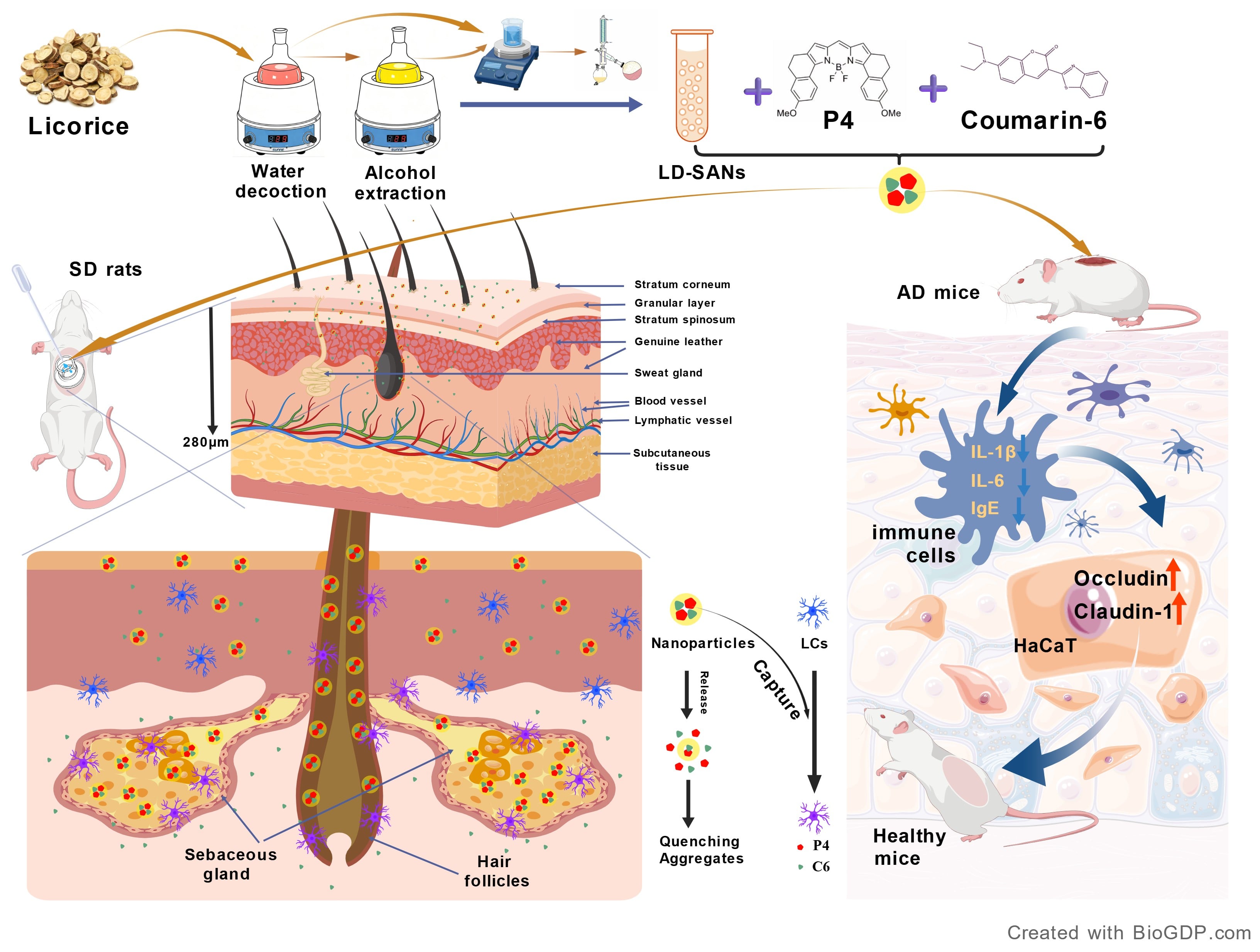
Objective: Self-assembled nanoparticles (SANs) naturally occurring in Traditional Chinese Medicine (TCM) decoctions are promising drug carriers due to their biocompatibility, but uncontrolled assembly often leads to poor stability, limiting transdermal permeability and industrial application. This study aimed to fabricate stable and uniform SANs from licorice by precisely regulating the controlled nanoprecipitation of its water- and alcohol-extracted components. The transdermal delivery efficiency and therapeutic efficacy of the SANs in the treatment of atopic dermatitis (AD) were evaluated. Methods: Licorice self-assembled nanoparticles (LD-SANs) were prepared by mixing water and ethanol extracts of licorice, followed by ethanol evaporation under reduced pressure to trigger nanoprecipitation. In vitro transdermal tests compared the delivery efficiency of six major bioactive compounds between LD-SANs and traditional licorice decoction (LD). The penetration mechanism was investigated via passive diffusion and cellular uptake studies. In an AD mouse model, the therapeutic effects and expression of tight junction (TJ) proteins (Occludin and Claudin-1) were assessed. Results: The average particle size of LD-SANs is 200 nm, and it is uniform and stable. LD-SANs significantly enhanced the delivery efficiency of all six bioactive compounds compared to LD. Mechanistic studies revealed a unique “dual-channel” penetration mechanism: the nanoscale size enabled passive diffusion through hair follicles, intercorneocyte lipid gaps, and skin appendages, while perifollicular antigen-presenting cells (APCs) actively recognized and internalized the nanoparticles, creating a cell-mediated active targeting route that collectively boosted skin accumulation. In the AD model, LD-SANs promoted the expression of Occludin and Claudin-1 in the epidermal granular layer, reinforcing intercellular barrier integrity. Conclusions: By combining “efficient penetration” and “barrier repair”, LD-SANs demonstrated notable therapeutic efficacy in AD. This work transforms a traditional decoction into a well-characterized, high-performance nanomedicine and offers a novel strategy for developing TCM-based transdermal delivery systems.
Keywords: licorice; self-assembled; transdermal delivery; nano-formulation; atopic dermatitis; barrier proteins licorice; self-assembled; transdermal delivery; nano-formulation; atopic dermatitis; barrier proteins
Graphical Abstract