This is an early access version, the complete PDF, HTML, and XML versions will be available soon.
Article

An Interactive Constraint-Based Decision-Support Tool for Pharmaceutical Formulation Development


by
Reihaneh Manteghi
1,2,* and
Eduardo Veas
1,2
1
Institute of Human-Centred Computing, Graz University of Technology, Sandgasse 36, 3rd Floor, 8010 Graz, Austria
2
Know Center Research GmbH, Sandgasse 34, 2nd Floor, 8010 Graz, Austria
*
Author to whom correspondence should be addressed.
Pharmaceutics 2026, 18(6), 635; https://doi.org/10.3390/pharmaceutics18060635

Submission received: 26 March 2026 / Revised: 11 May 2026 / Accepted: 16 May 2026 / Published: 22 May 2026

Abstract

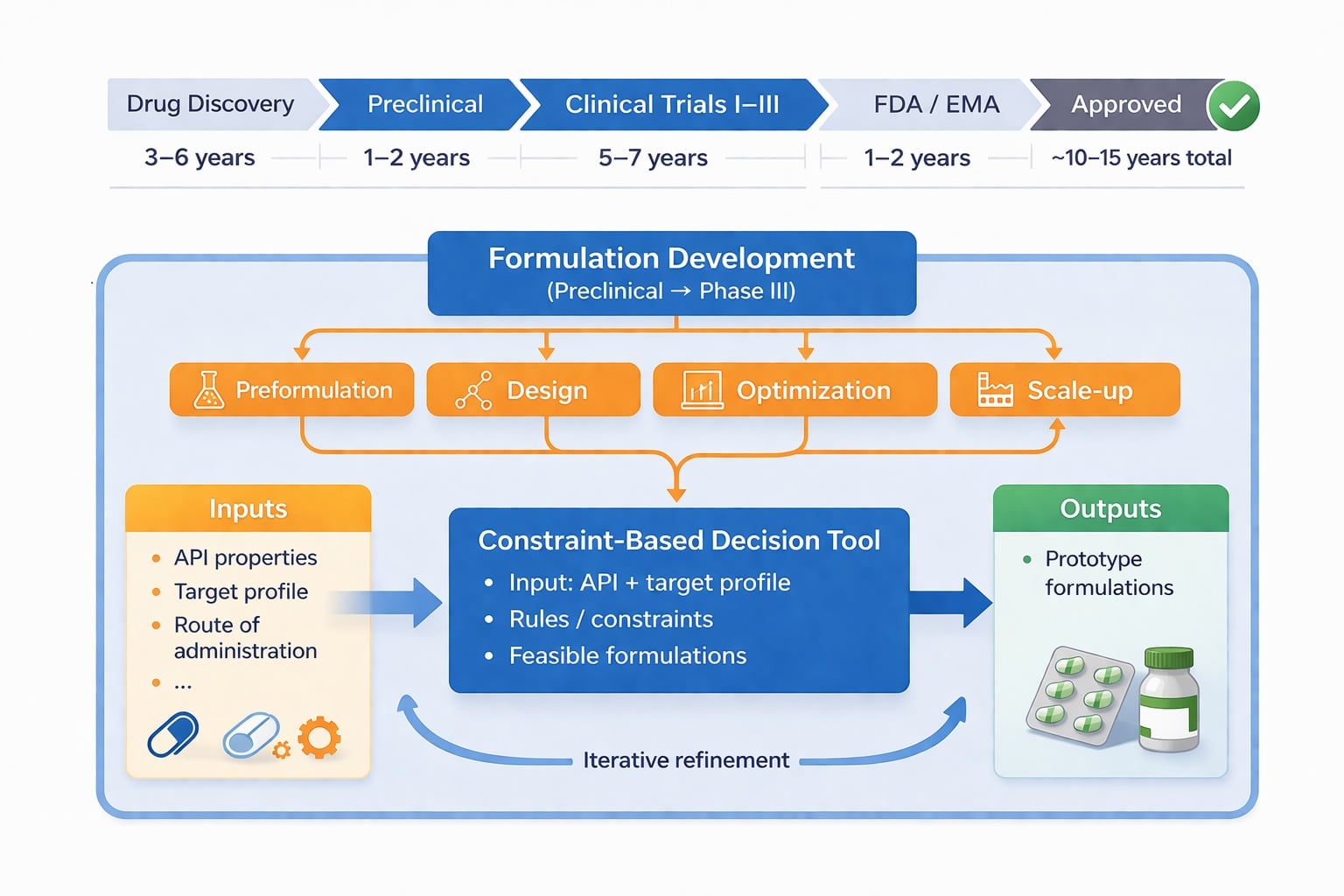
Background/Objectives: Pharmaceutical formulation involves designing a drug product by combining the properties of an active pharmaceutical ingredient (API) with suitable excipients and processing strategies to produce a safe, effective, and manufacturable dosage form. However, data in formulation science are often limited, expensive to generate, and frequently restricted by proprietary and confidentiality constraints. Interactive digital tools can support formulators during early drug product development by improving the structure, transparency, and efficiency of formulation decision-making. While the current system focuses on structured decision support, future extensions may incorporate machine-learning methods for recommendation and knowledge extraction. Methods: In this work, we developed the Formulation tool, an interactive decision-support and visualization system for formulation development based on a hierarchical formulation-strategy framework commonly used in pharmaceutical practice. The tool is designed to prioritize suitable formulation principles and associated processing routes, with oral solid formulation as the initial application domain. The evaluated scenarios also include pathway regions relevant to oral liquid formulations. Its modular architecture also makes it adaptable to other formulation scenarios. To assess practical applicability, the tool was evaluated in a structured expert study involving five expert users across six predefined formulation scenarios (n = 30 runs) , covering three drugs under adult and pediatric conditions. Results: The tool showed agreement with the expected dosage-form families and overall formulation properties, with adult scenarios converging to oral solid regions and pediatric scenarios converging to oral liquid regions. At the downstream formulation-profile level, users converged either to the dominant expected pathway or to alternative feasible pathways within the same formulation region. Variability in full pathway completion was observed and was primarily associated with differences in user interaction behavior and exploratory usage patterns. The median task completion time was 113.5 s. Conclusions: In addition to organizing formulation knowledge, the Formulation tool records user interactions in a structured manner, which may support future learning from usage patterns. Because detailed downstream formulation constraints are often institution-specific and are typically not available in the public domain, the present evaluation focused on agreement at the dosage-form-family level and on overall formulation properties rather than on highly specialized constraint logic. The system is based on a constraint satisfaction problem (CSP) framework, which is well suited for modeling complex decision processes under explicit constraints. CSP has also been widely applied in intelligent scheduling systems, supporting its suitability for structured, constraint-rich decision-making tasks such as pharmaceutical formulation strategy development.
Keywords: pharmaceutical formulation; decision-support systems; constraint satisfaction problem; interactive visualization; data-driven formulation pharmaceutical formulation; decision-support systems; constraint satisfaction problem; interactive visualization; data-driven formulation
Graphical Abstract