Single-Nucleotide Polymorphisms in Capecitabine Bioactivation Genes and Their Contribution to Breast Cancer Therapy
 , ,
, ,  ,
,
Abstract
1. Introduction
2. Materials and Methods
2.1. Study Design and Ethical Considerations
2.2. Study Population
Dosage
2.3. Variables
2.3.1. Outcome Variable
2.3.2. Sociodemographic and Clinical Variables
2.3.3. Genetic Variables
2.4. Statistical Analysis
3. Results
3.1. Sociodemographic and Clinical Characteristics
3.2. Genotype Distribution
3.3. Influence of Sociodemographic and Clinical Characteristics on Progression-Free Survival
3.4. Influence of SNPs Involved in Capecitabine Bioactivation on Progression-Free Survival
4. Discussion
5. Conclusions
Supplementary Materials
Author Contributions
Funding
Institutional Review Board Statement
Informed Consent Statement
Data Availability Statement
Acknowledgments
Conflicts of Interest
Abbreviations
References
- García, A.E.; Pérez, P. Cáncer de Mama Keywords. Rev. La Educ. Super. 2025, 14, 1412–1422. [Google Scholar] [CrossRef]
- Tan, P.H.; Ellis, I.; Allison, K.; Brogi, E.; Fox, S.B.; Lakhani, S.; Lazar, A.J.; Morris, E.A.; Sahin, A.; Salgado, R.; et al. The 2019 World Health Organization Classification of Tumours of the Breast. Histopathology 2020, 77, 181–185. [Google Scholar] [CrossRef]
- Xiong, X.; Zheng, L.W.; Ding, Y.; Chen, Y.F.; Cai, Y.W.; Wang, L.P.; Huang, L.; Liu, C.C.; Shao, Z.M.; Yu, K. Da Breast Cancer: Pathogenesis and Treatments. Signal Transduct. Target. Ther. 2025, 10, 49. [Google Scholar] [CrossRef]
- Daniyal, A.; Santoso, I.; Gunawan, N.H.P.; Barliana, M.I.; Abdulah, R. Genetic Influences in Breast Cancer Drug Resistance. Breast Cancer Targets Ther. 2021, 13, 59–85. [Google Scholar] [CrossRef] [PubMed]
- Dean, L.; Kane, M. Capecitabine Therapy and DPYD Genotype. In Medical Genetics Summaries; Bethesda: Rockville, MD, USA, 2012; pp. 1–17. [Google Scholar]
- Alzahrani, S.M.; Al Doghaither, H.A.; Al-Ghafari, A.B.; Pushparaj, P.N. 5-Fluorouracil and Capecitabine Therapies for the Treatment of Colorectal Cancer (Review). Oncol. Rep. 2023, 50, 175. [Google Scholar] [CrossRef]
- Vanave, A.M. Capecitabine: A Promising Anticancer Drug. J. Pharma Insights Res. 2023, 2, 102–107. [Google Scholar] [CrossRef]
- García-Sancha, N.; Corchado-Cobos, R.; Pérez-Losada, J. Understanding Susceptibility to Breast Cancer: From Risk Factors to Prevention Strategies. Int. J. Mol. Sci. 2025, 26, 2993. [Google Scholar] [CrossRef] [PubMed]
- Lai, E.; Persano, M.; Dubois, M.; Spanu, D.; Donisi, C.; Pozzari, M.; Deias, G.; Saba, G.; Migliari, M.; Liscia, N.; et al. Drug-Related Toxicity in Breast Cancer Patients: A New Path towards Tailored Treatment?—A Narrative Review. Precis. Cancer Med. 2022, 5, 15. [Google Scholar] [CrossRef]
- Lam, S.W.; Guchelaar, H.J.; Boven, E. The Role of Pharmacogenetics in Capecitabine Efficacy and Toxicity. Cancer Treat. Rev. 2016, 50, 9–22. [Google Scholar] [CrossRef] [PubMed]
- Amstutz, U.; Henricks, L.M.; Offer, S.M.; Barbarino, J.; Schellens, J.H.M.; Swen, J.J.; Klein, T.E.; McLeod, H.L.; Caudle, K.E.; Diasio, R.B.; et al. Clinical Pharmacogenetics Implementation Consortium (CPIC) Guideline for Dihydropyrimidine Dehydrogenase Genotype and Fluoropyrimidine Dosing: 2017 Update. Clin. Pharmacol. Ther. 2018, 103, 210–216. [Google Scholar] [CrossRef]
- De Mattia, E.; Milan, N.; Assaraf, Y.G.; Toffoli, G.; Cecchin, E. Clinical Implementation of Rare and Novel DPYD Variants for Personalizing Fluoropyrimidine Treatment: Challenges and Opportunities. Int. J. Biol. Sci. 2024, 20, 3742–3759. [Google Scholar] [CrossRef]
- Alqahtani, S.; Alzaidi, R.; Alsultan, A.; Asiri, A.; Asiri, Y.; Alsaleh, K. Clinical Pharmacokinetics of Capecitabine and Its Metabolites in Colorectal Cancer Patients. Saudi Pharm. J. 2022, 30, 527–531. [Google Scholar] [CrossRef]
- Bai, Y.; Chen, H.; Gu, L.; Shi, B.; Wang, Z.; Duanmu, Y.; Hu, Y.; Wang, Y.; Zhang, C.; Su, Z. Identification of Metabolites Associated with Capecitabine-induced Hand-foot Syndrome Using Untargeted Metabolomics in Patients with Cancer. Mol. Med. Rep. 2025, 32, 203. [Google Scholar] [CrossRef] [PubMed]
- Chan, T.H.; Zhang, J.E.; Pirmohamed, M. DPYD Genetic Polymorphisms in Non-European Patients with Severe Fluoropyrimidine-Related Toxicity: A Systematic Review. Br. J. Cancer 2024, 131, 498–514. [Google Scholar] [CrossRef]
- Sánchez-Bayona, R.; Catalán, C.; Cobos, M.A.; Bergamino, M. Pharmacogenomics in Solid Tumors: A Comprehensive Review of Genetic Variability and Its Clinical Implications. Cancers 2025, 17, 913. [Google Scholar] [CrossRef]
- Zhou, Y.; Lauschke, V.M. Population Pharmacogenomics: An Update on Ethnogeographic Differences and Opportunities for Precision Public Health. Hum. Genet. 2022, 141, 1113–1136. [Google Scholar] [CrossRef]
- De Mattia, E.; Roncato, R.; Fratte, C.D.; Ecca, F.; Toffoli, G.; Cecchin, E. The Use of Pharmacogenetics to Increase the Safety of Colorectal Cancer Patients Treated with Fluoropyrimidines. Cancer Drug Resist. 2019, 2, 116–130. [Google Scholar] [CrossRef]
- Jia, X.; Zhang, T.; Sun, J.; Lin, H.; Bai, T.; Qiao, Y.; Li, Y.; Li, G.; Li, G.; Peng, X.; et al. Rs11479 in Thymidine Phosphorylase Associated with Prognosis of Patients with Colorectal Cancer Who Received Capecitabine-Based Adjuvant Chemotherapy. Pharmgenomics Pers. Med. 2023, 16, 277–289. [Google Scholar] [CrossRef] [PubMed]
- Liu, D.; Li, X.; Li, X.; Zhang, M.; Zhang, J.; Hou, D.; Tong, Z.; Dong, M. CDA and MTHFR Polymorphisms Are Associated with Clinical Outcomes in Gastroenteric Cancer Patients Treated with Capecitabine-Based Chemotherapy. Cancer Chemother. Pharmacol. 2019, 83, 939–949. [Google Scholar] [CrossRef]
- Liu, D.; Li, X.; Li, X.; Wang, H.; Dong, M. Carboxylesterase 1 Polymorphisms Are Associated with Clinical Outcomes in Gastroenteric Cancer Patients Treated with Capecitabine. Cancer Chemother. Pharmacol. 2021, 87, 681–687. [Google Scholar] [CrossRef] [PubMed]
- Purcell, S.; Neale, B.; Todd-Brown, K.; Thomas, L.; Ferreira, M.A.R.; Bender, D.; Maller, J.; Sklar, P.; De Bakker, P.I.W.; Daly, M.J.; et al. PLINK: A Tool Set for Whole-Genome Association and Population-Based Linkage Analyses. Am. J. Hum. Genet. 2007, 81, 559–575. [Google Scholar] [CrossRef] [PubMed]
- Barrett, J.C.; Fry, B.; Maller, J.; Daly, M.J. Haploview: Analysis and Visualization of LD and Haplotype Maps. Bioinformatics 2005, 21, 263–265. [Google Scholar] [CrossRef]
- Lafaye de Micheaux, P.; Drouilhet, R.; Liquet, B. The R Software: Fundamentals of Programming and Statistical Analysis; Springer: Cham, Switzerland, 2013; ISBN 978-1-4614-9019-7. [Google Scholar]
- Wang, D.; Zou, L.; Jin, Q.; Hou, J.; Ge, G.; Yang, L. Human Carboxylesterases: A Comprehensive Review. Acta Pharm. Sin. B 2018, 8, 699–712. [Google Scholar] [CrossRef] [PubMed]
- Wang, X.; Shi, J.; Zhu, H.J. Functional Study of Carboxylesterase 1 Protein Isoforms. Proteomics 2019, 19, 1800288. [Google Scholar] [CrossRef]
- Stoeva, S.; Conev, N.; Marinov, P. The Role of Carboxylesterase Enzymes in Capecitabine Therapy. Scr. Sci. Pharm. 2020, 7, 7. [Google Scholar] [CrossRef]
- Ikonnikova, A.; Rodina, T.; Dmitriev, A.; Melnikov, E.; Kazakov, R.; Nasedkina, T. The Influence of the CES1 Genotype on the Pharmacokinetics of Enalapril in Patients with Arterial Hypertension. J. Pers. Med. 2022, 12, 580. [Google Scholar] [CrossRef]
- Cura, Y.; Sánchez-Martín, A.; Márquez-Pete, N.; González-Flores, E.; Martínez-Martínez, F.; Pérez-Ramírez, C.; Jiménez-Morales, A. Association of Single-Nucleotide Polymorphisms in Capecitabine Bioactivation Pathway with Adjuvant Therapy Safety in Colorectal Cancer Patients. Pharmaceutics 2023, 15, 2548. [Google Scholar] [CrossRef]
- Hamzic, S.; Kummer, D.; Milesi, S.; Mueller, D.; Joerger, M.; Aebi, S.; Amstutz, U.; Largiader, C.R. Novel Genetic Variants in Carboxylesterase 1 Predict Severe Early-Onset Capecitabine-Related Toxicity. Clin. Pharmacol. Ther. 2017, 102, 796–804. [Google Scholar] [CrossRef]
- Frances, A.; Cordelier, P. The Emerging Role of Cytidine Deaminase in Human Diseases: A New Opportunity for Therapy? Mol. Ther. 2020, 28, 357–366. [Google Scholar] [CrossRef]
- Buhagiar-Labarchède, G.; Onclercq-Delic, R.; Vacher, S.; Berger, F.; Bièche, I.; Stoppa-Lyonnet, D.; Amor-Guéret, M. Cytidine Deaminase Activity Increases in the Blood of Breast Cancer Patients. Sci. Rep. 2022, 12, 14062. [Google Scholar] [CrossRef]
- Ligasová, A.; Horejšová, M.; Brumarová, R.; Friedecký, D.; Koberna, K. Cytidine and DCMP Deaminases—Current Methods of Activity Analysis. Int. J. Mol. Sci. 2025, 26, 8045. [Google Scholar] [CrossRef]
- Cohen, R.; Preta, L.H.; Joste, V.; Curis, E.; Huillard, O.; Jouinot, A.; Narjoz, C.; Thomas-Schoemann, A.; Bellesoeur, A.; Tiako Meyo, M.; et al. Determinants of the Interindividual Variability in Serum Cytidine Deaminase Activity of Patients with Solid Tumours. Br. J. Clin. Pharmacol. 2019, 85, 1227–1238. [Google Scholar] [CrossRef] [PubMed]
- Martín, M.; Martínez, N.; Ramos, M.; Calvo, L.; Lluch, A.; Zamora, P.; Muñoz, M.; Carrasco, E.; Caballero, R.; García-Sáenz, J.Á.; et al. Standard Versus Continuous Administration of Capecitabine in Metastatic Breast Cancer (GEICAM/2009-05): A Randomized, Noninferiority Phase II Trial With a Pharmacogenetic Analysis. Oncologist 2015, 20, 111–112. [Google Scholar] [CrossRef] [PubMed]
- Loganayagam, A.; Arenas Hernandez, M.; Corrigan, A.; Fairbanks, L.; Lewis, C.M.; Harper, P.; Maisey, N.; Ross, P.; Sanderson, J.D.; Marinaki, A.M. Pharmacogenetic Variants in the DPYD, TYMS, CDA and MTHFR Genes Are Clinically Significant Predictors of Fluoropyrimidine Toxicity. Br. J. Cancer 2013, 108, 2505–2515. [Google Scholar] [CrossRef] [PubMed]
- Ciccolini, J.; Serdjebi, C.; Peters, G.J.; Giovannetti, E. Pharmacokinetics and Pharmacogenetics of Gemcitabine as a Mainstay in Adult and Pediatric Oncology: An EORTC-PAMM Perspective. Cancer Chemother. Pharmacol. 2016, 78, 1–12. [Google Scholar] [CrossRef]
- Sugiyama, E.; Lee, S.-J.; Lee, S.S.; Kim, W.-Y.; Kim, S.-R.; Tohkin, M.; Ryuichi Hasegawa, H.O.; Awamoto, M.K.; Amatani, N.K.; Awada, J.S.; et al. Ethnic Differences of Two Non-Synonymous Single Nucleotide Polymorphisms in CDA Gene. Drug Metab. Pharmacokinet. 2009, 24, 553–556. [Google Scholar] [CrossRef][Green Version]



| Gene | SNP | Chr | Allele Change | SNP Type | TaqMan® Assay ID |
|---|---|---|---|---|---|
| CDA | rs602950 | 1 | A>G | 2KB upstream variant | - |
| CDA | rs1048977 | 1 | C>T | Synonymous variant | C___7477307_30 |
| CES1 | rs71647871 | 16 | G>A | Missense variant | - |
| TYMP | rs11479 | 22 | C>T | Missense variant | C__11946264_20 |
| Characteristic | N | % | |
|---|---|---|---|
| Sex | Female | 85 | 100 |
| Family history of cancer | Yes | 59 | 69.41 |
| No | 26 | 30.59 | |
| Family history of BC | Yes | 32 | 37.65 |
| No | 53 | 62.35 | |
| Age at BC diagnosis (years) | 50.22 ± 11.93 | ||
| Smoking status | Smoker | 14 | 16.47 |
| Non-smoker | 60 | 70.59 | |
| Former smoker | 11 | 12.94 | |
| Alcohol consumption | Drinker | 0 | 0 |
| Non-drinker | 84 | 98.82 | |
| Former drinker | 1 | 1.18 | |
| Molecular subtype | Luminal A | 15 | 17.65 |
| Luminal B | 35 | 41.18 | |
| HER2+ | 2 | 2.35 | |
| Basal | 24 | 28.23 | |
| Missing | 9 | 10.59 | |
| Histopathology | DCIS | 4 | 4.70 |
| IDC | 59 | 69.41 | |
| ILC | 12 | 14.12 | |
| IC | 5 | 5.88 | |
| MC | 1 | 1.18 | |
| Missing | 4 | 4.71 | |
| Treatment setting | Adjuvant | 13 | 15.29 |
| Non-adjuvant | 68 | 80.00 | |
| Missing | 4 | 4.71 | |
| Treatment line | 1º | 13 | 15.29 |
| 2º | 14 | 16.47 | |
| ≥3º | 58 | 68.24 | |
| Capecitabine dose reduction | Yes | 39 | 45.88 |
| No | 46 | 54.12 | |
| Capecitabine daily dose (mg) | 3300 [3000–3500] | ||
| Progression-Free Survival | |||
|---|---|---|---|
| HR (95%CI) | p-Value | p-BH * | |
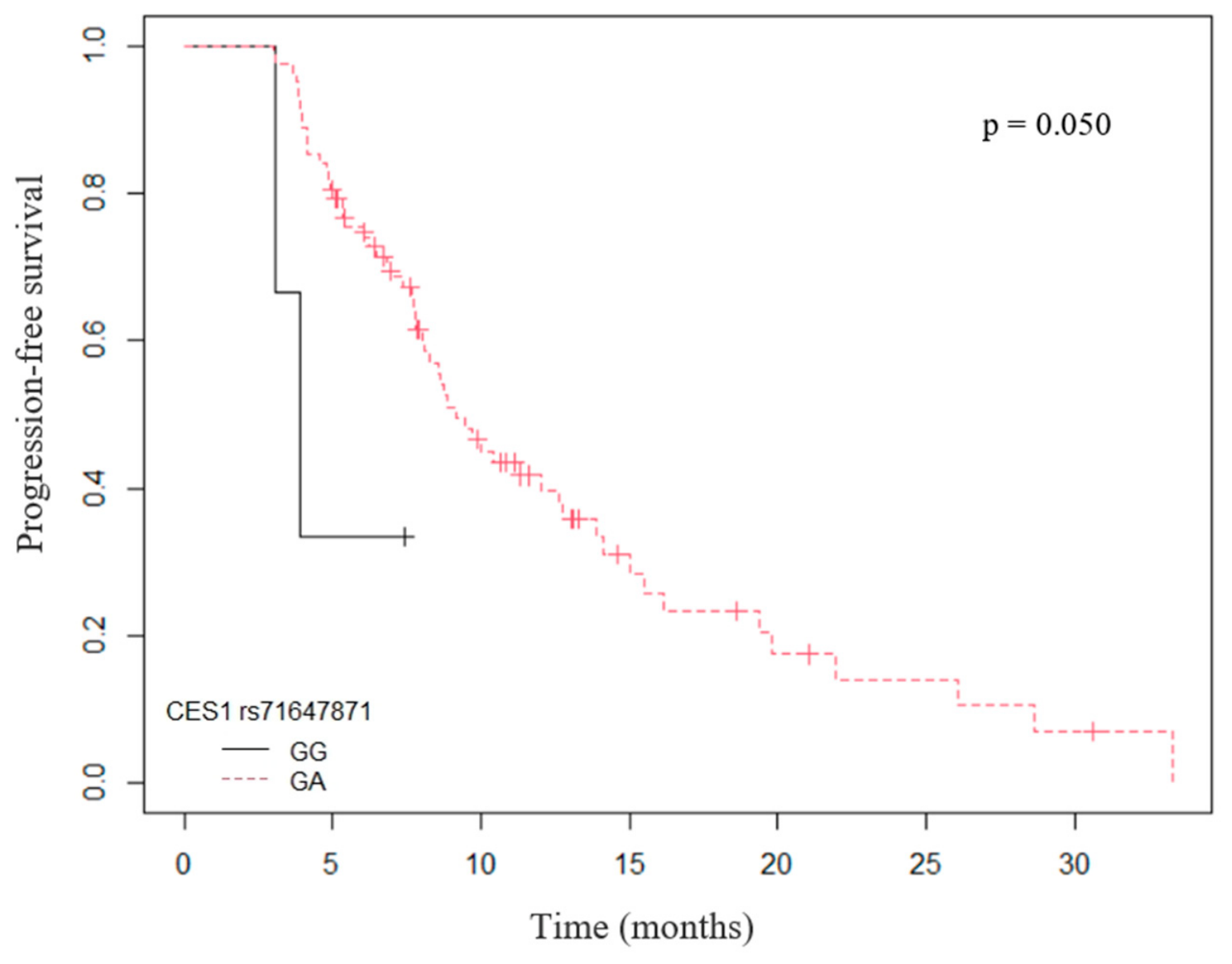
| CES1 rs71647871 (GA) | 7.46 (1.60–34.73) | 0.010 | 0.050 |
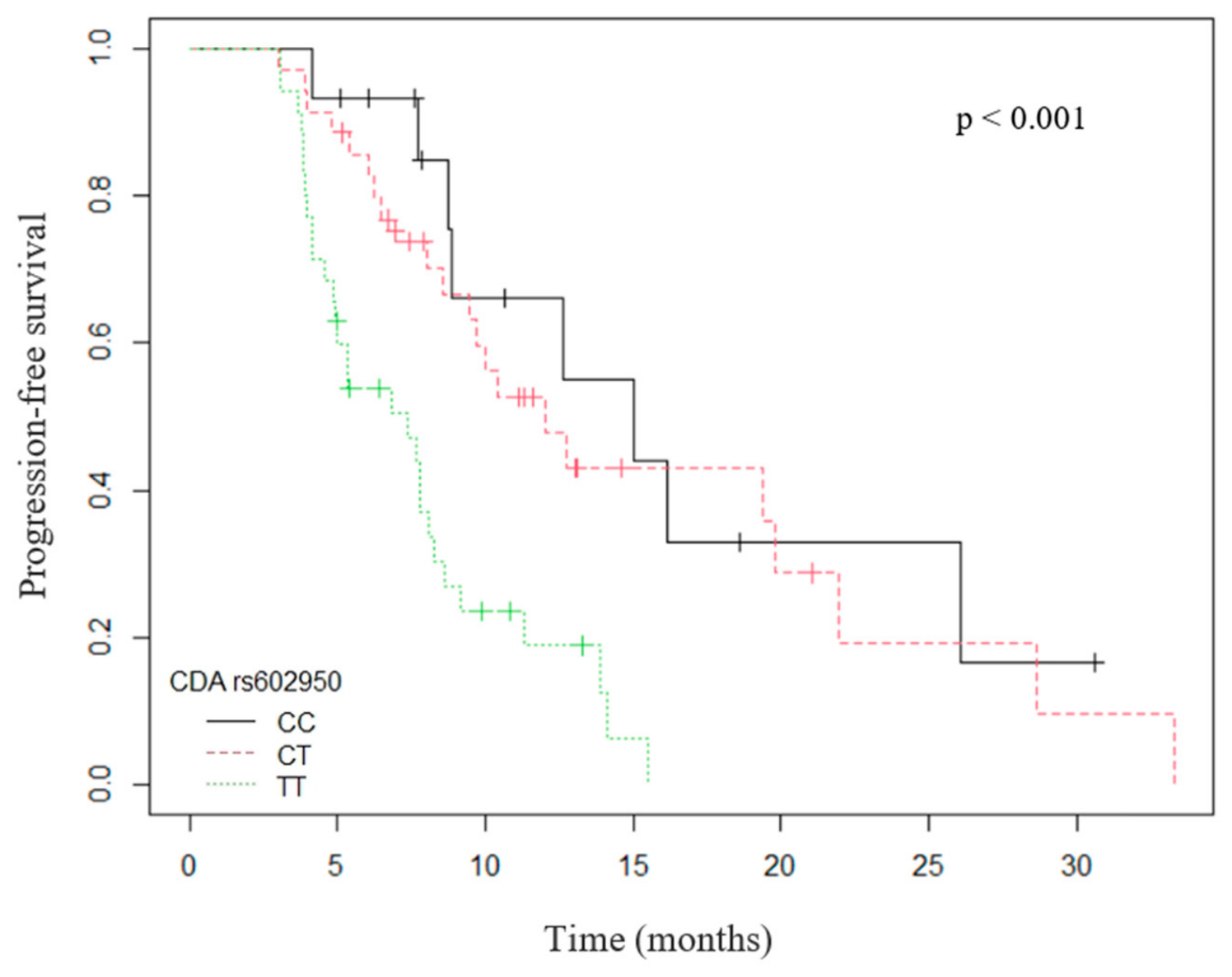
| CDA rs602950 (TT) | 3.50 (1.36–9.03) | 0.009 | 0.025 |
| Model p-value < 0.001 | |||
Disclaimer/Publisher’s Note: The statements, opinions and data contained in all publications are solely those of the individual author(s) and contributor(s) and not of MDPI and/or the editor(s). MDPI and/or the editor(s) disclaim responsibility for any injury to people or property resulting from any ideas, methods, instructions or products referred to in the content. |
© 2026 by the authors. Licensee MDPI, Basel, Switzerland. This article is an open access article distributed under the terms and conditions of the Creative Commons Attribution (CC BY) license.
Share and Cite
Fernández, A.; Cura-Cuevas, Y.; Rojo-Tolosa, S.; Gálvez-Navas, J.M.; González-Flores, E.; Pérez-Ramírez, C.; Jiménez-Morales, A. Single-Nucleotide Polymorphisms in Capecitabine Bioactivation Genes and Their Contribution to Breast Cancer Therapy. Pharmaceutics 2026, 18, 633. https://doi.org/10.3390/pharmaceutics18060633
Fernández A, Cura-Cuevas Y, Rojo-Tolosa S, Gálvez-Navas JM, González-Flores E, Pérez-Ramírez C, Jiménez-Morales A. Single-Nucleotide Polymorphisms in Capecitabine Bioactivation Genes and Their Contribution to Breast Cancer Therapy. Pharmaceutics. 2026; 18(6):633. https://doi.org/10.3390/pharmaceutics18060633
Chicago/Turabian StyleFernández, Andrea, Yasmín Cura-Cuevas, Susana Rojo-Tolosa, José María Gálvez-Navas, Encarnación González-Flores, Cristina Pérez-Ramírez, and Alberto Jiménez-Morales. 2026. "Single-Nucleotide Polymorphisms in Capecitabine Bioactivation Genes and Their Contribution to Breast Cancer Therapy" Pharmaceutics 18, no. 6: 633. https://doi.org/10.3390/pharmaceutics18060633
APA StyleFernández, A., Cura-Cuevas, Y., Rojo-Tolosa, S., Gálvez-Navas, J. M., González-Flores, E., Pérez-Ramírez, C., & Jiménez-Morales, A. (2026). Single-Nucleotide Polymorphisms in Capecitabine Bioactivation Genes and Their Contribution to Breast Cancer Therapy. Pharmaceutics, 18(6), 633. https://doi.org/10.3390/pharmaceutics18060633