This is an early access version, the complete PDF, HTML, and XML versions will be available soon.
Article

Crosslinking-Dependent Design of Hyaluronic Acid Matrices for Enhanced Bioadhesion and Cellular Response

by
Alina Diana Panainte
1,
Cătălina Anișoara Peptu
2,
Andreea Crețeanu
1,*,
Nela Bibire
1,
Isabella Nacu
3,
Liliana Vereștiuc
3,
Eliza Grațiela Popa
1,
Larisa Păduraru
1,
Liliana Mititelu Tartau
4,
Radu Dănilă
4,
Tudor Bibire
4 and
Catalina Natalia Yilmaz
5
1
Faculty of Pharmacy, Grigore T. Popa University of Medicine and Pharmacy Iasi, 16 Universitatii Street, 700116 Iasi, Romania
2
Faculty of Chemical Engineering and Environmental Protection, Gheorghe Asachi Technical University of Iasi, 71 Prof. Dr. Docent Dimitrie Mangeron Street, 700050 Iasi, Romania
3
Faculty of Medical Bioengineering, Grigore T. Popa University of Medicine and Pharmacy, 16 Universitatii Street, 700116 Iasi, Romania
4
Faculty of Medicine, Grigore T. Popa University of Medicine and Pharmacy, 16 Universitatii Street, 700116 Iasi, Romania
5
Faculty of Science, Dokuz Eylül University, Izmir 35390, Turkey
*
Author to whom correspondence should be addressed.
Pharmaceutics 2026, 18(5), 631; https://doi.org/10.3390/pharmaceutics18050631

Submission received: 7 April 2026 / Revised: 9 May 2026 / Accepted: 18 May 2026 / Published: 21 May 2026

Abstract

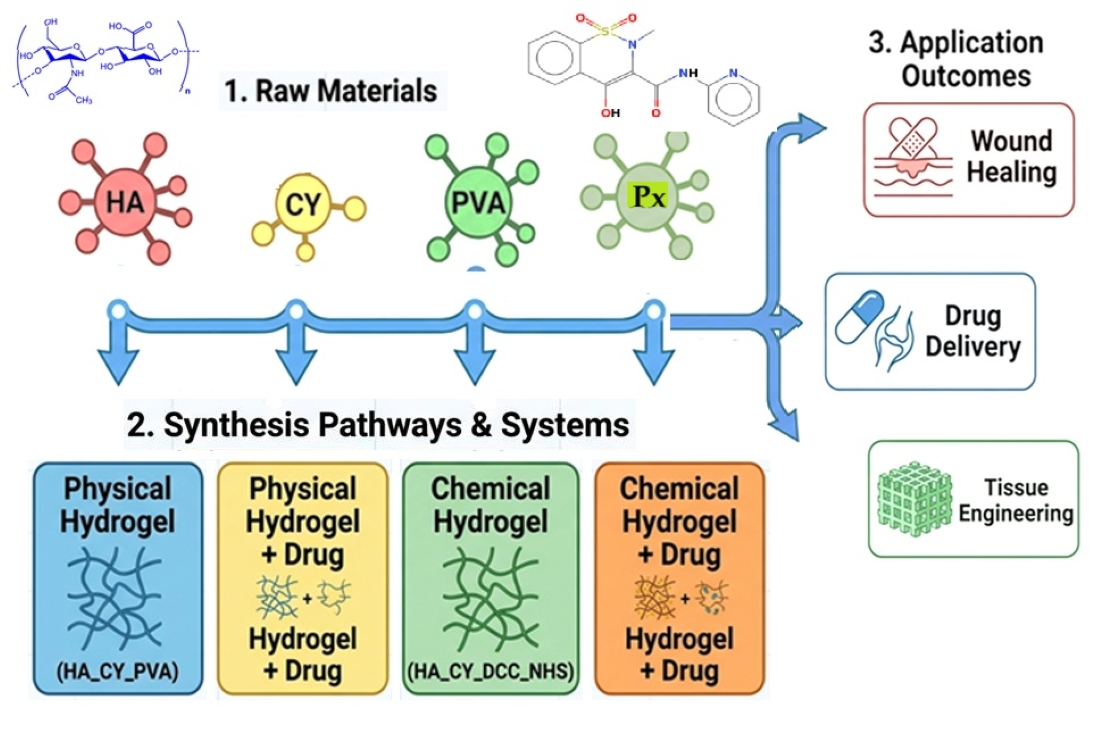
Hyaluronic acid (HA) hydrogels have attracted increasing interest for biomedical applications due to their tunable properties and biocompatibility. Methods: In this study, hyaluronic acid HA-based hydrogels were developed using two distinct crosslinking strategies: physical crosslinking through poly(vinyl alcohol) (PVA) incorporation and covalent crosslinking via DCC/NHS-mediated reactions. Piroxicam (Px) was included as a model drug to evaluate the drug delivery potential of the resulting systems. The hydrogels were characterized in terms of morphology, swelling behaviour, adhesion, enzymatic degradation, drug release, and in vitro cytocompatibility. Results: The results indicate that formulation parameters significantly influence the overall performance of the systems. PVA-containing hydrogels exhibited higher swelling capacity and improved adhesive properties, while covalently crosslinked networks showed reduced swelling and enhanced structural stability and resistance to enzymatic degradation. Drug release profiles were dependent on network structure, with more compact systems displaying slower release behaviour. In vitro assays suggested that the developed hydrogels are cytocompatible and that drug incorporation influences both release kinetics and cellular response. However, it should be noted that the biological evaluation was performed under simplified in vitro conditions, which primarily reflect specific aspects such as cell viability and migration. Conclusions: This study provides a comparative analysis of physical and covalent crosslinking strategies within a HA platform and highlights how formulation variables influence key physicochemical and biological properties. These findings contribute to the rational design of HA-based hydrogels, although further studies are required to establish their performance in more complex biological environments.
Keywords: thiolated hyaluronic acid; hydrogels; polyvinyl alcohol; physical crosslinking; carbodiimide crosslinking; piroxicam; tissue engineering thiolated hyaluronic acid; hydrogels; polyvinyl alcohol; physical crosslinking; carbodiimide crosslinking; piroxicam; tissue engineering
Graphical Abstract