Review

Metal–Organic Framework as Contrast Agents for Magnetic Resonance Imaging

1
School of Pharmacy, Nantong University, Nantong 226001, China
2
Department of Medical Imaging, Affiliated Hospital of Nantong University, Nantong 226001, China
3
Key Laboratory of Mental Health of the Ministry of Education, Guangdong-Hong Kong-Macao Greater Bay Area Center for Brain Science and Brain-Inspired Intelligence, Guangdong-Hong Kong Joint Laboratory for Psychiatric Disorders, Guangdong Province Key Laboratory of Psychiatric Disorders, Guangdong Basic Research Center of Excellence for Integrated Traditional and Western Medicine for Qingzhi Diseases, Department of Neurobiology, School of Basic Medical Sciences, Southern Medical University, Guangzhou 510515, China
*
Authors to whom correspondence should be addressed.
Pharmaceutics 2026, 18(5), 621; https://doi.org/10.3390/pharmaceutics18050621
Submission received: 26 March 2026 / Revised: 12 May 2026 / Accepted: 12 May 2026 / Published: 19 May 2026
(This article belongs to the Section Nanomedicine and Nanotechnology)

Abstract

Metal–organic frameworks (MOFs) possess unique structural tunability, abundant coordination sites, and outstanding biosafety, rendering them highly advantageous for the development of high-performance magnetic resonance imaging (MRI) contrast agents. In light of the significant advancements in MOF-derived theranostic platforms, a comprehensive overview focusing on their classification and clinically oriented applications is urgently required. This review provides an in-depth examination of various categories of MOF-derived contrast agents, including T1, T2, dual-mode, ratiometric and 19F imaging systems, and analyzes the correlation between structural characteristics and imaging performance. Furthermore, it highlights typical MRI-guided therapeutic applications, such as those related to atherosclerosis, bacterial infections, and cancer immunotherapy. The review systematically addresses existing challenges, including issues related to biodegradability, metabolic behavior, and biosafety. It also summarizes the rational design principles for novel MOF contrast agents, aiming to facilitate their transition from fundamental research to clinical applications.

1. Introduction

Molecular imaging technologies have provided important guidance for comprehending disease mechanisms, identifying new pharmacological targets, and evaluating treatment responses [1,2,3]. In clinical practice, computed tomography [4,5,6], magnetic resonance imaging (MRI) [7,8], as well as positron emission tomography [9,10], have become indispensable diagnostic tools in clinical practice. In particular, MRI represents a non-invasive diagnostic tool characterized by excellent soft-tissue contrast, high spatial resolution, non-ionizing nature, and deep tissue penetration capability [11,12]. Since the late 1980s, the use of MRI for quantitative flow imaging has become a standard practice in cardiothoracic and vascular MRI, enabling the assessment of hemodynamic abnormalities in patients with cardiovascular disease [13,14,15]. Despite technological advancements, MRI still lacks sufficient sensitivity for detecting low-abundance biomarkers in pathophysiological lesions [16,17].
To improve imaging effectiveness, contrast agents are commonly utilized to augment the signal contrast between normal tissues and pathological lesions [18,19,20]. Early contrast agents like Gd-DTPA, approved by the US Food and Drug Administration (FDA) in 1988, exhibit extracellular distribution and short rotational correlation times, leading to low relaxivity (r1 = 4.87 mM−1s−1 at 1.5 T) [21,22]. Superparamagnetic iron oxide nanoparticles (SPIONs) gained increasing attention in the 2000s, providing T2-weighted contrast through superparamagnetic relaxation enhancement [23,24]. However, conventional MRI contrast agents, either gadolinium-based chelates or SPIONs, encounter significant limitations. Gadolinium-based chelates pose risks of nephrogenic systemic fibrosis in patients with impaired renal function and potential long-term brain retention [25,26], while SPIONs suffer from low T2-weighted relaxivity, rapid clearance by the reticuloendothelial system (RES), and oxidative stress induced by iron ion leakage [27,28]. MRI contrast agents have evolved toward high sensitivity and specificity, with intelligent response to pathophysiological stimulation to enhance signal-to-noise ratio and improve diagnostic accuracy [29,30,31].
Owing to their tunable size and morphology, easy surface modification, excellent physicochemical performance, and favorable biocompatibility, functional metal–organic framework (MOF) nanomaterials have been extensively applied in the biomedical field [32,33,34]. MOFs, as crystalline porous materials constructed from metal ions/clusters and organic linkers, possess structural advantages that make them ideal candidates for MRI applications [35,36]. Notably, the clearance pathways of MOFs are strongly dependent on their particle size, surface properties, and degradation behaviors [37]. Specifically, MOF nanoparticles with a size of 10–100 nm are mainly cleared by RES, while ultra-small MOF nanoparticles (<10 nm) can be efficiently cleared through renal filtration [38,39]. Surface modification with hydrophilic materials can further reduce RES recognition, prolong their blood circulation time, and optimize tumor accumulation [40]. Compared to clinically approved MRI contrast agents, MOF-based contrast agents generally achieve much higher relaxivity through atomic arrangement of paramagnetic metal ions. As an example, Gd-MOFs synthesized with 1,4-benzenedicarboxylate and 1,2,4-benzenetricarboxylate exhibit an r1 of 83.9 mM−1s−1, approximately 17 times higher than that of commercially available Gd-DTPA [41].
Rational structure design or surface modification endows MOFs with suitable biocompatibility, avoiding premature leakage and ensuring sensitivity towards pathological stimulation [42]. The median lethal dose (LD50) of Gd-based MOFs generally exceeded 1000 mg/kg, which is much higher than the free Gd3+ (100–200 mg/kg) [43,44,45]. Typically, endogenous ligands and nutritional metal ions are considered relatively safe, which renders them preferable for constructing MOF-based MRI contrast agents with suitable biocompatibility [46]. Additionally, MOFs possess inherent stimuli-responsive characteristics that facilitate lesion-specific signal enhancement and improve the signal-to-noise ratio [47]. The T1 relaxivity of Mn(III)-TCPP significantly increases upon glutathione (GSH) stimulation, with r1 values increasing from 2.65 mM−1s−1 to 6.02 mM−1s−1 [48]. To further optimize the performance of MOF-based contrast agents, several strategies can be adopted. First, paramagnetic metal ions can be incorporated into MOFs via ion exchange [49,50] which is particularly useful for inert MOFs with high structural stability, ensuring crystallinity and avoiding metal ion leakage. In addition, MOFs hybridized with multiple metal nodes or post-modification offer multimodal or ratiometric contrast, enabling tailoring of relaxivity for specific imaging applications. For MRI applications, MOFs with modular metal ion incorporation properties allow for dense concentration of paramagnetic metal ions to ensure suitable relaxivity. Surface modification strategies could be optimized to reduce metal ion leakage, clarify biodistribution patterns, and establish standardized long-term toxicity evaluation protocols [51]. Ongoing innovations in green synthesis and surface engineering will further enhance the biosafety, biocompatibility, and stability under physiological conditions [52]. Moreover, establishing standardized long-term toxicity evaluation protocols and clarifying the biodistribution and biodegradation is essential.
Benefiting from their adjustable porosity, excellent metal ion loading performance, and customizable surface properties, MOFs are compelling candidates for theranostic applications combined with high-resolution MRI. Although remarkable advancements have been made in optimizing the structure and enhancing the performance of MOF-derived MRI contrast agents, most current studies focus primarily on material synthesis and preliminary imaging evaluation, without a comprehensive overview covering the rational classification, performance verification, and clinical translation process. In this review, we first clarify the classification of MOF-based contrast agents and highlight representative examples of T1, T2, dual-mode, ratiometric, and 19F MRI systems (Scheme 1). We then summarize state-of-the-art MRI-guided theranostic applications, including atherosclerosis management, antibacterial therapy, and epigenetic MOF-mediated metalloimmunotherapy. Key factors governing imaging performance and therapeutic efficacy are also discussed in depth. Finally, critical challenges toward clinical translation are identified and future perspectives are proposed, with the purpose of providing insightful guidance for practical biomedical applications of advanced MOF-based theranostic nanoplatforms.

2. Classification of MOF-Based Contrast Agents

Paramagnetic or superparamagnetic elements, such as Gd, Mn, and Fe, are the core components determining the imaging performance of MOF-based contrast agents. These metal ions exert their contrast effects by regulating proton relaxation rates, and the type of metal ion incorporated into the MOF directly dictates the MRI weighting mode. Specifically, Mn-MOFs and Gd-MOFs are commonly used for T1-weighted imaging due to their strong paramagnetism, while Fe-MOFs are ideal for T2-weighted imaging owing to their superparamagnetic properties. Detailed information regarding the composition, imaging type, key characteristics, and relaxivity of various MOF nanoformulations employed as MRI contrast agents is provided in Table 1.

2.1. T1 Contrast Agents

Traditional T1-weighted contrast agents mainly comprise paramagnetic metal chelates, which can significantly shorten the T1 relaxation time and achieve efficient contrast enhancement [65,66,67]. MOFs coordinated with paramagnetic metal ions emerged as promising candidates for MRI, owing to their adaptable structures, high relaxivity, and multifunctional capabilities. In comparison to clinically used gadoteridol, host–guest nanoplatformulation of β-cyclodextrin-based MOF demonstrated ~5-fold higher T1 relaxivity along with improved pharmacokinetic profiles [68]. Encapsulating Gd-DTPA within the porous framework of MOF-808 yields an r1 relaxivity of 30.1 mM−1s−1 (0.5 T), 5.4-fold higher than that of commercial Magnevis [69]. Post-synthetic functionalization endows the spn-type MOF high longitudinal relaxivity and allows for monitoring drug release with abundant accessible coordination sites [70]. Of note, the bottom-up assembly controlled by ultrasound produces Co-Mn-TCPP nanosheets with a high r1 relaxivity of 12.05 mM−1s−1, facilitating MRI-guided surgical removal of small tumor lesions [43].
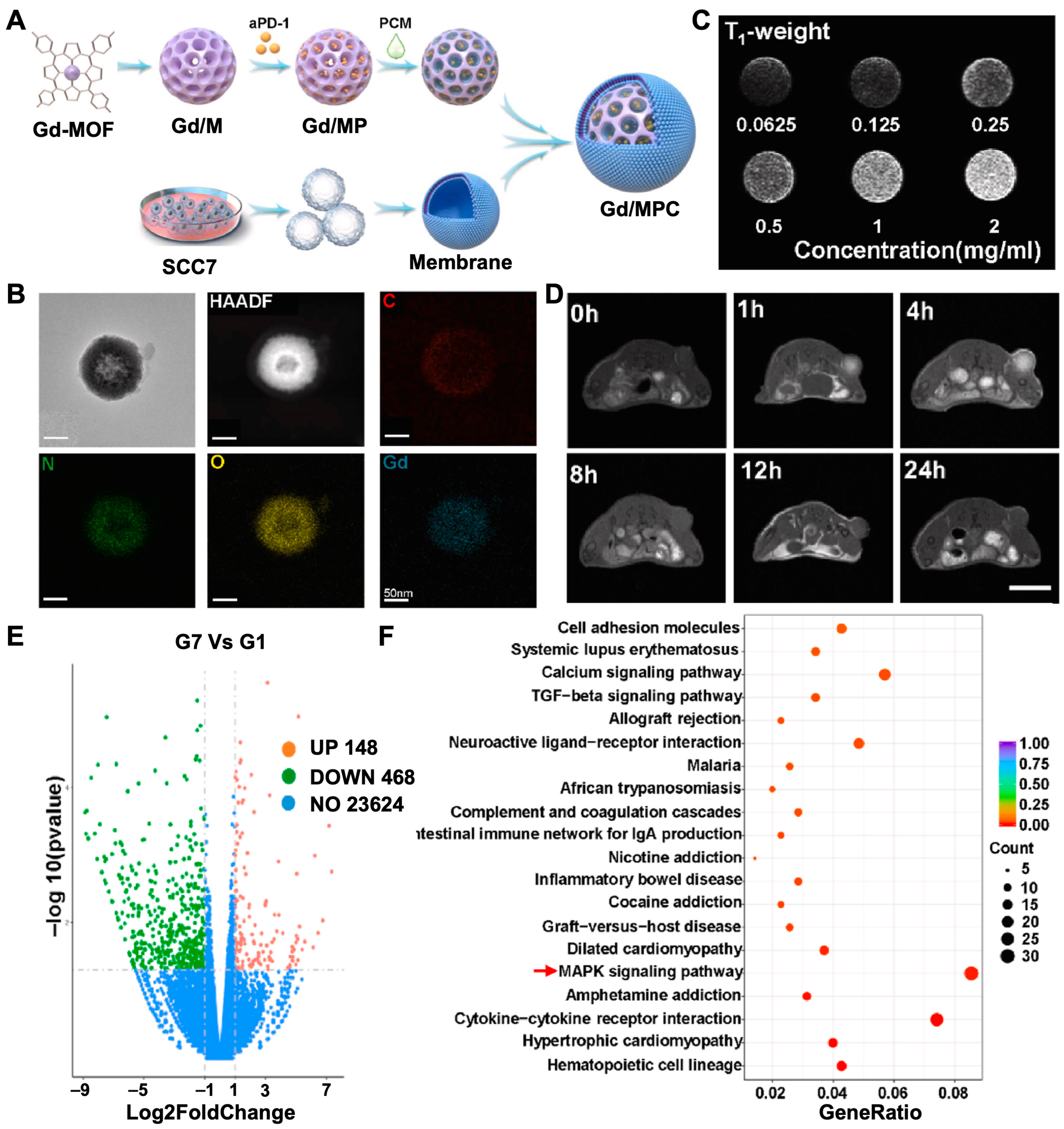
Utilizing paramagnetic metal ions Gd3+ as inorganic construction units, Gd-MOFs hold great potential in increasing the accuracy of cancer treatments guided by T1-weighted MRI [71]. In this regard, cancer cell membrane camouflaged Gd-MOF (Gd/MPC) has been designed and fabricated for MRI-guided microwave (MW) hyperthermia therapy [72]. As depicted in Figure 1A, the pre-synthesized Gd-MOF was sequentially functionalized with anti-PD-1 antibody (αPD-1) and phase change materials (PCMs), then endowed with homologous targeting capability by coating with SCC7 cell membrane. Observed by transmission electron microscopy, the spherical Gd/MPC has an average particle size close to 182 nm, with C, N, O, and Gd uniformly distributed (Figure 1B). In the Gd/MPC nanoplatform, the loading content of αPD-1 was approximately 28.23%, as determined by UV–visible spectroscopy, and the content of 1-tetradecanol, a typical PCM, was calculated to be around 28% via thermogravimetric analysis. For Gd/MPC solutions, the enhancement of T1-weighted MRI signals was closely related to their concentration, showing a clear concentration-dependent pattern (Figure 1C). In C3H tumor-bearing mice, the maximum MRI signal intensity in tumor was found at 4 h following injection, which was in line with the intratumoral Gd3+ content quantified by inductively coupled plasma (Figure 1D). Under microwave exposure at 0.6 W/cm2 for 10 min, the intratumoral temperature rapidly rose to approximately 55 °C following Gd/MPC intravenous administration. Moreover, the synergistic integration of Gd/MPC with microwave hyperthermia and PD-1 blockage can effectively improve the antitumor effect by homologous targeting ability and significantly remodel the immunosuppressive tumor microenvironment. Figure 1E illustrates that 148 genes were up-regulated and 468 genes were down-regulated after Gd/MPC + MW treatment. Treatment with Gd/MPC + MW resulted in a marked downregulation of the MAPK-associated pathway, as evidenced by Kyoto Encyclopedia of Genes and Genomes (KEGGs) analysis, with MSK-2, c-Jun and c-Fos being the key affected molecules (Figure 1F). In addition, Gd/MPC undergoes gradual degradation in the acidic tumor microenvironment, enabling controlled drug release, thus holding great potential as a theranostic nanoplatform for cancer thermal ablation guided by MRI.

2.2. T2 Contrast Agents

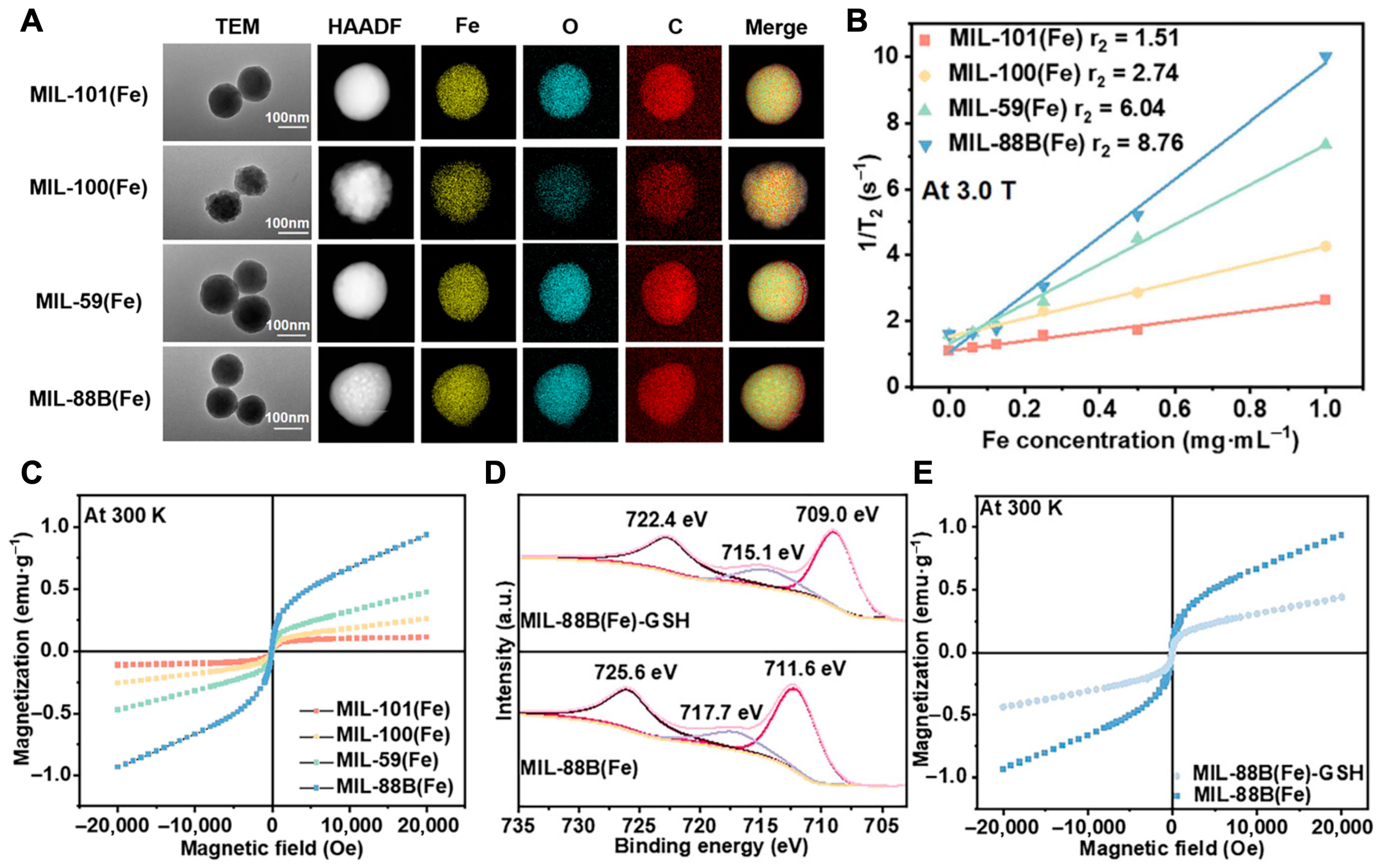
T2 contrast agents provide negative contrast enhancement by shortening transverse relaxation times, which is distinct from T1 contrast agents, thereby leading to signal attenuation in MRI [73]. Owing to this negative contrast characteristic, differentiating such signals from the weak background of adjacent tissues can occasionally be challenging [74]. To gain a clearer insight into the magnetic resonance characteristics, four MOFs topologies were synthesized by using triangular Fe3O clusters as inorganic construction units [75]. As shown in Figure 2A, isotropic spherical nanostructures with an average size of approximately 150 nm were successfully constructed for MIL-88B(Fe), MIL-59(Fe), MIL-100(Fe), and MIL-101(Fe). Among these four Fe-MOFs with diverse topological structures, the Fe3O cluster densities were found to be 1.347, 1.115, 0.7098, and 0.3989 per 1000 Å3, and the T2 relaxivities were determined as 8.76, 6.04, 2.74, and 1.51 mL mg−1 s−1 at 3.0 T magnetic field (Figure 2B). By using the same metal-oxo clusters as magnetic lattices, MIL-88B(Fe) with an acs topological structure displayed the most prominent T2 relaxivity and saturation magnetization (Figure 2C). Moreover, this phenomenon can also be found under high magnetic field strengths or in Ga-doped MOF arrays. Notably, MIL-88B(Fe) exhibits a stable negative contrast effect when exposed to H2O2. Nevertheless, it shows reduced magnetic moments and fewer unpaired electrons under high GSH concentrations. X-ray photoelectron spectroscopy (XPS) verified that the satellite peak located at 715.1 eV corresponds to the generation of Fe(II) species, which arises from the reduction induced by excess GSH (Figure 2D). Meanwhile, magnetic hysteresis measurements verified that such a reduction reaction also leads to a gradual decline in saturation magnetization (Figure 2E). MIL-88B(Fe) is capable of discriminating M1 from M2 macrophages, thereby showing considerable potential for monitoring tumor development.
The unique structural features of Fe-based MOFs deepen the understanding of topology effects in materials of institute lavoisier (MIL) series framework, providing new insights into rational design of high-relaxivity T2 contrast agents. For proof of concept, solvothermally prepared MIL-53(Fe) achieves high T2 relaxivity (r2 = 50 mM−1s−1) and is capable of high dosage of drug loading and pH-sensitive drug release [76]. Moreover, hybridization of MIL-100(Fe) and ultra-small superparamagnetic iron oxide further enhances r2 relaxivity to 93 mM−1s−1 [77]. The variations in structure and performance across different Fe-based MOFs provide important insights for customizing T2 contrast agents applied in biological imaging and therapeutic interventions. Overall, this research deepens the understanding of MOF topological effects, which can be strategically utilized to optimize T2 relaxivity for biological imaging.

2.3. Dual-Mode Contrast Agents

Combining T1 and T2 MRI allows high-resolution tissue visualization and offers complementary diagnostic information [78,79]. Apart from employing paramagnetic metal ions as inorganic building units, organic linkers that integrate Fe3+ into porphyrin-based architectures can endow nanosystems with dual T1-/T2-weighted MRI capability. The optimization of MOF-based contrast agents mainly relies on structural adjustments; as an example, GT-MIL-88A can be engineered into monodisperse nanostructures with excellent MRI performance (r1 = 3.27 mg mL−1·s−1, r2 = 7.13 mg mL−1·s−1) [80]. Bimetallic Gd/FeMOF is endowed with dual-mode MRI capability, enabling imaging guided microwave thermal therapy and immuno-modulation [81].
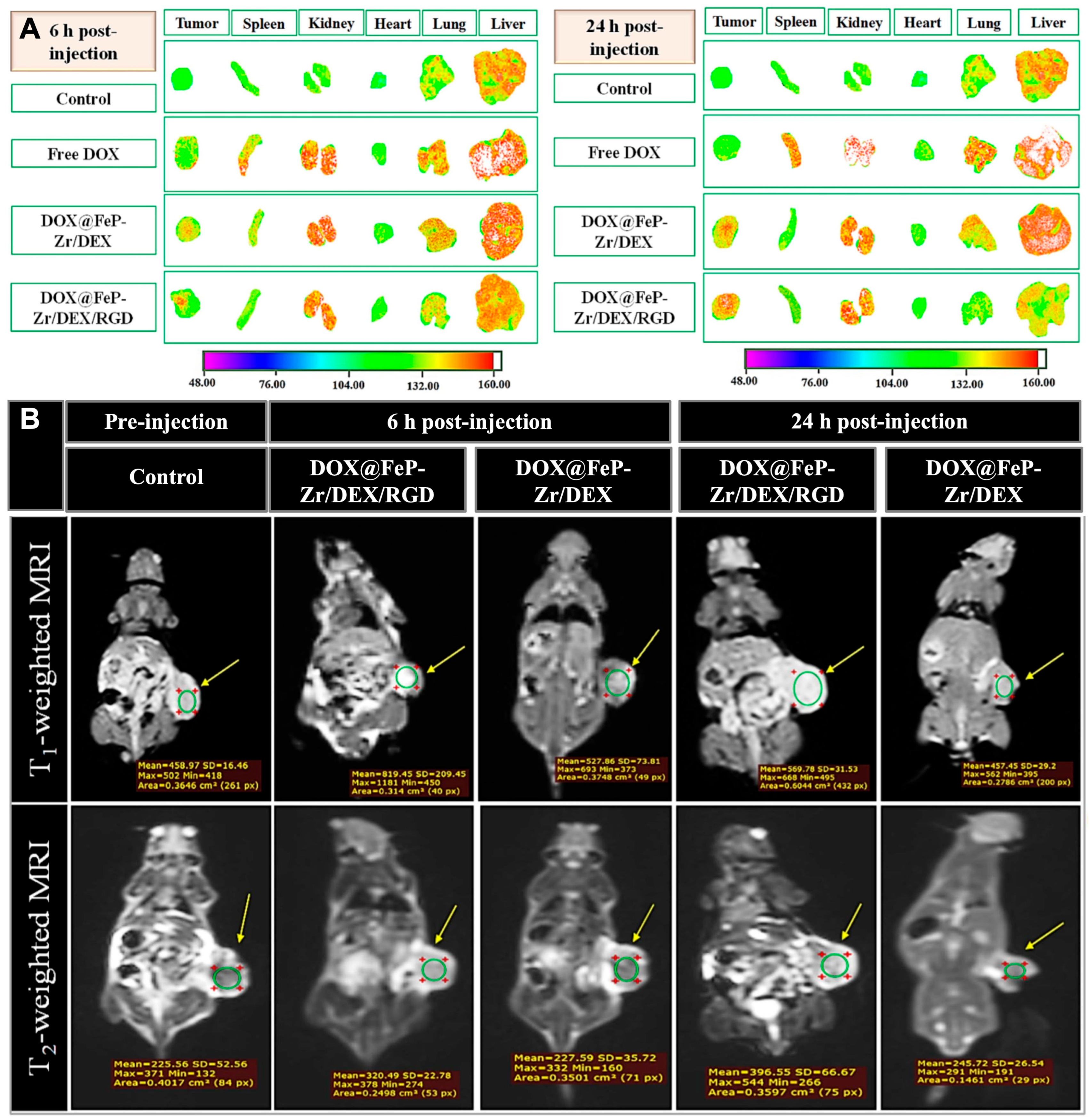
As a paradigm, the Fe-porphyrin-based MOF denoted as FeP-Zr was synthesized via self-assembly employing Zr6 clusters as metallic nodes and tetrakis(4-carboxyphenyl)porphyrin as organic bridging ligands [82]. Then, DOX was encapsulated into FeP-Zr through electrostatic interactions, and the MOF was further surface-functionalized with RGD-dextran to enhance its biocompatibility and biostability, as well as active targeting ability. Compared to free DOX, the MOF-based drug delivery system significantly lowered the mean fluorescence intensity in major organs, whereas targeted modification with RGD further augmented the tumor-specific accumulation of the therapeutic agent (Figure 3A). Also, the content of DOX@FeP-Zr/DEX/RGD distributed in major organs at 24 h post-injection was considerably decreased compared with that in the 6 h group, suggesting gradual renal clearance. Consistent with biodistribution results quantified by fluorescence imaging, T1-/T2-weighted MRI at the tumor sites in B16F10-bearing mice reached a maximum at 24 h post-injection in both active targeting and non-target delivery systems (Figure 3B). In addition, incorporation of Fe3+ into the porphyrin structure has been proven to be beneficial for improving photothermal conversion and photothermal stability. Taken together, the DOX@FeP-Zr/DEX/RGD nanosystem demonstrates desirable targeted delivery, efficient photothermal conversion, and dual-mode MRI capability. The nanosystem with RGD-dextran surface modification achieved 90% tumor eradication when combined with 808 nm laser irradiation, with 4 out of 5 B16F10 tumor-bearing mice achieving complete tumor remission without recurrence, significantly outperforming non-targeted MOFs and free DOX.

2.4. Ratiometric Contrast Agents

Quantitative mapping of magnetic resonance relaxation times represents an advanced imaging approach that utilizes magnetic fields and radiofrequency pulses to enable high-precision visualization of in vivo pathophysiological alterations [83,84]. Ratiometric contrast agents improve detection accuracy by establishing a T1/T2 relaxation signal ratio, thereby normalizing signal intensity and eliminating interference from the pathogenic microenvironment. This strategy mitigates interference from variations in probe concentration, tissue perfusion, and instrument parameters. Additionally, their ratiometric readout enables real-time monitoring of target-specific biological processes and facilitates accurate differentiation between normal and pathological tissues by enhancing the contrast-to-noise ratio, which is crucial for improving the specificity and reliability of in vivo imaging diagnosis.
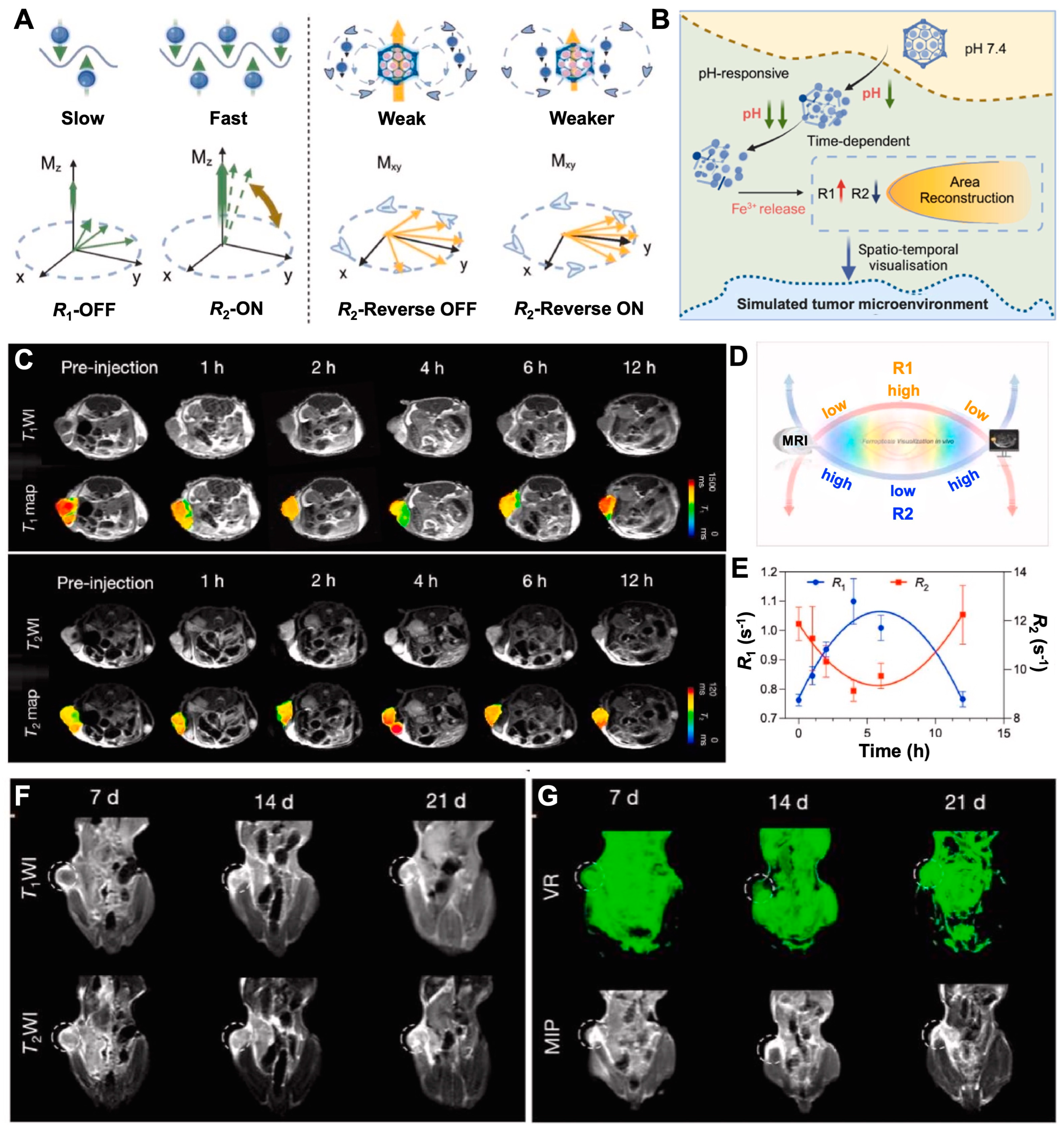
Recently, an Fe-MOF nanoplatform featuring reverse magnetic resonance tuning (ReMRT) performance was constructed to achieve real-time monitoring of ferroptosis-mediated tumor sensitization therapy [85]. Mechanistically, acidic conditions induce the disassembly of the ReMRT nanoprobe, which accelerates T1 relaxation by strengthening proton exchange and spin fluctuations, while simultaneously prolonging the T2 relaxation time (Figure 4A). This pH-responsive behavior synergistically enhances T1 and T2 imaging performance, and the “Area Reconstruction” algorithm further improves the accuracy of imaging evaluation (Figure 4B). According to T1-/T2-weighted images and mapping results, significantly enhanced signals were observed at 4 h post-injection, and then gradually declined due to probe degradation and metabolic clearance (Figure 4C). The use of “Area Reconstruction” method, the crossing points were approximately at 2 h and 10 h, with signal peak at 6 h identified as the optimal window for measuring ferroptosis-related biomarkers (Figure 4D,E). Consistent with MRI observations, the content of iron ions in the tumors was notably elevated at 4 h after injection. After chemo-ferroptosis therapy, Gd-DOTA-enhanced images revealed distinct tumor regression and necrosis at day 21 (Figure 4F,G). Notably, these pH-responsive T1/T2 contrast results highlight the potential of ReMRT nanoparticles to track real-time ferroptosis responses at the molecular scale, and achieve an approximately 95.1-fold higher sensitivity compared with conventional r1/r2 values.

2.5. 19F Contrast Agents

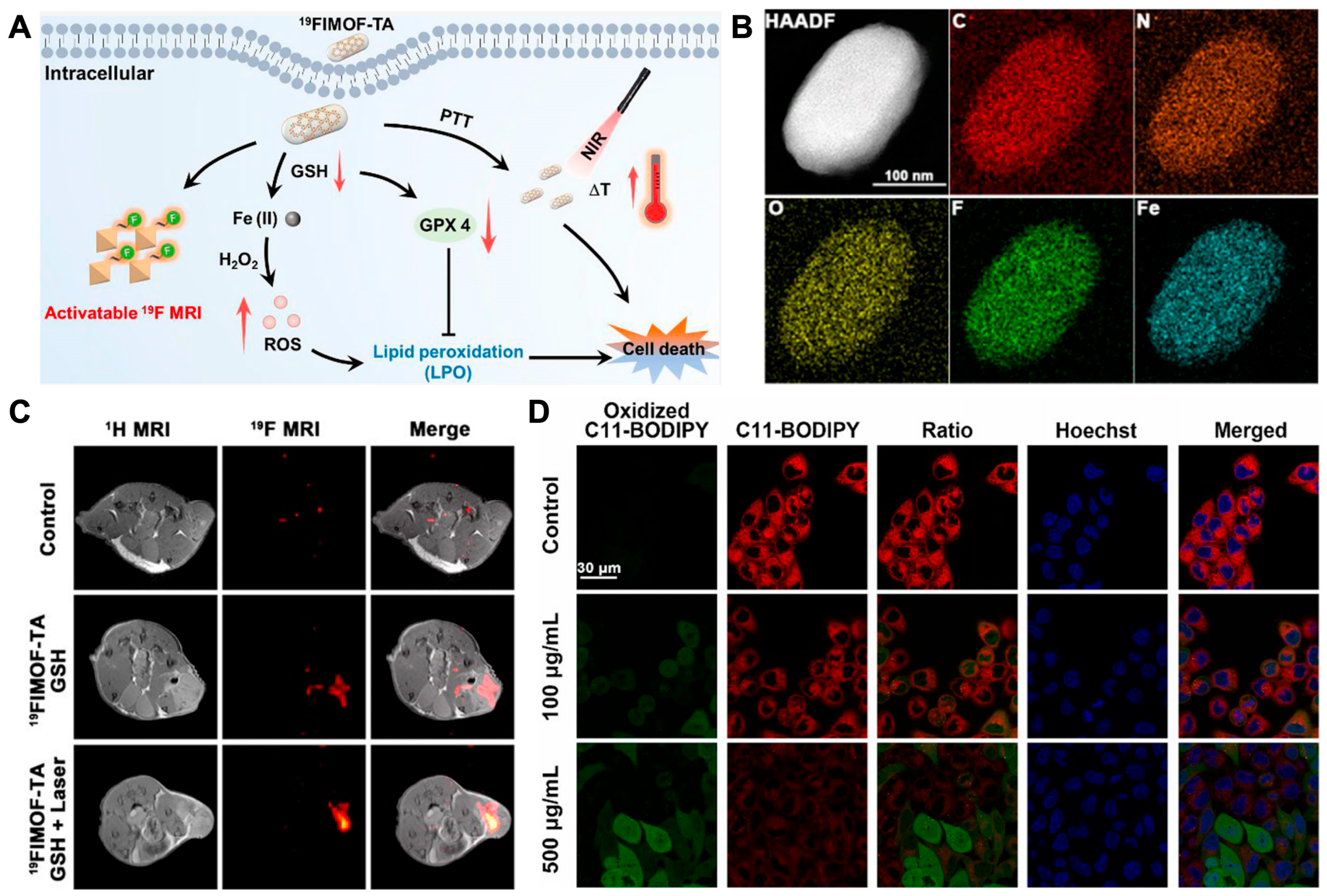
Fluorine-19 MRI is an evolving imaging modality with negligible background interference, which enables non-invasive and longitudinal insights into biological processes [86,87]. The MOF-based contrast agent permits long-term blood circulation and high-sensitive imaging [55]. Moreover, they possess high fluorine loading capacity and superior signal stability, ensuring imaging resolution during long-term monitoring. A tumor microenvironment responsive nanoprobe, 19FIMOF-TA, was rationally constructed using Fe3+ and fluorinated ligands, endowing it with activatable 19F imaging capability and enhanced tumor therapeutic efficacy (Figure 5A) [88]. As shown in Figure 5B, 19FIMOF-TA displays the spheroid shape with consistent dimensions of around 200 nm in length and 150 nm in width. In response to intratumoral GSH, these 19FIMOF-TA nanoparticles release fluorinated ligands and ferrous ions, thereby boosting the Fenton reaction, enhancing 19F MRI signals, and intensifying photothermal conversion efficiency (Figure 5C). Additionally, the ferrous ion supplement also facilitated ferroptosis execution, accompanied by increased cellular reactive oxygen species (ROS), exaggerated lipid peroxidation (LPO), and downregulated glutathione peroxidase 4 (GPX4) (Figure 5D). These findings reveal the great feasibility of the MOF-based 19F nanotheranostic agent integrating imaging diagnosis and therapeutic functions to realize synchronous monitoring and treatment of tumors for improved therapeutic outcomes. Furthermore, the tumor microenvironment-responsive activation feature ensures high specificity for tumor tissues, which reduces off-target effects and enhances safety of cancer therapy.

3. MOF-Based MRI Diagnosis and Atherosclerosis Treatment

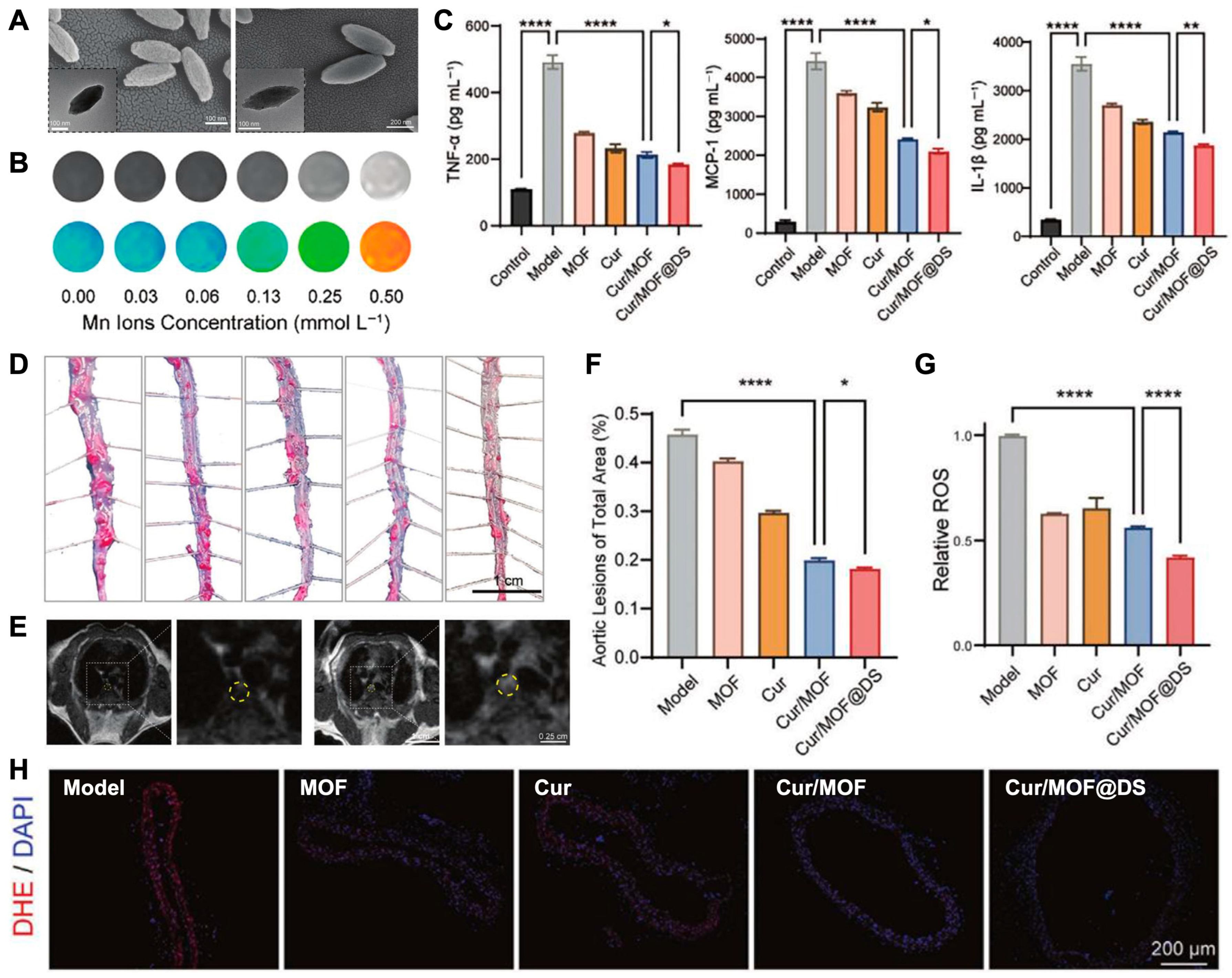
Atherosclerosis, a representative cardiovascular disorder, is mainly driven by oxidized low-density lipoprotein (ox-LDL) accumulation and sustained chronic inflammation [89,90]. Generally, the generation of ox-LDL within the arterial intima is recognized as the primary initiating factor, and subsequent phagocytosis of ox-LDL by macrophages through scavenger receptors further drives the pathological progression of atherosclerosis [91,92]. Curcumin demonstrates potential for atherosclerosis treatment by scavenging free radicals, inhibiting inflammation, and lowering blood lipid levels [93,94,95]. For atherosclerosis treatment, a nanozyme-like MOF equipped with curcumin was developed, enabling enzyme-mimetic catalysis for ROS scavenging and MRI diagnosis of plaque formation [96]. As shown in Figure 6A, PCN-222(Mn) takes on ellipsoidal shape, with dimensions of approximately 240 nm in length and 90 nm in width. Then, curcumin was loaded via pore adsorption and further surface-coated with dextran sulfate (DS) for targeted delivery via overexpressed scavenger receptor. Observed by scanning electron microscopy (SEM) and transmission electron microscopy (TEM), there is no significant change in the morphology and size distribution after post-modification.
As expected, the T1-weighted MRI signal exhibits a positive correlation with the content of paramagnetic manganese ions within the MOF structure (Figure 6B). The longitudinal relaxation rate (r1) of 33.71 mM−1s−1 was calculated, highlighting the significant potential of this material for early detection of atherosclerotic lesions. As shown in Figure 6C, the Cur/MOF@DS treatment markedly decreased the concentrations of atherosclerosis-related proinflammatory cytokines, such as monocyte chemoattractant protein-1 (MCP-1), interleukin-1 beta (IL-1β), and tumor necrosis factor-alpha (TNF-α). Mechanistically, Cur/MOF@DS could affect cholesterol metabolism by activating the LXRα/ABCA1 signaling pathway to increase the expression of cholesterol transporters. Histological staining demonstrated that, in high-fat diet-induced apolipoprotein E-deficient mice, Cur/MOF@DS remarkably decreased atherosclerotic lesion area and lipid content in aortic specimens (Figure 6D,F). Tail-vein injection of the Cur/MOF@DS nanoplatform led to a prominently elevated MRI signal in the aortic region, confirming its efficacy in vascular imaging and atherosclerotic plaque evaluation (Figure 6E). According to dihydroethidium (DHE) staining, the fluorescence signal in aortic tissue was the lowest in the Cur-/MOF@DS-treated group, indicating efficient ROS clearance and favorable anti-atherosclerotic effects mediated by this nanosystem (Figure 6G,H). Of note, Cur/MOF@DS not only exhibits robust therapeutic efficacy against atherosclerotic lesions but also holds great promise for early diagnosis via MRI enhancement in the plaque microenvironment. The Cur/MOF@DS nanoplatform exhibited superior anti-atherosclerotic effects in apolipoprotein E-deficient mice, reducing atherosclerotic lesion area and ROS levels in aortic tissue to a greater extent than non-modified Cur/MOF, while maintaining excellent biosafety.

4. MRI-Guided Antibacterial Treatment

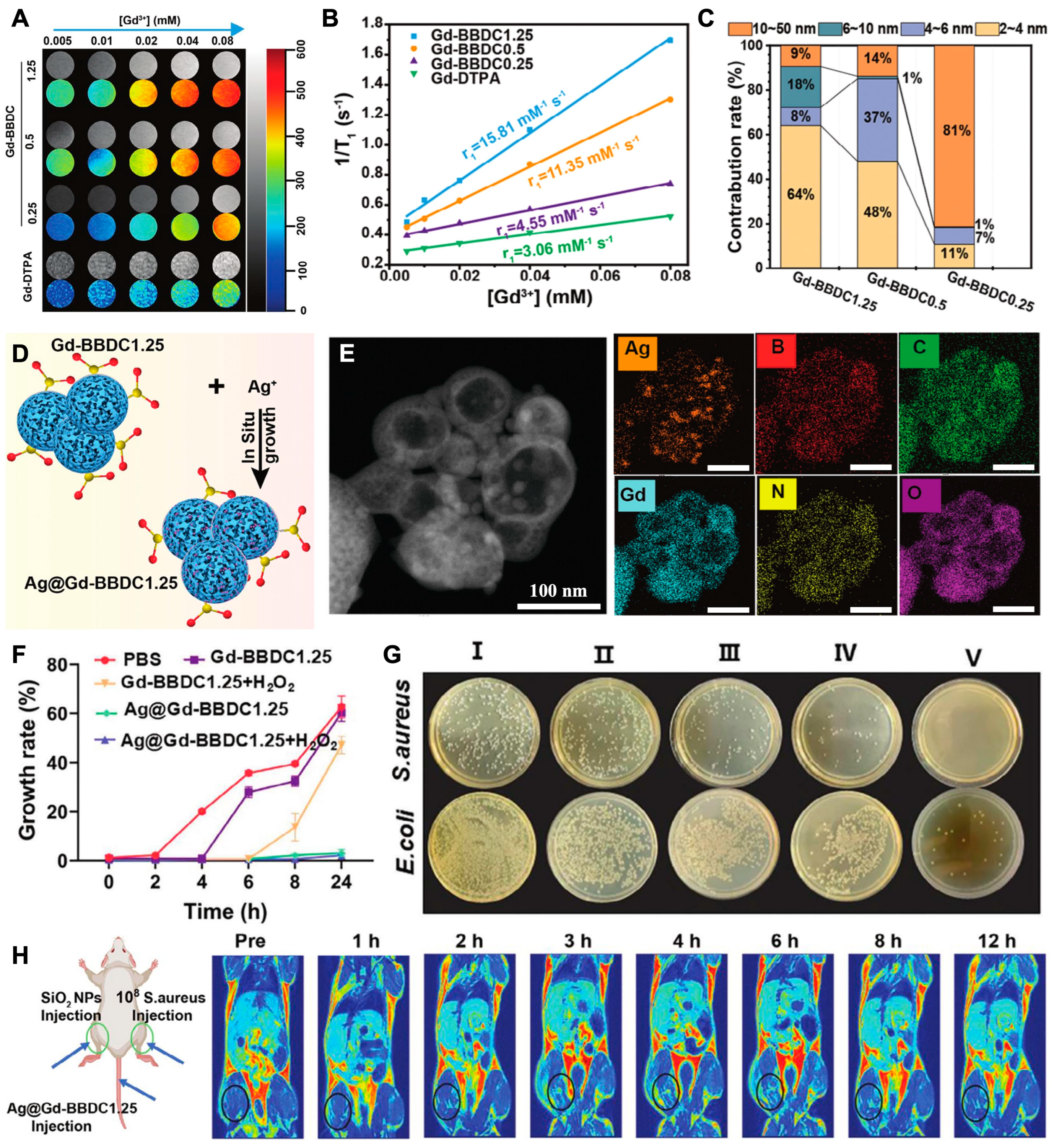
Antibiotic resistance emerging in bacterial pathogens toward traditional antimicrobial agents creates a critical challenge for the management of infectious disorders [97,98,99]. Nanomaterial-based treatments exhibit considerable potential in treating multidrug-resistant bacterial infections, as they can break through biofilm barriers and bypass conventional resistance mechanisms [100,101]. As a paradigm, Gd-MOF functionalized with 1-borono-3,5-benzenedicarboxylic acid (BBDC) as a bacteria-targeting moiety enables simultaneous bacteria-specific MRI diagnosis and in situ antibacterial treatment [102]. The Gd-MOF was synthesized via a one-step solvothermal approach, and the size uniformity and pore distribution were extensively optimized by tuning the Gd3+/BBDC ratio. As shown in Figure 7A, Gd-BBDC1.25 showed significantly stronger T1-weighted MRI contrast when compared to other Gd-MOFs with lower BBDC concentrations. Moreover, the longitudinal r1 monitored at a 1.41 T magnetic field is 5.16-fold that of commercially available Gd-DTPA (Figure 7B). Nitrogen adsorption and molecular dynamics simulations revealed that Gd-MOFs with different ratios of BBDC ligands resulted in differences in pore size distribution (Figure 7C). In comparison, the Gd-BBDC1.25 featuring an increased proportion of 2–4 nm mesopores more strongly restricts water molecule mobility, leading to enhanced longitudinal relaxivity. In situ reduction enabled the successful loading of silver nanoparticles (Ag NPs) into Gd-BBDC1.25, with its uniform particle size (~90 nm) and hierarchical porous structure well-maintained (Figure 7D,E). Impressively, the peroxidase (POD)-like activity of Ag@Gd-BBDC1.25 was notably enhanced, partly attributed to electron transfer across the formed Schottky heterojunctions. In addition, the presence of boronic acid groups from BBDC provides the nanoplatform with bacteria-targeting ability, which promotes the generation of toxic •OH via superior POD-like activity. In the presence of H2O2, Ag@Gd-BBDC1.25 induced a significant reduction in the OD600 value of bacterial suspensions (Figure 7F). The combined administration Ag@Gd-BBDC1.25+ H2O2 inhibited colony formation in both Staphylococcus aureus (S. aureus) and Escherichia coli (E. coli) (Figure 7G). In a myositis model, the signal intensity reached its maximum at 4 h following Ag@Gd-BBDC1.25 injection, indicating the targeted accumulation at infection sites. Of note, the T1-weighted MRI signal exhibited a quantitative correlation with S. aureus, showing a detection limit of approximately 105 cfu. The Ag@Gd-BBDC1.25 demonstrates bacteria-targeting capability and improved catalytic performance, offering a general nanoformulation to overcome antibiotic-resistant bacterial infections via a bacteria-targeted, MRI-guided bactericidal modality.

5. MOF for MRI-Guided Cancer Treatment

MRI has become the cornerstone of modern diagnostic medicine, enabling non-invasive visualization of soft tissues with unparalleled spatial resolution [103]. By providing detailed anatomical and functional information of biological tissues, MRI has revolutionized non-invasive medical diagnostics, with applications in fields such as oncology, neurology, and cardiology [104,105]. MOFs have demonstrated exceptional utility in tumor imaging, leveraging their high relaxivity and capability for targeted delivery (Table 2). Surface modification of MOFs with PEGylation or cell membrane camouflage contributes to increased blood circulation duration and enhanced colloidal stability. In response to tumor acidity, MOF constructed with coordination bonds are prone to dissociation, thereby enhancing relaxivity by releasing paramagnetic ions. However, rapid degradation may induce systemic cytotoxicity or reduce imaging durability, emphasizing the critical requirements for precise structure design.
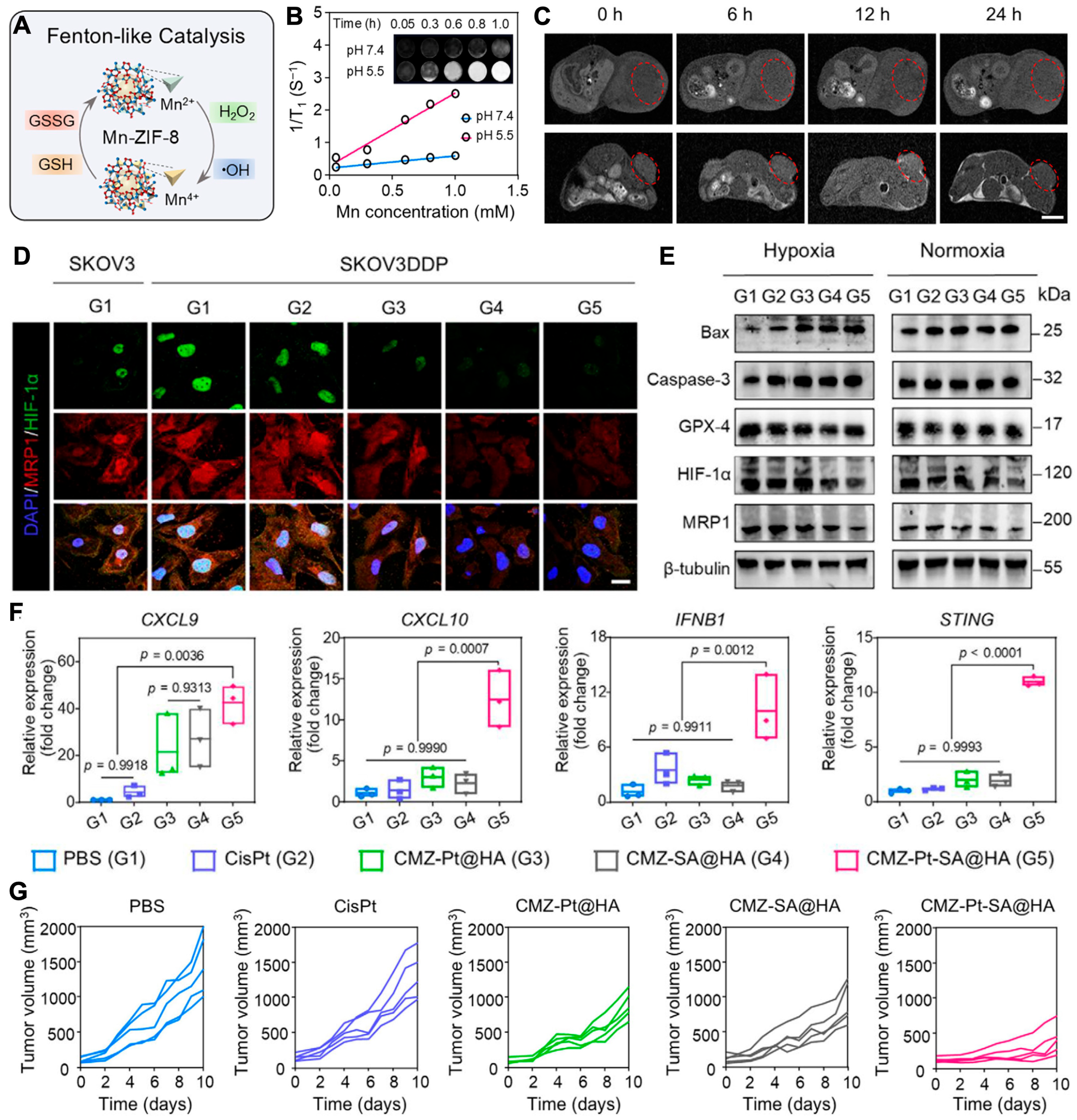
In ovarian cancer, platinum serves as the standard chemotherapy in clinical settings, while acquired resistance persists as a significant therapeutic obstacle, promoting tumor recurrence and negatively impacting patient survival [119,120]. Platinum resistance arises from a diverse array of mechanisms, such as genomic and epigenetic modifications, DNA damage repair pathways, pharmacokinetic variations, metabolic reprogramming, and the tumor microenvironment [121,122]. Epigenetic modulator-mediated TME reprogramming can improve the sensitivity of platinum-resistant ovarian cancer to therapeutic interventions [123,124]. In this regard, MOF nanocomposite (CMZ-Pt-SA@HA) was designed and fabricated, enabling MRI-guided diagnosis and epigenetic regulation of cisplatin-resistant ovarian cancer [125]. As depicted in Figure 8A, the one-pot synthesized bimetallic MOF Mn-ZIF-8 integrates multiple functions, including the oxidation of GSH to oxidized glutathione (GSSG) and the decomposition of H2O2 into cytotoxic •OH. Owing to its pH responsiveness, CMZ-Pt-SA@HA exhibits markedly amplified T1-weighted MRI signals in acidic environments, showing a 4.2-fold enhancement relative to neutral conditions at a Mn2+ concentration of 1 mM (Figure 8B). T1-weighted MRI also revealed intensified signal enhancement in mouse models bearing patient-derived xenografts (Figure 8C). In SKOV3DDP cells, administration of CMZ-Pt-SA@HA resulted in a remarkable reduction in the fluorescence signals of HIF-1α and MRP1 (Figure 8D). Quantitative analysis revealed that fluorescence intensities were decreased by 43.1-fold and 66.5-fold in the CMZ-Pt-SA@HA group compared with the PBS control. Under normoxia as well as hypoxia, CMZ-Pt-SA@HA effectively inhibited the expression of GPX-4, HIF-1α, and MRP1, and promoted the expression of Caspase-3 and Bax (Figure 8E). Mechanistically, CMZ-Pt-SA@HA treatment enhances DNA damage, leading to activation of the stimulator of interferon genes (STING) pathway, accompanied by increased expression levels of IFNB1, CXCL9, CXCL10, and STING (Figure 8F). CMZ-Pt-SA@HA treatment effectively inhibits drug-resistant tumor progression in a highly aggressive patient-derived xenograft mouse model, with 70% of treated mice surviving beyond 30 days (Figure 8G). This MOF-based theranostic system overcomes drug resistance via the synergistic integration of epigenetic modulation, metalloimmunotherapy, and dual-modal NIR FL/MRI, highlighting its potent therapeutic efficacy against platinum-resistant ovarian cancer.

6. Conclusions and Outlook

MOFs represent a transformative and versatile platform for MRI contrast agents, offering unique advantages including modular structural design, superior proton relaxivity, inherent biocompatibility, and integrated theranostic capabilities. These distinctive features enable MOFs to outperform conventional MRI contrast agents, facilitating high-resolution imaging of pathological lesions and synchronous therapeutic interventions in diverse disease models, such as atherosclerosis, antibiotic-resistant bacterial infections, and platinum-resistant ovarian cancer. As summarized in this review, MOF-based contrast agents cover a full spectrum of MRI modalities, including T1, T2, dual-mode, ratiometric, and 19F imaging. Their utilization in MRI-guided theranostics presents exceptional advantages in elevating diagnostic precision and therapeutic outcomes, thereby establishing a robust basis for the development of precision biomedicine.
Despite substantial progress in MOF-based MRI contrast agents, their clinical translation continues to encounter formidable challenges. Key issues involve scalable synthesis with consistent particle size and performance, reproducibility between batches, and rigorous quality control. In addition, compliance with Good Manufacturing Practice (GMP), alongside the cost-effectiveness of raw materials and automated fabrication processes is still challenging. Optimizing continuous flow synthesis technology and intelligent process control may offer opportunities for scalable production of MOFs with uniform particle size, suitable stability, and batch-to-batch reproducibility. The FDA identifies MOFs as class II/III medical devices or drug-device combinations, necessitating extensive physicochemical characterization, biosafety evaluation, and clinical efficacy. The European Medicines Agency (EMA) enforces MDR 2017/745 compliance, emphasizing risk assessment, complete manufacturing documentation, and nanomaterial hazard mitigation. In brief, compliance with pharmacopeia standards calls for stringent oversight of heavy metal residues and endotoxin content, which makes MOF nanoparticulate formulations far from practical application despite remarkably improved imaging sensitivity. These challenges will eventually be addressed through ongoing technological advancements and interdisciplinary cooperation among nanotechnology, materials science, artificial intelligence, and clinical medicine.

Author Contributions

Conceptualization, W.W. and Z.Y.; writing—original draft preparation, W.W.; writing—review and editing, M.Z. and Y.Y.; supervision, M.Z., H.X. and T.L.; funding acquisition, H.X. and T.L. All authors have read and agreed to the published version of the manuscript.

Funding

This work was supported by the Scientific Research Project of Nantong Municipal Health Commission (MS2024013 to T.L.), the National Natural Science Foundation of China (22407058 to H.X.), and the Guangdong Basic and Applied Basic Research Foundation (2023A1515110019, 2025A1515010301 to H.X.), and the Large Instruments Open Foundation of Nantong University (KFJN2649 to W.W.).

Institutional Review Board Statement

Not applicable.

Informed Consent Statement

Not applicable.

Data Availability Statement

No new data were created or analyzed in this study.

Conflicts of Interest

The authors declare no conflicts of interest.

Abbreviations

The following abbreviations are used in this manuscript:
MOFsMetal–organic frameworks
MRIMagnetic resonance imaging
SPIONsSuperparamagnetic iron oxide nanoparticles
DHTP2,5-dihydroxyterephthalic acid
HSAHuman serum albumin
BBBBlood–brain barrier
CDTChemodynamic therapy
CTComputed tomography
FLFluorescence
NIR-IINear-infrared II
NONitric oxide
PAIPhotoacoustic imaging
PDTPhoto-dynamic therapy
PTTPhotothermal therapy
RTRadiation therapy
USUltrasound
SEMScanning electron microscopy
TEMTransmission electron microscopy
Gd/MPCCancer cell membrane camouflaged Gd-MOF
αPD-1Anti-PD-1 antibody
PCMPhase change materials
KEGGsKyoto Encyclopedia of Genes and Genomes
GOGene ontology
GSHGlutathione
ReMRTReverse magnetic resonance tuning
ROSReactive oxygen species
LPOLipid peroxidation
GPX4Glutathione peroxidase 4
ox-LDLOxidized low-density lipoprotein
MCP-1Monocyte chemoattractant protein-1
IL-1βInterleukin-1 beta
TNF-αTumor necro-sis factor-alpha
DHEDihydroethidium
BBDC1-borono-3,5-benzenedicarboxylic acid
Ag NPsSilver nanoparticles
PODPeroxidase
GSSGOxidized glutathione

References

  1. Jiang, D.; Wei, W. Molecular imaging for better theranostics. Eur. J. Nucl. Med. Mol. Imaging 2023, 50, 3799–3801. [Google Scholar] [CrossRef] [PubMed]
  2. Sebastiano, J.; Rodriguez, C.; Samuels, Z.V.; Pepin, K.; Zeglis, B.M. Molecular imaging in gynecology: Beyond cancer. J. Nucl. Med. 2024, 65, 998–1003. [Google Scholar] [CrossRef]
  3. Rowe, S.P.; Pomper, M.G. Molecular imaging in oncology: Current impact and future directions. CA-Cancer J. Clin. 2021, 72, 333–352. [Google Scholar] [CrossRef]
  4. Brendel, J.M.; Mayrhofer, T.; Karády, J.; Kolossváry, M.; Kerkovits, N.M.; Langenbach, I.L.; Jung, M.; Kelsey, M.D.; Langenbach, M.C.; Pagidipati, N.; et al. Risk in women emerges at lower coronary plaque burden than in men: PROMISE trial. Circ. Cardiovasc. Imaging 2026, 19, e019011. [Google Scholar] [CrossRef]
  5. Karády, J.; Mayrhofer, T.; Brendel, J.M.; Kolossváry, M.; Langenbach, M.; Langenbach, I.; Baliyan, V.; Sturniolo, A.K.; Pagidipati, N.; Lu, M.T.; et al. Prognostic value of plaque volume in patients with first diagnosis of coronary artery disease: A substudy of the PROMISE randomized clinical trial. JAMA Cardiol. 2026, 11, 259–267. [Google Scholar] [CrossRef]
  6. Messina, E.; Borrelli, A.; Sciarra, A.; Laschena, L.; Antonini, D.; Shaholli, D.; Magliocca, F.M.; Novelli, S.; Santini, D.; La Torre, G.; et al. Primary noncontrast magnetic resonance imaging for prostate cancer screening: A randomized clinical trial (PROSA). Eur. Urol. 2025, 89, 246–257. [Google Scholar] [CrossRef] [PubMed]
  7. Güder, G.; Reiter, T.; Bauer, W.R.; Papavassiliu, T.; Schwab, J.; Pauschinger, M.; Lavall, D.; Wachter, R.; Berliner, D.; Bauersachs, J.; et al. Cardiac magnetic resonance imaging vs. coronary angiography as primary strategy in newly diagnosed heart failure. JACC Heart Fail. 2025, 13, 102528. [Google Scholar] [CrossRef] [PubMed]
  8. Liu, H.; Shang, X.M.; Zhao, Y.; Cheng, K.; Guo, X.; Xing, N.; Wang, W.; Chen, Y. Safety and efficacy study of 225Ac-DOTA-IBA in the treatment of bone metastases. Clin. Nucl. Med. 2026, 51, 325–331. [Google Scholar] [CrossRef]
  9. Hooker, J.M.; Carson, R.E. Human positron emission tomography neuroimaging. Annu. Rev. Biomed. Eng. 2019, 21, 551–581. [Google Scholar] [CrossRef]
  10. Schwenck, J.; Sonanini, D.; Cotton, J.M.; Rammensee, H.G.; la Fougère, C.; Zender, L.; Pichler, B.J. Advances in PET imaging of cancer. Nat. Rev. Cancer 2023, 23, 474–490. [Google Scholar] [CrossRef]
  11. Du, L.; Roy, S.; Wang, P.; Li, Z.; Qiu, X.; Zhang, Y.; Yuan, J.; Guo, B. Unveiling the future: Advancements in MRI imaging for neurodegenerative disorders. Ageing Res. Rev. 2024, 95, 102230. [Google Scholar] [CrossRef]
  12. Cash, R.F.H.; Cocchi, L.; Lv, J.; Fitzgerald, P.B.; Zalesky, A. Functional magnetic resonance imaging-guided personalization of transcranial magnetic stimulation treatment for depression. JAMA Psychiatry 2020, 78, 337–339. [Google Scholar] [CrossRef]
  13. Moran, P.R. A flow velocity zeugmatographic interlace for NMR imaging in humans. Magn. Reson. Imaging 1982, 1, 197–203. [Google Scholar] [CrossRef] [PubMed]
  14. Friedman, B.J.; Waters, J.; Kwan, O.L.; DeMaria, A.N. Comparison of magnetic resonance imaging and echocardiography in determination of cardiac dimensions in normal subjects. J. Am. Coll. Cardiol. 1985, 5, 1369–1376. [Google Scholar] [CrossRef]
  15. Ning, Y.; Zhou, I.Y.; Caravan, P. Quantitative in vivo molecular MRI. Adv. Mater. 2024, 36, e2407262. [Google Scholar] [CrossRef]
  16. Soulat, G.; McCarthy, P.; Markl, M. 4D Flow with MRI. Annu. Rev. Biomed. Eng. 2020, 22, 103–126. [Google Scholar] [CrossRef]
  17. Thomas, K.E.; Fotaki, A.; Botnar, R.M.; Ferreira, V.M. Imaging methods: Magnetic resonance imaging. Circ. Cardiovasc. Imaging 2023, 16, e014068. [Google Scholar] [CrossRef]
  18. Xiao, Y.-D.; Paudel, R.; Liu, J.; Ma, C.; Zhang, Z.-S.; Zhou, S.-K. MRI contrast agents: Classification and application. Int. J. Mol. Med. 2016, 38, 1319–1326. [Google Scholar] [CrossRef]
  19. Vora, S.; Pafundi, D.; Voss, M.; Buras, M.; Ashman, J.; Bendok, B.R.; Breen, W.; Hu, L.; Kizilbash, S.; Laack, N.; et al. Short-course hypofractionated proton beam therapy, incorporating 18F-DOPA PET and contrast-enhanced MRI targeting, for patients aged 65 years and older with newly diagnosed glioblastoma: A single-arm phase 2 trial. Lancet Oncol. 2024, 25, 1625–1634. [Google Scholar] [CrossRef] [PubMed]
  20. Avasthi, A.; Caro, C.; Pozo-Torres, E.; Leal, M.P.; García-Martín, M.L. Magnetic nanoparticles as MRI contrast agents. In Surface-Modified Nanobiomaterials for Electrochemical and Biomedicine Applications; Topics in Current Chemistry Collections; Springer: Cham, Switzerland, 2020; Volume 378, pp. 49–91. [Google Scholar]
  21. Runge, V.M.; Carollo, B.R.; Wolf, C.R.; Nelson, K.L.; Gelblum, D.Y. Gd DTPA: A review of clinical indications in central nervous system magnetic resonance imaging. Radiographics 1989, 9, 929–958. [Google Scholar] [CrossRef] [PubMed]
  22. Elster, A.D.; Sobol, W.T.; Hinson, W.H. Pseudolayering of Gd-DTPA in the urinary bladder. Radiology 1990, 174, 379–381. [Google Scholar] [CrossRef]
  23. Wang, Y.-X.; Hussain, S.; Krestin, G. Superparamagnetic iron oxide contrast agents: Physicochemical characteristics and applications in MR imaging. Eur. Radiol. 2001, 11, 2319–2331. [Google Scholar] [CrossRef]
  24. D’Arienzo, A.; Scaglione, G.; Vicinanza, G.; Manguso, F.; Bennato, R.; Belfiore, G.; Imbriaco, M.; Mazzacca, G. Magnetic resonance imaging with ferumoxil, a negative superparamagnetic oral contrast agent, in the evaluation of ulcerative colitis. Am. J. Gastroenterol. 2000, 95, 720–724. [Google Scholar] [CrossRef]
  25. Woolen, S.A.; Shankar, P.R.; Gagnier, J.J.; MacEachern, M.P.; Singer, L.; Davenport, M.S. Risk of nephrogenic systemic fibrosis in patients with stage 4 or 5 chronic kidney disease receiving a group II gadolinium-based contrast agent: A systematic review and meta-analysis. JAMA Intern. Med. 2019, 180, 223–230. [Google Scholar] [CrossRef] [PubMed]
  26. Mallepally, A.; Kidd, J.M.; Grizzard, J.D.; Syed, H.J.; Chetla, N.; Carucci, L.R.; Cowper, S.; Trankle, C.R. Nephrogenic systemic fibrosis in patients with advanced renal dysfunction following gadolinium-based contrast agents. Radiology 2025, 317, e251794. [Google Scholar] [CrossRef] [PubMed]
  27. Zhang, J.; Ning, Y.; Zhu, H.; Rotile, N.J.; Wei, H.; Diyabalanage, H.; Hansen, E.C.; Zhou, I.Y.; Barrett, S.C.; Sojoodi, M.; et al. Fast detection of liver fibrosis with collagen-binding single-nanometer iron oxide nanoparticles via T1-weighted MRI. Proc. Natl. Acad. Sci. USA 2023, 120, e2220036120. [Google Scholar] [CrossRef]
  28. Jeong, J.; Kim, S.; Rethinasabapathy, M.; Yang, Y.-J.; Huh, Y.S.; Cho, W.-S. Biotransformation of iron oxide nanoparticles and their impact on biokinetics in rats following intratracheal instillation. J. Hazard. Mater. 2025, 494, 138518. [Google Scholar] [CrossRef]
  29. Saul, P.; Schröder, L.; Schmidt, A.B.; Hövener, J.B. Nanomaterials for hyperpolarized nuclear magnetic resonance and magnetic resonance imaging. Wiley Interdiscip. Rev. Nanomed. Nanobiotechnol. 2023, 15, e1879. [Google Scholar] [CrossRef] [PubMed]
  30. Chang, F.; Davies, G.-L. Convergent evolution: Self-assembly of small molecule, polymeric, and inorganic contrast agents toward advanced MRI. J. Am. Chem. Soc. 2025, 147, 47871–47892. [Google Scholar] [CrossRef]
  31. Fu, S.; Cai, Z.; Ai, H. Stimulus-responsive nanoparticle magnetic resonance imaging contrast agents: Design considerations and applications. Adv. Healthc. Mater. 2020, 10, 5630–5649. [Google Scholar] [CrossRef]
  32. Hefayathullah, M.; Singh, S.; Ganesan, V.; Maduraiveeran, G. Metal-organic frameworks for biomedical applications: A review. Adv. Colloid Interface Sci. 2024, 331, 103210. [Google Scholar] [CrossRef]
  33. Miguel-Casañ, E.; Orton, G.R.F.; Schier, D.E.; Champness, N.R. Supramolecular chemistry in metal-organic framework materials. Adv. Mater. 2025, 37, e2414509. [Google Scholar] [CrossRef] [PubMed]
  34. Zou, Y.; Chen, J.; Qu, Y.; Luo, X.; Wang, W.; Zheng, X. Evolution of nMOFs in photodynamic therapy: From porphyrins to chlorins and bacteriochlorins for better efficacy. Front. Pharmacol. 2025, 16, 1533040. [Google Scholar] [CrossRef] [PubMed]
  35. Hamideh, R.A.; Akbari, B.; Fathi, P.; Misra, S.K.; Sutrisno, A.; Lam, F.; Pan, D. Biodegradable MRI visible drug eluting stent reinforced by metal organic frameworks. Adv. Healthc. Mater. 2020, 9, e2000136. [Google Scholar] [CrossRef]
  36. Bunzen, H.; Jirak, D. Recent advances in metal-organic frameworks for applications in magnetic resonance imaging. ACS Appl. Mater. Interfaces 2022, 14, 50445–50462. [Google Scholar] [CrossRef]
  37. Yang, F.; Dong, J.; Li, Z.; Wang, Z. Metal-organic frameworks (MOF)-assisted sonodynamic therapy in anticancer applications. ACS Nano 2023, 17, 4102–4133. [Google Scholar] [CrossRef] [PubMed]
  38. Hu, J.; Yan, X.; He, J.; Niu, Y.; Zhou, L.; Geng, M.; Jia, T.; Feng, L.; Fu, W.; Hu, S. Metalloporphyrin organic framework oxygen-generators enable tumour-targeted photodynamic therapy and metabolic reprogramming for enhanced glioblastoma treatment. J. Colloid Interface Sci. 2026, 705, 139521. [Google Scholar] [CrossRef]
  39. Wang, H.; Fang, T.; Wang, J.; Zhang, M.; Mu, X.; Gao, T.; Wei, T.; Dai, Z. Adaptive size evolution of an MOFs-in-MOF nanovehicle for enhanced nucleus-targeted tumor chemotherapy. Nano Lett. 2024, 24, 10605–10613. [Google Scholar] [CrossRef]
  40. Jin, W.; Tunca, E.T.; Farfán-Esponda, F.E.; Hosta-Rigau, L. Metal-organic frameworks for the fabrication of hemoglobin-based oxygen carriers: A comprehensive review. Adv. Colloid Interface Sci. 2026, 353, 103857. [Google Scholar] [CrossRef]
  41. Hatakeyama, W.; Sanchez, T.J.; Rowe, M.D.; Serkova, N.J.; Liberatore, M.W.; Boyes, S.G. Synthesis of gadolinium nanoscale metal-organic framework with hydrotropes: Manipulation of particle size and magnetic resonance imaging capability. ACS Appl. Mater. Interfaces 2011, 3, 1502–1510. [Google Scholar] [CrossRef]
  42. Zhang, Q.; Kuang, G.; Wang, H.; Zhao, Y.; Wei, J.; Shang, L. Multi-bioinspired MOF delivery systems from microfluidics for tumor multimodal therapy. Adv. Sci. 2023, 10, e2303818. [Google Scholar] [CrossRef]
  43. He, S.; Wu, L.; Li, X.; Sun, H.; Xiong, T.; Liu, J.; Huang, C.; Xu, H.; Sun, H.; Chen, W.; et al. Metal-organic frameworks for advanced drug delivery. Acta Pharm. Sin. B 2021, 11, 2362–2395. [Google Scholar] [CrossRef]
  44. Penfield, J.G.; Reilly, R.F., Jr. What nephrologists need to know about gadolinium. Nat. Clin. Pract. Nephrol. 2007, 3, 654–668. [Google Scholar] [CrossRef] [PubMed]
  45. Iki, N.; Nakane, R.; Masuya-Suzuki, A.; Ozawa, Y.; Maruoka, T.; Iiyama, M.; Sumiyoshi, A.; Aoki, I. MRI contrasting agent based on Mn-MOF-74 nanoparticles with coordinatively unsaturated sites. Mol. Imaging Biol. 2023, 25, 968–976. [Google Scholar] [CrossRef]
  46. Ge, X.; Wong, R.; Anisa, A.; Ma, S. Recent development of metal-organic framework nanocomposites for biomedical applications. Biomaterials 2022, 281, 121322. [Google Scholar] [CrossRef]
  47. Moharramnejad, M.; Malekshah, R.E.; Ehsani, A.; Gharanli, S.; Shahi, M.; Alvan, S.A.; Salariyeh, Z.; Azadani, M.N.; Haribabu, J.; Basmenj, Z.S.; et al. A review of recent developments of metal-organic frameworks as combined biomedical platforms over the past decade. Adv. Colloid Interface Sci. 2023, 316, 102908. [Google Scholar] [CrossRef] [PubMed]
  48. Wan, S.-S.; Cheng, Q.; Zeng, X.; Zhang, X.-Z. A Mn(III)-sealed metal-organic framework nanosystem for redox-unlocked tumor theranostics. ACS Nano 2019, 13, 6561–6571. [Google Scholar] [CrossRef] [PubMed]
  49. Zhao, B.; Hutereau, M.; Walker, M.; Kashtiban, R.J.; Thompson, P.B.; Slater, B.; Walton, R.I. Modulator control of cation distribution in mixed-metal UiO-66(Zr,Ce) metal-organic frameworks. Chem. Mater. 2025, 37, 9676–9688. [Google Scholar] [CrossRef]
  50. Xu, M.; Chi, B.; Han, Z.; He, Y.; Tian, F.; Xu, Z.; Li, L.; Wang, J. Controllable synthesis of rare earth (Gd(3+),Tm(3+)) doped Prussian blue for multimode imaging guided synergistic treatment. Dalton Trans. 2020, 49, 12327–12337. [Google Scholar] [CrossRef]
  51. Chowdhury, M.A. Metal-organic-frameworks for biomedical applications in drug delivery, and as MRI contrast agents. J. Biomed. Mater. Res. 2016, 105, 1184–1194. [Google Scholar] [CrossRef]
  52. Chan, M.-H.; Zhuang, R.-E.; Wei, D.-H.; Hsiao, M. Biomimetic red blood cell membrane-coated FePt metal-organic framework nanoparticles: A multifunctional theranostic system for enhanced MRI and targeted therapy. Nanoscale 2025, 17, 23343–23353. [Google Scholar] [CrossRef]
  53. Wang, L.; Wu, J.; Ji, R.; Qiang, S.; Shen, Y.; Zuo, Y.; Jian, S.; Liu, S.; Xu, F.; Hu, H.; et al. A spatiotemporally controlled nanoplatform for photothermal BRD4 degradation enables synergistic cancer immunotherapy. Adv. Sci. 2026, 13, e23928. [Google Scholar] [CrossRef]
  54. Bao, J.; Wang, J.; Chen, S.; Liu, S.; Wang, Z.; Zhang, W.; Zhao, C.; Sha, Y.; Yang, X.; Li, Y.; et al. Coordination self-assembled AuTPyP-Cu metal-organic framework nanosheets with pH/ultrasound dual-responsiveness for synergistically triggering cuproptosis-augmented chemotherapy. ACS Nano 2024, 18, 9100–9113. [Google Scholar] [CrossRef]
  55. Wang, Q.; Yu, Y.; Chang, Y.; Xu, X.; Wu, M.; Ediriweera, G.R.; Peng, H.; Zhen, X.; Jiang, X.; Searles, D.J.; et al. Fluoropolymer-MOF hybrids with switchable hydrophilicity for 19F MRI-monitored cancer therapy. ACS Nano 2023, 17, 8483–8498. [Google Scholar] [CrossRef]
  56. Yu, S.; Yu, H.; Si, P.; Wang, Z.; Wang, B.; Lin, W. Preparation of nanoscale cationic metal-organic framework Nano Mn(III)-TP for theranostics based on valence changes. J. Mater. Chem. B 2022, 10, 8988–8995. [Google Scholar] [CrossRef]
  57. Jiang, Q.; Xu, H.; Zhang, W.; Wang, Y.; Xia, J.; Chen, Z. Mn(II)-hemoporfin-based metal-organic frameworks as a theranostic nanoplatform for MRI-guided sonodynamic therapy. Biomater. Sci. 2023, 11, 7838–7844. [Google Scholar] [CrossRef]
  58. Qu, H.; Hang, L.; Diao, Y.; Wang, H.; Fang, L.; Liu, W.; Liu, J.; Sun, H.; Wang, J.; Meng, X.; et al. Mn-doped MOF nanoparticles mitigating hypoxia via in-situ substitution strategy for dual-imaging guided combination treatment of microwave dynamic therapy and chemotherapy. J. Colloid Interface Sci. 2025, 685, 912–926. [Google Scholar] [CrossRef] [PubMed]
  59. Chen, Z.; Sun, Y.; Wang, J.; Zhou, X.; Kong, X.; Meng, J.; Zhang, X. Dual-responsive triple-synergistic Fe-MOF for tumor theranostics. ACS Nano 2023, 17, 9003–9013. [Google Scholar] [CrossRef]
  60. Meng, X.; Zhang, F.; Guo, H.; Zhang, C.; Hu, H.; Wang, W.; Liu, J.; Shuai, X.; Cao, Z. One-pot approach to Fe2+/Fe3+-based MOFs with enhanced catalytic activity for Fenton reaction. Adv. Healthc. Mater. 2021, 10, e2100780. [Google Scholar] [CrossRef] [PubMed]
  61. Mo, G.; Li, X.; Jian, Y.; Xu, W.; Xiao, X.; Chen, A.; Ding, Y.; Jiang, X.; Shen, J.; Fan, L.; et al. Mn(II)-MOF nanoparticles conjugated with EOB-PEG as high-performance hepatobiliary-specific MRI contrast agents. Nanoscale 2025, 17, 5743–5754. [Google Scholar] [CrossRef] [PubMed]
  62. Hadwani, K.; Chaturvedi, S.; Kumaran, S.S.; Kumari, S.; Singh, J.; Ghosh, M.P.; Basu, T. Breaking the gadolinium mold: A metal-organic framework contrast agent for magnetic resonance imaging. ACS Appl. Bio Mater. 2025, 8, 7989–8009. [Google Scholar] [CrossRef] [PubMed]
  63. He, M.; Chen, Y.; Tao, C.; Tian, Q.; An, L.; Lin, J.; Tian, Q.; Yang, H.; Yang, S. Mn-porphyrin-based metal-organic framework with high longitudinal relaxivity for magnetic resonance imaging guidance and oxygen self-supplementing photodynamic therapy. ACS Appl. Mater. Interfaces 2019, 11, 41946–41956. [Google Scholar] [CrossRef] [PubMed]
  64. Lessard, J.M.; Pyle, D.; Bowen, J.; Lin, L.-W.; Musa, E.N.; Gładysiak, A.; Truong, L.; Kolluri, S.K.; Tanguay, R.L.; Wyatt, C.R.; et al. Aqueous-stable Mn(II)-MOF nanoparticles with high r1 relaxivity and biocompatibility: A novel T1 MRI contrast agent. J. Mater. Chem. B 2025, 13, 14837–14846. [Google Scholar] [CrossRef]
  65. Kamaly, N.; Miller, A.D.; Bell, J.D. Chemistry of tumour targeted T1 based MRI contrast agents. Curr. Top. Med. Chem. 2010, 10, 1158–1183. [Google Scholar] [CrossRef] [PubMed]
  66. Lee, S.H.; Kim, B.H.; Na, H.B.; Hyeon, T. Paramagnetic inorganic nanoparticles as T1 MRI contrast agents. Wiley Interdiscip. Rev. Nanomed. Nanobiotechnol. 2013, 6, 196–209. [Google Scholar] [CrossRef]
  67. Chen, S.-H.; Huang, L.-Y.; Huang, B.; Zhang, M.; Li, H.; Pang, D.-W.; Zhang, Z.-L.; Cui, R. Ultrasmall MnSe nanoparticles as T1-MRI contrast agents for in vivo tumor imaging. ACS Appl. Mater. Interfaces 2022, 14, 11167–11176. [Google Scholar] [CrossRef]
  68. Hu, Q.; Zhang, B.; Ren, H.; Zhou, X.; He, C.; Shen, Y.; Zhou, Z.; Hu, H. Supramolecular metal-organic frameworks as host-guest nanoplatforms for versatile and customizable biomedical applications. Acta Biomater. 2023, 168, 617–627. [Google Scholar] [CrossRef]
  69. Jia, M.; Yang, X.; Chen, Y.; He, M.; Zhou, W.; Lin, J.; An, L.; Yang, S. Grafting of Gd-DTPA onto MOF-808 to enhance MRI performance for guiding photothermal therapy. J. Mater. Chem. B 2021, 9, 8631–8638. [Google Scholar] [CrossRef]
  70. Luo, D.; Wu, T.; Qiu, T.; Li, J.; Gong, Y.; Weng, J.; Chen, Z.; Yang, Y.; Yin, B.; Ling, Y.; et al. Coordination-dissociation induced T1-weighted magnetic resonance imaging responses in a spn-type MOF for potential drug release monitoring. Adv. Funct. Mater. 2025, 35, 2425466. [Google Scholar] [CrossRef]
  71. Wu, G.; Feng, J.; Zhou, R.; Fan, Q.; Ren, B.; Huang, Y.; Wang, Z.; Huang, L.; Yang, J.; Zhu, J.; et al. Gadolinium coordination nanoparticle-based contrast agent for T1-weighted magnetic resonance imaging of tumors. Precis. Med. Eng. 2025, 2, 100033. [Google Scholar] [CrossRef]
  72. Cui, H.; Zhao, Y.-Y.; Wu, Q.; You, Y.; Lan, Z.; Zou, K.-L.; Cheng, G.-W.; Chen, H.; Han, Y.-H.; Chen, Y.; et al. Microwave-responsive gadolinium metal-organic frameworks nanosystem for MRI-guided cancer thermotherapy and synergistic immunotherapy. Bioact. Mater. 2024, 33, 532–544. [Google Scholar] [CrossRef]
  73. Shiroishi, M.S.; Castellazzi, G.; Boxerman, J.L.; D’Amore, F.; Essig, M.; Nguyen, T.B.; Provenzale, J.M.; Enterline, D.S.; Anzalone, N.; Dörfler, A.; et al. Principles of T2*-weighted dynamic susceptibility contrast MRI technique in brain tumor imaging. J. Magn. Reson. Imaging 2014, 41, 296–313. [Google Scholar] [CrossRef]
  74. Liu, Y.; Hughes, T.C.; Muir, B.W.; Waddington, L.J.; Gengenbach, T.R.; Easton, C.D.; Hinton, T.M.; Moffat, B.A.; Hao, X.; Qiu, J. Water-dispersible magnetic carbon nanotubes as T2-weighted MRI contrast agents. Biomaterials 2013, 35, 378–386. [Google Scholar] [CrossRef]
  75. Wang, Q.; Gong, Y.; Li, J.; Luo, D.; Zeng, X.; Ling, Y.; Zhou, Y.; Chen, Z. Topology-dependent T2 relaxivity in Fe3O cluster-based MOFs for enhanced tumor monitoring via MRI. J. Mater. Chem. B 2025, 13, 5521–5529. [Google Scholar] [CrossRef]
  76. Zhou, C.; Yang, Q.; Zhou, X.; Jia, N. PDA-coated CPT@MIL-53(Fe)-based theranostic nanoplatform for pH-responsive and MRI-guided chemotherapy. J. Mater. Chem. B 2022, 10, 1821–1832. [Google Scholar] [CrossRef]
  77. Zhao, H.; Sene, S.; Mielcarek, A.M.; Miraux, S.; Menguy, N.; Ihiawakrim, D.; Ersen, O.; Péchoux, C.; Guillou, N.; Scola, J.; et al. Hierarchical superparamagnetic metal–organic framework nanovectors as anti-inflammatory nanomedicines. J. Mater. Chem. B 2023, 11, 3195–3211. [Google Scholar] [CrossRef]
  78. Geraldes, C.F.G.C. Rational design of magnetic nanoparticles as T1-T2 dual-mode MRI contrast agents. Molecules 2024, 29, 1352. [Google Scholar] [CrossRef]
  79. Zhou, T.; Zhang, S.; Zhang, L.; Jiang, T.; Wang, H.; Huang, L.; Wu, H.; Fan, Z.; Jing, S. Redox ferrocenylseleno compounds modulate longitudinal and transverse relaxation times of FNPs-Gd MRI contrast agents for multimodal imaging and photo-Fenton therapy. Acta Biomater. 2023, 164, 496–510. [Google Scholar] [CrossRef]
  80. Zhang, M.; Lu, M.; Qiu, T.; Wang, Q.; Chen, Z.; Deng, M.; Yang, Y.; Yang, Y.; Li, W.; Ling, Y.; et al. Gelothermal synthesis of monodisperse MIL-88A nanoparticles with tunable sizes and metal centers for potential bioapplications. Small 2023, 19, e2301894. [Google Scholar] [CrossRef]
  81. Wang, Q.; Zhu, X.; Meng, X.; Zhong, H. Lenvatinib delivery using a Gd/Fe bimetallic MOF: Enhancing antitumor immunity following microwave-based thermal therapy. Acta Biomater. 2023, 172, 382–394. [Google Scholar] [CrossRef]
  82. Nazari, M.; Ramezani, M.; Eshghi, H.; Nekooei, S.; Saljooghi, A.S.; Alibolandi, M. Synthesis of RGD-dextran-coated Fe-porphyrin-based Zr-MOF for CT/MR imaging and targeted chemo-photothermal therapy of melanoma. Carbohydr. Polym. 2025, 360, 123614. [Google Scholar] [CrossRef]
  83. Alarcón-Fernández, C.; Zaldo, C.; Bañobre-López, M.; Gallo, J.; Ramos-Cabrer, P.; Plaza-García, S.; Villaverde, G.; Ruperti, A.; Cascales, C. Biocompatible NaLn(WO4)2 core-shell nanoplatelets for multimodal MRI contrast, NIR imaging, and high sensitivity infrared luminescent ratiometric thermometry. J. Mater. Chem. B 2025, 13, 9642–9665. [Google Scholar] [CrossRef]
  84. Zhang, C.; Nan, B.; Xu, J.; Yang, T.; Xu, L.; Lu, C.; Zhang, X.-B.; Rao, J.; Song, G. Magnetic-susceptibility-dependent ratiometric probes for enhancing quantitative MRI. Nat. Biomed. Eng. 2024, 9, 671–685. [Google Scholar] [CrossRef]
  85. Zhu, Y.; Deng, J.; Lu, H.; Mei, Z.; Lu, Z.; Guo, J.; Chen, A.; Cao, R.; Ding, X.; Wang, J.; et al. Reverse magnetic resonance tuning nanoplatform with heightened sensitivity for non-invasively multiscale visualizing ferroptosis-based tumor sensitization therapy. Biomaterials 2025, 315, 122935. [Google Scholar] [CrossRef]
  86. Arın, T.A.T.; Sedlacek, O. Stimuli-responsive polymers for advanced 19F magnetic resonance imaging: From chemical design to biomedical applications. Biomacromolecules 2024, 25, 5630–5649. [Google Scholar] [CrossRef]
  87. Han, J.; Duan, Z.; Liu, C.; Liu, Y.; Zhao, X.; Wang, B.; Cao, S.; Wu, D. Hyperbranched polymeric 19F MRI contrast agents with long T2 relaxation time based on β-Cyclodextrin and phosphorycholine. Biomacromolecules 2024, 25, 5860–5872. [Google Scholar] [CrossRef]
  88. Fan, Y.; Chen, D.; Chen, L.; Liu, K.; Zheng, Y.; Li, L.; Li, J.; Lin, H.; Gao, J. Fluorinated iron metal-organic frameworks for activatable 19F magnetic resonance imaging and synergistic therapy of tumors. Nano Lett. 2023, 23, 11989–11998. [Google Scholar] [CrossRef]
  89. Ajoolabady, A.; Pratico, D.; Lin, L.; Mantzoros, C.S.; Bahijri, S.; Tuomilehto, J.; Ren, J. Inflammation in atherosclerosis: Pathophysiology and mechanisms. Cell Death Dis. 2024, 15, 817. [Google Scholar] [CrossRef]
  90. Borén, J.; Packard, C.J.; Binder, C.J. Apolipoprotein B-containing lipoproteins in atherogenesis. Nat. Rev. Cardiol. 2025, 22, 399–413. [Google Scholar] [CrossRef]
  91. Khan, A.W.; Jandeleit-Dahm, K.A. Atherosclerosis in diabetes mellitus: Novel mechanisms and mechanism-based therapeutic approaches. Nat. Rev. Cardiol. 2025, 22, 482–496. [Google Scholar] [CrossRef]
  92. Libby, P. The changing landscape of atherosclerosis. Nature 2021, 592, 524–533. [Google Scholar] [CrossRef] [PubMed]
  93. Yao, H.; Wang, F.; Chong, H.; Wang, J.; Bai, Y.; Du, M.; Yuan, X.; Yang, X.; Wu, M.; Li, Y.; et al. A curcumin-modified coordination polymers with ROS scavenging and macrophage phenotype regulating properties for efficient ulcerative colitis treatment. Adv. Sci. 2023, 10, e2300601. [Google Scholar] [CrossRef]
  94. Fontana, F.; Molinaro, G.; Moroni, S.; Pallozzi, G.; Ferreira, M.P.; Tello, R.P.; Elbadri, K.; Torrieri, G.; Correia, A.; Kemell, M.; et al. Biomimetic platelet-cloaked nanoparticles for the delivery of anti-inflammatory curcumin in the treatment of atherosclerosis. Adv. Healthc. Mater. 2024, 13, e2302074. [Google Scholar] [CrossRef]
  95. Li, X.; Zhu, R.; Jiang, H.; Yin, Q.; Gu, J.; Chen, J.; Ji, X.; Wu, X.; Fu, H.; Wang, H.; et al. Autophagy enhanced by curcumin ameliorates inflammation in atherogenesis via the TFEB-P300-BRD4 axis. Acta Pharm. Sin. B 2022, 12, 2280–2299. [Google Scholar] [CrossRef]
  96. Lv, F.; Fang, H.; Huang, L.; Wang, Q.; Cao, S.; Zhao, W.; Zhou, Z.; Zhou, W.; Wang, X. Curcumin equipped nanozyme-like metal-organic framework platform for the targeted atherosclerosis treatment with lipid regulation and enhanced magnetic resonance imaging capability. Adv. Sci. 2024, 11, e2309062. [Google Scholar] [CrossRef]
  97. Darby, E.M.; Trampari, E.; Siasat, P.; Gaya, M.S.; Alav, I.; Webber, M.A.; Blair, J.M.A. Molecular mechanisms of antibiotic resistance revisited. Nat. Rev. Microbiol. 2022, 21, 280–295. [Google Scholar] [CrossRef]
  98. Qin, S.; Xiao, W.; Zhou, C.; Pu, Q.; Deng, X.; Lan, L.; Liang, H.; Song, X.; Wu, M. Pseudomonas aeruginosa: Pathogenesis, virulence factors, antibiotic resistance, interaction with host, technology advances and emerging therapeutics. Signal Transduct. Target. Ther. 2022, 7, 199. [Google Scholar] [CrossRef] [PubMed]
  99. Abbas, A.; Barkhouse, A.; Hackenberger, D.; Wright, G.D. Antibiotic resistance: A key microbial survival mechanism that threatens public health. Cell Host Microbe 2024, 32, 837–851. [Google Scholar] [CrossRef]
  100. Makabenta, J.M.V.; Nabawy, A.; Li, C.-H.; Schmidt-Malan, S.; Patel, R.; Rotello, V.M. Nanomaterial-based therapeutics for antibiotic-resistant bacterial infections. Nat. Rev. Microbiol. 2020, 19, 23–36. [Google Scholar] [CrossRef]
  101. Zhang, Q.; Zhou, H.; Jiang, P.; Xiao, X. Metal-based nanomaterials as antimicrobial agents: A novel driveway to accelerate the aggravation of antibiotic resistance. J. Hazard. Mater. 2023, 455, 131658. [Google Scholar] [CrossRef] [PubMed]
  102. Yu, Y.; Cui, T.; Liu, C.; Yang, W.; Zhang, B. Tunable hierarchically porous gadolinium-based metal-organic frameworks for bacteria-targeting magnetic resonance imaging and in situ anti-bacterial therapy. Adv. Sci. 2025, 12, e2415209. [Google Scholar] [CrossRef] [PubMed]
  103. Gu, W.; Liu, D.; Wu, Y.; Yang, W.; Yun, Y.; Zhang, B.; Liu, S. Biomimetic catalase-templated nanoprobes for MRI-guided oxygen-supplemented photodynamic therapy in breast cancer. Adv. Healthc. Mater. 2026, 13, e02430. [Google Scholar] [CrossRef] [PubMed]
  104. Lapusan, R.; Balmus, A.; Fechete, R.; Neamtu, B.V.; Ponti, J.; Borlan, R.; Focsan, M. From fundamentals to applications: Magnetic nanoparticles for MRI imaging and NIR-induced thermal activation in tissue-mimicking environments. J. Mater. Chem. B 2025, 13, 12056–12072. [Google Scholar] [CrossRef]
  105. Zhu, L.; Jiang, Y.; Tian, H.; Yu, Y.; Gan, Y.; Li, H.; Yuan, M.; Huang, X.; Liu, X. Recent advancement in MRI-based nanotheranostic agents for tumor diagnosis and therapy integration. Int. J. Nanomed. 2025, 20, 10503–10540. [Google Scholar] [CrossRef]
  106. Han, X.; Chen, J.; Cheng, Z.; Zhou, S. Design of an anti-PD-L1-mediated MOF nanodrug delivery system using terpyridine-metal coordination for tumor theranostics. Chem. Commun. 2025, 61, 1407–1410. [Google Scholar] [CrossRef]
  107. Wang, Y.; Pan, Y.; Sproules, S.; Liu, J.; Forgan, R.S. Multifunctional Fe-doped MOF-808 nanocomposites for chemo/chemodynamic synergistic therapy. Small 2025, 22, e12728. [Google Scholar] [CrossRef]
  108. Zhang, H.; Tian, X.-T.; Shang, Y.; Li, Y.-H.; Yin, X.-B. Theranostic Mn-porphyrin metal-organic frameworks for magnetic resonance imaging-guided nitric oxide and photothermal synergistic therapy. ACS Appl. Mater. Interfaces 2018, 10, 28390–28398. [Google Scholar] [CrossRef]
  109. Shang, W.; Peng, L.; Guo, P.; Hui, H.; Yang, X.; Tian, J. Metal-organic frameworks as a theranostic nanoplatform for combinatorial chemophotothermal therapy adapted to different administration. ACS Biomater. Sci. Eng. 2019, 6, 1008–1016. [Google Scholar] [CrossRef] [PubMed]
  110. Tian, X.-T.; Cao, P.-P.; Zhang, H.; Li, Y.-H.; Yin, X.-B. GSH-activated MRI-guided enhanced photodynamic- and chemo-combination therapy with a MnO2-coated porphyrin metal organic framework. Chem. Commun. 2019, 55, 6241–6244. [Google Scholar] [CrossRef]
  111. He, L.; Ji, Q.; Chi, B.; You, S.; Lu, S.; Yang, T.; Xu, Z.; Wang, Y.; Li, L.; Wang, J. Construction nanoenzymes with elaborately regulated multi-enzymatic activities for photothermal-enhanced catalytic therapy of tumor. Colloids Surf. B Biointerfaces 2023, 222, 113058. [Google Scholar] [CrossRef]
  112. Zhu, Y.; Xin, N.; Qiao, Z.; Chen, S.; Zeng, L.; Zhang, Y.; Wei, D.; Sun, J.; Fan, H. Bioactive MOFs based theranostic agent for highly effective combination of multimodal imaging and chemo-phototherapy. Adv. Healthc. Mater. 2020, 9, e2000205. [Google Scholar] [CrossRef] [PubMed]
  113. Meng, Z.; Huang, H.; Huang, D.; Zhang, F.; Mi, P. Functional metal-organic framework-based nanocarriers for accurate magnetic resonance imaging and effective eradication of breast tumor and lung metastasis. J. Colloid Interface Sci. 2021, 581, 31–43. [Google Scholar] [CrossRef]
  114. Li, Z.; Wang, C.; Chen, J.; Lian, X.; Xiong, C.; Tian, R.; Hu, L.; Xiong, X.; Tian, J. uPAR targeted phototheranostic metal-organic framework nanoprobes for MR/NIR-II imaging-guided therapy and surgical resection of glioblastoma. Mater. Des. 2021, 198, 109386. [Google Scholar] [CrossRef]
  115. Cheng, Y.; Wen, C.; Sun, Y.-Q.; Yu, H.; Yin, X.-B. Mixed-metal MOF-derived hollow porous nanocomposite for trimodality imaging guided reactive oxygen species-augmented synergistic therapy. Adv. Funct. Mater. 2021, 31, e2104378. [Google Scholar] [CrossRef]
  116. Pan, Y.-B.; Wang, S.; He, X.; Tang, W.; Wang, J.; Shao, A.; Zhang, J. A combination of glioma in vivo imaging and in vivo drug delivery by metal-organic framework based composite nanoparticles. J. Mater. Chem. B 2019, 7, 7683–7689. [Google Scholar] [CrossRef] [PubMed]
  117. Bao, J.; Zu, X.; Wang, X.; Li, J.; Fan, D.; Shi, Y.; Xia, Q.; Cheng, J. Multifunctional Hf/Mn-TCPP metal-organic framework nanoparticles for triple-modality imaging-guided PTT/RT synergistic cancer therapy. Int. J. Nanomed. 2020, 15, 7687–7702. [Google Scholar] [CrossRef]
  118. Wang, D.; Zhou, J.; Chen, R.; Shi, R.; Wang, C.; Lu, J.; Zhao, G.; Xia, G.; Zhou, S.; Liu, Z.; et al. Core-shell metal-organic frameworks as Fe2+ suppliers for Fe2+-mediated cancer therapy under multimodality imaging. Chem. Mater. 2017, 29, 3477–3489. [Google Scholar] [CrossRef]
  119. Zhao, Q.; Yao, Y.; Liang, T.; Chen, M.; Zeng, M.; Li, P.; Zhang, S.; Yao, T. Neutrophil extracellular traps enhance platinum resistance in ovarian cancer via SHP-1 activation. Cancer Lett. 2026, 643, 218288. [Google Scholar] [CrossRef]
  120. Lakhani, N.J.; Stewart, D.; Richardson, D.L.; Dockery, L.E.; Van Le, L.; Call, J.; Rangwala, F.; Wang, G.; Ma, B.; Metenou, S.; et al. First-in-human phase I trial of the bispecific CD47 inhibitor and CD40 agonist Fc-fusion protein, SL-172154 in patients with platinum-resistant ovarian cancer. J. Immunother. Cancer 2025, 13, e010565. [Google Scholar] [CrossRef]
  121. Li, H.; Sheng, J.-J.; Zheng, S.-A.; Liu, P.-W.; Wu, N.; Zeng, W.-J.; Li, Y.-H.; Wang, J. Platinum-resistant ovarian cancer: From mechanisms to treatment strategies. Genes Dis. 2025, 13, 101801. [Google Scholar] [CrossRef] [PubMed]
  122. Khan, M.A.; Vikramdeo, K.S.; Sudan, S.K.; Singh, S.; Wilhite, A.; Dasgupta, S.; Rocconi, R.P.; Singh, A.P. Platinum-resistant ovarian cancer: From drug resistance mechanisms to liquid biopsy-based biomarkers for disease management. Semin. Cancer Biol. 2021, 77, 99–109. [Google Scholar] [CrossRef]
  123. Chen, S.; Xie, P.; Cowan, M.; Huang, H.; Cardenas, H.; Keathley, R.; Tanner, E.J.; Fleming, G.F.; Moroney, J.W.; Pant, A.; et al. Epigenetic priming enhances antitumor immunity in platinum-resistant ovarian cancer. J. Clin. Investig. 2022, 132, e158800. [Google Scholar] [CrossRef] [PubMed]
  124. Fang, F.; Cardenas, H.; Huang, H.; Jiang, G.; Perkins, S.M.; Zhang, C.; Keer, H.N.; Liu, Y.; Nephew, K.P.; Matei, D. Genomic and epigenomic signatures in ovarian cancer associated with resensitization to platinum drugs. Cancer Res. 2017, 78, 631–644. [Google Scholar] [CrossRef] [PubMed]
  125. Lin, L.; Zhang, Q.; Liu, X.; Yang, S.; Fang, F.; Zhang, X.; Yang, Y.; Zhang, W.; Zhang, B.; Zhao, Z.; et al. Epigenetic metal-organic framework nanoagonist overcomes triple defenses to enable effective chemo-metalloimmunotherapy in platinum-resistant ovarian cancer. Adv. Mater. 2026, 38, e17286. [Google Scholar] [CrossRef] [PubMed]
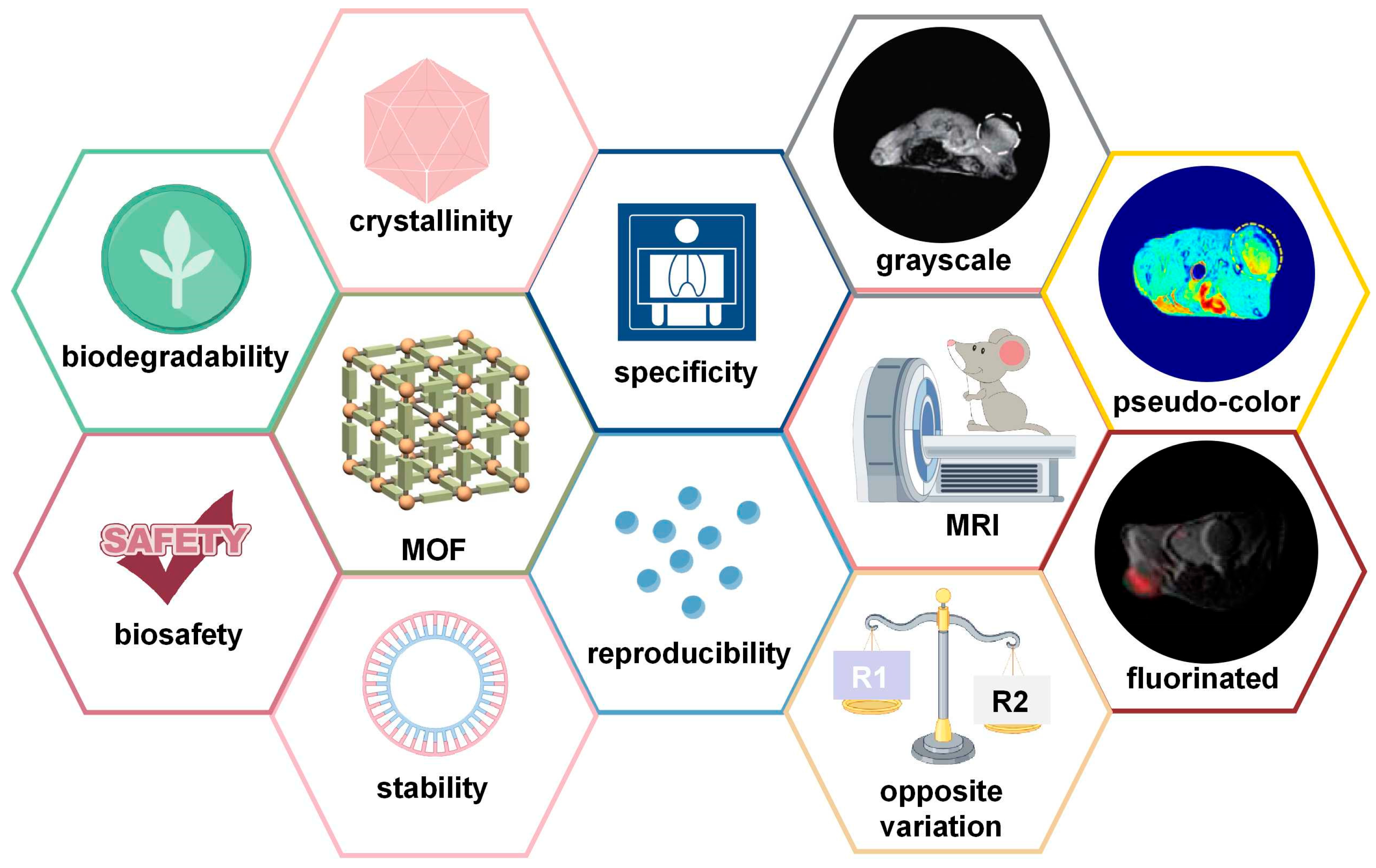
Scheme 1. Schematic overview of MOF-based MRI contrast agents for theranostic applications. The diagram highlights core material properties (crystallinity, stability, biodegradability, and biosafety) and diverse imaging modalities (grayscale, pseudo-color, fluorinated, and dual-mode ratiometric contrast). Specificity and reproducibility are depicted as central links connecting MOF structural design to imaging performance, reflecting the structure–function correlation in these theranostic systems. Reproduced from [53]. Copyright 2026 Wiley-VCH GmbH; reproduced from [54]. Copyright 2024 ACS publication; reproduced from [55]. Copyright 2023 ACS publication.
Pharmaceutics 18 00621 sch001
Figure 1. (A) Schematic overview of the fabrication strategy for Gd/MPC; (B) morphological features and elemental mapping characterization of Gd/MPC; (C) concentration-dependent T1-weighted MRI images in vitro; (D) T1-weighted MRI of tumor-bearing mice prior to and following Gd/MPC administration, scale bar: 1 cm; (E) volcano map and (F) KEGG analysis of Gd/MPC relative pathways (red arrows). Reproduced from ref. [72]. Copyright 2024. Available under a CC BY-NC-ND license.
Pharmaceutics 18 00621 g001
Figure 2. (A) Morphology and elemental mapping of MIL-88B(Fe), MIL-59(Fe), MIL-100(Fe), and (Fe)MIL-101(Fe); (B) T2 relaxivities monitored at 3.0 T magnetic field; (C) magnetic hysteresis measurements of four Fe-MOFs; (D) XPS and (E) magnetic hysteresis profiles of MIL-88B(Fe) in the absence and presence of GSH reduction. Reproduced from ref. [75]. Copyright 2025, the Royal Society of Chemistry.
Pharmaceutics 18 00621 g002
Figure 3. (A) Tissue distribution assessed on the basis of DOX fluorescence intensity at 6 h and 24 h post-injection; (B) coronal images of B16F10 tumor-bearing mice following the designated treatments. Reproduced from ref. [82]. Copyright 2025, the Royal Society of Chemistry.
Pharmaceutics 18 00621 g003
Figure 4. (A) Schematic illustration of ReMRT mechanisms in MOF-DOX nanoparticles; (B) pH-responsive MOF-DOX nanoparticles enabled spatiotemporal visualization of TME; (C) representative T1-weighted images and T2-weighted image in 4T1-bearing mice; (D) schematic illustration of Area Reconstruction; (E) quantitative analysis of increased R1 and decreased R2 relaxation; (F) coronal Gd-DOTA-enhanced images and (G) volume rendering and maximum intensity projection reconstructions after chemo-ferroptosis therapy. Reproduced from ref. [85]. Copyright 2024, Elsevier Ltd.
Pharmaceutics 18 00621 g004
Figure 5. (A) Depiction of 19FIMOF-TA nanosystem with GSH responsiveness for switchable 19F MRI and combined ferroptosis-photothermal therapy; (B) high-angle annular dark-field STEM characterization and associated corresponding elemental mapping analysis of 19FIMOF-TA; (C) representative 1H and 19F MR images in HepG2-bearing mice; (D) LPO staining of HepG2 cells treated with 19FIMOF-TA. Reproduced from ref. [88]. Copyright 2023, American Chemical Society.
Pharmaceutics 18 00621 g005
Figure 6. (A) Representative SEM and TEM (inset) images of MOF and Cur/MOF@DS; (B) MRI with varying Mn concentrations (3.0 T); (C) levels of the inflammatory cytokines MCP-1, IL-1β, and TNF-α levels in Raw264.7 cells under different treatment conditions; (D) oil red staining of aortic bulk after Cur/MOF@DS treatment; (E) representative T1-weighted images of aorta; quantitative analysis of (F) aortic lesions and (G) ROS accumulation within aorta; (H) DHE staining of aortic tissue after indicated treatment. Data were presented as means ± SD (n = 3). * p < 0.05, ** p < 0.01, **** p < 0.0001. Reproduced from ref. [96]. Copyright 2023, American Chemical Society.
Pharmaceutics 18 00621 g006
Figure 7. (A) T1-weighted MRI and (B) longitudinal relaxivity profiles of Gd-BBDC versus Gd-DTPA; (C) the distribution of pore sizes in Gd-MOF with different Gd3+/BBDC ratio; (D) schematic illustration of in situ reduction method to form Ag@Gd-BBDC1.25; (E) TEM image and corresponding elemental mapping of Ag@Gd-BBDC1.25 (scale bar = 100 nm); (F) the growth rate of S. aureus after indicated treatment; (G) typical photographic images of S. aureus and E. coli colonies, (I) PBS, (II) Gd-BBDC1.25, (III) Gd-BBDC1.25 + H2O2, (IV) Ag@Gd-BBDC1.25, (V) Ag@Gd-BBDC1.25 + H2O2; (H) representative T1-weighted images in S. aureus-induced myositis mice. Reproduced from ref. [102]. Copyright 2024, WILEY-VCH Verlag GmbH and Co. KGaA, Weinheim.
Pharmaceutics 18 00621 g007
Figure 8. (A) Schematic illustration of Mn-ZIF-8 for GSH depletion and •OH generation; (B) the T1-weighted MRI and corresponding longitudinal relaxation rate (1/T1) for CMZ-Pt-SA@HA; (C) representative T1-weighted MRI images in mice; (D) representative CLSM images showing HIF-1α and MRP1 immunofluorescence in SKOV3DDP and SKOV3 cells (scale bar, 20 μm); (E) protein expression levels of MRP1, HIF-1α, GPX-4, Caspase-3, and Bax under normoxia and hypoxia; (F) relative gene expression of IFNB1, CXCL9, CXCL10, and STING following indicated treatments; (G) tumor volume growth curves in the patient-derived xenograft tumor model. Reproduced from ref. [125] Copyright 2024, WILEY-VCH Verlag GmbH and Co. KGaA, Weinheim.
Pharmaceutics 18 00621 g008
Table 1. Representative MOF-based nanoformulations as MRI contrast agents.
MetalLigandModeRelaxation (mM−1s−1)MorphologyRef.
Mn(III)Pharmaceutics 18 00621 i001T1r1 = 2.65 (without GSH);
r1 = 6.08 (2.5 mM GSH)
fusiform-like structure: 170 nm in length, 50 nm in width[48]
Mn(III)Pharmaceutics 18 00621 i002T1r1 = 1.037 (without GSH);
r1 = 7.650 (GSH treated)
rod-like structure[56]
Mn(II)Pharmaceutics 18 00621 i003T1r1 = 3.55 (PEGylated)amorphous structure; spherical: 124 ± 51 nm[57]
Mn(II)/Fe(III)Pharmaceutics 18 00621 i004T1r1 = 2.007spindle-like structure: 100 nm[58]
Fe(III)Pharmaceutics 18 00621 i005T2r2 = 8.23 (PCN-600);
r2 = 32.84 (PCN@PDA)
spindle: 150 nm[59]
Fe(II)/Fe(III)Pharmaceutics 18 00621 i006T2r2 = 5.03 (pH 7.4); r2 = 9.27 (pH 6.0); r2 = 21.37 (pH 6.0 + H2O2)hydrangea-like structure: 70 ± 11.5 nm[60]
Mn(II)Pharmaceutics 18 00621 i007T1-T2r1 = 7.3 in water; r1 = 66.4 in HSA; r2 = 55.3 in water; r2 = 121.2 in HSAnanoparticle ranging from 50 to 150 nm[61]
Gd(III)/Fe(III)Pharmaceutics 18 00621 i008T1-T2r1 = 6.03 in agar; r1 = 3.85 in water; r2 = 53.65 in agar; r2 = 26.72 in waterbipyramidal: 1.108 μm in length, 583 nm in width; spheroid: 229 nm[62]
Zr(IV)/Mn(III)Pharmaceutics 18 00621 i009T1-T2r1 = 30.3; r2 = 36.7 (0.5 T);
r1 = 35.3; r2 = 42.5 (1.0 T)
spindle-like structure: 200 nm[63]
Mn(II)Pharmaceutics 18 00621 i010T1-T2r1 = 4.98; r2 = 75.7rod-like structure: 5 × 40 nm[64]
Abbreviations: GSH, glutathione; HSA, human serum albumin; PCN, porous coordination network; PDA, polydopamine; PEG, polyethylene glycol.
Table 2. Brief summary of MOFs in the MRI-guided theranostic applications.
MaterialsMetalLigandCharacteristicFunctionModelsRef.
CPT/αPD-L1@Tpy-SS-MOFCu(II)Pharmaceutics 18 00621 i011Antibody-gated; GSH responseT1-MRI/FL imaging/chemotherapy/checkpoint blockadeHepG2/AGS[106]
CA@MOF-808(Zr/Fe)-AuNP-Mn-PEGZr(IV)/Fe(III)/Mn(II)Pharmaceutics 18 00621 i012PEGylated; phosphate responseT1-MRI/CDT/chemotherapyHepG2[107]
NMOF-SNOZr(IV)/Mn(II)Pharmaceutics 18 00621 i013Heat/light responseT1-MRI/PTT/NO therapyMCF-7[108]
RGD-Au@Fe-MOFFe(III)Pharmaceutics 18 00621 i014Tumor-targetedT2-MRI/chemotherapy
/PTT
MDA-MB-231[109]
DOX@PCN@MnO2@PAHFe(III)Pharmaceutics 18 00621 i015GSH responseT1-MRI/PDT/chemotherapy4T1[110]
Co/La-PB@MOF-199/GOxCo(II)/La(III)/Cu(II)Pharmaceutics 18 00621 i016pH response/POD/CAT/GPxT2-MRI/PTT/catalytic therapy4T1[111]
Fe-DOX@Gd-MOF-ICGFe(III)/Gd(III)Pharmaceutics 18 00621 i017High drug loading ~71.4%; pH responseT2-MRI/PAI/chemotherapy/PTT/PDT4T1[112]
Mn2+&DOX@MOFMn(II)/Zr(IV)Pharmaceutics 18 00621 i018PEGylated; pH responseT1-MRI/chemotherapy4T1[113]
CH4T@MOF-PEG-AEFe(II)Pharmaceutics 18 00621 i019Tumor-targeted/BBB acrossT2-MRI/FL imaging/PTTU87[114]
ICG@Mn/Cu/Zn-MOF@MnO2Mn(II)/Cu(II)/Zn(II)Pharmaceutics 18 00621 i020pH/light response/porousT1-MRI/FL/PTT/PDT/CDTU87[115]
Mn-ZIF-8/5-FuMn(II)/Zn(II)Pharmaceutics 18 00621 i021pH responseT1-MRI/chemotherapyU87[116]
FA-Hf-Mn-NMOFHf(IV)/Mn(III)Pharmaceutics 18 00621 i022Tumor-targeted/high-Z elements/CATT1-MRI/CT/PAI/PTT/RTS180[117]
Mn3[Co(CN)6]2@MIL-100(Fe)@ASMn(II)/Co(III)/Fe(III)Pharmaceutics 18 00621 i023pH response/single/two-photonT1/T2 MRI/chemotherapy/ROS therapyHeLa[118]
Abbreviations: 4T1, 4T1 murine breast cancer cell line; AGS, human gastric cancer cell line; AS, artesunate; BBB, blood–brain barrier; CA, carboplatin; CAT, catalase; CDT, chemodynamic therapy; CPT, camptothecin; CT, computed tomography; FA, folic acid; FL, fluorescence; GPx, glutathione oxidase; HeLa, Henrietta lacks cell line; HepG2, human hepatocellular carcinoma cell line; ICG, indocyanine green; MCF-7, Michigan cancer foundation-7; MDA-MB-231, MD Anderson-metastatic breast-231; NIR-II, near-infrared II; NO, nitric oxide; PAH, poly(allylamine hydrochloride); PAI, photoacoustic imaging; PDT, photo-dynamic therapy; POD, peroxidase; PTT, photothermal therapy; RGD, arginine-glycine-aspartic acid; RT, radiation therapy; S180, Sarcoma 180 cell line; SNO, S-Nitrosothiol; Tpy, terpyridine; U87, U-87 glioma cell line; US, ultrasound.
Disclaimer/Publisher’s Note: The statements, opinions and data contained in all publications are solely those of the individual author(s) and contributor(s) and not of MDPI and/or the editor(s). MDPI and/or the editor(s) disclaim responsibility for any injury to people or property resulting from any ideas, methods, instructions or products referred to in the content.