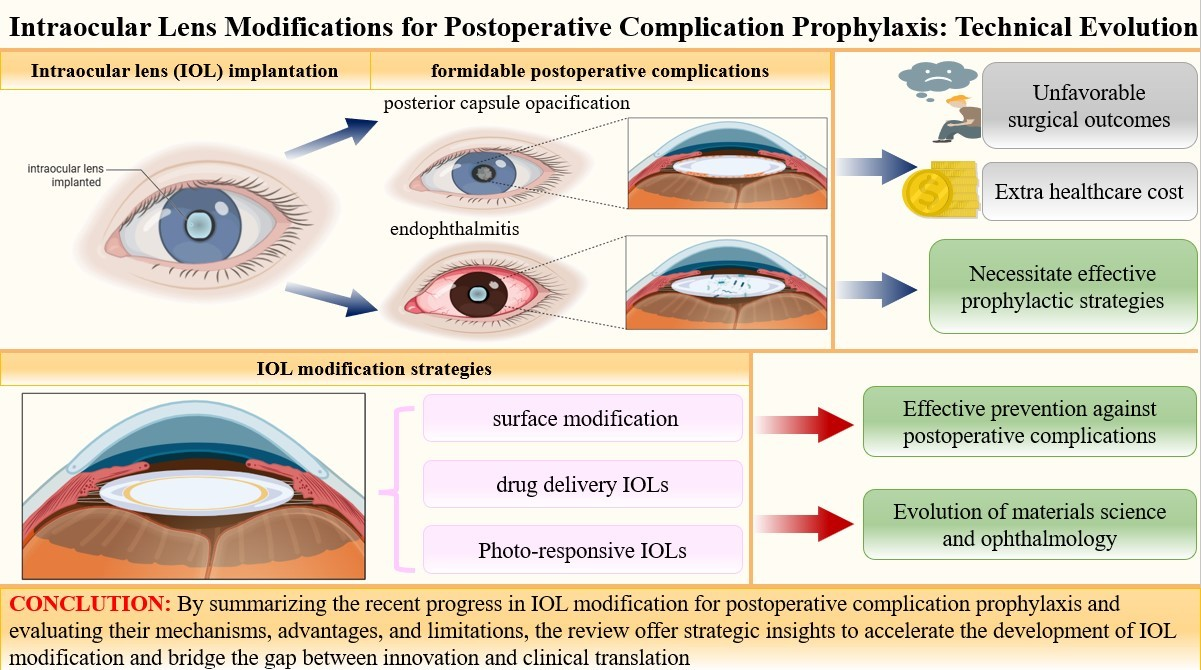
Intraocular Lens Modifications for Postoperative Complication Prevention: Advances in Surface Engineering, Drug Delivery, and Photo-Responsive Strategies
 ,
,
Abstract
1. Introduction
1.1. Pathogenesis, Treatment and Prevention of PCO
1.2. Pathogenesis, Treatment and Prevention of Endophthalmitis
1.3. Progress and Limitation in IOL Material Modification
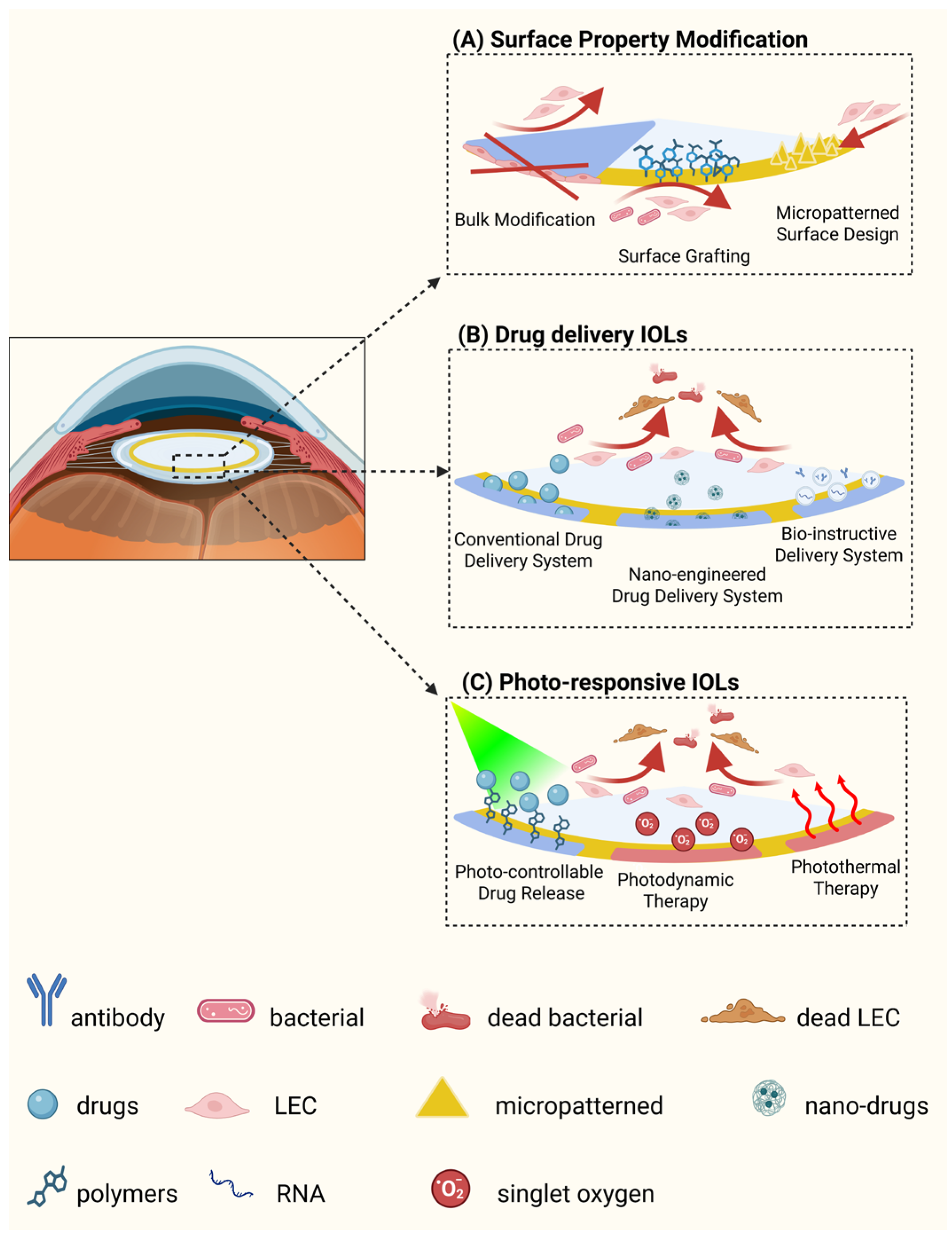
2. Surface Property Modification
2.1. Bulk Modification
2.2. Surface Grafting
2.3. Micropatterned Surface Design
3. IOL Drug Delivery Systems
3.1. Conventional DDSs
3.1.1. Matrix-Based DDSs
3.1.2. Drug-Coated IOLs
3.2. Nano-Engineered Drug Delivery Systems

| Reference | Year | IOL Material | Drug (Concentration) | Delivery Platform Material | Drug Loading Strategy | Experiment/Observation Period | Biological Evaluation |
|---|---|---|---|---|---|---|---|
| Manju et al. [143] | 2010 | PMMA | ampicillin (1 mg/mL) | PSS and PEI | LbL | drug release test: 7 d | achieve sustained drug release |
| Saraswathy et al. [75] | 2016 | hydrophobic acrylic | DEX (1 mg/mL) | siloxane nanogel | soaking | drug release test: 168 h | alleviate postoperative inflammation |
| Lamprogiannis et al. [147] | 2018 | Silicone | DEX (0.67 mg/sample, 0.5 mg/sample) | PLGA/PCL blend | encapsulation | drug release test: 10 w | form nanoporous structure with high encapsulation; achieve sustained clinical release |
| Karamitsos et al. [148] | 2020 | PMMA | DEX (74.10 μg/sample) | PLGA/PCL blend | encapsulation | drug release test: 8 w | achieve sustained drug release |
| Han et al. [60] | 2019 | foldable hydrophobic acrylic | DOX (0.05%) | heparin | LbL | HLECs: 72 h | inhibit cell adhesion, proliferation, and migration |
| rabbit eyes: 10 w | significantly reduce PCO and Soemmerring’s ring formation | ||||||
| Huang et al. [63] | 2021 | PDMS | paclitaxel (NA) | HA and CHI | LbL | HLECs: 48 h and 72 h | inhibit cell proliferation |
| Qin et al. [149] | 2021 | NA | DOX (1.3 μmol/mL) | PAMAM and haparin | LbL | LECs: 24 h | inhibit HLEC proliferation |
| rabbit eyes: 5 w | no pronounced PCO for 30 d | ||||||
| Vieira et al. [150] | 2017 | hydrophilic acrylic | MXF (5 mg/mL) | poly-HEMA | entrapment and soaking | microfluidic assay: 15 d | maintain effective antimicrobial levels for long-term endophthalmitis prevention |
| antibacterial tests: 24 h | maintain MFX concentrations above MIC for S. aureus and S. epidermidis for 12 d | ||||||
| Pimenta et al. [151] | 2017 | hydrophilic polymethacrylate | MXF (5 mg/mL) | AMPS or SBMA | soaking | drug release test: 21 d | AMPS-modified samples show higher release profile than SBMA-modified samples |
| antibacterial tests: 15 d | inhibit S. aureus and S. epidermidis for up to 12 d | ||||||
| Xiang et al. [152] | 2021 | hydrophobic acrylic | GS (1 mg/mL) | PDA | grafting | HLECs: 24 h | inhibit bacterial adhesion, decrease biofilm thickness, and inhibit HLEC adhesion |
3.3. Bio-Instructive Delivery Systems
4. Photo-Responsive IOLs
4.1. Photo-Controllable Drug Release IOLs
4.2. Photodynamic IOLs
4.3. Photothermal IOLs
5. Conclusions and Perspectives
Author Contributions
Funding
Institutional Review Board Statement
Informed Consent Statement
Data Availability Statement
Conflicts of Interest
References
- Liu, Y.C.; Wilkins, M.; Kim, T.; Malyugin, B.; Mehta, J.S. Cataracts. Lancet 2017, 390, 600–612. [Google Scholar] [CrossRef] [PubMed]
- GBD 2019 Blindness and Vision Impairment Collaborators. Causes of blindness and vision impairment in 2020 and trends over 30 years, and prevalence of avoidable blindness in relation to VISION 2020: The Right to Sight: An analysis for the Global Burden of Disease Study. Lancet Glob Health 2021, 9, e144–e160. [Google Scholar] [CrossRef]
- GBD 2023 Disease and Injury and Risk Factor Collaborators. Burden of 375 diseases and injuries, risk-attributable burden of 88 risk factors, and healthy life expectancy in 204 countries and territories, including 660 subnational locations, 1990–2023: A systematic analysis for the Global Burden of Disease Study 2023. Lancet 2025, 406, 1873–1922. [Google Scholar] [CrossRef]
- Jiang, B.; Wu, T.; Liu, W.; Liu, G.; Lu, P. Changing Trends in the Global Burden of Cataract Over the Past 30 Years: Retrospective Data Analysis of the Global Burden of Disease Study 2019. JMIR Public Health Surveill. 2023, 9, e47349. [Google Scholar] [CrossRef]
- Nibourg, L.M.; Gelens, E.; Kuijer, R.; Hooymans, J.M.; van Kooten, T.G.; Koopmans, S.A. Prevention of posterior capsular opacification. Exp. Eye Res. 2015, 136, 100–115. [Google Scholar] [CrossRef]
- Apple, D.J.; Solomon, K.D.; Tetz, M.R.; Assia, E.I.; Holland, E.Y.; Legler, U.F.C.; Tsai, J.C.; Castaneda, V.E.; Hoggatt, J.P.; Kostick, A.M.P. Posterior capsule opacification. Surv. Ophthalmol. 1992, 37, 73–116. [Google Scholar] [CrossRef]
- Gangwani, V.; Hirnschall, N.; Koshy, J.; Crnej, A.; Nishi, Y.; Maurino, V.; Findl, O. Posterior capsule opacification and capsular bag performance of a microincision intraocular lens. J. Cataract. Refract. Surg. 2011, 37, 1988–1992. [Google Scholar] [CrossRef] [PubMed]
- Karahan, E.; Er, D.; Kaynak, S. An Overview of Nd:YAG Laser Capsulotomy. Med. Hypothesis Discov. Innov. Ophthalmol. 2014, 3, 45–50. [Google Scholar]
- Borkenstein, A.F.; Borkenstein, E.M.; Omidi, P.; Langenbucher, A. Image Contrast and Spectral Transmission of Presbyopia-Correcting Intraocular Lenses: Evaluating the Impact of Nd:YAG Laser Associated Defects. Curr. Eye Res. 2025, 50, 51–57. [Google Scholar] [CrossRef]
- Billotte, C.; Berdeaux, G. Adverse clinical consequences of neodymium:YAG laser treatment of posterior capsule opacification. J. Cataract. Refract. Surg. 2004, 30, 2064–2071. [Google Scholar] [CrossRef] [PubMed]
- Borkenstein, A.F.; Kormilina, T.K.; Fitzek, H.; Rattenberger, J.; Kothleitner, G.; Charry, F.E.M.; Borkenstein, E.M. Incorrectly Focused Neodymium:Yttrium-Aluminum-Garnet (Nd:YAG) Laser Beam Leads to Massive Destructive Effects in Small-Aperture (Pinhole) Intraocular Lenses. Ophthalmol. Ther. 2024, 13, 2745–2758. [Google Scholar] [CrossRef]
- Borkenstein, A.F.; Borkenstein, E.M. Neodymium-Doped Yttrium Aluminum Garnet (Nd:YAG) Laser-Induced Damage to Intraocular Lenses: A Systematic Review of Mechanisms, Clinical Consequences, and Preventive Strategies. Cureus 2025, 17, e90903. [Google Scholar] [CrossRef]
- Creuzot-Garcher, C.; Benzenine, E.; Mariet, A.S.; de Lazzer, A.; Chiquet, C.; Bron, A.M.; Quantin, C. Incidence of Acute Postoperative Endophthalmitis after Cataract Surgery: A Nationwide Study in France from 2005 to 2014. Ophthalmology 2016, 123, 1414–1420. [Google Scholar] [CrossRef] [PubMed]
- Durand, M.L. Endophthalmitis. Clin. Microbiol. Infect. 2013, 19, 227–234. [Google Scholar] [CrossRef] [PubMed]
- Relhan, N.; Albini, T.A.; Pathengay, A.; Kuriyan, A.E.; Miller, D.; Flynn, H.W. Endophthalmitis caused by Gram-positive organisms with reduced vancomycin susceptibility: Literature review and options for treatment. Br. J. Ophthalmol. 2016, 100, 446–452. [Google Scholar] [CrossRef]
- Grzybowski, A.; Bajoriūnaitė, A.; Žemaitienė, R. The Rising Importance of Antiseptics in Ophthalmology: From Endophthalmitis Prevention to Treatment of Ocular Infections. Ophthalmol. Ther. 2025, 14, 2735–2752. [Google Scholar] [CrossRef]
- Wang, Y.; Cao, K.; Li, M.; Wan, X.H. Posterior capsular Opacification: Pathogenesis, challenges, and innovative therapeutic strategies. Exp. Eye Res. 2025, 259, 110585. [Google Scholar] [CrossRef] [PubMed]
- Wormstone, I.M.; Wormstone, Y.M.; Smith, A.J.O.; Eldred, J.A. Posterior capsule opacification: What’s in the bag? Prog. Retin. Eye Res. 2021, 82, 100905. [Google Scholar] [CrossRef]
- Fișuș, A.D.; Findl, O. Capsular fibrosis: A review of prevention methods and management. Eye 2020, 34, 256–262. [Google Scholar] [CrossRef]
- Lu, C.; Yu, S.; Song, H.; Zhao, Y.; Xie, S.; Tang, X.; Yuan, X. Posterior capsular opacification comparison between morphology and objective visual function. BMC Ophthalmol. 2019, 19, 40. [Google Scholar] [CrossRef]
- Findl, O.; Neumayer, T.; Hirnschall, N.; Buehl, W. Natural course of Elschnig pearl formation and disappearance. Investig. Ophthalmol. Vis. Sci. 2010, 51, 1547–1553. [Google Scholar] [CrossRef]
- Ursell, P.G.; Dhariwal, M.; O’Boyle, D.; Khan, J.; Venerus, A. 5 year incidence of YAG capsulotomy and PCO after cataract surgery with single-piece monofocal intraocular lenses: A real-world evidence study of 20,763 eyes. Eye 2020, 34, 960–968. [Google Scholar] [CrossRef]
- Ma, Y.; Ren, Z.; Chen, Y.; Qin, L.; Ju, R.; Qin, Y.; Wu, M. Novel Insight of Posterior Capsule Opacification: The Role of Lens Epithelial Cell Senescence. Clin. Exp. Ophthalmol. 2025, 53, 1008–1024. [Google Scholar] [CrossRef] [PubMed]
- Beckers, D.; Kretz, F.; Mehta, J.; Beckers, L. Analyzing the Relationship Between IOL Fixation and PCO Prevention. J. Clin. Med. 2025, 14, 6947. [Google Scholar] [CrossRef]
- Wesolosky, J.D.; Tennant, M.; Rudnisky, C.J. Rate of retinal tear and detachment after neodymium:YAG capsulotomy. J. Cataract. Refract. Surg. 2017, 43, 923–928. [Google Scholar] [CrossRef] [PubMed]
- Cinar, E.; Yuce, B.; Aslan, F.; Erbakan, G. Influence of Nd:YAG laser capsulotomy on toric intraocular lens rotation and change in cylinder power. J. Cataract. Refract. Surg. 2024, 50, 43–50. [Google Scholar] [CrossRef]
- Vrijman, V.; van der Linden, J.W.; Nieuwendaal, C.P.; van der Meulen, I.J.; Mourits, M.P.; Lapid-Gortzak, R. Effect of Nd:YAG laser capsulotomy on refraction in multifocal apodized diffractive pseudophakia. J. Refract. Surg. 2012, 28, 545–550. [Google Scholar] [CrossRef]
- Flohr, M.J.; Robin, A.L.; Kelley, J.S. Early complications following Q-switched neodymium: YAG laser posterior capsulotomy. Ophthalmology 1985, 92, 360–363. [Google Scholar] [CrossRef] [PubMed]
- Tang, J.; Liu, S.; Han, Y.; Wang, R.; Xia, J.; Chen, H.; Lin, Q. Surface modification of intraocular lenses via photodynamic coating for safe and effective PCO prevention. J. Mater. Chem. B 2021, 9, 1546–1556. [Google Scholar] [CrossRef]
- Lin, Q.; Tang, J.; Han, Y.; Xu, X.; Hao, X.; Chen, H. Hydrophilic modification of intraocular lens via surface initiated reversible addition-fragmentation chain transfer polymerization for reduced posterior capsular opacification. Colloids Surf. B Biointerfaces 2017, 151, 271–279. [Google Scholar] [CrossRef]
- Kamushadze, G.; Shengelia, D.; Gorgadze, G.; Shengelia, B.; Ibragimova, S. Posterior Capsulorhexis as a Preventive Strategy: A Case of Bilateral Congenital Cataract With Divergent Outcomes. Cureus 2025, 17, e91325. [Google Scholar] [CrossRef] [PubMed]
- Raj, S.M.; Vasavada, A.R.; Johar, S.R.; Vasavada, V.A.; Vasavada, V.A. Post-operative capsular opacification: A review. Int. J. Biomed. Sci. 2007, 3, 237–250. [Google Scholar]
- Hu, X.; Qi, J.; Cheng, K.; He, W.; Zhang, K.; Zhao, C.; Lu, Y.; Zhu, X. Effectiveness of prophylactic capsular tension ring implantation during cataract surgery in highly myopic eyes. J. Cataract. Refract. Surg. 2024, 50, 1030–1036. [Google Scholar] [CrossRef] [PubMed]
- Wu, K.Y.; Khammar, R.; Sheikh, H.; Marchand, M. Innovative Polymeric Biomaterials for Intraocular Lenses in Cataract Surgery. J. Funct. Biomater. 2024, 15, 391. [Google Scholar] [CrossRef]
- Cheng, J.W.; Wei, R.L.; Cai, J.P.; Xi, G.L.; Zhu, H.; Li, Y.; Ma, X.Y. Efficacy of different intraocular lens materials and optic edge designs in preventing posterior capsular opacification: A meta-analysis. Am. J. Ophthalmol. 2007, 143, 428–436. [Google Scholar] [CrossRef]
- Saika, S. Relationship between posterior capsule opacification and intraocular lens biocompatibility. Prog. Retin. Eye Res. 2004, 23, 283–305. [Google Scholar] [CrossRef]
- Huang, J.J.; Dun, C.; Son, H.S.; Makary, M.; Daoud, Y.; Srikumaran, D.; Chang, D.F.; Woreta, F.A. Trends in patient, surgeon, and procedural characteristics of intraocular lens exchange among Medicare beneficiaries 2011 to 2020. J. Cataract Refract. Surg. 2025, 51, 882–888. [Google Scholar] [CrossRef]
- Iu, L.P.L.; Chan, H.Y.; Li, G.K.H.; Ho, M.; Mak, A.C.Y.; Wong, P.P.Y.; Kam, K.W.; Chen, L.J.; Brelen, M.; Young, A.L. Acute postoperative endophthalmitis after cataract operation: Result of early vitrectomy within 24 hours of presentation. Eye 2023, 37, 2344–2350. [Google Scholar] [CrossRef] [PubMed]
- Creuzot-Garcher, C.P.; Mariet, A.S.; Benzenine, E.; Daien, V.; Korobelnik, J.F.; Bron, A.M.; Quantin, C. Is combined cataract surgery associated with acute postoperative endophthalmitis? A nationwide study from 2005 to 2014. Br. J. Ophthalmol. 2019, 103, 534–538. [Google Scholar] [CrossRef]
- Clarke, B.; Williamson, T.H.; Gini, G.; Gupta, B. Management of bacterial postoperative endophthalmitis and the role of vitrectomy. Surv. Ophthalmol. 2018, 63, 677–693. [Google Scholar] [CrossRef]
- Kanclerz, P.; Myers, W.G. Chlorhexidine and other alternatives for povidone-iodine in ophthalmic surgery: Review of comparative studies. J. Cataract. Refract. Surg. 2022, 48, 363–369. [Google Scholar] [CrossRef]
- Gentili, V.; Strazzabosco, G.; Salgari, N.; Mancini, A.; Rizzo, S.; Beltrami, S.; Schiuma, G.; Casciano, F.; Alogna, A.; Passarella, D.; et al. Ozonated Oil in Liposome Eyedrops Reduces the Formation of Biofilm, Selection of Antibiotic-Resistant Bacteria, and Adhesion of Bacteria to Human Corneal Cells. Int. J. Mol. Sci. 2023, 24, 14078. [Google Scholar] [CrossRef]
- Costerton, J.W.; Stewart, P.S.; Greenberg, E.P. Bacterial biofilms: A common cause of persistent infections. Science 1999, 284, 1318–1322. [Google Scholar] [CrossRef]
- Deepthi, K.G.; Prabagaran, S.R. Ocular bacterial infections: Pathogenesis and diagnosis. Microb. Pathog. 2020, 145, 104206. [Google Scholar] [CrossRef]
- Dzięgielewska, M.; Tomczyk, M.; Wiater, A.; Woytoń, A.; Junka, A. Targeting Ocular Biofilms with Plant-Derived Antimicrobials in the Era of Antibiotic Resistance. Molecules 2025, 30, 2863. [Google Scholar] [CrossRef]
- Gower, E.W.; Lindsley, K.; Tulenko, S.E.; Nanji, A.A.; Leyngold, I.; McDonnell, P.J. Perioperative antibiotics for prevention of acute endophthalmitis after cataract surgery. Cochrane Database Syst. Rev. 2017, 2, Cd006364. [Google Scholar] [CrossRef]
- Grzybowski, A.; Brona, P.; Zeman, L.; Stewart, M.W. Commonly used intracameral antibiotics for endophthalmitis prophylaxis: A literature review. Surv. Ophthalmol. 2021, 66, 98–108. [Google Scholar] [CrossRef] [PubMed]
- Hughes, P.M.; Olejnik, O.; Chang-Lin, J.E.; Wilson, C.G. Topical and systemic drug delivery to the posterior segments. Adv. Drug Deliv. Rev. 2005, 57, 2010–2032. [Google Scholar] [CrossRef]
- Del Amo, E.M.; Urtti, A. Current and future ophthalmic drug delivery systems. A shift to the posterior segment. Drug Discov. Today 2008, 13, 135–143. [Google Scholar] [CrossRef] [PubMed]
- Machida, Y.; Nakashizuka, H.; Onoe, H.; Kitagawa, Y.; Nakagawa, N.; Miyata, K.; Yamakawa, M.; Wakatsuki, Y.; Tanaka, K.; Mori, R.; et al. Intravitreal Povidone-Iodine Injection and Low-Dose Antibiotic Irrigation for Infectious Endophthalmitis: A Retrospective Case Series. Pharmaceutics 2025, 17, 995. [Google Scholar] [CrossRef] [PubMed]
- Davis, J.L. Defining Retinal Vasculitis. Am. J. Ophthalmol. 2024, 267, 84–89. [Google Scholar] [CrossRef]
- Zuo, C.; Mi, L.; Ye, D.; Guo, X.; Xiao, H.; Wu, M.; Liu, X. Toxic retinopathy after phacoemulsification when the cefuroxime dilution is correct. J. Cataract. Refract. Surg. 2018, 44, 28–33. [Google Scholar] [CrossRef]
- Delyfer, M.N.; Rougier, M.B.; Leoni, S.; Zhang, Q.; Dalbon, F.; Colin, J.; Korobelnik, J.F. Ocular toxicity after intracameral injection of very high doses of cefuroxime during cataract surgery. J. Cataract. Refract. Surg. 2011, 37, 271–278. [Google Scholar] [CrossRef] [PubMed]
- Gentile, R.C.; Shukla, S.; Shah, M.; Ritterband, D.C.; Engelbert, M.; Davis, A.; Hu, D.N. Microbiological spectrum and antibiotic sensitivity in endophthalmitis: A 25-year review. Ophthalmology 2014, 121, 1634–1642. [Google Scholar] [CrossRef]
- Cooksley, G.; Lacey, J.; Dymond, M.K.; Sandeman, S. Factors Affecting Posterior Capsule Opacification in the Development of Intraocular Lens Materials. Pharmaceutics 2021, 13, 860. [Google Scholar] [CrossRef] [PubMed]
- Jaitli, A.; Roy, J.; McMahan, S.; Liao, J.; Tang, L. An in vitro system to investigate IOL: Lens capsule interaction. Exp. Eye Res. 2021, 203, 108430. [Google Scholar] [CrossRef] [PubMed]
- Wang, R.; Xia, J.; Tang, J.; Liu, D.; Zhu, S.; Wen, S.; Lin, Q. Surface Modification of Intraocular Lens with Hydrophilic Poly(Sulfobetaine Methacrylate) Brush for Posterior Capsular Opacification Prevention. J. Ocul. Pharmacol. Ther. 2021, 37, 172–180. [Google Scholar] [CrossRef]
- Jaitli, A.; Roy, J.; Chatila, A.; Liao, J.; Tang, L. Role of fibronectin and IOL surface modification in IOL: Lens capsule interactions. Exp. Eye Res. 2022, 221, 109135. [Google Scholar] [CrossRef]
- Tan, X.; Zhan, J.; Zhu, Y.; Cao, J.; Wang, L.; Liu, S.; Wang, Y.; Liu, Z.; Qin, Y.; Wu, M.; et al. Improvement of Uveal and Capsular Biocompatibility of Hydrophobic Acrylic Intraocular Lens by Surface Grafting with 2-Methacryloyloxyethyl Phosphorylcholine-Methacrylic Acid Copolymer. Sci. Rep. 2017, 7, 40462. [Google Scholar] [CrossRef]
- Han, Y.; Tang, J.; Xia, J.; Wang, R.; Qin, C.; Liu, S.; Zhao, X.; Chen, H.; Lin, Q. Anti-Adhesive And Antiproliferative Synergistic Surface Modification Of Intraocular Lens For Reduced Posterior Capsular Opacification. Int. J. Nanomed. 2019, 14, 9047–9061. [Google Scholar] [CrossRef]
- Seo, Y.; Kim, S.; Lee, H.S.; Park, J.; Lee, K.; Jun, I.; Seo, H.; Kim, Y.J.; Yoo, Y.; Choi, B.C.; et al. Femtosecond laser induced nano-textured micropatterning to regulate cell functions on implanted biomaterials. Acta Biomater. 2020, 116, 138–148, Erratum in Acta Biomater. 2020, 2116, 2138–2148. https://doi.org/10.1016/j.actbio.2020.08.044. [Google Scholar] [CrossRef]
- Hu, Y.; Wang, J.; Hong, Y.; Han, Y.; Liang, L.; Yang, Y.; Wu, Z.; Lin, Q. Photo-controllable drug releasing bulk polyacrylic intraocular lens material for safer posterior capsular opacification prevention. J. Control Release 2024, 366, 494–504. [Google Scholar] [CrossRef]
- Huang, H.; Zhu, S.; Liu, D.; Wen, S.; Lin, Q. Antiproliferative drug-loaded multi-functionalized intraocular lens for reducing posterior capsular opacification. J. Biomater. Sci. Polym. Ed. 2021, 32, 735–748. [Google Scholar] [CrossRef]
- Liu, S.; Zhao, X.; Tang, J.; Han, Y.; Lin, Q. Drug-Eluting Hydrophilic Coating Modification of Intraocular Lens via Facile Dopamine Self-Polymerization for Posterior Capsular Opacification Prevention. ACS Biomater. Sci. Eng. 2021, 7, 1065–1073. [Google Scholar] [CrossRef]
- Hong, Y.; Zou, H.; Hu, Y.; Fei, F.; Liang, L.; Liu, D.; Han, Y.; Lin, Q. Design of foldable, responsively drug-eluting polyacrylic intraocular lens bulk materials for prevention of postoperative complications. J. Mater. Chem. B 2022, 10, 8398–8406, Erratum in J. Mater. Chem. B 2022, 8310, 9008–9009. https://doi.org/10.1039/d2tb01974d. [Google Scholar] [CrossRef] [PubMed]
- Lu, D.; Wang, H.; Feng, C.; Bai, T.; Xu, B.; Wei, Y.; Shen, L.; Lin, Q. Spin-Coating-Based Facile Annular Photodynamic Intraocular Lens Fabrication for Efficient and Safer Posterior Capsular Opacification Prevention. ACS Appl. Mater. Interfaces 2022, 14, 48341–48355. [Google Scholar] [CrossRef]
- Qin, C.; Wen, S.; Fei, F.; Han, Y.; Wang, H.; Chen, H.; Lin, Q. NIR-triggered thermosensitive polymer brush coating modified intraocular lens for smart prevention of posterior capsular opacification. J. Nanobiotechnol. 2023, 21, 323. [Google Scholar] [CrossRef] [PubMed]
- Ye, Z.; Huang, Y.; Li, J.; Ma, T.; Gao, L.; Hu, H.; He, Q.; Jin, H.; Li, Z. Two-dimensional ultrathin Ti3C2 MXene nanosheets coated intraocular lens for synergistic photothermal and NIR-controllable rapamycin releasing therapy against posterior capsule opacification. Front. Bioeng. Biotechnol. 2022, 10, 989099. [Google Scholar] [CrossRef] [PubMed]
- Lu, D.; Han, Y.; Liu, D.; Chen, S.; Qie, J.; Qu, J.; Lin, Q. Centrifugally concentric ring-patterned drug-loaded polymeric coating as an intraocular lens surface modification for efficient prevention of posterior capsular opacification. Acta Biomater. 2022, 138, 327–341. [Google Scholar] [CrossRef]
- Nanu, R.V.; Ungureanu, E.; Instrate, S.L.; Vrapciu, A.; Cozubas, R.; Carstocea, L.; Voinea, L.M.; Ciuluvica, R. An overview of the influence and design of biomaterial of the intraocular implant of the posterior capsule opacification. Rom. J. Ophthalmol. 2018, 62, 188–193. [Google Scholar] [CrossRef]
- Topete, A.; Saramago, B.; Serro, A.P. Intraocular lenses as drug delivery devices. Int. J. Pharm. 2021, 602, 120613. [Google Scholar] [CrossRef]
- Du, Y.; Meng, J.; He, W.; Lu, Y.; Zhu, X. Challenges of refractive cataract surgery in the era of myopia epidemic: A mini-review. Front. Med. 2023, 10, 1128818. [Google Scholar] [CrossRef]
- Li, H.; Cen, J.; Tong, W.; Yang, F.; Zhang, R.; Wang, D.; Chang, P.; Zhao, Y. Intraocular lens tilt and decentration and optical quality after primary intraocular lens implantation in pediatric cataract patients. Adv. Ophthalmol. Pract. Res. 2025, 5, 285–292. [Google Scholar] [CrossRef] [PubMed]
- Wang, Y.; Chen, Z.; Jia, W.; Shen, X.; Chen, X.; Chen, T.; Sun, Y.; Huo, Q.; Liu, Y.; Song, L.; et al. Longitudinal observation of posterior capsule opacification in pediatric eyes with Marfan syndrome after in-the-bag intraocular lens implantation. J. Cataract. Refract. Surg. 2025, 51, 687–694. [Google Scholar] [CrossRef]
- Saraswathy, M.; Stansbury, J.; Nair, D. Water dispersible siloxane nanogels: A novel technique to control surface characteristics and drug release kinetics. J. Mater. Chem. B 2016, 4, 5299–5307. [Google Scholar] [CrossRef]
- Wang, G.Q.; Dang, Y.L.; Huang, Q.; Woo, V.C.; So, K.F.; Lai, J.S.; Cheng, G.P.; Chiu, K. In Vitro Evaluation of the Effects of Intraocular Lens Material on Lens Epithelial Cell Proliferation, Migration, and Transformation. Curr. Eye Res. 2017, 42, 72–78. [Google Scholar] [CrossRef]
- Ram, J.; Pandey, S.K.; Apple, D.J.; Werner, L.; Brar, G.S.; Singh, R.; Chaudhary, K.P.; Gupta, A. Effect of in-the-bag intraocular lens fixation on the prevention of posterior capsule opacification. J. Cataract. Refract. Surg. 2001, 27, 1039–1046. [Google Scholar] [CrossRef]
- Zemaitiene, R.; Speckauskas, M.; Glebauskiene, B.; Jasinskas, V. Comparison of postoperative results after implantation of hydrophilic acrylic or hydrophobic acrylic intraocular lens: Data of one-year prospective clinical study. Medicina 2008, 44, 936. [Google Scholar] [CrossRef]
- Wang, B.; Lin, Q.; Shen, C.; Tang, J.; Han, Y.; Chen, H. Hydrophobic modification of polymethyl methacrylate as intraocular lenses material to improve the cytocompatibility. J. Colloid Interface Sci. 2014, 431, 1–7, Erratum in J. Colloid Interface Sci. 2022, 2622, 1054. https://doi.org/10.1016/j.jcis.2014.05.056. [Google Scholar] [CrossRef] [PubMed]
- Findl, O.; Buehl, W.; Bauer, P.; Sycha, T. Interventions for preventing posterior capsule opacification. Cochrane Database Syst. Rev. 2010, 2010, Cd003738. [Google Scholar] [CrossRef] [PubMed]
- Li, X.; Li, J.; Sun, D.; Ma, T.; Chen, W.; Ye, Z.; Li, Z. Development and Validation of a Prediction Model for Nd:YAG Laser Capsulotomy: A Retrospective Cohort Study of 9768 eyes. Ophthalmol. Ther. 2023, 12, 1893–1912. [Google Scholar] [CrossRef] [PubMed]
- Vargas, L.G.; Peng, Q.; Apple, D.J.; Escobar-Gomez, M.; Pandey, S.K.; Arthur, S.N.; Hoddinott, D.S.; Schmidbauer, J.M. Evaluation of 3 modern single-piece foldable intraocular lenses: Clinicopathological study of posterior capsule opacification in a rabbit model. J. Cataract. Refract. Surg. 2002, 28, 1241–1250. [Google Scholar] [CrossRef]
- Zhao, Y.; Yang, K.; Li, J.; Huang, Y.; Zhu, S. Comparison of hydrophobic and hydrophilic intraocular lens in preventing posterior capsule opacification after cataract surgery: An updated meta-analysis. Medicine 2017, 96, e8301. [Google Scholar] [CrossRef]
- Liu, D.; Tang, J.; Shen, L.; Liu, S.; Zhu, S.; Wen, S.; Lin, Q. Foldable Bulk Anti-adhesive Polyacrylic Intraocular Lens Material Design and Fabrication for Posterior Capsule Opacification Prevention. Biomacromolecules 2022, 23, 1581–1591. [Google Scholar] [CrossRef]
- Hamedi, H.; Green, S.W.; Puri, R.; Luo, R.; Lee, M.; Liu, J.; Cho, H.; Hansford, D.J.; Chandler, H.L.; Swindle-Reilly, K.E. Lens epithelial cell response to polymer stiffness and polymer chemistry. J. Polym. Sci. 2024, 62, 1820–1830. [Google Scholar] [CrossRef] [PubMed]
- Grzybowski, A.; Auffarth, G.U.; LaHood, B.R. How do intraocular lens materials influence the outcome of cataract surgery? Curr. Opin. Ophthalmol. 2025, 36, 18–24. [Google Scholar] [CrossRef] [PubMed]
- Zhao, X.; Deng, P.; Zou, J.; Xu, X. Combating posterior capsular opacification: From conventional intraocular lens modifications to proactive defense via interface engineering. Mater. Today Bio 2026, 36, 102666. [Google Scholar] [CrossRef]
- Huang, X.; Luo, C.; Lin, L.; Zhang, L.; Li, H.; Yao, K.; Xu, Z. UV-assisted treatment on hydrophobic acrylic IOLs anterior surface with methacryloyloxyethyl phosphorylcholine: Reducing inflammation and maintaining low posterior capsular opacification properties. Mater. Sci. Eng. C Mater. Biol. Appl. 2017, 75, 1289–1298. [Google Scholar] [CrossRef]
- Rao, L.; Liu, Y.; Zhou, H. Significantly improved cell affinity of polydimethylsiloxane enabled by a surface-modified strategy with chemical coupling. J. Mater. Sci. Mater. Med. 2022, 33, 66. [Google Scholar] [CrossRef]
- Fagerholm, P.; Björklund, H.; Holmberg, A.; Larsson, R.; Lydahl, E.; Philipson, B.; Selén, G. Heparin surface modified intraocular lenses implanted in the monkey eye. J. Cataract. Refract. Surg. 1989, 15, 485–490. [Google Scholar] [CrossRef]
- Spångberg, M.; Kihlström, I.; Björklund, H.; Bjurström, S.; Lydahl, E.; Larsson, R. Improved biocompatibility of intraocular lenses by heparin surface modification: A 12-month implantation study in monkeys. J. Cataract. Refract. Surg. 1990, 16, 170–177. [Google Scholar] [CrossRef]
- Trocme, S.D.; Li, H. Effect of heparin-surface-modified intraocular lenses on postoperative inflammation after phacoemulsification: A randomized trial in a United States patient population. Heparin-Surface-Modified Lens Study Group. Ophthalmology 2000, 107, 1031–1037. [Google Scholar] [CrossRef]
- Borgioli, M.; Coster, D.J.; Fan, R.F.; Henderson, J.; Jacobi, K.W.; Kirkby, G.R.; Lai, Y.K.; Menezo, J.L.; Montard, M.; Strobel, J.; et al. Effect of heparin surface modification of polymethylmethacrylate intraocular lenses on signs of postoperative inflammation after extracapsular cataract extraction. One-year results of a double-masked multicenter study. Ophthalmology 1992, 99, 1248–1254; discussion 1254-1245. [Google Scholar] [CrossRef]
- Lai, Y.K.; Fan, R.F. Effect of heparin-surface-modified poly(methyl methacrylate) intraocular lenses on the postoperative inflammation in an Asian population. J. Cataract. Refract. Surg. 1996, 22, 830–834. [Google Scholar] [CrossRef] [PubMed]
- Kang, S.; Choi, J.A.; Joo, C.K. Comparison of posterior capsular opacification in heparin-surface-modified hydrophilic acrylic and hydrophobic acrylic intraocular lenses. Jpn. J. Ophthalmol. 2009, 53, 204–208. [Google Scholar] [CrossRef]
- Krall, E.M.; Arlt, E.M.; Jell, G.; Strohmaier, C.; Moussa, S.; Dexl, A.K. Prospective Randomized Intraindividual Comparison of Posterior Capsule Opacification After Implantation of an IOL With and Without Heparin Surface Modification. J. Refract. Surg. 2015, 31, 466–472. [Google Scholar] [CrossRef]
- Bozukova, D.; Pagnoulle, C.; De Pauw-Gillet, M.-C.; Desbief, S.; Lazzaroni, R.; Ruth, N.; Jérôme, R.; Jérôme, C. Improved Performances of Intraocular Lenses by Poly(ethylene glycol) Chemical Coatings. Biomacromolecules 2007, 8, 2379–2387. [Google Scholar] [CrossRef]
- Huang, Q.; Cheng, G.P.; Chiu, K.; Wang, G.Q. Surface Modification of Intraocular Lenses. Chin. Med. J. 2016, 129, 206–214. [Google Scholar] [CrossRef]
- Matsushima, H.; Iwamoto, H.; Mukai, K.; Obara, Y. Active oxygen processing for acrylic intraocular lenses to prevent posterior capsule opacification. J. Cataract. Refract. Surg. 2006, 32, 1035–1040. [Google Scholar] [CrossRef]
- Babizhayev, M.A. Coated with nanomaterials intraocular lenses, ophthalmic and human body implantable devices with high catalytic antioxidant activities: A new nanotechnology strategy of peroxidase cellular enzyme mimics increasing the biocompatibility and therapeutic deployment of the medical prosthetic device. Recent Pat. Drug Deliv. Formul. 2013, 7, 39–65. [Google Scholar] [CrossRef] [PubMed]
- Huang, X.D.; Yao, K.; Zhang, H.; Huang, X.J.; Xu, Z.K. Surface modification of silicone intraocular lens by 2-methacryloyloxyethyl phosphoryl-choline binding to reduce Staphylococcus epidermidis adherence. Clin. Exp. Ophthalmol. 2007, 35, 462–467. [Google Scholar] [CrossRef] [PubMed]
- Han, Y.; Xu, X.; Tang, J.; Shen, C.; Lin, Q.; Chen, H. Bottom-up fabrication of zwitterionic polymer brushes on intraocular lens for improved biocompatibility. Int. J. Nanomed. 2017, 12, 127–135. [Google Scholar] [CrossRef]
- Choi, G.; Song, Y.; Lim, H.; Lee, S.H.; Lee, H.K.; Lee, E.; Choi, B.G.; Lee, J.J.; Im, S.G.; Lee, K.G. Antibacterial Nanopillar Array for an Implantable Intraocular Lens. Adv. Healthc. Mater. 2020, 9, e2000447. [Google Scholar] [CrossRef] [PubMed]
- Xia, N.; Thodeti, C.K.; Hunt, T.P.; Xu, Q.; Ho, M.; Whitesides, G.M.; Westervelt, R.; Ingber, D.E. Directional control of cell motility through focal adhesion positioning and spatial control of Rac activation. FASEB J. 2008, 22, 1649–1659. [Google Scholar] [CrossRef] [PubMed]
- Rajnicek, A.M.; Foubister, L.E.; McCaig, C.D. Alignment of corneal and lens epithelial cells by co-operative effects of substratum topography and DC electric fields. Biomaterials 2008, 29, 2082–2095. [Google Scholar] [CrossRef]
- McHugh, K.J.; Saint-Geniez, M.; Tao, S.L. Topographical control of ocular cell types for tissue engineering. J. Biomed. Mater. Res. B Appl. Biomater. 2013, 101, 1571–1584. [Google Scholar] [CrossRef]
- Magin, C.M.; May, R.M.; Drinker, M.C.; Cuevas, K.H.; Brennan, A.B.; Reddy, S.T. Micropatterned Protective Membranes Inhibit Lens Epithelial Cell Migration in Posterior Capsule Opacification Model. Transl. Vis. Sci. Technol. 2015, 4, 9. [Google Scholar] [CrossRef]
- Kramer, G.D.; Werner, L.; MacLean, K.; Farukhi, A.; Gardiner, G.L.; Mamalis, N. Evaluation of stability and capsular bag opacification with a foldable intraocular lens coupled with a protective membrane in the rabbit model. J. Cataract. Refract. Surg. 2015, 41, 1738–1744. [Google Scholar] [CrossRef]
- Ellis, N.; Werner, L.; Balendiran, V.; Shumway, C.; Jiang, B.; Mamalis, N. Posterior capsule opacification prevention by an intraocular lens incorporating a micropatterned membrane on the posterior surface. J. Cataract. Refract. Surg. 2020, 46, 102–107. [Google Scholar]
- Li, X.; Liang, C.; Guo, Y.; Su, J.; Chen, X.; Macgregor, R.B., Jr.; Zhang, R.X.; Yan, H. Clinical Translation of Long-Acting Drug Delivery Systems for Posterior Capsule Opacification Prophylaxis. Pharmaceutics 2023, 15, 1235. [Google Scholar] [CrossRef] [PubMed]
- Zhang, Y.; Zhang, C.; Chen, S.; Hu, J.; Shen, L.; Yu, Y. Research Progress Concerning a Novel Intraocular Lens for the Prevention of Posterior Capsular Opacification. Pharmaceutics 2022, 14, 1343. [Google Scholar] [CrossRef]
- Nishi, O.; Nishi, K.; Yamada, Y.; Mizumoto, Y. Effect of indomethacin-coated posterior chamber intraocular lenses on postoperative inflammation and posterior capsule opacification. J. Cataract. Refract. Surg. 1995, 21, 574–578. [Google Scholar] [CrossRef]
- Davis, J.L.; Yi, N.Y.; Salmon, J.H.; Charlton, A.N.; Colitz, C.M.; Gilger, B.C. Sustained-release celecoxib from incubated acrylic intraocular lenses suppresses lens epithelial cell growth in an ex vivo model of posterior capsule opacity. J. Ocul. Pharmacol. Ther. 2012, 28, 359–368. [Google Scholar] [CrossRef]
- Wertheimer, C.; Kassumeh, S.; Piravej, N.P.; Nilmayer, O.; Braun, C.; Priglinger, C.; Luft, N.; Wolf, A.; Mayer, W.J.; Priglinger, S.G.; et al. The Intraocular Lens as a Drug Delivery Device: In Vitro Screening of Pharmacologic Substances for the Prophylaxis of Posterior Capsule Opacification. Investig. Ophthalmol. Vis. Sci. 2017, 58, 6408–6418. [Google Scholar] [CrossRef] [PubMed]
- Wertheimer, C.; Kueres, A.; Siedlecki, J.; Braun, C.; Kassumeh, S.; Wolf, A.; Mayer, W.; Priglinger, C.; Priglinger, S.; Eibl-Lindner, K. The intraocular lens as a drug delivery device for an epidermal growth factor-Receptor inhibitor for prophylaxis of posterior capsule opacification. Acta Ophthalmol. 2018, 96, e874–e882. [Google Scholar] [CrossRef] [PubMed]
- Kassumeh, S.; Kueres, A.; Hillenmayer, A.; von Studnitz, A.; Elhardt, C.; Ohlmann, A.; Priglinger, S.G.; Wertheimer, C.M. Development of a drug-eluting intraocular lens to deliver epidermal growth factor receptor inhibitor gefitinib for posterior capsule opacification prophylaxis. Eur. J. Ophthalmol. 2021, 31, 436–444. [Google Scholar] [CrossRef]
- Kleinmann, G.; Apple, D.J.; Chew, J.; Stevens, S.; Hunter, B.; Larson, S.; Mamalis, N.; Olson, R.J. Hydrophilic acrylic intraocular lens as a drug-delivery system: Pilot study. J. Cataract. Refract. Surg. 2006, 32, 652–654. [Google Scholar] [CrossRef]
- Lipnitzki, I.; Ben Eliahu, S.; Marcovitz, A.L.; Ezov, N.; Kleinmann, G. Intraocular concentration of moxifloxacin after intracameral injection combined with presoaked intraocular lenses. J. Cataract. Refract. Surg. 2014, 40, 639–643. [Google Scholar] [CrossRef]
- Yovel, O.S.; Ben Eliahu, S.; Kleinmann, G. Prevention of Staphylococcus epidermidis Endophthalmitis by Different Moxifloxacin Prophylaxis Routes. Curr. Drug Deliv. 2016, 13, 90–94. [Google Scholar] [CrossRef]
- Lipnitzki, I.; Bronshtein, R.; Ben Eliahu, S.; Marcovich, A.L.; Kleinmann, G. Hydrophilic acrylic intraocular lens as a drug delivery system: Influence of the presoaking time and comparison to intracameral injection. J. Ocul. Pharmacol. Ther. 2013, 29, 414–418. [Google Scholar] [CrossRef] [PubMed]
- Shimizu, K.; Kobayakawa, S.; Tsuji, A.; Tochikubo, T. Biofilm formation on hydrophilic intraocular lens material. Curr. Eye Res. 2006, 31, 989–997. [Google Scholar] [CrossRef] [PubMed]
- Topete, A.; Serro, A.P.; Saramago, B. Dual drug delivery from intraocular lens material for prophylaxis of endophthalmitis in cataract surgery. Int. J. Pharm. 2019, 558, 43–52. [Google Scholar] [CrossRef]
- Topete, A.; Barahona, I.; Santos, L.F.; Pinto, C.A.; Saraiva, J.A.; Paula Serro, A.; Saramago, B. The effects of addition of functional monomers and molecular imprinting on dual drug release from intraocular lens material. Int. J. Pharm. 2021, 600, 120513. [Google Scholar] [CrossRef] [PubMed]
- Kravanja, K.A.; Finšgar, M.; Knez, Ž.; Knez Marevci, M. Supercritical Fluid Technologies for the Incorporation of Synthetic and Natural Active Compounds into Materials for Drug Formulation and Delivery. Pharmaceutics 2022, 14, 1670. [Google Scholar] [CrossRef]
- Davies, O.R.; Lewis, A.L.; Whitaker, M.J.; Tai, H.; Shakesheff, K.M.; Howdle, S.M. Applications of supercritical CO2 in the fabrication of polymer systems for drug delivery and tissue engineering. Adv. Drug Deliv. Rev. 2008, 60, 373–387. [Google Scholar] [CrossRef]
- Duarte, A.R.; Simplicio, A.L.; Vega-González, A.; Subra-Paternault, P.; Coimbra, P.; Gil, M.H.; de Sousa, H.C.; Duarte, C.M. Impregnation of an intraocular lens for ophthalmic drug delivery. Curr. Drug Deliv. 2008, 5, 102–107. [Google Scholar] [CrossRef] [PubMed]
- Masmoudi, Y.; Ben Azzouk, L.; Forzano, O.; Andre, J.M.; Badens, E. Supercritical impregnation of intraocular lenses. J. Supercrit. Fluids 2011, 60, 98–105. [Google Scholar] [CrossRef]
- González-Chomón, C.; Braga, M.E.; de Sousa, H.C.; Concheiro, A.; Alvarez-Lorenzo, C. Antifouling foldable acrylic IOLs loaded with norfloxacin by aqueous soaking and by supercritical carbon dioxide technology. Eur. J. Pharm. Biopharm. 2012, 82, 383–391. [Google Scholar] [CrossRef]
- Bouledjouidja, A.; Masmoudi, Y.; Sergent, M.; Trivedi, V.; Meniai, A.; Badens, E. Drug loading of foldable commercial intraocular lenses using supercritical impregnation. Int. J. Pharm. 2016, 500, 85–99. [Google Scholar] [CrossRef] [PubMed]
- Bouledjouidja, A.; Masmoudi, Y.; Li, Y.; He, W.; Badens, E. Supercritical impregnation and optical characterization of loaded foldable intraocular lenses using supercritical fluids. J. Cataract. Refract. Surg. 2017, 43, 1343–1349. [Google Scholar] [CrossRef]
- Ongkasin, K.; Masmoudi, Y.; Tassaing, T.; Le-Bourdon, G.; Badens, E. Supercritical loading of gatifloxacin into hydrophobic foldable intraocular lenses—Process control and optimization by following in situ CO2 sorption and polymer swelling. Int. J. Pharm. 2020, 581, 119247. [Google Scholar] [CrossRef] [PubMed]
- Li, M.; Xu, J.W.; Li, J.; Wang, W.; Luo, C.; Han, H.; Xu, Z.K.; Yao, K. A novel gatifloxacin-loaded intraocular lens for prophylaxis of postoperative endophthalmitis. Bioact. Mater. 2023, 20, 271–285. [Google Scholar] [CrossRef] [PubMed]
- Liu, H.; Wu, L.; Fu, S.; Hou, Y.; Liu, P.; Cui, H.; Liu, J.; Xing, L.; Zhang, X. Polylactide-glycoli acid and rapamycin coating intraocular lens prevent posterior capsular opacification in rabbit eyes. Graefes Arch. Clin. Exp. Ophthalmol. 2009, 247, 801–807. [Google Scholar] [CrossRef]
- Kassumeh, S.A.; Wertheimer, C.M.; von Studnitz, A.; Hillenmayer, A.; Priglinger, C.; Wolf, A.; Mayer, W.J.; Teupser, D.; Holdt, L.M.; Priglinger, S.G.; et al. Poly(lactic-co-glycolic) Acid as a Slow-Release Drug-Carrying Matrix for Methotrexate Coated onto Intraocular Lenses to Conquer Posterior Capsule Opacification. Curr. Eye Res. 2018, 43, 702–708. [Google Scholar] [CrossRef]
- Zhang, X.; Lai, K.; Li, S.; Wang, J.; Li, J.; Wang, W.; Ni, S.; Lu, B.; Grzybowski, A.; Ji, J.; et al. Drug-eluting intraocular lens with sustained bromfenac release for conquering posterior capsular opacification. Bioact. Mater. 2022, 9, 343–357. [Google Scholar] [CrossRef]
- Chen, S.; Qin, C.; Fang, Q.; Duo, L.; Wang, M.; Deng, Z.; Chen, H.; Lin, Q. Rapid and Economical Drug-Eluting IOL Preparation via Thermoresponsive Agarose Coating for Effective Posterior Capsular Opacification Prevention. Front. Bioeng. Biotechnol. 2022, 10, 930540. [Google Scholar] [CrossRef]
- Wang, Y.; Wen, C.; Jing, R.; Yang, Y.; Qin, Y.; Qi, T.; Hu, C.; Bai, X.; Wu, C.; Pei, C. Self-assembled coating with a metal-polyphenolic network for intraocular lens modification to prevent posterior capsule opacification. Biomed. Mater. 2024, 19, 025011. [Google Scholar] [CrossRef]
- Garty, S.; Shirakawa, R.; Warsen, A.; Anderson, E.M.; Noble, M.L.; Bryers, J.D.; Ratner, B.D.; Shen, T.T. Sustained antibiotic release from an intraocular lens-hydrogel assembly for cataract surgery. Investig. Ophthalmol. Vis. Sci. 2011, 52, 6109–6116. [Google Scholar] [CrossRef]
- Li, K.; Yu, L.; Ma, L.; Xia, J.; Peng, J.; Hu, P.; Liu, G.; Ye, J. Surface modification of commercial intraocular lens by zwitterionic and antibiotic-loaded coating for preventing postoperative endophthalmitis. Colloids Surf. B Biointerfaces 2023, 222, 113093. [Google Scholar] [CrossRef]
- Huang, L.; Huang, X.H.; Yang, X.; Hu, J.Q.; Zhu, Y.Z.; Yan, P.Y.; Xie, Y. Novel nano-drug delivery system for natural products and their application. Pharmacol. Res. 2024, 201, 107100. [Google Scholar] [CrossRef] [PubMed]
- Guo, Y.; Geng, W.; Sun, J. Layer-by-layer deposition of polyelectrolyte-polyelectrolyte complexes for multilayer film fabrication. Langmuir 2009, 25, 1004–1010. [Google Scholar] [CrossRef]
- Decher, G.; Hong, J.-D. Buildup of ultrathin multilayer films by a self-assembly process, 1 consecutive adsorption of anionic and cationic bipolar amphiphiles on charged surfaces. Makromol. Chem. Macromol. Symp. 1991, 46, 321–327. [Google Scholar] [CrossRef]
- Manju, S.; Kunnatheeri, S. Layer-by-Layer modification of poly (methyl methacrylate) intra ocular lens: Drug delivery applications. Pharm. Dev. Technol. 2010, 15, 379–385. [Google Scholar] [CrossRef]
- Kar, A.; Ahamad, N.; Dewani, M.; Awasthi, L.; Patil, R.; Banerjee, R. Wearable and implantable devices for drug delivery: Applications and challenges. Biomaterials 2022, 283, 121435. [Google Scholar] [CrossRef]
- Proshin, P.I.; Abdurashitov, A.S.; Sindeeva, O.A.; Ivanova, A.A.; Sukhorukov, G.B. Additive Manufacturing of Drug-Eluting Multilayer Biodegradable Films. Polymers 2022, 14, 4318. [Google Scholar] [CrossRef]
- Karagkiozaki, V.; Vavoulidis, E.; Karagiannidis, P.G.; Gioti, M.; Fatouros, D.G.; Vizirianakis, I.S.; Logothetidis, S. Development of a nanoporous and multilayer drug-delivery platform for medical implants. Int. J. Nanomed. 2012, 7, 5327–5338. [Google Scholar] [CrossRef] [PubMed]
- Lamprogiannis, L.; Karamitsos, A.; Karagkiozaki, V.; Tsinopoulos, I.; Gioti, M.; Fatouros, D.G.; Dimitrakos, S.; Logothetidis, S. Design and fabrication of drug-eluting polymeric thin films for applications in ophthalmology. IET Nanobiotechnol. 2018, 12, 1074–1079. [Google Scholar] [CrossRef] [PubMed]
- Karamitsos, A.; Lamprogiannis, L.; Karagkiozaki, V.; Laskarakis, A.; Papadopoulou, L.; Fatouros, D.; Ziakas, N.; Logothetidis, S.; Tsinopoulos, I. Design, characterisation and drug release study of polymeric, drug-eluting single layer thin films on the surface of intraocular lenses. IET Nanobiotechnol. 2020, 14, 501–507. [Google Scholar] [CrossRef]
- Qin, C.; Liu, S.; Wen, S.; Han, Y.; Chen, S.; Qie, J.; Chen, H.; Lin, Q. Enhanced PCO prevention of drug eluting IOLs via endocytosis and autophagy effects of a PAMAM dendrimer. J. Mater. Chem. B 2021, 9, 793–800. [Google Scholar] [CrossRef]
- Vieira, A.P.; Pimenta, A.F.R.; Silva, D.; Gil, M.H.; Alves, P.; Coimbra, P.; Mata, J.; Bozukova, D.; Correia, T.R.; Correia, I.J.; et al. Surface modification of an intraocular lens material by plasma-assisted grafting with 2-hydroxyethyl methacrylate (HEMA), for controlled release of moxifloxacin. Eur. J. Pharm. Biopharm. 2017, 120, 52–62. [Google Scholar] [CrossRef] [PubMed]
- Pimenta, A.F.R.; Vieira, A.P.; Colaço, R.; Saramago, B.; Gil, M.H.; Coimbra, P.; Alves, P.; Bozukova, D.; Correia, T.R.; Correia, I.J.; et al. Controlled release of moxifloxacin from intraocular lenses modified by Ar plasma-assisted grafting with AMPS or SBMA: An in vitro study. Colloids Surf. B Biointerfaces 2017, 156, 95–103. [Google Scholar] [CrossRef]
- Xiang, Y.; Jin, R.; Zhang, Y.; Li, K.; Liu, G.; Song, X.; Wang, Y.; Nie, Y. Foldable Glistening-Free Acrylic Intraocular Lens Biomaterials with Dual-Side Heterogeneous Surface Modification for Postoperative Endophthalmitis and Posterior Capsule Opacification Prophylaxis. Biomacromolecules 2021, 22, 3510–3521. [Google Scholar] [CrossRef]
- Cuellar, T.L.; Barnes, D.; Nelson, C.; Tanguay, J.; Yu, S.F.; Wen, X.; Scales, S.J.; Gesch, J.; Davis, D.; van Brabant Smith, A.; et al. Systematic evaluation of antibody-mediated siRNA delivery using an industrial platform of THIOMAB-siRNA conjugates. Nucleic Acids Res. 2015, 43, 1189–1203. [Google Scholar] [CrossRef]
- Lin, Q.; Ding, X.; Qiu, F.; Song, X.; Fu, G.; Ji, J. In situ endothelialization of intravascular stents coated with an anti-CD34 antibody functionalized heparin-collagen multilayer. Biomaterials 2010, 31, 4017–4025. [Google Scholar] [CrossRef] [PubMed]
- Yang, P.; Chou, S.J.; Li, J.; Hui, W.; Liu, W.; Sun, N.; Zhang, R.Y.; Zhu, Y.; Tsai, M.L.; Lai, H.I.; et al. Supramolecular nanosubstrate-mediated delivery system enables CRISPR-Cas9 knockin of hemoglobin beta gene for hemoglobinopathies. Sci. Adv. 2020, 6, eabb7107. [Google Scholar] [CrossRef]
- Tao, Y.; Ju, E.; Ren, J.; Qu, X. Bifunctionalized mesoporous silica-supported gold nanoparticles: Intrinsic oxidase and peroxidase catalytic activities for antibacterial applications. Adv. Mater. 2015, 27, 1097–1104. [Google Scholar] [CrossRef] [PubMed]
- Sun, C.B.; Teng, W.Q.; Cui, J.T.; Huang, X.J.; Yao, K. The effect of anti-TGF-β2 antibody functionalized intraocular lens on lens epithelial cell migration and epithelial-mesenchymal transition. Colloids Surf. B Biointerfaces 2014, 113, 33–42. [Google Scholar] [CrossRef] [PubMed]
- Wang, J.; Hu, Y.; Han, Y.; Fang, Q.; Chen, Z.; Wang, Y.; Zhao, P.; Wang, H.; Lin, Q. Non-viral gene coating modified IOL delivering PDGFR-α shRNA interferes with the fibrogenic process to prevent posterior capsular opacification. Regen. Biomater. 2023, 10, rbad020. [Google Scholar] [CrossRef]
- Zhu, S.; Huang, H.; Liu, D.; Wen, S.; Shen, L.; Lin, Q. Augmented cellular uptake and homologous targeting of exosome-based drug loaded IOL for posterior capsular opacification prevention and biosafety improvement. Bioact. Mater. 2022, 15, 469–481. [Google Scholar] [CrossRef]
- Jia, Q.; Wei, Y.; Hu, Y.; Yang, Y.; Hong, W.; Huang, H.; Lin, Q. Cascade catalytic multilayer modified intraocular lens for enhanced and safer posterior capsule opacification prevention. Acta Biomater. 2025, 192, 248–259. [Google Scholar] [CrossRef]
- O’Brien, K.; Breyne, K.; Ughetto, S.; Laurent, L.C.; Breakefield, X.O. RNA delivery by extracellular vesicles in mammalian cells and its applications. Nat. Rev. Mol. Cell Biol. 2020, 21, 585–606. [Google Scholar] [CrossRef]
- Akbari, A.; Nazari-Khanamiri, F.; Ahmadi, M.; Shoaran, M.; Rezaie, J. Engineered Exosomes for Tumor-Targeted Drug Delivery: A Focus on Genetic and Chemical Functionalization. Pharmaceutics 2022, 15, 66. [Google Scholar] [CrossRef]
- Liu, Y.C.; Wong, T.T.; Mehta, J.S. Intraocular lens as a drug delivery reservoir. Curr. Opin. Ophthalmol. 2013, 24, 53–59. [Google Scholar] [CrossRef] [PubMed]
- Bommanahalli Nagaraju, K.; Dey, A.; Kompella, U.; Chauhan, A. Pharmacokinetic model for drug delivery by Ozurdex. Drug Deliv. Transl. Res. 2026, 16, 1249–1261. [Google Scholar] [CrossRef]
- Ming, L.; Wu, H.; Fan, Q.; Dong, Z.; Huang, J.; Xiao, Z.; Xiao, N.; Huang, H.; Liu, H.; Li, Z. Bio-inspired drug delivery systems: A new attempt from bioinspiration to biomedical applications. Int. J. Pharm. 2024, 658, 124221. [Google Scholar] [CrossRef] [PubMed]
- Johnson, A.P.; Sabu, C.; Nivitha, K.P.; Sankar, R.; Ameena Shirin, V.K.; Henna, T.K.; Raphey, V.R.; Gangadharappa, H.V.; Kotta, S.; Pramod, K. Bioinspired and biomimetic micro- and nanostructures in biomedicine. J. Control Release 2022, 343, 724–754. [Google Scholar] [CrossRef] [PubMed]
- Chauhan, A.; Hazra, S.; Matter, B.; Sharma, P.K.; George, S.; Dey, A.; Nagaraju Kumara, B.; Kompella, U.B. Cysteamine-eluting contact lenses: Integrating in vitro, in vivo, and in silico approaches for ocular drug delivery. Int. J. Pharm. 2026, 690, 126528. [Google Scholar] [CrossRef]
- Alvarez-Lorenzo, C.; Bromberg, L.; Concheiro, A. Light-sensitive intelligent drug delivery systems. Photochem. Photobiol. 2009, 85, 848–860. [Google Scholar] [CrossRef]
- Kim, H.C.; Härtner, S.; Behe, M.; Behr, T.M.; Hampp, N.A. Two-photon absorption-controlled multidose drug release: A novel approach for secondary cataract treatment. J. Biomed. Opt. 2006, 11, 34024. [Google Scholar] [CrossRef]
- Sinkel, C.; Greiner, A.; Agarwal, S. A Polymeric Drug Depot Based on 7-(2′-Methacryloyloxyethoxy)-4-methylcoumarin Copolymers for Photoinduced Release of 5-Fluorouracil Designed for the Treatment of Secondary Cataracts. Macromol. Chem. Phys. 2010, 211, 1857–1867. [Google Scholar] [CrossRef]
- Xia, J.; Han, Y.; Shen, L.; Wang, R.; Wen, S.; Zhu, S.; Lin, Q. Photo-responsive intraocular lens with on demand drug release for posterior capsule opacification prevention and improved biosafety. Chem. Eng. J. 2022, 430, 132716. [Google Scholar] [CrossRef]
- Danhier, F.; Ansorena, E.; Silva, J.M.; Coco, R.; Le Breton, A.; Préat, V. PLGA-based nanoparticles: An overview of biomedical applications. J. Control Release 2012, 161, 505–522. [Google Scholar] [CrossRef] [PubMed]
- Zhang, Z.; Huang, W.; Lei, M.; He, Y.; Yan, M.; Zhang, X.; Zhao, C. Laser-triggered intraocular implant to induce photodynamic therapy for posterior capsule opacification prevention. Int. J. Pharm. 2016, 498, 1–11. [Google Scholar] [CrossRef]
- Wang, M.; Chang, M.; Chen, Q.; Wang, D.; Li, C.; Hou, Z.; Lin, J.; Jin, D.; Xing, B. Au2Pt-PEG-Ce6 nanoformulation with dual nanozyme activities for synergistic chemodynamic therapy/phototherapy. Biomaterials 2020, 252, 120093. [Google Scholar] [CrossRef]
- Qie, J.; Wen, S.; Han, Y.; Liu, S.; Shen, L.; Chen, H.; Lin, Q. A polydopamine-based photodynamic coating on the intraocular lens surface for safer posterior capsule opacification conquering. Biomater. Sci. 2022, 10, 2188–2197. [Google Scholar] [CrossRef]
- Fang, Q.; Qin, C.; Duo, L.; Fei, F.; Jia, Q.; Chen, H.; Lin, Q. Polydopamine based photothermal/photodynamic synchronous coating modified intraocular lens for efficient and safer posterior capsule opacification prevention. Biomater. Adv. 2024, 158, 213792. [Google Scholar] [CrossRef]
- Parsons, C.; McCoy, C.P.; Gorman, S.P.; Jones, D.S.; Bell, S.E.; Brady, C.; McGlinchey, S.M. Anti-infective photodynamic biomaterials for the prevention of intraocular lens-associated infectious endophthalmitis. Biomaterials 2009, 30, 597–602. [Google Scholar] [CrossRef]
- McCoy, C.P.; Craig, R.A.; McGlinchey, S.M.; Carson, L.; Jones, D.S.; Gorman, S.P. Surface localisation of photosensitisers on intraocular lens biomaterials for prevention of infectious endophthalmitis and retinal protection. Biomaterials 2012, 33, 7952–7958. [Google Scholar] [CrossRef]
- Liu, Y.; Huang, Y.; Yang, Z.; Lyu, L.; Li, Y. Photodynamic therapy could serve as a promising approach to prevent posterior capsular opacification. Photochem. Photobiol. Sci. 2025, 24, 681–691. [Google Scholar] [CrossRef] [PubMed]
- Ren, Y.; Yan, Y.; Qi, H. Photothermal conversion and transfer in photothermal therapy: From macroscale to nanoscale. Adv. Colloid Interface Sci. 2022, 308, 102753. [Google Scholar] [CrossRef] [PubMed]
- Qin, L.; Jiang, S.; He, H.; Ling, G.; Zhang, P. Functional black phosphorus nanosheets for cancer therapy. J. Control Release 2020, 318, 50–66. [Google Scholar] [CrossRef]
- Ying-Yan, M.; Meng, L.; Jin-Da, W.; Kai-Jie, W.; Jing-Shang, Z.; Shu-Ying, C.; Xu, L.; Qing-Feng, L.; Fei, G.; Xiu-Hua, W. NIR-triggered drug delivery system for chemo-photothermal therapy of posterior capsule opacification. J. Control Release 2021, 339, 391–402. [Google Scholar] [CrossRef]
- Moreira, A.F.; Filipe, H.A.L.; Miguel, S.P.; Ribeiro, M.J.; Coutinho, P. Recent advances in smart gold nanoparticles for photothermal therapy. Nanomedicine 2025, 20, 1339–1353. [Google Scholar] [CrossRef]
- Hong, Y.; Fang, Q.; Bai, T.; Zhao, P.; Han, Y.; Lin, Q. Cascade reaction triggering and photothermal AuNPs@MIL MOFs doped intraocular lens for enhanced posterior capsular opacification prevention. J. Nanobiotechnol. 2023, 21, 134. [Google Scholar] [CrossRef] [PubMed]
- Liu, D.; Wu, Q.; Chen, W.; Chen, K.; Lin, H.; Liu, F.; Xie, X.; Chen, H.J.; Chen, W. Nanoporous Gold Ring-Integrated Photothermal Intraocular Lens for Active Prevention of Posterior Capsular Opacification. Small 2022, 18, e2201098. [Google Scholar] [CrossRef] [PubMed]
- Dash, B.S.; Jose, G.; Lu, Y.J.; Chen, J.P. Functionalized Reduced Graphene Oxide as a Versatile Tool for Cancer Therapy. Int. J. Mol. Sci. 2021, 22, 2989. [Google Scholar] [CrossRef]
- Zhang, C.; Guo, Q.; Tong, Z.; Chen, S.; Mao, Z.; Yu, Y. Thin film nanoarchitectonics of layer-by-layer assembly with reduced graphene oxide on intraocular lens for photothermal therapy of posterior capsular opacification. J. Colloid Interface Sci. 2022, 619, 348–358. [Google Scholar] [CrossRef]
- Lin, L.; Xu, L.; Sun, W.; Liang, L.; Qi, X.; Zhao, Y.E. Mild Photothermal Therapy Prevents Posterior Capsule Opacification through Cytoskeletal Remodeling. Adv. Healthc. Mater. 2023, 12, e2300470. [Google Scholar] [CrossRef] [PubMed]
- Qin, C.; Fei, F.; Wei, Y.; Han, Y.; Hu, D.; Lin, Q. Thermo-sensitive Poloxamer based antibacterial anti-inflammatory and photothermal conductive multifunctional hydrogel as injectable, in situ curable and adjustable intraocular lens. Bioact. Mater. 2024, 41, 30–45. [Google Scholar] [CrossRef]
- Zhang, R.; Jia, Q.; Wang, J.; Li, W.; Chen, J.; Hong, W.; Huang, H.; Lin, Q. Photothermal and cascade ROS generative multilayer as intraocular lens surface coating for effective posterior capsular opacification inhibition. Regen. Biomater. 2026, 13, rbag020. [Google Scholar] [CrossRef]
| Reference | Year | IOL Material | Drug (Concentration) | Experiment/Observation Period | Biological Evaluation |
|---|---|---|---|---|---|
| Nishi et al. [112] | 1995 | PMMA | indomethacin (0.1% or 1.0%) | rabbit lens epithelial cells: 6–12 m | inhibit LEC proliferation and accumulation |
| rabbit eyes: 4 w | lower PCO incidence | ||||
| Davis et al. [113] | 2012 | hydrophobic and hydrophilic acrylic | CXB (20 μM and 300 mM) | HLECs: 28 d | complete LEC inhibition; no EMT |
| canine lens capsular bag model: 28 d | reduce cell infiltration; lower PCO incidence | ||||
| Wertheimer et al. [114] | 2017 | hydrophobic and hydrophilic acrylic | CA (1.6 ± 0.9 nM), disulfiram (359 ± 33 nM), MTX (98.0 ± 29.7 nM), RAPA (70.2 ± 14.0 pM), RA (1.1 ± 0.12 nM) | HLECs: 72 h | inhibit cell proliferation in MTX groups and CA groups |
| human capsular bag model: 57–65 d (MTX), 21.7 d (CA), 10.7–11.3 d (RE), 11–11.7 d (RA), 9–10 d (control) | prolong confluence and inhibit PCO in MTX-loaded IOLs | ||||
| Wertheimer et al. [115] | 2018 | hydrophilic acrylic, hydrophobic acrylic and hydrophilic acrylic with a hydrophobic surface | Erlotinib (unsaturated solution: 30 μm; supersaturated solution: NA) | HLECs: 72 h | inhibit LEC migration and proliferation |
| human capsular bag model: 8 d (24 h treatment), 11.8 d (72 h treatment), 5.9 d (control) | prolong the time to total cell coverage of the capsular bag | ||||
| Kassumeh et al. [116] | 2021 | hydrophobic and hydrophilic acrylic | Gefitinib (50 μM) | HLECs: 72 h | inhibit cell proliferation and migration; lower fibronectin; reduce fibrosis |
| human capsular bag mode: 6.3 d (experiment), 13.3 d (control) | prolong time to confluence; lower PCO incidence | ||||
| Kleinmann et al. [117] | 2006 | hydrophilic acrylic | GAT (NA), MXF(NA) | rabbit eyes: 6 h | maintain antimicrobial levels; lower endophthalmitis incidence |
| Shimizu et al. [121] | 2006 | hydrogel, PMMA, hydrophilic acrylic | LEV (0.5%), GAT (0.3%) | antibacterial tests: 72 h | reduce bacterial adhesion and inflammation |
| GAT (0.5%) | rabbit eyes: 72 h | lower incidence of corneal opacity and conjunctival hyperemia | |||
| Lipnitzki et al. [120] | 2013 | hydrophilic acrylic | GAT (0.3%), MXF (0.5%), prednisolone acetate (1%) | rabbit eyes: 10 h | time-dependent loading; sustained drug release |
| Lipnitzki et al. [118] | 2014 | hydrophilic acrylic | MXF (5 mg/mL) | rabbit eyes: 10 h | prevent endophthalmitis in combination of soaking and intracameral injection |
| Yovel et al. [119] | 2016 | hydrophilic acrylic | MXF (5 mg/mL) | rabbit eyes: 24 h | reduce endophthalmitis and hypopyon incidence |
| Topete A et al. [122] | 2019 | acrylic CI26Y material | MXF (5 mg/mL), KTL (5 mg/mL) | antibacterial tests: 26 d | inhibit bacterial activity |
| Topete A et al. [71] | 2021 | acrylic CI26Y material | MXF (2.56 mM), DFN (1.76 mM) | antibacterial tests: 14 d | inhibit bacterial activity |
| Reference | Year | IOL Material | Drug (Concentration) | Delivery Platform Material | Drug Loading Strategy | Experiment/Observation Period | Biological Evaluation |
|---|---|---|---|---|---|---|---|
| Liu et al. [133] | 2009 | PMMA | RAPA (40 μg/sample) | PLGA | spray coating | rabbit eyes: 14 d | inhibit LEC proliferation; lower PCO incidence |
| Kassumeh et al. [134] | 2018 | hydrophobic acrylic | MTX (NA) | PLGA | spray coating | human capsular bag model: 14 d | inhibit LEC growth and migration; delay PCO formation |
| Liu et al. [64] | 2021 | foldable hydrophobic acrylic (FV-60A) | DOX (0.5 mg/mL) | PDA-2-MPC | soaking | HLECs: 72 h | achieve sustained release; induce HLEC apoptosis |
| rabbit eyes: 6 w | achieve complete inhibition of PCO formation | ||||||
| Lu et al. [69] | 2022 | foldable hydrophobic acrylic (Pho) | CsA (5 mg/mL) | PLGA | spin coating | HLECs: 72 h | induce autophagy-mediated cell death; inhibit LEC proliferation |
| rabbit eyes: 1 m | lower PCO incidence | ||||||
| Zhang et al. [135] | 2022 | acrylic | BF (0.1%) | PLGA | spray coating | HLECs: 72 h | suppress EMT-related phenotypic changes; reduce LEC migration and proliferation |
| rabbit eyes: 2 m | reduce the PCO severity | ||||||
| Chen et al. [136] | 2022 | foldable hydrophobic acrylic (Pho) | DOX (400 μg/mL) | Aga | soaking | HLECs: 72 h | efficiently eliminate LECs |
| rabbit eyes: 21 d | lower PCO scores | ||||||
| Wang et al. [137] | 2024 | hydrophobic acrylic | AZD0364 (5 nmol/L), PTE (25 μg/mL) | metal–polyphenolic network | self-assembly | HLECs: 24 h | inhibit cell migration and adhesion |
| rabbit eyes: 30 d | prevent inflammation and PCO | ||||||
| Garty et al. [138] | 2011 | PhacoFLEX II, STAAR Elastic Lens, Foldable Silicone Multi-piece Lens | norfloxacin (1% (wt/vol)) | poly-HEMA hydrogel | sonication and mild heat | antibacterial tests: 24 h | all S. epidermidis died within 24 h in the norfloxacin-loaded polymer device |
| rabbit eyes: 32 d | prevent endophthalmitis for 4 weeks | ||||||
| Li et al. [139] | 2023 | hydrophobic acrylic | AMK (2 mg/mL) | pCBDA and DA | soaking | antibacterial tests: 24 h | inhibit cell migration and adhesion |
| Sprague Dawley rat subcutaneous infection models: 3 d | no bacteria adhesion on the coated IOL |
| Reference | Year | IOL Material | Drug (Concentration) | Delivery Platform Material | Drug Loading Strategy | Experiment/Observation Period | Biological Evaluation |
|---|---|---|---|---|---|---|---|
| Sun et al. [157] | 2014 | hydrophobic acrylic | anti-TGF-β2 antibody (50 μg/mL) | PEI and PLL | LbL | LECs: 48 h | inhibit LEC migration and EMT; transiently inhibit adhesion; no inhibitory effect on proliferation |
| Wang et al. [158] | 2023 | foldable hydrophobic acrylic | PDGFR-α shRNA (NA) | PEI–g–PEG | LbL | HLECs: 84 h | interfere with EMT; inhibit cell migration and PDGFR-α expression |
| rabbit eyes: 2 w | lower PCO incidence | ||||||
| Zhu et al. [159] | 2022 | foldable hydrophobic acrylic (Pho) | DOX (optimal: 11.7 μg/mL) | LEC exosome | electroporation | HLECs: 10 h | achieve exosome-mediated homologous targeting drug delivery; inhibit HLEC proliferation |
| rabbit eyes: 27 d | lower PCO incidence | ||||||
| Jia et al. [160] | 2025 | foldable hydrophobic acrylic | GOx (NA), HRP (NA) | mesoporous silica nanoparticles | LbL | HLECs: 72 h | induce cell apoptosis; lower cell viability |
| rabbit eyes: 28 d | lower PCO incidence |
Disclaimer/Publisher’s Note: The statements, opinions and data contained in all publications are solely those of the individual author(s) and contributor(s) and not of MDPI and/or the editor(s). MDPI and/or the editor(s) disclaim responsibility for any injury to people or property resulting from any ideas, methods, instructions or products referred to in the content. |
© 2026 by the authors. Licensee MDPI, Basel, Switzerland. This article is an open access article distributed under the terms and conditions of the Creative Commons Attribution (CC BY) license.
Share and Cite
Lin, M.; Yu, W.; Zhang, K.; Wu, J.; Chen, X.; Pan, Y.; Tian, Y.; Zeng, L.; Yuan, H.; Hu, X.; et al. Intraocular Lens Modifications for Postoperative Complication Prevention: Advances in Surface Engineering, Drug Delivery, and Photo-Responsive Strategies. Pharmaceutics 2026, 18, 616. https://doi.org/10.3390/pharmaceutics18050616
Lin M, Yu W, Zhang K, Wu J, Chen X, Pan Y, Tian Y, Zeng L, Yuan H, Hu X, et al. Intraocular Lens Modifications for Postoperative Complication Prevention: Advances in Surface Engineering, Drug Delivery, and Photo-Responsive Strategies. Pharmaceutics. 2026; 18(5):616. https://doi.org/10.3390/pharmaceutics18050616
Chicago/Turabian StyleLin, Meitong, Wenlu Yu, Ke Zhang, Jiayi Wu, Xingtong Chen, Yuke Pan, Yujie Tian, Liangjia Zeng, Haorui Yuan, Xiaofei Hu, and et al. 2026. "Intraocular Lens Modifications for Postoperative Complication Prevention: Advances in Surface Engineering, Drug Delivery, and Photo-Responsive Strategies" Pharmaceutics 18, no. 5: 616. https://doi.org/10.3390/pharmaceutics18050616
APA StyleLin, M., Yu, W., Zhang, K., Wu, J., Chen, X., Pan, Y., Tian, Y., Zeng, L., Yuan, H., Hu, X., & Tan, X. (2026). Intraocular Lens Modifications for Postoperative Complication Prevention: Advances in Surface Engineering, Drug Delivery, and Photo-Responsive Strategies. Pharmaceutics, 18(5), 616. https://doi.org/10.3390/pharmaceutics18050616