Emerging Near-Infrared Targeted Imaging Pharmaceutics for Ovarian Cancer




Abstract
1. Introduction
2. Management of Ovarian Cancer
2.1. Chemotherapy
2.2. Surgical Management
3. Imaging
4. Targets for Near-Infrared (NIR) Imaging
4.1. Mesothelin
4.2. Folate Receptor Alpha
4.3. Alpha 3-Integrin
4.4. EGFR and HER2
4.5. MUC 16
4.6. Cathepsin B
4.7. PD-L1
4.8. GLUT1
5. FDA Approved Contrast Agents and Dyes for NIR Imaging
5.1. Indocyanine Green
5.2. Pafolacianine

5.3. Ga-68-Trivehexin
6. Limitations and Translational Challenges
7. Conclusions
Author Contributions
Funding
Institutional Review Board Statement
Informed Consent Statement
Data Availability Statement
Acknowledgments
Conflicts of Interest
Abbreviations
| ApoA-I | Apolipoprotein A-I |
| CA15-3 | Cancer antigen 15-3 |
| CA72-4 | Tumor-associated glycoprotein 72 |
| CA125 | Cancer antigen 125 |
| CT | Computed Tomography |
| EC17 | EC-17 disodium salt |
| EGFR | Epidermal growth factor receptor |
| EOC | Epithelial ovarian cancer |
| EPR | Enhanced permeability and retention |
| FDA | Food and Drug Administration |
| FDG | 18F-fluorodeoxyglucose |
| FGS | Fluorescence-guided surgery |
| FRα | folate receptor-alpha |
| GLUT1 | Glucose transporter type 1 |
| HER2 | Human epidermal growth factor receptor 2 |
| HE4 | Human epididymis protein 4 |
| HGSOC | High-grade serous ovarian carcinomas |
| IRDye 800CW | IRDye 800CW Carboxylate |
| ITIH4 | Inter-alpha-trypsin inhibitor heavy chain H4 |
| MUC16 | Cancer antigen 125 |
| MCSF | Macrophage colony-stimulating factor |
| MRI | Magnetic resonance imaging |
| MSLN | Mesothelin |
| NIR | Near-infrared |
| OC | Ovarian cancer |
| OTL 38 | Pafolacianine |
| PARP | Poly (ADP-ribose) polymerase |
| PD-L1 | Programmed death-ligand 1 |
| PET | Positron emission tomography |
| TTR | Transthyretin |
| TVUS | Transvaginal ultrasound |
| VEGF | Vascular endothelial growth factor |
References
- Webb, P.M.; Jordan, S.J. Global epidemiology of epithelial ovarian cancer. Nat. Rev. Clin. Oncol. 2024, 21, 389–400. [Google Scholar] [CrossRef] [PubMed]
- Sung, H.; Ferlay, J.; Siegel, R.L.; Laversanne, M.; Soerjomataram, I.; Jemal, A.; Bray, F. Global Cancer Statistics 2020: GLOBOCAN Estimates of Incidence and Mortality Worldwide for 36 Cancers in 185 Countries. CA Cancer J. Clin. 2021, 71, 209–249. [Google Scholar] [CrossRef]
- Elias, K.M.; Guo, J.; Bast, R.C. Early Detection of Ovarian Cancer. Hematol./Oncol. Clin. N. Am. 2018, 32, 903–914. [Google Scholar] [CrossRef] [PubMed]
- Nash, Z.; Menon, U. Ovarian cancer screening: Current status and future directions. Best. Pract. Res. Clin. Obstet. Gynaecol. 2020, 65, 32–45. [Google Scholar] [CrossRef]
- Matulonis, U.A.; Sood, A.K.; Fallowfield, L.; Howitt, B.E.; Sehouli, J.; Karlan, B.Y. Ovarian cancer. Nat. Rev. Dis. Primers 2016, 2, 16061. [Google Scholar] [CrossRef]
- Liberto, J.M.; Chen, S.-Y.; Shih, I.-M.; Wang, T.-H.; Wang, T.-L.; Pisanic, T.R. Current and Emerging Methods for Ovarian Cancer Screening and Diagnostics: A Comprehensive Review. Cancers 2022, 14, 2885. [Google Scholar] [CrossRef]
- Torre, L.A.; Trabert, B.; DeSantis, C.E.; Miller, K.D.; Samimi, G.; Runowicz, C.D.; Gaudet, M.M.; Jemal, A.; Siegel, R.L. Ovarian cancer statistics, 2018. CA Cancer J. Clin. 2018, 68, 284–296. [Google Scholar] [CrossRef]
- Network, T.C.G.A.R. Erratum: Integrated genomic analyses of ovarian carcinoma. Nature 2012, 490, 292. [Google Scholar] [CrossRef]
- Charkhchi, P.; Cybulski, C.; Gronwald, J.; Wong, F.O.; Narod, S.A.; Akbari, M.R. CA125 and Ovarian Cancer: A Comprehensive Review. Cancers 2020, 12, 3730. [Google Scholar] [CrossRef] [PubMed]
- Chang, X.; Ye, X.; Dong, L.; Cheng, H.; Cheng, Y.; Zhu, L.; Liao, Q.; Zhao, Y.; Tian, L.; Tianyun Fu, A.; et al. Human Epididymis Protein 4 (HE4) as a Serum Tumor Biomarker in Patients With Ovarian Carcinoma. Int. J. Gynecol. Cancer 2011, 21, 852–858. [Google Scholar] [CrossRef]
- Anastasi, E.; Farina, A.; Granato, T.; Colaiacovo, F.; Pucci, B.; Tartaglione, S.; Angeloni, A. Recent Insight about HE4 Role in Ovarian Cancer Oncogenesis. Int. J. Mol. Sci. 2023, 24, 10479. [Google Scholar] [CrossRef]
- Barr, C.E.; Funston, G.; Jeevan, D.; Sundar, S.; Mounce, L.T.A.; Crosbie, E.J. The Performance of HE4 Alone and in Combination with CA125 for the Detection of Ovarian Cancer in an Enriched Primary Care Population. Cancers 2022, 14, 2124. [Google Scholar] [CrossRef] [PubMed]
- Thor, A.; Gorstein, F.; Ohuchi, N.; Szpak, C.A.; Johnston, W.W.; Schlom, J. Tumor-associated glycoprotein (TAG-72) in ovarian carcinomas defined by monoclonal antibody B72.3. J. Natl. Cancer Inst. 1986, 76, 995–1006. [Google Scholar] [CrossRef] [PubMed]
- Zhang, R.; Siu, M.K.Y.; Ngan, H.Y.S.; Chan, K.K.L. Molecular Biomarkers for the Early Detection of Ovarian Cancer. Int. J. Mol. Sci. 2022, 23, 12041. [Google Scholar] [CrossRef]
- Visintin, I.; Feng, Z.; Longton, G.; Ward, D.C.; Alvero, A.B.; Lai, Y.; Tenthorey, J.; Leiser, A.; Flores-Saaib, R.; Yu, H.; et al. Diagnostic Markers for Early Detection of Ovarian Cancer. Clin. Cancer Res. 2008, 14, 1065–1072. [Google Scholar] [CrossRef] [PubMed]
- Bayoumy, S.; Hyytiä, H.; Leivo, J.; Talha, S.M.; Huhtinen, K.; Poutanen, M.; Hynninen, J.; Perheentupa, A.; Lamminmäki, U.; Gidwani, K.; et al. Glycovariant-based lateral flow immunoassay to detect ovarian cancer–associated serum CA125. Commun. Biol. 2020, 3, 460. [Google Scholar] [CrossRef]
- Watrowski, R.; Heinze, G.; Jäger, C.; Forster, J.; Zeillinger, R. Usefulness of the preoperative platelet count in the diagnosis of adnexal tumors. Tumor Biol. 2016, 37, 12079–12087. [Google Scholar] [CrossRef]
- Cortez, A.J.; Tudrej, P.; Kujawa, K.A.; Lisowska, K.M. Advances in ovarian cancer therapy. Cancer Chemother. Pharmacol. 2018, 81, 17–38. [Google Scholar] [CrossRef]
- Monk, B.J.; Lorusso, D.; Fujiwara, K.; Sehouli, J. Optimal bevacizumab treatment strategy in advanced ovarian cancer: A review. Cancer Treat. Rev. 2025, 137, 102945. [Google Scholar] [CrossRef]
- Liu, S.; Kasherman, L.; Fazelzad, R.; Wang, L.; Bouchard-Fortier, G.; Lheureux, S.; Krzyzanowska, M.K. The use of bevacizumab in the modern era of targeted therapy for ovarian cancer: A systematic review and meta-analysis. Gynecol. Oncol. 2021, 161, 601–612. [Google Scholar] [CrossRef]
- Wiggans, A.J.; Cass, G.K.; Bryant, A.; Lawrie, T.A.; Morrison, J. Poly(ADP-ribose) polymerase (PARP) inhibitors for the treatment of ovarian cancer. Cochrane Database Syst. Rev. 2015, 2015, Cd007929. [Google Scholar] [CrossRef]
- Chelariu-Raicu, A.; Zibetti Dal Molin, G.; Coleman, R.L. The new world of poly-(ADP)-ribose polymerase inhibitors (PARPi) used in the treatment of gynecological cancers. Int. J. Gynecol. Cancer 2020, 30, 1608–1618. [Google Scholar] [CrossRef]
- Garrido, M.P.; Fredes, A.N.; Lobos-González, L.; Valenzuela-Valderrama, M.; Vera, D.B.; Romero, C. Current Treatments and New Possible Complementary Therapies for Epithelial Ovarian Cancer. Biomedicines 2022, 10, 77. [Google Scholar] [CrossRef] [PubMed]
- Saika, S.; Nimisha, S.; Mohd, Y.; Iti, C. A Comprehensive Review on Current Treatments and Challenges Involved in the Treatment of Ovarian Cancer. Curr. Cancer Drug Targets 2024, 24, 142–166. [Google Scholar] [CrossRef]
- Mutch, D.G. Surgical management of ovarian cancer. Semin. Oncol. 2002, 29, 3–8. [Google Scholar] [CrossRef] [PubMed]
- Chase, D.M.; Mahajan, A.; Scott, D.A.; Hawkins, N.; Kalilani, L. The impact of varying levels of residual disease following cytoreductive surgery on survival outcomes in patients with ovarian cancer: A meta-analysis. BMC Womens Health 2024, 24, 179. [Google Scholar] [CrossRef]
- Al Rawahi, T.; Lopes, A.D.; Bristow, R.E.; Bryant, A.; Elattar, A.; Chattopadhyay, S.; Galaal, K. Surgical cytoreduction for recurrent epithelial ovarian cancer. Cochrane Database Syst. Rev. 2013, 2013, Cd008765. [Google Scholar] [CrossRef]
- Kandemir, H.; Sözen, H.; Kartal, M.G.; Özkan, Z.G.; Topuz, S.; Salihoğlu, M.Y. An Assessment of the Effectiveness of Preoperative İmaging Modalities (MRI, CT, and 18F-FDG PET/CT) in Determining the Extent of Disease Spread in Epithelial Ovarian-Tubal-Peritoneal Cancer (EOC). Medicina 2025, 61, 199. [Google Scholar] [CrossRef]
- Sun, C.; Huang, Y.; Jiang, C.; Li, Z. Updates on fluorescent probes and open-field imaging methods for fluorescence-guided cytoreductive surgery for epithelial ovarian cancer: A review. BJOG Int. J. Obstet. Gynaecol. 2022, 129, 50–59. [Google Scholar] [CrossRef]
- Bilbao, M.; Aikins, J.K.; Ostrovsky, O. Is routine omentectomy of grossly normal omentum helpful in surgery for ovarian cancer? A look at the tumor microenvironment and its clinical implications. Gynecol. Oncol. 2021, 161, 78–82. [Google Scholar] [CrossRef]
- Hoogstins, C.E.S.; Tummers, Q.R.J.G.; Gaarenstroom, K.N.; de Kroon, C.D.; Trimbos, J.B.M.Z.; Bosse, T.; Smit, V.T.H.B.M.; Vuyk, J.; van de Velde, C.J.H.; Cohen, A.F.; et al. A Novel Tumor-Specific Agent for Intraoperative Near-Infrared Fluorescence Imaging: A Translational Study in Healthy Volunteers and Patients with Ovarian Cancer. Clin. Cancer Res. 2016, 22, 2929–2938. [Google Scholar] [CrossRef]
- El-Swaify, S.T.; Laban, M.; Ali, S.H.; Sabbour, M.; Refaat, M.A.; Farrag, N.; Ibrahim, E.A.; Coleman, R.L. Can fluorescence-guided surgery improve optimal surgical treatment for ovarian cancer? A systematic scoping review of clinical studies. Int. J. Gynecol. Cancer 2023, 33, 549–561. [Google Scholar] [CrossRef]
- Smorgick, N.; Maymon, R. Assessment of adnexal masses using ultrasound: A practical review. Int. J. Womens Health 2014, 6, 857–863. [Google Scholar] [CrossRef]
- Shen, Z.Y.; Shen, A.J.; Yang, S.L.; Wu, M.F. Combination of Sonographic Morphology Score and Tumor Markers for Detecting Postoperative Recurrent Pelvic Ovarian Carcinoma: Compared With MRI Assessment. Ultrasound Q. 2019, 35, 45–53. [Google Scholar] [CrossRef]
- Kose, S. Role of Computed Tomography in the Evaluation of Peritoneal Carcinomatosis. J. Belg. Soc. Radiol. 2023, 107, 27. [Google Scholar] [CrossRef] [PubMed]
- Coakley, F.V.; Choi, P.H.; Gougoutas, C.A.; Pothuri, B.; Venkatraman, E.; Chi, D.; Bergman, A.; Hricak, H. Peritoneal Metastases: Detection with Spiral CT in Patients with Ovarian Cancer. Radiology 2002, 223, 495–499. [Google Scholar] [CrossRef]
- Rajaram, S.; Chowdhury, N.; Iyer, S. Evaluation of indocyanine green (ICG) and handheld fluorescence imager in the management of early-stage gynecological cancer. J. Clin. Oncol. 2025, 43, TPS5638. [Google Scholar] [CrossRef]
- Kyriazi, S.; Collins, D.J.; Morgan, V.A.; Giles, S.L.; deSouza, N.M. Diffusion-weighted Imaging of Peritoneal Disease for Noninvasive Staging of Advanced Ovarian Cancer. RadioGraphics 2010, 30, 1269–1285. [Google Scholar] [CrossRef] [PubMed]
- Yoshida, Y.; Kurokawa, T.; Tsujikawa, T.; Okazawa, H.; Kotsuji, F. Positron emission tomography in ovarian cancer: 18F-deoxy-glucose and 16α-18F-fluoro-17β-estradiol PET. J. Ovarian Res. 2009, 2, 7. [Google Scholar] [CrossRef] [PubMed]
- Palomar, A.; Nanni, C.; Castellucci, P.; Ambrosini, V.; Montini, G.C.; Allegri, V.; Pettinato, C.; Al-Nahhas, A.; Soriano, A.; Grassetto, G.; et al. Value of FDG PET/CT in Patients with Treated Ovarian Cancer and Raised CA125 Serum Levels. Mol. Imaging Biol. 2012, 14, 123–129. [Google Scholar] [CrossRef]
- Wang, P.; Fan, Y.; Lu, L.; Liu, L.; Fan, L.; Zhao, M.; Xie, Y.; Xu, C.; Zhang, F. NIR-II nanoprobes in-vivo assembly to improve image-guided surgery for metastatic ovarian cancer. Nat. Commun. 2018, 9, 2898. [Google Scholar] [CrossRef]
- Pu, T.; Liu, Y.; Pei, Y.; Peng, J.; Wang, Z.; Du, M.; Liu, Q.; Zhong, F.; Zhang, M.; Li, F.; et al. NIR-II Fluorescence Imaging for the Detection and Resection of Cancerous Foci and Lymph Nodes in Early-Stage Orthotopic and Advanced-Stage Metastatic Ovarian Cancer Models. ACS Appl. Mater. Interfaces 2023, 15, 32226–32239. [Google Scholar] [CrossRef]
- Kashiwagi, S.; Choi, H.S. Ovarian cancer-targeted near-infrared fluorophores for fluorescence-guided surgery. Ann. Transl. Med. 2023, 11, 274. [Google Scholar] [CrossRef] [PubMed]
- Tanyi, J.L.; Randall, L.M.; Chambers, S.K.; Butler, K.A.; Winer, I.S.; Langstraat, C.L.; Han, E.S.; Vahrmeijer, A.L.; Chon, H.S.; Morgan, M.A.; et al. A Phase III Study of Pafolacianine Injection (OTL38) for Intraoperative Imaging of Folate Receptor–Positive Ovarian Cancer (Study 006). J. Clin. Oncol. 2023, 41, 276–284. [Google Scholar] [CrossRef] [PubMed]
- Fung, K.; Sharma, S.K.; Keinänen, O.; Roche, K.L.; Lewis, J.S.; Zeglis, B.M. A Molecularly Targeted Intraoperative Near-Infrared Fluorescence Imaging Agent for High-Grade Serous Ovarian Cancer. Mol. Pharm. 2020, 17, 3140–3147. [Google Scholar] [CrossRef]
- Randall, L.M.; Wenham, R.M.; Low, P.S.; Dowdy, S.C.; Tanyi, J.L. A phase II, multicenter, open-label trial of OTL38 injection for the intra-operative imaging of folate receptor-alpha positive ovarian cancer. Gynecol. Oncol. 2019, 155, 63–68. [Google Scholar] [CrossRef]
- García de Jalón, E.; Kleinmanns, K.; Fosse, V.; Davidson, B.; Bjørge, L.; Haug, B.E.; McCormack, E. Comparison of Five Near-Infrared Fluorescent Folate Conjugates in an Ovarian Cancer Model. Mol. Imaging Biol. 2023, 25, 144–155. [Google Scholar] [CrossRef] [PubMed]
- Chen, Z.; Huang, L.; Gao, D.; Bao, Z.; Hu, D.; Zheng, W.; Chen, J.; Liao, J.; Zheng, H.; Sheng, Z. High Spatiotemporal Near-Infrared II Fluorescence Lifetime Imaging for Quantitative Detection of Clinical Tumor Margins. Adv. Sci. 2025, 12, 2411272. [Google Scholar] [CrossRef]
- Lee, C.-H.; Mac, J.; Hanley, T.; Zaman, S.; Vankayala, R.; Anvari, B. Membrane cholesterol enrichment and folic acid functionalization lead to increased accumulation of erythrocyte-derived optical nano-constructs within the ovarian intraperitoneal tumor implants in mice. Nanomed. Nanotechnol. Biol. Med. 2024, 56, 102728. [Google Scholar] [CrossRef]
- Ferrari, F.A.; Ceccaroni, M.; Scambia, G.; Fagotti, A.; Pavone, M.; Bourdel, N.; Francesco, R.; Bogani, G. Enhancing surgical precision in ovarian cancer with FRα-fluorescence-guided surgery. Eur. J. Surg. Oncol. 2025, 51, 110120. [Google Scholar] [CrossRef]
- Hekman, M.C.H.; Boerman, O.C.; Bos, D.L.; Massuger, L.F.A.G.; Weil, S.; Grasso, L.; Rybinski, K.A.; Oosterwijk, E.; Mulders, P.F.A.; Rijpkema, M. Improved Intraoperative Detection of Ovarian Cancer by Folate Receptor Alpha Targeted Dual-Modality Imaging. Mol. Pharm. 2017, 14, 3457–3463. [Google Scholar] [CrossRef] [PubMed]
- Tummers, Q.R.J.G.; Hoogstins, C.E.S.; Gaarenstroom, K.N.; de Kroon, C.D.; van Poelgeest, M.I.E.; Vuyk, J.; Bosse, T.; Smit, V.T.H.B.M.; van de Velde, C.J.H.; Cohen, A.F.; et al. Intraoperative imaging of folate receptor alpha positive ovarian and breast cancer using the tumor specific agent EC17. Oncotarget 2016, 7, 32144–32155. [Google Scholar] [CrossRef]
- de Jong, J.M.; Hoogendam, J.P.; Braat, A.J.A.T.; Zweemer, R.P.; Gerestein, C.G. The feasibility of folate receptor alpha- and HER2-targeted intraoperative fluorescence-guided cytoreductive surgery in women with epithelial ovarian cancer: A systematic review. Gynecol. Oncol. 2021, 162, 517–525. [Google Scholar] [CrossRef]
- Godard, A.; Kalot, G.; Privat, M.; Bendellaa, M.; Busser, B.; Wegner, K.D.; Denat, F.; Le Guével, X.; Coll, J.-L.; Paul, C.; et al. NIR-II Aza-BODIPY Dyes Bioconjugated to Monoclonal Antibody Trastuzumab for Selective Imaging of HER2-Positive Ovarian Cancer. J. Med. Chem. 2023, 66, 5185–5195. [Google Scholar] [CrossRef]
- Zhang, Q.; Wu, L.; Liu, S.; Chen, Q.; Zeng, L.; Chen, X.; Zhang, Q. Moderating hypoxia and promoting immunogenic photodynamic therapy by HER-2 nanobody conjugate nanoparticles for ovarian cancer treatment. Nanotechnology 2021, 32, 425101. [Google Scholar] [CrossRef]
- Guerrero, Y.A.; Bahmani, B.; Singh, S.P.; Vullev, V.I.; Kundra, V.; Anvari, B. Virus-resembling nano-structures for near infrared fluorescence imaging of ovarian cancer HER2 receptors. Nanotechnology 2015, 26, 435102. [Google Scholar] [CrossRef] [PubMed]
- Bahmani, B.; Guerrero, Y.; Bacon, D.; Kundra, V.; Vullev, V.I.; Anvari, B. Functionalized polymeric nanoparticles loaded with indocyanine green as theranostic materials for targeted molecular near infrared fluorescence imaging and photothermal destruction of ovarian cancer cells. Lasers Surg. Med. 2014, 46, 582–592. [Google Scholar] [CrossRef] [PubMed]
- Satpathy, M.; Zielinski, R.; Lyakhov, I.; Yang, L. Optical Imaging of Ovarian Cancer Using HER-2 Affibody Conjugated Nanoparticles. In Apoptosis and Cancer: Methods and Protocols; Mor, G., Alvero, A.B., Eds.; Springer New York: New York, NY, USA, 2015; pp. 171–185. [Google Scholar]
- Verma, A.; Pandey, V.; Sherry, C.; James, C.; Matteson, K.; Smith, J.T.; Rudkouskaya, A.; Intes, X.; Barroso, M. Fluorescence Lifetime Imaging for Quantification of Targeted Drug Delivery in Varying Tumor Microenvironments. Adv. Sci. 2024, 12, e2403253. [Google Scholar] [CrossRef]
- Sato, K.; Hanaoka, H.; Watanabe, R.; Nakajima, T.; Choyke, P.L.; Kobayashi, H. Near Infrared Photoimmunotherapy in the Treatment of Disseminated Peritoneal Ovarian Cancer. Mol. Cancer Ther. 2015, 14, 141–150. [Google Scholar] [CrossRef]
- Vankayala, R.; Bahena, E.; Guerrero, Y.; Singh, S.P.; Ravoori, M.K.; Kundra, V.; Anvari, B. Virus-Mimicking Nanoparticles for Targeted Near Infrared Fluorescence Imaging of Intraperitoneal Ovarian Tumors in Mice. Ann. Biomed. Eng. 2021, 49, 548–559. [Google Scholar] [CrossRef]
- Debie, P.; Vanhoeij, M.; Poortmans, N.; Puttemans, J.; Gillis, K.; Devoogdt, N.; Lahoutte, T.; Hernot, S. Improved Debulking of Peritoneal Tumor Implants by Near-Infrared Fluorescent Nanobody Image Guidance in an Experimental Mouse Model. Mol. Imaging Biol. 2018, 20, 361–367. [Google Scholar] [CrossRef]
- Li, Q.; Tang, Q.; Zhang, P.; Wang, Z.; Zhao, T.; Zhou, J.; Li, H.; Ding, Q.; Li, W.; Hu, F.; et al. Human epidermal growth factor receptor-2 antibodies enhance the specificity and anticancer activity of light-sensitive doxorubicin-labeled liposomes. Biomaterials 2015, 57, 1–11. [Google Scholar] [CrossRef]
- Satpathy, M.; Wang, L.; Zielinski, R.; Qian, W.; Lipowska, M.; Capala, J.; Lee, G.Y.; Xu, H.; Wang, Y.A.; Mao, H.; et al. Active Targeting Using HER-2-Affibody-Conjugated Nanoparticles Enabled Sensitive and Specific Imaging of Orthotopic HER-2 Positive Ovarian Tumors. Small 2014, 10, 544–555. [Google Scholar] [CrossRef]
- Satpathy, M.; Wang, L.; Zielinski, R.J.; Qian, W.; Wang, Y.A.; Mohs, A.M.; Kairdolf, B.A.; Ji, X.; Capala, J.; Lipowska, M.; et al. Targeted Drug Delivery and Image-Guided Therapy of Heterogeneous Ovarian Cancer Using HER2-Targeted Theranostic Nanoparticles. Theranostics 2019, 9, 778–795. [Google Scholar] [CrossRef]
- Terwisscha van Scheltinga, A.G.T.; van Dam, G.M.; Nagengast, W.B.; Ntziachristos, V.; Hollema, H.; Herek, J.L.; Schröder, C.P.; Kosterink, J.G.W.; Lub-de Hoog, M.N.; de Vries, E.G.E. Intraoperative Near-Infrared Fluorescence Tumor Imaging with Vascular Endothelial Growth Factor and Human Epidermal Growth Factor Receptor 2 Targeting Antibodies. J. Nucl. Med. 2011, 52, 1778. [Google Scholar] [CrossRef]
- Xi, L.; Satpathy, M.; Zhao, Q.; Qian, W.; Yang, L.; Jiang, H. HER-2/neu targeted delivery of a nanoprobe enables dual photoacoustic and fluorescence tomography of ovarian cancer. Nanomed. Nanotechnol. Biol. Med. 2014, 10, 669–677. [Google Scholar] [CrossRef] [PubMed]
- Zhang, C.; Cheng, H.; Dou, S.; Wang, Y.; Ye, X.; Cui, H.; Chang, X.; Li, Y. Near-infrared fluorescent molecular probes with cetuximab in the in vivo fluorescence imaging for epithelial ovarian cancer. J. Ovarian Res. 2024, 17, 225. [Google Scholar] [CrossRef] [PubMed]
- Wang, L.; Liang, M.; Xiao, Y.; Chen, J.; Mei, C.; Lin, Y.; Zhang, Y.; Li, D. NIR-II Navigation with an EGFR-Targeted Probe Improves Imaging Resolution and Sensitivity of Detecting Micrometastases in Esophageal Squamous Cell Carcinoma Xenograft Models. Mol. Pharm. 2022, 19, 3563–3575. [Google Scholar] [CrossRef]
- van Lith, S.A.M.; van den Brand, D.; Wallbrecher, R.; Wübbeke, L.; van Duijnhoven, S.M.J.; Mäkinen, P.I.; Hoogstad-van Evert, J.S.; Massuger, L.; Ylä-Herttuala, S.; Brock, R.; et al. The effect of subcellular localization on the efficiency of EGFR-targeted VHH photosensitizer conjugates. Eur. J. Pharm. Biopharm. 2018, 124, 63–72. [Google Scholar] [CrossRef] [PubMed]
- Bauerschlag, D.; Meinhold-Heerlein, I.; Maass, N.; Bleilevens, A.; Bräutigam, K.; Al Rawashdeh, W.; Di Fiore, S.; Haugg, A.M.; Gremse, F.; Steitz, J.; et al. Detection and Specific Elimination of EGFR+ Ovarian Cancer Cells Using a Near Infrared Photoimmunotheranostic Approach. Pharm. Res. 2017, 34, 696–703. [Google Scholar] [CrossRef]
- Chen, X.; Lee, D.; Yu, S.; Kim, G.; Lee, S.; Cho, Y.; Jeong, H.; Nam, K.T.; Yoon, J. In vivo near-infrared imaging and phototherapy of tumors using a cathepsin B-activated fluorescent probe. Biomaterials 2017, 122, 130–140. [Google Scholar] [CrossRef]
- Yhee, J.Y.; Kim, S.A.; Koo, H.; Son, S.; Ryu, J.H.; Youn, I.-C.; Choi, K.; Kwon, I.C.; Kim, K. Optical Imaging of Cancer-Related Proteases Using Near-Infrared Fluorescence Matrix Metalloproteinase-Sensitive and Cathepsin B-Sensitive Probes. Theranostics 2012, 2, 179–189. [Google Scholar] [CrossRef]
- Lee, H.; Kim, J.; Kim, H.; Kim, Y.; Choi, Y. A folate receptor-specific activatable probe for near-infrared fluorescence imaging of ovarian cancer. Chem. Commun. 2014, 50, 7507–7510. [Google Scholar] [CrossRef]
- Kurokawa, T.; Yoshida, Y.; Kawahara, K.; Tsuchida, T.; Okazawa, H.; Fujibayashi, Y.; Yonekura, Y.; Kotsuji, F. Expression of GLUT-1 glucose transfer, cellular proliferation activity and grade of tumor correlate with [F-18]-fluorodeoxyglucose uptake by positron emission tomography in epithelial tumors of the ovary. Int. J. Cancer 2004, 109, 926–932. [Google Scholar] [CrossRef]
- Prantner, A.M.; Yin, C.; Kamat, K.; Sharma, K.; Lowenthal, A.C.; Madrid, P.B.; Scholler, N. Molecular Imaging of Mesothelin-Expressing Ovarian Cancer with a Human and Mouse Cross-Reactive Nanobody. Mol. Pharm. 2018, 15, 1403–1411. [Google Scholar] [CrossRef] [PubMed]
- Benloucif, A.; Meyer, D.; Balasse, L.; Goubard, A.; Danner, L.; Bouhlel, A.; Castellano, R.; Guillet, B.; Chames, P.; Kerfelec, B. Rapid nanobody-based imaging of mesothelin expressing malignancies compatible with blocking therapeutic antibodies. Front. Immunol. 2023, 14, 1200652. [Google Scholar] [CrossRef] [PubMed]
- Babeker, H.; Ketchemen, J.P.; Annan Sudarsan, A.; Andrahennadi, S.; Tikum, A.F.; Nambisan, A.K.; Fonge, H.; Uppalapati, M. Engineering of a Fully Human Anti-MUC-16 Antibody and Evaluation as a PET Imaging Agent. Pharmaceutics 2022, 14, 2824. [Google Scholar] [CrossRef] [PubMed]
- Truillet, C.; Oh, H.L.J.; Yeo, S.P.; Lee, C.-Y.; Huynh, L.T.; Wei, J.; Parker, M.F.L.; Blakely, C.; Sevillano, N.; Wang, Y.-H.; et al. Imaging PD-L1 Expression with ImmunoPET. Bioconjug. Chem. 2018, 29, 96–103. [Google Scholar] [CrossRef]
- Bridoux, J.; Broos, K.; Lecocq, Q.; Debie, P.; Martin, C.; Ballet, S.; Raes, G.; Neyt, S.; Vanhove, C.; Breckpot, K.; et al. Anti-Human PD-L1 Nanobody for Immuno-PET Imaging: Validation of a Conjugation Strategy for Clinical Translation. Biomolecules 2020, 10, 1388. [Google Scholar] [CrossRef]
- Sharma, G.; Braga, M.C.; Da Pieve, C.; Szopa, W.; Starzetz, T.; Plate, K.H.; Kaspera, W.; Kramer-Marek, G. Immuno-PET Imaging of Tumour PD-L1 Expression in Glioblastoma. Cancers 2023, 15, 3131. [Google Scholar] [CrossRef]
- Jin, J.; Sivakumar, I.; Mironchik, Y.; Krishnamachary, B.; Wildes, F.; Barnett, J.D.; Hung, C.-F.; Nimmagadda, S.; Kobayashi, H.; Bhujwalla, Z.M.; et al. PD-L1 near Infrared Photoimmunotherapy of Ovarian Cancer Model. Cancers 2022, 14, 619. [Google Scholar] [CrossRef]
- Aina, O.H.; Marik, J.; Gandour-Edwards, R.; Lam, K.S. Near-Infrared Optical Imaging of Ovarian Cancer Xenografts with Novel α3-Integrin Binding Peptide “OA02”. Mol. Imaging 2005, 4. [Google Scholar] [CrossRef] [PubMed]
- Lv, J.; Li, P. Mesothelin as a biomarker for targeted therapy. Biomark. Res. 2019, 7, 18. [Google Scholar] [CrossRef] [PubMed]
- Kachala, S.S.; Bograd, A.J.; Villena-Vargas, J.; Suzuki, K.; Servais, E.L.; Kadota, K.; Chou, J.; Sima, C.S.; Vertes, E.; Rusch, V.W.; et al. Mesothelin Overexpression Is a Marker of Tumor Aggressiveness and Is Associated with Reduced Recurrence-Free and Overall Survival in Early-Stage Lung Adenocarcinoma. Clin. Cancer Res. 2014, 20, 1020–1028. [Google Scholar] [CrossRef] [PubMed]
- Saeki, H.; Hashizume, A.; Izumi, H.; Suzuki, F.; Ishi, K.; Nojima, M.; Maeda, M.; Hino, O. The utility of serum N-ERC/mesothelin as a biomarker of ovarian carcinoma. Oncol. Lett. 2012, 4, 637–641. [Google Scholar] [CrossRef]
- Lamberts, L.E.; Menke-van der Houven van Oordt, C.W.; ter Weele, E.J.; Bensch, F.; Smeenk, M.M.; Voortman, J.; Hoekstra, O.S.; Williams, S.P.; Fine, B.M.; Maslyar, D.; et al. ImmunoPET with Anti-Mesothelin Antibody in Patients with Pancreatic and Ovarian Cancer before Anti-Mesothelin Antibody–Drug Conjugate Treatment. Clin. Cancer Res. 2016, 22, 1642–1652. [Google Scholar] [CrossRef]
- Mohiuddin, T.M.; Zhang, C.; Sheng, W.; Al-Rawe, M.; Zeppernick, F.; Meinhold-Heerlein, I.; Hussain, A.F. Near Infrared Photoimmunotherapy: A Review of Recent Progress and Their Target Molecules for Cancer Therapy. Int. J. Mol. Sci. 2023, 24, 2655. [Google Scholar] [CrossRef]
- Prantner, A.M.; Turini, M.; Kerfelec, B.; Joshi, S.; Baty, D.; Chames, P.; Scholler, N. Anti-Mesothelin Nanobodies for Both Conventional and Nanoparticle-Based Biomedical Applications. J. Biomed. Nanotechnol. 2015, 11, 1201–1212. [Google Scholar] [CrossRef]
- Shen, J.; Sun, X.; Zhou, J. Insights Into the Role of Mesothelin as a Diagnostic and Therapeutic Target in Ovarian Carcinoma. Front. Oncol. 2020, 10, 1263. [Google Scholar] [CrossRef]
- Guo, J.; Zeng, X.; Zhu, Y.; Yang, D.; Zhao, X. Mesothelin-based CAR-T cells exhibit potent antitumor activity against ovarian cancer. J. Transl. Med. 2024, 22, 367. [Google Scholar] [CrossRef]
- Weidemann, S.; Gorbokon, N.; Lennartz, M.; Hube-Magg, C.; Fraune, C.; Bernreuther, C.; Clauditz, T.S.; Jacobsen, F.; Jansen, K.; Schmalfeldt, B.; et al. High Homogeneity of Mesothelin Expression in Primary and Metastatic Ovarian Cancer. Appl. Immunohistochem. Mol. Morphol. 2023, 31, 77–83. [Google Scholar] [CrossRef]
- Zannoni, G.F.; Santoro, A.; d’Amati, A.; D’Alessandris, N.; Scaglione, G.; Padial Urtueta, B.; Valente, M.; Narducci, N.; Addante, F.; Spadola, S.; et al. Folate Receptor Alpha in Advanced Epithelial Ovarian Cancer: Diagnostic Role and Therapeutic Implications of a Clinically Validated Biomarker. Int. J. Mol. Sci. 2025, 26, 5222. [Google Scholar] [CrossRef]
- Varaganti, P.; Buddolla, V.; Lakshmi, B.A.; Kim, Y.-J. Recent advances in using folate receptor 1 (FOLR1) for cancer diagnosis and treatment, with an emphasis on cancers that affect women. Life Sci. 2023, 326, 121802. [Google Scholar] [CrossRef] [PubMed]
- Bukowski, K.; Rogalska, A.; Marczak, A. Folate Receptor Alpha—A Secret Weapon in Ovarian Cancer Treatment? Int. J. Mol. Sci. 2024, 25, 11927. [Google Scholar] [CrossRef] [PubMed]
- Numasawa, K.; Hanaoka, K.; Saito, N.; Yamaguchi, Y.; Ikeno, T.; Echizen, H.; Yasunaga, M.; Komatsu, T.; Ueno, T.; Miura, M.; et al. A Fluorescent Probe for Rapid, High-Contrast Visualization of Folate-Receptor-Expressing Tumors In Vivo. Angew. Chem. Int. Ed. 2020, 59, 6015–6020. [Google Scholar] [CrossRef] [PubMed]
- Mahalingam, S.M.; Kularatne, S.A.; Myers, C.H.; Gagare, P.; Norshi, M.; Liu, X.; Singhal, S.; Low, P.S. Evaluation of Novel Tumor-Targeted Near-Infrared Probe for Fluorescence-Guided Surgery of Cancer. J. Med. Chem. 2018, 61, 9637–9646. [Google Scholar] [CrossRef]
- Kim, E.T.; Kim, J.H.; Park, E.Y.; Song, I.H.; Park, H.S.; Park, S.-Y.; Lim, M.C. The Efficacy and Safety of Folate Receptor α-Targeted Antibody-Drug Conjugate Therapy in Patients With High-Grade Epithelial Ovarian, Primary Peritoneal, or Fallopian Tube Cancers: A Systematic Review and Meta-Analysis. Cancer Med. 2024, 13, e70392. [Google Scholar] [CrossRef]
- Boss, S.D.; Ametamey, S.M. Development of Folate Receptor−Targeted PET Radiopharmaceuticals for Tumor Imaging—A Bench-to-Bedside Journey. Cancers 2020, 12, 1508. [Google Scholar] [CrossRef]
- Chen, J.-R.; Zhao, J.-T.; Xie, Z.-Z. Integrin-mediated cancer progression as a specific target in clinical therapy. Biomed. Pharmacother. 2022, 155, 113745. [Google Scholar] [CrossRef]
- Haubner, R.; Maschauer, S.; Prante, O. PET Radiopharmaceuticals for Imaging Integrin Expression: Tracers in Clinical Studies and Recent Developments. BioMed. Res. Int. 2014, 2014, 871609. [Google Scholar] [CrossRef]
- Jain, S.; Parimelazhagan Santhi, P.; Vinod, R.; Afrin Ruma, S.; Huhtinen, K.; Pettersson, K.; Sundfeldt, K.; Leivo, J.; Gidwani, K. Aberrant glycosylation of α3 integrins as diagnostic markers in epithelial ovarian cancer. Clin. Chim. Acta 2023, 543, 117323. [Google Scholar] [CrossRef]
- Ke, F.-Y.; Chen, W.-Y.; Lin, M.-C.; Hwang, Y.-C.; Kuo, K.-T.; Wu, H.-C. Novel monoclonal antibody against integrin α3 shows therapeutic potential for ovarian cancer. Cancer Sci. 2020, 111, 3478–3492. [Google Scholar] [CrossRef]
- Wang, W.; Ke, S.; Wu, Q.; Charnsangavej, C.; Gurfinkel, M.; Gelovani, J.G.; Abbruzzese, J.L.; Sevick-Muraca, E.M.; Li, C. Near-Infrared Optical Imaging of Integrin αvβ3 in Human Tumor Xenografts. Mol. Imaging 2004, 3, 15353500200404148. [Google Scholar] [CrossRef] [PubMed]
- Harlaar, N.J.; Kelder, W.; Sarantopoulos, A.; Bart, J.; Themelis, G.; van Dam, G.M.; Ntziachristos, V. Real-time near infrared fluorescence (NIRF) intra-operative imaging in ovarian cancer using an α(v)β(3-)integrin targeted agent. Gynecol. Oncol. 2013, 128, 590–595. [Google Scholar] [CrossRef]
- Themelis, G.; Harlaar, N.J.; Kelder, W.; Bart, J.; Sarantopoulos, A.; van Dam, G.M.; Ntziachristos, V. Enhancing Surgical Vision by Using Real-Time Imaging of αvβ3-Integrin Targeted Near-Infrared Fluorescent Agent. Ann. Surg. Oncol. 2011, 18, 3506–3513. [Google Scholar] [CrossRef]
- Crasta, J.; Ravikumar, G.; Rajarajan, S.; Gali, S.; Kulkarni, K.A.; Vallikad, E.; Prabhu, J. Expression of HER2 and EGFR Proteins in Advanced Stage High-grade Serous Ovarian Tumors Show Mutual Exclusivity. Int. J. Gynecol. Pathol. 2021, 40, 49–55. [Google Scholar] [CrossRef]
- Kim, Y.-N.; Chung, Y.S.; Park, E.; Lee, S.T.; Lee, J.-Y. Human epidermal growth factor receptor-2 expression and subsequent dynamic changes in patients with ovarian cancer. Sci. Rep. 2024, 14, 7992. [Google Scholar] [CrossRef] [PubMed]
- Wang, B.; Hu, S.; Teng, Y.; Chen, J.; Wang, H.; Xu, Y.; Wang, K.; Xu, J.; Cheng, Y.; Gao, X. Current advance of nanotechnology in diagnosis and treatment for malignant tumors. Singal. Transduct. Target. Ther. 2024, 9, 200. [Google Scholar] [CrossRef]
- Ganta, S.; Singh, A.; Patel, N.R.; Cacaccio, J.; Rawal, Y.H.; Davis, B.J.; Amiji, M.M.; Coleman, T.P. Development of EGFR-Targeted Nanoemulsion for Imaging and Novel Platinum Therapy of Ovarian Cancer. Pharm. Res. 2014, 31, 2490–2502. [Google Scholar] [CrossRef] [PubMed]
- Morrison, J.; Thoma, C.; Goodall, R.J.; Lyons, T.J.; Gaitskell, K.; Wiggans, A.J.; Bryant, A. Epidermal growth factor receptor blockers for the treatment of ovarian cancer. Cochrane Database Syst. Rev. 2018, 2018, CD007927. [Google Scholar] [CrossRef]
- Hu, X.; Li, D.; Fu, Y.; Zheng, J.; Feng, Z.; Cai, J.; Wang, P. Advances in the Application of Radionuclide-Labeled HER2 Affibody for the Diagnosis and Treatment of Ovarian Cancer. Front. Oncol. 2022, 12, 917439. [Google Scholar] [CrossRef] [PubMed]
- Felder, M.; Kapur, A.; Gonzalez-Bosquet, J.; Horibata, S.; Heintz, J.; Albrecht, R.; Fass, L.; Kaur, J.; Hu, K.; Shojaei, H.; et al. MUC16 (CA125): Tumor biomarker to cancer therapy, a work in progress. Mol. Cancer 2014, 13, 129. [Google Scholar] [CrossRef]
- Wang, C.-W.; Weaver, S.D.; Boonpattrawong, N.; Schuster-Little, N.; Patankar, M.; Whelan, R.J. A Revised Molecular Model of Ovarian Cancer Biomarker CA125 (MUC16) Enabled by Long-read Sequencing. Cancer Res. Commun. 2024, 4, 253–263. [Google Scholar] [CrossRef] [PubMed]
- Song, Y.; Yuan, M.; Wang, G. Update value and clinical application of MUC16 (cancer antigen 125). Expert. Opin. Ther. Targets 2023, 27, 745–756. [Google Scholar] [CrossRef] [PubMed]
- Kolwijck, E.; Massuger, L.F.A.G.; Thomas, C.M.G.; Span, P.N.; Krasovec, M.; Kos, J.; Sweep, F.C.G.J. Cathepsins B, L and cystatin C in cyst fluid of ovarian tumors. J. Cancer Res. Clin. Oncol. 2010, 136, 771–778. [Google Scholar] [CrossRef]
- Scorilas, A.; Fotiou, S.; Tsiambas, E.; Yotis, J.; Kotsiandri, F.; Sameni, M.; Sloane, B.F.; Talieri, M. Determination of Cathepsin B Expression May Offer Additional Prognostic Information for Ovarian Cancer Patients. Biol. Chem. 2002, 383, 1297–1303. [Google Scholar] [CrossRef]
- Ryu, J.H.; Na, J.H.; Ko, H.K.; You, D.G.; Park, S.; Jun, E.; Yeom, H.J.; Seo, D.H.; Park, J.H.; Jeong, S.Y.; et al. Non-invasive optical imaging of cathepsin B with activatable fluorogenic nanoprobes in various metastatic models. Biomaterials 2014, 35, 2302–2311. [Google Scholar] [CrossRef]
- Shen, Y.; Wu, T.; Wang, Y.; Zhang, S.-L.; Zhao, X.; Chen, H.-Y.; Xu, J.-J. Nucleolin-Targeted Ratiometric Fluorescent Carbon Dots with a Remarkably Large Emission Wavelength Shift for Precise Imaging of Cathepsin B in Living Cancer Cells. Anal. Chem. 2021, 93, 4042–4050. [Google Scholar] [CrossRef]
- Kim, J.; Shim, M.K.; Cho, Y.-J.; Jeon, S.; Moon, Y.; Choi, J.; Kim, J.; Lee, J.; Lee, J.-W.; Kim, K. The safe and effective intraperitoneal chemotherapy with cathepsin B-specific doxorubicin prodrug nanoparticles in ovarian cancer with peritoneal carcinomatosis. Biomaterials 2021, 279, 121189. [Google Scholar] [CrossRef]
- Lu, J.; Guo, Y.; Hao, H.; Ma, J.; Lu, Y.; Sun, Y.; Shi, Z.; Dong, X.; Zhang, B.; Fang, L.; et al. Targeted delivery of cathepsin-activatable near-infrared fluorescence probe for ultrahigh specific imaging of peritoneal metastasis. Eur. J. Med. Chem. 2023, 262, 115909. [Google Scholar] [CrossRef]
- Alwosaibai, K.; Aalmri, S.; Mashhour, M.; Ghandorah, S.; Alshangiti, A.; Azam, F.; Selwi, W.; Gharaibeh, L.; Alatawi, Y.; Alruwaii, Z.; et al. PD-L1 is highly expressed in ovarian cancer and associated with cancer stem cells populations expressing CD44 and other stem cell markers. BMC Cancer 2023, 23, 13. [Google Scholar] [CrossRef]
- Mall, C.; Sckisel, G.D.; Proia, D.A.; Mirsoian, A.; Grossenbacher, S.K.; Pai, C.-C.S.; Chen, M.; Monjazeb, A.M.; Kelly, K.; Blazar, B.R.; et al. Repeated PD-1/PD-L1 monoclonal antibody administration induces fatal xenogeneic hypersensitivity reactions in a murine model of breast cancer. OncoImmunology 2016, 5, e1075114. [Google Scholar] [CrossRef]
- Chardin, L.; Leary, A. Immunotherapy in Ovarian Cancer: Thinking Beyond PD-1/PD-L1. Front. Oncol. 2021, 11, 795547. [Google Scholar] [CrossRef]
- Kalir, T.; Wang, B.Y.; Goldfischer, M.; Haber, R.S.; Reder, I.; Demopoulos, R.; Cohen, C.J.; Burstein, D.E. Immunohistochemical staining of GLUT1 in benign, borderline, and malignant ovarian epithelia. Cancer 2002, 94, 1078–1082. [Google Scholar] [CrossRef] [PubMed]
- Cantuaria, G.; Fagotti, A.; Ferrandina, G.; Magalhaes, A.; Nadji, M.; Angioli, R.; Penalver, M.; Mancuso, S.; Scambia, G. GLUT-1 expression in ovarian carcinoma. Cancer 2001, 92, 1144–1150. [Google Scholar] [CrossRef]
- Rudlowski, C.; Moser, M.; Becker, A.J.; Rath, W.; Buttner, R.; Schroder, W.; Schurmann, A. GLUT1 mRNA and Protein Expression in Ovarian Borderline Tumors and Cancer. Oncology 2004, 66, 404–410. [Google Scholar] [CrossRef]
- Zhang, S.; Wang, X.; Zhang, R.; Cui, Y.; Zhang, H.; Song, W.; Hou, X.; Fu, S.; Gao, Q.; Liu, S. A GLUT1 inhibitor-based fluorogenic probe for Warburg effect-targeted drug screening and diagnostic imaging of hyperglycolytic cancers. Anal. Chim. Acta 2021, 1167, 338593. [Google Scholar] [CrossRef] [PubMed]
- Zhu, J.; Zhou, C.; Yang, J.; Wang, Z. Dual Targeting of Neuropilin-1 and Glucose Transporter for Efficient Fluorescence Imaging of Cancer. Mol. Imaging Biol. 2025, 27, 250–259. [Google Scholar] [CrossRef]
- Pizzuti, L.; Sergi, D.; Mandoj, C.; Antoniani, B.; Sperati, F.; Chirico, A.; Di Lauro, L.; Valle, M.; Garofalo, A.; Vizza, E.; et al. GLUT 1 receptor expression and circulating levels of fasting glucose in high grade serous ovarian cancer. J. Cell. Physiol. 2018, 233, 1396–1401. [Google Scholar] [CrossRef] [PubMed]
- Semaan, A.; Munkarah, A.R.; Arabi, H.; Bandyopadhyay, S.; Seward, S.; Kumar, S.; Qazi, A.; Hussein, Y.; Morris, R.T.; Ali-Fehmi, R. Expression of GLUT-1 in epithelial ovarian carcinoma: Correlation with tumor cell proliferation, angiogenesis, survival and ability to predict optimal cytoreduction. Gynecol. Oncol. 2011, 121, 181–186. [Google Scholar] [CrossRef]
- Uwins, C.; Michael, A.; Skene, S.S.; Patel, H.; Ellis, P.; Chatterjee, J.; Tailor, A.; Butler-Manuel, S. MIRRORS ICG: Perfusion Assessment Using Indocyanine Green (ICG) Peritoneal Angiography during Robotic Interval Cytoreductive Surgery for Advanced Ovarian Cancer. Cancers 2024, 16, 2689. [Google Scholar] [CrossRef]
- Tummers, Q.R.J.G.; Hoogstins, C.E.S.; Peters, A.A.W.; de Kroon, C.D.; Trimbos, J.B.M.Z.; van de Velde, C.J.H.; Frangioni, J.V.; Vahrmeijer, A.L.; Gaarenstroom, K.N. The Value of Intraoperative Near-Infrared Fluorescence Imaging Based on Enhanced Permeability and Retention of Indocyanine Green: Feasibility and False-Positives in Ovarian Cancer. PLoS ONE 2015, 10, e0129766. [Google Scholar] [CrossRef] [PubMed]
- Kosaka, N.; Mitsunaga, M.; Longmire, M.R.; Choyke, P.L.; Kobayashi, H. Near infrared fluorescence-guided real-time endoscopic detection of peritoneal ovarian cancer nodules using intravenously injected indocyanine green. Int. J. Cancer 2011, 129, 1671–1677. [Google Scholar] [CrossRef]
- Achimas-Cadariu, P.; Kubelac, M.P.; Pasca, A.; Gata, V.A.; Fetica, B.; Balacescu, O.; Fischer-Fodor, E.; Focsan, M.; Astilean, S.; Vlad, I.C. Intraoperative imaging of residual ovarian cancer after neoadjuvant chemotherapy using indocyanine green. Int. J. Gynecol. Cancer 2024, 36, 101868. [Google Scholar] [CrossRef]
- U.S. Food and Drug Administration. CYTALUX™ (Pafolacianine) Injection, for Intravenous Use; U.S. Food and Drug Administration: Silver Spring, MD, USA, 2021. [Google Scholar]
- Gul, Z.; Henary, M. Pafolacianine, the magic wand of intraoperative imaging of folate-receptor positive ovarian cancer. Ann. Transl. Med. 2023, 11, 394. [Google Scholar] [CrossRef] [PubMed]
- Dindere, M.E.; Tanca, A.; Rusu, M.; Liehn, E.A.; Bucur, O. Intraoperative Tumor Detection Using Pafolacianine. Int. J. Mol. Sci. 2022, 23, 12842. [Google Scholar] [CrossRef] [PubMed]
- Singh, P.; Agrawal, K.; Emerson, R.; Baranwal, A.; Patro, P.S.S.; Parida, G.K. “Cancer Integrin” αvβ6 Imaging With 68Ga-Trivehexin PET/CT in Assessment of Ovarian Carcinoma. Clin. Nucl. Med. 2024, 49, e619–e621. [Google Scholar] [CrossRef]
- Thakral, P.; Das, S.S.; Dhiman, S.; Manda, D.; Virupakshappa, C.B.; Malik, D.; Sen, I. Validation of In-House Kit-Like Synthesis of 68Ga-Trivehexin and Its Biodistribution for Targeting the Integrin αvβ6 Expressing Tumors. Cancer Biother. Radiopharm. 2023, 38, 468–474. [Google Scholar] [CrossRef]
- Urso, L.; Napolitano, R.; Speltri, G.; Tuncel, M.; Badrane, I.; Uccelli, L.; Porto, F.; Martini, P.; Niorettini, A.; Cittanti, C.; et al. 68Ga-Trivehexin: Current Status of αvβ6-Integrin Imaging and Perspectives. Cancers 2025, 17, 1504. [Google Scholar] [CrossRef]
- Tanwar, K.S.; Pandey, M.K. Gallium-68-labeled radiopharmaceuticals: A review. Chem. Soc. Rev. 2025, 54, 7421–7483. [Google Scholar] [CrossRef]
- Kleynhans, J.; Ebenhan, T.; Sathekge, M.M. Expanding Role for Gallium-68 PET Imaging in Oncology. Semin. Nucl. Med. 2024, 54, 778–791. [Google Scholar] [CrossRef]
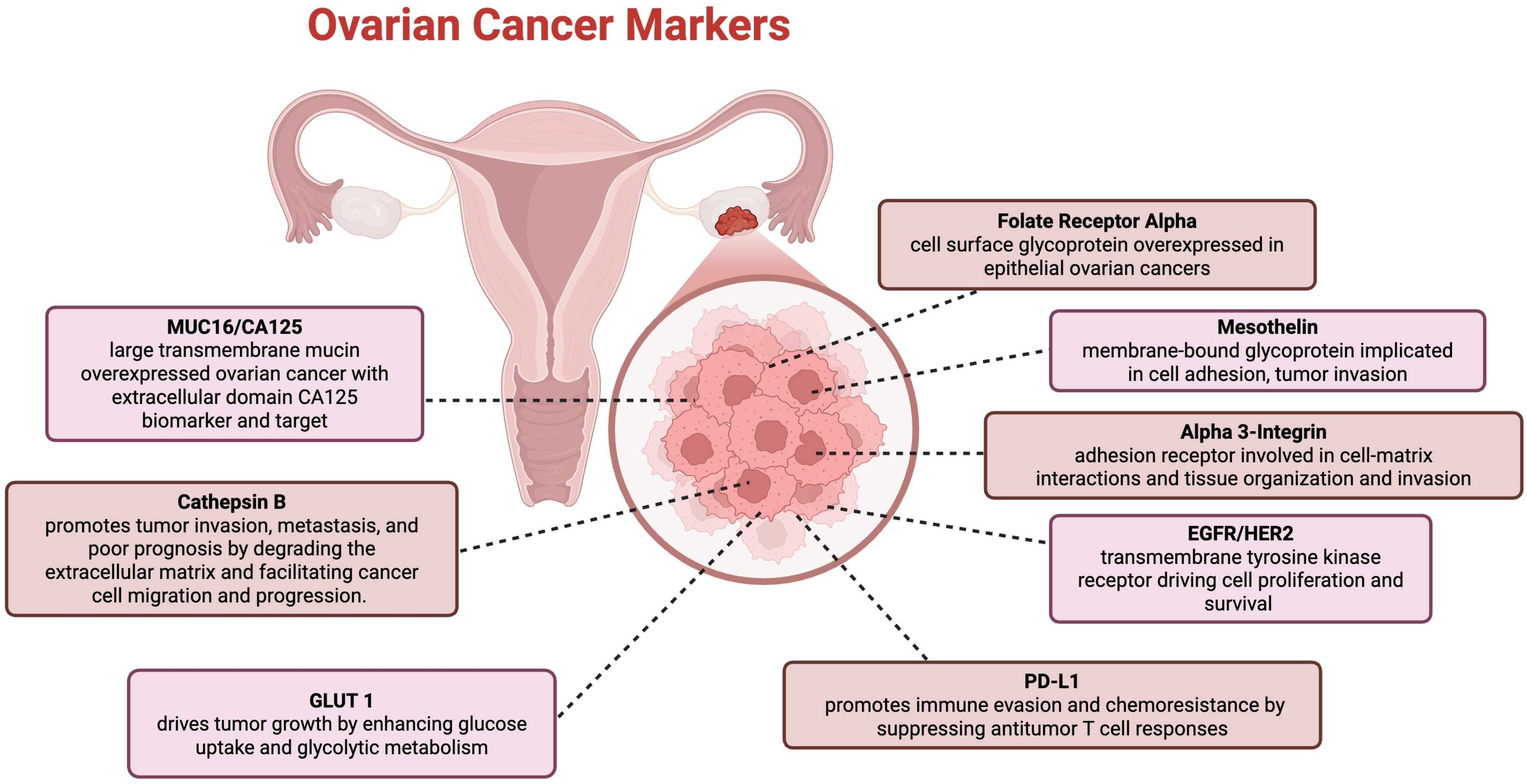


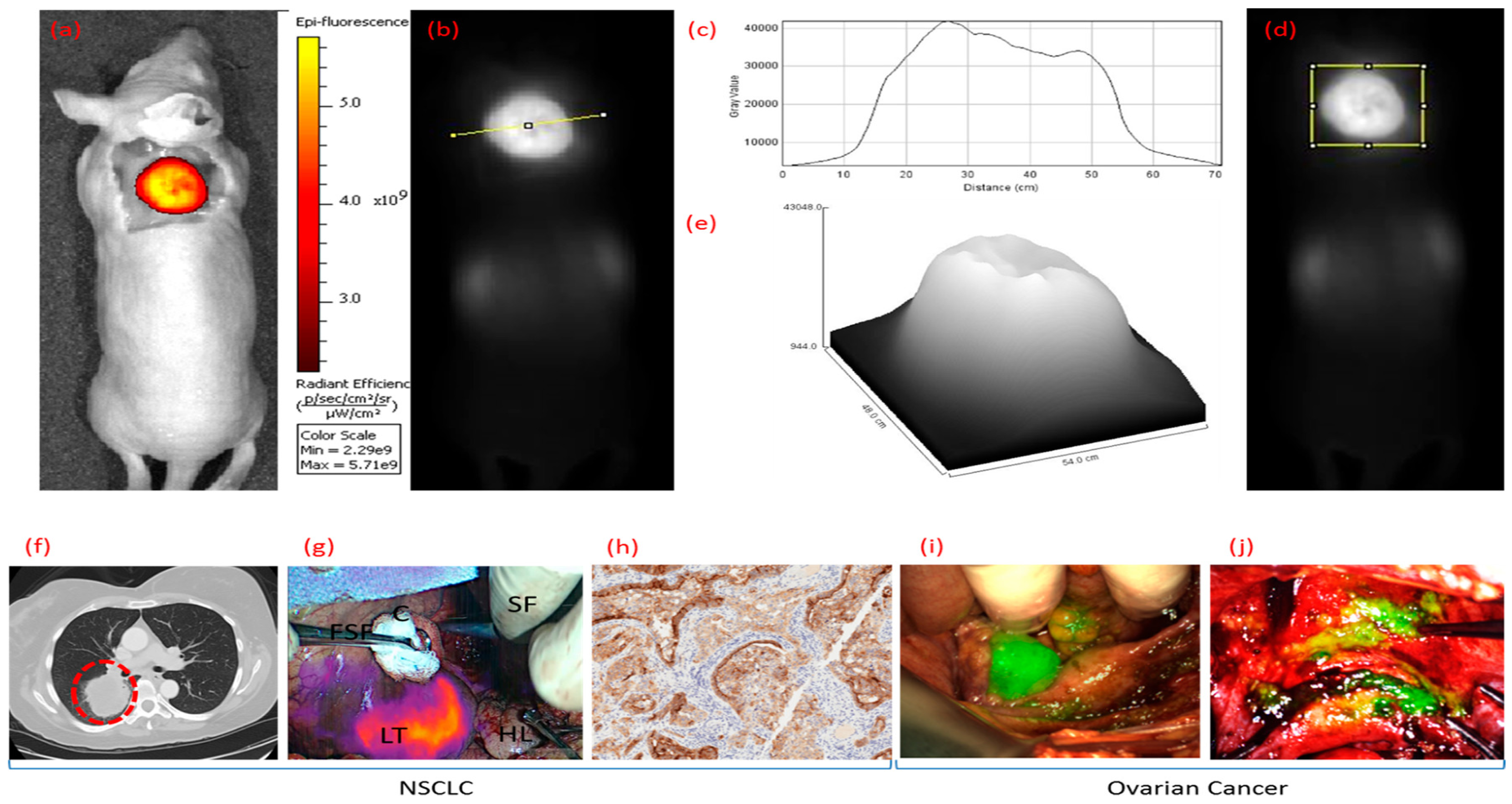



| Title of the Article and Citation | Target Agent, Study Design, and Animal Model/Clinical Trial Information | Key Findings or Outcome of the Study |
|---|---|---|
| Folate receptor-alpha | ||
| † A phase II, multicenter, open-label trial of OTL38 injection for the intra-operative imaging of folate receptor-alpha positive ovarian cancer, Randall et al., [46] | OTL38, a folate–indole–cyanine green-like conjugate targeting FRα, was evaluated in a Phase II, multicenter, open-label, prospective human clinical trial. | OTL38-based NIR imaging demonstrated a favorable safety and efficacy profile, achieving sensitivity of up to 97.97% and a positive predictive value of 94.93%, with 48.3% of patients having at least one additional malignant lesion detected exclusively by OTL38 and only mild drug-related adverse events reported. |
| Comparison of Five Near-Infrared Fluorescent Folate Conjugates in an Ovarian Cancer Model, García de Jalón et al., [47] | Five folate-conjugated NIR fluorophores, ZW800-1, ZW800-1 Forte, IRDye® 800CW, ICG-OSu, and an in-house Cy7 derivatives were evaluated in a comparative preclinical study using a subcutaneous SKOV-3 ovarian cancer xenograft mouse model, with systematic assessment of probe performance in both in vitro and in vivo settings. | The choice of fluorophore markedly influences biodistribution and tumor-to-background contrast, with ZW800-1 Forte demonstrating the highest tumor-specific contrast and specificity among the evaluated agents. |
| High Spatiotemporal Near-Infrared II Fluorescence Lifetime Imaging for Quantitative Detection of Clinical Tumor Margins, Chen et al., [48] | A folate receptor-targeted indocyanine green nanoprobe was evaluated in a comparative study using the SK-OV-3 ovarian cancer xenograft model, with systematic assessment of targeting and imaging performance across in vitro, in vivo (mouse), and ex vivo (human ovarian tumor tissue) platforms. | FL-tumor imaging using the folate receptor-targeted ICG nanoprobe enabled high-contrast, quantitative tumor margin delineation with superior accuracy (90%) and consistency compared with conventional NIR-II fluorescence imaging (58%), achieving a signal-to-background ratio of 10.8 and demonstrating highly specific targeting of folate receptor alpha. |
| † A Phase III Study of Pafolacianine Injection (OTL38) for Intraoperative Imaging of Folate Receptor–Positive Ovarian Cancer (Study 006) Tanyi et al., [44] | OTL38 was evaluated in a Phase III, open-label, multicenter (11 centers) confirmatory human clinical trial involving patients with known or suspected ovarian cancer scheduled for cytoreductive surgery; participants received 0.025 mg/kg IV pafolacianine at least one hour before surgery, and intraoperative NIR imaging was employed to detect malignant lesions. | In 33% of patients (95% CI, 24.3–42.7%) on tissue not planned for resection and undetectable by white light or palpation, exceeding the prespecified 10% threshold; ovarian cancer detection sensitivity was 83%, with a patient-level false-positive rate of 24.8%, and complete R0 cytoreduction was achieved in 62.4% of patients, while drug-related adverse events occurred in 30% (predominantly mild: nausea, vomiting, abdominal pain) with no serious drug-related events or deaths reported. |
| Membrane cholesterol enrichment and folic acid functionalization lead to increased accumulation of erythrocyte-derived optical nano-constructs within the ovarian intraperitoneal tumor implants in mice, Lee et al., [49] | Erythrocyte-derived nano-constructs encapsulating ICG, enhanced with membrane cholesterol and functionalized with folic acid to target folate receptor-α, were evaluated in a preclinical in vivo study using a mouse model with intraperitoneal ovarian tumor implants, enabling comparative assessment of tumor targeting and imaging performance. | Nano-constructs combining cholesterol enrichment and folic acid functionalization demonstrated approximately six-fold higher tumor accumulation than free ICG, two-fold greater uptake than cholesterol-only constructs, and 33% higher accumulation compared to FA-only constructs at 24 h post-injection, highlighting their enhanced efficacy for imaging ovarian tumors. |
| † Enhancing surgical precision in ovarian cancer with FRα-fluorescence-guided surgery, Ferrari et al., [50] | A systematic review encompassing 11 clinical and preclinical studies evaluated the safety, efficacy, and feasibility of folate receptor alpha-targeted fluorescence imaging in ovarian cancer surgery using agents such as OTL38 and EC-17 disodium salt (EC17), without introducing new animal models. | OTL38 markedly enhanced intraoperative detection of malignant lesions, identifying an additional 33% of tumors with sensitivity exceeding 85%, while EC17 proved feasible but was limited by tissue autofluorescence; most adverse events were mild, and overall, FRα-targeted imaging contributed to improved completeness of cytoreductive surgery. |
| Improved Intraoperative Detection of Ovarian Cancer by Folate Receptor Alpha Targeted Dual-Modality Imaging, Hekman et al., [51] | In a preclinical intraperitoneal ovarian cancer mouse model, this study evaluated 111In-farletuzumab-IRDye800CW for dual-modality imaging, with biodistribution assessed three days post-injection and FRα specificity confirmed by blocking studies and immunohistochemistry. | This study demonstrated that dual-modality imaging enabled specific visualization of intra-abdominal ovarian tumor lesions with minimal normal tissue uptake, allowing real-time fluorescence-guided resection. Competitive blocking with unlabeled farletuzumab confirmed FRα specificity, and the approach achieved favorable tumor-to-blood ratios (3.4–3.7), supporting its feasibility for intraoperative detection of ovarian cancer metastases. |
| † Intraoperative imaging of folate receptor alpha positive ovarian and breast cancer using the tumor specific agent EC17, Tummer et al., [52]. | In a prospective clinical study, patients with FRα-positive ovarian and breast cancer received intravenous EC17 prior to surgery, and intraoperative fluorescence imaging was performed to evaluate tumor detection, specificity, and sensitivity in correlation with histopathology and FRα expression, alongside safety and pharmacokinetic assessment. | In ovarian cancer patients, intraoperative EC17 fluorescence imaging identified 57 lesions, including 16% of malignant lesions missed by conventional inspection, with fluorescence correlating with FRα expression; however, high tissue autofluorescence limited specificity, particularly in breast cancer, despite an overall favorable safety profile. |
| The feasibility of folate receptor alpha- and HER2-targeted intraoperative fluorescence-guided cytoreductive surgery in women with epithelial ovarian cancer: A systematic review, de Jong et al., [53] | A systematic review of fluorescence-guided cytoreductive surgery (FGCS) evaluated FRα-targeted agents (e.g., OTL38, EC17) and HER2-targeted probes in both animal models of epithelial ovarian cancer (EOC) and human EOC patients, assessing their safety, tumor specificity, intraoperative detection efficacy, and impact on completeness of cytoreduction. | FGCS targeting FRα or HER2 is feasible in preclinical and clinical settings, improving intraoperative tumor detection with sensitivities up to 85.9% and true-positive rates of 75–77%. While false positives (10–25%), mainly from lymph nodes, remain a limitation, these approaches show strong potential to enhance cytoreduction, warranting further validation of survival benefit. |
| † A Novel Tumor-Specific Agent for Intraoperative Near-Infrared Fluorescence Imaging: A Translational Study in Healthy Volunteers and Patients with Ovarian Cancer, Hoogstins et al., [31] | OTL38 was evaluated in a translational Phase I/II study, demonstrating favorable safety and pharmacokinetics in healthy volunteers and ovarian cancer patients. | Intraoperative NIR imaging with OTL38 enabled detection of an additional 29% of malignant lesions not identified by inspection or palpation, with selective accumulation in FRα-positive tumors, supporting its feasibility and clinical utility for tumor-specific surgical guidance. |
| Human epidermal growth factor receptor 2 | ||
| NIR-II Aza-BODIPY Dyes Bioconjugated to Monoclonal Antibody Trastuzumab for Selective Imaging of HER2-Positive Ovarian Cancer, Godard et al., [54] | NIR-II aza-BODIPY dyes bioconjugated to trastuzumab were evaluated in a preclinical SKOV-3 HER2-positive ovarian cancer xenograft mouse model. | The bioconjugated NIR-II dyes demonstrated prolonged serum stability and preserved HER2-binding affinity, enabling selective, high-contrast in vivo imaging of HER2-positive ovarian tumors, thereby supporting their potential application in fluorescence-guided surgical resection. |
| Moderating hypoxia and promoting immunogenic photodynamic therapy by HER-2 nanobody conjugate nanoparticles for ovarian cancer treatment, Zhang et al., [55] | HER2-targeted nanobody-conjugated human serum albumin nanoparticles loaded with chlorin e6 (Ce6) and catalase (Nb@HCC) tested in HER2-positive SK-OV-3 ovarian tumors, enabling targeted photodynamic therapy. | Nb@HCC nanoparticles, when combined with NIR irradiation, effectively alleviated tumor hypoxia, downregulated HIF-1α expression, and induced immunogenic cell death, while promoting dendritic cell maturation; additionally, they synergized with anti-CTLA-4 therapy to suppress distant tumor growth, achieving potent antitumor effects with minimal systemic toxicity. |
| Virus-resembling nano-structures for near infrared fluorescence imaging of ovarian cancer HER2 receptors, Guerrero et al., [56] | Genome-depleted brome mosaic virus (BMV) nanoparticles, doped with ICG and covalently functionalized with anti-HER2 monoclonal antibodies, utilized to verify specific binding to HER2-expressing ovarian cancer cell lines in vitro, supporting their potential use as targeted NIR imaging agents for HER2-positive tumors. | Virus-mimicking nanostructures effectively targeted HER2-overexpressing ovarian cancer cells and enabled high-contrast NIR fluorescence imaging in vitro, highlighting their potential as precise, receptor-specific imaging platforms. |
| Functionalized polymeric nanoparticles loaded with indocyanine green as theranostic materials for targeted molecular near infrared fluorescence imaging and photothermal destruction of ovarian cancer cells, Bahmani et al., [57] | Anti-HER2 antibody-functionalized, PEGylated polymeric nanoparticles loaded with ICG tested for selective binding with HER2-high SKOV3 cells over HER2-low OVCAR3 cells, enabling targeted NIR fluorescence imaging and photothermal tumor cell ablation. | Functionalized nanoparticles demonstrate enhanced specificity for HER2-overexpressing ovarian cancer cells, provided superior NIR fluorescence imaging, and achieved markedly higher photothermal-mediated cell destruction compared to free ICG and non-targeted nanoparticle controls. |
| Optical Imaging of Ovarian Cancer Using HER-2 Affibody Conjugated Nanoparticles, Satpathy et al., [58] | This study aimed to develop and evaluate HER2-targeted iron oxide nanoparticles conjugated with an NIR dye for specific in vivo imaging of orthotopic ovarian cancer xenografts, integrating nanoparticle synthesis, tumor model establishment, and multimodal imaging to assess targeting efficiency and biodistribution. | HER-2 affibody-conjugated nanoparticles selectively accumulated in HER-2 positive ovarian tumors, enabling sensitive and specific noninvasive detection of both primary and disseminated tumors in the peritoneal cavity; multimodal imaging with a single agent was feasible. |
| Fluorescence Lifetime Imaging for Quantification of Targeted Drug Delivery in Varying Tumor Microenvironments, Verma et al., [59] | This study is about evaluating and quantifying the binding and distribution of the HER2-targeted monoclonal antibody trastuzumab (TZM) using NIR fluorescence resonance energy transfer (FRET) imaging in HER2-positive breast and ovarian cancer cell lines and xenograft mouse models, with validation by immunohistochemistry. | NIR FLI–FRET imaging quantitatively assessed trastuzumab–HER2 binding in vitro and in vivo, revealing lower antibody binding in SKOV-3 ovarian tumors than in breast cancer xenografts due to stromal and vascular barriers, and establishing FLI as a robust method to monitor antibody delivery and target engagement. |
| Near Infrared Photoimmunotherapy in the Treatment of Disseminated Peritoneal Ovarian Cancer, Sato et al., [60] | This investigation is aimed at evaluating the therapeutic potential of a trastuzumab-IRDye700DX antibody-photosensitizer conjugate (tra-IR700) for photoimmunotherapy (PIT) in HER2-positive ovarian cancer, including its cytotoxic effects in vitro (cell culture and 3D spheroids) and its efficacy in treating disseminated peritoneal and flank xenograft tumors in mouse models. | NIR-PIT induced light dose-dependent cytotoxicity in vitro and complete tumor cell killing in 3D spheroids; in vivo, NIR-PIT significantly reduced tumor volume and bioluminescence in both peritoneal and flank models compared to controls, demonstrating effective cell killing in HER2-positive disseminated ovarian cancer. |
| Virus-Mimicking Nanoparticles for Targeted Near Infrared Fluorescence Imaging of Intraperitoneal Ovarian Tumors in Mice, Vankayala et al., [61] | This study is aimed at evaluating the tumor-targeting efficiency and imaging performance of virus-mimicking nanoparticles (optical viral ghosts, OVGs) functionalized with anti-HER2 antibodies in a mouse model of intraperitoneal ovarian cancer, comparing them to non-functionalized OVGs and free dye using quantitative NIR fluorescence imaging. | Functionalized ovarian-targeting vesicles (OVGs) produced markedly higher tumor fluorescence and signal-to-noise ratios than non-functionalized controls and free dye, enabling enhanced tumor visualization at 24 h post-injection. |
| Improved Debulking of Peritoneal Tumor Implants by Near-Infrared Fluorescent Nanobody Image Guidance in an Experimental Mouse Model, Debie et al., [62] | This study evaluates the feasibility and efficacy of fluorescence-guided surgery using an IRDye800CW-labeled anti-HER2 nanobody in an intraperitoneal ovarian cancer mouse model, comparing tumor detection and resection outcomes against conventional surgical methods. | Fluorescence-guided surgery enabled clear visualization of submillimeter tumor nodules, significantly reduced residual tumor burden, increased sensitivity from 59.3% to 99.0%, and decreased false positive rate from 19.6% to 7.1% compared to conventional surgery. |
| Human epidermal growth factor receptor-2 antibodies enhance the specificity and anticancer activity of light-sensitive doxorubicin-labeled liposomes, Li et al., [63] | It examines the specificity, tumor-targeted accumulation, and therapeutic efficacy of HER2 antibody-conjugated liposomes containing doxorubicin and hollow gold nanospheres, using a dual HER2-positive and HER2-negative tumor mouse model with NIR irradiation. | HER2 antibody-conjugated liposomes showed >2-fold higher accumulation in HER2-positive tumors and, upon NIR irradiation, achieved up to 92.7% tumor growth inhibition without systemic toxicity through combined photothermal and chemotherapeutic effects. |
| Active Targeting Using HER-2-Affibody-Conjugated Nanoparticles Enabled Sensitive and Specific Imaging of Orthotopic HER-2 Positive Ovarian Tumors, Satpathy et al., [64] | This study aimed to investigate the targeting efficiency, biodistribution, and NIR imaging capability of HER2 affibody-conjugated magnetic iron oxide nanoparticles in an orthotopic ovarian cancer mouse model, comparing HER2-high and HER2-low tumor xenografts. | HER2-targeted iron oxide nanoparticles enabled highly sensitive dual-modality optical/MRI detection of ovarian tumors as small as 1 mm, with tumor uptake strictly dependent on HER2 overexpression. |
| Targeted Drug Delivery and Image-Guided Therapy of Heterogeneous Ovarian Cancer Using HER2-Targeted Theranostic Nanoparticles, Satpathy et al., [65] | It proposed to study the theranostic potential of amphiphilic polymer-coated magnetic iron oxide nanoparticles conjugated with NIR-labeled HER2 affibody and cisplatin, focusing on targeted drug delivery, imaging-guided therapy, and therapeutic efficacy in heterogeneous HER2-expressing orthotopic ovarian cancer xenografts. | HER2-targeted nanoparticles selectively delivered cisplatin to primary and metastatic tumors, with imaging signals correlating with HER2 expression and therapeutic response. Long retention of nanoparticles enabled detection of resistant residual tumors by molecular imaging. |
| Intraoperative Near-Infrared Fluorescence Tumor Imaging with Vascular Endothelial Growth Factor and Human Epidermal Growth Factor Receptor 2 Targeting Antibodies, Scheltinga et al., [66] | This study focused on evaluating bevacizumab (anti-VEGF) and trastuzumab (anti-HER2) conjugated to IRDye 800CW, with ^89Zr-labeled counterparts for PET imaging, in mice bearing subcutaneous and intraperitoneal ovarian cancer xenografts, assessing tumor uptake, biodistribution, and intraoperative imaging performance. | NIR fluorescence-labeled bevacizumab and trastuzumab enabled highly sensitive and specific in vivo detection of VEGF- and HER2-positive tumor lesions, including submillimeter deposits. Tumor-to-background ratios reached 1.93 ± 0.40 for bevacizumab and 2.92 ± 0.29 for trastuzumab at six days post-injection, with findings validated by histopathology, immunohistochemistry, and fluorescence microscopy |
| HER-2/neu targeted delivery of a nanoprobe enables dual photoacoustic and fluorescence tomography of ovarian cancer, Xi et al., [67] | This study investigates a HER-2/neu-targeted nanoprobe in an orthotopic human ovarian cancer xenograft mouse model, focusing on targeted delivery and dual-modality imaging performance in vivo. | HER-2/neu-targeted bevacizumab and trastuzumab enabled highly sensitive and specific in vivo detection of VEGF- and HER2-positive tumor lesions, including submillimeter deposits. Tumor-to-background ratios reached 1.93 ± 0.40 for bevacizumab and 2.92 ± 0.29 for trastuzumab at six days post-injection, with findings validated by histopathology, immunohistochemistry, and fluorescence microscopy |
| Epidermal growth factor receptor | ||
| Near-infrared fluorescent molecular probes with cetuximab in the in vivo fluorescence imaging for epithelial ovarian cancer, Zhang et al., [68] | This investigation explores Cetuximab-Cy7 in a subcutaneous SKOV3-Luc ovarian cancer xenograft mouse model, assessing nanoprobe development, targeted tumor uptake, distribution patterns, and imaging quantification. | Cetuximab-Cy7 selectively targeted EGFR-positive ovarian cancer xenografts, providing strong tumor-specific fluorescence with optimal imaging between 24 and 96 h post-injection. |
| NIR-II Navigation with an EGFR-Targeted Probe Improves Imaging Resolution and Sensitivity of Detecting Micrometastases in Esophageal Squamous Cell Carcinoma Xenograft Models, Wang et al., [69] | This investigation examines cetuximab-IR800 in esophageal squamous cell carcinoma mouse xenograft models, comparing the performance of NIR-I and NIR-II imaging for accurate tumor localization, detection of metastatic lymph nodes, and intraoperative surgical guidance. | In EGFR-positive esophageal cancer models, cetuximab-IR800 combined with NIR-II imaging significantly improved tumor contrast and enabled detection of subcentimeter metastases with enhanced spatial resolution. |
| The effect of subcellular localization on the efficiency of EGFR-targeted VHH photosensitizer conjugates, Lith et al., [70]. | This study shows how VHH 7D12 and VHH-CPP nanobodies conjugated to IRDye700DX are helpful to target EGFR-positive cancer cell lines and patient-derived ovarian cancer ascites cells, assessing how surface-bound versus internalized conjugates mediate phototoxicity upon light activation in vitro. | EGFR-targeted nanobody photosensitizer conjugates induced selective phototoxicity in EGFR-expressing cells, with superior efficacy observed for membrane-bound compared to internalized constructs. |
| Detection and Specific Elimination of EGFR+ Ovarian Cancer Cells Using a Near Infrared Photoimmunotheranostic Approach, Bauerschlag et al., [71] | It proposes the site-specific conjugation of IRDye700 to the EGFR-targeting scFv-425-SNAP-tag in EGFR-positive ovarian cancer cell lines and patient-derived tissues/ascites, evaluating NIR imaging capabilities and light-induced cytotoxicity in vitro and ex vivo. | These findings were further supported by studies demonstrating highly specific detection and elimination of EGFR-positive ovarian cancer cells and patient-derived ascites cells, with IC50 values in the low nanomolar range, establishing a framework for precise EGFR-directed theranostic conjugates. |
| Cathepsin B | ||
| In vivo near-infrared imaging and phototherapy of tumors using a cathepsin B-activated fluorescent probe, Chen et al., [72] | It aims to assess a Cathepsin B-activated fluorescent probe (CyA-P-CyB) in mouse tumor xenograft models, evaluating its specificity, near-infrared imaging performance, and phototherapeutic efficacy in both in vitro and in vivo settings. | Cathepsin B-responsive probes enabled tumor-specific NIR fluorescence activation and phototoxicity, with minimal off-target signal and no detectable toxicity in major organs. |
| Optical Imaging of Cancer-Related Proteases Using Near-Infrared Fluorescence Matrix Metalloproteinase-Sensitive and Cathepsin B-Sensitive Probes, Yhee et al., [73] | This study evaluates role of a Cathepsin B-sensitive polymer nanoparticle probe in mouse tumor xenograft models via enzyme-responsive activation approach. This study reports tumor-targeted imaging, and comparative performance in both in vitro and in vivo settings. | These probes exhibited cytoplasmic fluorescence recovery following enzymatic cleavage, supporting their utility for evaluating cytoplasmic drug delivery. |
| A folate receptor-specific activatable probe for near-infrared fluorescence imaging of ovarian cancer, Lee et al., [74] | The objective of this study is to identify a folate receptor-targeted, Cathepsin B-activatable probe in mouse ovarian cancer xenograft models, assessing its selective in vivo activation, tumor-specific near-infrared imaging, and potential for real-time lesion visualization. | Fluorescence activation occurred selectively after cathepsin B-mediated cleavage in folate receptor-positive cancer cells, further enhancing tumor specificity. |
| Glucose Transporter 1 | ||
| Expression of GLUT-1 glucose transfer, cellular proliferation activity and grade of tumor correlate with [F-18]-fluorodeoxyglucose uptake by positron emission tomography in epithelial tumors of the ovary, Kurokawa et al., [75] | This study assesses imaging capabilities of [18F]-FDG PET in ovarian cancer patients, focusing on GLUT1-mediated tracer uptake for tumor detection, metabolic activity assessment, and correlation with clinical and pathological features. | FDG uptake (SUV) strongly correlates with GLUT1 expression and tumor grade, noninvasive biomarker for ovarian cancer. |
| Mesothelin | ||
| Molecular Imaging of Mesothelin-Expressing Ovarian Cancer with a Human and Mouse Cross-Reactive Nanobody, Prantner et al., [76] | The nanobody NbG3a potential as NIRF and MRI agent. It uses subcutaneous A1847 xenografts and syngeneic orthotopic ID8 ovarian cancer models, to assess in vivo imaging performance, biodistribution, and epitope specificity. | Rapid, specific tumor accumulation; detectable at 4 h, persists to 48 h; diffuse intratumoral distribution. |
| Rapid nanobody-based imaging of mesothelin expressing malignancies compatible with blocking therapeutic antibodies, Benloucif et al., [77] | This study utilizes an anti-mesothelin nanobody toward mesothelin-positive tumor xenografts, focusing on in vivo PET imaging performance and tracer localization. | Demonstrated same-day imaging capability and good target specificity. |
| CA125 (Mucin 16) | ||
| Engineering of a Fully Human Anti-MUC-16 Antibody and Evaluation as a PET Imaging Agent, Babeker et al., [78] | To study outcomes of a fully human monoclonal antibody M16Ab, DFO-conjugated and 89Zr-labeled, in OVCAR3, SKOV3, and SW1990 xenograft models, assessing in vivo PET imaging over 24–120 h post-injection and ex vivo biodistribution. | Specific uptake in MUC16-expressing tumors; retention up to 120 h; high tumor-to-blood ratios; minimal uptake in negative controls (SKOV3). |
| A Molecularly Targeted Intraoperative Near-Infrared Fluorescence Imaging Agent for High-Grade Serous Ovarian Cancer, Fung et al., [45] | A preclinical study to examine B43.13-IR800, a CA125-targeting antibody conjugated to IRDye 800CW, in subcutaneous, orthotopic, and patient-derived xenograft models of high-grade serous ovarian cancer, focusing on site-specific conjugation, in vitro binding, in vivo imaging, and validation using human tumor samples. | B43.13-IR800 specifically binds CA125-expressing ovarian cancer cells and enables sensitive NIRF imaging of HGSOC tumors in mouse models; probe also binds and identifies CA125-expressing cells in human primary tumor and metastatic lymph node samples. |
| PD-L1 | ||
| Imaging PD-L1 Expression with ImmunoPET, Truillet et al., [79] | To evaluate the role of 89Zr-labeled human IgG1 antibody C4 for tumor uptake and biodistribution using PET/CT in xenograft models. | 89Zr-C4 detected low levels of PD-L1 in tumors; strong specificity; could detect changes in post treatment. |
| Anti-Human PD-L1 Nanobody for Immuno-PET Imaging: Validation of a Conjugation Strategy for Clinical Translation, Bridoux et al., [80] | Ga-68-labeled PD-L1 nanobody testing for in vivo tumor targeting and biodistribution in xenograft models. | Specific tumor uptake (~1.8%IA/g), good targeting, renal clearance, stable in vivo. |
| Immuno-PET Imaging of Tumour PD-L1 Expression in Glioblastoma, Sharma et al., [81] | ImmunoPET imaging capacity of novel 18F-AlF- and 68Ga-labeled Z_PD-L1 affibody, and evaluating its biodistribution, and correlation with PD-L1 expression in subcutaneous and orthotopic GBM xenograft models. | Could discriminate high vs. low PD-L1 expression, fast clearance, high contrast even at 1 h post injection. |
| PD-L1 near Infrared Photoimmunotherapy of Ovarian Cancer Model, Jin et al., [82] | The application of an anti-PD-L1 antibody–dye conjugate in a syngeneic orthotopic ovarian cancer mouse model, assessing its performance for in vivo NIR imaging, photoimmunotherapy, and real-time tumor visualization. | The PD-L1 probe localized tumors; imaging guided therapeutic effect in ovarian cancer model. |
| α3 Integrin | ||
| Near-Infrared Optical Imaging of Ovarian Cancer Xenografts with Novel α3-Integrin Binding Peptide “OA02”, Aina et al., [83] | The fate of α3-integrin-targeting peptide “OA02” labeled with Cy5.5 or AlexaFluor in nude mice bearing ES-2 (α3-positive) and Raji (α3-negative) xenografts, evaluating in vivo NIR imaging specificity and blocking effects. | Rapid, selective tumor uptake within 15 min; lasted up to ~70 min for some probes; binding blocked by anti-α3 antibody. |
Disclaimer/Publisher’s Note: The statements, opinions and data contained in all publications are solely those of the individual author(s) and contributor(s) and not of MDPI and/or the editor(s). MDPI and/or the editor(s) disclaim responsibility for any injury to people or property resulting from any ideas, methods, instructions or products referred to in the content. |
© 2026 by the authors. Licensee MDPI, Basel, Switzerland. This article is an open access article distributed under the terms and conditions of the Creative Commons Attribution (CC BY) license.
Share and Cite
Phillip, A.; Karithara, A.; Chauhan, S.C.; Yallapu, M.M. Emerging Near-Infrared Targeted Imaging Pharmaceutics for Ovarian Cancer. Pharmaceutics 2026, 18, 574. https://doi.org/10.3390/pharmaceutics18050574
Phillip A, Karithara A, Chauhan SC, Yallapu MM. Emerging Near-Infrared Targeted Imaging Pharmaceutics for Ovarian Cancer. Pharmaceutics. 2026; 18(5):574. https://doi.org/10.3390/pharmaceutics18050574
Chicago/Turabian StylePhillip, Angel, Annu Karithara, Subhash C. Chauhan, and Murali M. Yallapu. 2026. "Emerging Near-Infrared Targeted Imaging Pharmaceutics for Ovarian Cancer" Pharmaceutics 18, no. 5: 574. https://doi.org/10.3390/pharmaceutics18050574
APA StylePhillip, A., Karithara, A., Chauhan, S. C., & Yallapu, M. M. (2026). Emerging Near-Infrared Targeted Imaging Pharmaceutics for Ovarian Cancer. Pharmaceutics, 18(5), 574. https://doi.org/10.3390/pharmaceutics18050574