Nanoparticle Strategies for Bone Metastasis Immunotherapy: Targeting, Immune Reprogramming and Combination Therapy

 ,
, 
Abstract
1. Introduction
2. Engineering Strategies for Bone-Targeted Immunomodulatory Nanoparticles
2.1. Design Principles and Targeting Moieties for Bone-Directed Nanoparticles
2.1.1. Taxonomy and Functional Roles of Nanoparticle Modalities
2.1.2. Bone-Targeting Ligands
2.1.3. Bone-Targeting Peptides
2.1.4. Antibodies and Aptamers
2.2. Multifunctional Surface Engineering
2.2.1. Dual-Targeting Systems
2.2.2. Stealth Coatings
2.3. Bone Lesion Architecture and Design Implications: Osteolytic Versus Osteoblastic Metastases
2.4. Enzyme-Responsive Nanocarriers
2.5. Physically Guided Targeting
2.5.1. Magnetic Nanoparticles
2.5.2. Photothermal Nanoparticles
3. Immunological Interactions of NPs in the Bone Metastatic Niche
3.1. Myeloid Cell Modulation: Reprogramming TAMs from M2 to M1
3.2. Enhancing T-Cell Recruitment and Function
3.2.1. Local Delivery of Immune-Stimulatory Cytokines
3.2.2. Reversal of T-Cell Exhaustion
3.3. Activating Dendritic Cells (DCs)
3.3.1. Nanovaccines
3.3.2. In Situ Vaccination at Bone Lesions
4. Gene and RNA Delivery
4.1. Nucleic Acid-Based Nanotherapeutics for Modulating Bone Metastatic Pathways
4.1.1. siRNA Delivery Targeting Metastatic and Osteo-Modulatory Pathways
4.1.2. mRNA Nanoparticles for Immune Activation in Bone Metastasis
4.1.3. CRISPR/Cas9 Nanoparticle Systems for Durable Pathway Reprogramming
4.2. Photothermal (PTT) and Photodynamic Therapy (PDT)
4.2.1. Mechanistic Basis: Nanoparticle-Enabled ICD and Antigen Release
4.2.2. Combined Nano-PTT and Immunotherapy
4.3. Nanoparticle-Mediated Checkpoint Blockade
4.3.1. Organ-Specific and Systemic Immunologic Consequences of Bone Metastasis
4.3.2. Bone Metastatic Niche Mechanisms That Blunt PD-1 and PD-L1 Efficacy
4.3.3. Nanoparticle-Enabled Strategies That Mechanistically Sensitize Bone Lesions to Checkpoint Blockade
4.3.4. Spatial Confinement, Bone Targeting, and Therapeutic-Index Logic
4.4. Nanoparticle-Enabled Cancer Vaccination Strategies
5. Synergy with Conventional Therapies
5.1. Chemotherapy–Nanoparticle Synergy in Bone Metastasis
5.1.1. Immunogenic Cell Death as a Skeletal Immune-Priming Event
5.1.2. Chemotherapy-Induced PD-L1 Adaptation and Checkpoint Escape
5.1.3. Myeloid Reprogramming and Osteoclast–Immune Coupling
5.1.4. Bone-Targeted Co-Delivery and Therapeutic-Index Optimization
5.2. Bone-Modifying Agents and Nanoparticles
5.2.1. Osteoclast Inhibition and Interruption of the Tumor–Bone Vicious Cycle
5.2.2. RANKL Pathway Targeting and Immune Modulation
5.2.3. Targeting TGF-β and Osteoclast-Linked Immune Checkpoints
5.2.4. Therapeutic-Index Optimization Through Bone-Targeted Nanocarriers
5.3. Emerging Multi-Modal Nanoparticle Platforms: Integrative Disruption of the Bone Metastatic Niche
5.3.1. Chemo-Immuno-Osteoclast Integrated Platforms
5.3.2. Targeting Osteoimmune Checkpoints and Systemic Bone-Derived Signals
5.3.3. TGF-β Modulation and Microenvironmental Reprogramming
5.3.4. Systems-Level Therapeutic Index Optimization
6. Safety, Pharmacokinetics, and Translational Barriers
6.1. Biological Barriers: Safety, Immune Trade-Offs, Osteoimmunology, and Tumor Heterogeneity
6.2. Engineering Barriers: Manufacturing and Stability Challenges
6.3. Regulatory Barriers: Standardization and Clinical Evaluation
6.4. Current Clinical Landscape and Translational Outlook
7. Preclinical Models and Evaluation
7.1. Immune-Competent Models
7.2. Humanized Mouse Models
7.3. Bone Organoids and Ex Vivo Systems
7.4. Translational Limitations of Current Preclinical Models
7.5. Evaluation Endpoints
8. Conclusions and Future Directions
Author Contributions
Funding
Data Availability Statement
Acknowledgments
Conflicts of Interest
Abbreviations
| Abbreviation | Full Terminology/Definition |
| ABC | Accelerated Blood Clearance |
| ADC | Antibody–Drug Conjugate |
| ALD/ALN | Alendronate |
| ALP | Alkaline Phosphatase |
| AMF | Alternating Magnetic Field |
| AP-1 | Activator Protein 1 |
| APC | Antigen-Presenting Cell |
| AR | Androgen Receptor |
| ARG1 | Arginase-1 |
| ATO | Arsenic Trioxide |
| ATP | Adenosine Triphosphate |
| AUC | Area Under the Curve |
| BMA(s) | Bone-Modifying Agent(s) |
| BMDC(s) | Bone Marrow-Derived Dendritic Cell(s) |
| BMP(s) | Bone Morphogenetic Protein(s) |
| BP(s) | Bisphosphonate(s) |
| BPNS(s) | Black Phosphorus Nanosheet(s) |
| BTNPs | Bone-Targeting Nanoparticles |
| BV/TV | Bone Volume/Total Volume (Trabecular Bone Volume Fraction) |
| Tb.N | trabecular number |
| CARPA | Complement Activation-Related Pseudoallergy |
| CaP | Calcium Phosphate |
| CaZol NiM | Calcium–Zoledronate Nanoparticles Embedded in Microparticles |
| CBD | Collagen-Binding Domain |
| CCL5 | C-C Motif Chemokine Ligand 5 |
| cDC1 | Conventional Type 1 Dendritic Cell |
| cGAMP (2′3′-cGAMP) | Cyclic GMP-AMP |
| cGAS | Cyclic GMP-AMP Synthase |
| CHI | Chitosan |
| CLEC9A | C-Type Lectin Domain Family 9 Member A |
| CpG | Cytosine-Phosphate-Guanine Oligonucleotide |
| CRISPR | Clustered Regularly Interspaced Short Palindromic Repeats |
| CRISPR/Cas9 | Clustered Regularly Interspaced Short Palindromic Repeats/CRISPR-Associated Protein 9 |
| CRS | Cytokine Release Syndrome |
| CRT | Calreticulin |
| CTL | Cytotoxic T Lymphocyte |
| CTSK | Cathepsin K |
| CXCL9 | C-X-C Motif Chemokine Ligand 9 |
| CXCL10 | C-X-C Motif Chemokine Ligand 10 |
| CXCR4 | C-X-C Chemokine Receptor Type 4 |
| CyPA | Cyclophilin A |
| DAC | Decitabine |
| DAMP(s) | Damage-Associated Molecular Pattern(s) |
| DC(s) | Dendritic Cell(s) |
| Dkk1 | Dickkopf-Related Protein 1 |
| DOX | Doxorubicin |
| ECM | Extracellular Matrix |
| EMT | Epithelial-to-Mesenchymal Transition |
| EPR | Enhanced Permeability and Retention |
| ER | Endoplasmic Reticulum |
| ET-1 | Endothelin-1 |
| FDG | Fluorodeoxyglucose |
| GM-CSF | Granulocyte-Macrophage Colony-Stimulating Factor |
| HAP | Hydroxyapatite |
| HMGB1 | High Mobility Group Box 1 |
| HSP(s) | Heat Shock Protein(s) |
| HSP70 | Heat Shock Protein 70 |
| HSPC(s) | Hematopoietic Stem and Progenitor Cell(s) |
| ICD | Immunogenic Cell Death |
| ICI(s) | Immune Checkpoint Inhibitor(s) |
| IDO-1 | Indoleamine 2,3-Dioxygenase 1 |
| IFN-β | Interferon-Beta |
| IFN-γ | Interferon-Gamma |
| IL-1β | Interleukin-1 Beta |
| IL-2 | Interleukin-2 |
| IL-4 | Interleukin-4 |
| IL-6 | Interleukin-6 |
| IL-10 | Interleukin-10 |
| IL-12 | Interleukin-12 |
| IL-27 | Interleukin-27 |
| IL-30 | Interleukin-30 |
| IONP(s) | Iron Oxide Nanoparticle(s) |
| IRF | Interferon Regulatory Factor |
| IRF3 | Interferon Regulatory Factor 3 |
| iRGD | Internalizing Arginine-Glycine-Aspartate Peptide |
| JAK | Janus Kinase |
| KRAS | Kirsten Rat Sarcoma Viral Oncogene Homolog |
| LLC | Lewis Lung Carcinoma |
| LNP(s) | Lipid Nanoparticle(s) |
| MDS | Myelodysplastic Syndrome |
| MDSC(s) | Myeloid-Derived Suppressor Cell(s) |
| MHC I | Major Histocompatibility Complex I |
| MHC II | Major histocompatibility complex class II |
| HPAA | Hyperbranched poly(amido amine) |
| MHT | Magnetic Hyperthermia |
| miRNA | MicroRNA |
| MM | Multiple Myeloma |
| MMP-2 | Matrix Metalloproteinase-2 |
| MMP-9 | Matrix Metalloproteinase-9 |
| MOF | Metal–Organic Framework |
| mPEG | Methoxy Polyethylene Glycol |
| MPS | Mononuclear Phagocyte System |
| mRNA | Messenger RNA |
| MRI | Magnetic Resonance Imaging |
| mTOR | Mammalian Target of Rapamycin |
| MyD88 | Myeloid Differentiation Primary Response 88 |
| N-BP | Nitrogen-Containing Bisphosphonate |
| NBCD(s) | Non-Biological Complex Drug(s) |
| ncRNA | Non-Coding RNA |
| NF-κB | Nuclear Factor Kappa B |
| NIR | Near-Infrared |
| NK | Natural Killer (Cell) |
| mPLA | monophosphoryl lipid A |
| NOD/SCID | Non-Obese Diabetic/Severe Combined Immunodeficient |
| NP(s) | Nanoparticle(s) |
| NSG | NOD Scid Gamma |
| NSCLC | Non-Small Cell Lung Cancer |
| OPN | Osteopontin |
| PBA | Phenylboronic Acid |
| PBMC(s) | Peripheral Blood Mononuclear Cell(s) |
| PD-1 | Programmed Cell Death Protein 1 |
| PD-L1 | Programmed Death-Ligand 1 |
| PDT | Photodynamic Therapy |
| PEG | Polyethylene Glycol |
| PEI | Polyethylenimine |
| PET | Positron Emission Tomography |
| PLGA | Poly(Lactic-co-Glycolic Acid) |
| PMOA | Primary Mode of Action |
| poly(I:C) | Polyinosinic:Polycytidylic Acid |
| PSMA | Prostate-Specific Membrane Antigen |
| PTHrP | Parathyroid Hormone-Related Protein |
| PTT | Photothermal Therapy |
| PTX | Paclitaxel |
| QbD | Quality by Design |
| RANKL | Receptor Activator of Nuclear Factor Kappa-B Ligand |
| RBC | Red Blood Cell |
| RES | Reticuloendothelial System |
| RGD | Arginine-Glycine-Aspartate |
| ROS | Reactive Oxygen Species |
| sgRNA | Single-Guide RNA |
| SHH | Sonic Hedgehog |
| Siglec-15 | Sialic Acid-Binding Immunoglobulin-Like Lectin 15 |
| siRNA | Small Interfering RNA |
| SIRS | Systemic Inflammatory Response Syndrome |
| SPION(s) | Superparamagnetic Iron Oxide Nanoparticle(s) |
| STAT1 | Signal Transducer and Activator of Transcription 1 |
| STAT4 | Signal Transducer and Activator of Transcription 4 |
| STING | Stimulator of Interferon Genes |
| TAM(s) | Tumor-Associated Macrophage(s) |
| TBK1 | TANK-Binding Kinase 1 |
| TGF-β | Transforming Growth Factor Beta |
| Th1 | T Helper 1 (Cell) |
| TIM-3 | T-cell Immunoglobulin and Mucin-Domain Containing-3 |
| TLR | Toll-Like Receptor |
| TNF-α | Tumor Necrosis Factor Alpha |
| Treg(s) | Regulatory T-cell(s) |
| TRIF | TIR-Domain-Containing Adapter-Inducing Interferon-Beta |
| µCT | Micro-Computed Tomography |
| ZEB1 | Zinc Finger E-Box Binding Homeobox 1 |
| ZIF-8 | Zeolitic Imidazolate Framework-8 |
| ZOL | Zoledronate |
References
- Li, S.; Peng, Y.; Weinhandl, E.D.; Blaes, A.H.; Cetin, K.; Chia, V.M.; Stryker, S.; Pinzone, J.J.; Acquavella, J.F.; Arneson, T.J. Estimated Number of Prevalent Cases of Metastatic Bone Disease in the US Adult Population. Clin. Epidemiol. 2012, 4, 87–93. [Google Scholar] [CrossRef]
- Hernandez, R.K.; Wade, S.W.; Reich, A.; Pirolli, M.; Liede, A.; Lyman, G.H. Incidence of Bone Metastases in Patients with Solid Tumors: Analysis of Oncology Electronic Medical Records in the United States. BMC Cancer 2018, 18, 44. [Google Scholar] [CrossRef]
- Tsuzuki, S.; Park, S.H.; Eber, M.R.; Peters, C.M.; Shiozawa, Y. Skeletal Complications in Cancer Patients with Bone Metastases. Int. J. Urol. 2016, 23, 825–832. [Google Scholar] [CrossRef]
- Cheng, X.; Wang, Z. Immune Modulation of Metastatic Niche Formation in the Bone. Front. Immunol. 2021, 12, 765994. [Google Scholar] [CrossRef]
- Bakir, M.; Dabaliz, A.; Dawalibi, A.; Mohammad, K.S. Microenvironmental and Molecular Pathways Driving Dormancy Escape in Bone Metastases. Int. J. Mol. Sci. 2025, 26, 11893. [Google Scholar] [CrossRef]
- Mundy, G.R. Metastasis to bone: Causes, consequences and therapeutic opportunities. Nat. Rev. Cancer 2002, 2, 584–593. [Google Scholar] [CrossRef]
- Yoneda, T.; Hiraga, T. Crosstalk between Cancer Cells and Bone Microenvironment in Bone Metastasis. Biochem. Biophys. Res. Commun. 2005, 328, 679–687. [Google Scholar] [CrossRef]
- Guise, T.A.; Mohammad, K.S.; Clines, G.; Stebbins, E.G.; Wong, D.H.; Higgins, L.S.; Vessella, R.; Corey, E.; Padalecki, S.; Suva, L.; et al. Basic Mechanisms Responsible for Osteolytic and Osteoblastic Bone Metastases. Clin. Cancer Res. 2006, 12, 6213s–6216s. [Google Scholar] [CrossRef] [PubMed]
- Dawalibi, A.; Bakir, M.; Mohammad, K.S. The Genetic Architecture of Bone Metastases: Unveiling the Role of Epigenetic and Genetic Modifications in Drug Resistance. Cancer Drug Resist. 2025, 8, 19. [Google Scholar] [CrossRef]
- Gabrilovich, D.I.; Nagaraj, S. Myeloid-Derived Suppressor Cells as Regulators of the Immune System. Nat. Rev. Immunol. 2009, 9, 162–174. [Google Scholar] [CrossRef] [PubMed]
- Bakir, M.; Dabaliz, A.; Raddaoui, M.; Fatash, H.; Elsaadany, N.; AlKattan, W.; Mohammad, K.S. The Neuro–Bone Axis in Metastatic Progression: Innervation, Neuro-Immune–Osteoclast Crosstalk, and Therapeutic Opportunities. Biology 2026, 15, 364. [Google Scholar] [CrossRef]
- Zheng, S.; Wang, W.; Shen, L.; Yao, Y.; Xia, W.; Ni, C. Tumor battlefield within inflamed, excluded or desert immune phenotypes: The mechanisms and strategies. Exp. Hematol. Oncol. 2024, 13, 80. [Google Scholar] [CrossRef]
- Shiravand, Y.; Khodadadi, F.; Kashani, S.M.A.; Hosseini-Fard, S.R.; Hosseini, S.; Sadeghirad, H.; Ladwa, R.; O’Byrne, K.; Kulasinghe, A. Immune Checkpoint Inhibitors in Cancer Therapy. Curr. Oncol. 2022, 29, 3044–3060. [Google Scholar] [CrossRef]
- Nishijima, T.F.; Shachar, S.S.; Nyrop, K.A.; Muss, H.B. Safety and tolerability of PD-1/PD-L1 inhibitors compared with chemotherapy in patients with advanced cancer: A meta-analysis. Oncologist 2017, 22, 470–479. [Google Scholar] [CrossRef]
- Joseph, G.J.; Johnson, D.B.; Johnson, R.W. Immune Checkpoint Inhibitors in Bone Metastasis: Clinical Challenges, Toxicities, and Mechanisms. J. Bone Oncol. 2023, 43, 100505. [Google Scholar] [CrossRef] [PubMed]
- Hamza, F.N.; Mohammad, K.S. Immunotherapy in the Battle Against Bone Metastases: Mechanisms and Emerging Treatments. Pharmaceuticals 2024, 17, 1591. [Google Scholar] [CrossRef] [PubMed]
- Guan, Y.; Zhang, W.; Mao, Y.; Li, S. Nanoparticles and Bone Microenvironment: A Comprehensive Review for Malignant Bone Tumor Diagnosis and Treatment. Mol. Cancer 2024, 23, 246. [Google Scholar] [CrossRef] [PubMed]
- Imani, S.; Moradi, S.; Faraj, T.A.; Hassanpoor, P.; Musapour, N.; Najmaldin, S.K.; Abdulhamd, A.H.; Mohammadi, A.T.; Taha, C.H.; Aminnezhad, S. Nanoparticle Technologies in Precision Oncology and Personalized Vaccine Development: Challenges and Advances. Int. J. Pharm. X 2025, 10, 100353. [Google Scholar] [CrossRef]
- Cheng, Z.; Li, Y.; Zhao, D.; Zhao, W.; Wu, M.; Zhang, W.; Cui, Y.; Zhang, P.; Zhang, Z. Nanocarriers for Intracellular Co-Delivery of Proteins and Small-Molecule Drugs for Cancer Therapy. Front. Bioeng. Biotechnol. 2022, 10, 994655. [Google Scholar] [CrossRef]
- Li, J.; Yang, C.; Wang, L.; Li, S. Multifunctional Nanoplatforms Deciphering Immune Resistance in Bone Tumors: Cooperative Delivery, Immune Reprogramming and Microenvironment Remodeling. J. Nanobiotechnol. 2026, 24, 356. [Google Scholar] [CrossRef]
- Sivadasan, D.; Sultan, M.H.; Madkhali, O.; Almoshari, Y.; Thangavel, N. Polymeric Lipid Hybrid Nanoparticles (PLNs) as Emerging Drug Delivery Platform—A Comprehensive Review of Their Properties, Preparation Methods, and Therapeutic Applications. Pharmaceutics 2021, 13, 1291. [Google Scholar] [CrossRef] [PubMed]
- Lazareva, P.; Chulanov, V.; Kostyushev, D.; Abakumov, M. In Vivo Behavior of Biomimetic Nanoparticles: Strategies for Clearance Avoidance, Targeting, and Functional Delivery. Molecules 2025, 30, 4487. [Google Scholar] [CrossRef]
- Ganji, F.; Eshaghi, M.; Shaki, H.; Tayebi, L. Targeting Bone in Cancer Therapy: Advances and Challenges of Bisphosphonate-Based Drug Delivery Systems: Review Article. ADMET DMPK 2025, 13, 2756. [Google Scholar] [CrossRef]
- Xu, Y.; Qi, J.; Sun, W.; Zhong, W.; Wu, H. Therapeutic Effects of Zoledronic Acid-Loaded Hyaluronic Acid/Polyethylene Glycol/Nano-Hydroxyapatite Nanoparticles on Osteosarcoma. Front. Bioeng. Biotechnol. 2022, 10, 897641. [Google Scholar] [CrossRef]
- Rodríguez-Nogales, C.; Desmaële, D.; Sebastián, V.; Couvreur, P.; Blanco-Prieto, M.J. Decoration of Squalenoyl-Gemcitabine Nanoparticles with Squalenyl-Hydroxybisphosphonate for the Treatment of Bone Tumors. ChemMedChem 2021, 16, 3730–3738. [Google Scholar] [CrossRef] [PubMed]
- Ebetino, F.H.; Sun, S.; Cherian, P.; Roshandel, S.; Neighbors, J.D.; Hu, E.; Dunford, J.E.; Sedghizadeh, P.P.; McKenna, C.E.; Srinivasan, V.; et al. Bisphosphonates: The Role of Chemistry in Understanding Their Biological Actions and Structure-Activity Relationships, and New Directions for Their Therapeutic Use. Bone 2022, 156, 116289. [Google Scholar] [CrossRef]
- Wu, Y.; Sun, B.; Tang, Y.; Shen, A.; Lin, Y.; Zhao, X.; Li, J.; Monteiro, M.J.; Gu, W. Bone Targeted Nano-Drug and Nano-Delivery. Bone Res. 2024, 12, 51. [Google Scholar] [CrossRef]
- Jing, C.; Li, B.; Tan, H.; Zhang, C.; Liang, H.; Na, H.; Chen, S.; Liu, C.; Zhao, L. Alendronate-Decorated Nanoparticles as Bone-Targeted Alendronate Carriers for Potential Osteoporosis Treatment. ACS Appl. Bio Mater. 2021, 4, 4907–4916. [Google Scholar] [CrossRef]
- Zheng, L.; Zhuang, Z.; Li, Y.; Shi, T.; Fu, K.; Yan, W.; Zhang, L.; Wang, P.; Li, L.; Jiang, Q. Bone Targeting Antioxidative Nano-Iron Oxide for Treating Postmenopausal Osteoporosis. Bioact. Mater. 2022, 14, 250–261. [Google Scholar] [CrossRef]
- Rahman, M.A.; Ochiai, B. A Facile Aqueous Production of Bisphosphonated-Polyelectrolyte Functionalized Magnetite Nanoparticles for pH-Specific Targeting of Acidic-Bone Cells. RSC Adv. 2022, 12, 8043–8058. [Google Scholar] [CrossRef] [PubMed]
- Wang, B.; Liu, J.; Niu, D.; Wu, N.; Yun, W.; Wang, W.; Zhang, K.; Li, G.; Yan, S.; Xu, G.; et al. Mussel-Inspired Bisphosphonated Injectable Nanocomposite Hydrogels with Adhesive, Self-Healing, and Osteogenic Properties for Bone Regeneration. ACS Appl. Mater. Interfaces 2021, 13, 32673–32689. [Google Scholar] [CrossRef]
- Sagoe, P.N.K.; Zink, B.; Jain, E. Bisphosphonates Loaded Nanoparticles in Microparticles: A Potential Macrophage Targeting and Repolarizing Drug Delivery System. Drug Deliv. Transl. Res. 2026, 16, 140–161. [Google Scholar] [CrossRef] [PubMed]
- Lin, Y.; Villacanas, M.G.; Zou, H.; Liu, H.; Carcedo, I.G.; Wu, Y.; Sun, B.; Wu, X.; Prasadam, I.; Monteiro, M.J.; et al. Calcium-Bisphosphonate Nanoparticle Platform as a Prolonged Nanodrug and Bone-Targeted Delivery System for Bone Diseases and Cancers. ACS Appl. Bio Mater. 2021, 4, 2490–2501. [Google Scholar] [CrossRef]
- Stoppa, I.; Dianzani, C.; Clemente, N.; Bozza, A.; Bordano, V.; Garelli, S.; Cangemi, L.; Dianzani, U.; Battaglia, L. Alendronate-Grafted Nanoemulsions for Bone-Targeted Vincristine Delivery: Preliminary Studies on Cell and Animal Models. Biomolecules 2024, 14, 238. [Google Scholar] [CrossRef]
- Bakir, M.; Dawalibi, A.; Mufti, M.A.; Behiery, A.; Mohammad, K.S. Nano-Drug Delivery Systems for Bone Metastases: Targeting the Tumor–Bone Microenvironment. Pharmaceutics 2025, 17, 603. [Google Scholar] [CrossRef]
- An, Q.; Xie, Y.; Xu, C.; Xu, Q.; Kong, F. Precision Targeting of METTL3 via Bone-Homing Bisphosphonate-Modified PLGA Nanoparticles Mitigates Osteoporotic Bone Loss through m6A-PPARα Crosstalk in Ferroptotic Regulation. Free Radic. Biol. Med. 2026, 243, 173–191. [Google Scholar] [CrossRef]
- Si, Y.; Dong, S.; Li, M.; Gu, J.; Luo, M.; Wang, X.; Wang, Z.; Li, X.; Zhang, C. Curcumin-Encapsulated Exosomes in Bisphosphonate-Modified Hydrogel Microspheres Promote Bone Repair through Macrophage Polarization and DNA Damage Mitigation. Mater. Today Bio 2025, 32, 101874. [Google Scholar] [CrossRef]
- Kottmann, V.; Kolpeja, E.; Baumkötter, G.; Clauder, F.; Bokel, A.; Armbruster, F.; Drees, P.; Gercek, E.; Ritz, U. Bone Sialoprotein Stimulates Cancer Cell Adhesion through the RGD Motif and the Avβ3 and Avβ5 Integrin Receptors. Oncol. Lett. 2024, 28, 542. [Google Scholar] [CrossRef]
- Li, L.; Chen, X.; Yu, J.; Yuan, S. Preliminary Clinical Application of RGD-Containing Peptides as PET Radiotracers for Imaging Tumors. Front. Oncol. 2022, 12, 837952. [Google Scholar] [CrossRef] [PubMed]
- Yu, X.; Zhu, L. Nanoparticles for the Treatment of Bone Metastasis in Breast Cancer: Recent Advances and Challenges. Int. J. Nanomed. 2024, 19, 1867–1886. [Google Scholar] [CrossRef] [PubMed]
- Jackson, N.; Bouzeineddine, N.; Cecchi, D.; Holder, S.; Gee, K.; Beckham, W.; Basta, S.; Krishnan, S.; Chithrani, D.B. Comprehensive Analysis of the Tumor Targeting Efficiency of Functionalized Nanoparticles in an Immunocompetent Environment. Sci. Rep. 2025, 15, 35225. [Google Scholar] [CrossRef]
- Wang, B.; Tang, D.; Cui, J.; Jiang, H.; Yu, J.; Guo, Z. RGD-Based Self-Assembling Nanodrugs for Improved Tumor Therapy. Front. Pharmacol. 2024, 15, 1477409. [Google Scholar] [CrossRef] [PubMed]
- Nikitovic, D.; Kukovyakina, E.; Berdiaki, A.; Tzanakakis, A.; Luss, A.; Vlaskina, E.; Yagolovich, A.; Tsatsakis, A.; Kuskov, A. Enhancing Tumor Targeted Therapy: The Role of iRGD Peptide in Advanced Drug Delivery Systems. Cancers 2024, 16, 3768. [Google Scholar] [CrossRef]
- Bogdanović, B.; Fagret, D.; Ghezzi, C.; Montemagno, C. Integrin Targeting and Beyond: Enhancing Cancer Treatment with Dual-Targeting RGD (Arginine–Glycine–Aspartate) Strategies. Pharmaceuticals 2024, 17, 1556. [Google Scholar] [CrossRef]
- Markland, F.S.; Swenson, S.; Minea, R.; Pinski, J. Abstract PO030: A Novel Integrin-Targeted Therapeutic Agent for Prostate Cancer. Cancer Res. 2021, 81. [Google Scholar] [CrossRef]
- Florian, D.C.; Bennett, N.E.; Odziomek, M.; Baljon, J.J.; Wehbe, M.; Merkel, A.R.; Fischer, M.A.; Savona, M.R.; Rhoades, J.A.; Guelcher, S.A.; et al. Data from Nanoparticle STING Agonist Reprograms the Bone Marrow to an Antitumor Phenotype and Protects Against Bone Destruction; American Association for Cancer Research: Philadelphia, PA, USA, 2023. [Google Scholar] [CrossRef]
- Florian, D.C.; Bennett, N.E.; Odziomek, M.; Baljon, J.J.; Wehbe, M.; Merkel, A.R.; Fischer, M.A.; Savona, M.R.; Rhoades, J.A.; Guelcher, S.A.; et al. Nanoparticle STING Agonist Reprograms the Bone Marrow to an Antitumor Phenotype and Protects Against Bone Destruction. Cancer Res. Commun. 2023, 3, 223–234. [Google Scholar] [CrossRef]
- Zhang, X.; Liu, Q.; Zhang, T.; Gao, P.; Wang, H.; Yao, L.; Huang, J.; Jiang, S. Bone-Targeted Nanoplatform Enables Efficient Modulation of Bone Tumor Microenvironment for Prostate Cancer Bone Metastasis Treatment. Drug Deliv. 2022, 29, 889–905. [Google Scholar] [CrossRef]
- Liu, Z.; Liu, X.; Ma, J.; Zhang, Y.; Ye, M.; Liu, H.; Ding, K.; Song, J.; Fu, R.; Qi, J. Harnessing Targeted Photodynamic Therapy to Synergistically Activate T Cell and NK Cell Responses in Multiple Myeloma. Adv. Mater. 2025, 38, e18663. [Google Scholar] [CrossRef]
- Gao, H.; Zhang, J.; Kleijn, T.G.; Wu, Z.; Liu, B.; Ma, Y.; Ding, B.; Yin, D. Dual Ligand-Targeted Pluronic P123 Polymeric Micelles Enhance the Therapeutic Effect of Breast Cancer with Bone Metastases. Oncol. Res. 2024, 32, 769–784. [Google Scholar] [CrossRef]
- Shen, Y.; Lv, Y. Dual Targeted Zeolitic Imidazolate Framework Nanoparticles for Treating Metastatic Breast Cancer and Inhibiting Bone Destruction. Colloids Surf. B Biointerfaces 2022, 219, 112826. [Google Scholar] [CrossRef] [PubMed]
- Kaur, S.; Balakrishnan, B.; Mallia, M.B.; Keshari, R.; Hassan, P.A.; Banerjee, R. Technetium-99m Labeled Core Shell Hyaluronate Nanoparticles as Tumor Responsive, Metastatic Skeletal Lesion Targeted Combinatorial Theranostics. Carbohydr. Polym. 2023, 312, 120840. [Google Scholar] [CrossRef] [PubMed]
- Vanderburgh, J.; Hill, J.L.; Gupta, M.K.; Kwakwa, K.A.; Wang, S.K.; Moyer, K.; Bedingfield, S.K.; Merkel, A.R.; d’Arcy, R.; Guelcher, S.A.; et al. Tuning Ligand Density to Optimize Pharmacokinetics of Targeted Nanoparticles for Dual Protection against Tumor-Induced Bone Destruction. ACS Nano 2020, 14, 311–327. [Google Scholar] [CrossRef]
- Shukla, R.P.; Tiwari, P.; Sardar, A.; Urandur, S.; Gautam, S.; Marwaha, D.; Tripathi, A.K.; Rai, N.; Trivedi, R.; Mishra, P.R. Alendronate-Functionalized Porous Nano-Crystalsomes Mitigate Osteolysis and Consequent Inhibition of Tumor Growth in a Tibia-Induced Metastasis Model. J. Control. Release 2024, 372, 331–346. [Google Scholar] [CrossRef] [PubMed]
- Chen, S.-H.; Liu, T.-I.; Chuang, C.-L.; Chen, H.-H.; Chiang, W.-H.; Chiu, H.-C. Alendronate/Folic Acid-Decorated Polymeric Nanoparticles for Hierarchically Targetable Chemotherapy against Bone Metastatic Breast Cancer. J. Mater. Chem. B 2020, 8, 3789–3800. [Google Scholar] [CrossRef] [PubMed]
- Lu, C.; Xiao, Z.; Zhang, H.; Zhang, P.; Gao, Y.; Ouyang, L.; He, X.; Han, N.; Zhang, J.; Guan, M.; et al. Sequential Dual-Targeting Biomimetic Nanovesicles for Bone Marrow–Specific Delivery of Bortezomib in Multiple Myeloma. Front. Bioeng. Biotechnol. 2025, 13, 1714613. [Google Scholar] [CrossRef]
- He, Y.; Lei, L.; Cao, J.; Yang, X.; Cai, S.; Tong, F.; Huang, D.; Mei, H.; Luo, K.; Gao, H.; et al. A Combinational Chemo-Immune Therapy Using an Enzyme-Sensitive Nanoplatform for Dual-Drug Delivery to Specific Sites by Cascade Targeting. Sci. Adv. 2021, 7, eaba0776. [Google Scholar] [CrossRef]
- Schmid, D.; Park, C.G.; Hartl, C.A.; Subedi, N.; Cartwright, A.N.; Puerto, R.B.; Zheng, Y.; Maiarana, J.; Freeman, G.J.; Wucherpfennig, K.W.; et al. T Cell-Targeting Nanoparticles Focus Delivery of Immunotherapy to Improve Antitumor Immunity. Nat. Commun. 2017, 8, 1747. [Google Scholar] [CrossRef]
- Lee, N.K.; Kim, S.-N.; Park, C.G. Immune Cell Targeting Nanoparticles: A Review. Biomater. Res. 2021, 25, 44. [Google Scholar] [CrossRef]
- Dacoba, T.G.; Nabar, N.; Hammond, P.T. Modular Layer-by-Layer Nanoparticle Platform for Hematopoietic Progenitor and Stem Cell Targeting. ACS Nano 2025, 19, 11333–11347. [Google Scholar] [CrossRef]
- Zhu, J.; Fan, J.; Xia, Y.; Wang, H.; Li, Y.; Feng, Z.; Fu, C. Potential Targets and Applications of Nanodrug Targeting Myeloid Cells in Osteosarcoma for the Enhancement of Immunotherapy. Front. Pharmacol. 2023, 14, 1271321. [Google Scholar] [CrossRef]
- Jain, M.; Yu, X.; Schneck, J.P.; Green, J.J. Nanoparticle Targeting Strategies for Lipid and Polymer-Based Gene Delivery to Immune Cells In Vivo. Small Sci. 2024, 4, 2400248. [Google Scholar] [CrossRef]
- Fam, S.Y.; Chee, C.F.; Yong, C.Y.; Ho, K.L.; Mariatulqabtiah, A.R.; Tan, W.S. Stealth Coating of Nanoparticles in Drug-Delivery Systems. Nanomaterials 2020, 10, 787. [Google Scholar] [CrossRef] [PubMed]
- Suk, J.S.; Xu, Q.; Kim, N.; Hanes, J.; Ensign, L.M. PEGylation as a Strategy for Improving Nanoparticle-Based Drug and Gene Delivery. Adv. Drug Deliv. Rev. 2016, 99, 28–51. [Google Scholar] [CrossRef]
- Shi, L.; Zhang, J.; Zhao, M.; Tang, S.; Cheng, X.; Zhang, W.; Li, W.; Liu, X.; Peng, H.; Wang, Q. Effects of Polyethylene Glycol on the Surface of Nanoparticles for Targeted Drug Delivery. Nanoscale 2021, 13, 10748–10764. [Google Scholar] [CrossRef]
- Wagner, A.M.; Duggal, I.; Morse, B.; Lawrence, A.; Shearer, A.; Al-Sayyad, N.; Peppas, N.A. Rational Design of PEGylated Nanogels: Optimization of Degree of PEGylation and Development of a Novel Enzyme-Responsive Grafted Layer. Int. J. Pharm. 2025, 684, 126102. [Google Scholar] [CrossRef]
- Li, Y.-Q.; Kuang, Z.-Y.; Zhang, B.-Y.; Hao, Y.-Z.; Li, L.-X.; Zhang, J.-X.; Xiao, Y.-F.; Zhang, B.-W.; Shi, X.-B.; Pu, X.-H.; et al. Dual Character of Surface Engineering on SN38 Prodrug Nano-Assemblies: Divergent Effects on in Vitro and in Vivo Behavior. Mil. Med. Res. 2025, 12, 60. [Google Scholar] [CrossRef]
- Nunes, S.S.; Fernandes, R.S.; Cavalcante, C.H.; Da Costa César, I.; Leite, E.A.; Lopes, S.C.A.; Ferretti, A.; Rubello, D.; Townsend, D.M.; De Oliveira, M.C.; et al. Influence of PEG Coating on the Biodistribution and Tumor Accumulation of pH-Sensitive Liposomes. Drug Deliv. Transl. Res. 2019, 9, 123–130. [Google Scholar] [CrossRef] [PubMed]
- Rao, L.; Bu, L.; Xu, J.; Cai, B.; Yu, G.; Yu, X.; He, Z.; Huang, Q.; Li, A.; Guo, S.; et al. Red Blood Cell Membrane as a Biomimetic Nanocoating for Prolonged Circulation Time and Reduced Accelerated Blood Clearance. Small 2015, 11, 6225–6236. [Google Scholar] [CrossRef]
- Dash, P.; Piras, A.M.; Dash, M. Cell Membrane Coated Nanocarriers—An Efficient Biomimetic Platform for Targeted Therapy. J. Control. Release 2020, 327, 546–570. [Google Scholar] [CrossRef]
- Oroojalian, F.; Beygi, M.; Baradaran, B.; Mokhtarzadeh, A.; Shahbazi, M. Immune Cell Membrane-Coated Biomimetic Nanoparticles for Targeted Cancer Therapy. Small 2021, 17, 2006484. [Google Scholar] [CrossRef] [PubMed]
- Zhou, Y.; Wang, X.; Tian, X.; Zhang, D.; Cui, H.; Du, W.; Yang, Z.; Li, J.; Li, W.; Xu, J.; et al. Stealth Missiles with Precision Guidance: A Novel Multifunctional Nano-Drug Delivery System Based on Biomimetic Cell Membrane Coating Technology. Mater. Today Bio 2025, 33, 101922. [Google Scholar] [CrossRef]
- Graván, P.; Peña-Martín, J.; De Andrés, J.L.; Pedrosa, M.; Villegas-Montoya, M.; Galisteo-González, F.; Marchal, J.A.; Sánchez-Moreno, P. Exploring the Impact of Nanoparticle Stealth Coatings in Cancer Models: From PEGylation to Cell Membrane-Coating Nanotechnology. ACS Appl. Mater. Interfaces 2024, 16, 2058–2074. [Google Scholar] [CrossRef]
- Gao, Y.; Zhu, Y.; Xu, X.; Wang, F.; Shen, W.; Leng, X.; Zhao, J.; Liu, B.; Wang, Y.; Liu, P. Surface PEGylated Cancer Cell Membrane-Coated Nanoparticles for Codelivery of Curcumin and Doxorubicin for the Treatment of Multidrug Resistant Esophageal Carcinoma. Front. Cell Dev. Biol. 2021, 9, 688070. [Google Scholar] [CrossRef]
- Cahn, D.; Pal, S.; Patel, N.L.; Gower, T.; Kapnick, S.M.; Jewell, C.M.; Duncan, G.A.; Wolf, M.T. PEGylation Strategies for Enhanced Nanoparticle Delivery to Tumor Associated Immune Cells. bioRxiv 2025. [Google Scholar] [CrossRef]
- Hulugalla, K.; Shofolawe-Bakare, O.; Toragall, V.B.; Mohammad, S.A.; Mayatt, R.; Hand, K.; Anderson, J.; Chism, C.; Misra, S.K.; Shaikh, T.; et al. Glycopolymeric Nanoparticles Enrich Less Immunogenic Protein Coronas, Reduce Mononuclear Phagocyte Clearance, and Improve Tumor Delivery Compared to PEGylated Nanoparticles. ACS Nano 2024, 18, 30540–30560. [Google Scholar] [CrossRef]
- Tian, Y.; Gao, Z.; Wang, N.; Hu, M.; Ju, Y.; Li, Q.; Caruso, F.; Hao, J.; Cui, J. Engineering Poly(Ethylene Glycol) Nanoparticles for Accelerated Blood Clearance Inhibition and Targeted Drug Delivery. J. Am. Chem. Soc. 2022, 144, 18419–18428. [Google Scholar] [CrossRef]
- Zalba, S.; Ten Hagen, T.L.M.; Burgui, C.; Garrido, M.J. Stealth Nanoparticles in Oncology: Facing the PEG Dilemma. J. Control. Release 2022, 351, 22–36. [Google Scholar] [CrossRef]
- Jan, N.; Shah, H.; Shi, G. Biomimetic Approaches against Accelerated Blood Clearance (ABC) Phenomenon of Nanoparticulate Drug Delivery Systems. Int. J. Pharm. 2025, 680, 125753. [Google Scholar] [CrossRef] [PubMed]
- Ding, C.; Chen, C.; Zeng, X.; Chen, H.; Zhao, Y. Emerging Strategies in Stimuli-Responsive Prodrug Nanosystems for Cancer Therapy. ACS Nano 2022, 16, 13513–13553. [Google Scholar] [CrossRef] [PubMed]
- Sun, Y.; Davis, E. Nanoplatforms for Targeted Stimuli-Responsive Drug Delivery: A Review of Platform Materials and Stimuli-Responsive Release and Targeting Mechanisms. Nanomaterials 2021, 11, 746. [Google Scholar] [CrossRef] [PubMed]
- Shao, H.; Varamini, P. Breast Cancer Bone Metastasis: A Narrative Review of Emerging Targeted Drug Delivery Systems. Cells 2022, 11, 388. [Google Scholar] [CrossRef]
- Yang, Y.; Zeng, W.; Huang, P.; Zeng, X.; Mei, L. Smart Materials for Drug Delivery and Cancer Therapy. View 2021, 2, 20200042. [Google Scholar] [CrossRef]
- Kumari, R.; Sunil, D.; Ningthoujam, R.S. Hypoxia-Responsive Nanoparticle Based Drug Delivery Systems in Cancer Therapy: An up-to-Date Review. J. Control. Release 2020, 319, 135–156. [Google Scholar] [CrossRef]
- Sutrisno, L.; Ariga, K. Pore-Engineered Nanoarchitectonics for Cancer Therapy. NPG Asia Mater. 2023, 15, 21. [Google Scholar] [CrossRef]
- Han, J.; Huo, M.; Jia, C.; Zhang, B.; Zhang, F.; Meng, Q. Recent Advances in Biomaterials for Osteosarcoma Treatment. Regen. Biomater. 2025, 13, rbaf087. [Google Scholar] [CrossRef] [PubMed]
- Raza, A.; Rasheed, T.; Nabeel, F.; Hayat, U.; Bilal, M.; Iqbal, H.M.N. Endogenous and Exogenous Stimuli-Responsive Drug Delivery Systems for Programmed Site-Specific Release. Molecules 2019, 24, 1117. [Google Scholar] [CrossRef]
- Seidu, T.A.; Kutoka, P.T.; Asante, D.O.; Farooq, M.A.; Alolga, R.N.; Bo, W. Functionalization of Nanoparticulate Drug Delivery Systems and Its Influence in Cancer Therapy. Pharmaceutics 2022, 14, 1113. [Google Scholar] [CrossRef] [PubMed]
- Kanamala, M.; Wilson, W.R.; Yang, M.; Palmer, B.D.; Wu, Z. Mechanisms and Biomaterials in pH-Responsive Tumour Targeted Drug Delivery: A Review. Biomaterials 2016, 85, 152–167. [Google Scholar] [CrossRef] [PubMed]
- Imran, H.; Tang, Y.; Wang, S.; Yan, X.; Liu, C.; Guo, L.; Wang, E.; Xu, C. Optimized DOX Drug Deliveries via Chitosan-Mediated Nanoparticles and Stimuli Responses in Cancer Chemotherapy: A Review. Molecules 2023, 29, 31. [Google Scholar] [CrossRef]
- Dong, X.; Brahma, R.K.; Fang, C.; Yao, S.Q. Stimulus-Responsive Self-Assembled Prodrugs in Cancer Therapy. Chem. Sci. 2022, 13, 4239–4269. [Google Scholar] [CrossRef]
- Xie, A.; Hanif, S.; Ouyang, J.; Tang, Z.; Kong, N.; Kim, N.Y.; Qi, B.; Patel, D.; Shi, B.; Tao, W. Stimuli-Responsive Prodrug-Based Cancer Nanomedicine. eBioMedicine 2020, 56, 102821. [Google Scholar] [CrossRef]
- Zhang, Y.; Wu, B.M. Current Advances in Stimuli-Responsive Hydrogels as Smart Drug Delivery Carriers. Gels 2023, 9, 838. [Google Scholar] [CrossRef] [PubMed]
- Bai, X.; Smith, Z.; Wang, Y.; Butterworth, S.; Tirella, A. Sustained Drug Release from Smart Nanoparticles in Cancer Therapy: A Comprehensive Review. Micromachines 2022, 13, 1623. [Google Scholar] [CrossRef]
- Paris, J.L.; Baeza, A.; Vallet-Regí, M. Overcoming the Stability, Toxicity, and Biodegradation Challenges of Tumor Stimuli-Responsive Inorganic Nanoparticles for Delivery of Cancer Therapeutics. Expert Opin. Drug Deliv. 2019, 16, 1095–1112. [Google Scholar] [CrossRef] [PubMed]
- Clézardin, P.; Coleman, R.; Puppo, M.; Ottewell, P.; Bonnelye, E.; Paycha, F.; Confavreux, C.B.; Holen, I. Bone Metastasis: Mechanisms, Therapies, and Biomarkers. Physiol. Rev. 2021, 101, 797–855. [Google Scholar] [CrossRef] [PubMed]
- Withofs, N.; Collignon, J.; Rorive, A.; Jerusalem, G.; Hustinx, R. Heterogeneity of bone metastases in a patient with breast cancer: Case report illustrating the potential of combining various imaging techniques. Rev. Med. Liege 2011, 66, 288–290. [Google Scholar]
- Cheng, X.; Wei, J.; Ge, Q.; Xing, D.; Zhou, X.; Qian, Y.; Jiang, G. The Optimized Drug Delivery Systems of Treating Cancer Bone Metastatic Osteolysis with Nanomaterials. Drug Deliv. 2021, 28, 37–53. [Google Scholar] [CrossRef]
- Adjei, I.M.; Sharma, B.; Peetla, C.; Labhasetwar, V. Inhibition of Bone Loss with Surface-Modulated, Drug-Loaded Nanoparticles in an Intraosseous Model of Prostate Cancer. J. Control. Release 2016, 232, 83–92. [Google Scholar] [CrossRef]
- Rahman, M.T.; Kaung, Y.; Shannon, L.; Androjna, C.; Sharifi, N.; Labhasetwar, V. Nanoparticle-Mediated Synergistic Drug Combination for Treating Bone Metastasis. J. Control. Release 2023, 357, 498–510. [Google Scholar] [CrossRef]
- Vijayaraghavalu, S.; Gao, Y.; Rahman, M.T.; Rozic, R.; Sharifi, N.; Midura, R.J.; Labhasetwar, V. Synergistic Combination Treatment to Break Cross Talk between Cancer Cells and Bone Cells to Inhibit Progression of Bone Metastasis. Biomaterials 2020, 227, 119558. [Google Scholar] [CrossRef]
- Cheng, Y.-H.; He, C.; Riviere, J.E.; Monteiro-Riviere, N.A.; Lin, Z. Meta-Analysis of Nanoparticle Delivery to Tumors Using a Physiologically Based Pharmacokinetic Modeling and Simulation Approach. ACS Nano 2020, 14, 3075–3095. [Google Scholar] [CrossRef] [PubMed]
- Li, M.; Zhao, G.; Su, W.-K.; Shuai, Q. Enzyme-Responsive Nanoparticles for Anti-Tumor Drug Delivery. Front. Chem. 2020, 8, 647. [Google Scholar] [CrossRef] [PubMed]
- Li, Y.; Zhang, C.; Li, G.; Deng, G.; Zhang, H.; Sun, Y.; An, F. Protease-Triggered Bioresponsive Drug Delivery for the Targeted Theranostics of Malignancy. Acta Pharm. Sin. B 2021, 11, 2220–2242. [Google Scholar] [CrossRef]
- Wang, X.; Yang, Y.; Jia, H.; Jia, W.; Miller, S.; Bowman, B.; Feng, J.; Zhan, F. Peptide Decoration of Nanovehicles to Achieve Active Targeting and Pathology-Responsive Cellular Uptake for Bone Metastasis Chemotherapy. Biomater. Sci. 2014, 2, 961. [Google Scholar] [CrossRef]
- Hao, X.; Jiang, B.; Wu, J.; Xiang, D.; Xiong, Z.; Li, C.; Li, Z.; He, S.; Tu, C.; Li, Z. Nanomaterials for Bone Metastasis. J. Control. Release 2024, 373, 640–651. [Google Scholar] [CrossRef]
- Zhai, X.; Peng, S.; Zhai, C.; Wang, S.; Xie, M.; Guo, S.; Bai, J. Design of Nanodrug Delivery Systems for Tumor Bone Metastasis. Curr. Pharm. Des. 2024, 30, 1136–1148. [Google Scholar] [CrossRef]
- Van Rijt, S.H.; Bölükbas, D.A.; Argyo, C.; Datz, S.; Lindner, M.; Eickelberg, O.; Königshoff, M.; Bein, T.; Meiners, S. Protease-Mediated Release of Chemotherapeutics from Mesoporous Silica Nanoparticles to Ex Vivo Human and Mouse Lung Tumors. ACS Nano 2015, 9, 2377–2389. [Google Scholar] [CrossRef]
- Kalafatovic, D.; Nobis, M.; Son, J.; Anderson, K.I.; Ulijn, R.V. MMP-9 Triggered Self-Assembly of Doxorubicin Nanofiber Depots Halts Tumor Growth. Biomaterials 2016, 98, 192–202. [Google Scholar] [CrossRef]
- Kalafatovic, D.; Nobis, M.; Javid, N.; Frederix, P.W.J.M.; Anderson, K.I.; Saunders, B.R.; Ulijn, R.V. MMP-9 Triggered Micelle-to-Fibre Transitions for Slow Release of Doxorubicin. Biomater. Sci. 2015, 3, 246–249. [Google Scholar] [CrossRef]
- Kapalatiya, H.; Madav, Y.; Tambe, V.S.; Wairkar, S. Enzyme-Responsive Smart Nanocarriers for Targeted Chemotherapy: An Overview. Drug Deliv. Transl. Res. 2022, 12, 1293–1305. [Google Scholar] [CrossRef] [PubMed]
- Vangijzegem, T.; Lecomte, V.; Ternad, I.; Van Leuven, L.; Muller, R.N.; Stanicki, D.; Laurent, S. Superparamagnetic Iron Oxide Nanoparticles (SPION): From Fundamentals to State-of-the-Art Innovative Applications for Cancer Therapy. Pharmaceutics 2023, 15, 236. [Google Scholar] [CrossRef] [PubMed]
- Tzavara, D.; Papadia, K.; Kolokithas-Ntoukas, A.; Antimisiaris, S.G.; Skouras, A. Engineered PAM-SPION Nanoclusters for Enhanced Cancer Therapy: Integrating Magnetic Targeting with pH-Responsive Drug Release. Molecules 2025, 30, 2785. [Google Scholar] [CrossRef]
- Yusefi, M.; Shameli, K.; Jahangirian, H.; Teow, S.-Y.; Afsah-Hejri, L.; Mohamad Sukri, S.N.A.; Kuča, K. How Magnetic Composites Are Effective Anticancer Therapeutics? A Comprehensive Review of the Literature. Int. J. Nanomed. 2023, 18, 3535–3575. [Google Scholar] [CrossRef]
- Xiong, L.; Liang, B.; Yu, K. Magnetic Hyperthermia in Oncology: Nanomaterials-Driven Combinatorial Strategies for Synergistic Therapeutic Gains. Mater. Today Bio 2025, 33, 102070. [Google Scholar] [CrossRef]
- Fatima, H.; Charinpanitkul, T.; Kim, K.-S. Fundamentals to Apply Magnetic Nanoparticles for Hyperthermia Therapy. Nanomaterials 2021, 11, 1203. [Google Scholar] [CrossRef]
- Chen, Y.; Sun, H.; Li, Y.; Han, X.; Yang, Y.; Chen, Z.; Zhao, X.; Qian, Y.; Liu, X.; Zhou, F.; et al. Magnetic Nanomaterials for Hyperthermia-Based Therapy and Controlled Drug Delivery. Bioact. Mater. 2025, 53, 591–629. [Google Scholar] [CrossRef]
- Yu, K.; Zhou, H.; Xu, Y.; Cao, Y.; Zheng, Y.; Liang, B. Engineering a Triple-Functional Magnetic Gel Driving Mutually-Synergistic Mild Hyperthermia-Starvation Therapy for Osteosarcoma Treatment and Augmented Bone Regeneration. J. Nanobiotechnol. 2023, 21, 201. [Google Scholar] [CrossRef]
- Choi, J.; Kim, D.; Kim, J.; Pané, S.; Nelson, B.J.; Chang, Y.-T.; Choi, H. Magnetically Enhanced Intracellular Uptake of Superparamagnetic Iron Oxide Nanoparticles for Antitumor Therapy. ACS Nano 2023, 17, 15857–15870. [Google Scholar] [CrossRef] [PubMed]
- Khodaei, A.; Jahanmard, F.; Madaah Hosseini, H.R.; Bagheri, R.; Dabbagh, A.; Weinans, H.; Amin Yavari, S. Controlled Temperature-Mediated Curcumin Release from Magneto-Thermal Nanocarriers to Kill Bone Tumors. Bioact. Mater. 2022, 11, 107–117. [Google Scholar] [CrossRef]
- Wang, Y.; Wang, R.; Chen, L.; Chen, L.; Zheng, Y.; Xin, Y.; Zhou, X.; Song, X.; Zheng, J. Enhanced Tumor Penetration for Efficient Chemotherapy by a Magnetothermally Sensitive Micelle Combined with Magnetic Targeting and Magnetic Hyperthermia. Front. Pharmacol. 2022, 13, 1045976. [Google Scholar] [CrossRef] [PubMed]
- Dasari, A.; Xue, J.; Deb, S. Magnetic Nanoparticles in Bone Tissue Engineering. Nanomaterials 2022, 12, 757. [Google Scholar] [CrossRef]
- Carter, T.J.; Agliardi, G.; Lin, F.; Ellis, M.; Jones, C.; Robson, M.; Richard-Londt, A.; Southern, P.; Lythgoe, M.; Zaw Thin, M.; et al. Potential of Magnetic Hyperthermia to Stimulate Localized Immune Activation. Small 2021, 17, 2005241. [Google Scholar] [CrossRef]
- Pucci, C.; Degl’Innocenti, A.; Belenli Gümüş, M.; Ciofani, G. Superparamagnetic Iron Oxide Nanoparticles for Magnetic Hyperthermia: Recent Advancements, Molecular Effects, and Future Directions in the Omics Era. Biomater. Sci. 2022, 10, 2103–2121. [Google Scholar] [CrossRef]
- Lee, J.Y.; Na, Y.R.; Na, C.M.; Im, P.W.; Park, H.W.; Kim, M.K.; Kim, Y.; You, J.H.; Kang, D.S.; Moon, H.E.; et al. 7-Nm Mn0.5 Zn0.5 Fe2 O4 Superparamagnetic Iron Oxide Nanoparticle (SPION): A High-Performance Theranostic for MRI and Hyperthermia Applications. Theranostics 2025, 15, 2883–2902. [Google Scholar] [CrossRef] [PubMed]
- Qin, Q.; Zhou, Y.; Li, P.; Liu, Y.; Deng, R.; Tang, R.; Wu, N.; Wan, L.; Ye, M.; Zhou, H.; et al. Phase-Transition Nanodroplets with Immunomodulatory Capabilities for Potentiating Mild Magnetic Hyperthermia to Inhibit Tumour Proliferation and Metastasis. J. Nanobiotechnol. 2023, 21, 131. [Google Scholar] [CrossRef] [PubMed]
- Elzoghby, A.O.; Samir, O.; Emam, H.E.; Soliman, A.; Abdelgalil, R.M.; Elmorshedy, Y.M.; Elkhodairy, K.A.; Nasr, M.L. Engineering Nanomedicines for Immunogenic Eradication of Cancer Cells: Recent Trends and Synergistic Approaches. Acta Pharm. Sin. B 2024, 14, 2475–2504. [Google Scholar] [CrossRef] [PubMed]
- Dias, A.M.M.; Courteau, A.; Bellaye, P.-S.; Kohli, E.; Oudot, A.; Doulain, P.-E.; Petitot, C.; Walker, P.-M.; Decréau, R.; Collin, B. Superparamagnetic Iron Oxide Nanoparticles for Immunotherapy of Cancers through Macrophages and Magnetic Hyperthermia. Pharmaceutics 2022, 14, 2388. [Google Scholar] [CrossRef]
- Abreu, M.M.; Chocron, A.F.; Smadja, D.M. From Cold to Hot: Mechanisms of Hyperthermia in Modulating Tumor Immunology for Enhanced Immunotherapy. Front. Immunol. 2025, 16, 1487296. [Google Scholar] [CrossRef]
- Zhang, Y.; Gao, X.; Yan, B.; Wen, N.; Lee, W.S.V.; Liang, X.; Liu, X. Enhancement of CD8+ T-Cell-Mediated Tumor Immunotherapy via Magnetic Hyperthermia. ChemMedChem 2022, 17, e202100656. [Google Scholar] [CrossRef]
- Liu, P.; Ye, M.; Wu, Y.; Wu, L.; Lan, K.; Wu, Z. Hyperthermia Combined with Immune Checkpoint Inhibitor Therapy: Synergistic Sensitization and Clinical Outcomes. Cancer Med. 2023, 12, 3201–3221. [Google Scholar] [CrossRef]
- Zhong, G.; Miao, Y.; Zhou, J.; He, Y.; Yang, W.; Huang, C.; Zhang, Y.; Xiao, J.; Bai, B.; Zhou, J.; et al. Near-Infrared Light-Induced Photothermal and Immunotherapy System for Lung Cancer Bone Metastasis Treatment with Simultaneous Bone Repair. Bioact. Mater. 2025, 52, 182–199. [Google Scholar] [CrossRef]
- Li, Z.; Lai, X.; Fu, S.; Ren, L.; Cai, H.; Zhang, H.; Gu, Z.; Ma, X.; Luo, K. Immunogenic Cell Death Activates the Tumor Immune Microenvironment to Boost the Immunotherapy Efficiency. Adv. Sci. 2022, 9, 2201734. [Google Scholar] [CrossRef]
- Roussot, N.; Ghiringhelli, F.; Rébé, C. Tumor Immunogenic Cell Death as a Mediator of Intratumor CD8 T-Cell Recruitment. Cells 2022, 11, 3672. [Google Scholar] [CrossRef]
- Janssens, S.; Rennen, S.; Agostinis, P. Decoding Immunogenic Cell Death from a Dendritic Cell Perspective. Immunol. Rev. 2024, 321, 350–370. [Google Scholar] [CrossRef] [PubMed]
- Galluzzi, L.; Guilbaud, E.; Schmidt, D.; Kroemer, G.; Marincola, F.M. Targeting Immunogenic Cell Stress and Death for Cancer Therapy. Nat. Rev. Drug Discov. 2024, 23, 445–460. [Google Scholar] [CrossRef] [PubMed]
- Holca, A.; Cucuiet, V.; Astilean, S.; Lamy De La Chapelle, M.; Focsan, M. Recent Advances in Gold Nanoparticle-Graphene Hybrid Nanoplatforms with Visible to near-Infrared Response for Photodynamic and Photothermal Therapy and Bioimaging. RSC Adv. 2025, 15, 11902–11922. [Google Scholar] [CrossRef] [PubMed]
- Zhang, X.; Qiu, G.; Chen, Y.; Wang, S.; Han, C.; Mo, S.; Liu, J.; Wang, D.; Zeng, Z. Near-Infrared-Triggered Copper-Doped Carbon Nitride Nanocomposite Inducing Domino Effect for Synergistic Tumor Therapy and Immune Microenvironment Reprogramming. Mater. Today Bio 2025, 34, 102132. [Google Scholar] [CrossRef]
- Liang, Y.; Yuan, H.; Jin, Q.; Chen, A.; Chen, W.; Bai, Y.; Wang, X.; Ma, J.; Hou, M.; Wong, Y.K.; et al. Photothermal-Triggered Non-Apoptotic Regulated Cell Death-Related Pathway Regulation Boosts Systemic Antitumor Immunity. Mater. Today Bio 2025, 35, 102479. [Google Scholar] [CrossRef]
- Kennedy, B.E.; Noftall, E.B.; Dean, C.; Roth, A.; Clark, K.N.; Rowles, D.; Singh, K.; Pagliaro, L.; Giacomantonio, C.A. Targeted Intra-Tumoral Hyperthermia Using Uniquely Biocompatible Gold Nanorods Induces Strong Immunogenic Cell Death in Two Immunogenically ‘Cold’ Tumor Models. Front. Immunol. 2025, 15, 1512543. [Google Scholar] [CrossRef]
- Kumar, P.P.P.; Lim, D.-K. Photothermal Effect of Gold Nanoparticles as a Nanomedicine for Diagnosis and Therapeutics. Pharmaceutics 2023, 15, 2349. [Google Scholar] [CrossRef]
- Kesharwani, P.; Ma, R.; Sang, L.; Fatima, M.; Sheikh, A.; Abourehab, M.A.S.; Gupta, N.; Chen, Z.-S.; Zhou, Y. Gold Nanoparticles and Gold Nanorods in the Landscape of Cancer Therapy. Mol. Cancer 2023, 22, 98. [Google Scholar] [CrossRef] [PubMed]
- Pittet, M.J.; Di Pilato, M.; Garris, C.; Mempel, T.R. Dendritic Cells as Shepherds of T Cell Immunity in Cancer. Immunity 2023, 56, 2218–2230. [Google Scholar] [CrossRef] [PubMed]
- Zhao, Y.; Yu, J.; Wang, X.; Liu, X.; Zuo, F.; Xu, T.; Tang, L.; Xiong, L.; Li, L.; Li, H.; et al. Combined Photothermal and mTOR-Targeted Therapy Overcomes Immune Evasion and Enhances Checkpoint Blockade Efficacy in Metastatic Triple-Negative Breast Cancer. Adv. Sci. 2026, 13, e13711. [Google Scholar] [CrossRef]
- Jayaraj, S.; Jayaprakash, N.; Devaraji, M.; Murugavel, S.; Robinson, A.X.; Murugesan, L. Nanocarrier-Based Strategies for Advanced Cancer Drug Delivery and Therapeutics: Design Principles, Biological Interactions, and Clinical Potential. Nano Trends 2026, 14, 100203. [Google Scholar] [CrossRef]
- Pallares, R.M.; Barmin, R.A.; Wang, A.; Kiessling, F.; Lammers, T. Clinical Cancer Nanomedicines. J. Control. Release 2025, 385, 113991. [Google Scholar] [CrossRef]
- Mehta, M.; Bui, T.A.; Yang, X.; Aksoy, Y.; Goldys, E.M.; Deng, W. Lipid-Based Nanoparticles for Drug/Gene Delivery: An Overview of the Production Techniques and Difficulties Encountered in Their Industrial Development. ACS Mater. Au 2023, 3, 600–619. [Google Scholar] [CrossRef]
- Nielsen, J.J.; Low, S.A. Bone-Targeting Systems to Systemically Deliver Therapeutics to Bone Fractures for Accelerated Healing. Curr. Osteoporos. Rep. 2020, 18, 449–459. [Google Scholar] [CrossRef]
- Ebrahim Damavandi, S.; Banihashemi Jozdani, S.M.; Elyasigorji, Z.; Vosough, M. Bridging Cancer Therapies: The Role of Magnetic Nanoparticles in Combination Cancer Therapy. Discov. Nano 2026, 21, 49. [Google Scholar] [CrossRef] [PubMed]
- Zhao, X.; Chen, W.; Wu, J.; Shen, Y.; Xu, B.; Chen, Z.; Sun, Y. Application of Biomimetic Cell Membrane-Coated Nanocarriers in Cardiovascular Diseases. Int. J. Nanomed. 2025, 20, 8249–8289. [Google Scholar] [CrossRef]
- Zhang, Y.; Wang, J. Research Progress of Cell Membrane Biomimetic Nanoparticles for Circulating Tumor Cells. Front. Oncol. 2024, 14, 1389775. [Google Scholar] [CrossRef]
- Tang, J.; Amin, M.A.; Campian, J.L. Past, Present, and Future of Viral Vector Vaccine Platforms: A Comprehensive Review. Vaccines 2025, 13, 524. [Google Scholar] [CrossRef]
- Maier-Hauff, K.; Ulrich, F.; Nestler, D.; Niehoff, H.; Wust, P.; Thiesen, B.; Orawa, H.; Budach, V.; Jordan, A. Efficacy and Safety of Intratumoral Thermotherapy Using Magnetic Iron-Oxide Nanoparticles Combined with External Beam Radiotherapy on Patients with Recurrent Glioblastoma Multiforme. J. Neurooncol. 2011, 103, 317–324. [Google Scholar] [CrossRef]
- Bonvalot, S.; Rutkowski, P.L.; Thariat, J.; Carrère, S.; Ducassou, A.; Sunyach, M.-P.; Agoston, P.; Hong, A.; Mervoyer, A.; Rastrelli, M.; et al. NBTXR3, a First-in-Class Radioenhancer Hafnium Oxide Nanoparticle, plus Radiotherapy versus Radiotherapy Alone in Patients with Locally Advanced Soft-Tissue Sarcoma (Act.In.Sarc): A Multicentre, Phase 2–3, Randomised, Controlled Trial. Lancet Oncol. 2019, 20, 1148–1159. [Google Scholar] [CrossRef]
- Ramanlal Chaudhari, K.; Kumar, A.; Megraj Khandelwal, V.K.; Ukawala, M.; Manjappa, A.S.; Mishra, A.K.; Monkkonen, J.; Ramachandra Murthy, R.S. Bone Metastasis Targeting: A Novel Approach to Reach Bone Using Zoledronate Anchored PLGA Nanoparticle as Carrier System Loaded with Docetaxel. J. Control. Release 2012, 158, 470–478. [Google Scholar] [CrossRef]
- Wu, X.; Hu, Z.; Nizzero, S.; Zhang, G.; Ramirez, M.R.; Shi, C.; Zhou, J.; Ferrari, M.; Shen, H. Bone-Targeting Nanoparticle to Co-Deliver Decitabine and Arsenic Trioxide for Effective Therapy of Myelodysplastic Syndrome with Low Systemic Toxicity. J. Control. Release 2017, 268, 92–101. [Google Scholar] [CrossRef]
- Mushtaq, A.; Li, L.; A, A.; Grøndahl, L. Chitosan-Based Nanoparticles for Twist1 Knockdown in 4T1 Cells. Macromol. Biosci. 2025, 25, 2400627. [Google Scholar] [CrossRef] [PubMed]
- Li, Z.; Xiao, X.; Pu, X.; Yang, X.; Shi, J.; He, S.; Du, J.; Zhu, Y. Bone-Targeting Nucleic Acid Delivery Polymer Vector for Effective Therapy of Bone Metastasis. ACS Nano 2025, 19, 17014–17027. [Google Scholar] [CrossRef]
- Turco, V.; Pfleiderer, K.; Hunger, J.; Horvat, N.K.; Karimian-Jazi, K.; Schregel, K.; Fischer, M.; Brugnara, G.; Jähne, K.; Sturm, V.; et al. T Cell-Independent Eradication of Experimental Glioma by Intravenous TLR7/8-Agonist-Loaded Nanoparticles. Nat. Commun. 2023, 14, 771. [Google Scholar] [CrossRef]
- Luo, L.; Wang, X.; Liao, Y.-P.; Chang, C.H.; Nel, A.E. Nanocarrier Co-Formulation for Delivery of a TLR7 Agonist plus an Immunogenic Cell Death Stimulus Triggers Effective Pancreatic Cancer Chemo-Immunotherapy. ACS Nano 2022, 16, 13168–13182. [Google Scholar] [CrossRef]
- Sacristan Santos, V.; Pensado-López, A.; García-Campelo, R.; Antolin Novoa, S.; Señaris Rodriguez, R.; Andón, F.T. Reprogramming Tumor-Associated Macrophages Using STING or TLR Agonists: A Promising Strategy to Enhance Immunotherapy in Hormone-Dependent Cancers. J. Immunother. Cancer 2025, 13, e010950. [Google Scholar] [CrossRef]
- Wu, Y.; Qin, J.; Gu, Y.; Zhao, G.; Xu, P.; Lin, S.; Cheng, X.; Zhang, L.W.; Wang, Y.; Wang, Y. Radioresponsive Delivery of Toll-like Receptor 7/8 Agonist for Tumor Radioimmunotherapy Enabled by Core-Cross-Linked Diselenide Nanoparticles. ACS Nano 2024, 18, 2800–2814. [Google Scholar] [CrossRef]
- Wei, B.; Pan, J.; Yuan, R.; Shao, B.; Wang, Y.; Guo, X.; Zhou, S. Polarization of Tumor-Associated Macrophages by Nanoparticle-Loaded Escherichia coli Combined with Immunogenic Cell Death for Cancer Immunotherapy. Nano Lett. 2021, 21, 4231–4240. [Google Scholar] [CrossRef]
- Yazdimamaghani, M.; Kolupaev, O.V.; Lim, C.; Hwang, D.; Laurie, S.J.; Perou, C.M.; Kabanov, A.V.; Serody, J.S. Tumor Microenvironment Immunomodulation by Nanoformulated TLR 7/8 Agonist and PI3k Delta Inhibitor Enhances Therapeutic Benefits of Radiotherapy. Biomaterials 2025, 312, 122750. [Google Scholar] [CrossRef]
- Souza, S.V.D.P.; Aguiar, A.C.V.; Albuquerque, E.C.S.D.; Eich, C.; Cruz, L.J.; Lara, P.; Jorquera-Cordero, C.; Gomes, R.F.; Paula, R.C.M.D.; Freire, R.S.; et al. M1 Macrophage Extracellular Vesicles and TLR3 Agonist Nanoparticles Down-Regulate Immunosuppression and Metastasis via AKT/TAM in Triple-Negative Breast Cancer. Mol. Carcinog. 2025, 64, 1450–1461. [Google Scholar] [CrossRef] [PubMed]
- Huang, S.; Wen, T.; Wang, J.; Wei, H.; Xiao, Z.; Li, B.; Shuai, X. Nanoparticle-Integrated Dissolving Microneedles for the Co-Delivery of R848/aPD-1 to Synergistically Reverse the Immunosuppressive Microenvironment of Triple-Negative Breast Cancer. Acta Biomater. 2024, 176, 344–355. [Google Scholar] [CrossRef]
- Ma, M.; Li, X.; Zhong, M.; Li, X.; Yu, J.; Wang, Z.; Lv, Q.; Li, X.; He, Z.; Liu, H.; et al. Galloylated Toll-Like Receptor 7/8 Agonist Nanovaccine for Enhanced Tumor Antigen Delivery in Personalized Immunotherapy. ACS Nano 2025, 19, 11900–11912. [Google Scholar] [CrossRef] [PubMed]
- Lu, Q.; Kou, D.; Lou, S.; Ashrafizadeh, M.; Aref, A.R.; Canadas, I.; Tian, Y.; Niu, X.; Wang, Y.; Torabian, P.; et al. Nanoparticles in Tumor Microenvironment Remodeling and Cancer Immunotherapy. J. Hematol. Oncol. 2024, 17, 16. [Google Scholar] [CrossRef] [PubMed]
- Gao, J.; Liang, Y.; Wang, L. Shaping Polarization of Tumor-Associated Macrophages in Cancer Immunotherapy. Front. Immunol. 2022, 13, 888713. [Google Scholar] [CrossRef]
- Liu, J.-Q.; Zhang, C.; Zhang, X.; Yan, J.; Zeng, C.; Talebian, F.; Lynch, K.; Zhao, W.; Hou, X.; Du, S.; et al. Intratumoral Delivery of IL-12 and IL-27 mRNA Using Lipid Nanoparticles for Cancer Immunotherapy. J. Control. Release 2022, 345, 306–313. [Google Scholar] [CrossRef]
- Kang, S.; Mansurov, A.; Kurtanich, T.; Chun, H.R.; Slezak, A.J.; Volpatti, L.R.; Chang, K.; Wang, T.; Alpar, A.T.; Refvik, K.C.; et al. Engineered GM-CSF Polarizes Protumorigenic Tumor-Associated Macrophages to an Antitumorigenic Phenotype and Potently Synergizes with IL-12 Immunotherapy. J. Immunother. Cancer 2024, 12, e009541. [Google Scholar] [CrossRef]
- Balkhi, S.; Bilato, G.; De Lerma Barbaro, A.; Orecchia, P.; Poggi, A.; Mortara, L. Efficacy of Anti-Cancer Immune Responses Elicited Using Tumor-Targeted IL-2 Cytokine and Its Derivatives in Combined Preclinical Therapies. Vaccines 2025, 13, 69. [Google Scholar] [CrossRef]
- Ahn, J.J.; Dudics, S.; Langan, D.P.; Smith, J.D.; Hsu, A.H.; McCright, J.C.; Smith, S.R.; Castleberry, A.L.; George, B.I.; Goitía Vázquez, J.A.; et al. Coupling IL-2 with IL-10 to Mitigate Toxicity and Enhance Antitumor Immunity. Cell Rep. Med. 2025, 6, 102257. [Google Scholar] [CrossRef]
- Dong, C.; Tan, D.; Sun, H.; Li, Z.; Zhang, L.; Zheng, Y.; Liu, S.; Zhang, Y.; He, Q. Interleukin-12 Delivery Strategies and Advances in Tumor Immunotherapy. Curr. Issues Mol. Biol. 2024, 46, 11548–11579. [Google Scholar] [CrossRef]
- Karki, R.; Kanneganti, T.-D. The ‘Cytokine Storm’: Molecular Mechanisms and Therapeutic Prospects. Trends Immunol. 2021, 42, 681–705. [Google Scholar] [CrossRef]
- Xiao, X.; Huang, S.; Chen, S.; Wang, Y.; Sun, Q.; Xu, X.; Li, Y. Mechanisms of Cytokine Release Syndrome and Neurotoxicity of CAR T-Cell Therapy and Associated Prevention and Management Strategies. J. Exp. Clin. Cancer Res. 2021, 40, 367. [Google Scholar] [CrossRef]
- Morris, E.C.; Neelapu, S.S.; Giavridis, T.; Sadelain, M. Cytokine Release Syndrome and Associated Neurotoxicity in Cancer Immunotherapy. Nat. Rev. Immunol. 2022, 22, 85–96. [Google Scholar] [CrossRef]
- Peng, X.; Fang, J.; Lou, C.; Yang, L.; Shan, S.; Wang, Z.; Chen, Y.; Li, H.; Li, X. Engineered Nanoparticles for Precise Targeted Drug Delivery and Enhanced Therapeutic Efficacy in Cancer Immunotherapy. Acta Pharm. Sin. B 2024, 14, 3432–3456. [Google Scholar] [CrossRef]
- Kumar, A.; Taghi Khani, A.; Sanchez Ortiz, A.; Swaminathan, S. GM-CSF: A Double-Edged Sword in Cancer Immunotherapy. Front. Immunol. 2022, 13, 901277. [Google Scholar] [CrossRef] [PubMed]
- Han, T.-Y.; Hou, L.-S.; Li, J.-X.; Huan, M.-L.; Zhou, S.-Y.; Zhang, B.-L. Bone Targeted miRNA Delivery System for miR-34a with Enhanced Anti-Tumor Efficacy to Bone-Associated Metastatic Breast Cancer. Int. J. Pharm. 2023, 635, 122755. [Google Scholar] [CrossRef] [PubMed]
- Guimarães, P.P.G.; Figueroa-Espada, C.G.; Riley, R.S.; Gong, N.; Xue, L.; Sewastianik, T.; Dennis, P.S.; Loebel, C.; Chung, A.; Shepherd, S.J.; et al. In Vivo Bone Marrow Microenvironment siRNA Delivery Using Lipid–Polymer Nanoparticles for Multiple Myeloma Therapy. Proc. Natl. Acad. Sci. USA 2023, 120, e2215711120. [Google Scholar] [CrossRef] [PubMed]
- Haghighi, E.; Abolmaali, S.S.; Dehshahri, A.; Mousavi Shaegh, S.A.; Azarpira, N.; Tamaddon, A.M. Navigating the Intricate In-Vivo Journey of Lipid Nanoparticles Tailored for the Targeted Delivery of RNA Therapeutics: A Quality-by-Design Approach. J. Nanobiotechnol. 2024, 22, 710. [Google Scholar] [CrossRef]
- Amabile, A.; Phelan, M.; Yu, Z.; Silva, P.; Marks, A.; Morla-Folch, J.; Sohn, M.; Mollaoglu, G.; Falcomata, C.; Teunissen, A.J.P.; et al. Bispecific Antibody Targeting of Lipid Nanoparticles. bioRxiv 2024. [Google Scholar] [CrossRef]
- Roy Chowdhury, C.; Hoover, E.C.; Day, E.S. Membrane-Modified Lipid Nanoparticles for RNA Delivery. Mol. Ther. Methods Clin. Dev. 2025, 33, 101505. [Google Scholar] [CrossRef] [PubMed]
- Prigol, A.N.; Silva, A.H.; Rode, M.P.; Stulzer, H.K.; Cruz, L.A.; Carson, D.D.; Farach-Carson, M.C.; Pittella, F.; Creczynski-Pasa, T.B. Calcium Phosphate Nanoparticles Efficiently Deliver miR-205-5p to Modulate Oncogenic Targets in Prostate Cancer Cells. Int. J. Pharm. 2025, 682, 125984. [Google Scholar] [CrossRef]
- Wang, C.; Zhang, Y.; Kong, W.; Rong, X.; Zhong, Z.; Jiang, L.; Chen, S.; Li, C.; Zhang, F.; Jiang, J. Delivery of miRNAs Using Nanoparticles for the Treatment of Osteosarcoma. Int. J. Nanomed. 2024, 19, 8641–8660. [Google Scholar] [CrossRef] [PubMed]
- Wang, X.; He, J.; Ding, G.; Tang, Y.; Wang, Q. Overcoming Resistance to PD-1 and CTLA-4 Blockade Mechanisms and Therapeutic Strategies. Front. Immunol. 2025, 16, 1688699. [Google Scholar] [CrossRef]
- Zhong, T.; Sun, S.; Zhao, M.; Zhang, B.; Xiong, H. The Mechanisms and Clinical Significance of CD8+ T Cell Exhaustion in Anti-Tumor Immunity. Cancer Biol. Med. 2025, 22, 460–480. [Google Scholar] [CrossRef]
- Peña-Asensio, J.; Calvo, H.; Torralba, M.; Miquel, J.; Sanz-de-Villalobos, E.; Larrubia, J.-R. Anti-PD-1/PD-L1 Based Combination Immunotherapy to Boost Antigen-Specific CD8+ T Cell Response in Hepatocellular Carcinoma. Cancers 2021, 13, 1922. [Google Scholar] [CrossRef] [PubMed]
- Lin, X.; Kang, K.; Chen, P.; Zeng, Z.; Li, G.; Xiong, W.; Yi, M.; Xiang, B. Regulatory Mechanisms of PD-1/PD-L1 in Cancers. Mol. Cancer 2024, 23, 108. [Google Scholar] [CrossRef]
- Sun, L.; Zhang, H.; Gao, P. Metabolic Reprogramming and Epigenetic Modifications on the Path to Cancer. Protein Cell 2022, 13, 877–919. [Google Scholar] [CrossRef]
- Tien, F.-M.; Lu, H.-H.; Lin, S.-Y.; Tsai, H.-C. Epigenetic Remodeling of the Immune Landscape in Cancer: Therapeutic Hurdles and Opportunities. J. Biomed. Sci. 2023, 30, 3. [Google Scholar] [CrossRef]
- Andreu-Saumell, I.; Rodriguez-Garcia, A.; Mühlgrabner, V.; Gimenez-Alejandre, M.; Marzal, B.; Castellsagué, J.; Brasó-Maristany, F.; Calderon, H.; Angelats, L.; Colell, S.; et al. CAR Affinity Modulates the Sensitivity of CAR-T Cells to PD-1/PD-L1-Mediated Inhibition. Nat. Commun. 2024, 15, 3552. [Google Scholar] [CrossRef] [PubMed]
- Ji, Y.; Xiao, C.; Fan, T.; Deng, Z.; Wang, D.; Cai, W.; Li, J.; Liao, T.; Li, C.; He, J. The Epigenetic Hallmarks of Immune Cells in Cancer. Mol. Cancer 2025, 24, 66. [Google Scholar] [CrossRef] [PubMed]
- Luri-Rey, C.; Teijeira, Á.; Wculek, S.K.; De Andrea, C.; Herrero, C.; Lopez-Janeiro, A.; Rodríguez-Ruiz, M.E.; Heras, I.; Aggelakopoulou, M.; Berraondo, P.; et al. Cross-Priming in Cancer Immunology and Immunotherapy. Nat. Rev. Cancer 2025, 25, 249–273. [Google Scholar] [CrossRef] [PubMed]
- Barrera-Avalos, C.; Briceño, P.; Valdés, D.; Imarai, M.; Leiva-Salcedo, E.; Rojo, L.E.; Milla, L.A.; Huidobro-Toro, J.P.; Robles-Planells, C.; Escobar, A.; et al. P2X7 Receptor Is Essential for Cross-Dressing of Bone Marrow-Derived Dendritic Cells. iScience 2021, 24, 103520. [Google Scholar] [CrossRef]
- MacNabb, B.W.; Chen, X.; Tumuluru, S.; Godfrey, J.; Kasal, D.N.; Yu, J.; Jongsma, M.L.M.; Spaapen, R.M.; Kline, D.E.; Kline, J. Dendritic Cells Can Prime Anti-Tumor CD8+ T Cell Responses through Major Histocompatibility Complex Cross-Dressing. Immunity 2022, 55, 982–997.e8. [Google Scholar] [CrossRef] [PubMed]
- MacNabb, B.W.; Kline, J. MHC Cross-Dressing in Antigen Presentation. In Advances in Immunology; Elsevier: Amsterdam, The Netherlands, 2023; Volume 159, pp. 115–147. [Google Scholar] [CrossRef]
- Jhunjhunwala, S.; Hammer, C.; Delamarre, L. Antigen Presentation in Cancer: Insights into Tumour Immunogenicity and Immune Evasion. Nat. Rev. Cancer 2021, 21, 298–312. [Google Scholar] [CrossRef]
- Nguyen, N.T.; Le, X.T.; Lee, W.T.; Lim, Y.T.; Oh, K.T.; Lee, E.S.; Choi, H.-G.; Youn, Y.S. STING-Activating Dendritic Cell-Targeted Nanovaccines That Evoke Potent Antigen Cross-Presentation for Cancer Immunotherapy. Bioact. Mater. 2024, 42, 345–365. [Google Scholar] [CrossRef]
- Chen, X.; Xu, Z.; Li, T.; Thakur, A.; Wen, Y.; Zhang, K.; Liu, Y.; Liang, Q.; Liu, W.; Qin, J.-J.; et al. Nanomaterial-Encapsulated STING Agonists for Immune Modulation in Cancer Therapy. Biomark. Res. 2024, 12, 2. [Google Scholar] [CrossRef]
- Baljon, J.J.; Kwiatkowski, A.J.; Pagendarm, H.M.; Stone, P.T.; Kumar, A.; Bharti, V.; Schulman, J.A.; Becker, K.W.; Roth, E.W.; Christov, P.P.; et al. A Cancer Nanovaccine for Co-Delivery of Peptide Neoantigens and Optimized Combinations of STING and TLR4 Agonists. ACS Nano 2024, 18, 6845–6862. [Google Scholar] [CrossRef]
- Liu, S.; Wu, J.; Feng, Y.; Guo, X.; Li, T.; Meng, M.; Chen, J.; Chen, D.; Tian, H. CD47KO/CRT Dual-Bioengineered Cell Membrane-Coated Nanovaccine Combined with Anti-PD-L1 Antibody for Boosting Tumor Immunotherapy. Bioact. Mater. 2023, 22, 211–224. [Google Scholar] [CrossRef]
- Huang, D.; Wu, T.; Lan, S.; Liu, C.; Guo, Z.; Zhang, W. In Situ Photothermal Nano-Vaccine Based on Tumor Cell Membrane-Coated Black Phosphorus-Au for Photo-Immunotherapy of Metastatic Breast Tumors. Biomaterials 2022, 289, 121808. [Google Scholar] [CrossRef]
- Zhao, W.; Sun, S.; He, X.; Liu, Y.; Meng, J.; Hu, Q.; Sheng, W.; Jia, R. Co-assembled Manganese-CpG Nanoliposomes for Enhanced Immunotherapy against Colon Cancer Stem Cells. Adv. Healthc. Mater. 2025, 14, 2500545. [Google Scholar] [CrossRef] [PubMed]
- Wang, Y.; Liu, C.; Fang, C.; Peng, Q.; Qin, W.; Yan, X.; Zhang, K. Engineered Cancer Nanovaccines: A New Frontier in Cancer Therapy. Nano-Micro Lett. 2025, 17, 30. [Google Scholar] [CrossRef]
- Wang, N.; Yu, H.; Yin, J.; Yu, X. pH-Responsive Nano-Vaccine Combined with Anti-PD-1 Antibodies for Enhanced Immunotherapy of Breast Cancer. Theranostics 2025, 15, 6022–6043. [Google Scholar] [CrossRef]
- Chen, W.; Zhang, M.; Wang, C.; Zhang, Q. PEI-Based Nanoparticles for Tumor Immunotherapy via In Situ Antigen-Capture Triggered by Photothermal Therapy. ACS Appl. Mater. Interfaces 2023, 15, 55433–55446. [Google Scholar] [CrossRef]
- Xu, P.; Ma, J.; Zhou, Y.; Gu, Y.; Cheng, X.; Wang, Y.; Wang, Y.; Gao, M. Radiotherapy-Triggered In Situ Tumor Vaccination Boosts Checkpoint Blockaded Immune Response via Antigen-Capturing Nanoadjuvants. ACS Nano 2024, 18, 1022–1040. [Google Scholar] [CrossRef]
- Zhao, R.; Li, S.; Zhao, J.; Yao, C. Advancements in Nano-Delivery Systems for Photodynamic and Photothermal Therapy to Induce Immunogenic Cell Death in Tumor Immunotherapy. Int. J. Nanomed. 2025, 20, 8221–8248. [Google Scholar] [CrossRef]
- Wang, J.; Ma, J.; Xie, F.; Miao, F.; Lv, L.; Huang, Y.; Zhang, X.; Yu, J.; Tai, Z.; Zhu, Q.; et al. Immunogenic Cell Death-Based Cancer Vaccines: Promising Prospect in Cancer Therapy. Front. Immunol. 2024, 15, 1389173. [Google Scholar] [CrossRef] [PubMed]
- Zou, J.; Zhang, Y.; Pan, Y.; Mao, Z.; Chen, X. Advancing Nanotechnology for Neoantigen-Based Cancer Theranostics. Chem. Soc. Rev. 2024, 53, 3224–3252. [Google Scholar] [CrossRef] [PubMed]
- Feng, Z.-H.; Li, Z.-T.; Zhang, S.; Wang, J.-R.; Li, Z.-Y.; Xu, M.-Q.; Li, H.; Zhang, S.-Q.; Wang, G.; Liao, A.; et al. A Combination Strategy Based on an Au Nanorod/Doxorubicin Gel via Mild Photothermal Therapy Combined with Antigen-Capturing Liposomes and Anti-PD-L1 Agent Promote a Positive Shift in the Cancer-Immunity Cycle. Acta Biomater. 2021, 136, 495–507. [Google Scholar] [CrossRef]
- Peng, P.; Cao, J.; Cheng, W.; Ming, H.; He, B.; Duan, X.; Li, L.; Tian, Y.; Nice, E.C.; Zhang, Z.; et al. Manganese Dioxide-Based in Situ Vaccine Boosts Antitumor Immunity via Simultaneous Activation of Immunogenic Cell Death and the STING Pathway. Acta Biomater. 2025, 194, 467–482. [Google Scholar] [CrossRef] [PubMed]
- Alzeibak, R.; Mishchenko, T.A.; Shilyagina, N.Y.; Balalaeva, I.V.; Vedunova, M.V.; Krysko, D.V. Targeting Immunogenic Cancer Cell Death by Photodynamic Therapy: Past, Present and Future. J. Immunother. Cancer 2021, 9, e001926. [Google Scholar] [CrossRef] [PubMed]
- Choi, J.; Shim, M.K.; Yang, S.; Hwang, H.S.; Cho, H.; Kim, J.; Yun, W.S.; Moon, Y.; Kim, J.; Yoon, H.Y.; et al. Visible-Light-Triggered Prodrug Nanoparticles Combine Chemotherapy and Photodynamic Therapy to Potentiate Checkpoint Blockade Cancer Immunotherapy. ACS Nano 2021, 15, 12086–12098. [Google Scholar] [CrossRef] [PubMed]
- Wang, P.; Wang, Y.; Li, H.; Wang, M.; Wang, Y.; Wang, X.; Ran, L.; Xin, H.; Ma, J.; Tian, G.; et al. A Homologous-Targeting cGAS-STING Agonist Multimodally Activates Dendritic Cells for Enhanced Cancer Immunotherapy. Acta Biomater. 2024, 177, 400–413. [Google Scholar] [CrossRef]
- Chen, H.; Wang, D.; Liu, J.; Chen, J.; Hu, Y.; Ni, Y. Augmenting Antitumor Immune Effects through the Coactivation of cGAS-STING and NF-κB Crosstalk in Dendritic Cells and Macrophages by Engineered Manganese Ferrite Nanohybrids. ACS Appl. Mater. Interfaces 2025, 17, 13375–13390. [Google Scholar] [CrossRef]
- Liu, H.; Sun, W.; Wang, J.; Xiang, L.; Lin, X.; Wang, R.; Liu, Q.; Zhang, X. Alendronate-Functionalized ZIF-8 Nanoplatform for Targeted Delivery of SHH siRNA and Docetaxel to Treat Prostate Cancer Bone Metastasis. Pathol.-Res. Pract. 2025, 273, 156138. [Google Scholar] [CrossRef]
- Ma, S.; Li, X.; Mai, Y.; Guo, J.; Zuo, W.; Yang, J. Immunotherapeutic Treatment of Lung Cancer and Bone Metastasis with a mPLA/mRNA Tumor Vaccine. Acta Biomater. 2023, 169, 489–499. [Google Scholar] [CrossRef]
- Mao, K.; Tan, H.; Cong, X.; Liu, J.; Xin, Y.; Wang, J.; Guan, M.; Li, J.; Zhu, G.; Meng, X.; et al. Optimized Lipid Nanoparticles Enable Effective CRISPR/Cas9-Mediated Gene Editing in Dendritic Cells for Enhanced Immunotherapy. Acta Pharm. Sin. B 2025, 15, 642–656. [Google Scholar] [CrossRef]
- Fieni, C.; Ciummo, S.; Sorrentino, C.; Marchetti, S.; Vespa, S.; Lanuti, P.; Lotti, L.V.; Carlo, E. Prevention of Prostate Cancer Metastasis by a CRISPR-Delivering Nanoplatform for Interleukin-30 Genome Editing. Mol. Ther. 2024, 32, 3932–3954. [Google Scholar] [CrossRef]
- Gu, J.; Jiang, L.; Chen, Z.; Qi, J. A Simple Nanoplatform of Thermo-Sensitive Liposomes and Gold Nanorods to Treat Bone Metastasis through Improved Chemotherapy Combined with Photothermal Therapy. Int. J. Pharm. X 2024, 8, 100282. [Google Scholar] [CrossRef]
- Liu, X.; Wang, H.; Li, Z.; Li, J.; He, S.; Hu, C.; Song, Y.; Gao, H.; Qin, Y. Transformable Self-Delivered Supramolecular Nanomaterials Combined with Anti-PD-1 Antibodies Alleviate Tumor Immunosuppression to Treat Breast Cancer with Bone Metastasis. J. Nanobiotechnol. 2024, 22, 566. [Google Scholar] [CrossRef]
- Kroemer, G.; Galluzzi, L.; Kepp, O.; Zitvogel, L. Immunogenic Cell Death in Cancer Therapy. Annu. Rev. Immunol. 2013, 31, 51–72. [Google Scholar] [CrossRef] [PubMed]
- Chen, Q.; Xu, L.; Liang, C.; Wang, C.; Peng, R.; Liu, Z. Photothermal Therapy with Immune-Adjuvant Nanoparticles Together with Checkpoint Blockade for Effective Cancer Immunotherapy. Nat. Commun. 2016, 7, 13193. [Google Scholar] [CrossRef]
- Abbott, A.G.; Meyers, D.E.; Elmi-Assadzadeh, G.; Stukalin, I.; Marro, A.; Puloski, S.K.T.; Morris, D.G.; Cheung, W.Y.; Monument, M.J. Effectiveness of Immune Checkpoint Inhibitor Therapy on Bone Metastases in Non-Small-Cell Lung Cancer. Front. Immunol. 2024, 15, 1379056. [Google Scholar] [CrossRef] [PubMed]
- Zhu, Y.; Chang, X.; Zhou, R.; Chen, Y.; Ma, H.; Xiao, Z.; Qu, X.; Liu, Y.; Liu, L.; Li, Y.; et al. Bone Metastasis Attenuates Efficacy of Immune Checkpoint Inhibitors and Displays “Cold” Immune Characteristics in Non-Small Cell Lung Cancer. Lung Cancer 2022, 166, 189–196. [Google Scholar] [CrossRef] [PubMed]
- Zhu, Y.; She, J.; Sun, R.; Yan, X.; Huang, X.; Wang, P. Impact of Bone Metastasis on Prognosis in Non-Small Cell Lung Cancer Patients Treated with Immune Checkpoint Inhibitors: A Systematic Review and Meta-Analysis. Front. Immunol. 2024, 15, 1493773. [Google Scholar] [CrossRef]
- Cheng, J.-N.; Jin, Z.; Su, C.; Jiang, T.; Zheng, X.; Guo, J.; Li, X.; Chu, H.; Jia, J.; Zhou, Q.; et al. Bone Metastases Diminish Extraosseous Response to Checkpoint Blockade Immunotherapy through Osteopontin-Producing Osteoclasts. Cancer Cell 2025, 43, 1093–1107.e9. [Google Scholar] [CrossRef]
- Kfoury, Y.; Baryawno, N.; Severe, N.; Mei, S.; Gustafsson, K.; Hirz, T.; Brouse, T.; Scadden, E.W.; Igolkina, A.A.; Kokkaliaris, K.; et al. Human Prostate Cancer Bone Metastases Have an Actionable Immunosuppressive Microenvironment. Cancer Cell 2021, 39, 1464–1478.e8. [Google Scholar] [CrossRef]
- Arellano, D.L.; Juárez, P.; Verdugo-Meza, A.; Almeida-Luna, P.S.; Corral-Avila, J.A.; Drescher, F.; Olvera, F.; Jiménez, S.; Elzey, B.D.; Guise, T.A.; et al. Bone Microenvironment-Suppressed T Cells Increase Osteoclast Formation and Osteolytic Bone Metastases in Mice. J. Bone Miner. Res. 2022, 37, 1446–1463. [Google Scholar] [CrossRef]
- Wu, Y.; Ai, H.; Xi, Y.; Tan, J.; Qu, Y.; Xu, J.; Luo, F.; Dou, C. Osteoclast-Derived Apoptotic Bodies Inhibit Naive CD8+ T Cell Activation via Siglec15, Promoting Breast Cancer Secondary Metastasis. Cell Rep. Med. 2023, 4, 101165. [Google Scholar] [CrossRef]
- Mu, X.; Zhang, M.; Wei, A.; Yin, F.; Wang, Y.; Hu, K.; Jiang, J. Doxorubicin and PD-L1 siRNA Co-Delivery with Stem Cell Membrane-Coated Polydopamine Nanoparticles for the Targeted Chemoimmunotherapy of PCa Bone Metastases. Nanoscale 2021, 13, 8998–9008. [Google Scholar] [CrossRef]
- Zhou, X.; Deng, R.; Liao, Z.; Huang, X.; Huang, J.; Yang, H.; Leong, K.W.; Zhong, Y. Integrating Metabolic Modulation and Nanomedicine for Cancer Immunotherapy. Adv. Sci. 2025, 12, e10004. [Google Scholar] [CrossRef]
- Sanjabi, S.; Oh, S.A.; Li, M.O. Regulation of the Immune Response by TGF-β: From Conception to Autoimmunity and Infection. Cold Spring Harb. Perspect. Biol. 2017, 9, a022236. [Google Scholar] [CrossRef]
- Liu, D.; Xiao, H.; Xiang, Y.; Zhong, D.; Liu, Y.; Wang, Y.; Zhang, W. Strategies to Overcome PD-1/PD-L1 Blockade Resistance: Focusing on Combination with Immune Checkpoint Blockades. J. Cancer 2025, 16, 3425–3449. [Google Scholar] [CrossRef]
- Tian, Z.; Yu, C.; Zhang, W.; Wu, K.-L.; Wang, C.; Gupta, R.; Xu, Z.; Wu, L.; Chen, Y.; Zhang, X.H.-F.; et al. Bone-Specific Enhancement of Antibody Therapy for Breast Cancer Metastasis to Bone. ACS Cent. Sci. 2022, 8, 312–321. [Google Scholar] [CrossRef]
- Liu, Z.; Zhu, J.; Li, Z.; Liu, H.; Fu, C. Biomaterial Scaffolds Regulate Macrophage Activity to Accelerate Bone Regeneration. Front. Bioeng. Biotechnol. 2023, 11, 1140393. [Google Scholar] [CrossRef] [PubMed]
- Li, J.; Wu, T.; Wang, W.; Gong, Y.; Lu, M.; Zhang, M.; Lu, W.; Zhou, Y.; Yang, Y. Hybrid Nanoparticle–Mediated Simultaneous ROS Scavenging and STING Activation Improve the Antitumor Immunity of in Situ Vaccines. Sci. Adv. 2024, 10, eadn3002. [Google Scholar] [CrossRef]
- Fournier, C.; Mercey-Ressejac, M.; Derangère, V.; Al Kadi, A.; Rageot, D.; Charrat, C.; Leroy, A.; Vollaire, J.; Josserand, V.; Escudé, M.; et al. Nanostructured Lipid Carriers Based mRNA Vaccine Leads to a T Cell–Inflamed Tumour Microenvironment Favourable for Improving PD-1/PD-L1 Blocking Therapy and Long-Term Immunity in a Cold Tumour Model. eBioMedicine 2025, 112, 105543. [Google Scholar] [CrossRef] [PubMed]
- Xu, X.; Wang, X.; Liao, Y.-P.; Luo, L.; Nel, A.E. Reprogramming the Tolerogenic Immune Response Against Pancreatic Cancer Metastases by Lipid Nanoparticles Delivering a STING Agonist Plus Mutant KRAS mRNA. ACS Nano 2025, 19, 8579–8594. [Google Scholar] [CrossRef] [PubMed]
- Hiraga, T. Immunotherapy Targeting PD-1/PD-L1: A Potential Approach for the Treatment of Cancer Bone Metastases (Review). Int. J. Oncol. 2024, 64, 35. [Google Scholar] [CrossRef]
- Trivedi, T.; Pagnotti, G.M.; Guise, T.A.; Mohammad, K.S. The Role of TGF-β in Bone Metastases. Biomolecules 2021, 11, 1643. [Google Scholar] [CrossRef]
- Peng, J.; Hamanishi, J.; Matsumura, N.; Abiko, K.; Murat, K.; Baba, T.; Yamaguchi, K.; Horikawa, N.; Hosoe, Y.; Murphy, S.K.; et al. Chemotherapy Induces Programmed Cell Death-Ligand 1 Overexpression via the Nuclear Factor-κB to Foster an Immunosuppressive Tumor Microenvironment in Ovarian Cancer. Cancer Res. 2015, 75, 5034–5045. [Google Scholar] [CrossRef]
- Soki, F.N.; Cho, S.W.; Kim, Y.W.; Jones, J.D.; Park, S.I.; Koh, A.J.; Entezami, P.; Daignault-Newton, S.; Pienta, K.J.; Roca, H.; et al. Bone Marrow Macrophages Support Prostate Cancer Growth in Bone. Oncotarget 2015, 6, 35782–35796. [Google Scholar] [CrossRef]
- Dabaliz, A.; Al Hakawati, M.N.; Alrashdan, N.; Alrashdan, S.; Bakir, M.; Mohammad, K.S. Adipocyte-Tumor Interactions in the Bone Marrow Niche: Implications for Metastasis and Therapy. Int. J. Mol. Sci. 2025, 26, 9781. [Google Scholar] [CrossRef]
- Maurizi, A.; Rucci, N. The Osteoclast in Bone Metastasis: Player and Target. Cancers 2018, 10, 218. [Google Scholar] [CrossRef] [PubMed]
- Kwon, S.; Meng, F.; Tamam, H.; Gadalla, H.H.; Wang, J.; Dong, B.; Hopf Jannasch, A.S.; Ratliff, T.L.; Yeo, Y. Systemic Delivery of Paclitaxel by Find-Me Nanoparticles Activates Anti-Tumor Immunity and Eliminates Tumors. ACS Nano 2024, 18, 3681–3698. [Google Scholar] [CrossRef]
- Xie, Y.; Li, K.; Liang, J.; Wang, K.; Gong, Z.; Chen, X. Co-Delivery of Doxorubicin and STING Agonist cGAMP for Enhanced Antitumor Immunity. Int. J. Pharm. 2024, 654, 123955. [Google Scholar] [CrossRef] [PubMed]
- Weilbaecher, K.N.; Guise, T.A.; McCauley, L.K. Cancer to Bone: A Fatal Attraction. Nat. Rev. Cancer 2011, 11, 411–425. [Google Scholar] [CrossRef] [PubMed]
- Thudi, N.K.; Martin, C.K.; Nadella, M.V.P.; Fernandez, S.A.; Werbeck, J.L.; Pinzone, J.J.; Rosol, T.J. Zoledronic Acid Decreased Osteolysis but not Bone Metastasis in a Nude Mouse Model of Canine Prostate Cancer with Mixed Bone Lesions. Prostate 2008, 68, 1116–1125. [Google Scholar] [CrossRef]
- Han, C.; Deng, Y.; Xu, W.; Liu, Z.; Wang, T.; Wang, S.; Liu, J.; Liu, X. The Roles of Tumor-Associated Macrophages in Prostate Cancer. J. Oncol. 2022, 2022, 8580043. [Google Scholar] [CrossRef]
- Mariathasan, S.; Turley, S.J.; Nickles, D.; Castiglioni, A.; Yuen, K.; Wang, Y.; Kadel, E.E., III; Koeppen, H.; Astarita, J.L.; Cubas, R.; et al. TGFβ Attenuates Tumour Response to PD-L1 Blockade by Contributing to Exclusion of T Cells. Nature 2018, 554, 544–548. [Google Scholar] [CrossRef] [PubMed]
- Zhou, M.; Wang, J.; Pan, J.; Wang, H.; Huang, L.; Hou, B.; Lai, Y.; Wang, F.; Guan, Q.; Wang, F.; et al. Nanovesicles Loaded with a TGF-β Receptor 1 Inhibitor Overcome Immune Resistance to Potentiate Cancer Immunotherapy. Nat. Commun. 2023, 14, 3593. [Google Scholar] [CrossRef]
- Liu, C.; Zhong, Y.; Huang, H.; Lan, S.; Li, J.; Huang, D.; Zhang, W. Killing Two Birds with One Stone: Siglec-15 Targeting Integrated Bioactive Glasses Hydrogel for Treatment of Breast Cancer Bone Metastasis. Mater. Today Bio 2024, 29, 101362. [Google Scholar] [CrossRef]
- Hua, S.; de Matos, M.B.C.; Metselaar, J.M.; Storm, G. Current Trends and Challenges in the Clinical Translation of Nanoparticulate Nanomedicines: Pathways for Translational Development and Commercialization. Front. Pharmacol. 2018, 9, 790. [Google Scholar] [CrossRef] [PubMed]
- Pandey, A.; Mishra, A.K. Immunomodulation, Toxicity, and Therapeutic Potential of Nanoparticles. BioTech 2022, 11, 42. [Google Scholar] [CrossRef]
- Shah, A.; Dobrovolskaia, M.A. Immunological Effects of Iron Oxide Nanoparticles and Iron-Based Complex Drug Formulations: Therapeutic Benefits, Toxicity, Mechanistic Insights, and Translational Considerations. Nanomedicine 2018, 14, 977–990. [Google Scholar] [CrossRef]
- Fallatah, M.M.; Alradwan, I.; Alfayez, N.; Aodah, A.H.; Alkhrayef, M.; Majrashi, M.; Jamous, Y.F. Nanoparticles for Cancer Immunotherapy: Innovations and Challenges. Pharmaceuticals 2025, 18, 1086. [Google Scholar] [CrossRef] [PubMed]
- Adjei, I.M.; Temples, M.N.; Brown, S.B.; Sharma, B. Targeted Nanomedicine to Treat Bone Metastasis. Pharmaceutics 2018, 10, 205. [Google Scholar] [CrossRef]
- Barua, S.; Mitragotri, S. Challenges Associated with Penetration of Nanoparticles across Cell and Tissue Barriers: A Review of Current Status and Future Prospects. Nano Today 2014, 9, 223–243. [Google Scholar] [CrossRef]
- de Maar, J.S.; Sofias, A.M.; Porta Siegel, T.; Vreeken, R.J.; Moonen, C.; Bos, C.; Deckers, R. Spatial Heterogeneity of Nanomedicine Investigated by Multiscale Imaging of the Drug, the Nanoparticle and the Tumour Environment. Theranostics 2020, 10, 1884–1909. [Google Scholar] [CrossRef]
- Subhan, M.A.; Yalamarty, S.S.K.; Filipczak, N.; Parveen, F.; Torchilin, V.P. Recent Advances in Tumor Targeting via EPR Effect for Cancer Treatment. J. Pers. Med. 2021, 11, 571. [Google Scholar] [CrossRef]
- Herdiana, Y. Bridging the Gap: The Role of Advanced Formulation Strategies in the Clinical Translation of Nanoparticle-Based Drug Delivery Systems. Int. J. Nanomed. 2025, 20, 13039–13053. [Google Scholar] [CrossRef]
- Operti, M.C.; Bernhardt, A.; Grimm, S.; Engel, A.; Figdor, C.G.; Tagit, O. PLGA-Based Nanomedicines Manufacturing: Technologies Overview and Challenges in Industrial Scale-Up. Int. J. Pharm. 2021, 605, 120807. [Google Scholar] [CrossRef] [PubMed]
- Tenchov, R.; Hughes, K.J.; Ganesan, M.; Iyer, K.A.; Ralhan, K.; Lotti Diaz, L.M.; Bird, R.E.; Ivanov, J.M.; Zhou, Q.A. Transforming Medicine: Cutting-Edge Applications of Nanoscale Materials in Drug Delivery. ACS Nano 2025, 19, 4011–4038. [Google Scholar] [CrossRef]
- Lin, Y.; Xu, Y.; Zhou, S.; Liu, J.; Zhang, M.; Zhang, B.; Chen, H. Updated Advances on Drugs and Bone-Targeting Nanoparticles for Osteoporosis Therapy: Carrier Materials, Modification, Function Mechanism, and Applications—A Systematic Review. Pharmaceuticals 2025, 18, 1809. [Google Scholar] [CrossRef] [PubMed]
- Reis, M.E.; Bettencourt, A.; Ribeiro, H.M. The Regulatory Challenges of Innovative Customized Combination Products. Front. Med. 2022, 9, 821094. [Google Scholar] [CrossRef]
- Feng, T.; Hu, J.; Wen, J.; Qian, Z.; Che, G.; Zhou, Q.; Zhu, L. Personalized Nanovaccines for Treating Solid Cancer Metastases. J. Hematol. Oncol. 2024, 17, 115. [Google Scholar] [CrossRef] [PubMed]
- Salamanna, F.; Borsari, V.; Brogini, S.; Giavaresi, G.; Parrilli, A.; Cepollaro, S.; Cadossi, M.; Martini, L.; Mazzotti, A.; Fini, M. An in Vitro 3D Bone Metastasis Model by Using a Human Bone Tissue Culture and Human Sex-Related Cancer Cells. Oncotarget 2016, 7, 76966–76983. [Google Scholar] [CrossRef]
- Jinnah, A.H.; Zacks, B.C.; Gwam, C.U.; Kerr, B.A. Emerging and Established Models of Bone Metastasis. Cancers 2018, 10, 176. [Google Scholar] [CrossRef]
- Farhoodi, H.P.; Segaliny, A.I.; Wagoner, Z.W.; Cheng, J.L.; Liu, L.; Zhao, W. Optimization of a Syngeneic Murine Model of Bone Metastasis. J. Bone Oncol. 2020, 23, 100298. [Google Scholar] [CrossRef]
- Rüttinger, D.; Li, R.; Urba, W.J.; Fox, B.A.; Hu, H.-M. Evaluation of a Preclinical Model of Bone Metastasis for the Study of Adoptive Immunotherapy. Eur. Surg. Res. 2003, 35, 346–351. [Google Scholar] [CrossRef] [PubMed]
- Chuprin, J.; Buettner, H.; Seedhom, M.O.; Greiner, D.L.; Keck, J.G.; Ishikawa, F.; Shultz, L.D.; Brehm, M.A. Humanized Mouse Models for Immuno-Oncology Research. Nat. Rev. Clin. Oncol. 2023, 20, 192–206. [Google Scholar] [CrossRef]
- Thibaudeau, L.; Taubenberger, A.V.; Holzapfel, B.M.; Quent, V.M.; Fuehrmann, T.; Hesami, P.; Brown, T.D.; Dalton, P.D.; Power, C.A.; Hollier, B.G.; et al. A Tissue-Engineered Humanized Xenograft Model of Human Breast Cancer Metastasis to Bone. Dis. Model. Mech. 2014, 7, 299–309. [Google Scholar] [CrossRef] [PubMed]
- Sitarski, A.M.; Fairfield, H.; Falank, C.; Reagan, M.R. 3d Tissue Engineered In Vitro Models of Cancer in Bone. ACS Biomater. Sci. Eng. 2018, 4, 324–336. [Google Scholar] [CrossRef]
- Zhou, Y.; Yu, F.; Guo, M.; Tang, Y.; Xu, Q. Bridging the Gap: The Role of 3D Cell Cultures in Mimicking Tumor Microenvironment for Enhanced Drug Testing Accuracy. Front. Bioeng. Biotechnol. 2025, 13, 1498141. [Google Scholar] [CrossRef]
- Munoz Castro, N.; Nolan, J.; Maniati, E.; Agrawal, A.; Gauthier, V.; Pearce, O.M.T.; Verbruggen, S.W.; Knight, M.M. Multi-Omics Qualification of an Organ-on-a-Chip Model of Osteolytic Bone Metastasis. Acta Biomater. 2026, 209, 362–374. [Google Scholar] [CrossRef] [PubMed]
- Lee, H.; Shields, A.F.; Siegel, B.A.; Miller, K.; Krop, I.; Ma, C.; LoRusso, P.M.; Munster, P.; Campbell, K.; Gaddy, D.F.; et al. 64Cu-MM-302 Positron Emission Tomography Quantifies Variability of Enhanced Permeability and Retention of Nanoparticles in Relation to Treatment Response in Patients with Metastatic Breast Cancer. Clin. Cancer Res. 2017, 23, 4190–4202. [Google Scholar] [CrossRef]
- Modak, M.; Mattes, A.-K.; Reiss, D.; Skronska-Wasek, W.; Langlois, R.; Sabarth, N.; Konopitzky, R.; Ramirez, F.; Lehr, K.; Mayr, T.; et al. CD206+ Tumor-Associated Macrophages Cross-Present Tumor Antigen and Drive Antitumor Immunity. JCI Insight 2022, 7, e155022. [Google Scholar] [CrossRef]
- Lee, H.; Vanhecke, D.; Balog, S.; Taladriz-Blanco, P.; Petri-Fink, A.; Rothen-Rutishauser, B. The Impact of Macrophage Phenotype and Heterogeneity on the Total Internalized Gold Nanoparticle Counts. Nanoscale Adv. 2024, 6, 4572–4582. [Google Scholar] [CrossRef]
- Zhang, Q.; Sioud, M. Tumor-Associated Macrophage Subsets: Shaping Polarization and Targeting. Int. J. Mol. Sci. 2023, 24, 7493. [Google Scholar] [CrossRef] [PubMed]


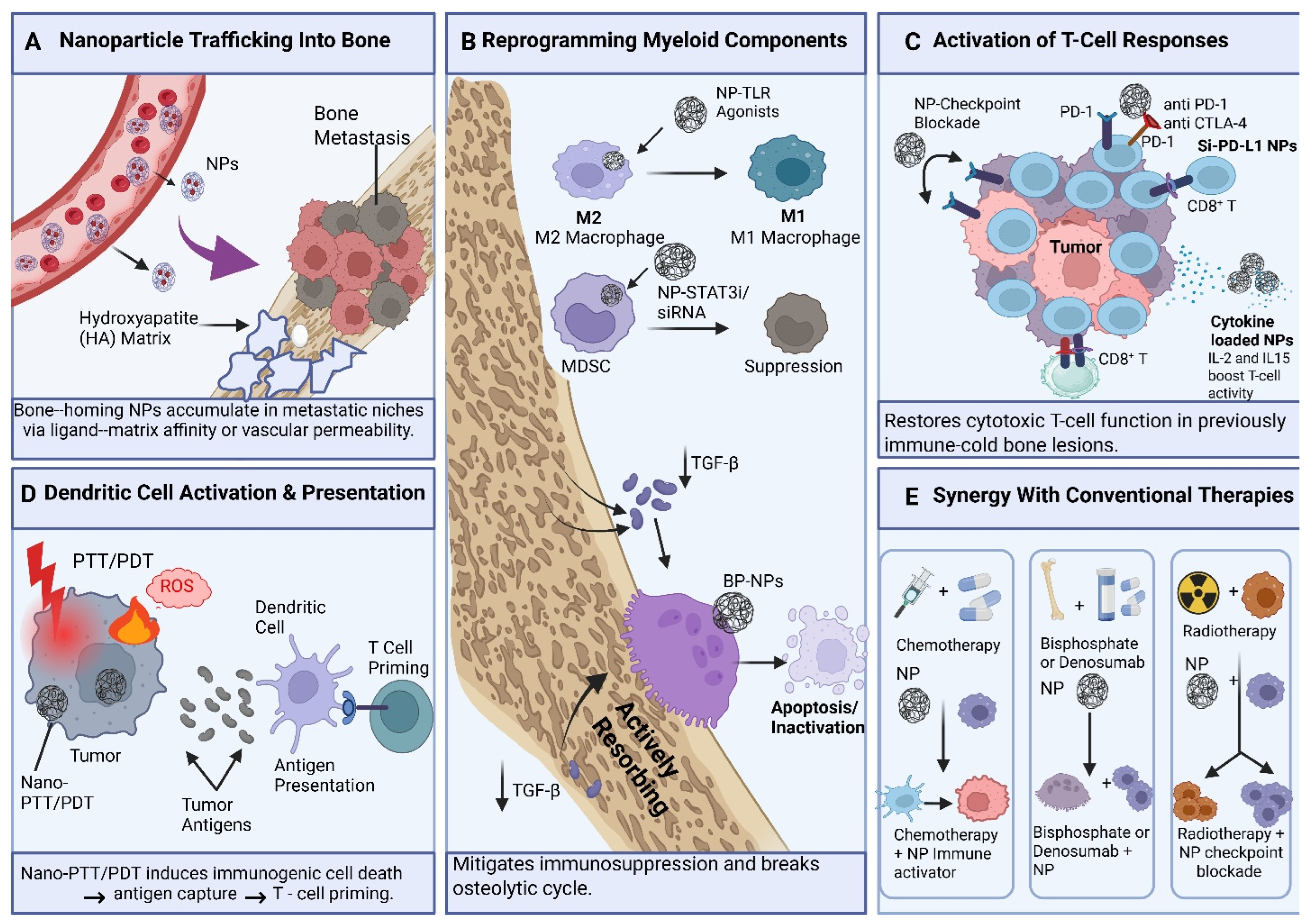

| Platform Class | Representative Clinical Precedent | Potential Relevance to Bone Metastasis Immunotherapy | Main Limitation |
|---|---|---|---|
| Liposomal nanomedicines | Pallares and Abergel, 2025 [146] | Shows the strongest clinical precedent for nanocarrier translation in oncology, including metastatic disease | Most approved liposomal systems are not bone-targeted and were not developed for marrow immune reprogramming |
| Polymeric nanomedicines | Pallares and Abergel, 2025 [146] | Provides translational precedent for polymer-based nanomedicines, a platform class widely used for experimental targeted and nucleic acid delivery systems | Bone-metastasis-specific immune applications remain largely preclinical, and clinical success is less mature than for liposomal systems |
| Iron oxide nanoparticles | Maier-Hauff et al., 2010 [147] | Provides clinical proof-of-concept that magnetic iron-oxide nanoparticles can be safely translated as hyperthermia-enabled therapeutic platforms in oncology | Clinical evidence is localized and indication-specific (glioblastoma), not bone-metastasis-specific and not designed for marrow immune reprogramming |
| Hafnium oxide nanoparticles (radioenhancers) | Bonvalot et al., 2019 [148] | Provides randomized clinical proof-of-concept that inorganic nanoparticles can potentiate local radiotherapy in solid tumors, supporting the translational feasibility of nanoparticle-enabled combination strategies | Evaluated as intratumoral radioenhancers in soft-tissue sarcoma rather than as bone-targeted or immunomodulatory nanotherapies for metastatic bone disease |
| Reference | Platform/Payload | Model | Quantitative Outcome | Comparator/Reference Condition | Key Implication |
|---|---|---|---|---|---|
| Chaudhari et al. [155]. | Zoledronate-conjugated PLGA-PEG nanoparticles loaded with docetaxel | Breast cancer bone metastasis model | Particle size 132 ± 9.5 nm; drug entrapment 73.53 ± 3.43%; 5.51% drug loading; prolonged blood-circulation half-life, reduced liver uptake, and significantly higher bone-site retention with enhanced tumor retention | Compared with non-targeted pegylated PLGA nanoparticles (PLGA-PEG NPs); in vitro activity also compared across other tested formulations | Zoledronate conjugation improved bone localization and retention of docetaxel-loaded nanocarriers |
| Wu et al. [156]. | ALN-conjugated bone-targeting lipid–polymer hybrid nanoparticles co-encapsulating decitabine (DAC) and arsenic trioxide (ATO) | MDS mouse model | Bone accumulation increased 6.7-fold for DAC and 7.9-fold for ATO versus untargeted nanoparticles at 24 h; plasma exposure increased (AUC0–∞: DAC 8685.15 vs. 1932.56 h·mg/L; ATO 4132.46 vs. 1243.40 h·mg/L, BTNPs vs. free drugs); circulation was sustained up to 72 h | Bone accumulation compared with untargeted nanoparticles; pharmacokinetic AUC compared with free DAC and free ATO solutions | ALN-mediated bone marrow targeting improved marrow drug enrichment and exposure, supporting more effective and less toxic MDS therapy |
| Gao et al. [50]. | Dual-ligand P123 polymeric micelles decorated with alendronate (ALN) and DP-8 and loaded with doxorubicin (DOX) | Breast cancer bone metastasis models (3D bone metastasis model and intratibial nude mouse model) | Mean particle size 122.97 ± 4.72 nm; drug loading 3.44%; encapsulation efficiency 76.87% ± 9.72%; HA binding reached ~38% at 30 min and ~52% at 90 min; IC50 decreased from 4.69 μg/mL (free DOX) to 0.989 μg/mL (P123-ALN/DP-8@DOX). | Compared with free DOX and non-targeted P123@DOX micelles | Dual bone/tumor targeting improved bone affinity and in vitro antitumor activity, with in vivo enrichment at the bone tumor region and reduced systemic toxicity in a breast cancer bone metastasis model |
| Mushtaq et al. [157]. | mPEG-CHI-siRNA and ALD-PEG-CHI-siRNA nanoparticles | 4T1 breast cancer cells (in vitro) | Mean particle size 40 ± 5 nm (mPEG-CHI-siRNA) and 60 ± 5 nm (ALD-PEG-CHI-siRNA); ζ-potential +3 ± 2 mV and +1 ± 1 mV, respectively; serum protection up to 6 h and 4 h, respectively, versus immediate degradation of naked siRNA; at 24 h, remaining wound area was 80% and 42% at 50 nM twist1-siRNA, versus 37% and 6% in untreated controls from the respective experiments | Compared with naked twist1-siRNA and untreated control cells | These nanoparticles achieved efficient twist1-siRNA encapsulation, improved serum stability, reduced TWIST1 protein expression, and delayed 4T1 cell migration, supporting preclinical in vitro potential for bone-metastatic breast cancer gene silencing |
| Li et al. [158]. | Bone-targeting bioreducible polymer vector ALN-Pabol/miRNA polyplex | Murine breast cancer bone metastasis model | Hydroxyapatite binding 91.1%; tumor weight reduced 79.1%; near-complete restoration of bone structure by micro-CT | Tumor weight reduction compared with PBS; additional comparison versus LNP/mRNA showed 36.8% greater reduction | Bone-targeted mRNA delivery produced strong antitumor and anti-osteolytic effects |
| Florian et al. [47]. | Polymeric STING-activating nanoparticles (STING-NPs) loaded with 2′3′-cGAMP | Murine 4T1-592 intratibial breast cancer bone metastasis model | STING-NPs reduced tumor burden at day 7, decreased osteolytic lesion area at days 7 and 14, and fluorescent nanoparticles showed preferential accumulation in tumor-bearing tibiae with 4.2-fold, 2.1-fold, and 9.5-fold higher signal than contralateral control tibiae at 2, 4, and 24 h, respectively; however, day-14 tumor burden was no longer significantly different, and Tregs were ~3-fold higher in treated marrow at day 14 | Compared with PBS-treated tumor-bearing mice; biodistribution compared with contralateral non-tumor tibia | Supports transient, not durable, bone marrow immune reprogramming in bone metastasis. |
| Zhong et al. [132]. | Injectable BP@Gel-CD[SA] hydrogel containing black phosphorus nanosheets (BPNSs) + STING agonist | Murine lung cancer bone metastasis models, including femoral LLC bone tumor/post-curettage recurrence model, bilateral distant-tumor model, and bone-defect repair model | 60% complete remission after curettage at 4 weeks; mature bone marrow-derived dendritic cells (BMDCs) 26.6%; intratumoral CD8+CD25+ T-cells 16.84 ± 1.18%; Tregs 11.68 ± 1.34%; distant-tumor CD8+CD25+ T-cells 6.92 ± 1.05% and CD80+CD86+ DCs 23.45 ± 1.7%; significant increases in BV/TV and Tb.N | Compared with Gel-CD, BP@Gel-CD, BP@Gel-CD + NIR, Gel-CD[SA], and BP@Gel-CD[SA] | Preclinical evidence that local PTT + STING agonist hydrogel can reduce recurrence, generate systemic antitumor immunity, and support bone regeneration in bone-metastatic disease |
Disclaimer/Publisher’s Note: The statements, opinions and data contained in all publications are solely those of the individual author(s) and contributor(s) and not of MDPI and/or the editor(s). MDPI and/or the editor(s) disclaim responsibility for any injury to people or property resulting from any ideas, methods, instructions or products referred to in the content. |
© 2026 by the authors. Licensee MDPI, Basel, Switzerland. This article is an open access article distributed under the terms and conditions of the Creative Commons Attribution (CC BY) license.
Share and Cite
Bakir, M.; Alkhatib, A.R.; Mustafa, A.R.; Raddaoui, M.; Alkattan, W.; Mohammad, K.S. Nanoparticle Strategies for Bone Metastasis Immunotherapy: Targeting, Immune Reprogramming and Combination Therapy. Pharmaceutics 2026, 18, 571. https://doi.org/10.3390/pharmaceutics18050571
Bakir M, Alkhatib AR, Mustafa AR, Raddaoui M, Alkattan W, Mohammad KS. Nanoparticle Strategies for Bone Metastasis Immunotherapy: Targeting, Immune Reprogramming and Combination Therapy. Pharmaceutics. 2026; 18(5):571. https://doi.org/10.3390/pharmaceutics18050571
Chicago/Turabian StyleBakir, Mohamad, Abdul Rahman Alkhatib, Abdul Rehman Mustafa, Mohammed Raddaoui, Wael Alkattan, and Khalid Said Mohammad. 2026. "Nanoparticle Strategies for Bone Metastasis Immunotherapy: Targeting, Immune Reprogramming and Combination Therapy" Pharmaceutics 18, no. 5: 571. https://doi.org/10.3390/pharmaceutics18050571
APA StyleBakir, M., Alkhatib, A. R., Mustafa, A. R., Raddaoui, M., Alkattan, W., & Mohammad, K. S. (2026). Nanoparticle Strategies for Bone Metastasis Immunotherapy: Targeting, Immune Reprogramming and Combination Therapy. Pharmaceutics, 18(5), 571. https://doi.org/10.3390/pharmaceutics18050571