1. Introduction
Population pharmacokinetic (PopPK) modeling is a standard component of model-informed drug development (MIDD) and regulatory decision-making, enabling characterization of between-subject variability, identification of clinically relevant covariates, and development of dosing recommendations across diverse patient populations [
1,
2,
3,
4,
5,
6,
7,
8]. Both the FDA and EMA have issued guidance emphasizing the role of PopPK analyses in supporting labeling claims and dose adjustments [
7,
8], and these analyses are now embedded throughout drug development programs [
9,
10,
11].
Despite its established value, PopPK model development remains a labor-intensive and expertise-dependent process. The workflow is inherently iterative, requiring modelers to cycle through data interpretation, structural model specification, random-effects modeling, covariate selection, and diagnostic evaluation, often with multiple rounds of refinement before arriving at a final model [
12,
13]. This process is further complicated by the need to balance statistical fit against physiological plausibility, ensure model stability across estimation methods, and identify clinically meaningful covariate relationships from among numerous candidate predictors [
14]. Surveys of industry practitioners indicate that covariate modeling alone—a single component of the overall workflow—can consume substantial time and resources, with the stepwise covariate model (SCM) building procedure remaining the most common approach despite its computational demands and susceptibility to local optima [
15,
16].
To reduce this burden, the pharmacometrics community has developed an extensive ecosystem of auxiliary tools. Workbenches such as Perl-speaks-NONMEM (PsN), Pirana, and Xpose provide programmatic interfaces for batch execution, automated covariate search procedures, diagnostic visualization, and output parsing [
17]. While these tools enhance workflow efficiency, they still require a pre-constructed, syntactically correct control stream, a bottleneck that large language models (LLMs) are uniquely positioned to address. LLMs have demonstrated remarkable capabilities in code generation and program synthesis across a wide range of programming tasks [
18]. More recently, “agentic” LLM systems that combine task decomposition, tool use, and feedback-driven refinement have shown particular promise for complex software engineering tasks [
19,
20]. Frameworks that interleave reasoning with actions and external feedback can improve reliability by enabling iterative self-correction when execution outcomes can be observed and incorporated into subsequent revisions [
21,
22]. Agent–computer interfaces that provide structured feedback and constrained action spaces have proven essential for enabling LLMs to navigate real-world codebases and debug errors autonomously [
23].
Motivated by these developments, this study introduces PKGPT, an agentic LLM system designed to produce executable NONMEM PopPK models and refine them through recursive, execution-in-the-loop iteration. Unlike generic LLM prompting approaches that treat NONMEM coding as a single-pass text generation task, PKGPT explicitly encodes pharmacometrics expertise into multiple specialized phase-specific expert-agent prompts and coordinates them across the full modeling lifecycle. The system transforms NONMEM error messages and run outputs into targeted repairs and structured model improvements, implementing phase-specific guidance that mirrors the sequential decision-making workflow of an experienced pharmacometrician. Critically, PKGPT addresses the fundamental challenge that has limited LLM utility in pharmacometrics: bridging the gap between the hallucinated syntax commonly produced by general-purpose LLMs and the rigid NM-TRAN-specific constraints required for successful parameter estimation. We evaluate PKGPT on three public PopPK datasets and benchmark its best models against independently developed human expert models, focusing on executability, iterative convergence, and the trade-off between objective function improvements and physiological plausibility.
3. Results
3.1. System Architecture and Workflow
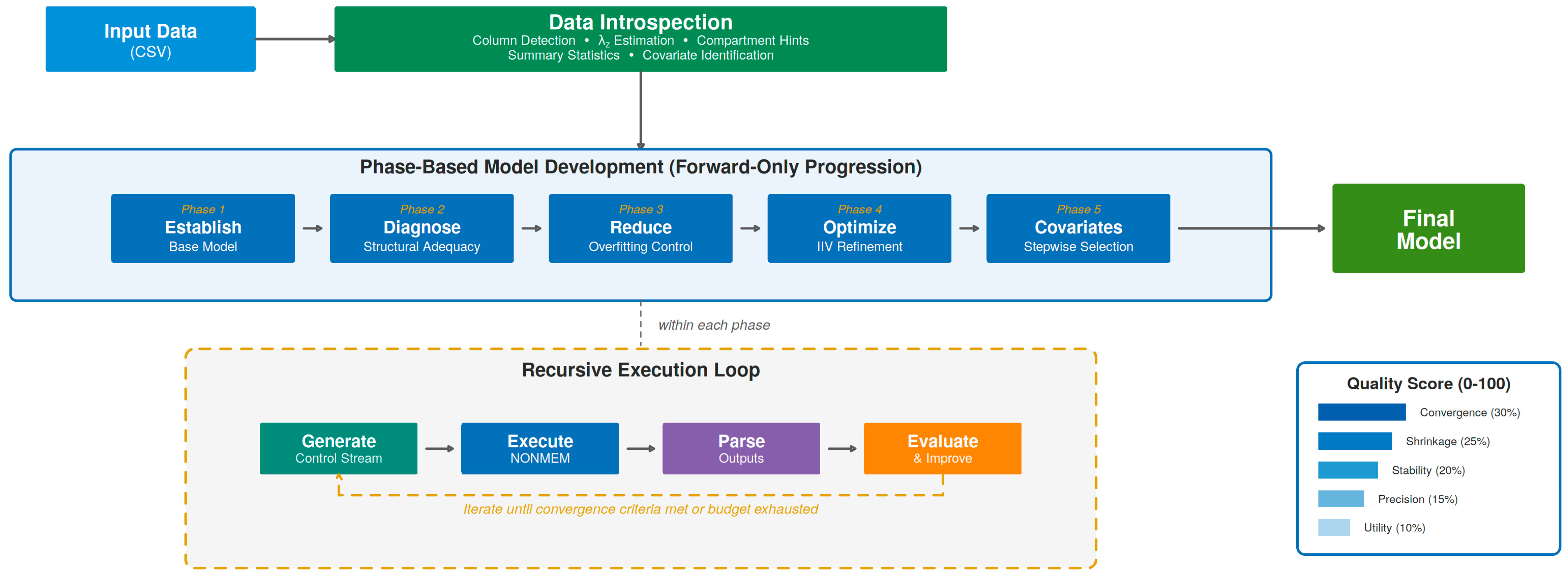
Figure 1 illustrates the PKGPT system architecture and its recursive optimization workflow. The framework implements an “execution-in-the-loop” design, where the LLM agent directly executes NONMEM, parses the resulting output files (.lst), and uses the extracted information—including OFV, parameter estimates, ETA shrinkage values, warnings, and error messages—to guide subsequent model modifications. This closed-loop execution–feedback–repair cycle enables automated error detection and iterative code refinement, substantially reducing manual intervention during the optimization process.
The framework implements a recursive, execution-in-the-loop architecture for automated PopPK modeling. Input data (CSV) first passes through a data introspection module that performs column detection, λz estimation via log-linear regression, and compartment hints based on BIC comparison to guide initial ADVAN selection. The phase-based model development follows a forward-only progression through five sequential phases: Establish (base model generation), Diagnose (structural adequacy), Reduce (overfitting control), Optimize (IIV refinement), and Covariates (stepwise covariate modeling). Within each phase, a recursive execution loop iterates through control stream generation, NONMEM execution, output parsing, and model evaluation until convergence criteria are met, progressively converging toward the final model. Model quality is assessed using a composite score (0–100) across five weighted dimensions: Convergence (30%), Shrinkage (25%), Stability (20%), Precision (15%), and Utility (10%).
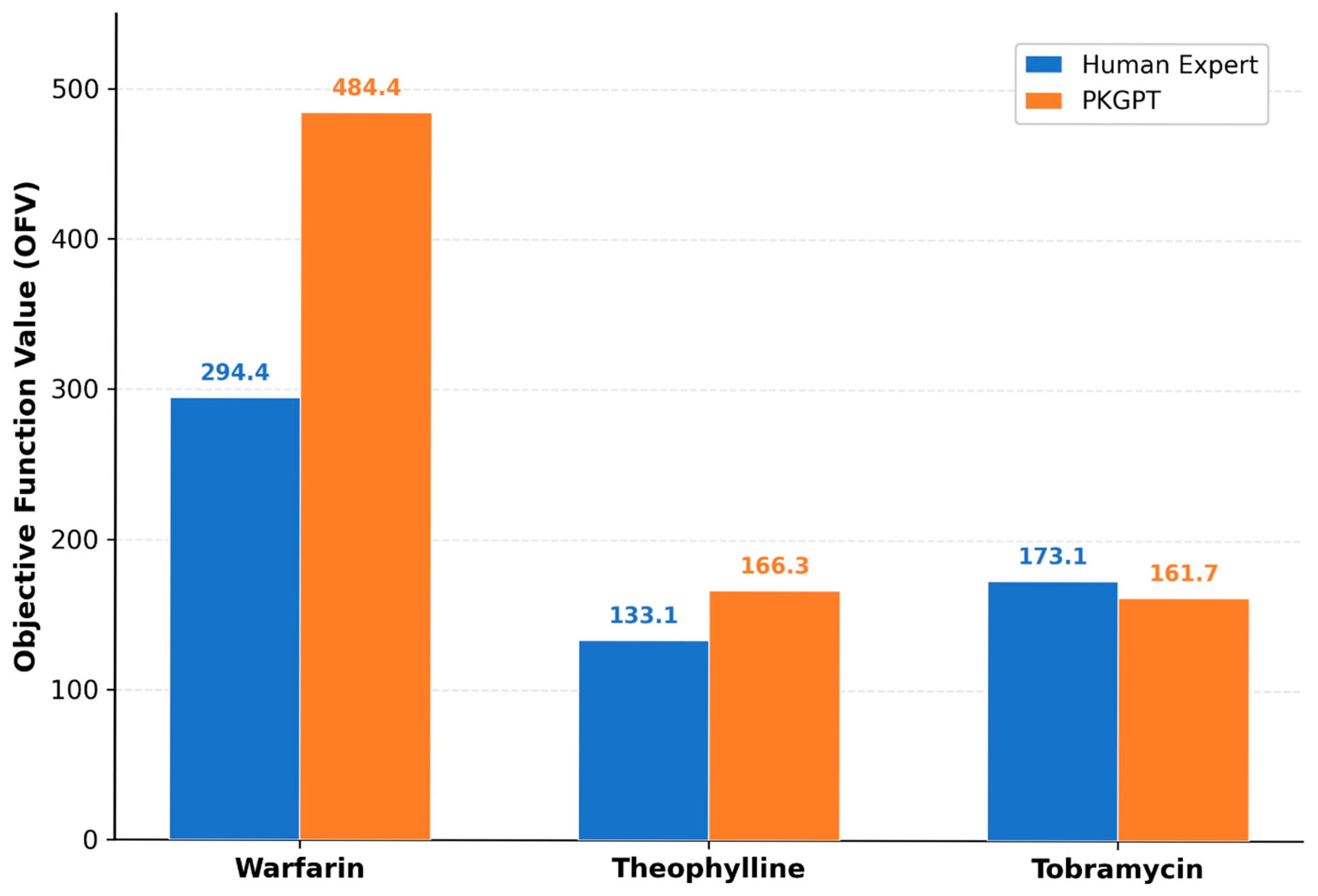
Bar plots compare objective function values (OFV) achieved by human expert models (blue) and PKGPT (orange). For Warfarin, the human expert achieved a lower OFV (294.4 vs. 484.4) through allometric scaling and lag time. For Theophylline, PKGPT showed a modestly higher OFV (166.3 vs. 133.1) with comparable parameter estimates. For Tobramycin, PKGPT achieved a lower OFV (161.7 vs. 173.1) but with physiologically implausible peripheral volume estimates.
3.2. Phase Progression and Model Refinement
PKGPT orchestrates the model development process through five sequential phases, each dedicated to specific refinement objectives. In Phase 1 (Establish Base Model), the system performs data introspection, estimates terminal elimination slope (λz) via log-linear regression, and applies a BIC-based comparison for initial compartment selection. It then generates an initial control stream with an appropriate ADVAN/TRANS specification. Phase 2 (Diagnose Structural Adequacy) evaluates residual patterns to detect structural misspecification. The detection of U-shaped residuals or evidence of biphasic decline triggers automated compartment upgrades (e.g., ADVAN2 → ADVAN4). Phase 3 (Reduce Overfitting) monitors overfitting indicators, including extreme ETA shrinkage (>90%), collapsed OMEGA terms, and physiologically implausible OFVs, applying model simplification when necessary. Phase 4 (Optimize IIV Structure) refines the random effects structure using dataset-size-dependent criteria—prioritizing diagonal Ω for small samples and block structures only when statistically warranted—combined with shrinkage-based retention thresholds. In Phase 5 (Covariate Analysis), upon satisfying stability prerequisites, the system performs stepwise covariate modeling using standard statistical criteria (forward selection: ΔOFV > 3.84; backward elimination: ΔOFV > 6.63).
The phase transition logic employs specific diagnostic criteria to determine advancement. Within each phase, the orchestrated prompt constrains the LLM to a specialized search neighborhood: Phase 1 focuses on syntax and estimation stability, Phase 2 links residual-pattern heuristics to compartment upgrades, and Phase 4 uses dataset-size-dependent IIV recommendations with shrinkage-based retention thresholds. For example, in the tobramycin Run 1 optimization, PKGPT detected 100% shrinkage on η(Q) and η(V
2) and removed these unsupported random effects in Phase 3, then simplified the OMEGA structure from correlated to diagonal, yielding the best model (OFV = 161.73). This run completed 9 NONMEM iterations in total; Warfarin Run 1 completed 7 iterations and Theophylline Run 1 completed 6 iterations. Individual PKGPT runs typically complete within 20–40 min (dominated by cumulative NONMEM execution time), compared to days to weeks for expert PopPK model development.
Figure 2 illustrates the OFV comparison between PKGPT and human expert models across the three datasets. Complete iteration-stamped control streams and NONMEM output files for all runs are provided in
Supplementary File S1.
3.3. Warfarin: Numerical Optimization and Parameter Plausibility
The Warfarin dataset (n = 32) served as a benchmark case for assessing PKGPT’s ability to handle a standard benchmark oral PK dataset with multiple covariates. In the optimal run, Phase 1 performed data introspection and recommended a one-compartment oral model based on terminal slope analysis, and both PKGPT and the human expert selected the same structural framework (ADVAN2/TRANS2) with FOCE-I estimation. PKGPT adopted a combined (proportional + additive) error model, while the human expert also employed a combined error model with the additive component fixed (σ2_add = 0.117 FIX). The human expert model additionally incorporated an absorption lag time (ALAG) and allometric body weight scaling (CL~WT0.75, V~WT1.0). During iterative refinement, PKGPT initially attempted BLOCK(3) OMEGA with three ETAs, which failed to minimize. The system progressively simplified from correlated to diagonal OMEGA, then reduced to two ETAs with FO estimation, before restructuring with IIV on Ka and CL, fixed V, and reverting to FOCE-I with a proportional-plus-additive error model. PKGPT converged to a final model with OFV 484.43 with successful minimization and covariance step completion. The human expert model achieved a substantially lower OFV of 294.41 (ΔOFV = −189.99), also with successful minimization (157 function evaluations, 4.2 significant digits) and successful covariance step completion.
PKGPT estimated physiologically plausible parameter values (
Table 1): Ka = 0.545 h
−1, CL = 0.133 L/h, V = 7.22 L, with IIV on Ka (ω
2 = 0.519) and CL (ω
2 = 0.0711). ETA shrinkage was 42.8% for Ka and 6.9% for CL. The human expert estimated Ka = 1.15 h
−1 (RSE 30.5%), CL
70 = 0.135 L/h (RSE 4.8%), V
70 = 7.86 L (RSE 3.0%), and ALAG = 0.825 h (RSE 8.6%). The expert fixed IIV on Ka (ω
2 = 0.5 FIX) and estimated IIV on CL (ω
2 = 0.0643, RSE 37.3%), achieving ETA shrinkage of 32.2% for Ka and 3.3% for CL. The lower OFV was primarily attributable to the allometric body weight covariate and absorption lag time, neither of which PKGPT identified through its automated stepwise procedure (forward selection ΔOFV > 3.84), suggesting limited sensitivity for physiologically established predictors with moderate effect sizes in this sample size.
However, three independent PKGPT runs revealed considerable variability in convergence stability (
Supplementary Table S1). While Run 1 achieved OFV 484.43 with a successful covariance step and low shrinkage (6.9% on CL), Runs 2 and 3 produced substantially higher OFVs (1208.94 and 1620.54, respectively) with numerical instability manifesting as collapsed random effects (shrinkage 99.3% and 100%) and failed covariance steps, illustrating the stochasticity inherent in LLM-driven optimization.
3.4. Theophylline: Validation with a Small Dataset
The Theophylline dataset (n = 12) served as a validation case for sparse, small-sample data. In the optimal run, PKGPT completed optimization and recommended a one-compartment oral model (ADVAN2/TRANS2) with FOCE-I estimation. Phase 1 performed data introspection, estimated λz, and established the base model. Phase 2 confirmed structural adequacy with no evidence of biphasic decline. The initial FOCE-I model with three ETAs and combined error achieved convergence at the first NONMEM execution (OFV = 166.29); subsequent iterations attempted to resolve covariance step failure by simplifying the OMEGA structure to two ETAs and switching to FO estimation, but the original three-ETA model was retained as the best-performing configuration. Phase 4 optimized the IIV structure using a diagonal OMEGA matrix appropriate for the small sample size, and Phase 5 covariate analysis identified no significant covariates given the limited number of subjects.
The final model achieved an OFV 166.29 with a combined error model
) with SIGMA fixed to 1, whereas the human expert employed a simpler proportional error model. PKGPT achieved successful minimization but failed the covariance step (parameter estimate near boundary), while the human expert model achieved a lower OFV of 133.11 (ΔOFV = −33.18) with both successful minimization (148 function evaluations, 3.5 significant digits) and successful covariance step completion. Despite the different error structure, PKGPT parameter estimates were consistent with the expert solution (
Table 2): Ka = 1.59 h
−1 (expert: 1.46, RSE 21.4%), CL = 0.0399 L/h/kg (expert: 0.0404, RSE 8.0%), and V = 1.29 L/kg (expert: 0.465, RSE 4.3%). Both models identified IIV on CL (ω
2 = 0.0587 vs. 0.0646) and Ka (ω
2 = 0.409 vs. 0.445). The human expert additionally estimated IIV on V (ω
2 = 0.0145, RSE 42.2%) with moderate shrinkage (19.4%), while PKGPT’s IIV on V (ω
2 = 1.06) exhibited extreme shrinkage (85.2%), suggesting overparameterization. ETA shrinkage on CL was 10.0% (PKGPT) vs. 3.8% (expert). Neither model identified significant covariates, consistent with the limited sample size (
n = 12). The OFV difference primarily reflects stochasticity in error model specification rather than a fundamental difference in structural or pharmacokinetic parameter adequacy.
Three independent PKGPT runs revealed variability in performance (
Supplementary Table S2). Run 1 (OFV 166.29) and Run 2 (OFV 179.79) produced consistent CL estimates (both 0.0399 L/h/kg) and Ka estimates (1.59 and 1.49 h
−1, respectively), demonstrating reproducible point estimation for the primary pharmacokinetic parameters. However, Run 3 yielded a physiologically implausible CL estimate of 2.38 L/h/kg with OFV 898.36 and high shrinkage (70.1%), indicating convergence to a spurious local minimum. Critically, the covariance step failed in all three PKGPT runs (Runs 1–2: parameter near boundary; Run 3: aborted), whereas the human expert model achieved successful covariance step completion. This consistent covariance failure underscores that small datasets (
n = 12) remain particularly challenging for automated modeling, where limited information results in ill-conditioned Hessian matrices that preclude formal uncertainty quantification.
3.5. Tobramycin: Two-Compartment Selection with Parameter Challenges
For Tobramycin, PKGPT correctly identified a two-compartment IV infusion model (ADVAN3) with FOCE-I estimation and a combined (proportional + additive) error model in the optimal run, consistent with the human expert’s structural choice. The human expert model additionally incorporated creatinine clearance (CLCR) and body weight (WT) as covariates (
). PKGPT achieved OFV 161.73, numerically lower than the human expert model (OFV 173.11, ΔOFV = −11.38); however, this improvement came at the cost of physiological plausibility. Both models achieved successful minimization, but the covariance step failed for PKGPT (boundary) while succeeding for the human expert. The human expert estimated CL = 2.95 L/h (at median CLCR 58 mL/min), V1 = 4.59 L (at median WT 62 kg), Q = 6.85 L/h, and V2 = 13.2 L, all within physiologically plausible ranges (
Table 3). PKGPT estimated CL = 2.89 L/h (comparable) but produced a physiologically implausible V2 = 149 L (~10-fold higher than expected) and high V1 = 19.4 L. ETA shrinkage was 30.2% for CL and 70.0% for V1 (PKGPT) vs. 21.2% for CL (expert). PKGPT did not identify CLCR or WT as covariates through its automated stepwise procedure, despite both being established predictors of aminoglycoside pharmacokinetics.
Three independent PKGPT runs showed substantial structural inconsistency (
Supplementary Table S3): only Run 1 selected a two-compartment model, while Runs 2 and 3 converged on simpler one-compartment structures (OFV 208.39 and 177.53). Run 2 additionally reverted to first-order (FO) estimation. This structural inconsistency across runs represents a more severe form of stochastic instability than observed in the other two datasets, where repeated runs at least converged on the same compartmental structure. Detailed parameter comparisons and run-to-run stability results are provided in
Table 3 and
Supplementary Table S3.
4. Discussion
The central finding across three case studies is that PKGPT can reliably produce executable, converging NONMEM models, but the gap between numerical optimization and clinically defensible modeling remains substantial. Across three case studies, PKGPT consistently demonstrated that an LLM-driven agent can automate large portions of the NONMEM workflow, including the generation of complete control streams, execution/iteration, and extraction of key diagnostics from .lst outputs. PKGPT demonstrated its capability to achieve numerical optimization in the tobramycin case, where a lower OFV was attained, while in the warfarin and theophylline cases, the human expert achieved lower OFVs through physiologically grounded covariates and parameter constraints.
Regarding the warfarin case, an instructive comparison was observed. Both the human expert and PKGPT selected the same one-compartment oral structure (ADVAN2/TRANS2), yet the human expert model achieved a substantially lower OFV (294.41 vs. 484.43). This difference was attributable to the expert’s incorporation of allometric body weight scaling (CL~WT0.75, V~WT1.0), an absorption lag time parameter, and strategic variance component estimation. This highlights the distinction between hypothesis-driven and data-driven modeling: human experts leverage a priori pharmacological knowledge to incorporate physiologically grounded covariate relationships and constrain the estimation problem, whereas PKGPT relies on automated stepwise procedures. The failure of PKGPT to identify body weight as a significant covariate—despite its well-established role in warfarin pharmacokinetics—suggests that automated stepwise procedures may lack sensitivity for covariates with moderate effect sizes in datasets of limited sample size (n = 32). This limitation also reflects a design decision in PKGPT’s covariate procedure, where allometric body weight scaling is evaluated through the same stepwise ΔOFV threshold as all other candidate covariates rather than being incorporated as a default structural feature for body-size-related parameters—an approach that future implementations should reconsider for drug classes with well-established size-based pharmacokinetic relationships.
In the theophylline case, PKGPT produced parameter estimates nearly identical to the expert solution despite selecting a different error model. However, the consistent failure or abortion of the covariance step in the theophylline runs (
n = 12) underscores a critical distinction between point estimation and statistical precision. While the agent located a plausible minimum for primary pharmacokinetic parameters (Ka, CL) in two of three independent runs, the sparsity of information in small datasets resulted in an ill-conditioned Hessian matrix, preventing the formal calculation of parameter uncertainty, a requirement for regulatory submissions where confidence intervals around key parameters inform dosing recommendations. These patterns illustrate that an automated agent must treat OFV as one signal in a constrained decision process, where plausibility, identifiability, and predictive performance act as hard brakes. Additionally, the volume of distribution was substantially overestimated by PKGPT (V = 1.29 L/kg vs. expert: 0.465 L/kg), accompanied by 85.2% IIV shrinkage on V. Critically, this 85.2% shrinkage level did not trigger Phase 3 activation—which requires ETA shrinkage exceeding 95%—illustrating a fundamental gap between the 20–30% EBE diagnostic reliability threshold established by Savic and Karlsson [
30] and the 95% hard trigger currently implemented. This means that substantial shrinkage indicating model misspecification can remain undetected by the automated pipeline. Run 3 further converged at a spurious local minimum with CL = 2.38 L/h/kg—approximately 60-fold higher than Runs 1 and 2—due to poor initial parameterization in Phase 1, an error that the forward-only constraint prevented from being corrected in subsequent phases. The OFV difference between PKGPT and the expert model (ΔOFV = 33.18) was primarily attributable to differences in error model specification rather than structural or pharmacokinetic parameter adequacy, suggesting that automated error model selection represents an additional optimization dimension where explicit decision criteria—analogous to those used for compartment and covariate selection—could improve convergence to clinically preferred model structures.
Similarly, in the tobramycin case, PKGPT achieved a numerically superior OFV of 161.73 compared to the expert model (173.11) by correctly identifying a two-compartment structure. However, this numerical “win” was offset by the estimation of a physiologically implausible peripheral volume (V2 = 149 L), compared to the expert’s 13.2 L. The implausible V2 and Q estimates (149 L and 1.73 L/h, respectively, compared to the expert’s 13.2 L and 6.85 L/h) likely reflect parameter non-identifiability in the peripheral compartment: with limited sampling during the distribution phase, intercompartmental clearance and peripheral volume are poorly constrained, allowing the optimizer to achieve a lower OFV by redistributing variance between Q and V2 without physiological penalty. As an aminoglycoside distributing primarily into extracellular fluid (expected V2 ≈ 10–15 L), the 149 L estimate exceeds the expected range approximately 10-fold, exemplifying a “mathematical trap” on a poorly constrained likelihood surface. Phase 3 overfitting detection did not flag this estimate because neither ΔOFV nor shrinkage exceeded their trigger thresholds, indicating the need for a direct physiological plausibility check in the quality scoring system. The concurrent covariance step failure further suggests model over-parameterization with an unstable Hessian matrix. Future implementations should incorporate drug-class-specific parameter bounds and treat covariance step success as a hard constraint. Similarly, the central volume estimate (V1 = 19.4 L) exceeded the expected range for tobramycin in a typical adult (~0.25 L/kg, approximately 15 L at 62 kg), further indicating that the two-compartment parameterization was not adequately constrained. This highlights the potential for automated agents to converge on mathematical minima that lack clinical validity, particularly when the search is not guided by physiologically grounded parameter boundaries. Furthermore, PKGPT’s failure to identify creatinine clearance and body weight as covariates—despite both being well-established predictors of aminoglycoside pharmacokinetics—parallels the pattern observed in warfarin and reinforces the need for domain-informed covariate screening that extends beyond purely statistical stepwise procedures. Both CLCR and WT were explicitly entered into the forward selection procedure (ΔOFV > 3.84, df = 1); neither met the threshold. The structural inconsistency across independent runs, where only one of three runs selected the two-compartment model, represents a more fundamental concern than parameter-level variability, as it indicates that the automated system’s structural decisions are sensitive to stochastic variation in the LLM’s initial model specification.
The stochastic instability observed in repeated runs is another practical limitation. This instability suggests that current LLM agents may occasionally prioritize numerical convergence over statistical robustness. Across all three datasets, run-to-run variability was substantial: Warfarin OFV ranged from 484 to 1621 across three independent runs (with two runs producing collapsed random effects and >99% shrinkage), theophylline produced one run with a physiologically implausible CL estimate 60-fold higher than the expert value, and tobramycin runs did not even converge on the same compartmental structure. This variability may arise from two sources: the inherent stochasticity of LLM text generation (temperature-dependent sampling) and the sensitivity of NONMEM optimization to initial parameter estimates specified in the LLM-generated control stream. Disentangling LLM-level stochasticity from NONMEM-level sensitivity to initial estimates requires controlled experiments with simultaneously fixed LLM temperature, random seed, and NONMEM initialization—a substantially more complex experimental design than the current three-run protocol. Furthermore, temperature = 0 does not guarantee deterministic outputs in API-served LLMs due to floating-point variation across parallel GPU computations. A further fundamental limitation is that LLMs may encode training-corpus biases toward frequently reported model structures, an issue distinct from stochasticity and not addressable through temperature control. From a systems perspective, this argues for consensus strategies such as majority-vote structural selection across multiple runs, median-based parameter initialization from an ensemble of initial runs, or requiring convergence to the same structural model across a minimum number of independent restarts before accepting the final model. The forward-only phase constraint amplifies this variability through a cascade effect: divergent Phase 1 specifications propagate irreversibly through subsequent phases. For example, theophylline Run 3 converged at a spurious local minimum (CL = 2.38 L/h/kg, approximately 60-fold higher than Runs 1–2) due to poor initial parameterization that the forward-only constraint prevented from being corrected.
The performance gap is partly attributable to prompt design: the current covariate prompt relies exclusively on statistical criteria (ΔOFV thresholds), limiting sensitivity for established covariates. Future work should explore pharmacology-informed prompting encompassing three complementary strategies: (1) drug-class-specific covariate checklists (e.g., renal function markers for renally cleared drugs, body size metrics for volume parameters); (2) physiologically plausible parameter bounds informed by drug physicochemical properties; and (3) pharmacological knowledge weighting, where established drug–covariate relationships receive lower statistical thresholds than exploratory covariates. Similarly, structural model components such as absorption lag time should be evaluated as mandatory candidates for oral formulations, as demonstrated by the warfarin case where the absence of ALAG forced Ka to compensate for delayed absorption onset, resulting in higher shrinkage (42.8% vs. 32.2%). Additionally, the modular architecture permits substitution of the underlying LLM; more capable models may further improve covariate identification and reproducibility.
A related limitation concerns the quality scoring system. Adjusting the relative weights among the five existing statistical dimensions (Convergence, Shrinkage, Stability, Precision, Utility) cannot resolve the physiological implausibility problem observed for tobramycin, for a fundamental structural reason: all five dimensions are defined in purely statistical terms, and none evaluate pharmacological plausibility. Concretely, the V
2 = 149 L estimate for tobramycin did not exceed any of the five statistical triggers (ΔOFV < −50; ETA shrinkage > 95%) regardless of how the weights are redistributed—weight adjustment is therefore an insufficient remedy. When we explored alternative weight configurations during development, increasing Stability or Shrinkage weights penalized some failure modes more effectively but simultaneously degraded performance on datasets where those dimensions were not the primary concern, confirming that the optimal weight configuration is inherently dataset-dependent. Because weights calibrated on a limited number of benchmark datasets cannot be assumed to generalize across the diversity of real-world clinical datasets—which vary substantially in sample size, sampling design, and covariate complexity—systematic validation across broader real-world datasets is planned as a necessary step before recommending any weight recalibration. The root cause is the absence of a pharmacologically grounded criterion in the scoring system itself. To address this in future work, we propose the following concrete development directions: First, addition of a dedicated “Plausibility” scoring dimension that evaluates parameter estimates against drug-class-specific physiological bounds—for example, flagging V
2 > 30 L as implausible for aminoglycosides, or V/F > 500 L as implausible for oral small-molecule drugs. Second, embedding physiologically informed hard bounds directly as NONMEM
$THETA lower and upper limits within the Phase 3 and Phase 4 expert prompts, so that the optimizer is constrained to physiologically plausible parameter spaces before the scoring system is even applied. Third, Bayesian-style informative priors on key PK parameters derived from literature population estimates, which would penalize deviations from established pharmacokinetic ranges during optimization. Systematic calibration of drug-class-specific physiological bounds across multiple drug classes is a prerequisite for deployment of these strategies and represents the highest-priority direction for future development of the PKGPT scoring system. PKGPT differs fundamentally from existing automated PopPK tools in its execution-in-the-loop architecture. Rule-based automation tools such as pyDarwin [
28], Pharmpy AMD [
25], and SAMBA [
27] operate within predefined model search spaces. Specifically, SAMBA accelerates model building by sampling parameter distributions to statistically predict candidate covariates, but it remains constrained to pre-defined compartmental structures and search boundaries. In contrast, PKGPT leverages the generative power of LLMs to dynamically modify and debug NM-TRAN code beyond fixed templates. Neural ODE-based approaches offer data-driven flexibility but function as black-box models that are difficult to interpret and require large training datasets; in contrast, PKGPT produces interpretable NM-TRAN code following established pharmacometric conventions.
Critically, our system implements a closed-loop execution architecture that directly interfaces with NONMEM 7.5, R 4.4 (R Foundation for Statistical Computing, Vienna, Austria), Python 3.12, and PsN 5.3 (Uppsala University, Uppsala, Sweden), enabling automated error detection and iterative code repair. This feature distinguishes PKGPT from prior LLM-based pharmacometrics studies [
29,
32,
33,
34,
35], which primarily evaluated zero-shot code generation without runtime feedback. However, this autonomous operation introduces the risk of converging to physiologically implausible parameter estimates, where the LLM may propose physically implausible parameter values—as observed in the Tobramycin V2 estimate. This confirms that while the system can control external tools, it still lacks the deep biological intuition required to “vet” its internal diagnostic findings against clinical reality.
A central contribution of PKGPT is that it does not treat NONMEM coding as a single-pass task. The prompt templates encode a “critical checklist” of NONMEM-specific requirements—the kind of domain substrate that generic LLM prompting tends to omit. This directly addresses a known weakness of general-purpose LLM code generation, where performance degrades when the target language is niche or a domain-specific language (DSL).
Several limitations should be acknowledged. First, while PKGPT executes NONMEM locally on the user’s computational environment, it transmits NONMEM control stream code, output summaries (OFV, parameter estimates, shrinkage values), and data-derived summary statistics (
n, mean, SD per variable) to an external LLM API during each iteration. Raw patient-level data files are not directly uploaded; however, transmitted metadata may contain information derived from clinical data. For environments with strict data privacy requirements (e.g., clinical trial data subject to regulatory restrictions), deployment with a locally hosted open-source LLM would eliminate external data transmission entirely and is identified as an important direction for future implementation. Second, the current implementation supports up to two-compartment models. Real-world applications frequently require more complex structures (e.g., TMDD, transit compartment absorption, indirect response models, time-varying clearance), where the performance gaps observed here would likely be amplified. Extension to such structures would require specialized expert prompts and more sophisticated diagnostic logic. Third, the stochastic instability suggests a need for ensembling. The variability arises from LLM-level stochasticity and NONMEM-level sensitivity to initial estimates, amplified by the forward-only cascade effect. Mitigation strategies include consensus-based structural selection across multiple runs and median-based parameter initialization. The forward-only constraint was motivated by empirical experience during development: unrestricted bidirectional phase transitions caused Phase 2 and Phase 3 to repeatedly trigger each other without convergence, consuming the full iteration budget without producing a final model. A configurable maximum iteration budget (default: 20 iterations per phase) provides an additional termination guarantee. Fourth, PKGPT did not identify certain clinically established covariates. This highlights that even when automated systems identify statistically significant models, the assessment of multicollinearity among candidate predictors and the final judgment on clinical plausibility and biological relevance remain the sole responsibility of human experts. Therefore, human-in-the-loop oversight is not merely a safety feature but a core requirement for final model validation. Based on the failure patterns observed across the three case studies, we propose that the system should flag models for mandatory expert review when any of the following conditions are met: (1) covariance step failure, indicating potential identifiability issues; (2) parameter estimates outside physiologically plausible ranges; (3) structural inconsistency across multiple independent runs; or (4) failure to identify covariates from a mandatory pharmacological checklist. Fifth, the 95% ETA shrinkage threshold used for overfitting detection and phase transition was empirically selected to target structural collapse, but the optimal cutoff within the gap between the 20–30% diagnostic reliability threshold established by Savic and Karlsson [
30] and this upper bound remains uncharacterized. Across the three case studies, shrinkage values spanning this intermediate range were observed—42.8% for Ka in warfarin, 85.2% for V in theophylline, and 70.0% for V1 in tobramycin—each carrying different implications for model adequacy that a single fixed threshold cannot fully capture. A systematic sensitivity analysis evaluating model selection quality, false positive and negative rates, and phase transition frequency across a range of shrinkage cutoffs (e.g., 50%, 70%, 80%, 90%) would inform the optimization of this threshold and is warranted as a direction for future research.
5. Conclusions
Meaningful automation of NONMEM-based PopPK modeling requires more than single-pass LLM code generation, which typically produces control streams that fail to execute or require extensive manual debugging. PKGPT addresses this gap by embedding pharmacometrics expertise into phase-specific expert-agent prompts and orchestrating them in a phase-structured, forward-only recursive loop that repeatedly executes NONMEM, parses run outputs, and applies targeted repairs. Across three public datasets, this design consistently produced executable models with successful minimization and enabled iterative refinement through automated diagnostics and phase-based model development.
PKGPT demonstrated that an LLM-driven agent can produce executable models with physiologically plausible primary parameter estimates, while benchmarking against human experts revealed persistent gaps in covariate identification, peripheral parameter estimation, and run-to-run reproducibility that necessitate human-in-the-loop oversight for final model acceptance.
Taken together, PKGPT is best viewed as a pharmacometrics copilot that improves executability, speeds early-stage model construction, and reduces the manual burden of iterative debugging and refactoring, while still requiring human oversight for final model acceptance. Future work should prioritize guardrails that align optimization with clinical interpretability, including physiology-informed parameter bounds and priors, mandatory covariate-screening policies for drug classes with well-established drivers, consensus strategies across independent runs to address stochastic variability, stability criteria across restarts, and routine inclusion of predictive diagnostics (e.g., GOF/VPC-based acceptance gates) alongside OFV. With these additions and broader validation across diverse study designs, LLM-based systems could evolve from code generators into reliable modeling assistants that deliver not only executable control streams but also robust, interpretable, and clinically defensible PopPK models.




 ,
,