Physiologically Based Pharmacokinetic Modeling to Assess Antiretroviral–BTK Inhibitor Interactions and Provide Recommendations for Co-Administration Regimens


Abstract
1. Introduction
2. Materials and Methods
2.1. PBPK Model Development and Verification for BTK Inhibitors
2.2. PBPK Model Development and Verification for Antiretroviral Drugs
2.3. DDI Simulation Design
3. Results
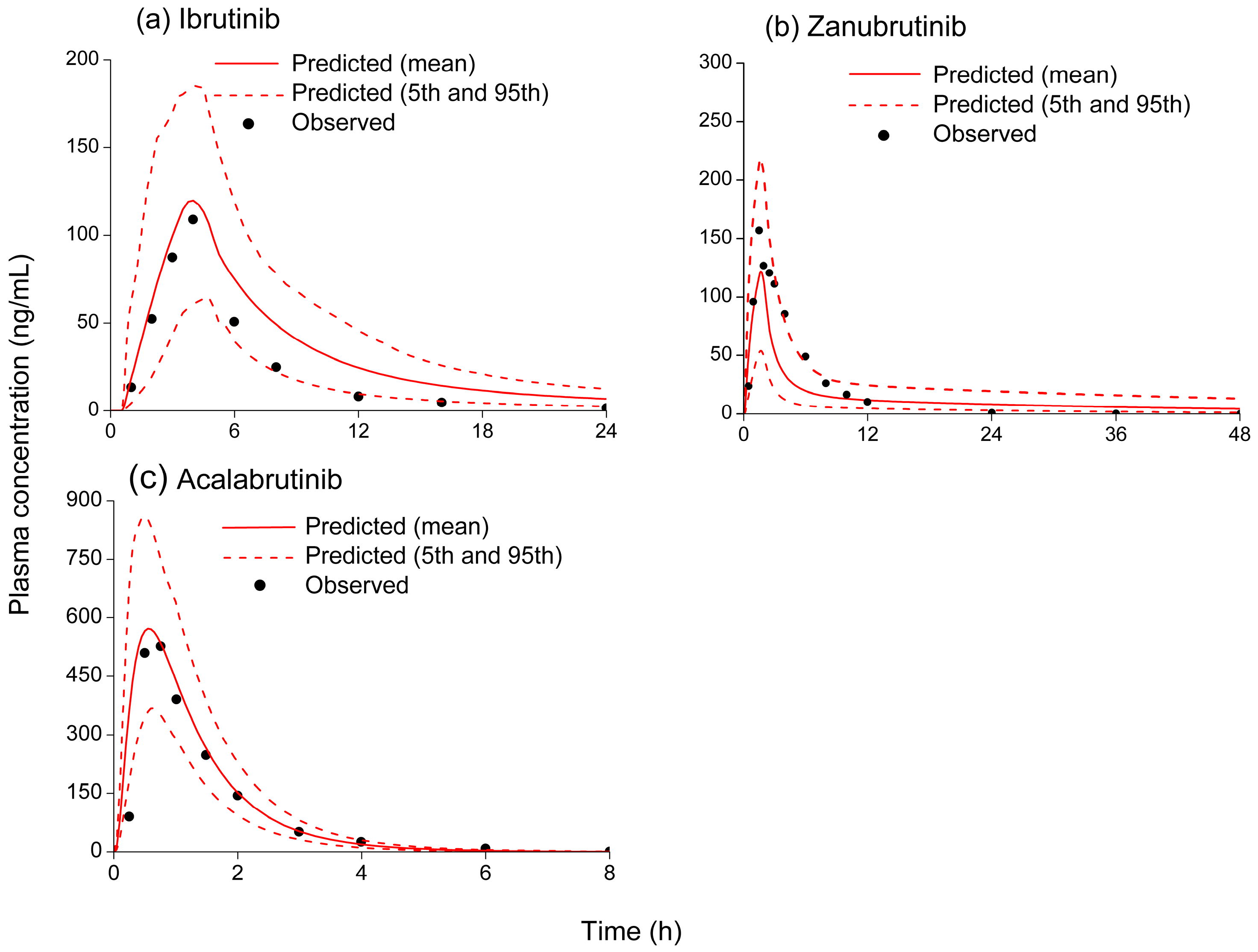
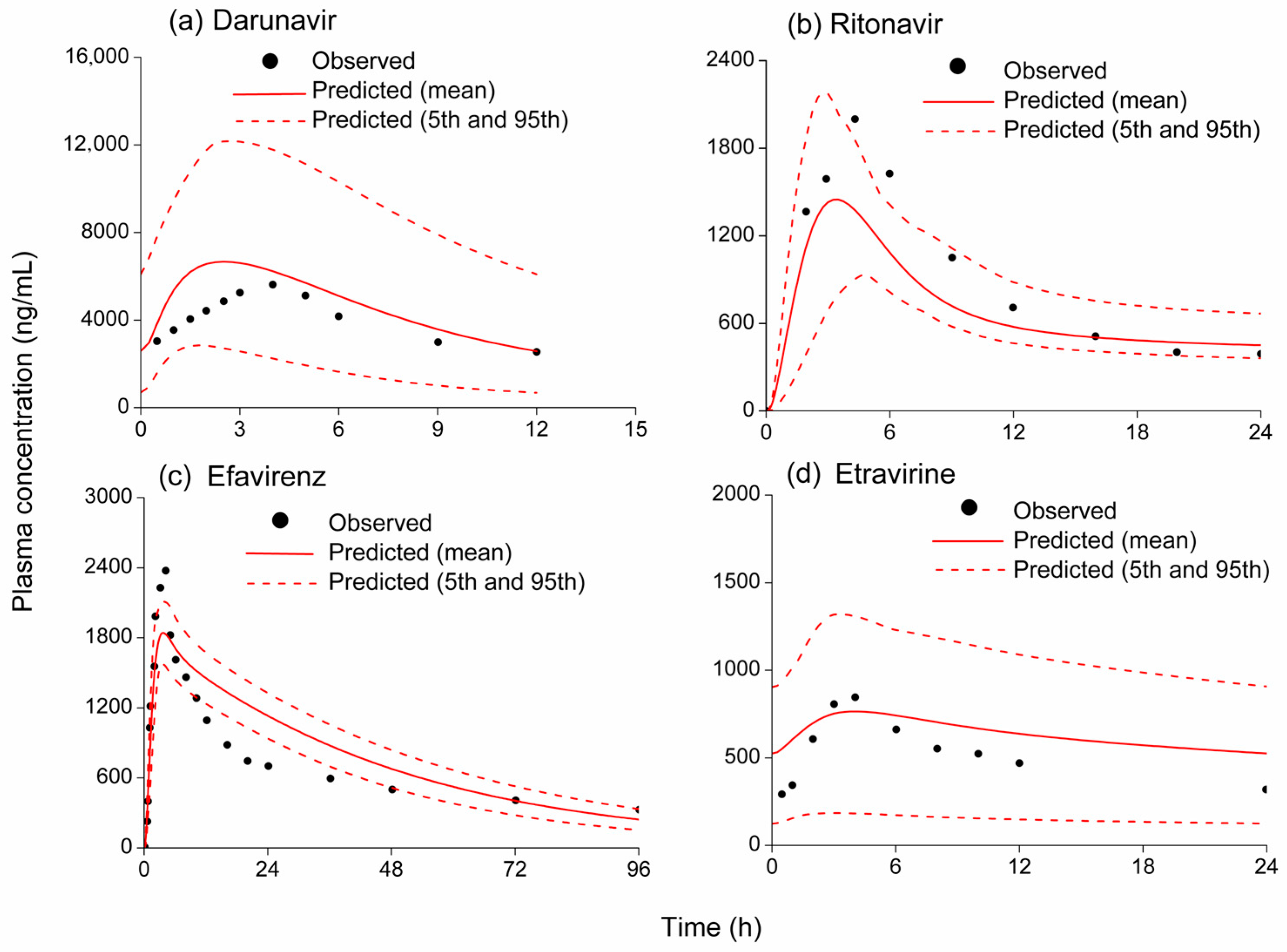
3.1. Model Development and Validation of BTK Inhibitors and Antiretrovirals
3.2. DDIs with Reference Probes
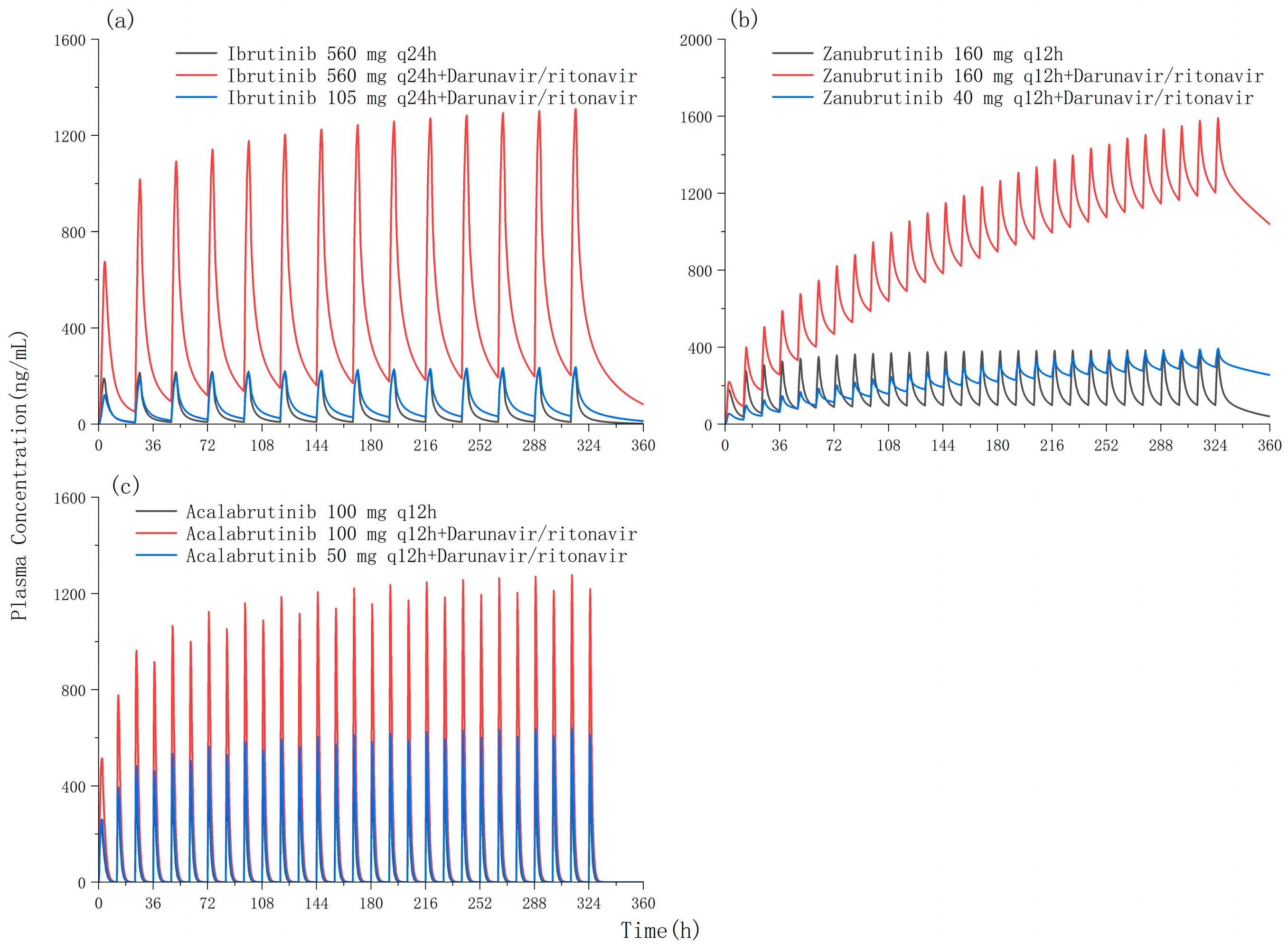
3.3. DDIs with BTK Inhibitors
4. Discussion
5. Conclusions
Supplementary Materials
Author Contributions
Funding
Institutional Review Board Statement
Data Availability Statement
Acknowledgments
Conflicts of Interest
Abbreviations
| BTK | Bruton’s tyrosine kinase |
| DDIs | Drug–drug interactions |
| PBPK | Physiologically based pharmacokinetic |
| Cmax | Maximum plasma concentration |
| HIV | Human immunodeficiency virus |
| HRL | HIV-related lymphomas |
| cART | Combination antiretroviral therapy |
| AUC | Area under the plasma concentration–time curve |
| ADAM | Advanced dissolution, absorption, and metabolism |
| MIDD | Model-informed drug development |
References
- Swinkels, H.M.; Nguyen, A.D.; Gulick, P.G. HIV and AIDS. In StatPearls [Internet]; StatPearls Publishing: Treasure Island, FL, USA, 2024. [Google Scholar]
- Berhan, A.; Bayleyegn, B.; Getaneh, Z. HIV/AIDS Associated Lymphoma: Review. Blood Lymphat. Cancer 2022, 12, 31–45. [Google Scholar] [CrossRef] [PubMed]
- Welz, T.; Wyen, C.; Hensel, M. Drug Interactions in the Treatment of Malignancy in HIV-Infected Patients. Oncol. Res. Treat. 2017, 40, 120–127. [Google Scholar] [CrossRef] [PubMed]
- Landgren, O.; Goedert, J.J.; Rabkin, C.S.; Wilson, W.H.; Dunleavy, K.; Kyle, R.A.; Katzmann, J.A.; Rajkumar, S.V.; Engels, E.A. Circulating serum free light chains as predictive markers of AIDS-related lymphoma. J. Clin. Oncol. 2010, 28, 773. [Google Scholar] [CrossRef]
- Carbone, A.; Vaccher, E.; Gloghini, A. Hematologic cancers in individuals infected by HIV. Blood 2022, 139, 995–1012. [Google Scholar] [CrossRef]
- Yarchoan, R.; Uldrick, T.S. HIV-Associated Cancers and Related Diseases. N. Engl. J. Med. 2018, 378, 1029–1041. [Google Scholar] [CrossRef]
- Gopal, S.; Patel, M.R.; Yanik, E.L.; Cole, S.R.; Achenbach, C.J.; Napravnik, S.; Burkholder, G.A.; Reid, E.G.; Rodriguez, B.; Deeks, S.G.; et al. Temporal trends in presentation and survival for HIV-associated lymphoma in the antiretroviral therapy era. J. Natl. Cancer Inst. 2013, 105, 1221–1229. [Google Scholar] [CrossRef]
- Tam, C.; Thompson, P.A. BTK inhibitors in CLL: Second-generation drugs and beyond. Blood Adv. 2024, 8, 2300–2309. [Google Scholar] [CrossRef]
- Hakkola, J.; Hukkanen, J.; Turpeinen, M.; Pelkonen, O. Inhibition and induction of CYP enzymes in humans: An update. Arch. Toxicol. 2020, 94, 3671–3722. [Google Scholar] [CrossRef]
- Stader, F.; Kinvig, H.; Battegay, M.; Khoo, S.; Owen, A.; Siccardi, M.; Marzolini, C. Analysis of Clinical Drug-Drug Interaction Data To Predict Magnitudes of Uncharacterized Interactions between Antiretroviral Drugs and Comedications. Antimicrob. Agents Chemother. 2018, 62, e00717-18. [Google Scholar] [CrossRef] [PubMed]
- Cingolani, A.; Torti, L.; Pinnetti, C.; de Gaetano Donati, K.; Murri, R.; Tacconelli, E.; Larocca, L.M.; Teofili, L. Detrimental clinical interaction between ritonavir-boosted protease inhibitors and vinblastine in HIV-infected patients with Hodgkin’s lymphoma. Aids 2010, 24, 2408–2412. [Google Scholar] [CrossRef]
- Corona, G.; Vaccher, E.; Sandron, S.; Sartor, I.; Tirelli, U.; Innocenti, F.; Toffoli, G. Lopinavir-ritonavir dramatically affects the pharmacokinetics of irinotecan in HIV patients with Kaposi’s sarcoma. Clin. Pharmacol. Ther. 2008, 83, 601–606. [Google Scholar] [CrossRef]
- Bundow, D.; Aboulafia, D.M. Potential drug interaction with paclitaxel and highly active antiretroviral therapy in two patients with AIDS-associated Kaposi sarcoma. Am. J. Clin. Oncol. 2004, 27, 81–84. [Google Scholar] [CrossRef]
- Watanabe, A.; Ishizuka, T.; Yamada, M.; Igawa, Y.; Shimizu, T.; Ishizuka, H. Physiologically based pharmacokinetic modelling to predict the clinical effect of CYP3A inhibitors/inducers on esaxerenone pharmacokinetics in healthy subjects and subjects with hepatic impairment. Eur. J. Clin. Pharmacol. 2022, 78, 65–73. [Google Scholar] [CrossRef]
- Kuepfer, L.; Niederalt, C.; Wendl, T.; Schlender, J.F.; Willmann, S.; Lippert, J.; Block, M.; Eissing, T.; Teutonico, D. Applied Concepts in PBPK Modeling: How to Build a PBPK/PD Model. CPT Pharmacomet. Syst. Pharmacol. 2016, 5, 516–531. [Google Scholar] [CrossRef] [PubMed]
- Foti, R.S. Utility of physiologically based pharmacokinetic modeling in predicting and characterizing clinical drug interactions. Drug Metab. Dispos. 2025, 53, 100021. [Google Scholar] [CrossRef] [PubMed]
- de Zwart, L.; Snoeys, J.; De Jong, J.; Sukbuntherng, J.; Mannaert, E.; Monshouwer, M. Ibrutinib Dosing Strategies Based on Interaction Potential of CYP3A4 Perpetrators Using Physiologically Based Pharmacokinetic Modeling. Clin. Pharmacol. Ther. 2016, 100, 548–557. [Google Scholar] [CrossRef]
- Wang, K.; Yao, X.; Zhang, M.; Liu, D.; Gao, Y.; Sahasranaman, S.; Ou, Y.C. Comprehensive PBPK model to predict drug interaction potential of Zanubrutinib as a victim or perpetrator. CPT Pharmacomet. Syst. Pharmacol. 2021, 10, 441–454. [Google Scholar] [CrossRef] [PubMed]
- Zhou, D.; Podoll, T.; Xu, Y.; Moorthy, G.; Vishwanathan, K.; Ware, J.; Slatter, J.G.; Al-Huniti, N. Evaluation of the Drug-Drug Interaction Potential of Acalabrutinib and Its Active Metabolite, ACP-5862, Using a Physiologically-Based Pharmacokinetic Modeling Approach. CPT Pharmacomet. Syst. Pharmacol. 2019, 8, 489–499. [Google Scholar] [CrossRef]
- de Jong, J.; Sukbuntherng, J.; Skee, D.; Murphy, J.; O’Brien, S.; Byrd, J.C.; James, D.; Hellemans, P.; Loury, D.J.; Jiao, J.; et al. The effect of food on the pharmacokinetics of oral ibrutinib in healthy participants and patients with chronic lymphocytic leukemia. Cancer Chemother. Pharmacol. 2015, 75, 907–916. [Google Scholar] [CrossRef]
- Ou, Y.C.; Preston, R.A.; Marbury, T.C.; Tang, Z.; Novotny, W.; Tawashi, M.; Li, T.K.; Sahasranaman, S. A phase 1, open-label, single-dose study of the pharmacokinetics of zanubrutinib in subjects with varying degrees of hepatic impairment. Leuk. Lymphoma 2020, 61, 1355–1363. [Google Scholar] [CrossRef]
- Chen, B.; Zhou, D.; Wei, H.; Yotvat, M.; Zhou, L.; Cheung, J.; Sarvaria, N.; Lai, R.; Sharma, S.; Vishwanathan, K.; et al. Acalabrutinib CYP3A-mediated drug-drug interactions: Clinical evaluations and physiologically based pharmacokinetic modelling to inform dose adjustment strategy. Br. J. Clin. Pharmacol. 2022, 88, 3716–3729. [Google Scholar] [CrossRef]
- Wagner, C.; Zhao, P.; Arya, V.; Mullick, C.; Struble, K.; Au, S. Physiologically Based Pharmacokinetic Modeling for Predicting the Effect of Intrinsic and Extrinsic Factors on Darunavir or Lopinavir Exposure Coadministered With Ritonavir. J. Clin. Pharmacol. 2017, 57, 1295–1304. [Google Scholar] [CrossRef]
- Arora, S.; Pansari, A.; Kilford, P.; Jamei, M.; Gardner, I.; Turner, D.B. Biopharmaceutic In Vitro In Vivo Extrapolation (IVIVE) Informed Physiologically-Based Pharmacokinetic Model of Ritonavir Norvir Tablet Absorption in Humans Under Fasted and Fed State Conditions. Mol. Pharm. 2020, 17, 2329–2344. [Google Scholar] [CrossRef]
- Colbers, A.; Greupink, R.; Litjens, C.; Burger, D.; Russel, F.G. Physiologically Based Modelling of Darunavir/Ritonavir Pharmacokinetics During Pregnancy. Clin. Pharmacokinet. 2016, 55, 381–396. [Google Scholar] [CrossRef]
- Marzolini, C.; Rajoli, R.; Battegay, M.; Elzi, L.; Back, D.; Siccardi, M. Physiologically Based Pharmacokinetic Modeling to Predict Drug-Drug Interactions with Efavirenz Involving Simultaneous Inducing and Inhibitory Effects on Cytochromes. Clin. Pharmacokinet. 2017, 56, 409–420. [Google Scholar] [CrossRef] [PubMed]
- Ke, A.; Barter, Z.; Rowland-Yeo, K.; Almond, L. Towards a Best Practice Approach in PBPK Modeling: Case Example of Developing a Unified Efavirenz Model Accounting for Induction of CYPs 3A4 and 2B6. CPT Pharmacomet. Syst. Pharmacol. 2016, 5, 367–376. [Google Scholar] [CrossRef] [PubMed]
- Litou, C.; Turner, D.B.; Holmstock, N.; Ceulemans, J.; Box, K.J.; Kostewicz, E.; Kuentz, M.; Holm, R.; Dressman, J. Combining biorelevant in vitro and in silico tools to investigate the in vivo performance of the amorphous solid dispersion formulation of etravirine in the fed state. Eur. J. Pharm. Sci. 2020, 149, 105297. [Google Scholar] [CrossRef] [PubMed]
- Stader, F.; Courlet, P.; Kinvig, H.; Battegay, M.; Decosterd, L.A.; Penny, M.A.; Siccardi, M.; Marzolini, C. Effect of ageing on antiretroviral drug pharmacokinetics using clinical data combined with modelling and simulation. Br. J. Clin. Pharmacol. 2021, 87, 458–470. [Google Scholar] [CrossRef]
- Hsu, A.; Granneman, G.R.; Witt, G.; Locke, C.; Denissen, J.; Molla, A.; Valdes, J.; Smith, J.; Erdman, K.; Lyons, N.; et al. Multiple-dose pharmacokinetics of ritonavir in human immunodeficiency virus-infected subjects. Antimicrob. Agents Chemother. 1997, 41, 898–905. [Google Scholar] [CrossRef]
- Sekar, V.; Lavreys, L.; Van de Casteele, T.; Berckmans, C.; Spinosa-Guzman, S.; Vangeneugden, T.; De Pauw, M.; Hoetelmans, R. Pharmacokinetics of darunavir/ritonavir and rifabutin coadministered in HIV-negative healthy volunteers. Antimicrob. Agents Chemother. 2010, 54, 4440–4445. [Google Scholar] [CrossRef]
- Wang, J.; Zhang, Z.Y.; Lu, S.; Powers, D.; Kansra, V.; Wang, X. Effects of rolapitant administered orally on the pharmacokinetics of dextromethorphan (CYP2D6), tolbutamide (CYP2C9), omeprazole (CYP2C19), efavirenz (CYP2B6), and repaglinide (CYP2C8) in healthy subjects. Support. Care Cancer 2019, 27, 819–827. [Google Scholar] [CrossRef]
- Boffito, M.; Jackson, A.; Lamorde, M.; Back, D.; Watson, V.; Taylor, J.; Waters, L.; Asboe, D.; Gazzard, B.; Pozniak, A. Pharmacokinetics and safety of etravirine administered once or twice daily after 2 weeks treatment with efavirenz in healthy volunteers. J. Acquir. Immune Defic. Syndr. 2009, 52, 222–227. [Google Scholar] [CrossRef]
- Cox, D.S.; Rehman, M.; Khan, T.; Ginman, K.; Salageanu, J.; LaBadie, R.R.; Wan, K.; Damle, B. Effects of nirmatrelvir/ritonavir on midazolam and dabigatran pharmacokinetics in healthy participants. Br. J. Clin. Pharmacol. 2023, 89, 3352–3363. [Google Scholar] [CrossRef] [PubMed]
- Abel, S.; Jenkins, T.M.; Whitlock, L.A.; Ridgway, C.E.; Muirhead, G.J. Effects of CYP3A4 inducers with and without CYP3A4 inhibitors on the pharmacokinetics of maraviroc in healthy volunteers. Br. J. Clin. Pharmacol. 2008, 65, 38–46. [Google Scholar] [CrossRef]
- Kakuda, T.N.; Abel, S.; Davis, J.; Hamlin, J.; Schöller-Gyüre, M.; Mack, R.; Ndongo, N.; Petit, W.; Ridgway, C.; Sekar, V.; et al. Pharmacokinetic interactions of maraviroc with darunavir-ritonavir, etravirine, and etravirine-darunavir-ritonavir in healthy volunteers: Results of two drug interaction trials. Antimicrob. Agents Chemother. 2011, 55, 2290–2296. [Google Scholar] [CrossRef] [PubMed]
- Rowland Yeo, K.; Gil Berglund, E.; Chen, Y. Dose Optimization Informed by PBPK Modeling: State-of-the Art and Future. Clin. Pharmacol. Ther. 2024, 116, 563–576. [Google Scholar] [CrossRef] [PubMed]
- Li, J.; Zhao, M.; He, P.; Hidalgo, M.; Baker, S.D. Differential metabolism of gefitinib and erlotinib by human cytochrome P450 enzymes. Clin. Cancer Res. 2007, 13, 3731–3737. [Google Scholar] [CrossRef]
- Moltó, J.; Rajoli, R.; Back, D.; Valle, M.; Miranda, C.; Owen, A.; Clotet, B.; Siccardi, M. Use of a physiologically based pharmacokinetic model to simulate drug-drug interactions between antineoplastic and antiretroviral drugs. J. Antimicrob. Chemother. 2017, 72, 805–811. [Google Scholar] [CrossRef]
- Imbruvica (Ibrutinib); Pharmacyclics LLC: South San Francisco, CA, USA, 2022. Available online: https://www.accessdata.fda.gov/drugsatfda_docs/label/2025/205552s044,210563s020,217003s005lbl.pdf (accessed on 7 April 2026).
- Calquence (Acalabrutinib); AstraZeneca Pharmaceuticals LP: Wilmington, DE, USA, 2022. Available online: https://www.accessdata.fda.gov/drugsatfda_docs/label/2026/210259s012lbl.pdf (accessed on 7 April 2026).
- Brukinsa (Zanubrutinib); BeiGene, Ltd.: Cambridge, MA, USA, 2023. Available online: https://www.accessdata.fda.gov/drugsatfda_docs/label/2025/213217s015lbl.pdf (accessed on 7 April 2026).
- Efavirenz (Sustiva). Available online: https://www.ema.europa.eu/en/documents/product-information/sustiva-epar-product-information_en.pdf (accessed on 7 April 2026).
- Etravirine (Intelence). Available online: https://www.ema.europa.eu/en/documents/product-information/intelence-epar-product-information_en.pdf (accessed on 7 April 2026).
- Yanakis, L.J.; Bumpus, N.N. Biotransformation of the antiretroviral drug etravirine: Metabolite identification, reaction phenotyping, and characterization of autoinduction of cytochrome P450-dependent metabolism. Drug Metab. Dispos. 2012, 40, 803–814. [Google Scholar] [CrossRef]
- Zhang, H.; Ou, Y.C.; Su, D.; Wang, F.; Wang, L.; Sahasranaman, S.; Tang, Z. In vitro investigations into the roles of CYP450 enzymes and drug transporters in the drug interactions of zanubrutinib, a covalent Bruton’s tyrosine kinase inhibitor. Pharmacol. Res. Perspect. 2021, 9, e00870. [Google Scholar] [CrossRef]
- Podoll, T.; Pearson, P.G.; Kaptein, A.; Evarts, J.; de Bruin, G.; Emmelot-van Hoek, M.; de Jong, A.; van Lith, B.; Sun, H.; Byard, S.; et al. Identification and Characterization of ACP-5862, the Major Circulating Active Metabolite of Acalabrutinib: Both Are Potent and Selective Covalent Bruton Tyrosine Kinase Inhibitors. J. Pharmacol. Exp. Ther. 2023, 384, 173–186. [Google Scholar] [CrossRef] [PubMed]
- Gupta, A.; Zhang, Y.; Unadkat, J.D.; Mao, Q. HIV protease inhibitors are inhibitors but not substrates of the human breast cancer resistance protein (BCRP/ABCG2). J. Pharmacol. Exp. Ther. 2004, 310, 334–341. [Google Scholar] [CrossRef] [PubMed]
- Profit, L.; Eagling, V.A.; Back, J.D. Modulation of P-glycoprotein function in human lymphocytes and Caco-2 cell monolayers by HIV-1 protease inhibitors. Aids 1999, 13, 1623–1627. [Google Scholar] [CrossRef] [PubMed]
- Gao, N.; Zhang, X.; Hu, X.; Kong, Q.; Cai, J.; Hu, G.; Qian, J. The Influence of CYP3A4 Genetic Polymorphism and Proton Pump Inhibitors on Osimertinib Metabolism. Front. Pharmacol. 2022, 13, 794931. [Google Scholar] [CrossRef]



| Parameter | Ibrutinib [17] | Zanubrutinib [18] | Acalabrutinib [19] |
|---|---|---|---|
| pKa | 3.78 | 3.3 | 3.54, 5.77 |
| Molecular weight (g/mol) | 440.5 | 471.55 | 465.5 |
| Rbp | 0.827 | 0.804 | 0.787 |
| Peff (×10−4 cm/s) | - | 0.9 | 5.4 |
| logP | 3.97 | 4.2 | 2.03 |
| Papp,caco-2 (×10−6 cm/s) | 32.6 | - | - |
| fup (%) | 2.7 | 5.82 | 2.6 |
| HLM CLint CYP3A4 (μL/min/mg) | 8312 | 120 | 9.63 μL/min/pmol |
| Additional clearance HLM (μL/min/mg) | 364.4 | 60 | 289.5 |
| CYP3A4 Vmax (pmol/min/pmol) | - | - | 4.13 |
| CYP3A4 Km (μM) | - | - | 2.78 |
| CYP3A4 CLint (μL/min/pmol) | - | - | 8.14 |
| CLR (L/h) | 0.004 | 0.5 | 1.33 |
| P-gp concentration (μM) | - | - | 0.16 |
| P-gpVmax (μM/min) | - | - | 50.0 |
| Parameter | Ritonavir [23,24] | Darunavir [23,25] | Efavirenz [26,27] | Etravirine [28,29] |
|---|---|---|---|---|
| pKa | 2 | Neutral (2.4 (basic) 13.6 (acidic)) | 10.2 | 3.8 |
| Molecular weight (g/mol) | 721 | 547.7 | 315.7 | 453.28 |
| Rbp | 0.58 | 0.64 | 0.74 | 0.7 |
| logP | 3.9 | 1.8 | 3.89 a | 5.2 |
| Papp,caco-2 (×10−6 cm/s) | 2.1 | 5.5 | 2.5 | 6.5 |
| fup (%) | 2 | 6 | 2 | 0.1 a |
| CYP3A4 Vmax (pmol/min/mg) | 1.37 | - | - | 0.072, 0.067, 5.57, 0.166 (For CYP3A4-M1, CYP3A4-M2, CYP2C19 and CYP3A4-M3, respectively) (pmol/mg/min) |
| CYP3A4 Km (µM) | 0.07 | - | - | 5.83, 72.85, 7.33, 27.8 |
| CYP3A5 Vmax (pmol/min/mg) | 1 | - | - | - |
| CYP3A5 Km (µM) | 0.05 | - | - | - |
| CYP2D6 Vmax (pmol/min/mg) | 0.7 | - | - | - |
| CYP2D6 Km (µM) | 1 | - | - | - |
| HLM CLint CYP3A4 (μL/min/mg) | - | 182 | - | - |
| CYP1A2 CLint (μL/min/pmol) | - | - | 0.03 | - |
| CYP2A6 CLint (μL/min/pmol) | - | - | 0.08 | - |
| CYP3A4 CLint (μL/min/pmol) | - | 0.007 | - | |
| CYP2B6 CLint (μL/min/pmol) | - | - | 0.55 | - |
| Additional clearance HLM (μL/min/mg) | 75 | - | - | 900, 400 (PE Tool for 100 mg, 200 mg) |
| CLR (L/h) | 0.27 | 0.3 | - | 0.0006 |
| CYP3A4/3A5 Ki (µM) | 0.4 | 20.6 | - | |
| CYP3A4/3A5 Kapp (µM) | 0.25 | - | - | - |
| CYP3A4/3A5 Kinact (1/h) | 19.8 | - | - | - |
| CYP3A4 Indmax | 68.5 | 2.2 | 9.9 | 2.5 |
| CYP3A4 Ind50 | 1 | 0.18 μM | 3.8 μM | 5.2 μM |
| CYP2B6 Indmax | - | - | 6.2 | - |
| CYP2B6 IndC50 | - | - | 1.2 μM | - |
| Cmax (ng/mL) | Tmax (h) | AUC a (ng·h/mL) | ||
|---|---|---|---|---|
| Ibrutinib 420 mg | Observed | 109 | 4 | 535 |
| Predicted | 119.93 | 4 | 853.61 | |
| Fold error | 1.10 | 1.00 | 1.59 | |
| Zanubrutinib 80 mg | Observed | 162.8 | 1.5 | 663.0 |
| Predicted | 121.84 | 1.65 | 678.81 | |
| Fold error | 1.11 | 1.13 | 1.38 | |
| Acalabrutinib 100 mg | Observed | 547 | 0.75 | 709.3 |
| Predicted | 589.63 | 0.55 | 844.73 | |
| Fold error | 1.08 | 1.36 | 1.19 | |
| Ritonavir 200 mg | Observed | 2000 | 4.3 | 18,700 |
| Predicted | 1448.74 | 3.5 | 16,786.52 | |
| Fold error | 1.38 | 1.23 | 1.11 | |
| Darunavir 600 mg | Observed | 5874 | 4 | 46,720 |
| Predicted | 6672.64 | 2.5 | 50,343.23 | |
| Fold error | 1.14 | 1.6 | 1.08 | |
| Efavirenz 600 mg | Observed | 2592 | 3 | 102,617 |
| Predicted | 1841.30 | 3.75 | 87,186.58 | |
| Fold error | 1.41 | 1.25 | 1.18 | |
| Etravirine 400 mg | Observed | 863 | 4 | 11,064 |
| Predicted | 764.57 | 4 | 15,228.03 | |
| Fold error | 1.13 | 1.00 | 1.38 | |
| Cmax (ng/mL) | AUC (ng·h/mL) | |||||
|---|---|---|---|---|---|---|
| Predicted Ratio | Observed Ratio | Fold-Error | Predicted Ratio | Observed Ratio | Fold-Error | |
| Midazolam DDI with ritonavir | 4.90 | 3.88 | 1.26 | 21.57 | 16.02 (AUCinf) | 1.35 |
| Maraviroc DDI with efavirenz | 0.52 | 0.44 | 1.18 | 0.52 | 0.48 (AUC0–12) | 1.08 |
| Maraviroc DDI with etravirine | 0.45 | 0.4 | 1.12 | 0.33 | 0.47 (AUC0–12) | 1.42 |
| AUC0–τ | Cmax | |
|---|---|---|
| Darunavir/Ritonavir 800/100 mg q24 h | ||
| Ibrutinib 560 mg q24 h | 9.25 | 5.96 |
| Ibrutinib 105 mg q24 h | 1.63 | 1.08 |
| Zanubrutinib 160 mg q12 h | 7.38 | 4.12 |
| Zanubrutinib 40 mg q12 h | 1.82 | 1.02 |
| Acalabrutinib 100 mg q12 h | 2.90 | 2.60 |
| Acalabrutinib 50 mg q12 h | 1.46 | 1.31 |
| Efavirenz 600 mg q24 h | ||
| Ibrutinib 560 mg q24 h | 0.57 | 0.57 |
| Ibrutinib 980 mg q24 h | 1.00 | 0.87 |
| Zanubrutinib 160 mg q12 h | 0.51 | 0.67 |
| Zanubrutinib 240 mg q12 h | 0.95 | 1.10 |
| Acalabrutinib 100 mg q12 h | 0.63 | 0.63 |
| Acalabrutinib 150 mg q12 h | 0.78 | 0.87 |
| Etravirine 200 mg q12 h | ||
| Ibrutinib 560 mg q24 h | 0.91 | 0.95 |
| Zanubrutinib 160 mg q12 h | 0.99 | 1.00 |
| Acalabrutinib 100 mg q12 h | 0.90 | 0.90 |
Disclaimer/Publisher’s Note: The statements, opinions and data contained in all publications are solely those of the individual author(s) and contributor(s) and not of MDPI and/or the editor(s). MDPI and/or the editor(s) disclaim responsibility for any injury to people or property resulting from any ideas, methods, instructions or products referred to in the content. |
© 2026 by the authors. Licensee MDPI, Basel, Switzerland. This article is an open access article distributed under the terms and conditions of the Creative Commons Attribution (CC BY) license.
Share and Cite
Chen, L.; Wang, X.; Li, L.; Yang, Y.; Liu, Y.; Chen, W. Physiologically Based Pharmacokinetic Modeling to Assess Antiretroviral–BTK Inhibitor Interactions and Provide Recommendations for Co-Administration Regimens. Pharmaceutics 2026, 18, 465. https://doi.org/10.3390/pharmaceutics18040465
Chen L, Wang X, Li L, Yang Y, Liu Y, Chen W. Physiologically Based Pharmacokinetic Modeling to Assess Antiretroviral–BTK Inhibitor Interactions and Provide Recommendations for Co-Administration Regimens. Pharmaceutics. 2026; 18(4):465. https://doi.org/10.3390/pharmaceutics18040465
Chicago/Turabian StyleChen, Lu, Xiaoxiao Wang, Lixian Li, Yi Yang, Yao Liu, and Wanyi Chen. 2026. "Physiologically Based Pharmacokinetic Modeling to Assess Antiretroviral–BTK Inhibitor Interactions and Provide Recommendations for Co-Administration Regimens" Pharmaceutics 18, no. 4: 465. https://doi.org/10.3390/pharmaceutics18040465
APA StyleChen, L., Wang, X., Li, L., Yang, Y., Liu, Y., & Chen, W. (2026). Physiologically Based Pharmacokinetic Modeling to Assess Antiretroviral–BTK Inhibitor Interactions and Provide Recommendations for Co-Administration Regimens. Pharmaceutics, 18(4), 465. https://doi.org/10.3390/pharmaceutics18040465