A Systematic Review of Advanced Drug Delivery Systems: Engineering Strategies, Barrier Penetration, and Clinical Progress (2016–April 2025)





Abstract
1. Introduction
2. Materials and Methods
2.1. Literature Search Strategy and Data Sources
2.2. Eligibility Criteria and Study Selection
- The PICOS criteria were used to determine study inclusion:
- Study Design: Original experimental, preclinical (in vivo, ex vivo), or clinical studies.
- Population/Intervention: Studies focused on the development, characterization, preclinical, or clinical evaluation of advanced drug delivery systems (DDSs), such as lipid and polymer nanoparticles, exosomes, micelles, 3D-printed systems, and other innovative platforms.
- Comparison: This could include comparison with control groups (e.g., free drug), different DDS, or routes of administration, but was not a mandatory criterion.
- Outcomes: Key physicochemical characteristics of the DDS, efficacy data (in vitro, in vivo), pharmacokinetics, safety/toxicity, clinical outcomes, or explicitly described translational significance.
- Articles published in English.
- Exclusion criteria:
- Purely conceptual, opinion-based, or hypothesis articles without original experimental data;
- Studies lacking sufficient characterization of the delivery system or relevant outcome measures;
- Conference abstracts, editorials, and non–peer-reviewed sources.
2.3. Data Extraction and Assessment of Study Quality and Translational Relevance
2.4. Data Synthesis and Organization of Results
3. Results
3.1. Results of the Systematic Search and Study Selection
3.2. Synthesis by Engineering Strategies to Overcome Barriers to Different Routes of Administration
3.2.1. Transdermal Delivery: From Passive Diffusion to Active Microdevices
3.2.2. Pulmonary Delivery: Co-Engineering Aerodynamics and Surface Engineering to Overcome Mucociliary Clearance
3.2.3. Intranasal Delivery to the CNS: Navigating Anatomy and Biology
3.2.4. Oral and Mucosal Delivery: Engineering to Overcome Chemical, Mucosal, and Epithelial Barriers
3.2.5. Ocular Delivery: Improving Ocular Retention and Penetration
3.2.6. Tumor and Brain Targeting: Strategies Against Selective Biological Barriers
3.2.7. Conclusion: Integrated Design and Future Directions
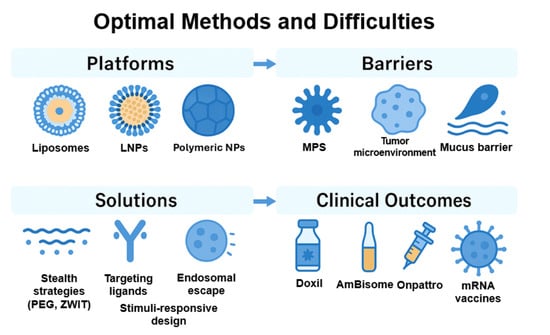
- From route of administration to systemic fate: Efficacy begins with co-engineering the device and formulation to overcome the anatomical and physiological limitations of a specific route (transdermal microneedles [30,36,37], aerodynamic powders [41], nasal sprays and gels [31,44]. However, once the carrier overcomes the first epithelial barrier, its fate is dictated by a universal interface in vivo—the dynamically forming protein corona [38,39]. Ignoring this step undermines even the most sophisticated targeting strategies [61].
- Evolution of targeting paradigms: In the field of tumor delivery, the focus has shifted from passive accumulation (EPR) to active remodeling of the microenvironment [34,58] and the creation of multistage systems [60]. For the BBB, it is becoming clear that simple ligand binding is not enough—strategies for managing or evading the protein corona are required.
- Key challenges and tools: Personalization (taking into account the disease state affecting the corona [54], scalability (see Section 3.3), and predictability are coming to the forefront. The integration of machine learning and in silico models for predicting in vivo behavior based on physicochemical properties opens the way to accelerated and rational design [62].
- The future: The next generation of platforms will not just be drug carriers, but adaptive therapeutic systems. They will combine precision material properties (elasticity [53], shape [63], “corona-aware” surface design, means of overcoming tissue barriers, and, possibly, logic for responding to biological signals. Their development will require an unprecedented convergence of pharmaceutical engineering, computational biology, and clinical science to translate laboratory breakthroughs into accessible and effective therapies for patients.
3.3. Synthesis of Manufacturing, Scale-Up, and Quality-by-Design Considerations
3.4. Synthesis of Safety, Immunogenicity, and Translational Evaluation Data
3.5. Synthesis of Clinical Landscape: Approved Systems and Promising Candidates in Development
3.6. Synthesis of Translational Hurdles: Cost, Scalability, and Accessibility
3.7. Future Directions and Emerging Paradigms
3.7.1. Extracellular Vesicles (EVs) as Natural Delivery Vectors
3.7.2. Biomimetic and Cell-Membrane–Coated Drug-Delivery Platforms
3.7.3. 3D/4D-Printed Dosage Forms and Adaptive Material Architectures
3.7.4. Delivery of Genome-Editing Tools and Complex Biologics
3.7.5. AI-Guided and Autonomous Intelligent Delivery Systems
4. Discussion
4.1. Brief Summary of the Main Findings
4.2. Interpretation and Significance
4.3. Comparison with Existing Literature
4.4. Limitations of the Review
5. Conclusions and Directions for Future Research
- Development of “corona-aware” design: Creation of standardized in vitro and in silico models for predicting the formation and evolution of protein coronas, which will enable prediction of the fate of nanocarriers in vivo and optimization of targeting strategies.
- Engineering for reproducibility and accessibility: Actively developing and validating continuous, cost-effective manufacturing processes (e.g., microfluidics-based) for promising but complex platforms such as EVs and biomimetic systems, incorporating Quality by Design (QbD) principles.
- Creating new preclinical models: Transitioning from simple to more complex models that account for disease heterogeneity (e.g., tumor stromal heterogeneity) and the human immune response, for a more accurate assessment of translational potential.
- Integrating digital tools into the full cycle: Extensive use of artificial intelligence and machine learning not only for in silico screening of materials but also for optimizing manufacturing processes, managing product stability (e.g., predictive models for the cold chain), and designing adaptive, closed-loop control systems.
Supplementary Materials
Author Contributions
Funding
Data Availability Statement
Acknowledgments
Conflicts of Interest
Abbreviations
| ABC | Accelerated Blood Clearance |
| AI | Artificial Intelligence |
| BBB | Blood–Brain Barrier |
| CARPA | Complement Activation-Related Pseudoallergy |
| CMC | Chemistry, Manufacturing, and Controls |
| CQA | Critical Quality Attribute |
| CRISPR | Clustered Regularly Interspaced Short Palindromic Repeats |
| DDS | Drug Delivery System(s) |
| DLS | Dynamic Light Scattering |
| DSPC | Distearoylphosphatidylcholine |
| EMA | European Medicines Agency |
| EPR | Enhanced Permeability and Retention |
| EV | Extracellular Vesicle |
| FDA | Food and Drug Administration |
| FRR | Flow-Rate Ratio |
| GC | Gas Chromatography |
| HPLC | High Performance Liquid Chromatography |
| ICH | International Council for Harmonization |
| LNPs | Lipid Nanoparticles |
| ML | Machine learning |
| MMAD | Mass Median Aerodynamic Diameter |
| MPS | Mononuclear Phagocyte System |
| MSN | Mesoporous Silica Nanoparticle |
| NMR | Nuclear Magnetic Resonance |
| NP | Nanoparticle |
| PCL | Poly(ε-caprolactone) |
| PDI | Polydispersity Index |
| PEG | Poly(Ethylene Glycol) |
| PLA | Polylactic Acid |
| PLD | Pegylated Liposomal Doxorubicin |
| PLGA | Poly(Lactic-co-Glycolic Acid) |
| PQS | Pharmaceutical Quality System |
| QbD | Quality by Design |
| QTPP | Quality Target Product Profile |
| RES | Reticuloendothelial System |
| RNP | Ribonucleoprotein |
| SAXS | Small-Angle X-ray Scattering |
| SEC | Size Exclusion Chromatography |
| TfR | Transferrin Receptor |
| TFR | Total Flow Rate |
| XPS | X-ray Photoelectron Spectroscopy |
References
- Adepu, S.; Ramakrishna, S. Controlled Drug Delivery Systems: Current Status and Future Directions. Molecules 2021, 26, 5905. [Google Scholar] [CrossRef] [PubMed]
- Mitchell, M.J.; Billingsley, M.M.; Haley, R.M.; Wechsler, M.E.; Peppas, N.A.; Langer, R. Engineering Precision Nanoparticles for Drug Delivery. Nat. Rev. Drug Discov. 2021, 20, 101–124. [Google Scholar] [CrossRef] [PubMed]
- Blanco, E.; Shen, H.; Ferrari, M. Principles of Nanoparticle Design for Overcoming Biological Barriers to Drug Delivery. Nat. Biotechnol. 2015, 33, 941–951. [Google Scholar] [CrossRef]
- Barenholz, Y. Doxil®—The First FDA-Approved Nano-Drug: Lessons Learned. J. Control. Release 2012, 160, 117–134. [Google Scholar] [CrossRef]
- Maeda, H. Toward a Full Understanding of the EPR Effect in Primary and Metastatic Tumors as Well as Issues Related to Its Heterogeneity. Adv. Drug Deliv. Rev. 2015, 91, 3–6. [Google Scholar] [CrossRef] [PubMed]
- Danhier, F. To Exploit the Tumor Microenvironment: Since the EPR Effect Fails in the Clinic, What Is the Future of Nanomedicine? J. Control. Release 2016, 244, 108–121. [Google Scholar] [CrossRef]
- Sun, T.; Zhang, Y.S.; Pang, B.; Hyun, D.C.; Yang, M.; Xia, Y. Engineered Nanoparticles for Drug Delivery in Cancer Therapy. Angew. Chem. Int. Ed. 2014, 53, 12320–12364. [Google Scholar] [CrossRef]
- Carugo, D.; Bottaro, E.; Owen, J.; Stride, E.; Nastruzzi, C. Liposome Production by Microfluidics: Potential and Limiting Factors. Sci. Rep. 2016, 6, 25876. [Google Scholar] [CrossRef]
- Gabizon, A.; Shmeeda, H.; Grenader, T. Pharmacological Basis of Pegylated Liposomal Doxorubicin: Impact on Cancer Therapy. Eur. J. Pharm. Sci. 2012, 45, 388–398. [Google Scholar] [CrossRef]
- Hou, X.; Zaks, T.; Langer, R.; Dong, Y. Lipid Nanoparticles for mRNA Delivery. Nat. Rev. Mater. 2021, 6, 1078–1094. [Google Scholar] [CrossRef]
- Polack, F.P.; Thomas, S.J.; Kitchin, N.; Absalon, J.; Gurtman, A.; Lockhart, S.; Perez, J.L.; Marc, G.P.; Moreira, E.D.; Zerbini, C.; et al. Safety and Efficacy of the BNT162b2 mRNA COVID-19 Vaccine. N. Engl. J. Med. 2020, 383, 2603–2615. [Google Scholar] [CrossRef] [PubMed]
- Adams, D.; Gonzalez-Duarte, A.; O′Riordan, W.D.; Yang, C.-C.; Ueda, M.; Kristen, A.V.; Tournev, I.; Schmidt, H.H.; Coelho, T.; Berk, J.L.; et al. Patisiran, an RNAi Therapeutic, for Hereditary Transthyretin Amyloidosis. N. Engl. J. Med. 2018, 379, 11–21. [Google Scholar] [CrossRef] [PubMed]
- Danhier, F.; Ansorena, E.; Silva, J.M.; Coco, R.; Le Breton, A.; Préat, V. PLGA-Based Nanoparticles: An Overview of Biomedical Applications. J. Control. Release 2012, 161, 505–522. [Google Scholar] [CrossRef]
- Wilhelm, S.; Tavares, A.J.; Dai, Q.; Ohta, S.; Audet, J.; Dvorak, H.F.; Chan, W.C.W. Analysis of Nanoparticle Delivery to Tumours. Nat. Rev. Mater. 2016, 1, 16014. [Google Scholar] [CrossRef]
- Bozzuto, G.; Molinari, A. Liposomes as Nanomedical Devices. Int. J. Nanomed. 2015, 10, 975–999. [Google Scholar] [CrossRef]
- Belliveau, N.M.; Huft, J.; Lin, P.J.; Chen, S.; Leung, A.K.; Leaver, T.J.; Wild, A.W.; Lee, J.B.; Taylor, R.J.; Tam, Y.K.; et al. Microfluidic Synthesis of Highly Potent Limit-Size Lipid Nanoparticles for In Vivo Delivery of siRNA. Mol. Ther. Nucleic Acids 2012, 1, e37. [Google Scholar] [CrossRef]
- Zhang, N.-N.; Li, X.-F.; Deng, Y.-Q.; Zhao, H.; Huang, Y.-J.; Yang, G.; Huang, W.-J.; Gao, P.; Zhou, C.; Zhang, R.-R.; et al. A Thermostable mRNA Vaccine against COVID-19. Cell 2020, 182, 1271–1283.e16. [Google Scholar] [CrossRef]
- Fredenberg, S.; Wahlgren, M.; Reslow, M.; Axelsson, A. The Mechanisms of Drug Release in Poly(Lactic-Co-Glycolic Acid)-Based Drug Delivery Systems—A Review. Int. J. Pharm. 2011, 415, 34–52. [Google Scholar] [CrossRef]
- Cabral, H.; Kataoka, K. Progress of Drug-Loaded Polymeric Micelles into Clinical Studies. J. Control. Release 2014, 190, 465–476. [Google Scholar] [CrossRef] [PubMed]
- Operti, M.C.; Bernhardt, A.; Sincari, V.; Jager, E.; Grimm, S.; Engel, A.; Hruby, M.; Figdor, C.G.; Tagit, O. Industrial Scale Manufacturing and Downstream Processing of PLGA-Based Nanomedicines Suitable for Fully Continuous Operation. Pharmaceutics 2022, 14, 276. [Google Scholar] [CrossRef]
- Madaan, K.; Kumar, S.; Poonia, N.; Lather, V.; Pandita, D. Dendrimers in Drug Delivery and Targeting: Drug-Dendrimer Interactions and Toxicity Issues. J. Pharm. Bioallied Sci. 2014, 6, 139. [Google Scholar] [CrossRef]
- Croissant, J.G.; Fatieiev, Y.; Khashab, N.M. Degradability and Clearance of Silicon, Organosilica, Silsesquioxane, Silica Mixed Oxide, and Mesoporous Silica Nanoparticles. Adv. Mater. 2017, 29, 1604634. [Google Scholar] [CrossRef]
- Zeng, M.; Shu, Y.; Parra-Robert, M.; Desai, D.; Zhou, H.; Li, Q.; Rong, Z.; Karaman, D.Ş.; Yang, H.; Peng, J.; et al. Scalable Synthesis of Multicomponent Multifunctional Inorganic Core@mesoporous Silica Shell Nanocomposites. Mater. Sci. Eng. C 2021, 128, 112272. [Google Scholar] [CrossRef]
- Fang, R.H.; Kroll, A.V.; Gao, W.; Zhang, L. Cell Membrane Coating Nanotechnology. Adv. Mater. 2018, 30, 1706759. [Google Scholar] [CrossRef]
- Elsharkasy, O.M.; Nordin, J.Z.; Hagey, D.W.; de Jong, O.G.; Schiffelers, R.M.; Andaloussi, S.E.; Vader, P. Extracellular Vesicles as Drug Delivery Systems: Why and How? Adv. Drug Deliv. Rev. 2020, 159, 332–343. [Google Scholar] [CrossRef]
- Vader, P.; Mol, E.A.; Pasterkamp, G.; Schiffelers, R.M. Extracellular Vesicles for Drug Delivery. Adv. Drug Deliv. Rev. 2016, 106, 148–156. [Google Scholar] [CrossRef] [PubMed]
- Page, M.J.; McKenzie, J.E.; Bossuyt, P.M.; Boutron, I.; Hoffmann, T.C.; Mulrow, C.D.; Shamseer, L.; Tetzlaff, J.M.; Akl, E.A.; Brennan, S.E.; et al. The PRISMA 2020 Statement: An Updated Guideline for Reporting Systematic Reviews. BMJ 2021, 372, n71. [Google Scholar] [CrossRef]
- Campbell, M.; McKenzie, J.E.; Sowden, A.; Katikireddi, S.V.; Brennan, S.E.; Ellis, S.; Hartmann-Boyce, J.; Ryan, R.; Shepperd, S.; Thomas, J.; et al. Synthesis without Meta-Analysis (SWiM) in Systematic Reviews: Reporting Guideline. BMJ 2020, 368, l6890. [Google Scholar] [CrossRef] [PubMed]
- Ranade, S.V.; Wieland, M.R.; Tam, T.; Rea, J.C.; Horvath, J.; Hieb, A.R.; Jia, W.; Grace, L.; Barteselli, G.; Stewart, J.M. The Port Delivery System with Ranibizumab: A New Paradigm for Long-Acting Retinal Drug Delivery. Drug Deliv. 2022, 29, 1326–1334. [Google Scholar] [CrossRef] [PubMed]
- Rouphael, N.G.; Paine, M.; Mosley, R.; Henry, S.; McAllister, D.V.; Kalluri, H.; Pewin, W.; Frew, P.M.; Yu, T.; Thornburg, N.J.; et al. The Safety, Immunogenicity, and Acceptability of Inactivated Influenza Vaccine Delivered by Microneedle Patch (TIV-MNP 2015): A Randomised, Partly Blinded, Placebo-Controlled, Phase 1 Trial. Lancet 2017, 390, 649–658. [Google Scholar] [CrossRef]
- El Taweel, M.M.; Aboul-Einien, M.H.; Kassem, M.A.; Elkasabgy, N.A. Intranasal Zolmitriptan-Loaded Bilosomes with Extended Nasal Mucociliary Transit Time for Direct Nose to Brain Delivery. Pharmaceutics 2021, 13, 1828. [Google Scholar] [CrossRef] [PubMed]
- Pangua, C.; Espuelas, S.; Martínez-Ohárriz, M.C.; Vizmanos, J.L.; Irache, J.M. Mucus-Penetrating and Permeation Enhancer Albumin-Based Nanoparticles for Oral Delivery of Macromolecules: Application to Bevacizumab. Drug Deliv. Transl. Res. 2024, 14, 1189–1205. [Google Scholar] [CrossRef]
- Zhao, Z.; Pan, D.C.; Qi, Q.M.; Kim, J.; Kapate, N.; Sun, T.; Shields, C.W., IV; Wang, L.L.-W.; Wu, D.; Kwon, C.J.; et al. Engineering of Living Cells with Polyphenol-Functionalized Biologically Active Nanocomplexes. Adv. Mater. 2020, 32, 2003492. [Google Scholar] [CrossRef] [PubMed]
- Zinger, A.; Sushnitha, M.; Naoi, T.; Baudo, G.; De Rosa, E.; Chang, J.; Tasciotti, E.; Taraballi, F. Enhancing Inflammation Targeting Using Tunable Leukocyte-Based Biomimetic Nanoparticles. ACS Nano 2021, 15, 6326–6339. [Google Scholar] [CrossRef]
- Kis, Z. Stability Modelling of mRNA Vaccine Quality Based on Temperature Monitoring throughout the Distribution Chain. Pharmaceutics 2022, 14, 430. [Google Scholar] [CrossRef]
- Adediran, E.; Arte, T.; Pasupuleti, D.; Vijayanand, S.; Singh, R.; Patel, P.; Gulani, M.; Ferguson, A.; Uddin, M.; Zughaier, S.M.; et al. Delivery of PLGA-Loaded Influenza Vaccine Microparticles Using Dissolving Microneedles Induces a Robust Immune Response. Pharmaceutics 2025, 17, 510. [Google Scholar] [CrossRef]
- Wu, Y.; Vora, L.K.; Wang, Y.; Adrianto, M.F.; Tekko, I.A.; Waite, D.; Donnelly, R.F.; Thakur, R.R.S. Long-Acting Nanoparticle-Loaded Bilayer Microneedles for Protein Delivery to the Posterior Segment of the Eye. Eur. J. Pharm. Biopharm. 2021, 165, 306–318. [Google Scholar] [CrossRef]
- Abbina, S.; Takeuchi, L.E.; Anilkumar, P.; Yu, K.; Rogalski, J.C.; Shenoi, R.A.; Constantinescu, I.; Kizhakkedathu, J.N. Blood Circulation of Soft Nanomaterials Is Governed by Dynamic Remodeling of Protein Opsonins at Nano-Biointerface. Nat. Commun. 2020, 11, 3048. [Google Scholar] [CrossRef]
- Schöttler, S.; Becker, G.; Winzen, S.; Steinbach, T.; Mohr, K.; Landfester, K.; Mailänder, V.; Wurm, F.R. Protein Adsorption Is Required for Stealth Effect of Poly(Ethylene Glycol)- and Poly(Phosphoester)-Coated Nanocarriers. Nat. Nanotechnol. 2016, 11, 372–377. [Google Scholar] [CrossRef] [PubMed]
- Schneider, C.S.; Xu, Q.; Boylan, N.J.; Chisholm, J.; Tang, B.C.; Schuster, B.S.; Henning, A.; Ensign, L.M.; Lee, E.; Adstamongkonkul, P.; et al. Nanoparticles That Do Not Adhere to Mucus Provide Uniform and Long-Lasting Drug Delivery to Airways Following Inhalation. Sci. Adv. 2017, 3, e1601556. [Google Scholar] [CrossRef]
- Chan, H.W.; Zhang, X.; Chow, S.; Lam, D.C.L.; Chow, S.F. Inhalable Paclitaxel Nanoagglomerate Dry Powders for Lung Cancer Chemotherapy: Design of Experiments-Guided Development, Characterization and in Vitro Evaluation. Int. J. Pharm. 2024, 653, 123877. [Google Scholar] [CrossRef]
- Pho, T.; Champion, J.A. Surface Engineering of Protein Nanoparticles Modulates Transport, Adsorption, and Uptake in Mucus. ACS Appl. Mater. Interfaces 2022, 14, 51697–51710. [Google Scholar] [CrossRef]
- Kumar, N.N.; Lochhead, J.J.; Pizzo, M.E.; Nehra, G.; Boroumand, S.; Greene, G.; Thorne, R.G. Delivery of Immunoglobulin G Antibodies to the Rat Nervous System Following Intranasal Administration: Distribution, Dose-Response, and Mechanisms of Delivery. J. Control. Release 2018, 286, 467–484. [Google Scholar] [CrossRef]
- Gonçalves, J.; Bicker, J.; Gouveia, F.; Liberal, J.; Oliveira, R.C.; Alves, G.; Falcão, A.; Fortuna, A. Nose-to-Brain Delivery of Levetiracetam after Intranasal Administration to Mice. Int. J. Pharm. 2019, 564, 329–339. [Google Scholar] [CrossRef]
- Chung, E.P.; Cotter, J.D.; Prakapenka, A.V.; Cook, R.L.; DiPerna, D.M.; Sirianni, R.W. Targeting Small Molecule Delivery to the Brain and Spinal Cord via Intranasal Administration of Rabies Virus Glycoprotein (RVG29)-Modified PLGA Nanoparticles. Pharmaceutics 2020, 12, 93. [Google Scholar] [CrossRef] [PubMed]
- Lamptey, R.N.L.; Gothwal, A.; Trivedi, R.; Arora, S.; Singh, J. Synthesis and Characterization of Fatty Acid Grafted Chitosan Polymeric Micelles for Improved Gene Delivery of VGF to the Brain through Intranasal Route. Biomedicines 2022, 10, 493. [Google Scholar] [CrossRef] [PubMed]
- Deshmukh, V.; Narwade, M.; Gajbhiye, K.R. Intranasal Delivery of Paclitaxel-Loaded Ligand Conjugated Polymeric Nanoparticles for Targeted Brain Delivery. AAPS PharmSciTech 2025, 26, 49. [Google Scholar] [CrossRef] [PubMed]
- Alleva, M.; Baranyai, Z.; Esteban-Pérez, N.; Martínez-Vicente, P.; Martín-Rapún, R.; Moros, M.; Martínez de la Fuente, J. Förster Resonance Energy Transfer (FRET) Demonstrates In Vitro Chitosan-Coated Nanocapsules Suitability for Intranasal Brain Delivery. ACS Appl. Mater. Interfaces 2025, 17, 26348–26360. [Google Scholar] [CrossRef]
- Han, S.; Wang, J.T.-W.; Yavuz, E.; Zam, A.; Rouatbi, N.; Utami, R.N.; Liam-Or, R.; Griffiths, A.; Dickson, W.; Sosabowski, J.; et al. Spatiotemporal Tracking of Gold Nanorods after Intranasal Administration for Brain Targeting. J. Control. Release 2023, 357, 606–619. [Google Scholar] [CrossRef]
- Baloch, J.; Sohail, M.F.; Sarwar, H.S.; Kiani, M.H.; Khan, G.M.; Jahan, S.; Rafay, M.; Chaudhry, M.T.; Yasinzai, M.; Shahnaz, G. Self-Nanoemulsifying Drug Delivery System (SNEDDS) for Improved Oral Bioavailability of Chlorpromazine: In Vitro and In Vivo Evaluation. Medicina 2019, 55, 210. [Google Scholar] [CrossRef]
- Guo, Y.; Ma, Y.; Chen, X.; Li, M.; Ma, X.; Cheng, G.; Xue, C.; Zuo, Y.Y.; Sun, B. Mucus Penetration of Surface-Engineered Nanoparticles in Various pH Microenvironments. ACS Nano 2023, 17, 2813–2828. [Google Scholar] [CrossRef] [PubMed]
- Lamson, N.G.; Berger, A.; Fein, K.C.; Whitehead, K.A. Anionic Nanoparticles Enable the Oral Delivery of Proteins by Enhancing Intestinal Permeability. Nat. Biomed. Eng. 2020, 4, 84–96. [Google Scholar] [CrossRef] [PubMed]
- Zheng, Y.; Xing, L.; Chen, L.; Zhou, R.; Wu, J.; Zhu, X.; Li, L.; Xiang, Y.; Wu, R.; Zhang, L.; et al. Tailored Elasticity Combined with Biomimetic Surface Promotes Nanoparticle Transcytosis to Overcome Mucosal Epithelial Barrier. Biomaterials 2020, 262, 120323. [Google Scholar] [CrossRef]
- Xu, W.; Xu, M.; Xiao, Y.; Yu, L.; Xie, H.; Jiang, X.; Chen, M.; Gao, H.; Wang, L. Changes in Target Ability of Nanoparticles Due to Protein Corona Composition and Disease State. Asian J. Pharm. Sci. 2022, 17, 401–411. [Google Scholar] [CrossRef]
- Liu, D.; Lian, Y.; Fang, Q.; Liu, L.; Zhang, J.; Li, J. Hyaluronic-Acid-Modified Lipid-Polymer Hybrid Nanoparticles as an Efficient Ocular Delivery Platform for Moxifloxacin Hydrochloride. Int. J. Biol. Macromol. 2018, 116, 1026–1036. [Google Scholar] [CrossRef]
- Bisht, R.; Jaiswal, J.K.; Oliver, V.F.; Eurtivong, C.; Reynisson, J.; Rupenthal, I.D. Preparation and Evaluation of PLGA Nanoparticle-Loaded Biodegradable Light-Responsive Injectable Implants as a Promising Platform for Intravitreal Drug Delivery. J. Drug Deliv. Sci. Technol. 2017, 40, 142–156. [Google Scholar] [CrossRef]
- Sindhwani, S.; Syed, A.M.; Ngai, J.; Kingston, B.R.; Maiorino, L.; Rothschild, J.; MacMillan, P.; Zhang, Y.; Rajesh, N.U.; Hoang, T.; et al. The Entry of Nanoparticles into Solid Tumours. Nat. Mater. 2020, 19, 566–575. [Google Scholar] [CrossRef]
- Panagi, M.; Voutouri, C.; Mpekris, F.; Papageorgis, P.; Martin, M.R.; Martin, J.D.; Demetriou, P.; Pierides, C.; Polydorou, C.; Stylianou, A.; et al. TGF-β Inhibition Combined with Cytotoxic Nanomedicine Normalizes Triple Negative Breast Cancer Microenvironment towards Anti-Tumor Immunity. Theranostics 2020, 10, 1910–1922. [Google Scholar] [CrossRef]
- Zinger, A.; Koren, L.; Adir, O.; Poley, M.; Alyan, M.; Yaari, Z.; Noor, N.; Krinsky, N.; Simon, A.; Gibori, H.; et al. Collagenase Nanoparticles Enhance the Penetration of Drugs into Pancreatic Tumors. ACS Nano 2019, 13, 11008–11021. [Google Scholar] [CrossRef]
- Duan, S.; Sun, F.; Qiao, P.; Zhu, Z.; Geng, M.; Gong, X.; Li, Y.; Yao, H. Detachable Dual-Targeting Nanoparticles for Improving the Antitumor Effect by Extracellular Matrix Depletion. ACS Biomater. Sci. Eng. 2023, 9, 1437–1449. [Google Scholar] [CrossRef] [PubMed]
- Xiao, W.; Wang, Y.; Zhang, H.; Liu, Y.; Xie, R.; He, X.; Zhou, Y.; Liang, L.; Gao, H. The Protein Corona Hampers the Transcytosis of Transferrin-Modified Nanoparticles through Blood–Brain Barrier and Attenuates Their Targeting Ability to Brain Tumor. Biomaterials 2021, 274, 120888. [Google Scholar] [CrossRef]
- Lin, Z.; Chou, W.-C.; Cheng, Y.-H.; He, C.; Monteiro-Riviere, N.A.; Riviere, J.E. Predicting Nanoparticle Delivery to Tumors Using Machine Learning and Artificial Intelligence Approaches. Int. J. Nanomed. 2022, 17, 1365–1379. [Google Scholar] [CrossRef]
- Meyer, R.A.; Mathew, M.P.; Ben-Akiva, E.; Sunshine, J.C.; Shmueli, R.B.; Ren, Q.; Yarema, K.J.; Green, J.J. Anisotropic Biodegradable Lipid Coated Particles for Spatially Dynamic Protein Presentation. Acta Biomater. 2018, 72, 228–238. [Google Scholar] [CrossRef]
- Okuda, K.; Sato, Y.; Iwakawa, K.; Sasaki, K.; Okabe, N.; Maeki, M.; Tokeshi, M.; Harashima, H. On the Size-Regulation of RNA-Loaded Lipid Nanoparticles Synthesized by Microfluidic Device. J. Control. Release 2022, 348, 648–659. [Google Scholar] [CrossRef]
- Gdowski, A.; Johnson, K.; Shah, S.; Gryczynski, I.; Vishwanatha, J.; Ranjan, A. Optimization and Scale up of Microfluidic Nanolipomer Production Method for Preclinical and Potential Clinical Trials. J. Nanobiotechnol. 2018, 16, 12. [Google Scholar] [CrossRef] [PubMed]
- Chen, S.; Tam, Y.Y.C.; Lin, P.J.C.; Sung, M.M.H.; Tam, Y.K.; Cullis, P.R. Influence of Particle Size on the in Vivo Potency of Lipid Nanoparticle Formulations of siRNA. J. Control. Release 2016, 235, 236–244. [Google Scholar] [CrossRef]
- Lu, R.; Groer, C.; Kleindl, P.A.; Moulder, K.R.; Huang, A.; Hunt, J.R.; Cai, S.; Aires, D.J.; Berkland, C.; Forrest, M.L. Formulation and Preclinical Evaluation of a Toll-like Receptor 7/8 Agonist as an Anti-Tumoral Immunomodulator. J. Control. Release 2019, 306, 165–176. [Google Scholar] [CrossRef] [PubMed]
- Sellaturay, P.; Nasser, S.; Islam, S.; Gurugama, P.; Ewan, P.W. Polyethylene Glycol (PEG) Is a Cause of Anaphylaxis to the Pfizer/BioNTech mRNA COVID-19 Vaccine. Clin. Exp. Allergy 2021, 51, 861–863. [Google Scholar] [CrossRef]
- Zhou, Z.; Feng, Y.; Jiang, M.; Yao, Z.; Wang, J.; Pan, F.; Feng, R.; Zhao, C.; Ma, Y.; Zhou, J.; et al. Ionizable Polymeric Micelles (IPMs) for Efficient siRNA Delivery. Nat. Commun. 2025, 16, 360. [Google Scholar] [CrossRef]
- MacCuaig, W.M.; Samykutty, A.; Foote, J.; Luo, W.; Filatenkov, A.; Li, M.; Houchen, C.; Grizzle, W.E.; McNally, L.R. Toxicity Assessment of Mesoporous Silica Nanoparticles upon Intravenous Injection in Mice: Implications for Drug Delivery. Pharmaceutics 2022, 14, 969. [Google Scholar] [CrossRef] [PubMed]
- Li, Y.; Mei, K.-C.; Liam-Or, R.; Wang, J.T.-W.; Faruqu, F.N.; Zhu, S.; Wang, Y.; Lu, Y.; Al-Jamal, K.T. Graphene Oxide Nanosheets Toxicity in Mice Is Dependent on Protein Corona Composition and Host Immunity. ACS Nano 2024, 18, 22572–22585. [Google Scholar] [CrossRef]
- Blok, S.L.J.; van Oeveren, W.; Engels, G.E. The Optimal Incubation Time for in Vitro Hemocompatibility Testing: Assessment Using Polymer Reference Materials under Pulsatile Flow with Physiological Wall Shear Stress Conditions. J. Biomed. Mater. Res. B Appl. Biomater. 2019, 107, 2335–2342. [Google Scholar] [CrossRef]
- Sperling, C.; Maitz, M.F.; Körber, V.; Hänsel, S.; Werner, C. Advanced in Vitro Hemocompatibility Assessment of Biomaterials Using a New Flow Incubation System. Biomater. Adv. 2023, 153, 213555. [Google Scholar] [CrossRef] [PubMed]
- Zhang, J.; Jiang, H.; Zhang, J.; Bao, G.; Zhang, G.; Wang, H.; Wang, X. Effectiveness and Safety of Pegylated Liposomal Doxorubicin versus Epirubicin as Neoadjuvant or Adjuvant Chemotherapy for Breast Cancer: A Real-World Study. BMC Cancer 2021, 21, 1301. [Google Scholar] [CrossRef]
- Fukuda, A.; Tahara, K.; Hane, Y.; Matsui, T.; Sasaoka, S.; Hatahira, H.; Motooka, Y.; Hasegawa, S.; Naganuma, M.; Abe, J.; et al. Comparison of the Adverse Event Profiles of Conventional and Liposomal Formulations of Doxorubicin Using the FDA Adverse Event Reporting System. PLoS ONE 2017, 12, e0185654. [Google Scholar] [CrossRef]
- Osouli-Bostanabad, K.; Puliga, S.; Serrano, D.R.; Bucchi, A.; Halbert, G.; Lalatsa, A. Microfluidic Manufacture of Lipid-Based Nanomedicines. Pharmaceutics 2022, 14, 1940. [Google Scholar] [CrossRef] [PubMed]
- Haldane, V.; Ariyarajah, A.; Berry, I.; Loutet, M.; Salamanca-Buentello, F.; Upshur, R.E.G. Global Inequity Creates Local Insufficiency: A Qualitative Study of COVID-19 Vaccine Implementation Challenges in Low-and-Middle-Income Countries. PLoS ONE 2023, 18, e0281358. [Google Scholar] [CrossRef] [PubMed]
- Wouters, O.J.; Shadlen, K.C.; Salcher-Konrad, M.; Pollard, A.J.; Larson, H.J.; Teerawattananon, Y.; Jit, M. Challenges in Ensuring Global Access to COVID-19 Vaccines: Production, Affordability, Allocation, and Deployment. Lancet 2021, 397, 1023–1034. [Google Scholar] [CrossRef]
- Zhu, J.-Y.; Zheng, D.-W.; Zhang, M.-K.; Yu, W.-Y.; Qiu, W.-X.; Hu, J.-J.; Feng, J.; Zhang, X.-Z. Preferential Cancer Cell Self-Recognition and Tumor Self-Targeting by Coating Nanoparticles with Homotypic Cancer Cell Membranes. Nano Lett. 2016, 16, 5895–5901. [Google Scholar] [CrossRef]
- Tian, Y.; Gong, M.; Hu, Y.; Liu, H.; Zhang, W.; Zhang, M.; Hu, X.; Aubert, D.; Zhu, S.; Wu, L.; et al. Quality and Efficiency Assessment of Six Extracellular Vesicle Isolation Methods by Nano-Flow Cytometry. J. Extracell. Vesicles 2020, 9, 1697028. [Google Scholar] [CrossRef]
- Veerman, R.E.; Teeuwen, L.; Czarnewski, P.; Güclüler Akpinar, G.; Sandberg, A.; Cao, X.; Pernemalm, M.; Orre, L.M.; Gabrielsson, S.; Eldh, M. Molecular Evaluation of Five Different Isolation Methods for Extracellular Vesicles Reveals Different Clinical Applicability and Subcellular Origin. J. Extracell. Vesicles 2021, 10, e12128. [Google Scholar] [CrossRef]
- Stickney, Z.; Losacco, J.; McDevitt, S.; Zhang, Z.; Lu, B. Development of Exosome Surface Display Technology in Living Human Cells. Biochem. Biophys. Res. Commun. 2016, 472, 53–59. [Google Scholar] [CrossRef]
- Zhou, X.; Miao, Y.; Wang, Y.; He, S.; Guo, L.; Mao, J.; Chen, M.; Yang, Y.; Zhang, X.; Gan, Y. Tumour-Derived Extracellular Vesicle Membrane Hybrid Lipid Nanovesicles Enhance siRNA Delivery by Tumour-Homing and Intracellular Freeway Transportation. J. Extracell. Vesicles 2022, 11, e12198. [Google Scholar] [CrossRef]
- You, Y.; Tian, Y.; Guo, R.; Shi, J.; Kwak, K.J.; Tong, Y.; Estania, A.P.; Hsu, W.-H.; Liu, Y.; Hu, S.; et al. Extracellular Vesicle-Mediated VEGF-A mRNA Delivery Rescues Ischaemic Injury with Low Immunogenicity. Eur. Heart J. 2025, 46, 1662–1676. [Google Scholar] [CrossRef]
- Murphy, D.E.; de Jong, O.G.; Evers, M.J.W.; Nurazizah, M.; Schiffelers, R.M.; Vader, P. Natural or Synthetic RNA Delivery: A Stoichiometric Comparison of Extracellular Vesicles and Synthetic Nanoparticles. Nano Lett. 2021, 21, 1888–1895. [Google Scholar] [CrossRef] [PubMed]
- Nawaz, M.; Heydarkhan-Hagvall, S.; Tangruksa, B.; González-King Garibotti, H.; Jing, Y.; Maugeri, M.; Kohl, F.; Hultin, L.; Reyahi, A.; Camponeschi, A.; et al. Lipid Nanoparticles Deliver the Therapeutic VEGFA mRNA In Vitro and In Vivo and Transform Extracellular Vesicles for Their Functional Extensions. Adv. Sci. 2023, 10, 2206187. [Google Scholar] [CrossRef] [PubMed]
- Fisher, W.S.; Douglas, J.; Roshan, S.; Perez, R.; Wei, S.; Roberts, L.; Ewert, K.K.; Safinya, C.R. Acidic Conditions Promote Clustering of Cancer Cell Derived Extracellular Vesicles and Enhance Their Fusion with Synthetic Liposomes. Langmuir 2025, 41, 4533–4544. [Google Scholar] [CrossRef] [PubMed]
- Oshchepkova, A.; Chernikov, I.; Miroshnichenko, S.; Patutina, O.; Markov, O.; Savin, I.; Staroseletz, Y.; Meschaninova, M.; Puchkov, P.; Zhukov, S.; et al. Extracellular Vesicle Mimetics as Delivery Vehicles for Oligonucleotide-Based Therapeutics and Plasmid DNA. Front. Bioeng. Biotechnol. 2024, 12, 1437817. [Google Scholar] [CrossRef]
- Kadry, H.; Al-Hilal, T.A.; Keshavarz, A.; Alam, F.; Xu, C.; Joy, A.; Ahsan, F. Multi-purposable filaments of HPMC for 3D printing of medications with tailored drug release and timed-absorption. Int. J. Pharm. 2018, 544, 285–296. [Google Scholar] [CrossRef]
- Larsen, B.S.; Kissi, E.; Nogueira, L.P.; Genina, N.; Tho, I. Impact of Drug Load and Polymer Molecular Weight on the 3D Microstructure of Printed Tablets. Eur. J. Pharm. Sci. 2024, 192, 106619. [Google Scholar] [CrossRef]
- Qiu, Z.; Guo, Q.; Lv, J.; Chen, L. 3D Printing Combined with pH-Induced 4D Printed Iron(III)-Oxidized Starch Gels for Controlled Iron Delivery and Enhanced Iron Supplementation. Carbohydr. Polym. 2025, 366, 123933. [Google Scholar] [CrossRef]
- Goyal, R.; Sahu, S.; Mitra, S.; Niranjan, R.; Priyadarshini, R.; Yadav, R.; Lochab, B. Nanocellulose-Reinforced 4D Printed Hydrogels: Thermoresponsive Shape Morphing and Drug Release. ACS Appl. Polym. Mater. 2024, 6, 1348–1361. [Google Scholar] [CrossRef]
- Rosenblum, D.; Gutkin, A.; Kedmi, R.; Ramishetti, S.; Veiga, N.; Jacobi, A.M.; Schubert, M.S.; Friedmann-Morvinski, D.; Cohen, Z.R.; Behlke, M.A.; et al. CRISPR-Cas9 Genome Editing Using Targeted Lipid Nanoparticles for Cancer Therapy. Sci. Adv. 2020, 6, eabc9450. [Google Scholar] [CrossRef]
- Wei, T.; Cheng, Q.; Min, Y.-L.; Olson, E.N.; Siegwart, D.J. Systemic Nanoparticle Delivery of CRISPR-Cas9 Ribonucleoproteins for Effective Tissue Specific Genome Editing. Nat. Commun. 2020, 11, 3232. [Google Scholar] [CrossRef]
- Mout, R.; Ray, M.; Yesilbag Tonga, G.; Lee, Y.-W.; Tay, T.; Sasaki, K.; Rotello, V.M. Direct Cytosolic Delivery of CRISPR/Cas9-Ribonucleoprotein for Efficient Gene Editing. ACS Nano 2017, 11, 2452–2458. [Google Scholar] [CrossRef]
- Charlesworth, C.T.; Deshpande, P.S.; Dever, D.P.; Camarena, J.; Lemgart, V.T.; Cromer, M.K.; Vakulskas, C.A.; Collingwood, M.A.; Zhang, L.; Bode, N.M.; et al. Identification of Preexisting Adaptive Immunity to Cas9 Proteins in Humans. Nat. Med. 2019, 25, 249–254. [Google Scholar] [CrossRef] [PubMed]
- Rouet, R.; de Oñate, L.; Li, J.; Murthy, N.; Wilson, R.C. Engineering CRISPR-Cas9 RNA–Protein Complexes for Improved Function and Delivery. CRISPR J. 2018, 1, 367–378. [Google Scholar] [CrossRef] [PubMed]
- Cave, J.; Christiono, A.; Schiavone, C.; Pownall, H.J.; Cristini, V.; Staquicini, D.I.; Pasqualini, R.; Arap, W.; Brinker, C.J.; Campen, M.; et al. Rational Design of Safer Inorganic Nanoparticles via Mechanistic Modeling-Informed Machine Learning. ACS Nano 2025, 19, 21538–21555. [Google Scholar] [CrossRef]
- Gong, D.; Ben-Akiva, E.; Singh, A.; Yamagata, H.; Est-Witte, S.; Shade, J.K.; Trayanova, N.A.; Green, J.J. Machine Learning Guided Structure Function Predictions Enable in Silico Nanoparticle Screening for Polymeric Gene Delivery. Acta Biomater. 2022, 154, 349–358. [Google Scholar] [CrossRef]
- Huang, Y.; Li, X.; Cao, J.; Wei, X.; Li, Y.; Wang, Z.; Cai, X.; Li, R.; Chen, J. Use of Dissociation Degree in Lysosomes to Predict Metal Oxide Nanoparticle Toxicity in Immune Cells: Machine Learning Boosts Nano-Safety Assessment. Environ. Int. 2022, 164, 107258. [Google Scholar] [CrossRef] [PubMed]
- Guo, Y.; Liu, S.; Luo, F.; Tang, D.; Yang, T.; Yang, X.; Xie, Y. A Nanosized Codelivery System Based on Intracellular Stimuli-Triggered Dual-Drug Release for Multilevel Chemotherapy Amplification in Drug-Resistant Breast Cancer. Pharmaceutics 2022, 14, 422. [Google Scholar] [CrossRef] [PubMed]
- Huayamares, S.G.; Lian, L.; Rab, R.; Hou, Y.; Radmand, A.; Kim, H.; Zenhausern, R.; Achyut, B.R.; Gilbert Ross, M.; Lokugamage, M.P.; et al. Nanoparticle Delivery of a Prodrug-Activating Bacterial Enzyme Leads to Anti-Tumor Responses. Nat. Commun. 2025, 16, 3490. [Google Scholar] [CrossRef] [PubMed]
- Han, X.; Gong, C.; Yang, Q.; Zheng, K.; Wang, Z.; Zhang, W. Biomimetic Nano-Drug Delivery System: An Emerging Platform for Promoting Tumor Treatment. Int. J. Nanomed. 2024, 19, 571–608. [Google Scholar] [CrossRef]
- Liu, Y.; An, D.; Meng, X.; Deng, S.; Liu, G. Zein-Based Nanocarriers: Advances in Oral Drug Delivery. Pharmaceutics 2025, 17, 944. [Google Scholar] [CrossRef] [PubMed]



| Product (Approval Year) | Carrier | Indication(s) | Headline Clinical Benefit |
|---|---|---|---|
| Doxil®/Caelyx® (1995 EU/1999 US) | PEGylated liposome (PLD) | Kaposi’s sarcoma, ovarian cancer, multiple myeloma | Reduced cardiotoxicity and sustained tumor exposure vs. conventional doxorubicin. |
| AmBisome® (1997) | Liposomal amphotericin B | Invasive fungal infections | Markedly reduced nephrotoxicity with maintained fungicidal efficacy. |
| Abraxane® (2005) | Albumin-bound paclitaxel (nab-paclitaxel) | Metastatic breast cancer; later pancreas, NSCLC | Improved tolerability and response rates via solvent-free, targeted delivery. |
| Onpattro® (2018) | LNPs (siRNA, patisiran) | Hereditary transthyretin (hATTR) polyneuropathy | Robust target silencing with meaningful improvement in neuropathy and QoL. |
| Comirnaty® (2020) | LNPs (mRNA) | COVID-19 prevention | High efficacy in phase III; rapid global scale-up and deployment |
| Spikevax® (2021) | LNPs (mRNA) | COVID-19 prevention | Strong immunogenicity; flexible adaptation to variants |
| Vyxeos® (2017) | Liposomal daunorubicin/cytarabine | High-risk AML | Improved overall survival vs. standard 7 + 3 regimen |
| Marqibo® (2012) | Liposomal vincristine | Ph-negative ALL | Enables higher effective dose; prolonged circulation; reduced neurotoxicity |
| DepoCyt®/DepoCyte® (1999) | DepoFoam liposomal formulation | Lymphomatous meningitis | Extended CSF exposure; reduced need for frequent lumbar punctures |
| Visudyne® (2000) | Liposomal verteporfin | Age-related macular degeneration (AMD) | Targeted photodynamic action with lower systemic toxicity |
| Adcetris® (2011) | Antibody–drug conjugate (ADC, brentuximab vedotin) | Hodgkin lymphoma; ALCL | Selective CD30 targeting enhances efficacy and reduces off-target effects. |
| Enhertu® (2019) | ADC (trastuzumab deruxtecan) | HER2-positive metastatic breast cancer | High response rates via potent, targeted payload delivery. |
| Susvimo® (Port Delivery System with ranibizumab) (2021) | Refillable intravitreal implant | Neovascular (wet) age-related macular degeneration (nAMD) | Continuous drug delivery extends treatment intervals to 6 months, preferred by patients [29]. |
| Platform/Candidate | Clinical Stage | Key Innovation/Outcome | Reference |
|---|---|---|---|
| Influenza Vaccine Microneedle Patch (TIV-MNP) | Phase 1 Trial | Safe, immunogenic, patient-friendly alternative to intramuscular injection. | [30] |
| Bilosomal Mucoadhesive In situ Gel (Zolmitriptan) | Preclinical (In vivo PK in rodents) | >10-fold increase in brain bioavailability via direct nose-to-brain transport (~98%). | [31] |
| Albumin-PEG NPs with Permeation Enhancer (Bevacizumab) | Preclinical (In vivo, rats) | Enabled oral bioavailability of a monoclonal antibody (~3.7%, 1000-fold increase). | [32] |
| “Cellnex” Cell Surface Engineering | Preclinical (In vivo proof-of-concept) | Coats living cells with nanocomplexes, enhancing targeting (11-fold lung delivery) and immunotherapy. | [33] |
| Tunable Leukocyte-Membrane Coated NPs | Preclinical (In vivo, inflammation models) | Quantitative tuning of protein–lipid ratio in coatings enhances targeting to inflamed endothelium. | [34] |
| Predictive Stability Model for LNP-mRNA Vaccines | In silico/Translational Solution | Kinetic model predicts CQA loss from temp. data, addressing cold-chain barrier. | [35] |
Disclaimer/Publisher’s Note: The statements, opinions and data contained in all publications are solely those of the individual author(s) and contributor(s) and not of MDPI and/or the editor(s). MDPI and/or the editor(s) disclaim responsibility for any injury to people or property resulting from any ideas, methods, instructions or products referred to in the content. |
© 2025 by the authors. Licensee MDPI, Basel, Switzerland. This article is an open access article distributed under the terms and conditions of the Creative Commons Attribution (CC BY) license.
Share and Cite
Uzakova, A.B.; Yergaliyeva, E.M.; Yerlanuly, A.; Mukatayeva, Z.S. A Systematic Review of Advanced Drug Delivery Systems: Engineering Strategies, Barrier Penetration, and Clinical Progress (2016–April 2025). Pharmaceutics 2026, 18, 11. https://doi.org/10.3390/pharmaceutics18010011
Uzakova AB, Yergaliyeva EM, Yerlanuly A, Mukatayeva ZS. A Systematic Review of Advanced Drug Delivery Systems: Engineering Strategies, Barrier Penetration, and Clinical Progress (2016–April 2025). Pharmaceutics. 2026; 18(1):11. https://doi.org/10.3390/pharmaceutics18010011
Chicago/Turabian StyleUzakova, Assem B., Elmira M. Yergaliyeva, Azamat Yerlanuly, and Zhazira S. Mukatayeva. 2026. "A Systematic Review of Advanced Drug Delivery Systems: Engineering Strategies, Barrier Penetration, and Clinical Progress (2016–April 2025)" Pharmaceutics 18, no. 1: 11. https://doi.org/10.3390/pharmaceutics18010011
APA StyleUzakova, A. B., Yergaliyeva, E. M., Yerlanuly, A., & Mukatayeva, Z. S. (2026). A Systematic Review of Advanced Drug Delivery Systems: Engineering Strategies, Barrier Penetration, and Clinical Progress (2016–April 2025). Pharmaceutics, 18(1), 11. https://doi.org/10.3390/pharmaceutics18010011