Structural Characterization of Linker Shielding in ADC Site-Specific Conjugates

 , , , , , , , ,
Abstract
1. Introduction
2. Materials and Methods
2.1. Molecular Dynamics Surface Area Calculations
2.2. Cloning, Protein Expression, and Purification
2.3. Linker–Payload Conjugation
2.4. Liquid Chromatography–Mass Spectrometry (LCMS)
2.5. Conjugation Stability Testing
2.6. Crystallization
2.7. Crystallography Data Collection and Structure Determination
2.8. Hydrophobic Interaction Chromatography (HIC) of Antibodies and Antibody–Drug Conjugates
3. Results
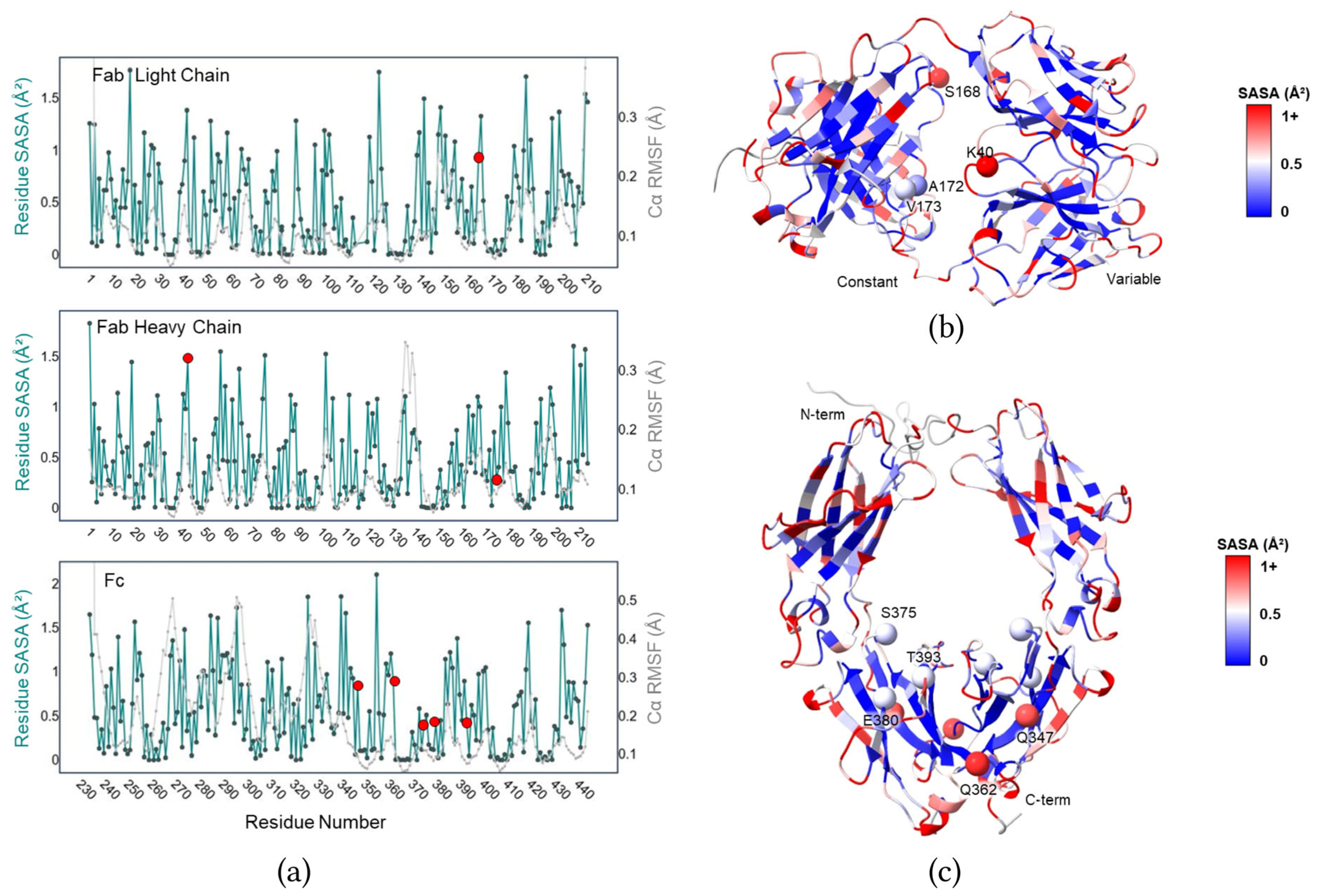
3.1. Molecular Dynamics-Guided Selection of Site-Specific Cysteine Mutants for Targeted ADC Exploration
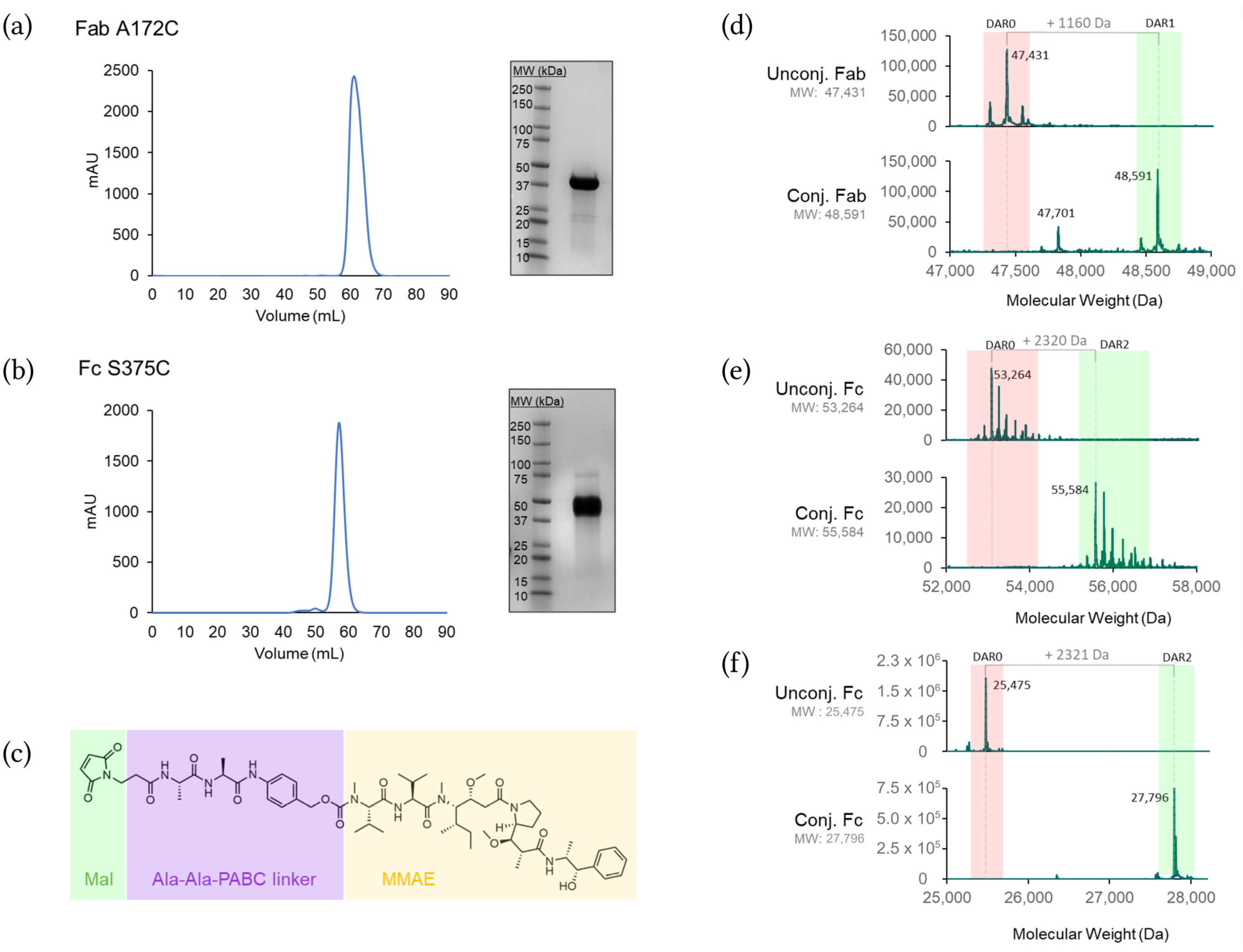
3.2. Selected Cysteine Mutants in Trastuzumab Fragments Are Homogenously Pure and Monodisperse Post Conjugation
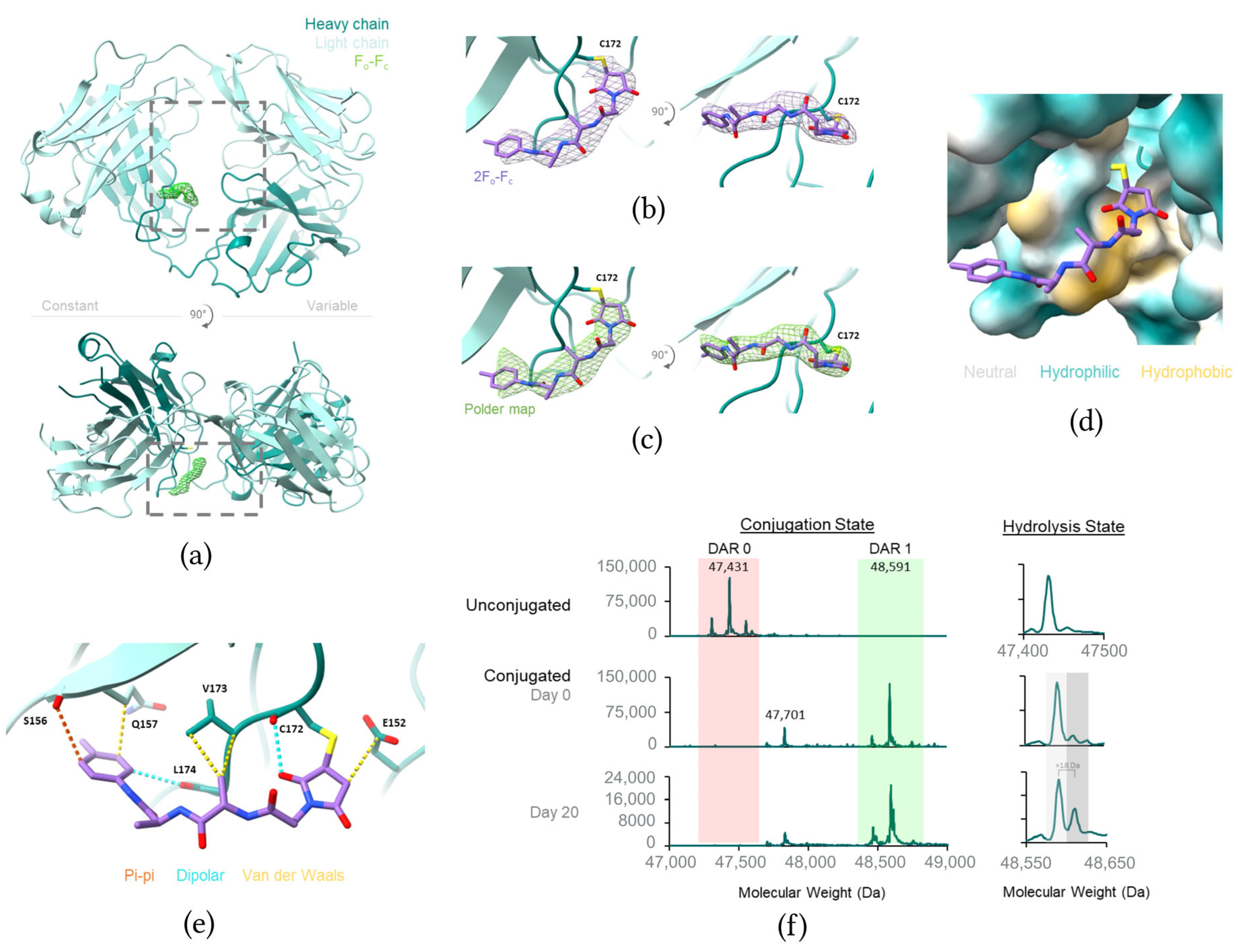
3.3. The Fab A172C Conjugate Linker Specifically Interacts with the Trastuzumab Fab
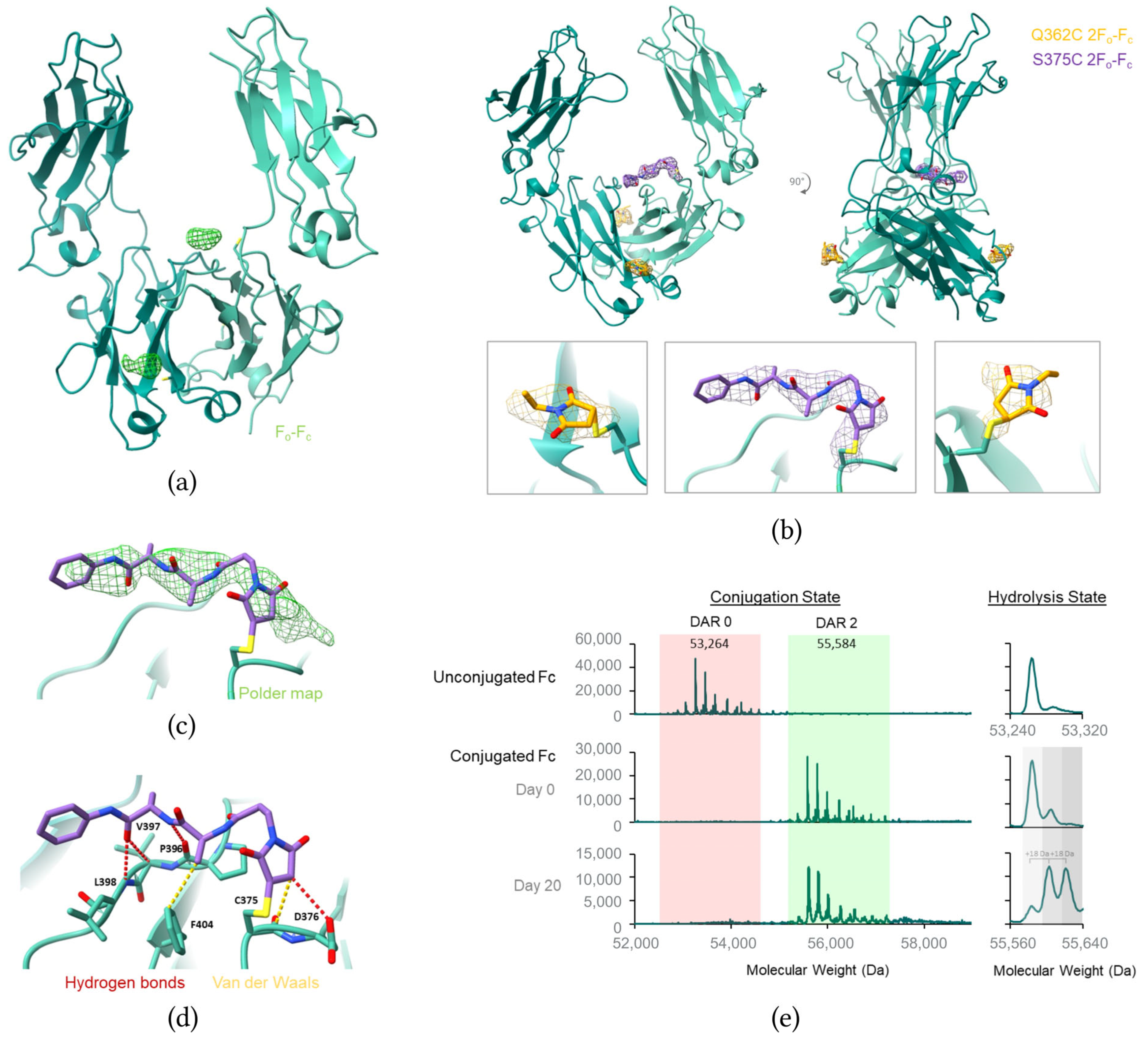
3.4. Fc S375C/Q362C Conjugate Structure Suggests the Central Fc Pocket Protects the Conjugated Linker
3.5. Maleimide Hydrolysis Likely Contributes to the Observed Heterogeneity at the S375C Site
3.6. Stronger Antibody–Linker Interactions Correlate with Lower ADC Hydrophobicity
4. Discussion
Supplementary Materials
Author Contributions
Funding
Data Availability Statement
Acknowledgments
Conflicts of Interest
Abbreviations
| ADC | Antibody Drug Conjugate |
| CH2/CH3 | antibody Constant Heavy domains |
| DAR | Drug Antibody Ratio |
| HIC | Hydrophobic Interaction Chromatography |
| IMCA | Industrial Macromolecular Crystallography Association |
| Fab | Fragment antigen-binding |
| Fc | Fragment crystallizable |
| HPLC | High-Performance Liquid Chromatography |
| LCMS | Liquid Chromatography–Mass Spectrometry |
| Mal | Maleimide |
| MMAE | Monomethyl auristatin E |
| mAb | monoclonal Antibody |
| PABC | P-AminoBenzyloxyCarbonyl |
| RMS | Root Mean Square |
| RMSF | Root Mean Square Fluctuation |
| SASA | Solvent-Accessible Surface Area |
| VH/VL | Variable Heavy/Variable Light chains |
References
- Bhushan, A.; Misra, P. Economics of Antibody Drug Conjugates (ADCs): Innovation, Investment and Market Dynamics. Curr. Oncol. Rep. 2024, 26, 1224–1235. [Google Scholar] [CrossRef] [PubMed]
- Zhou, W.; Xu, Z.; Liu, S.; Lou, X.; Liu, P.; Xie, H.; Zhang, S.; Liu, X.; Zhuo, B.; Huang, H. Landscape of clinical drug development of ADCs used for the pharmacotherapy of cancers: An overview of clinical trial registry data from 2002 to 2022. BMC Cancer 2024, 24, 898. [Google Scholar] [CrossRef]
- Paul, S.; Konig, M.F.; Pardoll, D.M.; Bettegowda, C.; Papadopoulos, N.; Wright, K.M.; Gabelli, S.B.; Ho, M.; van Elsas, A.; Zhou, S. Cancer therapy with antibodies. Nat. Rev. Cancer 2024, 24, 399–426. [Google Scholar] [CrossRef]
- Tsuchikama, K.; Anami, Y.; Ha, S.Y.Y.; Yamazaki, C.M. Exploring the next generation of antibody-drug conjugates. Nat. Rev. Clin. Oncol. 2024, 21, 203–223. [Google Scholar] [CrossRef]
- Nguyen, T.D.; Bordeau, B.M.; Balthasar, J.P. Mechanisms of ADC Toxicity and Strategies to Increase ADC Tolerability. Cancers 2023, 15, 713. [Google Scholar] [CrossRef]
- Saber, H.; Leighton, J.K. An FDA oncology analysis of antibody-drug conjugates. Regul. Toxicol. Pharmacol. 2015, 71, 444–452. [Google Scholar] [CrossRef]
- Kang, S.; Kim, S.B. Toxicities and management strategies of emerging antibody-drug conjugates in breast cancer. Ther. Adv. Med. Oncol. 2025, 17, 17588359251324889. [Google Scholar] [CrossRef]
- Hamblett, K.J.; Senter, P.D.; Chace, D.F.; Sun, M.M.; Lenox, J.; Cerveny, C.G.; Kissler, K.M.; Bernhardt, S.X.; Kopcha, A.K.; Zabinski, R.F.; et al. Effects of drug loading on the antitumor activity of a monoclonal antibody drug conjugate. Clin. Cancer Res. 2004, 10, 7063–7070. [Google Scholar] [CrossRef]
- Abdollahpour-Alitappeh, M.; Lotfinia, M.; Bagheri, N.; Sineh Sepehr, K.; Habibi-Anbouhi, M.; Kobarfard, F.; Balalaie, S.; Foroumadi, A.; Abbaszadeh-Goudarzi, G.; Abbaszadeh-Goudarzi, K.; et al. Trastuzumab-monomethyl auristatin E conjugate exhibits potent cytotoxic activity in vitro against HER2-positive human breast cancer. J. Cell. Physiol. 2019, 234, 2693–2704. [Google Scholar] [CrossRef]
- Yaghoubi, S.; Gharibi, T.; Karimi, M.H.; Sadeqi Nezhad, M.; Seifalian, A.; Tavakkol, R.; Bagheri, N.; Dezhkam, A.; Abdollahpour-Alitappeh, M. Development and biological assessment of MMAE-trastuzumab antibody-drug conjugates (ADCs). Breast Cancer 2021, 28, 216–225. [Google Scholar] [CrossRef]
- Junutula, J.R.; Raab, H.; Clark, S.; Bhakta, S.; Leipold, D.D.; Weir, S.; Chen, Y.; Simpson, M.; Tsai, S.P.; Dennis, M.S.; et al. Site-specific conjugation of a cytotoxic drug to an antibody improves the therapeutic index. Nat. Biotechnol. 2008, 26, 925–932. [Google Scholar] [CrossRef]
- Lyons, A.; King, D.J.; Owens, R.J.; Yarranton, G.T.; Millican, A.; Whittle, N.R.; Adair, J.R. Site-specific attachment to recombinant antibodies via introduced surface cysteine residues. Protein Eng. 1990, 3, 703–708. [Google Scholar] [CrossRef] [PubMed]
- Stimmel, J.B.; Merrill, B.M.; Kuyper, L.F.; Moxham, C.P.; Hutchins, J.T.; Fling, M.E.; Kull, F.C., Jr. Site-specific conjugation on serine --> cysteine variant monoclonal antibodies. J. Biol. Chem. 2000, 275, 30445–30450. [Google Scholar] [CrossRef]
- Benjamin, S.R.; Jackson, C.P.; Fang, S.; Carlson, D.P.; Guo, Z.; Tumey, L.N. Thiolation of Q295: Site-Specific Conjugation of Hydrophobic Payloads without the Need for Genetic Engineering. Mol. Pharm. 2019, 16, 2795–2807. [Google Scholar] [CrossRef] [PubMed]
- Strop, P.; Delaria, K.; Foletti, D.; Witt, J.M.; Hasa-Moreno, A.; Poulsen, K.; Casas, M.G.; Dorywalska, M.; Farias, S.; Pios, A.; et al. Site-specific conjugation improves therapeutic index of antibody drug conjugates with high drug loading. Nat. Biotechnol. 2015, 33, 694–696. [Google Scholar] [CrossRef]
- Shen, B.Q.; Xu, K.; Liu, L.; Raab, H.; Bhakta, S.; Kenrick, M.; Parsons-Reponte, K.L.; Tien, J.; Yu, S.F.; Mai, E.; et al. Conjugation site modulates the in vivo stability and therapeutic activity of antibody-drug conjugates. Nat. Biotechnol. 2012, 30, 184–189. [Google Scholar] [CrossRef]
- Tumey, L.N.; Li, F.; Rago, B.; Han, X.; Loganzo, F.; Musto, S.; Graziani, E.I.; Puthenveetil, S.; Casavant, J.; Marquette, K.; et al. Site Selection: A Case Study in the Identification of Optimal Cysteine Engineered Antibody Drug Conjugates. AAPS J. 2017, 19, 1123–1135. [Google Scholar] [CrossRef]
- Baldwin, A.D.; Kiick, K.L. Tunable degradation of maleimide-thiol adducts in reducing environments. Bioconjug. Chem. 2011, 22, 1946–1953. [Google Scholar] [CrossRef]
- Tumey, L.N.; Rago, B.; Han, X. In vivo biotransformations of antibody-drug conjugates. Bioanalysis 2015, 7, 1649–1664. [Google Scholar] [CrossRef]
- Alley, S.C.; Benjamin, D.R.; Jeffrey, S.C.; Okeley, N.M.; Meyer, D.L.; Sanderson, R.J.; Senter, P.D. Contribution of linker stability to the activities of anticancer immunoconjugates. Bioconjug. Chem. 2008, 19, 759–765. [Google Scholar] [CrossRef]
- Wei, C.; Zhang, G.; Clark, T.; Barletta, F.; Tumey, L.N.; Rago, B.; Hansel, S.; Han, X. Where Did the Linker-Payload Go? A Quantitative Investigation on the Destination of the Released Linker-Payload from an Antibody-Drug Conjugate with a Maleimide Linker in Plasma. Anal. Chem. 2016, 88, 4979–4986. [Google Scholar] [CrossRef] [PubMed]
- Tumey, L.N.; Charati, M.; He, T.; Sousa, E.; Ma, D.; Han, X.; Clark, T.; Casavant, J.; Loganzo, F.; Barletta, F.; et al. Mild method for succinimide hydrolysis on ADCs: Impact on ADC potency, stability, exposure, and efficacy. Bioconjug. Chem. 2014, 25, 1871–1880. [Google Scholar] [CrossRef] [PubMed]
- Lyon, R.P.; Setter, J.R.; Bovee, T.D.; Doronina, S.O.; Hunter, J.H.; Anderson, M.E.; Balasubramanian, C.L.; Duniho, S.M.; Leiske, C.I.; Li, F.; et al. Self-hydrolyzing maleimides improve the stability and pharmacological properties of antibody-drug conjugates. Nat. Biotechnol. 2014, 32, 1059–1062. [Google Scholar] [CrossRef]
- Lyon, R.P.; Bovee, T.D.; Doronina, S.O.; Burke, P.J.; Hunter, J.H.; Neff-LaFord, H.D.; Jonas, M.; Anderson, M.E.; Setter, J.R.; Senter, P.D. Reducing hydrophobicity of homogeneous antibody-drug conjugates improves pharmacokinetics and therapeutic index. Nat. Biotechnol. 2015, 33, 733–735. [Google Scholar] [CrossRef]
- McCombs, J.R.; Owen, S.C. Antibody drug conjugates: Design and selection of linker, payload and conjugation chemistry. AAPS J. 2015, 17, 339–351. [Google Scholar] [CrossRef]
- Pabst, M.; McDowell, W.; Manin, A.; Kyle, A.; Camper, N.; De Juan, E.; Parekh, V.; Rudge, F.; Makwana, H.; Kantner, T.; et al. Modulation of drug-linker design to enhance in vivo potency of homogeneous antibody-drug conjugates. J. Control. Release 2017, 253, 160–164. [Google Scholar] [CrossRef]
- Kovtun, Y.V.; Audette, C.A.; Ye, Y.; Xie, H.; Ruberti, M.F.; Phinney, S.J.; Leece, B.A.; Chittenden, T.; Blattler, W.A.; Goldmacher, V.S. Antibody-drug conjugates designed to eradicate tumors with homogeneous and heterogeneous expression of the target antigen. Cancer Res. 2006, 66, 3214–3221. [Google Scholar] [CrossRef]
- Erickson, H.K.; Park, P.U.; Widdison, W.C.; Kovtun, Y.V.; Garrett, L.M.; Hoffman, K.; Lutz, R.J.; Goldmacher, V.S.; Blattler, W.A. Antibody-maytansinoid conjugates are activated in targeted cancer cells by lysosomal degradation and linker-dependent intracellular processing. Cancer Res. 2006, 66, 4426–4433. [Google Scholar] [CrossRef]
- STARANISO; Global Phasing Ltd.: Cambridge, UK, 2016. Available online: https://staraniso.globalphasing.org/cgi-bin/staraniso.cgi (accessed on 2 February 2024).
- Vonrhein, C.; Flensburg, C.; Keller, P.; Sharff, A.; Smart, O.; Paciorek, W.; Womack, T.; Bricogne, G. Data processing and analysis with the autoPROC toolbox. Acta Crystallogr. D Biol. Crystallogr. 2011, 67 Pt 4, 293–302. [Google Scholar] [CrossRef]
- McCoy, A.J.; Grosse-Kunstleve, R.W.; Adams, P.D.; Winn, M.D.; Storoni, L.C.; Read, R.J. Phaser crystallographic software. J. Appl. Crystallogr. 2007, 40 Pt 4, 658–674. [Google Scholar] [CrossRef]
- Adams, P.D.; Afonine, P.V.; Bunkoczi, G.; Chen, V.B.; Davis, I.W.; Echols, N.; Headd, J.J.; Hung, L.W.; Kapral, G.J.; Grosse-Kunstleve, R.W.; et al. PHENIX: A comprehensive Python-based system for macromolecular structure solution. Acta Crystallogr. D Biol. Crystallogr. 2010, 66 Pt 2, 213–221. [Google Scholar] [CrossRef]
- Emsley, P.; Cowtan, K. Coot: Model-building tools for molecular graphics. Acta Crystallogr. D Biol. Crystallogr. 2004, 60 Pt 12 Pt 1, 2126–2132. [Google Scholar] [CrossRef]
- Coumans, R.G.E.; Ariaans, G.J.A.; Spijker, H.J.; Renart Verkerk, P.; Beusker, P.H.; Kokke, B.P.A.; Schouten, J.; Blomenrohr, M.; van der Lee, M.M.C.; Groothuis, P.G.; et al. A Platform for the Generation of Site-Specific Antibody-Drug Conjugates That Allows for Selective Reduction of Engineered Cysteines. Bioconjug. Chem. 2020, 31, 2136–2146. [Google Scholar] [CrossRef]
- Ohri, R.; Bhakta, S.; Fourie-O’Donohue, A.; Dela Cruz-Chuh, J.; Tsai, S.P.; Cook, R.; Wei, B.; Ng, C.; Wong, A.W.; Bos, A.B.; et al. High-Throughput Cysteine Scanning To Identify Stable Antibody Conjugation Sites for Maleimide- and Disulfide-Based Linkers. Bioconjug. Chem. 2018, 29, 473–485. [Google Scholar] [CrossRef]
- Zhou, Q.; Kyazike, J.; Boudanova, E.; Drzyzga, M.; Honey, D.; Cost, R.; Hou, L.; Duffieux, F.; Brun, M.P.; Park, A.; et al. Site-Specific Antibody Conjugation to Engineered Double Cysteine Residues. Pharmaceuticals 2021, 14, 672. [Google Scholar] [CrossRef]



| Construct Name | Amino Acid Sequence |
|---|---|
| Fc Q362C S375C | LLGGPSVFLFPPKPKDTLMISRTPEVTCVVVDVSHE DPEVKFNWYVDGVEVHNAKTKPREEQYNSTYRV VSVLTVLHQDWLNGKEYKCKVSNKALPAPIEKTI SKAKGQPREPQVYTLPPSRDELTKNCVSLTCLVKG FYPCDIAVEWESNGQPENNYKTTPPVLDSDGSFFL YSKLTVDKSRWQQGNVFSCSVMHEALHNHYTQK SLSLSPGK |
| Fc hinge S375C | MGWSCIILFLVATATGVHSTHTCPPCPAPELLGGP SVFLFPPKPKDTLMISRTPEVTCVVVDVSHEDPEVK FNWYVDGVEVHNAKTKPREEQYNSTYRVVSVLT VLHQDWLNGKEYKCKVSNKALPAPIEKTISKAKG QPREPQVYTLPPSRDELTKNQVSLTCLVKGFYPCD IAVEWESNGQPENNYKTTPPVLDSDGSFFLYSKLTV DKSRWQQGNVFSCSVMHEALHNHYTQKSLSLSPGK |
| Fab Light Chain | MGWSCIILFLVATATGVHSDIQMTQSPSSLSASVG DRVTITCRASQDVNTAVAWYQQKPGKAPKLLIYS ASFLYSGVPSRFSGSRSGTDFTLTISSLQPEDFATYY CQQHYTTPPTFGQGTKVEIKRTVAAPSVFIFPPSD EQLKSGTASVVCLLNNFYPREAKVQWKVDNALQ SGNSQESVTEQDSKDSTYSLSSTLTLSKADYEKHK VYACEVTHQGLSSPVTKSFNRGEC |
| Fab A172C Heavy Chain | MGWSCIILFLVATATGVHSEVQLVESGGGLVQPG GSLRLSCAASGFNIKDTYIHWVRQAPGKGLEWV ARIYPTNGYTRYADSVKGRFTISADTSKNTAYLQ MNSLRAEDTAVYYCSRWGGDGFYAMDYWGQG TLVTVSSASTKGPSVFPLAPSSKSTSGGTAALGCLV KDYFPEPVTVSWNSGALTSGVHTFPCVLQSSGLY SLSSVVTVPSSSLGTQTYICNVNHKPSNTKVDKKV EPKSCDK |
| Trastuzumab Fab A172C Conjugate | Trastuzumab Fc Q362C/S375C Conjugate | |
|---|---|---|
| Wavelength | 0.97934 Å | 1.18053 Å |
| Resolution range (ellipsoidal) | 64.29–2.42 (2.58–2.42) | 69.15–2.69 (2.73–2.68) |
| Resolution range (isotropic) | 64.29–2.65 (2.70–2.5) | 69.15–2.46 (2.66–2.46) |
| Space group | C 1 2 1 | P 21 21 21 |
| Unit cell | 128.90 64.94 83.81 90.0 129.91 90.0 | 49.52 79.69 138.29 90.0 90.0 90.0 |
| Total reflections | 103,793 | 195,096 |
| Unique reflections | 14,858 | 15,154 |
| Multiplicity | 7.0 | 12.9 |
| Completeness anisotropic (%) | 87.4 | 93.4 |
| Completeness isotropic (%) | 94.4 | 99.9 |
| Mean I/sigma(I) | 11.5 | 15.8 |
| Rmerge a | 0.084 (1.925) | 0.117 (2.118) |
| Rmeas b | 0.092 (2.080) | 0.122 (2.217) |
| Rpim c | 0.035 (0.780) | 0.034 (0.645) |
| CC1/2 | 0.983 (0.455) | 0.999 (0.464) |
| Reflections used in refinement | 14,831 | 15,162 |
| R-work | 0.241 | 0.248 |
| R-free | 0.290 | 0.272 |
| Number of non-hydrogen atoms | 3221 | 3545 |
| macromolecules | 3190 | 3287 |
| ligands | 31 | 246 |
| solvent | 0 | 12 |
| Protein residues | 421 | 414 |
| RMS (bonds) | 0.003 | 0.002 |
| RMS (angles) | 0.67 | 0.50 |
| Ramachandran favored (%) | 96.37 | 99.76 |
| Ramachandran allowed (%) | 3.63 | 0.24 |
| Ramachandran outliers (%) | 0.00 | 0.00 |
| Rotamer outliers (%) | 1.68 | 0.53 |
| Clashscore | 10.78 | 6.11 |
| Average B-factor | 70.62 | 68.68 |
| macromolecules | 70.52 | 66.35 |
| ligands | 80.45 | 100.68 |
| solvent | 51.90 |
Disclaimer/Publisher’s Note: The statements, opinions and data contained in all publications are solely those of the individual author(s) and contributor(s) and not of MDPI and/or the editor(s). MDPI and/or the editor(s) disclaim responsibility for any injury to people or property resulting from any ideas, methods, instructions or products referred to in the content. |
© 2025 by the authors. Licensee MDPI, Basel, Switzerland. This article is an open access article distributed under the terms and conditions of the Creative Commons Attribution (CC BY) license (https://creativecommons.org/licenses/by/4.0/).
Share and Cite
Jaime-Garza, M.; Waight, A.; Hudlikar, M.; Eddins, M.J.; Rasti, E.S.; Zaragoza, J.P.T.; Fayadat-Dilman, L.; Chrencik, J.E.; Gabelli, S.B.; Chen, Y.-T.; et al. Structural Characterization of Linker Shielding in ADC Site-Specific Conjugates. Pharmaceutics 2025, 17, 1568. https://doi.org/10.3390/pharmaceutics17121568
Jaime-Garza M, Waight A, Hudlikar M, Eddins MJ, Rasti ES, Zaragoza JPT, Fayadat-Dilman L, Chrencik JE, Gabelli SB, Chen Y-T, et al. Structural Characterization of Linker Shielding in ADC Site-Specific Conjugates. Pharmaceutics. 2025; 17(12):1568. https://doi.org/10.3390/pharmaceutics17121568
Chicago/Turabian StyleJaime-Garza, Maru, Andrew Waight, Manish Hudlikar, Michael J. Eddins, Elnaz S. Rasti, Jan Paulo T. Zaragoza, Laurence Fayadat-Dilman, Jill E. Chrencik, Sandra B. Gabelli, Yun-Ting Chen, and et al. 2025. "Structural Characterization of Linker Shielding in ADC Site-Specific Conjugates" Pharmaceutics 17, no. 12: 1568. https://doi.org/10.3390/pharmaceutics17121568
APA StyleJaime-Garza, M., Waight, A., Hudlikar, M., Eddins, M. J., Rasti, E. S., Zaragoza, J. P. T., Fayadat-Dilman, L., Chrencik, J. E., Gabelli, S. B., Chen, Y.-T., & Noland, C. L. (2025). Structural Characterization of Linker Shielding in ADC Site-Specific Conjugates. Pharmaceutics, 17(12), 1568. https://doi.org/10.3390/pharmaceutics17121568