Viruses in Extreme Marine Environments and Their Potential Existence in Extraterrestrial Environments

Abstract
1. Introduction
2. Review
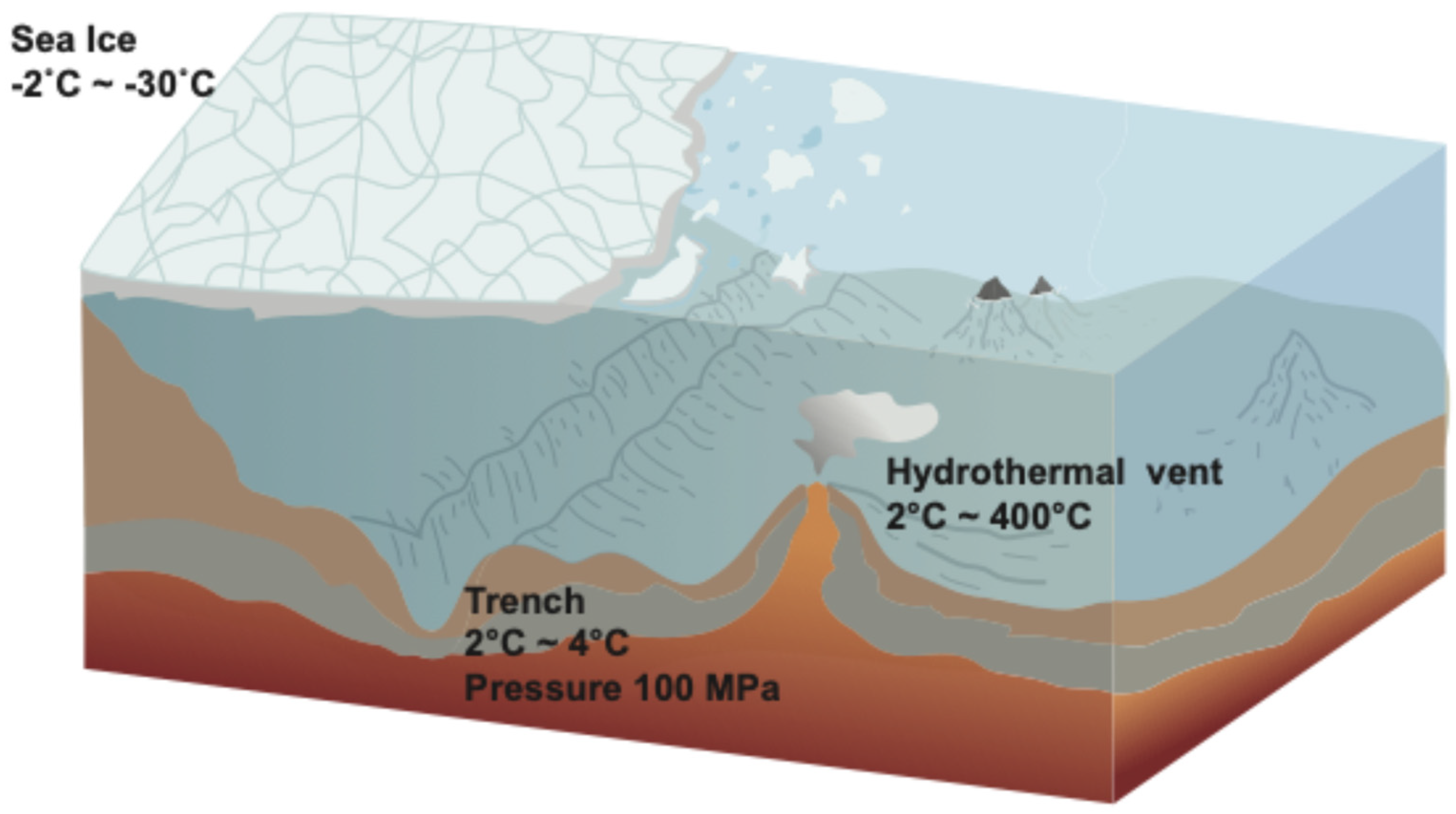
2.1. Sea Ice Environments
2.2. Hydrothermal Vents
2.3. Trench Environments
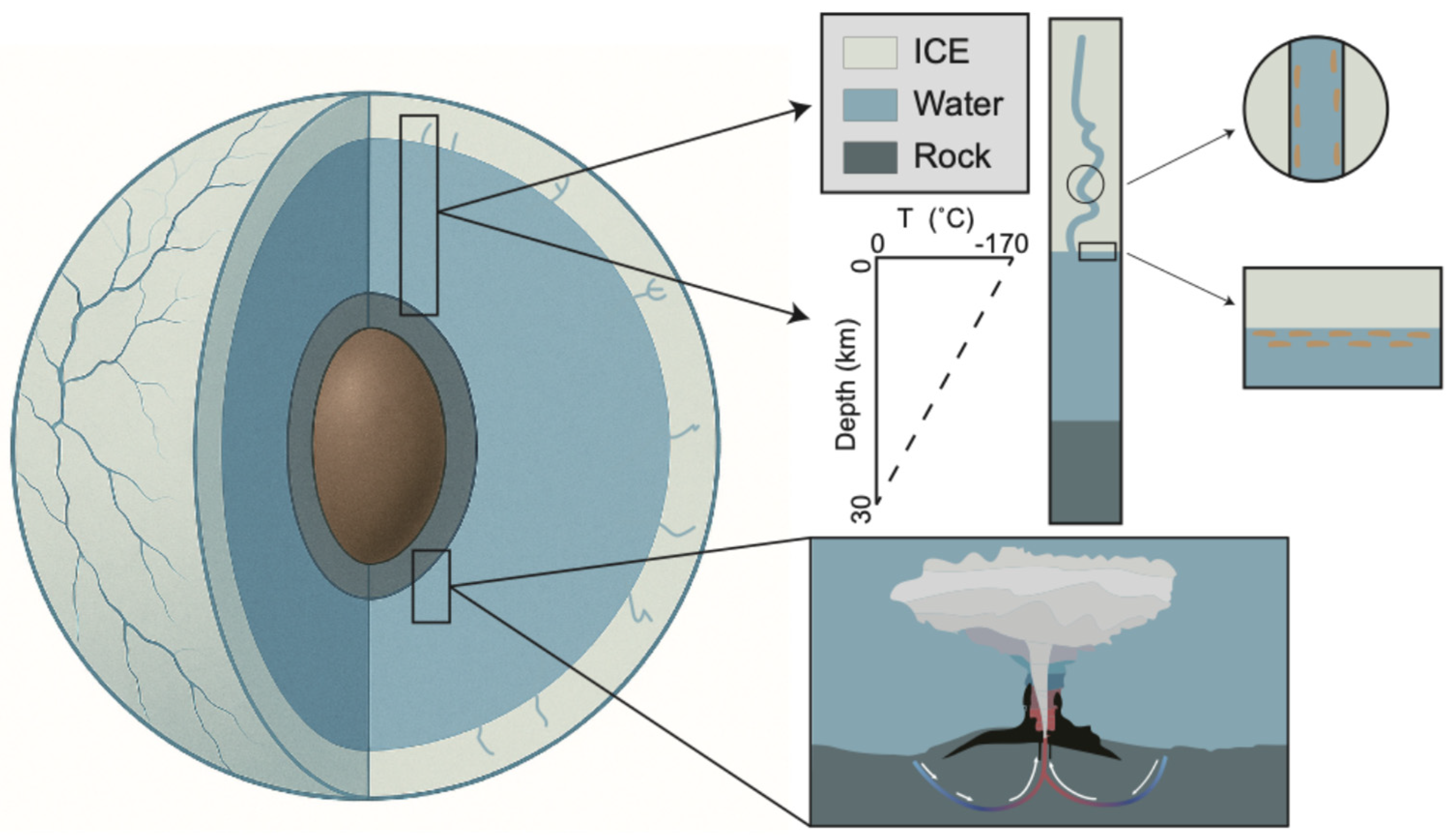
3. Discussion
Author Contributions
Funding
Data Availability Statement
Conflicts of Interest
References
- Suttle, C.A. Marine viruses—Major players in the global ecosystem. Nat. Rev. Microbiol. 2007, 5, 801–812. [Google Scholar] [CrossRef] [PubMed]
- Koschinsky, A.; Garbe-Schönberg, D.; Sander, S.; Schmidt, K.; Gennerich, H.-H.; Strauss, H. Hydrothermal venting at pressure-temperature conditions above the critical point of seawater, 5°S on the Mid-Atlantic Ridge. Geology 2008, 36, 615–618. [Google Scholar] [CrossRef]
- Takai, K.; Nakamura, K.; Toki, T.; Tsunogai, U.; Miyazaki, M.; Miyazaki, J.; Hirayama, H.; Nakagawa, S.; Nunoura, T.; Horikoshi, K. Cell proliferation at 122 °C and isotopically heavy CH4 production by a hyperthermophilic methanogen under high-pressure cultivation. Proc. Natl. Acad. Sci. USA 2008, 105, 10949–10954. [Google Scholar] [CrossRef] [PubMed]
- Brock, T.D. Life at high temperatures. Science 1985, 230, 132–138. [Google Scholar] [CrossRef] [PubMed]
- Clarke, A.; Morris, G.J.; Fonseca, F.; Murray, B.J.; Acton, E.; Price, H.C. A Low Temperature Limit for Life on Earth. PLoS ONE 2013, 8, e66207. [Google Scholar] [CrossRef]
- Hazael, R.; Meersman, F.; Ono, F.; McMillan, P.F. Pressure as a Limiting Factor for Life. Life 2016, 6, 34. [Google Scholar] [CrossRef]
- Koike, J.; Oshima, T. Planetary quarantine in the solar-system—Survival rates of some terrestrial organisms under simulated space conditions by proton irradiation. ACTA Astronaut. 1993, 29, 629–632. [Google Scholar] [CrossRef]
- Mizuno, C.M.; Guyomar, C.; Roux, S.; Lavigne, R.; Rodriguez-Valera, F.; Sullivan, M.B.; Gillet, R.; Forterre, P.; Krupovic, M. Numerous cultivated and uncultivated viruses encode ribosomal proteins. Nat. Commun. 2019, 10, 752. [Google Scholar] [CrossRef]
- Thomy, J.; Schvarcz, C.R.; McBeain, K.A.; Edwards, K.F.; Steward, G.F. Eukaryotic viruses encode the ribosomal protein eL40. npj Viruses 2024, 2, 51. [Google Scholar] [CrossRef]
- Nasir, A.; Romero-Severson, E.; Claverie, J.-M. Investigating the Concept and Origin of Viruses. Trends Microbiol. 2020, 28, 959–967. [Google Scholar] [CrossRef]
- Koonin, E.V.; Martin, W. On the origin of genomes and cells within inorganic compartments. Trends Genet. 2005, 21, 647–654. [Google Scholar] [CrossRef]
- Liang, Y.; Zheng, K.; McMinn, A.; Wang, M. Expanding diversity and ecological roles of RNA viruses. Trends Microbiol. 2023, 31, 229–232. [Google Scholar] [CrossRef] [PubMed]
- Knowles, B.; Silveira, C.B.; Bailey, B.A.; Barott, K.; Cantu, V.A.; Cobián-Güemes, A.G.; Coutinho, F.H.; Dinsdale, E.A.; Felts, B.; Furby, K.A.; et al. Lytic to temperate switching of viral communities. Nature 2016, 531, 466–470. [Google Scholar] [CrossRef] [PubMed]
- Arrigo, K.R. Sea ice ecosystems. Ann. Rev. Mar. Sci. 2014, 6, 439–467. [Google Scholar] [CrossRef] [PubMed]
- Boetius, A.; Anesio, A.M.; Deming, J.W.; Mikucki, J.A.; Rapp, J.Z. Microbial ecology of the cryosphere: Sea ice and glacial habitats. Nat. Rev. Microbiol. 2015, 13, 678–689. [Google Scholar] [CrossRef]
- Deming, J.W.; Collins, R.E. Sea ice as a habitat for Bacteria. Archaea and viruses. In Sea Ice, 3rd ed.; Thomas, D.N., Ed.; Wiley-Blackwell: Hoboken, NJ, USA, 2017; pp. 326–351. [Google Scholar]
- Lund-Hansen, L.C.; Gradinger, R.; Hassett, B.; Jayasinghe, S.; Kennedy, F.; Martin, A.; McMinn, A.; Søgaard, D.H.; Sorrell, B.K. Sea ice as habitat for microalgae, bacteria, virus, fungi, meio- and macrofauna: A review of an extreme environment. Polar Biol. 2024, 47, 1275–1306. [Google Scholar] [CrossRef]
- Scott, P.; McMinn, A.; Hosie, G. Physical parameters influencing diatom community structure in eastern Antarctic sea ice. Polar Biol. 1994, 14, 507–517. [Google Scholar] [CrossRef]
- Ralph, P.J.; McMinn, A.; Ryan, K.G.; Ashworth, C. Short-term effect of temperature on the photokinetics of microalgae from the surface layers of Antarctic pack ice. J. Phycol. 2005, 41, 763–769. [Google Scholar] [CrossRef]
- Zhai, C.; Kennedy, F.; Liang, Y.; Wang, M.; McMinn, A. Antarctic Marine Viruses: A Review and Future Perspectives. Ocean-Land-Atmos. Res. 2025, 4, 0101. [Google Scholar] [CrossRef]
- Lopez-Simon, J.; Vila-Nistal, M.; Rosenova, A.; De Corte, D.; Baltar, F.; Martinez-Garcia, M. Viruses under the Antarctic ice shelf are active and potentially involved in global nutrient cycles. Nat. Commun. 2023, 14, 8295. [Google Scholar] [CrossRef]
- Thiemes, M.W. Vents. In Encyclopedia of Biodiversity, 3rd ed.; Scheiner, S.M., Ed.; Academic Press: Cambridge, MA, USA, 2024; pp. 796–803. [Google Scholar]
- Brazelton, W.J.; Schrenk, M.O.; Kelley, D.S.; Baross, J.A. Methane and sulphur metabolizing microbial communities dominate in the Lost City hydrothermal vent ecosystem. Appl. Environ. Microbiol. 2006, 72, 6257–6270. [Google Scholar] [CrossRef] [PubMed]
- Han, Y.; Guo, C.; Guan, X.; McMinn, A.; Liu, L.; Zheng, G.; Jiang, Y.; Liang, Y.; Shao, H.; Tian, J.; et al. Comparison of deep-sea picoeukaryotic composition estimated from the V4 and V9 regions of 18S rRNA gene with a focus on the hadal zone of the Mariana Trench. Microb. Ecol. 2022, 83, 34–47. [Google Scholar] [CrossRef] [PubMed]
- Cheng, R.; Li, X.; Jiang, L.; Gong, L.; Geslin, C. Virus diversity and interactions with hosts in deep-sea hydrothermal vents. Microbiome 2022, 10, 235. [Google Scholar] [CrossRef] [PubMed]
- Frank, K.L.; Rogers, D.R.; Olins, H.C.; Vidoudez, C.; Girguis, P.R. Characterizing the distribution and rates of microbial sulfate reduction at Middle Valley hydrothermal vents. ISME J. 2013, 7, 1391–1401. [Google Scholar] [CrossRef]
- Jamieson, A.J.; Fujii, T.; Mayor, D.J.; Solan, M.; Priede, I.G. Hadal trenches: The ecology of the deepest places on Earth. Trends Ecol. Evol. 2010, 25, 190–197. [Google Scholar] [CrossRef]
- Xiao, X.; Zhao, W.; Song, W.; Qi, Q.; Wang, B.; Zhu, J.; Lin, J.; Wang, J.; Hu, A.; Huang, S.; et al. Microbial ecosystems and ecological driving forces in the deepest ocean sediments. Cell 2025, 188, 1363–1377. [Google Scholar] [CrossRef]
- Glud, R.; Wenzhöfer, F.; Middelboe, M.; Oguri, K.; Turnewitsch, R.; Canfield, D.E.; Kitazato, H. High rates of microbial carbon turnover in sediments in the deepest oceanic trench on Earth. Nat. Geosci. 2013, 6, 284–288. [Google Scholar] [CrossRef]
- Zhou, Y.L.; Mara, P.; Cui, G.J.; Edgcomb, V.P.; Wang, Y. Microbiomes in the Challenger Deep slope and bottom-axis sediments. Nat. Commun. 2022, 13, 1515. [Google Scholar] [CrossRef]
- Zhang, X.; Wu, K.; Han, Z.; Chen, Z.; Liu, Z.; Sun, Z.; Shao, L.; Zhao, Z.; Zhou, L. Microbial diversity and biogeochemical cycling potential in deep-sea sediments associated with seamount, trench, and cold seep ecosystems. Front. Microbiol. 2022, 13, 1029564. [Google Scholar] [CrossRef]
- Liu, J.; Li, D.-W.; He, X.; Liu, R.; Cheng, H.; Su, C.; Chen, M.; Wang, Y.; Zhao, Z.; Xu, H.; et al. A unique subseafloor microbiosphere in the Mariana Trench driven by episodic sedimentation. Mar. Life Sci. Technol. 2024, 6, 168–181. [Google Scholar] [CrossRef]
- Jian, H.; Yi, Y.; Wang, J.; Hao, Y.; Zhang, M.; Wang, S.; Meng, C.; Zhang, Y.; Jing, H.; Wang, Y.; et al. Diversity and distribution of viruses inhabiting the deepest ocean on Earth. ISME J. 2021, 15, 3094–3110. [Google Scholar] [CrossRef] [PubMed]
- Liu, J.; Zheng, Y.; Lin, H.; Wang, X.; Li, M.; Liu, Y.; Yu, M.; Zhao, M.; Pedentchouk, N.; Lea-Smith, D.J.; et al. Proliferation of hydrocarbon- degrading microbes at the bottom of the Mariana Trench. Microbiome 2019, 7, 47. [Google Scholar] [CrossRef] [PubMed]
- Gao, C.; Liang, Y.; Jiang, Y.; Paez-Espino, D.; Han, M.; Gu, C.; Wang, M.; Yang, Y.; Liu, F.; Zhang, X.; et al. Virioplankton assemblages from Challenger Deep, the deepest place in the worlds’ oceans. iScience 2022, 25, 104680. [Google Scholar] [CrossRef] [PubMed]
- Guo, R.; Liang, Y.; Yu, X.; Wang, L.; Mou, S.; Cao, C.; Xie, R.; Zhang, C.; Tian, J.; Zhang, Y. Insight Into the Pico- and Nano-Phytoplankton Communities in the Deepest Biosphere, the Mariana Trench. Front. Microbiol. 2018, 9, 2289. [Google Scholar] [CrossRef]
- Yoshida, M.; Takaki, Y.; Eitoku, M.; Nunoura, T.; Takai, K. Metagenomic analysis of viral communities in (Hado) pelagic sediments. PLoS ONE 2013, 8, e57271. [Google Scholar] [CrossRef]
- Cockell, C.S.; Bush, T.; Bryce, T.; Direito, S.; Fox-Powell, M.; Harrison, J.P.; Lammer, H.; Landenmark, H.; Martin-Torres, M.; Nicholson, N.; et al. Habitability: A review. Astrobiology 2016, 16, 89–117. [Google Scholar] [CrossRef]
- Farmer, J.D. Chapter 1—Habitability as a tool in astrobiological exploration. In From Habitability to Life on Mars; Carrol, N.A., Grin, E.A., Eds.; Elsevier: Amsterdam, The Netherlands, 2018. [Google Scholar]
- Martin, A.; McMinn, A. Sea ice, extremophiles and life in extra-terrestrial ocean worlds. Int. J. Astrobiol. 2018, 17, 1–16. [Google Scholar] [CrossRef]
- Martin, W.; Baross, J.; Kelley, D.; Russell, M.J. Hydrothermal vents and the origin of life. Nat. Rev. Microbiol. 2008, 6, 805–814. [Google Scholar] [CrossRef]
- Thiemens, M.H.; Pack, A.; Sharp, Z. Finding water on the Moon and Mars: Humanity’s extraterrestrial future. Proc. Natl. Acad. Sci. USA 2024, 121, e2421996121. [Google Scholar] [CrossRef]
- Postberg, F.; Khawaja, N.; Abel, B.; Choblet, G.; Glein, C.R.; Gudipati, M.S.; Henderson, B.L.; Hsu, H.-W.; Kempf, S.; Klenner, F.; et al. Macromolecular organic compounds from the depths of Enceladus. Nature 2018, 558, 564–568. [Google Scholar] [CrossRef]
- Schubert, G.; Hussmann, H.; Lainey, V.; Matson, D.L.; McKinnon, W.B.; Sohl, F.; Sotin, C.; Tobie, G.; Turrini, D.; Van Hoolst, T. Evolution of icy satellites. Space Sci. Rev. 2010, 153, 447–484. [Google Scholar] [CrossRef]


Disclaimer/Publisher’s Note: The statements, opinions and data contained in all publications are solely those of the individual author(s) and contributor(s) and not of MDPI and/or the editor(s). MDPI and/or the editor(s) disclaim responsibility for any injury to people or property resulting from any ideas, methods, instructions or products referred to in the content. |
© 2026 by the authors. Licensee MDPI, Basel, Switzerland. This article is an open access article distributed under the terms and conditions of the Creative Commons Attribution (CC BY) license.
Share and Cite
McMinn, A.; Liang, Y.; Wang, Z.; Wang, M. Viruses in Extreme Marine Environments and Their Potential Existence in Extraterrestrial Environments. Viruses 2026, 18, 457. https://doi.org/10.3390/v18040457
McMinn A, Liang Y, Wang Z, Wang M. Viruses in Extreme Marine Environments and Their Potential Existence in Extraterrestrial Environments. Viruses. 2026; 18(4):457. https://doi.org/10.3390/v18040457
Chicago/Turabian StyleMcMinn, Andrew, Yantao Liang, Ziyue Wang, and Min Wang. 2026. "Viruses in Extreme Marine Environments and Their Potential Existence in Extraterrestrial Environments" Viruses 18, no. 4: 457. https://doi.org/10.3390/v18040457
APA StyleMcMinn, A., Liang, Y., Wang, Z., & Wang, M. (2026). Viruses in Extreme Marine Environments and Their Potential Existence in Extraterrestrial Environments. Viruses, 18(4), 457. https://doi.org/10.3390/v18040457