


Abstract
JC Polyomavirus (JCPyV) is a non-enveloped virus with circular double stranded DNA responsible for the rare but fatal demyelinating disease known as progressive multifocal leukoencephalopathy (PML). In its host, this virus exists in two different forms: one found in the periphery, named archetype, and another found in the central nervous system, named prototype. This form usually harbors recombinations in the non-coding control region (NCCR), a key region that contains sequences regulating viral replication and containing binding sites for cellular transcription factors. This form also contains mutations in the capsid protein, especially VP1. Due to the diversity of the JCPyV, a natural polymorphism also exists between the different genotypes. In this review, we aimed to summarize the main features of the archetype and prototype strains in order to facilitate the interpretation of sequence data that are increasingly generated by new sequencing technologies. This will also help to distinguish mutations associated with the natural polymorphism from those specific to the prototype form.
1. Introduction
JC Polyomavirus (JCPyV) or Human polyomavirus 2 belongs to the Betapolyomavirus genus within the Polyomaviridae family [1]. Seven genotypes (1–4, 6–8), along with numerous subgenotypes, have been identified and linked to specific geographic regions and populations [2]. The virus was named JCPyV after the patient in whom it was first described [3]; however, the full name of the patient should no longer be used [4].
The seroprevalence of JCPyV antibodies increases with age, reaching as high as 80% among individuals aged 70 years and older [5,6,7]. Although JCPyV infection remains asymptomatic in healthy people, it can invade the central nervous system (CNS), targeting astrocytes and oligodendrocytes in immunocompromised patients. The cytolytic destruction of these cells results in the rare but fatal demyelinating disease known as progressive multifocal leukoencephalopathy (PML) [8,9]. Although PML was first described in AIDS patients and patients with hematological malignancies, other predisposing diseases such as chronic inflammatory diseases, solid organ transplantation, solid neoplasms and primary immune deficiency were identified [10]. The risk of iatrogenic PML is now well established during the use of immunomodulatory drugs such as natalizumab or rituximab [11,12]. Other manifestations due to JCPyV infection have been described, such as granule cell neuronopathy, an infection primarily of granule cells of the cerebellum [13,14,15]. Encephalopathy [16,17] and meningitis [18,19] have also been reported. More recently, the description of a unilateral retinopathy related to JCPyV infection of the retinal ganglion cell layer extended the clinical manifestations due to this virus [20]. Notably, the sequence of the virus found in this compartment was reminiscent of that with neurotropism.
In this review, we aimed to describe the variations present in the JCPyV genome, focusing not only on the regulating region but also on nonstructural and structural proteins, and to analyze their implications for the pathophysiology of the infection.
2. Genome Organization
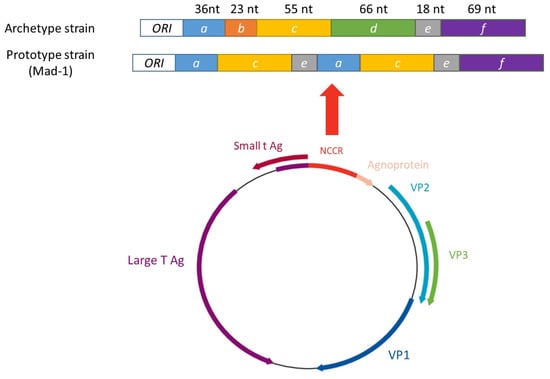
JCPyV is a 42 nm non-enveloped virus with circular double-stranded DNA of ~5.1 kb [21]. The genome has a tripartite functional organization, including early and late regions separated by a non-coding control region (NCCR) (Figure 1). The early region encodes the non-structural proteins, including small tumor antigen (stAg) and large tumor antigen (LTAg), with TAg splice variants. These proteins increase viral transcription and a proviral environment by binding to p53, blocking the cell from activating apoptotic pathways, and can act as a helicase, unwinding the viral DNA to continue the production of virus progeny [22,23,24]. LTAg can regulate the expression of early and late genes, whereas stAg has been shown to act as an interferon antagonist. Specifically, it can interact with the E3 ubiquitin ligase TRIM25, inhibiting the ubiquitination of RIG-I and its signal transduction [25]. In vitro experiments also suggest that LTAg and stAg have oncogenic potentials [26,27].
Figure 1.
Schematic representation of the JCPyV genome.
The late region is located on the opposite DNA strand and is transcribed in the alternative direction compared to the early genes. This region encodes three capsid proteins, VP1 (354 aa), VP2 (344 aa) and VP3 (225 aa), and the non-structural agnoprotein (77 aa). VP2 and VP3 enhance the binding of LTAg to viral DNA, thereby regulating DNA replication [28]. The agnoprotein can be phosphorylated by protein kinase C [29] and dephosphorylated by protein phosphatase 2A [30]. It has been identified in the nucleus, with its phosphorylated form observed in the cytoplasm [31]. The deletion of the agnoprotein led to a significant decrease in JCPyV replication [32] and a decreased expression of both LTAg and the VP1 protein [31,32]. The NCCR, which is approximately 400 bp long, separates the early and late transcription start codons and contains sequences that regulate viral replication, as well as binding sites for cellular transcription factors [33,34,35].
The NCCR exists in two forms: a non-rearranged sequence, usually found in the urine of healthy patients. This 267 bp sequence, or the reference strain CY, is divided into six blocks in alphabetic order from a to f and corresponds to the archetype or non-diseased strain. Block a is 36nt, b is 23 nt, c is 55 nt, d is 66 nt, e is 18nt and f is 69 nt. Rearranged NCCR (rrNCCR) is usually isolated in the CSF of PML patients. The NCCR of the reference strain Mad-1, corresponding to the prototype strain, presents deletions of the block d and duplications of the a, c and e blocks [21]. Since then, many prototype strains have been described [36]. Rearrangement of the NCCR sequence seems to be a prerequisite for PML. In PML patients, the majority of JCPyV isolates had genetic mutations and rearrangements in the NCCR compared to non-disease isolates and to other regions of the viral genome, such as VP1 [37,38]. Recent research has revealed a quasispecies population within the central nervous system, where 40% of cerebrospinal fluid (CSF) sequences were identified as rrNCCR, and approximately 90% of sequences obtained from brain tissue were also rrNCCR [39]. Although the mechanisms leading to rrNCCR are unknown, it is generally acknowledged that deletions precede duplication events [40].
3. Mutations in the NCCR
Several studies have investigated the tissues in which these two forms are found to assess the apparent compartmentalization between them (Table 1).
Table 1.
Summary of JCPyV NCCR Mutations in Clinical Samples.
In a Belgian cohort of 254 healthy subjects, 63 (24.8%) exhibited DNA shedding into their urine, with a median concentration of 6.60 log copies/mL [41]. Among the 61 sequences obtained with a Sanger method, 16 (24.6%) displayed a small deletion between 1 and 28 bp in the NCCR. Additionally, two samples contained (3.3%) insertions, specifically the duplication of 8 and 14 nt. A total of 54 urine samples from healthy people were sequenced using a 454 sequencing approach, and four samples (7.4%) contained quasispecies [41]. Variants harboring deletions never represented more than 6.5% in the quasispecies. In another study involving 400 healthy blood donors from Basel, Switzerland, 231 donors tested positive for IgG and 75 exhibited asymptomatic urinary shedding at the time of sampling. Sequences were obtained for 70 samples and a rrNCCR was found in 1/70 urine samples, with a duplication of 36 nt of the f block [6]. Additionally, in a cohort of 17 natalizumab-treated PML patients, Sanger sequencing demonstrated that all the NCCR sequences of the viruses isolated in the urine were archetype sequences, whereas those found in the CSF were rrNCCR [37]. Notably, the deletion of all or part of block d was the most frequent. A recent Indian study characterized the genetic diversity of JCPyV by sequencing the NCCR from 17 CSF of confirmed PML patients. The Sanger sequencing evidenced that deletions, duplications and insertions were frequently found in blocks d, c and f [50].
Delbue demonstrated this through the direct sequencing of four different NCCR sequences according to the tissue location (i.e., CSF, blood, serum and urine) from which the virus was isolated. The samples were taken from a patient living with HIV. Archetypal form (abcdef) was found exclusively in the urine, whereas rrNCCR was found in serum, peripheral blood cells and CSF [42]. Of note, block d was almost deleted in the virus isolated from the peripheral blood, and was completely deleted in the virus found in serum and CSF. This observation aligns with the hypothesis that rearrangements may occur as the virus transits from the kidney to lymphocytes [51,52].
In the study by Van Loy et al. [43], the JCPyV quasispecies was explored in 19 patients with PML using the 454-sequencing method on NCCR DNA from urine, plasma and CSF samples. A total of 10 urine, five plasma and 15 CSF samples were tested. In samples isolated from the urine, the NCCR sequence closely resembled the organization of the archetype, with the exception of one sequence that had a two bp deletion (del 221–222). In the CSF, rrNCCR sequences were found in 14 out of 15 samples. In the last sample, the viral load was significantly high (278,000,000 copies/mL) and despite the detection of archetype sequences, 12% of the quasispecies contained a deletion of block d and part of block e. Further research is needed to determine the contributions of these variants to the observed symptoms. In two patients, both plasma and CSF contained highly rearranged but identical consensus NCCR sequences.
Auvinen et al. used short-read next-generation sequencing (NGS), alongside bioinformatics tools, to characterize the NCCR in samples from 25 PML patients. They identified 11 sequences from cerebrospinal fluid (CSF) and 15 sequences from brain tissue. Archetypal NCCR was found in 2 out of 11 CSF samples, whereas archetype-like NCCR with minor mutations were found in one CSF and one brain tissue. Additionally, rrNCCR were found in 8 out of the 11 CSF and 14 out of 15 brain tissue samples [39]. Occasional JCPyV DNA detections in the brain of healthy individuals suggests that persistence of JCPyV in the brain cannot be excluded [53,54,55]. Yasuda reported a case of a 14-year-old patient with PML, where three distinct rrNCCR were found varying by brain region: the cerebellum, occipital lobe and brainstem. These findings suggest that the brain lesions may have originated independently [49].
Seppälä used a long-read sequencing technology to sequence JCPyV in the CSF of three patients with PML. One patient had an archetype-like rather than a neurotropic strain, despite mutations in the VP1 [45] (see Section 4). L’Honneur et al. used the same single-molecule sequencing technology to analyze the NCCR and VP1 sequences from 37 patients, including eight couples of CSF+ urines, 14 CSF, one cerebral biospie, 13 urine samples and for one patient, two samples of CSF [44]. Analysis of the VP1 is detailed in Section 4. Among the 24 CSF samples, deletions predominantly impacted block d (18/24). Other deletions affected blocks e and f, and to a lesser extent block b. In 21 of 24 cases, duplicated fragments (with a median size of 83 bp), mostly from sections b and c, were inserted near the e–f junction (n = 15) or in blocks c and d, as well as at the 5′ extremity of the late coding region (agnoprotein coding sequence). In one case, a 20-bp duplicated fragment from the vp1 gene was inserted in NCCR. No archetypal sequence was found [44]. When analyzing the quasispecies in the CSF, only one NCCR variant was identified in 14 of 23 samples, whereas nine samples contained two, three, or more NCCR variants (in five, two, and two cases, respectively). In seven of the nine cases, the mixed population consisted of a highly predominant variant (>90%), accompanied by minor subpopulations. One patient had two CSF samples drawn at 19-day intervals and the second sample revealed an additional NCCR variant. This could be due to an increase in the viral load (from 4.2 Log copies/mL to 5.0 Log copies/mL).
This is in line with the findings of Nakamichi et al., who studied the NCCR sequences of JCPyV of CSF specimens collected from 11 immunocompromised patients. Among the four patients with an increase in the viral load during the follow-up period (median of 48.5 days between the two CSF samples), a change in the dominant NCCR pattern was observed. Conversely, the four patients with a decrease of the viral load following mefloquin administration maintained the same dominant NCCR pattern [46]. This was also observed in a patient with AIDS-related PML, following a combination of antiretroviral therapy, achieved a 99% decrease in CSF viral load [46]. Additionally, Van Loy et al. reported a case in which a single patient had three samples taken over approximately two months, during which the consensus sequence remained identical, whereas the viral load decreased [43]. Taken together, this study suggests that variants are generated de novo during viral replication or when spreading within the brain.
Iannetta reported a case of a 51-year-old PML patient living with HIV-1 in whom the archetype form of the virus was found in the CSF at t0 and t3, whereas rrNCCR was found at t1 and t2, including a duplication of the region c [47].
JCPyV was found in the CSF of a patient with multiple sclerosis treated with dimethylfumarate at a concentration of 1 988 880 copies/mL [48]. The virus found was archetype-like with a deletion in the f region.
4. Mutations in VP1
VP1 mediates virion binding to the cellular receptor Lactoseries tetrasaccharide c (LSTc). Consequently, mutations occurring in this protein could alter the interaction [56]. Previous studies have identified genotype-specific mutations (Table 2). In VP1, mutations at position 117 and 164 were found to be genotype specific, whereas 55, 64, 74, 75, 113, 222 and 269 were considered as sporadic [57].
Table 2.
Genotype-specific polymorphism of JCPyV VP1 protein.
A more detailed analysis of VP1 sequences available in GenBank, which includes 69 sequences from patients with PML, revealed that five amino acids located at positions 55, 60, 265, 267, and 269 may evolve under positive selection [58] (Figure 2). In vitro experiments using virus-like particles (VLPs) confirmed that these mutations could alter binding to sialic acid [58]. Gorelik studied the VP1 sequences from paired CSF and urine samples from eight patients [59]. The findings indicated that urine sequences were different from those found in CSF; however, plasma VP1 sequences were identical to the corresponding CSF-derived sequence [59]. This observation suggests that the virus isolated from blood and CSF acquired specific mutations in VP1 in comparison with the “parental” virus obtained from the urine. In the same study, the authors characterized the PML-associated mutations in a larger cohort of 40 patients. They found mutations or deletions in 37/40 patients, with the most common mutations at position 269 (27%) and 55 (25%). Other mutations were reported at positions 60, 61, 265, 267 and 271, as described by Sunyaev [58]. The authors also described unknown mutations at position 50, 51, 122–125 and 283. Follow-up over time indicated that mutations were maintained.
Figure 2.
Positions of the mutations found in VP1 in JCPyV from PML patients. Positions in bold are those most frequently found to be mutated and that mediate interaction with LSTc. Other mutations were found but require further investigations.
Incorporation of these mutations (55F, 60E, 265D, 267F, 269F and 269Y) in VLPs led to a loss of interaction with sialylated ganglioside, suggesting changes in receptor specificity. When tested across various cell lines, 55F, 267F, 269F and 269Y were found not to bind to kidney and lymphocytic cells but still interact with CNS cells. VLPs carrying 60E or 66H still bound to all cell types, whereas 265D or 271H VLPs bound to the kidney but not primary lymphocytes. Treatment with neuraminidase indicated that the binding to the CNS cells was independent of sialic acid [59]. The impact of these mutations on cell binding was confirmed by another group [60]. In vitro experiments using a recombinant VP1 pentamer with a single mutation in aa located in the sialic acid binding pocket of VP1 (L54F, S266F, S268F, S268Y in the original publication, likely corresponding to L55F, S267F, S269F, S269Y) indeed showed the capsid protein was no longer able to bind to LSTc [60].
In a cohort of 17 natalizumab-treated PML patients, L55 and S269 were the most observed mutations in VP1. Other mutations affecting D66, N265, S267 S61, and Q271 were found less frequently. Mutations in the VP1 were found in 13/16 (81%) of patients with PML, but not in the urine [37].
L’Honneur et al. found seven of these 12 VP1 position mutations distinctive of PML (positions 50, 51, 55, 60, 61, 122, 129, 223, 265, 267, 269, and 271; underlined positions indicate mutations that have been found). In the 23 CNS samples, Ser 269 (n = 10), Leu 55 (n = 6) and Asn 265 (n = 4) were the most frequently mutated. Novel mutations affecting Phe68 and Tyr81 were detected in two samples. More detailed analysis showed that four out of 23 sequences contained a 100% wildtype (wt) VP1 population, ten samples contained a virus with a single mutation affecting positions 265, 267, or 269 (7/10), or aa 55 or 61 (3/10). The other samples contained mixed subpopulations. Interestingly, ten other samples contained mixed subpopulations [44]. In three PML patients, VP1 mutations at position 267 or 8, 158, 269, 345 or 60, 69, 269 were found [45], with position 158 likely corresponding to a genotype specific signature.
Apart from PML, few studies have focused on mutations affecting VP1. C terminus mutants with a deletion of 10nt were reported during JCPyV granule neuropathy. In vitro experiments showed that such mutants are still replication competent [61].
5. Other Mutations
Genotype-specific variations were also reported for the early proteins tAg and Tag and the late proteins VP2, VP3 and the Agnoprotein [57,62]. Using six prototypic and ten archetype complete DNA sequences, Kato [57] showed that within LTAg, the amino acids at positions 280, 301, 354, 408, 493 and 670 vary depending on the strain’s genotype. Conversely, unique amino acid substitution could occur at position 49, 160, 233, 295, 363, 413, 479, 481, 637 and 659. In stAg, position 121 is genotype specific, whereas position 49 was variable (Table 3). In agnoprotein, positions 53 and 61 correlated to genotypes, whereas positions 32, 38 and 55 were sporadic. Some positions are both sporadic and specific. In VP2/3, eight positions were genotype specific: 175, 192, 209, 214, 253, 268, 279 and 281 (Table 4). The authors concluded that there was no specific mutation in the proteins associated with PML. One year later, Cubitt made the same analysis based on 100 sequences of JCPyV strains [62]. In L’Honneur’s work, despite the majority of reported mutations in the VP2 protein being due to genotype specificity, the authors identified novel genotype-independent mutations (A20T, A30V, A36T, and P65A) in four of 24 samples. Additionally, three missense mutations (Y407N, M402I, G255K) were found to affect the helicase domain, whereas one mutation (N299T) impacted both the Pol alpha binding domain and the DNA binding (Zn finger) domain of LTAg, which plays a crucial role in viral replication [44].
Table 3.
Genotype-specific polymorphism of the Large T and small t antigens.
Table 4.
Genotype-specific polymorphism of the Agnoprotein, VP2 and VP3.
Two mutations in the LTAg coding region were found, T125A and C560S, in a cohort of 17 natalizumab-treated PML patients [37]. The use of deep sequence brought new light to JCPyV quasispecies. Takahashi evidenced that a A3495C nucleotide mutation led to a V392G aa substitution in the LTAg in all the six CSF samples from PML patients [63]. This variant represented 3% to 19% of the quasispecies. In vitro experiments indicated that introducing this mutation into the Mad1 strain decreased the expression of JCPyV proteins and DNA concentration in supernatants after the transfection of human neuroblastoma IMR-32 and human embryonic kidney HEK293 cells. This suggests that the V392G mutation in the LTAg inhibits JCPyV replication by inducing a conformational change in TAg, thereby preventing its optimal function.
JCPyV encephalopathy is due to productive infection of the cortical pyramidal neurons. In this context, Dang reported a unique JCPyV, named JCVPN1, in a non-HIV patient that presents a deletion of 143nt in the gene encoding the agnoprotein, leading to a truncated 10 amino acid peptide. The NCCR was archetype-like. The authors hypothesized that a virus expressing truncated agnoprotein could invade and accumulate in cortical pyramidal neurons [64], whereas those expressing the full agnoprotein remain mainly in glial cells. The same authors identified another variant with a different pattern of agnoprotein deletion in the CSF of a HIV+/PML patient. The impact of these strains with deletion of the agnoprotein deserves further investigation.
6. Consequences on the Pathophysiology of PML
Rearrangements in the NCCR were largely documented in patients suffering from PML. However, the mechanisms leading to such rearrangements and the compartment(s) where such variants emerge are largely unknown. Gosert et al. [65] showed that substitution of the archetype NCCR by a rrNCCR characterized in JCPyV isolated from the CSF of PML patients increased the replication rates in human progenitor astrocytes and human glioma cell line Hs683, but not in COS-7 cells, a fibroblast-like cell line derived from African green monkey kidney tissue constitutively expressing the SV40 LTAg. The use of a bidirectional reporter vector pHRG [66] evidenced that the rrNCCR increased early reporter gene expression. Interestingly, the deletion of block d led to an increased expression of the early genes. Of note, the HIV tat protein can enhance early gene expression for strains with an archetype NCCR [65]. Taken together, these results evidence that the rrNCCR could increase the early gene expression in infected cells, explaining higher replication rates. Although it is generally accepted that most rrNCCRs generate non-viable viruses, in certain instances, these rearrangements can endow the virus with new tissue tropism. In the rrNCCR, the number of transcription factor binding sites are higher due to duplication or creation compared to the archetype NCCR, notably block c duplications [36]. For instance, NFIX is known to activate JCPyV transcription [67]. Interestingly, NFIX binding sites are found in block c and this block is frequently duplicated in rrNCCR [36]. Conversely, the deletion of block d is frequent in rrNCCR. The partial or full deletion of block d leads to a decrease in CEBPβ binding sites, a repressor of viral transcription, ultimately leading to the enhancement of viral transcription [68]. Rearrangements in the NCCR consequently appear essential to improve the JCPyV lifecycle and to broaden the tropism of JCPyV. It is possible that the selection of adapted variants to the CNS occurs before the onset of PML.
Mutations occurring in the VP1 region during the pathogenesis of PML were also well studied [56]. Some variants seem to be associated with higher susceptibility or aggressive disease [69,70]. However, these mutations could be due to the genotype rather than a specific mutation associated with rapid or slow PML progression. This raises the question of a potential link between neuropathogenicity and genotypes [71]. The consequences of these mutations on the pathophysiology remains to be fully elucidated. The point mutations in the VP1 region could contribute to immune evasion but also affect interaction with the cellular receptors [56], including those at the surface of the neurovascular pericytes [72]. The loss of receptor interaction can be counterbalanced by the fact that the virus infects the choroid plexus, it leads to the release of extracellular vesicles containing viral particles, which may aid in dissemination within the CNS [73,74]. Consequently, alternative mechanisms of entry exist.
Mutations in other proteins are less well documented but could contribute to the improvement of the JCPyV lifecycle in infected cells.
7. Conclusions
In this review, we provided an overview of the mutations that have already been documented to help researchers interpret sequencing data. This is especially important for distinguishing whether mutations result from genotype polymorphisms or are linked to the emergence of a more aggressive variant during PML. NCCR and VP1 variations are well characterized. With the advent of new sequencing approaches, we can document variations in other proteins, such as TAg, tAg, Agnoprotein, VP2 and VP3. These data can lead to the identification of virological factors influencing the disease’s outcome.
Author Contributions
S.L.: writing—original draft preparation; M.P.W.: writing—review and editing. All authors have read and agreed to the published version of the manuscript.
Funding
This research received no external funding.
Data Availability Statement
No new data were created or analyzed in this study.
Acknowledgments
We thank Laurence Jouvin-Simet and Marie Casier for their help with page layout.
Conflicts of Interest
The authors declare no conflicts of interest.
Abbreviations
The following abbreviations are used in this manuscript:
| CNS | Central nervous system |
| CSF | Cerebrospinal fluid |
| JCPyV | JC Polyomavirus |
| LSTc | Lactoseries tetrasaccharide c |
| LTAg | Large T antigen |
| NCCR | Non-coding control region |
| PML | Progressive multifocal leukoencephalopathy |
| rrNCCR | Rearranged non-coding control region |
| stAg | Small t antigen |
| VLP | Virus-like particle |
References
- Walker, P.J.; Siddell, S.G.; Lefkowitz, E.J.; Mushegian, A.R.; Adriaenssens, E.M.; Alfenas-Zerbini, P.; Dempsey, D.M.; Dutilh, B.E.; Garcia, M.L.; Curtis Hendrickson, R.; et al. Recent changes to virus taxonomy ratified by the International Committee on Taxonomy of Viruses (2022). Arch. Virol. 2022, 167, 2429–2440. [Google Scholar] [CrossRef] [Scilit]
- Torres, C. Evolution and molecular epidemiology of polyomaviruses. Infect. Genet. Evol. 2020, 79, 104150. [Google Scholar] [CrossRef] [Scilit]
- Padgett, B.L.; Walker, D.L.; ZuRhein, G.M.; Eckroade, R.J.; Dessel, B.H. Cultivation of papova-like virus from human brain with progressive multifocal leucoencephalopathy. Lancet 1971, 1, 1257–1260. [Google Scholar] [CrossRef] [Scilit] [PubMed]
- Imperiale, M.J. JC Polyomavirus: Let’s Please Respect Privacy. J. Virol. 2018, 92, 10–1128. [Google Scholar] [CrossRef] [Scilit] [PubMed]
- Kean, J.M.; Rao, S.; Wang, M.; Garcea, R.L. Seroepidemiology of human polyomaviruses. PLoS Pathog. 2009, 5, e1000363. [Google Scholar] [CrossRef] [Scilit] [PubMed]
- Egli, A.; Infanti, L.; Dumoulin, A.; Buser, A.; Samaridis, J.; Stebler, C.; Gosert, R.; Hirsch, H.H. Prevalence of polyomavirus BK and JC infection and replication in 400 healthy blood donors. J. Infect. Dis. 2009, 199, 837–846. [Google Scholar] [CrossRef] [Scilit]
- Hennes, E.M.; Kornek, B.; Huppke, P.; Reindl, M.; Rostasy, K.; Berger, T. Age-Dependent Seroprevalence of JCV Antibody in Children. Neuropediatrics 2016, 47, 112–114. [Google Scholar] [CrossRef] [Scilit]
- Astrom, K.E.; Mancall, E.L.; Richardson, E.P., Jr. Progressive multifocal leuko-encephalopathy; a hitherto unrecognized complication of chronic lymphatic leukaemia and Hodgkin’s disease. Brain 1958, 81, 93–111. [Google Scholar] [CrossRef] [Scilit]
- Cortese, I.; Reich, D.S.; Nath, A. Progressive multifocal leukoencephalopathy and the spectrum of JC virus-related disease. Nat. Rev. Neurol. 2021, 17, 37–51. [Google Scholar] [CrossRef] [Scilit]
- Joly, M.; Conte, C.; Cazanave, C.; Le Moing, V.; Tattevin, P.; Delobel, P.; Sommet, A.; Martin-Blondel, G. Progressive multifocal leukoencephalopathy: Epidemiology and spectrum of predisposing conditions. Brain 2023, 146, 349–358. [Google Scholar] [CrossRef] [Scilit]
- Brandstadter, R.; Katz Sand, I. The use of natalizumab for multiple sclerosis. Neuropsychiatr. Dis. Treat. 2017, 13, 1691–1702. [Google Scholar] [CrossRef] [Scilit] [PubMed]
- McGuigan, C.; Craner, M.; Guadagno, J.; Kapoor, R.; Mazibrada, G.; Molyneux, P.; Nicholas, R.; Palace, J.; Pearson, O.R.; Rog, D.; et al. Stratification and monitoring of natalizumab-associated progressive multifocal leukoencephalopathy risk: Recommendations from an expert group. J. Neurol. Neurosurg. Psychiatry 2016, 87, 117–125. [Google Scholar] [CrossRef] [Scilit]
- Koralnik, I.J.; Wuthrich, C.; Dang, X.; Rottnek, M.; Gurtman, A.; Simpson, D.; Morgello, S. JC virus granule cell neuronopathy: A novel clinical syndrome distinct from progressive multifocal leukoencephalopathy. Ann. Neurol. 2005, 57, 576–580. [Google Scholar] [CrossRef] [Scilit] [PubMed]
- Du Pasquier, R.A.; Corey, S.; Margolin, D.H.; Williams, K.; Pfister, L.A.; De Girolami, U.; Mac Key, J.J.; Wuthrich, C.; Joseph, J.T.; Koralnik, I.J. Productive infection of cerebellar granule cell neurons by JC virus in an HIV+ individual. Neurology 2003, 61, 775–782. [Google Scholar] [CrossRef] [Scilit]
- Wijburg, M.T.; van Oosten, B.W.; Murk, J.L.; Karimi, O.; Killestein, J.; Wattjes, M.P. Heterogeneous imaging characteristics of JC virus granule cell neuronopathy (GCN): A case series and review of the literature. J. Neurol. 2015, 262, 65–73. [Google Scholar] [CrossRef] [Scilit]
- Wuthrich, C.; Dang, X.; Westmoreland, S.; McKay, J.; Maheshwari, A.; Anderson, M.P.; Ropper, A.H.; Viscidi, R.P.; Koralnik, I.J. Fulminant JC virus encephalopathy with productive infection of cortical pyramidal neurons. Ann. Neurol. 2009, 65, 742–748. [Google Scholar] [CrossRef] [Scilit]
- Reoma, L.B.; Trindade, C.J.; Monaco, M.C.; Solis, J.; Montojo, M.G.; Vu, P.; Johnson, K.; Beck, E.; Nair, G.; Khan, O.I.; et al. Fatal encephalopathy with wild-type JC virus and ruxolitinib therapy. Ann. Neurol. 2019, 86, 878–884. [Google Scholar] [CrossRef] [Scilit]
- Ballesta, B.; Gonzalez, H.; Martin, V.; Ballesta, J.J. Fatal ruxolitinib-related JC virus meningitis. J. Neurovirol. 2017, 23, 783–785. [Google Scholar] [CrossRef] [Scilit]
- Viallard, J.F.; Ellie, E.; Lazaro, E.; Lafon, M.E.; Pellegrin, J.L. JC virus meningitis in a patient with systemic lupus erythematosus. Lupus 2005, 14, 964–966. [Google Scholar] [CrossRef] [Scilit]
- Varenne, F.; Siegfried-Vergnon, A.; Lhomme, S.; Treiner, E.; Pignolet, B.; Joly, M.; Bonneville, F.; Gandia, P.; Rodriguez, C.; Cortese, I.; et al. JC Virus-Related Retinopathy. JAMA Ophthalmol. 2025, 143, 785–789. [Google Scholar] [CrossRef] [Scilit] [PubMed]
- Frisque, R.J.; Bream, G.L.; Cannella, M.T. Human polyomavirus JC virus genome. J. Virol. 1984, 51, 458–469. [Google Scholar] [CrossRef] [Scilit]
- Saribas, S.; Safak, M. A Comprehensive Proteomics Analysis of the JC Virus (JCV) Large and Small Tumor Antigen Interacting Proteins: Large T Primarily Targets the Host Protein Complexes with V-ATPase and Ubiquitin Ligase Activities While Small t Mostly Associates with Those Having Phosphatase and Chromatin-Remodeling Functions. Viruses 2020, 12, 1192. [Google Scholar] [CrossRef] [Scilit]
- Del Valle, L.; Gordon, J.; Assimakopoulou, M.; Enam, S.; Geddes, J.F.; Varakis, J.N.; Katsetos, C.D.; Croul, S.; Khalili, K. Detection of JC virus DNA sequences and expression of the viral regulatory protein T-antigen in tumors of the central nervous system. Cancer Res. 2001, 61, 4287–4293. [Google Scholar]
- Dickmanns, A.; Zeitvogel, A.; Simmersbach, F.; Weber, R.; Arthur, A.K.; Dehde, S.; Wildeman, A.G.; Fanning, E. The kinetics of simian virus 40-induced progression of quiescent cells into S phase depend on four independent functions of large T antigen. J. Virol. 1994, 68, 5496–5508. [Google Scholar] [CrossRef] [Scilit]
- Chiang, C.; Dvorkin, S.; Chiang, J.J.; Potter, R.B.; Gack, M.U. The Small t Antigen of JC Virus Antagonizes RIG-I-Mediated Innate Immunity by Inhibiting TRIM25’s RNA Binding Ability. mBio 2021, 12, 10-1128. [Google Scholar] [CrossRef] [Scilit]
- Del Valle, L.; Pina-Oviedo, S. Human Polyomavirus JCPyV and Its Role in Progressive Multifocal Leukoencephalopathy and Oncogenesis. Front. Oncol. 2019, 9, 711. [Google Scholar] [CrossRef] [Scilit] [PubMed]
- Huang, J.L.; Lin, C.S.; Chang, C.C.; Lu, Y.N.; Hsu, Y.L.; Wong, T.Y.; Wang, Y.F. Human JC virus small tumour antigen inhibits nucleotide excision repair and sensitises cells to DNA-damaging agents. Mutagenesis 2015, 30, 475–485. [Google Scholar] [CrossRef] [Scilit]
- Saribas, A.S.; Mun, S.; Johnson, J.; El-Hajmoussa, M.; White, M.K.; Safak, M. Human polyoma JC virus minor capsid proteins, VP2 and VP3, enhance large T antigen binding to the origin of viral DNA replication: Evidence for their involvement in regulation of the viral DNA replication. Virology 2014, 449, 1–16. [Google Scholar] [CrossRef] [Scilit] [PubMed]
- Sariyer, I.K.; Akan, I.; Palermo, V.; Gordon, J.; Khalili, K.; Safak, M. Phosphorylation mutants of JC virus agnoprotein are unable to sustain the viral infection cycle. J. Virol. 2006, 80, 3893–3903. [Google Scholar] [CrossRef] [Scilit] [PubMed]
- Sariyer, I.K.; Khalili, K.; Safak, M. Dephosphorylation of JC virus agnoprotein by protein phosphatase 2A: Inhibition by small t antigen. Virology 2008, 375, 464–479. [Google Scholar] [CrossRef] [Scilit]
- Okada, Y.; Endo, S.; Takahashi, H.; Sawa, H.; Umemura, T.; Nagashima, K. Distribution and function of JCV agnoprotein. J. Neurovirol. 2001, 7, 302–306. [Google Scholar] [CrossRef] [Scilit]
- Akan, I.; Sariyer, I.K.; Biffi, R.; Palermo, V.; Woolridge, S.; White, M.K.; Amini, S.; Khalili, K.; Safak, M. Human polyomavirus JCV late leader peptide region contains important regulatory elements. Virology 2006, 349, 66–78. [Google Scholar] [CrossRef] [Scilit]
- Ferenczy, M.W.; Marshall, L.J.; Nelson, C.D.; Atwood, W.J.; Nath, A.; Khalili, K.; Major, E.O. Molecular biology, epidemiology, and pathogenesis of progressive multifocal leukoencephalopathy, the JC virus-induced demyelinating disease of the human brain. Clin. Microbiol. Rev. 2012, 25, 471–506. [Google Scholar] [CrossRef] [Scilit] [PubMed]
- White, M.K.; Safak, M.; Khalili, K. Regulation of gene expression in primate polyomaviruses. J. Virol. 2009, 83, 10846–10856. [Google Scholar] [CrossRef] [Scilit]
- McIlroy, D.; Halary, F.; Bressollette-Bodin, C. Intra-patient viral evolution in polyomavirus-related diseases. Philos. Trans. R. Soc. Lond. B Biol. Sci. 2019, 374, 20180301. [Google Scholar] [CrossRef] [Scilit] [PubMed]
- Wilczek, M.P.; Pike, A.M.C.; Craig, S.E.; Maginnis, M.S.; King, B.L. Rearrangement in the Hypervariable Region of JC Polyomavirus Genomes Isolated from Patient Samples and Impact on Transcription Factor-Binding Sites and Disease Outcomes. Int. J. Mol. Sci. 2022, 23, 5699. [Google Scholar] [CrossRef] [Scilit]
- Reid, C.E.; Li, H.; Sur, G.; Carmillo, P.; Bushnell, S.; Tizard, R.; McAuliffe, M.; Tonkin, C.; Simon, K.; Goelz, S.; et al. Sequencing and analysis of JC virus DNA from natalizumab-treated PML patients. J. Infect. Dis. 2011, 204, 237–244. [Google Scholar] [CrossRef] [Scilit] [PubMed]
- Agostini, H.T.; Ryschkewitsch, C.F.; Singer, E.J.; Stoner, G.L. JC virus regulatory region rearrangements and genotypes in progressive multifocal leukoencephalopathy: Two independent aspects of virus variation. J. Gen. Virol. 1997, 78, 659–664. [Google Scholar] [CrossRef] [Scilit]
- Auvinen, E.; Honkimaa, A.; Laine, P.; Passerini, S.; Moens, U.; Pietropaolo, V.; Saarela, M.; Maunula, L.; Mannonen, L.; Tynninen, O.; et al. Differentiation of highly pathogenic strains of human JC polyomavirus in neurological patients by next generation sequencing. J. Clin. Virol. 2024, 171, 105652. [Google Scholar] [CrossRef] [Scilit]
- Johnson, E.M.; Wortman, M.J.; Dagdanova, A.V.; Lundberg, P.S.; Daniel, D.C. Polyomavirus JC in the context of immunosuppression: A series of adaptive, DNA replication-driven recombination events in the development of progressive multifocal leukoencephalopathy. Clin. Dev. Immunol. 2013, 2013, 197807. [Google Scholar] [CrossRef] [Scilit]
- Van Loy, T.; Thys, K.; Tritsmans, L.; Stuyver, L.J. Quasispecies analysis of JC virus DNA present in urine of healthy subjects. PLoS ONE 2013, 8, e70950. [Google Scholar] [CrossRef] [Scilit] [PubMed]
- Delbue, S.; Sotgiu, G.; Fumagalli, D.; Valli, M.; Borghi, E.; Mancuso, R.; Marchioni, E.; Maserati, R.; Ferrante, P. A case of a progressive multifocal leukoencephalopathy patient with four different JC virus transcriptional control region rearrangements in cerebrospinal fluid, blood, serum, and urine. J. Neurovirol. 2005, 11, 51–57. [Google Scholar] [CrossRef] [Scilit]
- Van Loy, T.; Thys, K.; Ryschkewitsch, C.; Lagatie, O.; Monaco, M.C.; Major, E.O.; Tritsmans, L.; Stuyver, L.J. JC virus quasispecies analysis reveals a complex viral population underlying progressive multifocal leukoencephalopathy and supports viral dissemination via the hematogenous route. J. Virol. 2015, 89, 1340–1347. [Google Scholar] [CrossRef] [Scilit]
- L’Honneur, A.S.; Pipoli Da Fonseca, J.; Cokelaer, T.; Rozenberg, F. JC Polyomavirus Whole Genome Sequencing at the Single-Molecule Level Reveals Emerging Neurotropic Populations in Progressive Multifocal Leukoencephalopathy. J. Infect. Dis. 2022, 226, 1151–1161. [Google Scholar] [CrossRef] [Scilit] [PubMed]
- Seppala, H.; Virtanen, E.; Saarela, M.; Laine, P.; Paulin, L.; Mannonen, L.; Auvinen, P.; Auvinen, E. Single-Molecule Sequencing Revealing the Presence of Distinct JC Polyomavirus Populations in Patients With Progressive Multifocal Leukoencephalopathy. J. Infect. Dis. 2017, 215, 889–895. [Google Scholar] [CrossRef] [Scilit]
- Nakamichi, K.; Kishida, S.; Tanaka, K.; Suganuma, A.; Sano, Y.; Sano, H.; Kanda, T.; Maeda, N.; Kira, J.; Itoh, A.; et al. Sequential changes in the non-coding control region sequences of JC polyomaviruses from the cerebrospinal fluid of patients with progressive multifocal leukoencephalopathy. Arch. Virol. 2013, 158, 639–650. [Google Scholar] [CrossRef] [Scilit]
- Iannetta, M.; Bellizzi, A.; Lo Menzo, S.; Anzivino, E.; D’Abramo, A.; Oliva, A.; D’Agostino, C.; d’Ettorre, G.; Pietropaolo, V.; Vullo, V.; et al. HIV-associated progressive multifocal leukoencephalopathy: Longitudinal study of JC virus non-coding control region rearrangements and host immunity. J. Neurovirol. 2013, 19, 274–279. [Google Scholar] [CrossRef] [Scilit]
- Motte, J.; Kneiphof, J.; Strassburger-Krogias, K.; Klasing, A.; Adams, O.; Haghikia, A.; Gold, R. Detection of JC virus archetype in cerebrospinal fluid in a MS patient with dimethylfumarate treatment without lymphopenia or signs of PML. J. Neurol. 2018, 265, 1880–1882. [Google Scholar] [CrossRef] [Scilit]
- Yasuda, Y.; Yabe, H.; Inoue, H.; Shimizu, T.; Yabe, M.; Yogo, Y.; Kato, S. Comparison of PCR-amplified JC virus control region sequences from multiple brain regions in PML. Neurology 2003, 61, 1617–1619. [Google Scholar] [CrossRef] [Scilit] [PubMed]
- Palani, G.S.; Telang, S.; Reddy, V.; Dhanya, K.; Ashwini, M.A.; Mani, R.S. Molecular characterization of JC virus in progressive multifocal leukoencephalopathy cases from India. Sci. Rep. 2025, 15, 42866. [Google Scholar] [CrossRef] [Scilit]
- Ault, G.S.; Stoner, G.L. Human polyomavirus JC promoter/enhancer rearrangement patterns from progressive multifocal leukoencephalopathy brain are unique derivatives of a single archetypal structure. J. Gen. Virol. 1993, 74, 1499–1507. [Google Scholar] [CrossRef] [Scilit] [PubMed]
- Iida, T.; Kitamura, T.; Guo, J.; Taguchi, F.; Aso, Y.; Nagashima, K.; Yogo, Y. Origin of JC polyomavirus variants associated with progressive multifocal leukoencephalopathy. Proc. Natl. Acad. Sci. USA 1993, 90, 5062–5065. [Google Scholar] [CrossRef] [Scilit] [PubMed]
- Elsner, C.; Dorries, K. Evidence of human polyomavirus BK and JC infection in normal brain tissue. Virology 1992, 191, 72–80. [Google Scholar] [CrossRef] [Scilit]
- Vago, L.; Cinque, P.; Sala, E.; Nebuloni, M.; Caldarelli, R.; Racca, S.; Ferrante, P.; Trabottoni, G.; Costanzi, G. JCV-DNA and BKV-DNA in the CNS tissue and CSF of AIDS patients and normal subjects. Study of 41 cases and review of the literature. J. Acquir. Immune Defic. Syndr. Hum. Retrovirol. 1996, 12, 139–146. [Google Scholar] [CrossRef] [Scilit]
- White, F.A., 3rd; Ishaq, M.; Stoner, G.L.; Frisque, R.J. JC virus DNA is present in many human brain samples from patients without progressive multifocal leukoencephalopathy. J. Virol. 1992, 66, 5726–5734. [Google Scholar] [CrossRef] [Scilit] [PubMed]
- Lauver, M.D.; Lukacher, A.E. JCPyV VP1 Mutations in Progressive MultifocalLeukoencephalopathy: Altering Tropismor Mediating Immune Evasion? Viruses 2020, 12, 1156. [Google Scholar] [CrossRef] [Scilit]
- Kato, A.; Sugimoto, C.; Zheng, H.Y.; Kitamura, T.; Yogo, Y. Lack of disease-specific amino acid changes in the viral proteins of JC virus isolates from the brain with progressive multifocal leukoencephalopathy. Arch. Virol. 2000, 145, 2173–2182. [Google Scholar] [CrossRef] [Scilit]
- Sunyaev, S.R.; Lugovskoy, A.; Simon, K.; Gorelik, L. Adaptive mutations in the JC virus protein capsid are associated with progressive multifocal leukoencephalopathy (PML). PLoS Genet. 2009, 5, e1000368. [Google Scholar] [CrossRef] [Scilit]
- Gorelik, L.; Reid, C.; Testa, M.; Brickelmaier, M.; Bossolasco, S.; Pazzi, A.; Bestetti, A.; Carmillo, P.; Wilson, E.; McAuliffe, M.; et al. Progressive multifocal leukoencephalopathy (PML) development is associated with mutations in JC virus capsid protein VP1 that change its receptor specificity. J. Infect. Dis. 2011, 204, 103–114. [Google Scholar] [CrossRef] [Scilit]
- Maginnis, M.S.; Stroh, L.J.; Gee, G.V.; O’Hara, B.A.; Derdowski, A.; Stehle, T.; Atwood, W.J. Progressive multifocal leukoencephalopathy-associated mutations in the JC polyomavirus capsid disrupt lactoseries tetrasaccharide c binding. mBio 2013, 4, e00247-13. [Google Scholar] [CrossRef] [Scilit]
- Dang, X.; Vidal, J.E.; Penalva de Oliveira, A.C.; Simpson, D.M.; Morgello, S.; Hecht, J.H.; Ngo, L.H.; Koralnik, I.J. JC virus granule cell neuronopathy is associated with VP1 C terminus mutants. J. Gen. Virol. 2012, 93, 175–183. [Google Scholar] [CrossRef] [Scilit]
- Cubitt, C.L.; Cui, X.; Agostini, H.T.; Nerurkar, V.R.; Scheirich, I.; Yanagihara, R.; Ryschkewitsch, C.F.; Stoner, G.L. Predicted amino acid sequences for 100 JCV strains. J. Neurovirol. 2001, 7, 339–344. [Google Scholar] [CrossRef] [Scilit] [PubMed]
- Takahashi, K.; Sekizuka, T.; Fukumoto, H.; Nakamichi, K.; Suzuki, T.; Sato, Y.; Hasegawa, H.; Kuroda, M.; Katano, H. Deep-Sequence Identification and Role in Virus Replication of a JC Virus Quasispecies in Patients with Progressive Multifocal Leukoencephalopathy. J. Virol. 2017, 91, 10-1128. [Google Scholar] [CrossRef] [Scilit]
- Dang, X.; Wuthrich, C.; Gordon, J.; Sawa, H.; Koralnik, I.J. JC virus encephalopathy is associated with a novel agnoprotein-deletion JCV variant. PLoS ONE 2012, 7, e35793. [Google Scholar] [CrossRef] [Scilit] [PubMed]
- Gosert, R.; Kardas, P.; Major, E.O.; Hirsch, H.H. Rearranged JC virus noncoding control regions found in progressive multifocal leukoencephalopathy patient samples increase virus early gene expression and replication rate. J. Virol. 2010, 84, 10448–10456. [Google Scholar] [CrossRef] [Scilit]
- Gosert, R.; Rinaldo, C.H.; Funk, G.A.; Egli, A.; Ramos, E.; Drachenberg, C.B.; Hirsch, H.H. Polyomavirus BK with rearranged noncoding control region emerge in vivo in renal transplant patients and increase viral replication and cytopathology. J. Exp. Med. 2008, 205, 841–852. [Google Scholar] [CrossRef] [Scilit]
- Shinohara, T.; Nagashima, K.; Major, E.O. Propagation of the human polyomavirus, JCV, in human neuroblastoma cell lines. Virology 1997, 228, 269–277. [Google Scholar] [CrossRef] [Scilit] [PubMed]
- Romagnoli, L.; Wollebo, H.S.; Deshmane, S.L.; Mukerjee, R.; Del Valle, L.; Safak, M.; Khalili, K.; White, M.K. Modulation of JC virus transcription by C/EBPbeta. Virus Res. 2009, 146, 97–106. [Google Scholar] [CrossRef] [Scilit]
- Zheng, H.Y.; Takasaka, T.; Noda, K.; Kanazawa, A.; Mori, H.; Kabuki, T.; Joh, K.; Oh-Ishi, T.; Ikegaya, H.; Nagashima, K.; et al. New sequence polymorphisms in the outer loops of the JC polyomavirus major capsid protein (VP1) possibly associated with progressive multifocal leukoencephalopathy. J. Gen. Virol. 2005, 86, 2035–2045. [Google Scholar] [CrossRef] [Scilit]
- Delbue, S.; Branchetti, E.; Bertolacci, S.; Tavazzi, E.; Marchioni, E.; Maserati, R.; Minnucci, G.; Tremolada, S.; Vago, G.; Ferrante, P. JC virus VP1 loop-specific polymorphisms are associated with favorable prognosis for progressive multifocal leukoencephalopathy. J. Neurovirol. 2009, 15, 51–56. [Google Scholar] [CrossRef] [Scilit]
- Dubois, V.; Moret, H.; Lafon, M.E.; Brodard, V.; Icart, J.; Ruffault, A.; Guist’hau, O.; Buffet-Janvresse, C.; Abbed, K.; Dussaix, E.; et al. JC virus genotypes in France: Molecular epidemiology and potential significance for progressive multifocal leukoencephalopathy. J. Infect. Dis. 2001, 183, 213–217. [Google Scholar] [CrossRef] [Scilit]
- O’Hara, B.A.; Garabian, K.; Yuan, W.; Atwood, W.J.; Haley, S.A. Neurovascular pericytes are susceptible to infection by JC polyomavirus. J. Virol. 2025, 99, e0061625. [Google Scholar] [CrossRef] [Scilit]
- O’Hara, B.A.; Morris-Love, J.; Gee, G.V.; Haley, S.A.; Atwood, W.J. JC Virus infected choroid plexus epithelial cells produce extracellular vesicles that infect glial cells independently of the virus attachment receptor. PLoS Pathog. 2020, 16, e1008371. [Google Scholar] [CrossRef] [Scilit]
- Morris-Love, J.; Gee, G.V.; O’Hara, B.A.; Assetta, B.; Atkinson, A.L.; Dugan, A.S.; Haley, S.A.; Atwood, W.J. JC Polyomavirus Uses Extracellular Vesicles To Infect Target Cells. mBio 2019, 10, 10-1128. [Google Scholar] [CrossRef] [Scilit]



Disclaimer/Publisher’s Note: The statements, opinions and data contained in all publications are solely those of the individual author(s) and contributor(s) and not of MDPI and/or the editor(s). MDPI and/or the editor(s) disclaim responsibility for any injury to people or property resulting from any ideas, methods, instructions or products referred to in the content. |
© 2026 by the authors. Licensee MDPI, Basel, Switzerland. This article is an open access article distributed under the terms and conditions of the Creative Commons Attribution (CC BY) license.