


Jamestown Canyon Virus Disease: An Analytic Review of Human Cases Reported from 1982 Through 2022


Abstract
1. Introduction
2. Methods
2.1. Analysis of the Literature and Determination of Cases for Inclusion as JCV
2.2. Analysis of Case Reports for Lumbar Puncture, Sample Sendoff, Awareness Interval Time, and Lab Results
2.3. Analysis of Cases of Meeting CDC Criteria for Confirmation as JCV Positive
2.4. Analysis of Cases for Acute Encephalitis Syndrome (AES)
3. Results
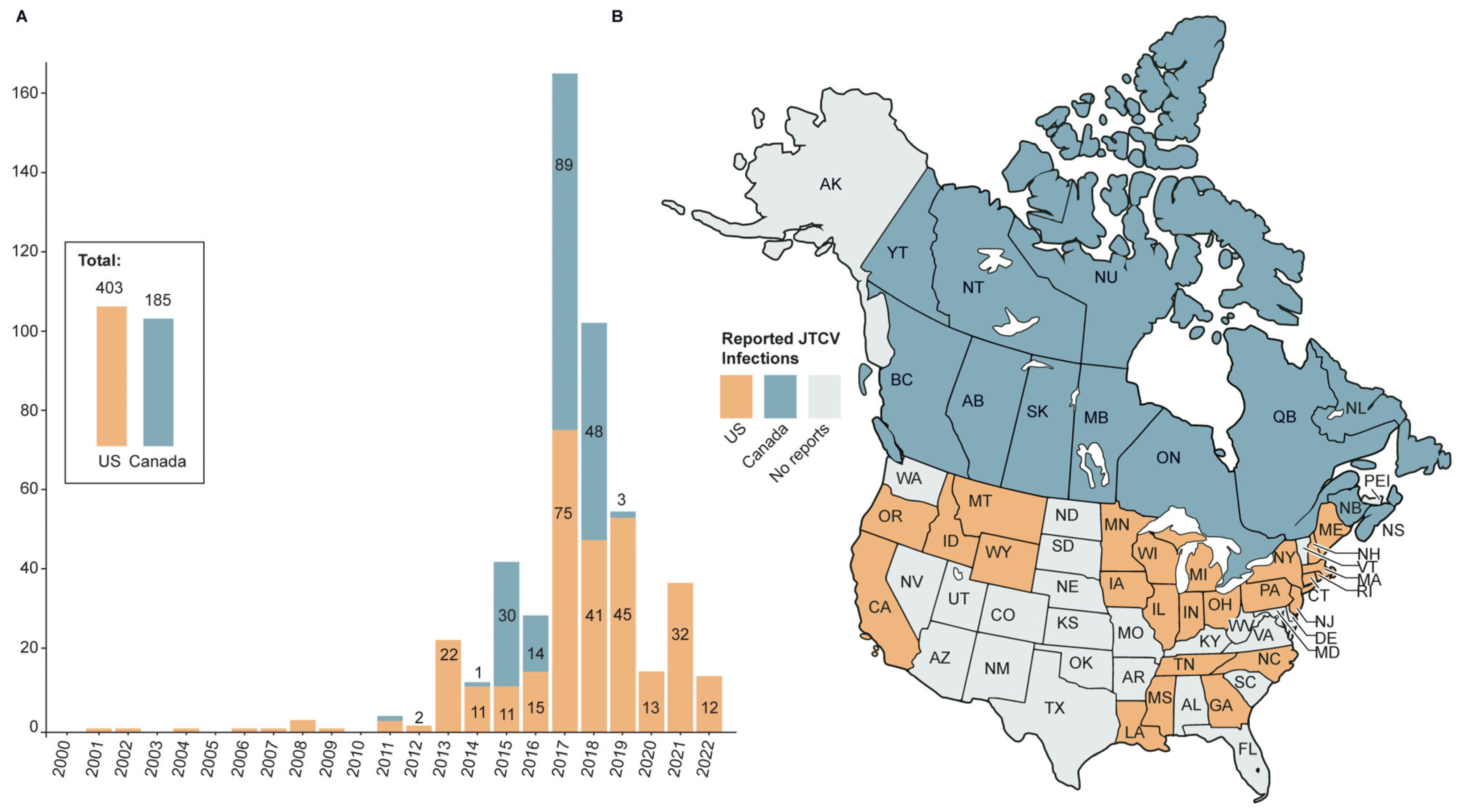
3.1. Human Case Reports of JCV
3.2. JCV Cases with Detailed Analysis for Further Evaluation
3.3. Probable and Confirmed Neuroinvasive Arbovirus Infection
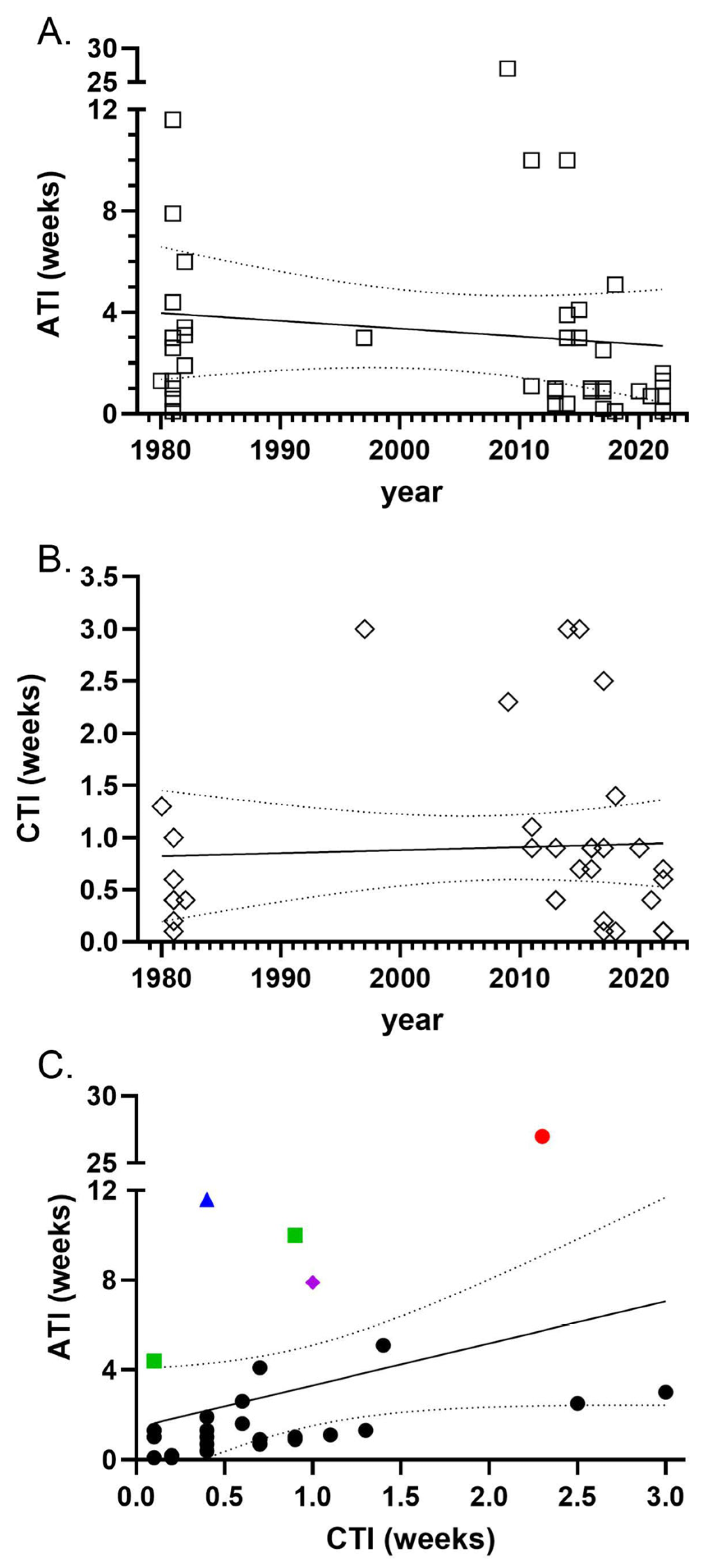
3.4. Timeline for Analysis of JCV as a Causative Agent

| Year a | Age, Sex b | Diag c | Prod d | AES e Maj/min | Outcome f | Ref, Case |
|---|---|---|---|---|---|---|
| 1980 | 8 F | E | Yes | 1/5 | Hospitalized 27 days, no sequelae at 15 months | [10,24], 1 |
| 1981 | 29 M | M | Yes | 0/2 | Recovered 10 days later | [10], 2 |
| 1981 | 39 F | M | Yes | 0/1 | Cognitively impaired for 2–4 months | [10], 3 |
| 1981 | 18 M | NN | Yes | 0/0 | Discharged day 4 | [10], 4 |
| 1981 | 31 M | M | Yes | 0/2 | Discharge at 6 days, no sequelae at 16 months | [10], 5 |
| 1981 | 31 M | M | Yes | 0/2 | Discharge at 3 days, no residua at 12 months | [10], 6 |
| 1981 | 87 M | E | Yes | 1/1 | NR | [10], 7 |
| 1981 | 34 M | P | Yes | 0/1 | NR | [10], 8 |
| 1981 | 21 F | M | Yes | 0/2 | Discharge at 3 days, no residua at 1 year | [10], 9 |
| 1981 | 22 F | NR | Yes | 0 | NR | [10], 12 |
| 1982 | 44 F | E | NR | 1/2 | Died | [10], 10 |
| 1982 | 24 M | NN | NR | 0/1 | NR | [10], 11 |
| 1982 | 52 M | E | Yes | 1/4 | NR | [22], 1 |
| 1982 | C M | NN | Yes | 0/0 | NR | [22], 2 |
| 1983 | 14 M | M | NR | 0/0 | NR | [22], 3 |
| 1984 | 11 M | M | NR | NR | NR | [70] |
| 1997 | 20 F | E | Yes | 1/1 | 2 months in hospital, 6 months LTC, severely disabled | [26] |
| 2001 | T M | M | Yes | 0/2 | Full recovery | [71] |
| 2009 | 51 M | E | None | 0/2 | Recovered by 6 months. Follow up confirmed E. | [42] |
| 2011 | 53 M | E | Yes | 1/2 | Hospitalized 28 days. Expressive aphasia persistent at 6 month follow up | [58], 4 |
| 2011 | 48 M | E | Yes | 1/4 | Full recovery | [58], 2 |
| 2013 | 66 M | E | Yes | 1/4 | Unable to resume work due to poor memory, ataxia, and depression | [58], 1 |
| 2013 | 65 M | E | Yes | 1/3 | Prolonged sequelae, brain atrophy | [58], 3 |
| 2016 | 70 M | E | Yes | 1/2 | Hospitalized 5 weeks, but full recovery | [58], 5 |
| 2011–16 | 80 F | E | NR | 1/2 | Died | [12] |
| 2013 | 57 M | E | Yes | 1/3 | 1 month in hospital, poor memory for several months | [50], 1 |
| 2014 | 65 M | E | Yes | 1/3 | Prolonged symptoms, brain biopsy was misleading | [50], 2 |
| 2014 | 31 M | NN | Yes | 0/0 | Recovered after 10 weeks | [50], 3 |
| 2014 | 63 M | NN | Yes | 0/1 | Recovered by 2 months | [50], 4 |
| 2015 | 36 M | E | Yes | 0/2 | Brain MRI verified E, symptoms lasted >1 year | [50], 5 |
| 2016 | 68 F | NN | Yes | 0/0 | NR | [50], 6 |
| 2016 | 57 M | E | Yes | 1/1 | Ongoing fatigue but working after 2 months | [50], 7 |
| 2017 | 28 M | NN | Yes | 1/0 | Dull headaches for >6 months | [50], 8 |
| 2017 | 40 M | E | None | 1/2 | Retrograde amnesia precluded return to work for >1 month | [50], 9 |
| 2014 | 62 M | S | Yes | 1/1 | Hospitalized 5 days, symptoms better after 2 months | [60] |
| 2015 | 73 M | E | Yes | 1/2 | Post-encephalitis dementia | [68] |
| 2016 | 31 M | E | Yes | 1/3 | EEG improved on ribavirin, but patient died of sepsis. Biopsy confirmed E | [62] |
| 2017 | 26 M | E | Yes | 0/3 | Brain MRI verified E, 5 days in hospital, fully recovered | [67] |
| 2017 | Ol M | E | Yes | 1/2 | In hospital 21 days; deficits resolved by 4 months post-onset | [46] |
| 2017 | 56 M | E | Yes | 1/3 | Brain biopsy verified E. Death and necropsy | [4] |
| 2018 | 10 F | E | Yes | 0/3 | Brain MRI verified E. 4 days in hospital, was well at 2.5 weeks | [55,56] |
| 2018 | 48 F | E | Yes | 1/1 | 3 hospitalizations within 53 days, then rehabilitation. Normal activities and cognitive function recovered | [34] |
| 2020 | 59 M | E | Yes | 1/2 | Brain MRI verified E. Died on hospital day 21 | [66] |
| 2021 | 59 M | E | Yes | 1/3 | Brain MRI consistent with E. Cognitive deficits lingered and required family supervision | [52] |
| 2022 | 79 M | E | Yes | 0/2 | Brain biopsy and brain MRI verified E. Improved by day 14 in hospital | [59] |
| 2022 | 57 F | E | Yes | 1/3 | JTCV precipitated MOGAD. Initial cognitive impairment, but back to baseline at 2 months post | [32] |
| 2022 | 36 M | M | Yes | 0/3 | Headache, neck stiffness and pain improved by day 6 | [72] |
| 2018 | 4 F | E | None | ?/3 | Stable, but significant neurologic impairment | [61] |
| 2022 | 43 M | E | Yes | 1/3 | 6 months after hospital discharge returned to work full-time | [49] |
| Year, Case a | Symptoms b | LP c | Tests d | Serology Tests: + if Positive e | SO f | CSG Viruses Tested g | SR h | JTCV Results i | CR j | Ref |
|---|---|---|---|---|---|---|---|---|---|---|
| 1980, 1 | 8-day prodrome with fever+, then seizures and coma | 1.3 | CT, LP+, EEG+ | EEE, SLE, WEE, but HSV+ | 1.3 | LACV, CEV, SSHV, KEYV, TVTV, TAHV, SANV | NR | IgM +, PRNT 4-fold rise in paired-sera | C | [24] |
| 1981, 2 | Prodrome, HA, shaking chills+ | <0.4 | LP+ | EEE, HSV, WEE, SLE, POW | 1.3 | LACV, KEYV, SSHV | NR | IgM not tested, PRNT 8-fold rise | C | [10] |
| 1981, 3 | Prodrome, fever+, stiff neck | No LP | NR | EEE, HSV WEE, SLE, POW, mmp, meas | 3.0 | LACV, KEYV, SSHV | NR | IgM+ PRNT 16-fold rise | C | [10] |
| 1981, 4 | Prodrome, HA, stiff neck | 1.0 | LP | EEE, WEE, SLE, HSV, POW, mmp, meas | 7.9 | LACV, KEYV, SSHV | NR | PRNT stable and 8-fold higher, IgM+ | P2 | [10] |
| 1981, 5 | HA, fever+, abnormal CSF | 0.2 | LP+ | EEE, WEE, SLE, HSV, POW, mmp, meas | 0.1 | LACV, KEYV, SSHV | NR | IgM+, PRNT 8-fold rise | P4 | [10] |
| 1981, 6 | Prodrome, HA, fever+ | 0.4 | LP+ | EEE, WEE, SLE, HSV, POW, mmp, meas | 11.6 | LACV, SSHV, KEYV | NR | Delayed IgM and PRNT 4-fold rise | C | [10] |
| 1981, 7 | Prodrome, coma+ | 0.1 | LP+ | EEE, WEE, SLE, HSV, POW, mmp, meas | 4.4 | LACV, SSHV, KEYV | NR | CF 2-fold rise, IgM+, PRNT 1:81,920 | P2 | [10] |
| 1981, 8 | HA, fever+, cough, stiff neck, HA | No LP | Chest X-Ray+ | EEE, WEE, SLE, HSV, POW, mmp, meas | 1.0 | LACV, SSHV, KEYV | NR | HI 8-fold rise, IgM+++, then dropped to 0, PRNT 1:5120 | C | [10] |
| 1981, 9 | Prodrome, HA, fever+ | 0.6 | LP+ | EEE, WEE, SLE, HSV, POW, mmp, meas | 2.6 | LACV, SSHV, KEYV | NR | HI 4-fold rise, IgM+ PRNT 1:640 | C | [10] |
| 1981, 12 | HA, stiff neck | No LP | NR | EEE, WEE, SLE, HSV, POW, mmp, meas | 0.6 | LACV, SSHV, KEYV | NR | IgM+, PRNT 1:320 | P2 | [10] |
| 1982, 10 | Seizures+, coma+, LP+ | 0.4 | NR | EEE, WEE, SLE, POW, mmp, meas, HSV+ 16-fold rise | 1.9 | LACV, SSHV, KEYV | NR | IgM+++ and JCV PRNT 1:80 through-out | P2 | [10] |
| 1982, 11 | HA, fever+ | No LP | NR | EEE, WEE, SLE, HSV, POW, mmp, meas | 3.1 | LACV, SSHV, KEYV | NR | IgM negative to ++ and PRNT 4-fold rise | C | [10] |
| 1982, 1 | HA, fever+, coma+, paralysis+, seizures+ | NR | NR | HSV and other CNS pathogens | 3.4 | LAC, TVT | NR | >2-fold PRNT titer rise, IgM NR | P4 | [22] |
| 1982, 2 | Vesiculopapular rash | NR | NR | HSV | NR | LAC, TVT | NR | 16-fold PRNT titer rise, IgM NR | C | [22] |
| 1983, 3 | Meningeal signs | NR | NR | HSV | 6.0 | LAC, TVT | NR | 4-fold PRNT titer rise, IgM NR | C | [22] |
| 1984 | Aseptic meningitis | NR | NR | NR | NR | CSG viruses, but members NR | None | Highest titers of HI, CF, PRNT, IgM+ | P1-P4 | [70] |
| 1997 | Prodrome, confusion+, HA, fever+ | 3.0 | LP+, CT, EEG, MRI+ | EEE, WEE, SLE, POW, HSV, CMV, EBV, HIV | 3.0 | LAC | NR | Initial CSF RT-PCR+, brain biopsy RT-PCR+ | C | [26] |
| 2001 | HA, fever+, diplopia+ | NR | NR | NR | NR | NR | NR | IgM+ by IFA, PRNT+ | P1, P3, P4 | [71] |
| 2009 | HA, fever+, left side numbness+, mosquitoes | 2.3 | CT, MRI, LP, Carotid ultra-sound | SLE. WNV (IgM+, but PRNT 1:320 unchanged) | 1.0 | LACV | NR | IgM+, 4-fold PRNT rise | C | [42] |
| 2011, 4 | Prodrome, fever+, rash, confused+, HA | 1.1 | LP | WNV, POW, EEE, WEE, Rickettsia, Borrelia, Ana-plasma+, but stable | 1.1 | SSHV + but IgM NR | NR | CSF IgM+ and PRNT increased 16-fold, serum IgM+ and PRNT increased | C | [58] |
| 2011, 2 | Prodrome, HA, ataxia+, confusion+ | 0.9 | CT, LP+, EEG+, MRI+ | HSV, VZV | 1.0 | SSHV | NR | IgM+ serum, PRNT rose 0 to 1:80 | C | [58] |
| 2013, 1 | Prodrome, fever+, confusion+ | 0.4 | EEG+, MRI+ | Crypto, HSV, VZV, >12 other micro-biology | 0.4 | SSHV CSF PRNT and IgM negative | NR | Serum PRNT IgM+ 1:40 then 1:80. CSF IgM+ 1:10 | C | [58] |
| 2013, 3 | Prodrome, HA, fever+, mosquitoes | 0.9 | CT, LP+, | HIV, WNV, Lyme, CMV, HSV, VZV | 0.9 | SSHV | NR | Serum JCV IgM+ in both samples, PRNT 0 to 1:40 later | C | [58] |
| 2016, 5 | Fever+, rash, | 0.9 | CT, MRI | HIV, Parvo B19, WNV POW, Lyme | NR | SSHV IgM+, PRNT 1:40 to 1:80 | NR | Serum 1:320 to 1:1280, CSF IgM+ 1:4 | C | [58] |
| 2011 TO 2016 | Confusion+, ataxia+ | NR | NR | EEE, POW, SLE, but WNV IgM+ | NR | LACV | NR | IgM + and PRNT confirmed JCV | C | [12] |
| 2013, 1 | Prodrome, rash, chills | 0.4 | LP+, MRI+, | WNV, EEE, Lyme, Babesia microti (IgM+) | <1.0 | LAC | NR | Serum IgM+, PRNT 1:160 | P4 | [50] |
| 2014, 2 | Long pro-drome, HA, confused+, left hand numb+ | 3.0 | LP+, MRI+, brain biopsy | Serum WNV, EEE, POW and CSF WNV IgM, CSF EEE IgM | 3.0 | LAC | NR | IgM+, PRNT 1:1280, both in CSF | P4 | [50] |
| 2014, 3 | Long pro-drome, HA, confused | No LP | None | WNV, SLE, EEE, POW | 10.0 | LACVPRNT+ at 1:160 | NR | IgM+, PRNT 1:1280 in serum | P4 | [50] |
| 2014, 4 | Prodrome, fever+, HA | No LP | None | WNV, EEE | 0.4 | LACVPRNT+ at 1:160 | NR | IgM+, PRNT 1:320 in serum | P4 | [50] |
| 2015, 5 | Prodrome, HA, paresthesia | 3.0 | LP+, MRI+ | WNV, EEE, POW, and WNV | 3.0 | LACV1:20 | NR | IgM+, PRNT 1:160 | P4 | [50] |
| 2016,6 | Long pro-drome, HA, fatigue, myalgias | NR | LP, MRI. | WNV, EEE, POW, but Lyme IgM and Western blot IgG+ | NR | NR | NR | IgM+, PRNT 1:80 | P1, P4 | [50] |
| 2016, 7 | HA, fever+, confused+ | 0.9 | LP+, MRI | WNV, POW | <1.0 | LACV1:40 | NR | IgM+, PRNT 1:2560 | P4 | [50] |
| 2017, 8 | HA, confused, | 2.5 | LP, CT, MRI | WNV, POW, POW- in CSF | 2.5 | LAC | NR | IgM+, PRNT 1:160 | P4 | [50] |
| 2017, 9 | HA, confused+, seizure+ | 0.1 | LP, MRI | WNV, EEE, POW | <1.0 | LAC | NR | IgM+, PRNT 1:160 | P4 | [50] |
| 2014 | Prodrome, HA, fever, sepsis, rash mosquitoes, stiff neck | No LP | CT pelvis and abdomen | 19 serological tests | 3.9 | LACV IgM negative, PRNT <1:10 to 1:320 | CSG | JTC IgM negative, PRNT 1:160 rose to 1:10,240 | P4 | [60] |
| 2015 | HA, fever+, confusion+ | 0.7 | LP, MRI, EEG | HSV, Bart, Borr, Coxac, Anaplas, autoimmune | 4.1 | IgM+, SSH rose 1:20 to 1:320 | CSG 4.1 | IgM+, JTC rose 1:40 to 1:320 | P4 | [68] |
| 2016 | Prodrome, HA, seizure+ | 0.7 | LP, MRI, EEG+, brain biopsy+ | Extensive infectious, autoimmune | 0.9 | NR | 4.0 | Initial serology and later PRNT+ | P3 | [62] |
| 2017 | Complex migraine-like HAs twice, also papilledema | 0.2 | LP+, CT, CTA, EEG, MRI+ | >15 micro-biology tests | 0.2 | SSH IgM+ serum and CSF, PRNT negative serum | NR | IgM+ serum and CSF, and PRNT+ > 1:80 in serum | C | [67] |
| 2017 | Prodrome, HA, fever+, Confused+, known liver transplant | 0.9 | LP+, auto- immune Ab panel both CSF serum, MRI | >15 micro-biology tests, anti-body panel for viruses, mMGS | 0.9 | LACV1:10 | 8.0 | CSF IgM+. PRNT in CSF 2 and 1:320 serum | C | [46] |
| 2017 | 11-month prodrome, then rapid dementia | NR | LP+, MRI, PET, EEG+, brain biopsy+ | Auto-immune panel, >15 microbio-logy tests | NR | LAC | NR | RT-PCR+, mNGS positive | C | [4] |
| 2018 | Prodrome, HA, ataxia+, diplopia, mosquitoes | 0.1 | LP+, CT, MRI+, EEG | >15 micro-biology tests | 0.1 | LACV 1:20, SSH 1:20 both stable in later sera | NR | IgM+ and PRNT 1:2560 in CSF and serum | C | [56] |
| 2018 | Confusion+, Hallucinations, known heart transplant. Admission day 10 | 1.4 | LP+, CT, MRI, EEG, cardiac biopsies | Autoimmune panel, >15 micro-biology tests, CSF encephalitis panel | 5.1 | LACV | 6.6 | RT-PCR negative throughout, IgM+ serum and CSF, PRNT rose 2-fold in serum. IgM+ >7 months | C | [34] |
| 2020 | Dysarthria+, Confused+, mosquitoes | 0.9 | LP+, MRI+ | CSF BioFire array for VZV+, but 13 agents negative | 0.9 | LACV IgM and ELISA | 20.0 | CSF IgM+ and PRNT 1:512 in serum | C | [66] |
| 2021 | Hallucinations+, HA, confusion+, mosquitoes, rash | 0.4 | LP+, CT, MRI+ | CSG, WNV, SLE, EEE, WEE, LCEV, VDRL | 0.7 | NR | NR | IgM in serum and CSF, PRNT 1:160 | P3 | [52] |
| 2022 | L arm cramp+, aphasia | 0.6 | LP+, CT, CTA, MRI+, EEG+ | Auto-immune, meningitis and tick panels, brain biopsy | 1.6 | LACV + 1:1 serum, CSF negative | NR | CSF at biopsy site: JTC IgM+ and PRNT > 1:64 | C | [59] |
| 2022 | HA, diplopia+, confusion+ | 0.1 | LP+, CT, MRI+, EEG+ | CSF BioFire array, auto-immune panel | 1.3 | NR | >5.4 | JTV IgM+, PRNT 1:40 in serum | C | [32] |
| 2022 | HA, fever+, stiff neck | 0.1 | LP, MRI+, meningitis panel | autoimmune and micro panels | 0.1 | LACV | 3.9 | JTCV IgM+ and PRNT+ in CSF | C | [72] |
| 2022 | seizure+ | 0.1 | LP, MRI+, CSF shunt | Brain biopsy, low level viremia from CMV and EBV | NR | NR, but LACV unlikely given where she lived. | NR | CSF JTC RT-PCR+, Serum JTC IgM+, PRNT 1:40 | C | [61] |
| 2022 | Fever+, confusion+ | 0.7 | LP+, MRI+ | CSF POW IgM+, PRNT 2, serum IgM+, PRNT 1:160 | 0.7 | NR | 5.0 | CSF JCV IgM +, PRNT 8, serum IgM+, PRNT 1:640 | C | [49] |
| Year, Case a | Other Infectious Agents b | Clinical Notes c | Laboratory and Serology Results d | Notes e | Ref |
|---|---|---|---|---|---|
| 1980 | HSV | Encephalitis, recurrent HSV | JTCV PRNT 4-fold rise; HSV 16-fold rise | HSV not detected in CSF Recovered | [24] |
| 1982, 10 | HSV | Encephalitis | JTCV PRNT, HI stable but IgM positive | HSV encephalitis? Death | [10] |
| 1997 | HSV? | Prolonged encephalitis | Slow 2-fold JCV PRNT rise. Low HSV titers | RT-PCR positive for JCV in CSF and brain biopsy, disabled | [26] |
| 2011–2016 | WNV | Encephalitis | PRNT confirmed both viruses recent | Limited details of case Death | [12] |
| 2013, 1 | Borrelia burgdorferi | Encephalitis | Lyme IgM Western blot+ JCV IgM+ with PRNT 1:160 | Poor memory, ataxia, depression | [50] |
| 2015 | SSHV | Encephalitis, | JTCV IgM+ and 8-fold PRNT rise, SSHV IgM+ and 16-fold PRNT rise | Cross-reactivity of viruses, long term symptoms | [68] |
| 2016, 7 | Borrelia burgdorferi | Rheumatoid arthritis (prednisone 10 mg daily). | Engorged tick JTCV IgM+ with PRNT 1:2560 | Empirical Lyme treatment, previously on methotrexate Ongoing fatigue | [50] |
| 2017–2018 | - | Rituximab for lymphoma, | RT-PCR and mNGS positive at end of life | One year of progressive dementia Death | [4] |
| 2018 | EBV | Heart transplant on tacrolimus and mycophenolate, encephalitis | Serum JCV PRNT rose only 2-fold, but serum and CSF IgM favored JCV over EBV. RT-PCR for JCV was positive at 7.5 weeks | Recovery after immune reconstitution and ribavirin Recovered | [34] |
| 2018–2023 | EBV | TYK2 deficient, pneumonia, encephalitis | CSF JCV IgM+ with PRNT 1:40 | Very complex case Long term neurological impairment | [61] |
| 2019 | VZV | Encephalitis, L5 dermatome rash, | CSF: VZV PCR+ and JCV IgM and PRNT 1:512 | Death | [66] |
| 2017 | - | Liver transplant on cyclosporin and prednisone, encephalitis | CSF IgM and serum PRNT 1:320 | Treated with IV IgG Recovered | [46] |
| 2022 | Borrelia burgdorferi | Erythema migrans and meningitis | Lyme serum IgM+, JCV CSF IgM and PRNT+ | Briefly hospitalized for antibiotics, recovered | [72] |
| 2022–2023 | POW | Encephalitis | CSF IgM and PRNT positive for POWV and JTCV | RT-PCR and mNGS negative for both viruses, recovered | [49] |
3.5. Outcomes of JCV Encephalitis
3.6. Confounding Factors of JCV Cases
4. Discussion
Supplementary Materials
Author Contributions
Funding
Data Availability Statement
Acknowledgments
Conflicts of Interest
References
- Granerod, J.; Tam, C.C.; Crowcroft, N.S.; Davies, N.W.; Borchert, M.; Thomas, S.L. Challenge of the unknown. A systematic review of acute encephalitis in non-outbreak situations. Neurology 2010, 75, 924–932. [Google Scholar] [CrossRef]
- Venkatesan, A.; Tunkel, A.R.; Bloch, K.C.; Lauring, A.S.; Sejvar, J.; Bitnun, A.; Stahl, J.P.; Mailles, A.; Drebot, M.; Rupprecht, C.E.; et al. Case definitions; diagnostic algorithms, and priorities in encephalitis: Consensus statement of the international encephalitis consortium. Clin. Infect. Dis. 2013, 57, 1114–1128. [Google Scholar] [CrossRef]
- George, B.P.; Schneider, E.B.; Venkatesan, A. Encephalitis hospitalization rates and inpatient mortality in the United States, 2000–2010. PLoS ONE 2014, 9, e104169. [Google Scholar] [CrossRef]
- Solomon, I.H.; Ganesh, V.S.; Yu, G.; Deng, X.D.; Wilson, M.R.; Miller, S.; Milligan, T.A.; Mukerji, S.S.; Mathewson, A.; Linxweiler, J.; et al. Fatal Case of Chronic Jamestown Canyon Virus Encephalitis Diagnosed by Metagenomic Sequencing in Patient Receiving Rituximab. Emerg. Infect. Dis. 2021, 27, 238–242. [Google Scholar] [CrossRef]
- Lyons, J.L.; Schaefer, P.W.; Cho, T.A.; Azar, M.M. Case 34-2017. A 76-Year-Old Man with Fever, Weight Loss, and Weakness. N. Engl. J. Med. 2017, 377, 1878–1886. [Google Scholar] [CrossRef]
- Meyer, H.M., Jr.; Johnson, R.T.; Crawford, I.P.; Dascomb, H.E.; Rogers, N.G. Central nervous system syndromes of “vital” etiology. A study of 713 cases. Am. J. Med. 1960, 29, 334–347. [Google Scholar] [CrossRef] [PubMed]
- Piantadosi, A.; Kanjilal, S. Diagnostic Approach for Arboviral Infections in the United States. J. Clin. Microbiol. 2020, 58, e01926-19. [Google Scholar] [CrossRef]
- Samuels, M.A.; Gonzalez, R.G.; Makadzange, A.T.; Hedley-Whyte, E.T. Case 3-2017. A 62-Year-Old Man with Cardiac Sarcoidosis and New Diplopia and Weakness. N. Engl. J. Med. 2017, 376, 368–379. [Google Scholar] [CrossRef] [PubMed]
- Tyler, K.L. Acute Viral Encephalitis. N. Engl. J. Med. 2018, 379, 557–566. [Google Scholar] [CrossRef]
- Deibel, R.; Srihongse, S.; Grayson, M.A.; Grimstad, P.R.; Mahdy, M.S.; Artsob, H.; Calisher, C.H. Jamestown Canyon virus: The etiologic agent of an emerging human disease? Prog. Clin. Biol. Res. 1983, 123, 313–325. [Google Scholar] [PubMed]
- Drebot, M.A. Emerging mosquito-borne bunyaviruses in Canada. Can. Commun. Dis. Rep. 2015, 41, 117–123. [Google Scholar] [CrossRef]
- Matkovic, E.; Johnson, D.K.H.; Staples, J.E.; Mora-Pinzon, M.C.; Elbadawi, L.I.; Osborn, R.A.; Warshauer, D.M.; Wegner, M.V.; Davis, J.P. Enhanced Arboviral Surveillance to Increase Detection of Jamestown Canyon Virus Infections, Wisconsin, 2011–2016. Am. J. Trop. Med. Hyg. 2019, 100, 445–451. [Google Scholar] [CrossRef] [PubMed]
- Pastula, D.M.; Smith, D.E.; Beckham, J.D.; Tyler, K.L. Four emerging arboviral diseases in North America: Jamestown Canyon, Powassan, chikungunya, and Zika virus diseases. J. Neurovirol 2016, 22, 257–260. [Google Scholar] [CrossRef]
- DeFoliart, G.R.; Anslow, R.O.; Hanson, R.P.; Morris, C.D.; Papadopoulos, O.; Sather, G.E. Isolation of Jamestown Canyon serotype of California encephalitis virus from naturally infected Aedes mosquitoes and tabanids. Am. J. Trop. Med. Hyg. 1969, 18, 440–447. [Google Scholar] [CrossRef]
- Sather, G.E.; Hammon, W.M. Antigenic patterns within the California-encephalitis-virus group. Am. J. Trop. Med. Hyg. 1967, 16, 548–557. [Google Scholar] [CrossRef]
- Kosoy, O.; Rabe, I.; Geissler, A.; Adjemian, J.; Panella, A.; Laven, J.; Basile, A.J.; Velez, J.; Griffith, K.; Wong, D.; et al. Serological Survey for Antibodies to Mosquito-Borne Bunyaviruses Among US National Park Service and US Forest Service Employees. Vector Borne Zoonotic Dis. 2016, 16, 191–198. [Google Scholar] [CrossRef]
- Mayo, D.N.; Karabatsos, N.; Scarano, F.J.; Brennan, T.; Buck, D.; Fiorentino, T.; Mennone, J.; Tran, S. Jamestown Canyon virus: Seroprevalence in Connecticut. Emerg. Infect. Dis. 2001, 7, 911–912. [Google Scholar] [CrossRef] [PubMed]
- Shepard, J.J.; Armstrong, P.M. Jamestown Canyon virus comes into view: Understanding the threat from an underrecognized arbovirus. J. Med. Entomol. 2023, 60, 1242–1251. [Google Scholar] [CrossRef]
- Snyman, J.; Villeneuve, C.A.; Snyman, L.P.; Martinez, V.; Dusfour, I.; Lecomte, N.; Jenkins, E.J.; Hobman, T.C.; Leighton, P.A.; Kumar, A. First Confirmed Report of Jamestown Canyon Virus in Greenland. J. Med. Virol. 2024, 96, e70064. [Google Scholar] [CrossRef] [PubMed]
- Walters, L.L.; Tirrell, S.J.; Shope, R.E. Seroepidemiology of California and Bunyamwera serogroup (Bunyaviridae) virus infections in native populations of Alaska. Am. J. Trop. Med. Hyg. 1999, 60, 806–821. [Google Scholar] [CrossRef]
- Woods, T.A.; Johnson, S.F.; Evans, A.B.; Peterson, K.E. Neutralizing Antibodies against California Serogroup Orthobunyaviruses in Human Serum Samples, Montana, USA. Emerg. Infect. Dis. 2025, 31, 699–709. [Google Scholar] [CrossRef]
- Grimstad, P.R.; Calisher, C.H.; Harroff, R.N.; Wentworth, B.B. Jamestown Canyon virus (California serogroup) is the etiologic agent of widespread infection in Michigan humans. Am. J. Trop. Med. Hyg. 1986, 35, 376–386. [Google Scholar] [CrossRef]
- Patriquin, G.M.; Drebot, M.; Cole, T.; Lindsay, R.; Schleihauf, E.; Johnston, B.L.; Dimitrova, K.; Traykova-Andonova, M.; Mask, A.; Haldane, D.; et al. High Seroprevalence of Jamestown Canyon Virus among Deer and Humans, Nova Scotia, Canada. Emerg. Infect. Dis. 2018, 24, 118–121. [Google Scholar] [CrossRef] [PubMed]
- Grimstad, P.R.; Shabino, C.L.; Calisher, C.H.; Waldman, R.J. A case of encephalitis in a human associated with a serologic rise to Jamestown Canyon virus. Am. J. Trop. Med. Hyg. 1982, 31, 1238–1244. [Google Scholar] [CrossRef] [PubMed]
- Srihongse, S.; Grayson, M.A.; Deibel, R. California serogroup viruses in New York State: The role of subtypes in human infections. Am. J. Trop. Med. Hyg. 1984, 33, 1218–1227. [Google Scholar] [CrossRef]
- Huang, C.W.; Campbell, W.; Grady, L.; Kirouac, I.; LaForce, F.M. Diagnosis of Jamestown Canyon encephalitis by polymerase chain reaction. Clin. Infect. Dis. 1999, 28, 1294–1297. [Google Scholar] [CrossRef]
- Pastula, D.M.; Johnson, D.K.H.; White, J.L.; Dupuis, A.P., 2nd; Fischer, M.; Staples, J.E. Jamestown Canyon Virus Disease in the United States—2000–2013. Am. J. Trop. Med. Hyg. 2015, 93, 384–389. [Google Scholar] [CrossRef]
- Public Health Agency of Canada. West Nile virus and other mosquito-borne diseases surveillance report: Annual edition 2019. In Disease and Conditions; Public Health Agency of Canada: Ottawa, ON, Canada, 2020. [Google Scholar]
- Centers for Disease Control. Leads from the MMWR. Arboviral infections of the central nervous system—United States, 1984. JAMA 1985, 253, 3231–3233. [Google Scholar]
- Centers for Disease Control. Leads from the MMWR. Arboviral infections of the central nervous system—United States, 1987. JAMA 1988, 260, 1688–1689+1694. [Google Scholar] [CrossRef]
- Centers for Disease Control. Arboviral infections of the central nervous system—United States, 1996–1997. Can. Commun. Dis. Rep. 1998, 24, 156–159. [Google Scholar]
- Abud, A.M.; Rizvi, S.; Zainah, H.; O’Brien, T.C.; Villamar, M.F. Aggressive MOGAD with bilateral corticospinal tract lesions following infection with Jamestown Canyon virus. J. Neuroimmunol. 2022, 373, 577997. [Google Scholar] [CrossRef]
- Artsob, H.; Spence, L.P.; Calisher, C.H.; Sekla, L.H.; Brust, R.A. Isolation of California encephalitis serotype from mosquitoes collected in Manitoba, Canada. J. Am. Mosq. Control Assoc. 1985, 1, 257–258. [Google Scholar]
- Askar, W.P.; Menaria, P.; Thohan, V.; Brummitt, C.F. Jamestown Canyon virus encephalitis in a heart transplant patient. Transpl. Infect. Dis. 2020, 22, e13210. [Google Scholar] [CrossRef]
- Burakoff, A.; Lehman, J.; Fischer, M.; Staples, J.E.; Lindsey, N.P. West Nile Virus and Other Nationally Notifiable Arboviral Diseases—United States, 2016. MMWR Morb. Mortal. Wkly. Rep. 2018, 67, 13–17. [Google Scholar] [CrossRef] [PubMed]
- Centers for Disease Control. Arboviral infections of the central nervous system—United States, 1984. MMWR Morb. Mortal. Wkly. Rep. 1985, 34, 283–286+291–294. [Google Scholar]
- Centers for Disease Control. Arboviral infections of the central nervous system—United States, 1985. MMWR Morb. Mortal. Wkly. Rep. 1986, 35, 341–344+349–350. [Google Scholar]
- Centers for Disease Control. Arboviral infections of the central nervous system—United States, 1986. MMWR Morb. Mortal. Wkly. Rep. 1987, 36, 450–455. [Google Scholar]
- Centers for Disease Control. Arboviral infections of the central nervous system—United States, 1987. MMWR Morb. Mortal. Wkly. Rep. 1988, 37, 506–508+513–515. [Google Scholar]
- Centers for Disease Control. Arboviral infections of the central nervous system—United States, 1989. MMWR Morb. Mortal. Wkly. Rep. 1990, 39, 407+413–417. [Google Scholar]
- Centers for Disease Control and Prevention. Arboviral infections of the central nervous system—United States, 1996–1997. MMWR Morb. Mortal. Wkly. Rep. 1998, 47, 517–522. [Google Scholar]
- Centers for Disease Control and Prevention. Human Jamestown canyon virus infection—Montana, 2009. MMWR Morb. Mortal. Wkly. Rep. 2011, 60, 652–655. [Google Scholar]
- Centers for Disease Control and Prevention. West Nile virus disease and other arboviral diseases—United States, 2010. MMWR Morb. Mortal. Wkly. Rep. 2011, 60, 1009–1013. [Google Scholar]
- Centers for Disease Control and Prevention. West nile virus disease and other arboviral diseases—United States, 2011. MMWR Morb. Mortal. Wkly. Rep. 2012, 61, 510–514. [Google Scholar]
- Centers for Disease Control and Prevention. West Nile virus and other arboviral diseases—United States, 2012. MMWR Morb. Mortal. Wkly. Rep. 2013, 62, 513–517. [Google Scholar]
- Ciccone, E.J.; Markmann, A.J.; Srinivas, M.L.; Levinson, K.J.; Miller, M.B.; van Duin, D.; Gay, C.L. Encephalitis Caused by Jamestown Canyon Virus in a Liver Transplant Patient, North Carolina, USA, 2017. Open Forum Infect. Dis. 2022, 9, ofac031. [Google Scholar] [CrossRef] [PubMed]
- Curren, E.J.; Lehman, J.; Kolsin, J.; Walker, W.L.; Martin, S.W.; Staples, J.E.; Hills, S.L.; Gould, C.V.; Rabe, I.B.; Fischer, M.; et al. West Nile Virus and Other Nationally Notifiable Arboviral Diseases—United States, 2017. MMWR Morb. Mortal. Wkly. Rep. 2018, 67, 1137–1142. [Google Scholar] [CrossRef]
- Fagre, A.C.; Lyons, S.; Staples, J.E.; Lindsey, N. West Nile Virus and Other Nationally Notifiable Arboviral Diseases—United States, 2021. MMWR Morb. Mortal. Wkly. Rep. 2023, 72, 901–906. [Google Scholar] [CrossRef]
- Gnanaprakasam, R.; Wormser, G.P.; Keller, M. Background seropositivity to Jamestown Canyon virus can lead to diagnostic confusion. Diagn. Microbiol. Infect. Dis. 2024, 108, 116161. [Google Scholar] [CrossRef]
- Kinsella, C.M.; Paras, M.L.; Smole, S.; Mehta, S.; Ganesh, V.; Chen, L.H.; McQuillen, D.P.; Shah, R.; Chan, J.; Osborne, M. Jamestown Canyon virus in Massachusetts: Clinical case series and vector screening. Emerg. Microbes Infect. 2020, 9, 903–912. [Google Scholar] [CrossRef]
- Krow-Lucal, E.; Lindsey, N.P.; Lehman, J.; Fischer, M.; Staples, J.E. West Nile Virus and Other Nationally Notifiable Arboviral Diseases—United States, 2015. MMWR Morb. Mortal. Wkly. Rep. 2017, 66, 51–55. [Google Scholar] [CrossRef] [PubMed]
- Kumar, D.; Hans, A.; Warsha, F.; Helmstetter, N. Jamestown Canyon virus-mediated meningoencephalitis with unusual laboratory findings. BMJ Case Rep. 2021, 14, e242014. [Google Scholar] [CrossRef]
- Lindsey, N.P.; Lehman, J.A.; Staples, J.E.; Fischer, M. West Nile Virus and Other Nationally Notifiable Arboviral Diseases—United States, 2014. MMWR Morb. Mortal. Wkly. Rep. 2015, 64, 929–934. [Google Scholar] [CrossRef]
- Lindsey, N.P.; Lehman, J.A.; Staples, J.E.; Fischer, M. West Nile virus and other arboviral diseases—United States, 2013. MMWR Morb. Mortal. Wkly. Rep. 2014, 63, 521–526. [Google Scholar] [CrossRef]
- Madigan, T.; Ryan, C.S.; Huskins, W.C.; Theel, E.S.; Pritt, B.S.; Palm, J.; Schiffman, E.; Strain, A.K.; Binnicker, M.J. Closing the Brief Case: A 10-Year-Old Girl with Meningoencephalitis. J. Clin. Microbiol. 2018, 56, e00255-18. [Google Scholar] [CrossRef]
- Madigan, M.; Ryan, C.S.; Huskins, W.C.; Theel, E.S.; Pritt, B.S.; Palm, J.; Schiffman, E.; Strain, A.K.; Binnicker, M.J. The Brief Case: A 10-Year-Old Girl with Meningoencephalitis. J. Clin. Microbiol. 2018, 56, e00254-18. [Google Scholar] [CrossRef] [PubMed]
- McDonald, E.; Martin, S.W.; Landry, K.; Gould, C.V.; Lehman, J.; Fischer, M.; Lindsey, N.P. West Nile Virus and Other Domestic Nationally Notifiable Arboviral Diseases—United States, 2018. MMWR Morb. Mortal. Wkly. Rep. 2019, 68, 673–678. [Google Scholar] [CrossRef] [PubMed]
- Meier-Stephenson, V.; Drebot, M.A.; Dimitrova, K.; DiQuinzio, M.; Fonseca, K.; Forrest, D.; Hatchette, T.; Morshed, M.; Patriquin, G.; Poliquin, G.; et al. Case Series of Jamestown Canyon Virus Infections with Neurologic Outcomes, Canada, 2011–2016. Emerg. Infect. Dis. 2024, 30, 874–881. [Google Scholar] [CrossRef]
- Rameez, F.; Walsh, M.; Wees, N.; Ali, R.; Min, J.; Tank, E.; Khan, M. Jamestown Canyon Virus (JCV) Encephalitis Mimicking Acute Stroke in Michigan: A Case Report and Review of the Literature. Neurohospitalist 2022, 12, 137–142. [Google Scholar] [CrossRef] [PubMed]
- Rogstad, D.K.; Schiffman, E.; Neitzel, D.; Baddour, L.M. Severe Sepsis Caused by California Serogroup Orthobunyavirus. Emerg. Infect. Dis. 2015, 21, 1876–1877. [Google Scholar] [CrossRef]
- Roussel, L.; Pham-Huy, A.; Yu, A.C.; Venkateswaran, S.; Perez, A.; Bourdel, G.; Sun, Y.; Villavicencio, S.T.; Bernier, S.; Li, Y.; et al. A Novel Homozygous Mutation Causing Complete TYK2 Deficiency, with Severe Respiratory Viral Infections, EBV-Driven Lymphoma, and Jamestown Canyon Viral Encephalitis. J. Clin. Immunol. 2023, 43, 2011–2021. [Google Scholar] [CrossRef]
- Savard, M.; Paradis, A.; Francoeur, C.L. Jamestown Canyon encephalitis with NORSE and electrographic response to ribavirin: A case report. Epilepsia Open 2018, 3, 286–289. [Google Scholar] [CrossRef]
- Soto, R.A.; Hughes, M.L.; Staples, J.E.; Lindsey, N.P. West Nile Virus and Other Domestic Nationally Notifiable Arboviral Diseases—United States, 2020. MMWR Morb. Mortal. Wkly. Rep. 2022, 71, 628–632. [Google Scholar] [CrossRef]
- Sutter, R.A.; Lyons, S.; Gould, C.V.; Staples, J.E.; Lindsey, N.P. West Nile Virus and Other Nationally Notifiable Arboviral Diseases—United States, 2022. MMWR Morb. Mortal. Wkly. Rep. 2024, 73, 484–488. [Google Scholar] [CrossRef] [PubMed]
- Vahey, G.M.; Mathis, S.; Martin, S.W.; Gould, C.V.; Staples, J.E.; Lindsey, N.P. West Nile Virus and Other Domestic Nationally Notifiable Arboviral Diseases—United States, 2019. MMWR Morb. Mortal. Wkly. Rep. 2021, 70, 1069–1074. [Google Scholar] [CrossRef]
- VanderVeen, N.; Nguyen, N.; Hoang, K.; Parviz, J.; Khan, T.; Zhen, A.; Jagger, B.W. Encephalitis with coinfection by Jamestown canyon virus (JCV) and varicella zoster virus (VZV). IDCases 2020, 22, e00966. [Google Scholar] [CrossRef]
- Vosoughi, R.; Walkty, A.; Drebot, M.A.; Kadkhoda, K. Jamestown Canyon virus meningoencephalitis mimicking migraine with aura in a resident of Manitoba. Can. Med Assoc. J. 2018, 190, E262–E264. [Google Scholar] [CrossRef] [PubMed]
- Webster, D.; Dimitrova, K.; Holloway, K.; Makowski, K.; Safronetz, D.; Drebot, M.A. California Serogroup Virus Infection Associated with Encephalitis and Cognitive Decline, Canada, 2015. Emerg. Infect. Dis. 2017, 23, 1423–1424. [Google Scholar] [CrossRef] [PubMed]
- Weiler, N.S.; Niendorf, E.; Dumic; Insects, I.T.; Bites, T. One Patient: A Lyme Disease and Jamestown Canyon Co-infection. Cureus 2023, 15, e40222. [Google Scholar] [CrossRef]
- Backman, R.; Foy, R.; Diggle, P.J.; Kneen, R.; Easton, A.; Defres, S.; McGill, F.; Michael, B.D.; Solomon, T.; Committee, E.U.P.S. A pragmatic cluster randomised controlled trial of a tailored intervention to improve the initial management of suspected encephalitis. PLoS ONE 2018, 13, e0202257. [Google Scholar] [CrossRef]
- Artsob, H.; Spence, L.; Sekla, L. Arbovirus activity in Canada in 1984. Can. Med Assoc. J. 1985, 133, 1026. [Google Scholar]
- Nelson, R.; Wilcox, L.; Brennan, B.A.; Mayo, D. Surveillance for Arbovirus Infections. In Connecticut Epidemiologist; Connecticut Department of Public Health: Hartford, CT, USA, 2002; pp. 5–6. [Google Scholar]
- Kvam, K.A.; Stahl, J.P.; Chow, F.C.; Soldatos, A.; Tattevin, P.; Sejvar, J.; Mailles, A. Outcome and Sequelae of Infectious Encephalitis. J. Clin. Neurol. 2024, 20, 23–36. [Google Scholar] [CrossRef]
- McJunkin, J.E.; de los Reyes, E.C.; Irazuzta, J.E.; Caceres, M.J.; Khan, R.R.; Minnich, L.L.; Fu, K.D.; Lovett, G.D.; Tsai, T.; Thompson, A. La Crosse encephalitis in children. N. Engl. J. Med. 2001, 344, 801–807. [Google Scholar] [CrossRef]
- Boutzoukas, A.E.; Freedman, D.A.; Koterba, C.; Hunt, G.W.; Mack, K.; Cass, J.; Yildiz, V.O.; de los Reyes, E.; Twanow, J.; Chung, M.G.; et al. La Crosse Virus Neuroinvasive Disease in Children: A Contemporary Analysis of Clinical/Neurobehavioral Outcomes and Predictors of Disease Severity. Clin. Infect. Dis. 2022, 76, e1114–e1122. [Google Scholar] [CrossRef] [PubMed]
- Abbuehl, L.S.; Hofmann, E.; Hakim, A.; Dietmann, A. Can we forecast poor outcome in herpes simplex and varicella zoster encephalitis? A narrative review. Front. Neurol. 2023, 14, 1130090. [Google Scholar] [CrossRef]
- Whitley, J. Effectiveness of small-group self-instruction in radiographic anatomy. Investig. Radiol. 1977, 12, 486–487. [Google Scholar] [CrossRef] [PubMed]
- Gibbons, C.L.; Mangen, M.J.; Plass, D.; Havelaar, A.H.; Brooke, R.J.; Kramarz, P.; Peterson, K.L.; Stuurman, A.L.; Cassini, A.; Fevre, E.M.; et al. Measuring underreporting and under-ascertainment in infectious disease datasets: A comparison of methods. BMC Public Health 2014, 14, 147. [Google Scholar] [CrossRef]
- Public Health Agency of Canada. West Nile Virus And Other Mosquito-Borne Disease Surveillance Report Final Surveillance Report, 2015. In Diseases and Conditions; Government of Canada: Ottawa, ON, Canada, 2016; pp. 1–3. [Google Scholar]
- Public Health Agency of Canada. 2016—Final—Summary West Nile Virus in Canada. In West Nile Virus and Other Mosquito-Borne Disease National Surveillance Report; Public Health Agency of Canada, Ed.; Government of Canada: Ottawa, ON, Canada, 2017. [Google Scholar]
- Public Health Agency of Canada. Annual national surveillance report—2017. In West Nile Virus and Other Mosquito-Borne Diseases in Canada; Government of Canada: Ottawa, ON, Canada, 2018; Available online: https://www.canada.ca/en/public-health/services/publications/diseases-conditions/west-nile-virus-surveillance/2017/annual-national-surveillance-report.html (accessed on 10 February 2026).
- Schneider, E.F.; Robich, R.M.; Elias, S.P.; Lubelczyk, C.B.; Cosenza, D.S.; Smith, R.P. Jamestown Canyon Virus in Collected Mosquitoes, Maine, United States, 2017–2019. Emerg. Infect. Dis. 2022, 28, 2330–2333. [Google Scholar] [CrossRef] [PubMed]
- Public Health Agency of Canada. West Nile virus and other mosquito-borne diseases surveillance report: Annual edition (2018). In Disease and Conditions; Government of Canada: Ottawa, ON, Canada, 2019; Available online: https://www.canada.ca/en/public-health/services/publications/diseases-conditions/west-nile-virus-other-mosquito-borne-diseases-surveillance-annual-report-2018.html (accessed on 10 February 2026).
Disclaimer/Publisher’s Note: The statements, opinions and data contained in all publications are solely those of the individual author(s) and contributor(s) and not of MDPI and/or the editor(s). MDPI and/or the editor(s) disclaim responsibility for any injury to people or property resulting from any ideas, methods, instructions or products referred to in the content. |
© 2026 by the authors. Licensee MDPI, Basel, Switzerland. This article is an open access article distributed under the terms and conditions of the Creative Commons Attribution (CC BY) license.
Share and Cite
Johnson, S.F.; Peterson, K.E. Jamestown Canyon Virus Disease: An Analytic Review of Human Cases Reported from 1982 Through 2022. Viruses 2026, 18, 271. https://doi.org/10.3390/v18020271
Johnson SF, Peterson KE. Jamestown Canyon Virus Disease: An Analytic Review of Human Cases Reported from 1982 Through 2022. Viruses. 2026; 18(2):271. https://doi.org/10.3390/v18020271
Chicago/Turabian StyleJohnson, Stephen F., and Karin E. Peterson. 2026. "Jamestown Canyon Virus Disease: An Analytic Review of Human Cases Reported from 1982 Through 2022" Viruses 18, no. 2: 271. https://doi.org/10.3390/v18020271
APA StyleJohnson, S. F., & Peterson, K. E. (2026). Jamestown Canyon Virus Disease: An Analytic Review of Human Cases Reported from 1982 Through 2022. Viruses, 18(2), 271. https://doi.org/10.3390/v18020271

