Article

The Therapeutic Potential for Steroid Treatment Strategies in the Treatment of Murine Venezuelan Equine Encephalitis Virus (VEEV) Infection


Defence Science and Technology Laboratory Porton Down, Salisbury SP4 0JQ, UK
*
Author to whom correspondence should be addressed.
Viruses 2026, 18(1), 89; https://doi.org/10.3390/v18010089
Submission received: 24 November 2025 / Revised: 23 December 2025 / Accepted: 29 December 2025 / Published: 8 January 2026
(This article belongs to the Special Issue Viral Infections and Immune Dysregulation 2024–2025)

Abstract

One highly consequential presentation of Venezuelan equine encephalitis virus (VEEV) infection is encephalitis. Here we considered anti-inflammatory interventions to limit the effects of this using a BALB/c subcutaneously challenged mouse model of disease. This disease model nearly ubiquitously presents with severe encephalitis, where viral neuroinvasion correlates with much of the outward clinical signs of disease. A selection of already licenced, commonly used anti-inflammatory drugs were tested in mice developing encephalitis (starting treatment at 24   h post challenge). Drug regimens were used that had previously been shown to have pharmacodynamic effects in mice for unrelated conditions. None of the treatment regimens tested reduced brain inflammation. A single anti-inflammatory drug (dexamethasone) was further tested utilising ascending doses in an effort to provide an effective anti-inflammatory regimen. Higher doses of dexamethasone ( 20 and 50   m g / k g ) reduced inflammatory markers in the brain and lowered weight loss and clinical signs early on during infection. However, the 50   m g / k g regimen also caused the disease to become more severe at later time points when compared to controls. When combined with the antiviral drug molnupiravir, the negative effects of the dexamethasone treatment ( 20 and 50   m g / k g ) were absent, and the positive disease severity-reducing effects remained. When combined with a specific VEEV monoclonal antibody (1A3B7), dexamethasone significantly reduced the antibody’s protective effects. These data present currently unique insights into how anti-inflammatory approaches might benefit patients with VEEV disease and where caution might be advised.

1. Introduction

Treatment of infection through immune suppression can appear counterintuitive. Indeed, the immune system has evolved specifically to combat invading microbes. However, it is important to note that pathogens are adapted to evade aspects of the host immune system. It is equally important to note that medical intervention with microbicidal drugs alters the balance against the pathogen and this can make inflammation less relevant. Host-directed therapies (HDTs) are often mooted as possible ways to improve outcome during infectious disease (recently reviewed by [1]). The reality is that HDTs have been greatly underused. An example against this trend was that early treatments for viral hepatis included interferon alpha in a variety of forms (reviewed in [2]). However, these were later replaced by therapies that directly interfere with viral replication, due to the side effects associated with activation of the host antiviral responses. Despite this, there continues to be interest in this approach to combating viral infection [3]. HDTs have been proven to provide benefits in the treatment of the most severe cases of COVID-19. The RECOVERY trial attempted to find rapid solutions to the rising death toll of the pandemic [4]. The trial (alongside several later studies) identified a suite of pharmaceuticals, which would normally be used to reduce the immunopathology of autoimmune conditions, that could also reduce the severe pathology of viral disease. The effect of these drugs was later overshadowed by the use of vaccines and antivirals. Nevertheless, these more effective treatments were outpaced by repurposing drugs like dexamethasone, which may have saved somewhere in the region of a million lives worldwide.
We propose that there is value in the exploration of the potential role of anti-inflammatory approaches in the treatment of dangerous infections, prior to an outbreak. Venezuelan equine encephalitis virus (VEEV) is a single-stranded positive-sense encephalitic alphavirus, capable of causing severe disease in humans and equines. During a large outbreak in Venezuela and Colombia in 1995, approximately 75,000–100,000 people were affected; neurological impairment was reported in ~4% of cases and the case fatality rate was <1% [5]. Symptoms in people range from a mild febrile illness to acute encephalitis when exposed via an infected mosquito bite, with a potentially increased case fatality rate when exposed by the inhalational route after accidental laboratory exposure [6]. VEEV is considered a biological warfare agent [7] for which there are currently no licenced medical countermeasures, although an investigational new drug (IND) vaccine is available for particularly vulnerable groups, such as laboratory workers [8,9]. In recent times, significant efforts have been made and continue being made along the pathway to the licensure of new-generation vaccines [10,11,12,13], with phase I clinical trials underway [14,15]. However, vaccination is typically used as a preventative measure and strategies that protect against established disease are highly desirable. Research in the field of post-exposure medical countermeasures against VEEV (and other encephalitic alphaviruses) has predominantly been focused on small molecule inhibitors and monoclonal antibodies [16,17,18,19,20,21,22,23,24,25,26,27], which display varying degrees of efficacy and remain unlicensed.
Viral encephalitis is not only caused by New World alphaviruses. The arbovirus Japanese Encephalitis Virus is another significant global cause of encephalitis [28]. Many human encephalitis cases are also attributed to viruses such as Herpes Simplex Virus [29], and in China, enteroviruses are a leading cause of this disease in children [30]. This is not the first study to consider the use of anti-inflammatory drugs such as corticosteroids in treating encephalitis. Corticosteroids were recently evaluated in a systematic meta-review of viral encephalitis [31]. Broadly, the authors concluded that while ‘steroid use seems to be safe in most cases,’ the ‘meta-analysis does not yield superiority of steroid therapy compared to supportive treatment or antiviral monotherapy.’ Notably, no cases of New World alphavirus infection were included in that analysis.
In this manuscript, with the aid of a mouse model of disease, we present data that starts to elucidate the cost–benefit of targeting dangerous inflammation induced by VEEV infection.

2. Materials and Methods

2.1. Cell Lines and Virus

Vero cells (ATCC CCL-81) from the European Culture Collection of Animal Cell Cultures (ECACC Salisbury, UK) were maintained in Dulbecco’s minimal essential media (DMEM) supplemented with 2   m M L-glutamine, 100   U / m L penicillin, 100   μ g / m L streptomycin, and 10 %   ( v / v ) foetal calf serum (FCS) at 37   ° C in a 5 %   ( v / v ) CO2 humidified atmosphere. For viral infections, cells were maintained in Leibovitz L-15 medium supplemented with 2   m M L-glutamine, 100   U / m L penicillin, 100   μ g / m L streptomycin, and 2 %   ( v / v ) FCS at 37   ° C (without CO2) in a humidified atmosphere. (All reagents were purchased from ThermoFisher, Loughborough, UK).
VEEV serogroup IA/B, Trinidad donkey (TrD), was originally provided by Dr R Shope of the University of Texas Arbovirus Research Unit, University of Texas Medical Branch (UTMB) in Galveston TX, USA. Stocks were prepared by inoculating suckling mouse pups intra-cranially with approximately 500 pfu in 10 µL, incubating for approximately 24 h, and harvesting the brain tissue into L-15 medium supplemented with 2 %   ( v / v ) FCS, 2   m M l-glutamine, 50   I U / m L penicillin, and 50   µ g / m L streptomycin. This was then passed through a 70   µ m nylon cell strainer (Corning Falcon, ThermoFisher, Loughborough, UK), clarified at 10,000   r p m   for 10   m i n in an SW28 rotor (Beckman Coulter, Amersham, UK), and stored at   80   ° C . This production method minimises the potential for loss of virulence factors because of cell culture adaptation and provides a representative wild-type virus population (quasispecies). All work with VEEV TrD was performed under ACDP (Advisory Committee on Dangerous Pathogens, London, UK) Containment Level 3 (CL3) (2023 to 2024) conditions unless the virus had been inactivated with formaldehyde.

2.2. In Vivo Studies

All procedures involving animals were conducted under a Project Licence approved by internal ethical review and the UK Home Office and in accordance with both the Animal (Scientific Procedures) Act (1986), the 1989 Codes of Practice for the Housing and Care of Animals used in Scientific Procedures, and approved Animal Care and Use Review Office appendices. Groups of age-matched (6- to 8-week-old) female BALB/c mice were obtained from Charles River Laboratories (UK) and were randomised into cages, and the cages were randomly assigned into groups. They were housed on a 12 h day–night light cycle, with food and water available ad libitum in an Advisory Committee Dangerous Pathogens (ACDP) Containment Level 3 (CL3) rigid-walled isolator, complying with British standard 5726 [32] and 2000 European standard EN 12469 [33]. Prior to entering study conditions, mice were allowed to acclimatise for a minimum of 5 days.
A lethal dose of VEEV TrD was prepared by serial dilution in L-15 medium supplemented with 2   m M L-glutamine and kept on ice until use. The virus was administered by the subcutaneous route ( 100   µ L /mouse), with challenge preparations back titrated to confirm the dose received. Following the challenge, a series of pre-determined cull points were selected to represent key stages of disease, encompassing baseline (no disease), early-stage infection, peak systemic disease, through to encephalitis and late-stage disease. All mice were weighed daily and clinically scored at least twice a day, increasing to 4-hourly scoring at the onset of severe clinical signs (in accordance with UK Home Office requirements). Clinical scoring of mice was blinded, and scores were assigned on a scale of 0 (absent), 1 (observable), 2 (moderate), and 3 (pronounced), specifically focusing on coat condition, body posture, respiratory state, eye condition, and activity/behaviour. Any mouse observed to have a pronounced activity/behaviour score (e.g., unable to reach food and water); a pronounced and very laboured respiratory rate; signs of neurological abnormality such as persistent circling, consistent head tilting, or limb paralysis; or to have lost 30% of their original body weight on 2 consecutive days (or ≥33% on any single occasion) was immediately culled on welfare grounds. All culls were performed using a UK Schedule 1 procedure. The mice were exsanguinated; they were anaesthetised by halothane until unresponsive and blood was drawn by cardiac puncture.
Experiment 1: A total of 60 mice were challenged with 117   p f u / 100 µ L VEEV TrD subcutaneously. Six mice were assigned to each group with the exception of the sham-treated PBS comparator which had twice the number. At five days post challenge, all mice were culled by cervical dislocation. These mice were subject to excision of the spleen and brain for virological and immunological analysis. Commencing 24   h post challenge, the anti-inflammatory drugs were administered as follows: (1) anakinra (Kineret, Sobi) 60   m g / k g alternating subcutaneous (SC) and intraperitoneal (IP) injections every 12   h , diluted into 200   μ L of sterile PBS for IP injection and into 100   μ L of sterile PBS for SC injection; (2) etanercept (Amgen, Thousand Oaks, CA, USA) 5   m g / k g injected SC every 48   h , diluted into 100   μ L of sterile PBS; (3) dexamethasone (Cambridge biosciences, Cambridge, UK) 1   m g / k g daily via the IP route, diluted into 200   μ L of sterile PBS; (4) tocilizumab (Roche, Welwyn Garden City, UK) 12.5   m g / k g injected by the IP route daily, diluted into 200   μ L of sterile PBS; (5) celecoxib (Cambridge Biosciences) 15   m g / k g daily via the IP route, diluted into 20   μ L of sterile neat DMSO; (6) baricitinib (Cambridge Biosciences) 10   m g / k g daily via the SC route, diluted into 20   μ L of sterile neat DMSO; (7) paracetamol (Cambridge Biosciences)   50   m g / k g   via the IP route every 12   h , diluted into 200   μ L of sterile PBS; (8) sham-treated group received alternating SC and IP injections of volume-matched sterile PBS every 12 h. A further control group of 6 mice were challenged and not treated. Treatments continued until the animals were culled on day 5 post challenge. The primary hypothesis of the experiment was that concentrations of TNF-alpha, CCL-2 and CCL-5, and CD45+ cells would be affected by one or more treatment regimens of anti-inflammatory drugs.
Experiment 2: A total of 30 mice were challenged with 150   p f u / 100   µ L VEEV TrD subcutaneously. Six mice were assigned to each group and were treated with a dose range of dexamethasone ( 0 50   m g / k g ) daily by the IP route, commencing 24   h post challenge. At five days post challenge, all mice were culled by cervical dislocation. These mice were subject to excision of the spleen and brain for virological and immunological analysis. Dexamethasone was diluted in 20   μ L of sterile neat DMSO, and treatment continued until the animals reached a humane endpoint or the end of the study (5 days post challenge). The primary hypothesis of the experiment was that concentrations of TNF-α, CCL-2 and CCL-5, and CD45+ cells would be affected by one or more regimens of dexamethasone.
Experiment 3: A total of 66 mice were challenged with 160   p f u / 100   µ L VEEV TrD subcutaneously. Eleven mice were assigned to each group. Four of these eleven were culled 4 days post challenge and subject to excision of the spleen and brain for virological and immunological analysis. The remaining mice were left to proceed until either they had reached the humane endpoint or fourteen days post challenge. A third of the mice received 0 ,   20 , or 50   m g / k g dexamethasone daily by the IP route (diluted in 20   μ L of sterile neat DMSO). Half the mice (including a group from each dexamethasone strata) received molnupiravir (Cambridge Biosciences) twice daily at 180   m g / k g diluted into 200   μ L of sterile PBS via the IP route. The other half received a PBS sham. The molnupiravir regimen started at 48   h post infection and continued for five days.
Experiment 4: A total of 99 mice were challenged with 194   p f u / 100   µ L VEEV TrD subcutaneously. Eleven mice were assigned to each group. Four of these eleven were culled 4 days post challenge and subject to excision of the spleen and brain for virological and immunological analysis. The remaining mice were left to proceed until either they had reached the humane endpoint or fourteen days post challenge. Three groups were treated with a high ( 50   m g / k g ) dose of dexamethasone daily by the IP route, commencing 24   h   post challenge for 5 days and, by the same route, a single dose of anti-VEEV mAbs 1A3B7 ( 5   m g / k g ) on either day 1, 2, or 3 post challenge. Three groups were treated with a low ( 20   m g / k g ) dose of dexamethasone daily by the IP route, commencing 24   h post challenge for 5 days and, by the same route, a single dose of anti-VEEV mAbs 1A3B7 either 1-, 2-, or 3 days post challenge. A further three groups were treated with only a single dose of anti-VEEV monoclonal antibody 1A3B7 by the IP route either 1-, 2-, or 3 days post challenge. Dexamethasone was diluted in 20   μ L of sterile neat DMSO and murine mAb 1A3B7 (m1A3B7) was diluted in 100   μ L of sterile PBS. Prior to use, m1A3B7 was subject to a standard plaque reduction neutralisation assay [19] to verify activity.

2.3. Plaque Assay

Vero cells were seeded into 24-well or 6-well plates, at a density of 1 × 10 5 5 × 10 5 cells/mL in DMEM supplemented with 2   m M L-glutamine, 100   U / m L penicillin, 100   μ g / m L streptomycin, and 10 %   ( v / v ) FCS and incubated at 37   ° C in a 5 %   ( v / v ) CO2 humidified atmosphere for 1–3 days. On the day of infection, the virus was ten-fold serially diluted in Leibovitz L-15 medium supplemented with   2   m M L-glutamine, 100   U / m L penicillin, 100   μ g / m L streptomycin, and 2 %   ( v / v )   FCS. The cell culture media was removed from the seeded plates and dilutions transferred to wells ( 100   µ L for 24-well plate and 500   µ L   for 6-well plate) in either duplicate or triplicate and allowed to adsorb at room temperature for   30   m i n , with occasional rocking. A total of 1   m L   (for 24-well plate) or 5   m L (for 6-well plate) of carboxymethylcellulose (CMC) overlay media (3% (w/v) CMC diluted 1:1 in double-strength Leibovitz L-15 medium) was added to each well and plates were incubated for 3 days at 37   ° C in a humidified atmosphere, without CO2. Cells were fixed to a minimum final concentration of 1 %   ( v / v ) formaldehyde overnight and stained with 0.1 %   ( w / v ) crystal violet solution to visualise plaques for counting. The limit of detection in this assay was 10   p f u / m L for titrations performed in 24-well plates and 2   p f u / m L for titrations performed in 6-well plates.
Mouse tissues (whole brain and spleen) were homogenised through a 40 μ m cell sieve (Corning Falcon, ThermoFisher, Loughborough, UK) into 1   m L PBS. Serial 10-fold dilutions were prepared (also in PBS) for a standard 24-well format plaque assay, as described above, for both blood and homogenised tissues. Neat samples were also plated. The remaining tissue suspensions were used in the immunological methods below. Blood was collected into EDTA tubes containing 10   μ L of 100   m M EDTA to prevent clotting and assayed in the same manner as for the tissues but without the need for homogenisation.

2.4. Immunological Methods

A   200 300   μ L aliquot of spleen or brain homogenate was centrifuged for 5   m i n at 300 ×   g . The supernatant was carefully removed by tipping and stored at 80   ° C for later cytokine analysis. The red blood cells within all the pellets were then lysed by adding 1.6   m L of red cell lysis buffer, inverting multiple times, incubating at room temperature for   5   m i n , and finally centrifuging for 5   m i n at 300 ×   g . Lysed blood and buffer were discarded and the pellets resuspended in   150   μ L of FACS buffer (PBS with 2% foetal bovine serum) containing Fc block ( 2   μ L of anti-CD16/32, Biolegend Cat #101320). After 20 30   m i n incubation at room temperature,   1   μ L of Bio-legend: anti-CD45 (Fluorochrome BV711, clone 30-F11) was added. These were incubated for a further   40   m i n before adding 1.6   m L of FACS buffer and centrifuging for 5   m i n at 300 ×   g . The supernatants were discarded and the cells resuspended in   400   μ L of 4 % paraformaldehyde in PBS. These were incubated for a minimum of 24   h at   4   ° C . Flow cytometry analysis was performed using the CyTek Aurora platform flow analyser and data was collected using SpectroFlo V2.0. Data were analysed using the software FlowJo V10.8.
Cytokine concentrations were measured using Ella cartridges (Protein Simple, Bio-Techne, San Jose, CA, USA) and were performed in accordance with the manufacturer’s instructions. Two murine cassettes were used. The first included TNF-α, IL-1β, and IL-6 IFN-γ. The second included CCL-2, CCL-5, and CXCL-1. In experiment 1, IL-1RA and IL-2RA were also measured.

2.5. Statistics

Primary measures of success and analysis plans were determined a priori. Post hoc analyses were only conducted where notable effects were identified in the primary analysis. Sample size calculations were performed to inform experimental design. Broadly, the principles set out previously were used [34]. The software G*power V3.1 was used for this purpose. Where inflammation was considered to be the primary measure of success in the   F test, a repeated measures between factors programme was used. Where reduction in inflammation was considered to be the primary measure of success in the F test, a repeated measures within-between factors programme was used. The software was used to estimate sample size based on previous work [35] and experimenter aspirations of effect size.
A variety of statistical analyses were performed throughout. The results sections outline these methods. The software IBM SPSS V29.0.2.0 was used for all analyses. Test assumptions were checked using standard diagnostic plots. Weight data was approximately normally distributed. All cytokine, viral count, and CD45+ cell count data was exponential and was transformed to the logarithm of 10 prior to analysis. Clinical sign data was analysed using negative binomial (log link) generalizer mixed models. To reduce the likelihood of false positives, post hoc analyses were only performed where a priori assigned effects were observed, and Bonferroni’s method was used for all familywise analyses. All graphs were prepared using the software GraphPad PRISM V10.0.3. The choice to use linear and logarithmic scales was based on how the data needed to be represented for the statistical modelling in a way that is consistent with the requirements of the statistical technique. Cytokine data was expressed on a logarithmic scale (base 10) while time, survival proportion, clinical signs, and proportional starting weight were expressed on a linear scale.

3. Results and Discussion

3.1. A Spectrum of Anti-Inflammatory Treatments Had No Measurable Effect on the Course of VEEV Disease

An objective of this work was to identify if standard anti-inflammatory treatments can mediate effects during VEEV encephalitis in mice. Multiple classes of licenced anti-inflammatory drugs are routinely used medically to treat a variety of conditions. Repurposing already licenced anti-inflammatory drug(s) could provide a potential medical countermeasure for a disease with none. Furthermore, this could potentially provide a more broad-spectrum medical intervention for other neuropathological infections with the same or a similar biomarker profile. Representative drugs from classes that could potentially treat acute inflammation, and with demonstrable prior utility in mice, were selected for assessment in treating VEEV-induced inflammation.
Non-Steroidal Anti-inflammatory Drugs (NSIADs) target cyclooxygenases (COX-1 and 2) and are medically ubiquitous in pain and inflammation control. There is a wide spectrum of licenced drugs with this activity including aspirin, paracetamol (acetaminophen), ibuprofen, and others. Inhibition of cyclooxygenases results in reductions in prostaglandin production. The downstream effect of this is a reduction in vascular plasticity, which consequently reduces how inflammation can transition from the blood into the tissues. It is reasonable to suggest that NSIADs are likely to be provided to patients knowingly or unknowingly infected with VEEV, given the non-specific symptoms of early infection. While NSIADs are not the most potent of anti-inflammatory drugs, this experiment included a paracetamol control to align any specific activity against plausible background anti-inflammation associated with symptom management and pain therapy. The regimen outlined in veterinary pain management guidelines was selected for use ( 50   m g / k g by the IP route, once daily [36]).
One difference between the two cyclooxygenases is that COX-2 expression is inducible [37]. Most NSIADs can inhibit both enzymes; however, some are COX-2-specific. Of interest is the anti-inflammatory drug celecoxib. This COX-2-specific inhibitor has also been found to actively inhibit VEEV replication [38] and treat Burkholderia pseudomallei infection in mice [39]. The pharmacodynamically active regimen used to treat B. pseudomallei infection was selected for these experiments ( 50   m g / k g by the IP route, once daily).
Corticosteroids have been used in medicine for decades. Dexamethasone is one of the most potent of this class of drugs and has been used in thousands of mouse studies. Dexamethasone was the first drug to be prescribed to treat severe COVID-19 [40]. The mouse equivalent dose for treatment of severe COVID-19 has been previously calculated ( 1   m g / k g by the IP route, once daily [41]) and was used in this study.
One group of (more recently developed) small molecule anti-inflammatory drugs are inhibitors of Janus Kinases (JAKs). Janus Kinases are the intracellular interfaces between membrane receptors and inflammatory cascades [42]. One drug of this class, baricitinib, has been used to treat severe cases of COVID-19 [43]. This drug has been used in mice with positive pharmacodynamical effects ( 10   m g / k g by the SC route, once daily [44]).
The other main class of immune-modulating drugs are the biologics. Medical science has licenced a variety of biologic drugs that target IL-6 signalling. The first drug targeting IL-6 signalling to be licenced for human use was tocilizumab, which binds to the IL-6 receptor, preventing signalling. This drug has also been successfully used to treat severe COVID-19 [45]. This drug has been used therapeutically in mice (anti-cancer) ( 12.5   m g / k g   by the IP route, once daily [46]). Other well-used targets for biologic pharmacological intervention include TNF-α and IL-1. Etanercept is a fusion of TNF-α binding protein and the constant region of an IgG [47]. This biologic has been shown to have a biological effect in mice infected with Staphylococcal disease ( 5   m g / k g by the SC route, once every two days [48]). Finally, while there are multiple biologics that specifically target IL-1 signalling, only anakinra has been previously used in mice. In a study to reduce inflammasome signalling, anakinra was used to significant effect in a mouse model of melioidosis ( 60   m g / k g alternating SC and IP injections every   12   h [49]).
In previous experiments we determined that outward clinical signs and weight loss correlated with brain viral titres and brain inflammation [35]. Brain infection is measurable from 24   h   post infection by SC injection (modelling a mosquito bite) and the blood–brain barrier becomes porous at this time [50,51]. To avoid the potential for interventions having a pre-encephalitic effect, our experimental treatment regimens commenced 24   h   post challenge.
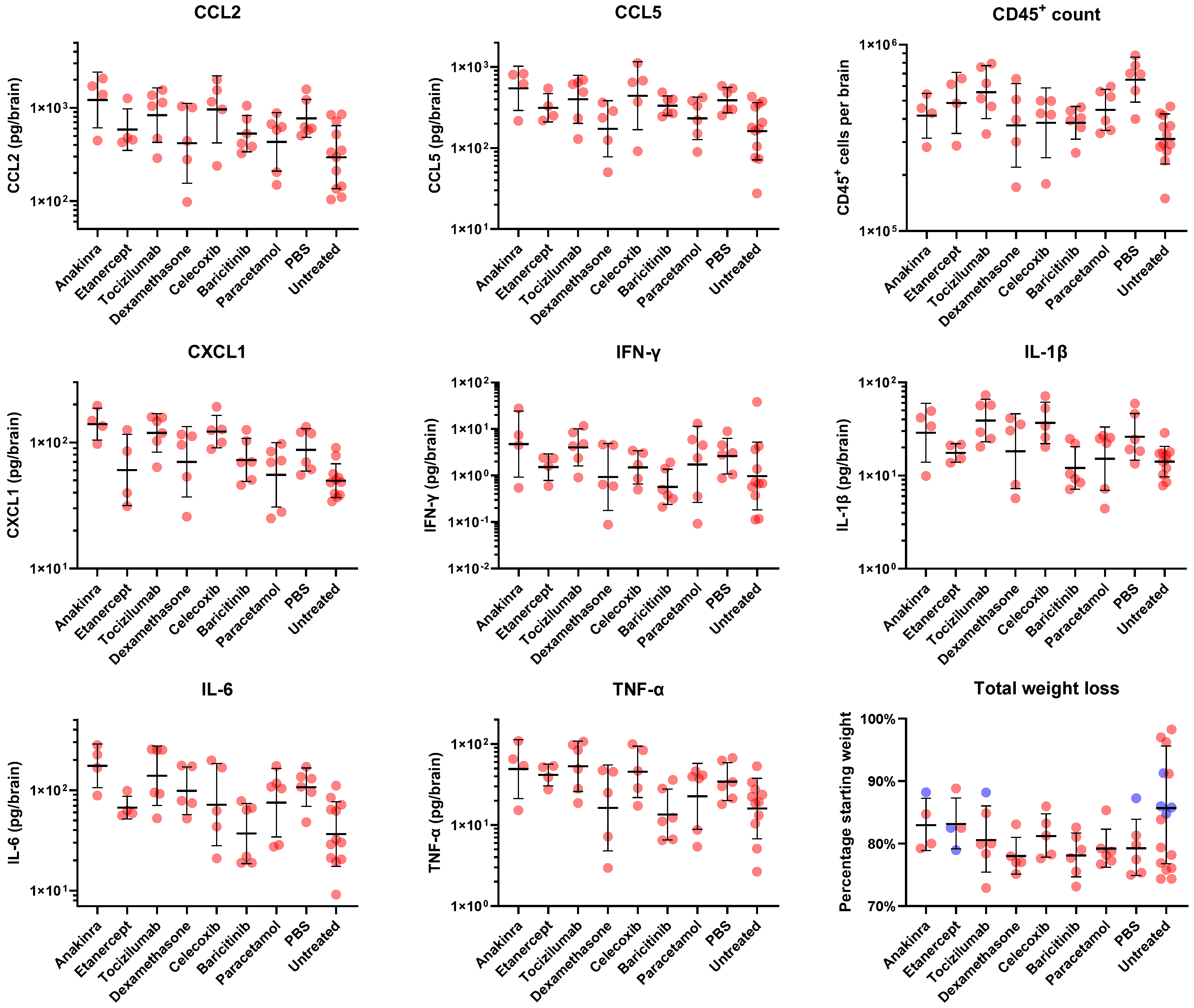
Experiment 1: Groups of mice were challenged with 117   P F U / m o u s e of VEEV TrD strain by the SC route and treated with the described small molecule or biologic drugs, commencing 24 h post challenge for a total of 5 days. The a priori determined primary hypothesis was that the immunological biomarkers of neuropathology identified in previous research [35] could be reduced using these therapeutic regimens. These markers were TNF-α, CCL-2, CCL-5, and the brain CD45+ cell count. Mice culled at 5 days post challenge (end of study) enabled a comparison of the inflammatory profile with and without therapy at a time when neuropathology has been previously identified to be severe. Some mice reached lethal endpoint prior to day 5 post challenge (exhibiting neurological clinical signs). These included one (of six) mouse treated with anakinra, two (of six) treated with etanercept, one (of six) treated with tocilizumab, one (of six) treated with PBS, and four (of twelve) untreated mice. Analysis of the body weights revealed there was no statistical difference between these mice and those culled 5 days post challenge (Figure 1, final panel). Some mice exhibited no clinical signs or weight loss and had no/little virus in their brains (two treated with anakinra, two treated with etanercept, one treated with dexamethasone, and one treated with celecoxib). These were attributed to failed challenges associated with the adoption of new subcutaneous injection techniques and these data were not included.
The generated data was statistically modelled using a multivariate general model, indicating a high likelihood of treatment effects ( p = 0.005 ). However, the least inflammation was observed in the untreated group, indicating that, if anything, one or more regimens had actually increased inflammation or that the high-frequency dosing regimen (handling of mice) was exerting an effect (Figure 1). The model revealed no evidence that treatment had different effects between the four identified biomarkers (TNF-α, CCL-2, CCL-5, and CD45+ cells) of neuropathology ( p = 0.317 using interaction term of the analysis). Further (familywise) comparisons indicated that tocilizumab may have increased inflammation compared to the untreated control ( p = 0.027 , adjusted using Bonferroni’s method). These data suggest that standard regimens of anti-inflammatory drugs are unable to usefully reduce pathology-correlated inflammation induced by VEEV infection in mice.
Systemic VEEV disease during the first 3 days in mice is largely inconsequential to the outward presentation of disease in BALB/c mice [35]. While this makes the mouse model an excellent choice for studying the highly consequential ~ 5 % of human VEEV cases that develop encephalitis, it is perhaps not an ideal choice for studying the majority of human cases. VEEV was developed as an incapacitation agent for biological warfare due to the debilitating effects of systemic disease after inhalational challenge. These effects were recently demonstrated in an NHP model of biodefence-relevant disease [52]. Given that these more standard regimens did not have a substantial bearing on encephalitic disease, it might be suggested that they could be used to ameliorate the effects of systemic disease without altering the pathogenesis of encephalitis. These results are consistent with the findings of Hodzic et al., who reported that moderate use of corticosteroids was generally safe but did not improve clinical outcomes [31].

3.2. Biomarkers of Neuropathology Are Reduced with an Increased Dose of Dexamethasone

While it is known that VEEV infection negatively effects the blood–brain barrier integrity in mice, the possibility exists that even the compromised barrier may also prevent the efficacy of the anti-inflammatory drugs selected for assessment. It is also conceivable that the inflammatory signal is so strong that the initial dosing regimens of the selected drugs are insufficient to counter this. This is perhaps reflected in the way anti-inflammatory drugs are used in other human brain infections, such as meningitis, where large doses of corticosteroids (such as dexamethasone) are administered (reviewed in [53]).
As one of the most broadly acting and broadly studied drugs, dexamethasone was selected to assess the hypothesis that much greater doses of anti-inflammatory drugs could reduce biomarkers of neuropathology in a lethal mouse model of infection. There are many published examples of dexamethasone use in mice, including with doses up to 50   m g / k g . This is fifty times the mouse equivalent dose used to treat severe COVID-19 [41].
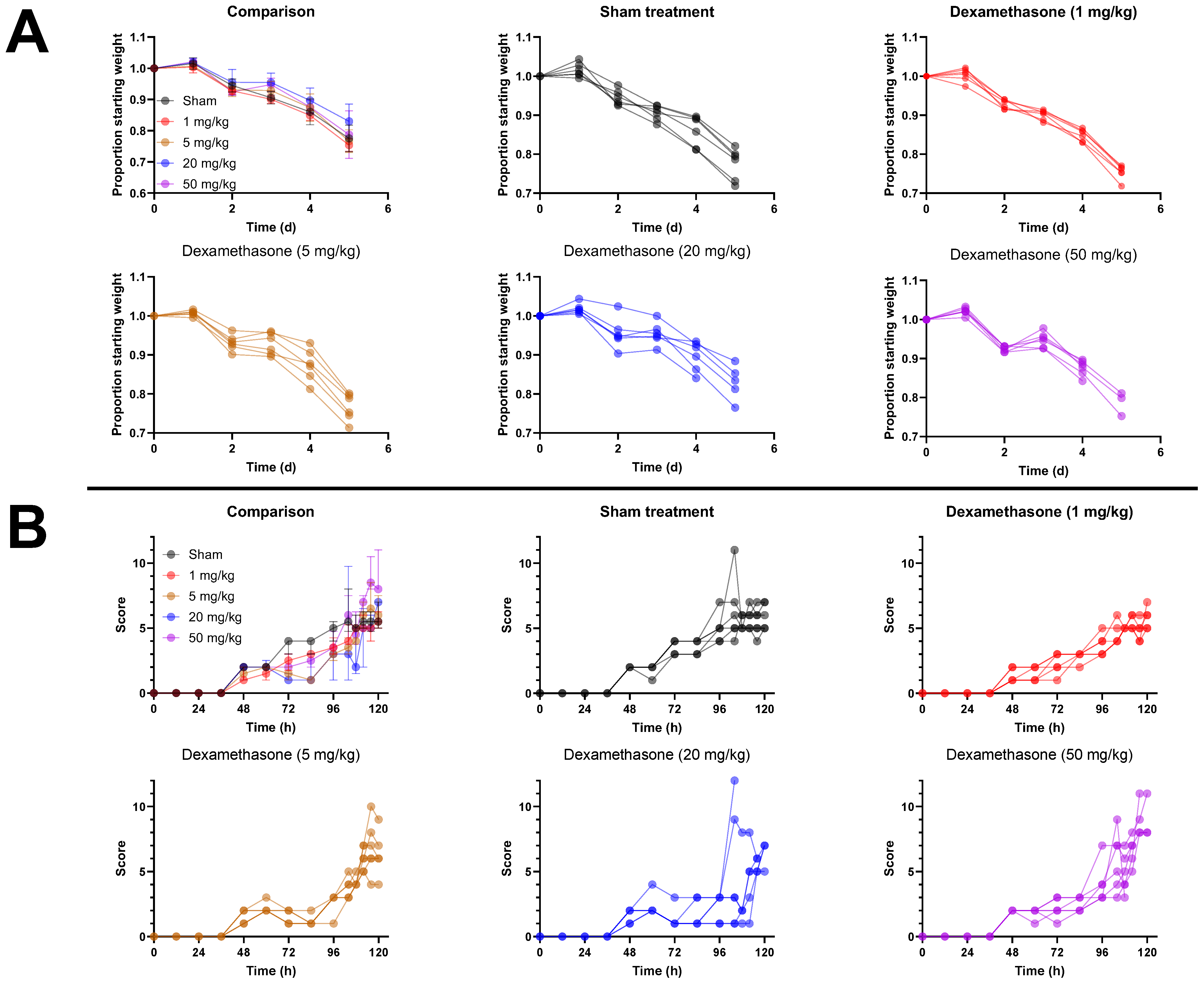
Experiment 2: Groups of six mice were infected with 150   P F U / m o u s e of VEEV TrD strain by the SC route and treated with sham or 1 50   m g / k g dexamethasone, commencing 24 h post infection (daily). Mice were culled five days post challenge for immunological analysis. Weight loss and clinical signs were monitored throughout (Figure 2). A number of mice were culled prior to the end of the experiment due to severe clinical signs and weight loss. These included two mice (of six) treated with 20   m g / k g dexamethasone (one at 108   h and one at 120   h post challenge) and four mice (of six) treated with 50   m g / k g dexamethasone (one at 104   h , two at 116   h , and one at 120   h post challenge). Due to the proximal time of cull to the desired time, these mice were included in the analysis. We found no evidence for any difference in inflammatory markers when comparing mice culled at 120   h and those culled earlier. This was investigated by performing statistical modelling where cull time was included a random covariate. These models indicate that cull time was not related to the primary metrics (below) ( p > 0.05 ).
The (a priori determined) primary hypothesis was that increased doses of dexamethasone would beneficially impact the defined biomarkers of neuropathology (TNF-α, CCL-2, CCL-5, and CD45+ cells in the brain [35]). Using multivariate linear modelling techniques, compelling significant evidence for a treatment-related difference was observed ( p   <   0.001 ). Moreover, the model indicated a high likelihood that increasing the dose of dexamethasone had different effects on the four immune markers ( p = 0.002 , using interaction term for analysis). Further (post hoc) analysis within this model showed that (across the four biomarkers, using Bonferroni’s method and compared to sham-treated mice) there was very strong evidence for an inflammation-reducing effect of the highest ( 50   m g / k g ) dose ( p   <   0.001 ) and marginal evidence for the next highest dose ( 20   m g / k g ) ( p = 0.056 ).
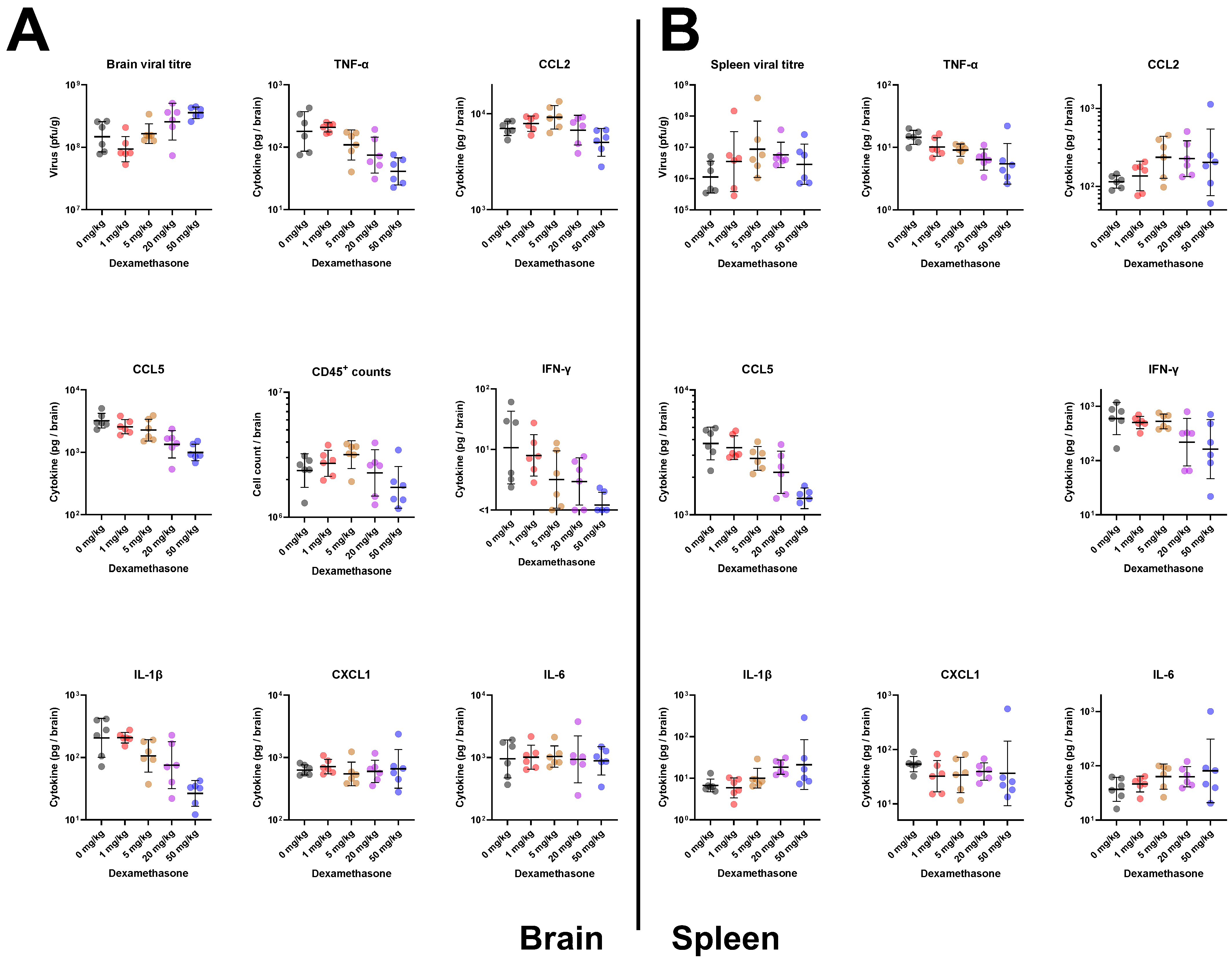
As the primary hypothesis had been met, a more comprehensive (ad hoc) analysis was performed across all measures. In both the spleen and the brain, viral loads were determined, and cytokine concentrations were measured for eight analytes (Figure 3). Multivariate linear models were generated using this data to determine which parameters might have been affected with dexamethasone treatment. The most compelling evidence for significant differences were observed in the brain (IL-1β, TNF-α, CCL-5; p   <   0.001 for each) and spleen (CCL5 ;   p   <   0.001 ). Additionally, strong evidence for a dexamethasone effect was also determined for IFN-γ ( p = 0.005 ) and CCL-2 ( p = 0.013 ) in the brain and TNF-α ( p = 0.006 ), IL-6 ( p = 0.018 ), and CCL5 ( p = 0.028 ) in the spleen. No evidence was observed in the brain for CXCL1, IL-6, splenic CCL2, or IFN-γ ( p > 0.15 ). And no evidence was observed in viral titres in the spleen ( p = 0.476 ); however, viral titres were higher in the brain of animals treated with the highest dose of dexamethasone ( p = 0.003 ).
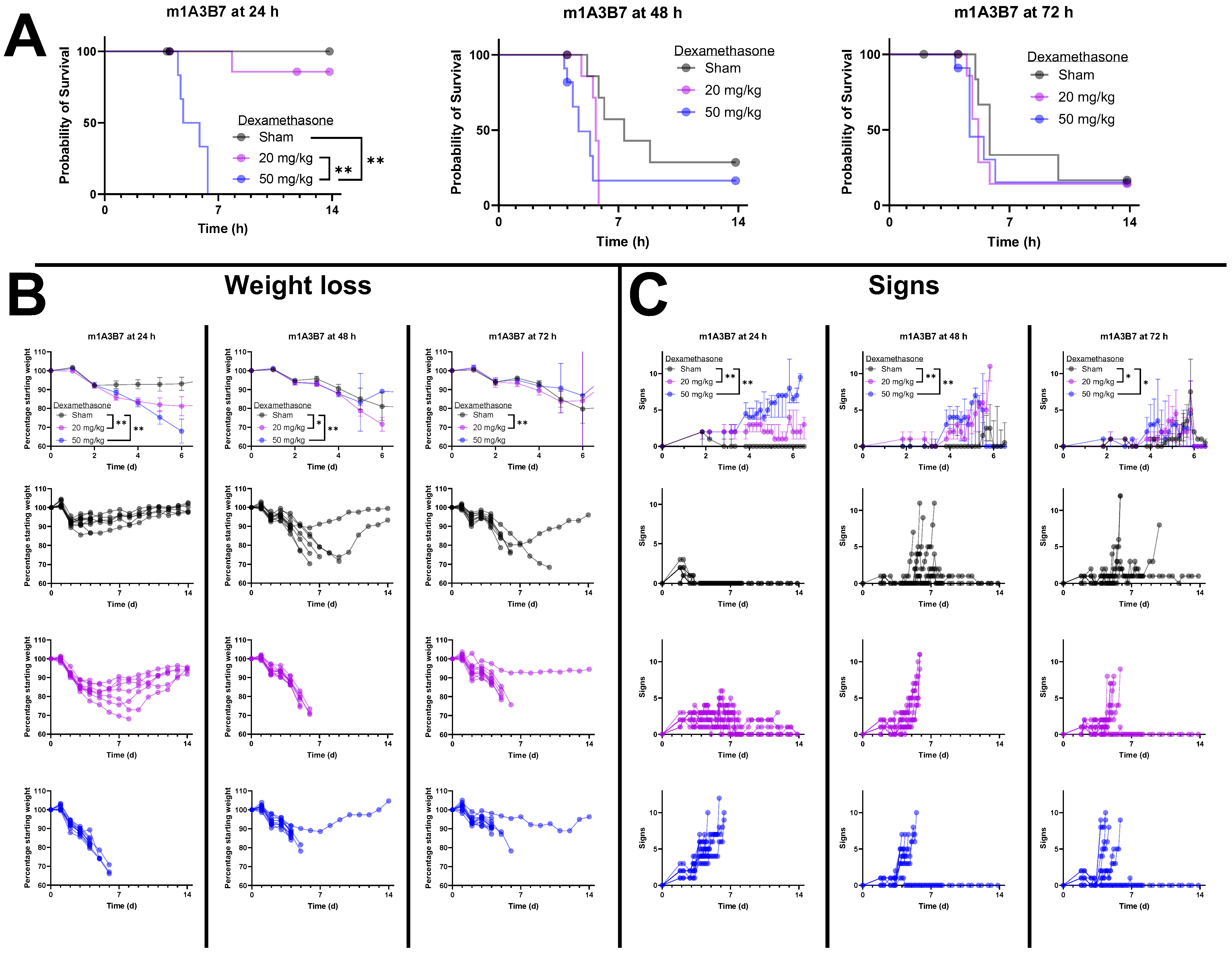
Mice were monitored for weight loss and subjective clinical signs (Figure 2). Notable differences were observed between treatment groups. Both weight loss and clinical signs seemed to be initially reduced in mice treated with the high doses of dexamethasone. These clinical signs are subjective measures of disease assigned by skilled technicians who were blinded to the groups. For the clinical signs, this situation was reversed in mice treated with 50   m g / k g at the last time points. Repeated measures general linear models were used to explore the differences in weight change between treatment groups. These models indicated a high probability for a difference in weight change ( p = 0.022 ) between groups. However, this study lacked the statistical power to make meaningful individual comparisons.
The reduced clinical signs and weight loss generated by a high dose regimen of dexamethasone early on during infection are a confirmation that the outward signs of disease are a reflection of the inflammation raised against the virus. That higher viral titres and greater clinical signs were observed in mice treated with the highest regimen of dexamethasone late in disease demonstrates that these highest doses of dexamethasone are disruptive to the host mechanisms of viral control.

3.3. Efficacy of Combination Regimens of Dexamethasone and a Virus-Directed Antiviral; Small Molecule Therapy

The data herein suggests that while high doses of dexamethasone can mediate the effects of disease, the overall ability of the host to fight the virus was also affected by the highest dose ( 50   m g / k g ). In this way dexamethasone can be detrimental to the outcome of disease. This presents an opportunity to target both the effects of VEEV disease (inflammation) and the infection itself in a synergistic (layered) approach. This was accomplished by assessing combination regimens of dexamethasone and a virus-directed antiviral drug (molnupiravir).
Molnupiravir presents a valuable opportunity as a future antiviral treatment for VEEV disease [54,55]. This compound negatively impacts viral growth by reducing the fidelity of RNA replication [56]. It is unclear how much the success of the therapy lies in the reduction in viable virions and how much might lie in the increased abundance of defective progeny that might elicit immune activity. In a mouse model of infection, the standard regimen of molnupiravir ( 400   m g / k g delivered through oral gavage) is fully protective when administered 12   h post challenge and 90% protective when administered 24   h post challenge. This protection begins to diminish if treatment is further delayed (40% protective efficacy when treatment commences 48   h post challenge). However, this 48   h regimen did reduce viral titres in the region of a hundred-fold in the brain [54]. It is plausible that (due to the early non-specific symptoms and limitations in diagnosis) this more accurately reflects real-world human disease and the specific use of antivirals is unlikely in the early stages of disease. The use of anti-inflammatory drugs may be used in the early stages of human disease to treat the non-specific symptoms, and it is this intervention that may provide a synergistic layered approach with molnupiravir to treat VEEV.
Due to logistical reasons, we were unable to deliver molnupiravir by oral gavage as used previously. The bioavailability of a similar dose in mice is known to be 36% with a rapid T m a x of 30   m i n [57]. With this knowledge we considered that an IP dose of 180   m g / k g would be equivalent.
Experiment 3: Using a suboptimal dosing regimen of molnupiravir ( 180   m g / k g delivered via the IP route, commencing 48   h post challenge) in combination with doses of dexamethasone previously observed to have a significant effect on inflammation ( 20 and 50   m g / k g ), groups of mice were challenged with 160   P F U /mouse of VEEV TrD subcutaneously ( n = 11 ). The primary metric for analysis (as determined from previous experiments) was weight change, as well as additional analyses to compare clinical signs, biomarkers of inflammation, and viral load.
By design, cohorts of mice ( n = 4 ) were culled at 96   h post challenge to verify that inflammation had been altered by dexamethasone treatment. These animals were culled earlier than in the previous experiment to avoid animals needing to be culled prior to this time point for humane reasons. The remaining mice ( n = 7 ) were monitored until 14 days had passed or they had reached the lethal endpoint (either 30 % weight loss or severe clinical signs). A full factorial design (where each condition is represented within another condition) was used where half of the groups of mice received the suboptimal regimen of molnupiravir ( 180   m g / k g twice daily by the IP route for 5 days starting at 48   h post challenge) and the other half were sham-treated. Within these two conditions (molnupiravir treated or sham-treated), a third of mice (single n = 11 groups) received the highest dose of dexamethasone ( 50   m g / k g daily by the IP route for 5 days starting at 24   h post infection), another third received the next highest dose ( 20   m g / k g ), and the final third were sham-treated.
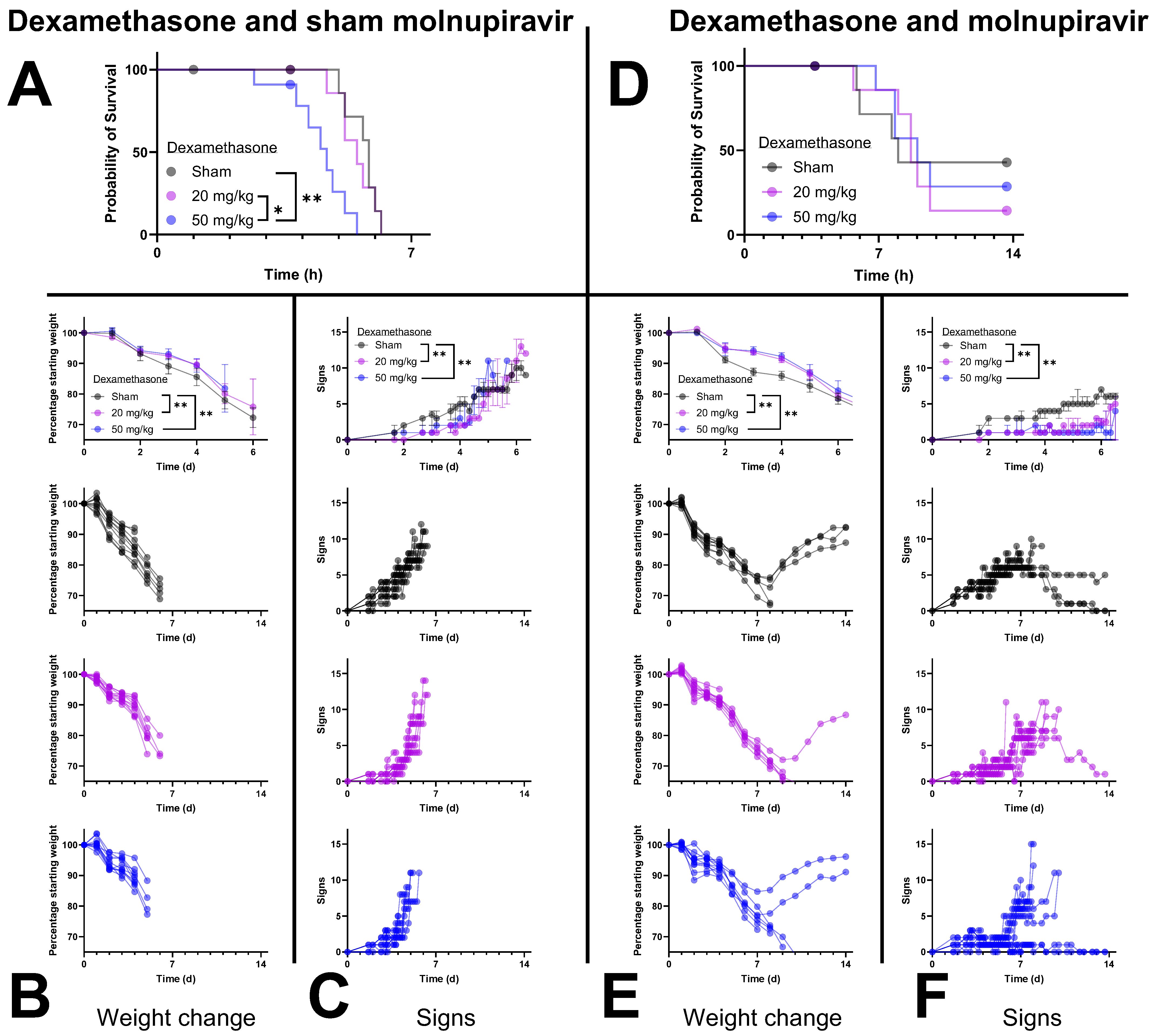
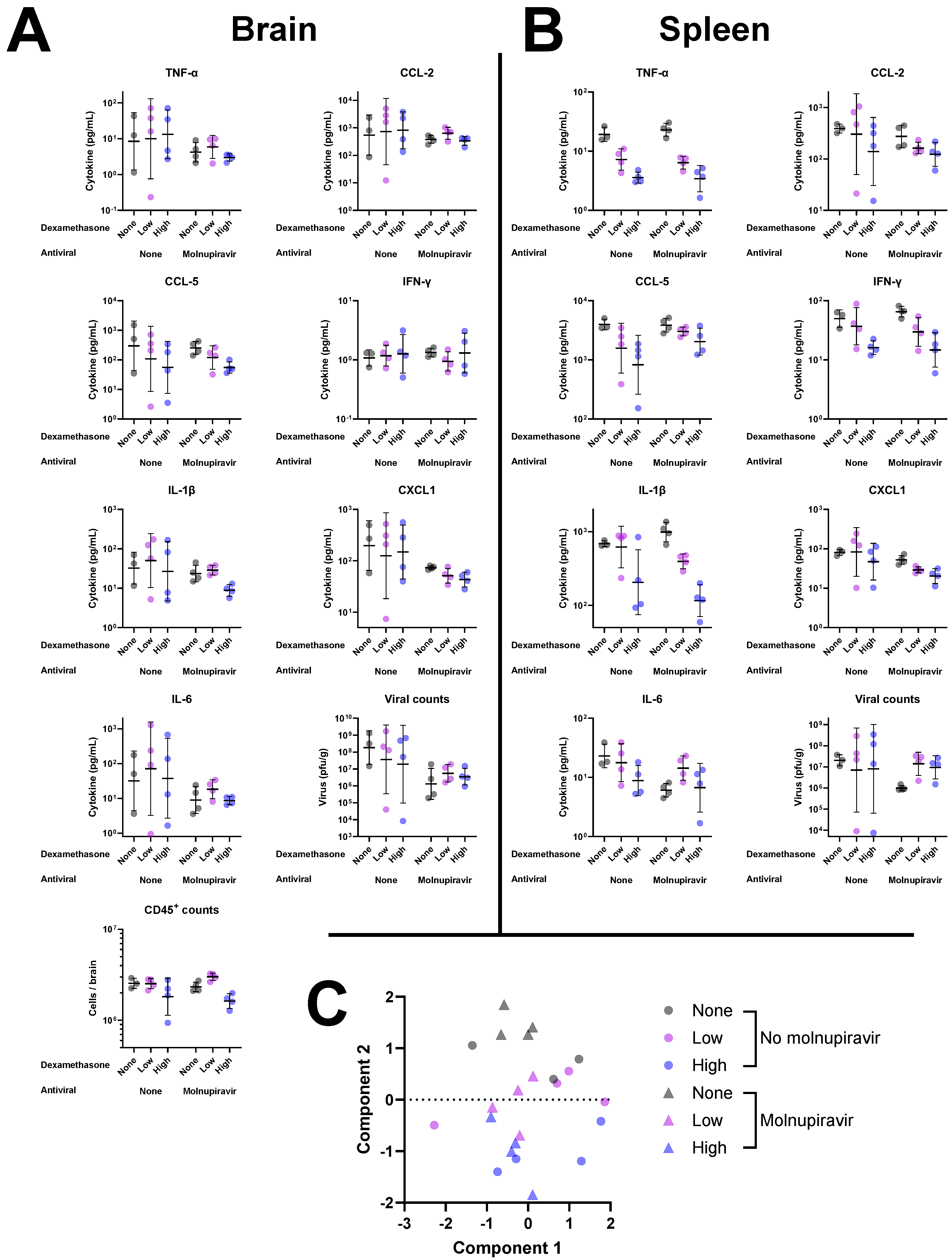
Animals that were treated with dexamethasone alone responded in the same way as previously observed, where the highest dosing regimen of dexamethasone was detrimental to the overall outcome although both dexamethasone regimens reduced early outward signs of disease (Figure 4, left). Animals that were treated with molnupiravir alone responded in the same approximate way as previously reported for this regimen in mice], with 60% protective efficacy (Figure 4, right). One mouse (from the 0   m g / k g dexamethasone and sham molnupiravir group) was removed from the experiment due to dosing-related injuries.
The a priori determined hypothesis concerning differences in weight loss was examined using mixed linear modelling. This method was used because of the sparsity of data once animals were culled. Mouse ID was used as an unstructured random variance component. Time (day), dexamethasone ( 0 , 20 , or 50   m g / k g ), and molnupiravir (binary) and all interactions that were included in the modelling. The initial model included all data, and the model indicated that the three-way interaction (time x dexamethasone x molnupiravir) was statistically probable ( p   <   0.001 ). The interpretation was that there were measurable differences in weight change that were associated with dexamethasone and these differences were likely to be affected by the presence of molnupiravir. Four sub-analyses were prioritised where each dexamethasone treatment group ( 20 or 50   m g / k g ) was compared with the relevant dexamethasone sham treatment group. In each comparison the weight change (interaction between time and dexamethasone) was found to be affected by dexamethasone ( p   <   0.004 , with Bonferroni’s adjustment for familywise error). This suggested that dexamethasone contributed to reduced weight loss with and without molnupiravir and that this effect was greater when in combination with molnupiravir treatment.
A series of post hoc analyses were performed to explore the additional data generated. Firstly, the time-to-cull data presented an opportunity for Kaplan–Meier (survival) analysis. To explore the role of dexamethasone in survival, the data was divided into mice that had received molnupiravir and mice that did not. Log rank tests for differences between groups were performed and no evidence was found for a dexamethasone-associated survival difference when treated with molnupiravir ( p > 0.999 , with Bonferroni’s adjustment for familywise error); however, strong evidence for dexamethasone effects when not treated with molnupiravir were evident ( p   <   0.002 , with Bonferroni’s adjustment for familywise error). Pairwise comparisons (further adjusted for familywise error) of the individual survival curves in the mice that were not treated with molnupiravir showed that dexamethasone at 50   m g / k g accelerated the time to lethal endpoint compared to the sham control ( p = 0.006 ) and also when treated with 20   m g / k g ( p = 0.027 ). Clinical scores were compared using negative binomial (log link) mixed generalised models using the same modelling strategy as the weight loss modelling. This modelling approach also suggested an interaction between molnupiravir and dexamethasone ( p   <   0.022 ). Individual comparisons were performed for clinical sign profiles comparing each dexamethasone-treated group with each sham dexamethasone group. These comparisons showed a universal benefit associated with both dexamethasone regimens ( p   <   0.004 for each, with Bonferroni’s adjustment for familywise error).
Animals culled at the pre-determined time point of 96   h were subjected to immunological and viral load analysis (Figure 5). Differences between inflammation were evident; however, the smaller group size of animals culled at an earlier time (when compared to the previous experiments) limited their suitability for meaningful hypothesis testing. The indications were that similar inflammatory markers were affected by the dexamethasone treatment as were found in the previous experiment (emphasis on TNF-α, CCL2, CCL5, IL-1β, and IFN-γ); however, in this experiment, the spleen was more affected than previously. The reason behind this is likely related to the time of sampling. In this experiment, the cytokine concentrations were measured 1 day earlier than the previous experiment, selected to ensure that no animals would have succumbed to disease at the time of sampling. At this time point, 4 days post infection, the disease was less well-established in the brain, with minimal inflammation here compared to the spleen as the systemic phase of disease continued. This is a recognised weakness of this design; however, the purpose of culling some animals earlier was only to confirm that the drugs were actively altering inflammation. Principal component analysis was used to identify which mice were more related than others in terms of their inflammation. This analysis showed that 73.27 % of the total variance, within the seventeen-parameter dataset, could be explained with two components. Examination of the component scores attributed to each mouse showed that component 2 provided the greatest grouping information (Figure 4C). Mice with low values for component 2 were more likely to have been treated with higher levels of dexamethasone. The role of component 1 is less clear; however, there does seem to be some separation between molnupiravir treatment states. This indicates that these regimens of dexamethasone have a measurable effect on VEEV-induced inflammation in mice. This further suggests that the observed weight loss due to dexamethasone treatment was driven by these anti-inflammatory effects.
Mouse data presented here is a clear demonstration that either a 20 or 50   m g / k g dosing regimen of dexamethasone administered alongside molnupiravir alleviates the outward signs of disease without compromising survival.

3.4. Large Doses of Dexamethasone Remove the Protective Effect of Virus-Specific Targeting of Monoclonal Antibody Therapy

Monoclonal antibodies (mAbs) can be highly effective antiviral therapies and the VEEV-specific mAb, 1A3B7, has demonstrable efficacy in the model used here, both against lethal subcutaneous and inhalational challenge [19,21]. Efficacy is dose-dependent as well as time-dependent. No protection is provided using 100   μ g delivered 72   h post challenge. Only partial protection is observed when treated 48   h post challenge, and full protection is observed when delivered within 24   h post challenge. This provides a useful spectrum of outcomes, affording the opportunity to assess whether adjunct anti-inflammatory dexamethasone therapy could enhance the protective effect of 1A3B7.
It is believed that antibodies protect the host by binding to essential surface components of the virus and preventing viral entry [23]. In the current studies, 100   μ g of antibody was delivered by the intraperitoneal route.
Experiment 4: Ahead of the in vivo study, m1A3B7 was assessed for neutralising activity in a standard plaque reduction neutralisation test and found to retain neutralisation activity in vitro. The same intra-group experimental design used in the molnupiravir experiment was used here. In brief, the total group size was n = 11 , where n = 4 were culled 4 days post challenge for immune/viral count analysis and the remainder ( n = 7 ) were culled either when the humane endpoint had been met or 14 days post challenge. A factorial design was used where a third of animals received mAbs at 24 h, a third at 48   h , and a third at 72   h   p o s t c h a l l e n g e . Within each of these conditions, a third of the groups of mice received the highest dose of dexamethasone ( 50   m g / k g daily by the IP route for 5 days starting at 24   h post infection), another third received the next highest dose ( 20   m g / k g ), and the final third received sham/vehicle treatment. Mice received 194   P F U of VEEV TrD by the SC route. One mouse was found not to have received a challenge (determined by lack of clinical signs and weight loss) and was excluded from analysis, and a further mouse was removed late in the study due to an unrelated medical issue.
Mice treated with m1A3B7 and dexamethasone exhibited persistent significant clinical signs, severe weight loss, and a reduction in protection, compared to mice treated with m1A3B7 alone (Figure 6).
Mice treated with m1A3B7 only at 24   h post challenge exhibited transient, minor clinical signs, with minimal weight loss, providing 100 % protection from disease. The same treatment regimen in combination with 20 or 50   m g / k g dexamethasone resulted in persistent significant clinical signs, severe weight loss, and only 86 % ( 20   m g / k g ) or no protection ( 50   m g / k g ), respectively, from disease.
Mice treated with m1A3B7 only at 48   h post challenge exhibited a range in severity of clinical signs and weight loss, providing 29 % protection from disease. The same treatment regimen in combination with 20 or 50   m g / k g dexamethasone resulted in persistent significant clinical signs, severe weight loss, and no protection or 14 % protection, respectively, from disease.
Mice treated with m1A3B7 only at 72   h post challenge exhibited a range in severity of clinical signs and weight loss, providing 29 % protection from disease. The same treatment regimen in combination with 20 or 50   m g / k g dexamethasone resulted in persistent significant clinical signs, severe weight loss, and 14 % and 14 %   protection, respectively, from disease.
The primary (a priori) determined hypothesis was that weight loss would be reduced when mice were treated with dexamethasone and m1A3B7. Due to the sparsity of data, later in the experiment, mixed general linear models were used to test this hypothesis. These were applied in the same way as the molnupiravir data above, where individual mice were held in the analysis as unstructured variance components. The model indicated a high likelihood that both dexamethasone and m1A3B7 influenced weight change ( p   <   0.001 , using time x dexamethasone x antibody interaction term). The effect of each dexamethasone regimen, compared to the dexamethasone sham, was evaluated for each stratum of mAb treatment in pairwise analyses. Where mAb was delivered at 24   h post challenge, in combination with either dexamethasone group, weight loss was more severe ( p   <   0.009 for both comparisons, using the interaction time x treatment and applying a Bonferroni’s correction). When mAb was delivered at 48   h post challenge, in combination with either dexamethasone group, a difference in weight loss severity was observed ( p = 0.027 for 20   m g / k g and p   <   0.009 for 50   m g / k g dexamethasone, using the interaction time x treatment and applying a Bonferroni’s correction). When mAb was delivered at 72   h post challenge in combination with 20   m g / k g dexamethasone, mice suffered altered weight loss ( p   <   0.009 using the interaction time x treatment and applying a Bonferroni’s correction) whereas the 50   m g / k g group did not ( p = 0.378 ).
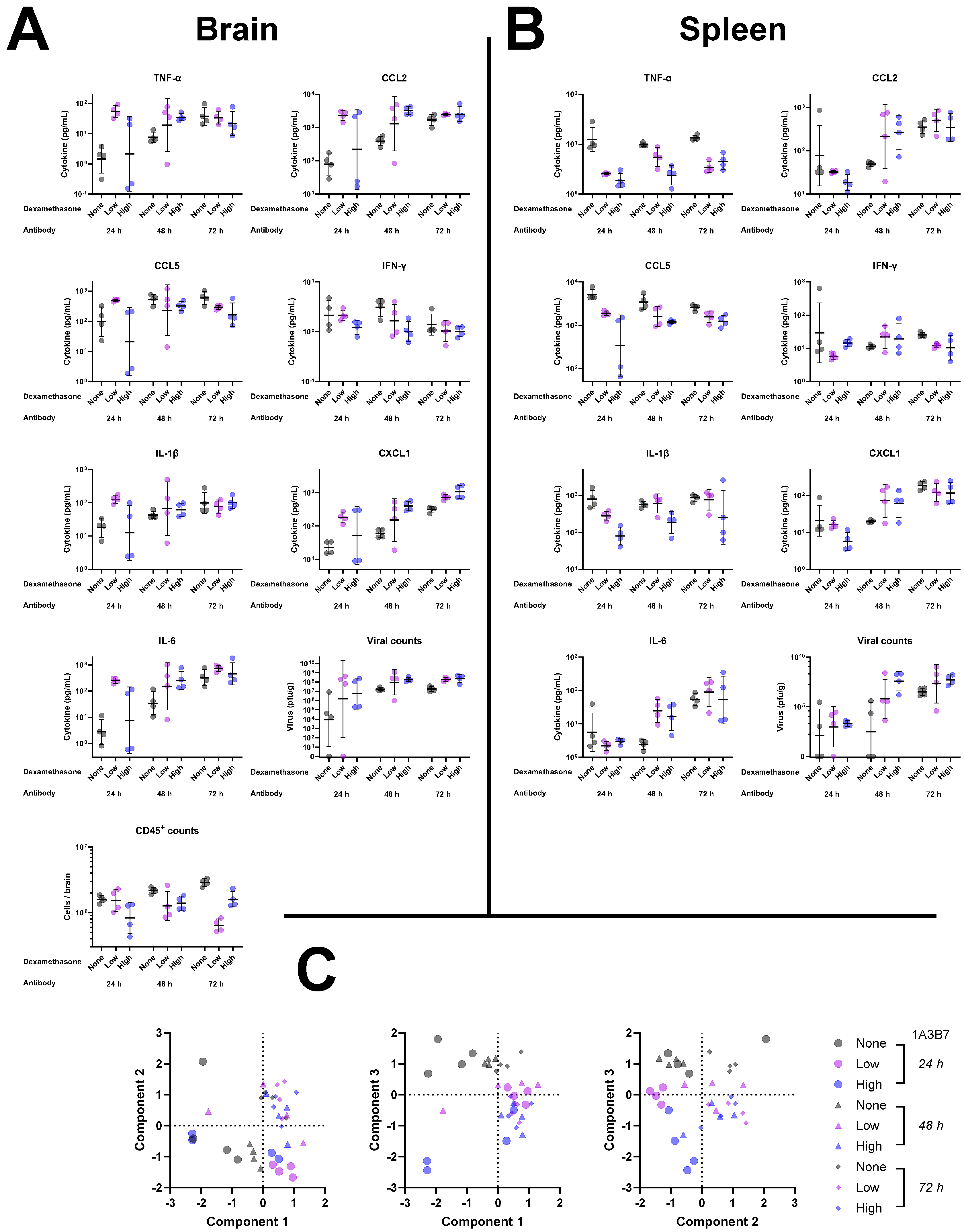
Further (post hoc) analyses were performed to further interpret the data. First Kaplan–Meier analysis was used to compare survival time, indicating survival differences when mAb was delivered at 24   h in combination with dexamethasone between the two doses used ( p   <   0.003 ). Within the groups where antibody was delivered at 24   h post challenge, all groups were found to be different from each other ( p   <   0.009 ). A Bonferroni’s correction was added to each of these statistical tests. We found no evidence for dexamethasone altering survival time when the mAb treatment was delivered at 48   h ( p = 0.168 ) or at 72   h ( p > 0.999 ). Secondly, negative binomial (log link) mixed models were used to analyse clinical sign data. This model was unable to run with the three-parameter interaction (probably due to data scarcity later in the experiment). A model with all two-parameter interactions indicated a high probability of interactions between time post challenge and dexamethasone, time post challenge and mAb, and dexamethasone and mAb ( p   <   0.001 ). Similarly to the weight loss data, individual modelling comparisons were performed to estimate the probability of each combination dexamethasone-treated group to the relevant dexamethasone sham control. These analyses suggested both combination dexamethasone regimens were detrimental to health for each mAb stratum ( p   <   0.006 in all cases except for where mAb was delivered at 72   h post infection in combination with 50   m g / k g   dexamethasone, where p = 0.03 ). The small group size, and multiple treatment conditions, precluded further meaningful hypothesis testing of the measures or inflammation in the predetermined cull groups. Instead, principal component analysis was used to verify if mice were more dissimilar across all inflammatory measurements due to treatments (Figure 7). A total of three components were needed to explain 79.3 % of the total variation within the dataset. Examination of the second principal component showed that this was largely explained by the time of mAb treatment (post challenge). Examination of the first and third principal components showed that this was largely explained by the regimen of dexamethasone. This collectively supports the evidence that both interventions had an effect on the pathogenesis of disease. Furthermore, this data aligned with limited immunological data also taken in the molnupiravir experiment.
These data indicate the importance of the innate immune system in providing protection when directed by antibody. The mode of action for antibody protection in VEEV is not fully understood. We show here that antibodies that are known to be neutralising can only protect the host in concert with an uninhibited innate immune response. One interpretation of this is that direct cell-to-cell spread is more important in the progression of VEEV disease than first thought. This is important because these effects are also likely to occur where antibodies are generated by vaccine or previous infection.

4. Conclusions

The impact of immune dampening and a reduction or elimination of inflammation in the brain is unlikely to rescue mice from a lethal challenge of VEEV, given the high titres and the rapid caudal spread of virus in the brain. However, such dampening may provide crucial time needed for the adaptive host response to mature and mount a more targeted, specific response to the virus. Moreover, it may widen the window of opportunity for the administration of antiviral drugs. This work provides some evidence towards whether such an approach might be viable.
While we believe we are the first to examine corticosteroid use in VEEV infection, similar findings have been reported for other viral encephalitides. In Herpes Simplex Virus encephalitis, IL-6 levels in cerebrospinal fluid declined more rapidly in patients treated with corticosteroids [58]. In a mouse model of Usutu virus encephalitis, Slowikowski et al. similarly observed that dexamethasone treatment ( 50   m g / k g ) reduced clinical scores and IL-6, CCL-2, and leukocyte infiltration [59].
Conclusions from this work must be caveated by the fact that we have only performed experiments using the mouse model of infection. The mouse model is well-studied and is believed to reflect human encephalitic disease well; however, species difference can be significant, and it would be better to consider these findings using additional models of infection. Furthermore, VEEV is one of a family of viruses with similar presentations. Further work should be performed to understand how these approaches work against WEEV and EEEV or even other strains of VEEV. It is also unclear whether different results might occur should the virus be delivered by a more biodefence-relevant aerosol route. One further limitation that should be acknowledged is that the work here is limited to immunological markers and outward signs of disease. Future histological work may provide highly informative data on inflammation, cellular infiltration, and tissue damage.
In primates, such as humans, the systemic disease has been shown to be more consequential than in mice [52]. The defined ‘standard’ regimens of anti-inflammatory treatment had no effect on the VEEV-induced inflammatory response in the brain. The consequence of this might be that these regimens of commonly used drugs (to treat inflammation in humans) might be safely used to ameliorate VEEV-induced systemic disease, without detriment to the VEEV-induced inflammatory response in the brain. Further research is needed to understand when the risk of developing encephalitis is altered under these conditions. The mouse model herein is not suitable for this purpose because encephalitis is nearly always a consequence of VEEV infection.
Similarly to adjunct therapy to treat mycobacterial meningitis [60], substantial doses of dexamethasone were needed to alter encephalitis progression in our model. This might be attributed to the immune-privileged nature of the brain, even in this virally compromised state. Initially, the effects of treatment with these specific drugs were universally beneficial, as both weight loss and clinical signs were reduced in groups of mice treated with either 20 or 50   m g / k g   dexamethasone. When treated at 50   m g / k g , a late infection, greater viral load, and accelerated rate of clinical signs was observed (culminating in animals rapidly succumbing to infection). When combined with molnupiravir, these substantial detrimental effects are resolved and only the positive effects of the treatment remain. It is noteworthy that the animals treated with both dexamethasone and molnupiravir survived longer than those only treated with molnupiravir until the antiviral drug regimen ceased and mortality was restored. It seems plausible that extending the use of the molnupiravir beyond the 5 days used in this design may have elicited a survival benefit for the layer/synergistic therapy. Conversely, when combined with a murine monoclonal antibody therapy, wholesale loss of protection was observed. This confirms the importance of innate immune activity in supporting or ensuring antibody (and plausibly vaccine) efficacy.
Caution is advised when considering high doses of dexamethasone without specific antiviral treatment or alongside therapies that rely on the inflammatory effect (e.g., mAb or vaccines). The detrimental effect observed with dexamethasone in combination with mAb treatment is surprising and indicates an essential immune process is required. This contra-indication might be avoided by careful targeting of pro-damage inflammation and avoiding pro-antiviral inflammation. This might be achieved using drugs that are more subtle than dexamethasone. It is anticipated that this effect would be lesser when associated with vaccination, opposed to mAb, due to the presence of antigen-specific effector cells as well as antibodies. This observation (that a well-known neutralising antibody requires an uninhibited immune response to protect) also indicates that cell-to-cell spread is probably more important in VEEV pathogenesis than infection by release virions. Cell-to-cell spread would protect the virions from the neutralising effects of the mAb; however, the mAb would still bind to infected cells to protect them from cytotoxic effects or engulfment.
In summary, in a lethal mouse model of VEEV infection, high doses of dexamethasone have a beneficial effect when used in combination with molnupiravir. This provides an orthogonal layered defence approach for a high-consequence viral BW agent. An opportunity may exist to repurpose already-licenced drugs and provide a medical countermeasure where currently none exist.

Supplementary Materials

The following supporting information can be downloaded at: https://www.mdpi.com/article/10.3390/v18010089/s1.

Author Contributions

Conceptualization, T.R.L. and A.L.P.; methodology, A.L.P., T.R.L., L.E., D.J. and P.L.H.; formal analysis, T.R.L.; investigation, A.L.P.; resources, P.L.H.; data curation, T.R.L.; writing—original draft preparation, T.R.L. and A.L.P.; writing—review and editing, all authors; visualisation, T.R.L.; supervision, M.S.L.; project administration, T.R.L.; funding acquisition, T.R.L. and A.L.P. All authors have read and agreed to the published version of the manuscript.

Funding

This research was funded by the Defense Threat Reduction Agency, USA, contract number HDTRA117-CBMB-05-2-0008.

Institutional Review Board Statement

Investigations involving animals were carried out according to the requirements of the UK Animal (Scientific Procedures) Act 1986 under the authority of a Project Licence PP2193827 granted by the UK Home Office, approved on 24 May 2024. This project licence was approved following an ethical review by Dstl’s Animal Welfare and Ethical Review Body.

Informed Consent Statement

Not applicable.

Data Availability Statement

The data file used to generate all analyses and figures are within Supplementary Materials files.

Acknowledgments

We thank Tom Maishman for useful discussion regarding statistical analysis. Additionally, we thank the DSTL high containment animal technical team and other DSTL scientists for providing ad hoc assistance. We also thank project managers Alan Newman and Aimee Andersen for keeping us to time and budget.

Conflicts of Interest

The authors declare no conflicts of interest.

References

  1. Thom, R.E.; D’Elia, R.V. Future applications of host direct therapies for infectious disease treatment. Front. Immunol. 2024, 15, 1436557. [Google Scholar] [CrossRef]
  2. Ye, J.; Chen, J. Interferon and Hepatitis B: Current and Future Perspectives. Front. Immunol. 2021, 12, 733364. [Google Scholar] [CrossRef]
  3. Mesic, A.; Jackson, E.K.; Lalika, M.; Koelle, D.M.; Patel, R.C. Interferon-based agents for current and future viral respiratory infections: A scoping literature review of human studies. PLoS Glob. Public Health 2022, 2, e0000231. [Google Scholar] [CrossRef]
  4. RECOVERY Randomised Evaluation of COVID-19 Therapy. 2022. Available online: https://www.recoverytrial.net/ (accessed on 29 January 2022).
  5. Daza, E.; Frias, V.; Alcola, A.; Lopez, I.; Bruzon, I.; Montero, J.T.; Alvarez, G.; Garcia, M.A.; Rodriguez, R.; Boschell, J.; et al. Venezuelan equine encephalitis—Colombia, 1995. MMWR Morb. Mortal. Wkly. Rep. 1995, 44, 721–724. [Google Scholar]
  6. Hanson, R.P.; Sulkin, S.E.; Beuscher, E.L.; Hammon, W.M.; McKinney, R.W.; Work, T.H. Arbovirus infections of laboratory workers. Extent of problem emphasizes the need for more effective measures to reduce hazards. Science 1967, 158, 1283–1286. [Google Scholar] [CrossRef]
  7. Honnold, S.P.; Mossel, E.C.; Dupuy, L.C.; Morazzani, E.M.; Martin, S.S.; Hart, M.K.; Ludwig, G.V.; Parker, M.D.; Smith, J.F.; Reed, D.S. Alphavirus Encephalitides. In Medical Aspects of Biological Warfare; Bozue, J., Cote, C.K., Glass, P.J., Eds.; Borden Institute: San Antonio, TX, USA, 2018; p. 483. [Google Scholar]
  8. Special Immunizations Program. 2022. Available online: https://www.usammda.army.mil/index.cfm/fhp/immunizations_program (accessed on 29 January 2022).
  9. Pittman, P.R.; Brown, E.S.; Chambers, M.S. Medical Countermeasures. In Medical Aspects of Biological Warfare; Bozue, J., Cote, C.K., Glass, P.J., Eds.; Borden Institute: San Antonio, TX, USA, 2018; pp. 773–776. [Google Scholar]
  10. Stromberg, Z.R.; Fischer, W.; Bradfute, S.B.; Kubicek-Sutherland, J.Z.; Hraber, P. Vaccine Advances against Venezuelan, Eastern, and Western Equine Encephalitis Viruses. Vaccines 2020, 8, 273. [Google Scholar] [CrossRef] [PubMed]
  11. Burke, C.W.; Erwin-Cohen, R.A.; Goodson, A.I.; Wilhelmsen, C.; Edmundson, J.A.; White, C.E.; Glass, P.J. Efficacy of Western, Eastern, and Venezuelan Equine Encephalitis (WEVEE) Virus-Replicon Particle (VRP) Vaccine against WEEV in a Non-Human Primate Animal Model. Viruses 2022, 14, 1502. [Google Scholar] [CrossRef]
  12. Tretyakova, I.; Plante, K.S.; Rossi, S.L.; Lawrence, W.S.; Peel, J.E.; Gudjohnsen, S.; Wang, E.; Mirchandani, D.; Tibbens, A.; Lamichhane, T.N.; et al. Venezuelan equine encephalitis vaccine with rearranged genome resists reversion and protects non-human primates from viremia after aerosol challenge. Vaccine 2020, 38, 3378–3386. [Google Scholar] [CrossRef]
  13. Reed, D.S.; Glass, P.J.; Bakken, R.R.; Barth, J.F.; Lind, C.M.; da Silva, L.; Hart, M.K.; Rayner, J.; Alterson, K.; Custer, M.; et al. Combined alphavirus replicon particle vaccine induces durable and cross-protective immune responses against equine encephalitis viruses. J. Virol. 2014, 88, 12077–12086. [Google Scholar] [CrossRef]
  14. Coates, E.E.; Edupuganti, S.; Chen, G.L.; Happe, M.; Strom, L.; Widge, A.; Florez, M.B.; Cox, J.H.; Gordon, I.; Plummer, S.; et al. Safety and immunogenicity of a trivalent virus-like particle vaccine against western, eastern, and Venezuelan equine encephalitis viruses: A phase 1, open-label, dose-escalation, randomised clinical trial. Lancet Infect. Dis. 2022, 22, 1210–1220. [Google Scholar] [CrossRef] [PubMed]
  15. Hannaman, D.; Dupuy, L.C.; Ellefsen, B.; Schmaljohn, C.S. A Phase 1 clinical trial of a DNA vaccine for Venezuelan equine encephalitis delivered by intramuscular or intradermal electroporation. Vaccine 2016, 34, 3607–3612. [Google Scholar] [CrossRef]
  16. Phillpotts, R.J.; Jones, L.D.; Howard, S.C. Monoclonal antibody protects mice against infection and disease when given either before or up to 24 h after airborne challenge with virulent Venezuelan equine encephalitis virus. Vaccine 2002, 20, 1497–1504. [Google Scholar] [CrossRef] [PubMed]
  17. Phillpotts, R.J.; Jones, L.D.; Lukaszewski, R.A.; Lawrie, C.; Brooks, T.J. Antibody and interleukin-12 treatment in murine models of encephalitogenic flavivirus (St. Louis encephalitis, tick-borne encephalitis) and alphavirus (Venezuelan equine encephalitis) infection. J. Interferon Cytokine Res. 2003, 23, 47–50. [Google Scholar] [CrossRef]
  18. Hunt, A.R.; Frederickson, S.; Hinkel, C.; Bowdish, K.S.; Roehrig, J.T. A humanized murine monoclonal antibody protects mice either before or after challenge with virulent Venezuelan equine encephalomyelitis virus. J. Gen. Virol. 2006, 87, 2467–2476. [Google Scholar] [CrossRef]
  19. Phillpotts, R.J. Venezuelan equine encephalitis virus complex-specific monoclonal antibody provides broad protection, in murine models, against airborne challenge with viruses from serogroups I, II and III. Virus Res. 2006, 120, 107–112. [Google Scholar] [CrossRef]
  20. O’Brien, L.M.; Underwood-Fowler, C.D.; Goodchild, S.A.; Phelps, A.L.; Phillpotts, R.J. Development of a novel monoclonal antibody with reactivity to a wide range of Venezuelan equine encephalitis virus strains. Virol. J. 2009, 6, 206. [Google Scholar] [CrossRef][Green Version]
  21. Hu, W.G.; Phelps, A.L.; Jager, S.; Chau, D.; Hu, C.C.; O’Brien, L.M.; Perkins, S.D.; Gates, A.J.; Phillpotts, R.J.; Nagata, L.P. A recombinant humanized monoclonal antibody completely protects mice against lethal challenge with Venezuelan equine encephalitis virus. Vaccine 2010, 28, 5558–5564. [Google Scholar] [CrossRef]
  22. Parker, M.D.; Buckley, M.J.; Melanson, V.R.; Glass, P.J.; Norwood, D.; Hart, M.K. Antibody to the E3 glycoprotein protects mice against lethal venezuelan equine encephalitis virus infection. J. Virol. 2010, 84, 12683–12690. [Google Scholar] [CrossRef]
  23. Goodchild, S.A.; O’Brien, L.M.; Steven, J.; Muller, M.R.; Lanning, O.J.; Logue, C.H.; D’Elia, R.V.; Phillpotts, R.J.; Perkins, S.D. A humanised murine monoclonal antibody with broad serogroup specificity protects mice from challenge with Venezuelan equine encephalitis virus. Antivir. Res. 2011, 90, 1–8. [Google Scholar] [CrossRef] [PubMed]
  24. Hunt, A.R.; Bowen, R.A.; Frederickson, S.; Maruyama, T.; Roehrig, J.T.; Blair, C.D. Treatment of mice with human monoclonal antibody 24h after lethal aerosol challenge with virulent Venezuelan equine encephalitis virus prevents disease but not infection. Virology 2011, 414, 146–152. [Google Scholar] [CrossRef] [PubMed]
  25. O’Brien, L.M.; Goodchild, S.A.; Phillpotts, R.J.; Perkins, S.D. A humanised murine monoclonal antibody protects mice from Venezuelan equine encephalitis virus, Everglades virus and Mucambo virus when administered up to 48 h after airborne challenge. Virology 2012, 426, 100–105. [Google Scholar] [CrossRef] [PubMed]
  26. Burke, C.W.; Froude, J.W.; Rossi, F.; White, C.E.; Moyer, C.L.; Ennis, J.; Pitt, M.L.; Streatfield, S.; Jones, R.M.; Musiychuk, K.; et al. Therapeutic monoclonal antibody treatment protects nonhuman primates from severe Venezuelan equine encephalitis virus disease after aerosol exposure. PLoS Pathog. 2019, 15, e1008157. [Google Scholar] [CrossRef]
  27. Kafai, N.M.; Williamson, L.E.; Binshtein, E.; Sukupolvi-Petty, S.; Gardner, C.L.; Liu, J.; Mackin, S.; Kim, A.S.; Kose, N.; Carnahan, R.H.; et al. Neutralizing antibodies protect mice against Venezuelan equine encephalitis virus aerosol challenge. J. Exp. Med. 2022, 219, e20212532. [Google Scholar] [CrossRef] [PubMed]
  28. Kumar, R. Understanding and managing acute encephalitis. F1000Research 2020, 9, F1000. [Google Scholar] [CrossRef]
  29. Tyler, K.L. Acute Viral Encephalitis. N. Engl. J. Med. 2018, 379, 557–566. [Google Scholar] [CrossRef] [PubMed]
  30. Ai, J.; Xie, Z.; Liu, G.; Chen, Z.; Yang, Y.; Li, Y.; Chen, J.; Zheng, G.; Shen, K. Etiology and prognosis of acute viral encephalitis and meningitis in Chinese children: A multicentre prospective study. BMC Infect. Dis. 2017, 17, 494. [Google Scholar] [CrossRef]
  31. Hodzic, E.; Hasbun, R.; Granillo, A.; Tröscher, A.R.; Wagner, H.; von Oertzen, T.J.; Wagner, J.N. Steroids for the treatment of viral encephalitis: A systematic literature review and meta-analysis. J. Neurol. 2023, 270, 3603–3615. [Google Scholar] [CrossRef]
  32. BS 5726:1992; Microbiological Safety Cabinets—Specification, Performance, Testing, Selection, Installation, and Maintenance. British Standards Institution: London, UK, 1992.
  33. BS EN 12469:2000; Biotechnology—Performance Criteria for Microbiological Safety Cabinets. British Standards Institution: London, UK, 2000.
  34. Laws, T.R.; Maishman, T.C. Considerations in the design of animal infection pilot studies. Front. Cell. Infect. Microbiol. 2022, 12, 948464. [Google Scholar] [CrossRef]
  35. Phelps, A.L.; Salguero, F.J.; Hunter, L.; Stoll, A.L.; Jenner, D.C.; O’Brien, L.M.; Williamson, E.D.; Lever, M.S.; Laws, T.R. Tumour Necrosis Factor-α, Chemokines, and Leukocyte Infiltrate Are Biomarkers for Pathology in the Brains of Venezuelan Equine Encephalitis (VEEV)-Infected Mice. Viruses 2023, 15, 1307. [Google Scholar] [CrossRef]
  36. Foley, P.L.; Kendall, L.V.; Turner, P.V. Clinical Management of Pain in Rodents. Comp. Med. 2019, 69, 468–489. [Google Scholar] [CrossRef]
  37. Vane, J.R.; Bakhle, Y.S.; Botting, R.M. CYCLOOXYGENASES 1 AND 2. Annu. Rev. Pharmacol. Toxicol. 1998, 38, 97–120. [Google Scholar] [CrossRef]
  38. Risner, K.; Ahmed, A.; Bakovic, A.; Kortchak, S.; Bhalla, N.; Narayanan, A. Efficacy of FDA-Approved Anti-Inflammatory Drugs Against Venezuelan Equine Encephalitis Virus Infection. Viruses 2019, 11, 1151. [Google Scholar] [CrossRef]
  39. Asakrah, S.; Nieves, W.; Mahdi, Z.; Agard, M.; Zea, A.H.; Roy, C.J.; Morici, L.A. Post-exposure therapeutic efficacy of COX-2 inhibition against Burkholderia pseudomallei. PLoS Neglected Trop. Dis. 2013, 7, e2212. [Google Scholar] [CrossRef]
  40. RECOVERY Collaborative Group. Dexamethasone in Hospitalized Patients with COVID-19. N. Engl. J. Med. 2020, 384, 693–704. [Google Scholar] [CrossRef]
  41. Hosseinzadeh, M.H.; Shamshirian, A.; Ebrahimzadeh, M.A. Dexamethasone vs COVID-19: An experimental study in line with the preliminary findings of a large trial. Int. J. Clin. Pract. 2021, 75, e13943. [Google Scholar] [CrossRef] [PubMed]
  42. Hu, X.; Li, J.; Fu, M.; Zhao, X.; Wang, W. The JAK/STAT signaling pathway: From bench to clinic. Signal Transduct. Target. Ther. 2021, 6, 402. [Google Scholar] [CrossRef]
  43. Consortia, R. Baricitinib in patients admitted to hospital with COVID-19 (RECOVERY): A randomised, controlled, open-label, platform trial and updated meta-analysis. Lancet 2022, 400, 359–368. [Google Scholar] [CrossRef]
  44. Gavegnano, C.; Haile, W.B.; Hurwitz, S.; Tao, S.; Jiang, Y.; Schinazi, R.F.; Tyor, W.R. Baricitinib reverses HIV-associated neurocognitive disorders in a SCID mouse model and reservoir seeding in vitro. J. Neuroinflamm. 2019, 16, 182. [Google Scholar] [CrossRef] [PubMed]
  45. Consortia, R. Tocilizumab in patients admitted to hospital with COVID-19 (RECOVERY): A randomised, controlled, open-label, platform trial. Lancet 2021, 397, 1637–1645. [Google Scholar] [CrossRef]
  46. Steinskog, E.S.; Sagstad, S.J.; Wagner, M.; Karlsen, T.V.; Yang, N.; Markhus, C.E.; Yndestad, S.; Wiig, H.; Eikesdal, H.P. Impaired lymphatic function accelerates cancer growth. Oncotarget 2016, 7, 45789–45802. [Google Scholar] [CrossRef]
  47. Peppel, K.; Crawford, D.; Beutler, B. A tumor necrosis factor (TNF) receptor-IgG heavy chain chimeric protein as a bivalent antagonist of TNF activity. J. Exp. Med. 1991, 174, 1483–1489. [Google Scholar] [CrossRef]
  48. Fei, Y.; Wang, W.; Kwiecinski, J.; Josefsson, E.; Pullerits, R.; Jonsson, I.M.; Magnusson, M.; Jin, T. The combination of a tumor necrosis factor inhibitor and antibiotic alleviates staphylococcal arthritis and sepsis in mice. J. Infect. Dis. 2011, 204, 348–357. [Google Scholar] [CrossRef]
  49. Ceballos-Olvera, I.; Sahoo, M.; Miller, M.A.; Del Barrio, L.; Re, F. Inflammasome-dependent pyroptosis and IL-18 protect against Burkholderia pseudomallei lung infection while IL-1beta is deleterious. PLoS Pathog. 2011, 7, e1002452. [Google Scholar] [CrossRef]
  50. Bocan, T.M.; Stafford, R.G.; Brown, J.L.; Akuoku Frimpong, J.; Basuli, F.; Hollidge, B.S.; Zhang, X.; Raju, N.; Swenson, R.E.; Smith, D.R. Characterization of Brain Inflammation, Apoptosis, Hypoxia, Blood-Brain Barrier Integrity and Metabolism in Venezuelan Equine Encephalitis Virus (VEEV TC-83) Exposed Mice by In Vivo Positron Emission Tomography Imaging. Viruses 2019, 11, 1052. [Google Scholar] [CrossRef]
  51. Cain, M.D.; Salimi, H.; Gong, Y.; Yang, L.; Hamilton, S.L.; Heffernan, J.R.; Hou, J.; Miller, M.J.; Klein, R.S. Virus entry and replication in the brain precedes blood-brain barrier disruption during intranasal alphavirus infection. J. Neuroimmunol. 2017, 308, 118–130. [Google Scholar] [CrossRef]
  52. Burke, C.W.; Gardner, C.L.; Goodson, A.I.; Piper, A.E.; Erwin-Cohen, R.A.; White, C.E.; Glass, P.J. Defining the Cynomolgus Macaque (Macaca fascicularis) Animal Model for Aerosolized Venezuelan Equine Encephalitis: Importance of Challenge Dose and Viral Subtype. Viruses 2023, 15, 2351. [Google Scholar] [CrossRef]
  53. McGee, S.; Hirschmann, J. Use of Corticosteroids in Treating Infectious Diseases. Arch. Intern. Med. 2008, 168, 1034–1046. [Google Scholar] [CrossRef] [PubMed]
  54. Painter, G.R.; Bowen, R.A.; Bluemling, G.R.; DeBergh, J.; Edpuganti, V.; Gruddanti, P.R.; Guthrie, D.B.; Hager, M.; Kuiper, D.L.; Lockwood, M.A.; et al. The prophylactic and therapeutic activity of a broadly active ribonucleoside analog in a murine model of intranasal venezuelan equine encephalitis virus infection. Antivir. Res. 2019, 171, 104597. [Google Scholar] [CrossRef] [PubMed]
  55. Urakova, N.; Kuznetsova, V.; Crossman, D.K.; Sokratian, A.; Guthrie, D.B.; Kolykhalov, A.A.; Lockwood, M.A.; Natchus, M.G.; Crowley, M.R.; Painter, G.R.; et al. β-d-N(4)-Hydroxycytidine Is a Potent Anti-alphavirus Compound That Induces a High Level of Mutations in the Viral Genome. J. Virol. 2018, 92, 10-1128. [Google Scholar] [CrossRef]
  56. Maas, B.M.; Strizki, J.; Miller, R.R.; Kumar, S.; Brown, M.; Johnson, M.G.; Cheng, M.; De Anda, C.; Rizk, M.L.; Stone, J.A. Molnupiravir: Mechanism of action, clinical, and translational science. Clin. Transl. Sci. 2024, 17, e13732. [Google Scholar] [CrossRef] [PubMed]
  57. Yoon, J.-J.; Toots, M.; Lee, S.; Lee, M.-E.; Ludeke, B.; Luczo, J.M.; Ganti, K.; Cox, R.M.; Sticher, Z.M.; Edpuganti, V.; et al. Orally Efficacious Broad-Spectrum Ribonucleoside Analog Inhibitor of Influenza and Respiratory Syncytial Viruses. Antimicrob. Agents Chemother. 2018, 62, 10-1128. [Google Scholar] [CrossRef] [PubMed]
  58. Kamei, S.; Taira, N.; Ishihara, M.; Sekizawa, T.; Morita, A.; Miki, K.; Shiota, H.; Kanno, A.; Suzuki, Y.; Mizutani, T.; et al. Prognostic value of cerebrospinal fluid cytokine changes in herpes simplex virus encephalitis. Cytokine 2009, 46, 187–193. [Google Scholar] [CrossRef] [PubMed]
  59. Slowikowski, E.; Willems, C.; Lemes, R.M.R.; Schuermans, S.; Berghmans, N.; Rocha, R.P.F.; Martens, E.; Proost, P.; Delang, L.; Marques, R.E.; et al. A central role for CCR2 in monocyte recruitment and blood–brain barrier disruption during Usutu virus encephalitis. J. Neuroinflamm. 2025, 22, 107. [Google Scholar] [CrossRef]
  60. Thwaites, G.E.; Nguyen, D.B.; Nguyen, H.D.; Hoang, T.Q.; Do, T.T.; Nguyen, T.C.; Nguyen, Q.H.; Nguyen, T.T.; Nguyen, N.H.; Nguyen, T.N.; et al. Dexamethasone for the treatment of tuberculous meningitis in adolescents and adults. N. Engl. J. Med. 2004, 351, 1741–1751. [Google Scholar] [CrossRef] [PubMed]
Figure 1. Analysis of biomarkers associated with VEEV-induced neuropathology after treatment with licenced anti-inflammatory drugs. BALB/c mice were infected with a lethal challenge of VEEV TrD ( 150   P F U ) subcutaneously and treated with the indicated drugs commencing 24   h post challenge and up to 5 days post challenge, whereupon all mice were culled. Some mice were culled shortly prior to this predetermined cull point as they had reached the predetermined humane endpoint. These animals are shown in blue on the total weight loss graph to demonstrate that disease had progressed to a similar level as it had in the animals culled at the intended time point. Each data point is from a single mouse brain and the line is indicative of the group geometric mean of the group; the error bars show the geometric standard deviation. Each panel represents a single analyte. Transparency was used to show where data points overlap. The group size was n   =   6 for treatment groups and n   =   12 for the comparator. Data from some mice was excluded as there was evidence to suggest they had not received the intended viral challenge (including 2 treated with anakinra, 2 treated with etanercept, 1 treated with dexamethasone, and 1 treated with celecoxib).
Viruses 18 00089 g001
Figure 2. Weight loss (A) and clinical sign (B) data in an experiment to assess the immune-tempering activity of different doses of dexamethasone in a lethal mouse model of VEEV infection. Anti-inflammatory therapy started 24   h after challenge with 150   P F U of virus by the subcutaneous route. The first graph of each metric is a comparison between treatment groups and each line represents the group mean (±95% confidence interval) for the weight and the median (± the interquartile range). Subsequent graphs take each treatment group, and each line shows the life history of each animal. The colours are consistent between graphs and show the treatment group (black = 0   m g / m L (sham), red = 1   m g / k g , orange = 5   m g / k g , blue = 20   m g / k g , and purple = 50   m g / k g dexamethasone). Transparency was used to show where data points overlap. The group sizes are n   =   6 .
Viruses 18 00089 g002
Figure 3. Analysis of biomarkers associated with VEEV-induced neuropathology and viral load in the brain (A) and spleen (B) after treatment with different doses of dexamethasone. BALB/c mice were infected with a lethal challenge of VEEV TrD ( 150   P F U ) subcutaneously and treated 24 h post challenge and up to 5 days post challenge, whereupon all mice were culled. Each data point is from a single mouse brain and the line is indicative of the group geometric mean of the group. The error bars are the geometric standard deviation. Each panel represents data generated from a single analyte. Transparency was used to show where data points overlap. The group sizes are n   =   6 .
Viruses 18 00089 g003
Figure 4. Survival (A,D), weight loss (B,E), and clinical sign (C,F) data in an experiment to assess the immune-tempering activity of different doses of dexamethasone (AC) in combination with a virus-directed antiviral (DF) in a lethal mouse model of VEEV infection. Anti-inflammatory therapy started 24   h after challenge with 160   P F U of virus by the subcutaneous route. Antiviral therapy started 48   h post challenge (molnupiravir, 180   m g / k g by the intraperitoneal route), continuing daily for 5 days. Survival is shown using a standard Kaplan–Meier plot with symbols where animals are right censored. The first graph for the weights and clinical signs is a comparison between treatment groups and each line represents the group mean (±95% confidence interval) for the weight and the median (±the interquartile range). Subsequent graphs take each treatment group, and each line shows the life history of each animal. The colours are consistent between graphs and show the treatment group (grey = 0   m g / m L (sham), purple = 20   m g / k g , and blue = 50   m g / k g dexamethasone). Transparency was used to show where data points overlap. Significance markers are indicative of appropriate statistical modelling comparisons between dexamethasone treatment concentrations. For survival analysis, log rank tests were used. For weight loss analysis, mixed linear modelling was used. For clinical sign data, mixed negative binomial generalised linear modelling was used. Familywise error has been accounted for and * is indicative of p   <   0.05 and ** is indicative of p   <   0.01 . Each group consisted of n   =   11 mice; however, n   =   4 predetermined mice were culled for further analysis at 96   h post infection.
Viruses 18 00089 g004
Figure 5. Brain and spleen immune markers in an experiment to assess the immune-tempering activity of different doses of dexamethasone (A) in combination with a virus-directed antiviral (B) in a lethal mouse model of VEEV infection. Anti-inflammatory therapy started 24   h after challenge with 160   P F U of virus by the subcutaneous route. Antiviral therapy started 48 h post challenge (molnupiravir, 180   m g / k g by the intraperitoneal route), continuing daily for 5 days. Mice were culled at 96   h   after infection. Each data point is from a single mouse and the line is indicative of the group geometric mean of the group and the error bars are the geometric standard deviation. Each panel represents data generated regarding a single analyte. The colours are consistent between graphs and show the treatment group (grey = 0   m g / m L (sham), purple = 20   m g / k g , and blue = 50   m g / k g dexamethasone). Transparency was used to show where data points overlap. Panel (C) was produced using principal component analysis of the data above and shows the first two components that describe the majority of the variability within the study. Each group comprised n   =   4 mice. One animal from the group of mice receiving no dexamethasone or molnupiravir was removed from the study prior to analysis (see Material and Methods).
Viruses 18 00089 g005
Figure 6. Survival (A), weight loss (B), and clinical sign (C) data in an experiment to assess the immune-tempering activity of different doses of dexamethasone when administered in combination with mAb m1A3B7 in a lethal mouse model of VEEV infection. Anti-inflammatory therapy started 24   h after challenge with 194   P F U of virus by the subcutaneous route. Mice were also treated with mAb m1A3B7 ( 100   μ g by the intraperitoneal route) either 24   h (columns 1 and 4), 48   h (columns 2 and 5), or 72   h (columns 3 and 6) post challenge. Survival probability is shown using a standard Kaplan–Meier plot with symbols where animals are right censored. The first graph for the weights and signs is a comparison between treatment groups and each line represents the group mean (±95% confidence interval) for the weight and the median (±the interquartile range). Subsequent graphs take each treatment group, and each line shows the life history of each animal. The colours are consistent between graphs and show the treatment group (black = sham treated, purple = 20   m g / k g , and blue = 50   m g / k g dexamethasone). Transparency was used to show where data points overlap. Significance markers are indicative of appropriate statistical modelling comparisons between dexamethasone treatment concentrations. For survival analysis, log rank tests were used. For weight loss analysis, mixed linear modelling was used. For clinical signs data, mixed negative binomial generalised linear modelling was used. Familywise error has been accounted for and * is indicative of p   <   0.05 and ** is indicative of p   <   0.01 . Each group consisted of n   =   11 mice; however, n   =   4 predetermined mice were culled for further analysis at 96   h post infection.
Viruses 18 00089 g006
Figure 7. Brain (A) and spleen (B) immune markers in an experiment to assess the immune-tempering activity of different doses of dexamethasone in combination with a VEEV-specific mAb in a lethal mouse model of VEEV infection. Anti-inflammatory therapy started 24   h after challenge with 194   P F U of virus by the subcutaneous route. MAb therapy was administered either 24   h , 48   h , or 72   h post challenge (m1A3B7 , 5   m g / k g by the intraperitoneal route). Mice were culled at 96   h   post challenge. Each data point is from a single mouse and the line is indicative of the group geometric mean of the group and the error bars show the geometric standard deviation. Each panel represents data from a single analyte. The colours are consistent between graphs and show the treatment group (grey = m A b   o n l y , purple = 20   m g / k g , and blue = 50   m g / k g dexamethasone). Transparency was used to show where data points overlap. Panel (C) show the principal component analysis of the data above and shows the first three components that describe the majority of the variability within the study. Each group comprised n   =   4 mice.
Viruses 18 00089 g007
Disclaimer/Publisher’s Note: The statements, opinions and data contained in all publications are solely those of the individual author(s) and contributor(s) and not of MDPI and/or the editor(s). MDPI and/or the editor(s) disclaim responsibility for any injury to people or property resulting from any ideas, methods, instructions or products referred to in the content.