Current Insights into Superinfection Exclusion in Insect-Specific Orthoflaviviruses

 , ,
, ,  , and
, and
Abstract
1. Introduction
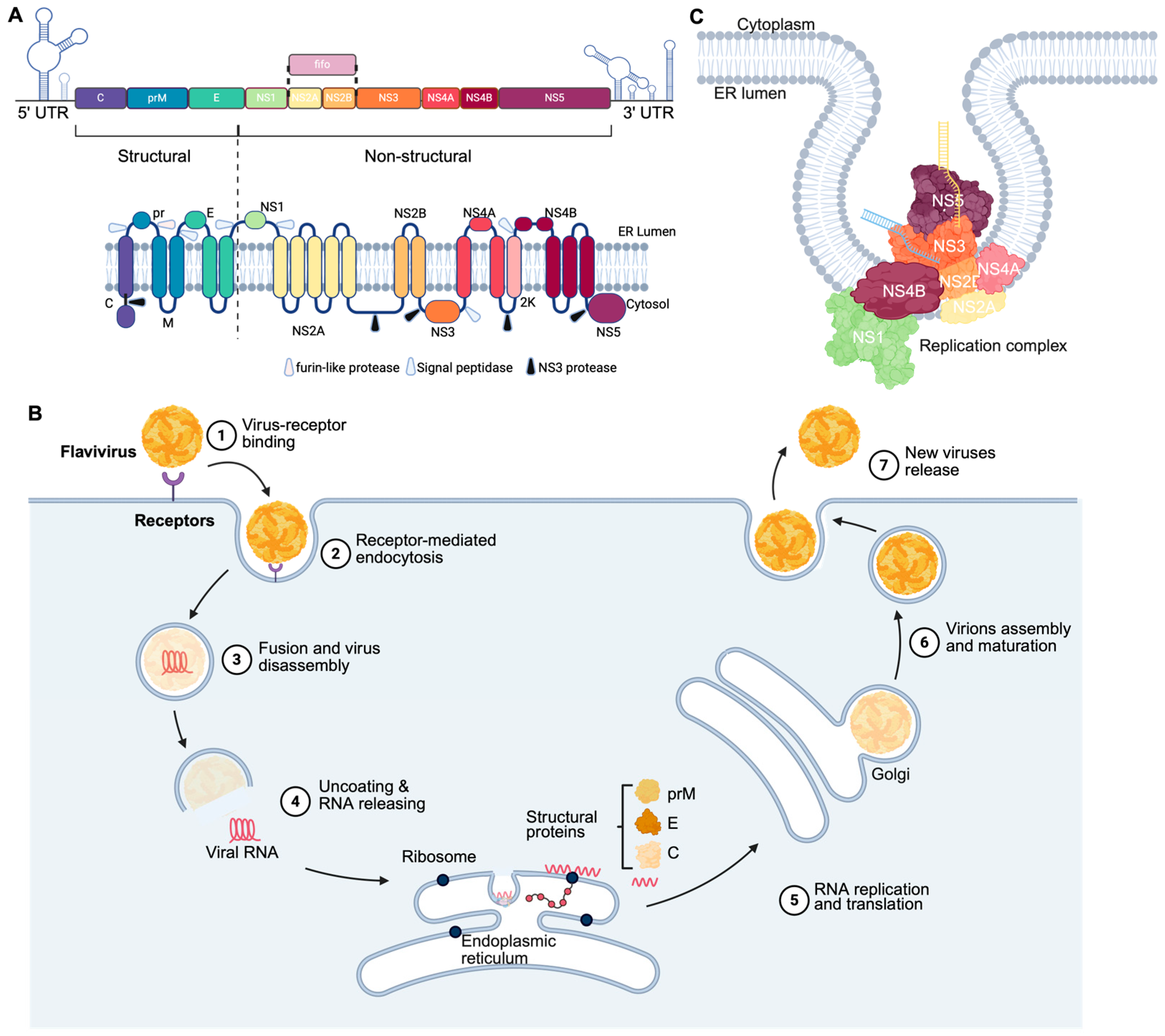
2. Molecular Organisation and Replication of Orthoflaviviruses
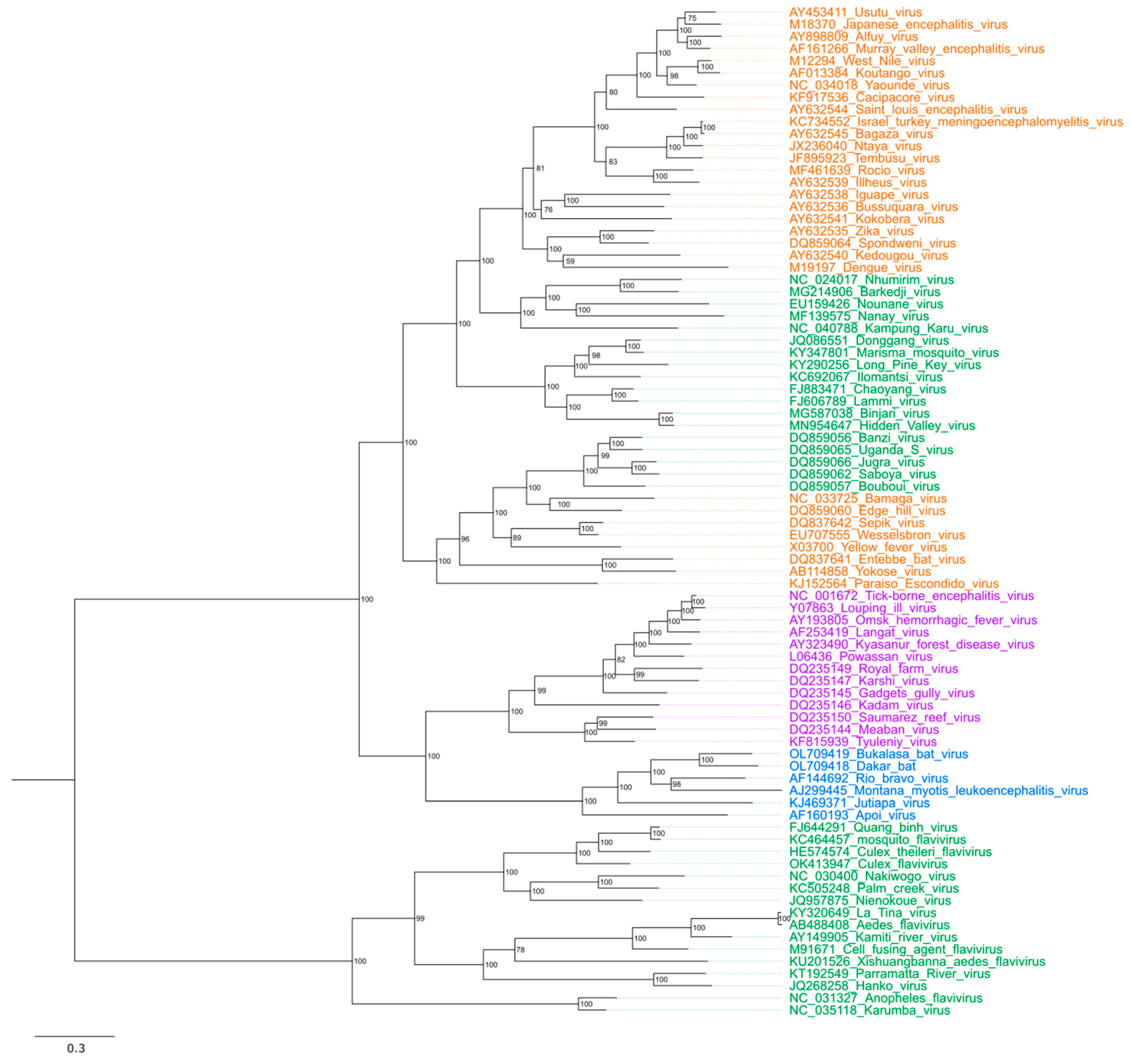
3. Diversity of the Insect-Specific Orthoflaviviruses
3.1. Lineage I or Classical Insect-Specific Flaviviruses
3.2. Lineage II or Dual-Host-Associated Insect-Specific Flaviviruses
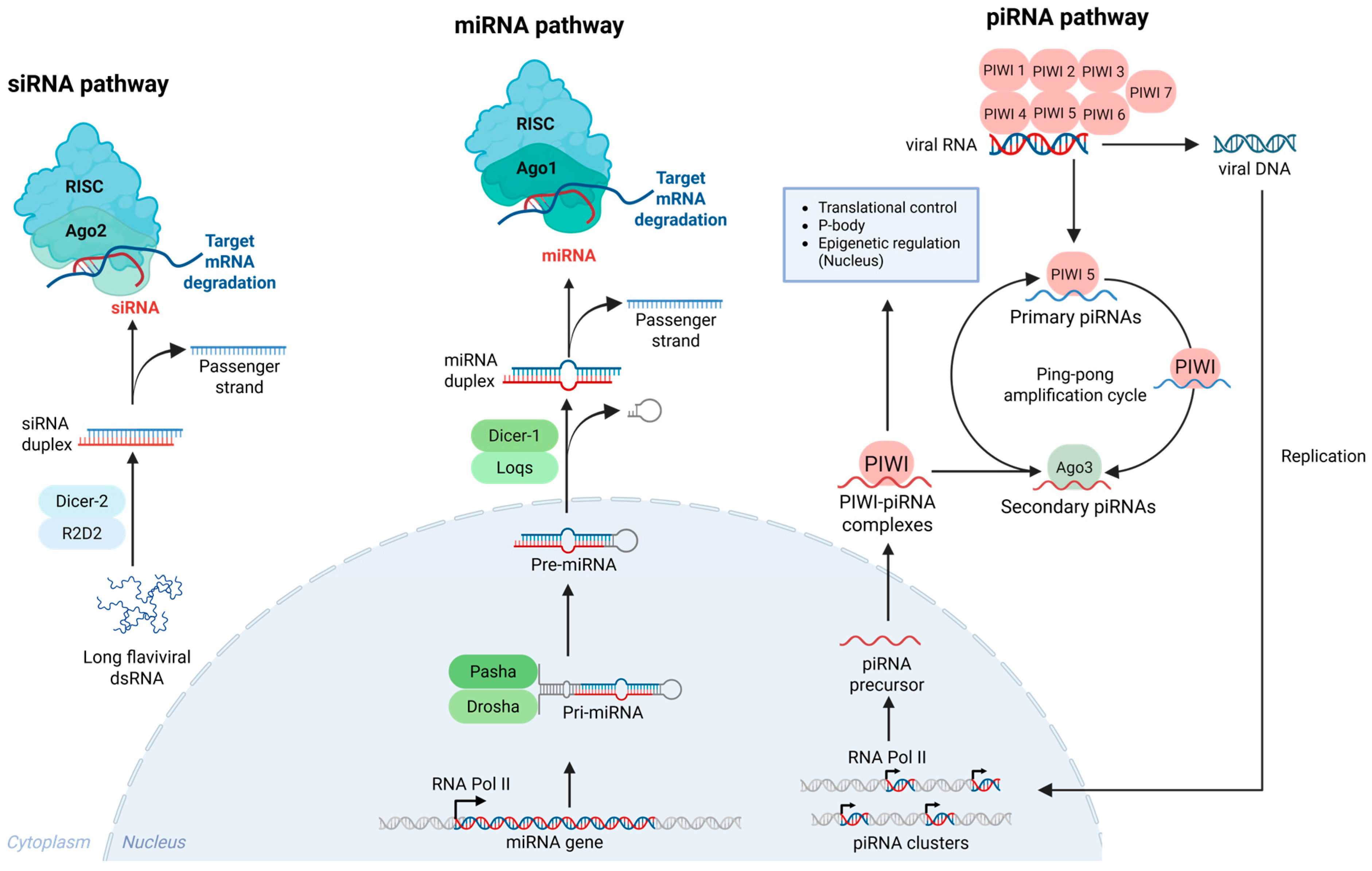
4. Mosquito Antiviral Strategies
4.1. RNA-Interference Pathway
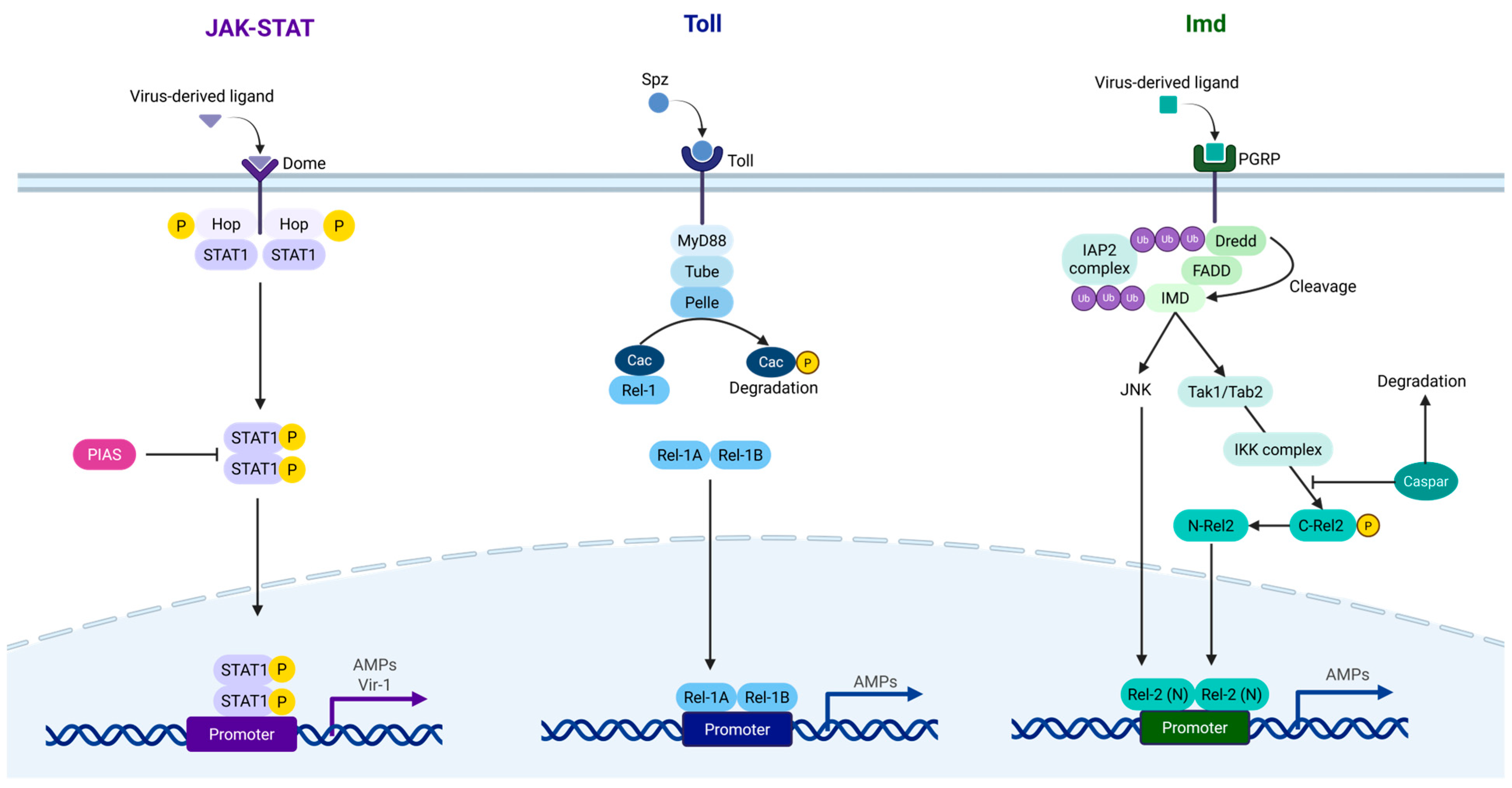
4.2. JAK-STAT Pathway
4.3. Toll Pathway
4.4. IMD Pathway
5. Superinfection Exclusion Capacity of ISFs

| Primary ISF (Country) Dose | Secondary MBF (Country) Dose | Model | Key Findings | Reference |
|---|---|---|---|---|
| AEFV (China) 6 × 10⁶ genome copies/µL | ZIKVMR766 (East Africa) Blood fed 1 × 10⁵ FFU/mL | Ae. albopictus * (In vivo) | ZIKV RNA significantly lower at 7 dpi with no significant difference at 3, 7, and 12 dpi. | [105] |
| DENV-2NGC (New Guinea) Blood fed 1 × 10⁸ FFU/mL | DENV-2 RNA significantly lower at 7 dpi with no significant difference at 3 and 12 dpi. | |||
| BinJVBFTA20 (Australia) MOI = 1 | WNV578/10 (Hungary) MOI = 1 | C6/36 (In vitro) | WNV titre significantly lower at 1–4 dpi. | [174] |
| BinJVBFTA20 (Australia) persistently infected | WNV titre significantly lower at 3–4 dpi. | |||
| BinJVBFTA20 (Australia) MOI = 1 | ZIKVNL00013 (Suriname) MOI = 1 | ZIKV titre significantly lower at 2–4 dpi. | ||
| BinJVBFTA20 (Australia) persistently infected | ||||
| BinJVBFTA20 (Australia) MOI = 1 | WNV578/10 (Hungary) MOI = 1 | Aag2 (In vitro) | WNV titre significantly lower at 3 dpi but similar at 4 dpi. | |
| BinJVBFTA20 (Australia) persistently infected | WNV titre significantly lower at 2–3 dpi but similar at 4 dpi. | |||
| BinJVBFTA20 (Australia) MOI = 1 | ZIKVNL00013 (Suriname) MOI = 1 | ZIKV titre significantly lower at 2–4 dpi. | ||
| BinJVBFTA20 (Australia) persistently infected | ||||
| BinJVBFTA20 (Australia) MOI = 1 | Aag2 Ago2 deficient (In vitro) | |||
| BinJVBFTA20 (Australia) MOI = 1 | ZIKV MOI = 1 * | C6/36 (In vitro) | ZIKV titre significantly lower at 1–5 dpi. | [175] |
| CFAV * # | DENV-2 MOI = 1 * | Aa20 (In vitro) | DENV-2 titre significantly higher at 3 dpi. | [176] |
| DENV-2 RNA significantly higher at 3 dpi. | ||||
| CFAV (Thailand) MOI = 0.23 | DENV-1 (Thailand) MOI = 0.1 | C6/36 (In vitro) | Increased reduction in DENV-1 titre as CFAV and DENV-1 time interval increased. | [84] |
| CFAV (Thailand) MOI = 0.11 | ZIKV (French Polynesia) MOI = 0.1 | ZIKV titre significantly lower at 4–7 dpi. | ||
| CFAV (Thailand) 1.14 × 10⁷ TCID50/mL | DENV-1 (Thailand) Blood fed 5 × 10⁶ FFU/mL | Ae. aegypti, Thailand (In vivo) | DENV-1 dissemination rate marginally significantly lower at 2–13 dpi. DENV-1 titre significantly lower at 13 dpi. | |
| ZIKV (French Polynesia) Blood fed 7.5 × 10⁶ FFU/mL | ZIKV dissemination rate no detectable difference at 13 dpi. ZIKV titre significantly lower at 13 dpi. | |||
| CFAV 5.39 × 10⁶ TCID50/mL * | DENV-1 (Thailand) Blood fed 5 × 10⁶ FFU/mL | DENV-1 dissemination rate no detectable difference at 13 dpi. DENV-1 titre significantly lower at 13 dpi. | ||
| CxFV (USA) 0.1 RNA copy/well | WNV (USA) 0.1 PFU/well | C6/36 (In vitro) | WNV titre significantly lower at 60, 108–156 hpi but equivalent at 168 hpi. | [101] |
| WNV (USA) 0.01 PFU/well | WNV titre significantly lower at 84–156 hpi but equivalent at 168 hpi. | |||
| CxFV (USA) naturally infected | WNV (USA) Blood fed 1 × 10⁷ PFU/mL | Cx. pipiens, USA (In vivo) | WNV transmission and infection rate no detectable difference at 7 and 14 dpi. WNV dissemination rate significantly lower at 7 dpi no detectable difference at 14 dpi. | |
| WNV RNA no detectable in bodies and saliva at 7 and 14 dpi. WNV RNA significantly lower in legs, heads and wings at 7 dpi and no detectable difference at 14 dpi. | ||||
| CxFVNIID21-2 (Japan) persistently infected | JEVMie/41/2002 (Japan) 0.1 PFU/cell | NIID-CTR (In vitro) | JEV titre significantly higher at 6 dpi. | [177] |
| DENV-2NIID02-20 (Thailand) 0.1 PFU/cell | DENV-2 titre significantly higher at 5–7 dpi. | |||
| CxFVIzabalGU-06-2692 (Guatemala) MOI = 0.1 | WNVGU-06-2256 (Guatemala) MOI = 0.1 | C6/36 (In vitro) | WNV titre no significant difference at 1–14 dpi. | [178] |
| CxFVIzabalGU-06-2692 (Guatemala) 1 × 103.3 PFU | WNVGU-06-2256 (Guatemala) Blood fed 1 × 106.3 PFU/mL | Cx. quinquefasciatus, USA (In vivo) | WNV titre significantly higher at 4 dpi with no significant difference at 1, 2, 8, and 10 dpi. | |
| CxFVIzabalGU-06-2692 (Guatemala) 1 × 102.8 to 1 × 103.3 PFU | WNVGU-06-2256 (Guatemala) Blood fed 1 × 108.9 PFU/mL | Cx. quinquefasciatus, USA and Honduras (In vivo) | WNV titre no significant difference at 14 dpi. WNV transmission, infection, and dissemination rate, no significant difference at 14 dpi. | |
| WNVGU-06-2256 (Guatemala) Blood fed 1 × 107.4 to 1 × 107.5 PFU/mL 1 × 105.4 to 1 × 105.6 PFU/mL for USA and Honduras mosquito respectively | ||||
| LAMV2009/FI/Original (Finland) 1.75 × 10⁵ RNA copies/well | WNV-1 (Africa) MOI = 0.1 | U4.4 (In vitro) | WNV titre significantly lower at 24–96 hpi. | [179] |
| NHUV (Brazil) MOI = 5 | WNVNY99 (USA) MOI = 0.1 | C6/36 (In vitro) | WNV, JEV, and SLEV titre significantly lower at 2–7 dpi. | [180] |
| JEV MOI = 0.1 * | ||||
| SLEV MOI = 0.1 * | ||||
| NHUV (Brazil) MOI = 1 | WNVNY99 (USA) MOI = 0.1 | C6/36 (In vitro) | WNV titre significantly lower at 1–7 dpi. | [119] |
| C7-10 (In vitro) | ||||
| NHUV MOI = 5 * | ZIKV MOI = 0.1 * | C6/36 (In vitro) | ZIKV titre significantly lower at 2–7 dpi. | [181] |
| ZIKV RNA significantly lower at 48–72 hpi. | ||||
| DENV-2 MOI = 0.1 * | DENV-2 titre significantly lower at 2–7 dpi. | |||
| NHUV 1 × 10⁴ PFU * | ZIKV Blood fed 1 × 10² PFU * | Ae. aegypti, Mexico (In vivo) | ZIKV dissemination and infection rate significantly lower at 14 dpi. ZIKV titre no significant difference at 14 dpi. | |
| PaRV (Australia) MOI = 5 | DENV-3 (Australia) MOI = 0.1 | C6/36 (In vitro) | DENV-3 titre significantly lower at 48–96 hpi. | [182] |
| WNVKUNVMRM16 (Australia) MOI = 0.1 | WNV titre significantly lower at 24–96 hpi. | |||
| PCV (Australia) MOI ≥ 1 | WNVKUNVMRM16 (Australia) MOI = 0.1 | C6/36 (In vitro) | WNV titre significantly lower at 24–48 hpi. | [38] |
| MVEV MOI = 0.1 * | MVEV titre significantly lower at 24–48 hpi. | |||
| PCV (Australia) 1 × 10⁴ TCID50/mL | WNVKUN2009 (Australia) Blood fed 1 × 10⁷ TCID50/mL | Cx. annulirostris, Boondall Wetlands, Hemmant and Tingalpa in Australia (In vivo) | WNV transmission and infection rate significantly lower with no significant difference in dissemination rate at 10–12 dpi. WNV titre no significant difference at 10–12 dpi. | [183] |
| WNVKUN2009 (Australia) 1 × 105.7 TCID50/mL | Cx. annulirostris, Boondall Wetlands in Australia (In vivo) | WNV transmission and infection rate no significant difference at 10–12 dpi. WNV titre significantly lower at 10–12 dpi. | ||
| WNVKUN2009 (Australia) 1 × 10⁵ TCID50/mL | WNV transmission and infection rate no significant difference at 10–12 dpi. WNV titre significantly higher at 10–12 dpi. | |||
| PCV (Australia) 1 × 10⁶ TCID50/mL | ZIKVMR766 (East Africa) Blood fed 1 × 10⁶ PFU/mL | Ae. aegypti, Thailand (In vivo) | ZIKV transmission, infection and dissemination rate no significant difference at 14 dpi. ZIKV titre no significant difference at 10–12 dpi. | [184] |
| QBV490 Cx.ge 9/2/21 T1 (Singapore) MOI = 1 | DENV-2GII MOI = 0.1 * | C6/36 (In vitro) | DENV-2 titre significantly lower at 1–6 dpi. | [185] |
| WNVKUNVMRM16 (Australia) MOI = 0.1 | WNV titre significantly lower at 1–6 dpi. |
5.1. Superinfection Exclusion In Vitro
5.2. Superinfection Exclusion In Vivo
6. Molecular Mechanisms of the ISF SIE
7. Use of ISFs in SIE-Based Biocontrol Strategies
8. Conclusions
Supplementary Materials
Author Contributions
Funding
Data Availability Statement
Conflicts of Interest
References
- Simmonds, P.; Becher, P.; Bukh, J.; Gould, E.A.; Meyers, G.; Monath, T.; Muerhoff, S.; Pletnev, A.; Rico-Hesse, R.; Smith, D.B.; et al. ICTV Virus Taxonomy Profile: Flaviviridae. J. Gen. Virol. 2017, 98, 2–3. [Google Scholar] [CrossRef] [PubMed]
- Almeida, P.R.; Weber, M.N.; Sonne, L.; Spilki, F.R. Aedes-borne orthoflavivirus infections in neotropical primates—Ecology, susceptibility, and pathogenesis. Exp. Biol. Med. 2023, 248, 2030–2038. [Google Scholar] [CrossRef]
- Zhang, Y.; Liang, D.; Yuan, F.; Yan, Y.; Wang, Z.; Liu, P.; Yu, Q.; Zhang, X.; Wang, X.; Zheng, A. Replication is the key barrier during the dual-host adaptation of mosquito-borne flaviviruses. Proc. Natl. Acad. Sci. USA 2022, 119, e2110491119. [Google Scholar]
- Ardakani, R.; Chauhan, L.; Piquet, A.L.; Tyler, K.L.; Pastula, D.M. An Overview of Saint Louis Encephalitis. Neurohospitalist 2024, 14, 230. [Google Scholar] [CrossRef] [PubMed]
- Mbaoma, O.C.; Thomas, S.M.; Beierkuhnlein, C. Significance of vertical transmission of arboviruses in mosquito-borne disease epidemiology. Parasites Vectors 2025, 18, 137, Correction in Parasites Vectors 2025, 18, 226. [Google Scholar] [CrossRef]
- Huang, Y.-J.S.; Higgs, S.; Horne, K.M.; Vanlandingham, D.L. Flavivirus-mosquito interactions. Viruses 2014, 6, 4703–4730. [Google Scholar] [CrossRef]
- Visser, I.; Koenraadt, C.J.; Koopmans, M.P.; Rockx, B. The significance of mosquito saliva in arbovirus transmission and pathogenesis in the vertebrate host. One Health 2023, 16, 100506. [Google Scholar] [CrossRef]
- Ali, S.; Gugliemini, O.; Harber, S.; Harrison, A.; Houle, L.; Ivory, J.; Kersten, S.; Khan, R.; Kim, J.; LeBoa, C. Environmental and social change drive the explosive emergence of Zika virus in the Americas. PLoS Neglected Trop. Dis. 2017, 11, e0005135. [Google Scholar]
- Samy, A.M.; Elaagip, A.H.; Kenawy, M.A.; Ayres, C.F.; Peterson, A.T.; Soliman, D.E. Climate change influences on the global potential distribution of the mosquito Culex quinquefasciatus, vector of West Nile virus and lymphatic filariasis. PLoS ONE 2016, 11, e0163863. [Google Scholar]
- Pierson, T.C.; Diamond, M.S. The continued threat of emerging flaviviruses. Nat. Microbiol. 2020, 5, 796–812. [Google Scholar] [CrossRef] [PubMed]
- Kain, M.P.; Skinner, E.B.; Athni, T.S.; Ramirez, A.L.; Mordecai, E.A.; van den Hurk, A.F. Not all mosquitoes are created equal: A synthesis of vector competence experiments reinforces virus associations of Australian mosquitoes. PLoS Neglected Trop. Dis. 2022, 16, e0010768. [Google Scholar] [CrossRef]
- ICTV. Orthoflavivirus. Available online: https://ictv.global/report/chapter/flaviviridae/flaviviridae/orthoflavivirus (accessed on 16 October 2025).
- Slonchak, A.; Parry, R.; Pullinger, B.; Sng, J.D.; Wang, X.; Buck, T.F.; Torres, F.J.; Harrison, J.J.; Colmant, A.M.; Hobson-Peters, J. Structural analysis of 3’UTRs in insect flaviviruses reveals novel determinants of sfRNA biogenesis and provides new insights into flavivirus evolution. Nat. Commun. 2022, 13, 1279. [Google Scholar] [CrossRef]
- Guzman, H.; Contreras-Gutierrez, M.A.; da Rosa, A.P.T.; Nunes, M.R.; Cardoso, J.F.; Popov, V.L.; Young, K.I.; Savit, C.; Wood, T.G.; Widen, S.G. Characterization of three new insect-specific flaviviruses: Their relationship to the mosquito-borne flavivirus pathogens. Am. J. Trop. Med. Hyg. 2017, 98, 410. [Google Scholar] [CrossRef] [PubMed]
- Kalyaanamoorthy, S.; Minh, B.Q.; Wong, T.K.; Von Haeseler, A.; Jermiin, L.S. ModelFinder: Fast model selection for accurate phylogenetic estimates. Nat. Methods 2017, 14, 587–589. [Google Scholar] [CrossRef] [PubMed]
- Nguyen, L.-T.; Schmidt, H.A.; Von Haeseler, A.; Minh, B.Q. IQ-TREE: A fast and effective stochastic algorithm for estimating maximum-likelihood phylogenies. Mol. Biol. Evol. 2015, 32, 268–274. [Google Scholar] [CrossRef]
- Hoang, D.T.; Chernomor, O.; Von Haeseler, A.; Minh, B.Q.; Vinh, L.S. UFBoot2: Improving the ultrafast bootstrap approximation. Mol. Biol. Evol. 2018, 35, 518–522. [Google Scholar] [CrossRef]
- Rambaut, A. FigTree: Tree Figure Drawing Tool, Version 1.4.4; University of Edinburgh: Edinburgh, UK, 2018.
- Collins, N.D.; Barrett, A.D. Live attenuated yellow fever 17D vaccine: A legacy vaccine still controlling outbreaks in modern day. Curr. Infect. Dis. Rep. 2017, 19, 14. [Google Scholar] [CrossRef]
- Jelinek, T.; Cromer, M.A.; Cramer, J.P.; Mills, D.J.; Lessans, K.; Gherardin, A.W.; Barnett, E.D.; Hagmann, S.H.; Askling, H.H.; Kiermayr, S. Safety and immunogenicity of an inactivated Vero cell_derived Japanese encephalitis vaccine (IXIARO®, JESPECT®) in a pediatric population in JE non-endemic countries: An uncontrolled, open-label phase 3 study. Travel Med. Infect. Dis. 2018, 22, 18–24. [Google Scholar] [CrossRef] [PubMed]
- Huang, C.-H.; Tsai, Y.-T.; Wang, S.-F.; Wang, W.-H.; Chen, Y.-H. Dengue vaccine: An update. Expert Rev. Anti-Infect. Ther. 2021, 19, 1495–1502. [Google Scholar] [CrossRef]
- Blitvich, B.J.; Firth, A.E. Insect-specific flaviviruses: A systematic review of their discovery, host range, mode of transmission, superinfection exclusion potential and genomic organization. Viruses 2015, 7, 1927–1959. [Google Scholar] [CrossRef]
- Hobson-Peters, J.; Harrison, J.J.; Watterson, D.; Hazlewood, J.E.; Vet, L.J.; Newton, N.D.; Warrilow, D.; Colmant, A.M.; Taylor, C.; Huang, B. A recombinant platform for flavivirus vaccines and diagnostics using chimeras of a new insect-specific virus. Sci. Transl. Med. 2019, 11, eaax7888. [Google Scholar] [CrossRef]
- Peterson, A.J.; Hall, R.A.; Harrison, J.J.; Hobson-Peters, J.; Hugo, L.E. Unleashing nature’s allies: Comparing the vertical transmission dynamics of insect-specific and vertebrate-infecting flaviviruses in mosquitoes. Viruses 2024, 16, 1499. [Google Scholar] [CrossRef] [PubMed]
- Mckinney, H.H. Mosaic diseases in the Canary Islands, West Africa and Gibraltar. J. Agric. Res. 1929, 39, 577–578. [Google Scholar]
- Mckinney, H. Virus mixtures that may not be detected in young Tobacco plants. Phytopathology 1926, 16, 893. [Google Scholar]
- Hoskins, M. A Protective Action of Neurotropic Against Viscerotropic Yellow Fever Virus in Macacus Rhesus. Am. J. Trop. Med. 1935, s1–15, 675–680. [Google Scholar] [CrossRef]
- Laliberte, J.P.; Moss, B. A novel mode of poxvirus superinfection exclusion that prevents fusion of the lipid bilayers of viral and cellular membranes. J. Virol. 2014, 88, 9751–9768. [Google Scholar] [CrossRef] [PubMed]
- Sims, A.; Tornaletti, L.B.; Jasim, S.; Pirillo, C.; Devlin, R.; Hirst, J.C.; Loney, C.; Wojtus, J.; Sloan, E.; Thorley, L. Superinfection exclusion creates spatially distinct influenza virus populations. PLoS Biol. 2023, 21, e3001941. [Google Scholar] [CrossRef] [PubMed]
- Bennett, C.W. Interactions between Viruses and Virus Strains. In Advances in Virus Research; Smith, K.M., Lauffer, M.A., Eds.; Academic Press: Cambridge, MA, USA, 1953; Volume 1, pp. 39–67. [Google Scholar]
- Reitmayer, C.M.; Levitt, E.; Basu, S.; Atkinson, B.; Fragkoudis, R.; Merits, A.; Lumley, S.; Larner, W.; Diaz, A.V.; Rooney, S. Mimicking superinfection exclusion disrupts alphavirus infection and transmission in the yellow fever mosquito Aedes aegypti. Proc. Natl. Acad. Sci. USA 2023, 120, e2303080120. [Google Scholar] [CrossRef]
- Karpf, A.R.; Lenches, E.; Strauss, E.G.; Strauss, J.H.; Brown, D.T. Superinfection exclusion of alphaviruses in three mosquito cell lines persistently infected with Sindbis virus. J. Virol. 1997, 71, 7119–7123. [Google Scholar] [CrossRef]
- Salas-Benito, J.S.; De Nova-Ocampo, M. Viral Interference and Persistence in Mosquito-Borne Flaviviruses. J. Immunol. Res. 2015, 2015, 873404. [Google Scholar] [CrossRef]
- Burivong, P.; Pattanakitsakul, S.-N.; Thongrungkiat, S.; Malasit, P.; Flegel, T.W. Markedly reduced severity of Dengue virus infection in mosquito cell cultures persistently infected with Aedes albopictus densovirus (AalDNV). Virology 2004, 329, 261–269. [Google Scholar] [CrossRef]
- Abrao, E.P.; da Fonseca, B.A.L. Infection of Mosquito Cells (C6/36) by Dengue-2 Virus Interferes with Subsequent Infection by Yellow Fever Virus. Vector-Borne Zoonotic Dis. 2016, 16, 124–130. [Google Scholar] [CrossRef] [PubMed]
- Dittmar, D.; Castro, A.; Haines, H. Demonstration of Interference between Dengue Virus Types in Cultured Mosquito Cells using Monoclonal Antibody Probes. J. Gen. Virol. 1982, 59, 273–282. [Google Scholar] [CrossRef]
- Sivaram, A.; Barde, P.V.; Gokhale, M.D.; Singh, D.K.; Mourya, D.T. Evidence of co-infection of chikungunya and densonucleosis viruses in C6/36 cell lines and laboratory infected Aedes aegypti (L.) mosquitoes. Parasites Vectors 2010, 3, 95. [Google Scholar] [CrossRef] [PubMed]
- Hobson-Peters, J.; Yam, A.W.Y.; Lu, J.W.F.; Setoh, Y.X.; May, F.J.; Kurucz, N.; Walsh, S.; Prow, N.A.; Davis, S.S.; Weir, R. A new insect-specific flavivirus from northern Australia suppresses replication of West Nile virus and Murray Valley encephalitis virus in co-infected mosquito cells. PLoS ONE 2013, 8, e56534. [Google Scholar] [CrossRef]
- de Faria, I.J.; de Almeida, J.P.; Marques, J.T. The impact of symbiotic insect specific viruses on mosquito vector competence for arboviruses. Curr. Opin. Insect Sci. 2024, 63, 101194. [Google Scholar] [CrossRef]
- Newman, C.M.; Cerutti, F.; Anderson, T.K.; Hamer, G.L.; Walker, E.D.; Kitron, U.D.; Ruiz, M.O.; Brawn, J.D.; Goldberg, T.L. Culex flavivirus and West Nile virus mosquito coinfection and positive ecological association in Chicago, United States. Vector Borne Zoonotic Dis. 2011, 11, 1099–1105. [Google Scholar] [CrossRef]
- Clarke, B.D.; Roby, J.A.; Slonchak, A.; Khromykh, A.A. Functional non-coding RNAs derived from the flavivirus 3’ untranslated region. Virus Res. 2015, 206, 53–61. [Google Scholar] [CrossRef] [PubMed]
- Yu, L.; Nomaguchi, M.; Padmanabhan, R.; Markoff, L. Specific requirements for elements of the 5′ and 3′ terminal regions in flavivirus RNA synthesis and viral replication. Virology 2008, 374, 170–185. [Google Scholar] [CrossRef]
- Khromykh, A.A.; Meka, H.; Guyatt, K.J.; Westaway, E.G. Essential role of cyclization sequences in flavivirus RNA replication. J. Virol. 2001, 75, 6719–6728. [Google Scholar] [CrossRef]
- Pijlman, G.P.; Funk, A.; Kondratieva, N.; Leung, J.; Torres, S.; van der Aa, L.; Liu, W.J.; Palmenberg, A.C.; Shi, P.Y.; Hall, R.A.; et al. A highly structured, nuclease-resistant, noncoding RNA produced by flaviviruses is required for pathogenicity. Cell Host Microbe 2008, 4, 579–591. [Google Scholar] [CrossRef]
- Jones, R.A.; Steckelberg, A.L.; Vicens, Q.; Szucs, M.J.; Akiyama, B.M.; Kieft, J.S. Different tertiary interactions create the same important 3D features in a distinct flavivirus xrRNA. RNA 2021, 27, 54–65. [Google Scholar] [CrossRef] [PubMed]
- Parry, R.H.; Slonchak, A.; Campbell, L.J.; Newton, N.D.; Debat, H.J.; Gifford, R.J.; Khromykh, A.A. A novel tamanavirus (Flaviviridae) of the European common frog (Rana temporaria) from the UK. J. Gen. Virol. 2023, 104, 001927. [Google Scholar] [CrossRef]
- Setoh, Y.X.; Amarilla, A.A.; Peng, N.Y.; Slonchak, A.; Periasamy, P.; Figueiredo, L.T.M.; Aquino, V.H.; Khromykh, A.A. Full genome sequence of Rocio virus reveal substantial variations from the prototype Rocio virus SPH 34675 sequence. Arch. Virol. 2018, 163, 255–258. [Google Scholar] [CrossRef]
- Slonchak, A.; Hugo, L.E.; Freney, M.E.; Hall-Mendelin, S.; Amarilla, A.A.; Torres, F.J.; Setoh, Y.X.; Peng, N.Y.G.; Sng, J.D.J.; Hall, R.A.; et al. Zika virus noncoding RNA suppresses apoptosis and is required for virus transmission by mosquitoes. Nat. Commun. 2020, 11, 2205. [Google Scholar] [CrossRef] [PubMed]
- Slonchak, A.; Chaggar, H.; Aguado, J.; Wolvetang, E.; Khromykh, A.A. Noncoding RNA of Zika Virus Affects Interplay between Wnt-Signaling and Pro-Apoptotic Pathways in the Developing Brain Tissue. Viruses 2023, 15, 1062. [Google Scholar] [CrossRef]
- Slonchak, A.; Wang, X.; Aguado, J.; Sng, J.D.J.; Chaggar, H.; Freney, M.E.; Yan, K.; Torres, F.J.; Amarilla, A.A.; Balea, R.; et al. Zika virus noncoding RNA cooperates with the viral protein NS5 to inhibit STAT1 phosphorylation and facilitate viral pathogenesis. Sci. Adv. 2022, 8, eadd8095. [Google Scholar] [CrossRef]
- Klaitong, P.; Smith, D.R. Roles of non-structural protein 4A in flavivirus infection. Viruses 2021, 13, 2077. [Google Scholar] [CrossRef]
- Slonchak, A.; Khromykh, A.A. Subgenomic flaviviral RNAs: What do we know after the first decade of research. Antivir. Res. 2018, 159, 13–25. [Google Scholar] [CrossRef]
- Firth, A.E.; Blitvich, B.J.; Wills, N.M.; Miller, C.L.; Atkins, J.F. Evidence for ribosomal frameshifting and a novel overlapping gene in the genomes of insect-specific flaviviruses. Virology 2010, 399, 153–166. [Google Scholar] [CrossRef]
- Junglen, S.; Korries, M.; Grasse, W.; Wieseler, J.; Kopp, A.; Hermanns, K.; León-Juárez, M.; Drosten, C.; Kümmerer, B.M. Host range restriction of insect-specific flaviviruses occurs at several levels of the viral life cycle. Msphere 2017, 2, e00375-16. [Google Scholar] [CrossRef]
- Perera-Lecoin, M.; Meertens, L.; Carnec, X.; Amara, A. Flavivirus entry receptors: An update. Viruses 2013, 6, 69–88. [Google Scholar] [CrossRef]
- Smit, J.M.; Moesker, B.; Rodenhuis-Zybert, I.; Wilschut, J. Flavivirus cell entry and membrane fusion. Viruses 2011, 3, 160. [Google Scholar] [CrossRef]
- Anwar, M.N.; Akhtar, R.; Abid, M.; Khan, S.A.; Rehman, Z.U.; Tayyub, M.; Malik, M.I.; Shahzad, M.K.; Mubeen, H.; Qadir, M.S. The interactions of flaviviruses with cellular receptors: Implications for virus entry. Virology 2022, 568, 77–85. [Google Scholar] [CrossRef]
- Fishburn, A.T.; Pham, O.H.; Kenaston, M.W.; Beesabathuni, N.S.; Shah, P.S. Let’s get physical: Flavivirus-host protein–protein interactions in replication and pathogenesis. Front. Microbiol. 2022, 13, 847588. [Google Scholar] [CrossRef] [PubMed]
- Goh, J.Z.; De Hayr, L.; Khromykh, A.A.; Slonchak, A. The flavivirus non-structural protein 5 (NS5): Structure, functions, and targeting for development of vaccines and therapeutics. Vaccines 2024, 12, 865. [Google Scholar] [CrossRef]
- Wong, H.H.; Crudgington, D.R.K.; Siu, L.; Sanyal, S. Flaviviruses induce ER-specific remodelling of protein synthesis. PLoS Pathog. 2024, 20, e1012766. [Google Scholar] [CrossRef] [PubMed]
- Van den Elsen, K.; Quek, J.P.; Luo, D. Molecular insights into the flavivirus replication complex. Viruses 2021, 13, 956. [Google Scholar] [CrossRef] [PubMed]
- Ci, Y.; Shi, L. Compartmentalized replication organelle of flavivirus at the ER and the factors involved. Cell. Mol. Life Sci. 2021, 78, 4939–4954. [Google Scholar] [CrossRef]
- Sotcheff, S.; Routh, A. Understanding flavivirus capsid protein functions: The tip of the iceberg. Pathogens 2020, 9, 42. [Google Scholar] [CrossRef]
- Zhao, R.; Wang, M.; Cao, J.; Shen, J.; Zhou, X.; Wang, D.; Cao, J. Flavivirus: From structure to therapeutics development. Life 2021, 11, 615. [Google Scholar] [CrossRef]
- Op De Beeck, A.; Molenkamp, R.; Caron, M.; Ben Younes, A.; Bredenbeek, P.; Dubuisson, J. Role of the transmembrane domains of prM and E proteins in the formation of yellow fever virus envelope. J. Virol. 2003, 77, 813–820. [Google Scholar] [CrossRef]
- Newton, N.D.; Hardy, J.M.; Modhiran, N.; Hugo, L.E.; Amarilla, A.A.; Bibby, S.; Venugopal, H.; Harrison, J.J.; Traves, R.J.; Hall, R.A. The structure of an infectious immature flavivirus redefines viral architecture and maturation. Sci. Adv. 2021, 7, eabe4507. [Google Scholar] [CrossRef]
- Kostyuchenko, V.A.; Zhang, Q.; Tan, J.L.; Ng, T.-S.; Lok, S.-M. Immature and mature dengue serotype 1 virus structures provide insight into the maturation process. J. Virol. 2013, 87, 7700–7707. [Google Scholar] [CrossRef]
- Hardy, J.M.; Newton, N.D.; Modhiran, N.; Scott, C.A.; Venugopal, H.; Vet, L.J.; Young, P.R.; Hall, R.A.; Hobson-Peters, J.; Coulibaly, F. A unified route for flavivirus structures uncovers essential pocket factors conserved across pathogenic viruses. Nat. Commun. 2021, 12, 3266. [Google Scholar] [CrossRef] [PubMed]
- Li, L.; Lok, S.-M.; Yu, I.-M.; Zhang, Y.; Kuhn, R.J.; Chen, J.; Rossmann, M.G. The flavivirus precursor membrane-envelope protein complex: Structure and maturation. Science 2008, 319, 1830–1834. [Google Scholar] [CrossRef]
- Pierson, T.C.; Diamond, M.S. Degrees of maturity: The complex structure and biology of flaviviruses. Curr. Opin. Virol. 2012, 2, 168–175. [Google Scholar] [CrossRef]
- Verhaegen, M.; Vermeire, K. The endoplasmic reticulum (ER): A crucial cellular hub in flavivirus infection and potential target site for antiviral interventions. npj Viruses 2024, 2, 24. [Google Scholar] [CrossRef]
- Donaldson, M.K.; Zanders, L.A.; Jose, J. Functional Roles and Host Interactions of Orthoflavivirus Non-Structural Proteins During Replication. Pathogens 2025, 14, 184. [Google Scholar] [CrossRef] [PubMed]
- Cook, S.; Moureau, G.; Kitchen, A.; Gould, E.A.; de Lamballerie, X.; Holmes, E.C.; Harbach, R.E. Molecular evolution of the insect-specific flaviviruses. J. Gen. Virol. 2012, 93, 223–234. [Google Scholar] [CrossRef] [PubMed]
- Vasilakis, N.; Tesh, R.B. Insect-specific viruses and their potential impact on arbovirus transmission. Curr. Opin. Virol. 2015, 15, 69–74. [Google Scholar] [CrossRef]
- Hall, R.A.; Bielefeldt-Ohmann, H.; McLean, B.J.; O’Brien, C.A.; Colmant, A.M.; Piyasena, T.B.; Harrison, J.J.; Newton, N.D.; Barnard, R.T.; Prow, N.A. Commensal viruses of mosquitoes: Host restriction, transmission, and interaction with arboviral pathogens. Evol. Bioinform. 2016, 12, 35–44. [Google Scholar] [CrossRef]
- Stollar, V.; Thomas, V.L. An agent in the Aedes aegypti cell line (Peleg) which causes fusion of Aedes albopictus cells. Virology 1975, 64, 367–377. [Google Scholar] [CrossRef]
- Cammisa-Parks, H.; Cisar, L.A.; Kane, A.; Stollar, V. The complete nucleotide sequence of cell fusing agent (CFA): Homology between the nonstructural proteins encoded by CFA and the nonstructural proteins encoded by arthropod-borne flaviviruses. Virology 1992, 189, 511–524. [Google Scholar] [CrossRef] [PubMed]
- Cook, S.; Bennett, S.N.; Holmes, E.C.; De Chesse, R.; Moureau, G.; De Lamballerie, X. Isolation of a new strain of the flavivirus cell fusing agent virus in a natural mosquito population from Puerto Rico. J. Gen. Virol. 2006, 87, 735–748. [Google Scholar] [CrossRef]
- Yamanaka, A.; Thongrungkiat, S.; Ramasoota, P.; Konishi, E. Genetic and evolutionary analysis of cell-fusing agent virus based on Thai strains isolated in 2008 and 2012. Infect. Genet. Evol. 2013, 19, 188–194. [Google Scholar] [CrossRef]
- Espinoza-Gómez, F.; López-Lemus, A.U.; Rodriguez-Sanchez, I.P.; Martinez-Fierro, M.L.; Newton-Sánchez, O.A.; Chávez-Flores, E.; Delgado-Enciso, I. Detection of sequences from a potentially novel strain of cell fusing agent virus in Mexican Stegomyia (Aedes) aegypti mosquitoes. Arch. Virol. 2011, 156, 1263–1267. [Google Scholar] [CrossRef] [PubMed]
- Zakrzewski, M.; Rašić, G.; Darbro, J.; Krause, L.; Poo, Y.S.; Filipović, I.; Parry, R.; Asgari, S.; Devine, G.; Suhrbier, A. Mapping the virome in wild-caught Aedes aegypti from Cairns and Bangkok. Sci. Rep. 2018, 8, 4690. [Google Scholar] [CrossRef]
- Natal Fernandes, L.; de Moura Coletti, T.; Julio Costa Monteiro, F.; Octavio da Silva Rego, M.; Soares D’Athaide Ribeiro, E.; de Oliveira Ribeiro, G.; dos Santos Souza Marinho, R.; Vasconcelos Komninakis, S.; Witkin, S.S.; Deng, X. A novel highly divergent strain of cell fusing agent virus (CFAV) in mosquitoes from the Brazilian Amazon region. Viruses 2018, 10, 666. [Google Scholar] [CrossRef]
- Logan, R.A.; Quek, S.; Muthoni, J.N.; von Eicken, A.; Brettell, L.E.; Anderson, E.R.; Villena, M.E.; Hegde, S.; Patterson, G.T.; Heinz, E. Vertical and horizontal transmission of cell fusing agent virus in Aedes aegypti. Appl. Environ. Microbiol. 2022, 88, e0106222. [Google Scholar] [CrossRef] [PubMed]
- Baidaliuk, A.; Miot, E.F.; Lequime, S.; Moltini-Conclois, I.; Delaigue, F.; Dabo, S.; Dickson, L.B.; Aubry, F.; Merkling, S.H.; Cao-Lormeau, V.-M. Cell-fusing agent virus reduces arbovirus dissemination in Aedes aegypti mosquitoes in vivo. J. Virol. 2019, 93, e00705-19. [Google Scholar] [CrossRef]
- Sang, R.; Gichogo, A.; Gachoya, J.; Dunster, M.; Ofula, V.; Hunt, A.; Crabtree, M.B.; Miller, B.; Dunster, L. Isolation of a new flavivirus related to cell fusing agent virus (CFAV) from field-collected flood-water Aedes mosquitoes sampled from a dambo in central Kenya. Arch. Virol. 2003, 148, 1085–1093. [Google Scholar] [CrossRef]
- Lutomiah, J.J.; Mwandawiro, C.; Magambo, J.; Sang, R.C. Infection and vertical transmission of Kamiti river virus in laboratory bred Aedes aegypti mosquitoes. J. Insect Sci. 2007, 7, 55. [Google Scholar] [CrossRef] [PubMed]
- Crabtree, M.B.; Sang, R.; Stollar, V.; Dunster, L.; Miller, B. Genetic and phenotypic characterization of the newly described insect flavivirus, Kamiti River virus. Arch. Virol. 2003, 148, 1095–1118. [Google Scholar] [CrossRef]
- Hoshino, K.; Isawa, H.; Tsuda, Y.; Yano, K.; Sasaki, T.; Yuda, M.; Takasaki, T.; Kobayashi, M.; Sawabe, K. Genetic characterization of a new insect flavivirus isolated from Culex pipiens mosquito in Japan. Virology 2007, 359, 405–414. [Google Scholar] [CrossRef] [PubMed]
- Morales-Betoulle, M.; Pineda, M.M.; Sosa, S.; Panella, N.; Cordon-Rosales, C.; Komar, N.; Powers, A.; Johnson, B. Culex flavivirus isolates from mosquitoes in Guatemala. J. Med. Entomol. 2008, 45, 1187–1190. [Google Scholar] [PubMed]
- Kim, D.Y.; Guzman, H.; Bueno, R., Jr.; Dennett, J.A.; Auguste, A.J.; Carrington, C.V.; Popov, V.L.; Weaver, S.C.; Beasley, D.W.; Tesh, R.B. Characterization of Culex Flavivirus (Flaviviridae) strains isolated from mosquitoes in the United States and Trinidad. Virology 2009, 386, 154–159. [Google Scholar] [CrossRef]
- Saiyasombat, R.; Dorman, K.S.; Garcia-Rejon, J.E.; Loroño-Pino, M.A.; Farfan-Ale, J.A.; Blitvich, B.J. Isolation and sequence analysis of Culex flavivirus from Culex interrogator and Culex quinquefasciatus in the Yucatan Peninsula of Mexico. Arch. Virol. 2010, 155, 983–986. [Google Scholar] [CrossRef]
- Huanyu, W.; Haiyan, W.; Shihong, F.; Guifang, L.; Hong, L.; Xiaoyan, G.; Lizhi, S.; Rayner, S.; Aiqiang, X.; Guodong, L. Isolation and identification of a distinct strain of Culex Flavivirus from mosquitoes collected in Mainland China. Virol. J. 2012, 9, 73. [Google Scholar] [CrossRef]
- Goenaga, S.; Fabbri, C.M.; García, J.B.; Rondán, J.C.; Gardenal, N.; Calderón, G.E.; Enria, D.A.; Levis, S.M. New strains of Culex flavivirus isolated in Argentina. J. Med. Entomol. 2014, 51, 900–906. [Google Scholar]
- Tyler, S.; Bolling, B.G.; Blair, C.D.; Brault, A.C.; Pabbaraju, K.; Armijos, M.V.; Clark, D.C.; Calisher, C.H.; Drebot, M.A. Distribution and phylogenetic comparisons of a novel mosquito flavivirus sequence present in Culex tarsalis mosquitoes from western Canada with viruses isolated in California and Colorado. Am. J. Trop. Med. Hyg. 2011, 85, 162. [Google Scholar] [CrossRef] [PubMed]
- McLean, B.J.; Hobson-Peters, J.; Webb, C.E.; Watterson, D.; Prow, N.A.; Nguyen, H.D.; Hall-Mendelin, S.; Warrilow, D.; Johansen, C.A.; Jansen, C.C. A novel insect-specific flavivirus replicates only in Aedes-derived cells and persists at high prevalence in wild Aedes vigilax populations in Sydney, Australia. Virology 2015, 486, 272–283. [Google Scholar] [CrossRef]
- Comeau, G.; Zinna, R.A.; Scott, T.; Ernst, K.; Walker, K.; Carrière, Y.; Riehle, M.A. Vertical transmission of Zika virus in Aedes aegypti produces potentially infectious progeny. Am. J. Trop. Med. Hyg. 2020, 103, 876. [Google Scholar] [CrossRef] [PubMed]
- Dahl, E.; Öborn, L.; Sjöberg, V.; Lundkvist, Å.; Hesson, J.C. Vertical transmission of Sindbis virus in Culex mosquitoes. Viruses 2022, 14, 1915. [Google Scholar] [CrossRef] [PubMed]
- Heath, C.J.; Grossi-Soyster, E.N.; Ndenga, B.A.; Mutuku, F.M.; Sahoo, M.K.; Ngugi, H.N.; Mbakaya, J.O.; Siema, P.; Kitron, U.; Zahiri, N. Evidence of transovarial transmission of Chikungunya and Dengue viruses in field-caught mosquitoes in Kenya. PLoS Neglected Trop. Dis. 2020, 14, e0008362. [Google Scholar] [CrossRef]
- Saiyasombat, R.; Bolling, B.G.; Brault, A.C.; Bartholomay, L.C.; Blitvich, B.J. Evidence of efficient transovarial transmission of Culex flavivirus by Culex pipiens (Diptera: Culicidae). J. Med. Entomol. 2011, 48, 1031–1038. [Google Scholar] [CrossRef]
- Peinado, S.A.; Aliota, M.T.; Blitvich, B.J.; Bartholomay, L.C. Biology and transmission dynamics of Aedes flavivirus. J. Med. Entomol. 2022, 59, 659–666. [Google Scholar] [CrossRef]
- Bolling, B.G.; Olea-Popelka, F.J.; Eisen, L.; Moore, C.G.; Blair, C.D. Transmission dynamics of an insect-specific flavivirus in a naturally infected Culex pipiens laboratory colony and effects of co-infection on vector competence for West Nile virus. Virology 2012, 427, 90–97. [Google Scholar] [CrossRef]
- Bolling, B.G.; Eisen, L.; Moore, C.G.; Blair, C.D. Insect-specific flaviviruses from Culex mosquitoes in Colorado, with evidence of vertical transmission. Am. J. Trop. Med. Hyg. 2011, 85, 169. [Google Scholar] [CrossRef]
- Vázquez, A.; Sánchez-Seco, M.-P.; Palacios, G.; Molero, F.; Reyes, N.; Ruiz, S.; Aranda, C.; Marqués, E.; Escosa, R.; Moreno, J. Novel flaviviruses detected in different species of mosquitoes in Spain. Vector-Borne Zoonotic Dis. 2012, 12, 223–229. [Google Scholar] [CrossRef]
- Crabtree, M.B.; Nga, P.T.; Miller, B.R. Isolation and characterization of a new mosquito flavivirus, Quang Binh virus, from Vietnam. Arch. Virol. 2009, 154, 857–860. [Google Scholar] [CrossRef] [PubMed]
- Fu, Y.; Zhao, W.; Wu, S.; Li, J.; Liu, Q.; Jiang, F.; Lu, H.; Kang, L.; Xia, Q.; Cui, F. Risk assessment of an Aedes flavivirus and its effect on pathogenic flavivirus replication in mosquitoes. Parasites Vectors 2025, 18, 88. [Google Scholar] [CrossRef]
- Hoshino, K.; Isawa, H.; Tsuda, Y.; Sawabe, K.; Kobayashi, M. Isolation and characterization of a new insect flavivirus from Aedes albopictus and Aedes flavopictus mosquitoes in Japan. Virology 2009, 391, 119–129. [Google Scholar] [CrossRef] [PubMed]
- Misencik, M.J.; Grubaugh, N.D.; Andreadis, T.G.; Ebel, G.D.; Armstrong, P.M. Isolation of a novel insect-specific flavivirus from Culiseta melanura in the northeastern United States. Vector-Borne Zoonotic Dis. 2016, 16, 181–190. [Google Scholar] [CrossRef]
- Sadeghi, M.; Popov, V.; Guzman, H.; Phan, T.G.; Vasilakis, N.; Tesh, R.; Delwart, E. Genomes of viral isolates derived from different mosquitos species. Virus Res. 2017, 242, 49–57. [Google Scholar] [CrossRef]
- Junglen, S.; Kopp, A.; Kurth, A.; Pauli, G.; Ellerbrok, H.; Leendertz, F.H. A new flavivirus and a new vector: Characterization of a novel flavivirus isolated from uranotaenia mosquitoes from a tropical rain forest. J. Virol. 2009, 83, 4462–4468. [Google Scholar] [CrossRef] [PubMed]
- Huhtamo, E.; Putkuri, N.; Kurkela, S.; Manni, T.; Vaheri, A.; Vapalahti, O.; Uzcátegui, N.Y. Characterization of a novel flavivirus from mosquitoes in northern europe that is related to mosquito-borne flaviviruses of the tropics. J. Virol. 2009, 83, 9532–9540. [Google Scholar] [CrossRef]
- Wang, Z.-S.; An, S.-Y.; Wang, Y. A new virus of Flavivirus: Chaoyang virus isolated in Liaoning province. Chin. J. Public Health 2009, 25, 769–772. [Google Scholar]
- Lee, J.S.; Grubaugh, N.D.; Kondig, J.P.; Turell, M.J.; Kim, H.-C.; Klein, T.A.; O’Guinn, M.L. Isolation and genomic characterization of Chaoyang virus strain ROK144 from Aedes vexans nipponii from the Republic of Korea. Virology 2013, 435, 220–224. [Google Scholar] [CrossRef]
- Liu, H.; Gao, X.; Liang, G. Newly recognized mosquito-associated viruses in mainland China, in the last two decades. Virol. J. 2011, 8, 68. [Google Scholar] [CrossRef]
- Evangelista, J.; Cruz, C.; Guevara, C.; Astete, H.; Carey, C.; Kochel, T.J.; Morrison, A.C.; Williams, M.; Halsey, E.S.; Forshey, B.M. Characterization of a novel flavivirus isolated from Culex (Melanoconion) ocossa mosquitoes from Iquitos, Peru. J. Gen. Virol. 2013, 94, 1266–1272. [Google Scholar] [CrossRef]
- Charles, J.; Tangudu, C.S.; Firth, A.E.; Blitvich, B.J. Complete genome sequences of two insect-specific flaviviruses. Arch. Virol. 2017, 162, 3913–3917. [Google Scholar] [CrossRef]
- Huhtamo, E.; Cook, S.; Moureau, G.; Uzcátegui, N.Y.; Sironen, T.; Kuivanen, S.; Putkuri, N.; Kurkela, S.; Harbach, R.E.; Firth, A.E. Novel flaviviruses from mosquitoes: Mosquito-specific evolutionary lineages within the phylogenetic group of mosquito-borne flaviviruses. Virology 2014, 464, 320–329. [Google Scholar] [PubMed]
- Pauvolid-Corrêa, A.; Solberg, O.; Couto-Lima, D.; Kenney, J.; Serra-Freire, N.; Brault, A.; Nogueira, R.; Langevin, S.; Komar, N. Nhumirim virus, a novel flavivirus isolated from mosquitoes from the Pantanal, Brazil. Arch. Virol. 2015, 160, 21–27. [Google Scholar] [PubMed]
- Harrison, J.J.; Hobson-Peters, J.; Colmant, A.M.; Koh, J.; Newton, N.D.; Warrilow, D.; Bielefeldt-Ohmann, H.; Piyasena, T.B.; O’Brien, C.A.; Vet, L.J. Antigenic characterization of new lineage II insect-specific flaviviruses in Australian mosquitoes and identification of host restriction factors. Msphere 2020, 5, e00095-20. [Google Scholar] [CrossRef] [PubMed]
- Goenaga, S.; Kenney, J.L.; Duggal, N.K.; Delorey, M.; Ebel, G.D.; Zhang, B.; Levis, S.C.; Enria, D.A.; Brault, A.C. Potential for co-infection of a mosquito-specific flavivirus, Nhumirim virus, to block West Nile virus transmission in mosquitoes. Viruses 2015, 7, 5801–5812. [Google Scholar] [CrossRef]
- Wen, D.; Ding, L.S.; Zhang, Y.; Li, X.; Zhang, X.; Yuan, F.; Zhao, T.; Zheng, A. Suppression of flavivirus transmission from animal hosts to mosquitoes with a mosquito-delivered vaccine. Nat. Commun. 2022, 13, 7780. [Google Scholar] [CrossRef]
- Kholodilov, I.S.; Aibulatov, S.V.; Khalin, A.V.; Polienko, A.E.; Klimentov, A.S.; Belova, O.A.; Rogova, A.A.; Medvedev, S.G.; Karganova, G.G. Orthoflavivirus Lammi in Russia: Possible Transovarial Transmission and Trans-Stadial Survival in Aedes cinereus (Diptera, Culicidae). Viruses 2024, 16, 527. [Google Scholar] [CrossRef]
- Li, M.; Zhou, Y.; Cheng, J.; Wang, Y.; Lan, C.; Shen, Y. Response of the mosquito immune system and symbiotic bacteria to pathogen infection. Parasites Vectors 2024, 17, 69. [Google Scholar] [CrossRef]
- Kumar, A.; Srivastava, P.; Sirisena, P.; Dubey, S.K.; Kumar, R.; Shrinet, J.; Sunil, S. Mosquito Innate Immunity. Insects 2018, 9, 95. [Google Scholar] [CrossRef]
- Lee, W.-S.; Webster, J.A.; Madzokere, E.T.; Stephenson, E.B.; Herrero, L.J. Mosquito antiviral defense mechanisms: A delicate balance between innate immunity and persistent viral infection. Parasites Vectors 2019, 12, 165. [Google Scholar] [CrossRef]
- Dong, Y.; Dong, S.; Dizaji, N.B.; Rutkowski, N.; Pohlenz, T.; Myles, K.; Dimopoulos, G. The Aedes aegypti siRNA pathway mediates broad-spectrum defense against human pathogenic viruses and modulates antibacterial and antifungal defenses. PLoS Biol. 2022, 20, e3001668, Correction in PLoS Biol. 2022, 20, e3001722. [Google Scholar] [CrossRef]
- O’Brien, C.A.; Hobson-Peters, J.; Yam, A.W.; Colmant, A.M.; McLean, B.J.; Prow, N.A.; Watterson, D.; Hall-Mendelin, S.; Warrilow, D.; Ng, M.L.; et al. Viral RNA intermediates as targets for detection and discovery of novel and emerging mosquito-borne viruses. PLoS Neglected Trop. Dis. 2015, 9, e0003629. [Google Scholar] [CrossRef]
- Bernstein, E.; Caudy, A.A.; Hammond, S.M.; Hannon, G.J. Role for a bidentate ribonuclease in the initiation step of RNA interference. Nature 2001, 409, 363–366. [Google Scholar] [CrossRef] [PubMed]
- Rand, T.A.; Ginalski, K.; Grishin, N.V.; Wang, X. Biochemical identification of Argonaute 2 as the sole protein required for RNA-induced silencing complex activity. Proc. Natl. Acad. Sci. USA 2004, 101, 14385–14389. [Google Scholar] [CrossRef]
- Skalsky, R.L.; Vanlandingham, D.L.; Scholle, F.; Higgs, S.; Cullen, B.R. Identification of microRNAs expressed in two mosquito vectors, Aedes albopictus and Culex quinquefasciatus. BMC Genom. 2010, 11, 119. [Google Scholar] [CrossRef] [PubMed]
- Lee, Y.; Kim, M.; Han, J.; Yeom, K.H.; Lee, S.; Baek, S.H.; Kim, V.N. MicroRNA genes are transcribed by RNA polymerase II. Embo J. 2004, 23, 4051–4060. [Google Scholar] [CrossRef] [PubMed]
- Lee, Y.; Ahn, C.; Han, J.; Choi, H.; Kim, J.; Yim, J.; Lee, J.; Provost, P.; Rådmark, O.; Kim, S.; et al. The nuclear RNase III Drosha initiates microRNA processing. Nature 2003, 425, 415–419. [Google Scholar] [CrossRef]
- Denli, A.M.; Tops, B.B.; Plasterk, R.H.; Ketting, R.F.; Hannon, G.J. Processing of primary microRNAs by the Microprocessor complex. Nature 2004, 432, 231–235. [Google Scholar] [CrossRef]
- Jouravleva, K.; Golovenko, D.; Demo, G.; Dutcher, R.C.; Hall, T.M.T.; Zamore, P.D.; Korostelev, A.A. Structural basis of microRNA biogenesis by Dicer-1 and its partner protein Loqs-PB. Mol. Cell 2022, 82, 4049–4063.e6. [Google Scholar] [CrossRef]
- Hoa, N.T.; Keene, K.M.; Olson, K.E.; Zheng, L. Characterization of RNA interference in an Anopheles gambiae cell line. Insect Biochem. Mol. Biol. 2003, 33, 949–957. [Google Scholar] [CrossRef] [PubMed]
- Huntzinger, E.; Izaurralde, E. Gene silencing by microRNAs: Contributions of translational repression and mRNA decay. Nat. Rev. Genet. 2011, 12, 99–110. [Google Scholar] [CrossRef] [PubMed]
- Cullen, B.R. Five Questions about Viruses and MicroRNAs. PLoS Pathog. 2010, 6, e1000787. [Google Scholar] [CrossRef] [PubMed]
- Slonchak, A.; Hussain, M.; Torres, S.; Asgari, S.; Khromykh, A.A. Expression of mosquito microRNA Aae-miR-2940-5p is downregulated in response to West Nile virus infection to restrict viral replication. J. Virol. 2014, 88, 8457–8467. [Google Scholar] [CrossRef]
- Portell-Montserrat, J.; Tirian, L.; Yu, C.; Silvestri, G.; Hohmann, U.; Handler, D.; Duchek, P.; Fin, L.; Plaschka, C.; Brennecke, J. Target RNA recognition drives PIWI* complex assembly for transposon silencing. Mol. Cell 2025, 85, 3288–3305.e6. [Google Scholar] [CrossRef]
- Mukherjee, D.; Das, S.; Begum, F.; Mal, S.; Ray, U. The Mosquito Immune System and the Life of Dengue Virus: What We Know and Do Not Know. Pathogens 2019, 8, 77. [Google Scholar] [CrossRef]
- Vagin, V.V.; Sigova, A.; Li, C.; Seitz, H.; Gvozdev, V.; Zamore, P.D. A distinct small RNA pathway silences selfish genetic elements in the germline. Science 2006, 313, 320–324. [Google Scholar] [CrossRef]
- Palatini, U.; Miesen, P.; Carballar-Lejarazu, R.; Ometto, L.; Rizzo, E.; Tu, Z.; van Rij, R.P.; Bonizzoni, M. Comparative genomics shows that viral integrations are abundant and express piRNAs in the arboviral vectors Aedes aegypti and Aedes albopictus. BMC Genom. 2017, 18, 512. [Google Scholar] [CrossRef]
- Miesen, P.; Ivens, A.; Buck, A.H.; van Rij, R.P. Small RNA Profiling in Dengue Virus 2-Infected Aedes Mosquito Cells Reveals Viral piRNAs and Novel Host miRNAs. PLoS Neglected Trop. Dis. 2016, 10, e0004452. [Google Scholar] [CrossRef]
- Czech, B.; Hannon, G.J. One Loop to Rule Them All: The Ping-Pong Cycle and piRNA-Guided Silencing. Trends Biochem. Sci. 2016, 41, 324–337. [Google Scholar] [CrossRef]
- Aravin, A.A.; Sachidanandam, R.; Bourc’his, D.; Schaefer, C.; Pezic, D.; Toth, K.F.; Bestor, T.; Hannon, G.J. A piRNA pathway primed by individual transposons is linked to de novo DNA methylation in mice. Mol. Cell 2008, 31, 785–799. [Google Scholar] [CrossRef]
- Miesen, P.; Joosten, J.; van Rij, R.P. PIWIs go viral: Arbovirus-derived piRNAs in vector mosquitoes. PLoS Pathog. 2016, 12, e1006017. [Google Scholar] [CrossRef]
- Brennecke, J.; Aravin, A.A.; Stark, A.; Dus, M.; Kellis, M.; Sachidanandam, R.; Hannon, G.J. Discrete small RNA-generating loci as master regulators of transposon activity in Drosophila. Cell 2007, 128, 1089–1103. [Google Scholar] [CrossRef]
- Zhang, G.; Etebari, K.; Asgari, S. Wolbachia suppresses cell fusing agent virus in mosquito cells. J. Gen. Virol. 2016, 97, 3427–3432. [Google Scholar] [CrossRef] [PubMed]
- Lee, M.; Etebari, K.; Hall-Mendelin, S.; van den Hurk, A.F.; Hobson-Peters, J.; Vatipally, S.; Schnettler, E.; Hall, R.; Asgari, S. Understanding the role of microRNAs in the interaction of Aedes aegypti mosquitoes with an insect-specific flavivirus. J. Gen. Virol. 2017, 98, 1892–1903. [Google Scholar] [CrossRef]
- Wang, Y.; Jin, B.; Liu, P.; Li, J.; Chen, X.; Gu, J. piRNA profiling of dengue virus type 2-infected Asian tiger mosquito and midgut tissues. Viruses 2018, 10, 213. [Google Scholar] [CrossRef] [PubMed]
- Hess, A.M.; Prasad, A.N.; Ptitsyn, A.; Ebel, G.D.; Olson, K.E.; Barbacioru, C.; Monighetti, C.; Campbell, C.L. Small RNA profiling of Dengue virus-mosquito interactions implicates the PIWI RNA pathway in anti-viral defense. BMC Microbiol. 2011, 11, 45. [Google Scholar] [CrossRef] [PubMed]
- Varjak, M.; Donald, C.L.; Mottram, T.J.; Sreenu, V.B.; Merits, A.; Maringer, K.; Schnettler, E.; Kohl, A. Characterization of the Zika virus induced small RNA response in Aedes aegypti cells. PLoS Neglected Trop. Dis. 2017, 11, e0006010. [Google Scholar] [CrossRef]
- Marconcini, M.; Hernandez, L.; Iovino, G.; Houé, V.; Valerio, F.; Palatini, U.; Pischedda, E.; Crawford, J.E.; White, B.J.; Lin, T.; et al. Polymorphism analyses and protein modelling inform on functional specialization of Piwi clade genes in the arboviral vector Aedes albopictus. PLoS Neglected Trop. Dis. 2019, 13, e0007919. [Google Scholar] [CrossRef]
- Lewis, S.H.; Salmela, H.; Obbard, D.J. Duplication and Diversification of Dipteran Argonaute Genes, and the Evolutionary Divergence of Piwi and Aubergine. Genome Biol. Evol. 2016, 8, 507–518. [Google Scholar] [CrossRef]
- Miesen, P.; Girardi, E.; van Rij, R.P. Distinct sets of PIWI proteins produce arbovirus and transposon-derived piRNAs in Aedes aegypti mosquito cells. Nucleic Acids Res. 2015, 43, 6545–6556. [Google Scholar] [CrossRef]
- Agaisse, H.; Perrimon, N. The roles of JAK/STAT signaling in Drosophila immune responses. Immunol. Rev. 2004, 198, 72–82. [Google Scholar] [CrossRef]
- Harrison, D.A.; McCoon, P.E.; Binari, R.; Gilman, M.; Perrimon, N. Drosophila unpaired encodes a secreted protein that activates the JAK signaling pathway. Genes Dev. 1998, 12, 3252–3263. [Google Scholar] [CrossRef]
- Lin, C.-C.; Chou, C.-M.; Hsu, Y.-L.; Lien, J.-C.; Wang, Y.-M.; Chen, S.-T.; Tsai, S.-C.; Hsiao, P.-W.; Huang, C.-J. Characterization of Two Mosquito STATs, AaSTAT and CtSTAT: Differential regulation of tyrosine phosphorylation and dna binding activity by lipopolysaccharide treatment and by japanese encephalitis virus infection *. J. Biol. Chem. 2004, 279, 3308–3317. [Google Scholar] [CrossRef]
- Asad, S.; Parry, R.; Asgari, S. Upregulation of Aedes aegypti Vago1 by Wolbachia and its effect on dengue virus replication. Insect Biochem. Mol. Biol. 2018, 92, 45–52. [Google Scholar] [CrossRef]
- Paradkar, P.N.; Trinidad, L.; Voysey, R.; Duchemin, J.-B.; Walker, P.J. Secreted Vago restricts West Nile virus infection in Culex mosquito cells by activating the Jak-STAT pathway. Proc. Natl. Acad. Sci. USA 2012, 109, 18915–18920. [Google Scholar] [CrossRef] [PubMed]
- Weber, A.N.R.; Tauszig-Delamasure, S.; Hoffmann, J.A.; Lelièvre, E.; Gascan, H.; Ray, K.P.; Morse, M.A.; Imler, J.-L.; Gay, N.J. Binding of the Drosophila cytokine Spätzle to Toll is direct and establishes signaling. Nat. Immunol. 2003, 4, 794–800. [Google Scholar] [CrossRef]
- Horng, T.; Medzhitov, R. Drosophila MyD88 is an adapter in the Toll signaling pathway. Proc. Natl. Acad. Sci. USA 2001, 98, 12654–12658. [Google Scholar] [CrossRef] [PubMed]
- Bian, G.; Shin, S.W.; Cheon, H.M.; Kokoza, V.; Raikhel, A.S. Transgenic alteration of Toll immune pathway in the female mosquito Aedes aegypti. Proc. Natl. Acad. Sci. USA 2005, 102, 13568–13573. [Google Scholar] [CrossRef] [PubMed]
- Wang, Y.; Chang, M.; Wang, M.; Ji, Y.; Sun, X.; Raikhel, A.S.; Zou, Z. OTU7B Modulates the Mosquito Immune Response to Beauveria bassiana Infection via Deubiquitination of the Toll Adaptor TRAF4. Microbiol. Spectr. 2023, 11, e0312322. [Google Scholar] [CrossRef]
- Angleró-Rodríguez, Y.I.; Tikhe, C.V.; Kang, S.; Dimopoulos, G. Aedes aegypti Toll pathway is induced through dsRNA sensing in endosomes. Dev. Comp. Immunol. 2021, 122, 104138. [Google Scholar] [CrossRef]
- Prince, B.C.; Chan, K.; Rückert, C. Elucidating the role of dsRNA sensing and Toll6 in antiviral responses of Culex quinquefasciatus cells. Front. Cell. Infect. Microbiol. 2023, 13, 1251204. [Google Scholar] [CrossRef]
- Sluss, H.K.; Han, Z.; Barrett, T.; Goberdhan, D.C.; Wilson, C.; Davis, R.J.; Ip, Y.T. A JNK signal transduction pathway that mediates morphogenesis and an immune response in Drosophila. Genes Dev. 1996, 10, 2745–2758. [Google Scholar] [CrossRef]
- Myllymäki, H.; Valanne, S.; Rämet, M. The Drosophila Imd Signaling Pathway. J. Immunol. 2014, 192, 3455–3462. [Google Scholar] [CrossRef]
- Meinander, A.; Runchel, C.; Tenev, T.; Chen, L.; Kim, C.H.; Ribeiro, P.S.; Broemer, M.; Leulier, F.; Zvelebil, M.; Silverman, N.; et al. Ubiquitylation of the initiator caspase DREDD is required for innate immune signalling. EMBO J. 2012, 31, 2770–2783–2783. [Google Scholar] [CrossRef] [PubMed]
- Chowdhury, A.; Modahl, C.M.; Tan, S.T.; Wong Wei Xiang, B.; Missé, D.; Vial, T.; Kini, R.M.; Pompon, J.F. JNK pathway restricts DENV2, ZIKV and CHIKV infection by activating complement and apoptosis in mosquito salivary glands. PLoS Pathog. 2020, 16, e1008754. [Google Scholar] [CrossRef] [PubMed]
- Silverman, N.; Zhou, R.; Stöven, S.; Pandey, N.; Hultmark, D.; Maniatis, T. A Drosophila IkappaB kinase complex required for Relish cleavage and antibacterial immunity. Genes Dev. 2000, 14, 2461–2471. [Google Scholar] [CrossRef]
- Kim, M.; Lee, J.H.; Lee, S.Y.; Kim, E.; Chung, J. Caspar, a suppressor of antibacterial immunity in Drosophila. Proc. Natl. Acad. Sci. USA 2006, 103, 16358–16363. [Google Scholar] [CrossRef]
- Kim, C.-H.; Paik, D.; Rus, F.; Silverman, N. The Caspase-8 Homolog Dredd Cleaves Imd and Relish but Is Not Inhibited by p35*. J. Biol. Chem. 2014, 289, 20092–20101. [Google Scholar] [CrossRef] [PubMed]
- Bartholomay, L.C.; Michel, K. Mosquito Immunobiology: The Intersection of Vector Health and Vector Competence. Annu. Rev. Entomol. 2018, 63, 145–167. [Google Scholar] [CrossRef]
- Willemsen, W.; Helmes, N.; Overheul, G.J.; Henkens, M.; Spruijt, R.; van Rij, R.P.; van Oers, M.M.; Pijlman, G.P.; Fros, J.J. Differential effect of acute versus persistent insect-specific flavivirus infection on superinfection exclusion of West Nile, Zika and chikungunya viruses in RNAi-competent and -deficient mosquito cells. One Health 2025, 20, 100960. [Google Scholar] [CrossRef]
- Torres, F.J.; Parry, R.; Hugo, L.E.; Slonchak, A.; Newton, N.D.; Vet, L.J.; Modhiran, N.; Pullinger, B.; Wang, X.; Potter, J. Reporter flaviviruses as tools to demonstrate homologous and heterologous superinfection exclusion. Viruses 2022, 14, 1501. [Google Scholar] [CrossRef]
- Zhang, G.; Asad, S.; Khromykh, A.A.; Asgari, S. Cell fusing agent virus and dengue virus mutually interact in Aedes aegypti cell lines. Sci. Rep. 2017, 7, 6935. [Google Scholar] [CrossRef]
- Kuwata, R.; Isawa, H.; Hoshino, K.; Sasaki, T.; Kobayashi, M.; Maeda, K.; Sawabe, K. Analysis of mosquito-borne Flavivirus superinfection in Culex tritaeniorhynchus (Diptera: Culicidae) cells persistently infected with Culex Flavivirus (Flaviviridae). J. Med. Entomol. 2015, 52, 222–229. [Google Scholar] [CrossRef]
- Kent, R.J.; Crabtree, M.B.; Miller, B.R. Transmission of West Nile virus by Culex quinquefasciatus say infected with Culex Flavivirus Izabal. PLoS Neglected Trop. Dis. 2010, 4, e671. [Google Scholar] [CrossRef]
- Öhlund, P.; Delhomme, N.; Hayer, J.; Hesson, J.C.; Blomström, A.-L. Transcriptome analysis of an Aedes albopictus cell line single-and dual-infected with Lammi virus and WNV. Int. J. Mol. Sci. 2022, 23, 875. [Google Scholar] [CrossRef] [PubMed]
- Kenney, J.L.; Solberg, O.D.; Langevin, S.A.; Brault, A.C. Characterization of a novel insect-specific flavivirus from Brazil: Potential for inhibition of infection of arthropod cells with medically important flaviviruses. J. Gen. Virol. 2014, 95, 2796–2808. [Google Scholar] [CrossRef]
- Romo, H.; Kenney, J.L.; Blitvich, B.J.; Brault, A.C. Restriction of Zika virus infection and transmission in Aedes aegypti mediated by an insect-specific flavivirus. Emerg. Microbes Infect. 2018, 7, 1–13. [Google Scholar] [CrossRef] [PubMed]
- McLean, B.J.; Hall-Mendelin, S.; Webb, C.E.; Bielefeldt-Ohmann, H.; Ritchie, S.A.; Hobson-Peters, J.; Hall, R.A.; Van Den Hurk, A.F. The insect-specific Parramatta River virus is vertically transmitted by Aedes vigilax mosquitoes and suppresses replication of pathogenic flaviviruses in vitro. Vector-Borne Zoonotic Dis. 2021, 21, 208–215. [Google Scholar] [CrossRef] [PubMed]
- Hall-Mendelin, S.; McLean, B.J.; Bielefeldt-Ohmann, H.; Hobson-Peters, J.; Hall, R.A.; van den Hurk, A.F. The insect-specific Palm Creek virus modulates West Nile virus infection in and transmission by Australian mosquitoes. Parasites Vectors 2016, 9, 414. [Google Scholar] [CrossRef]
- Koh, C.; Henrion-Lacritick, A.; Frangeul, L.; Saleh, M.-C. Interactions of the insect-specific palm creek virus with Zika and chikungunya viruses in Aedes mosquitoes. Microorganisms 2021, 9, 1652. [Google Scholar] [CrossRef]
- Ang, C.C.W.; Ang, A.T.Y.; Yam, J.; Lee, R.X.; Lim, M.J.; Loh, Z.Y.; Torno, M.; Hakim, L.; Wong, J.C.C.; Harrison, J.J. Spatiotemporal prevalence and characterization of the lineage I insect-specific flavivirus, Quang Binh virus, isolated from Culex gelidus mosquitoes in Singapore. J. Gen. Virol. 2025, 106, 002105. [Google Scholar] [CrossRef] [PubMed]
- Pepin, K.M.; Lambeth, K.; Hanley, K.A. Asymmetric competitive suppression between strains of dengue virus. BMC Microbiol. 2008, 8, 28. [Google Scholar] [CrossRef]
- Brackney, D.E.; Scott, J.C.; Sagawa, F.; Woodward, J.E.; Miller, N.A.; Schilkey, F.D.; Mudge, J.; Wilusz, J.; Olson, K.E.; Blair, C.D.; et al. C6/36 Aedes albopictus cells have a dysfunctional antiviral RNA interference response. PLoS Neglected Trop. Dis. 2010, 4, e856. [Google Scholar] [CrossRef]
- Scott, J.C.; Brackney, D.E.; Campbell, C.L.; Bondu-Hawkins, V.; Hjelle, B.; Ebel, G.D.; Olson, K.E.; Blair, C.D. Comparison of dengue virus type 2-specific small RNAs from RNA interference-competent and -incompetent mosquito cells. PLoS Neglected Trop. Dis. 2010, 4, e848. [Google Scholar] [CrossRef]
- Chen, S.; Cheng, L.; Zhang, Q.; Lin, W.; Lu, X.; Brannan, J.; Zhou, Z.H.; Zhang, J. Genetic, biochemical, and structural characterization of a new densovirus isolated from a chronically infected Aedes albopictus C6/36 cell line. Virology 2004, 318, 123–133. [Google Scholar] [CrossRef]
- Fredericks, A.C.; Russell, T.A.; Wallace, L.E.; Davidson, A.D.; Fernandez-Sesma, A.; Maringer, K. Aedes aegypti (Aag2)-derived clonal mosquito cell lines reveal the effects of pre-existing persistent infection with the insect-specific bunyavirus Phasi Charoen-like virus on arbovirus replication. PLoS Neglected Trop. Dis. 2019, 13, e0007346. [Google Scholar] [CrossRef]
- Schultz, M.J.; Frydman, H.M.; Connor, J.H. Dual Insect specific virus infection limits Arbovirus replication in Aedes mosquito cells. Virology 2018, 518, 406–413. [Google Scholar] [CrossRef]
- Maringer, K.; Yousuf, A.; Heesom, K.J.; Fan, J.; Lee, D.; Fernandez-Sesma, A.; Bessant, C.; Matthews, D.A.; Davidson, A.D. Proteomics informed by transcriptomics for characterising active transposable elements and genome annotation in Aedes aegypti. BMC Genom. 2017, 18, 101. [Google Scholar] [CrossRef]
- Lorenz, L.; Beaty, B.J.; Aitken, T.H.G.; Wallis, G.P.; Tabachnick, W.J. The Effect of Colonization upon Aedes Aegypti Susceptibility to Oral Infection with Yellow Fever Virus. Am. J. Trop. Med. Hyg. 1984, 33, 690–694. [Google Scholar] [CrossRef]
- Bolling, B.G.; Vasilakis, N.; Guzman, H.; Widen, S.G.; Wood, T.G.; Popov, V.L.; Thangamani, S.; Tesh, R.B. Insect-specific viruses detected in laboratory mosquito colonies and their potential implications for experiments evaluating arbovirus vector competence. Am. J. Trop. Med. Hyg. 2015, 92, 422–428. [Google Scholar] [CrossRef]
- Houé, V.; Gabiane, G.; Dauga, C.; Suez, M.; Madec, Y.; Mousson, L.; Marconcini, M.; Yen, P.S.; de Lamballerie, X.; Bonizzoni, M.; et al. Evolution and biological significance of flaviviral elements in the genome of the arboviral vector Aedes albopictus. Emerg. Microbes Infect. 2019, 8, 1265–1279. [Google Scholar] [CrossRef]
- Suzuki, Y.; Frangeul, L.; Dickson, L.B.; Blanc, H.; Verdier, Y.; Vinh, J.; Lambrechts, L.; Saleh, M.C. Uncovering the Repertoire of Endogenous Flaviviral Elements in Aedes Mosquito Genomes. J. Virol. 2017, 91. [Google Scholar] [CrossRef]
- Suzuki, Y.; Baidaliuk, A.; Miesen, P.; Frangeul, L.; Crist, A.B.; Merkling, S.H.; Fontaine, A.; Lequime, S.; Moltini-Conclois, I.; Blanc, H.; et al. Non-retroviral Endogenous Viral Element Limits Cognate Virus Replication in Aedes aegypti Ovaries. Curr. Biol. 2020, 30, 3495–3506.e6. [Google Scholar] [CrossRef]
- Folimonova, S.Y. Superinfection exclusion is an active virus-controlled function that requires a specific viral protein. J. Virol. 2012, 86, 5554–5561. [Google Scholar] [CrossRef]
- Gusachenko, O.N.; Woodford, L.; Balbirnie-Cumming, K.; Evans, D.J. First come, first served: Superinfection exclusion in Deformed wing virus is dependent upon sequence identity and not the order of virus acquisition. ISME J. 2021, 15, 3704–3713. [Google Scholar] [CrossRef] [PubMed]
- Lee, Y.-M.; Tscherne, D.M.; Yun, S.-I.; Frolov, I.; Rice, C.M. Dual Mechanisms of Pestiviral Superinfection Exclusion at Entry and RNA Replication. J. Virol. 2005, 79, 3231–3242. [Google Scholar] [CrossRef]
- Geleziunas, R.; Bour, S.; Wainberg, M.A. Cell surface down-modulation of CD4 after infection by HIV-1. Faseb J. 1994, 8, 593–600. [Google Scholar] [CrossRef] [PubMed]
- Huang, I.C.; Li, W.; Sui, J.; Marasco, W.; Choe, H.; Farzan, M. Influenza A virus neuraminidase limits viral superinfection. J. Virol. 2008, 82, 4834–4843. [Google Scholar] [CrossRef]
- Colpitts, T.M.; Conway, M.J.; Montgomery, R.R.; Fikrig, E. West Nile Virus: Biology, transmission, and human infection. Clin. Microbiol. Rev. 2012, 25, 635–648. [Google Scholar] [CrossRef] [PubMed]
- Zou, G.; Zhang, B.; Lim, P.Y.; Yuan, Z.; Bernard, K.A.; Shi, P.Y. Exclusion of West Nile virus superinfection through RNA replication. J. Virol. 2009, 83, 11765–11776. [Google Scholar] [CrossRef]
- Yuan, H.; Rao, J.; Zhang, J.; Ye, J.; Cao, S.; Chen, H.; Song, Y. Japanese encephalitis virus inhibits superinfection of Zika virus in cells by the NS2B protein. J. Virol. 2024, 98, e0185923. [Google Scholar] [CrossRef]
- Li, X.-D.; Deng, C.-L.; Ye, H.-Q.; Zhang, H.-L.; Zhang, Q.-Y.; Chen, D.-D.; Zhang, P.-T.; Shi, P.-Y.; Yuan, Z.-M.; Zhang, B. Transmembrane Domains of NS2B Contribute to both Viral RNA Replication and Particle Formation in Japanese Encephalitis Virus. J. Virol. 2016, 90, 5735–5749. [Google Scholar] [CrossRef] [PubMed]
- Apte-Sengupta, S.; Sirohi, D.; Kuhn, R.J. Coupling of replication and assembly in flaviviruses. Curr. Opin. Virol. 2014, 9, 134–142. [Google Scholar] [CrossRef]
- Schaller, T.; Appel, N.; Koutsoudakis, G.; Kallis, S.; Lohmann, V.; Pietschmann, T.; Bartenschlager, R. Analysis of hepatitis C virus superinfection exclusion by using novel fluorochrome gene-tagged viral genomes. J. Virol. 2007, 81, 4591–4603. [Google Scholar] [CrossRef]
- Zou, G.; Puig-Basagoiti, F.; Zhang, B.; Qing, M.; Chen, L.; Pankiewicz, K.W.; Felczak, K.; Yuan, Z.; Shi, P.-Y. A single-amino acid substitution in West Nile virus 2K peptide between NS4A and NS4B confers resistance to lycorine, a flavivirus inhibitor. Virology 2009, 384, 242–252. [Google Scholar] [CrossRef]
- Hamid, P.H.; Prastowo, J.; Ghiffari, A.; Taubert, A.; Hermosilla, C. Aedes aegypti resistance development to commonly used insecticides in Jakarta, Indonesia. PLoS ONE 2017, 12, e0189680. [Google Scholar] [CrossRef]
- Lopes, R.P.; Lima, J.B.P.; Martins, A.J. Insecticide resistance in Culex quinquefasciatus Say, 1823 in Brazil: A review. Parasites Vectors 2019, 12, 591. [Google Scholar] [CrossRef]
- Ahmad, M.F.; Ahmad, F.A.; Alsayegh, A.A.; Zeyaullah, M.; AlShahrani, A.M.; Muzammil, K.; Saati, A.A.; Wahab, S.; Elbendary, E.Y.; Kambal, N.; et al. Pesticides impacts on human health and the environment with their mechanisms of action and possible countermeasures. Heliyon 2024, 10, e29128. [Google Scholar] [CrossRef] [PubMed]
- Chadee, D.D. Landing periodicity of the mosquito Aedes aegypti in Trinidad in relation to the timing of insecticidal space-spraying. Med. Vet. Entomol. 1988, 2, 189–192. [Google Scholar] [CrossRef] [PubMed]
- Baik, L.S.; Nave, C.; Au, D.D.; Guda, T.; Chevez, J.A.; Ray, A.; Holmes, T.C. Circadian Regulation of Light-Evoked Attraction and Avoidance Behaviors in Daytime- versus Nighttime-Biting Mosquitoes. Curr. Biol. 2020, 30, 3252–3259.e3. [Google Scholar] [CrossRef]
- Utarini, A.; Indriani, C.; Ahmad, R.A.; Tantowijoyo, W.; Arguni, E.; Ansari, M.R.; Supriyati, E.; Wardana, D.S.; Meitika, Y.; Ernesia, I.; et al. Efficacy of Wolbachia-Infected Mosquito Deployments for the Control of Dengue. N. Engl. J. Med. 2021, 384, 2177–2186. [Google Scholar] [CrossRef] [PubMed]
- Frentiu, F.D.; Zakir, T.; Walker, T.; Popovici, J.; Pyke, A.T.; van den Hurk, A.; McGraw, E.A.; O’Neill, S.L. Limited dengue virus replication in field-collected Aedes aegypti mosquitoes infected with Wolbachia. PLoS Neglected Trop. Dis. 2014, 8, e2688. [Google Scholar] [CrossRef]
- Ryan, P.; Turley, A.; Wilson, G.; Hurst, T.; Retzki, K.; Brown-Kenyon, J.; Hodgson, L.; Kenny, N.; Cook, H.; Montgomery, B.; et al. Establishment of wMel Wolbachia in Aedes aegypti mosquitoes and reduction of local dengue transmission in Cairns and surrounding locations in northern Queensland, Australia [version 2; peer review: 2 approved]. Gates Open Res. 2020, 3, 1547. [Google Scholar] [CrossRef]
- Nazni, W.A.; Hoffmann, A.A.; NoorAfizah, A.; Cheong, Y.L.; Mancini, M.V.; Golding, N.; Kamarul, G.M.R.; Arif, M.A.K.; Thohir, H.; NurSyamimi, H.; et al. Establishment of Wolbachia Strain wAlbB in Malaysian Populations of Aedes aegypti for Dengue Control. Curr. Biol. 2019, 29, 4241–4248.e5. [Google Scholar] [CrossRef]
- Aliota, M.T.; Peinado, S.A.; Velez, I.D.; Osorio, J.E. The wMel strain of Wolbachia Reduces Transmission of Zika virus by Aedes aegypti. Sci. Rep. 2016, 6, 28792. [Google Scholar] [CrossRef]
- Pinto, S.B.; Riback, T.I.S.; Sylvestre, G.; Costa, G.; Peixoto, J.; Dias, F.B.S.; Tanamas, S.K.; Simmons, C.P.; Dufault, S.M.; Ryan, P.A.; et al. Effectiveness of Wolbachia-infected mosquito deployments in reducing the incidence of dengue and other Aedes-borne diseases in Niterói, Brazil: A quasi-experimental study. PLoS Neglected Trop. Dis. 2021, 15, e0009556. [Google Scholar] [CrossRef]
- Ross, P.A.; Ritchie, S.A.; Axford, J.K.; Hoffmann, A.A. Loss of cytoplasmic incompatibility in Wolbachia-infected Aedes aegypti under field conditions. PLoS Neglected Trop. Dis. 2019, 13, e0007357. [Google Scholar] [CrossRef]
- Ross, P.A.; Axford, J.K.; Yang, Q.; Staunton, K.M.; Ritchie, S.A.; Richardson, K.M.; Hoffmann, A.A. Heatwaves cause fluctuations in w Mel Wolbachia densities and frequencies in Aedes aegypti. PLoS Neglected Trop. Dis. 2020, 14, e0007958. [Google Scholar] [CrossRef] [PubMed]
- Bargielowski, I.; Nimmo, D.; Alphey, L.; Koella, J.C. Comparison of life history characteristics of the genetically modified OX513A line and a wild type strain of Aedes aegypti. PLoS ONE 2011, 6, e20699. [Google Scholar] [CrossRef] [PubMed]
- Harris, A.F.; McKemey, A.R.; Nimmo, D.; Curtis, Z.; Black, I.; Morgan, S.A.; Oviedo, M.N.; Lacroix, R.; Naish, N.; Morrison, N.I. Successful suppression of a field mosquito population by sustained release of engineered male mosquitoes. Nat. Biotechnol. 2012, 30, 828–830. [Google Scholar] [CrossRef]
- Harris, A.F.; Nimmo, D.; McKemey, A.R.; Kelly, N.; Scaife, S.; Donnelly, C.A.; Beech, C.; Petrie, W.D.; Alphey, L. Field performance of engineered male mosquitoes. Nat. Biotechnol. 2011, 29, 1034–1037. [Google Scholar] [CrossRef]
- Lacroix, R.; McKemey, A.R.; Raduan, N.; Kwee Wee, L.; Hong Ming, W.; Guat Ney, T.; Rahidah AA, S.; Salman, S.; Subramaniam, S.; Nordin, O. Open field release of genetically engineered sterile male Aedes aegypti in Malaysia. PLoS ONE 2012, 7, e42771. [Google Scholar] [CrossRef]
- Carvalho, D.O.; McKemey, A.R.; Garziera, L.; Lacroix, R.; Donnelly, C.A.; Alphey, L.; Malavasi, A.; Capurro, M.L. Suppression of a field population of Aedes aegypti in Brazil by sustained release of transgenic male mosquitoes. PLoS Neglected Trop. Dis. 2015, 9, e0003864. [Google Scholar] [CrossRef] [PubMed]
- Facchinelli, L.; Valerio, L.; Ramsey, J.M.; Gould, F.; Walsh, R.K.; Bond, G.; Robert, M.A.; Lloyd, A.L.; James, A.A.; Alphey, L. Field cage studies and progressive evaluation of genetically-engineered mosquitoes. PLoS Neglected Trop. Dis. 2013, 7, e2001. [Google Scholar] [CrossRef]
- Spinner, S.A.; Barnes, Z.H.; Puinean, A.M.; Gray, P.; Dafa’alla, T.; Phillips, C.E.; Nascimento de Souza, C.; Frazon, T.F.; Ercit, K.; Collado, A. New self-sexing Aedes aegypti strain eliminates barriers to scalable and sustainable vector control for governments and communities in dengue-prone environments. Front. Bioeng. Biotechnol. 2022, 10, 975786. [Google Scholar] [CrossRef] [PubMed]
- Wang, G.-H.; Gamez, S.; Raban, R.R.; Marshall, J.M.; Alphey, L.; Li, M.; Rasgon, J.L.; Akbari, O.S. Combating mosquito-borne diseases using genetic control technologies. Nat. Commun. 2021, 12, 4388. [Google Scholar] [CrossRef] [PubMed]
- Bolling, B.G.; Weaver, S.C.; Tesh, R.B.; Vasilakis, N. Insect-Specific Virus Discovery: Significance for the Arbovirus Community. Viruses 2015, 7, 4911–4928. [Google Scholar] [CrossRef]
- Calzolari, M.; Zé-Zé, L.; Vázquez, A.; Sánchez Seco, M.P.; Amaro, F.; Dottori, M. Insect-specific flaviviruses, a worldwide widespread group of viruses only detected in insects. Infect. Genet. Evol. 2016, 40, 381–388. [Google Scholar] [CrossRef]
- Blair, C.D.; Adelman, Z.N.; Olson, K.E. Molecular strategies for interrupting arthropod-borne virus transmission by mosquitoes. Clin. Microbiol. Rev. 2000, 13, 651–661. [Google Scholar] [CrossRef]
- Suzuki, Y.; Suzuki, T.; Miura, F.; Reyes, J.I.L.; Asin, I.C.A.; Mitsunari, W.; Uddin, M.M.; Sekii, Y.; Watanabe, K. No detectable fitness cost of infection by cell-fusing agent virus in Aedes aegypti mosquitoes. R. Soc. Open Sci. 2024, 11, 231373. [Google Scholar] [CrossRef] [PubMed]
- Macfarlane, N.B.W.; Adams, J.; Bennett, E.L.; Brooks, T.M.; Delborne, J.A.; Eggermont, H.; Endy, D.; Esvelt, K.M.; Kolodziejczyk, B.; Kuiken, T.; et al. Direct and indirect impacts of synthetic biology on biodiversity conservation. iScience 2022, 25, 105423. [Google Scholar] [CrossRef] [PubMed]


Disclaimer/Publisher’s Note: The statements, opinions and data contained in all publications are solely those of the individual author(s) and contributor(s) and not of MDPI and/or the editor(s). MDPI and/or the editor(s) disclaim responsibility for any injury to people or property resulting from any ideas, methods, instructions or products referred to in the content. |
© 2026 by the authors. Licensee MDPI, Basel, Switzerland. This article is an open access article distributed under the terms and conditions of the Creative Commons Attribution (CC BY) license.
Share and Cite
Chan, J.J.X.; Zhao, Z.; Vieira, C.J.S.P.; Goh, J.Z.H.; Slonchak, A. Current Insights into Superinfection Exclusion in Insect-Specific Orthoflaviviruses. Viruses 2026, 18, 115. https://doi.org/10.3390/v18010115
Chan JJX, Zhao Z, Vieira CJSP, Goh JZH, Slonchak A. Current Insights into Superinfection Exclusion in Insect-Specific Orthoflaviviruses. Viruses. 2026; 18(1):115. https://doi.org/10.3390/v18010115
Chicago/Turabian StyleChan, Justin J. X., Ziyao Zhao, Carla J. S. P. Vieira, Jarvis Z. H. Goh, and Andrii Slonchak. 2026. "Current Insights into Superinfection Exclusion in Insect-Specific Orthoflaviviruses" Viruses 18, no. 1: 115. https://doi.org/10.3390/v18010115
APA StyleChan, J. J. X., Zhao, Z., Vieira, C. J. S. P., Goh, J. Z. H., & Slonchak, A. (2026). Current Insights into Superinfection Exclusion in Insect-Specific Orthoflaviviruses. Viruses, 18(1), 115. https://doi.org/10.3390/v18010115