
A Systematic Literature Review of Variables Associated with the Occurrence of African Swine Fever

 , , , and
Abstract
1. Introduction
2. Methods
- Study setting, i.e., country, region, study period;
- Study characteristics, i.e., study design, target population (wild boars or domestic pigs), epidemiological unit of interest (farm, individual animal, or population), study sample size, and variables investigated;
- Statistical analysis, i.e., type of statistical analysis (e.g., logistic regression model, generalised linear mixed model), and measure of association of the outcome (e.g., OR, RR, HR);
- Study results, including CIs and p-values.
3. Results
3.1. Domestic Pigs
3.2. Wild Boars
4. Discussion
4.1. Discussion-Domestic Pigs
4.2. Discussion-Wild Boars
4.3. Overall Conclusions
Supplementary Materials
Author Contributions
Funding
Conflicts of Interest
References
- World Organisation for Animal Health (WOAH). 20232024. African Swine Fever (ASF) Situation Report, July 202357. WOAH ASF Situation Report. Available online: https://www.woah.org/app/uploads/2024/10/asf-report-57.pdf (accessed on 13 January 2025).
- Bergmann, H.; Dups-Bergmann, J.; Schulz, K.; Probst, C.; Zani, L.; Fischer, M.; Gethmann, J.; Denzin, N.; Blome, S.; Conraths, F.J.; et al. Identification of Risk Factors for African Swine Fever: A Systematic Review. Viruses 2022, 14, 2107. [Google Scholar] [CrossRef] [PubMed]
- Bellini, S.; Casadei, G.; De Lorenzi, G.; Tamba, M. A Review of Risk Factors of African Swine Fever Incursion in Pig Farming within the European Union Scenario. Pathogens 2021, 10, 84. [Google Scholar] [CrossRef] [PubMed] [PubMed Central]
- Jiang, D.; Ma, T.; Hao, M.; Ding, F.; Sun, K.; Wang, Q.; Kang, T.; Wang, D.; Zhao, S.; Li, M.; et al. Quantifying risk factors and potential geographic extent of African swine fever across the world. PLoS ONE 2022, 17, e0267128. [Google Scholar] [CrossRef] [PubMed]
- European Food Safety Authority (EFSA). Application of systematic review methodology to food and feed safety assessments to support decision making. EFSA J. 2010, 8, 1637. Available online: www.efsa.europa.eu (accessed on 13 January 2025). [CrossRef]
- Moher, D.; Liberati, A.; Tetzlaff, J.; Altman, D.G.; PRISMA Group. Preferred reporting items for systematic reviews and meta-analyses: The PRISMA statement. PLoS Med. 2009, 6, e1000097. [Google Scholar] [CrossRef] [PubMed] [PubMed Central]
- Ma, J.; Chen, H.; Gao, X.; Xiao, J.; Wang, H. African swine fever emerging in China: Distribution characteristics and high-risk areas. Prev. Vet. Med. 2020, 175, 104861. [Google Scholar] [CrossRef] [PubMed]
- Allepuz, A.; Hovari, M.; Masiulis, M.; Ciaravino, G.; Beltrán-Alcrudo, D. Targeting the search of African swine fever-infected wild boar carcasses: A tool for early detection. Transbound. Emerg. Dis. 2022, 69, 1682–1692. [Google Scholar] [CrossRef]
- Tiwari, S.; Dhakal, T.; Kim, T.S.; Lee, D.H.; Jang, G.S.; Oh, Y. Climate change influences the spread of African swine fever virus. Vet. Sci. 2022, 9, 606. [Google Scholar] [CrossRef]
- Li, Y.P.; Gao, X.; An, Q.; Sun, Z.; Wang, H.B. Ecological niche modeling based on ensemble algorithms to predicting current and future potential distribution of African swine fever virus in China. Sci. Rep. 2022, 12, 15614. [Google Scholar] [CrossRef]
- Gao, L.; Sun, X.; Yang, H.; Xu, Q.; Li, J.; Kang, J.; Liu, P.; Zhang, Y.; Wang, Y.; Huang, B. Epidemic situation and control measures of African Swine Fever Outbreaks in China 2018–2020. Transbound. Emerg. Dis. 2021, 68, 2676–2686. [Google Scholar] [CrossRef] [PubMed]
- Okoth, E.; Gallardo, C.; Macharia, J.M.; Omore, A.; Pelayo, V.; Bulimo, D.W.; Arias, M.; Kitala, P.; Baboon, K.; Lekolol, I.; et al. Comparison of African swine fever virus prevalence and risk in two contrasting pig-farming systems in South-west and Central Kenya. Prev. Vet. Med. 2013, 110, 198–205. [Google Scholar] [CrossRef] [PubMed]
- Huang, Z.Y.; van Langevelde, F.; Honer, K.J.; Naguib, M.; de Boer, W.F. Regional level risk factors associated with the occurrence of African swine fever in West and East Africa. Parasit. Vectors 2017, 10, 16. [Google Scholar] [CrossRef] [PubMed]
- Boklund, A.; Dhollander, S.; Chesnoiu Vasile, T.; Abrahantes, J.C.; Bøtner, A.; Gogin, A.; Gonzalez Villeta, L.C.; Gortázar, C.; More, S.J.; Papanikolaou, A.; et al. Risk factors for African swine fever incursion in Romanian domestic farms during 2019-commercial. Sci. Rep. 2020, 10, 10215. [Google Scholar] [CrossRef] [PubMed]
- Cappai, S.; Rolesu, S.; Coccollone, A.; Laddomada, A.; Loi, F. Evaluation of biological and socio-economic factors related to persistence of African swine fever in Sardinia. Prev. Vet. Med. 2018, 152, 1–11. [Google Scholar] [CrossRef]
- Fasina, F.O.; Agbaje, M.; Ajani, F.L.; Talabi, O.A.; Lazarus, D.D.; Gallardo, C.; Thompson, P.N.; Bastos, A.D. Risk factors for farm-level African swine fever infection in major pig-producing areas in Nigeria, 1997–2011. Prev. Vet. Med. 2012, 107, 65–75. [Google Scholar] [CrossRef]
- Nantima, N.; Ocaido, M.; Ouma, E.; Davies, J.; Dione, M.; Okoth, E.; Mugisha, A.; Bishop, R. Risk factors associated with occurrence of African swine fever outbreaks in smallholder pig farms in four districts along the Uganda-Kenya border. Trop. Anim. Health Prod. 2015, 47, 589–595. [Google Scholar] [CrossRef] [PubMed]
- Nurmoja, I.; Mõtus, K.; Kristian, M.; Niine, T.; Schulz, K.; Depner, K.; Viltrop, A. Epidemiological analysis of the 2015–2017 African swine fever outbreaks in Estonia—Wild boar effect. Prev. Vet. Med. 2020, 181, 104556. [Google Scholar] [CrossRef] [PubMed]
- Vergne, T.; Korennoy, F.; Combelles, L.; Gogin, A.; Pfeiffer, D.U. Modelling African swine fever presence and reported abundance in the Russian Federation using national surveillance data from 2007 to 2014. Spat. Spatio Temporal Epidemiol. 2016, 19, 70–77. [Google Scholar] [CrossRef]
- Loi, F.; Laddomada, A.; Coccollone, A.; Marrocu, E.; Piseddu, T.; Masala, G.; Bandino, E.; Cappai, S.; Rolesu, S. Socio-economic factors as indicators for various animal diseases in Sardinia—ASF in WB. PLoS ONE 2019, 14, 0217367. [Google Scholar]
- Andraud, M.; Bougeard, S.; Chesnoiu, T.; Rose, N. Spatiotemporal clustering and Random Forest models to identify risk factors of African swine fever outbreak in Romania in 2018-2019. Sci. Rep. 2021, 11, 2028. [Google Scholar] [CrossRef] [PubMed] [PubMed Central]
- Gulenkin, V.M.; Korennoy, F.I.; Karaulov, A.K.; Dudnikov, S.A. Cartographical analysis of African swine fever outbreaks in the territory of the Russian Federation and computer modeling of the basic reproduction ratio. Prev. Vet. Med. 2011, 102, 167–174. [Google Scholar] [CrossRef] [PubMed]
- Hien, N.D.; Nguyen, L.T.; Isoda, N.; Sakoda, Y.; Hoang, L.; Stevenson, M.A. Descriptive epidemiology and spatial analysis of African swine fever epidemics in Can Tho, Vietnam, 2019. Prev. Vet. Med. 2023, 211, 105819. [Google Scholar] [CrossRef] [PubMed]
- Lee, H.S.; Dao, T.D.; Huyen, L.T.T.; Bui, V.N.; Bui, A.N.; Ngo, D.T.; Pham, U.B. Spatiotemporal Analysis and Assessment of Risk Factors in Transmission of African Swine Fever Along the Major Pig Value Chain in Lao Cai Province, Vietnam. Front. Vet. Sci. 2022, 9, 853825. [Google Scholar] [CrossRef] [PubMed]
- Martinez-Lopez, B.; Perez, A.M.; Feliziani, F.; Rolesu, S.; Mur, L.; Sanchez-Vizcaino, J.M. Evaluation of the risk factors contributing to the African swine fever occurrence in Sardinia, Italy. Front. Microbiol. 2015, 6, 10. [Google Scholar] [CrossRef]
- Primatika, R.A.; Sudarnika, E.; Sumiarto, B.; Basri, C. Estimation of the probability risks of African swine fever outbreaks using the maximum entropy method in North Sumatra Province, Indonesia. Vet. World 2022, 15, 1814–1820. [Google Scholar] [CrossRef] [PubMed]
- Primatika, R.A.; Sudarnika, E.; Sumiarto, B.; Basri, C. Cartographical analysis and anthropogenic risk factor of African swine fever outbreak in north Sumatra, Indonesia on 2019–2020. Vet. Pract. 2022, 23, 200–206. [Google Scholar]
- Mur, L.; Sánchez-Vizcaíno, J.M.; Fernández-Carrión, E.; Jurado, C.; Rolesu, S.; Feliziani, F.; Laddomada, A.; Martínez-López, B. Understanding African Swine Fever infection dynamics in Sardinia using a spatially explicit transmission model in domestic pig farms. Transbound. Emerg. Dis. 2018, 65, 123–134. [Google Scholar] [CrossRef]
- Awosanya, E.J.; Olugasa, B.; Ogundipe, G.; Grohn, Y.T. Sero-prevalence and risk factors associated with African swine fever on pig farms in southwest Nigeria. BMC Vet. Res. 2015, 11, 11. [Google Scholar] [CrossRef] [PubMed]
- Dione, M.M.; Akol, J.; Roesel, K.; Kungu, J.; Ouma, E.A.; Wieland, B.; Pezo, D. Risk Factors for African Swine Fever in Smallholder Pig Production Systems in Uganda. Transbound. Emerg. Dis. 2017, 64, 872–882. [Google Scholar] [CrossRef]
- Ramachanderen, P.V.; Ramanoon, S.Z.; Nor, N.M. Environmental and Biosecurity-Related Risk Factors for African Swine Fever Outbreaks in Peninsular Malaysia. Acta Vet. Eurasia 2024, 50, 65–7631. [Google Scholar] [CrossRef]
- Kabuuka, T.; Kasaija, P.D.; Mulindwa, H.; Shittu, A.; Bastos, A.D.; Fasina, F.O. Drivers and risk factors for circulating African swine fever virus in Uganda, 2012–2013. Res. Vet. Sci. 2014, 97, 218–225. [Google Scholar] [CrossRef] [PubMed]
- Malakauskas, A.; Schulz, K.; Kukanauskaitė, I.; Masiulis, M.; Conraths, F.J.; Sauter-Louis, C. African Swine Fever Outbreaks in Lithuanian Domestic Pigs in 2019. Animals 2022, 12, 115. [Google Scholar] [CrossRef] [PubMed]
- Viltrop, A.; Reimus, K.; Niine, T.; Mõtus, K. Biosecurity Levels and Farm Characteristics of African Swine Fever Outbreak and Unaffected Farms in Estonia-What Can Be Learned from Them? Animals 2021, 12, 68. [Google Scholar] [CrossRef] [PubMed]
- Bisimwa, P.N.; Dione, M.; Basengere, B.; Mushagalusa, C.A.; Steinaa, L.; Ongus, J. Risk factors of African swine fever virus in suspected infected pigs in smallholder farming systems in South-Kivu province, Democratic Republic of Congo. J. Vet. Sci. 2021, 22, 35. [Google Scholar] [CrossRef] [PubMed]
- Chambaro, H.M.; Sasaki, M.; Sinkala, Y.; Gonzalez, G.; Squarre, D.; Fandamu, P.; Lubaba, C.; Mataa, L.; Shawa, M.; Mwape, K.E.; et al. Evidence for exposure of asymptomatic domestic pigs to African swine fever virus during an inter-epidemic period in Zambia-PCR. Transbound. Emerg. Dis. 2020, 67, 2741–2752. [Google Scholar] [CrossRef]
- Jurado, C.; Fernandez-Carrion, E.; Mur, L.; Rolesu, S.; Laddomada, A.; Sanchez-Vizcaino, J.M. Why is African swine fever still present in Sardinia? Transbound. Emerg. Dis. 2018, 65, 557–566. [Google Scholar] [CrossRef]
- Zakharova, O.I.; Blokhin, A.A.; Yashin, I.V.; Burova, O.A.; Kolbasov, D.V.; Korennoy, F.I. Investigation of Risk Factors Associated with the African Swine Fever Outbreaks in the Nizhny Novgorod Region of Russia, 2011–2022. Transbound. Emerg. Dis. 2023, 2023, 6334935. [Google Scholar] [CrossRef]
- Glazunova, A.A.; Korennoy, F.I.; Sevskikh, T.A.; Lunina, D.A.; Zakharova, O.I.; Blokhin, A.A.; Karaulov, A.K.; Gogin, A.E. Risk Factors of African Swine Fever in Domestic Pigs of the Samara Region, Russian Federation. Front. Vet. Sci. 2021, 8, 723375. [Google Scholar] [CrossRef]
- EFSA (European Food Safety Authority); Depner, K.; Gortazar, C.; Guberti, V.; Masiulis, M.; More, S.; Oļševskis, E.; Thulke, H.-H.; Viltrop, A.; Woźniakowski, G.; et al. Scientific report on the epidemiological analyses of African swine fever in the Baltic States and Poland. EFSA J. 2017, 15, 5068. [Google Scholar]
- European Food Safety Authority (EFSA); Boklund, A.; Cay, B.; Depner, K.; Foldi, Z.; Guberti, V.; Masiulis, M.; Miteva, A.; More, S.; Olsevskis, E.; et al. Epidemiological analyses of African swine fever in the European Union (November 2017 until November 2018). EFSA J. 2018, 16, e05494. [Google Scholar] [PubMed]
- European Food Safety Authority (EFSA); Anette, B.; Anette, B.; Theodora, C.V.; Klaus, D.; Daniel, D.; Vittorio, G.; Georgina, H.; Daniela, K.; Annick, L.; et al. Scientific report on the epidemiological analyses of African swine fever in the European Union (November 2018 to October 2019). EFSA J. 2020, 18, 5996. [Google Scholar]
- European Food Safety Authority (EFSA); Desmecht, D.; Gerbier, G.; Gortázar Schmidt, C.; Grigaliuniene, V.; Helyes, G.; Kantere, M.; Korytarova, D.; Linden, A.; Miteva, A.; et al. Epidemiological analysis of African swine fever in the European Union (September 2019 to August 2020). EFSA J. 2021, 19, 06572. [Google Scholar]
- EFSA (European Food Safety Authority); Baños, J.V.; Boklund, A.; Gogin, A.; Gortázar, C.; Guberti, V.; Helyes, G.; Kantere, M.; Korytarova, D.; Linden, A.; et al. Scientific report on the epidemiological analyses of African swine fever in the European Union. EFSA J. 2022, 20, 7290. [Google Scholar]
- Lim, J.S.; Vergne, T.; Pak, S.I.; Kim, E. Modelling the spatial distribution of ASF-positive wild boar carcasses in South Korea using 2019–2020 national surveillance data. Animals 2021, 11, 1208. [Google Scholar] [CrossRef] [PubMed]
- Podgórski, T.; Borowik, T.; Łyjak, M.; Woźniakowski, G. Spatial epidemiology of African swine fever: Host, landscape and anthropogenic drivers of disease occurrence in wild boar. Prev. Vet. Med. 2020, 177, 104691. [Google Scholar] [CrossRef]
- Podgorski, T.; Pepin, K.M.; Radko, A.; Podbielska, A.; Lyjak, M.; Wozniakowski, G.; Borowik, T. How do genetic relatedness and spatial proximity shape African swine fever infections in wild boar? Transbound. Emerg. Dis. 2022, 69, 2656–2666. [Google Scholar] [CrossRef] [PubMed]
- Ito, S.; Bosch, J.; Jeong, H.; Aguilar-Vega, C.; Park, J.; Martínez-Avilés, M.; Sánchez-Vizcaíno, J.M. Spatio-Temporal Epidemiology of the Spread of African Swine Fever in Wild Boar and the Role of Environmental Factors in South Korea. Viruses 2022, 14, 2779. [Google Scholar] [CrossRef]
- Han, J.H.; Yoo, D.S.; Pak, S.I.; Kim, E.T. Understanding the transmission of African swine fever in wild boars of South Korea: A simulation study for parameter estimation. Transbound. Emerg. Dis. 2021, 69, 1101–1112. [Google Scholar] [CrossRef]
- EFSA (European Food Safety Authority); Ståhl, K.; Boklund, A.E.; Podgórski, T.; Vergne, T.; Abrahantes, J.C.; Cattaneo, E.; Papanikolaou, A.; Mur, L. Epidemiological analysis of African swine fever in the European Union during 2023. EFSA J. 2024, 22, e8809. [Google Scholar] [CrossRef]
- Primatika, R.A.; Sumiarto, B.; Widiasih, D.A.; Drastini, Y.; Susetya, H.; Nugroho, W.S.; Putri, M.K. Risk Map of African Swine Fever in Dairi District, North Sumatra Province. IOP Conf. Ser. Earth Environ. Sci. 2023, 1174, 012013. [Google Scholar] [CrossRef]




| Category | Subcategory 2 | No. Studies Where Variable Was Investigated | No. Studies Where Variable Was Significant | Proportion * | Significant Variable (No. of Studies Where Specific Risk Factor Was Significant) | References | |
|---|---|---|---|---|---|---|---|
| Subcategory 1 | |||||||
| Timing of study | 5 | 5 | 1 | ||||
| Year | 1 | 1 | 1.0 | 2008 versus 2009 (1) | [11,12,13] | |
| Outbreak phase | 4 | 4 | 1.0 | Second year of outbreak (1); third year of outbreak (1); infection previous year (2) | ||
| ASF infection pressure in outbreak area | 19 | 13 | 0.7 | ||||
| Abattoir in commune | 1 | 1 | 1.0 | Abattoir in commune (1) | [14,15,16,17,18] | |
| Distance outbreak to ASF-affected area | 6 | 4 | 0.7 | Decreasing distance to outbreaks in DP (2); decreasing distance to outbreaks in WB (2) | |||
| Presence of ASF infection in outbreak area | 9 | 6 | 0.7 | ASF in neighbouring areas (3); increasing ASF prevalence in wild boars (2); increasing monthly incidence in wild boars (1) | |||
| Occurrence of ASF in specific region | 3 | 2 | 0.7 | Occurrence in district Busia in Kenya (1); occurrence in district Busia in Uganda (1) | |||
| Socio-economic factors | 96 | 64 | 0.7 | ||||
| Lack of access to laboratory services | 5 | 4 | 0.8 | Increased distance to the nearest diagnostic lab (2); increased time needed for diagnostic test (2) | [15,19] | |
| Farmer characteristics | 21 | 13 | 0.6 | Decreasing age of the farmer (3); lower education (5); male (3); increased number of relationships with other farms (2) | [15,20] | |
| Poverty-related factors | 17 | 15 | 0.9 | Low material deprivation index (8); low employment rate (1); increasing micro-criminality (3); increasing number of inhabitants at flood risk (1); tourism in non-summer season (1); cultural demands not growing (1) | |||
| Harbour density | 2 | 2 | 1.0 | Increasing harbour density (2) | [4,13,15,19,21,22,23,24,25,26,27] | |
| Human population density | 21 | 14 | 0.7 | Increasing human population density (8); decreasing population density (2); increasing household density (3); no neighbouring communes (1) | |||
| Other human population-related factors | 9 | 3 | 0.3 | Garbage dump (2); increasing nighttime light (1); increasing urban accessibility | |||
| Road/rail density | 21 | 13 | 0.6 | Increasing road density (9); increasing distance from roads (2); railway station density (2) | |||
| WB management | 11 | 3 | 0.3 | ||||
| Number of feeders | 2 | 0 | 0.0 | Na | Na | |
| Number of hunters | 2 | 0 | 0.0 | Na | |||
| Number of hunting grounds | 2 | 0 | 0.0 | Na | |||
| WB abundance/density | 3 | 3 | 1.0 | Increasing wild boar abundance (1); increasing wild boar density (2) | [14,28] | |
| WB habitat | 58 | 43 | 0.7 | ||||
| Altitude | 6 | 6 | 1.0 | Altitude (3) **; altitude < 500 (reference >1500 m) (1); altitude of 100–500 m (reference >1500 m) (1); altitude 1000–1500 m (reference >1500 m) (1) | [4,10,24,25] | |
| Precipitation | 7 | 5 | 0.7 | Mean precipitation (5) ** | [4,7,10,29] | |
| Seasonality | 2 | 1 | 0.5 | Season * herd size (1) ** | |||
| Sun | 3 | 2 | 0.7 | Mean diurnal range (1) **; mean solar radiation (1) ** | |||
| Wind | 1 | 1 | 1.0 | Wind speed (1) ** | |||
| Temperature | 6 | 4 | 0.7 | Na | |||
| Other wild animals | 1 | 1 | 1.0 | Presence of wild animals in the village (1) | [13,30] | |
| Wild suids | 1 | 1 | 1.0 | Area occupied by giant forest hog (1) | |||
| Crops | 2 | 2 | 1.0 | Increased presence of attractive crops in outbreak area (2) | [10,12,14,21,31] | |
| Vegetation index | 2 | 2 | 1.0 | Normalised difference vegetation index (NDVI) (2) ** | |||
| Landcover | 1 | 1 | 1.0 | Land cover (1) ** | |||
| Protected area | 5 | 2 | 0.4 | Proximity of national park (2) | |||
| Forest | 5 | 3 | (0.6) | Forest density in outbreak area (3) ** | |||
| Water bodies | 13 | 12 | 0.9 | Increasing percentage of area covered by water bodies (3); river density ** (1); increased river density (4); wetlands (3); increasing water vapour pressure (1) ** | [4,15,21,22,26,27] | |
| Suitable wild boar area | 1 | 0 | 0.0 | Na | Na | |
| Pig farming system | 181 | 98 | 0.5 | ||||
| Access to farm/pens | 8 | 5 | 0.6 | No gate at entry of farm (1); no lock for each pig pen (1); premises not fenced (2); wild birds observed in pig pen area (1) | [11,14,16,30,31,32,33,34] | |
| Carcasses/waste management | 2 | 2 | 1.0 | Indiscriminate disposal of offal after slaughter procedure (1); refused disposal of offal after slaughter procedure (1) | |||
| Cleaning and disinfection | 1 | 0 | 0.0 | Na | |||
| Disease-related measures | 3 | 0 | 0.0 | Na | |||
| Foot bath/cloths | 9 | 4 | 0.4 | Disinfection barrier partly or dysfunctional (4) | |||
| Hygiene practises | 2 | 1 | 0.5 | Mechanical transmission of virus by vehicles and personnel possible (1) | |||
| Outdoor activities personnel | 1 | 1 | 1.0 | Outdoor activities personnel (1) | |||
| Pest and rodent control | 4 | 3 | 0.8 | No pests/rodent control (3) | |||
| Pig introduction/quarantine | 2 | 0 | 0.0 | NA | |||
| Tools/equipment | 3 | 2 | 0.7 | Tools shared with other farms (1); equipment not washed (1) | |||
| Arthropod management | 3 | 2 | 0.7 | No insect screens (1); presence of biting insects (1) | |||
| Vehicles | 6 | 5 | 0.8 | Entry of vehicles on farm (2); no disinfection vehicles (3) | |||
| Visits on the farm | 5 | 4 | 0.8 | Visits of vets or professionals in high-risk period (3); farm gate buyers in HPR (1) | |||
| Bedding | 2 | 2 | 1.0 | No straw as bedding (1); unsafe storage of bedding materials (1) | [11,14,15,16,17,18,30,32,34,35,36] | |
| Feed and water | 14 | 7 | 0.5 | Swill feeding (3); forage of ASF-infected area (1); feed not stored in closed areas (1); feeding freshly cut forage (1); no control of feed and water (1) | |||
| Herd size | 8 | 4 | 0.5 | Increasing herd size (4) | |||
| Management of pigs | 16 | 7 | 0.4 | Animals other than pigs in the farm (1); mixed pigs of different ages on the farm (1); no male pigs on the farm (1); free-ranging pigs (2); sick pigs not separated (1); survivor pig(s) kept by farmer (1) | |||
| Record keeping | 1 | 0 | 0.0 | Na | |||
| Slaughter | 1 | 0 | 0.0 | Na | |||
| Treatments | 4 | 1 | 0.3 | Treatments of internal parasites (1) | |||
| ASF rules | 1 | 1 | 1.0 | Non-compliance with ASF rules (1) | [15,25,37] | |
| Registration/census | 5 | 2 | 0.4 | Increased no. of non-registered farms (1); increased proportion of outdoor farms without registration (1) | |||
| Free range, illegal breeding | 1 | 1 | 1.0 | Pigs illegally bred and free ranging (1) | |||
| Illegal movements | 1 | 0 | 0.0 | Na | |||
| Breed | 3 | 0 | 0.0 | Na | Na | |
| Pig population density | 40 | 26 | 0.6 | Increasing pig density (10); increasing backyard farm pig density (6); increasing low biosecurity farm pig density (5); increasing free ranging pig density (3) Increasing number of pigs per municipality (1), Increasing proportion of pigs in census per 100 pigs (1) | [15,20,21,25,31,34,37,38] | |
| Farm density | 24 | 12 | 0.5 | Increasing farm density (4); increasing backyard farm density (1); increasing outdoor farm density (1); increasing medium farm density (1); increasing semi-extensive farm density (1); increasing closed farm density (1); increasing number of farms in each municipality (1); increasing family farm density (1); increasing number of open cycle breeding farms (1) | [15,20,21,25,31,34,37,38] | |
| Pig trade | 12 | 6 | 0.5 | New animals purchased in HRP (1); increasing no. of movements for slaughtering during restriction period (1); increasing no. of pigs purchased last year (1); increasing no. of movements for own consumption in the area (1); increasing no. of live pigs moved from ASF regions (1); increasing no. of outgoing movements from area (1) | [15,17,35,37,39] | |
| Arthropods | 9 | 2 (0.2) | |||||
| In the area | 1 | 1 | 1 | Area with tick risk (1) | [13,32] | |
| On pigs/in the farm | 1 | 1 | 1 | Engorged ticks seen on pig by farmer (1) | |||
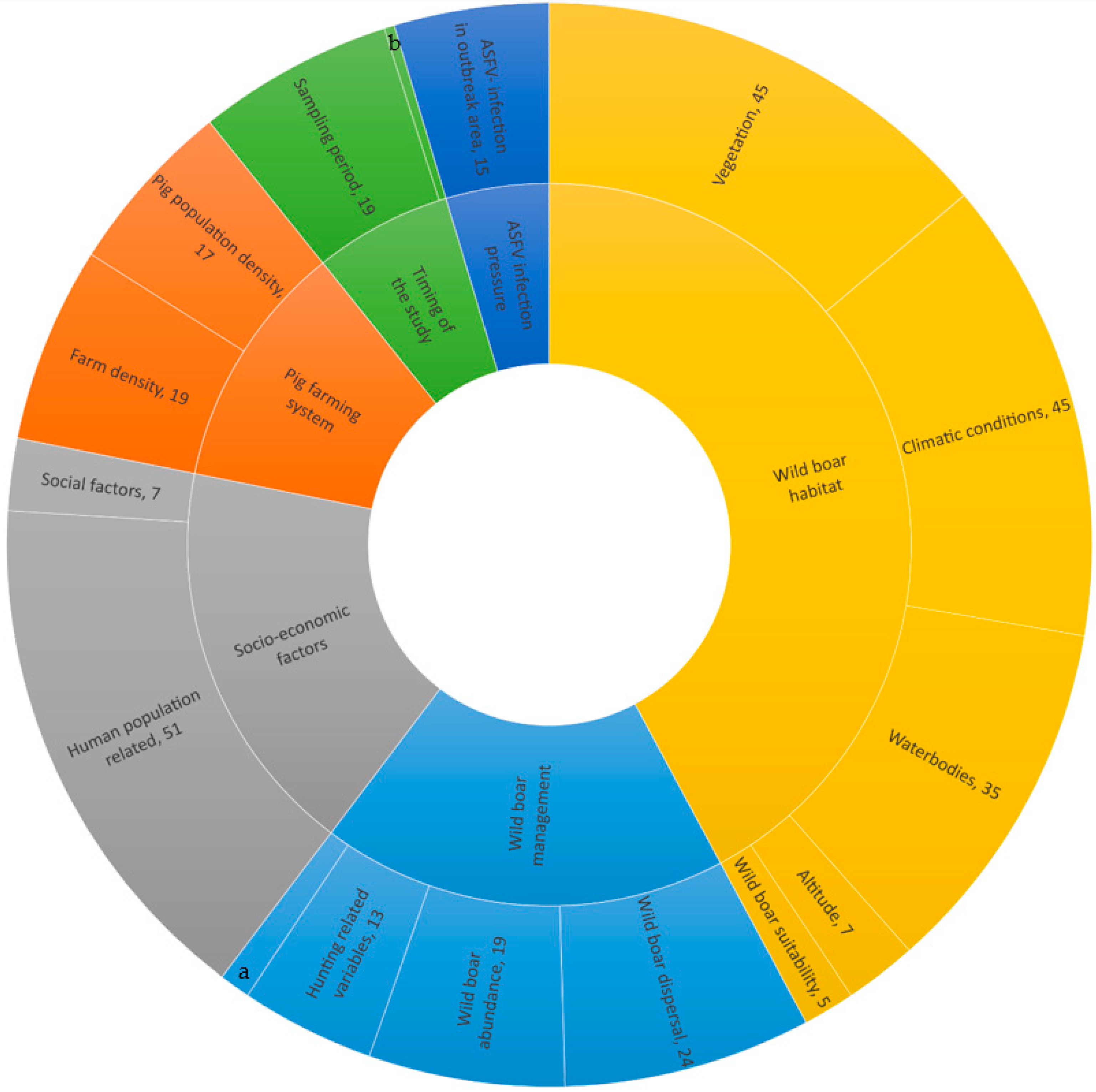
| Category | Subcategory 2 | Total Studies Where Variable Category Was Investigated | No. Studies Where Variable Category Was Significant | Proportion * | Significant Variable | References of Significant Variable | |
|---|---|---|---|---|---|---|---|
| Subcategory 1 | |||||||
| Timing of the study | 20 | 14 | 0.7 | ||||
| Year | Year | 20 | 14 | 0.7 | 2015 (3); 2016 (2); 2017 (3); 2018 (2); 2019 (3); 2020 (1) | [40,41,42,43,44] | |
| ASFV infection pressure | 15 | 10 | 0.7 | ||||
| ASFV infection in outbreak area | Distance outbreak to ASF-affected area | 12 | 8 | 0.7 | Decreased distance to infected area/country (7); ASF reported in neighbouring hexagon in previous period (1) | [43,45,46,47] | |
| Presence of ASF infection in outbreak area | 3 | 2 | 0.7 | ASF presence in domestic pigs in area (2) | |||
| Wild boar habitat | 137 | 75 | 0.5 | ||||
| Altitude | Altitude | 7 | 5 | 0.7 | Increasing mean altitude (2), elevation grade (3) | [4,44,48] | |
| Climatic conditions | Precipitation | 14 | 9 | 0.6 | Precipitation **(9) | [4,9,46,48] | |
| Seasonality | 13 | 1 | 0.1 | Season (1) | |||
| Sun | 1 | 0 | 0.0 | Na | |||
| Temperature | 17 | 11 | 0.6 | Mean temperature ** (6); annual range of temperature ** (4); isothermality ** (1) | |||
| Vegetation | Bare land | 5 | 0 | 0.0 | Na | [4,8,20,43,44,46,48,49] | |
| Crops | 12 | 6 | 0.5 | Increased percentage of area covered by complex cultivation patterns (1); fruit trees and berry plantation (1); rice cultivation (1); rain-fed crops (1); agriculture (1); vineyards (1) | |||
| Various landcover | 2 | 2 | 1 | Various habitats (1) | |||
| Herbaceous | 5 | 2 | 0.4 | Na | |||
| Growth | 1 | 1 | 1 | Increased length of vegetation growing period (1) | |||
| Vegetation index | 3 | 1 | 0.3 | Normalised difference vegetation index (NDVI) (1) | |||
| Forest | 17 | 12.0 | 0.7 | Increased percentage of area covered by forest (8); coniferous forest (1); mixed forest ** (1); broad-leaved forest ** (1); transitional woodland–shrub ** (1) | |||
| Water bodies | Water bodies | 35.0 | 21.0 | 0.6 | Increased percentage of area covered by water bodies (8); wetlands (7); peat bogs (1); soil moisture (2); inland marshes (1); water courses (1); increased water vapour pressure (1); | [4,8,38,43,44,48] | |
| WB suitability | Suitable wild boar area | 5 | 4 | 0.8 | Increased percentage of suitable wild boar area (4) | [45] | |
| Socio-economic factors | 58.0 | 38.0 | 0.7 | ||||
| Social factors | Poverty-related factors | 7 | 7 | 1.0 | Increased amount of differentiated waste (1); cultural traditions (1); low employment rates (1); low share of energy produced by renewable sources (1); increased micro-criminality (1); increased number of inhabitants at flood risk (1); increased number of reported thefts (1) | [20] | |
| Human population density | Human footprint index | 4 | 2 | 0.5 | Decreasing human footprint index (2) | [4,8,40,42,43,44,48] | |
| Human population density | 21 | 13 | 0.7 | Increasing human population density (11); increased percentage of urban areas (2) | |||
| Human population-related | 9 | 7 | 0.7 | Increased percentage of discontinuous urban areas (1); green urban areas **(1); industrial or commercial units (1); mineral extraction sites ** (1); land use (1); nighttime light ** (1); urban accessibility ** (1) | |||
| Road/rail density | 17 | 9 | 0.5 | Increased road density (6); distance from road grade 4 (1); increased travel time to major cities—grade 4 (longest time) (1); path presence **(1) | |||
| WB management | 55.0 | 14.0 | 0.3 | ||||
| Hunting | Feed and water | 3 | 0 | 0.0 | Na | [38,43] | |
| Number of days hunted | 2 | 1 | 0.5 | Decreasing number of days hunted in the hunting area per year (1) | |||
| Number of feeders | 1 | 0 | 0.0 | Na | |||
| Number of hunters | 3 | 0 | 0.0 | Na | |||
| Number of hunting dogs | 3 | 1 | 0.3 | Decreasing number of hunting dogs used in the hunting area per year (1) | |||
| Number of hunting farms | 1 | 1 | 1.0 | ||||
| WB abundance | WB abundance/density | 16 | 11 | 0.7 | Increased wild boar abundance (2); increased wild boar density (8); wild boar density * distance to previous ASF cases (1) | [8,40,42,43,46,48,49] | |
| Wild boar distribution index | 3 | 1 | 0.3 | Wild boar distribution index grade 5 (1) | [48] | ||
| WB dispersal | Female | 8 | 0 | 0.0 | Na | Na | |
| Male | 8 | 0 | 0.0 | Na | |||
| Yearlings | 8 | 0 | 0.0 | Na | |||
| WB population characteristics | Females | 1 | 0.0 | 0.0 | Na | Na | |
| Piglets | 2 | 0 | 0.0 | Na | |||
| Pig farming | 36.0 | 19.0 | 0.5 | ||||
| Pig population density | Farm density | 19.0 | 10.0 | 0.5 | Increased farm density (1); increased proportion of pig farms (5); increased proportion of small pig farms in the area (4) | [4,40,41,42,43,48] | |
| Pig population density | 17.0 | 9.0 | 0.5 | Increased pig density (2); increased density of pigs in small holdings/backyard farms (2); increased proportion of pigs (3); increased proportion of pigs in small farms (2) | |||
Disclaimer/Publisher’s Note: The statements, opinions and data contained in all publications are solely those of the individual author(s) and contributor(s) and not of MDPI and/or the editor(s). MDPI and/or the editor(s) disclaim responsibility for any injury to people or property resulting from any ideas, methods, instructions or products referred to in the content. |
© 2025 by the authors. Licensee MDPI, Basel, Switzerland. This article is an open access article distributed under the terms and conditions of the Creative Commons Attribution (CC BY) license (https://creativecommons.org/licenses/by/4.0/).
Share and Cite
Dhollander, S.; Chinchio, E.; Tampach, S.; Mur, L.; Méroc, E.; Thulke, H.-H.; Cortiñas, J.A.; Boklund, A.E.; Stahl, K.; Stegeman, J.A. A Systematic Literature Review of Variables Associated with the Occurrence of African Swine Fever. Viruses 2025, 17, 192. https://doi.org/10.3390/v17020192
Dhollander S, Chinchio E, Tampach S, Mur L, Méroc E, Thulke H-H, Cortiñas JA, Boklund AE, Stahl K, Stegeman JA. A Systematic Literature Review of Variables Associated with the Occurrence of African Swine Fever. Viruses. 2025; 17(2):192. https://doi.org/10.3390/v17020192
Chicago/Turabian StyleDhollander, Sofie, Eleonora Chinchio, Stefania Tampach, Lina Mur, Estelle Méroc, Hans-Hermann Thulke, José Abrahantes Cortiñas, Anette E. Boklund, Karl Stahl, and Jan Arend Stegeman. 2025. "A Systematic Literature Review of Variables Associated with the Occurrence of African Swine Fever" Viruses 17, no. 2: 192. https://doi.org/10.3390/v17020192
APA StyleDhollander, S., Chinchio, E., Tampach, S., Mur, L., Méroc, E., Thulke, H.-H., Cortiñas, J. A., Boklund, A. E., Stahl, K., & Stegeman, J. A. (2025). A Systematic Literature Review of Variables Associated with the Occurrence of African Swine Fever. Viruses, 17(2), 192. https://doi.org/10.3390/v17020192