Article

Characterization of Novel Przondovirus Phage Adeo Infecting Klebsiella pneumoniae of the K39 Capsular Type


by
Nadezhda V. Kolupaeva
1,
Peter V. Evseev
2,
Victoria A. Avdeeva
1,
Angelika A. Sizova
1,
Natalia E. Suzina
3,
Nikolay V. Volozhantsev
1 and
Anastasia V. Popova
1,*
1
State Research Center for Applied Microbiology and Biotechnology, City District Serpukhov, Moscow Region, 142279 Obolensk, Russia
2
Pirogov Russian National Research Medical University, 117997 Moscow, Russia
3
Skryabin Institute of Biochemistry and Physiology of Microorganisms, Federal Research Center “Pushchino Scientific Center for Biological Research of the Russian Academy of Sciences”, 142290 Pushchino, Russia
*
Author to whom correspondence should be addressed.
Viruses 2025, 17(12), 1600; https://doi.org/10.3390/v17121600
Submission received: 9 November 2025 / Revised: 7 December 2025 / Accepted: 8 December 2025 / Published: 10 December 2025
(This article belongs to the Section Bacterial Viruses)

Abstract

Klebsiella pneumoniae is one of the most significant nosocomial pathogens and an important cause of human infections worldwide. The microorganism is capable of producing different capsular polysaccharides (CPSs), which are the primary receptors for capsule-specific K. pneumoniae bacteriophages encoding tailspike proteins (TSPs) with polysaccharide-degrading activity. In this study, the novel virulent Przondovirus phage Adeo was isolated and characterized. The phage was able to infect K. pneumoniae strain with a K39 capsular polysaccharide structure. The morphology, biological properties, stability, and genomic organization of Adeo were studied. Comparative genomic and phylogenetic analyses were performed to establish the relationship between the phage and other bacterial viruses. The gene encoding TSP Adeo_gp48 was identified and cloned. Recombinant depolymerase lacking the N-terminal part was expressed, purified, and formed an opaque zone of CPS depolymerization on the K39 K. pneumoniae bacterial lawns. The structural and phylogenetic similarities of Adeo’s TSP to other phage-encoded depolymerases were discussed.

1. Introduction

Klebsiella pneumoniae is a Gram-negative, nonmotile, facultative anaerobic, encapsulated bacterium belonging to the family Enterobacteriaceae [1]. It can be a component of the human microbiota, but at the same time, it is considered a significant nosocomial pathogen that causes various hospital-acquired infections [2,3]. The microorganism is often associated with pneumonia, meningitis, respiratory tract, bloodstream, urinary tract, and surgical site infections, especially in hospitalized immunocompromised patients, patients with underlying chronic illnesses, newborns, and elderly patients [4,5]. Because of the strong potential of K. pneumoniae to form an antibiotic-resistant phenotype, it commonly causes infection outbreaks worldwide [4,6]. Thus, K. pneumoniae is ranked by the World Health Organization (WHO) among the critical priority microorganisms for developing of new antibacterial agents [7]. In this regard, the application of lytic bacteriophages (phages), viruses that specifically infect and lyse bacterial cells, may be one of the approaches to control the spread of multidrug-resistant K. pneumoniae strains.
K. pneumoniae produces numerous variants of surface structures, capsular polysaccharides (CPSs), which differ from each other by the contest and number of monosaccharides in the repeating polysaccharide units and linkages formed between them [8]. CPSs are one of the most significant virulence factors [9,10] and play an important role in bacterial cell survival [11] and immune response evasion [12,13]. To date, more than 180 capsule biosynthesis gene clusters (K loci, KL) have been bioinformatically recognized in different K. pneumoniae genomes [14]. Many lytic phages infecting K. pneumoniae contain genes encoding structural proteins with polysaccharide-depolymerizing activities or tailspike proteins (TSPs), which facilitate the attachment and adsorption of a phage to a bacterial host cell belonging to corresponding capsular type (K type) by degrading CPS with a certain structure [15,16,17].
In this study, we characterized the novel phage Adeo, which exhibits lytic activity against K. pneumoniae of the K39 capsule type. The K39 CPS structure was established in 1987 by depolymerization of the CPS polymer with endo-β-d-glucosidase of phage φ39, which was not characterized [18]. During the past five years, the isolation of K. pneumoniae strain carrying KL39 was reported from hospitalized and intensive care unit patients of different medical centers in Moscow and Saint Petersburg (Russia) [19,20,21].
The genus Przondovirus, to which Adeo belongs, constitutes the large group of phages infecting Klebsiella spp. and comprises 229 bacterial viruses with genomes that have been deposited in the National Center for Biotechnology Information (NCBI) GenBank by September 2025. Genomes of Przondoviruses encode tailspike proteins (TSPs) responsible for the ability of the bacterial viruses to infect K. pneumoniae strains with a certain CPS structure. In this group, viruses specific to K1 [22,23], K2 [23,24,25,26,27,28], K3 [29], K5, K8 [30], K10 [27], K11 [31], K21 [29,32], K30 [30], K47 [33,34], K56 [35], K57 [22,23,27,36]; K64 [36,37,38,39,40,41,42,43,44], K69 [30], K102 [27], K106 [27,45], and KN1, KN3, KN4 [35] K. pneumoniae capsular types (K types) have already been described. Phage Adeo is the first bacterial virus studied that is specific to K. pneumoniae with a K39 CPS structure among all Przondoviruses.
The study of phages that can infect different K types contributes to our understanding of the diversity of K. pneumoniae bacterial viruses and to the development of strategies to combat infections caused by this microorganism.

2. Materials and Methods

2.1. Phage Isolation, Propagation, and Purification

Phage Adeo was isolated from a sewage sample collected in the Moscow region (Russia) in 2024 on a bacterial lawn of K. pneumoniae strain KPB-1434/16 obtained from the State Collection of Pathogenic Microorganisms and Cell Cultures (SCPM-Obolensk, Obolensk, Russia) (SCPM-Obolensk accession number: B-8048, GenBank accession number: JAFEHO000000000.1, capsular type K39). The sample was centrifuged at 6000× g for 20 min. The supernatant was filtered through 0.45-µm-pore-size membrane filter (Merck Millipore, Cork, Ireland). The filtrate was supplemented with an equal volume of LB medium and incubated overnight at 37 °C with shaking in the presence of growing K. pneumoniae strains belonging to different capsular types. A portion of chloroform (10% v/v) was then added, and the sample was centrifuged at 6000× g for 20 min. The supernatant was filtered through 0.45- and 0.22 µm-pore-size membrane filters (Merck Millipore, Cork, Ireland) to remove bacterial debris.
A single plaque with a halo found on the lawn of K. pneumoniae KPB-1434/16 was picked up in the SM buffer (10 mM Tris-HCl, pH 7.5, 10 mM MgSO4, and 100 mM NaCl) and plaque-purified three times to obtain pure phage stock. The phage was propagated using K. pneumoniae KPB-1434/16 liquid culture (OD600 of 0.3–0.4) at a multiplicity of infection (MOI) of 0.1. The incubation was performed at 37 °C with shaking until lysis, and chloroform was then added. Bacterial debris was pelleted by centrifugation at 13,000× g for 5 min. The phage particles were precipitated by polyethylene glycol (PEG) 8000 (added to a final concentration of 10% w/v) and 500 mM NaCl for 24 h at 4 °C.

2.2. Determination of Phage and Depolymerase Specificity

The host specificity of phage Adeo was tested against 56 K. pneumoniae strains belonging to 19 different K types (K1, K2, K3, K10, K17, K20, K23, K24, K27, K28, K31, K39, K47, K48, K54, K57, K60, K62, and K64) (Table S1) using the double-layer method [46]. For this procedure, 300 µL of K. pneumoniae bacterial cultures grown in medium «GRM-broth» (8 g pancreatic hydrolysate of fish meal, 8 g dry enzymatic peptone, 4 g sodium chloride, SRCAMB, Obolensk, Moscow region, Russia) at 37 °C to an OD600 of 0.4 (~109 CFU/mL) were mixed with 4 mL of soft agar (GRM broth supplemented with 0.6% agarose) and then plated onto the nutrient agar. Subsequently, the phage (~108 PFU/mL) or purified recombinant depolymerase, and their several dilutions, were spotted on the soft agar lawns and incubated at 37 °C for 18–24 h. The efficiency of plating (EOP) was calculated as the ratio of the number of PFU per test strain to the number of PFU per host strain [47].

2.3. Phage Adsorption and One-Step Growth Experiments

For the adsorption assay, exponentially grown K. pneumoniae KPB-1434/16 bacterial cells were mixed with the phage Adeo at MOI = 0.001 and incubated at room temperature. A volume of 100 µL of samples was taken in 0, 1, 2, 3, 4, 5, 8, 10, 15, and 20 min and then mixed with 850 µL of SM buffer supplemented with 50 µL of chloroform. After centrifugation, the supernatants were titrated for further determination of unabsorbed phages at different time intervals by the plaque assay method. The adsorption constant was calculated according to Adams [46].
For the one-step growth experiments, 20 mL of host bacterial cells (OD600 of 0.4) was harvested by centrifugation (7000× g, 5 min, 4 °C) and resuspended in 0.5 mL GRM broth. Bacterial cells were infected with the phage at a MOI of 0.01. The phage was allowed to adsorb at 37 °C for 2 min. Then, the mixture was centrifuged at 10,000× g for 2 min to remove unabsorbed phage particles, and the pellet was resuspended in 20 mL of GRM broth. Samples were taken at 5-min intervals over a 2-h incubation period at 37 °C and immediately titrated.

2.4. Stability of Phage at Different Temperatures and pH Values

The thermal stability of the phage was tested over a period of 1 h at 8 °C, 24 °C, 37 °C, 42 °C, 56 °C, 70 °C, and 92 °C. Phage titer was calculated using the plaque assay. To determine the pH stability, the phage was incubated at 37 °C for 1 h in SM buffers with pH values ranging from 3.2 to 12. A titer of 2.4 × 10¹⁰ PFU/mL was chosen for the experiments.

2.5. Electron Microscopy

For negative staining, phage Adeo (109 PFU/mL) was placed onto grids coated with formvar film and then treated with a 0.3% aqueous solution of uranyl acetate (pH 4.0) after drying. The samples were examined with a JEM-1400 (JEOL, Tokyo, Japan) transmission electron microscope at an accelerating voltage of 80 kV.

2.6. DNA Isolation and Sequencing

Phage DNA was isolated using a standard phenol-chloroform method [48] after incubating of the sample in 0.5% SDS and 50 µg/mL proteinase K at 65 °C for 20 min. The GenoLab M platform (GeneMind Biosciences Co., Ltd., Shenzhen, China) with SG GM Plus (SESANA, Ltd., Moscow, Russia) and GenoLab Sequencing set V2.0 (FCM 300 cycles) (GeneMind Biosciences Co., Ltd., Shenzhen, China) were used for phage genome sequencing. The generated reads were assembled de novo into a single contig using SPAdes v.3.13 [49] with default parameters. The genome sequence of phage Adeo was deposited to GenBank under accession number OR855706.

2.7. Analysis of the Phage Genome and Proteins

Multiple nucleotide and protein sequence alignments were generated using MAFFT v7.48 with the L-INS-i algorithm under default options [50]. The resulting alignments served as input for phylogenetic inference in IQ-TREE v2.2.5, where ModelFinder selected the best-fit substitution model for each dataset and nodal support was assessed with 1000 ultrafast bootstrap replicates using the parameter set “-m TEST-bb 1000” [51]. The intergenomic relatedness among phages was assessed using VIRIDIC v1.1 under default settings, which computes pairwise identities through BLASTN-based comparisons and applies the recommended clustering thresholds [52]. Protein structures were predicted using AlphaFold 3 under default settings [53]. The top-ranked models were retained for downstream analyses, visualized in PyMOL v2.5.4 (Schrödinger Inc., New York, NY, USA), and used for pairwise superpositions. Structural similarity searches were performed with the DALI software (https://ekhidna2.biocenter.helsinki.fi/dali/, accessed on 1 October 2025), and the DALI Z-score was used as the primary metric of fold similarity, with RMSD and alignment length examined where appropriate [54,55]. Putative antibiotic resistance genes were queried using BLAST (https://blast.ncbi.nlm.nih.gov/Blast.cgi, accessed on 1 October 2025) against the Comprehensive Antibiotic Resistance Database (CARD) v3.2.7 [56]. Virulence factors were searched using the VFDB 2025 database [57]. Protein functions were inferred with HHpred under default options against the pdb70_from_mmcif_2023-06-18, pfam-a v35, and uniprot_sprot_vir70_Nov_2021 databases [58]. BLAST [59] was used to perform additional homology searches against a custom database constructed from genomic sequences retrieved from the GenBank PHG database. All software was run with the indicated versions, and unless specified otherwise, default parameters were applied.

2.8. Cloning, Expression and Purification of Recombinant Proteins

The DNA fragment of phage tailspike depolymerase (gp48; GenBank accession WQZ01644) lacking N-terminal domain was amplified by PCR using oligonucleotide primers 5′-GAACAGATTGGTGGTGTATCCGCCATGTCTTTACAGCA-3′ and 5′-TACCTAAGCTTGTCTTTAGTGAATTGCCTCCCACCCTG-3′ and cloned in the linearized pET SUMO vector (Thermo Fisher Scientific Inc., Waltham, MA, USA) by Gibson Assembly (New England Biolabs, Ipswich, MA, USA).
Expression vector was transformed into chemically competent Escherichia coli BL21(DE3) cells. Protein expression was performed in LB medium supplemented with 50 mg/L kanamycin. Transformed cells were grown at 37 °C until the optical density reached the value of 0.4 at 600 nm. The medium was cooled to the temperature of 16 °C, followed by the induction of expression by the addition of isopropyl-1-thio-β-D-galactopyranoside (IPTG) to a final concentration of 1 mM. After further incubation at 16 °C overnight (approximately 16 h), the cells were harvested by centrifugation at 3700× g for 20 min, at 4 °C. The cell pellets were resuspended in 1/50th of the original cell volume in buffer A (20 mM Tris, pH 7.5, 0.3 M NaCl, 5% glycerol). After that, resuspended cell pellets, divided into several aliquots, were lysed by sonication (three cycles with a 10-s on-time and a 20-s off-time) using Misonix S-4000-010 Ultrasonic Liquid Processor (Misonix Inc., Farmingdale, NY, USA). The cell debris was removed by centrifugation at 16,000× g for 30 min, 4 °C. The supernatants were loaded onto nickel Ni2+-charged GE HisTrap column (GE Healthcare Life Sciences, Marlborough, MA, USA) equilibrated with buffer A, and eluted with a 0–300 mM imidazole linear gradient in buffer A. The fractions containing the target proteins were pulled together and set up at 4 °C for the His-tag overnight digestion with SUMO-protease at a protease/protein ratio of 1/100 (w/w). This reaction mixture was simultaneously dialyzed against 20 mM Tris pH 7.5, 150 mM NaCl, 0.5 mM DTT (dithiothreitol) buffer to remove the His-SUMO expression tag. Protein samples after digestion were applied to the His-Trap column as before. A flow through was concentrated with ultrafiltration devices (molecular weight cutoff of 10,000) and stored in the same buffer at 4 °C.

2.9. Phage Infection Inhibition Assay

Adeo infection inhibition by purified recombinant TSP Adeo_gp48 was performed according to the published procedure [60]. A titer of 1.0  ×  105 PFU/mL for the phage was chosen for the competition experiments. K. pneumoniae KPB-1434/16 was grown in LB medium at 37 °C to an OD600 of 0.3. Subsequently, TSP Adeo_gp48 was added to a 100-μL aliquot of the cell culture to a final concentration of 0.5 mg/mL and incubated for 20 min at 37 °C. One hundred microliter aliquots of the K. pneumoniae host cells without anything and with bovine serum albumin (BSA) to a final concentration of 0.5 mg/mL incubated for 20 min at 37 °C served as controls. After incubation, several dilutions of phage Adeo and 4 mL of soft agar were added to the mixtures and plated onto the nutrient agar. Plates were incubated overnight at 37 °C and the number of lysis plaques was determined. The experiments were performed in triplicate. GraphPad Prism 8.0 software (GraphPad Software, Inc., La Jolla, CA, USA) was used for statistical analysis and graphical presentation of the results.

3. Results

3.1. Morphological Characteristics and Infection Parameters of Phage Adeo

Phage Adeo was isolated from a sewage sample by the enrichment procedure using K. pneumoniae strain KPB-1434/16 of the K39 type (GenBank accession: JAFEHO000000000.1) as the host bacterium. On the lawn of the host strain, Adeo produces clear plaques (about 2–5 mm in diameter) with opaque haloes (Figure 1A) formed as a result of the depolymerizing activity of phage tailspikes toward the CPS layer surrounding bacterial cells. Transmission electron microscopy of negatively stained phage particles revealed that Adeo has an icosahedral head of approximately 60 nm in diameter and a short noncontractile tail of up to 10 nm (Figure 1B).
The host specificity of the phage was determined using a collection of K. pneumoniae strains (n = 56) belonging to 19 different K types (Table S1). Among all tested strains, Adeo was able to infect only the fourteen strains with K39 CPS structure (Table S1). By comparing the titers of the phage on the thirteen K. pneumoniae strains of K39 types to the titer on the host strain K. pneumoniae KPB-1434/16, the EOP values for these strains varied from 0.1 to 0.91 (Table S1).
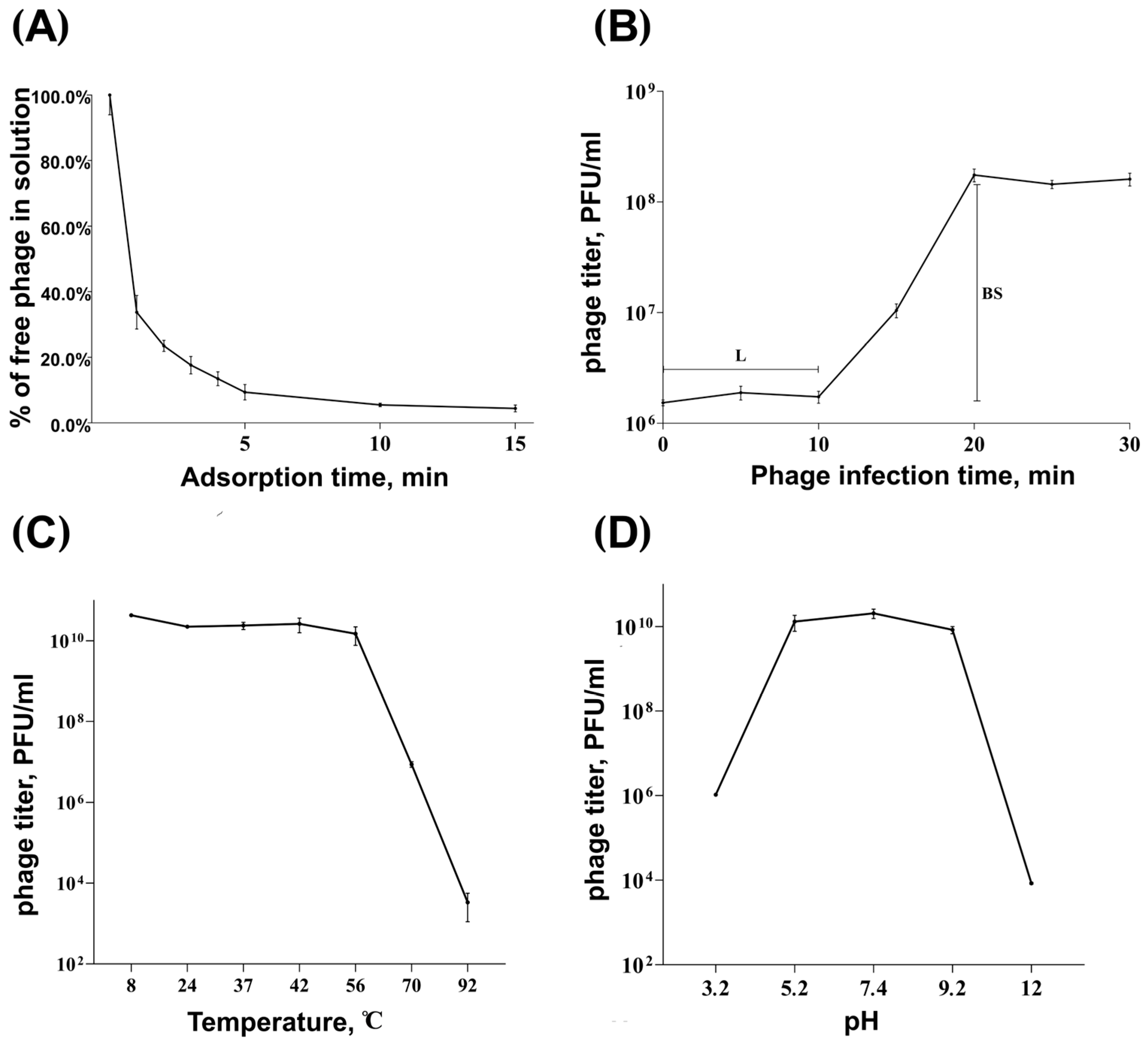
The parameters of the infection process were investigated in adsorption efficiency and one-step growth experiments. It was determined that above 60% of phage particles adsorbed to K. pneumoniae KPB-1434/16 cells within 1 min, and more than 90% within 5 min (Figure 2A). Phage Adeo exhibited an adsorption constant of 4.7 × 10⁻¹⁰ mL/min for the host strain for a period of 5 min. The one-step growth experiments revealed that Adeo had a latent period of 10 min, and the burst size was approximately 100 particles per infected cell (Figure 2B). As shown in Figure 2C, phage Adeo retained its infectivity in a temperature range of 8–56 °C, with a partial loss of infectivity at 70 °C and a very pronounced decrease its activity at 92 °C. The optimal pH values for phage Adeo were between 5.0 and 9.0, with a partial loss of activity at pH values of 3.2 or 12 (Figure 2D).

3.2. Analysis of Phage Genome and Phage-Derived Proteins

3.2.1. General Characterization of the Adeo Genome

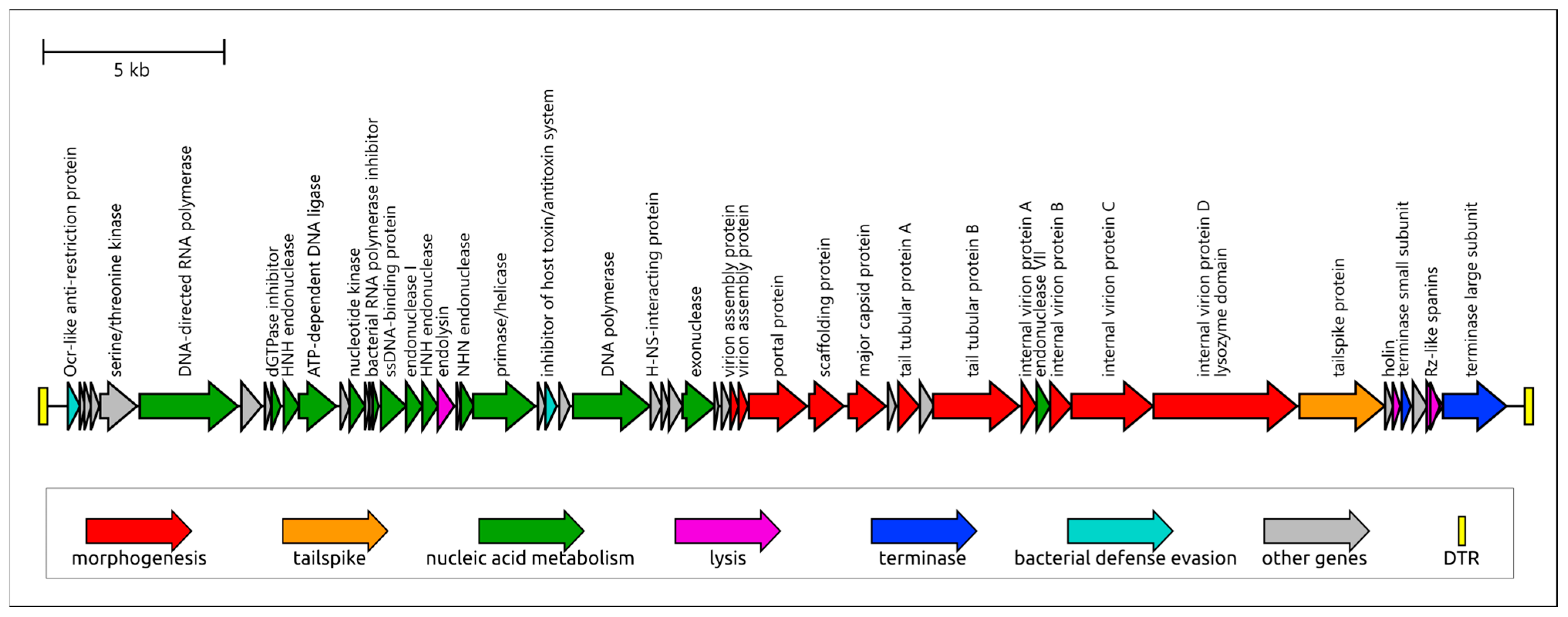
Phage Adeo possesses a linear double-stranded DNA (dsDNA) genome (GenBank accession number: OR855706) of 41,389 bp, comprising 60 predicted genes, all encoded on the forward strand (Figure 3). The genomic G + C content was 52.9%, which was slightly lower than that of its host, K. pneumoniae KPB-1434/16 (56.8%). No tRNA genes were identified. The genome harbors 182 bp direct terminal repeats. No genes encoding toxins or other virulence factors and no antibiotic-resistance determinants, were detected.

3.2.2. Genome Structure and Functional Modules

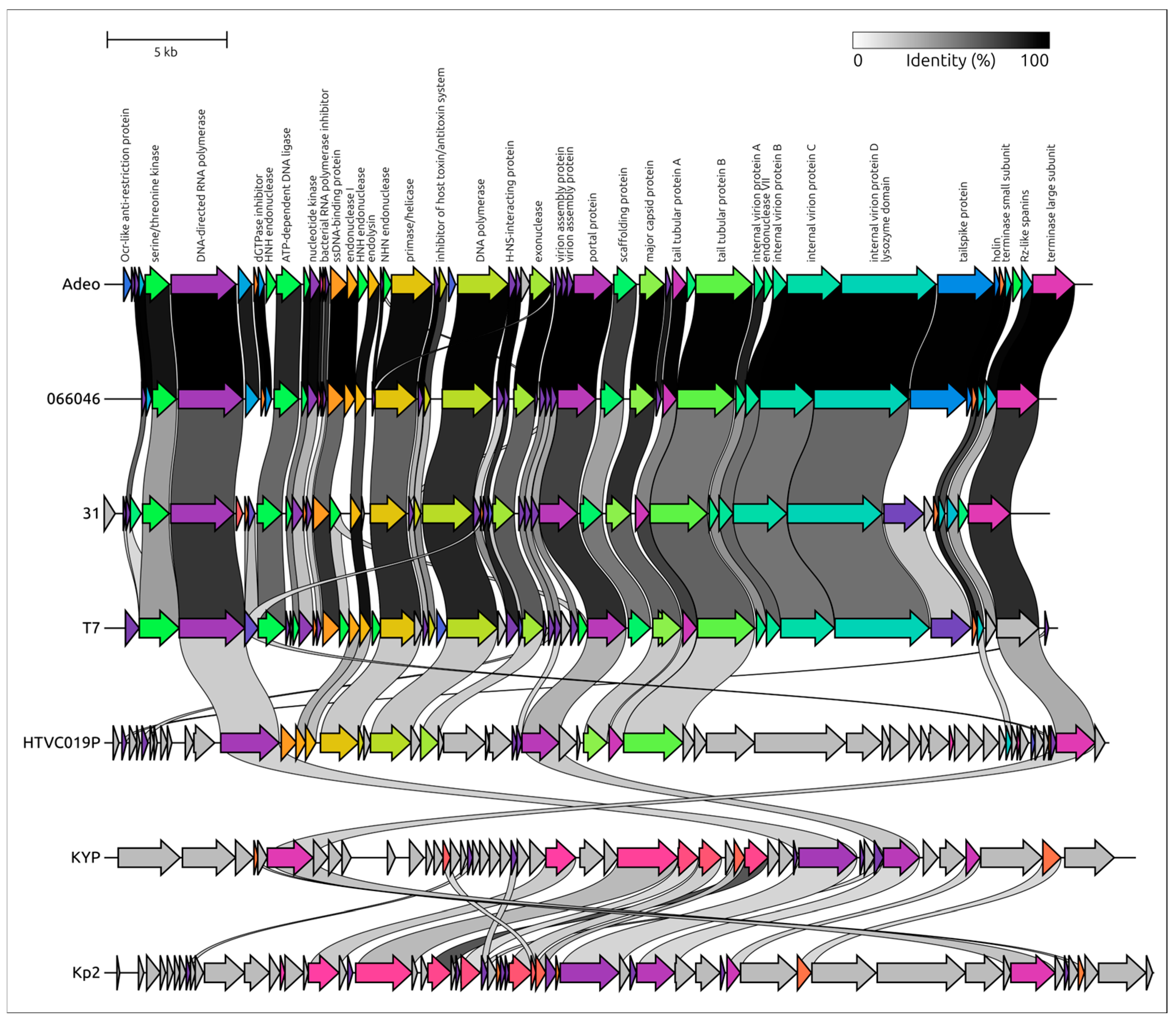
The phage genome has a modular organization reminiscent of T7-like phages sensu lato, which are currently classified within the order Autographivirales and the family Autotranscriptaviridae, comprising only the subfamily Studiervirinae (https://ictv.global/taxonomy, accessed on 20 October 2025) (Figure 3). Closely related phages identified by whole-genome BLAST include members of the genus Przondovirus infecting Klebsiella pneumoniae, in particular those annotated in NCBI GenBank as Klebsiella phage 066046 (ICTV species Przondovirus 066046), vB_Kpl_K48PH164C1 (Przondovirus K48PH164C1), and Klebsiella phage vB_Kpl_K58PH129C2 (Przondovirus K58PH129C2). Together with these phages and other Studiervirinae phages, Adeo shares a characteristic gene order that differentiates it from some non-Studiervirinae phages (e.g., Klebsiella phage KYP, subfamily Melnykvirinae; Figure 4). This organization includes a T7-like DNA-dependent RNA polymerase (RNAP)—a hallmark of the order Autographivirales—located in the early region of the genome [61,62,63]. Interestingly, a similar gene order was observed in the more distantly related Pelagibacter phage HTVC019P [64], which may represent an early-diverged group within Autographivirales (Figure 4). This pattern suggests that the ancestor of Studiervirinae phages likely possessed a broadly similar genomic architecture. The Adeo genome contains a replication module that includes a T7-like family A DNA polymerase, a primase/helicase, nucleases, and a DNA ligase. As well as the general genome organization, the order and composition of the replication genes are reminiscent of those in Escherichia phage T7 and other Autographivirales Studiervirinae phages. In this module, we identified an inserted endolysin gene encoding an N-acetylmuramoyl-L-alanine amidase homologous to the T7 lysozyme (gp3.5). In phage T7, this enzyme is a Zn2+-dependent amidase that cleaves the MurNAc–L-Ala bond of peptidoglycan and, together with the holin (gene 17.5) and spanins, mediates host–cell lysis; T7 lysozyme also binds and inhibits T7 RNAP to tune transcription timing [65]. These homologies suggest a similar enzymatic mechanism for Adeo endolysin. The packaging module encodes small and large terminase subunits, typical of Heunggongvirae phages. The morphogenesis block includes a T7-like podoviral portal protein (PP), a major capsid protein (MCP), four internal virion proteins that appear less conserved than MCP and PP, two tubular proteins, and accessory genes involved in virion assembly.
Furthermore, genome comparisons revealed clear similarities across most genes among the analyzed Studiervirinae phages, including Adeo and Escherichia phage T7, with lower conservation observed for nonstructural genes and internal virion proteins, although robust homology is retained for RNAP and other replication genes. However, the predicted tailspike protein (TSP) does not show significant homology to receptor-binding proteins of related Studiervirinae phages outside the genus Przondovirus, which is apparently explained by differences in the adsorption mechanism and ability of the phage to recognize of CPS of a certain structure. Another notable feature of the Adeo genome is the presence of bacterial defense-evasion genes. In particular, it encodes a putative Ocr-like protein that can function as an anti-restriction factor by mimicking DNA and inhibiting the type I DNA restriction–modification system [66] and possibly the BREX defense system [67]. The Ocr-like protein is conserved in other Studiervirinae viruses, including T7, although its sequence appears to be less conserved than its structure and function. Gene prediction also indicates two overlapping spanin genes, inner and outer spanin, a feature not previously annotated in most related Przondovirus phages and, to the authors’ knowledge, not discussed earlier, possibly due to the non-obvious positioning of these genes. This brings Adeo closer to phage T7, although the latter carries embedded spanin genes [68]. Finally, unlike some closely related Studiervirinae phages, including Klebsiella phage 06646, the Adeo genome contains a putative NHN endonuclease gene located upstream of the DNA ligase gene. A BLAST search revealed a mosaic pattern of presence and absence of this gene upstream of the DNA ligase among different phages within the subfamily Studiervirinae.

3.2.3. Taxonomy and Signature Genes Phylogeny

The taxonomic assignment of phage Adeo was performed according to common ICTV requirements [69]. Intergenomic comparisons were conducted using two datasets: a 117-genome set comprising ICTV-classified representatives of the genus Przondovirus and a 50-genome set containing diverse representatives of the order Autographivirales (Figures S1 and S2). The search revealed the highest intergenomic similarity of 89.1% to Klebsiella phage 06646 (ICTV species Przondovirus 066046), followed by 83.5% to Klebsiella phage FZ12 (Przondovirus FZ12) and 82.9% to Klebsiella phage vB_Kpl_K58PH129C2 (Przondovirus K58PH129C2). Using the 95% and 70% species and genus delineation cutoff, respectively, these values unambiguously assign phage Adeo to a new species, Przondovirus Adeo, within the genus Przondovirus [69]. Proteome-based ViPtree phylogeny supports these conclusions, placing phage Adeo within the Przondovirus clade (Figure S3).
At larger genetic distances, intergenomic comparisons indicate the relatedness of Przondovirus phages to other genera within the subfamily Studiervirinae (approximately 17–59%), particularly Benllochvirus (Klebsiella phage cp31), Apdecimavirus_AP10 (Yersinia phage vB_YenP_AP10), Eapunavirus Eap1 (Enterobacter phage phiEap-1), and Yuanmingyuanvirus NJ2 (Enterobacter phage NJ2). Notably, the intergenomic similarity between Przondovirus representatives and the Wuhanvirus representative Pasteurella phage vB_PmuP_PS07, recently (2024) assigned by the ICTV to the subfamily Studiervirinae, was the lowest (approximately 16–17%), whereas the similarity values between Przondovirus phages and non-Wuhanvirus Studiervirinae genera were approximately 32–59%.
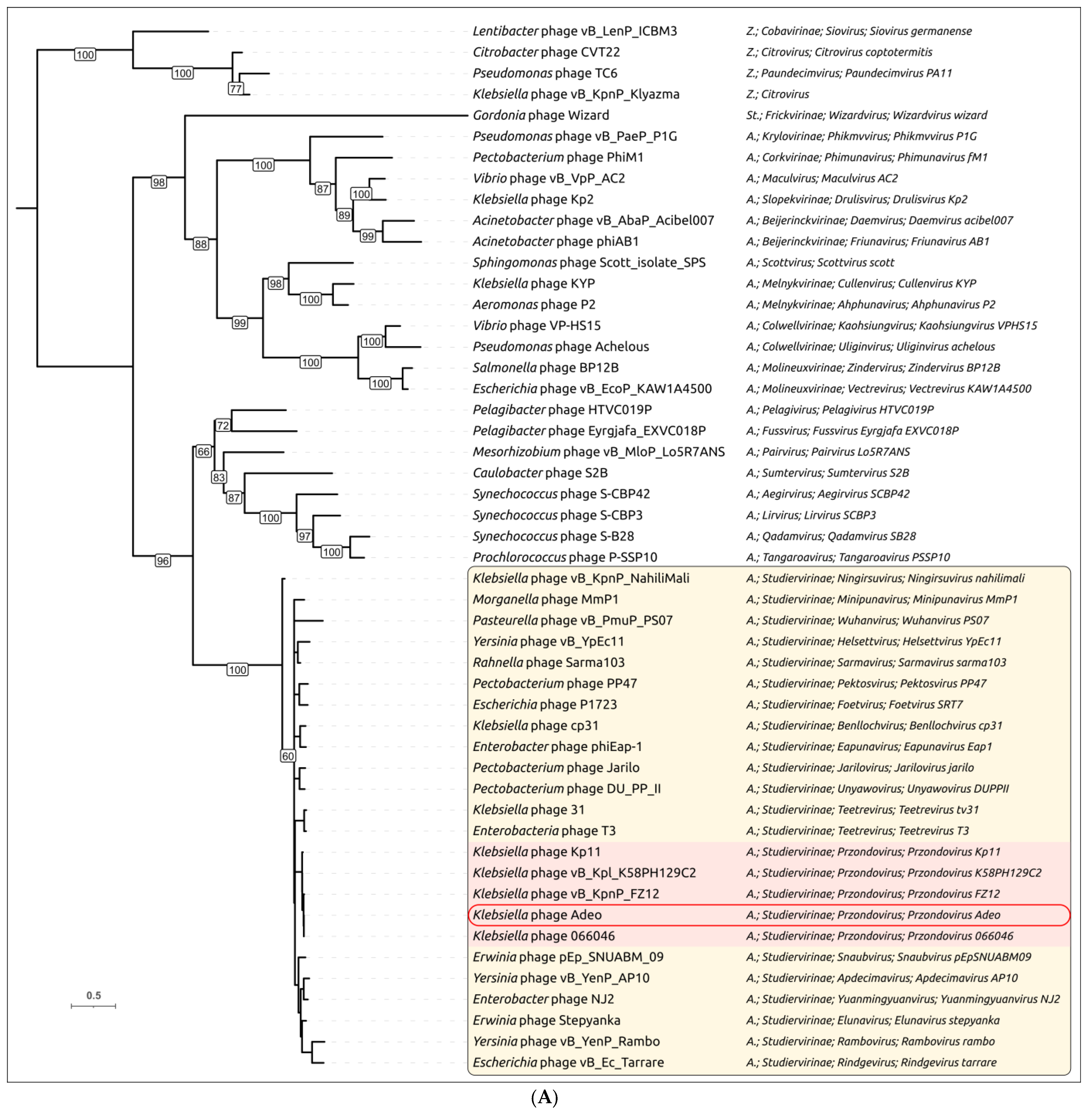
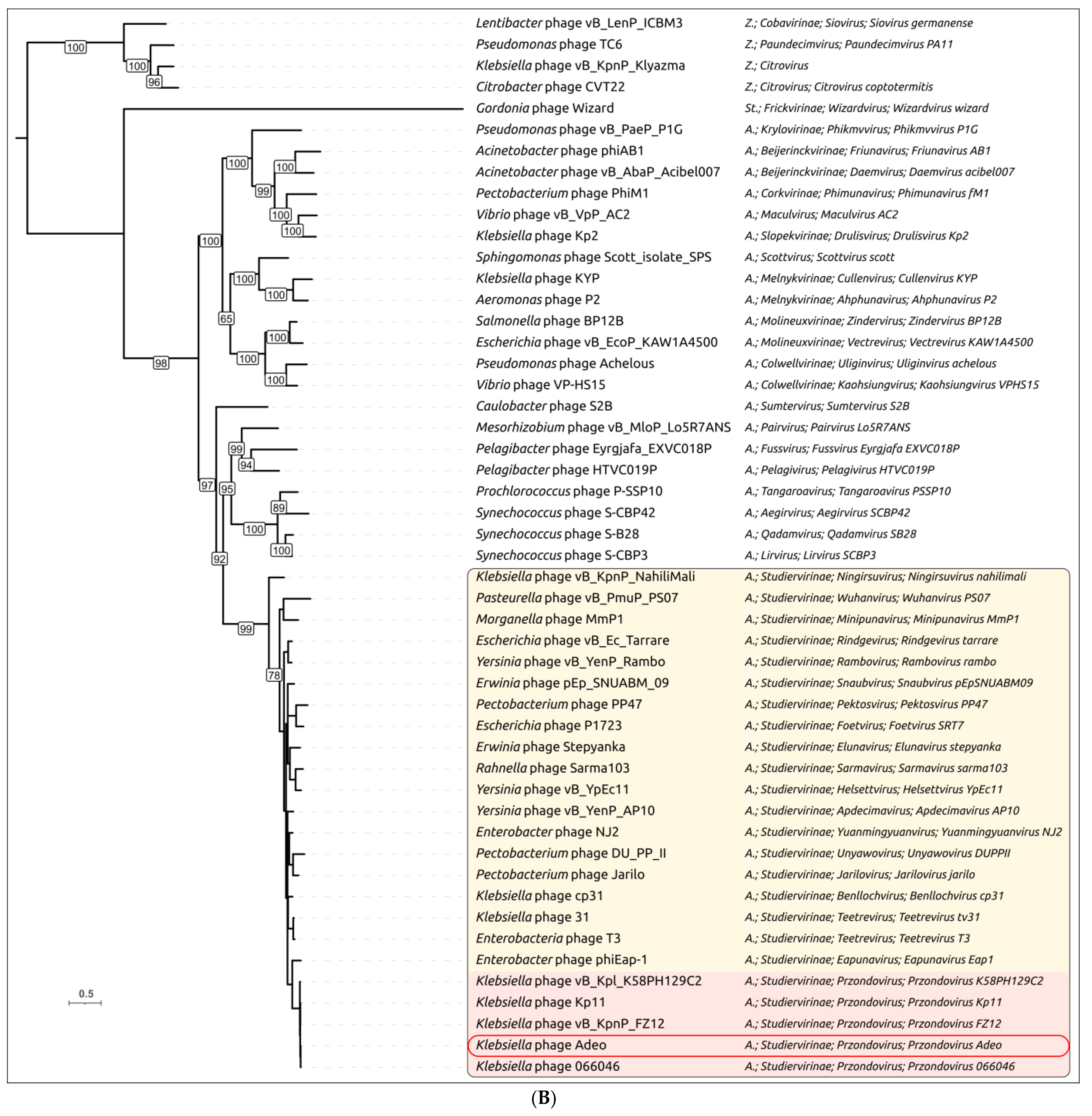
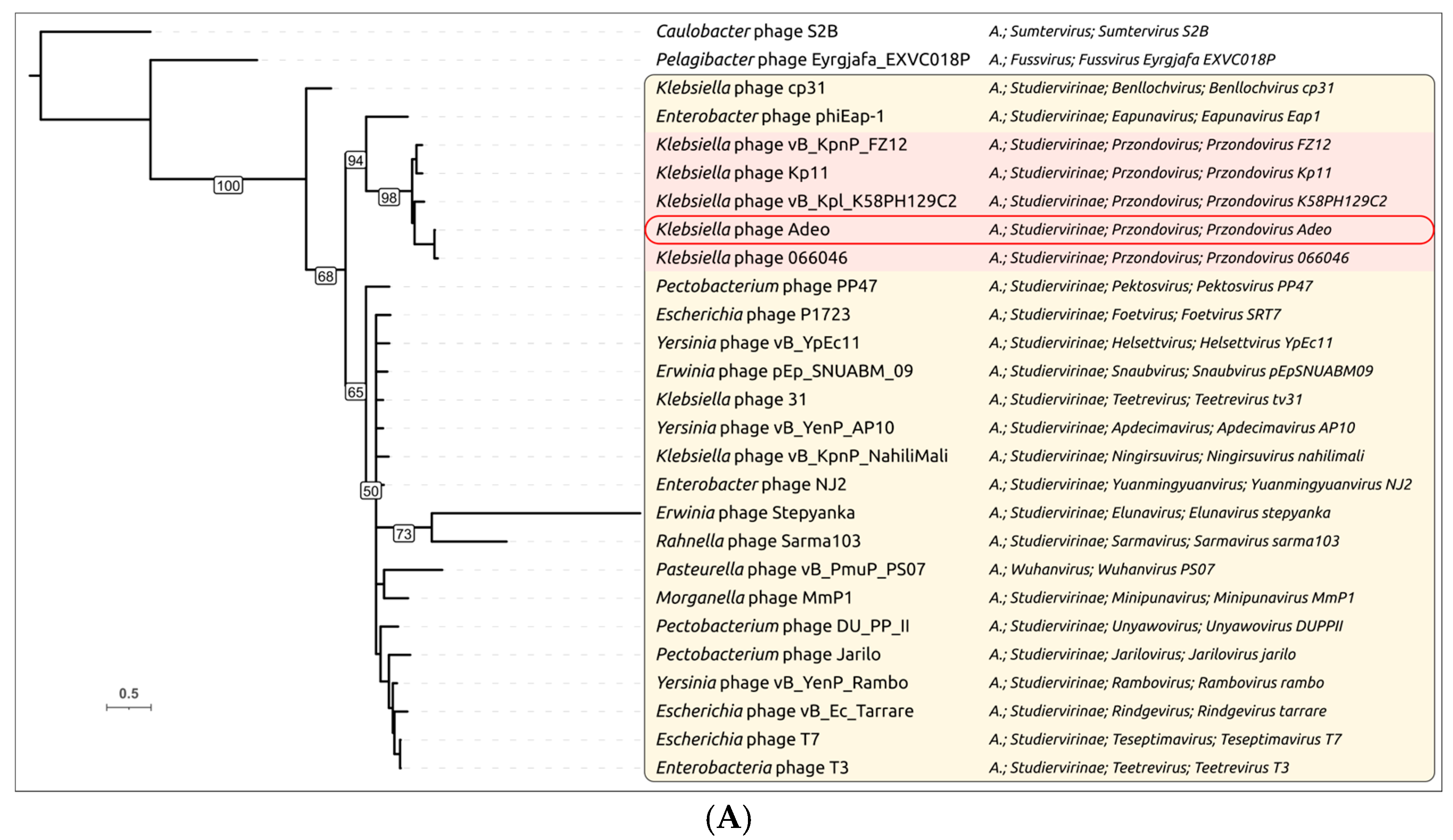
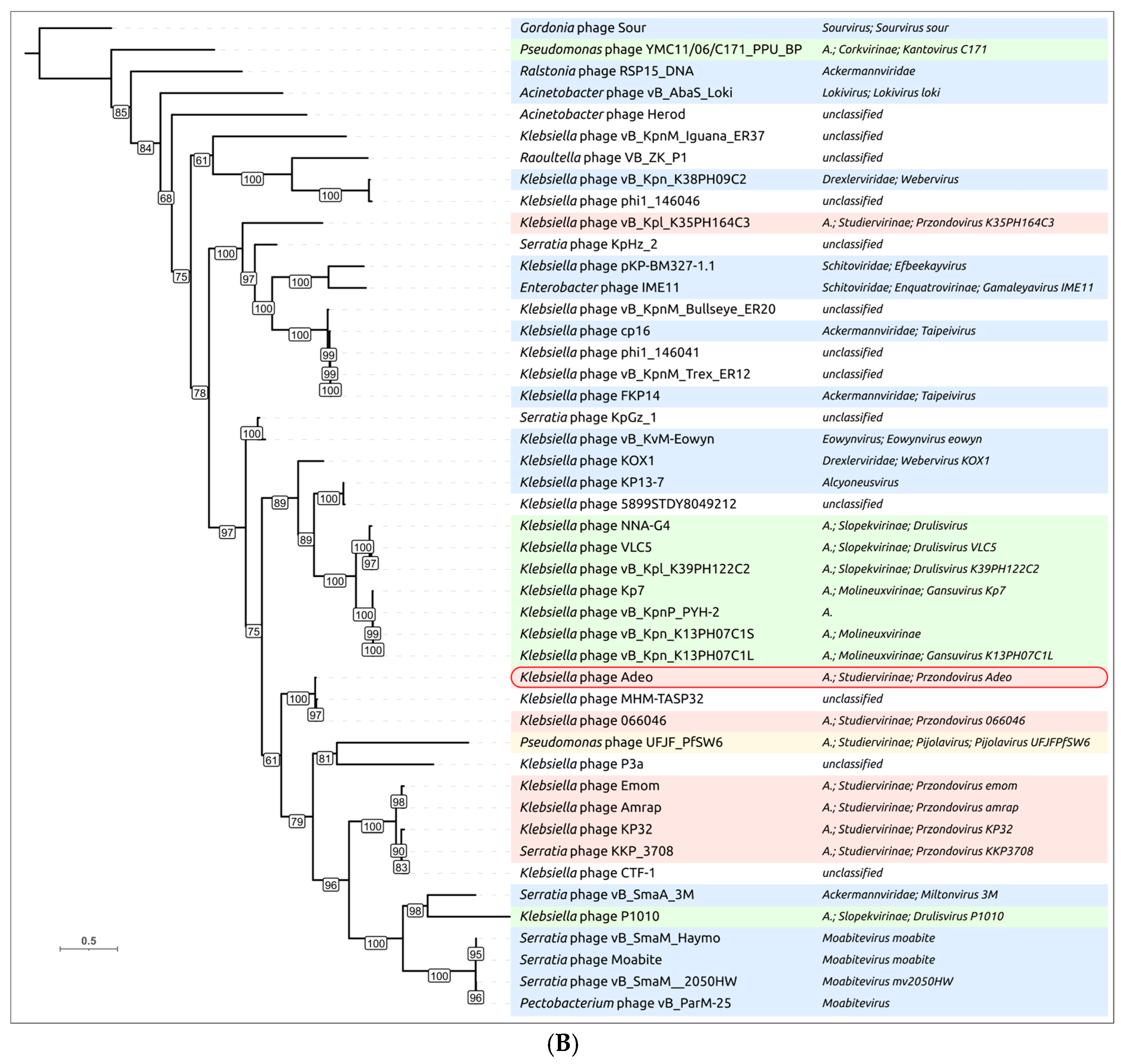
Phylogenetic analysis based on signature gene phylogenies was conducted using the amino acid sequences of the MCP (Figure 5A) and the terminase large subunit (TLS) (Figure 5B). Sequences were extracted from the genomes of 50 phages representing the order Autographivirales, including phages used in the intergenomic similarity calculations above, with additional Autographivirales-related phages from the families Stackebrandtviridae and Zobellviridae included as outgroups. This analysis generally supports the results described above. Phylogenies of MCP and TLS consistently place Klebsiella phage Adeo within Autographivirales, family Autotranscriptaviridae, subfamily Studiervirinae, genus Przondovirus. In the MCP tree, Adeo forms a well-supported sister relationship with Klebsiella phage 066046. This pair clusters with Klebsiella Przondovirus phages vB_KpnP_FZ12, Kp11, and KpK1_KSBPH129C2. The encompassing clade includes diverse Enterobacterales phages. The TLS phylogeny reproduced the same topology around Adeo and its closest neighbors, and the broader Przondovirus assemblage was recovered with strong support and similar intergeneric relationships. Overall congruence between the structural (MCP) and packaging (TLS) markers indicates vertical inheritance of these modules in Adeo and coevolution of these proteins, which may reflect a lower gene-content flux in lytic phages [70,71]. However, the placement of the temperate Gordonia phage Wizard in the MCP tree within one of two distinct clades that both contain Autographivirales raises questions about the origin and early evolution of Autographivirales and Stackebrandtviridae viruses. Furthermore, in the TLS tree, Pasteurella phage vB_PmuP_PS07 falls outside Przondovirus, grouping with Morganella phage MmP1 and its allies. Distant cyanophages and Pelagibacter phages form earlier-diverging branches that precede the Studiervirinae clade.

3.2.4. Tailspike Protein Analysis

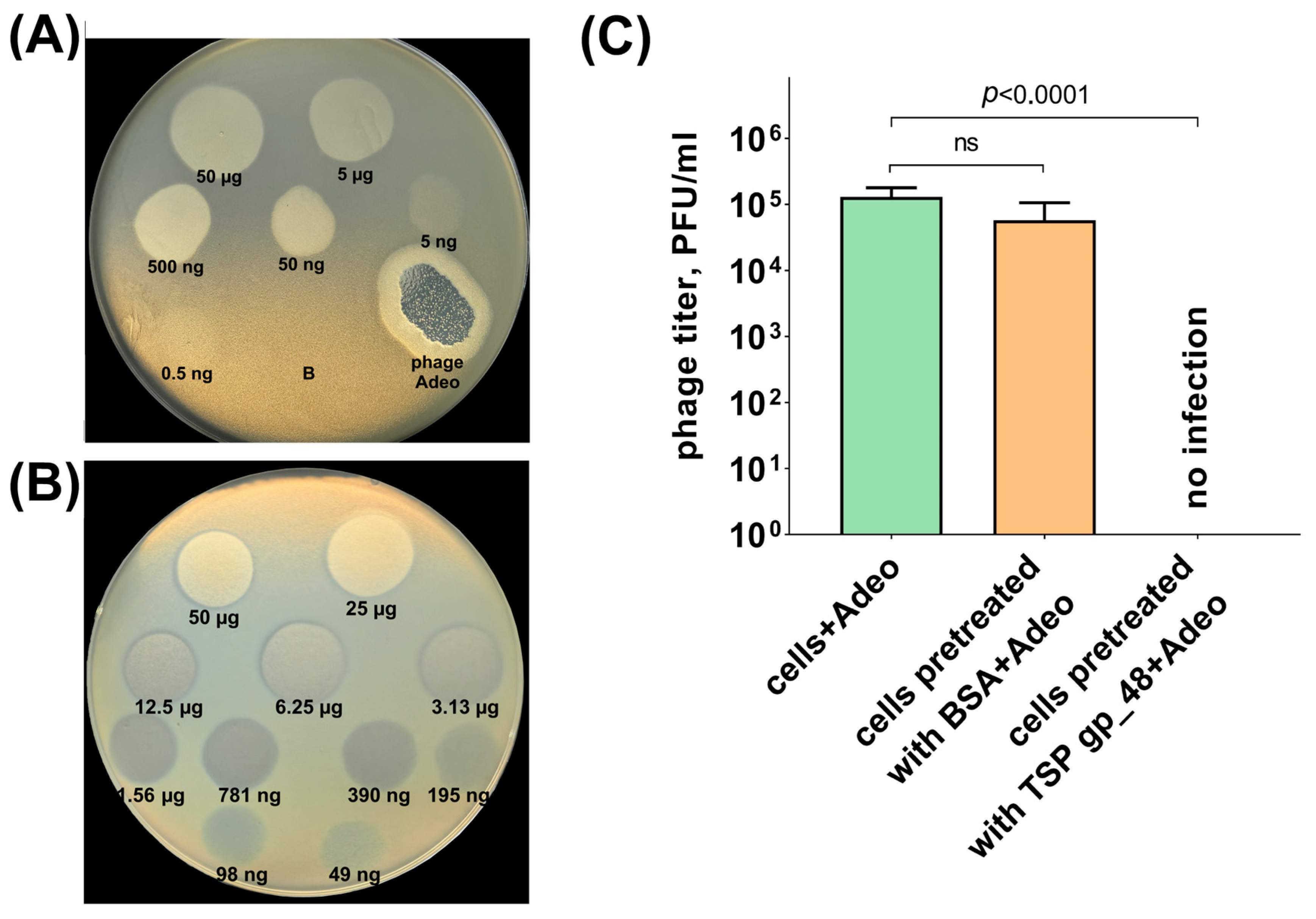
The genome of the phage Adeo encodes only one TSP with depolymerizing activity (Adeo_gp48, GenBank accession: WQZ01644) that determines specificity to K. pneumoniae with K39 CPS structure. Recombinant Adeo-derived depolymerase lacking the N-terminal domain was specific and formed an opaque halo (zone of depolymerization) on the bacterial lawn of K. pneumoniae KPB-1434/16 (Figure 6A,B) and on the lawns of the other K. pneumoniae of K39 type (n = 14, listed in Table S1) studied.
Phage infection inhibition or competition experiments have been performed to demonstrate that TSP Adeo_gp48 is responsible for the initial step of the phage Adeo-host cells interaction (Figure 6C). K. pneumoniae KPB-1434/16 host preincubated with purified recombinant protein Adeo_gp48 and with BSA in the negative-control experiment were mixed with several phage dilutions and plated on agar plates. After overnight incubation, phage titer was measured. It was shown that coincubation with Adeo_gp48 resulted in the K. pneumoniae KPB-1434/16 host cells becoming nonsusceptible to infection by phage Adeo. In other words, the addition of purified depolymerase Adeo_gp48 to the host cell at the chosen concentration (0.5 mg/mL) completely inhibited plaque formation. This means that the depolymerase effectively degraded the K39 CPS layer surrounding the K. pneumoniae KPB-1434/16 host cells and, consequently, the specific phage Adeo carrying TSPs with K39 polysaccharide-degrading activity could not specifically recognize the primary receptor, the K39 CPS polymer, and bind to the cell surface. In a negative-control experiment, host bacterial cells were pretreated with BSA (at the same concentration); after that, no significant differences in phage titers compared with the control without any protein were shown. This means that coincubation of host cells with BSA does not affect the K39 polymer capsule, and the phage could effectively bind to the cell at the initial step of infection.
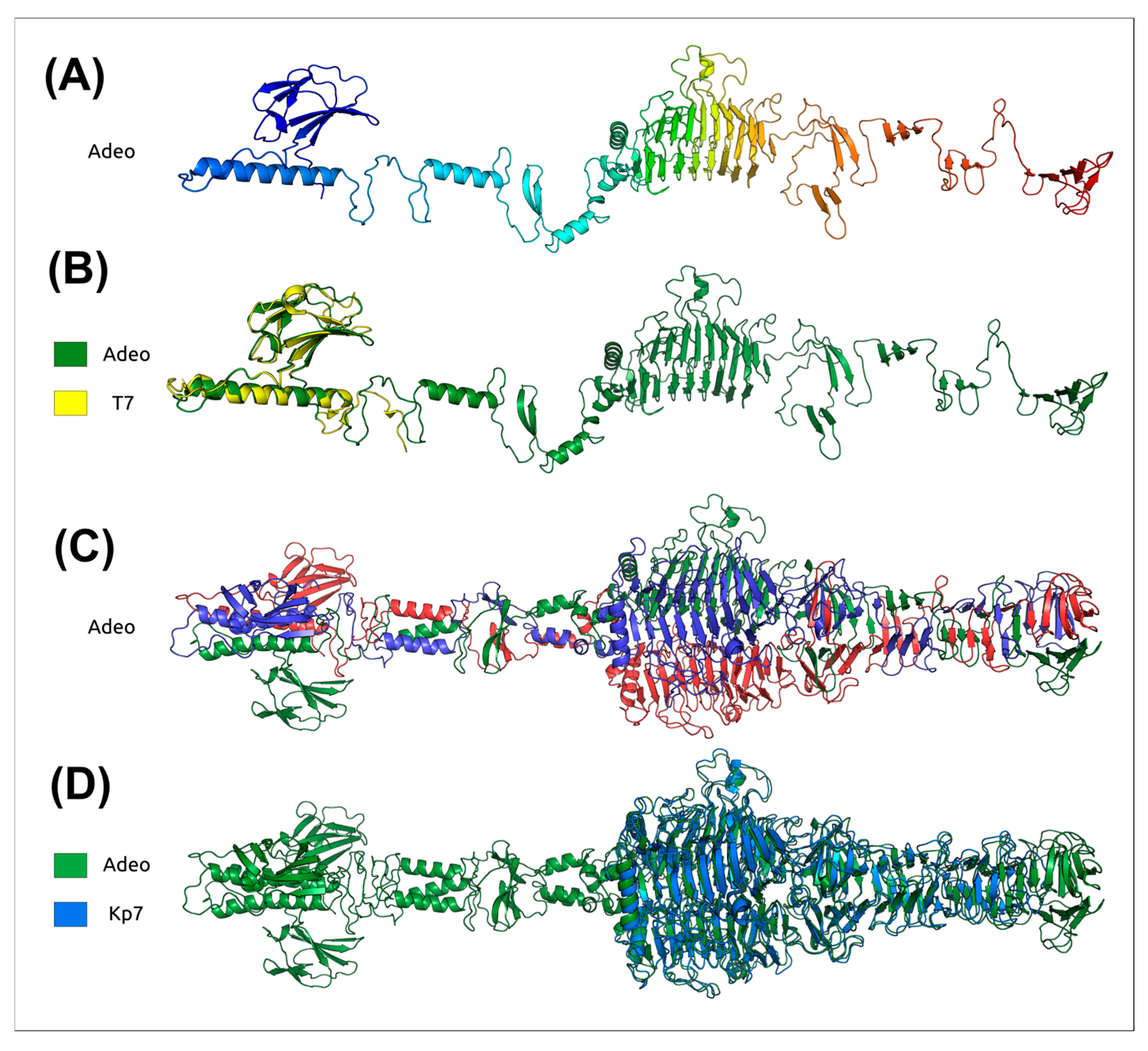
HMM-based analysis and structural modeling of Adeo’s TSP indicated its bipartite architecture, which included an N-terminal assembly/adapter module (N-terminus) and CPS-recognizing/degrading part or C-terminal polysaccharide-depolymerase module (C-terminus) (Figure 7). Structure-based superposition of the Adeo_gp48 N-terminus onto the homologous region (residues 6–141) of the Escherichia phage T7 tail fiber protein (PDB ID: 9JYZ [72]) yielded RMSD = 1.183 Å, indicating near-identity of the fold and supporting a conserved podoviral tail-attachment module. Conversely, the Adeo_gp48 C-terminus does not align to T7 but superposes onto the β-helix depolymerase domain of Klebsiella phage Kp7 (PDB ID: 7Y5S, https://www.rcsb.org/structure/7Y5S, accessed on 28 October 2015) with RMSD = 1.141 Å, indicating that Adeo carries a Klebsiella-type CPS depolymerase fused to a T7-like N-terminal adapter. These observations match the canonical functional division in podoviral tailspikes which imply conserved N-terminal trimerization/tail-docking and a variable, β-helix depolymerase that determines capsule specificity in Klebsiella phages [15,16,17].
Phylogenetic analysis using the closest phage sequences found by BLAST searches over the GenBank PHG database confirmed distinct evolutionary trajectories of the N- and C-terminal parts of Adeo’s TSP. In the N-terminus tree (Figure 8A), Adeo_gp48 clusters within the Autographivirales Autotranscriptaviridae Studiervirinae Przondovirus group alongside Klebsiella Przondovirus phages, including Kp11, KSBPH129C2, FZ12, and 066046. The tree preserves the expected relationships among these Enterobacteriaceae podoviruses. Together with the T7-like structural match (RMSD = 1.183 Å to 9JYZ), this topology indicates the vertical inheritance of the N-terminal domain within Przondovirus and the absence of recent domain replacement at the N-end. The C-terminus tree (Figure 8B) shows a markedly different picture. In this tree, Adeo_gp48 no longer groups exclusively with Przondovirus; instead, it falls inside a mixed Klebsiella depolymerase clade comprising phages from multiple taxa (e.g., Przondovirus, Drulisvirus/Ganusvirus-like groups, and even distantly related phages of the Ackermannviridae lineages). This crosstaxon clustering mirrors the convergent exchange of CPS-depolymerase domains among Klebsiella phages that attack the same or related capsule types [17,73].
The CPS-recognizing/degrading part of Adeo_gp48 shares a high percentage of amino acid similarity with the proteins encoded in Przondovirus 066046 (QOV07395) and unclassified Klebsiella phage MHM-TASP32 (XUJ68802). The similarity of amino acid sequences of these proteins indicates that they most likely interact specifically with CPS of the same structure, namely K39 CPS.
The close structural match of Adeo’s C-terminus to Kp7 depolymerase (RMSD = 1.141 Å to 7Y5S) is congruent with this placement and supports the assignment of Adeo_gp48 C-terminus to the right-handed β-helix lyase/hydrolase family, which is typical for Klebsiella capsule depolymerases. Comparing the two single-gene phylogenies demonstrates domain-wise incongruence. The N-terminus follows the virion-assembly lineage signal of Przondovirus (consistent with core virion genes such as MCP and TLS), whereas the C-terminus tracks substrate (capsule) specificity, grouping with depolymerases from Klebsiella phages of different taxonomy and origin. This discordance indicates a modular evolutionary history of Adeo’s TSP, with a conserved T7-like adapter inherited vertically within Przondovirus and a laterally acquired Klebsiella CPS-depolymerase module at the C-end.

4. Discussion

Phage Adeo is the first Przondovirus studied that is specific to K. pneumoniae belonging to the K39 type. The phage formed clear plaques with haloes, indicating the presence of structural proteins or tailspikes with depolymerizing activity. Recombinant Adeo-derived enzyme also formed zone of depolymerization on the bacterial lawn of K. pneumoniae KPB-1434/16 and effectively degraded K39 CPS of this strain inhibiting phage Adeo-host binding. The phage was characterized by rapid adsorption, large burst size, high stability, and the absence of genes encoding toxins, virulence factors, and antibiotic-resistance determinants in the genome. This indicates its potential for further practical usage as a candidate for controlling nosocomial infections caused by K. pneumoniae of the K39 type.
Genomic analysis indicated that Adeo belongs to Autographivirales, family Autotranscriptaviridae, subfamily Studiervirinae, genus Przondovirus, and shows a T7-like genomic layout: the early region contains the single-subunit RNA polymerase, the replication, packaging, and morphogenesis modules follow the canonical order for T7-like podoviruses. Intergenomic similarity and proteome phylogeny place Adeo within Przondovirus and support the status of a new species. MCP and TLS trees recover near-identical neighborhood for Adeo and resolve a compact Klebsiella Przondovirus cluster. Congruent placements of these two hallmark virion proteins indicate their vertical inheritance, which is consistent with a lower gene-content flux expected for strictly lytic lineages [70,71] and explains the high bootstrap support around the Adeo node in both trees. Comparisons with non-Studiervirinae podoviruses refine these conclusions: while Klebsiella Przondovirus phages form a coherent group across structural markers, Pasteurella phage vB_PmuP_PS07 falls outside this group in the terminase tree and supports the boundary of the Adeo clade. Distant cyanophages and pelagiphages form long-branched outgroups and do not affect Adeo placement. The observation that a T7-like early organization also appears in distant Autographivirales such as HTVC019P suggests that the common ancestor of Autographivirales already possessed a similar early transcription–replication architecture. Taken together, the single-gene analyses of signature markers robustly support the assignment of Adeo to the genus Przondovirus and clarify details of early evolution of Autographivirales.
Tailspike analysis revealed a clear division of evolutionary histories within a single protein. The N-terminus of the TSP Adeo_48 matches the T7 tail assembly adapter with near-identity of fold. The N-terminal tree clusters Adeo with Klebsiella Przondovirus phages and almost mirrors this part of the MCP and TLS topologies. This pattern indicates vertical inheritance of the adapter module within Przondovirus. The module likely mediates trimerization and docking to the phage particle and does not constrain receptor specificity [74,75,76]. The C-terminus shows a different signal. It aligns with the β-helix depolymerase domain of Klebsiella phage Kp7 and groups in a mixed Klebsiella depolymerase clade that spans several taxa. Such clustering reflects the exchange of polysaccharide-depolymerase domains among Klebsiella phages targeting the same or related capsules [73,76]. These observations explain the joint behavior of Adeo in single-gene phylogenies: markers tied to virion architecture, such as MCP, TLS, and the N-terminus of the tailspike, track the taxonomic backbone of Przondovirus, whereas the C-terminus of the tailspike follows capsule structure rather than phage taxonomy. Domain-wise incongruence indicates modular evolution with frequent lateral replacement of receptor-binding and catalytic regions [77,78].

Supplementary Materials

The following supporting information can be downloaded at: https://www.mdpi.com/article/10.3390/v17121600/s1, Figure S1: VIRIDIC intergenomic similarity clustered heatmap using 117 classified Przondovirus phages; Figure S2: VIRIDIC intergenomic similarity clustered heatmap for 117 genomes comprising ICTV-classified representatives of the genus Przondovirus; Figure S3: Proteome-based phylogenomic tree generated with ViPtree from genome-wide tBLASTx similarities; Table S1: The host specificity and lytic activity of phage Adeo.

Author Contributions

Conceptualization, A.V.P.; investigation, N.V.K., V.A.A. and A.V.P.; bioinformatic analysis, P.V.E., N.V.K., and N.V.V.; methodology, P.V.E., N.V.K., V.A.A., A.A.S., N.E.S. and A.V.P.; visualization, P.V.E., N.V.K. and A.V.P.; data curation, P.V.E. and A.V.P.; writing—original draft preparation, N.V.K., P.V.E. and A.V.P.; writing—review and editing, A.V.P.; supervision, A.V.P.; project administration, A.V.P. All authors have read and agreed to the published version of the manuscript.

Funding

This research was supported by the Ministry of Science and Higher Education of the Russian Federation, grant No. 075-15-2025-525 (Agreement dated 30 May 2025).

Institutional Review Board Statement

Not applicable.

Informed Consent Statement

Not applicable.

Data Availability Statement

The genome sequence of phage Adeo is available in GenBank under accession number OR855706.

Conflicts of Interest

The authors declare no conflicts of interest.

Abbreviations

The following abbreviations are used in this manuscript:
bpbase pair
CFUColony forming Unit
PFUPlaque Forming Unit
MOIMultiplicity of Infection
EOPEfficiency of Plating
ICTVInternational Committee on Taxonomy of Viruses

References

  1. Chang, D.; Sharma, L.; Dela Cruz, C.S.; Zhang, D. Clinical epidemiology, risk factors, and control strategies of Klebsiella pneumoniae infection. Front. Microbiol. 2021, 12, 750662. [Google Scholar] [CrossRef] [PubMed]
  2. Abbas, R.; Chakkour, M.; Zein El Dine, H.; Obaseki, E.F.; Obeid, S.T.; Jezzini, A.; Ghssein, G.; Ezzeddine, Z. General overview of Klebsiella pneumonia: Epidemiology and the role of siderophores in its pathogenicity. Biology 2024, 13, 78. [Google Scholar] [CrossRef] [PubMed]
  3. World Health Organization. Disease Outbreak News; Antimicrobial Resistance, Hypervirulent Klebsiella pneumoniae—Global Situation. Available online: https://www.who.int/emergencies/disease-outbreak-news/item/2024-DON527 (accessed on 12 October 2025).
  4. Ochońska, D.; Brzychczy-Włoch, M. Klebsiella pneumoniae—Taxonomy, occurrence, identification, virulence factors and pathogenicity. Adv. Microbiol. 2024, 63, 157–175. [Google Scholar] [CrossRef]
  5. Mancuso, G.; Midiri, A.; Gerace, E.; Biondo, C. Bacterial antibiotic resistance: The most critical pathogens. Pathogens 2021, 10, 1310. [Google Scholar] [CrossRef]
  6. Corona, A.; De Santis, V.; Agarossi, A.; Prete, A.; Cattaneo, D.; Tomasini, G.; Bonetti, G.; Patroni, A.; Latronico, N. Antibiotic therapy strategies for treating gram-negative severe infections in the critically ill: A narrative review. Antibiotics 2023, 12, 1262. [Google Scholar] [CrossRef]
  7. WHO. WHO Bacterial Priority Pathogens List 2024: Bacterial Pathogens of Public Health Importance, to Guide Research, Development, and Strategies to Prevent and Control Antimicrobial Resistance, 1st ed.; World Health Organization: Geneva, Switzerland, 2024; ISBN 978-92-4-009346-1. [Google Scholar]
  8. Whitfield, C.; Wear, S.S.; Sande, C. Assembly of bacterial capsular polysaccharides and exopolysaccharides. Annu. Rev. Microbiol. 2020, 74, 521–543. [Google Scholar] [CrossRef]
  9. Comstock, L.E.; Kasper, D.L. Bacterial glycans: Key mediators of diverse host immune responses. Cell 2006, 126, 847–850. [Google Scholar] [CrossRef]
  10. Rendueles, O.; Garcia-Garcerà, M.; Néron, B.; Touchon, M.; Rocha, E.P.C. Abundance and co-occurrence of extracellular capsules increase environmental breadth: Implications for the emergence of pathogens. PLoS Pathog. 2017, 13, e1006525. [Google Scholar] [CrossRef]
  11. Ophir, T.; Gutnick, D.L. A role for exopolysaccharides in the protection of microorganisms from desiccation. Appl. Environ. Microbiol. 1994, 60, 740–745. [Google Scholar] [CrossRef]
  12. D’Haeze, W.; Holsters, M. Surface polysaccharides enable bacteria to evade plant immunity. Trends Microbiol. 2004, 12, 555–561. [Google Scholar] [CrossRef]
  13. Matsuura, M. Structural modifications of bacterial lipopolysaccharide that facilitate gram-negative bacteria evasion of host innate immunity. Front. Immunol. 2013, 4, 109. [Google Scholar] [CrossRef]
  14. Lam, M.M.C.; Wick, R.R.; Judd, L.M.; Holt, K.E.; Wyres, K.L. Kaptive 2.0: Updated capsule and lipopolysaccharide locus typing for the Klebsiella pneumoniae species complex. Microb. Genom. 2022, 8, 000800. [Google Scholar] [CrossRef]
  15. Lu, Y.; Fang, C.; Xiang, L.; Yin, M.; Qian, L.; Yan, Y.; Zhang, L.; Li, Y. Characterization and therapeutic potential of three depolymerases against K54 capsular-type Klebsiella pneumoniae. Microorganisms 2025, 13, 1544. [Google Scholar] [CrossRef] [PubMed]
  16. Blundell-Hunter, G.; Enright, M.C.; Negus, D.; Dorman, M.J.; Beecham, G.E.; Pickard, D.J.; Wintachai, P.; Voravuthikunchai, S.P.; Thomson, N.R.; Taylor, P.W. Characterisation of bacteriophage-encoded depolymerases selective for key Klebsiella pneumoniae capsular exopolysaccharides. Front. Cell. Infect. Microbiol. 2021, 11, 686090. [Google Scholar] [CrossRef]
  17. Maciejewska, B.; Squeglia, F.; Latka, A.; Privitera, M.; Olejniczak, S.; Switala, P.; Ruggiero, A.; Marasco, D.; Kramarska, E.; Drulis-Kawa, Z.; et al. Klebsiella phage KP34gp57 capsular depolymerase structure and function: From a serendipitous finding to the design of active mini-enzymes against K. pneumoniae. mBio 2023, 14, e0132923. [Google Scholar] [CrossRef]
  18. Anderson, A.N.; Parolis, H.; Dutton, G.G.; Leek, D.M. Klebsiella serotype K39: Structure of an unusual capsular antigen deduced by use of a viral endoglucosidase. Carbohydr. Res. 1987, 167, 279–290. [Google Scholar] [CrossRef]
  19. Fursova, N.K.; Astashkin, E.I.; Ershova, O.N.; Aleksandrova, I.A.; Savin, I.A.; Novikova, T.S.; Fedyukina, G.N.; Kislichkina, A.A.; Fursov, M.V.; Kuzina, E.S.; et al. Multidrug-resistant Klebsiella pneumoniae causing severe infections in the Neuro-ICU. Antibiotics 2021, 10, 979. [Google Scholar] [CrossRef]
  20. Samoilova, A.A.; Kraeva, L.A.; Mikhailov, N.V.; Saitova, A.T.; Polev, D.E.; Vashukova, M.A.; Gordeeva, S.A.; Smirnova, E.V.; Beljatich, L.I.; Dolgova, A.S.; et al. Genomic analysis of Klebsiella pneumoniae strains virulence and antibiotic resistance. Russ. J. Infect. Immun. 2024, 14, 339–350. [Google Scholar] [CrossRef]
  21. Kolupaeva, N.V.; Kolupaeva, L.V.; Evseev, P.V.; Skryabin, Y.P.; Lazareva, E.B.; Chernenkaya, T.V.; Volozhantsev, N.V.; Popova, A.V. Acinetobacter baumannii and Klebsiella pneumoniae isolates obtained from intensive care unit patients in 2024: General characterization, prophages, depolymerases and esterases of phage origin. Viruses 2025, 17, 623. [Google Scholar] [CrossRef] [PubMed]
  22. Solovieva, E.V.; Myakinina, V.P.; Kislichkina, A.A.; Krasilnikova, V.M.; Verevkin, V.V.; Mochalov, V.V.; Lev, A.I.; Fursova, N.K.; Volozhantsev, N.V. Comparative genome analysis of novel Podoviruses lytic for hypermucoviscous Klebsiella pneumoniae of K1, K2, and K57 capsular types. Virus Res. 2018, 243, 10–18. [Google Scholar] [CrossRef]
  23. Teng, T.; Li, Q.; Liu, Z.; Li, X.; Liu, Z.; Liu, H.; Liu, F.; Xie, L.; Wang, H.; Zhang, L.; et al. Characterization and genome analysis of novel Klebsiella phage Henu1 with lytic activity against clinical strains of Klebsiella pneumoniae. Arch. Virol. 2019, 164, 2389–2393. [Google Scholar] [CrossRef]
  24. Qin, K.; Shi, X.; Yang, K.; Xu, Q.; Wang, F.; Chen, S.; Xu, T.; Liu, J.; Wen, W.; Chen, R.; et al. Phage-antibiotic synergy suppresses resistance emergence of Klebsiella pneumoniae by altering the evolutionary fitness. mBio 2024, 15, e0139324. [Google Scholar] [CrossRef]
  25. Huang, L.; Huang, X.; Zhao, T.; Zhang, J.; Xiang, Y. Isolation and characterization of three lytic podo-bacteriophages with two receptor recognition modules against multidrug-resistant Klebsiella pneumoniae. bioRxiv 2024. [Google Scholar] [CrossRef]
  26. Volozhantsev, N.V.; Borzilov, A.I.; Shpirt, A.M.; Krasilnikova, V.M.; Verevkin, V.V.; Denisenko, E.A.; Kombarova, T.I.; Shashkov, A.S.; Knirel, Y.A.; Dyatlov, I.A. Comparison of the therapeutic potential of bacteriophage KpV74 and phage-derived depolymerase (β-glucosidase) against Klebsiella pneumoniae capsular type K2. Virus Res. 2022, 322, 198951. [Google Scholar] [CrossRef]
  27. Lourenço, M.; Osbelt, L.; Passet, V.; Gravey, F.; Megrian, D.; Strowig, T.; Rodrigues, C.; Brisse, S. Phages against noncapsulated Klebsiella pneumoniae: Broader host range, slower resistance. Microbiol. Spectr. 2023, 11, e0481222. [Google Scholar] [CrossRef]
  28. Xu, J.; Tian, F.; Feng, Q.; Li, F.; Tong, Y. Genomic characterization of the novel bacteriophage IME183, infecting Klebsiella pneumoniae of capsular type K2. Arch. Virol. 2023, 168, 261. [Google Scholar] [CrossRef] [PubMed]
  29. Majkowska-Skrobek, G.; Latka, A.; Berisio, R.; Squeglia, F.; Maciejewska, B.; Briers, Y.; Drulis-Kawa, Z. Phage-borne depolymerases decrease Klebsiella pneumoniae resistance to innate defense mechanisms. Front. Microbiol. 2018, 9, 2517. [Google Scholar] [CrossRef] [PubMed]
  30. Hsieh, P.F.; Lin, H.H.; Lin, T.L.; Chen, Y.Y.; Wang, J.T. Two T7-like bacteriophages, K5-2 and K5-4, each encodes two capsule depolymerases: Isolation and functional characterization. Sci. Rep. 2017, 7, 4624. [Google Scholar] [CrossRef]
  31. Ando, H.; Lemire, S.; Pires, D.P.; Lu, T.K. Engineering modular viral scaffolds for targeted bacterial population editing. Cell Syst. 2015, 1, 187–196. [Google Scholar] [CrossRef] [PubMed]
  32. Lukianova, A.A.; Shneider, M.M.; Evseev, P.V.; Egorov, M.V.; Kasimova, A.A.; Shpirt, A.M.; Shashkov, A.S.; Knirel, Y.A.; Kostryukova, E.S.; Miroshnikov, K.A. Depolymerisation of the Klebsiella pneumoniae capsular polysaccharide K21 by Klebsiella phage K5. Int. J. Mol. Sci. 2023, 24, 17288. [Google Scholar] [CrossRef]
  33. Wu, Y.; Wang, R.; Xu, M.; Liu, Y.; Zhu, X.; Qiu, J.; Liu, Q.; He, P.; Li, Q. A novel polysaccharide depolymerase encoded by the phage SH-KP152226 confers specific activity against multidrug-resistant Klebsiella pneumoniae via biofilm degradation. Front. Microbiol. 2019, 10, 2768. [Google Scholar] [CrossRef]
  34. Fang, Q.; Zong, Z. Lytic phages against ST11 K47 carbapenem-resistant Klebsiella pneumoniae and the corresponding phage resistance mechanisms. mSphere 2022, 7, e0008022. [Google Scholar] [CrossRef]
  35. Pan, Y.J.; Lin, T.L.; Chen, Y.Y.; Lai, P.H.; Tsai, Y.T.; Hsu, C.R.; Hsieh, P.F.; Lin, Y.T.; Wang, J.T. Identification of three podoviruses infecting Klebsiella encoding capsule depolymerases that digest specific capsular types. Microb. Biotechnol. 2019, 12, 472–486. [Google Scholar] [CrossRef]
  36. Gorodnichev, R.B.; Kornienko, M.A.; Bespiatykh, D.A.; Malakhova, M.V.; Krivulia, A.O.; Veselovsky, V.A.; Bespyatykh, Y.A.; Goloshchapov, O.V.; Chernenkaya, T.V.; Shitikov, E.A. Isolation and characterization of virulent bacteriophages against Klebsiella pneumoniae of significant capsular types. Extrem. Med. 2023, 25, 159–167. [Google Scholar] [CrossRef]
  37. Li, M.; Xiao, Y.; Li, P.; Wang, Z.; Qi, W.; Qi, Z.; Chen, L.; Du, H.; Zhang, W. Characterization and genome analysis of Klebsiella phage P509, with lytic activity against clinical carbapenem-resistant Klebsiella pneumoniae of the KL64 capsular type. Arch. Virol. 2020, 165, 2799–2806. [Google Scholar] [CrossRef] [PubMed]
  38. Li, M.; Li, P.; Chen, L.; Guo, G.; Xiao, Y.; Chen, L.; Du, H.; Zhang, W. Identification of a phage-derived depolymerase specific for KL64 capsule of Klebsiella pneumoniae and its anti-biofilm effect. Virus Genes 2021, 57, 434–442. [Google Scholar] [CrossRef] [PubMed]
  39. Li, J.; Sheng, Y.; Ma, R.; Xu, M.; Liu, F.; Qin, R.; Zhu, M.; Zhu, X.; He, P. Identification of a depolymerase specific for K64-serotype Klebsiella pneumoniae: Potential applications in capsular typing and treatment. Antibiotics 2021, 10, 144. [Google Scholar] [CrossRef] [PubMed]
  40. Eckstein, S.; Stender, J.; Mzoughi, S.; Vogele, K.; Kühn, J.; Friese, D.; Bugert, C.; Handrick, S.; Ferjani, M.; Wölfel, R.; et al. Isolation and characterization of lytic phage TUN1 specific for Klebsiella pneumoniae K64 clinical isolates from Tunisia. BMC Microbiol. 2021, 21, 186. [Google Scholar] [CrossRef]
  41. Fang, Q.; Feng, Y.; McNally, A.; Zong, Z. Characterization of phage resistance and phages capable of intestinal decolonization of carbapenem-resistant Klebsiella pneumoniae in mice. Commun. Biol. 2022, 5, 48. [Google Scholar] [CrossRef]
  42. Yin, X.; Fang, Q.; Zong, Z. Interruption of capsular polysaccharide biosynthesis gene wbaZ by insertion sequence IS903B mediates resistance to a lytic phage against ST11 K64 carbapenem-resistant Klebsiella pneumoniae. mSphere 2022, 7, e0051822. [Google Scholar] [CrossRef]
  43. Wang, Q.; Chen, R.; Liu, H.; Liu, Y.; Li, J.; Wang, Y.; Jin, Y.; Bai, Y.; Song, Z.; Lu, X.; et al. Isolation and characterization of lytic bacteriophage vB_KpnP_23: A promising antimicrobial candidate against carbapenem-resistant Klebsiella pneumoniae. Virus Res. 2024, 350, 199473. [Google Scholar] [CrossRef]
  44. Yang, P.; Shan, B.; Hu, X.; Xue, L.; Song, G.; He, P.; Yang, X. Identification of a novel phage depolymerase against ST11 K64 carbapenem-resistant Klebsiella pneumoniae and its therapeutic potential. J. Bacteriol. 2025, 207, e0038724. [Google Scholar] [CrossRef]
  45. Thiry, D.; Passet, V.; Danis-Wlodarczyk, K.; Lood, C.; Wagemans, J.; De Sordi, L.; van Noort, V.; Dufour, N.; Debarbieux, L.; Mainil, J.G.; et al. New bacteriophages against emerging lineages ST23 and ST258 of Klebsiella pneumoniae and efficacy assessment in Galleria mellonella larvae. Viruses 2019, 11, 411. [Google Scholar] [CrossRef]
  46. Adams, M.H. Bacteriophages; Interscience Publishers: New York, NY, USA, 1959. [Google Scholar]
  47. Kutter, E. Phage host range and efficiency of plating. Methods Mol. Biol. 2009, 501, 141–149. [Google Scholar] [CrossRef]
  48. Sambrook, J.; Fritsch, E.F.; Maniatis, T. Molecular Cloning: A Laboratory Manual, 2nd ed.; Cold Spring Harbor Laboratory Press: Cold Spring Harbor, NY, USA, 1989; ISBN 0-87969-309-6. [Google Scholar]
  49. Bankevich, A.; Nurk, S.; Antipov, D.; Gurevich, A.A.; Dvorkin, M.; Kulikov, A.S.; Lesin, V.M.; Nikolenko, S.I.; Pham, S.; Prjibelski, A.D.; et al. SPAdes: A new genome assembly algorithm and its applications to single-cell sequencing. J. Comput. Biol. 2012, 19, 455–477. [Google Scholar] [CrossRef] [PubMed]
  50. Katoh, K.; Standley, D.M. MAFFT multiple sequence alignment software version 7: Improvements in performance and usability. Mol. Biol. Evol. 2013, 30, 772–780. [Google Scholar] [CrossRef] [PubMed]
  51. Nguyen, L.T.; Schmidt, H.A.; von Haeseler, A.; Minh, B.Q. IQ-TREE: A fast and effective stochastic algorithm for estimating maximum-likelihood phylogenies. Mol. Biol. Evol. 2015, 32, 268–274. [Google Scholar] [CrossRef] [PubMed]
  52. Moraru, C.; Varsani, A.; Kropinski, A.M. VIRIDIC—A novel tool to calculate the intergenomic similarities of prokaryote-infecting viruses. Viruses 2020, 12, 1268. [Google Scholar] [CrossRef]
  53. Abramson, J.; Adler, J.; Dunger, J.; Evans, R.; Green, T.; Pritzel, A.; Ronneberger, O.; Willmore, L.; Ballard, A.J.; Bambrick, J.; et al. Accurate structure prediction of biomolecular interactions with AlphaFold 3. Nature 2024, 630, 493–500. [Google Scholar] [CrossRef]
  54. Holm, L. Dali server: Structural unification of protein families. Nucleic Acids Res. 2022, 50, 210–215. [Google Scholar] [CrossRef]
  55. Holm, L. Using Dali for protein structure comparison. In Methods in Molecular Biology; Humana: New York, NY, USA, 2020; Volume 2112, pp. 29–42. [Google Scholar] [CrossRef]
  56. Alcock, B.P.; Huynh, W.; Chalil, R.; Smith, K.W.; Raphenya, A.R.; Wlodarski, M.A.; Edalatmand, A.; Petkau, A.; Syed, S.A.; Tsang, K.K.; et al. CARD 2023: Expanded curation, support for machine learning, and resistome prediction at the comprehensive antibiotic resistance database. Nucleic Acids Res. 2023, 51, 690–699. [Google Scholar] [CrossRef]
  57. Zhou, S.; Liu, B.; Zheng, D.; Chen, L.; Yang, J. VFDB 2025: An integrated resource for exploring anti-virulence compounds. Nucleic Acids Res. 2025, 53, 871–877. [Google Scholar] [CrossRef] [PubMed]
  58. Zimmermann, L.; Stephens, A.; Nam, S.-Z.; Rau, D.; Kübler, J.; Lozajic, M.; Gabler, F.; Söding, J.; Lupas, A.N.; Alva, V. A completely reimplemented MPI bioinformatics toolkit with a new HHpred server at its core. J. Mol. Biol. 2018, 430, 2237–2243. [Google Scholar] [CrossRef]
  59. Altschul, S.F.; Gish, W.; Miller, W.; Myers, E.W.; Lipman, D.J. Basic local alignment search tool. J. Mol. Biol. 1990, 215, 403–410. [Google Scholar] [CrossRef]
  60. Shchurova, A.S.; Shneider, M.M.; Arbatsky, N.P.; Shashkov, A.S.; Chizhov, A.O.; Skryabin, Y.P.; Mikhaylova, Y.V.; Sokolova, O.S.; Shelenkov, A.A.; Miroshnikov, K.A.; et al. Novel Acinetobacter baumannii myovirus TaPaz encoding two tailspike depolymerases: Characterization and host-recognition strategy. Viruses 2021, 13, 978. [Google Scholar] [CrossRef]
  61. Evseev, P.V.; Lukianova, A.A.; Shneider, M.M.; Korzhenkov, A.A.; Bugaeva, E.N.; Kabanova, A.P.; Miroshnikov, K.K.; Kulikov, E.E.; Toshchakov, S.V.; Ignatov, A.N.; et al. Origin and evolution of Studiervirinae bacteriophages infecting Pectobacterium: Horizontal transfer assists adaptation to new niches. Microorganisms 2020, 8, 1707. [Google Scholar] [CrossRef]
  62. Boeckman, J.; Korn, A.; Yao, G.; Ravindran, A.; Gonzalez, C.; Gill, J. Sheep in Wolves’ Clothing: Temperate T7-like bacteriophages and the origins of the Autographiviridae. Virology 2022, 568, 86–100. [Google Scholar] [CrossRef] [PubMed]
  63. Bujak, K.; Decewicz, P.; Rosinska, J.M.; Radlinska, M. Genome study of a novel virulent phage vB_SspS_KASIA and Mu-like prophages of Shewanella sp. M16 provides insights into the genetic diversity of the Shewanella virome. Int. J. Mol. Sci. 2021, 22, 11070. [Google Scholar] [CrossRef] [PubMed]
  64. Zhao, Y.; Qin, F.; Zhang, R.; Giovannoni, S.J.; Zhang, Z.; Sun, J.; Du, S.; Rensing, C. Pelagiphages in the Podoviridae family integrate into host genomes. Environ. Microbiol. 2019, 21, 1989–2001. [Google Scholar] [CrossRef]
  65. Nguyen, H.M.; Kang, C. Lysis delay and burst shrinkage of coliphage T7 by deletion of terminator Tφ reversed by deletion of early genes. J. Virol. 2014, 88, 2107–2115. [Google Scholar] [CrossRef]
  66. Walkinshaw, M.D.; Taylor, P.; Sturrock, S.S.; Atanasiu, C.; Berge, T.; Henderson, R.M.; Edwardson, J.M.; Dryden, D.T.F. Structure of Ocr from bacteriophage T7, a protein that mimics B-form DNA. Mol. Cell 2002, 9, 187–194. [Google Scholar] [CrossRef]
  67. Isaev, A.; Drobiazko, A.; Sierro, N.; Gordeeva, J.; Yosef, I.; Qimron, U.; Ivanov, N.V.; Severinov, K. Phage T7 DNA mimic protein Ocr is a potent inhibitor of BREX defence. Nucleic Acids Res. 2020, 48, 5397–5406. [Google Scholar] [CrossRef] [PubMed]
  68. Summer, E.J.; Berry, J.; Tran, T.A.T.; Niu, L.; Struck, D.K.; Young, R. Rz/Rz1 Lysis gene equivalents in phages of gram-negative hosts. J. Mol. Biol. 2007, 373, 1098–1112. [Google Scholar] [CrossRef]
  69. Turner, D.; Kropinski, A.M.; Adriaenssens, E.M. A Roadmap for genome-based phage taxonomy. Viruses 2021, 13, 506. [Google Scholar] [CrossRef] [PubMed]
  70. Mavrich, T.N.; Hatfull, G.F. Bacteriophage evolution differs by host, lifestyle and genome. Nat. Microbiol. 2017, 2, 17112. [Google Scholar] [CrossRef]
  71. Moura de Sousa, J.A.; Pfeifer, E.; Touchon, M.; Rocha, E.P.C. Causes and consequences of bacteriophage diversification via genetic exchanges across lifestyles and bacterial taxa. Mol. Biol. Evol. 2021, 38, 2497–2512. [Google Scholar] [CrossRef] [PubMed]
  72. Zheng, J.; Xiao, H.; Pang, H.; Wang, L.; Song, J.; Chen, W.; Cheng, L.; Liu, H. Conformational changes in and translocation of small proteins: Insights into the ejection mechanism of podophages. J. Virol. 2025, 99, e01249-24. [Google Scholar] [CrossRef]
  73. Cheetham, M.J.; Huo, Y.; Stroyakovski, M.; Cheng, L.; Wan, D.; Dell, A.; Santini, J.M. Specificity and diversity of Klebsiella pneumoniae phage-encoded capsule depolymerases. Essays Biochem. 2024, 68, 661–677. [Google Scholar] [CrossRef]
  74. Cuervo, A.; Pulido-Cid, M.; Chagoyen, M.; Arranz, R.; González-García, V.A.; Garcia-Doval, C.; Castón, J.R.; Valpuesta, J.M.; van Raaij, M.J.; Martín-Benito, J.; et al. Structural characterization of the bacteriophage T7 tail machinery. J. Biol. Chem. 2013, 288, 26290–26299. [Google Scholar] [CrossRef]
  75. Tang, L.; Marion, W.R.; Cingolani, G.; Prevelige, P.E.; Johnson, J.E. Three-dimensional structure of the bacteriophage P22 tail machine. EMBO J. 2005, 24, 2087–2095. [Google Scholar] [CrossRef]
  76. Latka, A.; Leiman, P.G.; Drulis-Kawa, Z.; Briers, Y. Modeling the architecture of depolymerase-containing receptor binding proteins in Klebsiella phages. Front. Microbiol. 2019, 10, 2649. [Google Scholar] [CrossRef] [PubMed]
  77. Latka, A.; Lemire, S.; Grimon, D.; Dams, D.; Maciejewska, B.; Lu, T.; Drulis-Kawa, Z.; Briers, Y. Engineering the modular receptor-binding proteins of Klebsiella phages switches their capsule serotype specificity. mBio 2021, 12, e00455-21. [Google Scholar] [CrossRef] [PubMed]
  78. Pas, C.; Latka, A.; Fieseler, L.; Briers, Y. Phage tailspike modularity and horizontal gene transfer reveals specificity towards E. coli O-antigen serogroups. Virol. J. 2023, 20, 174. [Google Scholar] [CrossRef] [PubMed]
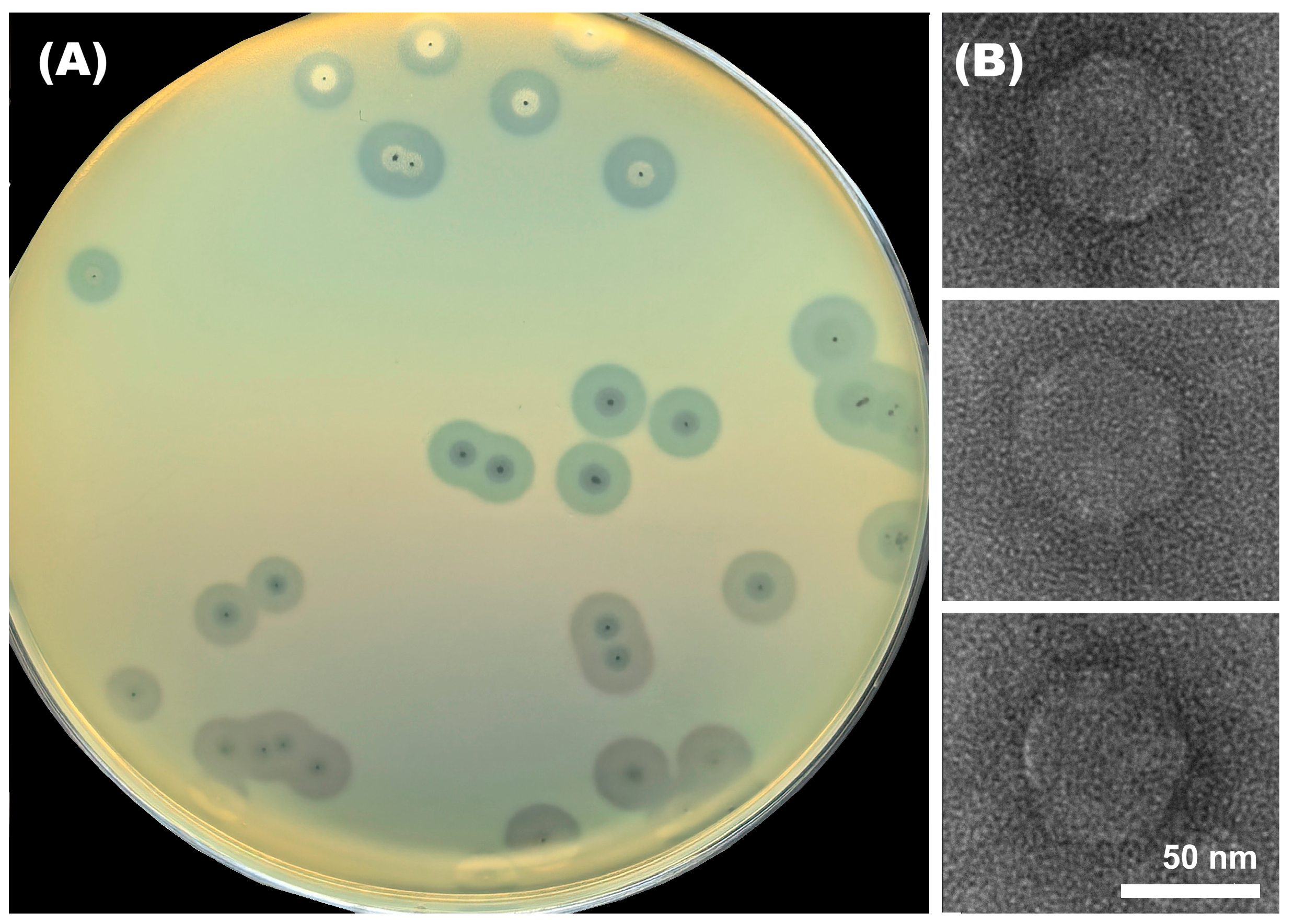
Figure 1. (A) Adeo plaques with opaque haloes on K. pneumoniae KPB-1434/16. (B) Transmission electron micrographs of different phage Adeo particles. Staining with 0.3% uranyl acetate. The scale bar is 50 nm.
Viruses 17 01600 g001
Figure 2. Infection analysis and phage Adeo stability. Adsorption assay (A) and one-step growth curve (B) of phage Adeo on K. pneumoniae KPB-1434/16 with the indication of estimated burst size (BS) and latent period (L). (C) Activity of phage Adeo in a range of different temperatures during 1 h of incubation. (D) Stability of phage Adeo in various pH conditions during 1 h of incubation. Results are presented as means and standard deviations from three independent experiments. PFU: plaque-forming units.
Viruses 17 01600 g002
Figure 3. Genetic map of the Klebsiella phage Adeo. Predicted genes are depicted as arrows oriented in the transcription direction. Functional annotations and predicted gene products are indicated by labels and legends. The scale bar denotes nucleotide positions along the genome. DTR: direct terminal repeats.
Viruses 17 01600 g003
Figure 4. Comparative genomic map of Klebsiella phage Adeo, Klebsiella phage 06646, Escherichia phage T7, Pelagibacter phage HTVC019P, and Klebsiella phage Kp2. Arrows indicate predicted genes and their transcriptional orientation. The grayscale scale bar indicates gene identity with a 25% cutoff. Genes encoding similar proteins are rendered in the same colors across genomes, whereas non-homologous proteins are shown in gray.
Viruses 17 01600 g004
Figure 5. Maximum-likelihood phylogenies of the major capsid protein (A) and the large terminase subunit (B). Bootstrap support values are shown at nodes; the scale bar indicates substitutions per site. Colored areas highlight Studiervirinae; the Przondovirus group is shaded light red; Adeo is outlined in red. Clades with bootstrap support < 50 are shown as polytomies. The ICTV taxonomy is shown to the right. The abbreviations “A.”, “St.”, and “Z” denote Autographivirales, Stackebrandtviridae, and Zobellviridae, respectively.
Viruses 17 01600 g005aViruses 17 01600 g005b
Figure 6. Spot test with serial 10-fold (A) and 2-fold (B) titration of purified recombinant TSP Adeo_gp48 on K. pneumoniae KPB-1434/16 lawn after 16 h of incubation. B—buffer for storage of the protein as a negative control. Phage Adeo—a spot formed by the phage Adeo (10 µL from a phage preparation with the titer of 108 PFU/mL). (C) Phage Adeo infection inhibition by TSP Adeo_gp48. From left to right, phage titers were observed on the bacterial lawns after the treatment of K. pneumoniae KPB-1434/16 cells with phage Adeo only, after preincubated of cell cultures with BSA (as a negative control, at a final concentration of 0.5 mg/mL), and with purified TSP Adeo_gp48 (at a final concentration of 0.5 mg/mL), followed by phage Adeo treatment. Significance was determined using the t-test. p: p-value, ns: not significant.
Viruses 17 01600 g006
Figure 7. Structural analysis of the TSP Adeo_gp48. (A) TSP Adeo_gp48 model colored from N-terminus to C-terminus. (B) the N-terminal region (residues 6–141) of the Escherichia phage T7 tail fiber protein (PDB ID: 9JYZ) superposed on the Adeo’s TSP model; RMSD = 1.183 Å (Adeo, green; T7, yellow). (C) Adeo’s TSP trimer model, each subunit is depicted in a different color. (D) C-terminal depolymerase domain of the Klebsiella phage Kp7 depolymerase (PDB ID: 7Y5S) superposed on the TSP Adeo_gp48 trimer model; RMSD = 1.141 Å (Adeo, green; Kp7, blue).
Viruses 17 01600 g007
Figure 8. Maximum-likelihood trees of the N-terminal (A) and C-terminal region (B) of TSPs from representative phages. Bootstrap values are shown at nodes; scale bar, substitutions per site. Colored areas highlight Studiervirinae (light red), not-Studiervirinae phages (green) and other phage groups (blue) classified by ICTV or in NCBI annotations; Adeo is outlined. Clades with bootstrap support values < 50 are shown as polytomies. The ICTV or NCBI taxonomy is shown on the right. The abbreviation “A.” stands for Autographivirales.
Viruses 17 01600 g008aViruses 17 01600 g008b
Disclaimer/Publisher’s Note: The statements, opinions and data contained in all publications are solely those of the individual author(s) and contributor(s) and not of MDPI and/or the editor(s). MDPI and/or the editor(s) disclaim responsibility for any injury to people or property resulting from any ideas, methods, instructions or products referred to in the content.