Abstract
In recent years, the prevalence of pseudorabies virus (PRV) has caused huge economic losses to the Chinese pig industry. Meanwhile, PRV infection in humans also sounded the alarm about its cross-species transmission from pigs to humans. To study the regional PRV epidemic, serological and epidemiological investigations of PRV in pig populations from Yunnan Province during 2017–2021 were performed. The results showed that 31.37% (6324/20,158, 95% CI 30.73–32.01) of serum samples were positive for PRV glycoprotein E (gE)-specific antibodies via enzyme-linked immunosorbent assay (ELISA). The risk factors, including the breeding scale and development stage, were significantly associated with PRV seroprevalence among pigs in Yunnan Province. Of the 416 tissue samples collected from PRV-suspected pigs in Yunnan Province, 43 (10.33%, 95% CI 7.41–13.26) samples were positive for PRV-gE nucleic acid in which 15 novel PRV strains from these PRV-positive samples were isolated, whose gC and gE sequences were analyzed. Phylogenetic analysis showed that all 15 isolates obtained in this study belonged to the genotype II. Additionally, the gC gene of one isolate (YuN-YL-2017) was genetically closer to variant PRV strains compared with others, while the gE gene was in the same clade with other classical PRV strains, indicating that this isolate might be a recombinant strain generated from the classical and variant strains. The results revealed the severe PRV epidemic in Yunnan Province and indicated that PRV variants are the major genotypes threatening the pig industry development.
1. Introduction
Pseudorabies (PR) is a devastating infectious disease that poses a huge threat to the development of the pig industry worldwide [1]. The causative agent of PR, pseudorabies virus (PRV) or Suid herpesvirus (SuHV-1), is an enveloped double-stranded DNA virus that belongs to the subfamily Alphaherpesvirinae of the family of Herpesviridae [2]. Pigs are known as the natural host and reservoir for PRV. The clinical symptoms of pigs infected with PRV vary depending on the growth stages: in newborn piglets, PRV infection causes severe diarrhea, vomiting, and neurological symptoms, resulting in high morbidity; in pregnant sows, PRV infection leads to reproductive failure [2,3]. Moreover, PRV has an intensive cross-species transmission capacity, which can infect a wide variety of animals, such as pigs, ruminants, carnivores, bears, etc. [4]. Notably, PRV transmission from pigs to humans has raised worldwide concerns since Chinese researchers recently have successfully isolated a variant PRV strain from an acute human encephalitis case [5].
Since the first detection of PRV in the United States, the disease caused by this pathogen has been observed in many countries, including Canada, China, and Hungary [6]. PR has been successfully controlled or eradicated in some countries or regions, such as Canada and Mexico, due to the application of multiple diagnosis approaches and glycoprotein E (gE)-deleted live or attenuated PRV vaccines [2]. However, this infectious disease remains widely prevalent in Chinese populations. Since late 2011 especially, PRs caused by PRV variants have frequently erupted in some Bartha-K61-immuized pig farms in China [7,8]. Subsequent experiments showed that the Bartha-K61 vaccine could not provide complete protection against these variants [8].
Currently, PRV strains are composed of two genotypes (genotype I and genotype II). PRV strains from Europe and USA belong to the genotype I, while most of genotype II PRV strains are isolated from Asian countries, mainly in China [2]. Moreover, the genotype II strains can be further divided into two sub-genotypes (classical PRV strains and variant PRV strains) [2]. According to the genetic characteristics among different PRV genotype strains, several amino acid (aa) insertions and deletions were observed, for example, the PRV genotype II strains have a 3-aa continuous deletion (75VPG79) in the UL27 gene and a 7-aa continuous insertion (63AASTPAA69) in the UL44 gene compared with PRV genotype I strains [9].
An investigation of the prevalence of PRV is required to build up strategies to control and even eradicate PR and minimize the risk of humans contacting this infectious pathogen. Though the prevalence and genetic characteristics of PRV have been documented in several regions or provinces of China [2,3,10,11], the relevant information in Yunnan Province in recent years is still not available. To fill in this gap, 20,158 pig serum samples were collected from 2017 to 2021 to investigate the epidemiology of PRV in Yunnan Province. Furthermore, the genetic characteristics of 15 newly isolated PRV strains were analyzed based on their gC and gE sequences.
2. Materials and Methods
2.1. Samples Collection
A total of 20,158 pig serum specimens were collected from 573 pig farms between March 2017 and December 2021, which nearly covered the entire Yunnan Province, China. The sampled pigs were chosen according to the breeding scale and breeding model. In brief, approximately equal numbers of specimens were collected from different growth stages (sucking piglets, nursery pigs, fattening pigs, sows, and gilts). Meanwhile, approximately equal sampling frequency was applied; 10, 25~30, and 50~60 serum samples were collected from each small (<100 sows), medium (100~500 sows), and large-scaled pig farm (>500 sows), respectively. In addition, tissue samples (such as brain, lymph node, lung, and kidney) were collected from 416 PRV infection-suspected pigs in 107 farms; the clinical symptoms of these diseased pigs mainly included encephalitis, diarrhea, fever, etc. The specimens were collected with standard procedures and delivered to Yunnan Animal Science and Veterinary Institute in a cold environment. Detailed information of each sample was documented.
2.2. Serological Detection of Anti PRV-gE Antibodies
Anti-gE antibodies in each serum sample were detected with Pseudorabies Virus (PRV)-gE antibody ELISA Kits (Cat: CP144, IDEXX Laboratories, Westrook, ME, USA) following the manufacturer’s instructions, which could be used to differentiate the vaccine strain or field strain-infected pigs.
2.3. Virus Detection and Isolation
Viral DNA were extracted from the tissue samples using a DNA Isolation Kit (Genenode Biotech Co.Ltd., Beijing, China) according to the manufacturer’s instructions. PCR was performed targeting the partial PRV-gE gene, with primers gE-F/R (gE-F: 5′-CCCAACGACACGGGCCTCTA-3′; gE-R:5′-GCACAGCACGCAGAGCCAGA-3′). The virus was isolated from PRV-positive tissue samples for subsequent experiments. Briefly, the tissue samples were homogenized and subjected to three freeze–thaw cycles. The supernatants, containing PRV virus, were filtered through a 0.22 µm filter after centrifugation and inoculated into a monolayer of BHK-21 or ST cells, which were cultured in a 5% CO2 incubator at 37 °C. The supernatants and cells with obvious cytopathic effects (CPE) were harvested for plaque purification assays [3] and molecular identification by real-time PCR assays. Viral titers were determined by the Reed–Muench method in ST cells and the 50% lethal dose (LD50) of which in mice models were calculated as described by Luo et al. [12].
2.4. Sequencing and Genetic Analysis
PCR was performed to amplify the complete sequences of gE and gC of 15 novel PRV strains as described previously [2]. The positive PCR products were purified and cloned into the pUCm-T vector. The plasmid carrying either the gE or gC gene was sequenced in duplicate. The full-length of gE or gC sequences of 15 newly isolated PRV strains and reference strains were compared using the DNAStar version 7.10 software. The phylogenetic tree based on the gE or gC gene was generated using the neighbor-joining (NJ) method in MEGA X software, with 1000 bootstrap replicates [13]. Detailed information of 15 novel PRV isolates and reference strains were available in the NCBI database as shown in Table 1.
Table 1.
Detailed information of PRV strains identified in this study and reference strains, including strain name, collection year, isolation region, viral titer, the median lethal doses (LD50) to mice, and GenBank accession numbers.
2.5. Data Analyses
The seroprevalence of PRV in pigs was presented as the minimum infection rate (MIR) with 95% confidence intervals (CIs). The statistical significance of PRV-gE seroprevalence among different groups was analyzed using a Chi-square test in SPSS 21.0 software (SPSS Inc., Chicago, IL, USA). A difference with a p-value < 0.05 was considered statistically significant.
3. Results
3.1. Seroprevalence of PRV-gE in Yunnan Province during 2017–2021
In total, 573 pig farms were included in this survey, where nearly all sampled pigs had been immunized with an attenuated PRV vaccine (Bartha-K61 or HB-98 strain) or inactivated PRV vaccine. Of the collected serum samples, 6324 out of 20,158 samples were seropositive for PRV-gE specific antibodies, contributing to the overall positive rate of 31.37% (95% CI 30.73–32.01). The seroprevalence rates of PRV-gE from March 2017 to Augest 2018, September 2018 to January 2020, and April 2020 to December 2021 were 29.25% (2355/8051), 41.48% (2449/5904), and 24.50% (1520/6203), respectively (Table 2) (p < 0.01).
Table 2.
Seroprevalence of PRV-gE among pigs in Yunnan province with different risk factors.
In terms of pig herds, the average PRV-gE seroprevalence rate in piglets (16.72%, 442/2644) was significantly lower than these of other development stages of pigs (25.29~40.94%) (p < 0.01) (Table 2). Moreover, we further investigated the seroprevalence of PRV in pig farms with different breeding scales, which showed that the lowest seroprevalence was observed in medium scale farms (24.80%, 1556/6273), followed by small-scale farms and large-scale farms at 33.45% (3495/10,447) and 37.03% (1273/3438), respectively (p < 0.01) (Table 2).
3.2. PRV Detection and Viral Isolation
As shown in Table 3, of the 416 tissue samples collected from PR-suspected pigs, 43 (10.33%, 95% CI 7.41–13.26) samples were positive for PRV-gE nucleic acids. The detection rate of PRV among collected samples from March 2017 to August 2018, September 2018 to January 2020, and April 2020 to December 2021 were 9.04% (16/177), 14.56% (15/103), and 8.82% (12/136), respectively (p > 0.05). In terms of tissue samples from the pigs with different clinical symptoms, the positive rates of PRV infection among aborted fetuses (13.89%, 15/108) and piglets with neurological symptoms (18.07%, 15/83) were higher than other samples (5.78%, 13/225) (p < 0.01).
Table 3.
The PRV-gE DNA positive rates among pigs with different risk factors.
To further investigate the genetic features of PRV strains prevalent in Yunnan Province in recent years, 15 PRV strains were successfully isolated from the PRV-positive samples, purified via plaque purification, and further validated by PCR. The viral titers of these PRV strains were determined via the Reed–Muench method in ST cells, varying from ~105.25 to 107.4 TCID50/0.1 mL (Table 1). The subsequent animal experiments showed that the LD50 of 15 novel PRV strains to six-week-old female Kunming-mice ranged from ~102.0 to 103.5 TCID50 (Table 1).
3.3. Phylogenetic Analysis
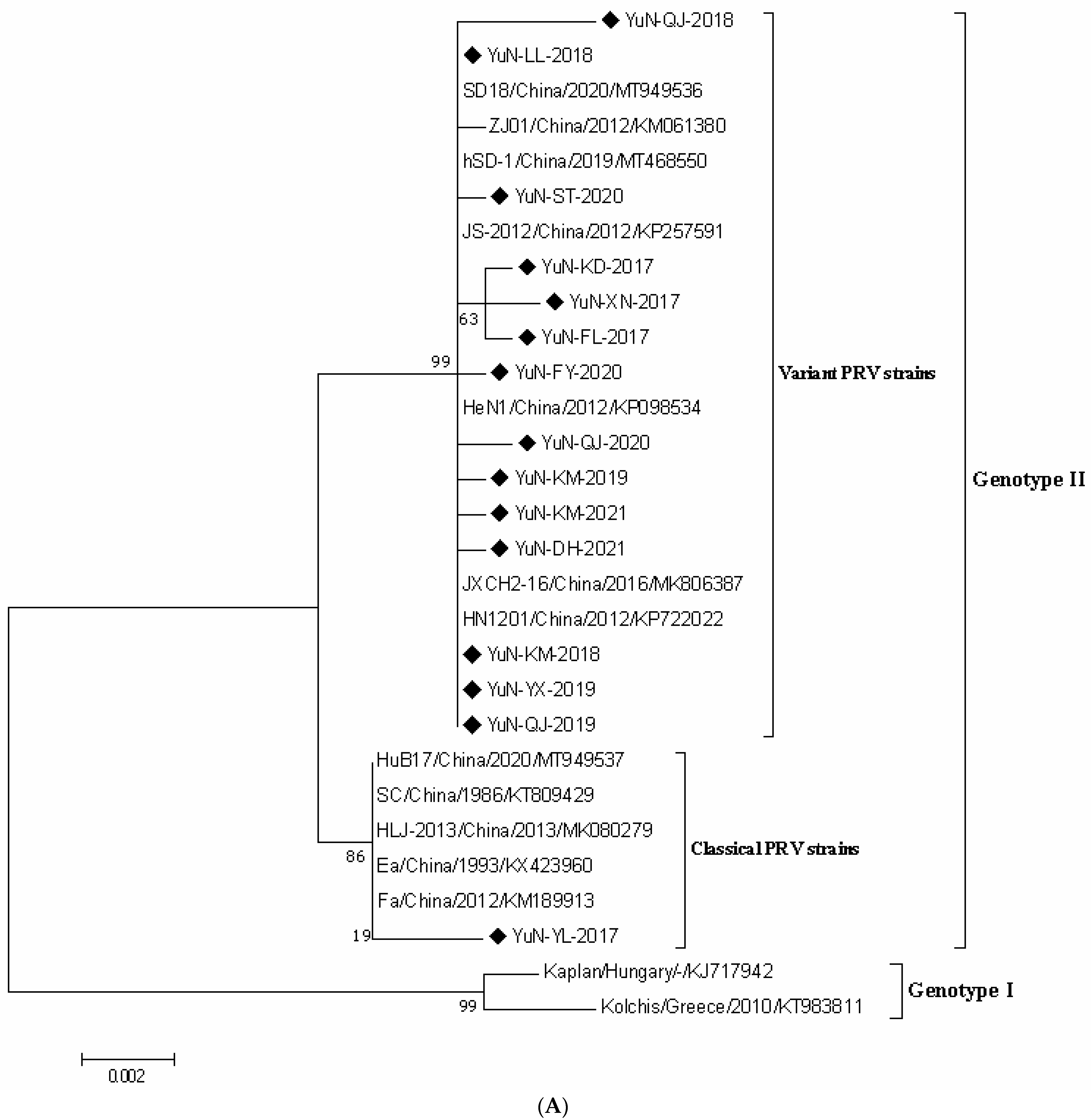
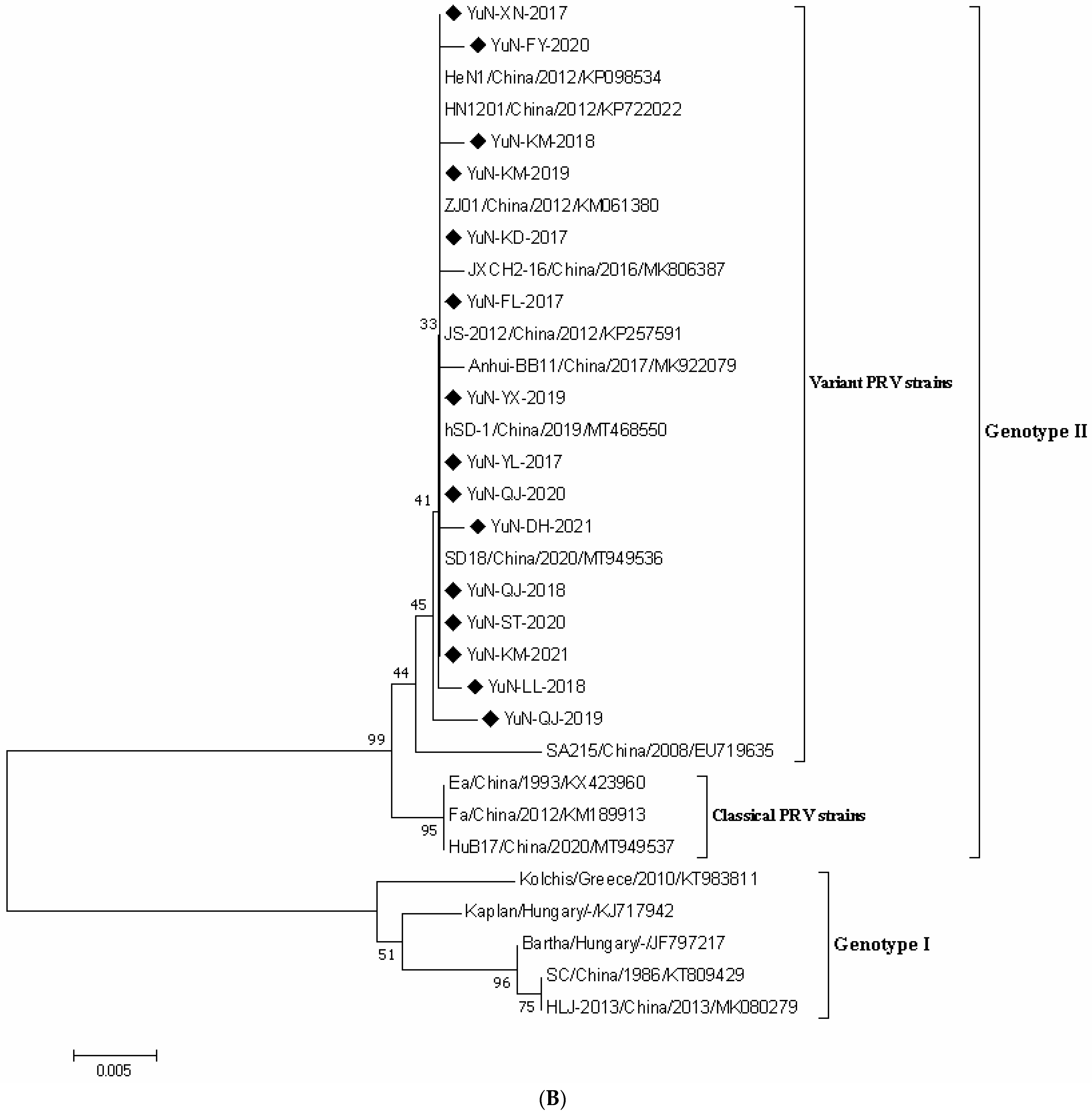
PRV gE and gC of the newly identified 15 PRV stains were amplified by PCR and cloned into a pUCm-T vector for sequencing [2]. According to the phylogenetic analysis based on PRV gE or gC sequences, all PRV strains, including 15 novel PRV strains and reference strains, were divided into two genotypes: genotype I and genotype II (Figure 1A,B). In agreement with a previous study [14], most of the isolates from China were clustered as genotype II, which could be further divided into the classical (before 2012) and variant (after 2012) sub-genotypes, while PRV strains from other parts, such as Europe and the U.S., belonged to genotype I. Notably, all 15 PRV isolates obtained in this study belonged to genotype II. Importantly, the gE phylogenetic tree showed that one isolate from Yunnan Province in 2017 (designed as YuN-YL-2017) was genetically closer to classical PRV strains compared with others (Figure 1A), while the gC gene was in the same clade with other PRV variants (Figure 1B).

Figure 1.
Phylogenetic analysis based on the nucleotide sequences of gE (A) and gC (B) genes of the 15 novel PRV isolates obtained in this study and other reference strains. A phylogenetic tree was generated using the neighbor-joining method with 1000 bootstrap replicates in MEGA X software. The black triangle represents the 15 PRV isolates.
3.4. Analysis of PRV gC and gE
The nucleotide and the corresponding amino acid sequence variations for gC (1464 bp) and gE (1734~1740 bp) genes of 15 novel PRV strains within the isolates were 0.0~0.3%, 0.0~0.7%, and 0.0~0.8%, 0.0~1.7%, respectively (Table 4). Moreover, compared with PRV variants and classical PRV strains, these 15 PRV strains exhibited a 99.6~100.0%, 99.1~99.4% nucleotide and 99.4~100.0%, 98.3~98.7% amino acid sequence identity in the gC gene and a 99.3~100.0%, 99.2~99.8% nucleotide and 98.6~100.0%, 98.8~99.5% amino acid sequence identity in the gE gene (Table 4), respectively. Remarkable, the gE gene of the YuN-YL-2017 strain showed a higher sequence homology with classical PRV strains (such as Ea and Fa), while its gC gene was highly homologous to the variants (such as HeN1 and ZJ01).
Table 4.
Sequence similarity analysis of the gC and gE sequences of PRV strains identified in this study.
PRV gC and gE proteins sequences among the PRV strains were further aligned. The results revealed that there was no amino acid insertions or deletions, but several mutations were observed among gC proteins of 15 PRV strains when compared with other PRV variants. Except for some amino acid mutations among gE proteins, compared with the PRV variants, the YuN-YL-2017 strain had two amino acid deletions at site 48 (D) and 498 (D).
4. Discussion
Since the emergence of variant PRV strains in China in 2011, the disease caused by PRV variants has been considered a major factor contributing to huge economic losses to the swine industry. Recently, the cross-species transmission events of PRV from pigs to humans have also attracted increasing attention [15,16]. Great efforts have been made for the control of PR; particularly, this disease was listed in the “Mid- and Long-term Animal Disease Prevention and Control Program in China (2012–2020)”. Nevertheless, PR remains widely spread in Chinese pig populations and pose a challenge for other animals breeding in China, such as fox and mink. Thus, obtaining accurate data on the epidemiological characteristics of PRV is beneficial for formulating control or eradication measures.
The present results showed that the average PRV-gE seropositive rate was 31.37% among 20,158 serum samples from Yunnan Province from 2017 to 2021. Further analysis showed that the PRV seroprevalence in Yunnan Province between September 2018 to January 2020 (41.48%, 2449/5904) was higher than these during March 2017–August 2018 (29.25%, 2355/8051) and April 2020–December 2021 (24.50%, 1520/6203), and a similar epidemiological trend was also observed in the pathogen detection section in this study. Since the outbreaks of African swine fever (ASF) and its rapid spread since August 2018 contributed to the substantial reduction of the sow population in China, many PRV-positive sows might have been introduced into pig farms to keep the breeding scale, which contributed to the high seroprevalence of PRV in some regions of China [2]. Owing to the fact that the prevalence of ASF has been controlled in 2020 [17] and the excessive pig production in China recently, many pig farms subsequently focused on the prevention or eradication of other infectious diseases, including PR, classical swine fever, etc.
Two factors, “pig herd” and “breeding scale”, were significantly associated with the seroprevalence of PRV of pigs in Yunnan Province. The seroprevalence of PRV in fattening pigs, sows, and gilts was higher than these in piglets, nursery pigs, and boars; similar results were also observed in previous research [18]. On one hand, the occurrences of PR in fattening pigs are often neglected since they only display mild symptoms. On the other hand, fattening pigs are not immunized with PRV vaccines in some pig farms. Meanwhile, long-term feeding increases the probability of PRV infection among sows and gilts. Moreover, as reported in Lin’s study [2], we also found that a lower PRV-gE seropositive rate among pigs was detected from medium-sized farms compared with those in large and small ones, which might suggest that the medium-density feeding mode is more suitable for infectious diseases control.
The gC protein participates in viral abortion on a host cellular surface; meanwhile, this protein is an important target for neutralizing an antibody [19]. The gE protein is mainly involved in viral virulence [4]. Phylogenetic analysis based on the gE or gC gene revealed that PRV strains prevalent worldwide can be divided into two genotypes (namely, genotype I and genotype II), and most PRV strains circulated in China belong to the genotype II [1,14]. In line with these, 15 novel PRV strains obtained in this study formed one large clade with Chinese PRV variants (after 2012) and Chinese classical PRV strains (before 2012) and belonged to the genotype II, which showed a distinct relationship to genotype I strains, such as Bartha and Backer (Figure 1A,B). Remarkably, one isolate, namely, YuN-YL-2017, was identified as a PRV variant according to the genetic analysis of gC gene, which belonged to the classical strains according to the gE gene. These results indicated this strain might be a recombinant variant strain. Further analysis showed that the LD50 of YuN-YL-2017 to mice was higher than those of other PRV variants (103.5 TCID50 VS 102.0–2.8 TCID50), suggesting that the recombinant event in the genome of YuN-YL-2017 decreased its virulence to mice, and the underlying mechanisms will be explored in the future.
5. Conclusions
In conclusion, this study comprehensively investigated the prevalence and genetic features of PRV in Yunnan Province from 2017 to 2021, showing that PR remains highly prevalent among pig populations in Yunnan Province, China. Phylogenetic analysis showed that all 15 PRV strains isolated in this study belonged to the genotype II, displaying a distinct evolutionary relationship with the Bartha strain in genotype I, which might partly explain the immune failure of the PRV Bartha-K61 vaccine in pigs challenged by PRV variants, and further suggesting that novel vaccines should be developed for the control of PR in this region. In addition, the results above also highlighted the importance of continuous monitoring the molecular epidemiology of such recombinant PRV strains in the future.
Author Contributions
Conceptualization, J.Y., C.S. and J.L.; methodology, J.Y. and X.S.; software, L.G. and Y.H.; formal analysis, C.S., J.L., L.G., S.Y. and Y.H.; investigation, J.Y., Y.H., J.X., P.Z., Y.Z., X.Z. and L.D.; resources, S.Y., X.S., C.S. and J.L.; original draft writing, J.Y.; review and revising, J.Y., C.S., J.L. and X.S.; funding acquisition, J.Y. and X.S. All authors participated in editing the article and approved the final manuscript. All authors have read and agreed to the published version of the manuscript.
Funding
This work was supported by the National Key Research and Development Program of China (No. 2017YFD0501800) and the Major Specialized Projects of Yunnan Science and Technology (No. 202102AE090007).
Institutional Review Board Statement
All animal experiments were conducted according to the rules of Animal Ethics Committee of the Yunnan Agricultural University, Kunming, China (YNAU2019llwyh022).
Informed Consent Statement
Not applicable.
Data Availability Statement
All data presented in the present study can be found in online repositories.
Conflicts of Interest
The authors declare no conflict of interest.
References
- Sun, Y.; Luo, Y.; Wang, C.-H.; Yuan, J.; Li, N.; Song, K.; Qiu, H.-J. Control of swine pseudorabies in China: Opportunities and limitations. Vet. Microbiol. 2016, 183, 119–124. [Google Scholar] [CrossRef] [PubMed]
- Lin, Y.; Tan, L.; Wang, C.; He, S.; Fang, L.; Wang, Z.; Zhong, Y.; Zhang, K.; Liu, D.; Yang, Q.; et al. Serological Investigation and Genetic Characteristics of Pseudorabies Virus in Hunan Province of China From 2016 to 2020. Front. Vet. Sci. 2021, 8, 1503. [Google Scholar] [CrossRef] [PubMed]
- Zheng, H.-H.; Jin, Y.; Hou, C.-Y.; Li, X.-S.; Zhao, L.; Wang, Z.-Y.; Chen, H.-Y. Seroprevalence investigation and genetic analysis of pseudorabies virus within pig populations in Henan province of China during 2018–2019. Infect. Genet. Evol. 2021, 92, 104835. [Google Scholar] [CrossRef] [PubMed]
- Tan, L.; Shu, X.; Xu, K.; Liao, F.; Song, C.; Duan, D.; Yang, S.; Yao, J.; Wang, A. Homologous recombination technology generated recombinant pseudorabies virus expressing EGFP facilitates to evaluate its susceptibility to different cells and screen antiviral compounds. Res. Vet. Sci. 2022, 145, 125–134. [Google Scholar] [CrossRef] [PubMed]
- Liu, Q.; Wang, X.; Xie, C.; Ding, S.; Yang, H.; Guo, S.; Li, J.; Qin, L.; Ban, F.; Wang, D.; et al. A Novel Human Acute Encephalitis Caused by Pseudorabies Virus Variant Strain. Clin. Infect. Dis. 2021, 73, E3690–E3700. [Google Scholar] [CrossRef] [PubMed]
- Mueller, T.; Hahn, E.C.; Tottewitz, F.; Kramer, M.; Klupp, B.G.; Mettenleiter, T.C.; Freuling, C. Pseudorabies virus in wild swine: A global perspective. Arch. Virol. 2011, 156, 1691–1705. [Google Scholar] [CrossRef]
- An, T.-Q.; Peng, J.-M.; Tian, Z.-J.; Zhao, H.-Y.; Li, N.; Liu, Y.-M.; Chen, J.-Z.; Leng, C.-L.; Sun, Y.; Chang, D.; et al. Pseudorabies Virus Variant in Bartha-K61-Vaccinated Pigs, China, 2012. Emerg. Infect. Dis. 2013, 19, 1749–1755. [Google Scholar] [CrossRef]
- Tong, W.; Liu, F.; Zheng, H.; Liang, C.; Zhou, Y.-J.; Jiang, Y.-F.; Shan, T.-L.; Gao, F.; Li, G.-X.; Tong, G.-Z. Emergence of a Pseudorabies virus variant with increased virulence to piglets. Vet. Microbiol. 2015, 181, 236–240. [Google Scholar] [CrossRef]
- Tan, L.; Yao, J.; Yang, Y.-D.; Luo, W.; Yuan, X.-M.; Yang, L.-C.; Wang, A.-B. Current Status and Challenge of Pseudorabies Virus Infection in China. Virol. Sin. 2021, 36, 588–607. [Google Scholar] [CrossRef] [PubMed]
- Gu, J.; Hu, D.; Peng, T.; Wang, Y.; Ma, Z.; Liu, Z.; Meng, F.; Shang, Y.; Liu, S.; Xiao, Y. Epidemiological investigation of pseudorabies in Shandong Province from 2013 to 2016. Transbound. Emerg. Dis. 2018, 65, 890–898. [Google Scholar] [CrossRef] [PubMed]
- Xia, L.; Sun, Q.; Wang, J.; Chen, Q.; Liu, P.; Shen, C.; Sun, J.; Tu, Y.; Shen, S.; Zhu, J.; et al. Epidemiology of pseudorabies in intensive pig farms in Shanghai, China: Herd-level prevalence and risk factors. Prev. Vet. Med. 2018, 159, 51–56. [Google Scholar] [CrossRef] [PubMed] [Green Version]
- Luo, Y.; Li, N.; Cong, X.; Wang, C.-H.; Du, M.; Li, L.; Zhao, B.; Yuan, J.; Liu, D.-D.; Li, S.; et al. Pathogenicity and genomic characterization of a pseudorabies virus variant isolated from Bartha-K61-vaccinated swine population in China. Vet. Microbiol. 2014, 174, 107–115. [Google Scholar] [CrossRef] [PubMed]
- Kumar, S.; Stecher, G.; Li, M.; Knyaz, C.; Tamura, K. MEGA X: Molecular Evolutionary Genetics Analysis across Computing Platforms. Mol. Biol. Evol. 2018, 35, 1547–1549. [Google Scholar] [CrossRef] [PubMed]
- Ye, C.; Zhang, Q.-Z.; Tian, Z.-J.; Zheng, H.; Zhao, K.; Liu, F.; Guo, J.-C.; Tong, W.; Jiang, C.-G.; Wang, S.-J.; et al. Genomic characterization of emergent pseudorabies virus in China reveals marked sequence divergence: Evidence for the existence of two major genotypes. Virology 2015, 483, 32–43. [Google Scholar] [CrossRef] [PubMed]
- Wong, G.; Lu, J.; Zhang, W.; Gao, G.F. Pseudorabies virus: A neglected zoonotic pathogen in humans? Emerg. Microbes Infect. 2019, 8, 150–154. [Google Scholar] [CrossRef] [PubMed] [Green Version]
- Guo, Z.; Chen, X.-X.; Zhang, G. Human PRV Infection in China: An Alarm to Accelerate Eradication of PRV in Domestic Pigs. Virol. Sin. 2021, 36, 823–828. [Google Scholar] [CrossRef]
- Liu, J.; Liu, B.; Shan, B.; Wei, S.; An, T.; Shen, G.; Chen, Z. Prevalence of African Swine Fever in China, 2018–2019. J. Med. Virol. 2020, 92, 1023–1034. [Google Scholar] [CrossRef]
- Zhou, H.; Pan, Y.; Liu, M.; Han, Z. Prevalence of Porcine Pseudorabies Virus and Its Coinfection Rate in Heilongjiang Province in China from 2013 to 2018. Viral Immunol. 2020, 33, 550–554. [Google Scholar] [CrossRef]
- Gerdts, V.; Jons, A.; Mettenleiter, T.C. Potency of an experimental DNA vaccine against Aujeszky’s disease in pigs. Vet. Microbiol. 1999, 66, 1–13. [Google Scholar] [CrossRef]
Publisher’s Note: MDPI stays neutral with regard to jurisdictional claims in published maps and institutional affiliations. |
© 2022 by the authors. Licensee MDPI, Basel, Switzerland. This article is an open access article distributed under the terms and conditions of the Creative Commons Attribution (CC BY) license (https://creativecommons.org/licenses/by/4.0/).