Article

Soil CO2 Flux in Middle-Aged Pedunculate Oak (Quercus robur L.) Stands on Different Chernozem Subtypes

Institute of Lowland Forestry and Environment, University of Novi Sad, Antona Čehova 13d, 21000 Novi Sad, Serbia
*
Author to whom correspondence should be addressed.
Forests 2026, 17(6), 671; https://doi.org/10.3390/f17060671
Submission received: 29 April 2026 / Revised: 27 May 2026 / Accepted: 29 May 2026 / Published: 31 May 2026

Abstract

The increase in CO2 concentration in the atmosphere can be attributed to various anthropogenic activities. Soils play a significant role in climate regulation, particularly through the storage of atmospheric carbon in soil organic matter. The main aim of the study was to examine the effects of site conditions on soil CO2 flux in middle-aged stands of pedunculate oak (Quercus robur L.). A three-year study was conducted in three middle-aged stands within different subtypes of Chernozem. One of these stands is a windbreak (RŠ), while the other two stands (VN and DE) belong to larger forest complexes. Air samples were collected using the closed-chamber technique and analyzed using gas chromatography. The linear mixed-effects model (LMM) revealed that soil temperature, soil moisture, and location had significant effects on soil CO2 flux (p < 0.05), whereas the effect of year was not significant (p > 0.05). The results showed that there was a higher temperature sensitivity of soil respiration (Q10) in the windbreak (RŠ) compared to the other two stands (VN and DE). The mean annual carbon loss through soil respiration for all stands was assessed to be approximately 3.24 ± 0.12 t C ha−1 yr−1. These findings suggest that lower soil CO2 flux in stands growing under optimal site conditions may indicate a more favorable carbon balance compared to stands growing outside their ecological optimum.

1. Introduction

The increase in CO2 concentration in the atmosphere can be attributed to anthropogenic activities such as fossil fuel burning and land use changes [1]. Forest ecosystems play a crucial role in the global carbon cycle and in mitigating climate change. Forests absorb CO2 from the atmosphere through net growth. Additionally, forests cover approximately 30% of the global land (4 billion hectares) on a global scale and serve as enormous reservoirs of carbon [2]. Approximately 30% of human carbon emissions are currently absorbed by terrestrial ecosystems. From 2000 to 2007, forests absorbed roughly 90% (8.8 Gt CO2e per year) of the total land carbon uptake (9.5 Gt CO2e per year) [3]. Forests sequester huge amounts of carbon from the atmosphere, retaining it in living biomass, deadwood, litter and soil [4]. Forests and the atmosphere exchange carbon dioxide in a complex way. Tree death and a reduction in the total carbon stock can be caused by fire. Dead trees decompose after a disturbance, while young trees start to grow and store carbon. Approximately 60% of the carbon in forest ecosystems is stored by both living and dead trees [5]. The carbon stock of the world’s forests is estimated to be 861 Gt C with 383 Gt C stored in the soil. The largest amount of carbon in the world’s forests is stored in tropical forests (471 Gt C), while temperate forests store 119 Gt C (13%) [6].
Soils play a significant role in climate regulation, particularly through the storage of atmospheric carbon in soil organic matter [7]. Estimates of global soil organic carbon stock vary from 504 to 3000 Gt C. However, most studies estimate global soil organic carbon stock at approximately 1500 Gt C [8]. The main sources of soil organic matter are roots and litter from plants, while algae, fungi, lichens and mosses are specifically important in arctic and desert environments [9]. Soil organic matter is composed of stable forms such as complex humic substances and labile forms like fresh litter [10].
Soil respiration (soil CO2 flux) is crucial for carbon cycling, soil science, forest ecosystem ecology, plant physiology, and climate change modeling [11]. The total CO2 flux from soil consists of several sources which can be broadly categorized into two categories: autotrophic respiration originating from plant roots and other organisms directly related to them in the rhizosphere, and heterotrophic respiration (decomposition of soil organic matter) [12,13]. The emission of CO2 from soil results from the integration of soil organic matter decomposition (microbial respiration) and plant root respiration [14]. The contribution of root respiration varies between 10% and 90% for both non-forest and forest ecosystems [11]. Autotrophic respiration depends on soil temperature, stand age, fine root biomass, carbon allocation and nutrient availability [15]. Additionally, heterotrophic respiration is influenced by soil microbiota and soil macrofauna whose impact depends on microbial biomass, soil temperature, soil moisture, amounts of soil organic matter and plant litter. The ratio of autotrophic soil respiration to total soil respiration is determined by factors such as climate conditions, vegetation type, soil type and management practices [15].
One consequence of global warming is the accelerated decomposition of soil organic matter, which releases carbon dioxide into the atmosphere and intensifies the warming trend [16]. Due to agricultural cultivation, a decrease in carbon stocks in the soil can lead to a rise in carbon dioxide concentration in the atmosphere [7]. The continuous disturbance of the soil caused by intense cropping results in carbon losses through oxidation [17]. Soil compaction resulting from the use of heavy machinery during various field operations can significantly affect soil CO2 flux [18]. Changes in land use and climate can either increase or decrease soil CO2 fluxes. Variations in temperature and precipitation along with changes in land use such as conversion from forests to croplands or implementing different management techniques, will affect soil respiration. Consequently, this can have a significant influence on the carbon budget of terrestrial ecosystems [19].
Autotrophic and heterotrophic components of soil respiration are difficult to separate due to the complex interaction between plant roots, mycorrhizae and heterotrophic decomposers [10]. Soil temperature and moisture are the most important abiotic factors controlling soil respiration (soil CO2 flux) [19,20]. The type of soil and its properties can strongly affect CO2 flux from the soil [14,21].
This study focuses on assessing daily and annual CO2 flux from the soil in three pedunculate oak (Quercus robur L.) stands at the same developmental stage, growing on different subtypes of the same soil type. The main aim of the study was to examine the effects of site conditions on soil CO2 flux in pedunculate oak stands. The obtained results will contribute to a better understanding of carbon dynamics and soil CO2 flux in the examined stands. The goals of this study were to (1) compare the differences in daily soil CO2 flux between the examined stands within different subtypes of Chernozem; (2) explore the influence of soil temperature and moisture on the variation in soil CO2 flux; (3) determine the temperature sensitivity (Q10) of soil respiration (soil CO2 flux) for each stand; (4) estimate the annual C flux from soil and loss of carbon through the soil respiration process for each stand.

2. Materials and Methods

2.1. The Study Design

The three-year study was carried out in three pedunculate oak (Quercus robur L.) forest stands at the same developmental stage from 2022 to 2024. The stands were selected within three different locations in Vojvodina Province, the Republic of Serbia (Figure 1).
According to Banković et al. (2009) [22], pedunculate oak is the most widespread tree species in the Vojvodina Province. The first location was Vinična (44°56′21.90″ N; 19°11′58.12″ E), which belongs to the largest pedunculate oak complex in the Vojvodina Province. The second location was selected in a windbreak (45°20′35.11″ N; 19°51′22.71″ E) near the city of Novi Sad (Rimski Šančevi). This location is situated approximately 70 km northeast of Vinična. The northernmost location was in Deronje (45°27′14.18″ N; 19°10′25.86″ E), which is part of a smaller pedunculate oak complex compared to the Vinična complex. Meteorological data for the examined locations were obtained from the nearest weather stations for the climatological standard normal period (1991–2020) [23].

2.2. The Description of the Studied Stands

We selected three middle-aged stands within different subtypes of Chernozem. In Vinična (VN), pedunculate oak (Quercus robur L.) forms a mixed forest with narrow-leaved ash (Fraxinus angustifolia) and hornbeam (Carpinus betulus). Quercus robur is the dominant tree species in Deronje (DE), although other tree species can be found in the forest such as Quercus cerris, Pyrus pyraster, Acer campestre, Acer tataricum and Ulmus campestre. The main tree species planted for the purpose of establishing the windbreak in Rimski Šančevi (RŠ) were Quercus robur and Robinia pseudoacacia. In this stand, dying black locust (Robinia pseudoacacia) trees are present, with crowns that are mostly broken and damaged. Other species planted in RŠ were Tilia argentea, Sophora japonica, Celtis occidentalis, Juglans regia and Acer negundo. Structural parameters of the examined stands are shown in Table 1. Structural parameters were obtained from forest management plans for VN and DE [24,25], while these parameters for RŠ were obtained using the official methodology for forest stand inventory [26]. In all three examined stands, pedunculate oak was the dominant species in terms of total stand volume and volume increment. VN represented the reference stand, as it grows under optimal site conditions, unlike RŠ and DE. In the RŠ and DE stands, pedunculate oak, as the dominant species, occurs outside its ecological optimum, resulting in a lower number of trees per hectare and a more open canopy.

2.3. The Soil Properties in Examined Stands

According to the WRB classification [27], Gleyic Chernozem (Loamic) was identified as the soil type within all examined stands. To describe differences in soil properties among the examined stands, we used the official soil classification system of the Republic of Serbia [28]. The soil subtype in VN was Chernozem on alluvial deposits, while Chernozem on loess and loess-like sediments was found in RŠ and DE. The variety of Chernozem within VN, RŠ, and DE was leached gleyed Chernozem for all stands. However, the pH value in DE indicates a degradation process of the soil. Various soil degradation processes have been documented in the region of Vojvodina [29]. Different forms of Chernozem were determined based on the A horizon depth. In VN, Chernozem was deep (>80 cm), while shallow (<40 cm) chernozem was determined in RŠ and DE. Physical and chemical properties of the soil for VN were presented in Karaklić et al. (2024) [30]. Soil properties for RŠ and DE were determined using the methodology described by Karaklić et al. (2023) [31]. The properties of the humus-accumulative horizon (A) for all tree stands are shown in Table 2.

2.4. Soil CO2 Flux Measurement

Soil CO2 flux was measured from the beginning of 2022 to the end of 2024 using the closed chamber technique [32]. Five chambers were positioned at representative places and evenly distributed under homogeneous conditions within each examined stand. PVC collars (20 cm inside diameter) were inserted approximately 10 cm into the soil in each stand and remained at the same location throughout the study period. Due to the potential soil disturbance caused by collar insertion, gas sampling was delayed by two weeks to ensure the stabilization of soil CO2 flux [19]. The air sampling protocol and soil CO2 flux calculation were well described by Karaklić et al. (2025) [33]. Before sampling, PVC chambers were attached to the collars, and the air inside the chambers was continuously mixed using an integrated fan. Gas samples (10 mL) were withdrawn using a syringe at 15, 30, and 45 min after chamber closure through a valve located at the top of the chamber and subsequently transferred into glass vials for further analysis.
Air sampling was carried out one to three times a month at each location. A total of 1875 air samples were collected and analyzed (125 observations across all stands during the study period × 5 chambers per stand × 3 sampling times per chamber). The samples of air were taken between 8:00 a.m. and 11:00 a.m. [34]. The obtained values were used for the calculation of the average daily soil CO2 flux [35]. Diurnal measurements showed that soil CO2 fluxes measured in the morning were representative of the daily mean values [36], so morning sampling was used as a proxy for estimating average daily fluxes. Average daily CO2 flux is expressed in g CO2 m−2 d−1 [37].
The soil temperature was recorded at a depth of 5 cm using a soil thermometer [30]. Soil moisture content was determined by the gravimetric method using soil samples collected at the same depth. The collected samples were dried in an oven at 103–105 °C until constant weight [31]. Soil temperature measurements and soil sampling for moisture determination were conducted 30 min after chamber closure.
The concentration of CO2 was measured with a gas chromatograph system (Agilent 8890, Agilent Technologies, Santa Clara, CA, USA). The gas chromatograph (GC) was calibrated using an ultra-high-purity CO2 standard gas. Soil CO2 flux was calculated according to the following equation [38]:
SCF = ρ × V/BA × ΔC/Δt × T0/T
where SCF is soil CO2 flux (g CO2 m−2 d−1), ρ is the density of CO2 (1.98 × 10³ g m−3) under standard conditions, V is the chamber volume (4712.4 cm3), and BA is the chamber basal area (314.2 cm2). ΔC represents the change in CO2 concentration within the chamber over the time interval Δt, while T is the absolute temperature during sampling and T0 is the absolute temperature under standard conditions. For the purpose of flux calculation in appropriate units, all variables in the equation were converted into consistent units.
The cumulative monthly and annual CO2 flux for the examined stands were calculated by multiplying the average daily CO2 flux by the number of days in each month. Values of total soil CO2 flux are expressed as t C ha−1 yr−1. The conversion factor for CO2 to C was 12/44. The carbon loss through the soil respiration process was estimated as the ratio of heterotrophic soil respiration (Rh) to total soil respiration (Rs). According to Vesterdal et al. (2012) [39], the Rh/Rs ratio amounted to 0.542.

2.5. Statistical Analysis

Exponential and linear regression models were used to describe the relationship between soil CO2 flux and soil temperature during the study period [35,40]. The exponential model was linearized using natural logarithm transformation, and predictions were back-transformed to the original scale. Additionally, a quadratic model was used to evaluate the combined effect of soil moisture and temperature on soil CO2 flux [41]. Regression analyses were performed as follows:
y = aebt (lny = lna + bx)
y = a + bt
y = a + bt + ct2 + dw + ew2 + ftw
where y is the soil CO2 flux, t is the soil temperature at 5 cm depth (°C), w is soil moisture (%), while a, b, c, d, e and f are the model coefficients. The temperature sensitivity (Q10 coefficient) of soil respiration (soil CO2 flux) was calculated from this exponential model using the following equation:
Q 10   =   a e b t + 10 a e b t   =   e 10 b
The logistic model was used to describe the cumulative increase in soil CO2 flux during the year. This model was fitted to the observed data in order to predict the relationship between cumulative soil CO2 flux and time. The temporal dynamics of soil CO2 flux rate during the year were modeled based on the first derivative of the logistic model. These models were performed as follows:
y   =   a 1 + b e   c x
f ( x ) = dy dx = a b c   e c x 1 + b e   c x 2
where y is the cumulative soil CO2 flux during the year expressed as t C ha−1 yr−1, x is time, while a, b and c are the model coefficients.
One way analysis of variance (ANOVA) was conducted to determine the statistical significance of differences in air temperature and precipitation among the three examined stands. A linear mixed-effects model (LMM) was applied to evaluate the effects of year, stand, soil temperature, and soil moisture on soil CO2 flux. In this model, soil CO2 flux was treated as the dependent variable, while soil temperature, soil moisture, stand, and year were included as fixed effects. Chambers were included as random effects to account for repeated measurements within sampling locations. The model was fitted using restricted maximum likelihood (REML) estimation implemented in the nlme package (version 3.1-168) [42] within the R environment. Tukey-adjusted pairwise comparisons of estimated marginal means (EMMs) were performed to evaluate significant differences among the values predicted by the mixed-effects model for the investigated stands using the emmeans package (version 2.0.3) [43] in R. All statistical analyses were performed using R statistical software (version 4.3.2). The graphs were created using “ggplot2” (version 3.5.2) [44] and “rgl” (version 1.3.18) [45] packages in the R environment.

3. Results

3.1. The Average Monthly Air Temperature and Average Monthly Precipitation

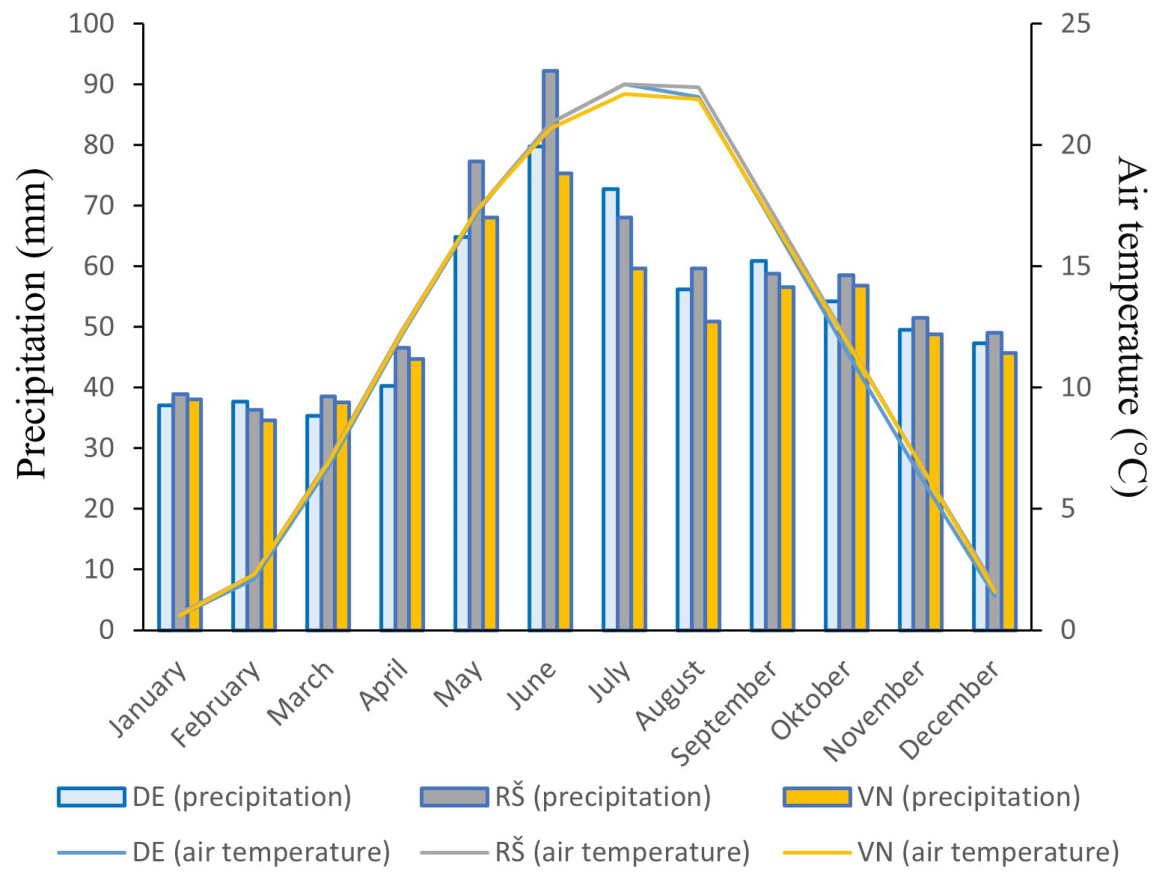
The average monthly air temperature and average monthly precipitation for the observation period from 1991 to 2020 are shown in Figure 2. The values of average annual precipitation in VN, RŠ, and DE were 617.1, 675.8 and 636.0 mm, respectively. The average annual air temperature was around 12 °C at all three locations. The results of a one-way ANOVA indicated that there were no significant differences (p > 0.05) in air temperature and precipitation among the locations of the investigated stands.

3.2. Soil CO2 Flux Variation During Study Period

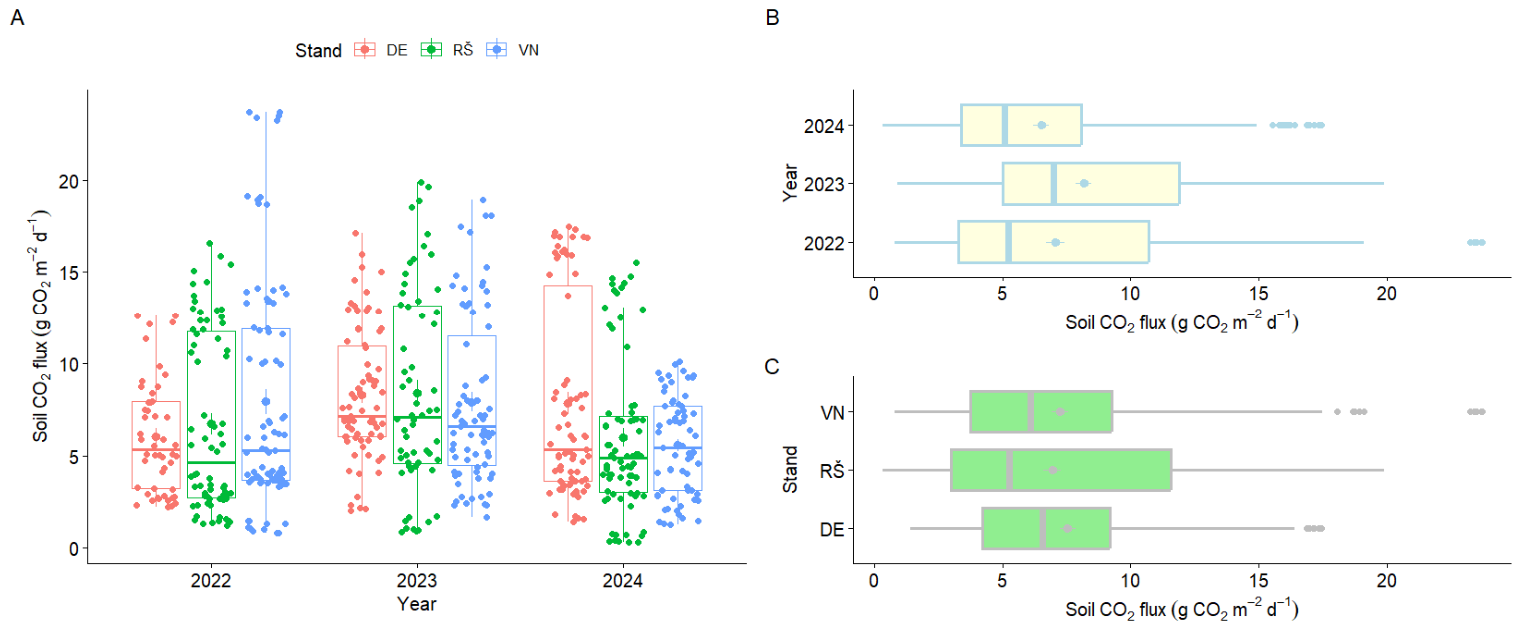
The variation in soil CO2 flux in the examined stands is shown in Figure 3A for each year of the three-year study period. The arithmetic means of daily CO2 flux in VN, RŠ, and DE were 7.23, 6.95, and 7.53 g CO2 m−2 d−1, respectively (Figure 3C). The highest mean soil CO2 flux values were observed during 2023 for all three investigated stands (Figure 3B). The highest coefficient of variation (CV) was recorded in RŠ (70.98%), followed by VN (68.84%), while the lowest CV was observed in DE (57.13%).

3.3. Relationship Between Environmental Drivers (Soil Temperature and Soil Moisture) and Soil CO2 Flux

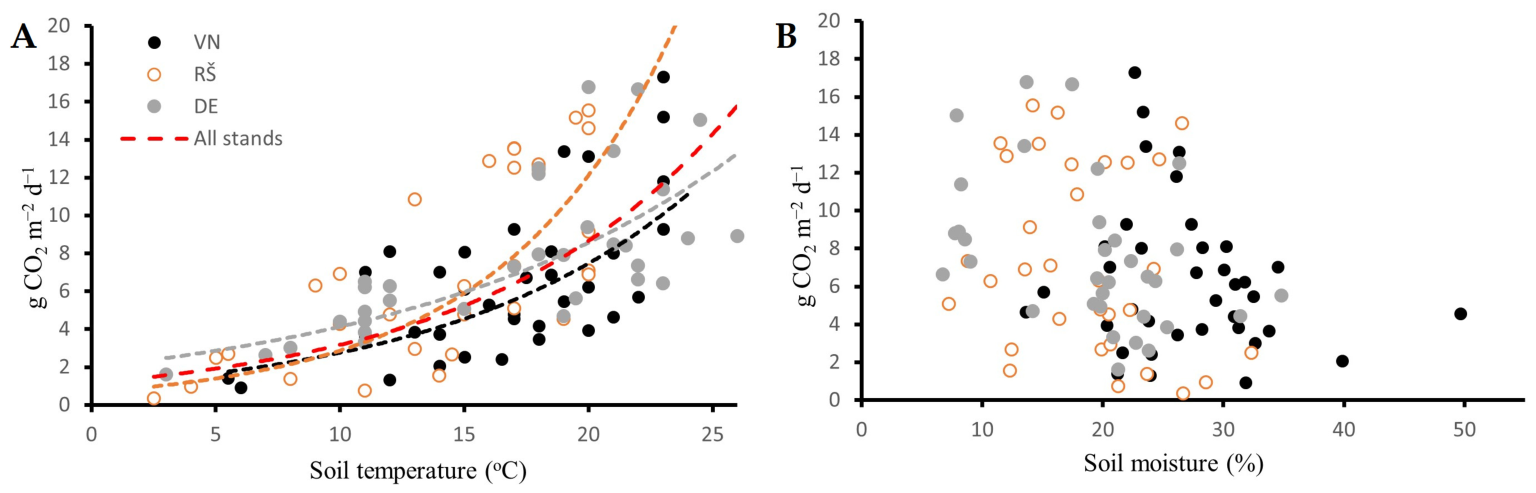
A significant (p < 0.001) exponential relationship between soil CO2 flux and soil temperature was observed in all three examined stands (VN, RŠ, and DE), with the strongest correlation in DE. The exponential relationship between soil temperature and soil CO2 flux for each stand is presented in Figure 4A and Table 3. Additionally, the linear regression model also showed a significant relationship (p < 0.001); however, it had lower coefficients of determination (R2) than the exponential model (Table 3). The increase in soil temperature was accompanied by an exponential rise in soil CO2 flux, as the exponential model better explained the variation in soil CO2 flux than the linear model. The temperature sensitivity (Q10) of soil respiration was 2.46, 4.06, and 2.01 in VN, RŠ, and DE, respectively. During the study period, no significant relationship (p > 0.05) between soil moisture and soil CO2 flux was detected using either linear or exponential models (Figure 4B).
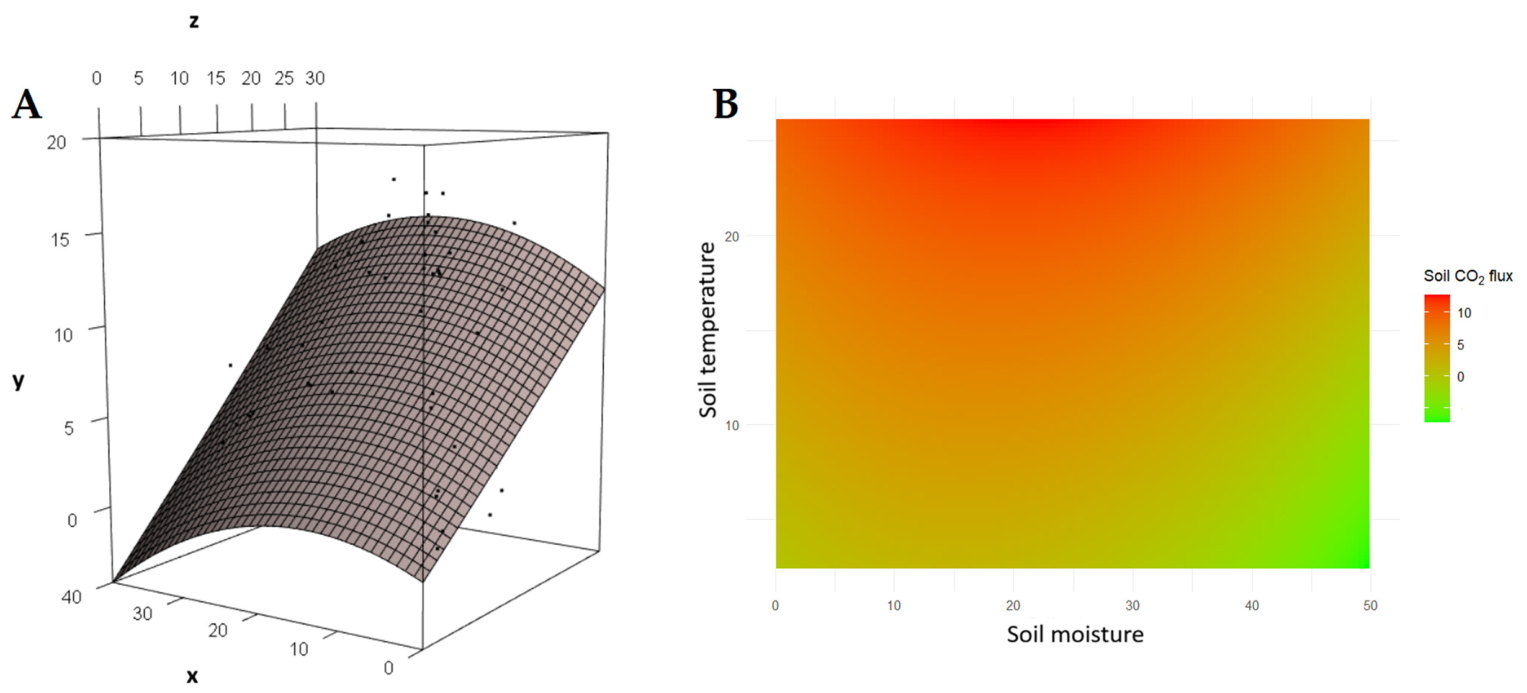
The R2 value of the quadratic model was 0.49 (p < 0.001) for all three stands (Table 4). A similar R2 value (0.51, p < 0.001) was obtained for the exponential model, which included only temperature as the independent variable (Figure 4A; Table 3). According to the exponential model, the Q10 value for all stands was 2.72. The quadratic model indicated that soil CO2 flux increased most with rising soil temperature when soil moisture levels were around 20%. The 3D illustration and heatmap of the quadratic model are presented in Figure 5.

3.4. The Mixed Effect of Soil Temperature, Soil Moisture, Stand (Location) and Year on Soil CO2 Flux

Results of the linear mixed-effects model (LMM) showed that soil temperature and soil moisture had significant effects (p < 0.001) on soil CO2 flux (Table 5). Pearson correlation analysis did not reveal a significant relationship (p > 0.05) between soil moisture and soil CO2 flux (Figure 4B), whereas the LMM identified soil moisture as a significant predictor (p < 0.001) (Table 5). The lowest arithmetic mean of soil CO2 flux was recorded in RŠ (Figure 3C); however, estimated marginal means (EMMs) indicated significantly higher (p < 0.05) soil CO2 fluxes in DE and RŠ compared to the reference stand (VN) (Table 6). No significant differences (p > 0.05) in soil CO2 flux were observed between DE and RŠ (Table 6). Additionally, the LMM showed that year did not have a significant effect (p > 0.05) on soil CO2 flux (Table 6).

3.5. Monthly and Annual C Flux from Soil

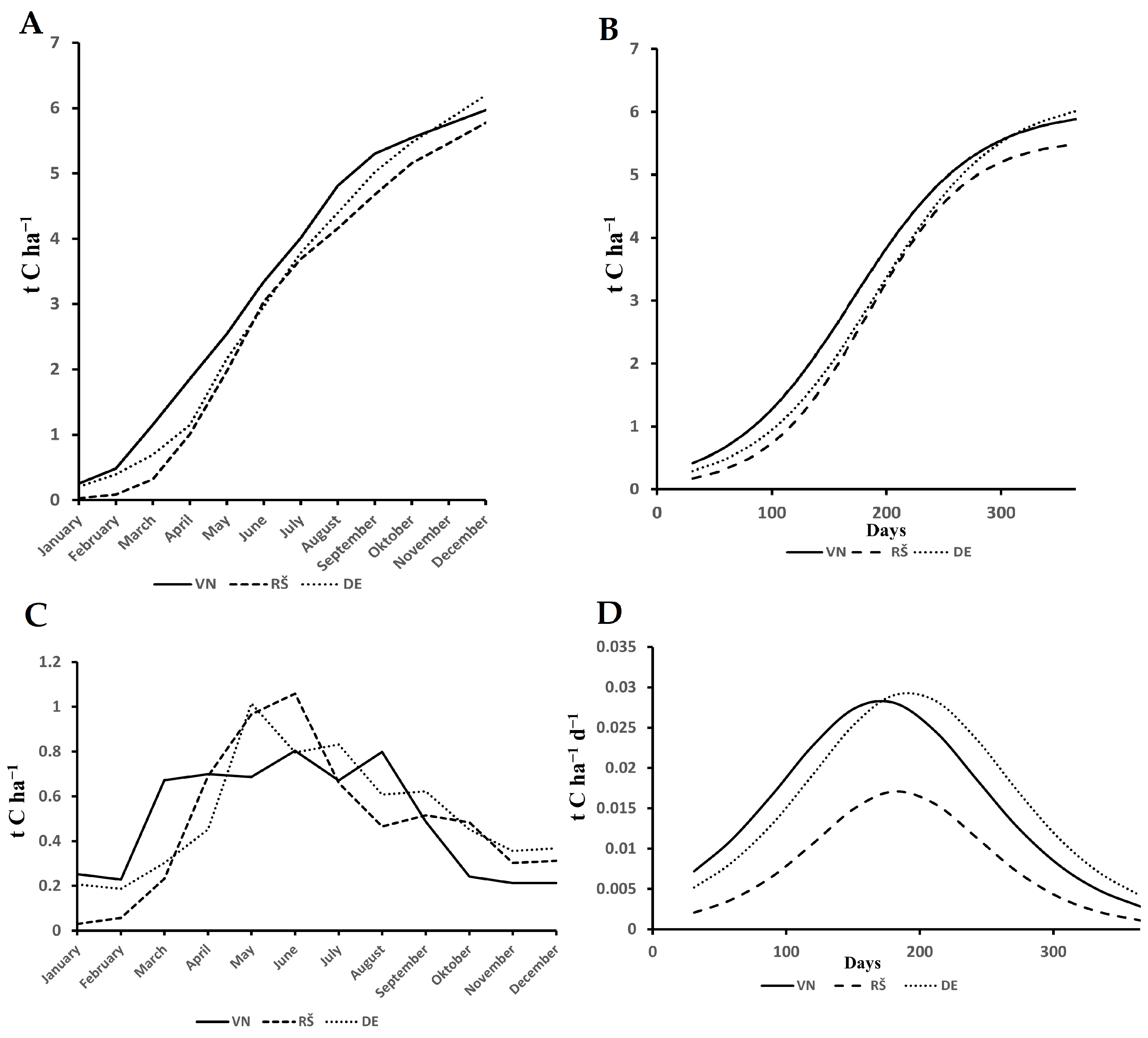
Based on the observed data, the annual C flux from soil was calculated for VN, RŠ, and DE, amounting to 5.97, 5.77, and 6.20 t C ha−1 yr−1, respectively (Figure 6A). The total monthly C flux from soil for each stand is shown in Figure 6C. The dynamics of monthly C flux indicated that the lowest values occurred at the beginning and end of the year, whereas the highest values were recorded from May to August.
A logistic model was fitted to the observed data to describe the relationship between cumulative flux and time (Figure 6B). This model showed a very strong relationship between cumulative flux and time for each stand (Table 7). The model predicted increasing trends over time, which were typically sigmoidal. According to the logistic model, the predicted annual C flux from soil in VN, RŠ, and DE was 5.89, 5.49, and 6.01 t C ha−1 yr−1, respectively. The observed annual soil C flux values were slightly higher than the predicted values.
Figure 6D illustrates the temporal dynamics of soil C flux rate derived from the first derivative of the fitted logistic model for each forest over time. The model predicts that peak soil CO2 flux rates occur approximately from day 150 to day 210 of the year.

4. Discussion

The relationship between soil CO2 flux and environmental drivers can be expressed using various single and multiple models [41,46,47]. These relationships can be linear or nonlinear, depending on the dataset [35,48,49,50,51]. The most common way to describe the relationship between soil CO2 flux and soil temperature is through exponential models, although other models are also used to express this relationship [40,52,53,54,55,56,57].
The results of our study showed an exponential rise in soil CO2 flux, followed by an increase in soil temperature during a three-year observation period. The most intensive increase in soil CO2 flux, along with the rise in soil temperature was recorded in the windbreak (RŠ) compared to the other two examined stands. During the study period, linear and exponential regression models did not reveal a significant relationship between soil moisture and soil CO2 flux. A similar effect of soil temperature and moisture on soil CO2 flux was recorded for six temperate species in Denmark using the same non-linear regression analysis [39]. However, the linear mixed-effects model (LMM) revealed that both soil moisture and soil temperature had significant effects on soil CO2 flux. In our previous studies, we concluded that soil moisture had a strong seasonal effect on soil CO2 flux [30,33,58]. This effect is usually most pronounced when there is a narrow range of soil temperature [30]. The strong seasonal impact of soil moisture on soil CO2 flux was also described in a few studies [37,59,60,61]. We can conclude that soil moisture can have a significant additional effect on soil CO2 flux. According to the quadratic model, the highest increase in soil CO2 flux was observed following a soil temperature increase at a soil moisture level of approximately 20%.
Our study showed significant differences in daily soil CO2 flux among stands at the three locations. Climatic conditions were comparable, with no significant differences in air temperature or precipitation among the locations. The linear mixed-effects model indicated that soil CO2 flux in the reference stand (VN) was significantly lower than in the other two stands (DE and RŠ). Our previous study reported significant differences in soil CO2 flux among pedunculate oak stands of different developmental stages growing on the same soil type [30]. Similarly, differences in fluxes were observed in a chronosequence consisted of seven stands of different ages in Croatia [62]. Other studies have also reported significant variation in soil CO2 flux among stands of different ages [53,63,64,65]. This study shows that soil CO2 flux may also differ among stands belonging to the same developmental stage, suggesting that site conditions play a significant role in controlling soil CO2 flux.
The Q10 values were 2.46, 4.06, and 2.01 in VN, RŠ, and DE, respectively. The Q10 values for soil CO2 flux mainly ranged from 2 to 4 within various ecosystems [66]. The Q10 value for RŠ was higher compared to the other two stands. According to Bond-Lamberty and Thomson (2010) [67], the response of soil respiration (soil CO2 flux) to soil temperature was moderate in VN and DE. This can be explained by the fact that VN and DE belong to larger forest complexes, unlike RŠ. The width of the windbreak is only 20 m, while its length is 340 m. This windbreak is surrounded by agricultural land (cropland). Temperature increases in the windbreak would have a greater impact on soil respiration rates compared to other forests. The high temperature sensitivity of soil respiration (Q10) in RŠ can be attributed to the characteristics and position of the windbreak, i.e., greater exposure of the windbreak to temperature changes compared to other stands. The high Q10 values were found in temperate mixed hardwood forest, ranging from 3.4 to 5.6 [20]. Additionally, high values of Q10 (Q10 > 5) were determined in a middle-aged pedunculate oak stand in the Belgian Campine region [68]. These higher Q10 values reflect the effect of temperature as well as the contribution of other seasonal factors that covary with temperature, including variations in root and mycorrhizal biomass [68]. The higher values of Q10 (up to 4.8) were recorded under pedunculate oak than under Scots pine in an urban mixed forest in Belgium. The larger soil respiration and Q10 values under oak were explained by larger aboveground net primary production and production of more detritus compared to pine [69]. Additionally, high Q10 values were recorded for Fagus sylvatica L. and Quercus robur L. in Denmark [39]. With the increase in soil temperature, soil respiration was less sensitive under pedunculate oak trees in Serbia compared to Belgium and Denmark [39,68,69].
The annual C flux from soil ranged from 5.77 to 6.20 t C ha−1 yr−1 in the studied stands. However, values of annual C flux from soil in pedunculate oak stands of different ages in Croatia ranged from 7.19 to 9.49 t C ha−1 yr−1. The highest values were recorded in younger stands, while the annual C flux was around 8 t C ha−1 yr−1 in the middle-aged stand [62]. The values of annual C flux from soil ranged from 5.9 to 7.8 t C ha−1 yr−1 in a middle-aged pedunculate oak stand in Belgium [69]. However, in a mixed forest mainly consisting of Acer pseudoplatanus, Fraxinus excelsior and Quercus robur in the UK, the annual soil CO2 flux was 4.1 t C ha−1 yr−1 [70]. Janssens et al. (2001) [71] suggested that the annual soil CO2 flux was 7.6 ± 3.4 t C m−2 yr−1 within various forest ecosystems in the European Union. Vesterdal et al. (2012) [39] suggested that the estimated heterotrophic CO2 flux approximately amounted to 54.2% of the total soil CO2 flux. We can conclude that the approximate carbon loss through the soil respiration process ranged from 3.13 to 3.36 t C ha−1 yr−1 in the examined stands. Our results compare well with Vesterdal et al. (2012) [39] who reported that heterotrophic soil respiration for Quercus robur was 3.48 t C ha−1 yr−1. Ostrogović Sever et al. (2019) [62] suggested that the average carbon loss through heterotrophic soil respiration was 5.34 ± 0.38 t C ha−1 yr−1 for different ages of pedunculate oak stand.
The forest management plan for the DE forest reported that the mean aboveground volume increment is 3.95 m−3 ha−1 yr−1, while this increment for VN was 9.47 m−3 ha−1 yr−1 [24,25]. The mean aboveground volume increment for RŠ was 4.59 m−3 ha−1 yr−1. The significantly lower soil CO2 flux observed in the reference stand (VN), together with its higher stand increment, may suggest a more favorable carbon balance compared to the other examined stands.

5. Conclusions

The linear mixed-effects model (LMM) showed that soil temperature and soil moisture as key drivers had significant effects on soil CO2 flux during the study period. The study showed that stand (location) had a significant effect on soil CO2 flux, whereas year did not significantly affect soil CO2 flux. The LMM revealed significantly lower soil CO2 flux in the reference stand (VN) compared to the other two investigated stands. Our study confirmed a higher temperature sensitivity of soil respiration (Q10) in the windbreak (RŠ) compared to the other two stands (VN and DE). The estimated annual CO2 flux from the soil was 5.98 ± 0.22 t C ha−1 yr−1, while the estimated mean annual carbon loss through soil respiration across all stands was approximately 3.24 ± 0.12 t C ha−1 yr−1. The lower soil CO2 flux observed in stands growing under optimal site conditions may suggest a more favorable carbon balance compared to stands growing outside their ecological optimum.

Author Contributions

V.K. and Z.G. performed conceptualization. M.S., Z.G. and V.K. performed methodology. V.K., M.S., Z.G. and M.Z. performed formal analysis and investigation. V.K. prepared original draft. Z.G., M.S. and M.Z. wrote, reviewed, and edited the manuscript. V.K. reviewed and edited the manuscript. Z.G. performed supervision. All authors contributed to the article and approved the submitted version. All authors have read and agreed to the published version of the manuscript.

Funding

This study was supported by the project: “Climate-SMART Forestry—a Near Real-Time Monitoring of Tree Vitality for Higher Decision Security in Managing and Protecting Riparian Forests (SmartTogether)” (Reg. No. 17278) funded by the Science Fund of the Republic of Serbia within DIASPORA 2023 program. The research is co-funded by the Ministry of Science, Technological Development, and Innovation of the Republic of Serbia (Grants No. 451-03-33/2026-03/200197).

Data Availability Statement

The data presented in this study are available from the corresponding author upon request.

Acknowledgments

We acknowledge the public enterprise “Vojvodinašume” for their support during fieldwork.

Conflicts of Interest

The authors declare no conflicts of interest.

References

  1. Nunes, L.J.; Meireles, C.I.; Pinto Gomes, C.J.; Almeida Ribeiro, N.M. Forest contribution to climate change mitigation: Management oriented to carbon capture and storage. Climate 2020, 8, 21. [Google Scholar] [CrossRef]
  2. Canadell, J.G.; Raupach, M.R. Managing forests for climate change mitigation. Science 2008, 320, 1456–1457. [Google Scholar] [CrossRef]
  3. Anderegg, W.R.; Trugman, A.T.; Badgley, G.; Anderson, C.M.; Bartuska, A.; Ciais, P.; Cullenward, D.; Field, C.B.; Freeman, J.; Goetz, S.J.; et al. Climate-driven risks to the climate mitigation potential of forests. Science 2020, 368, eaaz7005. [Google Scholar] [CrossRef]
  4. Whitehead, D. Forests as carbon sinks—Benefits and consequences. Tree Physiol. 2011, 31, 893–902. [Google Scholar] [CrossRef] [PubMed]
  5. McKinley, D.C.; Ryan, M.G.; Birdsey, R.A.; Giardina, C.P.; Harmon, M.E.; Heath, L.S.; Houghton, R.A.; Jackson, R.B.; Morrson, J.F.; Murray, B.C.; et al. A synthesis of current knowledge on forests and carbon storage in the United States. Ecol. Appl. 2011, 21, 1902–1924. [Google Scholar] [CrossRef] [PubMed]
  6. Pan, Y.; Birdsey, R.A.; Fang, J.; Houghton, R.; Kauppi, P.E.; Kurz, W.A.; Phillips, O.L.; Shvidenko, A.; Lewis, S.L.; Canadell, J.G.; et al. A large and persistent carbon sink in the world’s forests. Science 2011, 333, 988–993. [Google Scholar] [CrossRef] [PubMed]
  7. Goncharova, O.; Matyshak, G.; Udovenko, M.; Semenyuk, O.; Epstein, H.; Bobrik, A. Temporal dynamics, drivers, and components of soil respiration in urban forest ecosystems. Catena 2020, 185, 104299. [Google Scholar] [CrossRef]
  8. Scharlemann, J.P.; Tanner, E.V.; Hiederer, R.; Kapos, V. Global soil carbon: Understanding and managing the largest terrestrial carbon pool. Carbon Manag. 2014, 5, 81–91. [Google Scholar] [CrossRef]
  9. Stolt, M.H.; Lindbo, D.L. Soil organic matter. In Interpretation of Micromorphological Features of Soils and Regoliths; Elsevier: Amsterdam, The Netherlands, 2010; pp. 369–396. [Google Scholar]
  10. Schindlbacher, A.; Zechmeister-Boltenstern, S.; Jandl, R. Carbon losses due to soil warming: Do autotrophic and heterotrophic soil respiration respond equally? Glob. Change Biol. 2009, 15, 901–913. [Google Scholar] [CrossRef]
  11. Bond-Lamberty, B.; Wang, C.; Gower, S.T. A global relationship between the heterotrophic and autotrophic components of soil respiration? Glob. Change Biol. 2004, 10, 1756–1766. [Google Scholar] [CrossRef]
  12. Subke, J.A.; Voke, N.R.; Leronni, V.; Garnett, M.H.; Ineson, P. Dynamics and pathways of autotrophic and heterotrophic soil CO2 efflux revealed by forest girdling. J. Ecol. 2011, 99, 186–193. [Google Scholar] [CrossRef]
  13. Kuzyakov, Y. Sources of CO2 efflux from soil and review of partitioning methods. Soil Biol. Biochem. 2006, 38, 425–448. [Google Scholar] [CrossRef]
  14. Sugihara, S.; Funakawa, S.; Kilasara, M.; Kosaki, T. Effects of land management on CO2 flux and soil C stock in two Tanzanian croplands with contrasting soil texture. Soil Biol. Biochem. 2012, 46, 1–9. [Google Scholar] [CrossRef]
  15. Hu, S.; Li, Y.; Chang, S.X.; Li, Y.; Yang, W.; Fu, W.; Liu, J.; Jiang, P.; Lin, Z. Soil autotrophic and heterotrophic respiration respond differently to land-use change and variations in environmental factors. Agric. For. Meteorol. 2018, 250, 290–298. [Google Scholar] [CrossRef]
  16. Jenkinson, D.S.; Adams, D.E.; Wild, A. Model estimates of CO2 emissions from soil in response to global warming. Nature 1991, 351, 304–306. [Google Scholar] [CrossRef]
  17. Majumder, B.; Mandal, B.; Bandyopadhyay, P.K.; Gangopadhyay, A.; Mani, P.K.; Kundu, A.L.; Mazumdar, D. Organic amendments influence soil organic carbon pools and rice–wheat productivity. Soil Sci. Soc. Am. J. 2008, 72, 775–785. [Google Scholar] [CrossRef]
  18. Staněk, L.; Neruda, J.; Ulrich, R. Changes in the concentration of CO2 in forest soils resulting from the traffic of logging machines. J. For. Sci. 2025, 71, 250–267. [Google Scholar] [CrossRef]
  19. Buchmann, N. Biotic and abiotic factors controlling soil respiration rates in Picea abies stands. Soil Biol. Biochem. 2000, 32, 1625–1635. [Google Scholar] [CrossRef]
  20. Davidson, E.A.; Belk, E.; Boone, R.D. Soil water content and temperature as independent or confounded factors controlling soil respiration in a temperate mixed hardwood forest. Glob. Change Biol. 1998, 4, 217–227. [Google Scholar] [CrossRef]
  21. Feizienė, D.; Feiza, V.; Vaidelienė, A.; Povilaitis, V.; Antanaitis, Š. Soil surface carbon dioxide exchange rate as affected by soil texture, different long-term tillage application and weather. Zemdirbyste=Agriculture 2010, 97, 25–42. [Google Scholar]
  22. Banković, S.; Medarević, M.; Pantić, D.; Petrović, N. National Forest Inventory of the Republic of Serbia—The Growing Stock of the Republic of Serbia; Ministry of Agriculture, Forestry and Water Management of the Republic of Serbia—Forest Directorate: Belgrade, Serbia, 2009; pp. 1–238.
  23. Republic Hydrometeorological Service of Serbia. Available online: https://www.hidmet.gov.rs/ (accessed on 11 March 2026).
  24. Forest Management Plan for MU Vinična-Žeravinac-Puk. Available online: https://www.upravazasume.gov.rs/wp-content/uploads/2017/01/Vinicna-Zeravinac-Puk-2017-2026.docx (accessed on 15 March 2026).
  25. Forest Management Plan for MU Branjevina. Available online: https://upravazasume.gov.rs/obavestenja/sumarstvo/javne-rasprave/osnova-gazdovanja-sumama-jpvojvodinasuma-petrovaradini-za-gj-branjevina/ (accessed on 15 March 2026).
  26. Banković, S.; Pantić, D. Dendrometry; Faculty of Forestry, University of Belgrade: Belgrade, Serbia, 2006. [Google Scholar]
  27. FAO. World Reference Base for Soil Resources 2014, Update 2015; World Soil Resources Reports 106; FAO: Rome, Italy, 2015. [Google Scholar]
  28. Škorić, A.; Filipovski, G.; Cirić, M. Classification of Yugoslav Soils; Academy of Sciences and Arts of Bosnia and Herzegovina, Interacademic Board for Soil Science: Sarajevo, Bosnia and Herzegovina, 1985. [Google Scholar]
  29. Ivanišević, P.; Galić, Z.; Rončević, S.; Kovačević, B.; Marković, M. Significance of establishment of forest tree and shrub plantations for the stability and sustainable development of ecosystems in Vojvodina. Topola 2008, 181, 31–40. [Google Scholar]
  30. Karaklić, V.; Samardžić, M.; Orlović, S.; Zorić, M.; Kesić, L.; Perendija, N.; Galić, Z. Effect of stand age on soil CO2 emissions in pedunculate oak (Quercus robur L.) forests. Forests 2024, 15, 1574. [Google Scholar] [CrossRef]
  31. Karaklić, V.; Galić, Z.; Samardžić, M.; Kesić, L.; Orlović, S.; Zorić, M. Carbon dioxide (CO2) emissions from soils during the regeneration of pedunculate oak (Quercus robur L.) stand in the summer period. Šumar. List 2023, 147, 227–237. [Google Scholar] [CrossRef]
  32. Avilov, K.V.; Barkov, A.V.; Vasenev, I.I.; Vasenev, I.V.; Vizirskaja, M.M.; Paskarev, A.A.; Terekhov, V.A.; Kurbatova, A.J.; Samardzhich, M. Device for Measuring Emission of Greenhouse Gas from Soil and Plants; Russian Federation’s Federal Service for Intellectual Property: Moscow, Russia, 2014; No. RU 2 518 979 C1.
  33. Karaklić, V.; Samardžić, M.; Orlović, S.; Guzina, I.; Kovač, M.; Novčić, Z.; Galić, Z. Differences in Soil CO2 Emissions Between Managed and Unmanaged Stands of Quercus robur L. in the Republic of Serbia. Forests 2025, 16, 1369. [Google Scholar] [CrossRef]
  34. Köster, K.; Püttsepp, Ü.; Pumpanen, J. Comparison of soil CO2 flux between uncleared and cleared windthrow areas in Estonia and Latvia. For. Ecol. Manag. 2011, 262, 65–70. [Google Scholar] [CrossRef]
  35. Ming, A.; Yang, Y.; Liu, S.; Wang, H.; Li, Y.; Li, H.; Nong, Y.; Cai, D.; Jia, H.; Tao, Y.; et al. Effects of near natural forest management on soil greenhouse gas flux in Pinus massoniana (Lamb.) and Cunninghamia lanceolata (Lamb.) Hook. plantations. Forests 2018, 9, 229. [Google Scholar] [CrossRef]
  36. Tang, X.; Liu, S.; Zhou, G.; Zhang, D.; Zhou, C. Soil-atmospheric exchange of CO2, CH4, and N2O in three subtropical forest ecosystems in southern China. Glob. Change Biol. 2006, 12, 546–560. [Google Scholar] [CrossRef]
  37. Sarzhanov, D.A.; Vasenev, V.I.; Vasenev, I.I.; Sotnikova, Y.L.; Ryzhkov, O.V.; Morin, T. Carbon stocks and CO2 emissions of urban and natural soils in Central Chernozemic region of Russia. Catena 2017, 158, 131–140. [Google Scholar] [CrossRef]
  38. Iqbal, J.; Ronggui, H.; Lijun, D.; Lan, L.; Shan, L.; Tao, C.; Leilei, R. Differences in soil CO2 flux between different land use types in mid-subtropical China. Soil Biol. Biochem. 2008, 40, 2324–2333. [Google Scholar] [CrossRef]
  39. Vesterdal, L.; Elberling, B.; Christiansen, J.R.; Callesen, I.; Schmidt, I.K. Soil respiration and rates of soil carbon turnover differ among six common European tree species. For. Ecol. Manag. 2012, 264, 185–196. [Google Scholar] [CrossRef]
  40. Song, X.; Yuan, H.; Kimberley, M.O.; Jiang, H.; Zhou, G.; Wang, H. Soil CO2 flux dynamics in the two main plantation forest types in subtropical China. Sci. Total Environ. 2013, 444, 363–368. [Google Scholar] [CrossRef]
  41. Cui, Y.B.; Feng, J.G.; Liao, L.G.; Yu, R.; Zhang, X.; Liu, Y.H.; Yang, L.Y.; Zhao, J.F.; Tan, Z.H. Controls of temporal variations on soil respiration in a tropical lowland rainforest in Hainan Island, China. Trop. Conserv. Sci. 2020, 13, 1940082920914902. [Google Scholar] [CrossRef]
  42. Pinheiro, J.; Bates, D.; DebRoy, S.; Sarkar, D.; R Core Team. nlme: Linear and Nonlinear Mixed Effects Models. CRAN Mixed Model Rev 2023, Version 3.1-169. Available online: https://CRAN.R-project.org/package=nlme (accessed on 16 May 2026).
  43. Lenth, R. emmeans: Estimated Marginal Means, Aka Least-Squares Means. CRAN Stat Inference J 2025, Version 2.0.3. Available online: https://CRAN.R-project.org/package=emmeans (accessed on 16 May 2026).
  44. Wickham, H. ggplot2: Elegant Graphics for Data Analysis; Springer: New York, NY, USA, 2016. [Google Scholar]
  45. Adler, D.; Murdoch, D. rgl: 3D Visualization Device System (OpenGL), R Package Version 1.3.36. Available online: http://CRAN.R-project.org/package=rgl (accessed on 29 January 2026).
  46. Jia, B.; Zhou, G.; Wang, Y.; Wang, F.; Wang, X. Effects of temperature and soil water-content on soil respiration of grazed and ungrazed Leymus chinensis steppes, Inner Mongolia. J. Arid. Environ. 2006, 67, 60–76. [Google Scholar] [CrossRef]
  47. Li, H.J.; Yan, J.X.; Yue, X.F.; Wang, M.B. Significance of soil temperature and moisture for soil respiration in a Chinese mountain area. Agric. For. Meteorol. 2008, 148, 490–503. [Google Scholar] [CrossRef]
  48. Bao, X.; Zhu, X.; Chang, X.; Wang, S.; Xu, B.; Luo, C.; Zhang, Z.; Wang, Q.; Rui, Y.; Cui, X. Effects of soil temperature and moisture on soil respiration on the Tibetan plateau. PLoS ONE 2016, 11, e0165212. [Google Scholar] [CrossRef]
  49. Kochiieru, M.; Veršulienė, A.; Feiza, V.; Feizienė, D. Trend for soil CO2 efflux in grassland and forest land in relation with meteorological conditions and root parameters. Sustainability 2023, 15, 7193. [Google Scholar] [CrossRef]
  50. Mühlbachová, G.; Kusá, H.; Růžek, P.; Vavera, R. CO2 emissions in a soil under different tillage practices. Plant Soil Environ. 2020, 68, 253–261. [Google Scholar] [CrossRef]
  51. Shen, H.; Zhang, L.; Meng, H.; Zheng, Z.; Zhao, Y.; Zhang, T. Response of soil respiration and its components to precipitation exclusion in Vitex negundo var. heterophylla shrubland of the Middle Taihang Mountain in North China. Front. Environ. Sci. 2021, 9, 712301. [Google Scholar] [CrossRef]
  52. Wu, X.; Zang, S.; Ma, D.; Ren, J.; Chen, Q.; Dong, X. Emissions of CO2, CH4, and N2O fluxes from forest soil in permafrost region of Daxing’an Mountains, Northeast China. Int. J. Environ. Res. Public Health 2019, 16, 2999. [Google Scholar] [CrossRef]
  53. Zhao, X.; Li, F.; Zhang, W.; Ai, Z.; Shen, H.; Liu, X.; Cao, J.; Manevski, K. Soil respiration at different stand ages (5, 10, and 20/30 years) in coniferous (Pinus tabulaeformis Carrière) and deciduous (Populus davidiana Dode) plantations in a sandstorm source area. Forests 2016, 7, 153. [Google Scholar] [CrossRef]
  54. Franco-Luesma, S.; Cavero, J.; Plaza-Bonilla, D.; Cantero-Martínez, C.; Arrúe, J.L.; Álvaro-Fuentes, J. Tillage and irrigation system effects on soil carbon dioxide (CO2) and methane (CH4) emissions in a maize monoculture under Mediterranean conditions. Soil Tillage Res. 2020, 196, 104488. [Google Scholar] [CrossRef]
  55. Fischer, D.G.; Chamberlain, Z.R.; Cook, C.E.; Martin, R.A.; Mueller, L.O. Long-term patterns in forest soil CO2 flux in a Pacific Northwest temperate rainforest. Forests 2024, 15, 161. [Google Scholar] [CrossRef]
  56. Lellei-Kovács, E.; Kovács-Láng, E.; Botta-Dukát, Z.; Kalapos, T.; Emmett, B.; Beier, C. Thresholds and interactive effects of soil moisture on the temperature response of soil respiration. Eur. J. Soil Biol. 2011, 47, 247–255. [Google Scholar] [CrossRef]
  57. Gaumont-Guay, D.; Black, T.A.; Griffis, T.J.; Barr, A.G.; Jassal, R.S.; Nesic, Z. Interpreting the dependence of soil respiration on soil temperature and water content in a boreal aspen stand. Agric. For. Meteorol. 2006, 140, 220–235. [Google Scholar] [CrossRef]
  58. Galić, Z.; Karaklić, V.; Marković, S.B.; Kiš, A.; Samardžić, M. Forest soil CO2 emission in Quercus robur level II monitoring site. Open Geosci. 2024, 16, 20220723. [Google Scholar] [CrossRef]
  59. Wei, S.; Zhang, X.; McLaughlin, N.B.; Liang, A.; Jia, S.; Chen, X.; Chen, X. Effect of soil temperature and soil moisture on CO2 flux from eroded landscape positions on black soil in Northeast China. Soil Tillage Res. 2014, 144, 119–125. [Google Scholar] [CrossRef]
  60. Shi, W.Y.; Tateno, R.; Zhang, J.G.; Wang, Y.L.; Yamanaka, N.; Du, S. Response of soil respiration to precipitation during the dry season in two typical forest stands in the forest–grassland transition zone of the Loess Plateau. Agric. For. Meteorol. 2011, 151, 854–863. [Google Scholar] [CrossRef]
  61. Najdovski, B.; Cokoski, K.; Vasilevski, K.; Velkovski, N. Abiotic factors impact on soil respiration. Topola 2025, 216, 53–62. [Google Scholar] [CrossRef]
  62. Ostrogović Sever, M.Z.; Alberti, G.; Delle Vedove, G.; Marjanović, H. Temporal Evolution of carbon stocks, fluxes and carbon balance in pedunculate oak chronosequence under close-to-nature forest management. Forests 2019, 10, 814. [Google Scholar] [CrossRef]
  63. Saiz, G.; Byrne, K.A.; Butterbach-Bahl, K.; Kiese, R.; Blujdea, V.; Farrell, E.P. Stand age-related effects on soil respiration in a first rotation Sitka spruce chronosequence in central Ireland. Glob. Change Biol. 2006, 12, 1007–1020. [Google Scholar] [CrossRef]
  64. Tedeschi, V.; Rey, A.N.A.; Manca, G.; Valentini, R.; Jarvis, P.G.; Borghetti, M. Soil respiration in a Mediterranean oak forest at different developmental stages after coppicing. Glob. Change Biol. 2005, 12, 110–121. [Google Scholar] [CrossRef]
  65. Gong, J.; Ge, Z.; An, R.; Duan, Q.; You, X.; Huang, Y. Soil respiration in poplar plantations in northern China at different forest ages. Plant Soil. 2012, 360, 109–122. [Google Scholar] [CrossRef]
  66. Wang, T.; Wang, Y.; Wang, Y.; Dong, J.; Yu, S. Temperature effects on forest soil greenhouse gas emissions: Mechanisms, ecosystem responses, and future directions. Forests 2025, 16, 1371. [Google Scholar] [CrossRef]
  67. Bond-Lamberty, B.; Thomson, A. Temperature-associated increases in the global soil respiration record. Nature 2010, 464, 579–582. [Google Scholar] [CrossRef]
  68. Yuste, J.C.; Janssens, I.A.; Ceulemans, R. Calibration and validation of an empirical approach to model soil CO2 efflux in a deciduous forest. Biogeochemistry 2005, 73, 209–230. [Google Scholar] [CrossRef]
  69. Yuste, J.C.; Janssens, I.A.; Carrara, A.; Ceulemans, R. Annual Q10 of soil respiration reflects plant phenological patterns as well as temperature sensitivity. Glob. Change Biol. 2004, 10, 161–169. [Google Scholar] [CrossRef]
  70. Fenn, K.M.; Malhi, Y.; Morecroft, M.D. Soil CO2 efflux in a temperate deciduous forest: Environmental drivers and component contributions. Soil Biol. Biochem. 2010, 42, 1685–1693. [Google Scholar] [CrossRef]
  71. Janssens, I.A.; Lankreijer, H.; Matteucci, G.; Kowalski, A.S.; Buchmann, N.; Epron, D.; Pilegaard, K.; Kutsch, W.; Longdoz, B.; Grünwald, T.; et al. Productivity overshadows temperature in determining soil and ecosystem respiration across European forests. Glob. Change Biol. 2001, 7, 269–278. [Google Scholar] [CrossRef]
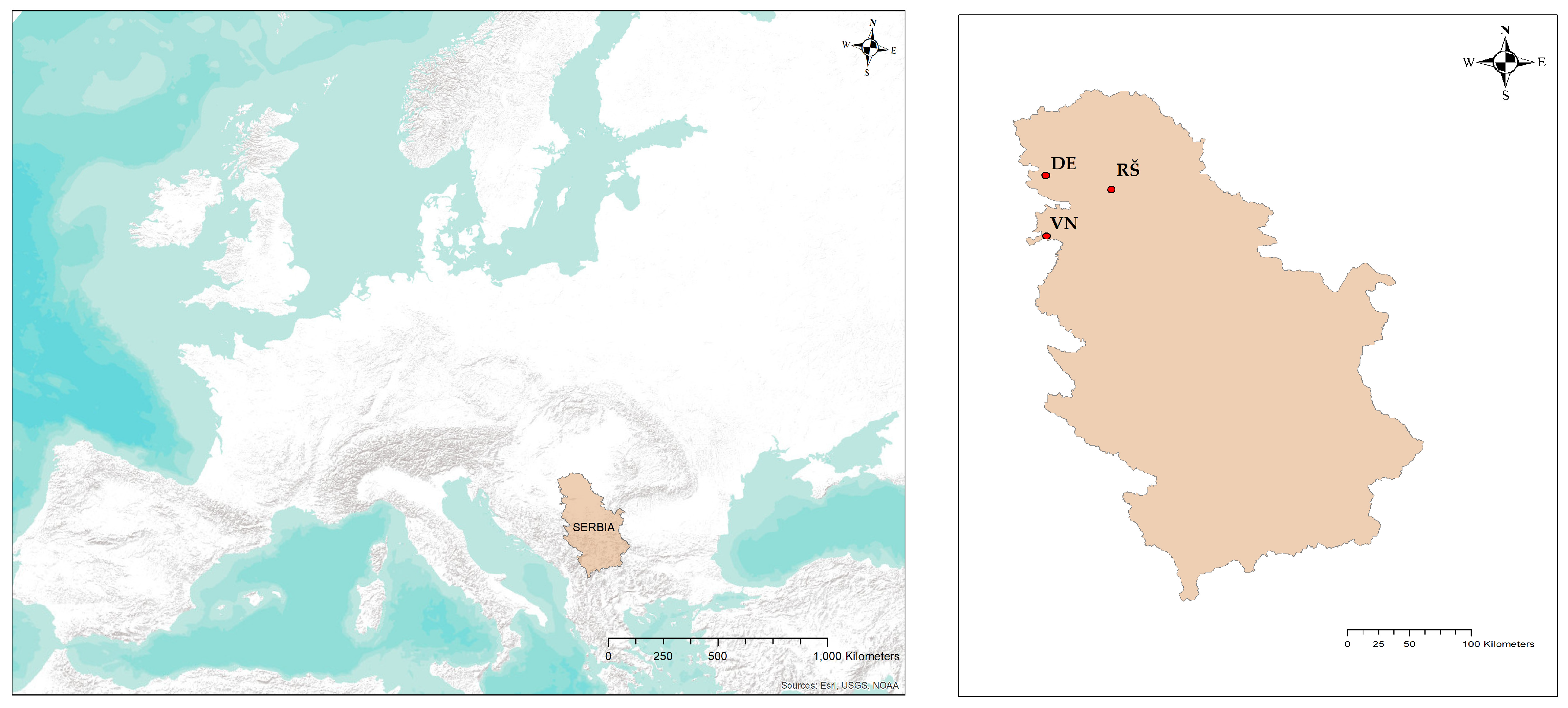
Figure 1. The position of the examined stands: VN-Vinična (44°56′21.90″ N; 19°11′58.12″ E); RŠ-Rimski Šančevi (45°20′35.11″ N; 19°51′22.71″ E); DE-Deronje (45°27′14.18″ N; 19°10′25.86″ E).
Forests 17 00671 g001
Figure 2. The average monthly air temperature and average monthly precipitation for the observation period from 1991 to 2020.
Forests 17 00671 g002
Figure 3. Variation in soil CO2 flux among the examined stands during the study period (2022–2024): Deronje (DE), Rimski Šančevi (RŠ), and Vinična (VN). Variation in soil CO2 flux among stands for each study year (A); annual variation in soil CO2 flux across all examined stands (B); variation in soil CO2 flux among stands over the entire study period (C). The line within each boxplot represents the median, whereas dots indicate arithmetic mean values.
Forests 17 00671 g003
Figure 4. Relationship between daily soil CO2 flux (g CO2 m−2 d−1) and soil temperature at 5 cm depth (°C) (A), and soil moisture (%) (B).
Forests 17 00671 g004
Figure 5. Combined influence of soil temperature (T, °C) and soil moisture (W, %) on soil CO2 flux (g CO2 m−2 d−1), modeled using a quadratic model (y = a + bT + cW + dT2 + eW2 + fTW) for all stands. 3D illustration of the quadratic model (A) and heatmap of the quadratic model (B). The y-, x-, and z-axes represent soil CO2 flux, soil moisture (W), and soil temperature (T), respectively.
Forests 17 00671 g005
Figure 6. Cumulative CO2 flux (t C ha−1 yr−1) over the year based on observed data (A); Predicted cumulative CO2 flux (t C ha−1 yr−1) as a function of time (days), obtained using a logistic model for each stand (B); Total monthly soil CO2 flux (t C ha−1 yr−1) based on observed data for each stand (C); Temporal dynamics of soil CO2 flux rate derived from the differential form of the logistic model (D).
Forests 17 00671 g006
Table 1. Structural parameters of examined stands.
Vinična (VN)
Tree SpeciesAverage DBH (cm)Average Height (m)Number of Trees Per HectareVolume (m3 ha−1)Average Annual Volume Increment (m3 ha−1)
Quercus robur33.827.6266422.517.23
Carpinus betulus16.218.842175.81.42
Fraxinus angustifolia34.727.71521.220.33
Other species15.214.79514.490.5
Total 797534.029.48
Deronje (DE)
Quercus robur33.921.4163225.483.83
Quercus cerris31.921.51819.130.1
Other species11.910.518615.930.02
Total 367260.543.95
Rimski Šančevi (RŠ)
Quercus robur56.220.4200442.964.43
Robinia pseudoacacia45.112.1125128.21-
Other species17.588.51506.390.16
Total 475577.564.59
Table 2. Soil properties of the humus-accumulative horizon (A) of Chernozem for each examined stand.
LocationSoil ClassificationA Horizon DepthTotal Sand
>0.02 mm
Silt + Clay
<0.02 mm
Textural ClassC
(%)
N
(%)
CaCO3
(%)
pH (H2O)
Soil TypeSubtypeVarietyForm
Vinična (VN)Chernozemon alluvial depositsleached gleyedDeep
(>80 cm)
82 cm26.873.2clay loam0.890.160.587.32
Rimski Šančevi (RŠ)on loess and loess-like sedimentsShallow
(<40 cm)
40 cm40.959.1loam2.280.130.007.7
Deronje (DE)38 cm48.151.9loam1.890.241.734.65
Table 3. Results of regression analysis describing the relationship between daily soil CO2 flux and soil temperature for the examined stands.
StandModellnaabNR2R2adjp-Value
VNlny = lna + bx (y = aebt)0.01771.0180.0997370.480.46p < 0.001
−0.38870.6780.1442320.580.57p < 0.001
DE0.6881.9900.0729330.640.62p < 0.001
All stands0.1471.1580.1011020.510.51p < 0.001
VNy = a + bx-−2.27720.5266370.390.38p < 0.001
-−2.110.6661320.50.49p < 0.001
DE-0.00580.4590330.480.46p < 0.001
All stands-−1.04960.51521020.410.41p < 0.001
Table 4. Results of the regression analysis for the mixed quadratic model describing the combined effects of soil temperature and moisture on soil CO2 flux.
All standsRegression EquationsCoefficientsNR2R2adjp-value
abcdef
y = a + bt + ct2 + dw + ew2 + ftw−0.900.380.00070.22−0.0080.0041020.490.44p < 0.001
Table 5. Estimated fixed effects of soil temperature, soil moisture, stand, and year on soil CO2 flux derived from a linear mixed-effects model.
Fixed EffectEstimateStd.ErrorDFt-Valuep-Value
(Intercept)−3.40411.42816606−2.38350.0175 *
Soil temperature0.362320.040246069.00388<0.001 ***
Soil moisture0.174220.032436065.37179<0.001 ***
DE (stand)1.579820.51814123.049020.0101 *
RŠ (stand)1.478230.54018122.736580.0180 *
2023 (year)0.685720.443076061.547660.1222 ns
2024 (year)−0.32670.44147606−0.73990.4596 ns
ns—not significant, *** p < 0.001, * p < 0.05.
Table 6. Estimated marginal means (EMMs) of soil CO2 flux for investigated stands and study years.
Stand
VNDE
6.31 a7.79 b7.89 b
Year
202220232024
7.21 a7.9 a6.88 a
Significant differences in soil CO2 flux values in the table are denoted by different lowercase letters.
Table 7. Estimated parameters and coefficients of determination (R2) for the logistic model describing cumulative CO2 flux in the examined stands.
StandModelabcR2
VNy = a 1 + b e c x 6.04324.3400.0190.99
5.58162.6100.0230.99
DE6.24136.7580.0190.99
Disclaimer/Publisher’s Note: The statements, opinions and data contained in all publications are solely those of the individual author(s) and contributor(s) and not of MDPI and/or the editor(s). MDPI and/or the editor(s) disclaim responsibility for any injury to people or property resulting from any ideas, methods, instructions or products referred to in the content.