Article

Impacts of Vertical Variation in Canopy Structures on Shelterbelt Windbreak Effectiveness: A Large-Eddy Simulation Study

1
Shaoguan Bureau of Meteorology of Guangdong Province, Shaoguan 512026, China
2
School of Soil and Water Conservation, Beijing Forestry University, Beijing 100107, China
3
Guangdong Climate Center, Guangdong Provincial Meteorological Service, Guangzhou 510080, China
4
Department of Civil, Chemical, Environmental and Materials Engineering, University of Bologna, 40136 Bologna, Italy
5
School of Civil Engineering and Architecture, Guangxi University, Nanning 530004, China
*
Authors to whom correspondence should be addressed.
Forests 2026, 17(4), 498; https://doi.org/10.3390/f17040498
Submission received: 27 March 2026 / Revised: 14 April 2026 / Accepted: 15 April 2026 / Published: 17 April 2026
(This article belongs to the Section Forest Ecology and Management)

Abstract

Shelterbelts are increasingly used to mitigate strong wind damage, but the complex canopy structures create challenges for numerical studies of windbreak effectiveness, such as the trade-off between computational cost and accuracy of results. To address these challenges and accurately investigate the downstream wind fields, most conventional studies represent shelterbelts as rectangular porous media with a uniformly distributed aerodynamic resistance coefficient. However, due to the vertical variation in canopy diameter and the irregular distribution of leaf density, the aerodynamic resistance of natural shelterbelts becomes nonuniform accordingly. To quantify the discrepancies arising from this simplification, this study first proposes a non-destructive approach to calculate canopy porosity profiles, which are further used to derive aerodynamic resistance at different heights. Then, by comparing the results obtained from the conventional and proposed approaches in Large-Eddy Simulations, the discrepancies caused by ignoring the vertical variation in canopy structures are analyzed. Finally, these discrepancies are further investigated for double-row shelterbelts. The results show that ignoring the vertical variation in canopy diameter leads to significant differences in windbreak effectiveness, especially for the downstream velocity and pressure fields at the top and middle heights of the canopy. The proposed approach provides a computationally efficient and more accurate representation of near-surface wind fields downstream of shelterbelts, thereby contributing to the accurate prediction of local wind fields for meteorological services.

1. Introduction

Shelterbelts constitute vital components of agricultural ecosystems and natural landscapes, offering essential protection against ecological and environmental threats, such as wind erosion and soil degradation [1,2,3,4]. In particular, shelterbelts can significantly reduce wind velocity and turbulence intensity for the farmland, thereby mitigating damage caused by various wind disasters [5,6,7]. Nevertheless, shelterbelts introduce complex aerodynamic effects on the downstream flow, which significantly increase the difficulty of accurately predicting the downstream near-surface wind fields. This introduces substantial uncertainty into near-surface wind field forecasting, which directly hinders the reliable operation of low-altitude unmanned aerial vehicles, as small-scale wind fluctuations can pose risks to flight safety [8]. Therefore, accurate quantification of their windbreak effectiveness is fundamental for both optimal shelterbelt design and safe drone operation [9,10,11].
The windbreak effectiveness of shelterbelts is significantly influenced by their structural parameters, such as the external features (e.g., tree heights and canopy diameter) and internal properties (e.g., the leaf area index and canopy porosity) [12]. However, direct field measurements to investigate the influences of these parameters on windbreak effectiveness are usually expensive and time-consuming [13,14,15]. Additionally, field measurements are often limited by weather conditions, especially the unpredictability of incoming winds. Despite these limitations, the field data are necessary for validating the modeling approaches and results of other studies. Previous measurements demonstrate that the windbreak effectiveness of shelterbelts is significantly influenced by their total leaf density and width [16]. Furthermore, for single-row shelterbelts, a noticeable linear correlation is found between windbreak effectiveness and optical porosity [17]. Wind tunnel tests offer a relatively low-cost alternative for evaluating the aerodynamic shielding performance of shelterbelts [18]. However, the velocity measurements in wind tunnels are restricted to discrete sensor locations within the test section. Moreover, the complex three-dimensional structures of shelterbelt canopies challenge the creation of scaled shelterbelt models [19].
To overcome the high cost of field measurements and the scaling challenges of wind tunnel experiments, Computational Fluid Dynamics, CFD, is increasingly employed to analyze the windbreak effectiveness of shelterbelts [20]. Previous studies have shown that the Large-Eddy Simulation, LES, is able to well reproduce the profiles of mean wind velocity and turbulent kinetic energy around shelterbelts [21]. Therefore, LES has been widely utilized to optimize the design of vegetated shelterbelts by determining optimal structural layouts and parameters, including shelterbelt width and length [22,23]. Additionally, LES can be used to investigate the influences of isolated trees and buildings on wind fields, which is a key technical point for meteorological departments to improve the prediction accuracy of low-altitude gusts and turbulence [24,25,26]. In particular, to achieve a balance between computational cost and result accuracy, shelterbelts are commonly represented as rectangular zones by using the porous media model with a uniform coefficient to characterize the aerodynamic resistance [27,28]. The calculation of this coefficient has traditionally focused on overall leaf density and drag of tree canopies. However, due to the structural variability of canopies, especially the variation in canopy diameter at different heights and the irregular distributions of leaves in three-dimensional space, the conventional modeling approach with an aerodynamic resistance coefficient is inadequate [29]. For example, when employing the conventional approach, two systematic biases appear to be inevitable: the windbreak effectiveness is underestimated in the mid-canopy regions, where the densest leaves are typically found, and overestimated around the canopy top, where fewer leaves exist. This inadequacy not only affects the accuracy of windbreak effectiveness evaluation, but also limits the improvement of near-surface wind field simulation accuracy, further restricting the support role of meteorological simulation technology for the low-altitude economy.
In order to address these limitations, nonuniform aerodynamic coefficients of shelterbelts are increasingly considered in studies of windbreak effectiveness, but the calculation of these coefficients remains challenging [30]. Destructive measurements of double-row shelterbelts indicate that both vegetative surface area density (vegetative surface area per unit canopy volume) and cubic density (vegetative volume per unit canopy volume) change significantly with height [31]. Based on the measured marginal distributions of canopy surface area and volume with height, an approach has been proposed to estimate the nonuniformly distributed coefficients of aerodynamic resistance [32]. This approach has been successfully adopted for the design and management of tree shelterbelts [33]. Additionally, for shelterbelts with canopies far from the ground, the trunk area needs to be modeled separately [34]. Furthermore, point cloud data obtained via LiDAR measurements are increasingly used to establish detailed canopy geometries [35,36,37,38]. However, given the complexity of measuring and calculating detailed canopy geometric parameters, a non-destructive and universal method for obtaining canopy porosity profiles remains desirable.
Inspired by the Alpha Blending algorithm, which is a fragment modifier operation and commonly used to achieve transparency effects in computer graphics, this study attempts to propose and evaluate a novel approach to calculate porosity profiles based on the distributions of local opacity, which incorporates both canopy diameter variation and leaf density characteristics [39]. Detailed information is provided in the next section. After preliminary validation, the discrepancies caused by using the previous modeling approach, which ignores the variation in canopy diameter along height, are quantitatively analyzed.
This paper is structured as follows. Firstly, a non-destructive approach for calculating the nonuniform aerodynamic resistance coefficients of shelterbelts is introduced in Section 2, together with the setup of LES cases for evaluating the discrepancies caused by the conventional approach. Particularly, the cases with the proposed and conventional approaches are respectively named Nonuniform-K and Uniform-K, where K represents the aerodynamic resistance coefficient. Then, the obtained results are analyzed and compared in Section 3, focusing on the velocity and pressure distributions downstream of single-row and double-row shelterbelts. Finally, conclusions are drawn in Section 4.

2. Materials and Methods

2.1. Porous Media Model with the Uniform-K Approach

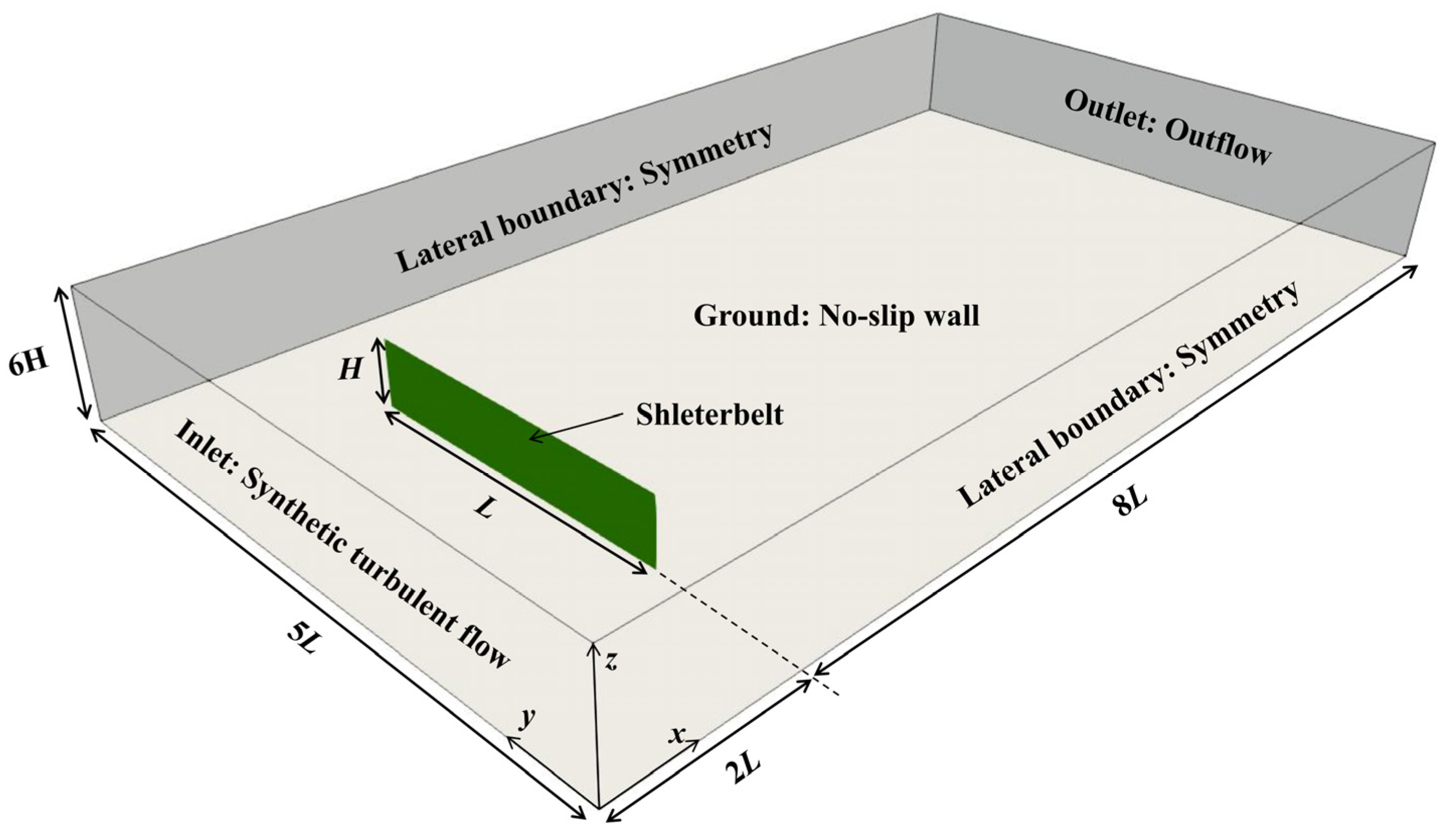
We first proceed with the conventional Uniform-K modeling approach, i.e., the porous media model with uniform aerodynamic resistance. A typical example of using this approach based on the pressure-jump boundary condition (an application of employing the porous media model on thin belts) is shown in Figure 1. In particular, a green shelterbelt is located in the central region of the LES domain, which is 10 L long, 5 L wide and 6 H high. The distance from the shelterbelt to the inlet and outlet boundaries is 2 L and 8 L, respectively. In this case, the geometric blockage ratio is 3.3%, smaller than the 5% recommendation in wind engineering studies [40]. Since the shelterbelt is porous rather than solid, the actual blocking ratio is even smaller. It should be noted that, although shelterbelts are three-dimensional structures, the boundary condition for representing the shelterbelt is zero thickness. This simplification is appropriate for single-row shelterbelts, because the airflow through the canopy thickness (perpendicular to the shelterbelt) is short, which allows the three-dimensional flow characteristics inside the canopy to be modeled homogeneously without reducing the simulation accuracy of the windbreak effectiveness.
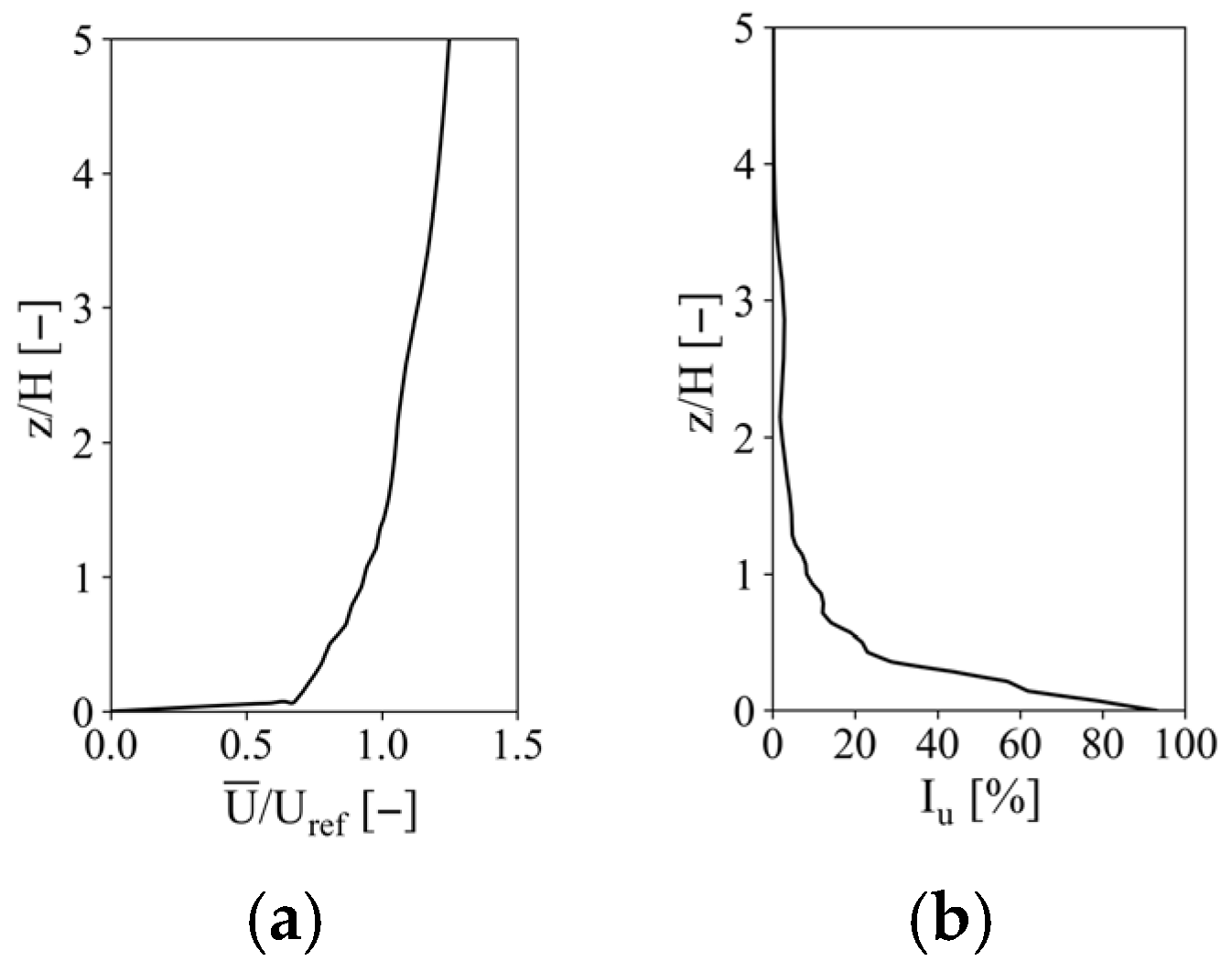
A pressure outlet boundary condition is adopted at the outflow. The side and top boundaries are set as symmetry boundary conditions, while the bottom is a no-slip wall. Regarding the inlet, a turbulent inflow generated by artificial synthesis is applied, where the profiles are provided as follows. To replicate atmospheric boundary layer inflow characteristics, the PRFG3 method is used to generate synthetic turbulent inflows in the regions with low vegetation and scattered obstacles like individual farms [41]. Figure 2a shows the resulting mean velocity profile, exhibiting an increase with height that reaches the reference velocity Uref at the standard meteorological measurement height of 0.5 H. Figure 2b provides the profile of the turbulent kinetic energy generated by the PRFG3 method. With increasing height, the turbulent kinetic energy decreases continuously, falling to 0 at 3.5 H.
In terms of numerical methods, the temporal discretization employs a blended scheme combining Euler implicit and Crank–Nicolson formulations. A fixed time step of Δt = 0.01 s maintains a maximum Courant number approximately equal to 1.0 throughout the domain. The diffusion term is used in the Gauss linear format, and the convection term is processed in the Linear Upwind Stabilised Transport, LUST. In this study, the windward mixing of LUST format is set to 0.25 and the central mixing factor is set to 0.75. Pressure–velocity coupling is resolved through the Pressure Implicit with Splitting of Operators algorithm. Simulations extend over 1000 s of physical time. To eliminate the effect of the initial transient effect, data from the initial stage of the simulation, i.e., t ranges from 0 to 200 s, are discarded. The statistical average of the flow field is obtained based on the time window after stability, i.e., t ranges from 200 to 1000 s.
The following simulations are performed using the open-source software OpenFOAM-v2112.

Evaluation of the Uniform-K Approach

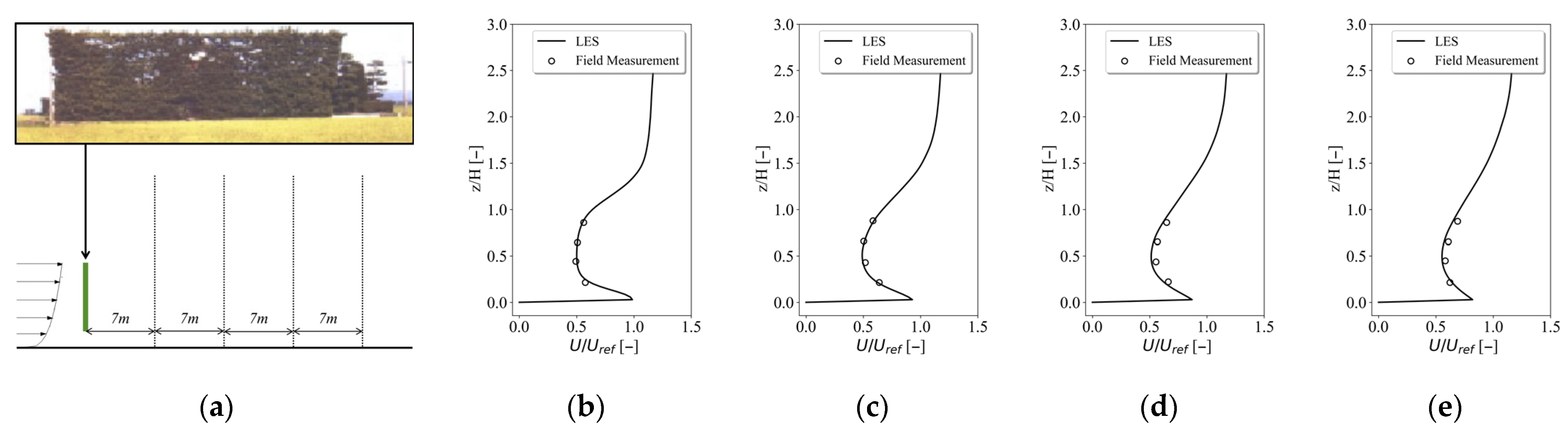
Before performing simulations with the conventional Uniform-K approach and collecting results for comparison, the accuracy of this approach needs to be evaluated. For this purpose, the above-mentioned LES domain and the Uniform-K approach are employed to reproduce the wind velocity profiles downstream of the Tsuijimatsu shelterbelt, whose canopy is pruned into a rectangle, shown in Figure 3a, so that the vertical variation in aerodynamic resistance can be ignored [42,43]. In particular, according to a previous study on the windbreak effectiveness of this shelterbelt, the uniform coefficient of aerodynamic resistance equals 1.2 [23]. It should also be noted that the aerodynamic resistance of trunks is not considered in this case, with the influences of this ignorance further discussed in the next section.
The wind velocities downstream of the shelterbelt obtained respectively by field measurements and LES with the conventional Uniform-K approach are compared, as shown in Figure 3b–e. Good agreement is observed between measurement data and LES results at most locations, indicating the acceptable accuracy of the Uniform-K approach when the canopy shape is similar to the porous media model adopted.

2.2. Porous Media Model with the Nonuniform-K Approach

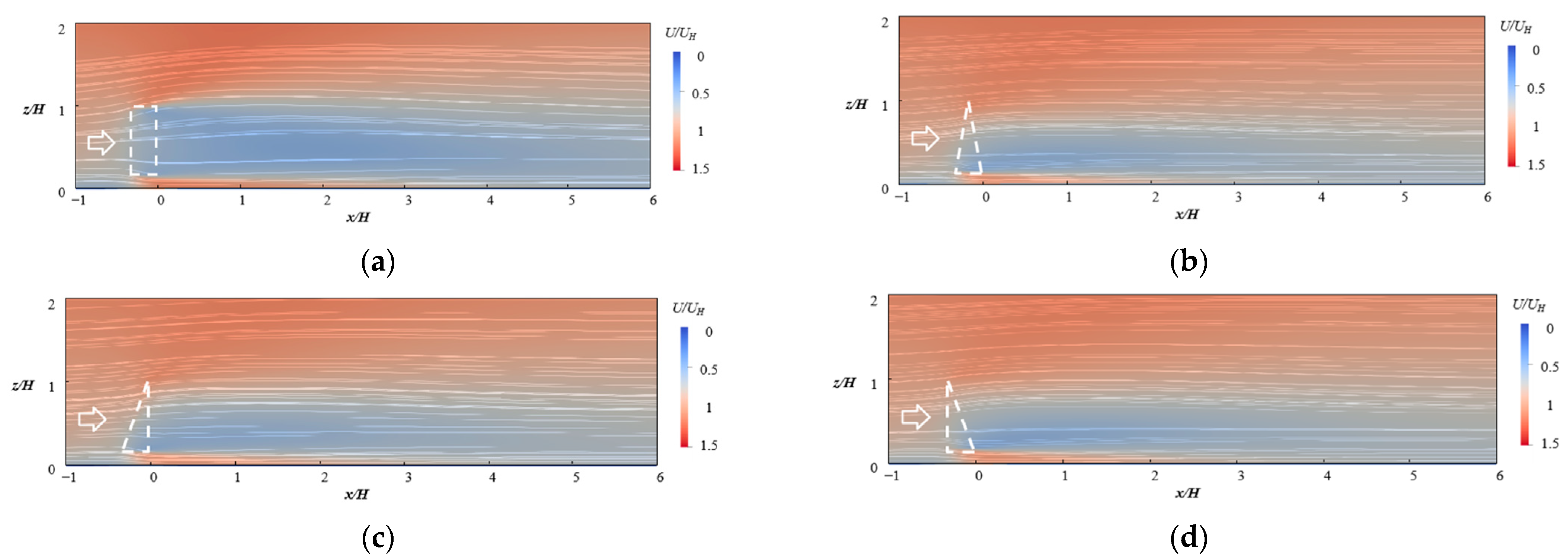
We then extend the analysis to account for vertical variations in canopy structure by adopting a porous media model with the Nonuniform-K approach. An example explicitly using this approach and illustrating the influences of canopy vertical variation on windbreak effectiveness is shown in Figure 4, where the nonuniform distribution of aerodynamic resistance is considered by explicitly modeling the canopy shape [22]. As shown in Figure 4a,b, the canopies of shelterbelts are respectively modeled as rectangular and triangular porous media, where the same coefficient of aerodynamic resistance is adopted inside porous areas. In this scenario, the rectangular porous media essentially provide larger total aerodynamic drag, especially on the top of shelterbelts. Consequently, at a dimensionless height of z/H = 1.0, the wind velocity downstream of the triangular shape canopy is significantly higher than that for the rectangular canopy. Additional comparisons between the wind velocity fields downstream of shelterbelts that are respectively modeled as symmetrical, windward and leeward triangle porous media are shown in Figure 4b–d. Despite the differences in canopy geometry, similar wake heights and lengths are observed for these triangular models. The primary reason for this is that the horizontal cross-sectional dimensions of the triangular porous media are equal at each height, resulting in similar vertical aerodynamic resistance profiles.
The above comparisons demonstrate that modeling shelterbelt aerodynamic resistance without accounting for its vertical variation can lead to significant discrepancies in the evaluation of windbreak effectiveness. Explicitly modeling canopy geometries with non-rectangular porous media is a direct approach to address this issue, but the explicit model of canopy shape requires additional mesh arrangement and consequently increases the computational costs. It is also worth mentioning that the canopy structures are usually irregular; thus, the Nonuniform-K approach is difficult to adopt by explicitly accounting for the three-dimensional canopy shapes. Therefore, a more general solution for employing the Nonuniform-K approach is still desirable.
To overcome this limitation, a cost-effective alternative is proposed to represent aerodynamic resistance as a height-dependent variable, i.e., implementing a porous media model with nonuniform resistance coefficients. In this context, accurately obtaining the aerodynamic resistance coefficients of shelterbelts at different heights is crucial. Several models correlating aerodynamic resistance coefficients with geometric porosity have been developed for this purpose. Nevertheless, two key challenges remain for practical implementation: Firstly, due to the complexity of the canopy structures, the direct measurement or calculation of canopy porosity is extremely challenging. Therefore, a feasible method to calculate the porosity, β, and aerodynamic resistance coefficient, K, at different heights is worthwhile. Secondly, as these K-β models are commonly validated with thin porous fences instead of tree shelterbelts, further calibrations are necessary.

2.2.1. Calculating the Profiles of β

Regarding the first challenge, i.e., quantifying the vertical variation in porosity, the primary difficulty stems from the three-dimensional canopy geometry, including the irregular distribution of trunk diameters and leaf densities across the vertical profile. Although the well-known optical porosity, defined as the ratio of open space to the total projected area, is a sufficient metric for two-dimensional wind fences [44], it fails to capture the internal volumetric obstruction of three-dimensional tree canopies. This limitation arises because two-dimensional projection of a three-dimensional canopy produces a solid silhouette that masks the true internal permeability of the canopy, even when open flow paths exist across different vertical cross-sections.
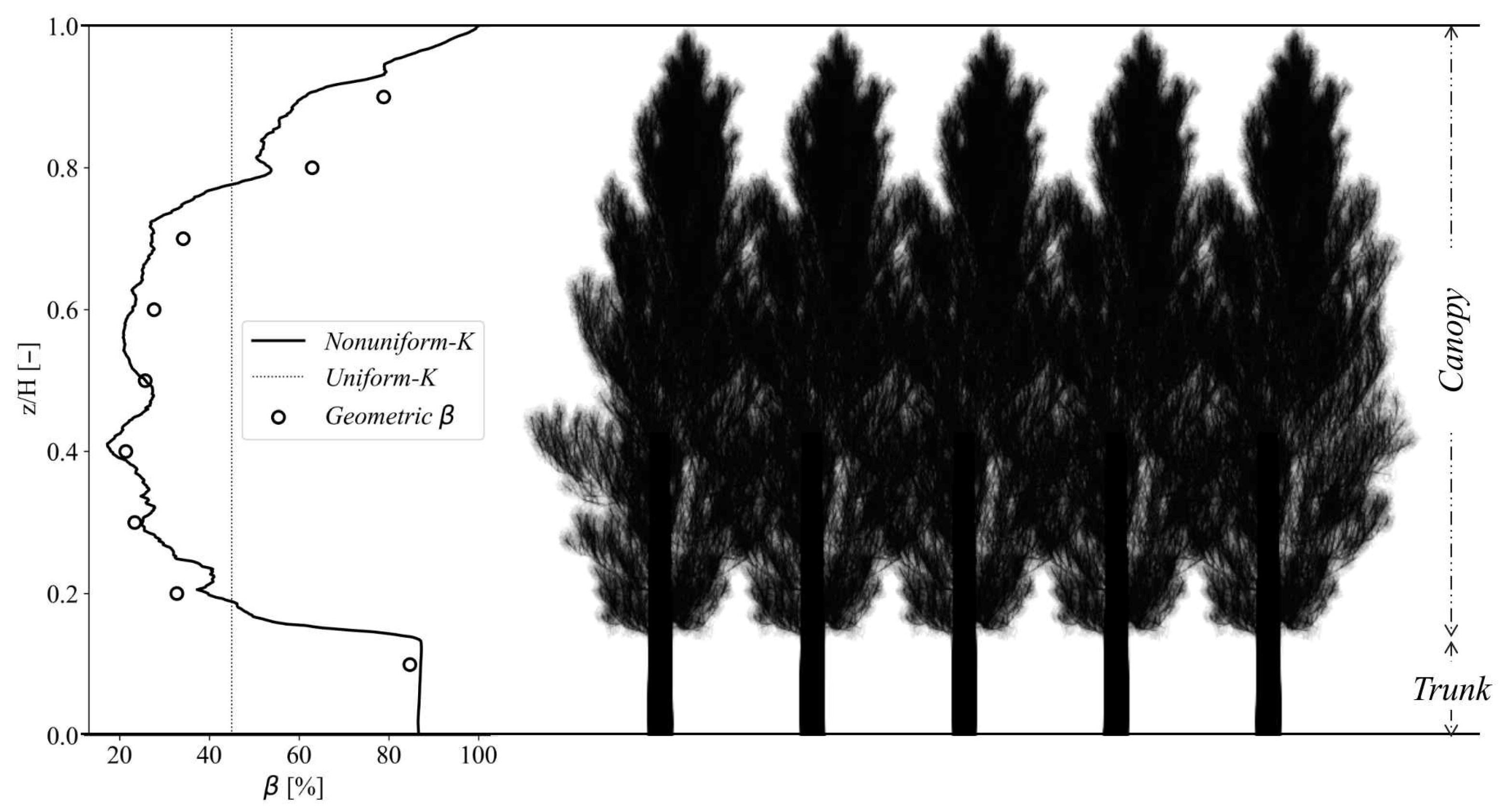
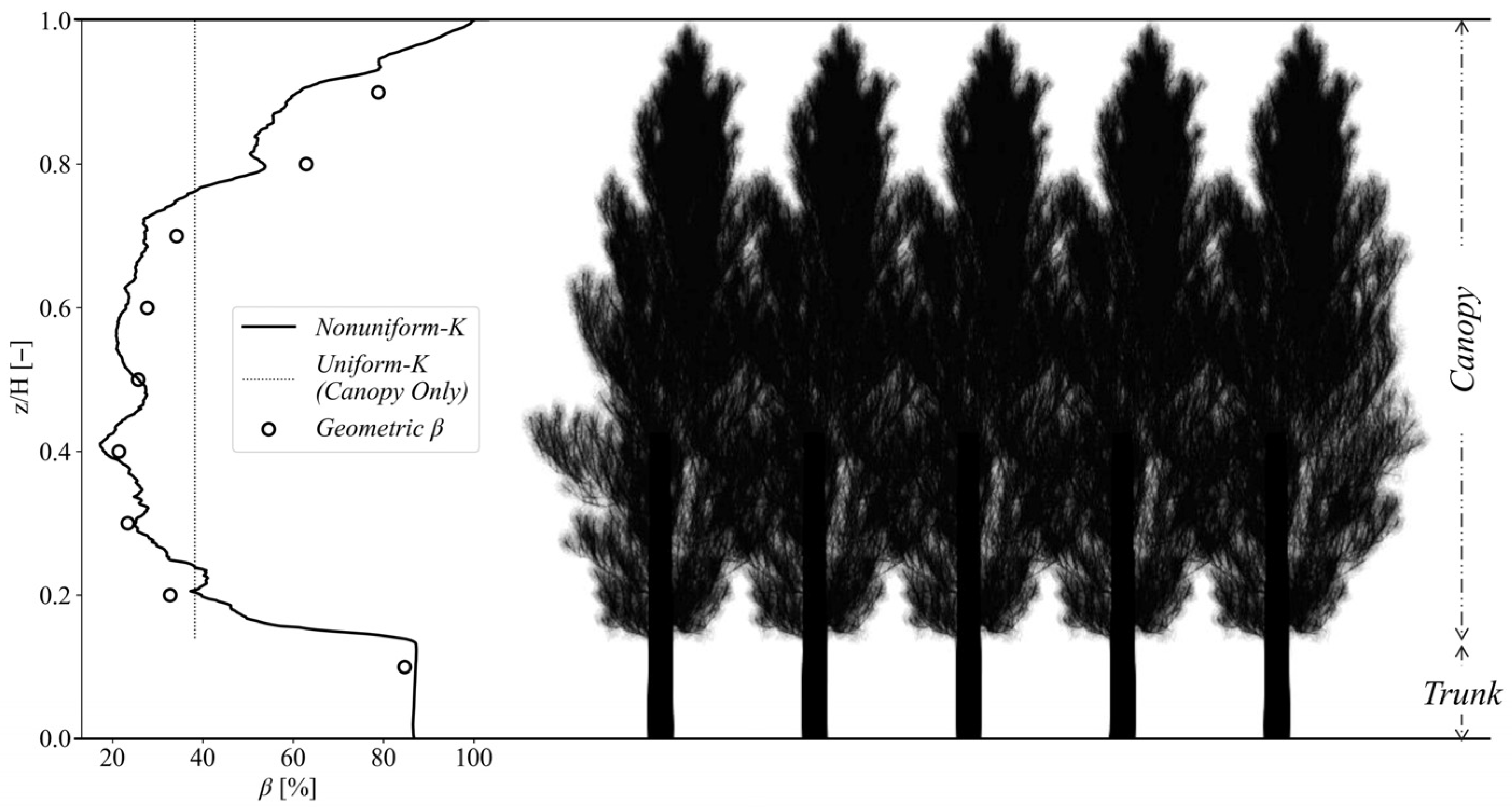
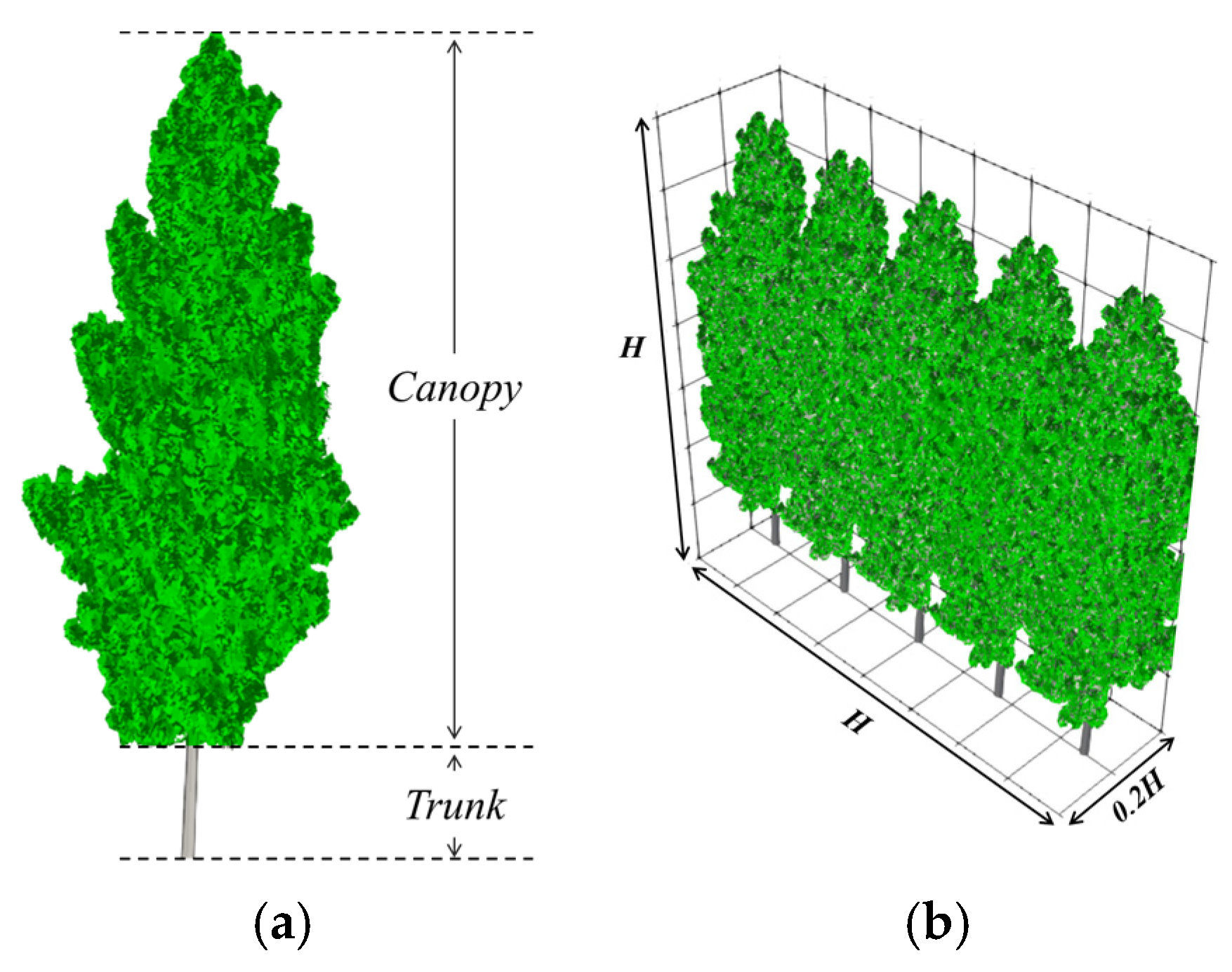
Inspired by the Alpha Blending algorithm, this study proposes a novel method to calculate shelterbelt canopy porosity based on the distributions of local opacity, which incorporates both canopy diameter variation and leaf density characteristics [45]. This method discretizes the canopy into a series of vertical, translucent layers, where grayscale values are used to represent foliage density (which is inversely related to local porosity). It leverages principles from volume rendering and stratified image analysis to simulate light transmission through the canopy matrix, thereby enabling the quantification of vertical porosity variations. Taking a part of a single-row shelterbelt composed of metasequoia trees with a height of H and a maximum diameter of 0.2 H as an example, the method proceeds in the following steps. It should be noted that, as shown in Figure 5, the model can be extended to longer shelterbelts by periodic repetition of this basic segment, although only five trees are adopted for demonstration.
First, the three-dimensional model of the shelterbelt is created based on the metasequoia plant, where several LiDAR measurement results are adopted as references [46,47,48]. Then, the geometric model is converted into a triangular mesh, with a resolution of 0.0125 m3 to balance computational efficiency and detail. An opacity value of 0.05 is then assigned to each individual mesh element to represent foliage translucency. After that, the opacity values of all mesh elements are accumulated vertically along the height of the canopy using the Alpha Blending algorithm, yielding higher cumulative opacity values in regions with high leaf density or large canopy cross-sectional diameter. For subsequent visualization and quantitative analysis, the cumulative opacity values are linearly scaled to an 8-bit grayscale range (0–255). The grayscale values at each vertical height are then normalized by the maximum grayscale value (i.e., 255) to derive the local porosity at each height across the canopy profile. In addition, at the heights of trunks, the local porosity is calculated as the ratio of the total trunk cross-sectional area to the total cross-sectional area of the shelterbelt model unit. This approach provides a continuous vertical profile of porosity, which enables the derivation of a height-resolved resistance coefficient profile that transitions smoothly from the high-porosity trunk region to the variable-porosity canopy region.
The vertical porosity profile derived using the proposed Nonuniform-K approach is presented on the left in Figure 6, where significantly height-dependent variation can be found. Particularly, the porosity in the trunk region (height lower than 0.15 H) is about β = 87%, while the minimum porosity β = 17% occurs at 0.41 H, corresponding to the height of the maximum canopy diameter. Geometric porosity values (calculated as the ratio of canopy volume to total volume) at several discrete heights are included for comparison. In practice, the calculation is performed as follows. The entire tree height H is divided into 20 horizontal layers along the vertical direction, each with a thickness of 0.05 H. For each layer, the canopy volume within that layer is calculated based on the three-dimensional geometric shape of canopies. Meanwhile, the total volume of the corresponding control volume is also determined. The geometric porosity at each height is then obtained as the ratio of the free air volume (i.e., total volume minus canopy volume) to the total volume. As shown in Figure 6 (left), good agreement is observed between the two porosity profiles. For this shelterbelt, the conventional Uniform-K approach uses a spatially averaged porosity value of 45% for the entire canopy.

2.2.2. Calibration of the K-β Model

For the second challenge, this study adopts a previously validated aerodynamic resistance model that can be further calibrated using field experimental data. As previously mentioned, although several models have been proposed [49,50,51], comparisons between these models and field experimental data show that a calibration scale factor is required to achieve good agreement [52,53]. Therefore, a K-β correlation model that incorporates an experimentally derived calibration parameter is selected for this study [54]:
K = ( 0.5 β + 2 ) ( β 1 ) β 2 ( γ 1 )
where K is the coefficient of aerodynamic resistance, β is the porosity, and γ is the parameter for calibration.
Then, determine the calibration parameter γ for the shelterbelt K-β relationship; the approximate optical porosity of 19%, measured by Kurotani’s field measurement at a height of 5.355 m, is adopted here as the reference value [42]. Additionally, previous LES studies that reproduced these field measurements showed that an aerodynamic resistance coefficient of 1.2 shows good agreement [23]. Therefore, using the reference porosity and resistance coefficient values, the calibration parameter γ is derived as −37.9, and this value is used for subsequent Nonuniform-K simulations. In this case, γ was calibrated against field measurement data based on the Tsuijimatsu shelterbelt that is artificially pruned into a regular rectangular shape. This eliminates the interference of vertical canopy heterogeneity, providing a clean dataset for model calibration. Nevertheless, it is still worth mentioning that the calibration coefficient γ can be sensitive to vegetation type and height. This sensitivity is associated with differences between species, suggesting that currently employed γ may not be directly applicable to other contexts, and requiring additional evaluation for the calibrated K-β relationship.

2.2.3. Preliminary Evaluation of the Nonuniform-K Approach

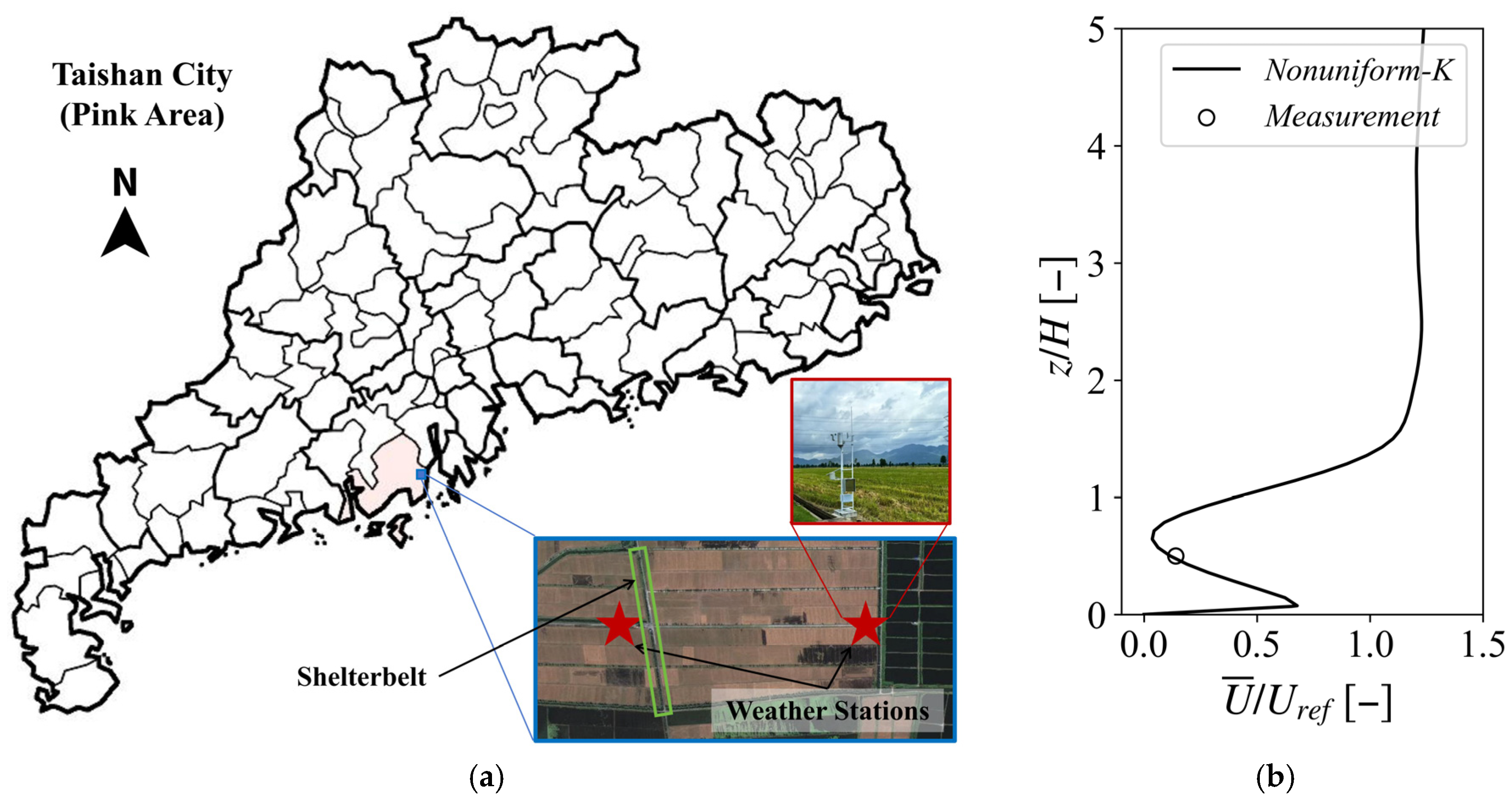
For evaluating the accuracy of the Nonuniform-K approach with the calibrated K-β relationship, wind velocity data measured by two automatic weather stations in Taishan City, Guangdong Province, China, is utilized. As shown in Figure 7a, two automatic weather stations are respectively located at 112.978 E, 22.089 N and 112.968 E, 22.096 N (approximately 1.1 km away from each other), with a shelterbelt situated between them. Since the surrounding area is flat farmland, the wind remains unobstructed at a height of 0.5 H until reaching the shelterbelt. Thus, for easterly wind conditions, the velocity measured by the eastern weather station is taken as the upstream wind velocity of the shelterbelt. Similarly, the velocity measured by the western weather station, approximately located at a distance of 2.1 H leeward of the shelterbelt, is taken as the downstream wind velocity of the shelterbelt.
Measurement data recorded at 15:00 on 28 December 2024 is utilized as the reference data to verify the accuracy of the Nonuniform-K approach. An easterly wind with an upstream velocity of Uref = 5.1 m/s and a downstream velocity of 0.7 m/s is measured by the eastern and western weather stations, respectively. By using the LES setup shown in Figure 1 with an inflow velocity of Uref = 5.1 m/s, the wind fields are simulated. In particular, the velocity profile downstream of the shelterbelts at a distance of 2.1 H is measured. The comparison between the field-measured data and the Nonuniform-K simulation results is presented in Figure 7b, and a good agreement is found.
It should also be noted that the Nonuniform-K approach reproduces the influence of vertical canopy heterogeneity on windbreak effectiveness without the need to resolve the full three-dimensional geometry, thereby substantially lowering computational cost. However, this approach is appropriate for narrow shelterbelts, e.g., a single-row case, where the pressure-jump boundary condition is valid because the streamwise flow path through the canopy remains short. For a group of vegetation canopies with substantial thickness, such as forest, where significant three-dimensional flow characteristics and turbulence development occur, a porous media model that explicitly considers canopy volume is more appropriate.

2.3. Evaluation of the Mesh Sensitivity

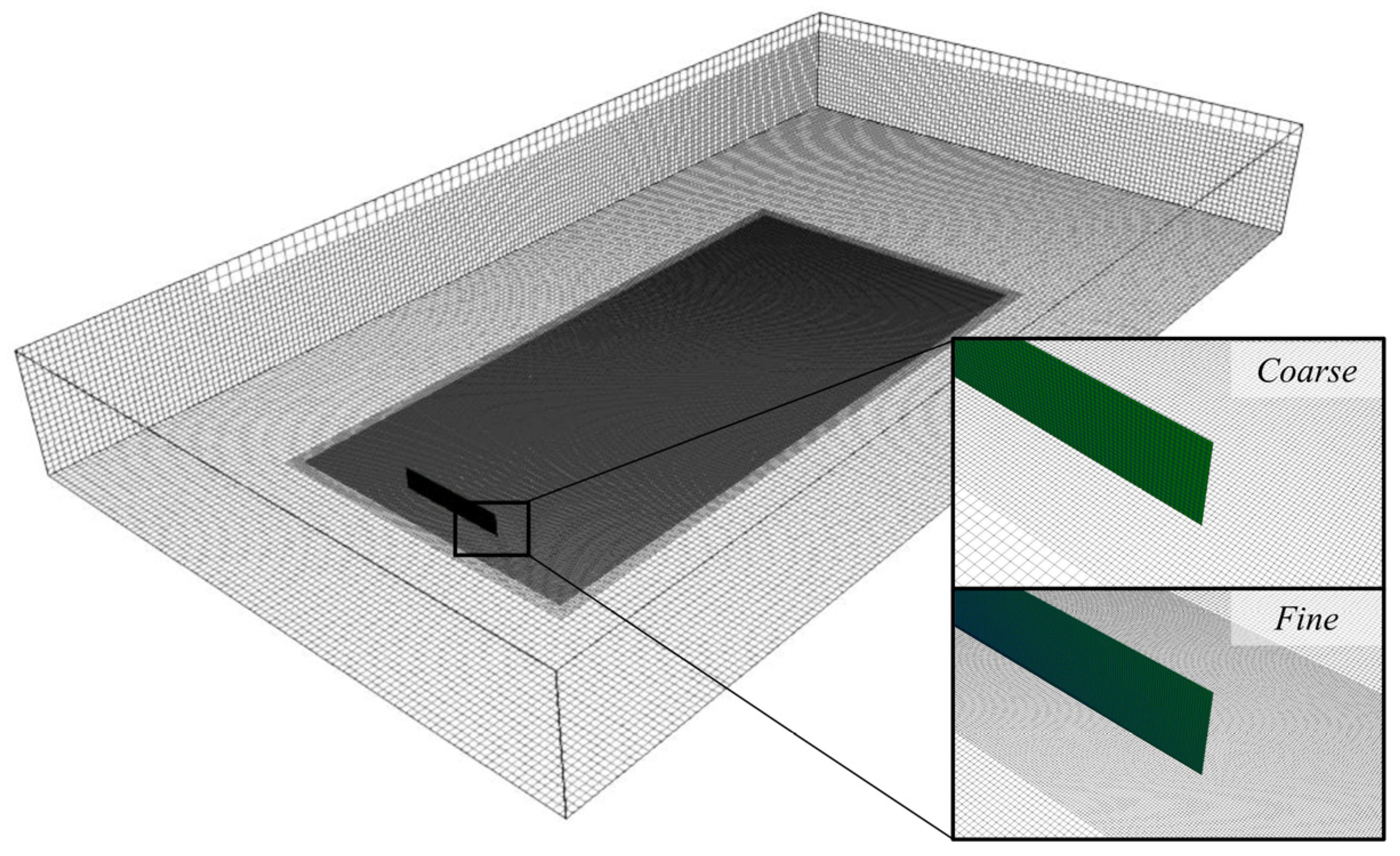
Finally, before performing the simulations and comparing the results obtained from Uniform-K and Nonuniform-K cases, a mesh sensitivity analysis is performed to verify the grid independence of the numerical results. The CFD simulations in this study use structured hexahedral meshes for the entire computational domain, with the mesh configuration illustrated in Figure 8. Two distinct grid resolutions are adopted for the mesh independence test across all simulation cases: a coarse mesh, which discretizes the shelterbelt height into 20 computational cells with a nominal resolution of approximately 0.05 H per cell, and a fine mesh, which uses 40 cells along the shelterbelt height with a nominal resolution of approximately 0.025 H per cell. Local mesh refinement is applied in the vicinity of the shelterbelt to accurately capture the fine-scale flow characteristics in the canopy wake region.
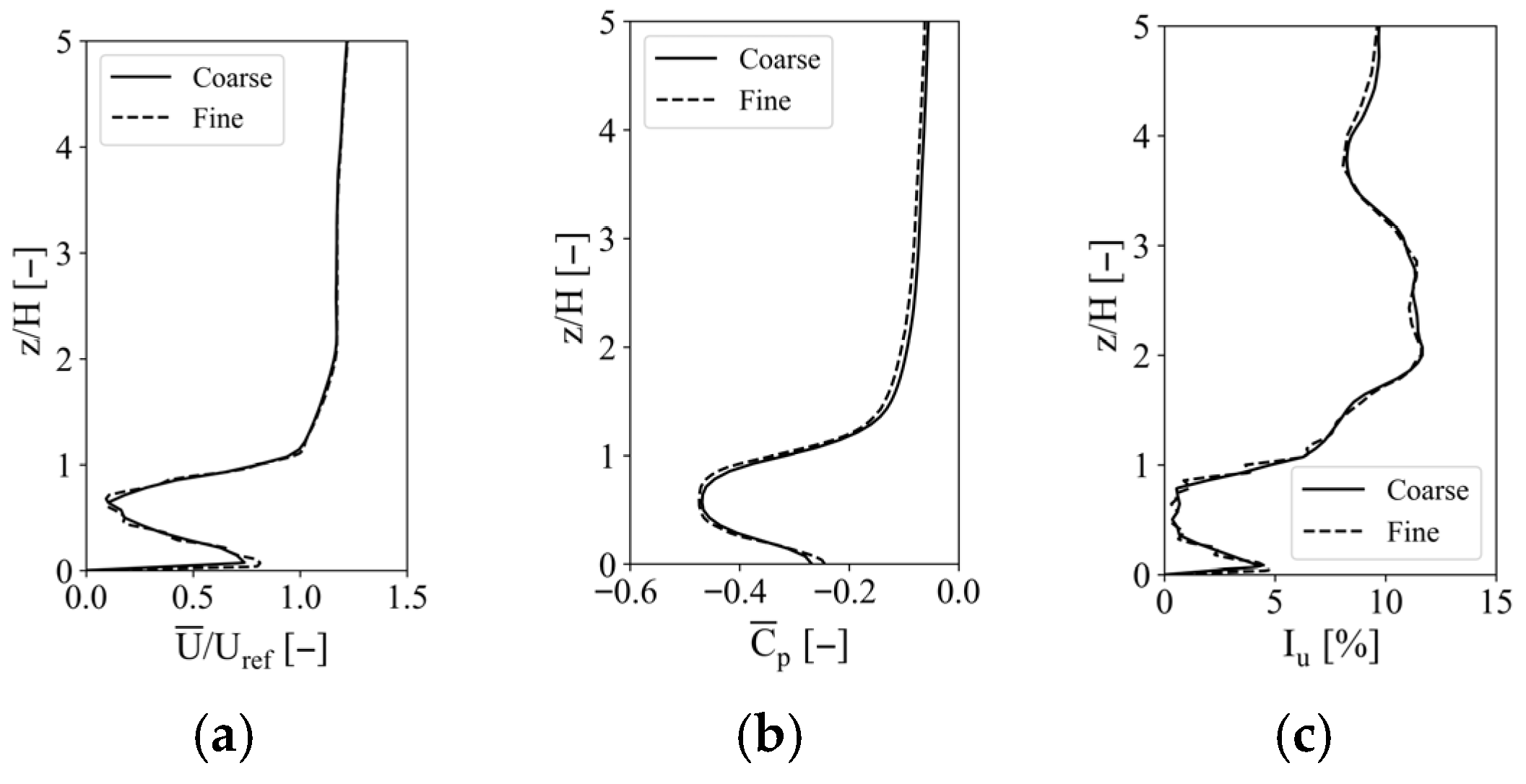
The Nonuniform-K simulations are selected as the representative case for the mesh sensitivity analysis, with the downstream velocity, pressure coefficient, and turbulent kinetic energy profiles for the two mesh resolutions presented for comparison in Figure 9 The results obtained by using coarse and fine mesh configurations show good quantitative agreement across all flow field parameters. This finding demonstrates that the mesh resolution has negligible impact on the overall simulation results for the studied flow field. Thus, the coarse mesh is adopted for all subsequent Uniform-K and Nonuniform-K simulations to balance numerical accuracy and computational efficiency. Moreover, the runtime difference between the Nonuniform-K and Uniform-K approaches is negligible. Based on the OpenFOAM simulation logs, the computational time difference between the Nonuniform-K and Uniform-K cases is only approximately 0.6%.

3. Results

In this section, the results of the windbreak effectiveness obtained by using the Nonuniform-K and Uniform-K approaches are compared. For these purposes, two typical cases using the Nonuniform-K and Uniform-K approaches are adopted for comparisons, i.e., applications on entire single-row and double-row shelterbelts. In particular, discrepancies on velocity and pressure fields downstream of shelterbelts caused by using the Uniform-K approach, which ignores the vertical variation in canopy structures, are quantitatively analyzed.

3.1. Applications on Single-Row Shelterbelt

3.1.1. Discrepancies on Velocity Fields of Single-Row Cases

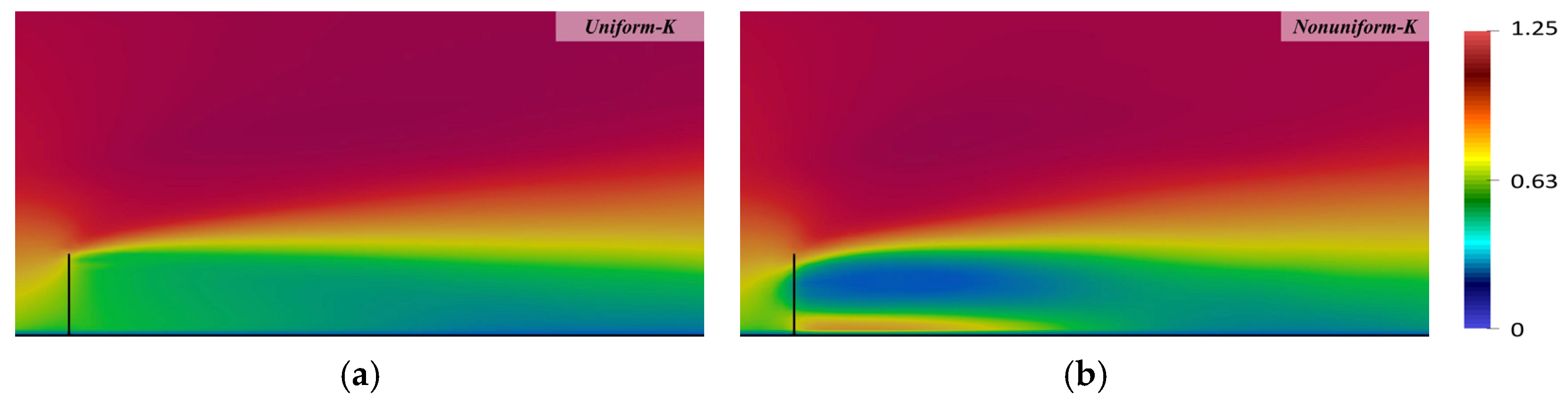
We first present a comparison of the numerical results obtained by applying the Nonuniform-K and Uniform-K approaches on an entire single-row shelterbelt. The time-averaged velocity fields (normalized by the reference velocity Uref) on the central vertical section of the computational domain are presented in Figure 10. Comparison reveals two major differences in the downstream flow characteristics of the shelterbelt between the two models: The Uniform-K approach fails to capture both the high-velocity flow zone in the trunk region and the low-velocity flow zone at mid-canopy height. In particular, the Uniform-K approach overestimates the windbreak effectiveness in the trunk region, while underestimating it at mid-canopy height, which is a direct consequence of neglecting the vertical variation in canopy structural characteristics and the corresponding aerodynamic resistance. Moreover, the aerodynamic resistance near the canopy top is significantly lower than that at mid-canopy height, owing to the sharp reduction in canopy diameter and leaf density in this upper region. This phenomenon is not found in the Uniform-K case.
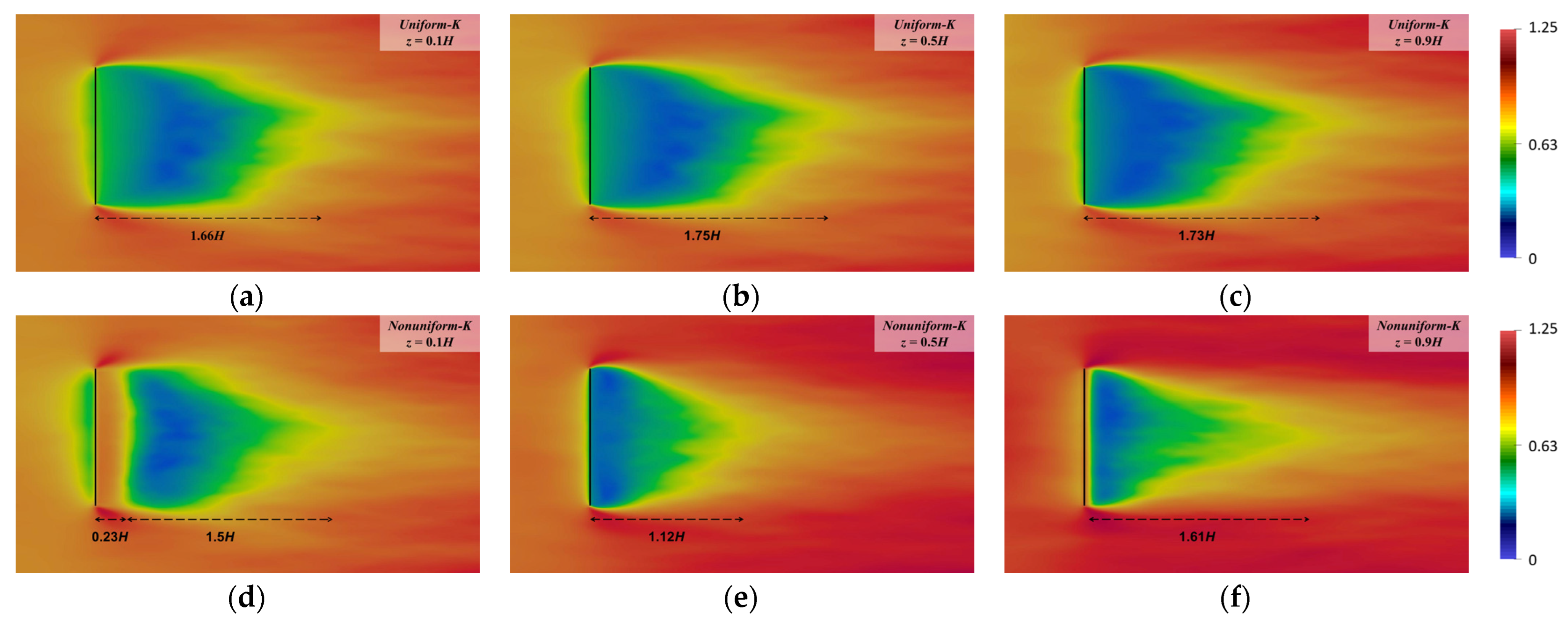
To further quantify the aforementioned flow discrepancies at the trunk, mid-canopy, and canopy top heights, the time-averaged velocity fields on the horizontal sections at dimensionless heights of z = 0.1 H, z = 0.5 H and z = 0.9 H are shown in Figure 11a–f, respectively. At the trunk height of z = 0.1 H, the wake lengths predicted by the two models are comparable. However, the Nonuniform-K model captures a prominent high-velocity flow zone extending approximately 0.23 H downstream of the shelterbelt (Figure 11d). This phenomenon arises from the significantly lower aerodynamic resistance in the trunk region relative to the canopy, which leads to reduced local windbreak effectiveness. This characteristic flow feature is absent in the Uniform-K model results (Figure 11a) due to the model’s neglect of the resistance coefficient difference between the trunk and canopy regions.
At the mid-canopy height of z = 0.5 H, as shown in Figure 11b,e, the Uniform-K model predicts a low-velocity wake zone extending 1.75 H downstream, which is longer than the 1.12 H of the Nonuniform-K model. However, in the Nonuniform-K case, the maximum wind velocity reduction is observed immediately behind the shelterbelt, while the lowest-velocity area in the Uniform-K case is noticed further downstream. The main reason for this difference is that in the Nonuniform-K case, the canopy aerodynamic resistance at a height of z = 0.5 H is similar to that of a fully solid barrier, thus generating a vortex close to the shelterbelt downstream. This phenomenon is not observed in the Uniform-K case.
At the canopy top height of z = 0.9 H, as shown in Figure 11c,f, although the low-velocity wake lengths of the two models are similar, which are respectively 1.73 H and 1.61 H, the Nonuniform-K model predicts a smaller windbreak area. Moreover, a narrow high-velocity zone is observed immediately behind the shelterbelt in the Nonuniform-K case, which is similar to the phenomena at the height of z = 0.1 H. The major reason is that, according to the porosity profile shown in Figure 6, the canopy aerodynamic resistances at z = 0.1 H and z = 0.9 H are similar. However, due to the ignorance of aerodynamic resistance vertical variation, the Uniform-K model is not able to reproduce the differing windbreak effectiveness between mid- and top-canopy heights.
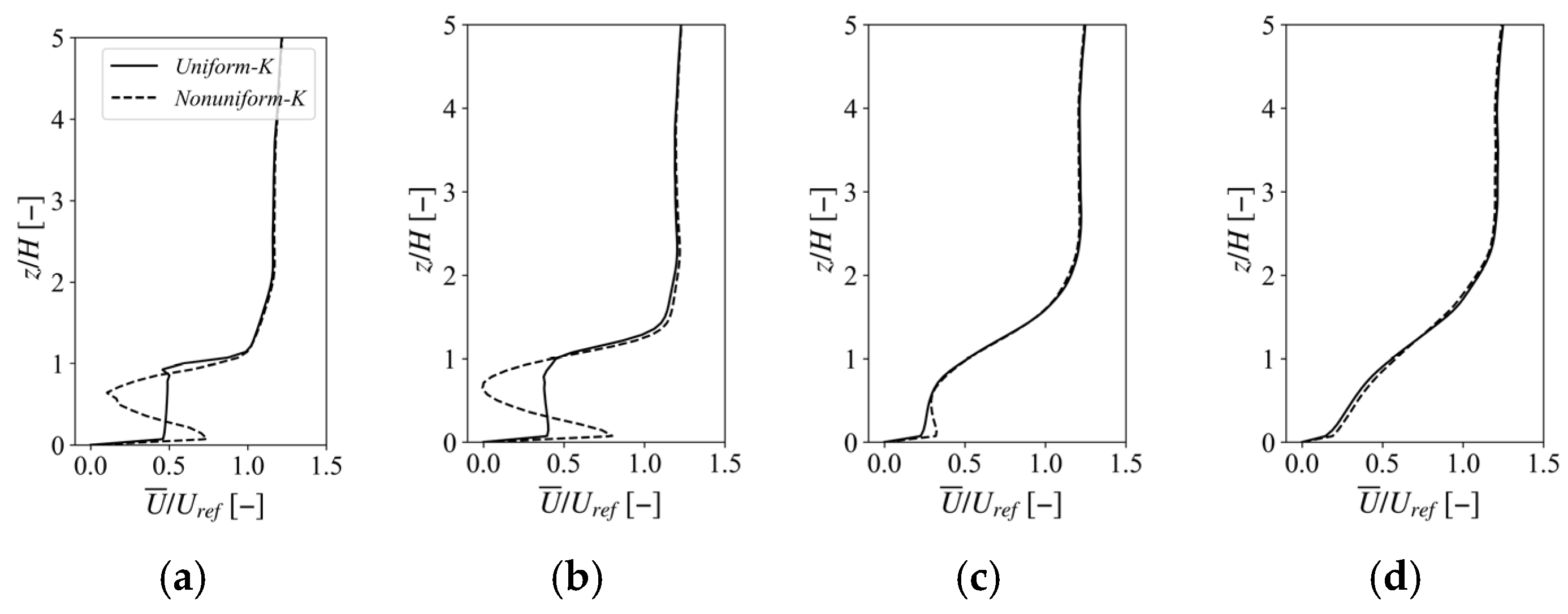
Figure 12 shows the time-averaged velocity profiles measured downstream of the shelterbelts at positions x = 0.15 H, x = 1.15 H, x = 5.15 H and x = 7.15 H. Discrepancies of the time-averaged velocity are mainly concentrated in regions immediately downstream of the shelterbelts, shown in Figure 12a,b. These differences gradually diminish as the downstream distance increases; see Figure 12c,d. The Nonuniform-K case shows a significant low-velocity area downstream of the middle canopy and high-velocity area downstream of the trunk, which are not reproduced by using the Uniform-K approach. These differences indicate again that the conventional Uniform-K modeling approach underestimates the windbreak effectiveness at the mid-canopy height and overestimates the aerodynamic resistance at the height of trunk, respectively.

3.1.2. Discrepancies on Pressure Fields of Single-Row Cases

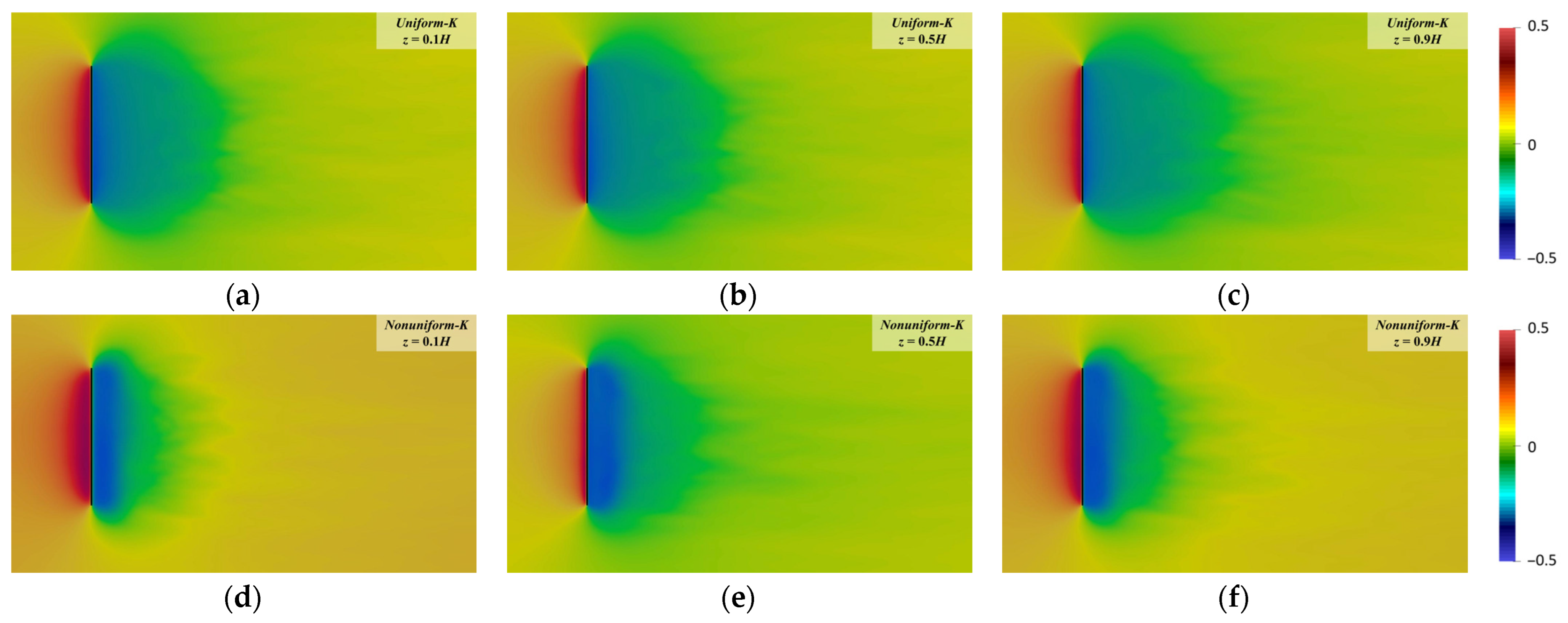
The distributions of the time-averaged pressure coefficient (defined as C p ¯ = p ¯ / 0.5 ρ U 2 , where p ¯ is the time-averaged pressure, and ρ is the air density) at the heights of z = 0.1 H, z = 0.5 H and z = 0.9 H are shown in Figure 13. The two modeling approaches provide overall comparable pressure coefficient distributions. However, immediately behind shelterbelts, the region with negative C p ¯ values in the Nonuniform-K case is smaller than that in the Uniform-K case, especially at the height of z = 0.1 H and z = 0.5 H.
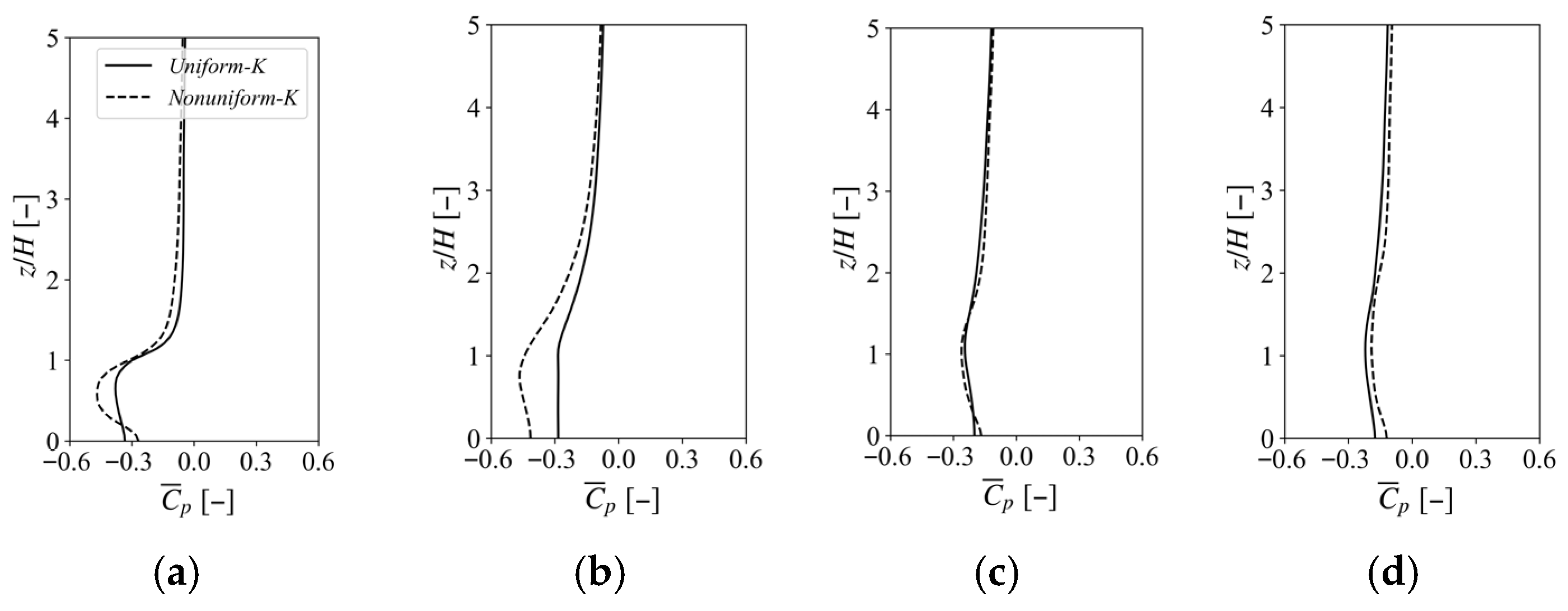
Figure 14 presents the vertical profiles of the time-averaged pressure coefficient extracted from the numerical simulations at downstream dimensionless positions x = 0.15 H, x = 1.15 H, x = 5.15 H and x = 7.15 H. Significant discrepancies between the Uniform-K and Nonuniform-K model results are observed in the region immediately behind the shelterbelt. At the position of x = 1.15 H and z = 0.76 H, the maximum discrepancy between the two models reaches approximately 65%. In addition, non-negligible discrepancies can also be observed in the flow region above the canopy top. In most regions, the C p ¯ is overestimated using the Uniform-K modeling approach. Additionally, as shown in Figure 14c,d, the above-mentioned differences become less noticeable in the far-downstream area, i.e., x ≥ 5.15 H.

3.1.3. Comparisons with the Uniform-K (Canopy Only)

Considering that applying the Uniform-K approach exclusively to the canopy region is also a widely used modeling strategy (especially for tree species with tall trunks), we further compare the windbreak effectiveness respectively obtained by using the aforementioned single-row Nonuniform-K model case and the Uniform-K model applied only to the canopy region, hereafter referred to as the Uniform-K (Canopy Only) model. As illustrated in Figure 15, the Uniform-K (Canopy Only) approach specifies a porosity of β = 100% in the trunk region, corresponding to an aerodynamic resistance coefficient of zero, i.e., K = 0. In this case, to maintain the same total aerodynamic resistance as the aforementioned entire Uniform-K and Nonuniform-K cases, a uniform canopy porosity of β = 38.25% is adopted for the Uniform-K (Canopy Only) model.
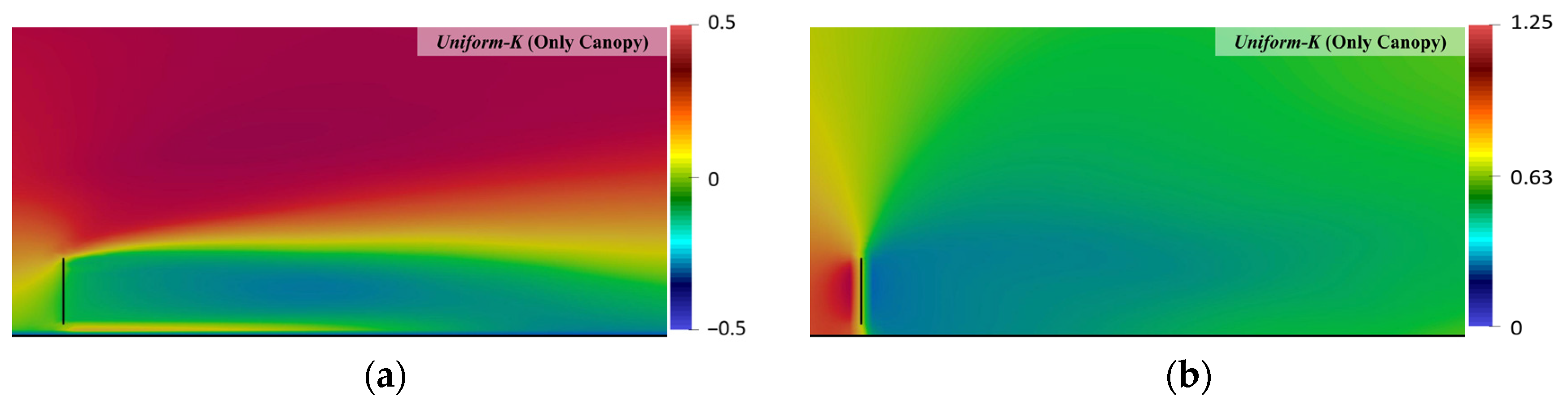
Figure 16 shows the distributions of the time-averaged velocity and pressure coefficient on the central vertical slice of the Uniform-K (Canopy Only). As shown in Figure 16a, a noticeable high-velocity area is noticed at the trunk height. This flow characteristics can also be found in the Nonuniform-K case; see Figure 10b. However, the distribution of pressure coefficients, shown in Figure 16b, is not significantly affected by this high-velocity area.
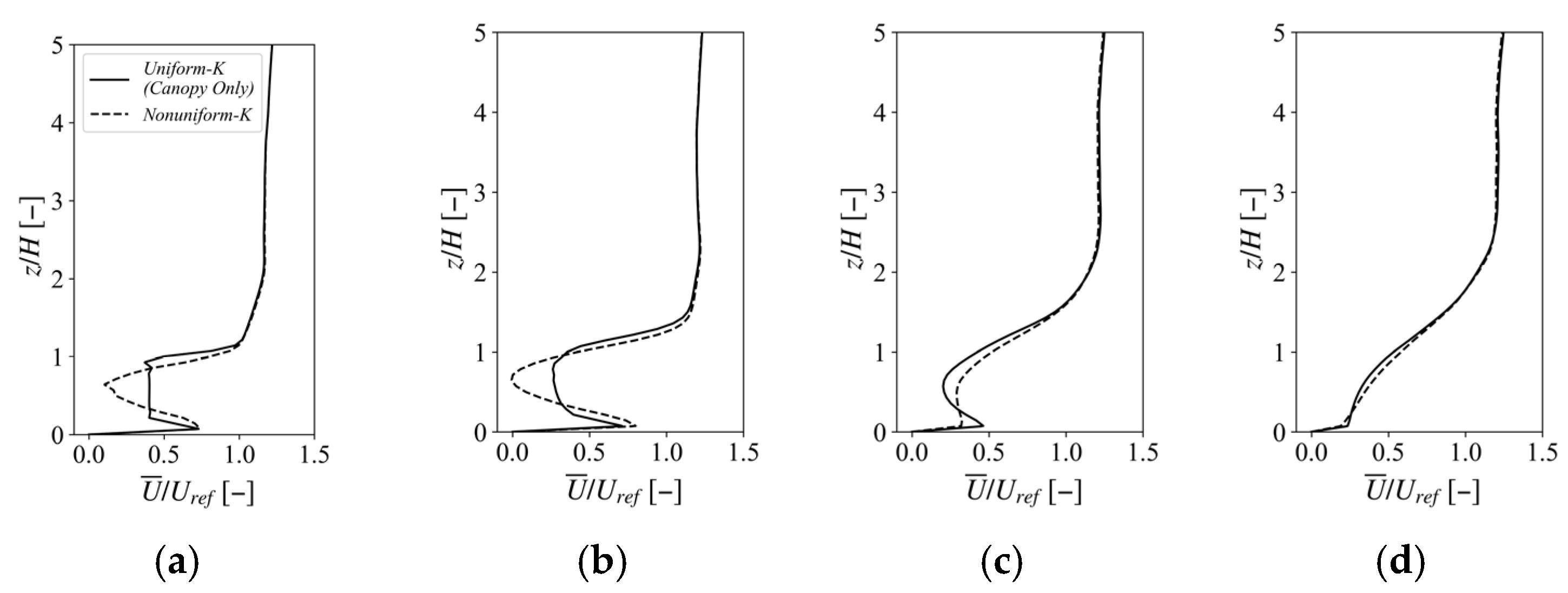
By respectively using the Uniform-K (Canopy Only) and the Nonuniform-K approaches, the time-averaged velocity profiles measured at positions x = 0.15 H, x = 1.15 H, x = 5.15 H and x = 7.15 H are shown in Figure 17. Compared with the previous results in the case that applies the Uniform-K approach for entire shelterbelts (see Figure 12), the velocity profiles predicted by the Uniform-K (Canopy Only) model show improved agreement with the Nonuniform-K model results, particularly in the trunk region. Nevertheless, the differences between the Uniform-K and Nonuniform-K cases at the middle- and top-canopy heights still persist.
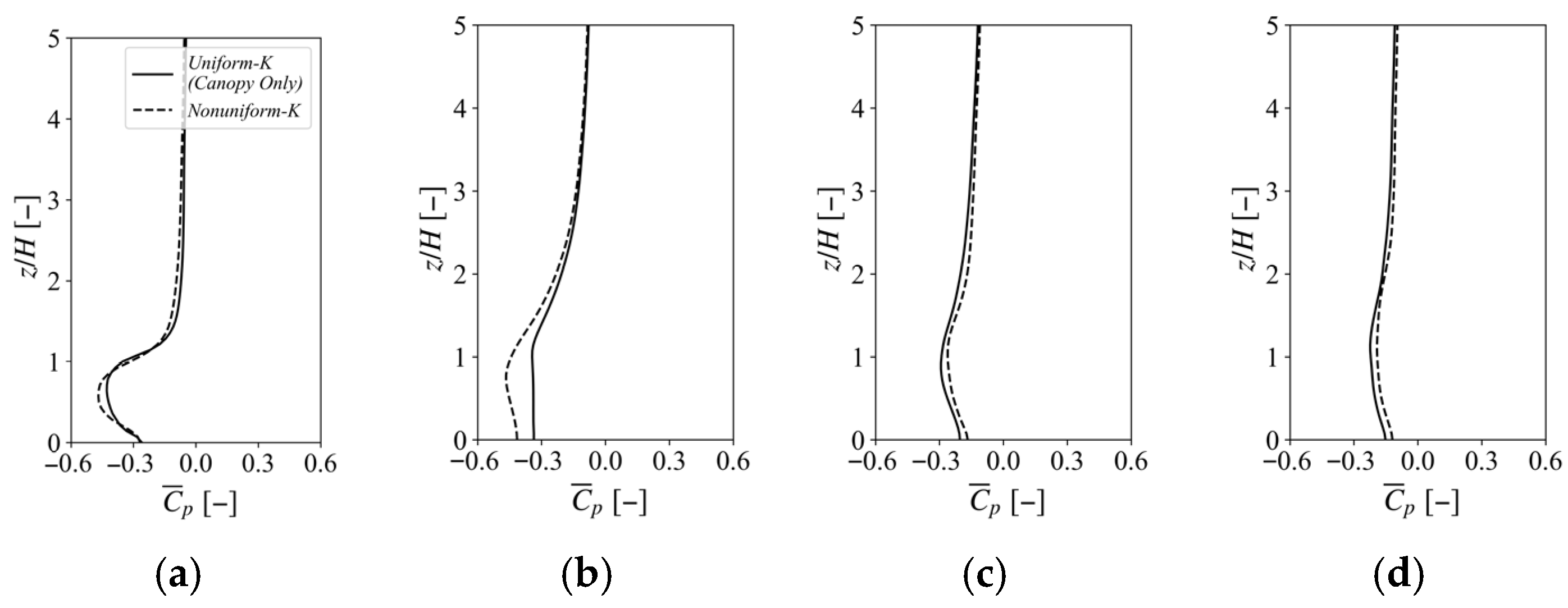
The aforementioned improvement in consistency between the Uniform-K and Nonuniform-K results can also be found in the comparison of pressure coefficients, shown in Figure 18. In particular, at the downstream position x = 0.15 H, compared with the significant discrepancies of C p ¯ at trunk height shown in Figure 14a, good agreement between Uniform-K (Canopy Only) and Nonuniform-K cases is found in Figure 18a. Furthermore, although the maximum relative discrepancy still occurs at x = 1.15 H and z = 0.76 H, its magnitude is reduced to 38%.
In summary, while applying the Uniform-K (Canopy Only) approach exclusively to the canopy region improves the accuracy of simulation results in the trunk region, discrepancies persist at other canopy heights due to the inherent mismatch between the uniform porosity assumption in the model and the actual height-dependent porosity of the real shelterbelt.

3.2. Applications on Double-Row Shelterbelt

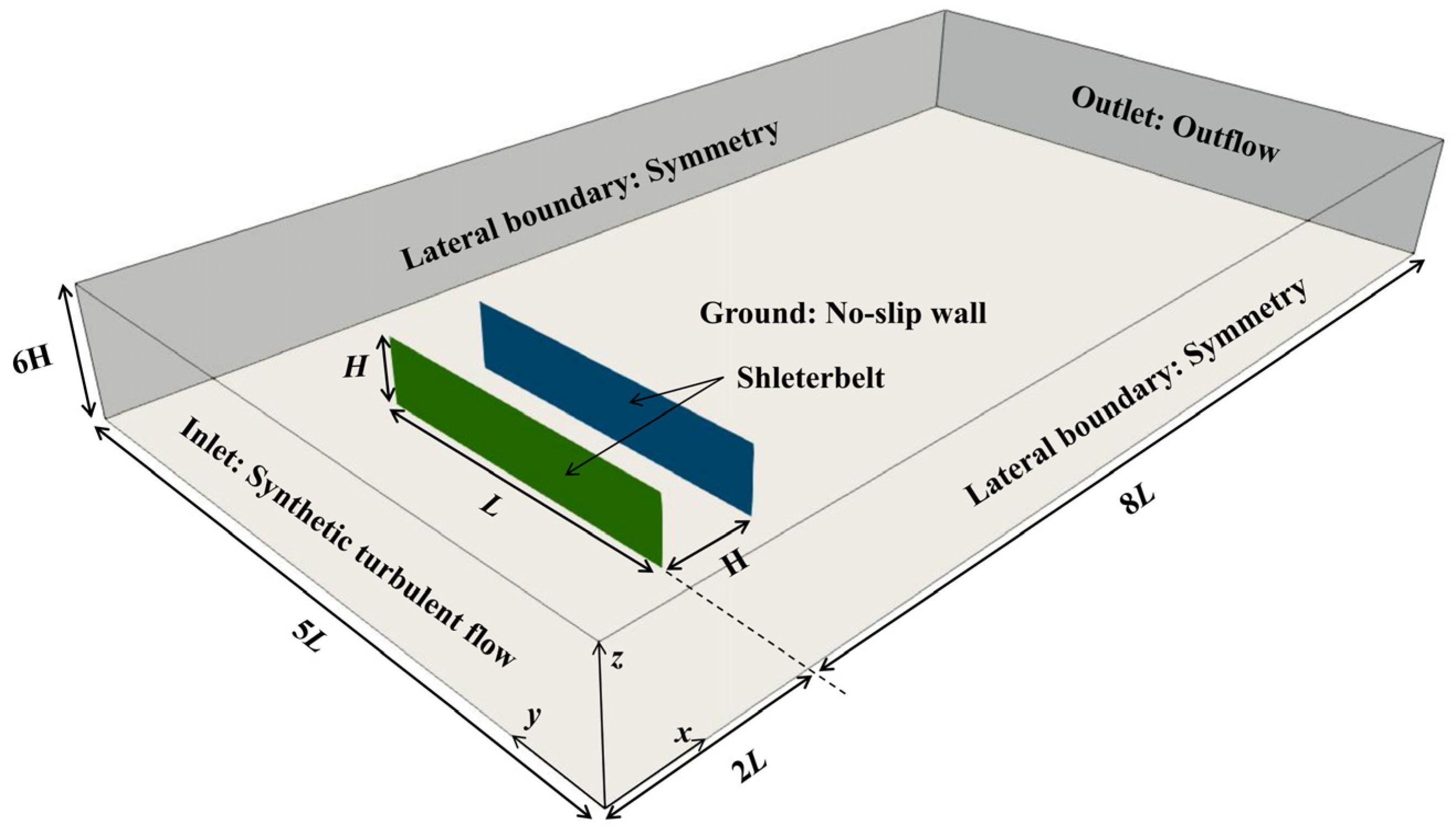
The Uniform-K approach has also been widely applied to investigate the windbreak effectiveness of double-row shelterbelts. To quantify the discrepancies induced by the uniform resistance assumption in this configuration, the results obtained from the Nonuniform-K approach are used as the benchmark for comparison. The computational domain with the double-row shelterbelt is shown in Figure 19, where the downstream shelterbelt (marked in blue) is spaced a distance H apart from the upstream shelterbelt. Both shelterbelts employ identical Uniform-K and Nonuniform-K parameterization schemes detailed in Section 2, with all other computational settings kept consistent with the single-row shelterbelt cases.

3.2.1. Discrepancies on Velocity Fields of Double-Row Cases

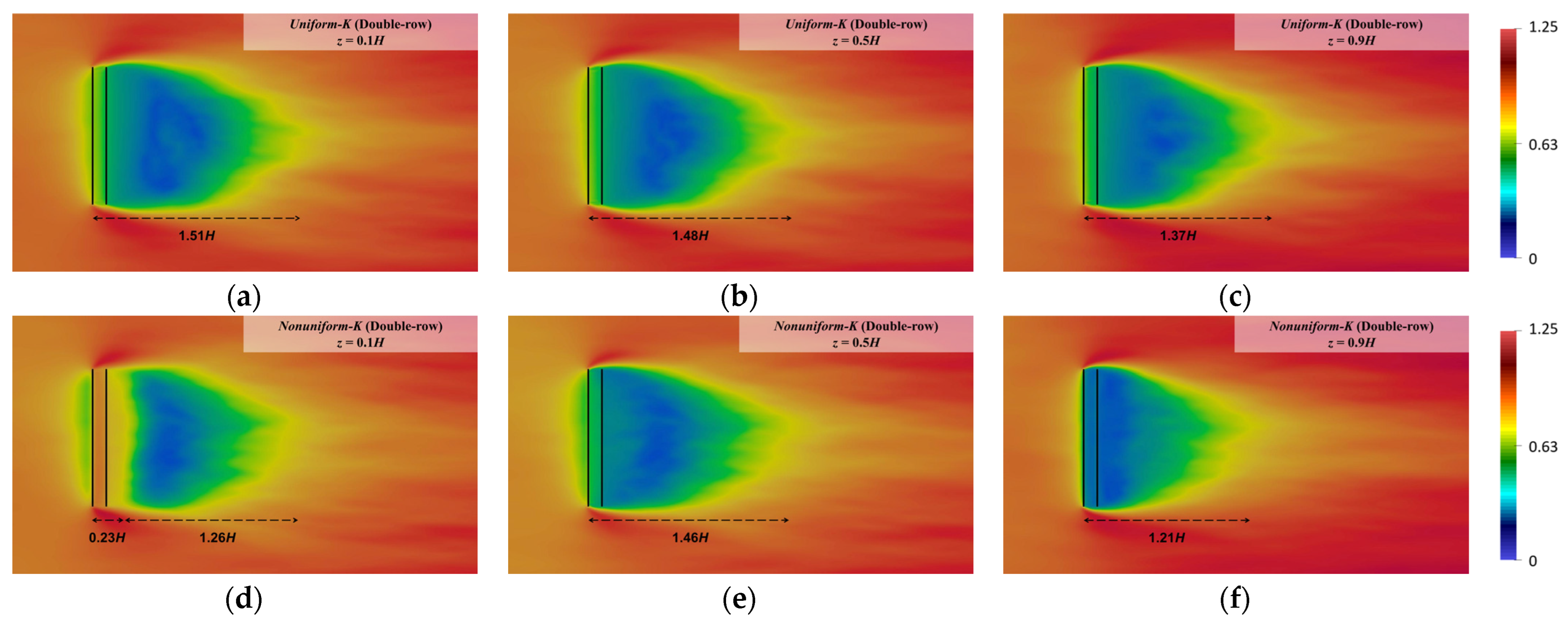
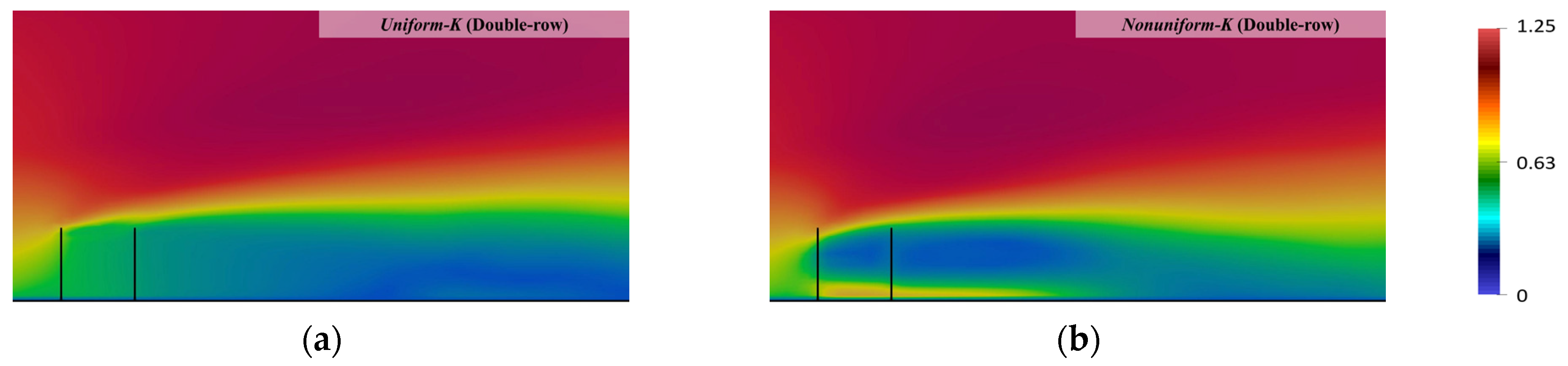
Figure 20 presents the time-averaged normalized velocity distributions at dimensionless heights of z = 0.1 H, z = 0.5 H, and z = 0.9 H for the double-row shelterbelt configuration. The key discrepancies induced by the Uniform-K modeling approach, which were observed in the single-row cases, are also present in this double-row configuration. At the trunk height of z = 0.1 H, shown in Figure 20a,d, a noticeable high-velocity flow zone is observed downstream of both shelterbelts in the Nonuniform-K case, while this flow feature is not captured by the Uniform-K modeling approach. At the mid-canopy height of z = 0.5 H, shown in Figure 20b,e, discrepancies in the velocity distributions between the Uniform-K and Nonuniform-K cases become negligible. The length of the low-velocity wake zone is 1.48 H and 1.46 H for the two models, respectively. At the canopy top height of z = 0.9 H, shown in Figure 20c,f, the length of the low-velocity zone is overestimated by the Uniform-K approach. Furthermore, the region of maximum velocity reduction is located immediately behind the shelterbelts in the Nonuniform-K case, whereas this region is shifted further downstream in the Uniform-K case. These differences are consistent with the phenomenon observed from the case of single-row shelterbelts.
Figure 21 shows the vertical cross-sectional velocity distributions for both Uniform-K and Nonuniform-K modeling approaches in the double-row shelterbelt configuration. Consistent with conclusions from the single-row cases, the Uniform-K approach fails to capture two key flow characteristics: the high-velocity flow zone at trunk height and the low-velocity flow zone at mid-canopy height, where the densest foliage and branches are located. Moreover, compared with shelterbelts arranged in a single row, the aforementioned differences in double-row cases affect the velocity distributions further downstream.
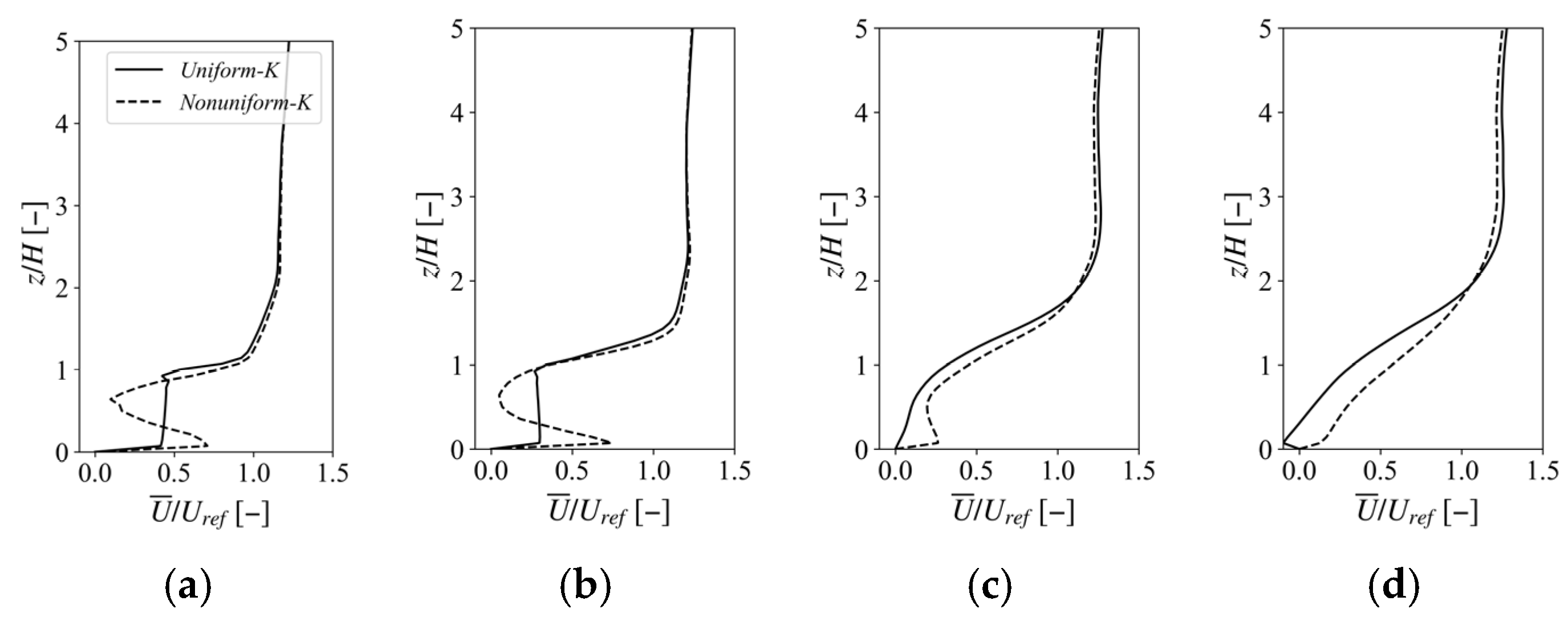
Figure 22 presents velocity profiles at downstream dimensionless positions of x = 0.15 H, x = 1.15 H, x = 5.15 H, and x = 7.15 H for the double-row shelterbelt configuration. In the near-downstream region of the shelterbelts (i.e., x = 0.15 H and x = 1.15 H), noticeable differences between the Uniform-K and Nonuniform-K cases can be found, particularly at the trunk and mid-canopy heights, which are consistent with the findings from the single-row cases. However, in the double-row cases, differences are also found in further-downstream and higher regions (i.e., x ≥ 5.15 H and z ≥ 7.15 H). This finding indicates that the systematic biases induced by the Uniform-K modeling approach can be amplified in multi-row shelterbelt configurations.

3.2.2. Discrepancies on Pressure Fields of Double-Row Cases

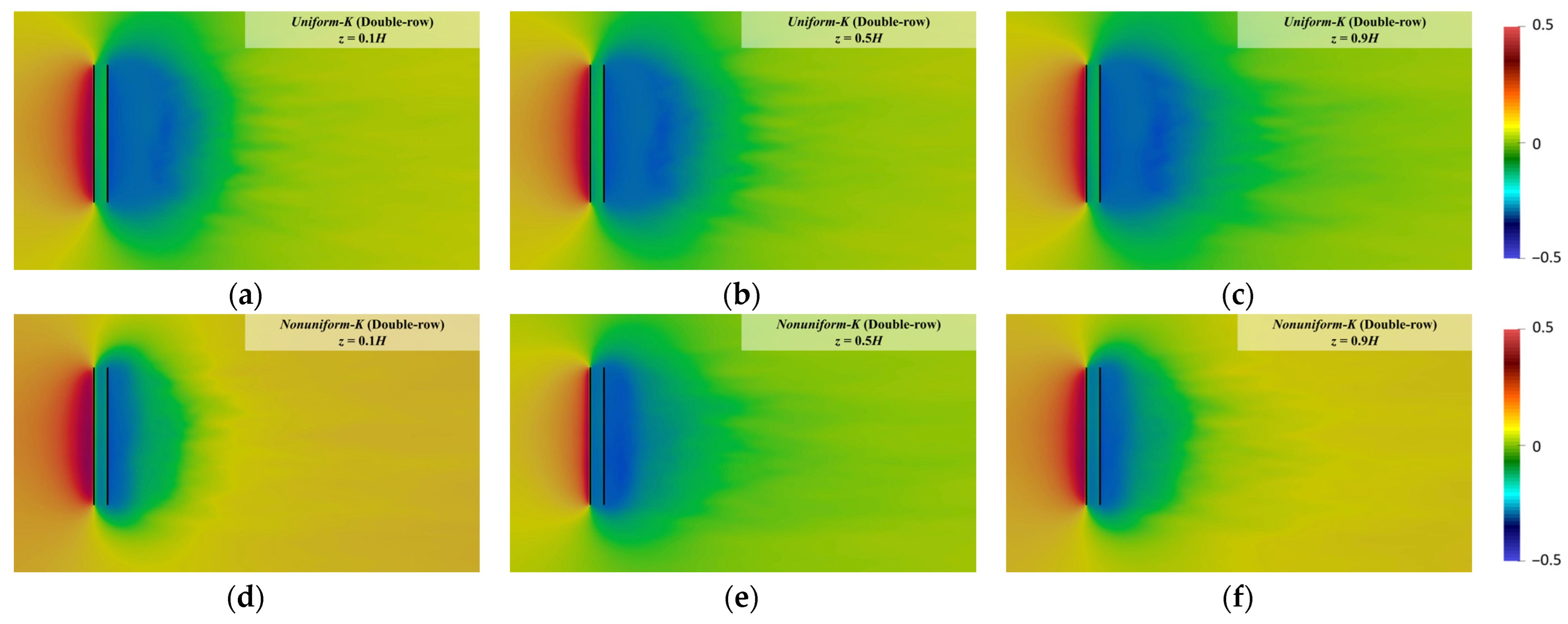
Figure 23 shows the distributions of time-averaged pressure coefficient fields at dimensionless heights of z = 0.1 H, z = 0.5 H, and z = 0.9 H for the two modeling approaches. Results of the Uniform-K case, shown in Figure 23a–c, indicate that a significant pressure drop occurs as the wind passes through both the upstream and downstream shelterbelts, with this trend observed consistently across all three heights. Regarding the Nonuniform-K case, the pressure drop occurs mainly as the wind passes through the upstream shelterbelt, while the additional pressure reduction induced by the downstream shelterbelt is only notable at the trunk height of z = 0.1 H.
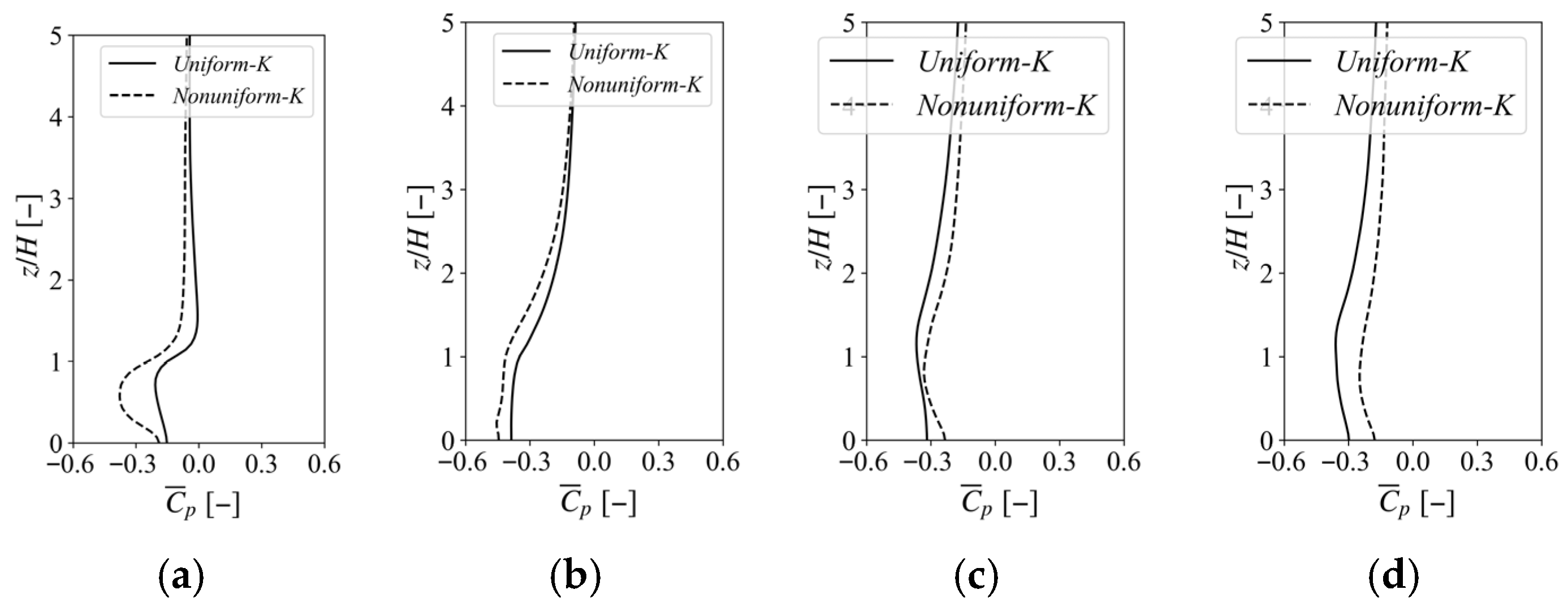
Figure 24 presents the vertical profiles of the time-averaged pressure coefficient ( C p ¯ ) at downstream dimensionless positions of x = 0.15 H, x = 1.15 H, x = 5.15 H, and x = 7.15 H for the double-row shelterbelt configuration. Consistent with the trend observed in the velocity profiles, discrepancies between the Uniform-K and Nonuniform-K cases are observed in both the near- and far-downstream regions of the shelterbelts. Furthermore, in contrast to the single-row cases, the maximum relative discrepancy in C p ¯ is observed at the near-downstream position of x = 0.15 H, reaching a magnitude of approximately 91%. This result further demonstrates that the systematic biases induced by the Uniform-K modeling approach can be amplified and accumulated in multi-row shelterbelt configurations.
In summary, for the double-row shelterbelt configuration, the primary discrepancies between the Uniform-K and Nonuniform-K modeling approaches in the near-downstream region are still concentrated at the trunk and mid-canopy heights. Moreover, when studying the windbreak effectiveness of multi-row shelterbelts, the amplifications and accumulations of inaccuracies caused by the Uniform-K approach need to be carefully considered.

4. Conclusions

This study proposes a novel approach to parameterize the vertical profile of aerodynamic resistance coefficients for shelterbelts, which incorporates the vertical variation in canopy structural properties. In this approach, the nonuniform aerodynamic resistance coefficients of shelterbelts are calculated based on the vertical profile of cumulative canopy opacity at corresponding heights. Throughout this study, the novel approach is referred to as the Nonuniform-K, while the conventional uniform resistance approach is denoted as the Uniform-K. By investigating wind flow through single-row and double-row shelterbelt configurations in Large-Eddy Simulations, this study systematically quantifies the discrepancies induced by the Uniform-K approach, which neglects the vertical variation in canopy diameter and foliage density. The conclusions of this study are summarized as follows.
(1)
The non-destructive method based on the Alpha Blending algorithm enables accurate quantification of the vertical variation in shelterbelt canopy porosity. The porosity profiles derived from this method show good agreement with geometric porosity measurements, and establish a robust framework for deriving height-resolved nonuniform aerodynamic resistance coefficients.
(2)
Neglecting the vertical variation in canopy structures via the conventional Uniform-K model leads to significant systematic biases in the evaluation of windbreak effectiveness: the velocity reduction downstream is underestimated at mid-canopy height and overestimated at the canopy top.
(3)
These discrepancies can be partially mitigated by applying the Uniform-K model exclusively to the canopy region, i.e., neglecting the aerodynamic resistance exerted by tree trunks. With this modified configuration, the discrepancies between the two models in the trunk region are substantially reduced. At mid-canopy heights (where the densest foliage is located), the maximum relative discrepancy in the downstream pressure coefficient is also reduced from approximately 65% to 38%.
(4)
The aforementioned discrepancies can be amplified and accumulated when the Uniform-K model is applied to multi-row shelterbelt configurations. For example, in the wake of single-row shelterbelts, these discrepancies diminish gradually with increasing downstream distance, whereas they remain noticeable also in the far-downstream region for double-row shelterbelts.
Finally, it is worth noting that the proposed model in this study requires calibration of the aerodynamic resistance coefficient. Further systematic field measurements and wind tunnel experiments are planned to verify the model’s performance.

Author Contributions

Conceptualization, M.X., Y.Z. and L.P.; methodology, M.X., Y.Z., L.P. and Y.L.; software, Y.L. and M.X.; validation, J.W., W.C. and W.L.; formal analysis, Y.L., M.X., Y.Z. and L.P.; investigation, Y.L., J.W., W.C. and W.L.; resources, M.X., Y.Z., W.C., J.W. and W.L.; data curation, J.W., W.C. and W.L.; writing—original draft preparation, Y.L.; writing—review and editing, Y.L., J.W., W.C., M.X., Y.Z., L.P. and W.L.; visualization, Y.L.; supervision, M.X., Y.Z. and L.P.; project administration, M.X. and Y.Z.; funding acquisition, Y.L., W.C. and Y.Z. All authors have read and agreed to the published version of the manuscript.

Funding

This research was funded by the Guangdong Provincial Basic and Applied Basic Research Foundation (Grant No. 2024A1515010064, 2024A1515510034), Shaoguan Science and Technology Program (Grant No. 230616148033947), and Science and Technology Research Project of Guangdong Meteorological Service (Grant No. GRMC2024M17).

Data Availability Statement

The raw data supporting the conclusions of this article will be made available by the authors on request.

Acknowledgments

During the preparation of this manuscript/study, the authors used DeepSeek-V3.2 for the purposes of grammar check. The authors have reviewed and edited the output and take full responsibility for the content of this publication.

Conflicts of Interest

The authors declare no conflicts of interest.

Abbreviations

The following abbreviations are used in this manuscript:
CFDComputational Fluid Dynamics
LESLarge-Eddy Simulation
LUSTLinear Upwind Stabilised Transport

References

  1. Lyu, J.; Wang, C.M.; Mason, M.S. Review of models for predicting wind characteristics behind windbreaks. J. Wind Eng. Ind. Aerodyn. 2020, 199, 104117. [Google Scholar] [CrossRef]
  2. Terziev, A.; Bode, F.; Zlateva, P.; Pichurov, G.; Ivanov, M.; Denev, J.; Stankov, B. Numerical Study on Tree Belt Impact on Wind Shear on Agricultural Land. Appl. Sci. 2025, 15, 7450. [Google Scholar] [CrossRef]
  3. Li, M.M.; Liu, A.T.; Zou, C.J.; Xu, W.D.; Shimizu, H.; Wang, K.Y. An overview of the “Three-North” Shelterbelt project in China. For. Stud. China 2012, 14, 70–79. [Google Scholar] [CrossRef]
  4. Su, Z.A.; Zhou, T.; Zhang, X.B.; Wang, X.Y.; Wang, J.J.; Zhou, M.H.; Zhang, R.C. A preliminary study of the impacts of shelter forest on soil erosion in cultivated land: Evidence from integrated 137Cs and 210Pbex measurements. Soil Tillage Res. 2021, 206, 104843. [Google Scholar] [CrossRef]
  5. Wang, K.; Yang, Y.; Reniers, G.; Huang, Q. A study into the spatiotemporal distribution of typhoon storm surge disasters in China. Nat. Hazards 2021, 108, 1237–1256. [Google Scholar] [CrossRef]
  6. Shan, Q.; Zhang, J.; Sun, S.; Chen, G.; Zhang, H.; Shen, L. Construction of coastline shelterbelts and assessment of their environmental effects in Yuyao, China. Land Degrad. Dev. 2018, 29, 2428–2437. [Google Scholar] [CrossRef]
  7. Lee, S.H.; Kim, H.; Moon, H.; Kim, H.S.; Han, S.S.; Jeong, S. Effects of wind barrier porosity and inclination on wind speed reduction. Appl. Sci. 2023, 13, 8310. [Google Scholar] [CrossRef]
  8. Enescu, C.M.; Mihalache, M.; Ilie, L.; Dinca, L.; Constandache, C.; Murariu, G. Agricultural benefits of shelterbelts and windbreaks: A bibliometric analysis. Agriculture 2025, 15, 1204. [Google Scholar] [CrossRef]
  9. Wang, B.H.; Wang, D.B.; Ali, Z.A.; Ting Ting, B.; Wang, H. An overview of various kinds of wind effects on unmanned aerial vehicle. Meas. Control 2019, 52, 731–739. [Google Scholar] [CrossRef]
  10. Wang, H.; Takle, E.S. A numerical simulation of boundary-layer flows near shelterbelts. Bound.-Layer Meteorol. 1995, 75, 141–173. [Google Scholar] [CrossRef]
  11. Suratman, M.N.; Brandle, J.R. Tree shelterbelts for sustainable agroforestry. In Agroforestry for Carbon and Ecosystem Management; Jhariya, M.K., Meena, R.S., Banerjee, A., Yadav, D.K., Eds.; Academic Press, Elsevier: Amsterdam, The Netherlands, 2024; pp. 97–107. [Google Scholar]
  12. Wu, T.; Yu, M.; Wang, G.; Wang, Z.; Duan, X.; Dong, Y.; Cheng, X. Effects of stand structure on velocity reduction in a Metasequoia glyptostroboides shelterbelt. Agrofor. Syst. 2013, 87, 251–257. [Google Scholar] [CrossRef]
  13. Bean, A.; Alperi, R.W.; Federer, C.A. A method for categorizing shelterbelt porosity. Agric. Meteorol. 1974, 14, 417–429. [Google Scholar] [CrossRef]
  14. Wang, H.; Takle, E.S. Momentum budget and shelter mechanism of boundary-layer flow near a shelterbelt. Bound.-Layer Meteorol. 1997, 82, 417–437. [Google Scholar] [CrossRef]
  15. Zhao, Y.; Huang, N.; Sun, J.; Zhan, K.; Li, X.; Han, B.; Zhang, J. Numerical simulation of the plant shelterbelt configuration based on porous media model. Atmosphere 2024, 15, 602. [Google Scholar] [CrossRef]
  16. Torita, H.; Satou, H. Relationship between shelterbelt structure and mean wind reduction. Agric. For. Meteorol. 2007, 145, 186–194. [Google Scholar] [CrossRef]
  17. Wu, T.; Zhang, P.; Zhang, L.; Wang, J.; Yu, M.; Zhou, X.; Wang, G.G. Relationships between shelter effects and optical porosity: A meta-analysis for tree windbreaks. Agric. For. Meteorol. 2018, 259, 75–81. [Google Scholar] [CrossRef]
  18. Manickathan, L.; Defraeye, T.; Allegrini, J.; Derome, D.; Carmeliet, J. Comparative study of flow field and resistance coefficient of model and small natural trees in a wind tunnel. Urban For. Urban Green. 2018, 35, 230–239. [Google Scholar] [CrossRef]
  19. Hao, Y.F. Studies on Dynamic Characteristics of Trees Measured in Field and Wind Tunnel Tests of an Aeroelastic Model Tree. Ph.D. Thesis, Hunan University, Changsha, China, 2022. [Google Scholar]
  20. Guo, Z.; Yang, X.; Wu, X.; Zou, X.; Zhang, C.; Fang, H.; Xiang, H. Optimal design for vegetative windbreaks using 3D numerical simulations. Agric. For. Meteorol. 2021, 298, 108290. [Google Scholar] [CrossRef]
  21. Chen, Z.; Wang, J.; Yang, C.; Yang, X.; Gao, G.; Zhang, X. Effects of cross-sectional shapes and arrangement patterns on windbreak effectiveness of shelterbelts by large eddy simulation. Yingyong Shengtai Xuebao 2024, 35, 1877–1886. [Google Scholar] [CrossRef]
  22. Wang, J.; Patruno, L.; Chen, Z.; Yang, Q.; Tamura, Y. Windbreak effectiveness of single and double-arranged shelterbelts: A parametric study using large eddy simulation. Forests 2024, 15, 1760. [Google Scholar] [CrossRef]
  23. Wang, J.; Patruno, L.; Zhao, G.; Tamura, Y. Windbreak effectiveness of shelterbelts with different characteristic parameters and arrangements by means of CFD simulation. Agric. For. Meteorol. 2024, 344, 109813. [Google Scholar] [CrossRef]
  24. Wang, J.; Patruno, L.; Wang, H.; Wang, P.; Li, D. Evaluation of the aerodynamic loads over isolated and clustered tree canopies using large eddy simulation. Phys. Fluids 2025, 37, 045130. [Google Scholar] [CrossRef]
  25. Cao, Z.; Zhang, X.; Weerasuriya, A.U.; Wang, Z.; Guo, J. Estimating the impacts of the wind field size, wind speed, turbulence, and no-fly zones on unmanned aerial vehicle flights in urban areas. Phys. Fluids 2026, 38, 015130. [Google Scholar] [CrossRef]
  26. Qi, Y.; Ishihara, T. Numerical study of turbulent flow fields around of a row of trees and an isolated building by using modifiedurma k-ε model and LES model. J. Wind Eng. Ind. Aerodyn. 2018, 177, 293–305. [Google Scholar] [CrossRef]
  27. He, Y.; Jones, P.J.; Rayment, M. A simple parameterisation of windbreak effectiveness on velocity reduction and resulting thermal benefits to sheep. Agric. For. Meteorol. 2017, 239, 96–107. [Google Scholar] [CrossRef]
  28. Mochida, A.; Tabata, Y.; Iwata, T.; Yoshino, H. Examining tree canopy models for CFD prediction of wind environment at pedestrian level. J. Wind Eng. Ind. Aerodyn. 2008, 96, 1667–1677. [Google Scholar] [CrossRef]
  29. Zhou, X.H.; Brandle, J.R.; Mize, C.W.; Takle, E.S. Three-dimensional aerodynamic structure of a tree shelterbelt: Definition, characterization and working models. Agrofor. Syst. 2005, 63, 133–147. [Google Scholar] [CrossRef]
  30. Cao, X.; Zhu, T.Y.; Jiang, F.Q. Science of Farmland Shelterbelt; China Forestry Publishing House: Beijing, China, 1983. [Google Scholar]
  31. Zhou, X.H.; Brandle, J.R.; Takle, E.S.; Mize, C.W. Estimation of the three-dimensional aerodynamic structure of a green ash shelterbelt. Agric. For. Meteorol. 2002, 111, 93–108. [Google Scholar] [CrossRef]
  32. Zhou, X.H.; Brandle, J.R.; Mize, C.W.; Takle, E.S. The relationship of three-dimensional structure to shelterbelt function: A theoretical hypothesis. In Ecological Basis of Agroforestry; CRC Press: Boca Raton, FL, USA, 2007. [Google Scholar]
  33. Yuan, W.; Zhu, N.; Zhang, L.; Tong, R.; Miao, Y.; Zhou, F.; Wu, T. Three-dimensional aerodynamic structure estimation and wind field simulation for wide tree shelterbelts. For. Ecol. Manag. 2024, 559, 121813. [Google Scholar] [CrossRef]
  34. Zhang, L. Three Dimensional Structure Model of Coastal Metasequoia glyptostroboides and Populus euramevicana Shelterbelts and Numerical Simulation of Wind Field. Master’s Thesis, Chinese Academy of Forestry, Beijing, China, 2017. [Google Scholar]
  35. Wu, C.; Cheng, M.; Chen, D.; Zhang, S.; Sun, X. Advanced intelligent recognition algorithm for tree canopy carbon sequestration capacity based on 3D visualization: Application in Larch plantations under drought stress. Ecol. Indic. 2025, 178, 113780. [Google Scholar] [CrossRef]
  36. Kim, D.H.; Ko, C.U.; Kim, D.G.; Kang, J.T.; Park, J.M.; Cho, H.J. Automated segmentation of individual tree structures using deep learning over LiDAR point cloud data. Forests 2023, 14, 1159. [Google Scholar] [CrossRef]
  37. Bauwens, S.; Bartholomeus, H.; Calders, K.; Lejeune, P. Forest inventory with terrestrial LiDAR: A comparison of static and hand-held mobile laser scanning. Forests 2016, 7, 127. [Google Scholar] [CrossRef]
  38. Li, Z.; Zhang, Z.; Dian, Y.; Cai, S.; Chen, Z. Multi-Scale LAI Estimation Integrating LiDAR Penetration Index and Point Cloud Texture Features. Forests 2025, 16, 1321. [Google Scholar] [CrossRef]
  39. McReynolds, T.; Blythe, D. Advanced Graphics Programming Using OpenGL; Morgan Kaufmann: San Francisco, CA, USA, 2005. [Google Scholar]
  40. Holmes, J.D. Wind Loading of Structures, 2nd ed.; Taylor & Francis: London, UK, 2007. [Google Scholar]
  41. Patruno, L.; Ricci, M. A systematic approach to the generation of synthetic turbulence using spectral methods. Comput. Methods Appl. Mech. Eng. 2018, 340, 881–904. [Google Scholar] [CrossRef]
  42. Kurotani, Y. Windbreak effect of tsuijimatsu in izumo part. 2. In Summaries of Technical Papers of Annual Meeting; Architectural Institute of Japan (AIJ): Tokyo, Japan, 2002; pp. 745–746. [Google Scholar]
  43. Iwata, T.; Kimura, A.; Mochida, A.; Yoshino, H.; Ooka, R.; Yoshida, S. Numerical analysis of wind break effect on velocity reduction based on plant canopy model. In Summaries of the Annual Research Conference of the Japan Association of Wind Engineering; Japan Association of Wind Engineering: Tokyo, Japan, 2003; p. 32. [Google Scholar]
  44. Středa, T.; Malenová, P.; Pokladníková, H.; Rožnovský, J. The efficiency of windbreaks on the basis of wind field and optical porosity measurement. Acta Univ. Agric. Silvic. Mendel. Brun. 2008, 56, 281–288. [Google Scholar] [CrossRef]
  45. Porter, T.; Duff, T. Compositing digital images. In Proceedings of the 11th Annual Conference on Computer Graphics and Interactive Techniques (SIGGRAPH’84), Minneapolis, MN, USA, 23–27 July 1984; ACM: New York, NY, USA, 1984; pp. 253–259. [Google Scholar]
  46. Chen, C.; Zhou, L.; Li, X.; Zhao, Y.; Yu, J.; Lv, L.; Du, H. Optimizing the spatial structure of metasequoia plantation forest based on UAV-liDAR and backpack-liDAR. Remote Sens. 2023, 15, 4090. [Google Scholar] [CrossRef]
  47. Williams, C.J.; LePage, B.A.; Vann, D.R.; Tange, T.; Ikeda, H.; Ando, M.; Sweda, T. Structure, allometry, and biomass of plantation Metasequoia glyptostroboides in Japan. For. Ecol. Manag. 2003, 180, 287–301. [Google Scholar] [CrossRef]
  48. Wu, W.; Lin, J.; Ning, X.; Liu, Z. Seasonal Impacts on Individual Tree Detection and Height Extraction Using UAV-LiDAR: Preliminary Study of Planted Deciduous Stand. Forests 2025, 16, 1384. [Google Scholar] [CrossRef]
  49. Eckert, B.; Pfluger, F. The Resistance Coefficient of Commercial Round Wire Grids; NACA Technical Memorandum No. 1003; National Advisory Committee for Aeronautics (NACA): Washington, DC, USA, 1942.
  50. Wieghardt, K.E.G. On the resistance of screens. Aeronaut. Q. 1953, 4, 186–192. [Google Scholar] [CrossRef]
  51. Annand, W.J.D. The resistance to air flow of wire gauzes. Aeronaut. J. 1953, 57, 141–146. [Google Scholar] [CrossRef]
  52. Allori, D.; Bartoli, G.; Mannini, C. Wind tunnel tests on macro-porous structural elements: A scaling procedure. J. Wind Eng. Ind. Aerodyn. 2013, 123, 291–299. [Google Scholar] [CrossRef]
  53. Azizi, F. On the pressure drop of fluids through woven screen meshes. Chem. Eng. Sci. 2019, 207, 464–478. [Google Scholar] [CrossRef]
  54. Xu, M.; Patruno, L.; Lo, Y.L.; de Miranda, S. On the use of the pressure jump approach for the simulation of separated external flows around porous structures: A forward facing step. J. Wind Eng. Ind. Aerodyn. 2020, 207, 104377. [Google Scholar] [CrossRef]
Figure 1. The Large-Eddy Simulation domain and boundary conditions, where the green rectangle represents a shelterbelt modeled using the Uniform-K approach, where L and H represents the length and height of the shelterbelt, respectively.
Forests 17 00498 g001
Figure 2. The profiles of (a) normalized inflow velocity magnitude and (b) turbulent kinetic energy generated by the PRFG3 method.
Forests 17 00498 g002
Figure 3. The results of time-averaged velocity magnitude downstream of the Tsuijimatsu shelterbelt, whose canopy is pruned into a rectangular shape, where (a): the illustration of result collection [43]; (be): the velocity profiles measured at a distance of 7 m, 14 m, 21 m and 28 m, respectively.
Forests 17 00498 g003
Figure 4. The time-averaged velocity fields downstream of shelterbelts that are modeled by explicitly using the Nonuniform-K approach as (a) rectangular, (b) symmetrical triangle, (c) windward triangle and (d) leeward triangle porous media [22].
Forests 17 00498 g004
Figure 5. The geometry of (a) a single metasequoia tree and (b) a part of the single-row shelterbelt composed of metasequoia trees and adopted for calculating the porosity (β) profiles.
Forests 17 00498 g005
Figure 6. The porosity (β) profiles of the adopted shelterbelt obtained with the Nonuniform-K and Uniform-K approaches, where the geometric porosities at several heights are added as reference.
Forests 17 00498 g006
Figure 7. The illustration of (a) the locations of the shelterbelt and automatic weather stations for measuring the wind velocity at 4 m height and (b) the comparisons between numerical and measured results of wind velocity at the western automatic weather station.
Forests 17 00498 g007
Figure 8. The meshes adopted for the Uniform-K and Nonuniform-K simulations with coarse and fine resolutions, respectively.
Forests 17 00498 g008
Figure 9. The profiles of (a) time-averaged velocity magnitude, (b) pressure coefficient and (c) turbulence intensity obtained with the coarse and fine meshes.
Forests 17 00498 g009
Figure 10. The fields of time-averaged velocity, U ¯ / U r e f , on the middle vertical plane of the (a) Uniform-K case and (b) Nonuniform-K case.
Forests 17 00498 g010
Figure 11. The fields of time-averaged velocity, U ¯ / U r e f , obtained at different heights with (ac) Uniform-K and (df) Nonuniform-K modeling approaches.
Forests 17 00498 g011
Figure 12. The profiles of time-averaged velocity magnitude at (a) x = 0.15 H, (b) x = 1.15 H, (c) x = 5.15 H and (d) x = 7.15 H obtained from the Uniform-K and Nonuniform-K cases.
Forests 17 00498 g012
Figure 13. The fields of the time-averaged pressure coefficient, C p ¯ , obtained at different heights with (ac) Uniform-K and (df): Nonuniform-K modeling approaches.
Forests 17 00498 g013
Figure 14. The profiles of the time-averaged pressure coefficient, C p ¯ , at (a) x = 0.15 H, (b) x = 1.15 H, (c) x = 5.15 H and (d) x = 7.15 H obtained from the Uniform-K and Nonuniform-K cases.
Forests 17 00498 g014
Figure 15. The porosity profiles of the single-row shelterbelt obtained with the Nonuniform-K and Uniform-K (Canopy Only) approaches.
Forests 17 00498 g015
Figure 16. The distributions of (a) time-averaged velocity, U ¯ / U r e f , and (b) the time-averaged pressure coefficient, C p ¯ , on the middle vertical slice obtained using the Uniform-K (Canopy Only) approach.
Forests 17 00498 g016
Figure 17. The profiles of time-averaged velocity magnitude at (a) x = 0.15 H, (b) x = 1.15 H, (c) x = 5.15 H and (d) x = 7.15 H obtained using the Uniform-K modeling approach only for the tree canopy and using the Nonuniform-K for entire shelterbelts, respectively.
Forests 17 00498 g017
Figure 18. The profiles of time-averaged pressure coefficient, C p ¯ , at (a) x = 0.15 H, (b) x = 1.15 H, (c) x = 5.15 H and (d) x = 7.15 H obtained using the Uniform-K (Canopy Only) and Nonuniform-K approaches, respectively.
Forests 17 00498 g018
Figure 19. The computational domain and boundary conditions adopted for the LES cases with double-row arranged shelterbelts, where L and H represents the length and height of the shelterbelt, respectively.
Forests 17 00498 g019
Figure 20. The fields of time-averaged velocity, U ¯ / U r e f , obtained with (ac) Uniform-K and (df): Nonuniform-K modeling approaches.
Forests 17 00498 g020
Figure 21. The fields of time-averaged velocity, U ¯ / U r e f , on the middle vertical slice of (a) Uniform-K and (b) Nonuniform-K cases with double-row shelterbelts.
Forests 17 00498 g021
Figure 22. The profiles of time-averaged velocity magnitude at (a) x = 0.15 H, (b) x = 1.15 H, (c) x = 5.15 H and (d) x = 7.15 H obtained in the cases with double-row shelterbelts.
Forests 17 00498 g022
Figure 23. The fields of time-averaged pressure coefficients, C p ¯ , obtained with (ac) Uniform-K and (df) Nonuniform-K modeling approaches.
Forests 17 00498 g023
Figure 24. The vertical profiles of the time-averaged pressure coefficient, C p ¯ , at (a) x = 0.15 H, (b) x = 1.15 H, (c) x = 5.15 H and (d) x = 7.15 H obtained in the cases with double-row shelterbelts.
Forests 17 00498 g024
Disclaimer/Publisher’s Note: The statements, opinions and data contained in all publications are solely those of the individual author(s) and contributor(s) and not of MDPI and/or the editor(s). MDPI and/or the editor(s) disclaim responsibility for any injury to people or property resulting from any ideas, methods, instructions or products referred to in the content.