Next Article in Journal / Special Issue
A Multi-Model Framework to Quantify the Carbon Sink Potential of Larix olgensis Plantations in Northeast China
Previous Article in Journal
Land Surface Phenology Reveals Region-Specific Hurricane Impacts Across the North Atlantic Basin (2001–2022)
Previous Article in Special Issue
Assessing Anthropogenic Impacts on the Carbon Sink Dynamics in Tropical Lowland Rainforest Using Multiple Remote Sensing Data: A Case Study of Jianfengling, China
 
 
Due to scheduled maintenance work on our servers, there may be short service disruptions on this website between 11:00 and 12:00 CEST on March 28th.
Article

Biomass Estimation of Picea schrenkiana Forests in the Western Tianshan Mountains Using Integrated ICESat-2 and GF-6 Data

1
College of Geography and Tourism, Xinjiang Normal University, Urumqi 830017, China
2
College of Computer and Information Engineering, Chuzhou University, Chuzhou 239000, China
3
College of Geography and Tourism, Anhui Normal University, Wuhu 241002, China
*
Author to whom correspondence should be addressed.
Forests 2026, 17(4), 421; https://doi.org/10.3390/f17040421
Submission received: 3 March 2026 / Revised: 22 March 2026 / Accepted: 25 March 2026 / Published: 27 March 2026
(This article belongs to the Special Issue Modelling and Estimation of Forest Biomass)

Abstract

Forest biomass reflects the carbon storage capacity of forest ecosystems. Although remote sensing-based biomass estimation techniques have become increasingly mature, the issue of signal saturation in optical remote sensing still requires further investigation. This study was conducted in the Picea schrenkiana forest of the Ili River Valley in the western Tianshan Mountains. By integrating multimodal data from ICESat-2 LiDAR and GF-6 optical imagery, we developed machine learning and deep learning models to achieve high-precision biomass estimation. Based on forest management inventory data, we extracted spectral and textural features from GF-6, along with canopy structure attributes derived from the four acquisition modes (day/night, strong/weak beams) of ICESat-2. After correlation-based feature selection, LightGBM, CatBoost, and TabNet models were trained and compared. The results showed that models integrating multi-source data significantly outperformed those based on a single data source. The TabNet model not only achieved high estimation accuracy but also provided clear feature importance rankings, with ICESat-2-derived canopy height percentiles and GF-6 red-edge vegetation indices contributing most significantly to the biomass estimation of Picea schrenkiana. These findings demonstrate the feasibility of synergistically utilizing domestic high-resolution satellites and multi-mode spaceborne LiDAR for forest biomass estimation in arid regions, providing an effective technical reference for accurate carbon sink monitoring of specific tree species in forest areas.

1. Introduction

Forests, as the dominant terrestrial ecosystems, store approximately 80% of the global terrestrial vegetation carbon pool. Accurate estimation of their biomass is crucial for understanding global carbon cycles, assessing regional carbon sink capacities, and formulating climate change policies [1]. Forest ecosystems in arid and semi-arid regions exhibit heightened sensitivity to climate change, making the dynamic monitoring of their carbon stocks particularly significant for both scientific research and practical applications. Remote sensing technology, with its advantages of macro-scale, rapid, and periodic observation, has become the core method for large-scale forest biomass estimation [2]. Optical remote sensing provides rich spectral and textural information but often suffers from saturation issues in when estimating biomass within highly heterogeneous mountain forests. LiDAR, however, can directly capture three-dimensional canopy structure parameters, effectively overcoming the saturation limitations of optical data. Yet, satellite-based platforms such as ICESat-2 (Ice, Cloud, and land Elevation Satellite-2) offer relatively sparse spatial coverage, making it challenging to support continuous regional-scale mapping solely with their data. Therefore, integrating multi-source remote sensing data to leverage their respective strengths has become a critical direction for enhancing forest biomass estimation accuracy. Spruce (Picea schrenkiana) forests are a dominant forest type across the boreal zone and temperate mountains of the northern hemisphere, playing a key role in global carbon and water cycles. The stability of their ecosystems and carbon sequestration capacity significantly affects regional ecological security and global carbon balance. However, the region’s complex topography, highly heterogeneous forest stands, and difficulties in acquiring ground-based measurement data pose significant challenges for traditional remote sensing methods in monitoring spruce forest biomass. Consequently, there is an urgent need to integrate multi-modal remote sensing data with advanced algorithms to develop high-precision biomass estimation models suitable for mountain forests in arid regions.
The advancement of remote sensing technology has provided effective technical means for real-time monitoring of large-scale forest biomass. Chen [3] employed HJ-1 satellite data to conduct the first remote sensing monitoring of spruce forest biomass, exploring its spatial heterogeneity and spatiotemporal variation patterns. Liu et al. [4] extracted spectral and textural parameters from vegetation using GF-6 (Gaofen-6) remote sensing data. Based on field measurements of tree height and diameter at breast height (DBH), they converted these parameters into observed aboveground biomass values using allometric growth equations and subsequently constructed biomass estimation models. The results indicated that among the multiple models tested, the Random Forest (RF) algorithm achieved the highest estimation accuracy, with a coefficient of determination (R2) of 0.6638 and a root mean square error (RMSE) of 28.13 Mg/ha. Optical remote sensing data have limited capability in capturing forest vertical structure information. Additionally, spectral signals are prone to saturation and exhibit poor penetration, leading to reduced estimation accuracy [5]. Light Detection and Ranging (LiDAR) possesses strong penetration capabilities in forests and rapidly acquires accurate three-dimensional vegetation information. It offers significant advantages in deriving forest canopy height, leaf area index (LAI), and above-ground biomass (AGB). Currently, forestry-applied LiDAR primarily utilizes large-spot-size systems (spot diameters ranging from 8 to 70 m) and small-spot-size LiDAR data (spot diameters under 1 m) [6]. Popescu [7] employed tree height and crown diameter parameters derived from airborne LiDAR to estimate pine biomass in eastern Texas through regression modeling. The results demonstrated that the linear regression model achieved an excellent goodness-of-fit, with coefficients of determination (R2) of 0.93 for individual tree biomass, 0.90 for DBH, and 0.79–0.80 for various biomass components, thereby validating the significant potential of LiDAR-derived crown parameters for tree-level biomass estimation. Nie et al. [8] proposed a nonlinear data fusion method that combined height metrics with newly constructed canopy cover structure parameters to estimate forest AGB. By comparing the estimation performance of different data sources, they found that, compared to using only discrete return metrics (R2 = 0.76, RMSE = 38.41 Mg/ha), the incorporation of full-waveform metrics (R2 = 0.81, RMSE = 34.30 Mg/ha) significantly improved AGB estimation accuracy. This finding highlights the value of the rich structural information contained in full-waveform LiDAR data for enhancing the performance of biomass estimation models. Satellite-based LiDAR offers low data acquisition costs, high spatio and temporal resolution, and the capability to perform large-area, multi-scale, and multi-temporal forest resource monitoring tasks.
The new generation of satellite-borne LiDAR systems, exemplified by ICESat-2, can acquire detailed surface information through multi-mode observations and is widely applied in estimating forest height, biomass, and canopy cover [9]. Prior to ICESat-2’s launch, researchers had already conducted forest biomass studies using simulated ICESat-2 data. Montesano et al. [10] explored the potential of simulated ICESat-2 data for estimating coniferous forest biomass, but their results also revealed significant quantitative uncertainties: at a 50 m scale, for AGB greater than 20 Mg·ha−1, estimation errors ranged from 20% to 50%, and the data lacked the ability to resolve AGB variations at intervals of 10 Mg·ha−1. This accuracy threshold provides an important benchmark for improving forest biomass estimation models in subsequent studies. Narine et al. [11] evaluated the potential of simulated ICESat-2 photon-counting LiDAR vegetation products for estimating forest aboveground biomass. Results from model cross-validation showed that the data achieved a coefficient of determination (R2) of 0.63 and a percent root mean square error (%RMSE) of 49% for AGB prediction. This level of accuracy provides a quantitative benchmark for assessing the applicability of ICESat-2 photon-counting LiDAR in biomass estimation studies. Multi-source data fusion has become a mainstream approach to enhancing forest biomass estimation accuracy. Studies indicate that fusion schemes significantly improve model performance when combining optical, SAR (Synthetic Aperture Radar), LiDAR, and other remote sensing data [12]. Zhang et al. [13] demonstrated that integrating SAR with optical remote sensing factors improves model prediction accuracy. The accuracy obtained using a single data source was lower than that obtained when combining optical data with C-band SAR data, yielding R2 values ranging from 0.59 to 0.83 and RMSE values from 9.49 to 26.79 t·hm−2. Chi et al. [14] employed a random forest approach to establish biomass regression models using ICESat/GLAS and MODIS data for national forest aboveground biomass mapping in China. During data preparation, they first validated the GLAS-derived forest heights against those extracted from high-resolution LiDAR point clouds, achieving good agreement with a coefficient of determination (R2) of 0.79 and a root mean square error (RMSE) of 4.1 m. Yang et al. [15] developed a novel allometric model for forest AGB estimation by integrating airborne LiDAR canopy height with Sentinel-2 spectral data. Their approach employs a power-law form to fuse structural and spectral information. A comparative analysis of data sources revealed that LiDAR-derived metrics alone explained 84% of the AGB variance, with an RMSE of 26.53 Mg/ha, substantially outperforming optical data, which achieved an R2 of only 0.49 and an RMSE of 47.20 Mg/ha. The fusion of LiDAR and optical data yielded further improvement, attaining an R2 of 0.88 and an RMSE of 22.68 Mg/ha.
Recent advances in machine learning have substantially expanded the methodological options for forest biomass estimation. Ensemble tree-based methods, particularly Random Forest (RF) and Extreme Gradient Boosting (XGBoost), are widely used due to their ability to capture complex non-linear relationships and resilience to overfitting when handling high-dimensional, multi-source remote sensing data [16,17]. For instance, in a systematic review, Nguyen and Saha [18] found that RF was used in 88% of studies on forest AGB estimation, while XGBoost outperformed alternative methods in 75% of comparative analyses. More recent gradient boosting variants have further advanced this paradigm, as highlighted by Luo et al. [19] who noted that these methods incorporate optimizations like gradient-based one-side sampling and ordered boosting, thereby improving computational efficiency and reducing prediction shift. Beyond conventional machine learning, deep learning architectures have gained traction for their capacity for hierarchical feature extraction. Wang et al. [20] demonstrated that convolutional neural networks (CNNs) effectively capture spatial patterns in optical and radar imagery and that hybrid models such as CNN-LSTM combined with attention mechanisms can integrate multi-temporal and multi-modal data for improved biomass estimation. In this context, Kumar and Aneesh [21] emphasized that attention mechanisms allow models to dynamically focus on the most informative features across heterogeneous data sources—a critical capability for multi-source data fusion. The increasing complexity of multi-source data—including optical imagery, LiDAR, and SAR data—necessitates modeling approaches capable of capturing complex interactions among heterogeneous inputs. Xu et al. [22] noted that traditional linear models and single-algorithm approaches often underperform in such contexts. Consequently, Lv et al. [23] emphasized the need for systematic comparisons of different modeling paradigms, including ensemble tree methods and attention-based deep learning models, to identify optimal configurations for specific data fusion scenarios. This study contributes to this line of inquiry by evaluating three representative models—Light Gradient Boosting Machine (LightGBM), Categorical Boosting (CatBoost), and Tabular Network (TabNet)—within a multi-source data fusion framework for spruce forest biomass estimation in complex mountainous terrain.
While multi-source data fusion has become a mainstream approach for forest biomass estimation, existing studies predominantly focus on integrating optical data with airborne LiDAR or combining optical data with spaceborne LiDAR from a single acquisition mode. However, several critical gaps remain: (1) the systematic evaluation and utilization of distinct acquisition modes (day/night, strong/weak beams) of spaceborne LiDAR, such as ICESat-2, is largely overlooked, despite their known impact on signal-to-noise ratio and canopy penetration; (2) the synergistic potential of domestic high-resolution optical satellites (e.g., GF-6 with its red-edge bands) and multi-mode ICESat-2 LiDAR for biomass estimation in complex mountainous terrain has not been thoroughly investigated; and (3) the performance of advanced deep learning models like TabNet, which combines the interpretability of tree-based methods with the power of attention mechanisms, remains unexplored for integrating such heterogeneous multi-source data.
To address these gaps, this study focuses on Picea schrenkiana, the dominant spruce species in the mountain forests of the western Tianshan Mountains, China—a region of critical ecological importance for carbon sequestration and water conservation in arid Central Asia. To this end, we systematically evaluate, for the first time, the performance of four ICESat-2 acquisition modes (day/night, strong/weak beams) within a multi-source data fusion framework combining ICESat-2 LiDAR and Gaofen-6 (GF-6) optical imagery. Through the training and optimization of spatial raster models, multidimensional forest structure information was extracted and compared across single-source and integrated data configurations. Specifically, our study makes the following methodological contributions: (a) we systematically compare the performance of four ICESat-2 acquisition modes (daytime strong/weak beam, nighttime strong/weak beam) for Picea schrenkiana biomass estimation; (b) we develop and validate a novel integration framework combining GF-6 optical imagery (spectral and texture features) with multi-mode ICESat-2 LiDAR (canopy structure) data; and (c) we evaluate and demonstrate the superior performance of the TabNet deep learning model over conventional machine learning approaches (LightGBM, CatBoost) for this specific multi-source data fusion task. The findings demonstrate the synergistic application of domestic high-resolution satellite imagery and internationally advanced LiDAR data for precise forest biomass estimation, offering a novel technical pathway for advancing carbon sink monitoring in arid regions and supporting regional ecological conservation efforts.

2. Materials and Methods

2.1. Study Area

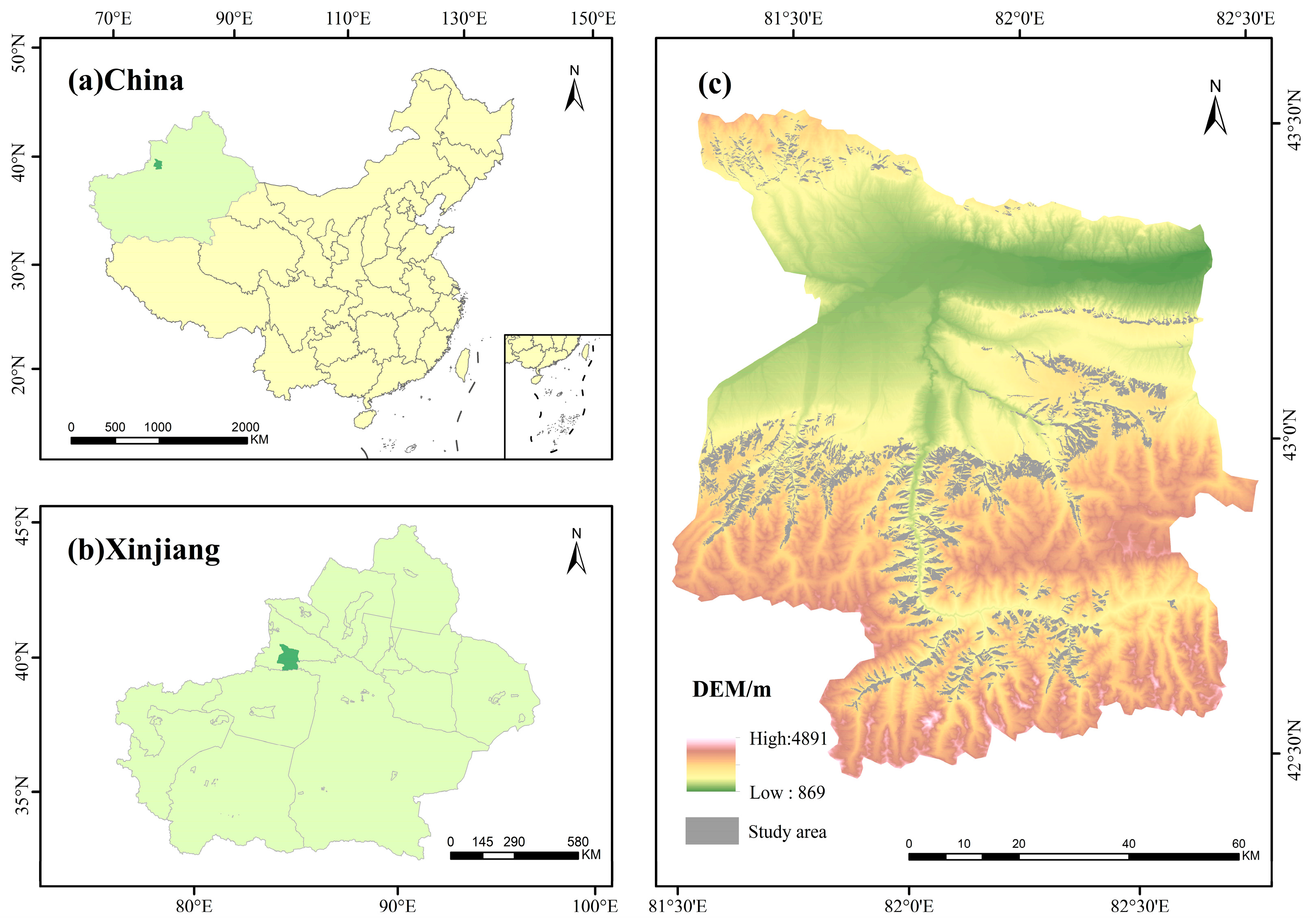
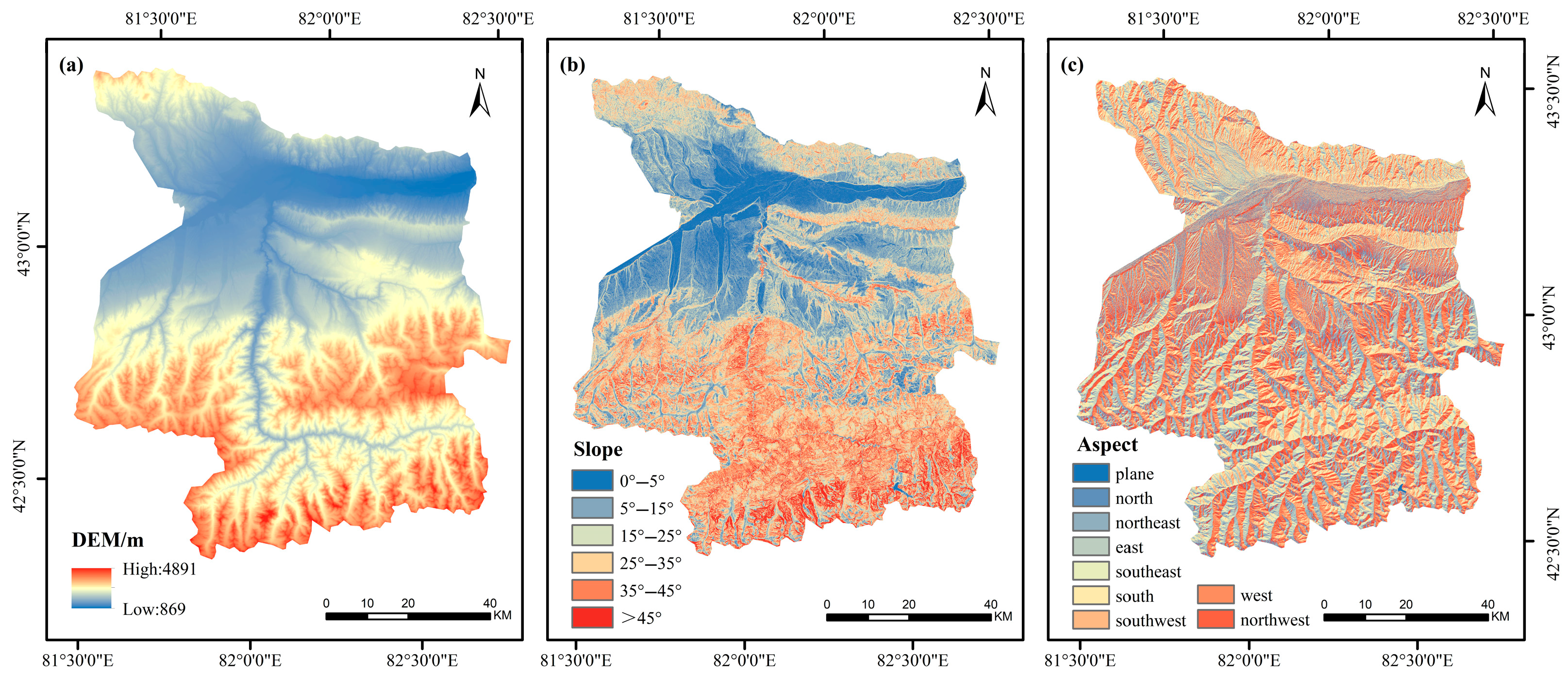
This study was conducted in the spruce forests of the Ili River Valley, located in the western Tianshan Mountains, Xinjiang, China. This region represents a vital water conservation and carbon sink area within the arid zones of Central Asia. The study area is specifically situated in Tekes County (81°19′ to 82°37′ E, 42°12′ to 43°25′ N), which lies at the northern foothills of the Tianshan Mountains, the southern edge of the Ili River Valley, and the eastern section of the Tekes Basin. The location of the study area is shown in Figure 1. The county is surrounded by mountains on all sides, with a topography characterized by higher elevations in the north and south and a lower central area. The Tekes River flows from west to east, traversing the entire county. Elevations in the study area range from 869 m to 4891 m, with complex topographic variations including steep slopes and diverse aspects, which pose significant challenges for remote sensing-based biomass estimation. Moreover, the region experiences a temperate continental semi-arid mountain climate with distinct seasons and marked seasonal temperature variations. The annual average temperature is approximately 5.3 °C (12.6 °F), with precipitation primarily concentrated from May to August. The annual average precipitation is about 375 mm.
The forest area within the study region exhibits a relatively monotonous tree species composition, dominated by naturally occurring Tianshan spruce (Picea schrenkiana var.) as the primary dominant species. Species such as Populus spp. and Betula spp. are only sparsely distributed. The understory vegetation is sparse, with common species including short-distance impatiens (Impatiens parviflora) and northeastern sheep’s horn parsley (Glehnia littoralis) [24]. The Picea schrenkiana forests in this region are characterized by high spatial heterogeneity in canopy structure and biomass distribution, largely attributed to variations in elevation, slope, and historical forest management practices. Overall, spruce dominates both forest area and timber volume. The data for this study were derived from the second-class forest resource survey of the Tekes Forest Farm. From a total of 3198 pure Tianshan spruce forest survey plots [25], abnormal sample points were excluded, and a portion of the remaining samples was randomly selected for subsequent experiments and analysis.

2.2. Technical Workflow

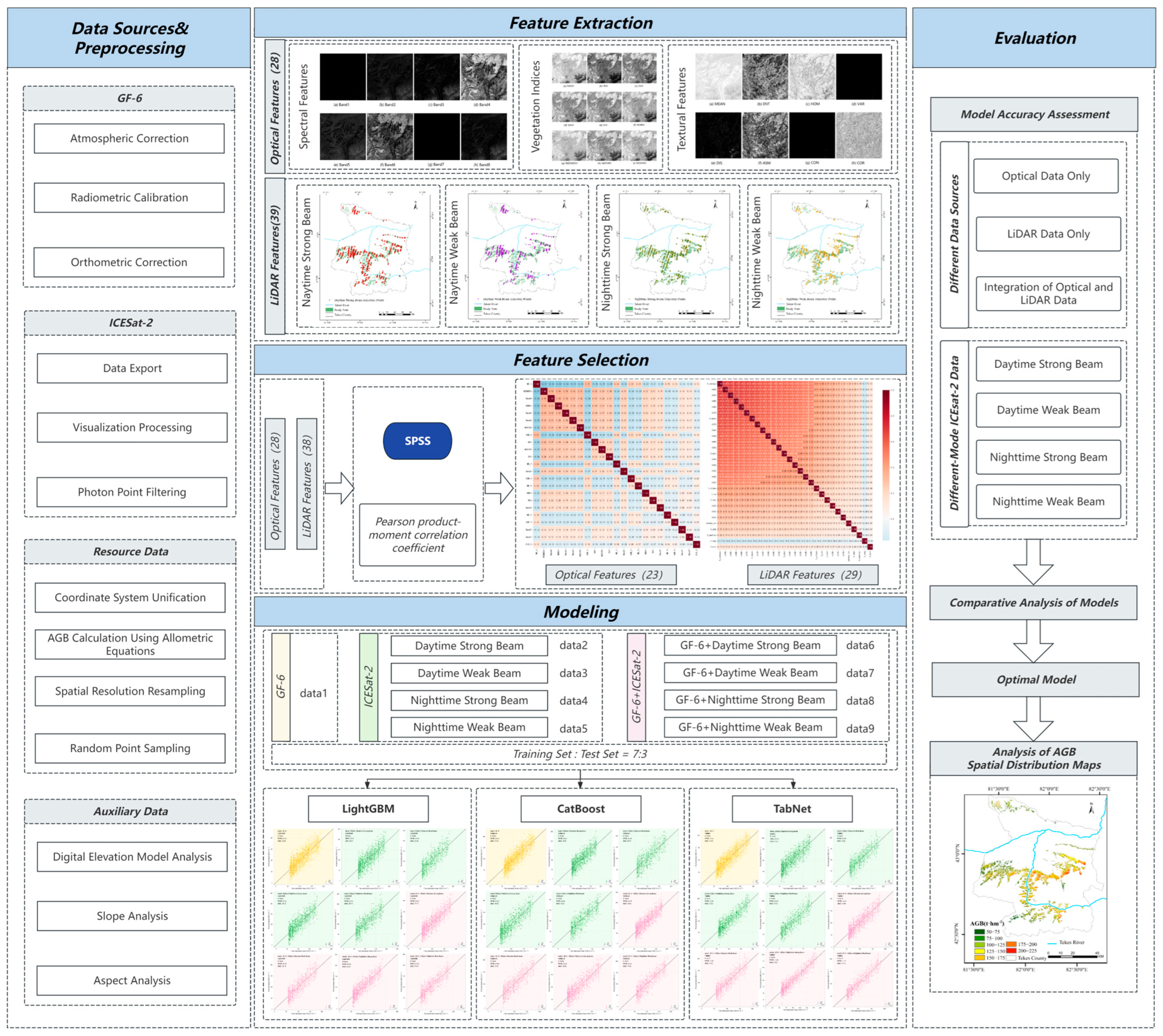
The methodological framework for forest AGB estimation proposed in this study encompasses five core components: data sources and preprocessing, feature extraction, feature selection, modeling, and evaluation. First, the GF-6 WFV optical imagery and ICESat-2 ATL08 LiDAR data were preprocessed to extract spectral indices, textural features, and canopy structure parameters, respectively. Second, the extracted features were integrated with field plot measurements and screened through correlation analysis to construct the modeling dataset. Finally, three machine learning algorithms—LightGBM, CatBoost, and TabNet—are employed for model training, with the coefficient of determination (R2), root mean square error (RMSE), and mean absolute error (MAE) used as performance evaluation metrics. The optimal model was then applied to map AGB at the regional scale. The subsequent sections provide detailed descriptions of each step, and the overall technical workflow is illustrated in Figure 2.

2.3. Data Procesinng

2.3.1. Overview of Datasets

This study integrated three types of datasets for forest biomass estimation. (1) Optical imagery: Gaofen-6 (GF-6) Wide Field of View (WFV) multispectral data, sourced from the National Remote Sensing Data and Application Service Platform, provided spectral information including the red-edge and violet bands sensitive to vegetation characteristics. (2) LiDAR data: ICESat-2 ATL08 land and vegetation height products, obtained from the National Snow and Ice Data Center (NSIDC), supplied three-dimensional canopy structure information, including percentile-based forest canopy heights. (3) Field-based forest resource data: Second-class forest resource survey data, stored in vector format (.shp), provided ground-truth measurements of tree height, DBH, volume, and other stand parameters, which were used to calculate AGB using allometric equations. All datasets were preprocessed to ensure spatial consistency, including coordinate transformation to WGS 1984 UTM Zone 43N and resampling to a unified 10 m spatial resolution.

2.3.2. GF-6 WFV Data

All optical remote sensing data used in this study were sourced from the National Remote Sensing Data and Application Service Platform (https://www.cpeos.org.cn/) (access on 2 March 2026). The Gaofen-6 satellite, a vital component of China’s high-resolution Earth observation system, was successfully launched from Jiuquan, Gansu, on 2 June 2018, and officially entered service in March 2019. The satellite is equipped with a WFV multispectral camera that offers significant enhancements in spectral and spatial resolution. It features eight spectral bands with a 16 m spatial resolution and achieves a single-scene imaging swath exceeding 800 km, enabling efficient rapid coverage and high-frequency revisit observations across vast regions [26].
Crucially, GF-6 introduces the “Red Edge 1” band (approximately 0.69–0.73 μm) for the first time—a band vital for vegetation monitoring. Highly sensitive to chlorophyll content, nitrogen status, and phenological changes, this band significantly enhances the accuracy of vegetation classification and growth condition monitoring [27]. The newly added “Violet” band (approximately 0.40–0.45 μm) improves detection capabilities for aerosols, coastal water bodies, and certain minerals. Together with the other bands, these new spectral bands hold significant application value in fields such as forest resource surveys and vegetation dynamics monitoring [28].
To ensure data quality and spatial consistency for subsequent biomass estimation, a rigorous preprocessing workflow was implemented using ENVI 5.6 software (Exelis Visual Information Solutions, Inc., Boulder, CO, USA). The workflow comprised four key steps:
  • Radiometric Calibration: To convert raw digital number (DN) values to physical radiance values and eliminate sensor-induced errors, radiometric calibration was performed. Using the specific calibration parameters for the GF-6 WFV sensor obtained from the data provider, the ENVI (version 5.6.) Radiometric Calibration tool was applied. The conversion followed the linear formula:
L = G a i n × D N + O f f s e t
where L is the spectral radiance at the sensor’s aperture, and G a i n and O f f s e t are the sensor-specific calibration coefficients.
2.
Atmospheric Correction: The FLAASH (Fast Line-of-sight Atmospheric Analysis of Spectral Hypercubes) module in ENVI was employed to convert the calibrated radiance data to surface reflectance. This step corrects for atmospheric absorption and scattering effects (e.g., from water vapor and aerosols). The MODTRAN-based FLAASH model was parameterized as follows: the sensor type was set to “UNKNOWN-MSI”; the satellite altitude was set to 645 km; the average scene elevation was derived from the ALOS PALSAR DEM; pixel size was set to 16 m; the atmospheric model was selected based on the imagery date and latitude; the aerosol model was set to ‘Rural’; and because the GF-6 WFV lacks a shortwave infrared band, the aerosol retrieval method was set to ‘None’, with an initial visibility of 40 km.
3.
Orthorectification: To correct geometric distortions caused by sensor geometry and terrain relief, orthorectification was performed. This process utilized the rational polynomial coefficient (RPC) model embedded in the image metadata, combined with a 12.5 m ALOS PALSAR DEM to account for topographic displacement. ground control points (GCPs) were manually selected to refine the RPC model, ensuring high geolocation accuracy.
4.
Mosaicking and Clipping: Individual image scenes covering the study area were mosaicked into a single seamless composite using the Seamless Mosaic tool in ENVI 5.6. The final step was to clip the mosaic to the exact administrative boundary of the study area, producing a final, spatially consistent GF-6 dataset for subsequent feature extraction.
Following this preprocessing workflow, all GF-6 imagery was standardized to ensure data quality and spatial consistency, providing a reliable foundation for subsequent analyses.

2.3.3. ICESat-2 AT08 Data

The ICESat-2 satellite employed in this study was launched on 15 September 2018. Its Advanced Topographic Laser Altimeter System (ATLAS) utilizes photon-counting technology, featuring an orbital sampling interval of approximately 0.7 m and a single laser footprint diameter of about 11–12 m [29]. ATLAS emits six laser beams arranged in three parallel groups along the orbit, each group comprising one strong laser and one weak laser. Operating in a continuous day-night observation mode, the satellite is subject to varying solar background noise at different times, which affects the data signal-to-noise ratio. The system generates 21 standard data products categorized into four levels: Level 0 to Level 3 [25,30,31]. This study utilizes Level 3 land and vegetation height products (ATL08). This product provides surface and vegetation structure information, including forest canopy height at different percentiles, surface elevation, and slope. Previous studies indicate that forest heights derived from ATL08 are generally lower than those from the Second National Forest Resources Survey based on airborne LiDAR. However, ATL08’s percentile height index becomes more accurate as the percentile increases [32], providing a crucial data foundation for regional-scale inversion of parameters such as forest height, biomass, and carbon storage. To enhance subsequent inversion accuracy, this study preprocessed the ATL08 data, primarily by removing data points with high canopy height uncertainty and anomalous photon points where the difference between ground elevation and SRTM reference elevation exceeded 50 m (such anomalies typically result from cloud interference causing laser signals to misrepresent actual ground elevation). All LiDAR data used in this study were sourced from the ATL08 product (https://nsidc.org/data/atl08/versions/7, accessed on 2 March 2026).

2.3.4. Resource Data

The forest resource data from the second-class survey used in this study are stored in vector format (.shp) and has undergone vectorization. The attribute fields include plot number, average DBH, average tree height, tree age, dominant tree species, canopy closure, soil type, soil layer thickness, and standing timber volume per hectare. To maintain spatial consistency with GF-6 optical remote sensing imagery, the survey data underwent coordinate transformation and were uniformly projected into the WGS 1984 geographic coordinate system and UTM Zone 43N projection (Universal Transverse Mercator projection). Required fields for this study were extracted. Biomass calculations were performed using the regression equations for spruce forest biomass and volume established by Fang et al. [33], based on the volume field from the forest resource survey data.
B = 0.4642 V + 47.499
In the formula: B : Unit biomass, unit: t·hm−2; V : Volume, unit: m3·hm−2.
At the spatial analysis level, the study area was first divided into a regular grid of 10 m × 10 m cells (using the fishing-net method [34]). Based on this grid, 1913 cells were randomly selected from the area containing ICESat-2 ATL08 photon points as analysis plots. Considering the ICESat-2 single-pulse footprint diameter of approximately 11–12 m (covering an area of about 95–113 m2), and to maintain consistency in spatial units across different data sources, the spatial units of the second-class forest resource survey data were uniformly converted to 10 m × 10 m. The GF-6 multispectral imagery was resampled to unify its spatial resolution to 10 m. Finally, from the forest resource data identified and corrected for spruce forest types, the corresponding small plots within the aforementioned 1913 grid cells were extracted as study samples. Their per-hectare volume distribution is shown in Table 1.

2.3.5. Auxiliary Data

This study obtained Digital Elevation Model (DEM) data generated by the PALSAR sensor of the ALOS (Advanced Land Observing Satellite-1) satellite from the GSCloud platform (https://www.gscloud.cn) (access on 2 March 2026), featuring a spatial resolution of 12.5 m. Using ArcGIS 10.8 software (Environmental Systems Research Institute, Inc., Redlands, CA, USA), terrain factors such as elevation, slope, and aspect were extracted from the DEM through raster surface analysis algorithms. The resulting terrain feature map, shown in Figure 3, was utilized for subsequent analysis and modeling.

2.4. Feature Extraction

2.4.1. Optical Image Features

(1)
The Surface Reflectance
The raw bands of optical remote sensing imagery directly capture the spectral characteristics of terrestrial objects, containing key information reflecting land cover and vegetation conditions. Different spectral bands correspond to distinct reflectance properties of land features, which form the basis for vegetation discrimination and parameter retrieval. In the visible spectrum, the blue band exhibits strong water penetration, effectively capturing water turbidity information; the green band is sensitive to chlorophyll content in vegetation, showing higher reflectance; the red band is closely associated with photosynthesis, where vegetation absorbs significant light energy, resulting in relatively lower reflectance. The near-infrared band offers unique advantages for vegetation detection, as healthy vegetation displays extremely high reflectance due to multiple scattering and reflection within the canopy structure.
To fully leverage the spectral potential of the GF-6 satellite, this study extracted reflectance values for all eight bands from preprocessed imagery, including four standard multispectral bands: the blue band (0.45–0.52 μm), the green band (0.52–0.59 μm), the red band (0.63–0.69 μm), and the near-infrared band (0.77–0.89 μm); and four GF-6-specific bands: the red edge 1 band (0.69–0.73 μm), the red edge 2 band (0.73–0.77 μm), the violet band (0.40–0.45 μm), and the yellow band (0.59–0.63 μm). These new bands (particularly the two red edge bands) exhibit high sensitivity to vegetation physiological parameters (e.g., chlorophyll content, nitrogen status) and phenological changes, significantly enhancing vegetation identification and parameter retrieval capabilities. For each sample plot, the final reflectance was calculated as the average value of all pixels falling within the 10 m × 10 m plot grid to mitigate within-pixel heterogeneity and improve result stability. All band information extraction was performed using the ENVI software platform. The resulting spectral data were serve as core input variables for subsequent modeling and analysis.
(2)
Vegetation Index
Using a single band or multiple single-band data often fails to fully capture the complex spectral characteristics and variation patterns of vegetation in remote sensing imagery. To more effectively utilize remote sensing satellite data for characterizing vegetation status, this study constructed and extracted nine vegetation indices based on the spectral characteristics of typical vegetation. These indices, calculated through linear or nonlinear combinations of spectral bands (e.g., addition, subtraction, multiplication, division), enhance vegetation signals and minimize confounding factors such as soil background and atmospheric effects. These indices include NDVI, RVI, DVI, SAVI, EVI, NDREI, REDNDVI, NDVIR1, and NDVIR2 [35,36], with their calculation formulas shown in Table 2.
The specific indices employed are as follows:
Normalized Difference Vegetation Index (NDVI): A standard index for vegetation greenness and coverage, closely related to vegetation cover fraction. NDVI values range from −1 to 1, with higher values indicating denser vegetation.
Ratio Vegetation Index (RVI): Sensitive to dense vegetation, this index enhances vegetation information by leveraging the strong reflectance in the near-infrared band and strong absorption in the red band.
Difference Vegetation Index (DVI): Calculated as the difference between two spectral bands, this index is sensitive to soil variations and effectively distinguishes water bodies and vegetation.
Soil-Adjusted Vegetation Index (SAVI): Designed to minimize soil brightness effects in high-density vegetation areas, SAVI reduces saturation issues common with NDVI in dense canopies.
Enhanced Vegetation Index (EVI): Optimized for high-biomass regions by incorporating the blue band and adjustment coefficients, EVI more accurately reflects vegetation status under complex conditions such as atmospheric interference or heterogeneous soil backgrounds.
Normalized Difference Red Edge Index (NDREI): This index replaces the near-infrared and red bands in NDVI with the red edge band’s peak and valley, making it sensitive to chlorophyll content.
Red Edge Normalized Difference Vegetation Index (REDNDVI): Combining the near-infrared and the first red-edge band (R1), this index is associated with vegetation chlorophyll content.
NDVIR1 and NDVIR2: These indices replace the near-infrared band in NDVI with red edge 1 (R1) and red edge 2 (R2), respectively. They are sensitive to subtle changes in the canopy layer and senescence, making them suitable for forest monitoring and precision agriculture applications.
By amplifying the reflectance differences between vegetation and other land cover types such as soil and water bodies in the red, near-infrared, and red edge bands, these vegetation indices can more sensitively reflect vegetation cover, growth status, and physiological parameters (e.g., chlorophyll content, biomass). This provides important remote sensing feature inputs for forest structure parameter extraction and biomass estimation.
(3)
Texture Features
Texture features describe the spatial distribution patterns of grayscale or color in image pixels, serving as crucial visual indicators for characterizing the surface structure of land objects [37]. In remote sensing image analysis, texture features provide essential spatial contextual information for land object interpretation, classification, and identification. Particularly in areas with complex forest stand structures, incorporating texture features enhances the accuracy and reliability of biomass estimation [38]. Numerous studies have demonstrated that integrating spectral and texture features significantly improves the estimation accuracy of forest parameter inversion models [39,40].
Among various texture analysis methods, the Gray-Level Co-occurrence Matrix (GLCM) is widely used due to its robustness and adaptability. Originally proposed by Haralick in 1973, GLCM captures the correlation between grayscale values of pixel pairs at a specified distance and direction, reflecting comprehensive information on image orientation, variation amplitude, and spacing. Common directions include 0°, 45°, 90°, and 135°.
In this study, to reduce data dimensionality while preserving critical information, Principal Component Analysis (PCA) was first performed on the eight GF-6 spectral bands. The first principal component, which accounted for 96.5% of the total variance, was selected as the input image for texture analysis. Based on the Gray-level Co-occurrence Matrix (GLCM), eight commonly used texture features were extracted from the first principal component across four window sizes (3 × 3, 5 × 5, 7 × 7, 9 × 9), including: Mean, Entropy, Homogeneity, Variance, Dissimilarity, Angular Second Moment, Contrast, and Correlation.
The choice of window size is critical for capturing texture information at different spatial scales. Smaller windows (e.g., 3 × 3) capture fine-scale structural variations, while larger windows capture broader spatial patterns. Through iterative testing, the 3 × 3 window was found to most effectively capture the fine-scale textural characteristics of the spruce forest. Consequently, this study employed a 3 × 3 moving window with a step size of 1 and an angle of 0° for texture feature extraction.
The eight extracted texture features are defined in Table 3 as follows:
Mean (ME): The average gray level within the window, reflecting the overall brightness level of the target area.
Entropy (ENT): A measure of randomness indicating texture complexity; higher entropy values suggest more complex canopy structures.
Homogeneity (HOM): Measures the closeness of the distribution of elements in the GLCM to the diagonal; higher values indicate more uniform texture.
Variance (VAR): A measure of gray-level dispersion; greater variance indicates richer, “rougher” texture.
Dissimilarity (DIS): Measures the absolute difference between gray levels; higher values indicate greater texture heterogeneity.
Angular Second Moment (ASM): A measure of textural uniformity (energy); higher values indicate more regular, uniform texture.
Contrast (CON): A measure of local gray-level variation; high contrast indicates significant gray-level differences.
Correlation (COR): A measure of linear dependency between gray levels, indicating the linear relationship between pixel gray values.

2.4.2. LiDAR Image Features

ALT08 product includes geographic coordinates, slope, elevation, and canopy height information for photon points. Parameters potentially influencing spruce forest biomass were screened as feature variables, as shown in Table 4. A total of 38 feature variables were selected, including forest canopy height and elevation at different percentiles.
The Advanced Topographic Laser Altimeter System (ATLAS) aboard the ICESat-2 satellite emits six laser beams arranged in three parallel groups along the orbital direction. Each group consists of one high-power laser and one low-power laser. The strong beams (gt3l, gt3r) have a pulse energy of approximately 110 μJ, while the weak beams (gt1l, gt1r, gt2l, gt2r) have an energy of about 28 μJ [41]. This energy difference directly affects the photon flux density, thereby determining the spatial sampling characteristics of the photon point cloud. In vegetation-covered areas, the strong beam typically penetrates the canopy more effectively to capture understory terrain signals, while photons from the weak beam are largely intercepted by the upper canopy layer. To mitigate the impact of laser intensity differences on spruce forest biomass estimation, this study categorizes photons into strong and weak beam groups based on beam intensity. The sc_orient field in the ATL08 product records the satellite’s attitude information during forward, backward, and transition flight modes. When sc_orien t = 1 (ICESat-2 is considered to be flying forward), strong beams are located ahead of the orbit, and weak beams are located behind. When sc_orient = 0 (ICESat-2 is considered to be flying backward), strong beams are located behind, and weak beams are located ahead.
The ICESat-2 satellite operates in a continuous day-night observation mode, where variations in solar background noise levels impact metrics such as signal-to-noise ratio (SNR). During daytime observations, significant scattering of solar radiation by the atmosphere substantially increases the number of background photons received by the detector. The background noise level of the ATLAS system typically exceeds that during nighttime operations by 1–2 orders of magnitude [42]. This elevated background noise not only reduces the signal-to-noise ratio (SNR) but also increases the false alarm rate of photon classification algorithms (e.g., DRAGANN), particularly over low-albedo surfaces. Daytime atmospheric turbulence, convective activity, and aerosol concentrations are generally higher than at night, causing additional beam broadening and path perturbations that degrade the spatial distribution accuracy of the photon point cloud. The more stable nighttime atmosphere facilitates sub-meter elevation measurement accuracy [43]. Daytime surface reflectance exhibits significant angular dependence, particularly for high-albedo surfaces like snow, ice, and deserts. The coupled effect of solar elevation angle and observation geometry substantially alters optical return intensity, introducing additional elevation bias [44]. Nighttime observations eliminate solar radiation interference and stabilize surface reflectance characteristics, facilitating consistent analysis of long-term time series. To mitigate the impact of solar radiation and atmospheric conditions on spruce forest biomass inversion, this study further categorizes data into daytime and nighttime segments based on observation timing. The night_flag field in the ATL08 product identifies data acquisition periods: 0 denotes daytime, 1 denotes nighttime. This flag is calculated based on the solar elevation angle within the geolocated segment. If the solar elevation angle exceeds the threshold, the observation is classified as daytime; otherwise, it is classified as nighttime. A total of 5796 valid photon points were extracted within the study area. Based on the two dimensions of observation time and beam intensity, these points were categorized into four observation modes: daytime strong beam, daytime weak beam, nighttime strong beam, and nighttime weak beam. This classification facilitates subsequent analysis of how different modes influence biomass estimation.

2.4.3. Determination of Characteristic Factors

Using Pearson’s correlation coefficient method in SPSS data analysis software (IBM SPSS Statistics v26, IBM Corp., Armonk, NY, USA), we analyzed the correlation between characteristic factors and spruce forest biomass, identifying statistically significant factors correlated with spruce forest biomass [45]. This approach eliminates redundant variables and optimizes model inputs, enhancing the model’s predictive accuracy and computational efficiency. This study calculated Pearson correlations between measured spruce forest biomass values and the characteristic factors from GF-6 and ICESat-2, as shown in Table 5 and Table 6, respectively.
Among the 28 feature factors in the GF-6 dataset, 19 feature factors showed significant correlation at the 0.01 level (two-tailed), while 4 feature factors exhibited significant correlation at the 0.05 level (two-tailed). The feature factor with the highest correlation coefficient against spruce forest biomass in the study area was ME_3, with a correlation coefficient of 0.612. The top five feature factors by absolute correlation coefficient were ME_3, REDNDVI, Band6, NDREI, and Band5, with respective correlations of 0.612, −0.601, −0.583, −0.572, and −0.557. The feature factors with strong correlation coefficients were the mean statistics within the texture features, indicating that the mean statistics of the bands are highly sensitive to biomass.
Among the 38 feature factors in the ICESat-2 data, 25 feature factors showed significant correlations at the 0.01 level (two-tailed), while 4 feature factors showed significant correlations at the 0.05 level (two-tailed). Among these, the highest correlation coefficient was observed for h_canopy, reaching 0.831. The top five feature factors by absolute correlation coefficient were h_canopy, rh90, rh95, rh85, and rh80, with respective correlations of 0.831, 0.824, 0.817, 0.812, and 0.796—all significant at the 0.01 level. The results indicate that canopy height from ICESat-2 data exhibits strong sensitivity to spruce forest biomass.
Given that remote sensing features may exhibit complex nonlinear relationships with forest biomass beyond linear correlations, a secondary validation was conducted during model construction using model-based feature importance evaluation mechanisms. Specifically, during the training of LightGBM, CatBoost, and TabNet models, the built-in importance metrics—including gain and split count for LightGBM and CatBoost, and attention masks with feature contribution weights for TabNet—were employed to rank and refine the preliminarily selected features. The final feature set for modeling was determined by synthesizing the results from both correlation analysis and model-based importance evaluation.
Through the above correlation analysis, feature factors with the most significant correlations to measured spruce forest biomass values were identified from the two types of remote sensing data and retained for dataset construction. Following screening, GF-6 data retained 23 feature factors, while ICESat-2 data retained 29 feature factors.


2.4.4. Dataset Construction

To investigate the impact of different datasets on spruce forest biomass estimation, three feature sets (FS) were constructed based on two types of data, as shown in Table 7 below. FS_1 comprises 28 feature factors from GF-6 data significantly correlated with spruce forest biomass; FS_2 comprises 29 feature factors from ICESat-2 data significantly correlated with spruce forest biomass; FS_3 comprises a total of 57 feature factors from both GF-6 and ICESat-2 datasets.
Additionally, to investigate the impact of photonic points on spruce forest biomass estimation under multi-mode conditions, four datasets were further subdivided within FS_2—which utilizes single LiDAR data—based on ICESat-2 satellite observation timing and beam intensity. The same approach was applied to FS_3, which combines both data types. The specific composition of each dataset is outlined below.

2.5. Model Introduction

The integration of multi-source remote sensing data—specifically, optical imagery from GF-6 and LiDAR data from ICESat-2—yields a feature space characterized by high dimensionality, heterogeneous data types, and complex non-linear relationships. Conventional linear models are often inadequate for capturing such intricate interactions. To address this challenge, three representative machine learning models were selected to evaluate the performance of different modeling paradigms within a multi-source data fusion framework: two ensemble tree-based models (LightGBM and CatBoost) and one attention-based deep learning model (TabNet). These models were chosen for their complementary strengths: LightGBM efficiently handles high-dimensional spectral features; CatBoost provides robust generalization under complex terrain conditions; and TabNet effectively captures non-linear interactions between heterogeneous features through its attention mechanism. The following sections detail the principles and training procedures of each model.

2.5.1. LightGBM

Light Gradient Boosting Machine (LightGBM) is a gradient boosting framework introduced by Microsoft in 2017 [46]. It employs histogram-based algorithms and a leaf-wise growth strategy, significantly improving training efficiency and reducing memory consumption compared to traditional boosting methods. LightGBM is particularly well-suited for processing high-dimensional feature spaces, making it appropriate for the rich spectral bands and texture features derived from GF-6 optical imagery. Additionally, LightGBM supports efficient parallel training and demonstrates robust performance with large-scale datasets.
LightGBM constructs robust prediction models by integrating multiple weak decision tree learners. Its fundamental unit is the decision tree, comprising a root node representing the entire sample space, internal nodes that partition samples based on feature thresholds, and leaf nodes that output predicted values. LightGBM employs a forward stepwise additive model, iteratively training multiple trees to progressively refine residuals. Let the input feature matrix be X R n × m and the target biomass vector be y R n . The prediction output of the LightGBM model after the t-th iteration is:
y ^ i t = k = 1 t f k ( x i ) ,   f k F
In the formula: where f k is the k -th decision tree, F is the entire space of all possible tree structures, and y ^ i t is the predicted value of the i -th sample after t trees.
The training process of LightGBM comprises the following key steps. First, feature-selected datasets were input into the model, with each dataset containing spectral features, vegetation indices, and texture features as input variables, and measured plot biomass as the target variable. All datasets were randomly split into training (70%) and testing (30%) sets after outlier detection and missing value processing. Second, during model training, the intrinsic feature importance evaluation mechanism was employed for secondary feature selection and validation. Specifically, the gain metric was used to assess the contribution of each feature in the decision tree splitting process. Features with higher gain values were retained, while those with lower contributions were excluded, thereby optimizing the feature space while maintaining model performance. Third, Gradient-Based One-Side Sampling (GOSS) was employed for sample selection, where samples with large gradients (carrying more information) were retained, while samples with small gradients were randomly sampled with weight compensation to maintain data distribution. Fourth, Exclusive Feature Bundling (EFB) was applied to reduce feature dimensionality by bundling mutually exclusive features into a single feature without information loss. Fifth, decision trees were constructed using a leaf-wise growth strategy with depth constraints, where a histogram-based algorithm discretized continuous features into fixed bins to determine optimal split points. Sixth, model accuracy was validated using the testing set, with evaluation metrics including coefficient of determination (R2), root mean square error (RMSE), and mean absolute error (MAE). An early stopping mechanism was employed to terminate training when validation loss did not decrease for 50 consecutive iterations. Finally, grid search combined with 5-fold cross-validation was used to optimize key hyperparameters, including max_depth, num_leaves, learning_rate, subsample, and colsample_bytree. The optimal hyperparameters were determined through grid search and cross-validation.

2.5.2. CatBoost

Categorical Boosting (CatBoost) is a gradient boosting algorithm developed by Yandex [47]. It is designed to effectively handle categorical features through ordered target statistics and symmetric tree structures. Its inherent mechanisms for mitigating overfitting, including ordered boosting and oblivious trees, provide superior generalization capabilities, particularly in scenarios involving complex terrain conditions where remote sensing data may exhibit substantial spatial heterogeneity. This characteristic makes CatBoost well-suited for biomass estimation in the mountainous study area.
CatBoost employs a forward stepwise additive model, where its prediction is obtained by aggregating the outputs from multiple decision trees:
y ^ i = k = 1 K f k ( x i )
In the formula, f k ( x i ) is the prediction contribution of the k -th decision tree to sample x i , and K is the total number of decision trees.
Traditional gradient boosting suffers from prediction shift, where the gradient distribution during tree training differs from that during prediction [48]. CatBoost resolves this issue through its Ordered Boosting algorithm. In standard gradient boosting, the t tree utilizes gradients computed based on the entire training data from the first t 1 trees:
g t ( x i , y i ) = L ( y i , y ^ i t 1 ) y ^ i t 1
In the formula: This leads to conditional bias in gradient estimation, where E [ g t ( x i | λ ^ i ) | x i ] does not equal the true gradient value. CatBoost’s ordered boosting computes gradients using only historical samples, obtaining unbiased gradient estimates and mitigating prediction shift.
The training process of CatBoost follows six steps. First, feature-selected datasets were divided into training (70%) and testing (30%) sets with consistent random seed (random_state = 42) to ensure reproducibility. Second, during model training, the intrinsic feature importance evaluation mechanism was employed for secondary feature selection and validation. Specifically, the split count metric was used to assess the frequency with which each feature was utilized for splitting during the construction of oblivious trees. Features with higher split counts were retained as key variables, while those with lower contributions were excluded, thereby optimizing the feature space while maintaining model generalization capability. Third, Ordered Boosting was applied to address target leakage by computing gradients for each sample using only historical samples. Fourth, oblivious trees (symmetric trees) were constructed, where the same splitting feature and threshold are used across each level, simplifying model complexity and improving computational efficiency. Fifth, trees were built iteratively, with each new tree fitting the negative gradient direction of the previous loss, and predictions from all trees were integrated through weighted summation. Sixth, early stopping (patience = 50) was applied to prevent overfitting, and model accuracy was evaluated using R2, RMSE, and MAE on the testing set. Finally, grid search was used to optimize iterations, depth, and learning_rate. The optimal hyperparameters were determined through grid search and cross-validation.

2.5.3. TabNet

TabNet is a deep learning model specifically designed for tabular data, introduced by Arik and Pfister in 2021 [49]. It ingeniously combines the computational power of attention mechanisms with the transparent, interpretable advantages of decision trees. Compared to traditional neural networks, TabNet’s built-in sparse attention mechanism is particularly well-suited for high-dimensional, highly correlated spectral data that often contains noise. It effectively identifies key spectral features, enhancing the model’s ability to analyze complex spectral information. This attention-based approach is particularly advantageous for multi-source data fusion tasks, as it can effectively capture complex, non-linear interactions between heterogeneous features—such as the vertical structural information from ICESat-2 LiDAR and the spectral characteristics from GF-6 optical imagery.
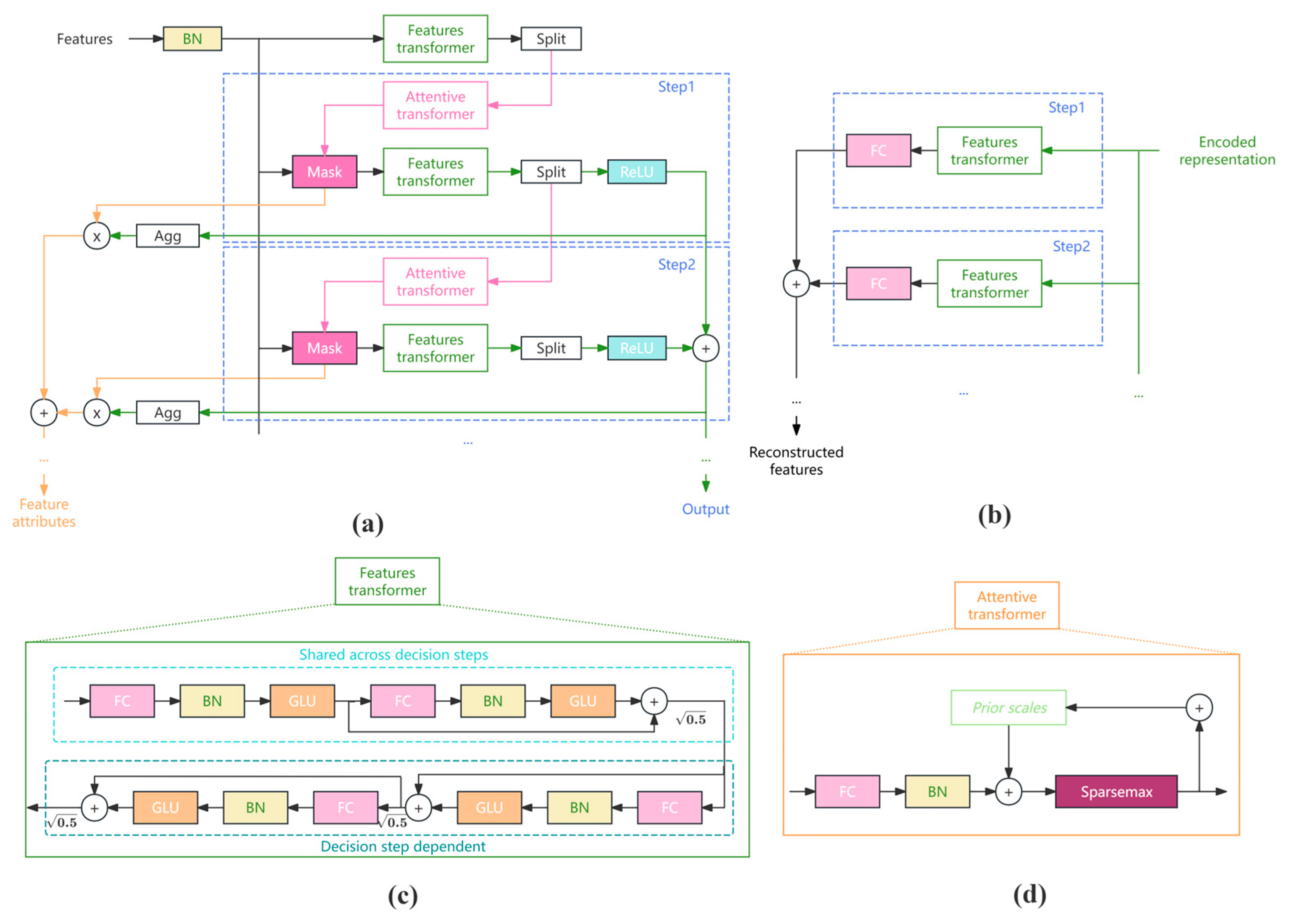
TabNet consists of four main modules, as shown in Figure 4: (1) Feature Transformer [50]: Processes input features through multiple sequential decision steps, each comprising fully connected layers, batch normalization, and nonlinear activation functions, achieving hierarchical feature representation and transformation. (2) Task-Attentive Transformer [51]: Dynamically generates attention scores based on the current task, guiding the Feature Transformer to focus on the most informative features at each step for adaptive feature selection. (3) SparseMax Layers [52]: Replaces the traditional softmax function with the SparseMax function to output sparse probability distributions, ensuring only a subset of features are activated at each decision step, thereby enhancing model interpretability. (4) Decision Aggregation: Integrates outputs from multiple weak decision-makers through weighted averaging or stacking to form the final prediction.
The training process of TabNet comprises seven steps. First, feature-selected datasets were split into training (70%) and testing (30%) sets. An additional validation set (20% of training data) was used for early stopping. All input features were standardized (mean = 0, standard deviation = 1) to eliminate scale effects. Second, during model training, the intrinsic attention-based feature importance evaluation mechanism was employed for secondary feature selection and validation. Specifically, at each decision step, a SparseMax layer generated a sparse feature selection mask (attention mask), which directly reflected the importance weight of each feature at that step. By aggregating mask information across multiple decision steps, a global importance score for each feature was obtained. Based on these attention weights, features with higher contributions were retained as key variables, while those with lower weights were excluded, thereby optimizing the feature space while enhancing model interpretability. Third, the loss function combined mean squared error with a sparsity regularization term:
L o s s = 1 n i = 1 n ( y i y ^ i ) 2 + λ j = 1 m L s p a r s e ( j )
In the formula: the first term is the mean square error between the predicted and true values, which measures the model’s goodness of fit. The second term is the sparsity regularization term, where λ denotes the sparsity loss coefficient, and L s p a r s e j represents the sparsity loss at the j -th decision step. This term encourages the model to activate only a small number of features at each decision step, thereby enhancing the interpretability of feature selection and the overall clarity of the model. By minimizing this composite loss function, the model achieves a balance between prediction accuracy and the sparsity of feature selection. Fourth, the Adam optimizer was used for parameter updates with an initial learning rate of 2 × 10⁻⁴, and a StepLR scheduler reduced the learning rate by a factor of 0.9 every 50 epochs. Fifth, batch size was set to 128, and virtual batch normalization was employed to improve normalization stability. Sixth, training terminated when validation RMSE did not decrease for 50 consecutive epochs, and the best model weights were automatically saved. Seventh, model parameters were optimized through grid search and cross-validation. The final hyperparameters were determined through grid search and cross-validation.

2.6. Accuracy Verification

Model performance evaluation employs three key metrics: the Coefficient of Determination (R2), Root Mean Squared Error (RMSE), and Mean Absolute Error (MAE). R2 reflects the model’s ability to explain variance in the target variable, with values ranging from 0 to 1. An R2 approaching 1 indicates excellent model fit. RMSE quantifies the average deviation between predicted and observed values, directly reflecting the model’s predictive accuracy—lower values indicate smaller prediction errors. MAE is a common metric for measuring the discrepancy between predicted and actual values, representing the average absolute error between predicted and observed values. The calculation formula is as follows, where n is the total number of samples; y i and y i ^ represent the measured and predicted biomass values for the i -th sample; and y ¯ denotes the average measured biomass value of the samples.
R 2 = 1 i = 1 n ( y i y i ^ ) 2 i = 1 n ( y i y ¯ ) 2
RMSE = i = 1 n y i y i ^ 2 N
MAE = i = 1 n y i y i ^ N

3. Results

3.1. Estimates from Different Data Sources

To evaluate the potential of single-source versus multi-source data combinations in forest AGB estimation, this study constructed nine distinct datasets based on GF-6 optical imagery, ICESat-2 photon-counting LiDAR (divided into four modes: day/night and strong/weak beams), and their combinations. Three models—LightGBM, CatBoost, and TabNet—were employed for training and prediction. The prediction accuracy metrics (R2, RMSE, MAE) for each combination are presented in Table 8.

3.1.1. Optical Data Only

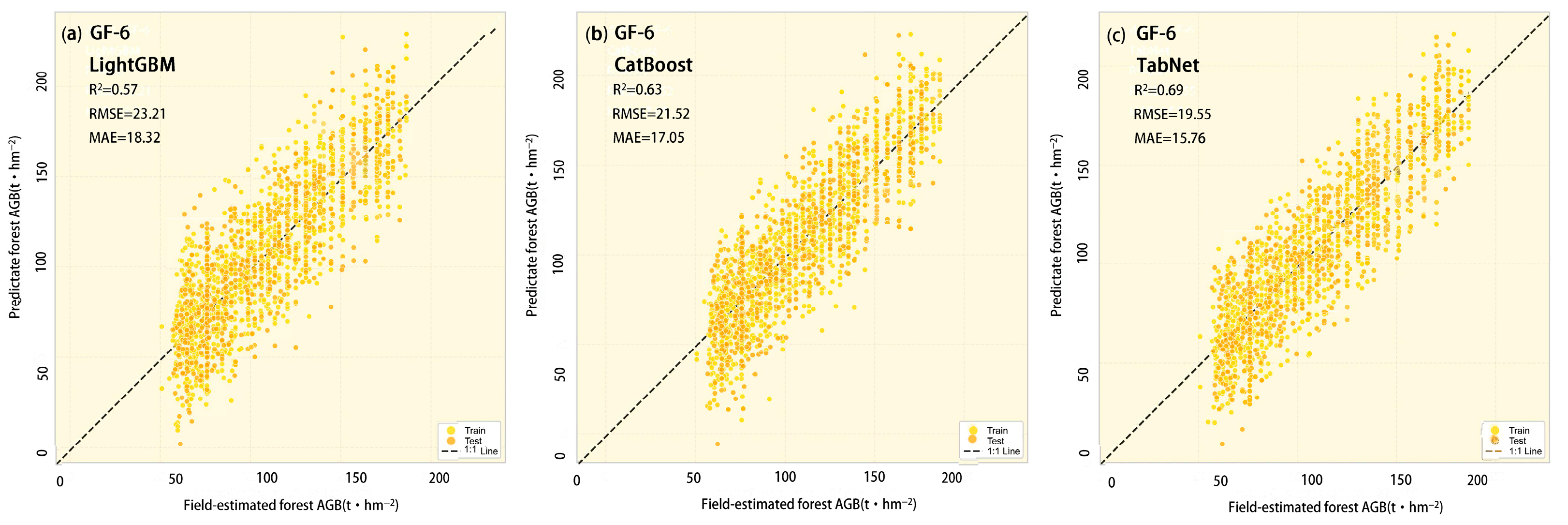
Results indicate significant performance differences among models when processing a single data source. In Figure 5, when using only the single optical GF-6 dataset (GF-6 Only), the TabNet model achieved the highest prediction accuracy (R2 = 0.69, RMSE = 19.55 t·hm−2, MAE = 15.76 t·hm−2), substantially outperforming both CatBoost (R2 = 0.63) and LightGBM (R2 = 0.53) models. This demonstrates TabNet’s superior feature extraction and fitting capabilities when handling high-dimensional optical features.
Compared to previous studies using optical remote sensing data for forest biomass estimation, our results show competitive performance. Zhang et al. [13] reported that the optical-only configuration yielded lower accuracy (R2 = 0.59) in their study integrating SAR with optical data for Picea schrenkiana biomass estimation. Liu et al. [53] reported that multiple stepwise regression models achieved relatively low accuracy (R2 = 0.379–0.658) using GF-6 data in subtropical forests, highlighting the limitations of traditional linear approaches.

3.1.2. LiDAR Data Only

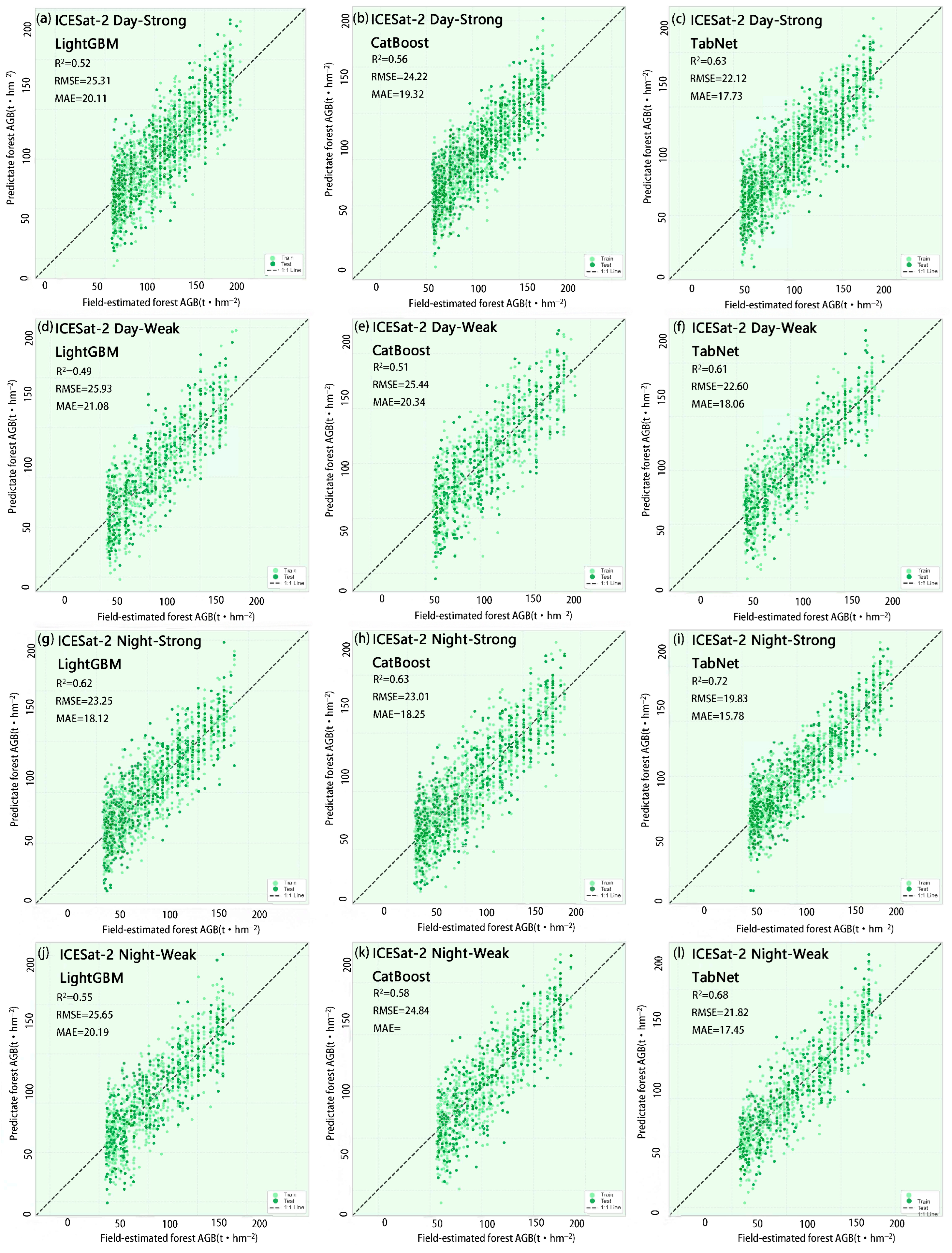
Within a single LiDAR data source, model accuracy exhibits high sensitivity to different acquisition modes, with their discrete sampling characteristics having a decisive impact on results (Figure 6). The highest single-source inversion was achieved in the combination of “ICESat-2 Night-Strong (data4)” and the TabNet model, yielding R2 = 0.72 and RMSE = 19.83 Mg·hm−2, outperforming even the best results from single optical data. Conversely, the lowest accuracy was observed when estimating “ICESat-2 Day-Weak (data3)” using LightGBM, yielding R2 = 0.49 and RMSE = 25.93 Mg·hm−2. This indicates that among single data sources, both optical data and nighttime strong-beam LiDAR provide relatively rich canopy structure and spectral information. Particularly under nighttime conditions, atmospheric interference is reduced, and LiDAR signals are more stable, which enhances biomass estimation accuracy. Although some LiDAR models outperform optical data in certain evaluation metrics, the overall trend shows that optical data still exhibit better stability as a single source. Optical imagery holds advantages in reflecting vegetation structure, cover, and leaf area index, providing rich surface-level information. While LiDAR can capture vertical structural information, its standalone performance is constrained by data coverage limitations and noise effects, resulting in overall performance slightly inferior to optical data.
The performance of ICESat-2 data for biomass estimation observed in this study is consistent with recent findings. The accuracy achieved using ICESat-2 nighttime strong beam data (R2 = 0.72, RMSE = 19.83 Mg·hm−2) exceeds that reported by Meng et al. [54] in Zhejiang Province, China, where ICESat-2 alone yielded R2 = 0.59 (RMSE = 31.25 t·hm−2), GEDI alone yielded R2 = 0.41 (RMSE = 39.27 t·hm−2), and their fusion improved accuracy to R2 = 0.678 (RMSE = 27.36 t·hm−2). The superior performance of our single-source ICESat-2 model may be attributed to the use of nighttime strong beam data and the TabNet deep learning model, which effectively captures complex nonlinear relationships in LiDAR-derived features. Further supporting the critical role of vertical structure information, Zhang et al. [55] demonstrated that incorporating canopy height features from ICESat-2 ATL03/08 fusion data significantly improved AGB model performance, with R2 increases of 13.89% for linear regression and 10.34% for random forest models.

3.1.3. Integration of Optical and LiDAR Data

When integrating GF-6 and ICESat-2 data, biomass estimation accuracy significantly improved across all models (Figure 7), further validating the effectiveness of multi-source data fusion. Taking TabNet—the model with the highest accuracy—as an example: the prediction accuracy using only optical data (GF-6 Only) was R2 = 0.69, RMSE = 19.55 t·hm−2, MAE = 15.76 t·hm−2. Under the best LiDAR mode using nighttime strong beams (ICESat-2 Night-Strong), the prediction accuracy was R2 = 0.72, RMSE = 19.83 t·hm−2, MAE = 15.78 t·hm−2, while the prediction accuracy of the combined optical and ICESat-2 nighttime strong beam (GF-6 + ICESat-2 Night-Strong) reached R2 = 0.83, RMSE = 15.36 t·hm−2, MAE = 12.23 t·hm−2. Compared to single optical data, the multi-source fusion approach showed a 22.7% increase in R2 and a 20.2% decrease in RMSE; compared to single nighttime strong beam data, R2 increased by 9.5% and RMSE decreased by 14.5%.
The enhancement achieved through multi-source data fusion in this study is consistent with findings from previous investigations. Tian et al. [56] evaluated various optical data (GF-6, Sentinel-2, Landsat-8) and SAR data (GF-3, Sentinel-1, ALOS-2) in the Hangzhou area, China, reporting that multisource data fusion improved estimation accuracy by 5–10% compared to single-source data, with the CNN-LSTM model achieving the best performance (R2 = 0.74, RMSE = 26.43 Mg·hm−2). Ali et al. [57] similarly demonstrated that combining ALOS-PALSAR (L-band SAR) and SPOT-6 (optical) data in coniferous planted forests in Iran improved AGB prediction, with RMSE decreases of 1.14–23% and R2 increases of 0.11–0.33 across different models, while deep learning models consistently outperformed traditional machine learning approaches. Furthermore, Yang et al. [15] combined airborne LiDAR canopy height attributes with optical spectral indexes, achieving R2 = 0.82 and RMSE = 28.6 t·hm−2, further demonstrating the synergistic effect of integrating vertical structure and spectral information. These studies collectively support the effectiveness of multi-source data fusion for enhancing biomass estimation accuracy, with our approach achieving superior performance (R2 = 0.83, RMSE = 15.36 t·hm−2), which is likely due to the use of nighttime strong beam ICESat-2 data and the TabNet deep learning model.
The results demonstrate that multi-source data fusion effectively enhances the model’s ability to interpret biomass spatial distribution through complementary information: optical imagery reflects the horizontal spectral characteristics of vegetation, while LiDAR data provides vertical height information of forest canopies. This study confirms that the multidimensional complementarity of “spectral characteristics + vertical structure” is crucial for biomass inversion. Optical data alone lacks vertical structure information, while relying solely on LiDAR data, despite its high vertical resolution, fails to achieve continuous spatial coverage due to its discretely distributed sampling spots along the flight path. After integrating both data types, the precise tree height information from LiDAR imposes vertical structural constraints on optical data, effectively correcting estimation biases in high-canopy-cover areas. Simultaneously, the rich spectral information contained in optical imagery (such as vegetation indices and red edge features) supplements the environmental background information between LiDAR spots. This three-dimensional observation mode enables the model to simultaneously capture both the horizontal heterogeneity and vertical complexity of forests, significantly enhancing its ability to interpret biomass in complex forest stands. The integrated use of both data types not only improves data quality but also markedly enhances the overall performance of the model.

3.2. Estimation Results for ICESat-2 Spot Data in Different Modes

The ICESat-2 mission provides distinct photon counting acquisition modes (daytime/nighttime, strong beam/weak beam), each characterized by varying signal-to-noise ratios and canopy penetration capabilities. This study systematically evaluated the influence of these modes on forest AGB estimation using a single LiDAR data source (Figure 6).
Substantial variations in model performance were observed across different photon acquisition modes when using ICESat-2 data alone. Using the TabNet model—which consistently achieved the highest accuracy—as a benchmark, the nighttime strong beam mode (data4) yielded the best estimation accuracy (R2 = 0.72, RMSE = 19.83 t·hm−2, MAE = 15.78 t·hm−2). The nighttime weak beam mode (data5) achieved comparatively lower but still favorable accuracy (R2 = 0.68, RMSE = 21.82 t·hm−2, MAE = 17.45 t·hm−2). In contrast, daytime acquisitions exhibited substantially reduced performance: the daytime strong beam (data2) achieved R2 = 0.63 (RMSE = 22.12 t·hm−2, MAE = 17.73 t·hm−2), while the daytime weak beam (data3) yielded the lowest accuracy (R2 = 0.61, RMSE = 22.60 t·hm−2, MAE = 18.06 t·hm−2). These results reveal two principal patterns: nighttime acquisitions consistently outperform daytime acquisitions, and strong beam modes outperform weak beam modes.
The observed performance hierarchy is consistent with recent findings in the literature. Zhang et al. [58] investigated AGB retrieval using ICESat-2 data across multiple acquisition modes in the Jinsha River Basin, China, reporting that nighttime strong beam acquisitions achieved the highest accuracy (R2 = 0.71), followed by nighttime weak beam (R2 = 0.69), daytime strong beam (R2 = 0.68), and daytime weak beam (R2 = 0.55). The consistency between their results (R2 = 0.71 for nighttime strong beam) and our findings (R2 = 0.72) provides robust validation of the performance superiority of nighttime strong beam acquisitions across geographically distinct forest ecosystems. Neuenschwander et al. [59] elucidated the underlying physical mechanisms driving these performance differences through a radiometric assessment of ICESat-2 over vegetated surfaces. Their analysis revealed that solar background noise reduces daytime signal radiometry by approximately 10% for strong beams and 40% for weak beams relative to nighttime acquisitions. This radiometric degradation directly compromises photon detection efficiency and classification accuracy, particularly in complex forest environments. Additionally, Yang et al. [60] noted that nighttime data exhibit higher signal-to-noise ratios and more stable photon counts, while strong beams demonstrate enhanced canopy penetration capabilities, further supporting the physical basis for the observed performance differences.
The integration of optical imagery (GF-6) with ICESat-2 data substantially improved AGB estimation accuracy across all acquisition modes (Figure 7). The combined optical-LiDAR configuration consistently outperformed single-source LiDAR models, with the greatest synergistic effect observed for the nighttime strong beam combination. Specifically, the TabNet model achieved the highest accuracy when integrating GF-6 with ICESat-2 nighttime strong beam (data8: R2 = 0.83, RMSE = 15.36 t·hm−2, MAE = 12.23 t·hm−2), followed by GF-6 with nighttime weak beam (data9: R2 = 0.79), GF-6 with daytime strong beam (data6: R2 = 0.74), and GF-6 with daytime weak beam (data7: R2 = 0.71). The magnitude of improvement varied by acquisition mode, with the nighttime strong beam configuration exhibiting the largest accuracy gains.
The superior performance achieved through multi-source data fusion in this study (R2 = 0.83, RMSE = 15.36 t·hm−2) is comparable to recent advances in the field. Liu et al. [61] developed a comprehensive upscaling and tree species stratification framework integrating ICESat-2 LiDAR, Sentinel-2 imagery, ALOS-2 PALSAR, and environmental data for boreal forests, achieving R2 = 0.82 and RMSE = 13.72 t·hm−2. The convergence of these independent studies—achieving R2 > 0.80 across different forest types (temperate vs. boreal), geographic regions (Central Asia vs. China), and data configurations—provides compelling evidence for the generalizability and effectiveness of integrating spaceborne LiDAR with optical imagery for forest biomass estimation. The high accuracy attained in our study can be attributable to the combined advantages of nighttime strong beam acquisition and the TabNet deep learning architecture, which effectively captures complex nonlinear relationships inherent in multi-source remote sensing data [49].

3.3. Biomass Mapping

Based on the above results, this study selected the TabNet model to predict forest AGB using combined GF-6 and ICESat-2 nighttime strong beam data (R2 = 0.83, RMSE = 15.36 t·hm−2, MAE = 12.23 t·hm−2), thereby obtaining the continuous spatial distribution of spruce forest AGB in the Tekes Forest Farm, Xinjiang. The spatially distributed AGB of the spruce forest, as retrieved in this study, is shown in Figure 8. The overall mean AGB of the spruce forest is 142.06 t·hm−2. The spruce forest AGB distribution shows higher values in the central and eastern parts of the study area. These regions are at lower elevations, close to the Tekes River basin and its tributary, the Keks River, in the upper reaches of the Ili River valley, and have high vegetation coverage. Smaller spruce forest AGB values were primarily distributed in the northwestern and southwestern regions. This distribution largely aligns with the actual spruce forest AGB distribution in the study area, indicating that the TabNet model constructed using combined GF-6 and ICESat-2 nighttime strong beam data achieved reliable inversion results.

4. Discussion

4.1. Impact of Multi-Mode ICESat-2 Spot Data on Biomass Estimation

The results of this study indicate that ICESat-2 data from different observation modes significantly impact the accuracy of spruce forest biomass estimation. The fundamental cause lies in variations in atmospheric noise, solar background radiation, and sensor signal-to-noise ratio (SNR), which affect the capture and classification quality of canopy photon signals. During daytime observations, intense solar background noise overwhelms faint laser echo signals, causing numerous valid canopy photons to be misclassified as noise. This effect is particularly pronounced in weak beam mode, where lower signal energy further degrades the signal-to-noise ratio. Consequently, daytime weak beam observations (data3) exhibit the lowest inversion accuracy (TabNet, R2 = 0.61). In contrast, nighttime observations avoid solar radiation interference, significantly reducing background noise. Laser pulses can more effectively penetrate the canopy and return high-quality photon point clouds. Consequently, the nighttime strong beam (data4) delivers the best performance among all single-source LiDAR datasets (TabNet, R2 = 0.72), achieving the lowest RMSE (19.38 t·hm−2) and MAE (15.78 t·hm−2). Its higher energy endows it with superior penetration capability and noise resistance in complex terrain and dense canopy conditions. Additionally, while the nighttime weak beam (data5) outperforms daytime modes, its limited energy causes signal attenuation in dense forest stands, resulting in incomplete structural parameter extraction. Consequently, for biomass inversion in temperate mountain forests, ICESat-2 nighttime strong beam data are recommended to maximize the integrity of canopy vertical structure information.

4.2. Comparison with Existing Multi-Source Fusion Studies

To contextualize the methodological contributions of this study, we compare our results with representative recent studies that integrated LiDAR and optical data for forest AGB estimation. Our optimal model, which combines GF-6 optical data with ICESat-2 nighttime strong beam LiDAR data within the TabNet framework, achieved an R2 of 0.83 and an RMSE of 15.36 t·hm−2. This performance is competitive with, or superior to, existing fusion-based approaches.
Cao et al. [62] integrated airborne LiDAR with optical data in arid and semi-arid regions of China using Random Forest, reporting that the fusion model (R2 = 0.913, RMSE = 13.352 t·hm−2) outperformed LiDAR-only (R2 = 0.899, RMSE = 14.00 t·hm−2) and optical-only models (R2 = 0.835, RMSE = 22.724 t·hm−2). Their findings demonstrate that combining structural and spectral information yields substantial accuracy gains, with RMSE reductions of up to 40% compared to optical-only approaches. Similarly, Gobakken et al. [63] fused airborne LiDAR with IRS 1C LISS III satellite multispectral data in the Southern Italian Alps, achieving a reduction in RMSE from 44.5% (optical-only) to 23.2% (fusion) for stem volume estimation. Their study confirmed that LiDAR variables provide the majority of explanatory contribution, while multispectral variables offer complementary spectral information. These studies underscore the effectiveness of multi-source data fusion, albeit primarily relying on airborne LiDAR.
More importantly, our study demonstrates the effectiveness of spaceborne LiDAR for regional-scale mapping. Zhang et al. [13] integrated SAR and optical data for the same tree species (Picea schrenkiana) in a nearby region, achieving R2 values ranging from 0.59 to 0.83, with the lower end corresponding to single-source data. Yang et al. [15] fused airborne LiDAR and Sentinel-2 data, achieving an R2 of 0.88 (RMSE = 22.68 t·hm−2). Our study achieved a comparable R2 with a lower RMSE using satellite-only data, highlighting the potential of ICESat-2 spaceborne LiDAR for high-precision biomass estimation. A recent comprehensive review by Balestra et al. [64] concluded that integrating LiDAR with multispectral, hyperspectral, and radar data consistently improves accuracy for AGB assessments, canopy height estimation, and tree species classification, although the marginal improvements must be weighed against data collection and processing costs.
Crucially, while Meng et al. [54] combined ICESat-2 and GEDI data (R2 = 0.678, RMSE = 27.36 t·hm−2), our results show that explicitly selecting the nighttime strong beam mode from ICESat-2 alone, when fused with GF-6 optical data, can surpass the performance of multi-satellite LiDAR fusion. This underscores the critical role of data quality relative to data quantity.
Furthermore, our study is among the first to systematically evaluate all four acquisition modes of ICESat-2 (day/night, strong/weak beams) within a multi-source fusion framework. The finding that nighttime strong beam data consistently outperform daytime or weak beam modes provides a practical guideline for future studies. This analysis goes beyond previous works that often use ICESat-2 data without such mode-specific stratification [14,58]. By incorporating these mode-specific insights and leveraging the TabNet model’s ability to handle heterogeneous features, our framework offers a robust and transferable methodological pathway for high-precision biomass estimation in mountainous forests.

4.3. Importance Analysis of Optical and LiDAR Features

To thoroughly analyze the contribution of multi-source features in the optimal model, this study evaluates the input features of the TabNet model using the Permutation Importance method on the GF-6 and ICESat-2 nighttime strong beam fusion data (data8).
The feature importance results in Figure 9 reveal a distinct hierarchical structure, with LiDAR-derived canopy height metrics being the dominant contributors, accounting for over 60% of the total importance. Notably, the 98th percentile canopy height (h_canopy) ranked first with a contribution of 46.81%, substantially exceeding all other features. This finding aligns with fundamental forest ecological principles, as canopy height directly reflects tree growth status and carbon accumulation, making it the single most critical variable for biomass estimation. The high percentile height metrics—such as rh95, rh85, and rh90—exhibited the next highest contributions, with importance values showing a clear decreasing trend as the percentile decreased. This pattern indicates that information from the upper and mid-upper canopy layers plays a dominant role in biomass estimation. Mid-percentile features (e.g., rh75, rh70, h_mean) maintained moderate explanatory power, while low-percentile features (e.g., below rh30) contributed minimally. This hierarchical structure is consistent with the ecological characteristics of Picea schrenkiana forests, where biomass is primarily concentrated in the mid-to-upper canopy layers, while understory trees experience light limitation, slower growth, and consequently contribute less to total stand biomass.
Among optical features, textural characteristics significantly outperformed traditional vegetation indices. The Gray-Level Co-occurrence Matrix correlation (COR_3) ranked sixth with a contribution of 13.26%, representing the highest among all optical features. This suggests that the spatial correlation of canopy texture effectively captures forest spatial distribution patterns. The mean texture feature (ME_3) also contributed, reflecting local spectral homogeneity. In contrast, traditional vegetation indices (e.g., NDVI, REDNDVI) and GF-6-specific red-edge bands (Band5, Band6) showed relatively low contributions, mostly below 3%. This indicates that in a fusion model dominated by nighttime strong beam LiDAR data, optical spectral information primarily plays a supplementary role rather than serving as a core explanatory variable.
In summary, the feature importance analysis based on ICESat-2 data reveals a clear hierarchical structure: LiDAR-derived canopy vertical structure parameters—particularly canopy top and mid-to-upper height metrics—constitute the core explanatory variables for biomass estimation. Optical texture features serve as critical complements, effectively capturing canopy horizontal heterogeneity and spatial patterns. Traditional spectral vegetation indices contribute relatively little. This feature combination pattern—dominated by vertical structure and supplemented by horizontal texture—not only validates the complementary nature of spaceborne LiDAR and optical data for biomass estimation but also provides a quantitative basis for feature selection in multi-source remote sensing data fusion. Specifically, priority should be given to key LiDAR parameters that capture canopy vertical structure, complemented by optical texture features.

4.4. Uncertainty Analysis

Despite achieving high inversion accuracy in this study, the following limitations remain: First, constrained by field survey costs and terrain accessibility, the study area exhibits significant topographic variation. Although the small ICESat-2 spot size reduces sensitivity to local terrain, photon signals in steep slope regions may still experience displacement or attenuation due to terrain obstruction, introducing elevation errors. Second, biomass estimation relies on the DBH-tree height allometric model, in which inherent parameter uncertainties are propagated into the final inversion results. Finally, machine learning models exhibit limited generalization capabilities beyond their training data range, leading to saturation phenomena in regions with extreme biomass values. This aligns with the “low-value overestimation and high-value underestimation” issue observed by Li et al. [65] when applying random forests in Sonoma County. Future efforts should address these uncertainties by expanding extreme sample plots, incorporating terrain correction factors, and employing physically constrained models.

5. Conclusions

This study estimated AGB of Picea schrenkiana forests in the Ili River Valley of the western Tianshan Mountains by integrating GF-6 optical imagery with multi-mode ICESat-2 LiDAR data. Multi-source feature sets were constructed and evaluated using LightGBM, CatBoost, and TabNet models. The main findings are summarized as follows:
(1)
Multi-source data fusion significantly improved AGB estimation accuracy. The combination of GF-6 optical data and ICESat-2 nighttime strong-beam LiDAR data (data8) achieved the highest accuracy with the TabNet model, yielding an R2 of 0.83, RMSE of 15.36 t·hm−2, and MAE of 12.23 t·hm−2. Compared with optical data alone, R2 increased by approximately 22.7% and RMSE decreased by 20.2%. Across all tested configurations, multi-source data consistently outperformed single-source data, demonstrating the advantages of data synergy under complex terrain and vegetation conditions.
(2)
The acquisition mode of ICESat-2 had a considerable impact on estimation accuracy. Nighttime strong-beam data achieved the highest accuracy among single-source LiDAR configurations (R2 = 0.72), whereas daytime weak-beam data yielded the lowest accuracy (R2 = 0.61). These results indicate that nighttime observations and strong-beam modes offer superior signal-to-noise ratios and canopy penetration capabilities under complex terrain conditions, providing empirical guidance for mode selection in future applications of ICESat-2 data over mountainous forests.
(3)
The TabNet model demonstrated superior performance over LightGBM and CatBoost in multi-source data fusion tasks. Its attention mechanism enabled effective feature selection, exhibiting strong modeling and generalization capabilities for high-dimensional, heterogeneous remote sensing tabular data. Feature importance analysis further revealed that LiDAR-derived canopy height metrics (e.g., h_canopy, rh90) contributed most to AGB estimation, followed by textural features and red-edge vegetation indices derived from GF-6 imagery, confirming the effectiveness of integrating vertical structural information with spectral characteristics.
The methodological contributions of this study are threefold: (1) it provides the first systematic evaluation of all four ICESat-2 acquisition modes (day/night, strong/weak) for AGB estimation in temperate mountainous forests, demonstrating the clear superiority of nighttime strong-beam data; (2) it develops a robust multi-source fusion strategy that leverages the complementary strengths of GF-6 red-edge spectral information and ICESat-2 vertical canopy structure, validating the synergistic potential of domestic high-resolution optical satellites and multi-mode spaceborne LiDAR; and (3) it introduces and validates TabNet as an effective deep learning model for forestry remote sensing applications, which outperforms conventional machine learning approaches (LightGBM, CatBoost) in handling heterogeneous multi-source data. These contributions provide an operationally viable technical solution for carbon sink monitoring in the Tianshan spruce forests of Xinjiang.
Future research directions include three key aspects: First, the integration of multi-frequency and multi-polarization SAR data, such as Sentinel-1 and ALOS-2, should be explored to enhance model robustness under cloudy conditions and complex terrain. Second, advanced deep learning architectures, including Transformer-based models and graph neural networks, warrant further investigation to better capture spatial heterogeneity and nonlinear interactions among features. Third, incorporating ground-based observations and environmental variables (e.g., topography, climate) into biomass modeling will facilitate spatiotemporal dynamics analysis and improve the ecological interpretability of inversion results. These efforts will contribute to the development of high-precision, operational frameworks for regional forest carbon sink monitoring.

Author Contributions

Conceptualization, Y.T. and D.C.; formal analysis, Y.T.; investigation, Y.T.; methodology, Y.T. and D.C.; software, P.X.; resources, X.L.; data curation, J.S.; visualization, J.S.; validation, X.L.; supervision, X.L.; funding acquisition, D.C.; project administration, P.X.; writing—original draft, Y.T.; writing—review and editing, D.C. and X.L. All authors have read and agreed to the published version of the manuscript.

Funding

This research was funded by the General Scientific Research Project of the Anhui Provincial Department of Education (Grant No. 2025AHGXZK30840), the Startup Fund for Scientific Research of the University (Grant No. 2025qd09), and the Science Foundation for Distinguished Young Scholars of Anhui Universities (Grant No. 2022AH020069).

Data Availability Statement

All data, models, or code generated or used during the study are available from the author by request (107622023210609@stu.xjnu.edu.cn).

Acknowledgments

We would like to thank the data support provided by various data source websites used in this study. We are grateful to Donghua Chen for his guidance on this paper and for his support of the projects underlying this work. We also extend our sincere thanks to Guohui Zhang for his valuable guidance and assistance.

Conflicts of Interest

The authors declare no conflicts of interest.

Abbreviations

The following abbreviations are used in this manuscript:
AGBAboveground Biomass
LiDARLight Detection and Ranging
LightGBMLight Gradient Boosting Machine

References

  1. Clark, D.B.; Kellner, J.R. Tropical forest biomass estimation and the fallacy of misplaced concreteness. J. Veg. Sci. 2012, 23, 1191–1196. [Google Scholar] [CrossRef]
  2. Lu, D.; Chen, Q.; Wang, G.; Liu, L.; Li, G.; Moran, E. A survey of remote sensing-based aboveground biomass estimation methods in forest ecosystems. Int. J. Digit. Earth 2016, 9, 63–105. [Google Scholar] [CrossRef]
  3. Chen, D. Research on Biomass/Productivity Retrieval and Spatiotemporal Analysis of Western Tianshan Spruce Forests Based on HJ-1 Data. Doctoral Dissertation, Beijing Normal University, Beijing, China, 2010. [Google Scholar]
  4. Liu, Y.; Shao, Z.; Wu, C.; Huang, X.; Lei, Y. Remote sensing estimation of above-ground vegetation biomass in Nanchang city based on Gaofen-6 satellite data. Geomat. Inf. Sci. 2024, 49, 107–112. [Google Scholar]
  5. Tang, Z.; Xia, X.; Huang, Y.; Guo, Q.; Liu, L.; Li, X. Estimation of national forest aboveground biomass from multi-source remotely sensed dataset with machine learning algorithms in China. Remote Sens. 2022, 14, 5487. [Google Scholar] [CrossRef]
  6. Pang, Y.; Li, Z.; Chen, E. Lidar technology and its application in forestry. Sci. Silvae Sin. 2005, 41, 129–136. [Google Scholar]
  7. Popescu, S.C. Estimating biomass of individual pine trees using airborne lidar. Biomass Bioenergy 2007, 31, 646–655. [Google Scholar] [CrossRef]
  8. Nie, S.; Wang, C.; Zeng, H.; Xi, X.; Li, G. Above-ground biomass estimation using airborne discrete-return and full-waveform LiDAR data in a coniferous forest. Ecol. Indic. 2017, 78, 221–228. [Google Scholar] [CrossRef]
  9. Zhu, X.; Wang, C.; Xi, X.; Nie, S.; Ma, H. Research progress on data processing and applications of ICESat-2 satellite-borne photon-counting lidar. Infrared Laser Eng. 2020, 49, 20200259. [Google Scholar]
  10. Montesano, P.M.; Rosette, J.; Sun, G.; North, P.; Nelson, R.F.; Dubayah, R.O.; Ranson, K.J.; Kharuk, V. The uncertainty of biomass estimates from modeled ICESat-2 returns across a boreal forest gradient. Remote Sens. Environ. 2015, 158, 95–109. [Google Scholar] [CrossRef]
  11. Narine, L.L.; Popescu, S.; Neuenschwander, A.; Zhou, T.; Srinivasan, S.; Harbeck, K. Estimating aboveground biomass and forest canopy cover with simulated ICESat-2 data. Remote Sens. Environ. 2019, 224, 1–11. [Google Scholar] [CrossRef]
  12. Lin, J.; Chen, J. Research on forest biomass estimation based on multi-source data and abundance information fusion. Trans. Chin. Soc. Agric. Mach. 2025, 56, 65–73. [Google Scholar]
  13. Zhang, G.; Chen, D.; Li, H.; Xu, Y.; Chang, Y.; Wang, X. Estimation of aboveground biomass of Picea schrenkiana forests considering vertical zonality and stand age. Forests 2025, 16, 445. [Google Scholar] [CrossRef]
  14. Chi, H.; Sun, G.; Huang, J.; Guo, Z.; Ni, W.; Fu, A. National forest aboveground biomass mapping from ICESat/GLAS data and MODIS imagery in China. Remote Sens. 2015, 7, 5534–5564. [Google Scholar] [CrossRef]
  15. Yang, Q.; Su, Y.; Hu, T.; Jin, S.; Liu, X.; Guo, Q. Allometry-based estimation of forest aboveground biomass combining LiDAR canopy height attributes and optical spectral indexes. For. Ecosyst. 2022, 9, 100059. [Google Scholar] [CrossRef]
  16. Xie, D.; Huang, H.; Feng, L.; Sharma, R.P.; Wang, G.; Pang, Y. Aboveground biomass prediction of arid shrub-dominated community based on airborne Lidar through parametric and nonparametric methods. Remote Sens. 2023, 15, 3344. [Google Scholar] [CrossRef]
  17. Tian, L.; Wu, X.; Tao, Y.; Li, M.; Qian, C.; Chen, L. Review of remote sensing-based methods for forest aboveground biomass estimation: Progress, challenges, and prospects. Forests 2023, 14, 1086. [Google Scholar] [CrossRef]
  18. Nguyen, A.; Saha, S. Machine learning and multi-source remote sensing in forest aboveground biomass estimation: A review. arXiv 2024, arXiv:2411.17624. [Google Scholar]
  19. Luo, M.; Anees, S.A.; Huang, Q.; Qin, S.; Qin, Y.; Pan, Y.; Zhai, J.; Han, W.; Shataee Jouibary, S.; Wang, G. Improving forest above-ground biomass estimation by integrating individual machine learning models. Forests 2024, 15, 1015. [Google Scholar] [CrossRef]
  20. Wang, B.; Chen, Y.; Yan, Z.; Liu, W. Integrating remote sensing data and CNN-LSTM-attention techniques for improved forest stock volume estimation. Remote Sens. 2024, 16, 324. [Google Scholar] [CrossRef]
  21. Kumar, R.; Aneesh, K.S. Aboveground tree biomass modelling using geospatial data and machine learning algorithms. Res. Sq. 2025, preprint. [Google Scholar]
  22. Xu, W.; Deng, X.; Zhang, L.; Liu, Y.; Wang, Y.; Li, Z. Comparing machine learning and statistical models for remote sensing-based forest aboveground biomass estimations. Forests 2025, 16, 1430. [Google Scholar] [CrossRef]
  23. Lv, M.; Li, Z.; Zhang, T.; Sun, B.; Wang, X.; Chen, E. Fusion-based approaches and machine learning algorithms for forest monitoring: A systematic review. Forests 2025, 2, 7. [Google Scholar]
  24. Chen, Z.; Wang, Z.; Dong, W.; Zhang, S.; Liu, Y. Analysis and evaluation of understory vegetation diversity in Tianshan spruce forests of western Tianshan protected areas. Agric. Sci. Technol. Equip. 2022, 2, 17–19. [Google Scholar] [CrossRef]
  25. Xiao, Z.; Huang, J.; Ling, C.; Chen, Y.; Li, Z. Spatial variation analysis of forest land and forest biomass in the natural forest protection project area of western Tianshan mountains, Xinjiang. For. Resour. Manag. 2018, 1, 57–62. [Google Scholar] [CrossRef]
  26. Zhang, M.; Ma, X.; Chen, A.; Wang, J.; Liu, Y.; Zhao, F. A spatio-temporal fusion strategy for improving the estimation accuracy of the aboveground biomass in grassland based on GF-1 and MODIS. Ecol. Indic. 2023, 157, 111276. [Google Scholar] [CrossRef]
  27. Han, W. Remote Sensing Monitoring of Forest Disturbances Based on Gaofen-6 Satellite Data. Master’s Thesis, Anhui Normal University, Wuhu, China, 2023. [Google Scholar]
  28. Li, D.; Wang, M.; Jiang, J.; Zhang, G.; Liu, L. China’s high-resolution optical remote sensing satellites and their mapping applications. Geo-Spat. Inf. Sci. 2021, 24, 85–94. [Google Scholar] [CrossRef]
  29. Magruder, L.A.; Brunt, K.M.; Alonzo, M.; Neumann, T.A.; Hancock, D.W.; Smith, B.E. Early ICESat-2 on-orbit geolocation validation using ground-based corner cube retro-reflectors. Remote Sens. 2020, 12, 3653. [Google Scholar] [CrossRef]
  30. Wang, Z.; Xu, T.; Yue, C.; Xu, H.; Liu, X. Study on a dumb variable-based model for retrieving high mountain pine stock volume. For. Resour. Manag. 2017, 4, 75–81. [Google Scholar] [CrossRef]
  31. Xu, X.; Sun, H.; Wang, G.; Zhang, J.; Chen, Q. Remote sensing retrieval of leaf area index in Kangbao county based on GF-1 and Landsat-8. J. Cent. South Univ. For. Technol. 2018, 38, 43–48. [Google Scholar]
  32. Dong, J.; Ni, W.; Zhang, Z.; Sun, G.; Huang, J.; Fu, A.; Liu, Q. Evaluation of the effectiveness of ICESat-2 vegetation canopy height and surface elevation data products for forest height extraction. J. Remote Sens. 2021, 25, 1294–1307. [Google Scholar]
  33. Fang, J.; Liu, G.; Xu, S. Biomass and net production of forest vegetation in China. Acta Ecol. Sin. 1996, 16, 497–508. [Google Scholar]
  34. Yang, Q.; Wang, R.; Xu, H.; Yue, C.; Ou, G.; Zhang, Y. Optimizing second-order sampling for forest biomass in Shangri-La city based on second-class forest resource survey data. J. Southwest For. Univ. (Nat. Sci.) 2021, 41, 160–167. [Google Scholar]
  35. Chen, L.; He, A.; Xu, Z.; Du, H.; Zhou, G.; Mao, F.; Xu, X. Mapping aboveground biomass of Moso bamboo (Phyllostachys pubescens) forests under Pantana phyllostachysae Chao-induced stress using Sentinel-2 imagery. Ecol. Indic. 2024, 158, 111564. [Google Scholar] [CrossRef]
  36. Xu, D.; Wang, C.; Chen, J.; Shen, M.; Shen, B.; Yan, R.; Li, Z.; Zhang, X. The superiority of the normalized difference phenology index (NDPI) for estimating grassland aboveground fresh biomass. Remote Sens. Environ. 2021, 264, 112578. [Google Scholar] [CrossRef]
  37. Fu, B.L.; Wang, Y.Q.; Campbell, A.; Li, Y.; Zhang, B.; Yin, S.; Xing, Z.F.; Jin, X.M. Comparison of object-based and pixel-based Random Forest algorithm for wetland vegetation mapping using high spatial resolution GF-1 and SAR data. Ecol. Indic. 2017, 73, 105–117. [Google Scholar] [CrossRef]
  38. Bu, X.; Dong, S.; Mi, W.; Li, F.; Zhang, L. Spatial-temporal change of carbon storage and sink of wetland ecosystem in arid regions, Ningxia Plain. Atmos. Environ. 2019, 204, 89–101. [Google Scholar]
  39. Gou, R.; Chen, J.; Duan, G.; Zhao, P.; Li, C.; Wang, X. In-situ biomass retrieval of Pinus tabulaeformis plantations based on GF-2. Chin. J. Appl. Ecol. 2019, 30, 4031–4040. [Google Scholar]
  40. Yu, X.; Ge, H.; Lu, D.; Zhang, M.; Lai, S.; Wang, G.; Liu, L. Comparative study on variable selection approaches in establishment of remote sensing model for forest biomass estimation. Remote Sens. 2019, 11, 1437. [Google Scholar] [CrossRef]
  41. Zhu, X. Study on Forest Height Inversion at 30-Meter Resolution in China Based on ICESat-2 and GEDI Data. Doctoral Dissertation, University of Chinese Academy of Sciences (Aerospace Information Research Institute), Beijing, China, 2021. [Google Scholar]
  42. Markus, T.; Neumann, T.; Martino, A.; Abdalati, W.; Brunt, K.; Csatho, B.; Farrell, S.; Fricker, H.; Gardner, A.; Harding, D.; et al. The Ice, Cloud, and land Elevation Satellite-2 (ICESat-2): Science requirements, concept, and implementation. Remote Sens. Environ. 2017, 190, 260–273. [Google Scholar] [CrossRef]
  43. Neuenschwander, A.; Pitts, K. ATLAS/ICESat-2 L3A Land and Vegetation Height, Version 3; NASA National Snow and Ice Data Center Distributed Active Archive Center: Boulder, CO, USA, 2020. [Google Scholar]
  44. Hancock, S.; Armston, J.; Hofton, M.; Sun, X.; Tang, H.; Duncanson, L.I.; Kellner, J.R.; Dubayah, R. The ICESat-2 mission: A global lidar for mapping the Earth’s surface. Philos. Trans. R. Soc. A Math. Phys. Eng. Sci. 2018, 376, 20170295. [Google Scholar]
  45. Zhang, X.; Yu, B. Countermeasures for Beijing’s urban haze management based on Pearson correlation analysis and BP neural networks. Syst. Eng. 2023, 41, 26–34. [Google Scholar]
  46. Ke, G.; Meng, Q.; Finley, T.; Wang, T.; Chen, W.; Ma, W.; Ye, Q.; Liu, T.-Y. Lightgbm: A highly efficient gradient boosting decision tree. In Proceedings of the 31st Conference on Neural Information Processing Systems (NIPS 2017), Long Beach, CA, USA, 4–9 December 2017; pp. 3149–3157. [Google Scholar]
  47. Huang, G.; Wu, L.; Ma, X.; Zhang, W.; Fan, J.; Yu, X.; Zeng, W.; Zhou, H. Evaluation of CatBoost method for prediction of reference evapotranspiration in humid regions. J. Hydrol. 2019, 574, 1029–1041. [Google Scholar] [CrossRef]
  48. Samat, A.; Li, E.; Du, P.; Liu, S.; Xia, J.; Gamba, P. CatBoost for RS image classification with pseudo label support from neighbor patches-based clustering. IEEE Geosci. Remote Sens. Lett. 2020, 19, 8004105. [Google Scholar] [CrossRef]
  49. Arik, S.O.; Pfister, T. TabNet: Attentive interpretable tabular learning. In Proceedings of the AAAI Conference on Artificial Intelligence, Virtual, 2–9 February 2021; Volume 35, pp. 6679–6687. [Google Scholar]
  50. Zhang, X.; Wang, Z.; Jiang, L. Tfwt: Tabular feature weighting with transformer. arXiv 2024, arXiv:2405.08403. [Google Scholar] [CrossRef]
  51. Cai, Y.; Thomason, J.; Rostami, M. Task-attentive transformer architecture for continual learning of vision-and-language tasks using knowledge distillation. In Findings of the Association for Computational Linguistics: EMNLP 2023; Association for Computational Linguistics: Kerrville, TX, USA, 2023. [Google Scholar]
  52. Zhou, Y.; Fritz, M.; Keuper, M. MultiMax: Sparse and multi-modal attention learning. arXiv 2024, arXiv:2406.01189. [Google Scholar]
  53. Liu, C.; Chen, D.; Zou, C.; Wang, W.; Liu, S.; Huang, X.; Zhang, X. Modeling biomass for natural subtropical secondary forest using multi-source data and different regression models in Huangfu Mountain, China. Sustainability 2022, 14, 13006. [Google Scholar] [CrossRef]
  54. Meng, G.; Zhao, D.; Xu, C.; Chen, J.; Li, X.; Zheng, Z.; Zeng, Y. Joint estimation of forest aboveground biomass using ICESat-2 and GEDI spaceborne LiDAR data. Natl. Remote Sens. Bull. 2024, 28, 1632–1647. [Google Scholar]
  55. Zhang, B.; Wang, Z.; Ma, T.; Wang, Z.; Li, H.; Ji, W.; He, M.; Jiao, A.; Feng, Z. Correcting forest aboveground biomass biases by incorporating independent canopy height retrieval with conventional machine learning models using GEDI and ICESat-2 data. Ecol. Inform. 2025, 86, 103045. [Google Scholar] [CrossRef]
  56. Tian, X.; Li, J.; Zhang, F.; Zhang, H.; Jiang, M. Forest aboveground biomass estimation using multisource remote sensing data and deep learning algorithms: A case study over Hangzhou area in China. Remote Sens. 2024, 16, 1074. [Google Scholar] [CrossRef]
  57. Ali, H.; Mohammadi, J.; Jouibary, S.S. Deep and machine learning prediction of forest above-ground biomass using multi-source remote sensing data in coniferous planted forests in Iran. Eur. J. For. Res. 2024, 143, 1731–1745. [Google Scholar] [CrossRef]
  58. Zhang, Y.; Li, M.; Wang, C. Forest aboveground biomass retrieval integrating ICESat-2, Landsat-8, and environmental factors. Ecol. Inform. 2025, 89, 103194. [Google Scholar]
  59. Neuenschwander, A.; Magruder, L.; Guenther, E. Radiometric assessment of ICESat-2 over vegetated surfaces. Remote Sens. 2022, 14, 787. [Google Scholar] [CrossRef]
  60. Yang, Z.; Zhou, W.; Gu, C. ICESat-2/ATLAS radar data in forestry applications. Mod. Agric. Sci. Technol. 2024, 6, 176–181. [Google Scholar] [CrossRef]
  61. Liu, P.; Ren, C.; Wang, Z. Improving aboveground biomass estimation by integrating ICESat-2 LiDAR sampling and tree species stratification strategies using multi-source datasets. Geo-Spat. Inf. Sci. 2025, 29, 211–231. [Google Scholar] [CrossRef]
  62. Cao, L.; Pan, J.; Li, R.; Li, J.; Li, Z. Integrating airborne LiDAR and optical data to estimate forest aboveground biomass in arid and semi-arid regions of China. Remote Sens. 2018, 10, 532. [Google Scholar] [CrossRef]
  63. Gobakken, T.; Næsset, E. Fusion of airborne LiDAR and satellite multispectral data for the estimation of timber volume in the Southern Alps. Remote Sens. Environ. 2011, 115, 2486–2498. [Google Scholar]
  64. Balestra, M.; Marselis, S.; Sankey, T.T.; Sankey, J.B.; Cabo, C.; Vastaranta, M.; Shrestha, R.; Mauerman, M.; Lopes Queiroz, G.; Lang, N.; et al. LiDAR data fusion to improve forest attribute estimates: A review. Curr. For. Rep. 2024, 10, 281–297. [Google Scholar] [CrossRef]
  65. Li, H.; Nie, S.; Xi, X.; Wang, C.; Liu, M.; Zhu, X. Forest above-ground biomass retrieval based on ICESat-2/ATLAS and characteristic parameters. Laser J. 2023, 44, 62–67. [Google Scholar]
Figure 1. Geographic Location Map of the Study Area (a) Location of the study area within China, (b) Location of the study area within Xinjiang, (c) Elevation map of the study area.
Forests 17 00421 g001
Figure 2. Methodological workflow of the proposed framework for forest AGB estimation using multi−source data (GF–6 WFV and ICESat–2 ATL08). The workflow consists of five main steps: Data Sources and Preprocessing, Feature Extraction, Feature Selection, Modeling, and Evaluation.
Forests 17 00421 g002
Figure 3. Topographic Characteristics of the Study Area. (a) Digital Elevation Model (DEM) map of the study area, showing elevations ranging from 869 m to 4891 m; (b) Slope classification map of the study area, categorized into six classes: 0–5°, 5–15°, 15–25°, 25–35°, 35–45°, and >45°; (c) Aspect classification map of the study area, categorized into nine classes: plane, north, northeast, east, southeast, south, southwest, west, northwest. Plane = flat areas with no aspect; north = 0° ± 22.5°; northeast = 45° ± 22.5°; east = 90° ± 22.5°; southeast = 135° ± 22.5°; south = 180° ± 22.5°; southwest = 225° ± 22.5°; west = 270° ± 22.5°; northwest = 315° ± 22.5°.
Forests 17 00421 g003
Figure 4. TabNet Model Architecture Diagram. (a) TabNet Encoder: composed of a feature transformer, attention transformer, and feature masking module. At each decision step, the feature selection module generates masks to filter important features while providing interpretable information on feature usage. Masks from successive steps can be aggregated to assess the global importance of features across the entire model, (b) TabNet Decoder: composed of multiple progressively stacked feature transformation modules, it reconstructs and decodes encoded features layer by layer to recover the representation information of the original features, (c) Feature Transformer Block: this module employs a multi-layer structure for feature transformation, incorporating two fully connected layers shared across decision steps and two independent adjustable layers specific to the current decision step, balancing generality and task adaptability, (d) Attention Transformer Module: this module iteratively calculates mapping coefficients based on feature usage history (i.e., the cumulative selection frequency of features preceding the current decision step). It then performs sparse normalization via a SparseMax layer to achieve adaptive sparse feature selection, BN = Batch Normalization; FC = Fully Connected Layer; GLU = Gated Linear Unit; ReLU = Rectified Linear Unit; Sparsemax = Sparse sparsemax activation function; Mask = Feature mask; → = Data flow.
Forests 17 00421 g004
Figure 5. Accuracy evaluation of models based on single GF-6 data. (a) LightGBM model with GF-6 data; (b) CatBoost model with GF-6 data; (c) TabNet model with GF-6 data. Each subplot displays predicted vs. measured aboveground biomass with the 1:1 line (dashed). R2 and RMSE values are shown in each plot.
Forests 17 00421 g005
Figure 6. Accuracy evaluation of models based on different ICESat-2 data acquisition modes. (ac) Daytime Strong Beam data: (a) LightGBM model, (b) CatBoost model, (c) TabNet model; (df) Daytime Weak Beam data: (d) LightGBM model, (e) CatBoost model, (f) TabNet model; (gi) Nighttime Strong Beam data: (g) LightGBM model, (h) CatBoost model, (i) TabNet model; (jl) Nighttime Weak Beam data: (j) LightGBM model, (k) CatBoost model, (l) TabNet model. Each subplot displays predicted versus measured aboveground biomass with the 1:1 line (dashed). R2 and RMSE values are shown in each plot.
Forests 17 00421 g006
Figure 7. Accuracy evaluation of models based on combined GF-6 and different ICESat-2 data acquisition modes. (ac) GF-6 combined with Daytime Strong Beam data: (a) LightGBM model, (b) CatBoost model, (c) TabNet model; (df) GF-6 combined with Daytime Weak Beam data: (d) LightGBM model, (e) CatBoost model, (f) TabNet model; (gi) GF-6 combined with Nighttime Strong Beam data: (g) LightGBM model, (h) CatBoost model, (i) TabNet model; (jl) GF-6 combined with Nighttime Weak Beam data: (j) LightGBM model, (k) CatBoost model, (l) TabNet model. Each subplot displays predicted versus measured aboveground biomass with the 1:1 line (dashed). R2 and RMSE values are shown in each plot.
Forests 17 00421 g007
Figure 8. Spatial distribution of AGB estimated using the optimal model with the optimal data combination. AGB values are classified into seven categories: 50–75, 75–100, 100–125, 125–150, 150–175, 175–200, and 200–225 t·hm−2. The map shows the spatial heterogeneity of forest biomass across the study area, with higher biomass concentrations in areas with specific topographic and vegetation conditions.
Forests 17 00421 g008
Figure 9. Variable importance measure (VIM) analysis using the TabNet model with the optimal data combination (GF-6 and ICESat-2 Nighttime Strong Beam). The figure displays the relative importance of each input feature, including spectral features, vegetation indices, and textural features derived from GF-6 multispectral imagery, as well as canopy height metrics and photon count attributes derived from ICESat-2 ATL08 LiDAR data. Higher VIM values indicate a greater contribution of the feature to forest aboveground biomass estimation.
Forests 17 00421 g009
Table 1. Statistical information on forest stock volume in the study area.
Volume Classes/m3·hm−2Number of PlotsMaximum Value/m3·hm−2Minimum Value/m3·hm−2Average Value/m3·hm−2
[0, 50)29949635
[50, 100)513995070
[100, 150)366149100125
[150, 200)358199151177
[200, 250)208249200227
≥250169298250271
Note: Volume classes are based on standing timber volume per hectare derived from second-class forest resource survey data. m3·hm−2 = cubic meters per hectare. The total number of sample plots is 1913, which were randomly selected as 10 m × 10 m grid cells from areas containing ICESat-2 ATL08 photon points. The mean value for each class represents the average volume within that class. Biomass can be calculated from volume using the allometric equation B = 0.4642V + 47.499 [33], where B is aboveground biomass (t·hm−2) and V is volume (m3·hm−2).
Table 2. Vegetation index calculation formulas derived from GF-6 multispectral imagery.
Vegetation IndexA Formula to Calculate
Normalized Difference Vegetation Index (NDVI) N D V I = NIR RED NIR + RED
Ratio Vegetation Index (RVI) R V I = NIR RED
Difference Vegetation Index (DVI) D V I = N I R R E D
Soil-Adjusted Vegetation Index (SAVI) S A V I = ( 1 + L ) ( N I R R E D ) N I R + R E D + L
Enhanced Vegetation Index (EVI) E V I = 2.5 ( N I R R E D ) N I R + 6 R E D 7 B U L E + 1
Normalized Difference Red Edge Index (NDREI) N D R E I = R 2 R 1 R 2 + R 1
Red Edge Normalized Difference Vegetation Index (REDNDVI) R E D N D V I = N I R R 1 N I R + R 1
Normalized Difference Vegetation Index, R1 and RED (NDVIR1) N D V I R 1 = R 1 R E D R 1 + R E D
Normalized Difference Vegetation Index, R2 and RED (NDVIR2) N D V I R 2 = R 2 R E D R 2 + R E D
Note: In the Formula, RED, GRE, BLUE, NIR, R1, and R2 represent the reflectance values of the red, green, blue, near-infrared, red edge 1, and red edge 2 bands from GF-6 WFV multispectral imagery, respectively. L is the soil brightness correction factor, set to 0.5 in this study.
Table 3. Formulas for calculating texture feature values.
GLCMA Formula to Calculate
Mean (ME) M E = i = 0 N 1 j = 0 N 1 i × P i , j
Entropy (ENT) E N T = i = 0 N 1 j = 0 N 1 P i , j × log P i , j
Homogeneity (HOM) H O M = i = 0 N 1 j = 0 N 1 P i , j 1 + i j 2
Variance (VAR) V A R = i = 0 N 1 j = 0 N 1 P i , j ( i u i ) 2
Dissimilarity (DIS) D I S = i = 0 N 1 j = 0 N 1 P i , j i j
Angular Second Moment (ASM) A S M = i = 0 N 1 j = 0 N 1 P i , j 2
Contrast (CON) C O N = i = 0 N 1 j = 0 N 1 i j 2 P i , j
Correlation (COR) C O R = i = 0 N 1 j = 0 N 1 i u i j u j φ i φ j P i , j
Note: In the Formula, GLCM = Gray-Level Co-occurrence Matrix. i and j represent the row and column indices of the GLCM, respectively. N is the number of gray levels (dimension of the GLCM). P i . j is the probability that two pixels with gray levels i and j appear at a given offset. u i and u j are the means of the row and column marginal distributions, respectively. φ i and φ j are the variances of the row and column marginal distributions, respectively. All texture features were calculated from GF-6 multispectral imagery using a moving window approach.
Table 4. ICESat-2 ATL08 data product parameters used in this study.
LabelDescriptionSymbol
latitudeLatitude of the center-most signal photon within each segmentlat
longitudeLongitude of the center-most signal photon within each segmentlon
n_seg_phNumber of photons within each land segmenth_seg
dem_hBest available DEM value at the geolocation point (meters above WGS84 Ellipsoid)h_dem
h_canopy98th percentile height of individual canopy relative heights above the estimated terrain surfaceh_canopy
h_mean_canopyMean of individual relative canopy heights within segmenth_mean
h_max_canopyMaximum of individual relative canopy heights within segmenth_max
h_min_canopyMinimum of individual relative canopy heights within segmenth_min
h_median_canopyMedian of individual relative canopy heights within segmenth_med
h_canopy_quadQuadratic mean height of individual classified relative canopy photon heights above the estimated terrain surfaceh_quad
h_canopy_uncertaintyUncertainty of the relative canopy heights for the segment (incorporates systematic uncertainties and photon identification errors)canopy_un
terrain_slopeAlong-track slope of terrain within each segment (computed by linear fit of terrain-classified photons)t_slope
toc_roughnessStandard deviation of the relative heights of all photons classified as top of canopy within the segmenttoc_roug
n_ca_photonsNumber of photons classified as canopy within the segmentn_ca_ph
n_toc_photonsNumber of photons classified as top of canopy within the segmentn_toc_ph
n_te_photonsNumber of photons classified as terrain within the segmentn_te_ph
msw_flagMultiple scattering warning flag (values from −1 to 5; 0 = no multiple scattering, 5 = greatest)msw_flag
night_flagFlag indicating data acquired in night conditions (0 = day, 1 = night; derived from solar elevation)night_flag
cloud_flag_atmIndicates number of cloud or aerosol layers identified (values > 0 indicate possible clouds/aerosols)cloud_flag
classed_pc_flagLand vegetation classification flag for each photon (0 = noise, 1 = ground, 2 = canopy, 3 = top of canopy)pc_flag
sc_orientSpacecraft orientation (forward/backward/transitional flight modes; forward = weak beams leading strong beams, backward = strong beams leading weak beams)beam_type
canopy_h_metricsHeight metrics based on cumulative distribution of relative canopy heights above interpolated ground surface at percentiles: 10, 15, 20, 25, 30, 35, 40, 45, 50, 55, 60, 65, 70, 75, 80, 85, 90, 95%rh_i(i = 10, 15, …, 95)
Note: Relative canopy heights are computed by differencing the canopy photon height from the estimated terrain surface. All parameters were extracted from the ATL08 product (version 5) obtained from the National Snow and Ice Data Center (NSIDC). Data preprocessing included filtering based on cloud_flag, msw_flag, and h_canopy_uncertainty to ensure data quality.
Table 5. Correlation analysis between spruce forest biomass and GF-6 derived feature factors.
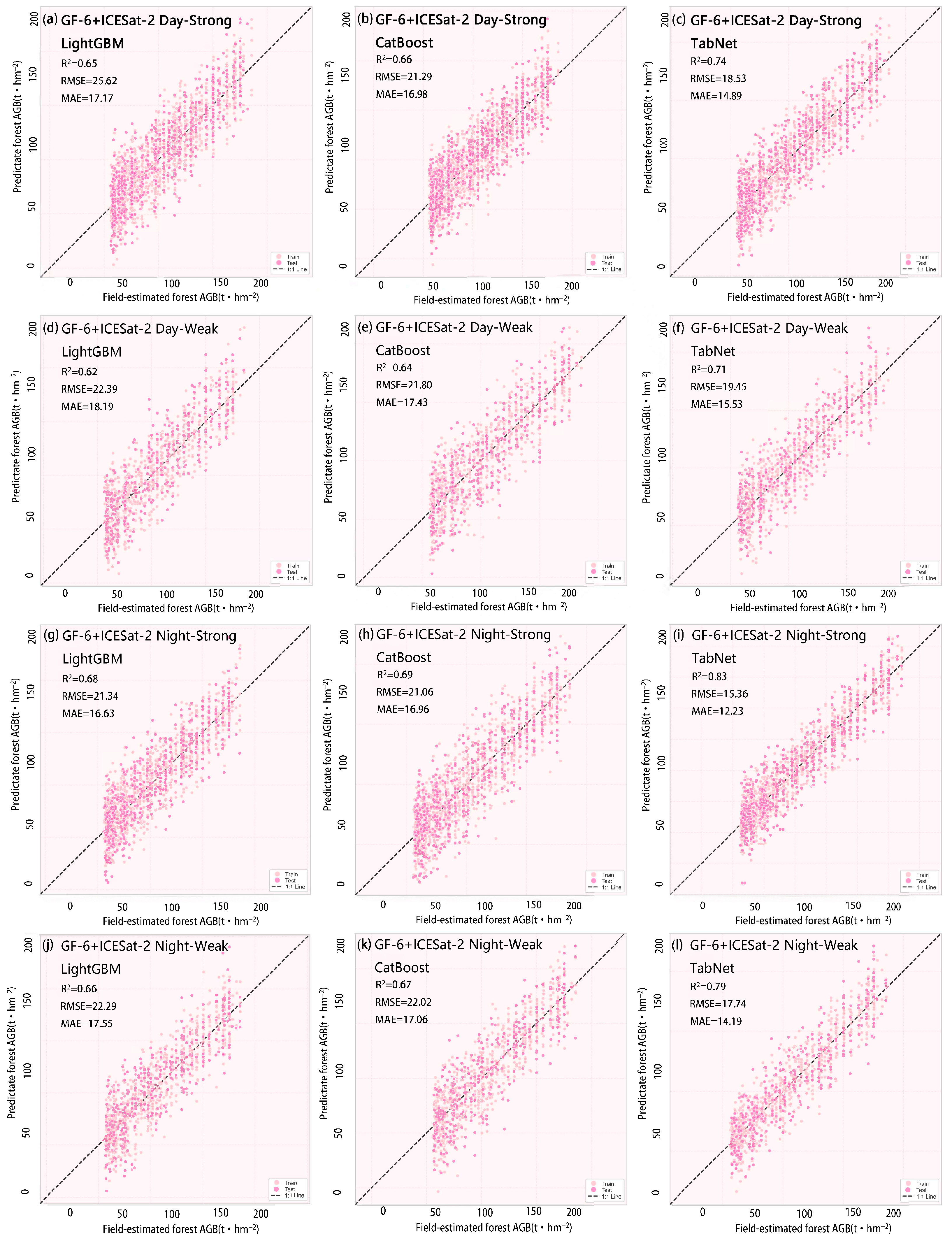
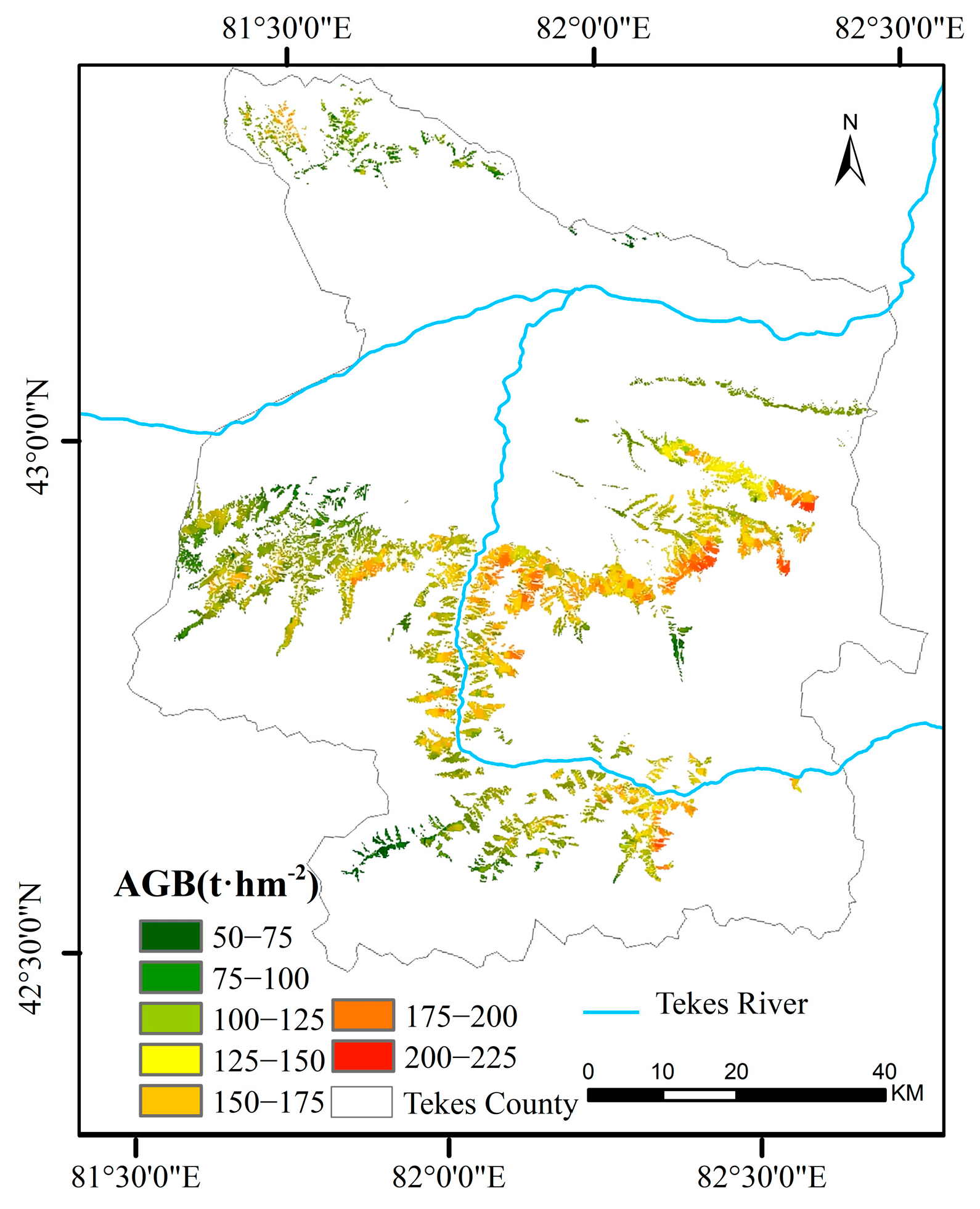
Feature FactorCorrelation CoefficientFeature FactorCorrelation Coefficient
ME_30.612**Band2−0.418**
REDNDVI−0.601**CON_30.407**
Band6−0.583**ME_90.381**
NDREI−0.572**NDVI−0.366**
Band5−0.557**RVI−0.349**
Band4−0.532**Band3−0.319**
NDVIR2−0.523**ME_50.293**
COR_30.511**VAR_30.268*
DVI−0.495**Band1−0.258*
NDVIR1−0.478**Band7−0.224*
EVI−0.461**DIS_30.195*
ME_70.431**
Note: Feature factors are derived from GF-6 multispectral imagery. Band1–Band8 correspond to GF-6 spectral bands. ME, VAR, COR, CON, DIS, ENT, HOM, ASM are texture features calculated from the Gray-Level Co-occurrence Matrix (GLCM); the suffix number (e.g., _3, _5, _7, _9) indicates the moving window size (e.g., ME_3 = Mean texture feature calculated with a 3 × 3 window). Correlation coefficients are Pearson’s r. * indicates significant correlation at the 0.05 level (two-tailed); ** indicates significant correlation at the 0.01 level (two-tailed).
Table 6. Correlation analysis between spruce forest biomass and ICESat-2 ATL08 feature factors.
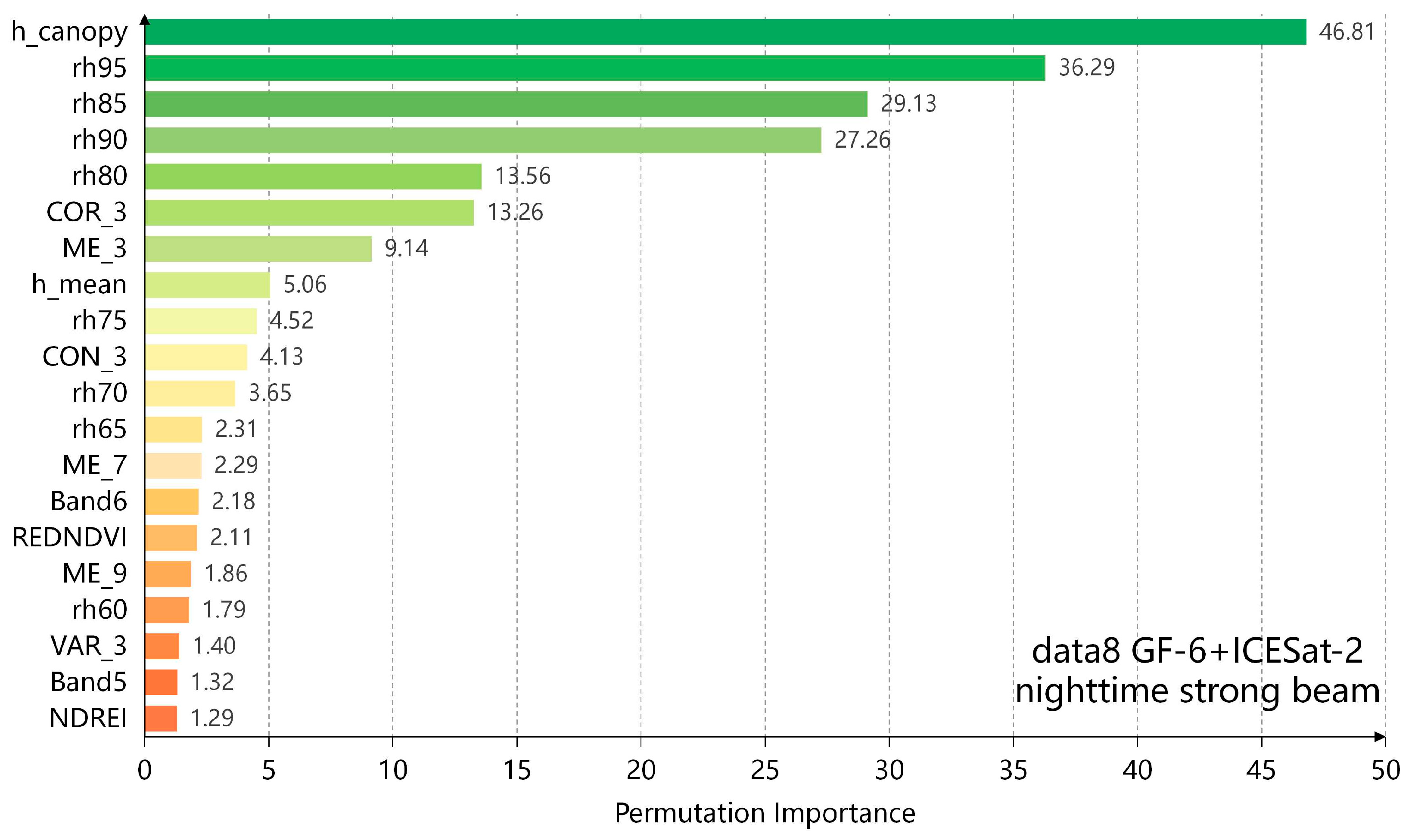
Feature FactorCorrelation CoefficientFeature FactorCorrelation Coefficient
h_canopy0.831**rh_350.645**
rh_900.824**rh_300.611**
rh_950.817**rh_250.598**
rh_850.812**t_slope0.499**
rh_800.796**n_ca_ph0.487**
rh_750.789**n_toc_ph0.441**
h_mean0.773**rh_200.423**
rh_700.756**rh_150.378**
rh_650.732**rh_100.356**
rh_600.721**canopy_un0.312**
rh_550.703**h_dem0.287*
rh_500.693**h_median0.236*
h_max0.684**n_seg_ph−0.199*
rh_450.678**h_min0.154*
rh_400.659**
Note: All feature factors are derived from the ICESat-2 ATL08 land and vegetation height product. h_canopy = 98th percentile canopy height; rh_i (i = 10, 15, …, 95) = relative canopy height at the ith percentile. Correlation coefficients are Pearson’s r. * indicates significant correlation at the 0.05 level (two-tailed); ** indicates significant correlation at the 0.01 level (two-tailed).
Table 7. Dataset construction for model training and evaluation.
Data SourceFeature SetDatasetInput Data Type
Optical dataFS_1data1GF-6
LiDAR dataFS_2data2ICESat-2 Daytime Strong Beam
data3ICESat-2 Daytime Weak Beam
data4ICESat-2 Nighttime Strong Beam
data5ICESat-2 Nighttime Weak Beam
Integrated dataFS_3data6Integrated GF-6 and ICESat-2 Daytime Strong Beam
data7Integrated GF-6 and ICESat-2 Daytime Weak Beam
data8Integrated GF-6 and ICESat-2 Nighttime Strong Beam
data9Integrated GF-6 and ICESat-2 Nighttime Weak Beam
Note: FS_1 (Optical features) includes spectral bands (Band1–Band8), vegetation indices (NDVI, RVI, DVI, SAVI, EVI, NDREI, REDNDVI, NDVI_R1, NDVI_R2), and texture features (ME, VAR, COR, CON, DIS, ENT, HOM, ASM with window sizes of 3 × 3, 5 × 5, 7 × 7, and 9 × 9) derived from GF-6 imagery. FS_2 (LiDAR features) includes canopy height metrics (h_canopy, h_mean, h_max, h_median, h_min, rh_i), photon counts (n_ca_ph, n_toc_ph, n_seg_ph), and terrain parameters (t_slope, h_dem, canopy_un) derived from ICESat-2 ATL08 data. FS_3 (Integrated features) combines all features from FS_1 and FS_2. GF-6 = Gaofen-6 multispectral imagery; ICESat-2 = Ice, Cloud, and land Elevation Satellite-2; ATL08 = ICESat-2 ATL08 land and vegetation height product. Datasets data1–data5 use single-source inputs, while data6–data9 integrate multimodal data for biomass estimation.
Table 8. Accuracy assessment of different models under the same dataset configurations.
Data SourceDatasetModelR2RMSE (t·hm−2)MAE (t·hm−2)
Optical dataGF-6 OnlyLightGBM0.5723.2118.32
CatBoost0.6321.5217.05
TabNet0.6919.5515.76
LiDAR dataICESat-2 Day-StrongLightGBM0.5225.3120.11
CatBoost0.5624.2219.32
TabNet0.6322.1217.73
ICESat-2 Day-WeakLightGBM0.4925.9321.08
CatBoost0.5125.4420.34
TabNet0.6122.6018.06
ICESat-2 Night-StrongLightGBM0.6223.2518.12
CatBoost0.6323.0118.52
TabNet0.7219.8315.78
ICESat-2 Night-WeakLightGBM0.5525.6520.19
CatBoost0.5824.8419.25
TabNet0.6821.8217.45
Optical data
+
LiDAR data
GF-6 + ICESat-2 Day-StrongLightGBM0.6521.6217.17
CatBoost0.6621.2916.98
TabNet0.7418.5314.89
GF-6 + ICESat-2 Day-WeakLightGBM0.6222.3918.19
CatBoost0.6421.817.43
TabNet0.7119.4515.53
GF-6 + ICESat-2 Night-StrongLightGBM0.6821.3416.63
CatBoost0.6921.0616.96
TabNet0.8315.3612.23
GF-6 + ICESat-2 Night-WeakLightGBM0.6622.2917.55
CatBoost0.6722.0217.06
TabNet0.7917.7414.19
Note: Bold values indicate the highest accuracy achieved across all model-data combinations.
Disclaimer/Publisher’s Note: The statements, opinions and data contained in all publications are solely those of the individual author(s) and contributor(s) and not of MDPI and/or the editor(s). MDPI and/or the editor(s) disclaim responsibility for any injury to people or property resulting from any ideas, methods, instructions or products referred to in the content.