Article

Drought Stress Response of Norway Spruce Seedlings Treated with Drought-Mitigative Additives
1
Faculty of Forestry, Technical University in Zvolen, T.G. Masaryka 24, 96001 Zvolen, Slovakia
2
National Forest Centre, Forest Research Institute, T.G. Masaryka 22, 96001 Zvolen, Slovakia
*
Author to whom correspondence should be addressed.
Forests 2026, 17(4), 420; https://doi.org/10.3390/f17040420
Submission received: 28 February 2026 / Revised: 24 March 2026 / Accepted: 26 March 2026 / Published: 27 March 2026
(This article belongs to the Special Issue The Influence of Environment Changes on Tree Seedlings)

Abstract

Forest plantations, including those of Norway spruce, are increasingly threatened by drought in Central Europe. One of the measures understating this threat might be the use of drought-mitigative additives at planting. The effects of induced water limitation and the application of hydrogel Agrisorb and commercial ectomycorrhizal fungi (EMF) inoculum Ectovit on the development of 2 + 1 spruce seedlings were estimated in this study. The root systems of 2 + 0 seedlings were treated with the additives, along with their spring transplantation into peat-filled pots. The seedlings were then exposed throughout the entire growing season either to full watering (FW)—volumetric soil water content 70%, reduced watering (RW)—water content 40%, periodic watering (PW)—substrate rehydrated to 70% after drying to the wilting point (21%), or remained non-watered (NW). Survival, growth and chlorophyll fluorescence of the seedlings decreased proportionally to the increased drought intensity, while the highest root-to-shoot ratio and EMF colonization of roots occurred under PW and RW, respectively. NW seedlings died after 9 weeks of desiccation, whereas the EMF inoculum prolonged the survival time by one week. Ectomycorrhizas were formed predominantly with native EMF in all the treatments; nevertheless, compared with the uninoculated control, the formation of a treatment-specific EMF root morphotype and increased EMF colonization under PW and RW were observed on the inoculated seedlings. Both the EMF inoculum and the hydrogel increased survival under PW by approximately 15% but did not significantly affect growth, regardless of the watering regime. These results are limited to the experimental conditions and suggest a more dominant effects of the watering regimes compared with the additives tested.

1. Introduction

Norway spruce (Picea abies [L.] Karst.) (spruce) is extensively distributed across northern and Central Europe and represents a native tree species of major ecological and economic significance in these regions [1,2]. However, in recent decades, spruce has been the most threatened and disturbed forest tree species in Central Europe, especially in older, even-aged monospecific stands [3,4]. Disturbances are caused mostly by wind, heat, drought, snow, bark-beetle outbreaks, or synergistic effects of these factors [5,6,7]. The key concept for mitigating the decline and improving the sustainability of spruce forests is the incorporation of other native tree species into the composition of spruce stands [3,8]. Nevertheless, spruce is still considered an irreplaceable and predominant tree species in mountain and subalpine conditions in this region [9]. The natural regeneration of spruce is a long process, and especially at large clear sites, it is sometimes impossible due to adverse conditions and the absence of mature seed trees at these sites. The reconstruction and establishment of forests by planting seedlings of adequate quality is an efficient reforestation strategy in such conditions [10,11]. However, plantations are continuously threatened by heatwaves and drought periods in early spring and/or during the growing season [12], which has an unfavourable effect on the soil water content and water uptake by plants at the planting site, resulting in a poor outplanting seedling performance.
One of the most reliable and effective water-holding substances for overcoming plant drought stress are macromolecular networks of hydrophilic polymer chains (hydrogels), which have high water absorption capacities [13,14]. At least partial positive effects of hydrogel application on seedling performance have been observed in pot and field trials [15,16,17]. However, the effects of hydrogel on the development of seedlings is influenced by many factors [18,19], occasionally inducing insignificant or even negative effects of the hydrogel [13,20].
Symbiosis of ectotrophic tree species, including spruce, with symbiotic (ectomycorrhizal) fungi (EMF) can increase the absorption area of roots via an external hyphal network, providing increased water and nutrient uptake compared with those of nonmycorrhizal roots, as well as bringing other benefits to plants [21,22]. Several authors reported positive effects of inoculation with EMF on seedling nurseries [23,24] and field performance [25,26,27], but others found insignificant or variable results due to diverse fungi and/or trees tested and other factors influencing ectomycorrhiza formation and efficiency [28,29]. Hence, the selection of compatible and effective EMF, testing of inoculum types, doses and inoculation techniques should continue to improve outplanting seedling performance at nutrient-, water-, and microbe-deficient sites.
Testing the effects of the application of water-holding amendments and EMF inocula under simulated water deficiency on seedlings of forest tree species growing in temperate zones [14,28] can facilitate the prediction of the effects of drought and additives on seedling development under real field conditions. Significant effects of soil water availability on seedling development were confirmed in controlled water supply experiments [30,31,32], but the results vary in terms of the seedling drought response rate depending on the drought period and intensity. Although several experiments have focused on the effects of hydrogel application on seedlings of forest trees exposed to induced drought [17,19], studies on spruce seedlings are scarce. Findings on the formation of ectomycorrhizas on the seedlings of several tree species under simulated drought and the effectiveness of EMF on seedling development are inconsistent. Some studies revealed increased EMF colonization rates in seedlings with increasing drought [33,34], while other experiments revealed a decrease or no change in seedling root colonization [35,36]. The development of ectomycorrhizal symbiosis in spruce seedlings subjected to drought was investigated by cultivation of seedlings in soil containing EMF propagules collected from a spruce stand [37]. However, to the best of our knowledge, the inoculation of spruce seedlings exposed to drought with spore or vegetative EMF inoculum is unknown in the literature.
In our article previously published in Forests, we assessed the response of European beech seedlings to drought stress and application of an EMF and hydrogel [34]. According to substantially the same methodology as described in [34], but in different years, we carried out an experiment with spruce in this study, with the aim to contribute to the knowledge on spruce seedlings’ response to drought conditions and application of drought-mitigative amendments, potentially facilitating the improvement of outplanting seedling performance in a water-deficient environment. Based on the above background, the specific objective of this study was to estimate the effects of commercial amendments (hydrogel and combined spore–mycelial EMF inoculum) applied to the seedling roots on the survival and development of Norway spruce seedlings exposed to different induced water deficiency levels.

2. Materials and Methods

2.1. Experimental Design

In early spring, two-year-old bare-root spruce seedlings were replanted into three-litre containers containing a peat-based substrate. To prevent rainfall from influencing the treatments, the seedlings were cultivated under a polyethylene covering until the end of the growing period. During this time, four watering regimes were applied:
(i)
Full watering (FW), maintaining the substrate volumetric water content at 70%.
(ii)
Reduced watering (RW), with the water content held at 40%.
(iii)
Periodic watering (PW), the substrate was rehydrated to 70% once the moisture dropped to the wilting threshold (21%).
(iv)
No watering (NW).
For each watering treatment, seedling roots were either treated with the commercial ectomycorrhizal product Ectovit, the hydrogel Agrisorb, or left without any additive as a control. The study followed a completely randomized block design comprising 12 treatment combinations (four irrigation levels combined with three additives, including the untreated control), each replicated three times (three blocks), resulting in a total of 720 seedlings. A schematic image of the experimental arrangement is provided in [34].

2.2. Growing of Seedlings

The experiment was carried out in a forest nursery located in Lokca (620 m above sea level; 49°22′20″ N, 19°24′18″ E, northern Slovakia), operated by the state forest enterprise. Spruce seeds were obtained from a certified source, specifically from a mature stand situated in northern Slovakia (985 m above sea level; 49°22′02″ N, 19°19′01″ E). The seeds were sown by broadcast for operational purposes into an outdoor soil seedbed in spring at the end of April. The fundamental characteristics of the seedbed soil at the time of sowing, as determined by the National Forest Centre in Zvolen, were as follows: dry matter content 97.14%, pH (H2O) 6.97, carbon 5.42%, nitrogen 0.38%, phosphorus 75 mg kg−1, potassium 235 mg kg−1, calcium 3901 mg kg−1, magnesium 165 mg kg−1, bulk density 0.811 g cm−3, and electrical conductivity 0.145 mS cm−1. Prior to sowing, the soil was fumigated with the fungicide Basamid (200 g m−3) for 5 days, followed by a 14-day aeration period. A granular fertilizer, Cererit (NPK 8-13-11% + 2% Mg + microelements), was thoroughly incorporated into approximately the upper 10 cm of the soil at a rate of 30 g m−2 before sowing. The seedbed was covered to provide mechanical protection for the seeds and was shaded after germination. Following the onset of terminal shoot growth, the seedlings were fertilized once per week for 5 weeks with a 0.1% solution of Kristalon (NPK 19-6-20% + 3% Mg + microelements). During the second growing season, fertilization consisted of Cererit applied at the beginning of the season and a single application of Kompakt (NPK 21-7-14% + 6% Mg + microelements) at a rate of 60 g m−2, applied 6 weeks after the Cererit treatment [9]. Seedlings were watered using a sprinkler system to compensate for insufficient natural precipitation, and weeds were controlled either manually or with herbicides as needed. Two-year-old seedlings that overwintered in the seedbed were lifted during dormancy in the second half of April, and subsequently stored at 2 °C until planting.
Seedlings exhibiting comparable morphological traits were chosen from the operational batch for experimental purposes. Their root collar diameter averaged 3.0 mm with a standard deviation of ±0.2 mm, while the mean stem height reached 27.5 ± 2.5 cm. The dry mass of the root system was 0.54 ± 0.09 g and of the aboveground biomass was 0.87 ± 0.15 g, resulting in a root-to-shoot dry mass ratio of 0.62 ± 0.12. These characteristics of the 2 + 0 planting stock were determined based on measurements taken from a randomly selected subset of 20 individuals designated for the trial. Following transplantation at the end of April, simultaneously with the application of the tested amendments, the seedlings were transferred outdoors and positioned on a wooden platform elevated 15 cm above ground level. They were cultivated over a single growing season under controlled watering treatments. To prevent natural rainfall from influencing the experiment, a transparent polyethylene sheeting (17 µm thick) was installed approximately 2 m above the seedlings. Weeds in the pots were removed manually when necessary. No chemical treatments (fertilizers or pesticides) were used. Apart from the exclusion of precipitation, the plants were exposed to natural outdoor conditions. Climatic data representing long-term averages (1991–2020) for annual and growing season (April–September) air temperatures and precipitation totals were derived from four nearby meteorological stations operated by the Slovak Hydrometeorological Institute. These averages were 5.8 °C and 12.1 °C for temperature, and 1193 mm and 646 mm for precipitation, respectively. During the study period, the recorded annual and seasonal precipitation totals at these stations were 1135/643 mm, 1285/681 mm, and 1122/568 mm. Correspondingly, the mean air temperatures measured directly at the nursery using a data logger (EMS, Brno, Czech Republic) were 5.2/12.1 °C, 5.1/11.6 °C, and 5.3/12.3 °C for the cultivation periods of 1 + 0, 2 + 0, and 2 + 1 seedlings, respectively.

2.3. Substrate and Additives

PVC containers with a capacity of 3 L (dimensions: 13.0 × 13.0 cm at the top, 11.5 × 11.5 cm at the base, and 20 cm in height) were packed with a cultivation medium supplied by VermiVital s.r.o. (Záhorce, Slovakia). The substrate composition included 80% white peat (fiber length 0–20 mm) and 20% black peat (fiber length 0–10 mm), supplemented with PG Mix fertilizer containing macro- and micronutrients at a rate of 1.9 kg m−3, the wetting agent Fibazorb at 0.1 L m−3, and the root development enhancer Bioroot at 200 mL m−3. The baseline physicochemical characteristics of the substrate were as follows: dry matter content 83.31%, pH (H2O) 5.62, carbon 30.5%, nitrogen 0.971%, phosphorus 238 mg kg−1, potassium 663 mg kg−1, calcium 7952 mg kg−1, magnesium 891 mg kg−1, bulk density 0.157 g cm−3, and electrical conductivity 0.165 mS cm−1.
The commercial EMF preparation Ectovit comprised fungal mycelium from three EMF species (Amanita rubescens (Pers. ex Fr.) Gray, Pisolithus arrhizus (Scop.) Rauschert, and Paxillus involutus (Batsch) Fr.), along with basidiospores of P. arrhizus and Scleroderma citrinum Pers. The inoculum also comprised natural additives (humic substances, mineral powders, and seaweed-derived extracts), all embedded within a finely processed peat-based carrier. Prior to seedling transplanting, the EMF inoculum was blended with the cultivation substrate at a volumetric ratio of 1:6. During transplantation into pots, the mixture was compactly arranged around the root system, with each seedling receiving 100 mL of the preparation. In this amount, approximately 17 mL consisted of fungal mycelium. The amount of spores present in Ectovit has not been specified. The hydrogel Agrisorb is a copolymer of acrylic acid, supplied as free-flowing white granules with particle sizes ranging from 0.2 to 1.0 mm. In distilled water, its water absorption capacity reaches 250–300 mL per gram. For application, the root systems were immersed in a gel formed by mixing Agrisorb granules with water at a 1:100 (v:v) ratio immediately before transplanting the seedlings into the pots.

2.4. Watering Treatments

The volumetric water content (VWC) values described in Section 2.1 were established based on standard soil water potential levels. The lower limits of soil water potential intervals representing readily available water (−1 to −5 kPa), less accessible water (−10 to −1500 kPa), and the permanent wilting threshold (−1500 kPa) [38,39,40] were selected to define the watering treatments. To identify the substrate VWC corresponding to these potentials and to determine the reference weights for setting watering regimes, three cylindrical rollers (5.3 × 4.6 cm, diameter × height, respectively) full of the growth medium were saturated via capillary uptake over a 24-h period. The saturated samples were weighed, then transferred into a pressure chamber, where repeated measurements were taken at −1, −10, and −1500 kPa. The final weighing was conducted after oven drying at 105 °C for 48 h. The VWC values for each specified water potential were subsequently computed using the gravimetric approach [38,40], with appropriate rounding applied in the cases of FW and RW.
To control the irrigation levels in the pots, the substrate mass in the pots was determined for each watering regime based on measurements obtained from reference cylinders. At the onset of the study, all treatments were standardized to a substrate VWC of 70% (FW). In order to sustain the target VWC for each watering regime, three additional pots per treatment were placed among the seedlings and used for regular weighing. These pots were monitored daily under the FW regime, also daily under the RW regime once the VWC declined to 40%, and weekly—or more frequently as plants approached the wilting point—under the PW regime. Whenever the pot weight dropped below the predetermined reference corresponding to the specified VWC, water was replenished in quantities matching the observed loss across all pots within the given treatment. Irrigation was done nearly every day for both the FW and RW treatments. Under the PW regime, watering was first applied five weeks after the experiment began and subsequently repeated three times over a period of 5–6 weeks, with the timing influenced by the ambient temperature and relative humidity.

2.5. Sampling and Measurements

The seedling survival (mortality) was monitored continuously throughout the growing season after transplantation into pots. A seedling was classified as dead once its needles had turned brown and its branches had become brittle [17]. Survival rates were calculated for each combination of watering regime, additive, and block as the percentage of living seedlings relative to the total number initially transplanted.
Within every watering regime × additive × block combination, ten seedlings were randomly selected for further analysis by excavating every second individual from a group of twenty established. These samples were used to measure the stem height, root collar diameter, and dry mass of both the roots and aboveground (shoots) parts, as determined after drying for 48 h at 80 °C. From these measurements, the root-to-shoot dry mass ratio and total biomass were subsequently derived. In repetitions of the PW treatment, fewer than ten out of twenty seedlings survived; therefore, all remaining viable individuals were included in the evaluation. The development of seedlings under NW was assessed shortly after complete mortality occurred within this treatment. Seedlings subjected to the remaining watering regimes were evaluated at the end of the third growing season (late October).
From each seedling used in the growth evaluation, three segments of fine lateral roots, with each segment about 3 cm in length and less than 1 mm in diameter, were collected from the upper, central, and basal portions of the cleaned root system, yielding roughly 27 cm of fine lateral roots per seedling in total [41]. The number of short roots was determined under a dissecting microscope at 10–40× magnification. These short roots were classified into two groups: ectomycorrhizas and non-mycorrhizal roots. The frequency of short roots was expressed as the number of short roots per centimetre of lateral root, irrespective of their mycorrhizal status. Ectomycorrhizas were also identified and evaluated in recently deceased NW seedlings. Their classification into ectomycorrhizal morphological types (morphotypes) was based on observable macro-morphological features, including the branching pattern, shape, coloration, characteristics of the outer mantle, and the presence of hyphae and rhizomorphs [42]. For each seedling, EMF colonization was calculated as the proportion of ectomycorrhizas relative to the total number of short roots (including both ectomycorrhizas and non-mycorrhizal roots). No attempt was made to quantify individual morphotypes, nor was molecular analysis used to identify the fungal partners.
Chlorophyll a fluorescence was assessed in ten seedlings for every combination of watering regime, additive, and block. Measurements were carried out one week after the substrate moisture level had declined to the wilting point under both the NW and PW conditions in order to capture the influence of varying water availability on seedlings while still ensuring an adequate number of surviving NW individuals. A Handy PEA fluorimeter (Hansatech Ltd., King’s Lynn, UK) was employed for all recordings. Following a 30-min period of dark adaptation using leaf clips, the needles were exposed to a one-second saturating light pulse (2000 µmol m−2 s−1), enabling the determination of key fluorescence parameters. Initially, the dark-adapted needles were subjected to a low-intensity modulated measuring light, during which all PSII reaction centres remained open, allowing the minimal fluorescence level in darkness (F0) to be recorded. Subsequently, the application of the saturating pulse caused closure of all PSII reaction centres, resulting in the maximal fluorescence signal (Fm). From these values, variable fluorescence (Fv = Fm − F0) and the maximum quantum efficiency of PSII (Fv/Fm) were derived [43].

2.6. Data Analysis

The seedling survival for each combination of watering and additive treatments was determined by calculating the mean survival rate across the three experimental blocks; due to the small number of these values, they were not subjected to further statistical evaluation. Before proceeding with the analysis, data distribution normality for the other variables was assessed using the Shapiro–Wilk test. Because the percentage data representing EMF colonization did not meet normality assumptions, a log10 transformation was applied prior to the analysis. Subsequently, the dataset was evaluated using a three-way analysis of variance (ANOVA), where watering, additive, and their interaction were treated as fixed factors, while block was considered as a random factor. Differences between treatments were identified using Tukey’s honestly significant difference (HSD) post hoc test at a significance threshold of p ≤ 0.05. The experimental unit was one block (combination of watering and additive treatments), comprising 20 seedlings. All statistical analyses were carried out using the PC SAS software package 9.1 (SAS Institute Inc., Cary, NC, USA).

3. Results

3.1. Survival

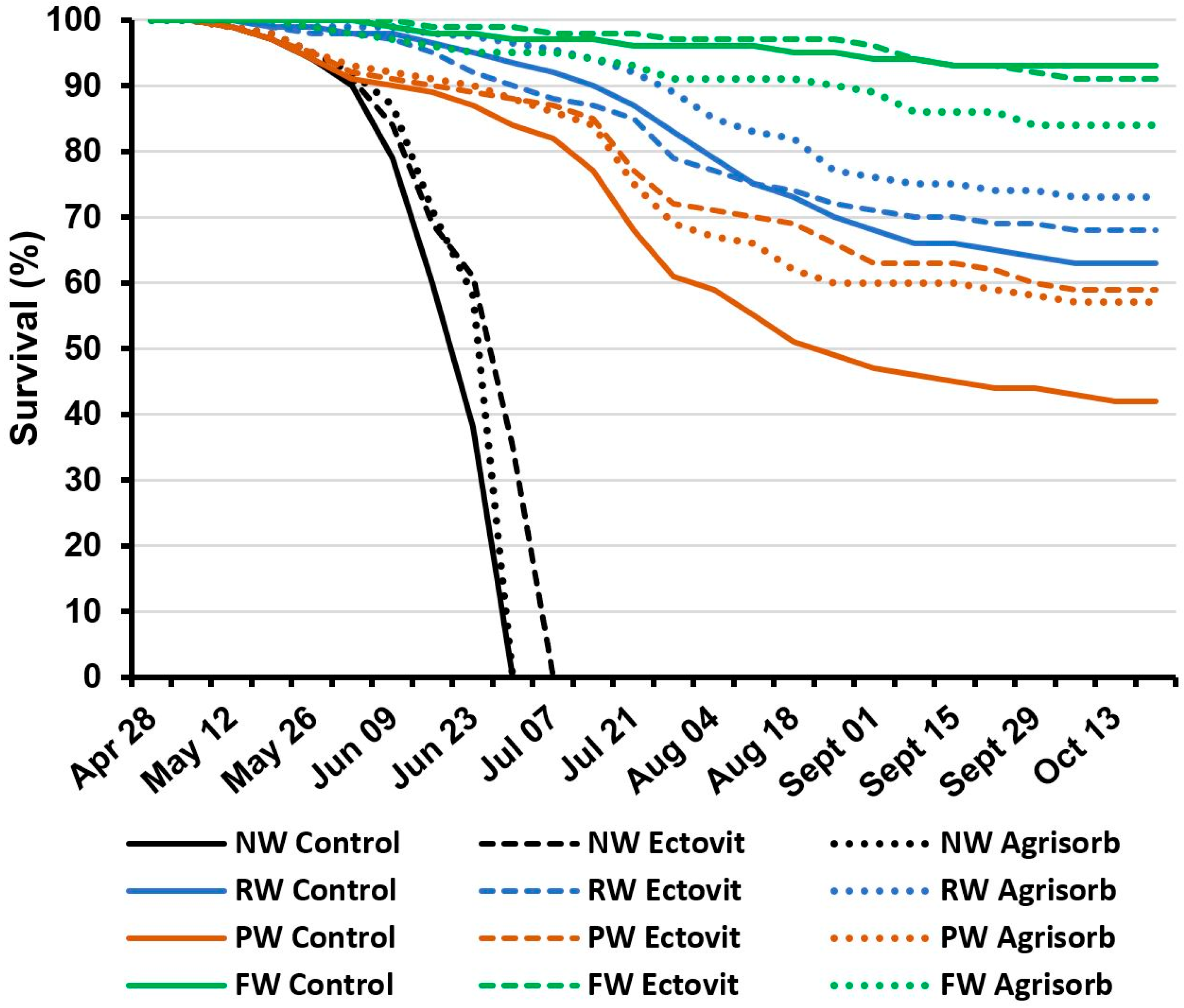
Seedling mortality was relatively low until the beginning of June (approximately 5 weeks since the experiment had started) regardless of the treatment (Figure 1). From that time, high mortality was recorded in the NW seedlings, as all control (untreated) and hydrogel-treated seedlings had died by the end of June (after 9 weeks of desiccation), whereas EMF application prolonged the survival time by one week. The death of seedlings under the other watering regimes was balanced throughout the entire experimental period, except for a higher mortality under PW during two to three weeks in the second half of July. At the end of the experiment, seedling survival was 89%, 68% and 53% (averages of the additive treatments within the respective watering regimes) under the FW, RW and PW regimes, respectively. The survival in the Ectovit and Agrisorb treatments under PW was 59% and 57%, which was 17% and 15% higher, respectively, than that in the untreated control (Figure 1). Compared with the untreated seedlings, seedlings treated with Agrisorb and Ectovit under RW survived 10% and 5% better, respectively. In contrast, the survival of Agrisorb-treated seedlings under FW was almost 10% lower than that of EMF-inoculated and untreated seedlings.

3.2. Growth

Analysis of variance revealed a significant effect of watering on all assessed seedling growth parameters and of additive on root collar diameter (Table 1). No significant effect of the watering × additive interaction was found. The mean values of the growth parameters (except root-to-shoot ratio) of the seedlings under FW treatment were significantly higher, and those of seedlings under the NW treatment were significantly lower than those under RW and PW, except for the insignificant difference between FW and PW in root dry weight (Table 2). Although the PW seedlings reached significantly larger root collar diameter, root and total dry weights and root-to-shoot ratio compared with RW seedlings, differences in the stem height and shoot dry weight were insignificant. The root-to-shoot ratio of PW seedlings was significantly higher, and that of NW seedlings was significantly lower than the ratio under the FW and RW treatments (Table 2). The root collar diameter of the Ectovit-treated seedlings (5.3 mm) was significantly lower than that of the Agrisorb-treated (5.6 mm) and untreated seedlings (5.6 mm). No significant effects of the additives on the other growth variables were observed (Table 1), but the root and shoot dry weight values were slightly lower under the NW, PW and FW regimes and slightly higher under RW for the Ectovit-treated seedlings compared with the control seedlings.

3.3. Short Roots and Ectomycorrhizas

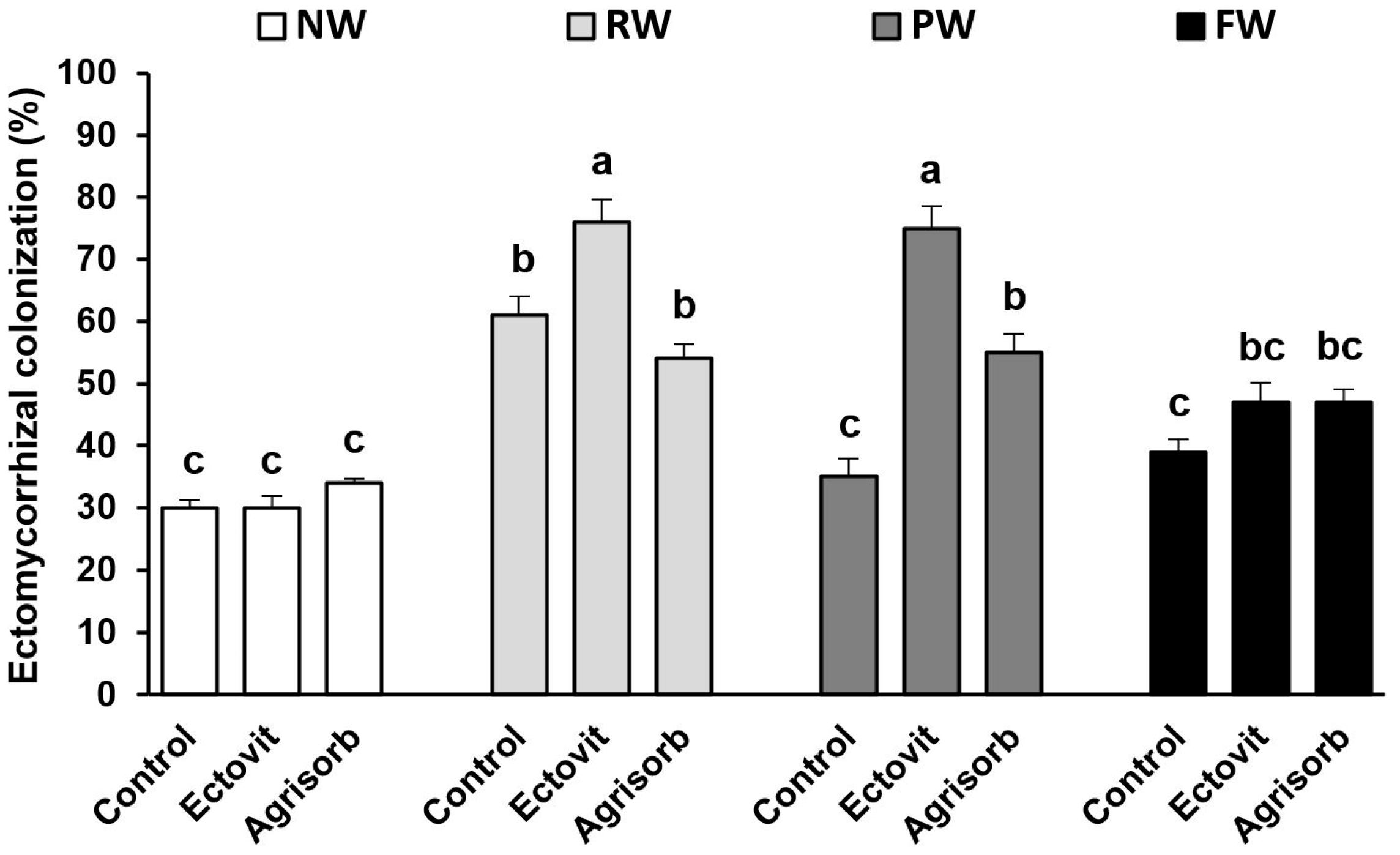
The watering had a significant effect on both the short root frequency and the total EMF colonization of roots, while the additive had a significant effect only on the latter parameter (Table 1). FW and PW seedlings had significantly higher short root frequencies than those in the RW and NW treatments; the frequency under RW was also significantly higher than under NW (Table 3). The differences between additive treatments within watering regimes were insignificant. The highest EMF colonization was found in the RW seedlings (64%), which was significantly higher than those in the FW and NW seedlings (Table 3). Colonization of roots under PW was significantly higher than that under NW but was not significantly different compared with FW and RW. The EMF colonization of Ectovit-treated seedlings was significantly higher than that of untreated seedlings. Differences between Agrisorb and the other additive treatments were not significant (Table 3). The EMF colonization of NW seedlings assessed immediately after seedling death (early July) was very close in all additive treatments (Figure 2). Regarding irrigated (RW, PW and FW) seedlings assessed after the growing season (end of October), EMF colonization under FW was also very similar regardless of additives; however, colonization of seedlings inoculated with Ectovit was significantly higher than that of hydrogel-treated and untreated seedlings under RW and PW (Figure 2).
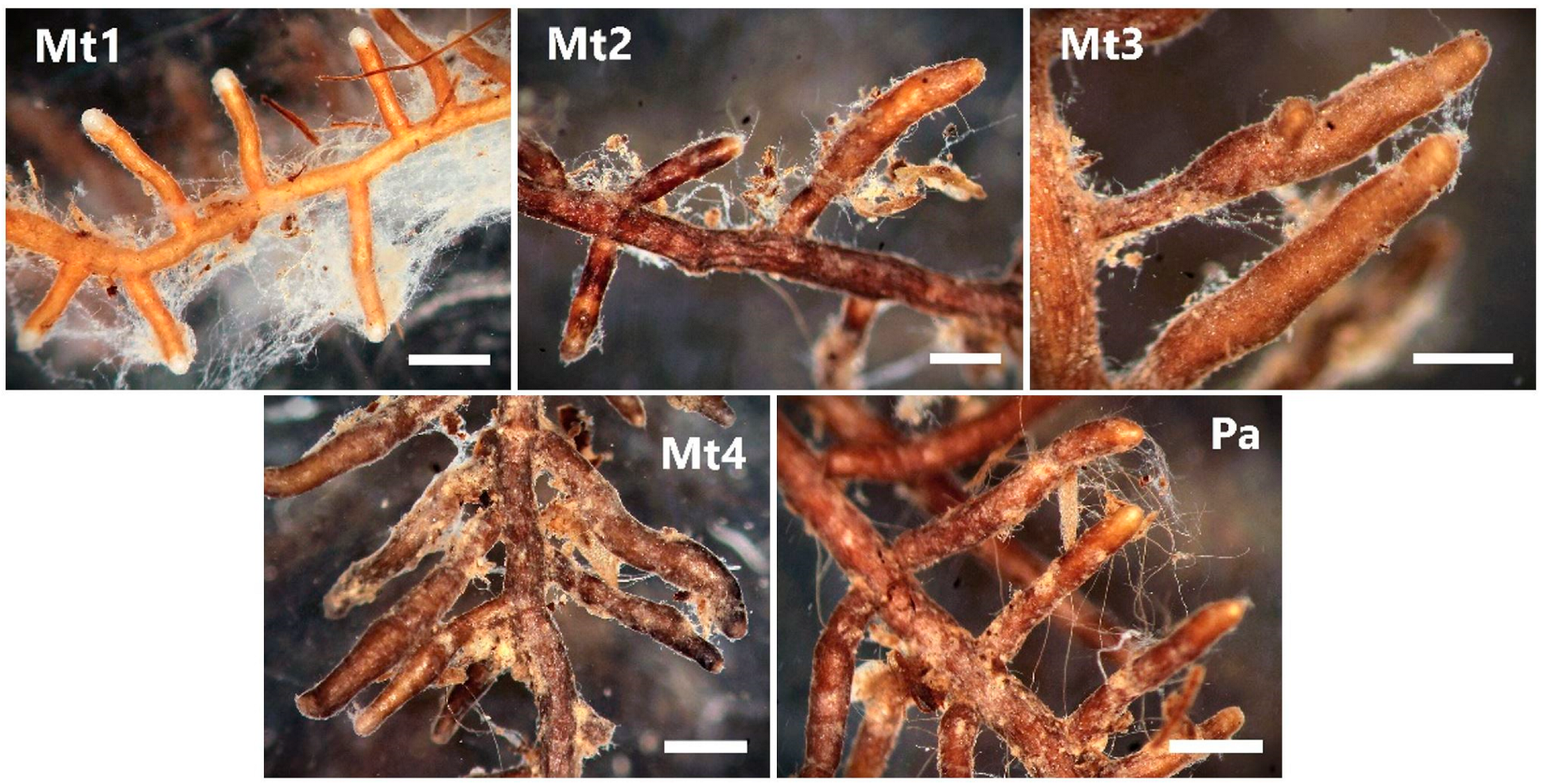
The ectomycorrhizas of NW seedlings were at an early stage of development, creating one morphotype (photo not available). The morphological features of these ectomycorrhizas were absent or displayed monopodial-pinnate mycorrhizal system ramification; straight or bent, not inflated, cylindric unramified ends; a thin, semi-transparent smooth mantle; a light yellowish-brown mantle colour (older parts brown); white apical tips; and proximally concentrated, infrequent emanating hyphae. Five EMF morphotypes were distinguished on the roots of the RW, PW and FW seedlings at the end of the growing season (Figure 3). Four of these five morphotypes were found in all watering and additive treatments. Paxillus-like morphotype, comparable with published descriptions for Paxillus involutus ectomycorrhiza [24,42,44,45], was found in the Ectovit treatment; this treatment-specific morphotype accounted for approximately one fifth of ectomycorrhizas in the Ectovit-treated seedlings and did not occur in the other treatments.

3.4. Chlorophyll a Fluorescence

Significant differences were found between the Fm, Fv and Fv/Fm parameters affected by the watering regime, while they were not significantly affected by the additives (Table 1). The mean values of these parameters in the FW treatment were significantly higher than those in the NW and PW treatments (the lowest values occurred in the NW treatment) (Table 3). Additionally, they were significantly higher under RW than under NW. The Fv/Fm values of the additive treatments were similar within each watering treatment, but the F0, Fm and Fv values of the Agrisorb- and Ectovit-treated seedlings in the FW treatment were slightly higher than those of the control seedlings.

4. Discussion

4.1. Soil Water Availability and Seedling Performance

In this study, in proportion to increasing the substrate water deficit, the seedling survival and growth decreased; the highest values were found under FW, and the lowest values were recorded under NW. Similar results for the aboveground mass of spruce seedlings exposed to drought have been reported in [32,46]. However, Matisons et al. [31] found that the highest relative height increment of spruce seedlings grown in mineral soil occurred in response to intermediate drought (about equal to PW and RW in this study); in peat soil, which has a high water-bearing capacity, the highest values of increment were recorded even when receiving 0% and 25% of full irrigation. Moreover, at the end of the 60-day experiment, only seedlings grown in mineral soil at 0% irrigation completely died, whereas some of those grown in peat survived. The results in [31], together with the finding of 9-week survival in the no-watering treatment in this study, indicate a degree of plastic acclimation, which resulted in a certain tolerance of spruce seedlings to drought, despite the fact that spruce is considered to be more sensitive to environmental stressors and more sensitive to drought than European beech (Fagus sylvatica L.) (beech) [30]. This suggestion is supported by a record of the total mortality of beech seedlings after as much as 17 weeks of water exclusion in the experiment carried out by Repáč et al. [34] according to the same methodology used in this experiment, although at different times, and thus, with different weather conditions. One of the reasons for the poorer performance of spruce is that its root system architecture does not allow its roots to penetrate the bottom layer of the potting substrate, which has a more balanced water supply, as soon as beech does and to the extent that beech does.
Under dry conditions, seedlings usually invest proportionally more biomass in the root system than in the aboveground part; however, the absolute root biomass is the same or smaller than that under wet conditions [35]. The root-to-shoot ratio of 4-year-old container spruce seedlings increased from 0.67 under wet conditions to 2.08 under severe drought stress [46]. These findings are consistent with our result under PW; in contrast, the root-to-shoot ratio under RW was close to that of FW and was significantly lower under NW than under FW. Schall et al. [30] observed a significant increase in the proportion of the root system for beech but not for spruce seedlings, indicating that biomass allocation in drought conditions is species-specific. In addition to the low or even absent water availability under severe drought (NW treatment in this study), an increasing mechanical barrier of the dry substrate could limit root growth and decrease the root-to-shoot ratio [47].

4.2. Effects of Hydrogel

Our results revealed a positive effect of the hydrogel Agrisorb on survival but no effect on the growth of seedlings under simulated drought. The effects of the hydrogel application on survival in this study are consistent with the results in [18], suggesting that the water accumulated by hydrophilic compounds is enough for seedling survival, or even its increase, under moderate drought, but it is not enough to keep the seedlings alive under severe drought. Dipping the root plugs of containerized spruce seedlings in hydrogel increased the survival at a planting site during a summer drought period, but dipping the roots of bareroot spruce seedlings (the application method used in this experiment) was inefficient [9]. Trials with loblolly pine (Pinus taeda L.) show that the use of hydrogel in droughty soils may not increase seedling survival, and in some cases, may increase seedling mortality [13]. The authors of [13] point out that the impact of hydrogels on seedling survival is dependent on the application technique of hydrogel, soil moisture availability, hydrogel particle size, and composition. Dipping of roots of Scots pine (Pinus sylvestris L.) seedlings to hydrogel Stockosorb slurry increased seedling survival in sand soil compared with a control, whereas the direct application of granules of this hydrogel to planting holes caused increased mortality of seedlings due to oversized soil water content following a higher precipitation amount [20]. Also, concerning the different application technique and hydrogel, the higher seedling survival of control and Ectovit-treated seedlings than of those treated with hydrogel under FW in our study can indicate an adverse effect of a higher level of substrate moisture on the hydrogel efficiency on seedling survival.
Biehl et al. [14] found significantly different effects of two commercial hydrogels on spruce seedlings exposed to drought; in contrast with our results on seedling growth, the total biomass was greater for seedlings grown in Polyter-amended soil, while Stockosorb application resulted in even more severe drought stress. Similarly, hydrogel Luquasorb prolonged survival and increased the biomass production of spruce, beech and Scots pine seedlings under drought, particularly in sand, and to a lesser extent in loam and clay soils [17]. Tomášková et al. [48] tested the effect of the Stockosorb hydrogel on the seedlings of several Central European tree species in a greenhouse and in the field, but under favourable moisture conditions. The hydrogel did not affect the growth but slightly reduced the mortality of sessile oak (Quercus petraea (Matt.) Liebl.) seedlings in the field, while spruce, Scots pine, and beech did not respond to the hydrogel application. The abovementioned observations and our results indicate that the drought stress response of seedlings treated with hydrogels depends on the tree species, seedling traits (including stocktype), soil (substrate) type and moisture, type, application technique and dose of the hydrogel, and other factors.

4.3. Effects of Ectomycorrhizal Inoculation

Water uptake by EMF can be important for survival, especially for tree seedlings whose roots do not reach the deeper soil layers [35], such as spruce seedlings. EMF can additionally have an indirect positive effect on plant water dynamics, for instance, by improving nutrient availability, which, in turn, enhances the water use efficiency of seedlings [49]. These benefits of EMF might help prolong the survival of the inoculated seedlings under NW and decrease mortality throughout the growing season under PW in this experiment. Mrak and Kraigher [36] reported that colonization by EMF in natural conditions is greater under moderate drought than under severe drought. The lower degree of colonization under severe drought conditions, when photosynthesis levels are low, helps preserve the limited carbon supply (which would otherwise be spent to support fungi in exchange for nutrients) for plant survival [36]. Consistent with this thesis and with our results, compared with those under sufficient water conditions, Pinus tabulaeformis seedlings cultured in potting autoclaved mixture of soil, sand, and vermiculite under severe drought had lower EMF colonization, and those under moderate drought had higher EMF colonization [33]. Higher EMF colonization of the roots of beech seedlings with increasing drought was observed in [34]. A lower nutrient supply when the seedlings are under drought stress and their ability to release root exudates increases the chance of fungal colonization of roots to facilitate plant nutrient uptake via EMF [21]. However, increased EMF colonization usually increases carbon allocation from seedlings to fungal symbionts, in any cases resulting in suppression of seedling growth [22]. This mechanism could contribute to the decrease in seedling development in RW and PW treatments. Contrary to our results, the total number of root tips and ectomycorrhizas of potted spruce seedlings grown in quartz sand and sieved mor humus mixtures was significantly lower after short-term drought than after watering [37]. Additionally, decreased soil water availability did not alter the EMF colonization of the root tips of Scots pine seedlings [35].
The detection of a Paxillus-like morphotype only in the Ectovit treatment prompted us to hypothesize that this morphotype was formed by Paxillus involutus applied with Ectovit. However, because the identification of root-associated EMF was not performed by molecular analysis, the participation of the applied strain of P. involutus in ectomycorrhiza formation has not been verified. The Paxillus-like morphotype improved the EMF colonization of Ectovit-treated seedlings and probably facilitated seedling survival, particularly under PW. Additionally, the Paxillus-like morphotype was recorded on spruce seedlings inoculated with Ectovit containing the mycelium of P. involutus in another experiment [24], suggesting the potential efficiency of this fungus in ectomycorrhiza formation at spruce nursery inoculation. The increased ectomycorrhiza formation induced by several strains of P. involutus was accompanied by an increased growth of P. sylvestris seedlings cultured under aseptic conditions [50]. Studies on the effect of P. involutus on drought-stressed seedlings of important forest tree species in the temperate zone revealed that the fungus did not support the growth of potted P. sylvestris seedlings [28] but was found to be the most competitive among the EMF applied in nursery and markedly improved the growth of outplanted pedunculate oak (Quercus robur L.) seedlings during years with summer drought [25].
Inoculation with Ectovit significantly increased survival and/or growth of spruce seedlings grown in nutrient-poor peat substrate in the nursery [24] and after outplanting [9,51,52]. However, in these referenced studies, Ectovit also contained moisture-holding and natural nutritional amendments along with EMF, and which of these components were effective for seedling development is unknown. The nutritional, but not moisture-holding, amendments were also contained in the Ectovit used in this study, and thus, it is possible that they had some effects on the ectomycorrhiza formation and efficiency and seedling development.

4.4. Soil Water Availability and Chlorophyll a Fluorescence

Although chlorophyll a fluorescence (chl fluorescence) seems to be a relatively reliable marker for water scarcity and can be easily recorded [43], mildly stressed spruce seedlings did not respond by decreasing their Fv/Fm, and a significant decrease in this parameter was found only in severely stressed seedlings [32,46,53]. Our results revealed that the Fv/Fm values did not significantly differ between FW and RW but were significantly higher under FW than under PW and NW, which is similar to the findings of the above-referenced reports. However, the one-time measurement of chl fluorescence in this experiment should be considered informative and disputable, disallowing the assessment of the progress of chl fluorescence and its interactions with the other attributes of seedling development. Moreover, the conventional wilting point considered in this experiment refers to agricultural plants; however, tree seedlings may deplete water at lower soil water potentials [40]. Relatively constant values of Fv/Fm were also recorded 35 days after withholding the irrigation of potted spruce seedlings grown in peat [54]. The importance of the growth substrate was highlighted by Matisons et al. [31], as the chl fluorescence of spruce seedlings rapidly decreased three weeks after the cessation of irrigation in mineral soil, whereas in peat, it was not much lower than that under higher irrigation levels. These findings could indicate a low sensitivity of the fast kinetics of chl fluorescence to water deficit in spruce seedlings. A possible explanation is that an insufficient water supply may favour ecophysiological patterns that increase carbon assimilation to counterbalance the shorter growing season [40].
The additives did not significantly affect the Fv/Fm values in our experiment. Studies on the effects of the additives tested in this study on the chl fluorescence of spruce seedlings under drought have not, to our knowledge, been reported in the literature. Values of chl fluorescence parameters decreased in drought-stressed beech seedlings, but the application of the hydrogel Stockosorb increased the Fv/Fm values to the values recorded in the watering treatment [16]. In contrast, Apostol et al. [19] reported that compared with untreated seedlings, hydrogel-treated red oak (Quercus rubra L.) seedlings did not differ significantly in net photosynthesis following the drought stress exposure.

4.5. Pot Versus Field Experimental Conditions

Pot experiments, besides other advantages, simplify the natural heterogeneity, eliminate uncontrollable environmental factors, create favourable growing conditions for plants, and provide better opportunity to establish and maintain the treatments tested (e.g., exposition of the seedlings to drought stress); however, the transferability of the results and their practical implementation to the field conditions, due to the many limitations of pot experiments, are limited [55]. Various circumstances affect the growth of seedlings in pot experiments, including the pot and seedling sizes and the growth substrate. Poorter et al. [56] proposed a suitable pot volume derived from the total dry weight of the seedlings cultivated in the pot. In [56], a dry weight per unit pot volume of <2.0 g L−1 was recommended, with an optimal value < 1.0 g L−1. In our experiment, the seedling biomass-to-pot volume ratio had the recommended value when the seedlings were transplanted to the pots, but at the time of the seedling assessment, it was higher than that recommended, except for NW treatment, indicating potential root limitation in the containers in the second half of the growing season. The potting substrate used in our study distinctly differs from the soils at planting sites. However, in the case of testing EMF inoculation, in contrast to the commercial potting substrate, natural soils usually contain propagules of indigenous EMF, which cause difficulties in the assessment of EMF (in)compatibility with seedlings and of EMF effectiveness on mycorrhiza formation and seedling development. Results from pot experiments can be affected, e.g., by restrictions to root and extramatrical mycelium development, and therefore, further experiments should adopt more natural conditions or should be supplemented by field studies [28,57]. Although this and other outdoor pot experiments are closer to natural climatic conditions compared with indoor experiments, the experimental conditions in this study are far away from those at planting sites, and consequently, the results presented in this study are limited to the specific experimental conditions.

5. Conclusions

This study contributes to the findings on the responses of Norway spruce seedlings to the application of hydrogel and ectomycorrhizal inoculum under drought stress in a pot experiment. The outcomes of this experiment suggest a higher importance of water availability than of application of potentially drought-mitigative additives for seedling development. The EMF inoculum effectively promoted treatment-specific ectomycorrhiza formation and increased the level of EMF colonization under continuously reduced irrigation under specific experimental conditions, but the effectiveness of the applied EMF was not verified by molecular methods. Both additives increased the seedling survival during drought periods but did not improve the seedling growth under any of the experimental drought regimes. Although the additives did not completely support the development of seedlings through all of the induced drought stress levels, and the results of the pot experiments are limited towards field conditions, we suggest that the use of such additives may be a prospective measure that could moderate the detrimental effects of drought and facilitate the adaptation process of outplanted seedlings. Further research focusing on the effects of the moisture of natural soils and the type, along with the quantity and application technique of the additives, on spruce seedling development in pot experiments, ideally complemented with field experiments, would be useful. In the case of a sufficient number of encouraging results, this topic should be an important item of reforestation programs for disturbed spruce forests in Central Europe in order to improve outplanting seedling performance at water-deficient planting sites.

Author Contributions

Conceptualization and Methodology, I.R., M.B. and J.V.; Investigation, D.S., Z.P., J.P. and J.V.; Data Curation, Writing—Original Draft Preparation, I.R. and M.B.; Formal Analysis and Visualization, M.B. and J.P.; Writing—Review and Editing, I.R., S.K., D.S., Z.P. and J.V.; Project Administration and Funding Acquisition, I.R. and S.K. All authors have read and agreed to the published version of the manuscript.

Funding

This study was funded by the Scientific Grant Agency of Ministry of Education of Slovak Republic and Slovak Academy of Sciences (projects VEGA 1/0183/25 and 1/0575/25) and by the Slovak Research and Development Agency under the Contract No. APVV-21-0199.

Data Availability Statement

The datasets analyzed during the current study are available from the corresponding author upon reasonable request.

Acknowledgments

We thank Marian Smolár for the organizational and technical support. We are grateful to the two anonymous reviewers for their constructive comments.

Conflicts of Interest

The authors declare no conflicts of interest.

References

  1. Brus, D.J.; Hengeveld, G.M.; Walvoort, D.J.J.; Goedhart, P.W.; Heidema, A.H.; Nabuurs, G.J.; Gunia, K. Statistical mapping of tree species over Europe. Eur. J. For. Res. 2012, 131, 145–157. [Google Scholar] [CrossRef]
  2. Euforgen. Distribution Map of Norway Spruce (Picea abies). Available online: http://www.euforgen.org (accessed on 10 November 2025).
  3. Slodičák, M.; Novák, J.; Dušek, D. Management of Norway spruce stands in the Western Carpathians. In The Carpathians: Integrating Nature and Society Towards Sustainability; Kozak, J., Ostapowicz, K., Bytnerowicz, A., Wyżga, B., Eds.; Springer: Dordrecht, Germany, 2013; pp. 301–309. [Google Scholar] [CrossRef]
  4. Potterf, M.; Svitok, M.; Mezei, P.; Jarčuška, B.; Jakuš, R.; Blaženec, M.; Hlásny, T. Contrasting Norway spruce disturbance dynamics in managed forests and strict forest reserves in Slovakia. Forestry 2023, 96, 387–398. [Google Scholar] [CrossRef]
  5. Konôpka, B.; Zach, P.; Kulfan, J. Wind—An important ecological factor and destructive agent in forests. Cent. Eur. For. J. 2016, 62, 123–130. [Google Scholar] [CrossRef]
  6. Parobeková, Z.; Sedmáková, D.; Kucbel, S.; Pittner, J.; Jaloviar, P.; Saniga, M.; Balanda, M.; Vencurik, J. Influence of disturbances and climate on high-mountain Norway spruce forests in the Low Tatra Mts. For. Ecol. Manag. 2016, 380, 128–138. [Google Scholar] [CrossRef]
  7. Mezei, P.; Jakuš, R.; Pennerstorfer, J.; Havašová, M.; Škvarenina, J.; Ferenčík, J.; Slivinský, J.; Bičárová, S.; Bilčík, D.; Blaženec, M.; et al. Storms, temperature maxima and the Eurasian spruce bark beetle Ips typographus—An infernal trio in Norway spruce forests of the Central European High Tatra Mountains. Agric. For. Meteorol. 2017, 242, 85–95. [Google Scholar] [CrossRef]
  8. Bošeľa, M.; Tumajer, J.; Cienciala, E.; Dobor, L.; Kulla, L.; Marčiš, P.; Popa, I.; Sedmák, R.; Sedmáková, D.; Sitko, R.; et al. Climate warming induced synchronous growth decline in Norway spruce populations across biogeographical gradients since 2000. Sci. Total Environ. 2021, 752, 141794. [Google Scholar] [CrossRef]
  9. Repáč, I.; Belko, M.; Krajmerová, D.; Paule, L. Planting time, stocktype and additive effects on the development of spruce and pine plantations in Western Carpathian Mts. New For. 2021, 52, 449–472. [Google Scholar] [CrossRef]
  10. Mauer, O.; Rozmánek, M.; Houšková, K. Drought spells and their impact on the growth of young plantations established with the containerized planting stock. Acta Univ. Agric. Silvic. Mendel. Brun. 2018, 66, 89–99. [Google Scholar] [CrossRef]
  11. Mataruga, M.; Cvjetković, B.; De Cuyper, B.; Aneva, I.; Zhelev, P.; Cudlín, P.; Metslaid, M.; Kankaanhuhta, V.; Collet, C.; Anhöfer, P.; et al. Monitoring and control of forest seedling quality in Europe. For. Ecol. Manag. 2023, 546, 121308. [Google Scholar] [CrossRef]
  12. Gera, M.; Damborská, I.; Lapin, M.; Melo, M. Climate changes in Slovakia: Analysis of past and present observations and scenarios of future developments. In Water Resources in Slovakia: Part II Climate Change, Drought and Floods; Negm, A., Zeleňáková, M., Eds.; Springer: Berlin/Heidelberg, Germany, 2017; pp. 21–47. [Google Scholar] [CrossRef]
  13. Starkey, T.E.; Enebak, S.A.; South, D.B.; Cross, R.E. Particle size and composition of polymer root gels affect loblolly pine seedling survival. Nativ. Plants J. 2012, 13, 19–26. [Google Scholar] [CrossRef]
  14. Biehl, J.; Sandén, H.; Rewald, B. Contrasting effects of two hydrogels on biomass allocation, needle loss, and root growth of Picea abies seedlings under drought. For. Ecol. Manag. 2023, 538, 120970. [Google Scholar] [CrossRef]
  15. Šijačić-Nikolić, M.; Vilotić, D.; Milovanović, J. Effect of polymers on Scots pine (Pinus silvestris L.) and Austrian pine (Pinus nigra Arn.) seedling development in afforestation. Glob. J. Biodivers. Sci. Manag. 2011, 1, 11–18. [Google Scholar]
  16. Jamnická, G.; Ditmarová, Ľ.; Kmet’, J.; Pšidová, E.; Macková, M.; Gömöry, D.; Střelcová, K. The soil hydrogel improved photosynthetic performance of beech seedlings treated under drought. Plant Soil Environ. 2013, 59, 446–451. [Google Scholar] [CrossRef]
  17. Orikiriza, L.J.B.; Agaba, H.; Eilu, G.; Kabasa, D.J.; Worbes, M.; Hüttermann, A. Effects of hydrogels on tree seedling performance in temperate soils before and after water stress. J. Environ. Prot. 2013, 4, 713–721. [Google Scholar] [CrossRef]
  18. Rowe, E.C.; Williamson, J.C.; Jones, D.L.; Holliman, P.; Healey, J.R. Initial tree establishment on blocky quarry waste ameliorated with hydrogel or slate processing fines. J. Environ. Qual. 2005, 34, 994–1003. [Google Scholar] [CrossRef]
  19. Apostol, K.G.; Jacobs, D.F.; Dumroese, R.K. Root desiccation and drought stress responses of bareroot Quercus rubra seedlings treated with a hydrophilic polymer root dip. Plant Soil 2009, 315, 229–240. [Google Scholar] [CrossRef]
  20. Sarvaš, M.; Pavlenda, P.; Takáčová, E. Effect of hydrogel application on survival and growth of pine seedlings in reclamations. J. For. Sci. 2007, 53, 204–209. [Google Scholar] [CrossRef]
  21. Smith, S.; Read, D. Mycorrhizal Symbiosis, 3rd ed.; Academic Press: London, UK, 2008; pp. 191–385. [Google Scholar] [CrossRef]
  22. Courty, P.E.; Buee, M.; Diedhiou, A.G.; Frey-Klett, P.; Le Tacon, F.; Rineau, F.; Turpault, M.P.; Uroz, S.; Garbaye, J. The role of ectomycorrhizal communities in forest ecosystem processes: New perspectives and emerging concepts. Soil Biol. Biochem. 2010, 42, 679–698. [Google Scholar] [CrossRef]
  23. Aleksandrowicz-Trzcińska, M.; Hamera-Dzierzanowska, A.; Zybura, H.; Drozdowski, S. Effect of mycorrhization and chitosan on the growth of Scots pine (Pinus sylvestris L.) in nursery and plantation. Sylwan 2013, 157, 899–908, (In Polish with English summary). [Google Scholar] [CrossRef]
  24. Repáč, I.; Parobeková, Z.; Belko, M. Ectomycorrhiza-hydrogel additive enhanced growth of Norway spruce seedlings in a nutrient-poor peat substrate. J. For. Sci. 2022, 68, 170–181. [Google Scholar] [CrossRef]
  25. Garbaye, J.; Churin, J.L. Growth stimulation of young oak plantations inoculated with the ectomycorrhizal fungus Paxillus involutus with special reference to summer drought. For. Ecol. Manag. 1997, 98, 221–228. [Google Scholar] [CrossRef]
  26. Hawkins, J.B.; Jones, D.M.; Kranabetter, M.J. Ectomycorrhizae and tree seedling nitrogen nutrition in forest restoration. New For. 2015, 46, 747–771. [Google Scholar] [CrossRef]
  27. Karličić, V.; Ćurguz, G.V.; Raičević, V. The alleviation of reforestation challenges by beneficial soil microorganisms. Reforesta 2016, 1, 238–260. [Google Scholar] [CrossRef]
  28. Kipfer, T.; Wohlgemuth, T.; van der Heijden, M.G.A.; Ghazoul, J.; Egli, S. Growth response of drought-stressed Pinus sylvestris seedlings to single- and multi-species inoculation with ectomycorrhizal fungi. PLoS ONE 2012, 7, e35275. [Google Scholar] [CrossRef] [PubMed]
  29. Himanen, K.; Nygren, M.; Pennanen, T. Mycelial inoculation of containerized Norway spruce seedlings with ectomycorrhizal fungi. New For. 2024, 55, 47–61. [Google Scholar] [CrossRef]
  30. Schall, P.; Lödige, C.; Beck, M.; Ammer, C. Biomass allocation to roots and shoots is more sensitive to shade and drought in European beech than in Norway spruce seedlings. For. Ecol. Manag. 2012, 266, 246–253. [Google Scholar] [CrossRef]
  31. Matisons, R.; Krisans, O.; Jansons, A.; Kondratovics, T.; Elferts, D.; Ievinsh, G. Norway spruce seedlings from an eastern baltic provenance show tolerance to simulated drought. Forests 2021, 12, 82. [Google Scholar] [CrossRef]
  32. Húdoková, H.; Fleischer, P.; Jezik, M.; Maresová, J.; Psidova, E.; Mukarram, M.; Ditmarova, L.; Sliacka-Konopkova, A.; Jamnická, G. Can seedlings of Norway spruce (Picea abies L. H. Karst.) populations withstand changed climate conditions? Photosynthetica 2023, 61, 328–341. [Google Scholar] [CrossRef]
  33. Wang, J.X.; Zhang, H.Q.; Gao, J.; Zhang, Y.; Liu, Y.Q.; Tang, M. Effects of ectomycorrhizal fungi (Suillus variegatus) on the growth, hydraulic function, and non-structural carbohydrates of Pinus tabulaeformis under drought stress. BMC Plant Biol. 2021, 21, 171. [Google Scholar] [CrossRef]
  34. Repáč, I.; Belko, M.; Krajmerová, D.; Kmeť, J.; Pavlík, M. Induced drought stress response of European beech seedlings treated with hydrogel and ectomycorrhizal inoculum. Forests 2023, 14, 1749. [Google Scholar] [CrossRef]
  35. Moser, B.; Kipfer, T.; Richter, S.; Egli, S.; Wohlgemuth, T. Drought resistance of Pinus sylvestris seedlings conferred by plastic root architecture rather than ectomycorrhizal colonisation. Ann. For. Sci. 2015, 72, 303–309. [Google Scholar] [CrossRef]
  36. Mrak, T.; Kraigher, H. Effects of drought on tree fine roots and ectomycorrhiza in forest ecosystems. Acta Silvae Ligni 2019, 120, 1–12. [Google Scholar] [CrossRef]
  37. Möttönen, M.; Lehto, T.; Rita, H.; Aphalo, P. Recovery of Norway spruce (Picea abies) seedlings from repeated drought as affected by boron nutrition. Trees 2005, 19, 213–223. [Google Scholar] [CrossRef]
  38. DeBoodt, M.; Verdonck, O.; Cappaert, I. Method for measuring water release curve of organic substrates. Acta Hortic. 1974, 37, 2054–2062. [Google Scholar] [CrossRef]
  39. Prasad, M.; O’Shea, J. Relative breakdown of peat and non-peat growing media. Acta Hortic. 1999, 481, 121–128. [Google Scholar] [CrossRef]
  40. Cocozza, C.; Miguel, M.; Pšidová, E.; Ditmarová, Ľ.; Marino, S.; Maiuro, L.; Alvino, A.; Czajkowski, T.; Bolte, A.; Tognetti, R. Variation in ecophysiological traits and drought tolerance of beech (Fagus sylvatica L.) seedlings from different populations. Front. Plant Sci. 2016, 7, 886. [Google Scholar] [CrossRef]
  41. Vaario, L.M.; Tervonen, A.; Haukioja, K.; Haukioja, M.; Pennanen, T.; Timonen, S. The effect of nursery substrate and fertilization on the growth and ectomycorrhizal status of containerized and outplanted seedlings of Picea abies. Can. J. For. Res. 2009, 39, 64–75. [Google Scholar] [CrossRef]
  42. DEEMY—An Information System for Characterization and Determination of Ectomycorrhizae. Available online: http://www.deemy.de (accessed on 20 November 2025).
  43. Ditmarová, L.; Kurjak, D.; Palmroth, S.; Kmet, J.; Strelcová, K. Physiological responses of Norway spruce (Picea abies) seedlings to drought stress. Tree Physiol. 2010, 30, 205–213. [Google Scholar] [CrossRef]
  44. Ingleby, K.; Mason, P.A.; Last, F.T.; Fleming, L.V. Identification of Ectomycorrhizas; ITE Research Publication No. 5; HMSO: London, UK, 1990; pp. 83–86. Available online: https://books.google.sk/books/about/Identification_of_Ectomycorrhizas.html?id=c2wOAQAAMAAJ&redir_esc=y (accessed on 10 December 2025).
  45. Rudawska, M.; Leski, T.; Trocha, L.K.; Gornowicz, R. Ectomycorrhizal status of Norway spruce seedlings from bare-root forest nurseries. For. Ecol. Manag. 2006, 236, 375–384. [Google Scholar] [CrossRef]
  46. Hájíčková, M.; Plichta, R.; Urban, J.; Volarik, D.; Gebauer, R. Low resistance but high resilience to drought of flushing Norway spruce seedlings. Tree Physiol. 2021, 41, 1848–1860. [Google Scholar] [CrossRef]
  47. Bengough, A.G.; Bransby, M.F.; Hans, J.; McKenna, S.J.; Roberts, T.J.; Valentine, T.A. Root responses to soil physical conditions; growth dynamics from field to cell. J. Exp. Bot. 2006, 57, 437–447. [Google Scholar] [CrossRef] [PubMed]
  48. Tomášková, I.; Resnerová, K.; Trombik, J.; Bláha, J.; Pastierovič, F.; Macků, J. Potential of hydrogel treatment in forest regeneration: Impact on growth and vitality of Central European tree species. Front. For. Glob. Change 2023, 6, 1251041. [Google Scholar] [CrossRef]
  49. Lehto, T.; Zwiazek, J.J. Ectomycorrhizas and water relations of trees: A review. Mycorrhiza 2011, 21, 71–90. [Google Scholar] [CrossRef] [PubMed]
  50. Rudawska, M.L.; Kieliszewska-Rokicka, B. Mycorrhizal formation by Paxillus involutus strains in relation to their IAA-synthesizing activity. New Phytol. 1997, 137, 509–517. [Google Scholar] [CrossRef]
  51. Holuša, J.; Pešková, V.; Vostrá, L.; Pernek, M. Impact of mycorrhizal inoculation on spruce seedling: Comparisons of a 5-year experiment in forests infested by honey fungus. Period. Biol. 2009, 111, 413–417. [Google Scholar]
  52. Lorenc, F.; Lubojacký, J.; Tonka, T. Influence of mycorrhizal preparation and fertilizer on growth and honey fungus infestation of Norway spruce seedlings. Zprávy Lesn. Výzk. Rep. For. Res. 2023, 68, 107–115, (In Czech with English summary). [Google Scholar] [CrossRef]
  53. Hrivnák, M.; Krajmerová, D.; Kurjak, D.; Konopkova, A.; Magni, F.; Scaglione, D.; Ditmarova, L.; Jamnicka, G.; Maresova, J.; Gömöry, D. Differential associations between nucleotide polymorphisms and physiological traits in Norway spruce (Picea abies Karst.) plants under contrasting water regimes. Forestry 2022, 95, 686–697. [Google Scholar] [CrossRef]
  54. Slugeňová, K.; Ditmarová, Ľ.; Kurjak, D.; Váľka, J. Drought and aluminium as stress factors in Norway spruce (Picea abies [L.] Karst) seedlings. J. For. Sci. 2011, 57, 547–554. [Google Scholar] [CrossRef]
  55. Kawaletz, H.; Mölder, I.; Annighöfer, P.; Terwei, A.; Zerbe, S.; Ammer, C. Pot experiments with woody species—A review. Forestry 2014, 87, 482–491. [Google Scholar] [CrossRef]
  56. Poorter, H.; Bühler, J.; van Dusschoten, D.; Climent, J.; Postma, J.A. Pot size matters: A meta-analysis of the effects of rooting volume on plant growth. Funct. Plant Biol. 2012, 39, 839–850. [Google Scholar] [CrossRef]
  57. Kunz, J.; Räder, A.; Bauhus, J. Effects of drought and rewetting on growth and gas exchange of minor European broadleaved tree species. Forests 2016, 7, 239. [Google Scholar] [CrossRef]
Figure 1. Time course of survival of 2 + 1 potted Norway spruce seedlings treated with ectomycorrhizal inoculum Ectovit and hydrogel Agrisorb and subjected to different watering treatments (NW: no, RW: reduced, PW: periodic, FW: full watering) throughout the third growing period.
Forests 17 00420 g001
Figure 2. Mean values of ectomycorrhizal colonization of 2 + 1 potted Norway spruce seedlings treated with ectomycorrhizal inoculum Ectovit and hydrogel Agrisorb and subjected to different watering treatments (NW: no, RW: reduced, PW: periodic, FW: full watering) throughout the third growing period. Mean values of watering and additive combinations followed by different letters are significantly different (p < 0.05). Error bars express standard errors of the means.
Forests 17 00420 g002
Figure 3. Ectomycorrhizal morphological types on roots of 2 + 1 potted Norway spruce seedlings treated with commercial ectomycorrhizal inoculum Ectovit and hydrogel Agrisorb and subjected to different watering treatments throughout the third growing period. Mt1–Mt4: unidentified morphotypes; Pa: Paxillus-like morphotype; bars, 1 mm.
Forests 17 00420 g003
Table 1. Analysis of variance of effects of watering and additives (ectomycorrhizal inoculum and hydrogel) on growth, short roots, ectomycorrhizal fungi (EMF) colonization and chlorophyll a fluorescence of 2 + 1 Norway spruce seedlings.
VariableWateringAdditiveWatering × Additive
FpFpFp
Stem height12.470.0060.550.6121.120.410
Root collar diameter83.820.00135.560.0301.300.335
Root dry weight74.470.0013.040.1570.490.802
Shoot dry weight92.870.0014.620.0910.380.877
Total dry weight417.810.0013.900.1150.390.875
Root-to-shoot ratio47.080.0010.620.5840.410.854
Short root frequency19.530.0020.720.5380.970.490
EMF colonization156.250.00122.750.0062.200.121
F00.570.6061.270.3740.970.476
Fm6.350.0472.610.1871.020.451
Fv9.690.0292.990.1600.970.472
Fv/Fm22.120.0074.630.0910.340.841
Degrees of freedom: additive 2, watering 3, block 2, additive × watering 6, additive × block 4 (error term for additive), watering × block 6 (error term for watering), additive × watering × block 12 (error term for additive × watering), model 35; degrees of freedom for growth, short root frequency and ectomycorrhizal colonization: residual 316, total 351; degrees of freedom for chlorophyll a fluorescence: residual 324, total 359.
Table 2. Growth parameters (mean ± standard error) of 2 + 1 potted Norway spruce seedlings treated with ectomycorrhizal inoculum Ectovit and hydrogel Agrisorb and subjected to different watering treatments throughout the third growing period. Means within watering and additive treatments followed by different letters are significantly different (p < 0.05).
TreatmentStem Height (cm)Root Collar
Diameter (mm)
Root Dry Weight (g)Shoot Dry Weight (g)Total Dry Weight (g)Root-to-Shoot Dry Weight Ratio
WateringNone30.39 ± 0.29 c3.30 ± 0.04 d0.95 ± 0.03 c2.13 ± 0.05 c3.08 ± 0.07 d0.45 ± 0.01 c
Reduced33.96 ± 0.30 b4.97 ± 0.08 c3.65 ± 0.10 b5.55 ± 0.18 b9.20 ± 0.26 c0.67 ± 0.02 b
Periodic34.33 ± 0.32 b5.50 ± 0.06 b4.71 ± 0.13 a5.48 ± 0.13 b10.19 ± 0.14 b0.86 ± 0.02 a
Full36.95 ± 0.37 a6.38 ± 0.09 a4.76 ± 0.18 a6.39 ± 0.22 a11.16 ± 0.38 a0.75 ± 0.02 b
AdditiveControl34.26 ± 0.33 a5.59 ± 0.09 a4.37 ± 0.17 a5.68 ± 0.18 a8.58 ± 0.32 a0.75 ± 0.02 a
Ectovit33.91 ± 0.26 a5.32 ± 0.11 b3.65 ± 0.14 a5.08 ± 0.18 a7.48 ± 0.31 a0.72 ± 0.02 a
Agrisorb34.34 ± 0.26 a5.58 ± 0.09 a4.03 ± 0.14 a5.53 ± 0.17 a8.22 ± 0.34 a0.72 ± 0.01 a
Table 3. Short roots, ectomycorrhizal fungi (EMF) colonization and chlorophyll a fluorescence parameters (mean ± standard error) of 2 + 1 potted Norway spruce seedlings treated with ectomycorrhizal inoculum Ectovit and hydrogel Agrisorb and subjected to different watering treatments throughout the third growing period. Means within watering and additive treatments followed by different letters are significantly different (p < 0.05).
TreatmentShort Roots
(No cm−1)
EMF Colonization (%)F0FmFvFv/Fm
WateringNone3.83 ± 0.05 c31 ± 1.3 c0.29 ± 0.006 a1.21 ± 0.031 c0.93 ± 0.023 c0.76 ± 0.003 c
Reduced4.22 ± 0.09 b64 ± 2.9 a0.28 ± 0.007 a1.42 ± 0.037 ab1.14 ± 0.031 ab0.80 ± 0.002 ab
Periodic4.66 ± 0.07 a55 ± 3.1 ab0.28 ± 0.008 a1.31 ± 0.036 bc1.03 ± 0.029 bc0.78 ± 0.003 bc
Full4.94 ± 0.08 a44 ± 2.3 b0.29 ± 0.007 a1.54 ± 0.038 a1.25 ± 0.032 a0.81 ± 0.003 a
AdditiveControl4.62 ± 0.09 a41 ± 2.2 b0.28 ± 0.008 a1.34 ± 0.037 a1.06 ± 0.030 a0.79 ± 0.003 a
Ectovit4.53 ± 0.10 a57 ± 3.0 a0.27 ± 0.007 a1.33 ± 0.038 a1.06 ± 0.033 a0.79 ± 0.003 a
Agrisorb4.42 ± 0.06 a47 ± 2.0 ab0.29 ± 0.007 a1.42 ± 0.039 a1.13 ± 0.032 a0.79 ± 0.002 a
Disclaimer/Publisher’s Note: The statements, opinions and data contained in all publications are solely those of the individual author(s) and contributor(s) and not of MDPI and/or the editor(s). MDPI and/or the editor(s) disclaim responsibility for any injury to people or property resulting from any ideas, methods, instructions or products referred to in the content.