Next Article in Journal
The Accuracy of Snapshot Observations in Determining the Structure of Tree Harvester Operating Times
Next Article in Special Issue
Estimation of Complex Heterogeneous Stand Canopy Height Using a Bi-Directional Stacking Model Framework with Multi-Forest-Type Feature Fusion Based on GEDI and Multi-Source Remote Sensing Data
Previous Article in Journal
Integrating Multisource Environmental and Socioeconomic Drivers to Predict Forest Fire Risk Using a Random Forest Model in Hubei Province, Central China
Previous Article in Special Issue
A Multi-Sensor Fusion Approach for the Assessment of Water Stress in Woody Plants
 
 
Due to scheduled maintenance work on our servers, there may be short service disruptions on this website between 11:00 and 12:00 CEST on March 28th.
Article

A Multi-Stage Photon Processing Framework for Robust Terrain and Canopy Height Retrieval in Diurnal and Beam-Strength Variability


College of Geomatics and Geoinformation, Guilin University of Technology, Guilin 541004, China
*
Author to whom correspondence should be addressed.
Forests 2026, 17(2), 225; https://doi.org/10.3390/f17020225
Submission received: 7 January 2026 / Revised: 3 February 2026 / Accepted: 5 February 2026 / Published: 6 February 2026
(This article belongs to the Special Issue Climate-Smart Forestry: Forest Monitoring in a Multi-Sensor Approach)

Abstract

The Ice, Cloud, and Land Elevation Satellite-2 (ICESat-2), equipped with the Advanced Topographic Laser Altimeter System (ATLAS), is capable of acquiring large-scale terrain and forest structural information through photon-counting LiDAR. However, photon point clouds exhibit significant noise variability due to diurnal changes and variations in beam intensity, which undermines the accuracy and stability of terrain and canopy height retrievals in forested regions. To address the limited adaptability of existing methods under daytime/nighttime and strong/weak beam conditions, this study proposes a multi-stage processing framework integrating photon denoising, classification, and quasi-full-waveform reconstruction. First, local statistical features combined with adaptive parameter optimization were employed, applying Gaussian and exponential fitting to denoise daytime strong and weak beams and enhance the signal-to-noise ratio (SNR). Subsequently, an improved random sample consensus (RANSAC) algorithm was introduced to remove residual noise and classify photons under both diurnal and beam-intensity variations. Finally, a radial basis function (RBF) interpolation was used to reconstruct quasi-full-waveform curves for terrain and canopy heights. Compared with the ATL08 product (terrain root mean square error (RMSE): 2.65 m for daytime strong beams and 5.77 m for daytime weak beams), the proposed method reduced RMSE by 0.53 m and 1.30 m, respectively, demonstrating enhanced stability and robustness under low-SNR conditions. For canopy height estimation, all beam types showed high consistency with airborne LiDAR measurements, with the highest correlation achieved for nighttime strong beams (R = 0.90), accompanied by the lowest RMSE (4.82 m) and mean absolute error (MAE = 2.97 m). In comparison, ATL08 canopy height errors for nighttime strong beams were higher (RMSE = 5.67 m; MAE = 4.16 m). Notably, significant improvements were observed for weak beams relative to ATL08. These results indicate that the proposed framework effectively denoises and classifies photon point clouds under diverse daytime/nighttime and strong/weak beam conditions, providing a robust methodological reference for high-precision terrain and forest canopy height estimation in forested regions.

1. Introduction

Forest ecosystems, as the largest terrestrial carbon pool, play a critical role in regulating the global climate system and maintaining ecological balance [1,2]. Forest canopy height, a key structural parameter, is closely correlated with forest carbon storage [3]. Accurate large-scale retrieval of forest canopy height is essential for quantifying carbon budgets and supporting climate change mitigation policies [4]. Traditional large-scale canopy height measurements rely on forest inventories, which are time-consuming, labor-intensive, and low-frequency, limiting timely data support for forest management [5]. Spaceborne lidar overcomes these limitations by providing vertical forest structure data with global coverage and higher update frequency [6]. The Ice, Cloud, and Land Elevation Satellite-2 (ICESat-2), as a new-generation photon-counting lidar satellite, launched in 2018, carries the Advanced Topographic Laser Altimeter System (ATLAS). The ATLAS enables precise measurements of ice-sheet elevation, sea-ice freeboard, vegetation canopy height, and ocean surface topography with lower energy consumption, smaller laser footprints, and higher spatial sampling density [7]. The accuracy of ICESat-2 terrain and canopy height products has been validated in multiple studies [8,9]. Building on these results, numerous studies have integrated ICESat-2 data with multisource remote sensing imagery for regional-scale forest canopy height estimation [10,11]. Consequently, ICESat-2 has become a critical data source for regional forest canopy height estimation.
Although ICESat-2 effectively captures terrain and vegetation structure, its data are affected by noise from surface reflectance, solar angle, and atmospheric conditions. It is noteworthy that the signal-to-noise ratio (SNR) varies significantly between daytime and nighttime conditions, with the daytime SNR substantially lower than that at night [12]. Achieving effective denoising and classification under varying daytime/nighttime conditions is critical for accurate forest parameter inversion. The official ATL08 product employs a dynamic reference area and Gaussian adaptive noise nulling (DRAGANN) algorithm [13] for denoising, but its empirical parameters often over-filter canopy information in high-SNR data. To address this issue, Huang et al. [14] combined local statistics from DRAGANN with bimodal Gaussian fitting, followed by multi-step filtering to identify terrain and top-of-canopy (TOC) photons. While effective for terrain retrieval, residual strip-like noise in daytime data still impairs canopy height accuracy. Similarly, Kui et al. [15] adopted a comparable denoising strategy and further used a radial basis function (RBF) algorithm, which is less sensitive to diurnal variations, to classify terrain and top-of-canopy (TOC) photons. Nevertheless, residual noise near the signal photons continues to affect the accurate extraction of terrain and canopy heights. Chang et al. [16] proposed an adaptive linear cloth simulation filter (ALCSF), which improves terrain and canopy height estimation relative to the ATL08 product. However, this method remains limited in effectively removing daytime beam noise and residual artifacts near the canopy. Xia et al. [17] developed a technique based on local distance statistics and least-squares fitting, which performs robustly under nighttime conditions. Yet, it is prone to photon misclassification during daytime due to noise near the surface-adjacent photons.
Beyond daytime/nighttime conditions, beam intensity also impacts terrain and canopy height retrieval. Strong beams exhibit high photon density with distinct ground and canopy signals, making them suitable for detecting low-reflectance vegetation even in high daytime noise [13]. In contrast, weak beams exhibit lower photon density and minimal discrimination between signal and noise photons. This challenge is exacerbated under daytime conditions, thereby impeding the precise extraction of terrain and canopy height. Accurate denoising and classification of weak beams can improve across-track sampling and spatial continuity in forest parameter retrieval [18]. Consequently, researchers have thus developed algorithms for precise denoising of strong/weak beams. For instance, Tian and Shan [19] proposed a gravity-based density algorithm for clustering photons from both beam types, demonstrating enhanced robustness in denoising and generating high-SNR data for terrain/canopy estimation. Zhang et al. [20] and Tang et al. [21] improved photon denoising through algorithmic fusion, obtaining high-quality photon data. Despite these advancements, residual noise persists in many methods and continues to affect the extraction accuracy. Additional classification algorithms are often required to identify terrain and canopy photons. Wu et al. [22] applied a linear fitting with local mean error to extract terrain from denoised strong-beam photons. The method works in open areas but shows deviations in dense vegetation and lacks validation for weak beams. Fu et al. [23] employed an adaptive density-based spatial clustering of applications with noise (DBSCAN) for photon denoising. This method demonstrated robust performance under strong beam conditions but exhibited relatively poor effectiveness for weak beam data.
In summary, existing ICESat-2 photon processing algorithms suffer from several limitations: (1) denoising methods often rely on empirical parameters or fixed thresholds, which have limited adaptability to the different noise characteristics under daytime and nighttime conditions, leading to potential misclassification of signal photons or unstable classification in high-noise daytime scenarios; (2) most methods perform well under strong beam conditions but show reduced effectiveness for weak beams; and (3) current approaches primarily focus on improving denoising accuracy, lacking a systematic and coordinated design from denoising through classification to height retrieval, which poses challenges for the accurate extraction of terrain and canopy heights in forested regions. To address these issues, this study proposes a multi-stage processing framework that integrates photon denoising, classification, and quasi-full-waveform reconstruction. Specifically, (1) preliminary denoising: Gaussian fitting with locally optimized parameters is applied to daytime strong and weak beam photon data to enhance the distinguishability of the primary signal peak; (2) secondary denoising: exponential fitting is performed on local photon statistics with adaptive segmentation parameters to further suppress residual noise; (3) residual noise removal and classification: an improved random sample consensus (RANSAC) algorithm [24] is employed to remove remaining noise and classify photons under both daytime and nighttime conditions; and (4) quasi-full-waveform reconstruction: the radial basis function (RBF) model is used to continuously fit the classified photons, generating smooth quasi-full-waveform curves that improve the accuracy and robustness of terrain and top-of-canopy height retrievals. This integrated framework provides a robust and systematic solution for ICESat-2 photon denoising, classification, and terrain and canopy height extraction in forested regions.

2. Materials and Methods

2.1. Study Area

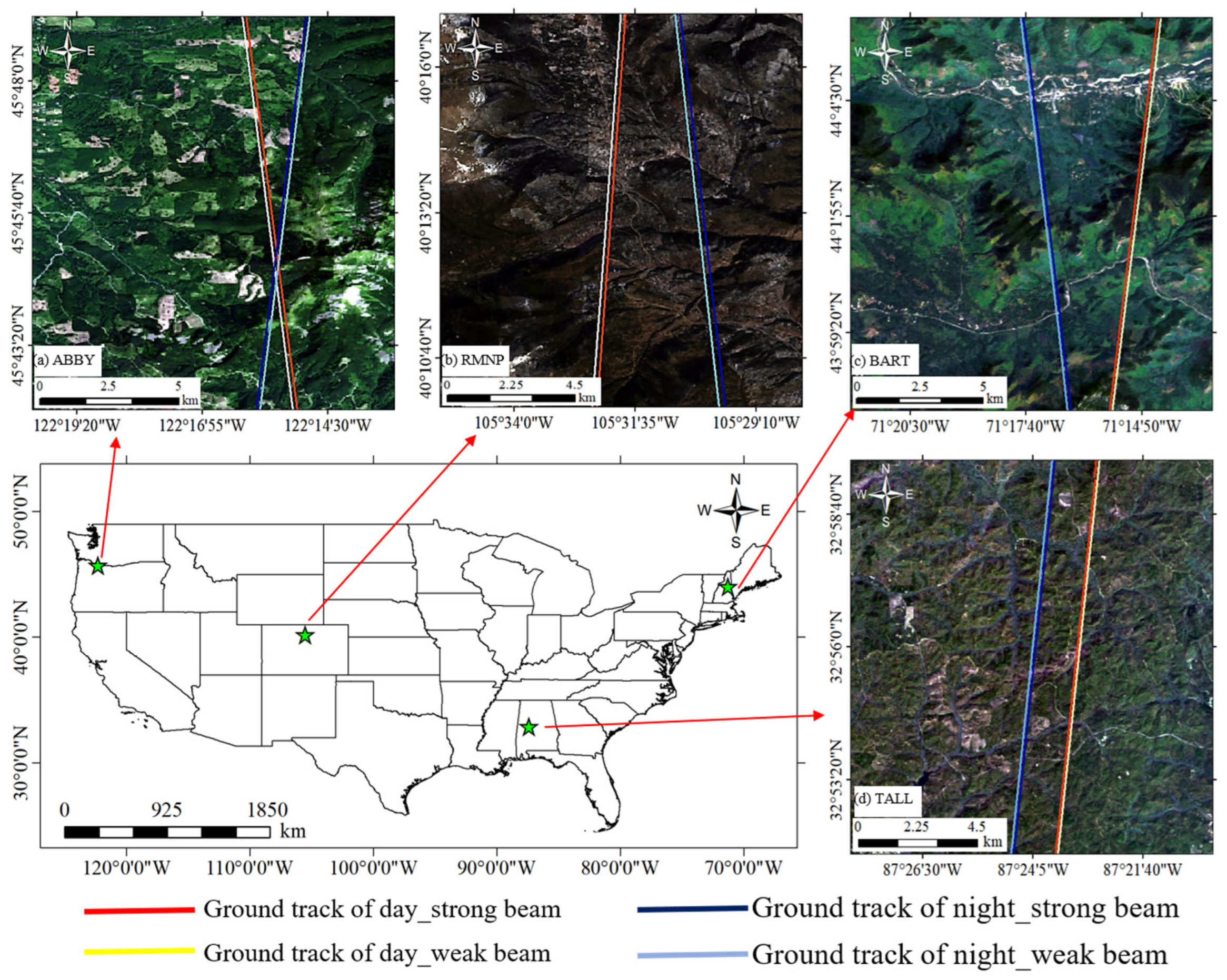
This study selected four regions in the United States with publicly available airborne lidar data provided by the National Ecological Observatory Network (NEON), Boulder, CO, USA (Figure 1). These regions were used to evaluate the accuracy of terrain and canopy height estimation based on ICESat-2 photon data. Among these, the Abbey Road (ABBY) site is located in central Washington State, USA, situated on the eastern side of the Cascade Mountains, with an elevation range of 300 to 1300 m. The region receives approximately 2450 mm of annual precipitation and has an average annual temperature of about 10 °C. The vegetation is predominantly coniferous-broadleaved mixed forest. The Rocky Mountain National Park (RMNP) site is situated in north-central Colorado, USA, adjacent to the Rocky Mountain National Park, with elevations ranging from 2400 to 3500 m. The vegetation is primarily alpine coniferous forest, dominated by spruce, pine, and fir species. The Bartlett Experimental Forest (BART) site lies in south-central New Hampshire, USA, with elevations between 200 and 1000 m and relatively mild terrain. The area receives about 1200 mm of annual precipitation and has an average annual temperature of approximately 8 °C. The vegetation is mainly temperate evergreen coniferous forest, featuring species such as red pine and white pine. Finally, the Talladega National Forest (TALL) site is located in central Alabama, USA, with elevations from 60 to 200 m and predominantly flat terrain. Annual precipitation averages around 1400 mm, and the mean annual temperature is about 16 °C. The vegetation is primarily temperate evergreen and deciduous broadleaved mixed forest.

2.2. Data

2.2.1. ICESat-2/ATLAS Data

The ICESat-2 satellite, launched by NASA, carries the ATLAS. ATLAS emits six green (532 nm) laser beams at a pulse repetition frequency of 10 kHz, organized into three pairs. Each pair consists of one strong beam and one weak beam, with an energy ratio of 4:1 [25]. The beams are arranged with an intra-pair spacing of 0.7 m [26], generating a footprints diameter of approximately 11 m. The across-track distance between each beam pair is about 3.3 km, while the along-track spacing within a pair is 2.5 km and the across-track spacing is 90 m. Notably, the relative positions of the strong and weak beams reverse when the satellite moves in forward or backward orientations along its orbit [27].
ICESat-2 provides products at four distinct levels (L1, L2, L3A, and L3B). Starting from raw telemetry signals, preliminary processing yields L1 products, from which higher-level data products are derived. Global geolocated photon data (ATL03), a L2 level product, provides geolocated latitude, longitude, and height information of photons [28]. It offers a spatial resolution of 70 cm and a temporal resolution of 91 days, with global coverage. L3A and L3B products are generated from further processing of L2 data, including land ice height (ATL06) to atmospheric column (ATL21) datasets. Among these, ATL08 is the land and vegetation height product. It extracts terrain and canopy height from ATL03 photon clouds, labeling photons along the track at 100-m step intervals as noise, ground, canopy, or canopy top [12].
Owing to the impact of solar background noise on ICESat-2/ATLAS data quality, photon cloud characteristics differ between strong and weak beams. This study selects ATL03 datasets under varying observation conditions (daytime/nighttime, strong/weak beams) and evaluates results using corresponding ATL08 products and airborne lidar data. The applicability and accuracy of terrain and canopy height extracted by the algorithm under different observation conditions are analyzed. Details of the ICESat-2 data used in this study are listed in Table 1. It should be noted that the TALL site experiences mild winters with rare persistent snow cover. In addition, the site consists of mixed evergreen and deciduous broadleaf forests. Although partial leaf-off occurs in January, its influence on ICESat-2–derived canopy height is relatively limited and is unlikely to substantially affect the results.

2.2.2. Airborne Lidar Data

This study employs open-source ALS (Airborne Laser Scanning) data from the NEON (National Ecological Observatory Network) to assess the accuracy of terrain and canopy height. The ALS data were primarily acquired using the ALTM Gemini sensor, which operates at a 1064 nm wavelength and a pulse repetition frequency of 100 kHz. This system achieves horizontal and vertical positioning accuracies better than 0.40 m and 0.36 m, respectively. Crucially, the data utilize Mean Sea Level (MSL) as the vertical datum [29], ensuring consistency with ICESat-2’s elevation reference. The downloaded lidar products include DTM (Digital Terrain Models) and DSM (Digital Surface Models), both featuring a 1-m spatial resolution [18]. To ensure consistency and reliability, ALS data, which were collected during the same periods as ICESat-2 acquisitions, were selected. This approach helps reduce the influence of seasonal variation and environmental factors. The main characteristics of the four study sites are listed in Table 2. Although small-scale offsets between ICESat-2 footprints and 1 m raster data may affect absolute heights, the comparison between the proposed algorithm and ATL08 was performed at the same along-track aggregation scale, ensuring their relative performance is directly comparable.

2.3. Methods

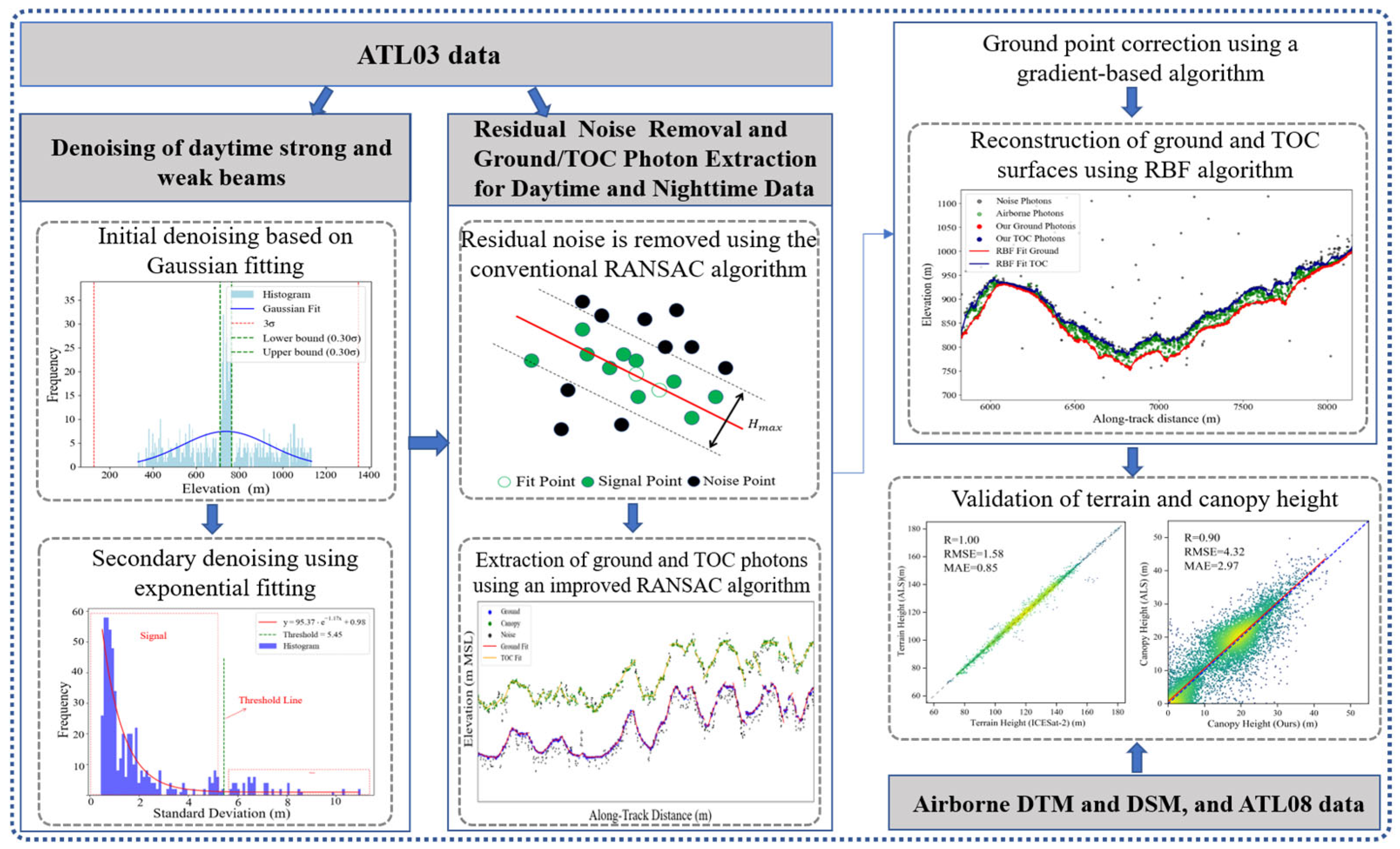
This study proposes a multi-stage processing framework integrating photon denoising, classification, and quasi-full-waveform reconstruction. The framework is divided into four major parts: (1) For daytime data, a Gaussian function is fitted to the elevation frequency histogram. The signal interval is determined using an adaptive multiplier of the Gaussian standard deviation ( σ ), where the optimal multiplier is automatically selected using Otsu’s algorithm, enabling preliminary photon denoising. (2) For Gaussian-filtered daytime data, the standard deviation of local photon distances (STD) is calculated and fitted with an exponential function. Adaptive segmentation thresholds derived from the fitted model are then applied to perform secondary denoising and extract signal photons. (3) Under daytime/nighttime and strong/weak beam conditions, residual noise is first removed using the conventional RANSAC algorithm. The retained photons are then further processed using an improved RANSAC algorithm to extract ground and TOC photons. (4) The gradient algorithm is applied to correct elevation discontinuities in ground photons. Subsequently, RBF fitting is applied to ground and TOC photons to reconstruct continuous quasi-full-waveform profiles of terrain and canopy height. The technical workflow is showed in Figure 2.

2.3.1. Gaussian Fitting Denoising for Daytime Data

ICESat-2/ATLAS emits both strong and weak laser beams with inherent energy differences. During daytime, strong beams are more affected by solar background noise, leading to higher noise levels. Consequently, differentiated filtering strategies are adopted for strong and weak beams: Strong beams used shorter fixed and moving windows of 100 m and 80 m, respectively, with window overlap introduced to enhance local adaptability and reduce the risk of fitting instability. In contrast, although weak beams have lower signal energy, their photon distribution is relatively stable under background conditions. Therefore, a single fixed window of 200 m was adopted for weak beams to ensure sufficient photon counts for robust statistical estimation, while a moving window was not used in order to avoid introducing unnecessary local variability under low-photon conditions. Along the elevation axis, elevation values are divided into 3-m intervals to build photon frequency histograms. Bins with the highest frequency and nearby high-frequency bins are identified as signal photons. A Gaussian function [30] is then fitted to the elevation histogram within each along-track window. The function is defined in Formula (1).
    f = a × exp x μ 2 2 σ 2 c
where a, μ, and σ represent the amplitude, mean, and standard deviation of the fitted Gaussian function, corresponding to the peak magnitude, center position, and width of the curve, respectively.
In probability theory and mathematical statistics, data falling outside 3 σ are commonly regarded as noise, whereas data within 3 σ are considered signal [30]. However, using fixed-multiple σ often leads to photon underfitting or overfitting within variable along-track windows. To overcome this limitation, Otsu’s algorithm [31] is employed to analyze elevation statistics for each window. The method exhaustively evaluates all possible segmentation thresholds and selects the optimal one by maximizing the interclass variance between signal and noise photons. The threshold that maximizes the interclass variance is selected as the optimal segmentation point, as defined in Formula (2).
T = arg max t w 1 ( t ) × w 2 ( t ) × μ 1 ( t ) μ 2 ( t ) 2
where w 1 t   and   w 2 t represent the probabilities (class weights) of the two data groups divided by the potential threshold t . They indicate the proportion of photons on each side of the threshold. μ1(t) and μ2(t) are the mean elevation values of photons on either side of the threshold, respectively. T denotes the optimal segmentation threshold. The relationship between the Gaussian standard deviation multiplier (k) and the threshold T is defined in Formula (3), and signal photons are subsequently classified according to Formula (4).
k = T μ σ
μ k × σ Elevation μ + k × σ
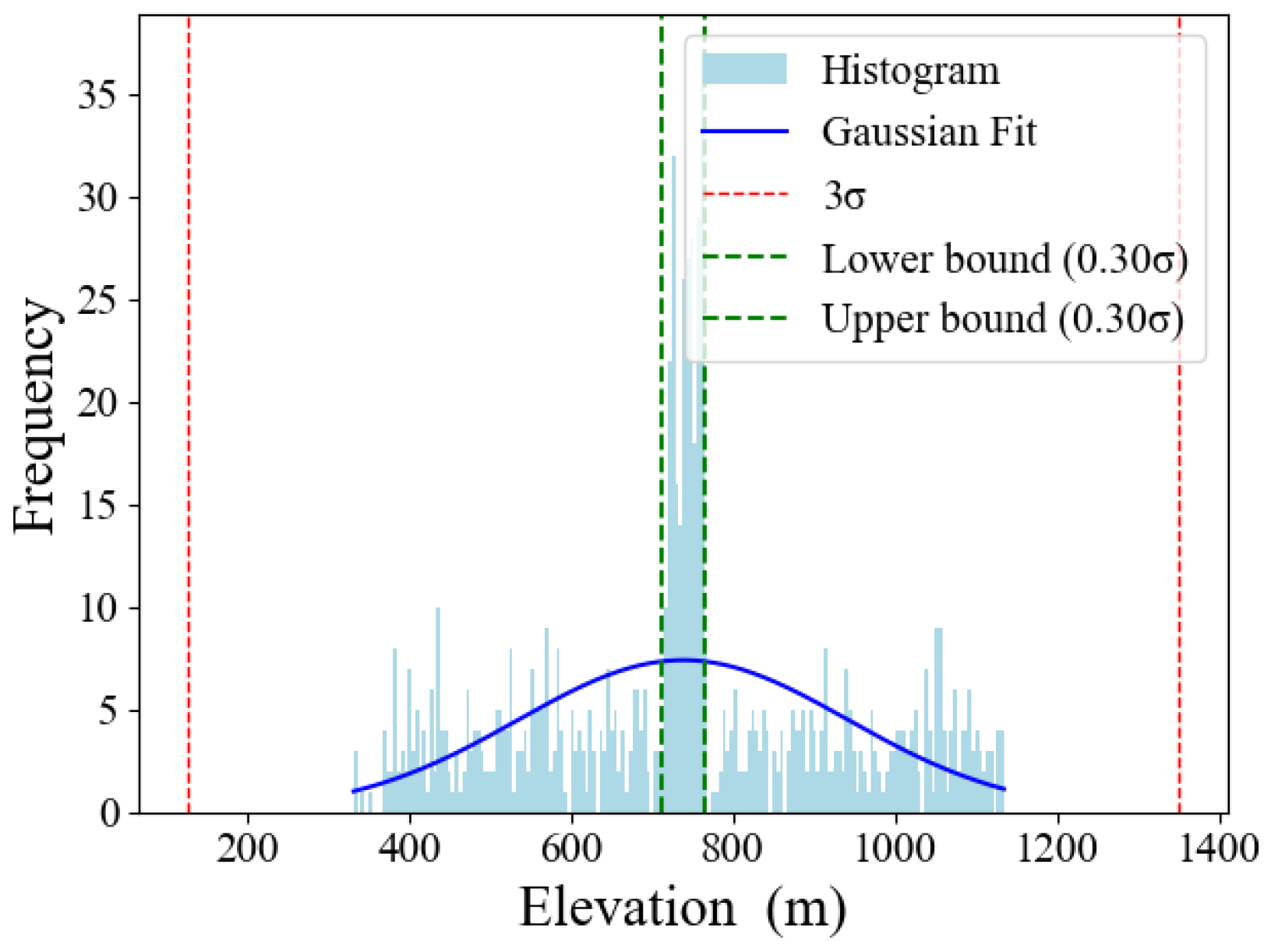
where k denotes the adaptive multiplier of the σ , μ is the mean of the fitted Gaussian function. Photons within the adaptive range of μ ± k σ are identified as signal photons. The elevation histogram and its Gaussian fitting are shown in Figure 3.
Daytime weak beams often show bimodal or multimodal elevation histograms with increased noise. In such cases, a single global threshold from Otsu’s method becomes less effective. To address this, each histogram is split into two subsets based on the peak. Otsu’s algorithm is then applied separately to derive two adaptive thresholds, which correspond to different k. The classification rule is shown in Formula (5).
μ k 1 × σ Elevation μ + k 2 × σ
where k 1 and k 2 are adaptive multipliers obtained from the left and right subset of the elevation histogram using Otsu’s method.

2.3.2. Fitting the STD of Distances Using an Exponential Function

For daytime photons after Gaussian fitting, residual noise remains above and below the signal photons. To reduce this noise, photons are divided into along-track windows. In each window, the K-nearest neighbors (KNN) algorithm [32] identifies the K (K = 50) closest photons for each target photon. The STD of nearest-neighbor distances is then calculated, as shown in Formula (6).
STD = 1 m 1 j = 1 m ( D i j μ i ) 2
where m denotes the number of nearest-neighbor photons, D i j represents the distance between the current photon i and its j -th nearest neighbor, μ i is the mean distance from photon i to its m neighbors, and STD denotes the standard deviation of local photon distances.
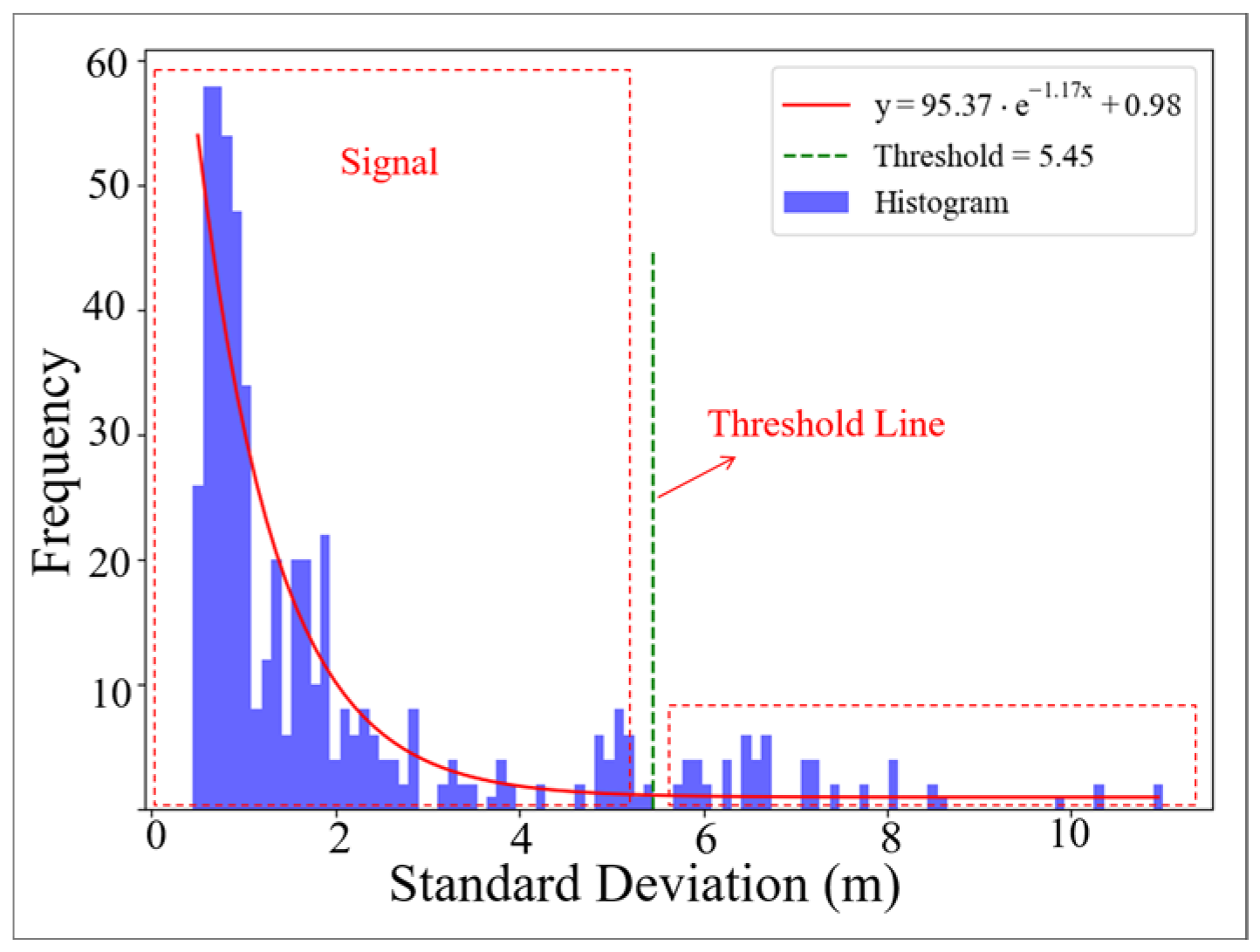
The STD quantifies the spread of photons around their mean distance. Smaller STD values indicate denser photon clustering and a higher probability of signal photons, while larger values typically correspond to noise. The distribution of the STD is modeled using an exponential function to better illustrate its characteristics. Finally, the initial segmentation threshold is determined based on the point of maximum curvature of the fitted curve. To conservatively enlarge the signal retention range, a constant compensation term is subsequently added to the threshold (2–4 for strong beams and 6–8 for weak beams). This compensation term serves as a robustness adjustment to reduce the risk of erroneously removing signal photons near canopy edges and exhibits low sensitivity to the overall denoising performance, thereby enhancing the stability of the proposed algorithm. The exponential fitting function is given in Formula (7).
f ( x ) = a × exp { b × x } + c
where a represents the initial height of the exponential function, b controls the decay rate, with larger values indicating faster decay, and c shifts the curve vertically. Figure 4 shows a schematic diagram of the exponential fit for STD.

2.3.3. Residual Noise Removal and Photon Classification

The RANSAC algorithm [24] is employed to remove residual noise and classify photons in both daytime and nighttime data. The RANSAC algorithm iteratively fits linear models by randomly sampling minimal data points. Each model is evaluated against the entire dataset, and through multiple iterations, the algorithm converges to an optimal linear solution. All beam types of ICESat-2 data are projected onto along-track distance–elevation plane, where RANSAC effectively captures photon distributions and identifies signal photons near the fitted line.
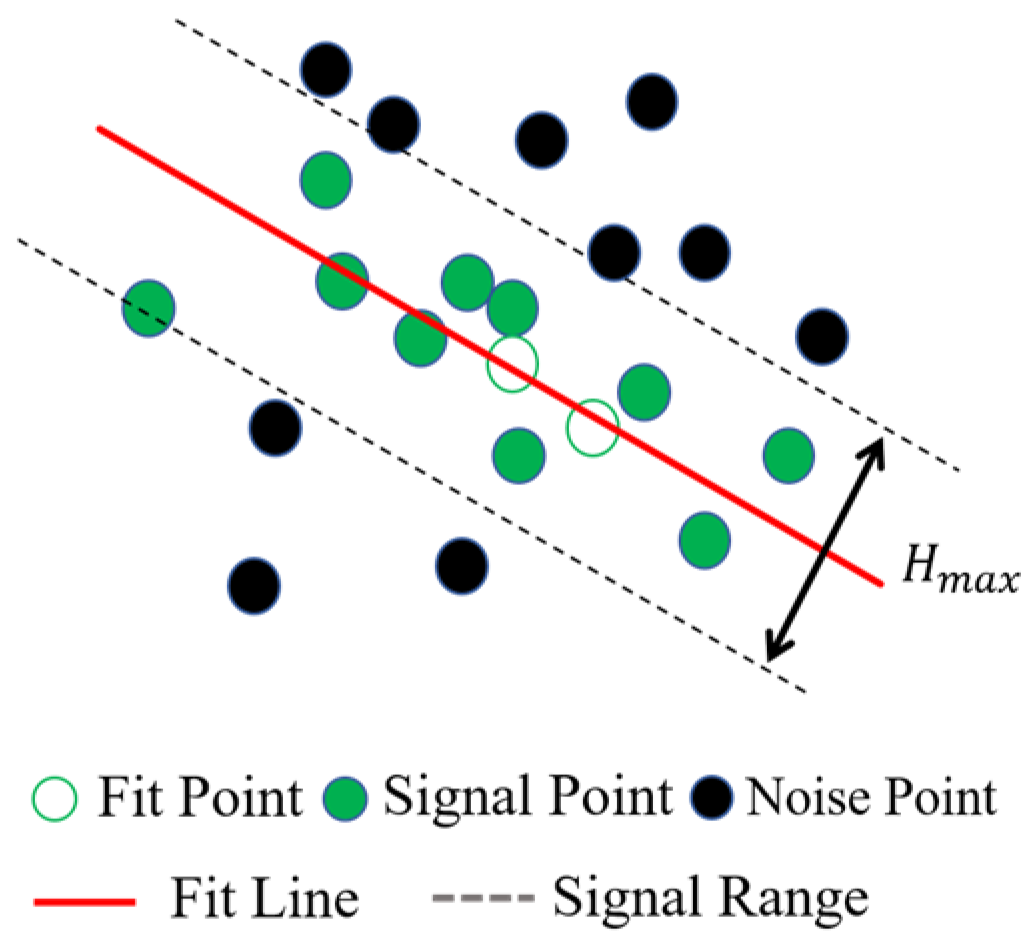
Threshold selection is key to the algorithm. In the first stage, the conventional RANSAC algorithm is applied to remove noise photons. Loose upper and lower thresholds (±25 m) are applied to retain photons within a 50 m elevation range. This helps preserve potential signal photons while removing outliers far from the fitted line. The remaining photons are then used to extract ground and TOC photons. Figure 5 shows a schematic of the RANSAC algorithm.
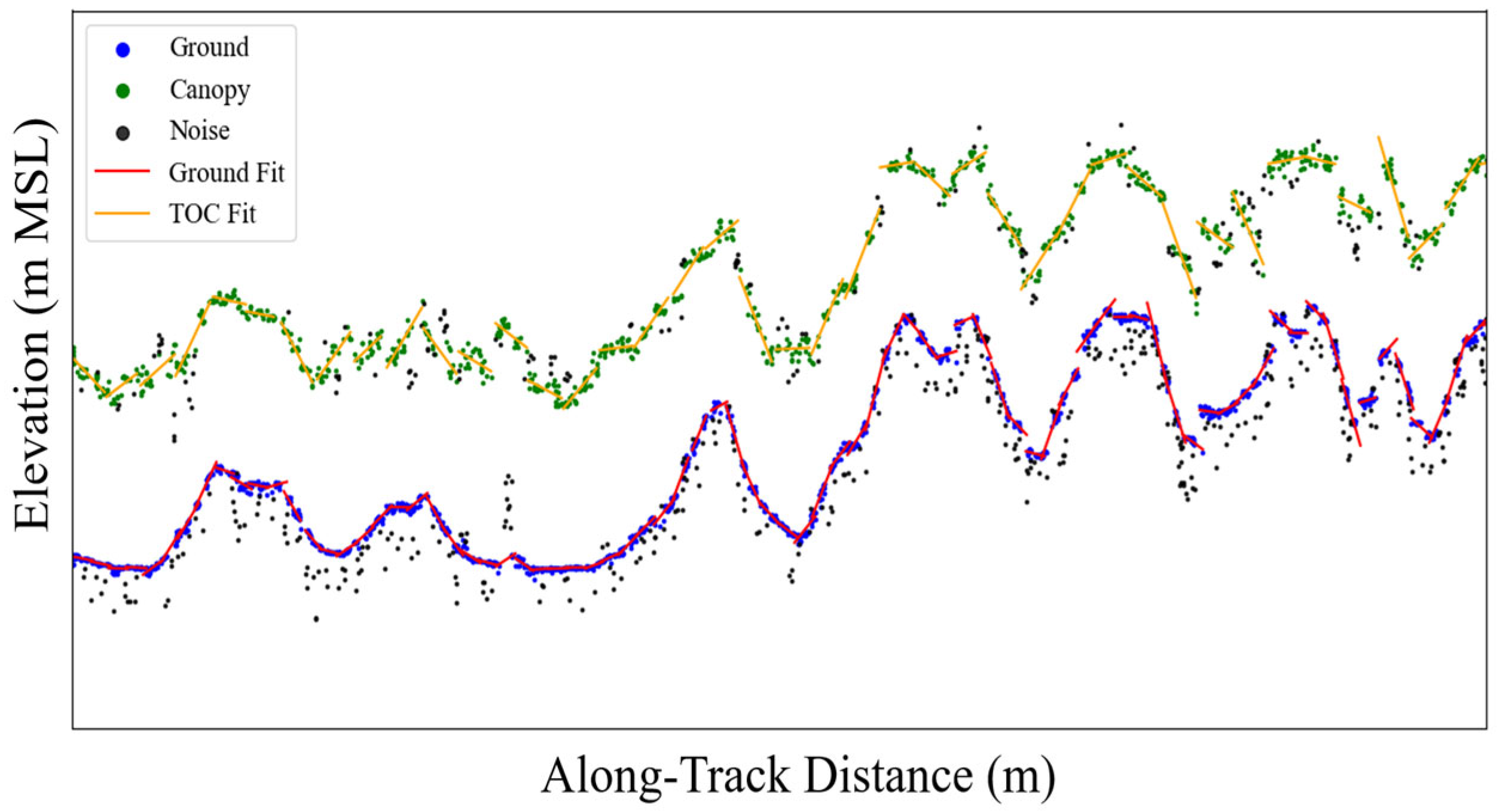
In the second stage, an improved RANSAC algorithm is applied to extract ground and TOC photons. Within local along-track windows, potential ground and TOC photons are first identified using height percentile statistics. For daytime data with high noise levels, the 0%–25% and 80%–98% percentiles are used to extract ground and TOC photons, respectively. For nighttime data with lower noise, narrower ranges of 0%–10% and 90%–98% are applied. The main improvement of the RANSAC algorithm is to constrain the slope of fitted lines between −1 and 1, corresponding to terrain gradients of 0–45°, thereby reducing the influence of vertically clustered points. Figure 6 illustrates the overall classification of ground and TOC photons.

2.3.4. Quasi-Full-Waveform Reconstruction of Terrain and Canopy Height

Accurate canopy height estimation requires vertical alignment between TOC photons and ground surfaces. Direct differential calculations are unreliable due to their spatial mismatch. To resolve this, the RBF algorithm [33] is used to interpolate ground photons and generate a smooth terrain surface. The RBF algorithm was selected instead of traditional polynomial fitting or spline interpolation because RBF is a locally weighted, nonparametric method that maintains strong surface smoothness and shape adaptability under uneven along-track photon distributions, local data gaps, and residual noise, thereby enabling more stable reconstruction of continuous terrain surfaces. The RBF model was constructed using a multiquadric kernel function, and a smoothing parameter (smooth = 5) was used to control the sensitivity of the fitted curve to local anomalous points. Ground elevations at TOC photon locations are then obtained by along-track interpolation, allowing precise canopy height calculation.
Ground photons generally show spatial and elevation continuity. Abrupt elevation changes between neighboring ground photons often indicate misclassification. Therefore, a gradient-based method was used to remove abnormal points. Mean elevation gradients were computed within sliding windows. The along-track window spacing was fixed (10 m), the gradient threshold can be equivalently expressed as an elevation-difference threshold between adjacent windows. Based on terrain continuity after spatial averaging, inter-window elevation differences rarely exceed 2–3 m. Thus, a conservative elevation-difference threshold of 3 m was adopted to identify anomalous elevation jumps. Remaining ground photons are then fitted with a radial basis function (RBF) to generate a smooth terrain surface.
TOC photons are often discrete due to vegetation structure, laser penetration, and observation geometry. However, canopy height shows spatial continuity at the crown structure scale. Therefore, this study applies RBF interpolation to TOC photons to generate continuous canopy surface curves. This approach supports detailed analysis of crown structure and spatial heterogeneity. The reconstructed terrain and TOC curves exhibit geometric characteristics and spatial continuity that are comparable to the envelope structure of canopy echoes in conventional full-waveform LiDAR. Therefore, these curves are referred to as quasi-full-waveform curves in this study.

2.3.5. Validation of Terrain and Canopy Height

The elevations of signal photons are converted to coordinate systems based on airborne DTM and DSM. Then, DTM and DSM values are extracted for ground and TOC photons classified in this study and those from the ATL08 product.
ICESat-2 footprints have an along-track spacing of about 0.7 m, allowing a minimum photon separation of 0.7 m. In this study, a 5-m along-track interval is defined for statistics. Mean elevations of classified ground photons and DTM values were calculated within 5-m along-track intervals to represent the terrain height at the center of each interval. Canopy heights for TOC photons were obtained by subtracting the interpolated terrain from the TOC elevations, and the mean canopy height within each interval was used to represent the interval center. Canopy heights from airborne LiDAR were calculated as DSM minus DTM, and similarly averaged within the same intervals. This approach ensures that the comparison between ICESat-2 and airborne LiDAR canopy heights is conducted at a consistent spatial scale. The 5-m interval balances mitigate the impact of individual photon spatial offsets, while minimizing the effects of terrain variations and vegetation structural changes from larger intervals. ATL08-classified photons are validated using the same procedure. Formulas (8) and (9) are used to calculate the mean of ICESat-2 heights and the corresponding ALS heights, respectively.
x i = 1 n j = 1 n x j
y i = 1 n j = 1 n y j
where x i and y i denote the mean of ICESat-2 and ALS heights at the interval center, respectively, while xj and yj represent individual photon height of ICESat-2 and ALS within the interval.
The accuracy of terrain and canopy height estimates is evaluated using several statistical metrics, including the correlation coefficient (R), root mean square error (RMSE), and mean absolute error (MAE). Their corresponding formulas are provided in Formulas (10)–(12).
R = n i = 1 ( x i x ¯ ) ( y i y ¯ ) n i = 1 ( x i x ¯ ) 2 n i = 1 ( y i y ¯ ) 2
RMSE = i = 1 n ( y i x i ) 2 n
MAE = 1 n i = 1 n y i x i
where x i is the height of ground or canopy (from this study or ATL08), x ¯ is its mean, y i is the height of ALS, y ¯ is its mean, n is the number of samples.
In addition, the denoising performance of the proposed method was quantitatively evaluated and the parameter sensitivity was analyzed. Airborne LiDAR-derived DTM and DSM products were used as reference benchmarks for assessing the accuracy of photon cloud denoising. Specifically, “DTM − 0.5 m” and “DSM + 0.5 m” were set as the ground and canopy top boundaries, respectively, and photons falling within these two boundaries were considered signal photons, whereas those outside were regarded as noise photons [34]. Three statistical metrics were introduced to evaluate the algorithm’s accuracy: the recall ( R ), the precision ( P ), and the comprehensive evaluation index ( F ) [35]. The recall R was further divided into signal photon recall R s and noise photon recall R n , as defined in Equations (13)–(17).
R s = T P T P + F N
R n = T N T N + F P
P = T P T P + F P
F = 2 P R P + R
where TP denotes the number of signal photons correctly identified, TN denotes the number of noise photons correctly classified, FP represents the number of noise photons misclassified as signal photons, and FN indicates the number of signal photons that were not correctly identified.

3. Results

3.1. Denoising Results of Gaussian Fitting

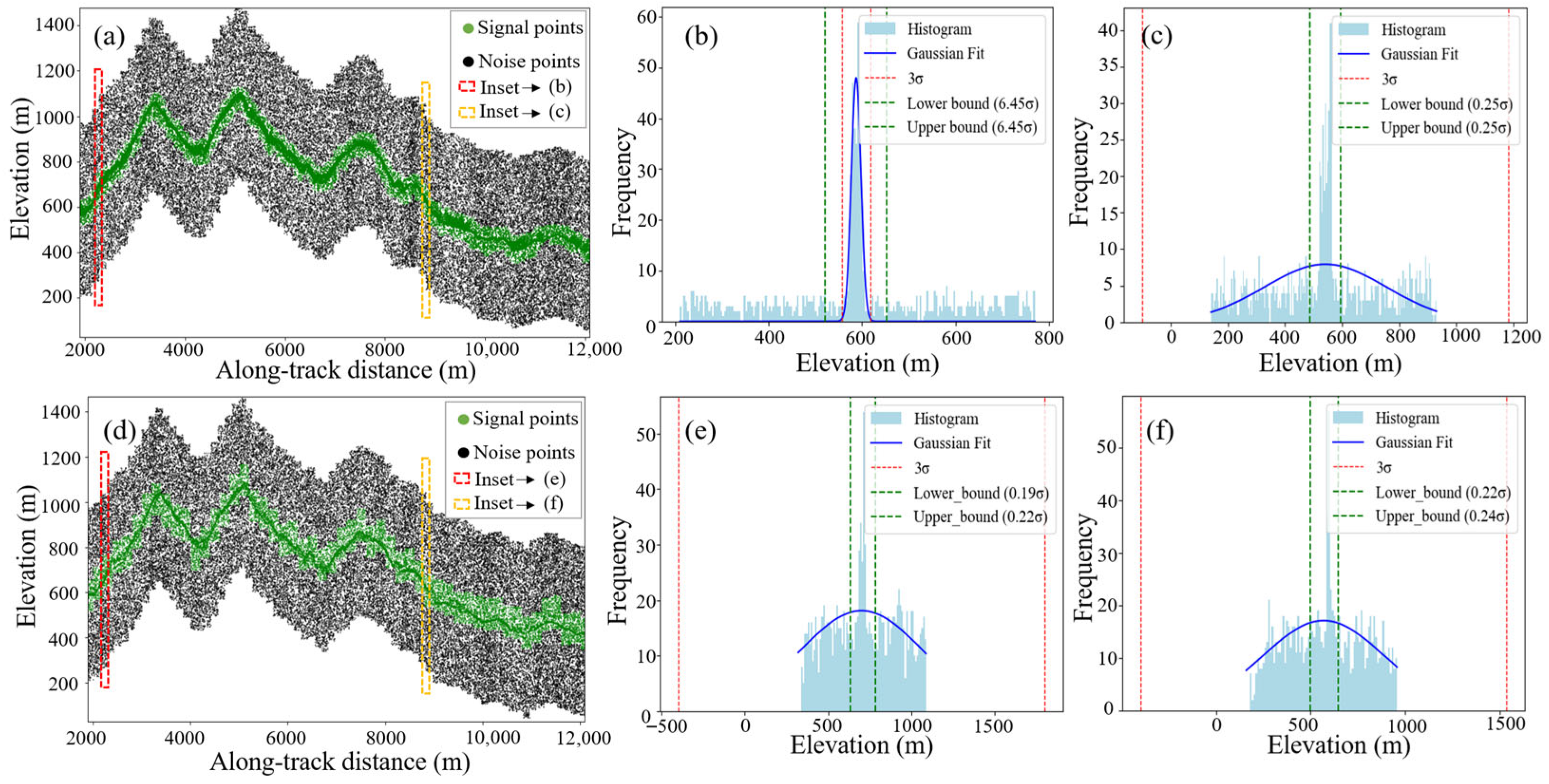
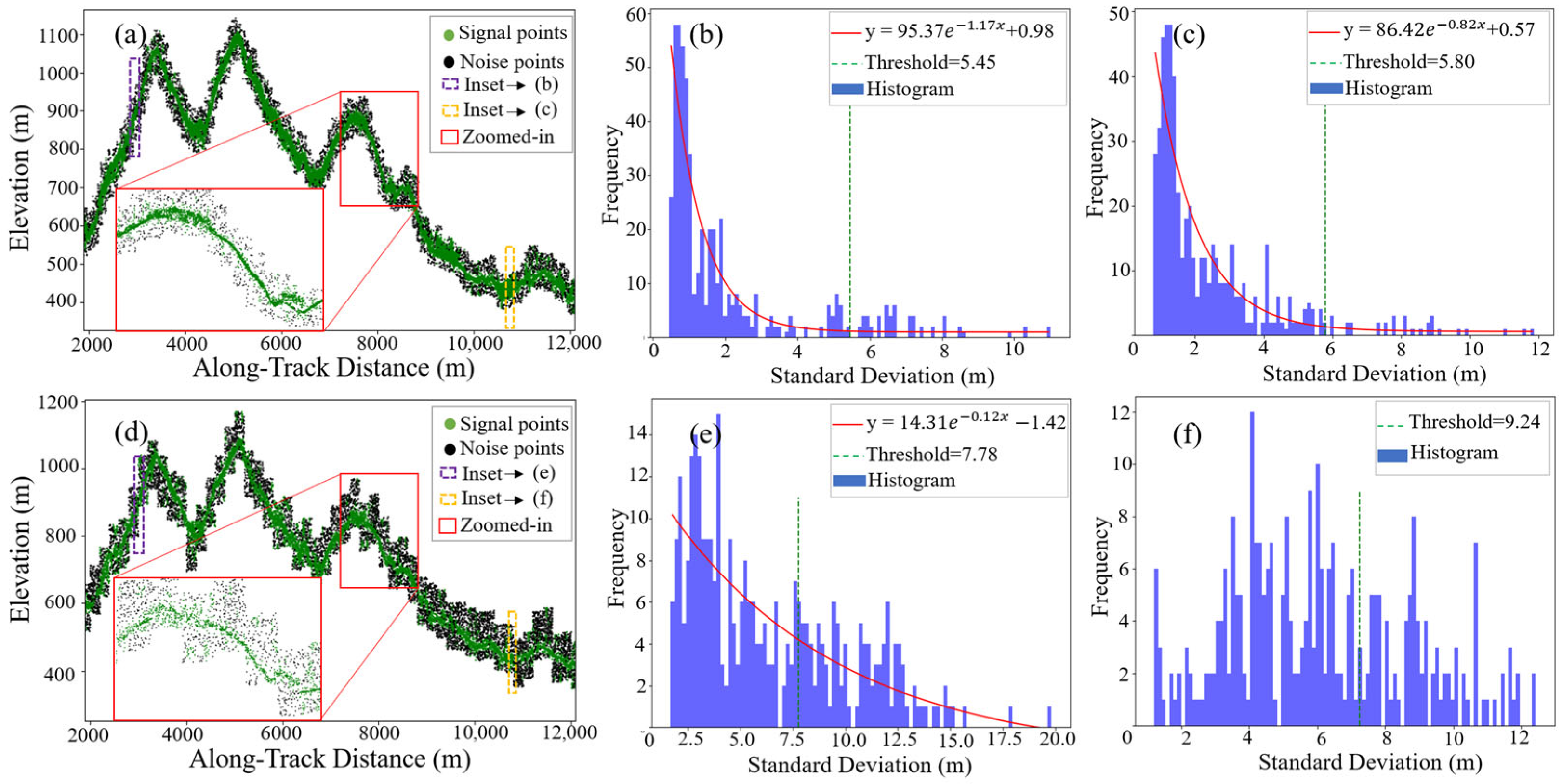
To suppress solar noise in daytime strong and weak beams, elevation thresholds are derived using Gaussian fitting and Otsu’s method to identify signal segments. Photons are divided into along-track windows for local distribution fitting. The fixed ±3σ threshold is based on the idea that photon elevations follow a symmetric Gaussian pattern. In forest environments, however, photon elevations are influenced by terrain changes, canopy cover, and background noise, so their distributions are often uneven or spread out. In these cases, a fixed statistical range may not represent the real distribution of signal photons and may remove useful terrain or canopy returns, which can reduce elevation accuracy. To address this, this study uses an adaptive threshold derived from locally fitted Gaussian parameters. The threshold is adjusted according to the elevation distribution within each window, allowing better noise removal while keeping important terrain and canopy signals under different beam conditions and complex surfaces. Figure 7 illustrates denoising results for daytime strong and weak beams at the ABBY site.
Based on analysis of Figure 7, the Gaussian fitting with an adaptive k effectively removes noise for both strong and weak beams. For daytime strong beams, a fixed 3σ threshold may misclassify all photons as signals in some windows or remove true signals in others. For weak beams, photon counts at peak and non-peak elevation ranges are similar. As a result, the 3σ range covers the full Gaussian curve, classifying all photons as signal.

3.2. Denoising Results of Exponential Fitting

Based on the preceding analysis, noise remains in photons from daytime strong and weak beams even after Gaussian filtering. To reduce remaining noise, an exponential function is fitted to the STD, enabling further denoising (Figure 8).
As shown in Figure 8, Exponential fitting of the STD effectively suppresses noise near signal photons for both daytime strong and weak beams. For strong beams, clear spatial and density differences between signal and noise photons enable accurate separation. In contrast, weak beams show smaller differences, leading to poor fitting results. Some windows cannot be fitted properly, requiring higher thresholds to preserve signal photons. This method effectively reduces noise levels but does not achieve complete noise removal.

3.3. Results of Residual Noise Removal and Photon Classification

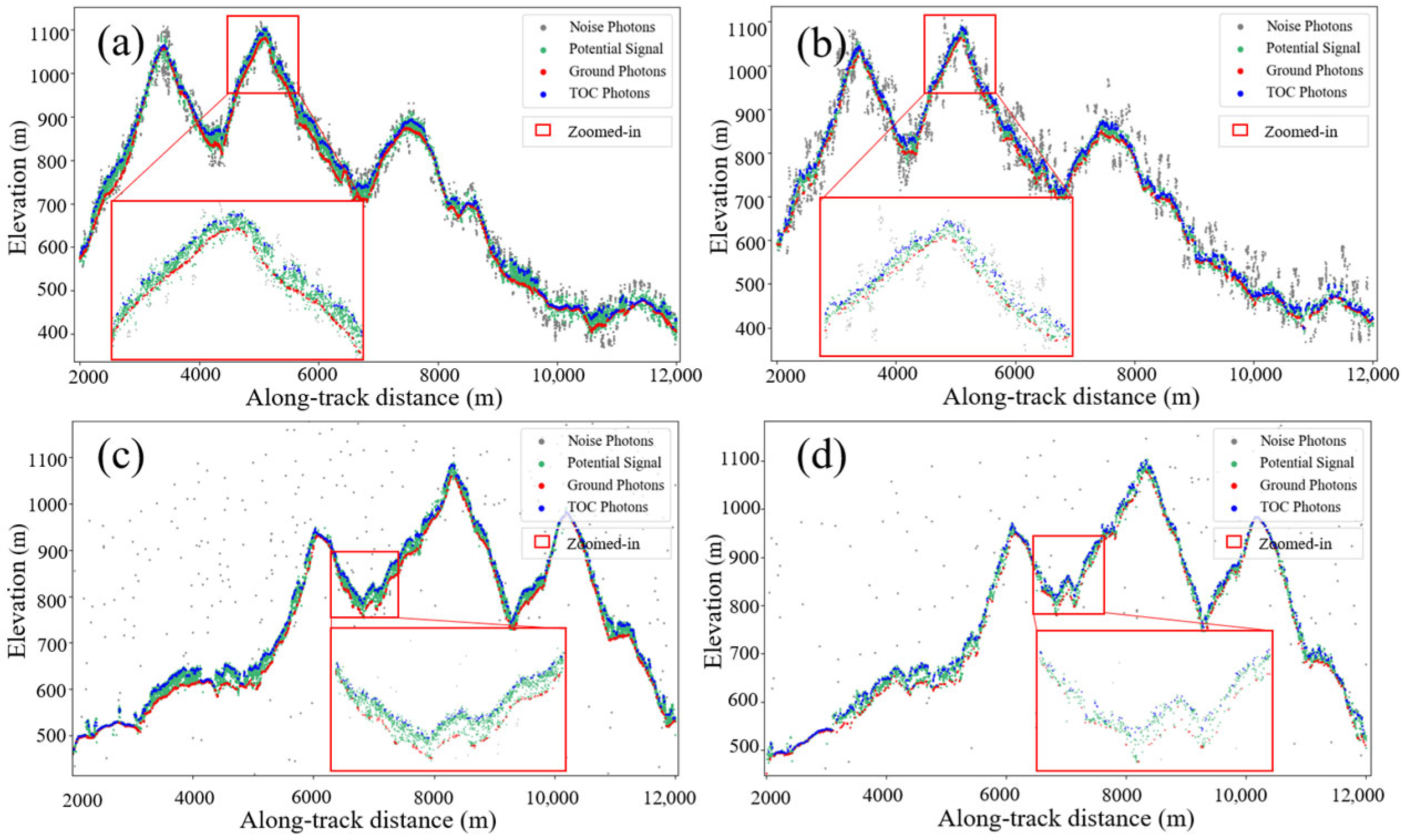
Following exponential fitting, the RANSAC algorithm further removes residual noise and extracts ground and TOC photons, as shown in Figure 9.
As shown in Figure 9, the RANSAC algorithm effectively eliminate noise across all beam types. For daytime strong beams, clear terrain and canopy structures are recovered due to strong signal intensity. Despite reduced signal density in daytime weak beams, ground and canopy features are reliably modeled. Nighttime beams benefit from lower noise, producing smoother and more continuous profiles. Based on the results of classification, ground and TOC photons show good continuity across different beam types. It suggests strong structure recognition in complex terrain and layered vegetation.

3.4. Results of Quasi-Full-Waveform Reconstruction for Terrain and Canopy Height

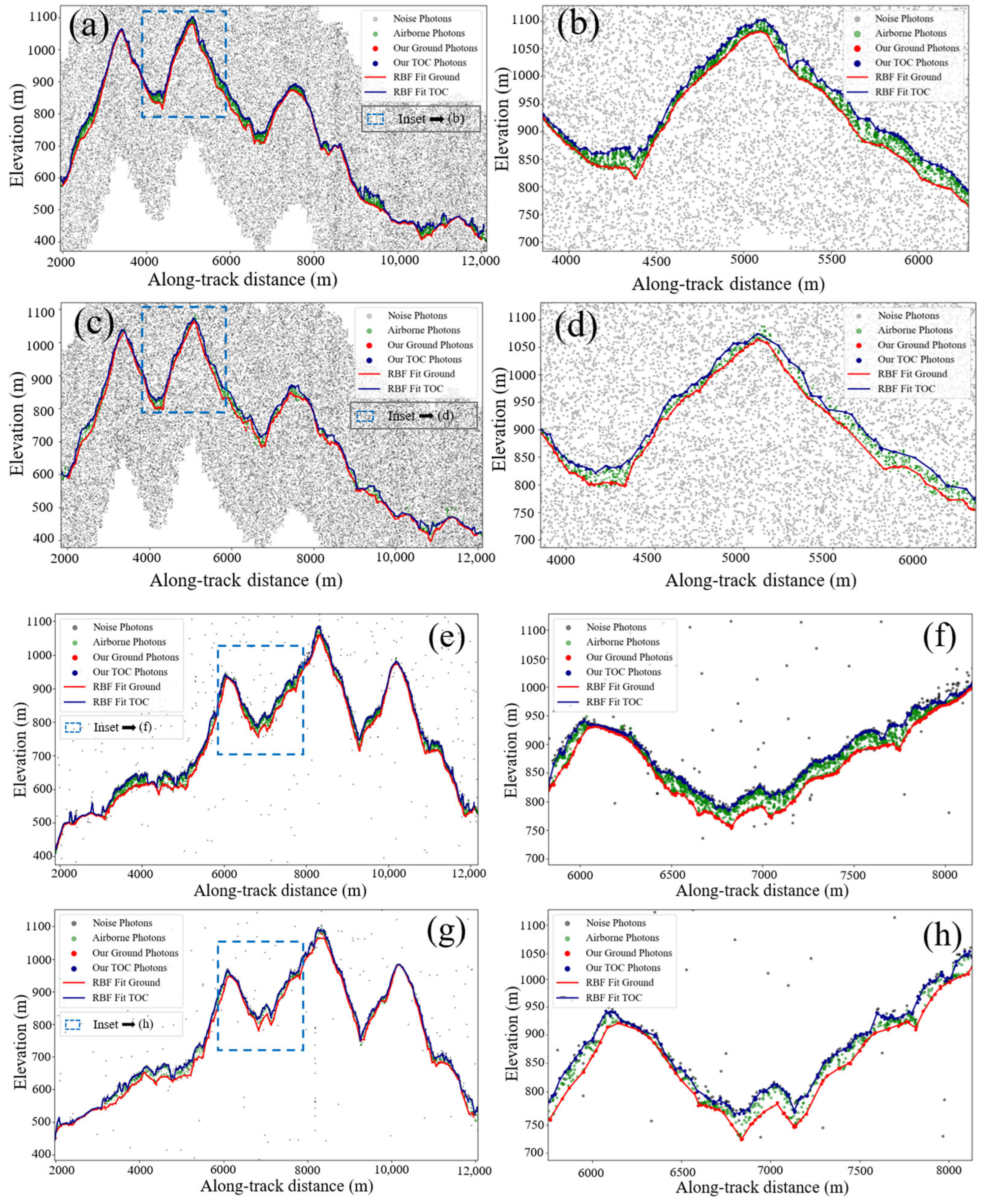
To improve terrain fitting, misclassified ground photons are further removed based on RANSAC classification. The RBF method is then used to fit ground and TOC photons separately, generating continuous quasi-full-waveform profiles of terrain and canopy height. The results are illustrated in Figure 10.
Analysis of Figure 10 shows that the RBF-fitted terrain and TOC curves (red and blue lines) closely match the ALS ground and TOC photons. This consistency demonstrates the accuracy and stability of the proposed RANSAC and RBF method under various beam conditions. Under daytime strong beam (e.g., Figure 10a,b), the method shows strong robustness. High solar background noise does not significantly affect classification. Key terrain and canopy structures are well preserved. Under daytime weak beam in Figure 10c,d), signal density is low and noise is higher. Minor deviations are observed in some ground and TOC photons. At night (e.g., Figure 10e–h), background noise is minimal and classified photons closely follow the ALS references. The method achieves high fitting accuracy under nighttime conditions.

3.5. Terrain Height Validation

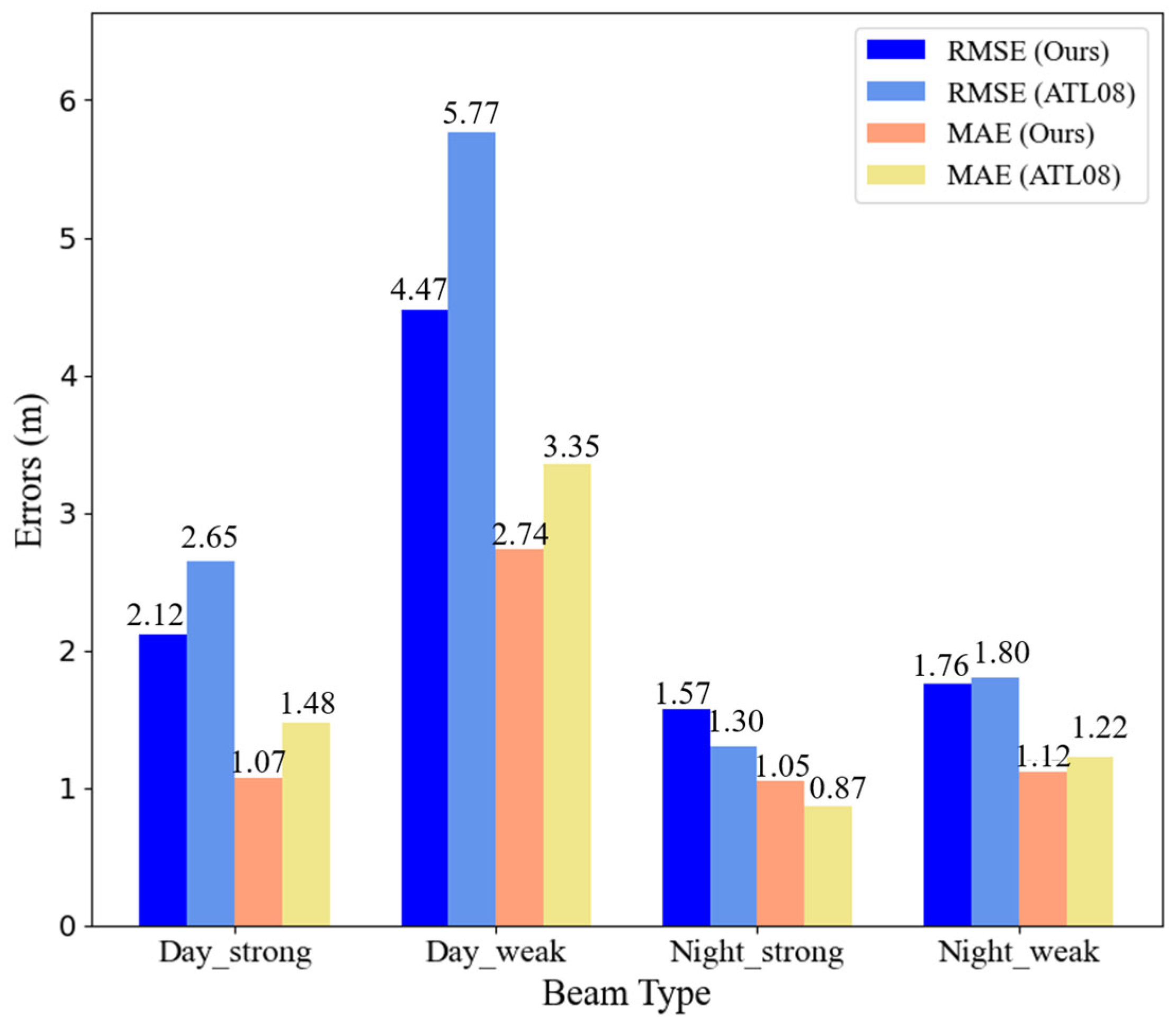
To further evaluate the accuracy of terrain, this study extracted classified ground photons from different beam types across four study areas, as well as those from ATL08. Both datasets were compared against ALS DEM data. The evaluation outcomes are presented in Figure 11.
Analysis of Figure 11 shows that under daytime strong beams, the proposed method achieves an RMSE of 2.12 m, improving over ATL08’s 2.65 m. The MAE also decreases from 1.48 m to 1.07 m. This indicates enhanced identification and ground fitting ground-fitting capabilities despite intense solar noise. Under daytime weak beams with low SNR, ATL08’s RMSE rises to 5.77 m, while the proposed method reduces it to 4.47 m. Under nighttime strong beams, ATL08 achieves a slightly better RMSE of 1.30 m compared to 1.57 m for the proposed method. However, MAE values are similar at 0.87 m and 1.05 m, showing both methods maintain high accuracy in high SNR environments. Under nighttime weak beams, the proposed method shows a slight improvement over ATL08 in both RMSE and MAE, confirming stable performance in low-signal, low-noise settings. This demonstrates excellent robustness in conditions with sparse signals and low background noise.

3.6. Canopy Height Validation

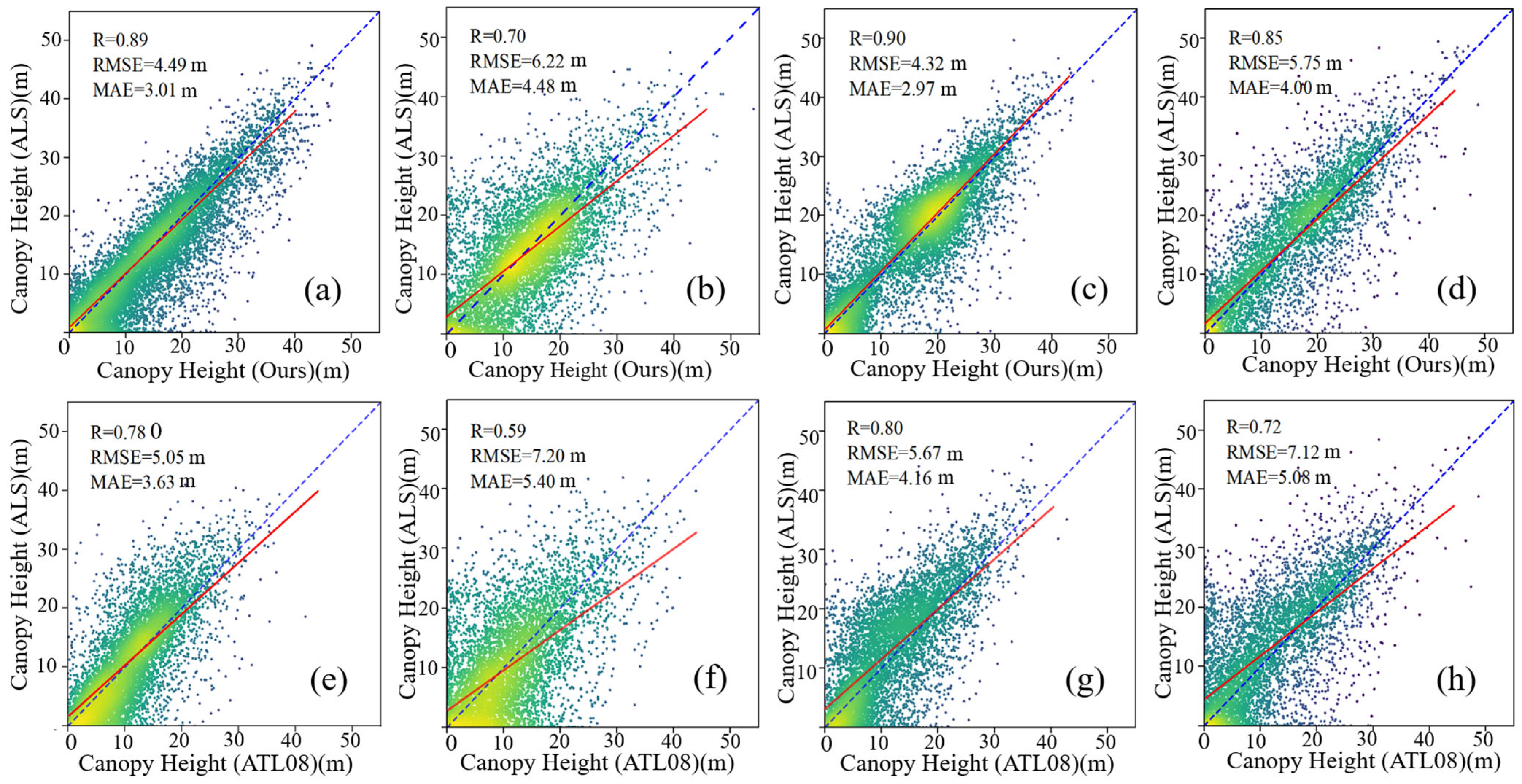
To further evaluate the accuracy of canopy height retrieval, TOC photons extracted from different beam types and those provided by the ATL08 product were separately assessed against an airborne LiDAR-derived digital surface model (DSM). It is noteworthy that, in this study, the canopy top surface and terrain surface were first reconstructed using the radial basis function (RBF) algorithm, and the canopy height profile was subsequently obtained from their difference. Based on this profile, only valid photons falling within the canopy height range were retained, and the 98th percentile of their heights was calculated as the final canopy height metric. This definition is consistent with the RH98-based canopy height used in the ATL08 product, thereby ensuring the comparability of results across different methods. The validation results of canopy height from different beam types across four study areas are shown in Figure 12.
In Figure 12, scatter-fitted lines from all beam types align closely with the 45° reference line in the proposed method, which indicate strong correlation and trend agreement. Compared with airborne canopy heights, ATL08 systematically underestimates TOC heights. In contrast, the proposed method achieves higher accuracy under daytime strong beams, nighttime strong beams, and nighttime weak beams (Figure 12a,c,d). The R values are 0.89, 0.90, and 0.85, respectively, with RMSE values of 4.49 m, 4.32 m, and 5.75 m. The values of MAE remain below 4 m in all three cases. This indicates a high consistency between our canopy heights and ALS canopy heights under strong signal and low background noise conditions. However, under daytime weak beam (Figure 12b,f), the accuracy decreases notably due to low signal density. Overall, the proposed method provides more robust canopy height estimates than ATL08.

4. Discussion

4.1. Sensitivity Analysis of Denoising Parameters for Daytime Data

4.1.1. The Impact of STD Multipliers on Gaussian Fitting-Based Denoising

Based on Gaussian fitting, the establishment of a confidence interval is a common method for ICESat-2 daytime photon denoising. Confidence intervals are usually defined by ± k σ . In probability statistics, the ±3σ interval is generally considered the main signal range. This interval effectively separates signals from noise in aquatic environments [30]. However, photon distributions differ markedly between land and water surfaces. To address this, Liu et al. [36] introduced a triple k differential method (upper threshold: 3σ, lower threshold: 1.5σ) for Gaussian fitting in land photon processing. The method effectively eliminates over 90% of noise photons. However, signal photons over land show complex patterns. A fixed k of k σ may retain amount of noise or lose signals. Further- more, histogram intervals also influence fitting. Narrow bins enhance distribution clarity, while wide bins may miss key features [37]. To overcome these limitations, this study applies Otsu’s algorithm to analyze elevation distributions within each along-track distance window. The method adaptively defines the Gaussian interval of signal photons, improving stability under varying noise conditions.
To assess the range of adaptive k, this study analyzed their distribution across all daytime strong and weak beams in four study areas. Multipliers were grouped into three intervals: (0–1.5σ), (1.5–3σ), and >3σ. In addition, while maintaining stable Gaussian fitting, various histogram bin intervals were tested to assess their impact on the adaptive STD multipliers. Histogram intervals and the interval-specific counts of k values are shown in Table 3.
Table 3 shows that changing histogram bin widths (2–5 m) has little effect on the selection of adaptive k. This indicates low sensitivity to parameter settings and good robustness. For strong beams, adaptive k values are distributed across all intervals, mostly within 1.5σ, with some exceeding 3σ. For weak beams, most adaptive k values are below 1.5σ, often in lower ranges. These patterns suggest that fixed 3σ thresholds may overestimate signal ranges in complex land surfaces, leading to more noise retention.

4.1.2. Influence of the Constant Compensation Term in Exponential Fitting

The idea of buffer-based signal protection has been used in previous photon filtering studies. Liu et al. [38], in a grid-based denoising method, did not keep only the grid with the highest photon count. They also retained the grid with the second-highest photon count and its neighboring cells. This formed a potential signal buffer and reduced the risk of misidentifying signal intervals when photon counts were similar. Chang et al. [16] reported that when signal and noise photon densities are close, statistical thresholds may cause misclassification. They introduced an anti-noise strategy based on an extended regional standard deviation. Neighborhood statistics were used to build a buffer zone and reduce the influence of local anomalies. These studies show that rigid thresholds are often insufficient when signal and noise distributions overlap. A buffering mechanism is needed to improve stability. The compensation term proposed in this study serves a similar role.
To evaluate the rationality of the threshold setting in the exponential fitting stage, parameter sensitivity experiments were conducted for both strong and weak beams across the four study areas. The denoising performance under the original threshold (compensation term = 0) and different compensation term values was compared (Table 4).
For strong beams, when the Compensation Term was 0, the algorithm already exhibited strong noise suppression capability while maintaining a high Rs. When the compensation term increased to 2–4 m, the Rn slightly decreased, but almost all signal photons were preserved. This indicates that a moderate increase in the threshold helps reduce the risk of erroneously removing signal photons near canopy edges, achieving a more robust balance between signal preservation and noise removal. As the compensation term continued to increase, the denoising capability weakened significantly, whereas the improvement in signal retention was limited. This behavior is related to the high photon density and concentrated STD distribution of strong beams. When the threshold becomes too large, the statistical characteristics of signal and noise photons tend to overlap, reducing the effectiveness of the exponential fitting stage. Therefore, 2–4 m is considered a reasonable compensation term range for strong beams.
For weak beams, the original threshold (compensation term = 0) tended to cause signal loss. When the compensation term was less than 6, more noise photons were removed, but this was accompanied by significant signal misclassification, indicating a certain degree of over-filtering. When the compensation term was within 6–8 m, the Rs increased markedly, while the Rn decreased only slightly, suggesting that this range achieves better signal–noise separation. If the compensation term increases further, the threshold becomes overly relaxed, leading to reduced denoising effectiveness. Therefore, 6–8 m is regarded as the optimal compensation term range for weak beams.
Overall, the influence of the compensation term shows a clear beam-dependent characteristic, reflecting differences in STD distribution under varying photon density conditions. A reasonable compensation term can reduce the risk of misclassifying structural edge signals while avoiding the decline in denoising capability caused by excessive threshold relaxation, thereby enhancing the stability of the algorithm under different observation conditions.

4.2. Overall Denoising Performance and Computational Efficiency Analysis

Previous studies on ICESat-2 photon denoising have shown that performance strongly depends on how well signal and noise can be separated. When photon density changes under different beam strengths or daytime/nighttime conditions, fixed thresholds and single-stage statistical filters often become unstable. Therefore, recent research has shifted toward adaptive and multi-stage strategies. For instance, Tang et al. [21] improved denoising in complex terrain by using multilevel adaptive clustering and adjusting the search domain based on terrain slope. Huang et al. [14] combined spatial clustering, adaptive thresholding, and terrain curve fitting to enhance signal identification under varying noise levels. These studies suggest that single statistical rules are insufficient under changing observation conditions, and that adaptive mechanisms with structural constraints are key to improving robustness.
The proposed method is a multi-stage adaptive statistical denoising framework that reduces uncertainty at the signal–noise boundary through signal distribution fitting, local structural statistics, and model constraints rather than relying on a single threshold. Its overall stability therefore needs to be evaluated under varying observation conditions. A total of 100 km of along-track photon data were selected from each study area to perform photon denoising, classification, and extraction of ground and canopy-top photons, and the runtime of the complete processing workflow was recorded. Meanwhile, the denoising performance was quantitatively evaluated using photons located within the airborne LiDAR coverage segments.
As shown in Table 5, the proposed method demonstrates stable denoising performance across different study areas. Overall, the signal photon recall Rs remains at a high level in all scenarios (mostly close to 1.0), indicating that the algorithm effectively preserves true signal photons while suppressing noise, rather than achieving higher accuracy through the misclassification of signal photons. For daytime beams, the noise photon recall Rn is also relatively high, suggesting a good balance between signal preservation and noise removal. Correspondingly, Precision and F-score values are consistently high with limited variation, further confirming that the performance improvement arises from effective signal–noise separation rather than aggressive filtering strategies.
The relatively lower Rn observed for nighttime beams can be attributed to physical factors rather than insufficient generalization of the algorithm. Under nighttime conditions, the background noise level is low, and the laser pulse energy experiences limited attenuation before reaching the ground and canopy, enhancing multiple scattering effects at these surfaces. As a result, some scattered photons still fall within a plausible structural height range and are therefore difficult to distinguish from true signal photons [39]. These “structural noise” photons geometrically overlap with genuine signal photons, which reduces the noise recall rate but does not significantly affect the signal recall or overall F-score. Furthermore, the generally lower Rn of strong nighttime beams compared to weak beams indicates that higher laser energy intensifies scattering, providing a physical explanation for the differences among beam types.
In addition to accuracy metrics, computational efficiency was also evaluated. The results show that processing 100 km of along-track data requires approximately 140–345 s. Although runtime varies among study areas, the overall fluctuation range is limited. Combined with the accuracy results, the relatively short runtime does not lead to a decrease in signal recall or F-score, indicating that the improvement in accuracy is not achieved at the cost of substantially increased computational demand.
Overall, the algorithm achieves consistently high and stable Recall, Precision, and F-score values across different regions, observation conditions, and beam types, while maintaining a manageable runtime. This indicates that the performance gain is derived from effective multi-stage structural constraints on photon spatial characteristics rather than selective data retention or over-aggressive filtering, thereby achieving a good balance between accuracy and computational efficiency and demonstrating strong robustness and generalization capability.

4.3. The Impacts of Canopy Structure and Topographic Variations on Ground Extraction

Forest canopy structure and terrain slope are critical factors influencing lidar-derived elevation. Studies have documented that canopy occlusion effects severely impede lidar’s capacity to characterize forest physical structures [40]. Neuenschwander et al. [9] found that high canopy coverage and seasonal leaf changes cause significant errors in ATL08 ground. These errors show nonlinear relationships with changes in canopy density. Furthermore, Tang et al. [21] and He et al. [41] identified slope as an important topographic factor of terrain measurement accuracy. Fu et al. [23] further confirmed that slope is the main factor influencing the accuracy of terrain height estimation.
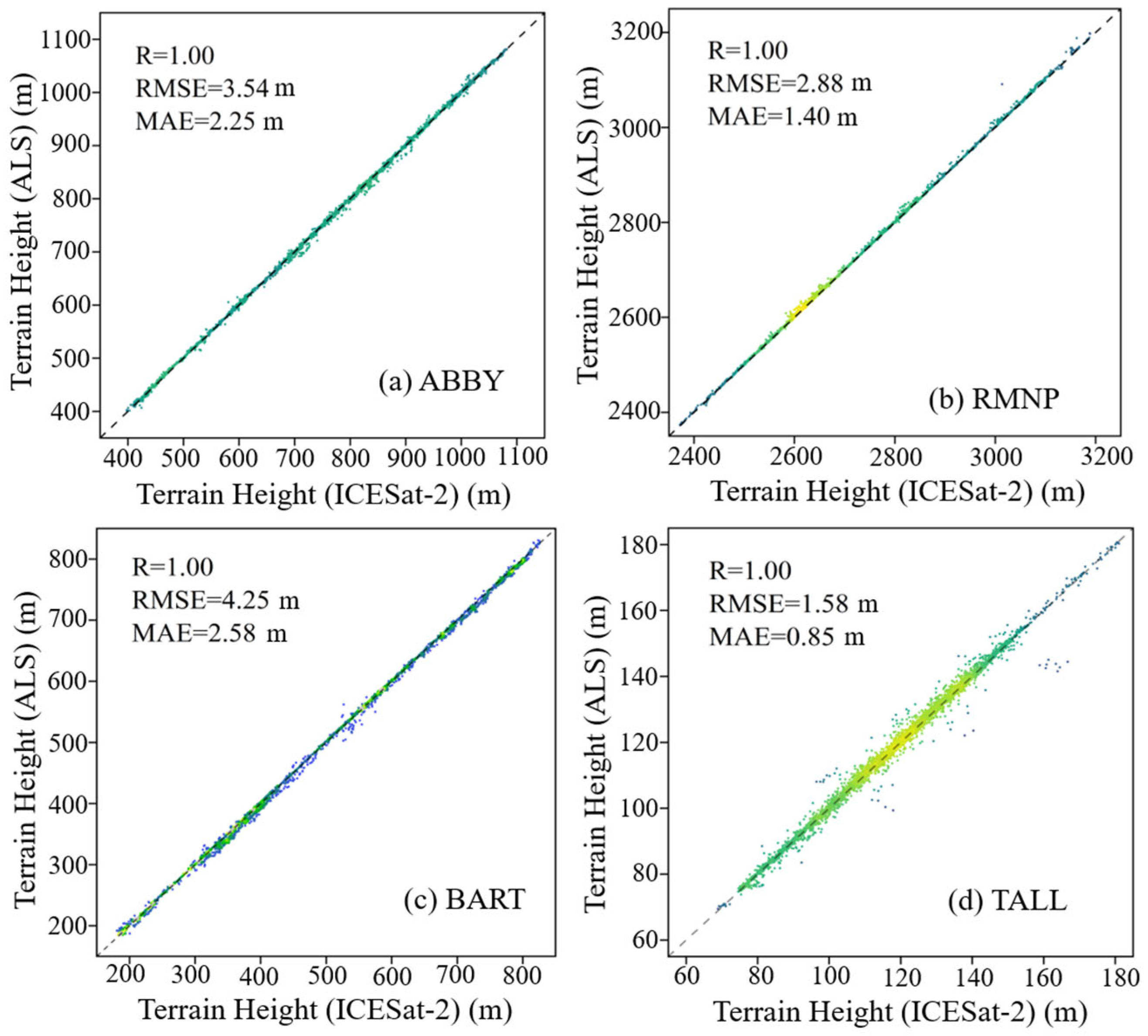
To evaluate the adaptability of our terrain extraction method across diverse geographical environments, validation results under daytime/nighttime and strong/weak beam conditions were integrated for each site. Overall RMSE and MAE were calculated, providing a comprehensive evaluation of the method’s performance across different regions. The results are shown in Figure 13.
In Figure 13, the ABBY and BART sites have higher RMSE and MAE values. Specifically, the ABBY site is located on the eastern slope of the Cascade Range, which has steep terrain with an average slope of 17.5°. The area also contains diverse vegetation and complex canopy structures, with an average canopy height of 34 m. These factors hinder ground photon detection and lead to increased elevation errors at this site (RMSE: 3.54 m; MAE: 2.25 m). The BART site has gentler terrain with a mean slope of 11.89° and is covered by dense evergreen coniferous forest with an average canopy height of 23 m. The high canopy closure limits the penetrability of photons and signals are easily scattered or blocked by the canopy. This leads to significant confusion between ground photons and nearby-ground noise or canopy photons. As a result, this site exhibits the lowest extraction accuracy with an RMSE of 4.25 m and a MAE of 2.58 m. In contrast, the TALL site shows the flattest terrain, with a mean slope of 8.05°. Canopy at this site is relatively tall, with a mean height of 25 m. The forest exhibits a uniform spatial structure, which promotes better laser penetration. This facilitates ground photon identify- cation and results in the highest extraction accuracy at the TALL site (RMSE: 1.58 m; MAE: 0.85 m). The RMNP site is a high-altitude site, ranging from 2400 to 3500 m. It features moderate slopes, with a mean value of 8.85°. The area is dominated by a homogeneous coniferous forest with a relatively low canopy height averaging 19 m. Such conditions cause minimal interference with laser penetration, which enables stable ground photon identification. Consequently, terrain extraction errors remain within acceptable limits, with an RMSE of 2.88 m and a MAE of 1.40 m.
Based on the preceding findings, topographic variations and canopy structure both affect the accuracy of ground photon extraction. Areas with gentle slopes and uniform canopy cover tend to support better laser penetration. These conditions help improve ground point identification. In contrast, steep terrain or dense forests degrade the signal quality. This observation aligns with the conclusions drawn by Mulverhill et al. [2]. These findings also indicate that the effectiveness of the proposed method is partially constrained in environments characterized by steep terrain and highly complex canopy structures.

4.4. The Influence of Canopy Continuity on Canopy Height Estimation

Forest structure and type are key factors influencing lidar observations [41], their effects are especially evident in spaceborne lidar-based estimation of forest parameters such as canopy height [42]. Among structural parameters of forest, fractional vegetation cover (FVC) plays a critical role in determining retrieval accuracy [43]. ICESat-2-based analysis by Wang et al. [44] showed that estimation precision declines as FVC increases. In addition, canopy height STD reflects forest structural complexity [41,45] and it can assess the reliability on canopy height estimation.
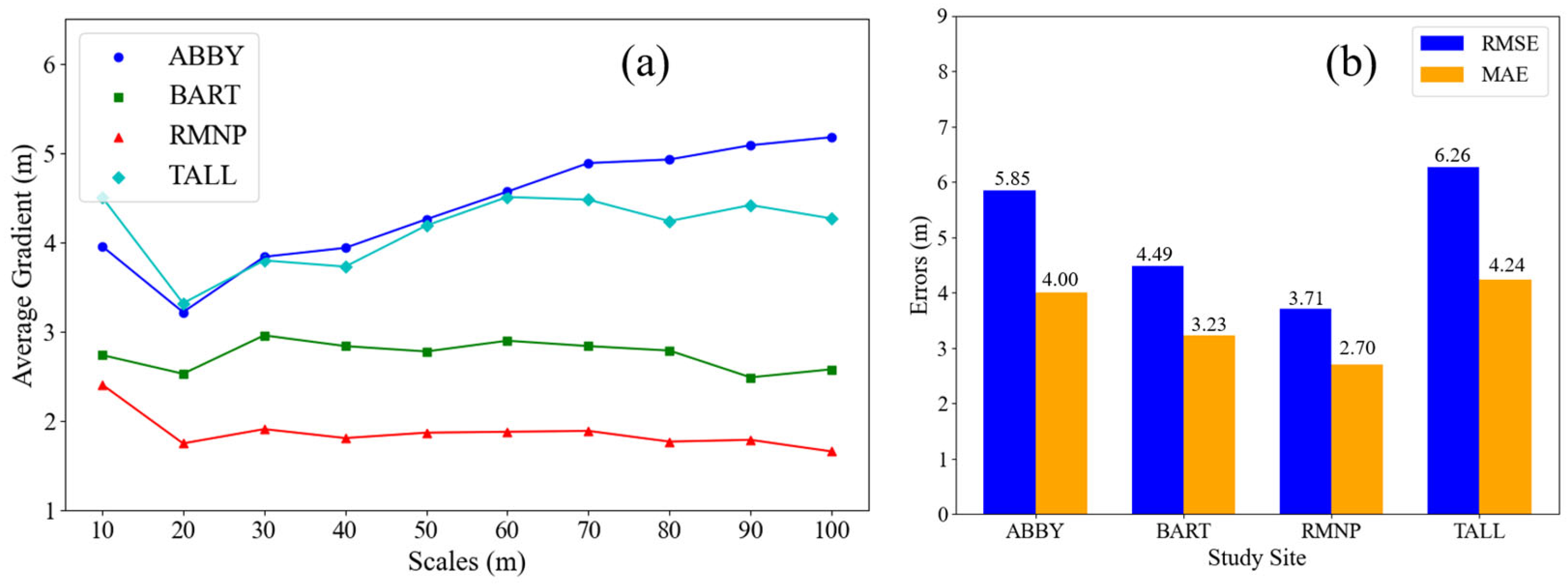
Current studies on forest structure effects are mostly limited to small-scale or fixed-window analyses. The influence of canopy variation across spatial scales remains underexplored. To address this, we propose a new structural indicator: canopy continuity. This is quantified using the Canopy Height Gradient (CHG). Unlike FVC, which represents horizontal canopy cover density, and canopy height standard deviation, which reflects vertical structural variability within individual windows, CHG characterizes the spatial continuity of canopy height along the track. Therefore, CHG complements existing structural metrics by quantifying horizontal structural transitions between adjacent windows rather than vertical dispersion within a single window. The description of this parameter is as follows: At each site, airborne-derived canopy heights are extracted at the locations of the classified TOC photons. Along-track windows with a length of L (unit: m) were applied. The mean canopy height within each window was calculated as Formula (17). The CHG is defined as the difference between the mean canopy heights of two adjacent windows. It is expressed as Formula (18):
H ¯ i = 1 n i m = 1 n i H i , m
C H G i = H ¯ i + 1 H ¯ i
where H i , m represents the canopy height of sample m in window i , and n i denotes the number of samples contained in that window. The unit of CHG is meters (m), representing the magnitude of canopy height variation between neighboring spatial units along the track direction.
The overall CHG (OCHG) represents the mean CHG value across the study area. Lower OCHG indicates higher canopy continuity, and higher OCHG reflects greater structural discontinuity. The results of OCHG and associated canopy height accuracy are shown in Figure 14.
Analysis of Figure 14a reveals significantly higher Overall Canopy Height Gradient (OCHG) values at ABBY and TALL sites, indicating lower canopy continuity across these regions. In contrast, BART and RMNP exhibit comparatively lower OCHG metrics with stable variation trends, demonstrating structurally continuous canopies characterized by smooth spatial transitions. Further examination in Figure 14b shows a clear pattern in canopy height errors. Sites with lower OCHG have smaller RMSE and MAE values. RMNP has the lowest OCHG across all spatial scales. It also achieves the best accuracy with RMSE of 3.71 m and MAE of 2.70 m. In contrast, ABBY and TALL have higher OCHG values. Their estimation errors exceed 4 m (RMSE > 4.00 m; MAE > 3.20 m). These results provide strong evidence that canopy continuity affects estimation precision.
In summary, forest canopy spatial continuity significantly affects canopy height accuracy across different along-track spatial scales. The results show that the OCHG is a reliable indicator of canopy structural complexity. Lower values indicate smoother canopy height transitions within the region. It helps evaluate the accuracy of lidar-based canopy height estimation in such areas.

5. Conclusions

This study developed an integrated multi-stage processing framework that combines photon denoising, classification, and quasi-full-waveform reconstruction to achieve high-accuracy estimation of terrain and canopy height in forested areas. The main innovative contributions of this study are summarized as follows:
(1)
To address the high noise level and unstable photon distributions in daytime observations, a data-driven adaptive denoising strategy is proposed. Otsu’s maximum interclass variance criterion is first introduced to adaptively adjust the Gaussian standard deviation threshold during Gaussian fitting, enabling an initial separation of signal photons. Subsequently, the distribution of photon distance standard deviation is modeled using an exponential function, and dynamic thresholds are applied to further distinguish signal photons from noise. This two-stage adaptive denoising scheme significantly reduces the uncertainty associated with fixed-threshold methods and improves noise suppression in daytime data.
(2)
For low-SNR conditions dominated by multimodal noise, particularly in daytime weak beams, a locally adaptive thresholding strategy driven by multimodal decomposition is developed. By integrating this strategy with a conservative exponential compensation mechanism, the proposed method effectively suppresses noise while preserving canopy-edge signal photons, thereby achieving stable signal extraction under low-SNR conditions.
(3)
An enhanced RANSAC algorithm is employed to remove residual noise from nighttime data and denoised daytime data, followed by accurate classification of ground and canopy photons. On this basis, RBF interpolation is applied to reconstruct terrain and canopy-top surfaces, enabling quasi-full-waveform representations of terrain and canopy height with improved spatial continuity.
(4)
An integrated processing framework is established that enables robust denoising and classification of ICESat-2 photon data across different observation conditions (day/night and strong/weak beams), providing a reliable and extensible technical solution for high-precision retrieval of terrain and canopy height in forested environments.
Validation results demonstrate that nighttime beams consistently achieve higher terrain accuracy than daytime beams. Compared with the ATL08 product, all beam types exhibit improved terrain estimation accuracy, with the most pronounced improvement observed for daytime weak beams, where terrain RMSE decreases from 5.77 m to 4.47 m, indicating enhanced noise resistance under low-SNR conditions. For canopy height estimation, all beams outperform the ATL08 product, with nighttime strong beams yielding the best performance (correlation coefficient r = 0.90, RMSE = 4.32 m, and MAE = 2.97 m). Strong beams benefit from high photon density and clear structural returns, enabling stable extraction of terrain and canopy information. Nighttime weak beams also demonstrate robust identification capability, whereas daytime weak beams are more affected by noise but still provide canopy height estimates with practical reference value.
Overall, the proposed multi-stage framework improves the robustness of photon-based terrain and canopy height retrieval under varying SNR conditions and residual noise environments. Rather than representing a universal replacement, the framework serves as a practical and complementary alternative to the ATL08 product, particularly in observation scenarios where ATL08 performance is constrained by noise or low signal-to-noise ratios. This makes the method a useful technical option for regional-scale forest structural parameter estimation. Nevertheless, performance degradation is observed in areas with steep terrain or highly complex canopy structures. In addition, although the four NEON sites cover diverse forest conditions, they cannot represent all forest types and global environmental settings; therefore, further validation in other ecosystems is needed. Future work will focus on integrating high-resolution stereo optical imagery with ICESat-2 photon data to enhance three-dimensional modeling accuracy in complex environments, as well as incorporating multi-temporal observations to enable dynamic monitoring of forest canopy structure. In addition, error analyses stratified by terrain slope will be considered to further evaluate algorithm performance and robustness in steep and structurally complex forests.

Author Contributions

Conceptualization, Y.L. and H.Y.; Methodology, Y.L., J.D. and H.Y.; Formal analysis, J.H. and J.C.; Data curation, Z.W.; Validation, Z.W. and J.C.; Writing—original draft preparation, Y.L. and H.Y.; Writing—review and editing, Y.L., J.D. and H.Y.; Supervision, J.H. All authors have read and agreed to the published version of the manuscript.

Funding

This research was supported by grants from the National Natural Science Foundation of China (42261063, 41901370), BaGui Young Outstanding Talents Cultivation Program of the provincial government of Guangxi, and Scientific Research Foundation of Guilin University of Technology (GLUTQD2017094).

Data Availability Statement

The data presented in this study are available from the corresponding author by reasonable request.

Conflicts of Interest

The authors declare no conflicts of interest.

References

  1. Saatchi, S.S.; Harris, N.L.; Brown, S.; Lefsky, M.; Mitchard, E.T.A.; Salas, W.; Zutta, B.R.; Buermann, W.; Lewis, S.L.; Hagen, S.; et al. Benchmark map of forest carbon stocks in tropical regions across three continents. Proc. Natl. Acad. Sci. USA 2011, 108, 9899–9904. [Google Scholar] [CrossRef]
  2. Mulverhill, C.; Coops, N.C.; Hermosilla, T.; White, J.C.; Wulder, M.A. Evaluating ICESat-2 for monitoring, modeling, and update of large area forest canopy height products. Remote Sens. Environ. 2022, 271, 112919. [Google Scholar] [CrossRef]
  3. Malambo, L.; Popescu, S.C. Assessing the agreement of ICESat-2 terrain and canopy height with airborne lidar over US ecozones. Remote Sens. Environ. 2021, 266, 112711. [Google Scholar] [CrossRef]
  4. Drake, J.B.; Dubayah, R.O.; Knox, R.G.; Clark, D.B.; Blair, J.B. Sensitivity of large-footprint lidar to canopy structure and biomass in a neotropical rainforest. Remote Sens. Environ. 2002, 81, 378–392. [Google Scholar] [CrossRef]
  5. Wulder, M.A.; White, J.C.; Bater, C.W.; Coops, N.C.; Hopkinson, C.; Chen, G. Lidar plots—a new large-area data collection option: Context, concepts, and case study. Can. J. Remote Sens. 2012, 38, 600–618. [Google Scholar] [CrossRef]
  6. Wang, X.; Liang, X.; Gong, W.; Häkli, P.; Wang, Y. Accuracy fluctuations of ICESat-2 height measurements in time series. Int. J. Appl. Earth Obs. Geoinf. 2024, 135, 104234. [Google Scholar] [CrossRef]
  7. Ma, Y.; Zhang, W.; Sun, J.; Li, G.; Wang, X.H.; Li, S.; Xu, N. Photon-Counting Lidar: An Adaptive Signal Detection Method for Different Land Cover Types in Coastal Areas. Remote Sens. 2019, 11, 471. [Google Scholar] [CrossRef]
  8. Li, B.; Xie, H.; Tong, X.; Liu, S.; Xu, Q.; Sun, Y. Extracting accurate terrain in vegetated areas from ICESat-2 data. Int. J. Appl. Earth Obs. Geoinf. 2023, 117, 103200. [Google Scholar] [CrossRef]
  9. Neuenschwander, A.; Guenther, E.; White, J.C.; Duncanson, L.; Montesano, P. Validation of ICESat-2 terrain and canopy heights in boreal forests. Remote Sens. Environ. 2020, 251, 112110. [Google Scholar] [CrossRef]
  10. Luo, Y.; Qi, S.; Liao, K.; Zhang, S.; Hu, B.; Tian, Y. Mapping the Forest Height by Fusion of ICESat-2 and Multi-Source Remote Sensing Imagery and Topographic Information: A Case Study in Jiangxi Province, China. Forests 2023, 14, 454. [Google Scholar] [CrossRef]
  11. Wu, Z.; Shi, F. Mapping Forest Canopy Height at Large Scales Using ICESat-2 and Landsat: An Ecological Zoning Random Forest Approach. IEEE Trans. Geosci. Remote Sens. 2023, 61, 4400116. [Google Scholar] [CrossRef]
  12. Neuenschwander, A.L.; Magruder, L.A. Canopy and Terrain Height Retrievals with ICESat-2: A First Look. Remote Sens. 2019, 11, 1721. [Google Scholar] [CrossRef]
  13. Neuenschwander, A.; Pitts, K. The ATL08 land and vegetation product for the ICESat-2 Mission. Remote Sens. Environ. 2019, 221, 247–259. [Google Scholar] [CrossRef]
  14. Huang, X.; Cheng, F.; Wang, J.; Duan, P.; Wang, J. Forest Canopy Height Extraction Method Based on ICESat-2/ATLAS Data. IEEE Trans. Geosci. Remote Sens. 2023, 61, 5700814. [Google Scholar] [CrossRef]
  15. Kui, M.; Xu, Y.; Wang, J.; Cheng, F. Research on the Adaptability of Typical Denoising Algorithms Based on ICESat-2 Data. Remote Sens. 2023, 15, 3884. [Google Scholar] [CrossRef]
  16. Chang, B.; Xiong, H.; Li, Y.; Pan, D.; Cui, X.; Zhang, W. ALCSF: An adaptive and anti-noise filtering method for extracting ground and top of canopy from ICESat-2 LiDAR data along single tracks. ISPRS J. Photogramm. Remote Sens. 2024, 215, 80–98. [Google Scholar] [CrossRef]
  17. Xia, S.; Wang, C.; Xi, X.; Luo, S.; Zeng, H. Point cloud filtering and tree height estimation using airborne experiment data of ICESat-2. J. Remote Sens 2014, 18, 1199–1207. [Google Scholar] [CrossRef]
  18. You, H.; Li, Y.; Qin, Z.; Lei, P.; Chen, J.; Shi, X. Research on Multilevel Filtering Algorithm Used for Denoising Strong and Weak Beams of Daytime Photon Cloud Data with High Background Noise. Remote Sens. 2023, 15, 4260. [Google Scholar] [CrossRef]
  19. Tian, X.; Shan, J. Detection of Signal and Ground Photons from ICESat-2 ATL03 Data. IEEE Trans. Geosci. Remote Sens. 2023, 61, 5700314. [Google Scholar] [CrossRef]
  20. Zhang, Z.; Liu, X.; Ma, Y.; Xu, N.; Zhang, W.; Li, S. Signal Photon Extraction Method for Weak Beam Data of ICESat-2 Using Information Provided by Strong Beam Data in Mountainous Areas. Remote Sens. 2021, 13, 863. [Google Scholar] [CrossRef]
  21. Tang, J.; Xing, Y.; Wang, J.; Yang, H.; Wang, D.; Li, Y.; Zhang, A. A Multilevel Autoadaptive Denoising Algorithm Based on Forested Terrain Slope for ICESat-2 Photon-Counting Data. IEEE J. Sel. Top. Appl. Earth Obs. Remote Sens. 2024, 17, 16831–16846. [Google Scholar] [CrossRef]
  22. Wu, Y.; Zhao, R.; Hu, Q.; Zhang, Y.; Zhang, K. Retrieving Sub-Canopy Terrain from ICESat-2 Data Based on the RNR-DCM Filtering and Erroneous Ground Photons Correction Approach. Remote Sens. 2023, 15, 3904. [Google Scholar] [CrossRef]
  23. Fu, L.; Shu, Q.; Xia, C.; Li, Z.; Zhang, X.; Zhang, Y. ICESat-2 Performance for Terrain and Canopy Height Retrieval in Complex Mountainous Environments. Remote Sens. 2025, 17, 1897. [Google Scholar] [CrossRef]
  24. Derpanis, K.G. Overview of the RANSAC Algorithm. Image Rochester NY 2010, 4, 2–3. [Google Scholar]
  25. Zhao, R.; Ni, W.; Zhang, Z.; Dai, H.; Yang, C.; Li, Z.; Liang, Y.; Liu, Q.; Pang, Y.; Li, Z.; et al. Optimizing ground photons for canopy height extraction from ICESat-2 data in mountainous dense forests. Remote Sens. Environ. 2023, 299, 113851. [Google Scholar] [CrossRef]
  26. Herzfeld, U.C.; Lawson, M.; Trantow, T.; Nylen, T. Airborne Validation of ICESat-2 ATLAS Data over Crevassed Surfaces and Other Complex Glacial Environments: Results from Experiments of Laser Altimeter and Kinematic GPS Data Collection from a Helicopter over a Surging Arctic Glacier (Negribreen, Svalbard). Remote Sens. 2022, 14, 1185. [Google Scholar] [CrossRef]
  27. Li, W.; Niu, Z.; Shang, R.; Qin, Y.; Wang, L.; Chen, H. High-resolution mapping of forest canopy height using machine learning by coupling ICESat-2 LiDAR with Sentinel-1, Sentinel-2 and Landsat-8 data. Int. J. Appl. Earth Obs. Geoinf. 2020, 92, 102163. [Google Scholar] [CrossRef]
  28. Neumann, T.A.; Martino, A.J.; Markus, T.; Bae, S.; Bock, M.R.; Brenner, A.C.; Brunt, K.M.; Cavanaugh, J.; Fernandes, S.T.; Hancock, D.W.; et al. The Ice, Cloud, and Land Elevation Satellite–2 mission: A global geolocated photon product derived from the Advanced Topographic Laser Altimeter System. Remote Sens. Environ. 2019, 233, 111325. [Google Scholar] [CrossRef] [PubMed]
  29. Carrasco, L.; Giam, X.; Papeş, M.; Sheldon, K.S. Metrics of Lidar-Derived 3D Vegetation Structure Reveal Contrasting Effects of Horizontal and Vertical Forest Heterogeneity on Bird Species Richness. Remote Sens. 2019, 11, 743. [Google Scholar] [CrossRef]
  30. Wang, B.; Ma, Y.; Zhang, J.; Zhang, H.; Zhu, H.; Leng, Z.; Zhang, X.; Cui, A. A noise removal algorithm based on adaptive elevation difference thresholding for ICESat-2 photon-counting data. Int. J. Appl. Earth Obs. Geoinf. 2023, 117, 103207. [Google Scholar] [CrossRef]
  31. Liu, D.; Yu, J. Otsu Method and K-means. In Proceedings of the 2009 Ninth International Conference on Hybrid Intelligent Systems, Shenyang, China, 12–14 August 2009; pp. 344–349. [Google Scholar]
  32. Guo, G.; Wang, H.; Bell, D.; Bi, Y. KNN Model-Based Approach in Classification. In On The Move to Meaningful Internet Systems 2003: CoopIS, DOA, and ODBASE. OTM 2003; Springer: Berlin/Heidelberg, Germany, 2003. [Google Scholar]
  33. Er, M.J.; Wu, S.; Lu, J.; Toh, H.L. Face recognition with radial basis function (RBF) neural networks. IEEE Trans. Neural Netw. 2002, 13, 697–710. [Google Scholar]
  34. Huang, J.; Xing, Y.; Shuai, Y.; Zhu, H. A Novel Noise Filtering Evaluation Criterion of ICESat-2 Signal Photon Data in Forest Environments. IEEE Geosci. Remote Sens. Lett. 2022, 19, 7003805. [Google Scholar] [CrossRef]
  35. Zheng, X.; Hou, C.; Huang, M.; Ma, D.; Li, M. A Density and Distance-Based Method for ICESat-2 Photon-Counting Data Denoising. IEEE Geosci. Remote Sens. Lett. 2023, 20, 6500405. [Google Scholar] [CrossRef]
  36. Liu, X.; Wang, Z.; Yang, W.; Chen, S.; Wang, F.; Chen, X.; Xu, W.; Shu, R. An Adaptive Signal Photon Detection Method Based on DBSCAN for Photon-Counting Laser Altimeter. IEEE J. Sel. Top. Appl. Earth Obs. Remote Sens. 2024, 17, 3674–3686. [Google Scholar] [CrossRef]
  37. Jia, K.; Ma, Y.; Zhang, J.; Wang, B.; Zhang, X.; Cui, A. A Denoising Methodology for Detecting ICESat-2 Bathymetry Photons Based on Quasi Full Waveform. IEEE Trans. Geosci. Remote Sens. 2024, 62, 4207916. [Google Scholar] [CrossRef]
  38. Liu, J.; Liu, J.; Xie, H.; Ye, D.; Li, P. A Multi-Level Auto-Adaptive Noise-Filtering Algorithm for Land ICESat-2 Photon-Counting Data. Remote Sens. 2023, 15, 5176. [Google Scholar] [CrossRef]
  39. Gan, J.; Tao, Y. On the Hardness and Approximation of Euclidean DBSCAN. ACM Trans. Database Syst. 2017, 42, 14. [Google Scholar] [CrossRef]
  40. Yun, T.; Cao, L.; An, F.; Chen, B.; Xue, L.; Li, W.; Pincebourde, S.; Smith, M.J.; Eichhorn, M.P. Simulation of multi-platform LiDAR for assessing total leaf area in tree crowns. Agric. For. Meteorol. 2019, 276–277, 107610. [Google Scholar] [CrossRef]
  41. He, L.; Pang, Y.; Zhang, Z.; Liang, X.; Chen, B. ICESat-2 data classification and estimation of terrain height and canopy height. Int. J. Appl. Earth Obs. Geoinf. 2023, 118, 103233. [Google Scholar] [CrossRef]
  42. Dubayah, R.; Blair, J.; Goetz, S.; Fatoyinbo, L.; Hansen, M.; Healey, S.; Hofton, M.; Hurtt, G.; Kellner, J.; Luthcke, S. The Global Ecosystem Dynamics Investigation: High-resolution laser ranging of the Earth’s forests and topography. Sci. Remote Sens. 2020, 1, 100002. [Google Scholar] [CrossRef]
  43. Moudrý, V.; Gdulová, K.; Gábor, L.; Šárovcová, E.; Barták, V.; Leroy, F.; Špatenková, O.; Rocchini, D.; Prošek, J. Effects of environmental conditions on ICESat-2 terrain and canopy heights retrievals in Central European mountains. Remote Sens. Environ. 2022, 279, 113112. [Google Scholar] [CrossRef]
  44. Wang, C.; Zhu, X.; Nie, S.; Xi, X.; Li, D.; Zheng, W.; Chen, S. Ground elevation accuracy verification of ICESat-2 data: A case study in Alaska, USA. Opt. Express 2019, 27, 38168–38179. [Google Scholar] [CrossRef] [PubMed]
  45. Jia, W.; Coops, N.C.; Tortini, R.; Pang, Y.; Black, T.A. Remote sensing of variation of light use efficiency in two age classes of Douglas-fir. Remote Sens. Environ. 2018, 219, 284–297. [Google Scholar] [CrossRef]
Figure 1. Location of the study area. (a) ABBY site; (b) RMNP site; (c) BART site; (d) TALL site.
Forests 17 00225 g001
Figure 2. Workflow of the proposed algorithm.
Forests 17 00225 g002
Figure 3. Schematic diagram of the elevation histogram and its Gaussian fitting. The red and green dashed lines indicate the range of conventional and adaptive k σ , respectively. Photons within the green range are classified as signal photons.
Forests 17 00225 g003
Figure 4. Exponential fitting to the STD.
Forests 17 00225 g004
Figure 5. Diagram of the RANSAC algorithm, where H m a x denotes the maximum iteration width.
Forests 17 00225 g005
Figure 6. Classification of photons using the RANSAC algorithm. The red and orange lines indicate the best-fit models for ground and TOC photons within local along-track windows.
Forests 17 00225 g006
Figure 7. Denoising Results of Gaussian Fitting. (a) Denoising performance for strong beams; (b,c) Gaussian fitting results within two along-track windows of strong beam data. (d) Denoising performance for weak beams; (e,f) Gaussian fitting results within two along-track windows of weak beam data. In the histograms, green dashed lines mark is the range defined by the adaptive k for signal extraction. Red dashed lines show the ±3 σ range.
Forests 17 00225 g007
Figure 8. Results of exponential fitting. (a) Denoising performance for strong beams; (b,c) exponential fitting results within two along-track windows of strong beam data. (d) Denoising performance for weak beams; (e,f) Exponential fitting results within two along-track windows of weak beam data.
Forests 17 00225 g008
Figure 9. Results of residual noise removal and photon classification. (a) Daytime strong beam; (b) daytime weak beam; (c) nighttime strong beam; (d) nighttime weak beam.
Forests 17 00225 g009
Figure 10. Results of quasi-full-waveform reconstruction. (a,b) Daytime strong beam; (c,d) daytime weak beam; (e,f) nighttime strong beam; (g,h) nighttime weak beam.
Forests 17 00225 g010
Figure 11. Results of terrain height validation for different beam types. Numbers above the bars indicate error values (m).
Forests 17 00225 g011
Figure 12. Results of height validation for different beam types. (ad) Validation results of the proposed method under daytime strong beam, daytime weak beam, nighttime strong beam, and nighttime weak beam, respectively. (eh) Corresponding validation results of the ATL08 product under the same beam conditions.
Forests 17 00225 g012
Figure 13. Overall terrain extraction accuracy at each study area. (a) ABBY; (b) RMNP; (c) BART; (d) TALL.
Forests 17 00225 g013
Figure 14. Results of the OCHG and the evaluation of canopy height accuracy. (a) OCHG values across various scales of along-track distance windows for each study area; (b) overall canopy height accuracy across all beam types within each study area.
Forests 17 00225 g014
Table 1. Specific details of the ICESat-2 data.
SiteDateTimeTrack Number
ABBY18 July 2021Daytimegt1r, gt1l
25 July 2021Nighttimegt2r, gt2l
RMNP24 August 2022Daytimegt1r, gt1l
25 June 2022Nighttimegt1r, gt1l
BART3 July 2022Daytimegt1r, gt1l
28 October 2022Nighttimegt3r, gt3l
TALL18 January 2022Daytimegt3r, gt3l
18 October 2021Nighttimegt3l, gt3r
Table 2. Detailed information of ALS data used in this study.
SiteDateAverage Slope (°)Average Canopy Height (m)Std, Min, Max Canopy Height (m)Dominant Species
ABBYJuly 202117.503411.21/0/49.69Coniferous forest and
Broadleaf forest
RMNPJuly 20228.85193.56/0/25.54Alpine coniferous forest
BARTAugust 202211.89235.46/0/37.79Evergreen coniferous forest
TALLMay 20218.05258.28/0/41.68Mixed evergreen-deciduous
broadleaf forest
Table 3. Histogram intervals and the interval-specific counts of k values.
Beam TypeSTD Interval (σ)Histogram Elevation Bin Size (m)
22.533.544.55
Strong0–1.5568568567568568568568
1.5–3329332334331334335335
>3166163162164161160160
Weak0–1.5246246246246246246246
1.5–30000000
>31111111
Table 4. Influence of the compensation term on denoising performance.
Beam TypeCompensation Term (m)ABBYRMNPBARTTALL
RsRnRsRnRsRnRsRn
Strong00.980.890.990.930.970.910.990.91
20.990.881.000.920.980.900.990.90
40.990.861.000.900.990.881.000.88
61.000.831.000.870.990.851.000.86
81.000.821.000.860.990.831.000.86
101.000.821.000.860.990.831.000.86
Weak00.910.950.890.940.860.960.880.95
20.940.930.930.950.900.940.930.92
40.960.900.960.930.930.930.970.90
60.980.880.980.910.950.920.980.88
80.980.840.990.880.960.870.980.85
100.990.820.990.860.960.850.990.85
Table 5. Overall denoising performance and computational efficiency.
SiteBeam TypeRsRnPFTime (s)
ABBYDay_strong0.970.920.810.88344.89
Day_weak0.970.930.750.79301.78
Night_strong0.990.350.940.96187.08
Night_weak0.990.440.930.95141.10
RMNPDay_strong0.990.940.790.88325.48
Day_weak0.930.950.790.85298.58
Night_strong1.000.150.900.95189.25
Night_weak1.000.170.890.94157.42
BARTDay_strong0.960.930.760.85312.39
Day_weak0.920.960.720.78272.05
Night_strong1.000.660.950.97261.02
Night_weak1.000.830.940.97166.92
TALLDay_strong0.990.940.860.92281.19
Day_weak0.940.920.800.86312.31
Night_strong0.990.810.840.91154.52
Night_weak0.980.850.820.90132.62
Disclaimer/Publisher’s Note: The statements, opinions and data contained in all publications are solely those of the individual author(s) and contributor(s) and not of MDPI and/or the editor(s). MDPI and/or the editor(s) disclaim responsibility for any injury to people or property resulting from any ideas, methods, instructions or products referred to in the content.