Article

Assessing the Impact of Catchment-Oriented Harvest Scheduling on Financial Returns and Rainfall-Induced Landslide Susceptibility of Radiata Pine (Pinus radiata D.Don) Plantations in the Uawa Catchment, Gisborne, New Zealand

1
Faculty of Forestry, Universidad de Chile, Santiago 8330111, Chile
2
School of Forestry, Faculty of Engineering, University of Canterbury, Christchurch 8041, New Zealand
3
Earth Sciences New Zealand, Fairway Drive, Lower Hutt 5011, New Zealand
4
MapHQ Limited, Blenheim 7201, New Zealand
*
Author to whom correspondence should be addressed.
Forests 2026, 17(2), 170; https://doi.org/10.3390/f17020170
Submission received: 5 December 2025 / Revised: 21 January 2026 / Accepted: 21 January 2026 / Published: 27 January 2026
(This article belongs to the Section Forest Operations and Engineering)

Abstract

Severe storm damage has prompted calls to restrict large-scale clearfelling on Aotearoa, New Zealand’s erosion-prone land. We evaluated the impact of traditional versus catchment-oriented forest harvest scheduling of radiata pine (Pinus radiata D.Don) plantations on profitability and rainfall-induced landslide susceptibility in the Uawa catchment, Aotearoa, New Zealand. Fifty-nine per cent of the Uawa catchment area is covered with radiata pine plantations (31,899 hectares). These plantations are located within 89 catchment management units (CMUs) and 1123 hill slope units (HSUs). The HSUs are assumed to be the forest stands with stand ages as measured in 2024. We maximised the net present value of the forests subject to non-declining yield constraints, considering different maximum harvesting levels (MHLs) (10% to 50% of CMU area) that could be allowed for any single CMU during any single 5-year period. We found that profitability increased rapidly when the MHL increased from 10% to 20%, with only marginal increases after 25%. We chose an MHL 25% as optimal as it marginally reduced the internal rate of return (IRR) from the business-as-usual scenario (8.92%) to 8.52%. We calculated a proxy for rainfall-induced landslide (RIL) susceptibility as the aggregated sum of the area harvested from each HSU, multiplied by its RIL susceptibility. We then imposed on the MHL 25% scenario constraints for the RIL proxy to become constant over successive periods. This new scenario further reduced the IRR to 6.97% mainly explained by excluding the highest RIL prone stands from harvesting. Forest owners’ concerns about the economic and operational effects of catchment-oriented harvest scheduling appear to be surmountable.

1. Introduction

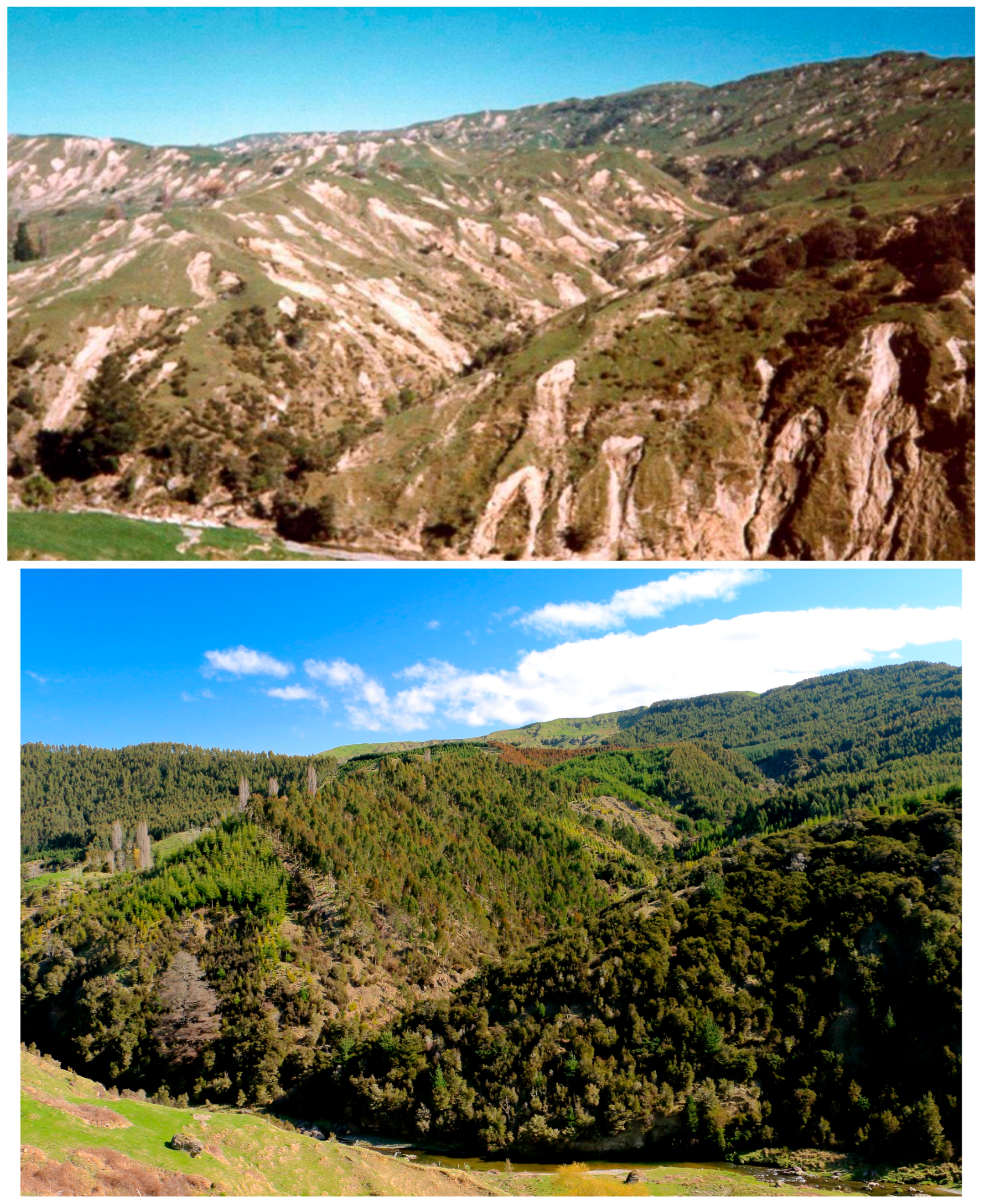
In Aotearoa, New Zealand (henceforth “New Zealand”), 24% of plantation forests are located on steep, erosion-susceptible lands [1]. In many cases, these steepland plantations were deliberately established to control soil erosion that followed the large-scale clearance of indigenous forests and their conversion to grassland for pastoral farming. This strategy has proved successful (Figure 1).
However, these plantations are typically clearfelled for commercial wood production when mature. Clearfelling on erosion-susceptible lands creates a “window of vulnerability” (WoV), where soil reinforcement by tree roots, rainfall interception, and evapotranspiration are drastically reduced, increasing erosion susceptibility by three- to ten-fold compared with mature forests [2]. The WoV lasts approximately six years until replanted trees grow large enough to protect the soil [2]. Over 90% of the forest plantation area in New Zealand comprises even-aged, single-species stands of radiata pine (Pinus radiata D.Don) managed under a clearfell regime with a rotation length of approximately 28 years [3]. Thus, the first six years (or 21%) of a 28-year radiata pine plantation rotation are in the WoV.
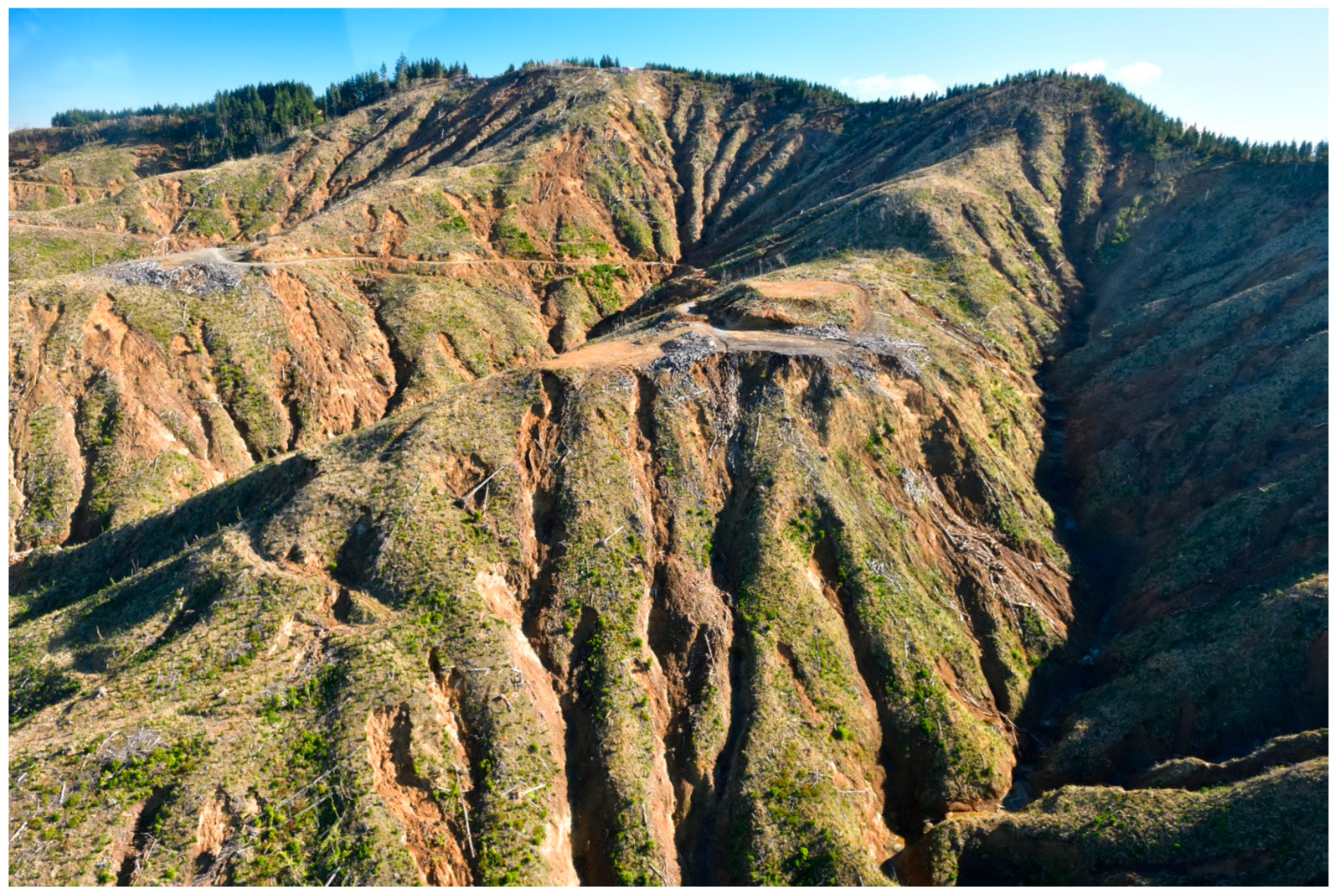
Many of the forests established for erosion control in New Zealand were planted over large areas in a short time, with entire catchments planted within three to five years in some cases. Because these plantation forests were managed as commercial forests for wood production, they were typically clearfelled at or near the average New Zealand rotation age of 28 years. This has resulted in very large clearfelling areas (Figure 2) extending for several hundreds or even thousands of hectares [4].
Erosion-susceptible lands in New Zealand are prone to rainfall-induced landslide (RIL) events, where large numbers of shallow landslides occur within areas ranging from tens to thousands of square kilometres, typically triggered by intense or long-duration regional rainfall [5]. When a harvested forest in the WoV experiences a RIL event, increased erosion susceptibility can result in much higher landsliding rates. Because the landslide discharges are occurring on harvested sites, considerable volumes of woody debris (“slash”) are mixed in with the landslide, resulting in downstream discharges of sediment and woody material [6].
Over the last 15 years in New Zealand, plantation forest harvesting has led to multiple sediment and logging slash impacts on downstream communities and environments [4]. Two notable examples are as follows:
  • In June 2018, two RIL events in Tairāwhiti, Gisborne District, resulted in catastrophic discharges of sediment and slash from recently clearfelled plantation forests. These unauthorised discharges led to five forestry companies being prosecuted and convicted under New Zealand’s Resource Management Act 1991 [4].
  • Between 11 and 17 February 2023, Tropical Cyclone Gabrielle impacted ~40% of the North Island (46,000 km2) with rainfall recurrence intervals exceeding 250 years in places [7]. Landslide analysis in Tairāwhiti, Gisborne, and Hawke’s Bay showed landslides within plantations preferentially occurred on slopes clear felled 3–5 years before Cyclone Gabrielle, i.e., within the WoV.
In the aftermath of Cyclone Gabrielle, a “Ministerial Inquiry into Land Use causing woody debris and sediment-related damage in Tairāwhiti and Wairoa” (MILU) was convened [8]. The MILU recognised the link between clearfelling and landsliding on erosion-susceptible land. It recommended a halt to large-scale clearfell harvesting in Tairāwhiti, Gisborne, and the neighbouring Wairoa District, with maximum coupe sizes of 40 ha and limits to the annual clearfelled area within a catchment of ≤5% per year [8].
Internationally, such “catchment-oriented harvesting” (restrictions on the size and location of clearfell coupes) is a widely accepted strategy [9]. In contrast, the need for small clearfelling coupes has not been accepted unconditionally by the New Zealand forest industry [4]. There are few examples of catchment-oriented harvesting in New Zealand, where large single-age plantation forests have been systematically harvested with coupe size and location restrictions.
This study assesses the impact of traditional versus catchment-oriented harvest schedules on financial returns, wood flows, landslide susceptibility, and WoV location and size. We test the hypothesis that catchment-oriented harvest scheduling can mitigate landslide susceptibility with minimal economic impact and predict that alleged drawbacks are surmountable.

2. Materials and Methods

2.1. Study Area

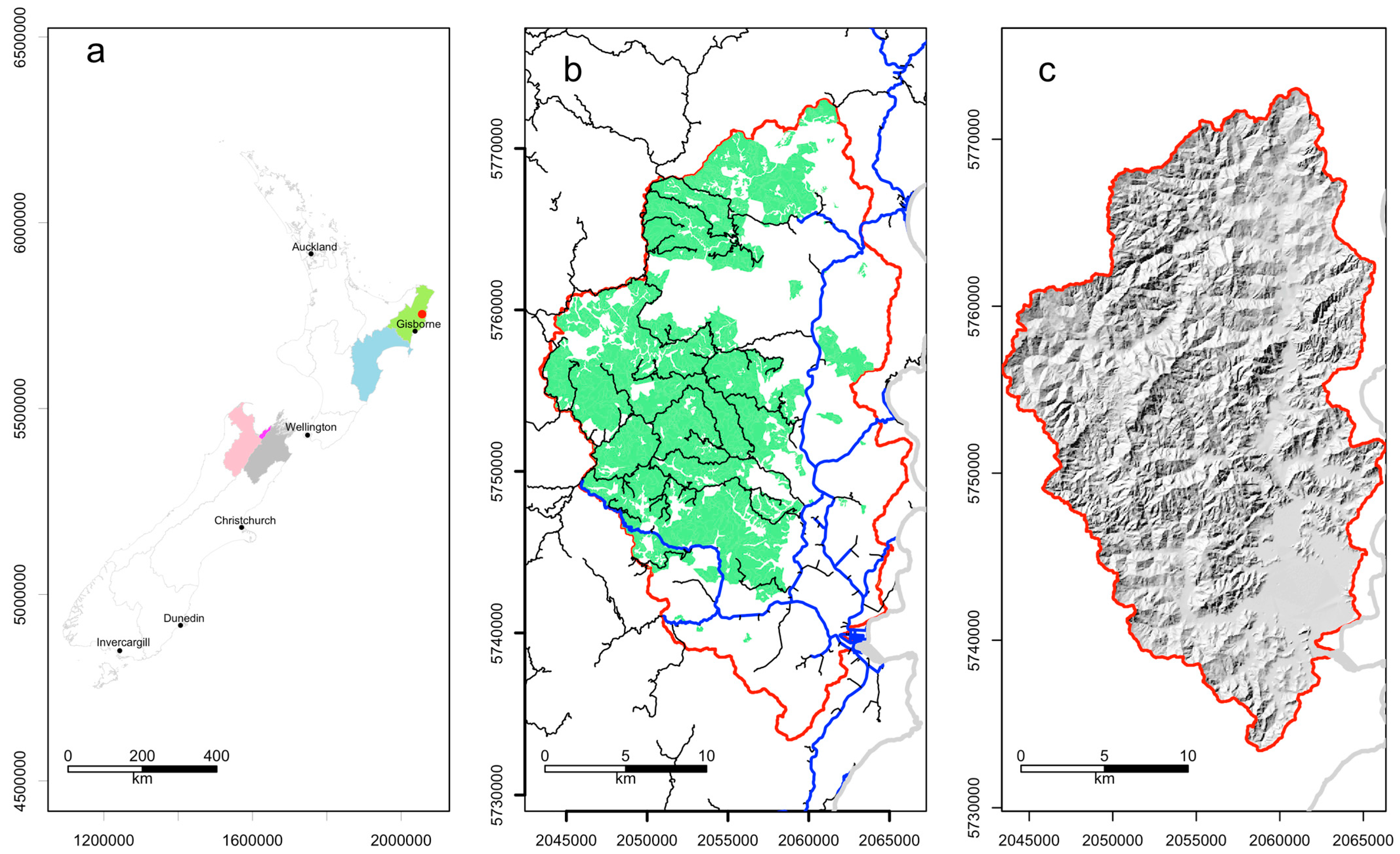
This hypothetical case study simulates radiata pine plantation management in the Uawa catchment, Tairāwhiti, Gisborne district, New Zealand (Figure 3). This area was chosen because it was severely impacted by June 2018 storms, with prior clearfelling of several thousand hectares over 3–5 years causing catastrophic downstream effects [8]. Much clearfelled forest was replanted in radiata pine, so large areas of even-age plantations will be harvest-ready from 2045 onwards. Unconstrained clearfell harvesting could result in landslide disasters of a similar scale to June 2018.
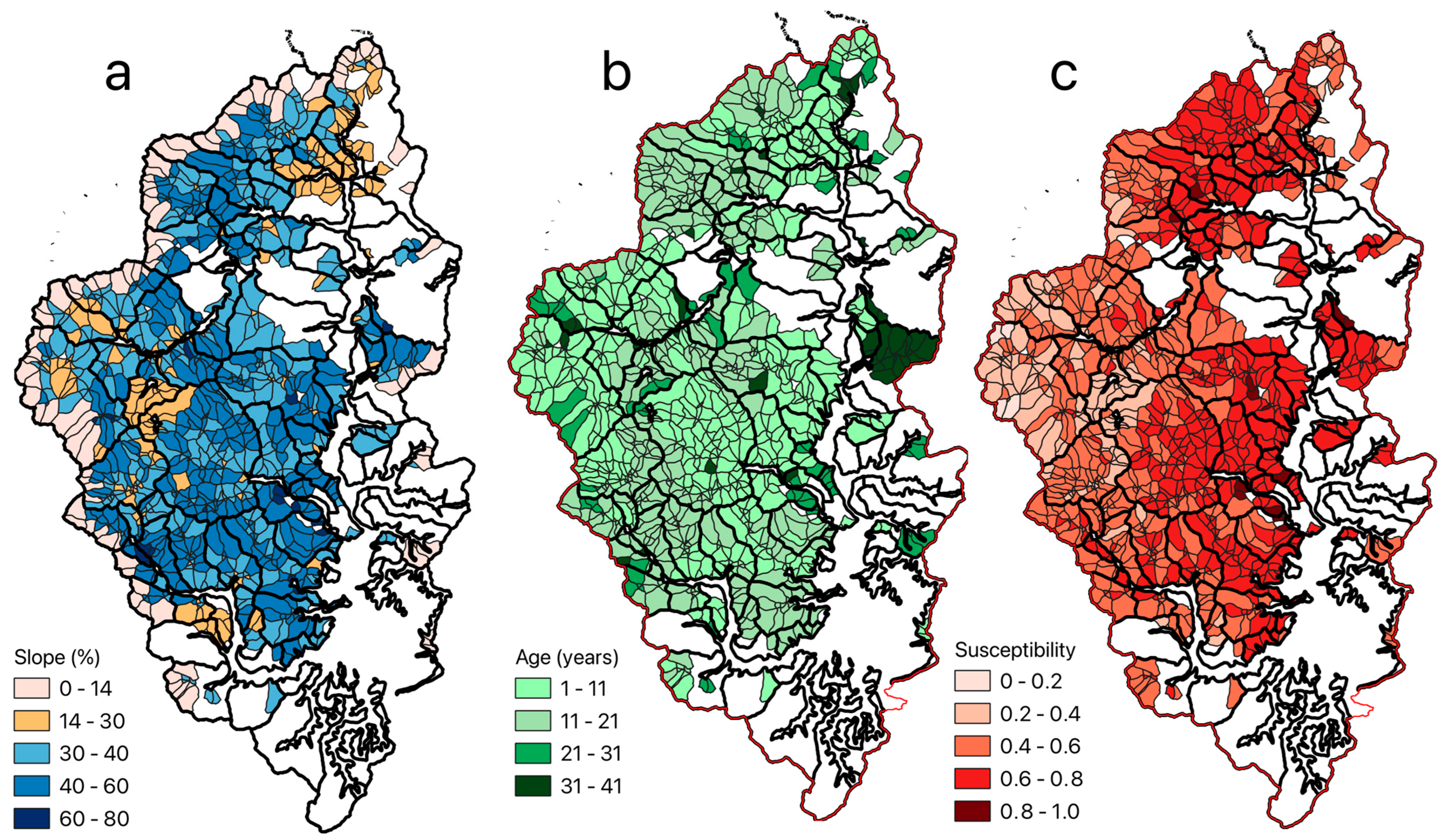
The Uawa catchment has a total area of 53,866 ha and a perimeter of 168 km. Terrain varies substantially across the catchment (Figure 3c), being generally gentler in the lower part and rugged in the upper part where radiata pine plantations are mostly located. The Uawa catchment has an average slope of 32% (±20%) while the forest plantations have an average slope of 38% (±16%) (Table 1).

2.2. The Forestry Catchment Planner

The Forestry Catchment Planner (FCP, https://www.forestrycatchmentplanner.nz/, accessed on 4 August 2025) is a geospatial app that uses region-wide maps of plantation forest areas and ages to predict where and when clearfell harvesting is likely to occur, and, therefore, forest land will be in the WoV. The FCP then uses maps of erosion susceptibility to show if the land in the WoV is highly erosion-susceptible, and therefore more likely to generate landslides and other erosion processes. This allows visualisation of the future spatial distribution of the risk of sediment (from erosion) and harvesting slash discharges [10]. Currently, the FCP covers the Tairāwhiti, Gisborne District, and the Hawkes Bay regions in the North Island of New Zealand, as well as the Te Tau Ihu region (comprising Nelson, Marlborough, and Tasman Districts) in the South Island of New Zealand (Figure 3a).
In this study, we use the FCP for the following tasks:
  • Predicting the spatial and temporal occurrence of plantation forest clearfelling in the Uawa catchment over a 30-year planning period (2025–2055), under different catchment-oriented harvesting scenarios.
  • Identifying the landslide susceptibility of areas clearfelled under the different scenarios.
We then use the predicted plantation forest clearfelling for each scenario to calculate forest wood flows, cash flows, variation in landslide susceptibility due to clearfelling, and overall economic performance of forests. Thus, we can evaluate each scenario using both commercial (wood flow, cash flow, and financial metrics) and environmental (landslide susceptibility and erosion mitigation) criteria.

2.2.1. Catchment Management Units (CMUs)

While MILU recommended a 5% annual harvested area limit within catchments [8], it did not define “catchment”, preventing practical application. FCP solves this by defining catchments as CMUs, dividing the landscape into units for visualising and managing clearfell harvesting locations in steepland forests.
CMU’s are defined using a longstanding concept in fluvial geomorphology where a fluvial system comprises three parts (Table 2): Zone 1 comprises the headwater subcatchments from which most sediment and water originate; downstream of Zone 1 is Zone 2, the transfer zone in which, if stable, sediment inputs equal sediment outputs; and downstream of Zone 2 is Zone 3, the area where deposition is the dominant process [11].
A CMU is a subcatchment upstream from where Zone 2 transitions to Zone 1, containing Order 1 and 2 streams that flow together into an Order 3 stream. This confluence with Order 3 streams typically occurs at a “pour point” through which all sediment and water discharges flow from a Zone 1 subcatchment into a river channel located in Zone 2.
This concept works well in the New Zealand context, since most steepland plantation forests on erosion-susceptible land are located in Zone 1. Discharges of sediment and woody debris from a CMU in Zone 1 will directly impact the natural and built environment in Zone 2, although sediment and woody debris will eventually be transported by the fluvial system down to Zone 3 or even the coastline.

2.2.2. Hill Slope Units (HSU)

Each CMU is subdivided into multiple hill slope units (HSUs), typically Order 1 or 2 catchments (“headwater streams”) dominated by steep slopes and high gradients where erosion dominates. We do this because significant variation in erosion susceptibility and landsliding can exist within CMUs. Each HSU represents areas reasonably similar in erosion susceptibility and likelihood of delivering woody debris and sediment downslope to the CMU pour-point.
The average size of HSUs within the areas covered by the FCP is 28 ha (ranging from 1 to 450 ha). HSUs were defined using the watersheds in the New Zealand River Environments Classification (REC2) database [12]. HSUs usually correspond to Order 1 and/or Order 2 subcatchments in the REC2 classification. Some REC2 watersheds occur on both sides of the stream channel. These were split using the REC2 riverlines so that individual HSUs were defined on either side of the channel. Areas of flat land on floodplains, terraces or low fans were removed from the hill slope units. These flat lands were identified using data from the New Zealand Land Resource Inventory database [13]. They were clipped from the hill slope units, typically excluding slopes with angles less than 8 degrees [10].

2.2.3. Rainfall-Induced Landslide Susceptibility Layer

The rainfall-induced landslide (RIL) probability model was developed by Rosser et al. (2021) [14]. The output from the RIL probability model is a spatial raster (or grid) covering New Zealand showing the probability of a landslide occurring in a given grid cell or pixel (32 × 32 m), when subject to a 100-year return interval rainfall event. The model was developed from existing storm landslide inventories compiled for 20 nationwide storm events during the period 1938–2019. Rainfall data for each storm event were obtained from the National Climate Database (https://data.niwa.co.nz/pages/clidb-on-datahub, accessed on 4 August 2025). Rainfall data included 24 h maximum and storm rainfall totals. Logistic regression modelling was used to determine RIL probabilities for a 100-year return interval based on storm intensity and duration and topographic and soil factors. This model is incorporated into the Forestry Catchment Planner (FCP).
The FCP aims to identify the area and location of erosion-susceptible plantation forests within a CMU, as harvesting these forests will influence the amount of erosion and, consequently, the sediment that flows out of the CMU and into Zones 2 and 3. To manage this erosion and sediment flowing out of the CMU, we need to manage the area of erosion-susceptible land within the CMU that is in the WoV at any point in time [10]. To this aim, erosion susceptibility was spatially defined using the outputs from the rainfall-induced landslide (RIL) prediction model developed by Rosser et al. (2021) [14]. In the FCP, these landslide probabilities were averaged for each HSU.
The RIL susceptibility layer in the FCP allows us to visualise where rainfall-induced landslide susceptibility is relatively higher or lower (Figure 4c). This can inform decisions about managing clearfelling and the cumulative area in the WoV in each CMU at any one time [10].

2.3. Forest Estates Under Study

We assumed that the HSUs that intercepted the plantation forest cover of the Uawa catchment (Figure 3b) would be managed as forest stands in our hypothetical case study. with stand ages as of 2024. Geospatial layers with this information can be downloaded from the FCP website (https://www.docs.forestrycatchmentplanner.nz/, accessed on 6 August 2025). The planning horizon was set at 30 years (2025–2055) with 5-year planning periods.
The forest estate in the Uawa catchment comprised 1123 HSUs within 89 CMUs, covering an area of 31,899 ha, representing 59% of the total catchment area. Twenty-five per cent of the HSUs were below 7.8 ha, 50% below 20.8 ha, and 75% below 39.0 ha. The maximum HSU size was 182 ha. The forest estate was relatively young, with 42% of the area below 10 years, 46% between 10 and 20 years, 7% between 20 and 30 years, and 6% above 30 years (maximum age 39 years) (Figure 4b). In terms of rainfall-induced landslide susceptibility, 86% of forested HSUs were above 0.4 (extreme susceptibility), with only 14% of the area below 0.4 (i.e., high or very high susceptibility) (Figure 4c).

2.4. Estimates of Total Recoverable Stem Volume and Log Outturn

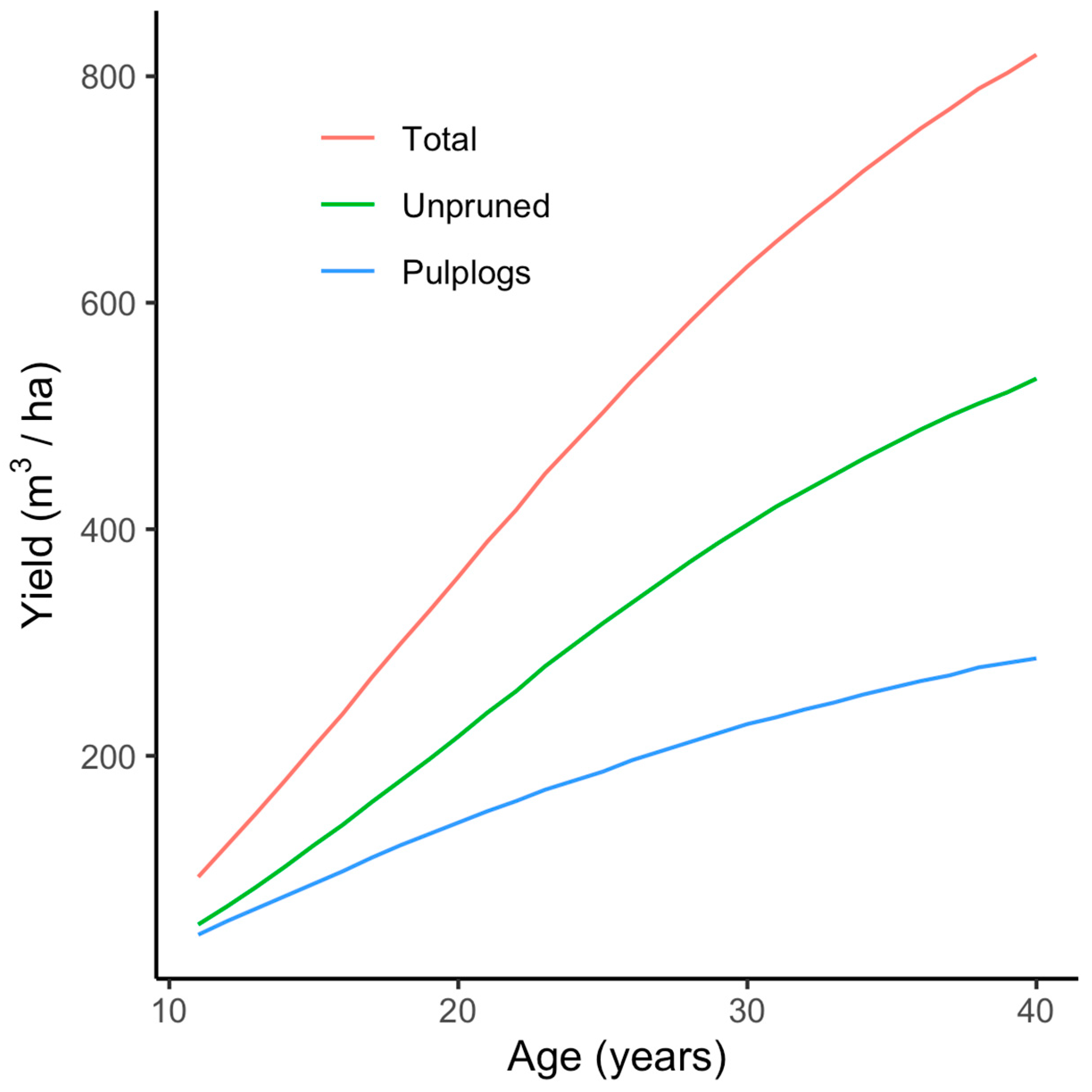
For simplicity, we used one timber yield trajectory. We used the yield table for radiata pine planted post-1989 under an unpruned, without production thinning regime from the Gisborne or East Coast region from the National Exotic Forest Description yield tables (https://www.canopy.govt.nz/forestry-data-research/national-exotic-forest-description, accessed on 6 August 2025). We chose “Unpruned without production thinning” as it is the most common tending regime in New Zealand (55% of plantation area) [15]. This table provides log outturn for total, unpruned, and pulplogs for ages 11–40 years (Figure 5). This regime produces structural grade timber with high demand from China, Korea, Japan, and the domestic market (https://www.canopy.govt.nz/market-forest/what-silviculture-regime, accessed 8 August 2025). It is worth noting that stands have different ages at the start of the planning horizon (Figure 4b); therefore, yield predictions along the planning horizon are unique for each stand.
For tactical harvest scheduling planning, we used a fitted model to interpolate the total volume presented in Figure 5: y = 1037(1 − 1/e(0.069x))3.708, where y is total recoverable volume (m3/ha), and x is age in years since planting.

2.5. Timber Value

We used indicative radiata pine prices and weighted averages for the June 2025 quarter from the New Zealand Ministry of Primary Industries (https://www.canopy.govt.nz/forestry-data-research/indicative-radiata-pine-log-prices, accessed on 6 August 2025), i.e., unpruned A Grade 148 NZD/m3, unpruned K Grade 138 NZD/m3, and pulplogs (117 NZD/m3). Considering log outturn and prices, we calculated a weighted average price as a function of age, which only marginally changed (range 133–134 NZD/m3) from ages 20–40. For this reason, we used the average price for total recoverable volume at 134 NZD/m3 as a constant for all ages.

2.6. Silvicultural and Management Costs

All costs related to silviculture and management were estimated based on published sources (Table 3). Initial establishment expenses in year 0 were NZD 2034/ha and covered activities such as land preparation, planting, release spraying, and mapping. Stands were unpruned. Thinning was performed at ages 4 and 8 to reduce stocking to 450 stems/ha at a cost per operation of NZD 900/ha, representing a cost of NZD 1278/ha at a discount rate of 6% p.a. Annual operating costs covered forest management (NZD 40/ha/year) and insurance (NZD 42/ha/year) (Table 3). The land cost was a fixed cost at NZD 10,000/ha charged at the beginning of the planning horizon and recovered at the end of the 30-year planning horizon.

2.7. Harvesting, Roading, and Transport Costs

Harvesting costs were estimated for each HSU based on the Visser Costing Model (VCM) [16,17]. The VCM calculates the harvesting cost (NZD/m3) as a function of slope (%), total recoverable volume (m3/ha), and stand area (ha). The current road network for our case study comprises 202.911 km within 31,899 ha, which equates to a road density of 6.35 m/ha. We assume these are primary roads, while access to secondary and spur roads were calculated according to the VCM, in which roading cost depends mainly on stand area (ha) and total recoverable volume (NZD/m3). For further details about the VCM see Appendix A. Transport costs to a mill were estimated at 19 NZD/m3, assuming a cartage distance of 100 km and transport carried out by a log truck [18].
We also added a premium to those units with their centroids within a buffer of 200 m from primary roads, as road construction costs will be minimal compared with areas where those roads are not available. Roading costs for these units were considered zero.

2.8. Accounting for Fixed Costs

We considered fixed costs due to land value, stumpage, and existing roads. Because the total area for the case study was 31,899 ha, the land value was NZD 263,450,609 (land value at year 0 minus discounted land value at year 30). Considering an administration cost of 82 NZD/ha/year over the total forest estate, the annual value of the series over 30 years amounts to NZD 43,466,815. The current road length within the forest estate is 202.911 km. Using past road construction costs (pers. comm. Robin Webster, 7 February 2025) corrected for inflation, we arrived at a value of 137,091 NZD/km for primary roads. Based on that, we consider that existing roads could be valued at NZD 27,817,271. Stumpage was obtained by multiplying the total recoverable volume times the net price (gross price minus harvesting, roading and transport cost) for each HSU at the start of the planning horizon. When the difference between price and costs was negative, we considered the stumpage to be zero. The total stumpage value for the forest estate was NZD 153,562,623. Therefore, the total fixed cost at year zero, considering land value, stumpage and existing roads was NZD 488,297,318.
Optimisation models, such as those used for harvest scheduling, typically exclude fixed costs from the objective function as they do not affect the optimal solution among feasible production plans. They are considered in post-optimisation or subsequent decision-making [19].

2.9. Tactical Planning Model

The proposed spatially explicit tactical model aims to determine a harvest schedule for all forest stands located in the Uawa catchment, maximising profit (NPV, IRR) while maintaining a non-declining yield (NDY) and controlling rainfall-induced landslide susceptibility. All costs and revenue were discounted at a rate of 6% for calculation of NPV.
The tactical model is described by four components: decision variables, parameters (or known values), an objective function, and constraints, described in more detail below.

2.9.1. Decision Variables

The decision variable selected is an integer binary variable, i.e., it takes either a value of 0 or 1 but not a fractional value. There are as many variables as stands and periods.
xitA binary variable that indicates whether stand i is harvested in period t (1) or not (0)
where
i ∈ A (stand, A is the set of stands);
t: 1, 2, …, m (time period).

2.9.2. Auxiliary Variables

Auxiliary variables are a combination of decision variables and parameters. They do not influence the final solution but document and keep track of management quantities relevant for decision-making. For this case study, there are two auxiliary variables:
HtAn auxiliary variable to account for the total volume harvested in period t;
StAn auxiliary variable to account for the weighted sum of rainfall-induced landslide (RIL) probability times areas harvested in period t. We hypothesise this value as a surrogate for landslides and therefore discharges of sediment and woody debris.

2.9.3. Parameters

The parameters of the model refer to specific values that characterise the forest and its management at the tactical level. Parameters describing the forest estate include the stand areas, recoverable volumes along the planning horizon, and RIL probabilities, among others. A list of these parameters is given below:
ASet or list of all HSUs (stands) that are within the Uawa catchment forest estate.
CSet or list of all catchment management units (CMUs) intersected with the forest estate. Each CMU has one or more HSUs and may have an area without forest cover.
CjSet or list of all HSUs within a particular CMU j. For each CMU in list C, there is a list of stands which are within CMU j.
mNumber of periods, e.g., for 6 periods of 5 years each, m = 6.
aiArea of stand i (ha).
vitTotal recoverable volume (m3/ha) that could be harvested from stand i in period t (period t goes from 1 to m).
siSusceptibility to rainfall-induced landslide (RIL) of stand i when harvested.
NPVitNet present value (NZD/ha) from harvesting stand i in period t.
The NPVit is an auxiliary parameter derived from harvesting 1 ha of spatial unit i in period t. Therefore
N P V i t = v i t   p i t C s ( 1 + r ) t
where pit is the net price per cubic metre at mill gate considering the harvesting, roading, and transport cost estimated using the VCM [16,17], from unit i in period t, Cs is the discounted silvicultural cost of establishment and thinning after harvesting, and r is the interest or discount rate (6% in this study).

2.9.4. Objective Function at the Tactical Level

The objective function aims to maximise the net present value from harvesting the stands over the planning horizon. This is represented by
M a x   z = i t a i   x i t   N P V i t

2.9.5. Constraints at the Tactical Level

(a)
Area constraints: Each stand can only be harvested once along the tactical planning horizon (30 years) or left unharvested:
t x i t 1                       i
(b)
The total volume harvested in each period, being an auxiliary variable, is calculated as follows:
H t = i a i   x i t   v i t                       t
(c)
Non-declining timber yield. This constraint ensures that volumes harvested do not decline over the planning horizon,
H t + 1 H t                     t < T
(d)
Aggregated RIL susceptibility per period: The RIL susceptibility from harvested areas in each period, being an auxiliary variable, is calculated as follows:
S t = i a i   x i t   s i                       t
(e)
Declining RIL susceptibility. This constraint ensures that aggregated RIL probabilities are declining along the planning horizon,
S t + 1 S t                   t < T
(f)
Non-declining RIL susceptibility. This constraint ensures that aggregated RIL susceptibilities are non-declining along the planning horizon,
S t + 1 S t                   t < T
(g)
RIL susceptibility is allowed to vary by no more than 10% from one period to the next. This constraint ensures that aggregated RIL susceptibilities does not greatly change along the planning horizon,
S t + 1 0.9   S t                   t < T S t + 1 1.1   S t                   t < T

2.10. Optimisation Algorithm

The tactical spatially explicit harvest schedule problem was programmed using the Operations Research language MATHPROG, read using package Rglpk (version 0.6-5.1) and solved using the GUROBI (version 12.0.3) commercial package [20] in the R system for statistical computing [21]. Both R packages, and particularly GUROBI, provide a high-level interface to R for solving large-scale linear programming (LP) and mixed-integer linear programming (MILP) problems.

2.11. Scenarios Analysed

Tactical planning was carried out for the following scenarios.

2.11.1. Base Scenario

Tactical harvest scheduling, which is the core of this study, was programmed for the forest estate described in Section 2.3, considering maximising the NPV of the harvest schedule over a planning horizon of 30 years, with time aggregation into 5-year periods, and subject to non-declining yield (NDY) constraints. During the tactical planning horizon (30 years), each stand should be harvested at most once. Here, it is implicitly assumed that we are only concerned with first-harvest and that replanted stands will not reach a profitable age within the planning horizon. This is a reasonable assumption given the age distribution of the forest estate (see Section 2.3) and structural regime rotations of about 28 years. The minimum harvest age was set to 20 years while there is not maximum.

2.11.2. Catchment-Oriented Harvest Schedule Scenarios

The forest estate under study was divided into stands equivalent to the HSUs, which were contained within CMUs as developed from the FCP [10]. Under the catchment-oriented harvest schedule, we took the base scenario and then added restrictions so that no more than a given percentage of each CMU would be harvested at any given five-year period. We tried different maximum harvesting levels (MHL) (10% to 50% of the CMU area with 5% steps) to assess the effect of such a policy on profitability.

2.11.3. Scenarios Including Proxies of Rainfall-Induced Landslides

Taking the previous best catchment-oriented harvest schedule scenario (i.e., the one considered best within MHLs 10%–50%), we added a representation of rainfall-induced landslide susceptibility. This proxy was calculated as the cumulative sum of the HSU areas harvested times their RIL probabilities, for each period. We then tested declining and non-declining susceptibility constraints, and aggregated susceptibility allowed to vary by no more than 10% from one period to the next. The idea behind this policy will be to spread the RIL susceptibility of the landscape over time, so that we do not observe periods of high susceptibility followed by periods of lower susceptibility.

2.11.4. Variable Relaxation

During this stage, we performed some model improvements, particularly decision variable relaxation for a small subset of HSUs in order to better adapt the model to reality. Most HSUs are harvested once along the planning horizon; however, some HSUs are left unharvested because if harvested, they would render the problem infeasible. This would usually happen for large units within small CMUs. Therefore, these units are allowed to be harvested in partialities over several periods.

3. Results

3.1. Profitability of Different MHL Scenarios

The base scenario maximised NPV for the radiata pine estate (31,899 ha) subject to non-declining yield (NDY) without other constraints. The model ran over 30 years with 5-year periods (6 total). There were 1123 HSUs assimilated to stands with age distribution similar to actual 2024 levels, mostly juvenile (Section 2.3). The decision selected stands to harvest in any of six periods. The problem was solved with mixed-integer linear programming (MILP) using binary variables so that stands were either harvested (value of 1) or not (value of 0) in any period. The net present value (NPV) for the base scenario was 5727 NZD/ha with an internal rate of return (IRR) of 8.92% per annum. The allowable cut was about 2.1 million m3 per period (426,000 m3 per year) during the first two periods, increasing to about 3.8 million m3 per period (762,000 m3 per year) thereafter. Therefore, for the steady-state condition (the latter periods), this harvest level would equate to an average cut of about 23.9 m3/ha/year, being slightly over the mean annual increment (MAI) of 20.7 m3/ha/year at a reference rotation age of 28 years.
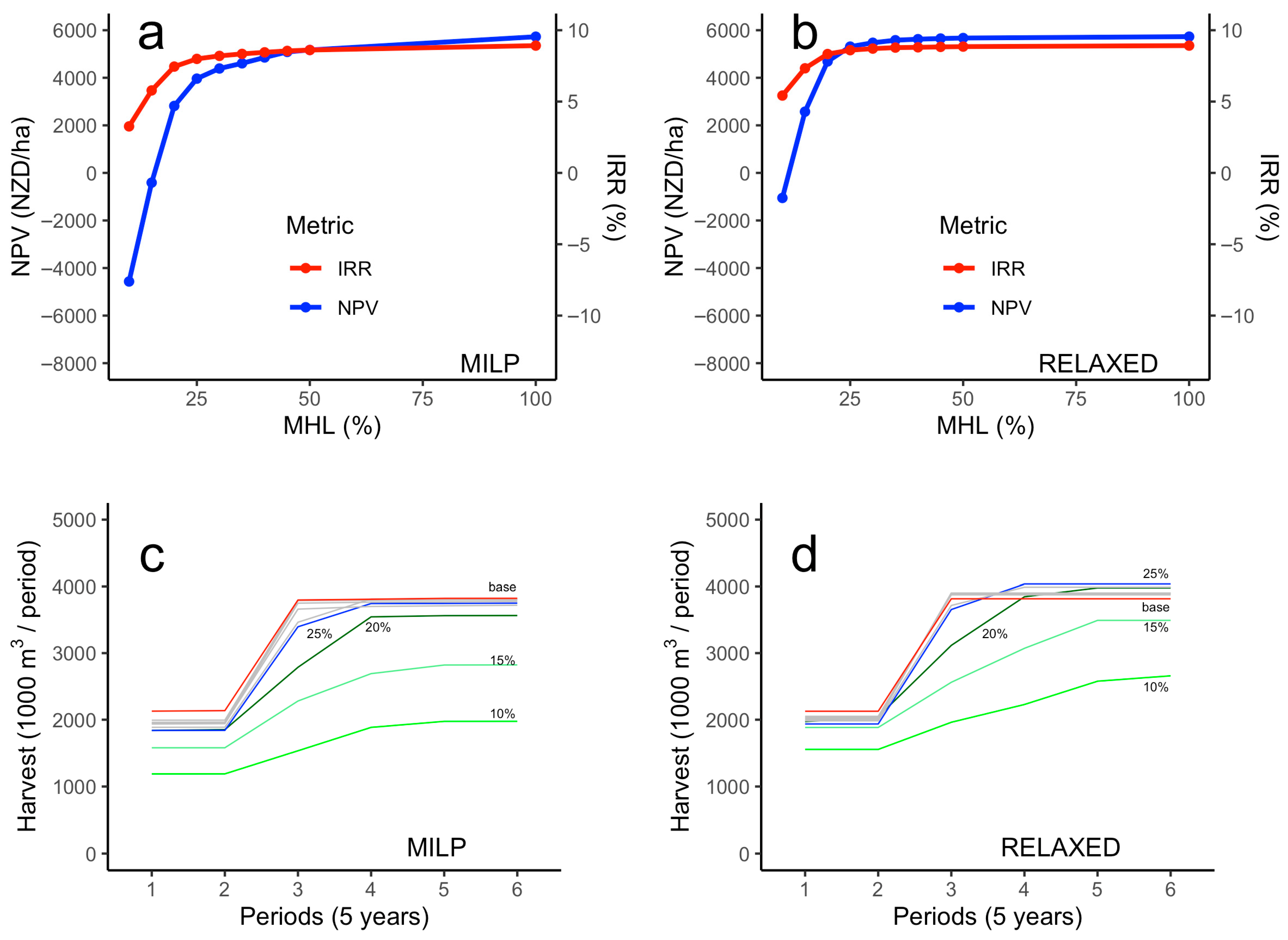
A more restricted set of scenarios, the catchment-oriented harvest schedule scenarios, were based on the constraint that stands are managed with consideration of the CMU where they are located. In this context, we consider threshold values for the maximum proportion of area within those CMUs that could be harvested within any single period. We called the Maximum Harvest Level (MHL) such a threshold, assessing the impact of imposing different MHLs on the profitability of the harvest schedules. We tested MHLs of 10% to 50% with steps of 5%, e.g., an MHL of 15% means that not more than 15% of the area of any single CMU could be harvested in any one period. Figure 6 shows the profitability and allowable cut of the catchment-oriented harvest schedule scenarios compared with the base scenario. Figure 6a,c represent the mixed-integer linear programming (MILP) (binary) solutions, while Figure 6b,d correspond to the relaxation of the MILP formulation. For relaxation, we mean that instead of using strict binary 0–1 variables, we allowed that every HSU could be harvested over several periods, and hence the decision variable would take any value from 0 to 1 in any single period.
The comparison of profitability across different MHL for the MILP solution (Figure 6a) shows that NPVs increase rapidly from an MHL of 10% to 20%, then more slowly after 25%. Please note that an MHL of 100% corresponds to the base scenario. Even more pronounced is the effect of MHL on the IRR (Figure 6a), so that IRR only marginally increases after an MHL of 25%. The relaxed solution (Figure 6b) shows a similar pattern to the MILP solution (Figure 6a). However, as expected, profitability is higher in the relaxed compared with the MILP solution. Profitability for the base scenario (MHL 100%) under the MILP (NPV 5727 NZD/ha, IRR 8.92%) and the relaxed solution (NPV 5729 NZD/ha, IRR 8.92%) were almost identical. The trend in profitability vs. MHLs is the same for both the MILP and the MILP relaxed solution, with only marginal increases in profitability for MHLs of 25% or over.

3.2. Reasons for Reductions in Profitability with MHL Restrictions

Increases in profitability as MHL increased can be explained by increases in the allowable cut. Figure 6c shows that the allowable cut along the planning horizon is the highest in the base unconstrained scenario compared with the MHL 10%–50% scenarios, with a clear increase in allowable cut as the MHL increased. Similarly to profitability, changes in the allowable cut for MHLs over 25% are relatively small. The relaxed solutions exhibited an overall similar pattern in the allowable cut (Figure 6d), although with some differences; notably, a higher allowable cut for the base scenario during the first two periods, declining below the MHL 20%–50% scenarios in later periods.
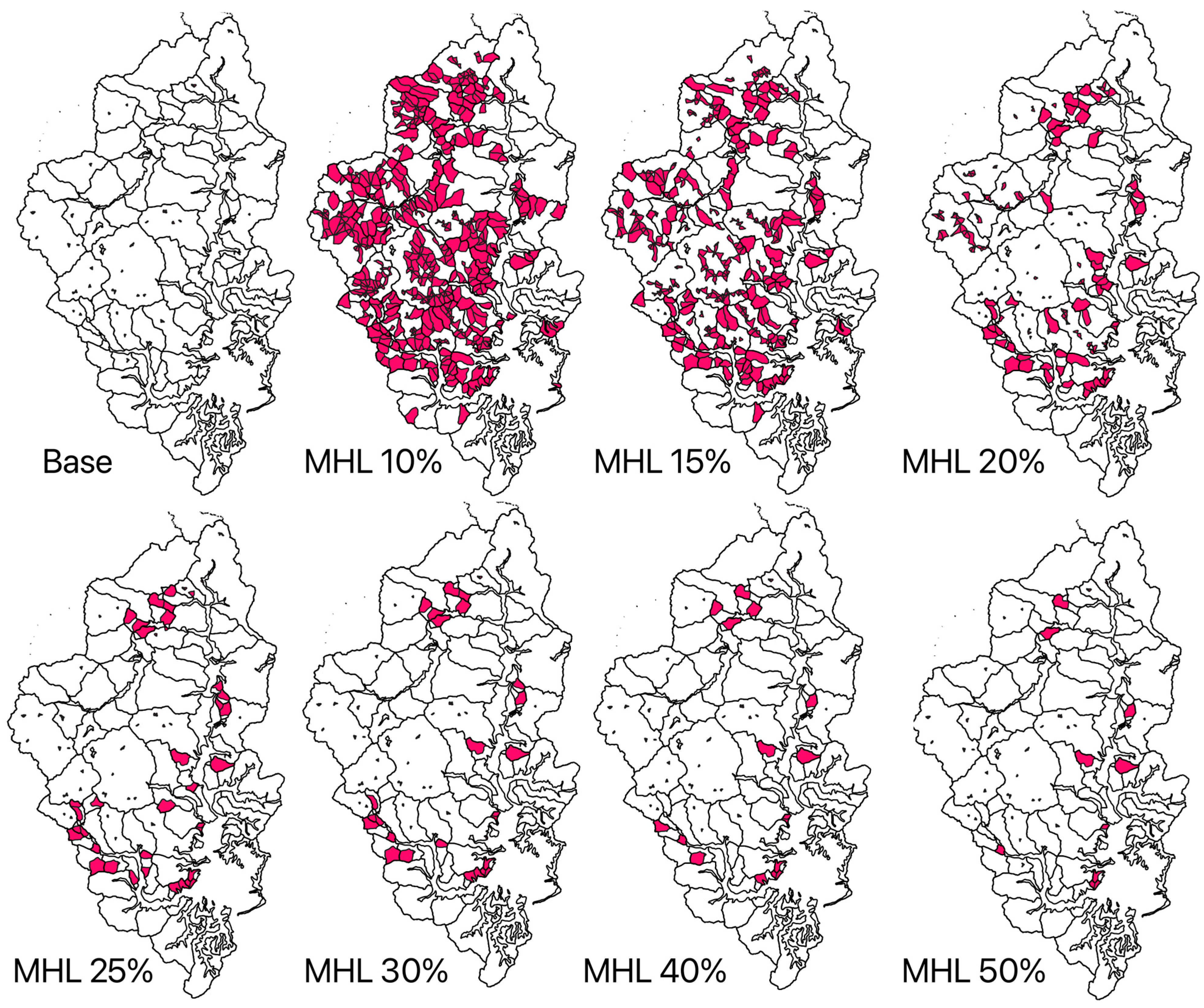
Now that profitability drops with lower MHLs, driven by lower allowable cut, we may examine why this occurs. First, imposing a maximum threshold area that could be harvested in a CMU at any single period evidently imposes restrictions translating to profitability reductions (e.g., imposing 25% MHL on a CMU with mostly mature forests obliges postponing most harvests to subsequent periods, reducing profitability). The second reason is less evident, although probably more important than the first reason, which is related to the stands that are not harvested along the planning horizon. Figure 7 compares the stands unharvested under the base and the MHL scenarios. Only a marginal area was left unharvested in the base scenario (100 ha, 0.31% of the total area), being very small units with high harvesting and roading costs, rendering harvesting unprofitable (Figure 7). Almost the same occurs with the relaxed MILP solution, where only 103 ha were left unharvested in the base scenario.
The areas left unharvested at the end of the planning horizon increase as the MHL becomes more restrictive (e.g., MHL 10% is more restrictive than MHL 25%) (Figure 7). The uncut areas decrease as the MHL increases: 16,324 ha (51% of the total forest estate) for MHL 10%, 9526 ha (30%) for MHL 15%, 3955 ha (12%) for MHL 20%, 2273 ha (7%) for MHL 25%, 1764 ha (6%) for MHL 30%, 1575 ha (5%) for MHL 35%, 1246 ha (4%) for MHL 40%, 886 ha (3%) for MHL 45%, 797 ha (2%) for MHL 50%. The area left unharvested in the MILP relaxed solution was lower than for the MILP solution but far from zero, i.e., 10,522 ha (33%) for MHL 10%, 4675 ha (15%) for MHL 15%, 827 ha (3%) for MHL 20%, 120 ha (0.38%) for MHL 25%, 106 ha (0.33%) for MHL 30%, 106 ha (0.33%) for MHL 35%, 103 ha (0.32%) for MHL 40%, 103 ha (0.32%) for MHL 45%, and 103 ha (0.32%) for MHL 50%.
The MILP and the MILP relaxed solutions provide us with an upper and lower bound of the unharvested area. At this time, we consider that an MHL of 25% seems reasonable in terms of profitability and allowable cut, particularly if the unharvested areas of the MILP could be harvested according to the MILP relaxed solution. An MHL of 25% seems reasonable compared with the other MHL scenarios because of its profitability and also because the unharvested area could be moved from a maximum of 2273 ha (7%) for the MILP solution to somewhere down to 120 ha (0.38% of the area of the forest estate) for the relaxed MILP solution. The IRR for an MHL of 25% would be 7.99% for the MILP and 8.60% for the relaxed MILP compared with 8.92% for the base scenario. It follows that for a catchment-oriented forest schedule such as the one proposed for the MHL 25%, the IRR would have to be sacrificed by 0.32%–0.93% per annum.
The rationale for the uncut areas is that if harvested, the MILP problem will become unfeasible, mainly because some HSUs represent more than 25% of relatively small CMUs, so that harvesting one will surpass the MHL permitted.
In order to minimise the gap in profitability between the base and the 25% MHL scenarios, one alternative would be to combine both the MILP and the relaxed MILP solutions for the 25% MHL. A more elegant approach, as presented in the next section, would be to relax the solution but only for those units unharvested in the MILP solution (Figure 7, bottom left).

3.3. A Semi-Relaxed MILP Solution

Based on the above, we constructed a new scenario considering our previous findings. This new scenario comprises catchment-oriented forest planning with no more than 25% of any CMU to be harvested at any single period. The CMU is composed of HSUs, which will be either harvested in a single period along the planning horizon or left unharvested. However, there is an exception. Some HSUs represent more than 25% of the area of the CMU, and therefore, under such a strict constraint, the HSUs are left unharvested, which becomes unrealistic. There are 47 out of 1123 HSUs (4.2%) under this condition, and the model relaxation allowed these particular HSUs to be partially harvested during the planning horizon, while all remaining HSUs were treated with binary variables.
The new semi-relaxed MILP scenario (NPV 5256 NZD/ha, IRR 8.55%) compares well with the base scenario (5727 NZD/ha, IRR 8.92%). Although there is a reduction in profitability (by 471 NZD/ha in NPV, and by 0.37% in IRR), the catchment-oriented harvest schedule seems to be marginally less profitable than the base scenario.
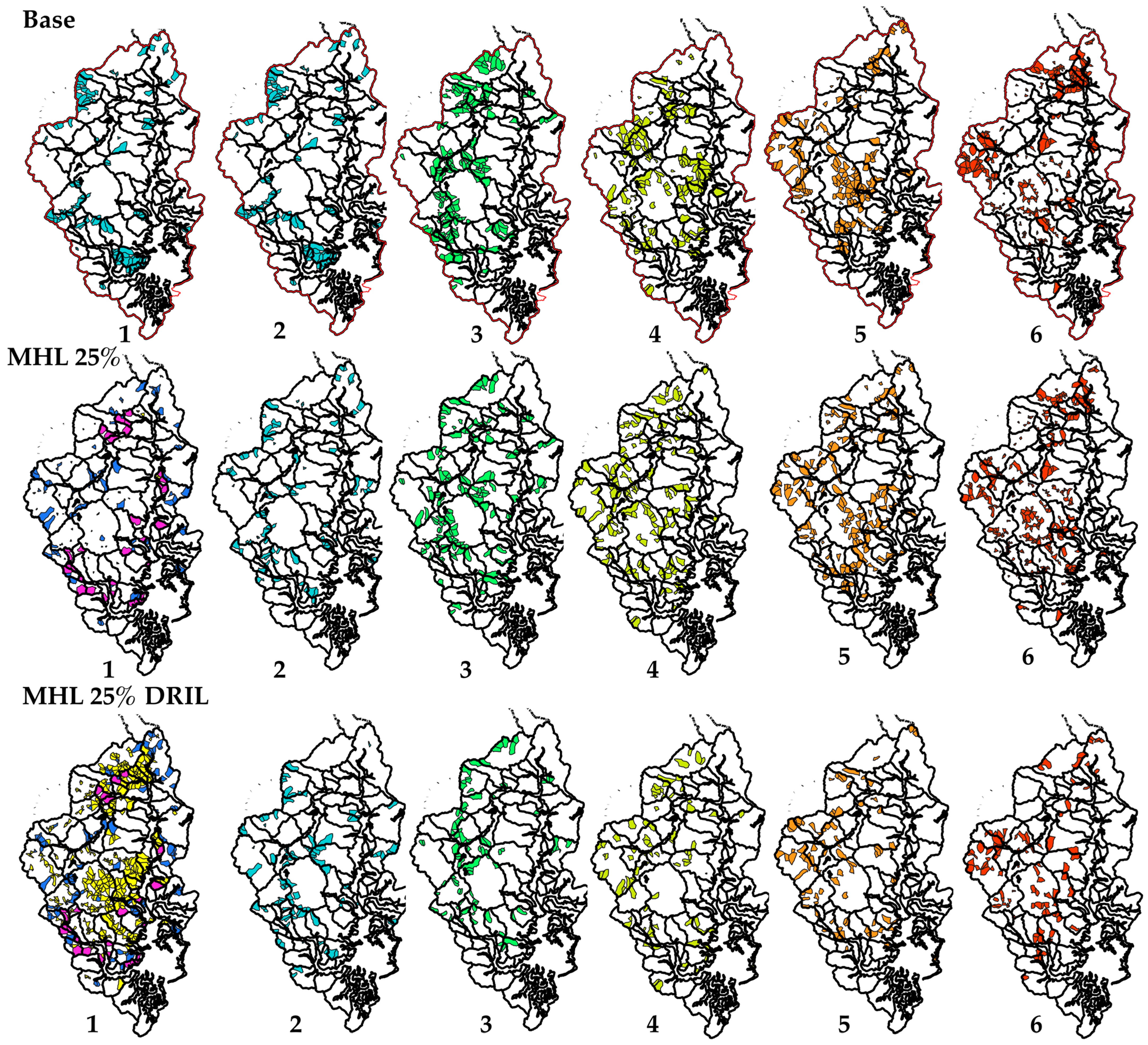
A visual depiction of the base scenario compared with the MHL 25% is shown in Figure 8. The base scenario shows that a high proportion of some CMUs are harvested in some periods, while only marginally harvested or not harvested in others. The MHL 25% scenario shows a more spatially balanced harvest schedule across CMUs.
In the Uawa catchment, the 89 CMUs range in size from 36 to 2971 ha with a mean of 697 ha. Not all CMUs were completely covered with plantations. Of all CMUs, 60% had partial forest cover with an average of 63%. This fact meant that the constraint that no more than 25% of each CMU could be harvested at any single period was not as harsh as previously thought. In fact, although the maximum area harvested in each CMU in any single period is 25%, the minimum is 0 and the mean varies from 9% to 19%.

3.4. Incorporating Rainfall-Induced Landslides into Decision-Making

Figure 4c shows the RIL susceptibility across the study area, highlighting significant differences among HSUs (stands) and CMUs. Greatest RIL susceptibility is found within a strip running north to south along the slopes contributing to the main Uawa valley. Such high RIL susceptibilities should be considered in harvest scheduling. For instance, from the base scenario (Figure 8, above), it can be seen that a large proportion of some CMUs are harvested on a massive scale within a single period, even though their RIL susceptibilities are high. This is what has happened in the recent past, probably associated with older stands located in highly RIL-susceptible areas. Within the MHL 25% scenario, showing a more balanced spatial harvest distribution among CMUs, there must be a way to incorporate the RIL susceptibility into decision-making. A feasible alternative would be to spread the area in the WoV with high RIL susceptibility evenly throughout the planning horizon.
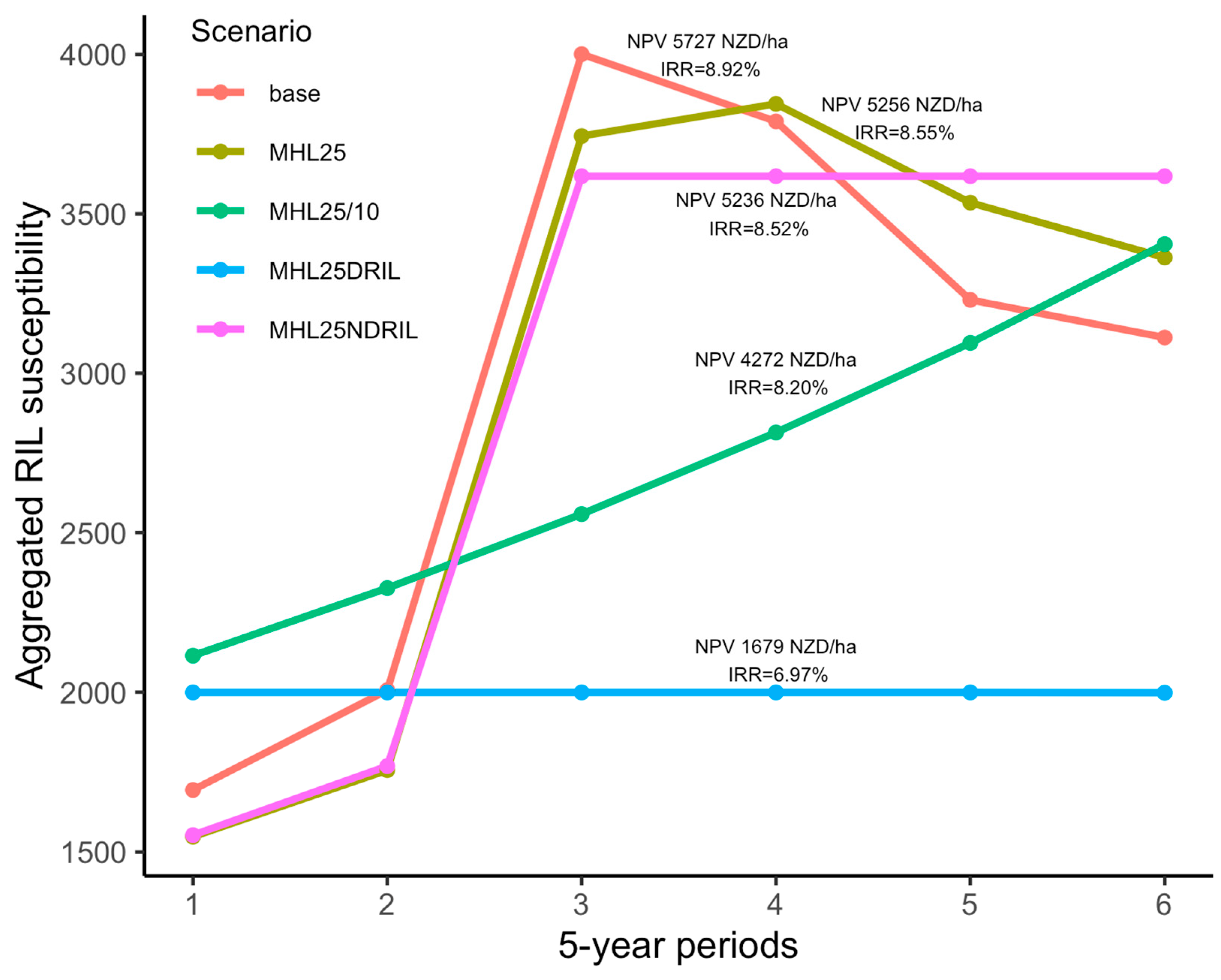
To model this, we ran new scenarios based on the MHL 25% by adding a proxy of RIL susceptibility as the weighted sum of area harvested times the HSU’s RIL susceptibility in a given period (see Equation (6) above). Figure 9 compares the RIL susceptibility for the base scenario, the MHL 25%, the MHL 25% with non-declining (MHL25NDRIL) (Equation (7)), declining (MHL25DRIL) (Equation (8)) RIL susceptibility, and RIL susceptibility allowed to vary by no more than 10% from one period to the next (MHL25/10) (Equation (9)).
The base scenario with the highest profitability (NPV 5727 NZD/ha, IRR 8.92%) among all scenarios analysed showed the most variable aggregated RIL susceptibility along the planning horizon (Figure 9). The base scenario also showed the highest peak in aggregated RIL susceptibility in period 3. The MHL25% scenario (NPV 5256 NZD/ha, IRR 8.55%) was similar in aggregated RIL susceptibility to the base scenario, although with a slightly lower peak. When adding non-declining RIL susceptibility constraints to the MHL 25% scenario (NPV 5236 NZD/ha, IRR 8.52%), profitability reduced marginally compared with the MHL25% scenario, but RIL susceptibility stayed constant after period 3 with lower peaks compared with the base and MHL 25% scenarios (Figure 9). When adding declining RIL susceptibility constraints to the MHL 25% scenario, profitability was drastically reduced compared with other scenarios (NPV 1679 NZD/ha, IRR 6.97%), but with the advantage that RIL susceptibility was kept constant over all six periods and was lower compared with the peaks of all other scenarios. We found the base scenario to be the least preferred solution as a result of the high fluctuations from period to period in RIL susceptibility. The most conservative solution, the MHL 25% with declining RIL susceptibility constraints (MHL25DRIL scenario), distributed evenly the RIL susceptibility over time, although with the highest penalty on profitability (i.e., 1.95% in the IRR) compared to the base scenario. An intermediate solution was the MHL 25% allowing the RIL susceptibility to vary by no more than 10% (NPV 4272 NZD/ha, IRR 8.20%).

3.5. Our Best Solution for the Catchment-Oriented Harvest Schedule

Depending on the profile of the decision-maker, we believe the best catchment-oriented harvest schedule should move between the MHL 25% and the MHL25% plus declining aggregated RIL susceptibility (Figure 9). The MHL 25% scenario is one where no more than 25% of each CMU is harvested in any single 5-year period (i.e., no more than 5% of each CMU per year), applying a semi-relaxed MILP approach (most stands are either harvested or not in any single period, while a minority are partially harvested over several periods) and considering non-declining timber yield constraints. The second scenario considers adding on top of the MHL 25% scenario, a declining aggregated RIL susceptibility constraint, which, in practice, works as a constraint to keep the RIL susceptibility constant. A constant RIL susceptibility would allow forest owners to spread landslide risk equally over time. However this comes at a cost, with profitability reduced from a maximum IRR of 8.55% for the MHL 25% to 6.97% for the MHL 25% DRIL scenario. Such reduction was brought about by leaving a large area uncut (8303 ha, 26% of the forest estate), imposed by the strict declining aggregated RIL susceptibility constraint. It is worth noting that there is an overall match between a high RIL susceptibility (Figure 4c) and the areas left uncut in the MHL 25% DRIL scenario (Figure 8 bottom left). Both solutions, the MHL 25% and the MHL 25% DRIL scenarios, are better than the base scenario with respect to aggregated RIL susceptibility (Figure 9).
The base and the MHL 25% scenarios were very similar in terms of profitability, wood flow and aggregated RIL susceptibility (Table 4). However, the MHL 25% scenario was set so that no more than 25% of each CMU was harvested in any single 5-year period. This was a clear advantage in terms of RIL susceptibility over the base scenario spreading the harvests into smaller coupes over the entire forest estate. When adding a declining RIL susceptibility constraint to the MHL 25% scenario, profitability, wood flow, and aggregated RIL susceptibility drastically decreased. The last row of the stock table for the three scenarios described in Table 4 shows some cells in green, denoting a relatively balanced age distribution, while cells in grey represent the areas left uncut at the end of the planning horizon. The latter corresponds to 100, 159 and 8303 ha unharvested for the base, MHL 25%, and MHL 25% DRIL scenarios, respectively (cells in orange).

4. Discussion

Radiata pine plantation management has been shown to be highly profitable, particularly in the North Island of New Zealand. Our hypothesis that catchment-oriented harvest planning profitability (IRR 8.55%) would not drastically differ from business-as-usual policy (IRR 8.92%) was confirmed. These IRRs are considered robust for radiata pine and other exotic plantation species such as Douglas-fir (Pseudotsuga menziesii (Mirb.) Franco), eucalypts (Eucalyptus spp. L’Hér.), and blackwood (Acacia melanoxylon R.Br.) in New Zealand [22]. Even in our harshest scenario in which we kept the aggregated RIL susceptibility constant along the planning horizon, the IRR was still highly competitive and equal to 6.97% p.a.
The minimal reduction in profitability when implementing catchment-oriented harvest scheduling is particularly significant given the current regulatory environment in New Zealand. Following Cyclone Gabrielle, stakeholders have called for restrictions on plantation forestry in erosion-prone areas. Our results demonstrate that meaningful reductions in RIL susceptibility can be achieved through spatial and temporal harvest constraints while maintaining commercially viable returns.
In our catchment-oriented harvest scheduling approach, land is divided not according to the limits of stands historically planted but according to HSUs, which behave hydrologically as a unit. These hill slope units typically represent Order 1 or 2 catchments (“headwater streams”), dominated by steep slopes and high stream gradients, where erosion is the dominant landscape process. These HSUs are fully contained within CMUs, which discharge through a “pour point” onto built and natural environments in the downstream transfer and depositional zones.
Once HSUs and CMUs are defined, a limit can be placed on the maximum area that can be clearfell harvested in any single period along the planning horizon within each CMU. We have called this threshold the Maximum Harvest Level (MHL), expressed as a fraction of any CMU, e.g., MHL 15% means that not more than 15% of any CMU could be harvested at any single 5-year period. For the base scenario, we ran a tactically explicit harvest scheduling model maximising the NPV subject to non-declining yield (NDY) constraints. We then ran further scenarios in which MHL constraints were added to the base simulation, testing MHLs in a series from 10% to 50% with 5% steps. Thus, for these new scenarios, we maximised the NPV subject to NDY and MHL constraints. Imposing the MHL constraints in the range 10%–20% drastically reduced profitability. In comparison, for MHLs 25% and larger, differences in profitability with the base scenario were relatively small. Based on the results of our study, we consider that an MHL of 25% struck a good balance between profitability and limiting the maximum area that could be harvested in any CMU in any single 5-year period.
When running the tactical harvest scheduling model under the MHL 25% constraint, we found that 47 out of 1123 HSUs were left unharvested at the end of the planning horizon because they represented more than 25% of the CMU. This is something likely to happen in reality, where CMUs are relatively small in area and composed of a small number of HSUs, or when HSUs are large compared with the CMU size. As these HSUs are only a small proportion of the total number of HSUs (4.2%), we relaxed the solution for those particular cases, i.e., instead of using binary 0–1 variables, we used continuous variables in the 0–1 range. As an example, an HSU unit left unharvested (binary variable equal to zero) could be relaxed, allowing the decision variable to take fractional values, meaning that the stand could be harvested over several periods in partialities. For example, 0.3 means that 30% of that HSU would be harvested in that period. Such a strategy of using binary variables for most of the forest estate and continuous fractional variables for the units that exceeded 25% of the CMU proved to be technically and financially feasible. This condition of small CMUs or CMUs with only a few large HSUs is likely to occur in other forest estates, suggesting that relaxing the solution is a useful option.
A proxy of rainfall-induced landslide susceptibility was constructed as the product of the area harvested times RIL susceptibility calculated for each period. This proxy was then forced to be as constant as possible. This strategy would allow the spreading of risk from rainfall-induced landslides along the planning horizon, avoiding years where stands in the WoV had high RIL susceptibility, followed by years where stands in the WoV had low RIL susceptibility. We achieved such a condition by applying declining RIL susceptibility constraints, i.e., ensuring that the aggregated value of area harvested times RIL probabilities declined or stayed the same from one period to the next. Given that the information about RIL susceptibility is widely available at the HSU level, it follows that it could be routinely included in tactical harvest scheduling planning in the Gisborne Region.
Following Cyclone Gabrielle, the Ministry for the Environment (2023) established the “Ministerial Inquiry into Land Use” (MILU) to address damage caused by woody debris and sediment in Tairāwhiti and Wairoa. Identifying a clear connection between clearfell logging and landslides on fragile terrain, the MILU proposed ending large-scale harvesting in these regions. Specifically, they recommended capping harvest plots (coupes) at 40 hectares and ensuring no more than 5% of any single catchment is clearfelled annually. We found that our model aligns well with MILU recommendations. The median of our 1123 HSUs is 20 ha, while 75% are below 39 ha. For those units exceeding 40 ha, we can enforce harvesting less than the whole HSU every year with continuous fraction variables in the range 0–1. In relation to the second part of the statement, i.e., no more than 5% of each CMU is harvested each year, our results also align well because an MHL of 25% means that over the 5-year planning period, the clearfell harvest is limited to 25% or 5% per year.
Adjacency constraints are a common practice in forest management in other areas around the world, which prevent neighbouring units from being concurrently harvested so that the maximum size of clearcuts does not exceed statutory or policy limits [23]. Harvest scheduling now routinely incorporates such constraints to address multiple objectives, including erosion control, biodiversity conservation, and mitigation of storm impacts on forests [23,24,25,26]. In our catchment-oriented harvest scheduling plan, we have not considered adjacency constraints because the HSUs represent subcatchments which are hydrologically independent of other HSUs. Then, it is worth asking whether an adjacency constraint will have any effect on rainfall-induced landslide risk when using the FCP methodology.
Where neighbouring HSUs drain to different streams, it would make no sense to impose adjacency constraints to reduce RIL susceptibility. However, there might be some space here to consider the case of HSUs that contribute to the same water and woody debris flow pathway—for example, those on opposite slopes of the same subcatchment; in that case, adjacency may play a role. We suggest here that adjacency constraints might be necessary for a reduced subset of HSUs in order to harvest these units in different periods.
Implicitly, the MHL 25% scenario implies a greenup period of 5 years. Consider that during the first 5-year period, no more than 25% of the CMU will be harvested. During the second period, this condition will be repeated. Then, at least some units harvested during the first and second period will be neighbours, where the ones harvested during the first period will have a 5-year-old plantation. Reference [2] defines the concept of “WoV” as the time lapse following forest removal when steep land is vulnerable to rainfall-induced landslides. This WoV may vary between 1 and 8 years after clearfelling, although years 2–4 seem to be the most critical. In our case, we consider that five years would allow radiata pine plantations to reach 6–8 m in height and achieve complete canopy cover after planting in the Tairāwhiti, Gisborne region, which is a condition for landslide density to drastically drop [2].
Study limitations present several opportunities for further investigation. First, reshaping current forest stands to HSUs may take a few years and some planning for harvesting and the plantation establishment. Therefore, taking the decision today to start a catchment-oriented harvest scheduling will not give immediate results and will need a transition period. Second, two or more forest owners may be present in a given CMU, and therefore, harvest scheduling would need coordination between them. We may find that some CMUs are only controlled by one forest owner, and that some CMUs may have several forest owners, where trade-offs might be necessary. Third, we have not modelled temporal variability in storm frequency and intensity, which climate change projections suggest may increase in New Zealand [27]. Finally, the model assumes harvesting operations proceed as planned; in reality, market conditions and weather events may force deviation from model-optimised schedules.
Another counterargument that could arise is that harvesting HSUs spread over the landscape might impose higher operational costs. Our take on this is that the HSUs are big enough so that operational costs will not increase. In fact, the VCM cost model [16,17] shows that for areas greater than 20 ha, harvesting and roading costs only marginally increase per m3. In our particular case, nearly 50% of the HSUs were below 20 ha subject to marginal increases in harvesting and roading costs.
A further counterargument is that harvesting systems may not suit HSU-based harvesting units. We argue the contrary: catchment-oriented harvest scheduling suits conventional steepland harvesting systems. It is routine to set skylines on ridges for harvesting steepland forests in New Zealand [6]. However, haul distances rarely exceed 300–500 m between ridges [28]. These skyline distances are comfortably within values for many Uawa catchment HSUs. For large HSUs, those distances could be achieved by subdividing the HSUs. Detailed operational planning is needed to implement catchment-oriented harvesting, particularly in broken terrain, but difficulties are likely surmountable in most cases.
The range of piece sizes resulting from the extended harvesting age may pose operational challenges. The tactical planning shows that some harvesting along the planning horizon will involve trees 45+ years reaching up to 80 cm in dbh. Feller-bunchers typically handle trees up to 45–60 cm dbh [29,30], with productivity declining as stems approach machine capacity limits [31,32]. Similarly, cut-to-length harvesters, even with maximum cutting capacities of 75–80 cm dbh depending on harvesting head specifications [33], demonstrate a declining processing efficiency at larger stem sizes [34], with cycle times increasing substantially near these cutting capacity limits [35]. Based on the above, some operational difficulties and increases in harvesting costs are expected to arise as a result of piece size, particularly on HSUs where the rainfall-induced landslide probability is high.
Our model, while currently theoretical and not yet field-tested, suggests that catchment-oriented harvest scheduling is technically and financially feasible. We predict that reshaping stands to conform to hill slope units and harvesting no more than 25% of each CMU over 5 years (5% per year) may increase landscape resilience and reduce rainfall-induced landslide susceptibility. Besides, constraining the weighted sum of areas harvested times their RIL susceptibility to stay constant will ensure spreading the risk equally over successive periods. This catchment-oriented approach would likely be more ecologically and socially acceptable than traditional unconstrained clearcuts with only marginal reductions in profitability.


5. Conclusions

This study suggests a transformative approach to forestry in New Zealand’s most fragile landscapes. By adopting catchment management units (CMUs) and hill slope units (HSUs) as the basis for planning, and by ensuring that no more than 25% of each CMU is harvested in any single five-year period, we suggest the forestry sector can significantly reduce the risk of catastrophic sediment and slash discharge. This scenario aligns well with the MILU-recommended 5% annual harvest limit, with only marginal reductions from the business-as-usual internal rate of return (IRR) (8.92%) to 8.55%. A proxy for rainfall-induced landslide (RIL) susceptibility was calculated as the aggregated sum of harvested areas times its RIL susceptibility for each period, and then imposed on the catchment-oriented harvest for the RIL proxy to become constant over successive periods. This new scenario further reduced the IRR to 6.97% mainly by excluding the highest RIL prone stands from harvesting. Forest owners’ concerns that catchment-oriented harvest scheduling would need coordination across ownerships, that reshaping stands would take time, effort and money, and that operational costs would increase as a result of spreading the harvesting units over the landscape do not seem to be insurmountable.

Author Contributions

Conceptualisation, H.E.B., M.B. and M.D.; databases, M.B., R.B. and B.R.; methodology, H.E.B., M.B. and M.D.; software, H.E.B. and R.B.; validation, H.E.B., M.B. and M.D.; formal analysis, H.E.B., M.B. and M.D.; investigation, H.E.B., M.B. and M.D.; data curation, M.B., R.B. and B.R.; writing—original draft preparation, H.E.B., M.B., M.D. and B.R.; writing—review and editing, H.E.B., M.B., M.D., R.B. and B.R. All authors have read and agreed to the published version of the manuscript.

Funding

This research was mainly supported by the University of Canterbury through an Erskine fellowship and the University of Chile through a sabbatical leave.

Data Availability Statement

The yield tables used to develop the model are proprietary data owned by the New Zealand Ministry of Primary Industries and are publicly available. Details of access to the FCP layers used in this study are given in the text.

Acknowledgments

The authors gratefully acknowledge the expert advice of Rien Visser, Campbell Harvey and Karen Bayne, whose insights were invaluable in aligning the tactical planning for the Uawa catchment with practical, on-the-ground realities.

Conflicts of Interest

Author Robert Besaans is employed by MapHQ Limited. The remaining authors declare that the research was conducted in the absence of any commercial or financial relationships that could be construed as a potential conflict of interest.

Acronyms

CMUCatchment management unit
DRILDeclining RIL susceptibility
FCPForestry Catchment Planner
HSUHill slope unit
IRRInternal rate of return
MHLMaximum Harvesting Level
MILPMixed-integer linear programming
MILUMinisterial Inquiry into Land Use
NDRILNon-declining RIL susceptibility
NDYNon-declining yield
NEFDNational Exotic Forest Description
NPVNet present value
NZDNew Zealand dollars
REC2River Environments Classification
RILRainfall-induced landslide
VCMVisser Costing Model
WoVWindow of vulnerability

Appendix A. The VCM

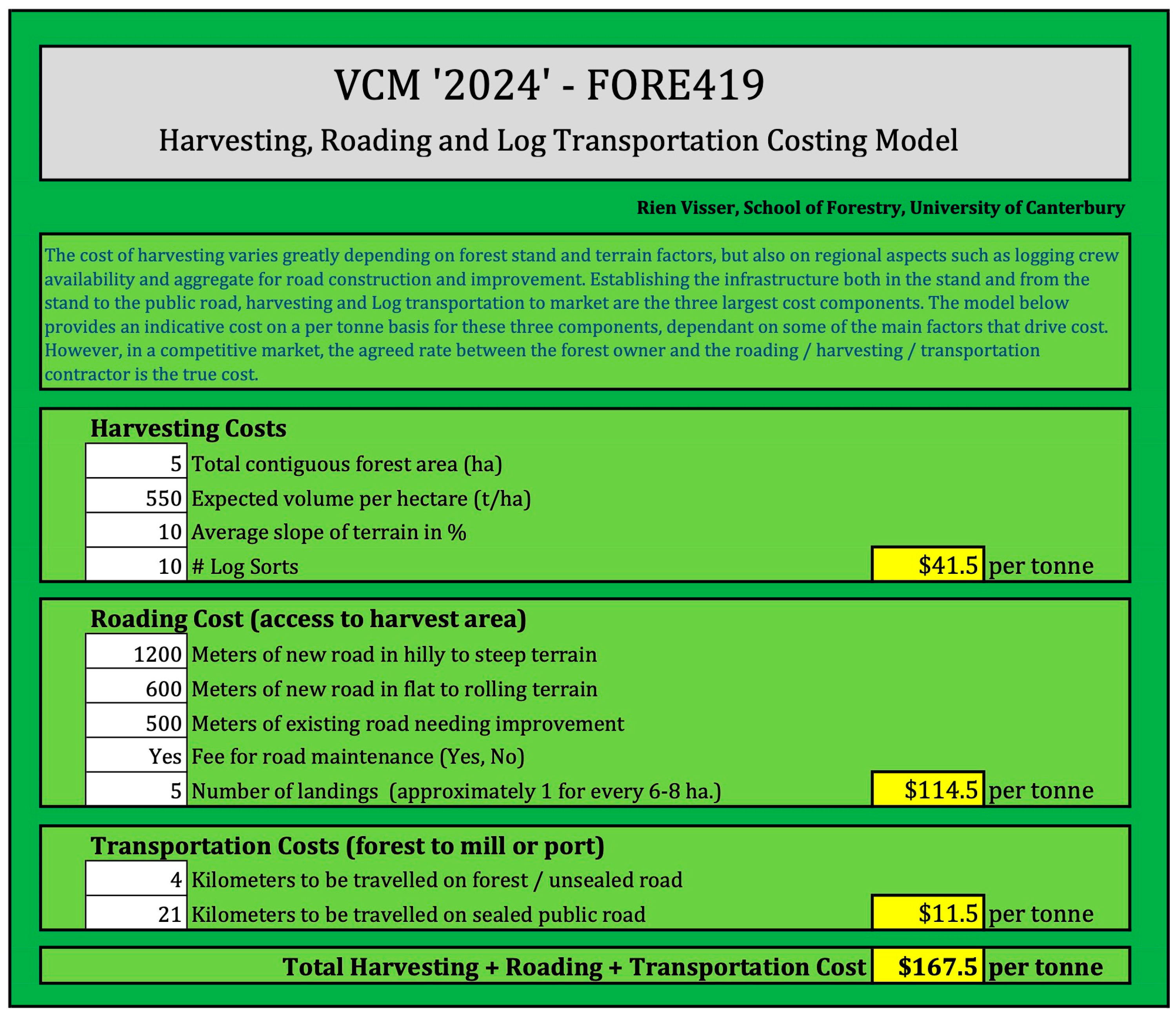
Harvesting and roading costs were estimated for each HSU based on the Visser Costing Model (VCM) [16,17]. The VCM calculates the harvesting cost (NZD/m3) as a function of slope (%), total recoverable volume (m3/ha), and stand area (ha). Roading cost depends mainly on stand area (ha) and total recoverable volume (NZD/m3). Figure A1 shows the input variables required by the VCM (white cells) and the concomitant calculation of harvesting, roading and transport costs (yellow cells).
Figure A1. Input variables (white cells) required to estimate harvesting, roading and transport costs (yellow cells) using the Visser Costing Model (VCM).
Forests 17 00170 g0a1

References

  1. Te Uru Rākau. Erosion Susceptibility Classification by Class & Area of Plantation Forestry (Excluding Department of Conservation Land). 2025. Available online: https://www.mpi.govt.nz/dmsdocument/29804-Erosion-Susceptibility-Classification-by-class-area-of-plantation-forestry-excluding-Department-of-Conservation-Land (accessed on 23 October 2025).
  2. Phillips, C.; Betts, H.; Smith, H.G.; Tsyplenkov, A. Exploring the post-harvest ‘window of vulnerability’ to landslides in New Zealand steepland plantation forests. Ecol. Eng. 2024, 206, 107300. [Google Scholar] [CrossRef]
  3. Paul, T.; Wakelin, S. New Zealand’s planted forests–Carbon stocks and yield in fast growing exotic tree plantations of the Southern Hemisphere. Trees For. People 2024, 16, 100590. [Google Scholar] [CrossRef]
  4. Bloomberg, M.; Urlich, S. Lessons for steepland forestry harvesting in New Zealand from recent Resource Management Act prosecutions. N. Z. J. For. 2025, 70, 3–9. [Google Scholar]
  5. Crozier, M.J. A proposed cell model for multiple-occurrence regional landslide events: Implications for landslide susceptibility mapping. Geomorphology 2017, 295, 480–488. [Google Scholar] [CrossRef]
  6. Amishev, D.; Basher, L.; Phillips, C.; Hill, S.; Marden, M.; Bloomberg, M.; Moore, J. New Forest Management Approaches to Steep Hills; Ministry for Primary Industries: Wellington, New Zealand, 2013. Available online: https://ndhadeliver.natlib.govt.nz/delivery/DeliveryManagerServlet?dps_pid=IE24411127 (accessed on 17 September 2025).
  7. Massey, C.; Leith, K.; Robinson, T.R.; Lukovic, B.; McColl, S.; Carey-Smith, T.; Rosser, B.; Wotherspoon, L.; Smith, H.; Betts, H.; et al. What controlled the occurrence of more than 116,000 human-mapped landslides triggered by Cyclone Gabrielle, New Zealand? Landslides 2025, 22, 3953–3972. [Google Scholar] [CrossRef]
  8. Ministry for the Environment. Outrage to Optimism: Report of the Ministerial Inquiry into Land Uses Associated with the Mobilisation of Woody Debris (Including Forestry Slash) and Sediment in Tairāwhiti/Gisborne District and Wairoa District. Ministerial Inquiry into Land Uses in Tairawhiti and Wairoa. 2023. Available online: https://environment.govt.nz/assets/Outrage-to-optimism-superseded.pdf (accessed on 23 October 2025).
  9. Bloomberg, M.; Cairns, E.; Du, D.; Palmer, H.; Perry, C. Alternatives to clearfelling for harvesting of radiata pine plantations on erosion-susceptible land. N. Z. J. For. 2019, 64, 33–39. [Google Scholar]
  10. MapHQ. Forestry Catchment Planner 1.0. 2024. Available online: https://www.forestrycatchmentplanner.nz/ (accessed on 23 September 2025).
  11. Gellis, A.; Fitzpatrick, F.; Schubauer-Berigan, J. A Manual to Identify Sources of Fluvial Sediment; US Environmental Protection Agency: Cincinnati, OH, USA, 2016. Available online: https://nepis.epa.gov/Exe/ZyPDF.cgi/P100QVM1.PDF?Dockey=P100QVM1.PDF (accessed on 25 October 2025).
  12. Snelder, T.H.; Biggs, B.J.F. Multiscale river environment classification for water resources management. J. Am. Water Resour. Assoc. 2002, 38, 1225–1239. [Google Scholar]
  13. Manaaki Whenua—Landcare Research. NZLRI Land Use Capability 2021. Available online: https://lris.scinfo.org.nz/layer/48076-nzlri-land-use-capability-2021/ (accessed on 23 October 2025).
  14. Rosser, B.; Massey, C.; Lukovic, B.; Dellow, S.; Hill, M. Development of a Rainfall-Induced Landslide Forecast Tool for New Zealand. In Understanding and Reducing Landslide Disaster Risk: Volume 3 Monitoring and Early Warning; Casagli, N., Tofani, V., Sassa, K., Bobrowsky, P.T., Takara, K., Eds.; Springer: Berlin/Heidelberg, Germany, 2021; pp. 273–277. Available online: https://link.springer.com/chapter/10.1007/978-3-030-60311-3_32 (accessed on 13 January 2026).
  15. New Zealand Forest Owners Association—NZFOA (Ed.) New Zealand Plantation Forest Industry Facts and Figures 2023–2024; NZFOA: Wellington, New Zealand, 2024; pp. 1–63. Available online: https://www.nzfoa.org.nz/images/FOA_Facts_and_Figures_2023-2024_-_Web_file.pdf (accessed on 25 September 2025).
  16. Park, D.; Manley, B.; Morgenroth, J.; Visser, R. What proportion of the forest of small-scale owners is likely to be harvested-a Whanganui case study. N. Z. J. For. 2012, 57, 4–11. [Google Scholar]
  17. Manley, B.; Morgenroth, J.; Visser, R. What proportion of the small-scale owners’ estate in the North Island is likely to be harvested? N. Z. J. For. 2015, 60, 26–34. [Google Scholar]
  18. Manley, B. Afforestation Economic Modelling. Final Report Prepared for Ministry for Primary Industries; Ministry for Primary Industries: Christchurch, New Zealand, 2021. Available online: https://www.mpi.govt.nz/dmsdocument/50302-Afforestation-Economic-Modelling-Report (accessed on 18 September 2025).
  19. Taha, H. Operations Research: An Introduction, 8th ed.; George, D., Ed.; Pearson Prentice Hall: Upper Saddle River, NJ, USA, 2007. [Google Scholar]
  20. Gurobi Optimization, L. Gurobi Optimizer Reference Manual. 2024. Available online: https://www.gurobi.com (accessed on 7 November 2025).
  21. R Core Team. R: A Language and Environment for Statistical Computing; R Foundation for Statistical Computing, Ed.; R Foundation for Statistical Computing: Vienna, Austria, 2024. [Google Scholar]
  22. Manley, B. Discount rates used for forest valuation—Results of 2017 survey. N. Z. J. For. 2018, 63, 35–43. [Google Scholar]
  23. O’Hara, A.; Faaland, B.; Bare, B. Spatially constrained timber harvest scheduling. Can. J. For. Res. 1989, 19, 715–724. [Google Scholar] [CrossRef]
  24. Boston, K.; Sessions, J. Development of a spatial harvest scheduling system to promote the conservation between indigenous and exotic forests. Int. For. Rev. 2006, 8, 297–306. [Google Scholar] [CrossRef]
  25. Boston, K.; Bettinger, P. Combining Tabu Search and Genetic Algorithm Heuristic Techniques to Solve Spatial Harvest Scheduling Problems. For. Sci. 2002, 48, 35–46. [Google Scholar] [CrossRef]
  26. Loehle, C. Optimal control of spatially distributed process models. Ecol. Modell. 2000, 131, 79–95. [Google Scholar] [CrossRef]
  27. Gibson, P.B.; Lewis, H.; Campbell, I.; Rampal, N.; Fauchereau, N.; Harrington, L.J. Downscaled Climate Projections of Tropical and Ex-Tropical Cyclones Over the Southwest Pacific. J. Geophys. Res. Atmos. 2025, 130, e2025JD043833. [Google Scholar] [CrossRef]
  28. Wells, C. Forest harvesting roads: Meeting operational, social and environmental needs with efficiency and economy. In Applying Reduced Impact Logging to Advance Sustainable Forest Management: International Conference Proceedings, Kuching, Malaysia, 26 February–1 March 2001; Enters, T., Durst, P., Applegate, G., Kho, P., Man, G., Eds.; FAO: Rome, Italy, 2002; p. 311. Available online: https://www.fao.org/4/ac805e/ac805e07.htm#bm07 (accessed on 18 August 2025).
  29. Nascimento, A.; Pinto, A.; Leite, P.; Soares, T.; De Freitas, L. Technical and economical analysis of the forest harvesting with feller-buncher. Cerne 2011, 17, 9–15. [Google Scholar] [CrossRef]
  30. Gülci, N.; Yüksel, K.; Gülci, S.; Serin, H.; Bilici, E.; Akay, A.E. Analysis of a feller-buncher productivity: A case study of whole-tree harvesting from marmara region, Turkey. Ann. For. Res. 2021, 64, 99–110. [Google Scholar] [CrossRef]
  31. Visser, R.; Spinelli, R. Determining the shape of the productivity function for mechanized felling and felling-processing. J. For. Res. 2012, 17, 397–402. [Google Scholar] [CrossRef]
  32. Miyajima, R.H.; Fenner, P.T.; Batistela, G.C.; Simões, D. Effect of Feller-Buncher Model, Slope Class and Cutting Area on the Productivity and Costs of Whole Tree Harvesting in Brazilian Eucalyptus Stands. Forests 2021, 12, 1092. [Google Scholar] [CrossRef]
  33. Labelle, E.R.; Breinig, L.; Sycheva, E. Exploring the Use of Harvesters in Large-Diameter Hardwood-Dominated Stands. Forests 2018, 9, 424. [Google Scholar] [CrossRef]
  34. Kärhä, K.; Anttonen, T.; Poikela, A.; Palander, T.; Laurén, A.; Peltola, H.; Nuutinen, Y. Evaluation of Salvage Logging Productivity and Costs in Windthrown Norway Spruce-Dominated Forests. Forests 2018, 9, 280. [Google Scholar] [CrossRef]
  35. Mederski, P.S.; Bembenek, M.; Karaszewski, Z.; Łacka, A.; Szczepańska-Álvarez, A.; Rosińska, M. Estimating and Modelling Harvester Productivity in Pine Stands of Different Ages, Densities and Thinning Intensities. Croat. J. For. Eng. 2016, 37, 27–36. [Google Scholar]
Figure 1. Waihapua Forest, Northern Hawkes Bay, after Cyclone Bola in 1988 (above) and 2025 (below). Source: Garth Eyles & James Powrie.
Forests 17 00170 g001
Figure 2. A typical scale of clearfelling areas on highly erosion-susceptible land in Tairāwhiti, Gisborne, 2018. Source: D. Townsend, Earth Sciences New Zealand; 11 July 2018.
Forests 17 00170 g002
Figure 3. Location and overall view of the Uawa catchment. The red dot in (a) represents the location of the Uawa catchment within the Gisborne Region of New Zealand. Colours in (a) represent the Gisborne (green), Hawkes Bay (blue), Nelson (magenta), Tasman (pink), and Marlborough (grey) regions. The Uawa catchment is represented in (b,c) by a red outline polygon and the coast by a grey line. In (b), forest plantations are represented by light green and highways by a blue line, while primary roads are represented by a black line. In (c), the hillshade model illustrates the broken terrain of the Uawa catchment. CRS: NZGD2000/New Zealand Transverse Mercator 2000.
Forests 17 00170 g003
Figure 4. CMUs, HSUs, slopes (a), forest ages (b), and rainfall-induced landslide susceptibility (c). A red outline polygon represents the Uawa catchment, CMUs are defined by thick black lines, while HSUs are defined by thin black lines.
Forests 17 00170 g004
Figure 5. Total recoverable volume and log outturn versus harvesting age for radiata pine planted post-1989 under an unpruned, without production thinning regime from the Gisborne or East Coast region.
Forests 17 00170 g005
Figure 6. Comparison of profitability and allowable cut for different harvest schedules considering Maximum Harvest Levels (MHL) within each catchment management unit (CMU). The MHLs displayed are 10% to 50% (with 5% steps) of the area of each CMU that could be harvested at any one period. MHLs of 30%–50% are represented as grey lines in (c,d). (a,c) show the MILP solutions, while (b,d) show the relaxed MILP solutions.
Forests 17 00170 g006
Figure 7. Unharvested areas along the planning horizon for the base and the Maximum Harvest Level (MHL) scenarios. An MHL of 15% means that the maximum proportion of a catchment management unit (CMU) that could be harvested at any one 5-year period is 15%. The areas in red became unharvested because, if harvested, the MILP problem would become infeasible.
Forests 17 00170 g007
Figure 8. Comparison of the harvested areas in the base (top), the semi-relaxed MILP solution for the MHL 25% (middle), and the declining aggregated RIL susceptibility (MHL 25% DRIL) (bottom) scenarios. The MHL 25% scenario means that at most 25% of a catchment management unit (CMU) could be harvested in any one 5-year period. Numbers in the bottom left side of each map represent the period in which the units were harvested. The binary (1 = harvested, 0 = unharvested) solution was relaxed for those units in magenta in period 1, meaning that fractions of those units will be harvested over several periods. Units in yellow in period 1 represent units uncut.
Forests 17 00170 g008
Figure 9. A proxy of RIL susceptibility is calculated as the aggregated sum of harvested areas times each HSU’s RIL susceptibility. The plot compares the base scenario (red line) against the MHL 25% scenario (olive line), the MHL 25% plus non-declining (MHL25NDRIL, magenta line) and declining (MHL25DRIL, blue line) aggregated RIL susceptibility, and the MHL 25% plus aggregated RIL susceptibility allowed to vary by no more than 10% from one period to the next (MHL25/10, green line). The MHL 25% scenario means that at most 25% of each CMU could be harvested in any one 5-year period. Profitability metrics are also included: NPV (net present value) and IRR (internal rate of return).
Forests 17 00170 g009
Table 1. Variation in the percentage area by slope category (%) for the whole Uawa catchment and forest plantations.
PropertySlope (%)
<14%14%–30%30%–40%40%–60%60%–80%>80%
Uawa Catchment19%27%21%24%7%2%
Forest Plantations6%26%26%33%8%1%
Table 2. Definition of fluvial system zones.
Network PositionStream
Order
Channel GradientLandformsDominant Process
Zone 11, 2High/steepHeadwater streamsErosion
Zone 23, 4Mid gradientPool/riffle, tributariesTransfer/storage
Zone 35, 6, 7Low gradientMain stem, floodplainsDeposition
Table 3. Summary of silvicultural, management, and harvesting costs and the year in which they occurred. All costs are given in New Zealand dollars (NZD), except where VCM denotes costs calculated by the Visser Costing Model.
ItemCost (NZD/ha)Year
Land cost10,0000, 30
Land prep, silvicultural costs
Tracking, land preparation 100Year established
Pre-plant spray1840
Seedlings, planting13000
Release spraying4000
Mapping500
Thinning to waste9004, 8
Annual costs
Forest Management40Annually
Rates, insurance, administration42Annually
Cost (NZD/m3)Year
Harvesting costs
HarvestingVCMYear of harvest
Secondary roads and skid tracksVCMYear of harvest
Cartage19Year of harvest
Cost (NZD/km)Year
Road construction
Primary roads137,091Year of harvest
Table 4. Comparison of areas cut and remaining by age class across the planning horizon, harvested volume, and aggregated RIL susceptibility for the base (a), MHL 25% (b), and MHL 25% DRIL (c) scenarios.
(a) Base NPV (NZD/ha) 5727, IRR (%) 8.92
Cut (ha) in age class: AreaVolume
Year0–55–1010–1515–2020–2525–3030–3535–4040–4545+(ha)(m3)
5 01001456829531029152,128,437
10 1520157231740736438562,136,325
15 174354431700072043,797,010
20 0604140800064493,808,797
25 0189839041100059123,822,566
30 064037109601312254643,823,195
Total (ha)31,799
Stock (ha) in age class: AreaRIL
Year0–55–1010–1515–2020–2525–3030–3535–4040–4545+(ha)
0648563812,684762916014191874870536031,899-
52915648563812,6847629160131941842531,8991694
1038562915648563812,684610929212731,8992006
15720438562915648563810,9416661221931,8994001
20644972043856291564856384900258122031,8993790
255912644972043856291564837409961483231,8993230
30546459126449720438562915830362631,8993112
Uncut (ha)100
(b) MHL 25%NPV (NZD/ha) 5256, IRR (%) 8.55
Cut (ha) in age class: AreaVolume
Year0–55–1010–1515–2020–2525–3030–3535–4040–4545+(ha)(m3)
5 2282181419528375027671,894,479
10 1380103019543214312933091,894,479
15 210241932164822467483,615,969
20 720470814361150069794,100,300
25 13178839784210062004,100,300
30 0627305718451832557374,100,300
Total (ha) 31,740
Stock (ha) in age class: AreaRIL
Year0–55–1010–1515–2020–2525–3030–3535–4040–4545+(ha)
0648563812,684762916014191874870536031,899-
52767648563812,6847629137320145534316131,8991541
1033092767648563812,684624934362323231,8991744
15674833092767648563810,582205612722231,8993735
20697967483309276764849195874620122431,8993858
2562006979674833092767635313118971993631,8993543
30573762006979674833092767874512631,8993369
Uncut (ha)159
(c) MHL 25% plus declining RIL susceptibilityNPV (NZD/ha) 1680, IRR (%) 6.97
Cut (ha) in age class: AreaVolume
Year0–55–1010–1515–2020–2525–3030–3535–4040–4545+(ha)(m3)
5 10293211303664208035252,188,820
10 2898354975639621142182,188,820
15 129223641340422440182,188,820
20 35219331530770038922,367,728
25 0101028072290040462,743,720
30 0115173520416038962,853,740
Total (ha) 23,596
Stock (ha) in age class: AreaRIL
Year0–55–1010–1515–2020–2525–3030–3535–4040–4545+(ha)
0648563812,684762916014191874870536031,899-
53525648563812,68476295729857120632831,8992058
1042183525648563812,68447312182922731,8992058
15401842183525648563811,3922367842731,8992058
203892401842183525648528694598367931,8992058
2540463892401842183525648427666526071631,8992058
303896404638924018421835255332541461261731,8992058
Uncut (ha)8303
Disclaimer/Publisher’s Note: The statements, opinions and data contained in all publications are solely those of the individual author(s) and contributor(s) and not of MDPI and/or the editor(s). MDPI and/or the editor(s) disclaim responsibility for any injury to people or property resulting from any ideas, methods, instructions or products referred to in the content.