


Ecological and Economic Synergies of Acacia melanoxylon and Eucalyptus Mixed Plantations: A Combined Bibliometric and Narrative Review
Abstract
1. Introduction
2. Materials and Methods
2.1. Research Methods
2.2. Research Trends and Thematic Evolution
2.3. Research Hotspots and Thematic Evolution
3. Synergistic Cultivation Strategies and Resource Complementarity Mechanisms
3.1. Inter–Species Fertilisation Synergistic Effect and Nutrient Optimisation
3.2. Optimising Ecological Niche Complementary Planting Patterns
3.3. Resource Conservation and Value Sharing
4. Synergistic Stress Resistance Mechanisms and Nutrient Coupling
4.1. Stress Physiology and System Synergy
4.2. Nutrient Utilisation and Stress Interactions
4.3. Drought Adaptation and Water Regulation
5. Ecological Security Risks and Synergistic Regulation
5.1. Allelopathy and Ecological Risks
5.2. Invasive Ecological Processes and Multi–Scale Effects
6. Model–Policy Synergy and Innovation–Driven Development
6.1. Development of Management Models and Value Reinvention
6.2. Policy–Driven Mechanisms and Pathway Optimisation
7. Conclusions and Prospects
- (1)
- Elucidation of multi–level synergistic mechanisms: Interspecific coordination is driven by vertical niche complementarity. Eucalyptus occupies the canopy to intercept light resources, while Acacia melanoxylon maximises underground nutrient dynamics through a deep root structure and biological nitrogen fixation. Strip intercropping at a 7:3 ratio was confirmed as an effective mode for optimising stand structure and enhancing systemic resilience. The mixed system exhibits superior timber quality and soil functionality compared to monocultures, demonstrating the lowest environmental maintenance costs.
- (2)
- Full–cycle eco–economic assessment: We conducted a full–cycle evaluation by converting the value of nitrogen fixation into fertiliser cost savings to evaluate eco–economic benefits.
- (3)
- Integration of a three–dimensional analytical framework: We constructed a “Cultivation Strategy–Physio–ecology–Value Assessment” analytical framework. Through closed–loop resource design, this framework can effectively reduce production costs while actively enriching soil and biodiversity, serving as a theoretical tool in the transition towards multi–functional plantation management. Although these synergistic effects have been systematically dissected, the following limitations remain: the key mechanisms of below–ground ecological processes are not well understood, long–term monitoring data are scarce, and eco–economic evaluation standards diverge. Thus, future research should focus on the following directions: macro–scale and long–term monitoring, establishing large–scale ecological monitoring networks spanning more than 10 years, in conjunction with remote sensing technology. It is crucial to assess the responses of mixed systems to climate change (e.g., droughts and heatwaves) and carbon–water coupling processes. Moving from observational correlation to mechanistic prediction requires opening the “black box” of rhizosphere processes. This can be achieved by leveraging techniques like gene editing and isotope tracing to map microbial interaction networks and metabolite fluxes. Establishing a robust empirical basis for models also requires the high–precision measurement of key parameters, particularly the in situ efficiency of biological nitrogen fixation. At the application level, integrating the eco–economic synergistic effect framework with forest growth models (e.g., the Faustmann model) into a Decision Support System (DSS) is essential. Such integration will enable the dynamic optimisation and region–specific adaptive configuration of mixed–species planting patterns.
Author Contributions
Funding
Data Availability Statement
Conflicts of Interest
References
- Richardson, D.M.; Binggeli, P.; Botella, C. Australian Acacia Species in Africa. In Wattles: Australian Acacia Species Around the World; CABI: Wallingford, UK, 2023; pp. 181–200. [Google Scholar]
- Griffin, A.; Midgley, S.; Bush, D.; Cunningham, P.; Rinaudo, A. Global uses of Australian acacias–recent trends and prospects. Divers. Distrib. 2011, 17, 837–847. [Google Scholar] [CrossRef]
- Arnold, R.; Xie, Y.; Luo, J.; Wang, H.; Midgley, S. A tale of two genera: Exotic Eucalyptus and Acacia species in China. 2. Plantation resource development. Int. For. Rev. 2020, 22, 153–168. [Google Scholar] [CrossRef]
- Huong, V.D.; Nambiar, E.S.; Quang, L.T.; Mendham, D.S.; Dung, P.T. Improving productivity and sustainability of successive rotations of Acacia auriculiformis plantations in South Vietnam. South. For. J. For. Sci. 2015, 77, 51–58. [Google Scholar] [CrossRef]
- Cubbage, F.; Koesbandana, S.; Mac Donagh, P.; Rubilar, R.; Balmelli, G.; Olmos, V.M.; De La Torre, R.; Murara, M.; Hoeflich, V.A.; Kotze, H.; et al. Global timber investments, wood costs, regulation, and risk. Biomass Bioenergy 2010, 34, 1667–1678. [Google Scholar] [CrossRef]
- Ye, S.; Wen, Y.; Zhang, H. Principal component analysis of soil physical and chemical properties in successive Eucalyptus plantation. Bull. Soil Water Conserv. 2010, 30, 101–105. [Google Scholar]
- Paula, R.R.; de Oliveira, I.R.; Gonçalves, J.L.M.; de Vicente Ferraz, A. Why mixed forest plantation? In Mixed Plantations of Eucalyptus and Leguminous Trees: Soil, Microbiology and Ecosystem Services; Springer: Berlin/Heidelberg, Germany, 2020; pp. 1–13. [Google Scholar]
- Liu, X.W.; Jiang, Y.; Liu, X. Construction of evaluation system on comprehensive benefit of management model of Eucalyptus plantation in Guangxi. J. West China For. Sci. 2013, 42, 96–99. [Google Scholar]
- Zhang, T.; Hu, F.; Ma, L. Phosphate-solubilizing bacteria from safflower rhizosphere and their effect on seedling growth. Open Life Sci. 2019, 14, 246–254. [Google Scholar] [CrossRef]
- Xue, B.; Tian, G. Analysis of comprehensive benefits and influencing factors based on the combined economic value of carbon sequestration and timber benefits. J. Nanjing For. Univ. 2021, 45, 205–212. [Google Scholar]
- Zhang, T.T.; Lee, B.Z.; Zhu, Q.H.; Han, X.; Chen, K. Document keyword extraction based on semantic hierarchical graph model. Scientometrics 2023, 128, 2623–2647. [Google Scholar] [CrossRef]
- Pottier, P.; Lagisz, M.; Burke, S.; Drobniak, S.M.; Downing, P.A.; Macartney, E.L.; Martinig, A.R.; Mizuno, A.; Morrison, K.; Pollo, P.; et al. Title, abstract and keywords: A practical guide to maximize the visibility and impact of academic papers. Proc. R. Soc. B-Biol. Sci. 2024, 291, 20241222. [Google Scholar] [CrossRef] [PubMed]
- Halomoan, S.S.T. Effect of fertilization on the growth and biomass of Acacia mangium and Eucalyptus hybrid (E. grandis x E. pellita). J. Trop. Soils 2015, 20, 157–166. [Google Scholar]
- Da Silva, R.M.L.; Hakamada, R.E.; Bazani, J.H.; Otto, M.S.G.; Stape, J.L. Fertilization response, light use, and growth efficiency in Eucalyptus plantations across soil and climate gradients in Brazil. Forests 2016, 7, 117. [Google Scholar] [CrossRef]
- Chen, T.; Bai, X.; He, Q.; Hu, B.; Zeng, B.; Lu, Z. Comprehensive evaluation in different genotypes of Acacia melanoxylon under nitrogen deficiency stress. J. Cent. South Univ. For. Technol. 2023, 43, 47–59. [Google Scholar]
- Wang, Z.; Du, A.; Xu, Y.; Zhu, W.; Zhang, J. Factors limiting the growth of eucalyptus and the characteristics of growth and water use under water and fertilizer management in the dry season of Leizhou Peninsula, China. Agronomy 2019, 9, 590. [Google Scholar] [CrossRef]
- Zeng, S.; Jacobs, D.F.; Sloan, J.L.; Xue, L.; Li, Y.; Chu, S. Split fertilizer application affects growth, biomass allocation, and fertilizer uptake efficiency of hybrid Eucalyptus. New For. 2013, 44, 703–718. [Google Scholar] [CrossRef]
- Zhou, F.-P.; Xu, J.-M.; Lu, H.-F.; Li, G.-Y.; Fan, C.-J.; Liang, B.-Z.; Zhang, L. Transformation of Eucalyptus urophylla × Eucalyptus grandis clone plantation into mixed-species forest using precious tree species. For. Res. 2022, 35, 10–19. [Google Scholar]
- Viera, M.; Schumacher, M.V.; Liberalesso, E. Growth and yield in monospecific and mixed stands of Eucalyptus urograndis and Acacia mearnsii. Pesqui. Agropecu. Trop. 2011, 41, 415–421. [Google Scholar]
- Laclau, J.-P.; Nouvellon, Y.; Reine, C.; Gonçalves, J.L.d.M.; Krushe, A.V.; Jourdan, C.; le Maire, G.; Bouillet, J.-P. Mixing Eucalyptus and Acacia trees leads to fine root over-yielding and vertical segregation between species. Oecologia 2013, 172, 903–913. [Google Scholar] [CrossRef] [PubMed]
- Wu, F.; Bao, W.; Li, F.; Wu, N. Effects of drought stress and N supply on the growth, biomass partitioning and water-use efficiency of Sophora davidii seedlings. Environ. Exp. Bot. 2008, 63, 248–255. [Google Scholar] [CrossRef]
- Zhang, R.; Liu, Y.; Cheng, F. Impact of Tree Species Mixture on Microbial Diversity and Community Structure in Soil Aggregates of Castanopsis hystrix Plantations. Microorganisms 2025, 13, 578. [Google Scholar] [CrossRef]
- Yang, L.; Liu, N.; Ren, H.; Wang, J. Facilitation by two exotic Acacia: Acacia auriculiformis and Acacia mangium as nurse plants in South China. For. Ecol. Manag. 2009, 257, 1786–1793. [Google Scholar] [CrossRef]
- Xu, R.; Wang, L.; Zhang, J.; Zhou, J.; Cheng, S.; Tigabu, M.; Ma, X.; Wu, P.; Li, M. Growth rate and leaf functional traits of four broad-leaved species underplanted in Chinese fir plantations with different tree density levels. Forests 2022, 13, 308. [Google Scholar] [CrossRef]
- Amazonas, N.T.; Forrester, D.I.; Silva, C.C.; Almeida, D.R.A.; Rodrigues, R.R.; Brancalion, P.H.S. High diversity mixed plantations of Eucalyptus and native trees: An interface between production and restoration for the tropics. For. Ecol. Manag. 2018, 417, 247–256. [Google Scholar] [CrossRef]
- Sein, C.C.; Mitlöhner, R. Acacia mangium Willd: Ecology and Silviculture in Vietnam; CIFOR: Bogor, Indonesia, 2011. [Google Scholar]
- Cabreira, G.V.; Silva, E.V.; Pereira, M.G.; Paula, T.R.; Cabreira, W.V. Root development and growth of mixed stands of Eucalyptus urograndis and Acacia mangium under different types of soil tillage. Floresta 2021, 51, 1. [Google Scholar] [CrossRef]
- Forrester, D.I.; Baker, T.G. Growth responses to thinning and pruning in Eucalyptus globulus, Eucalyptus nitens, and Eucalyptus grandis plantations in southeastern Australia. Can. J. For. Res. 2012, 42, 75–87. [Google Scholar] [CrossRef]
- Chemetova, C.; Ribeiro, H.; Fabião, A.; Gominho, J. Towards sustainable valorisation of Acacia melanoxylon biomass: Characterization of mature and juvenile plant tissues. Environ. Res. 2020, 191, 110090. [Google Scholar] [CrossRef] [PubMed]
- Ozkan, S.; Sousa, H.; Gonçalves, D.; Puna, J.; Carvalho, A.; Bordado, J.; dos Santos, R.G.; Gomes, J. Unlocking Nature’s Potential: Modelling Acacia melanoxylon as a Renewable Resource for Bio-Oil Production through Thermochemical Liquefaction. Energies 2024, 17, 4899. [Google Scholar] [CrossRef]
- Neiva, D.M.; Godinho, M.C.; Simoes, R.M.S.; Gominho, J. Encouraging Invasive Acacia Control Strategies by Repurposing Their Wood Biomass Waste for Pulp and Paper Production. Forests 2024, 15, 822. [Google Scholar] [CrossRef]
- Hua, L.S.; Chen, L.W.; Antov, P.; Kristak, L.; Tahir, P.M. Engineering Wood Products from Eucalyptus spp. Adv. Mater. Sci. Eng. 2022, 2022, 8000780. [Google Scholar] [CrossRef]
- Bridglall, P.A.; Laing, M.; Morris, A.; Burgdorf, R. A review of the factors affecting bark quality of black wattle (Acacia mearnsii De Wild.) in South Africa. South. For. J. For. Sci. 2025, 87, 151–165. [Google Scholar] [CrossRef]
- Cheng, A.; Tu, D.; Zhu, Z.; Zhou, Q.; Wei, W.; Hu, C.; Liu, X. Study on machining properties and surface coating properties of heat-treated densified poplar wood. Wood Res. 2022, 67, 1032–1045. [Google Scholar] [CrossRef]
- Cuong, T.; Chinh, T.T.Q.; Zhang, Y.; Xie, Y. Economic performance of forest plantations in Vietnam: Eucalyptus, Acacia mangium, and Manglietia conifera. Forests 2020, 11, 284. [Google Scholar] [CrossRef]
- Juan-Ovejero, R.; Reis, F.; da Silva, P.M.; Marchante, E.; Garcia, F.; Dias, M.C.; Covelo, F.; da Silva, A.A.; Freitas, H.; Sousa, J.P.; et al. Acacia invasion triggers cascading effects above- and belowground in fragmented forests. Neobiota 2025, 100, 345–369. [Google Scholar] [CrossRef]
- Brito, L.M.; Reis, M.; Mourao, I.; Coutinho, J. Use of Acacia Waste Compost as an Alternative Component for Horticultural Substrates. Commun. Soil Sci. Plant Anal. 2015, 46, 1814–1826. [Google Scholar] [CrossRef]
- Ruan, S.-N.; Chen, L.-B.; Zhang, B.; Zhang, W.-H.; Ding, G.-C.; Cao, G.-Q.; Ye, L.-T.; He, S.-B.; Shen, D.-Y.; Yan, Q. Genotype by environment interaction for growth traits of families of Acacia melanoxylon based on BLUP and GGE biplot. Front. Plant Sci. 2025, 16, 1656136. [Google Scholar] [CrossRef]
- Bradbury, G.J.; Beadle, C.L.; Potts, B.M. Genetic control in the survival, growth and form of Acacia melanoxylon. New For. 2010, 39, 139–156. [Google Scholar] [CrossRef]
- Moraes Goncalves, J.L.D.; Alvares, C.A.; Higa, A.R.; Silva, L.D.; Alfenas, A.C.; Stahl, J.; Ferraz, S.F.d.B.; Lima, W.d.P.; Brancalion, P.H.S.; Hubner, A.; et al. Integrating genetic and silvicultural strategies to minimize abiotic and biotic constraints in Brazilian eucalypt plantations. For. Ecol. Manag. 2013, 301, 6–27. [Google Scholar] [CrossRef]
- Romero, F.M.B.; Novais, T.d.N.O.; Jacovine, L.A.G.; Bezerra, E.B.; Lopes, R.B.d.C.; de Holanda, J.S.; Reyna, E.F.; Fearnside, P.M. Wood Basic Density in Large Trees: Impacts on Biomass Estimates in the Southwestern Brazilian Amazon. Forests 2024, 15, 734. [Google Scholar] [CrossRef]
- Alam, M.A.; Curran, T.J.; Sullivan, J.J. Variation in understorey floristic composition, regeneration, and fire hazard under Acacia invaded forest canopy in New Zealand. For. Ecol. Manag. 2024, 554, 121671. [Google Scholar] [CrossRef]
- Khaw, T.Y.; Amran, A.; Teoh, A. Factors influencing ESG performance: A bibliometric analysis, systematic literature review, and future research directions. J. Clean. Prod. 2024, 448, 141430. [Google Scholar] [CrossRef]
- Fikri-Benbrahim, K.; Chraibi, M.; Lebrazi, S.; Moumni, M.; Ismaili, M. Phenotypic and Genotypic Diversity and Symbiotic Effectiveness of Rhizobia Isolated from Acacia sp Grown in Morocco. J. Agric. Sci. Technol. 2017, 19, 201–216. [Google Scholar]
- Qiu, Z.; Fan, C.; Zeng, B. The Physiological and Biochemical Responses of Acaciamelanoxylon Under Phosphorus Deficiency. J. Southwest For. Univ. 2020, 40, 27–33. [Google Scholar]
- Chen, Z.; Bai, X.; Li, X.; Zeng, B.; Hu, B. Effects of Boron on the Growth and Development of Acacia melanoxylon R. Br. seedlings. J. For. Sci. 2023, 36, 181–191. [Google Scholar]
- Chen, Z.; Zeng, B.; Ding, W.; Shen, L.; Chen, M.; Hu, B.; Li, X. Multi-omics analysis reveals changes in lignin metabolism and hormonal regulation in Acacia melanoxylon stems under low boron stress. Plant Stress 2025, 18, 101058. [Google Scholar] [CrossRef]
- Bouillet, J.-P.; Laclau, J.-P.; Gonçalves, J.L.d.M.; Voigtlaender, M.; Gava, J.L.; Leite, F.P.; Hakamada, R.; Mareschal, L.; Mabiala, A.; Tardy, F.; et al. Eucalyptus and Acacia tree growth over entire rotation in single-and mixed-species plantations across five sites in Brazil and Congo. For. Ecol. Manag. 2013, 301, 89–101. [Google Scholar] [CrossRef]
- Chen, B.; Chen, L.; Jiang, L.; Zhu, J.; Chen, J.; Huang, Q.; Liu, J.; Xu, D.; He, Z. C: N: P stoichiometry of plant, litter and soil along an elevational gradient in subtropical forests of China. Forests 2022, 13, 372. [Google Scholar] [CrossRef]
- Guarnaschelli, A.; Garau, A.; Lemcoff, J. Water stress and afforestation: A contribution to ameliorate forest seedling performance during the establishment. Water Stress 2012, 2, 74–110. [Google Scholar]
- Jiménez, E.; Vega, J.A.; Pérez-Gorostiaga, P.; Fonturbel, T.; Fernández, C. Evaluation of sap flow density of Acacia melanoxylon R. Br. (blackwood) trees in overstocked stands in north-western Iberian Peninsula. Eur. J. For. Res. 2010, 129, 61–72. [Google Scholar] [CrossRef]
- Wujeska-Klause, A.; Bossinger, G.; Tausz, M. Seedlings of two Acacia species from contrasting habitats show different photoprotective and antioxidative responses to drought and heatwaves. Ann. For. Sci. 2015, 72, 403–414. [Google Scholar] [CrossRef]
- Harris, C.J.; Manea, A.; Moles, A.T.; Murray, B.R.; Leishman, M.R. Differences in life-cycle stage components between native and introduced ranges of five woody Fabaceae species. Austral Ecol. 2017, 42, 404–413. [Google Scholar] [CrossRef]
- Hussain, M.I.; El-Sheikh, M.A.; Reigosa, M.J. Allelopathic potential of aqueous extract from Acacia melanoxylon R. Br. on Lactuca sativa. Plants 2020, 9, 1228. [Google Scholar] [CrossRef] [PubMed]
- Riveiro, S.F.; Cruz, O.; Reyes, O. Are the invasive Acacia melanoxylon and Eucalyptus globulus drivers of other species invasion? Testing their allelochemical effects on germination. New For. 2024, 55, 751–767. [Google Scholar] [CrossRef]
- Arán, D.; García-Duro, J.; Cruz, O.; Casal, M.; Reyes, O. Understanding biological characteristics of Acacia melanoxylon in relation to fire to implement control measurements. Ann. For. Sci. 2017, 74, 61. [Google Scholar] [CrossRef]
- Crous, P.; Shivas, R.; Quaedvlieg, W.; van der Bank, M.; Zhang, Y.; Summerell, B.; Guarro, J.; Wingfield, M.; Wood, A.; Alfenas, A.; et al. Fungal Planet description sheets: 214–280. Persoonia 2014, 32, 184–306. [Google Scholar] [CrossRef] [PubMed]
- Warrington, S.; Ellis, A.; Novoa, A.; Wandrag, E.M.; Hulme, P.E.; Duncan, R.P.; Valentine, A.; Le Roux, J.J. Cointroductions of Australian acacias and their rhizobial mutualists in the Southern Hemisphere. J. Biogeogr. 2019, 46, 1519–1531. [Google Scholar] [CrossRef]
- Birnbaum, C.; Bissett, A.; Thrall, P.H.; Leishman, M.R. Invasive legumes encounter similar soil fungal communities in their non-native and native ranges in Australia. Soil Biol. Biochem. 2014, 76, 210–217. [Google Scholar] [CrossRef]
- Wraage, C.P.; Sottile, G.D.; Honaine, M.F.; Meretta, P.E.; Pérez, C.V. Contribution to the study of vegetation and its relationship with geodiversity in rangeland environments located at Los Padres and La Brava hills of the southeastern Tandilia System (Buenos Aires, Argentina). Bol. Soc. Argent. Bot. 2025, 60, 49–72. [Google Scholar] [CrossRef]
- Kraaij, T.; Baard, J.A.; Grobler, B.A.; Miles, B. Effects of Acacia melanoxylon, an alien tree species to South Africa, on Afrotemperate forest tree sapling composition. South. For.-A J. For. Sci. 2023, 85, 74–83. [Google Scholar] [CrossRef]
- Cadenas-Madrigal, C.; Mata-Zayas, E.E.; Olivera-Gómez, L.D.; van der Wal, J.C.; Arriaga-Weiss, S.L. Avifauna in commercial agroforestry monocultures in Huimanguillo, Tabasco, Mexico. Rev. Mex. Biodivers. 2023, 94, e944913. [Google Scholar] [CrossRef]
- Rodríguez, J.; Cordero-Rivera, A.; González, L. Characterizing arthropod communities and trophic diversity in areas invaded by Australian acacias. Arthropod-Plant Interact. 2020, 14, 531–545. [Google Scholar] [CrossRef]
- Pereira, A.; Figueiredo, A.; Ferreira, V. Invasive Acacia Tree Species Affect Instream Litter Decomposition Through Changes in Water Nitrogen Concentration and Litter Characteristics. Microb. Ecol. 2021, 82, 257–273. [Google Scholar] [CrossRef] [PubMed]
- Miettinen, J.; Ollikainen, M. Economics of forest bioeconomy: New results. Can. J. For. Res. 2022, 52, 426–438. [Google Scholar] [CrossRef]
- Deegen, P.; Wang, S.; Kant, S.; Hostettler, M. New frontiers of forest economics, IV: Entrepreneurship in forestry: Innovation, uncertainty and profit. For. Policy Econ. 2025, 170, 103380. [Google Scholar] [CrossRef]
- Molin, P.G. Dynamic Modeling of Native Vegetation in the Piracicaba River Basin and Its Effects on Ecosystem Services. Ph.D. Thesis, Universidade de São Paulo, São Paulo, Brazil, 2014. [Google Scholar]
- Lu, H.; Xu, J.; Li, G.; Liu, W. Site classification of Eucalyptus urophylla × Eucalyptus grandis plantations in China. Forests 2020, 11, 871. [Google Scholar] [CrossRef]
- Bayle, G. Ecological and social impacts of eucalyptus tree plantation on the environment. J. Biodivers. Conserv. Bioresour. Manag. 2019, 5, 93–104. [Google Scholar] [CrossRef]
- Malkamäki, A.; D’aMato, D.; Hogarth, N.J.; Kanninen, M.; Pirard, R.; Toppinen, A.; Zhou, W. A systematic review of the socio-economic impacts of large-scale tree plantations, worldwide. Glob. Environ. Change-Hum. Policy Dimens. 2018, 53, 90–103. [Google Scholar] [CrossRef]
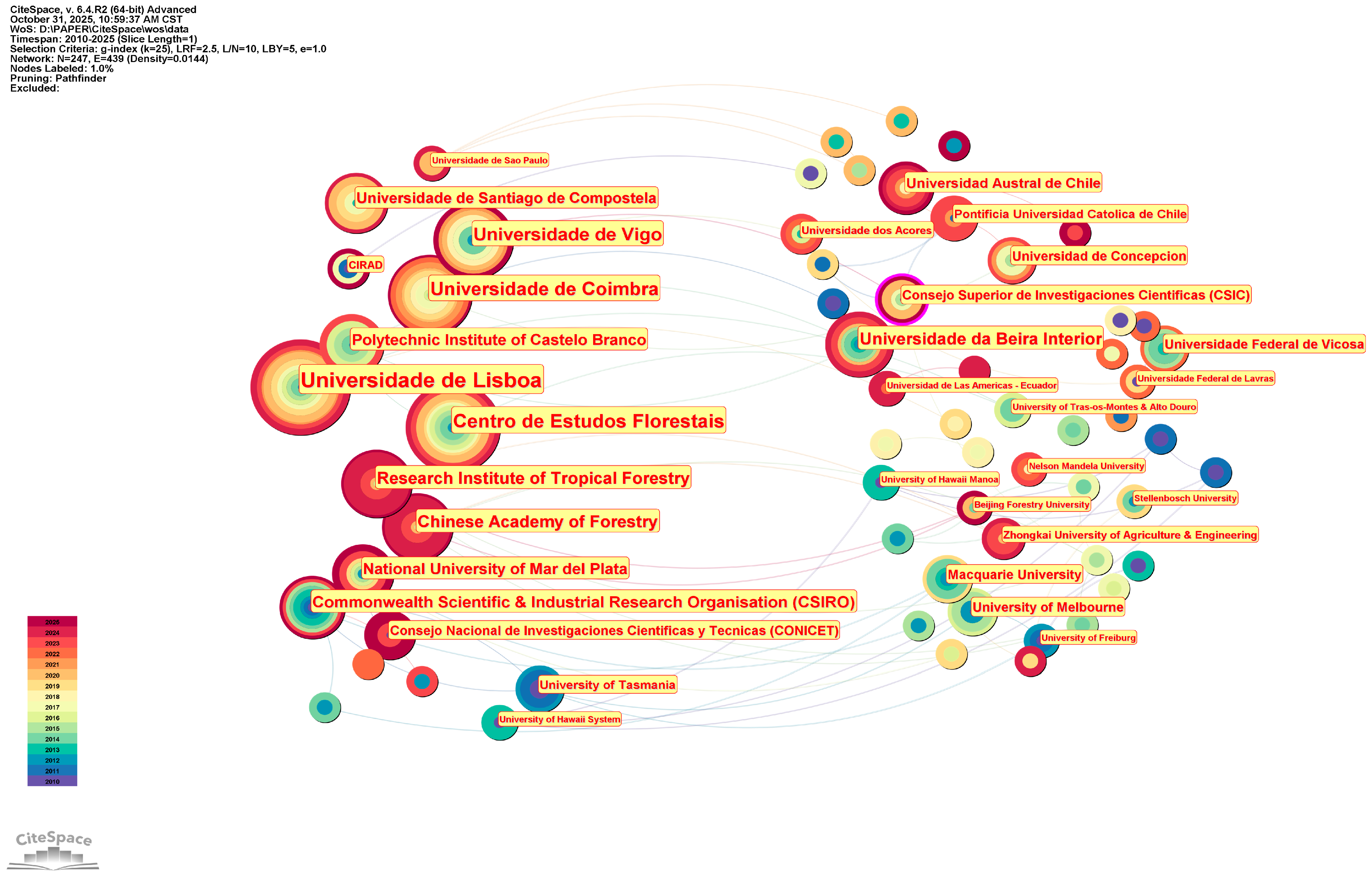
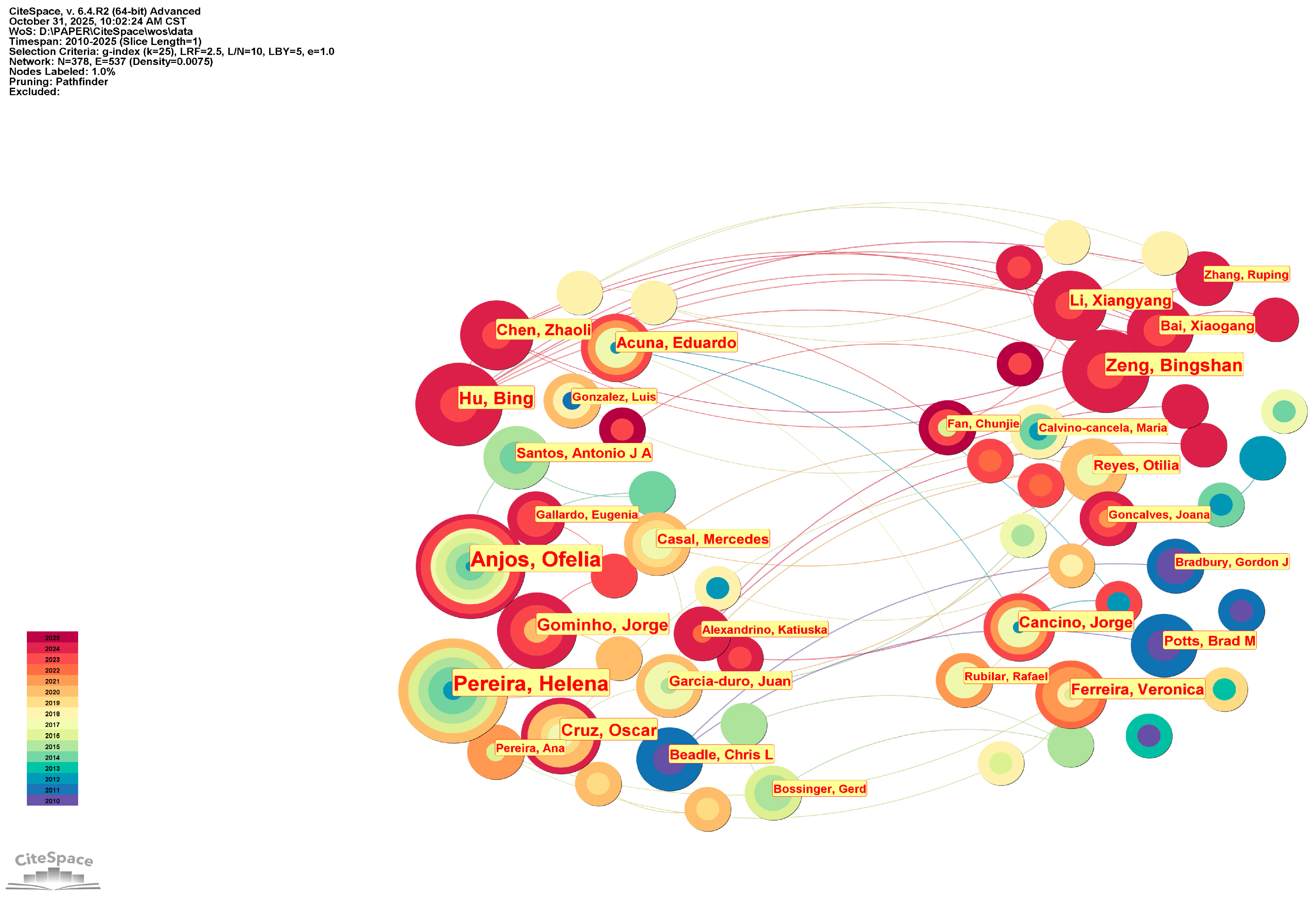
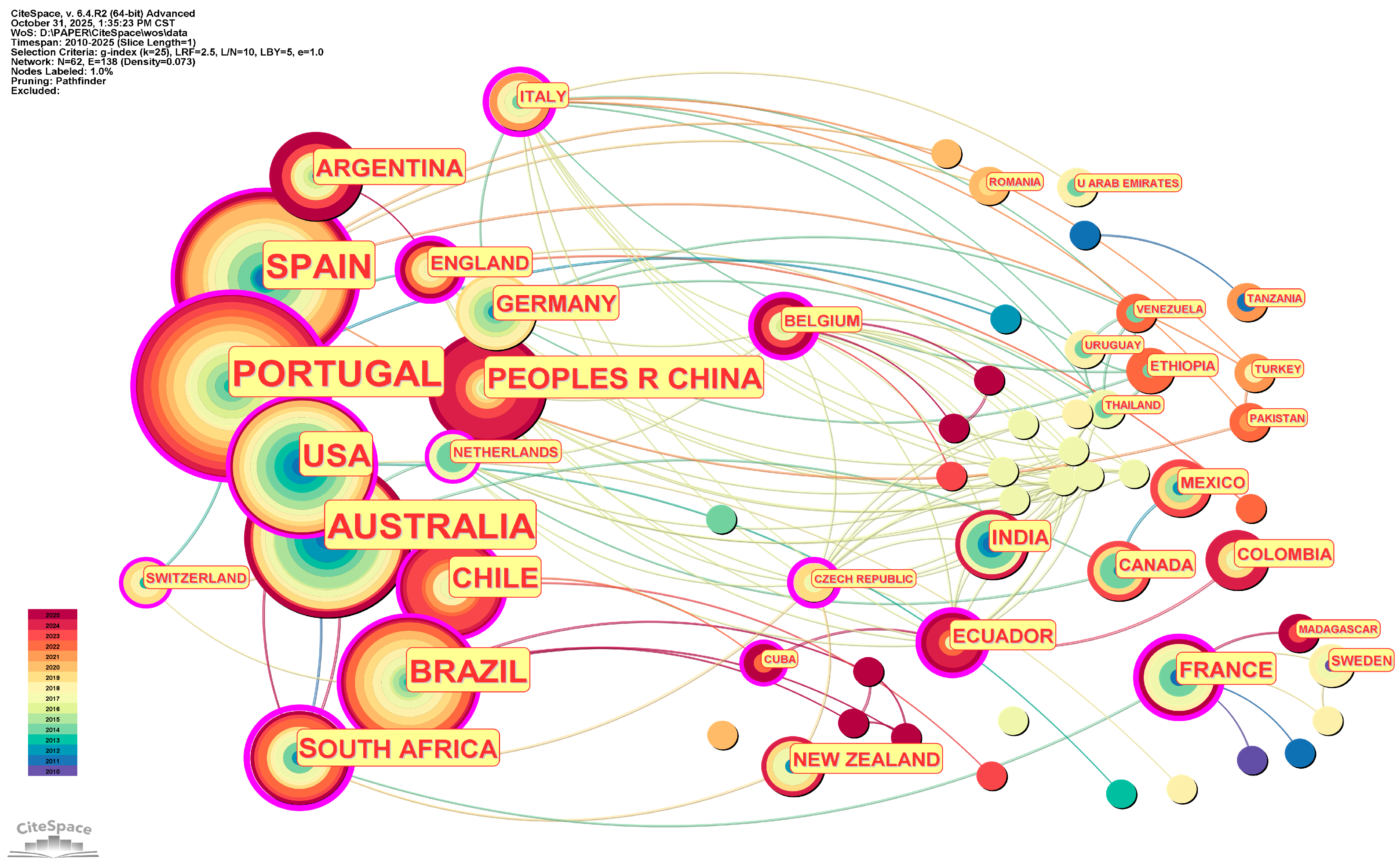
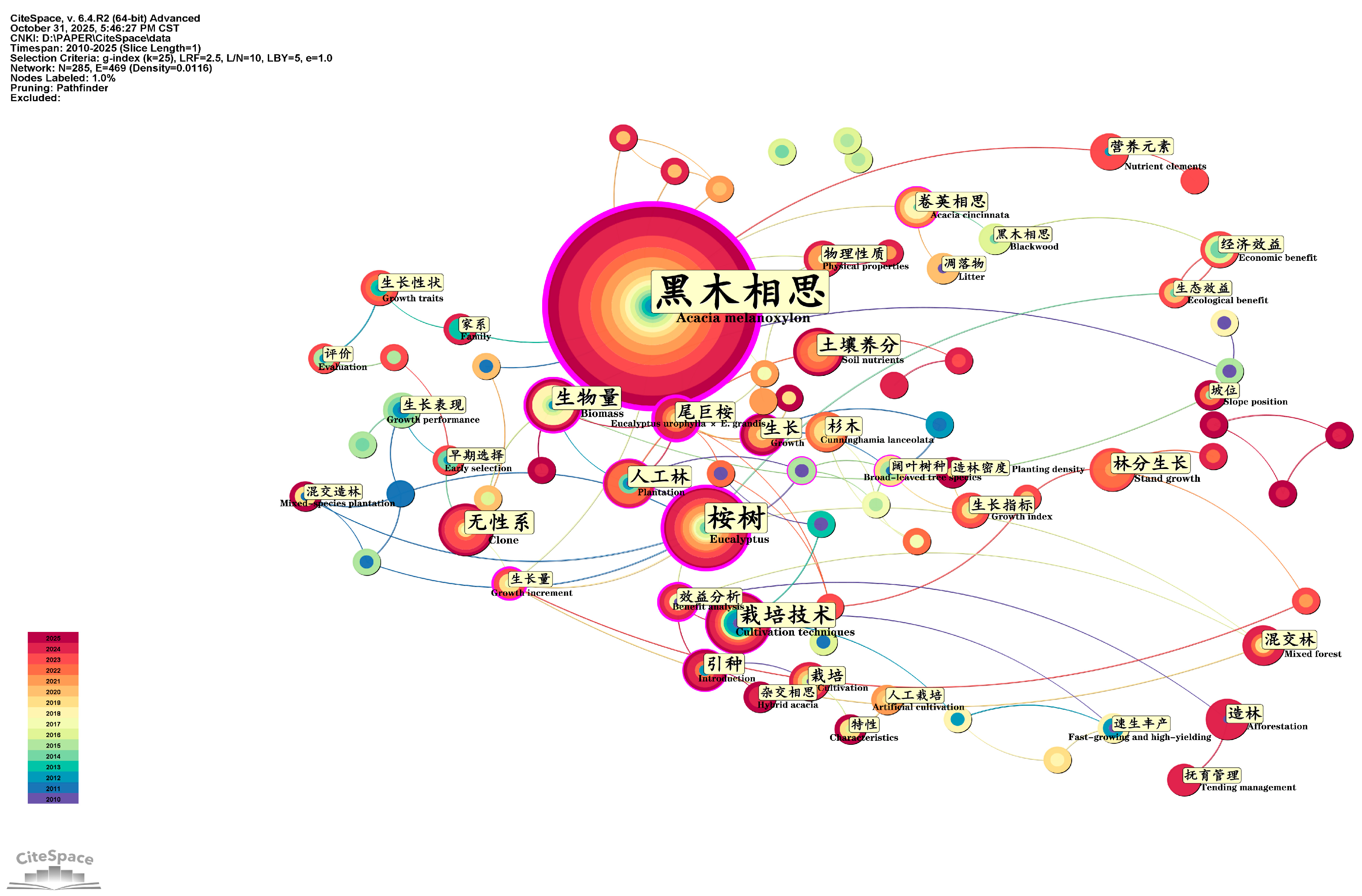
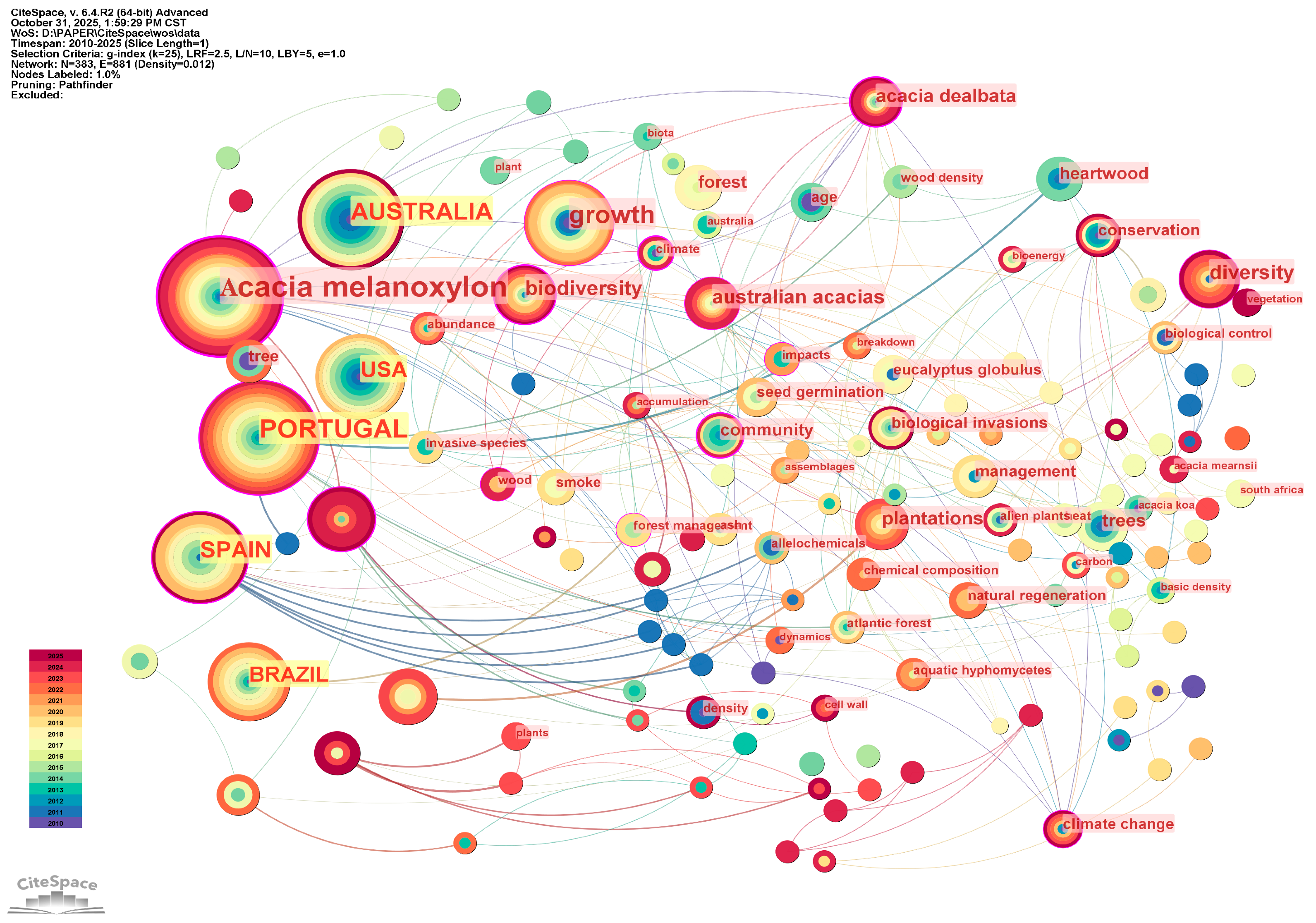
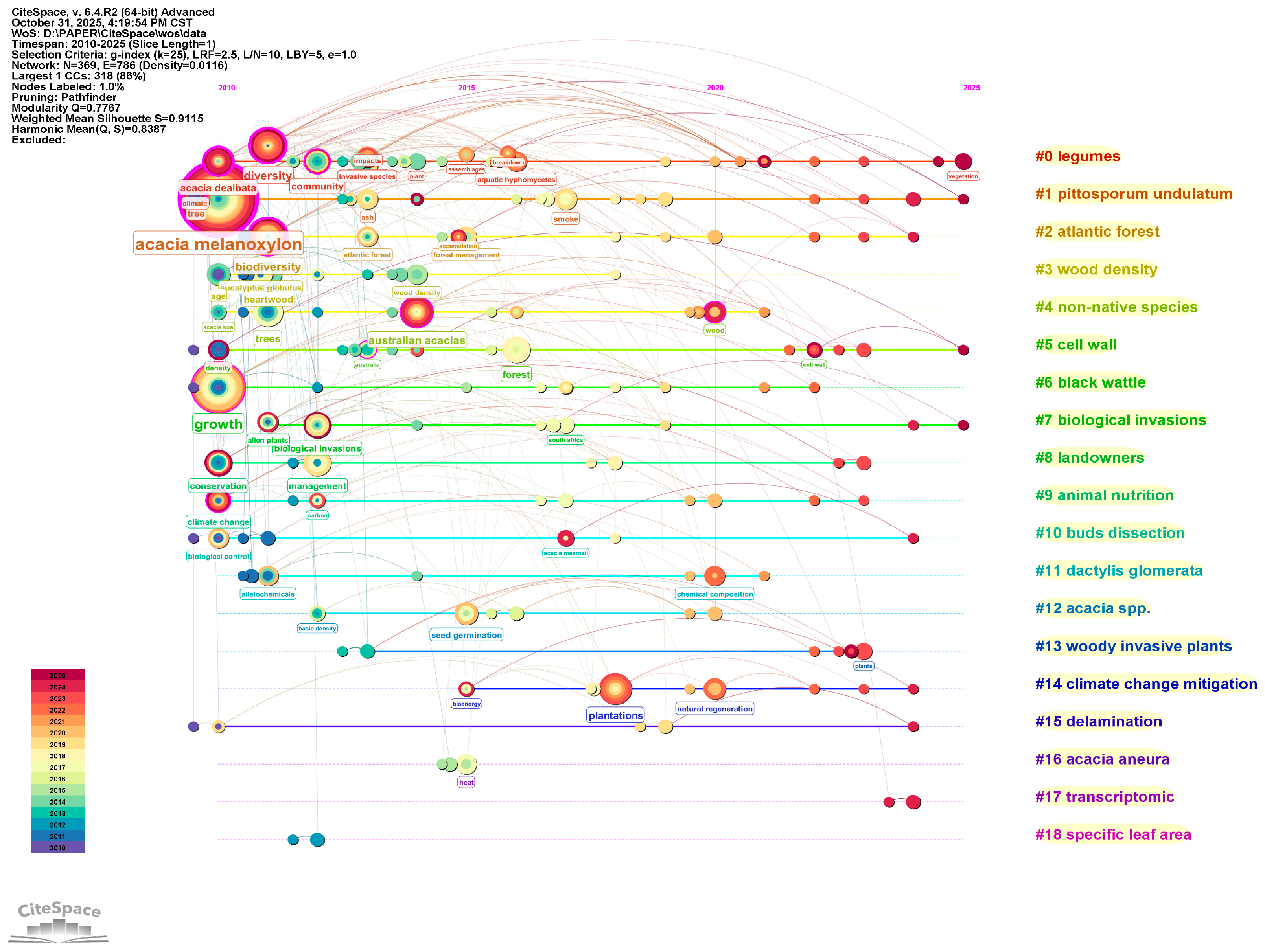

| Cluster ID | Cluster Label | Key Research Topics | Temporal Phase | Evolutionary Characteristics |
|---|---|---|---|---|
| #0/#6 | Forest Ecology and Environmental Effects | Soil fertility; Nutrient cycling; Carbon sequestration; Litter decomposition | 2010–Present | Foundational research; shifted from single–factor soil analysis to complex ecosystem service evaluation. |
| #3/#15 | Wood Science and Utilization | Wood density; Heartwood quality; Bio-oil production; Pulp properties | 2010–2018 | Focus on raw material properties; decreasing relative dominance as ecological concerns rise. |
| #5/#17 | Physiology and Stress Mechanisms | Drought stress; Nitrogen fixation; Root architecture; Water use efficiency | 2015–Present | Growing interest in physiological traits that drive interspecific complementarity. |
| #4/#7 | Invasion Ecology | Allelopathy; Invasiveness risk; Biodiversity loss; Native species regeneration | 2018–Present | Emerging hotspot; critical for assessing the ecological safety of mixed plantations in non-native ranges. |
Disclaimer/Publisher’s Note: The statements, opinions and data contained in all publications are solely those of the individual author(s) and contributor(s) and not of MDPI and/or the editor(s). MDPI and/or the editor(s) disclaim responsibility for any injury to people or property resulting from any ideas, methods, instructions or products referred to in the content. |
© 2025 by the authors. Licensee MDPI, Basel, Switzerland. This article is an open access article distributed under the terms and conditions of the Creative Commons Attribution (CC BY) license.
Share and Cite
Gui, H.; Sun, X.; Wei, H.; Wu, L. Ecological and Economic Synergies of Acacia melanoxylon and Eucalyptus Mixed Plantations: A Combined Bibliometric and Narrative Review. Forests 2026, 17, 65. https://doi.org/10.3390/f17010065
Gui H, Sun X, Wei H, Wu L. Ecological and Economic Synergies of Acacia melanoxylon and Eucalyptus Mixed Plantations: A Combined Bibliometric and Narrative Review. Forests. 2026; 17(1):65. https://doi.org/10.3390/f17010065
Chicago/Turabian StyleGui, Haoyu, Xiaojie Sun, Hong Wei, and Lichao Wu. 2026. "Ecological and Economic Synergies of Acacia melanoxylon and Eucalyptus Mixed Plantations: A Combined Bibliometric and Narrative Review" Forests 17, no. 1: 65. https://doi.org/10.3390/f17010065
APA StyleGui, H., Sun, X., Wei, H., & Wu, L. (2026). Ecological and Economic Synergies of Acacia melanoxylon and Eucalyptus Mixed Plantations: A Combined Bibliometric and Narrative Review. Forests, 17(1), 65. https://doi.org/10.3390/f17010065

