


Abstract
Increasing aridity and climate extremes are challenging the resilience of key Mediterranean species. Proxies that indicate plant water status, physiological condition and soil water availability are valuable tools for management planning. However, their reliability requires species-specific validation under dynamic environmental conditions. This study examined the relationship between predawn leaf water potential (ΨPD) and soil water potential (ΨS) in potted seedlings of two co-occurring Mediterranean evergreen oaks, Q. ilex and Q. suber, subjected to imposed soil drying under greenhouse conditions. We further quantified the occurrence and magnitude of predawn disequilibrium (PDD)—the mismatch between ΨPD and ΨS—and evaluated its association with soil water availability, plant water-status indicators, environmental factors, and physiological variables. In parallel, we assessed stomatal closure dynamics during the desiccation phase and characterised species-specific mortality patterns under progressive drought. Linear Mixed-Effects Models (LMMs), with pot identity included as a random factor, were fitted to assess the relationship between ΨPD and ΨS, as well as the occurrence of PDD and its potential drivers for each species. Stomatal conductance (gs) responses to ΨS were evaluated using a paired t-test and an additional LMM. Finally, Generalised Linear Mixed-Effects Models (GLMMs) were used to analyse interspecific differences in mortality. We confirmed a tight relationship between ΨPD and ΨS, followed by a consistent PDD in both species, with magnitudes of 0.53 MPa for Q. ilex and 0.98 MPa for Q. suber, which increased significantly with drought severity. Our findings suggest that PDD under the studied conditions is primarily driven by soil water depletion and plant desiccation, as indicated by its negative correlation with water status parameters, as well as by its increase with progressive drought. Both oaks exhibited a water-saving strategy, with stomatal closure initiated around ΨS = −0.31 MPa (Q. ilex) and −0.42 MPa (Q. suber). Despite their physiological similarities, Q. suber showed higher mortality under imposed drought. These results encourage modelling the relationship between ΨPD and ΨS to accurately interpret plant and soil water needs in Mediterranean oaks, especially under soil water scarcity, and highlight species-specific responses critical for forest management and restoration under climate change.
1. Introduction
The Mediterranean climate is characterised by mild, wet winters and hot, dry summers. The combination of reduced precipitation and elevated temperatures during summer leads to soil water scarcity and high evaporative demand, coinciding with the period of active growth for much of the vegetation [1]. This, in turn, affects the productivity, competitive ability, and distribution patterns of plant species [2]. Furthermore, plants growing in Mediterranean-type climate regions have developed a range of functional and structural adaptations that enable them to endure moderate drought stress without significant reductions in performance or survival [3].
The specific structural adaptive traits of Mediterranean plants are often described as “conservative”, as they enhance their capacity for either tolerating, avoiding, or escaping water stress [4]. These traits include the formation of a deep and extensive root system [5,6], leaf sclerophylly along with higher leaf mass area (LMA) [7], and high plasticity in foliar morphology and size [8,9]. Physiological adaptations to drought involve the ability to maintain water flux and the hydraulic lift of soil water, as well as resistance to xylem cavitation and stomatal control of transpiration. Together, these mechanisms are ecologically relevant because they reflect plant interactions with the surrounding environment through the soil–plant-atmosphere continuum (SPAC) [10]. Despite these specific adaptations, increased aridity in the Mediterranean basin, particularly in southern Europe [11,12], along with other climate change-related phenomena, threatens the capacity of individuals to cope with drought events [13]. In many cases, preserving these species requires the adoption of preventive, mitigating, or adaptive measures. For this purpose, monitoring and accurately characterising the response of Mediterranean vegetation to water scarcity is crucial for understanding their capacity to persist under increasingly dry and warm conditions [14], as well as for providing valuable feedback with which to adapt future management strategies to new climate scenarios [15].
Oaks are considered keystone species in Mediterranean-type ecosystems. Their distribution directly reflects their competitiveness in terms of growth under arid conditions, as well as centuries of human influence [16,17]. Currently, they provide a broad array of environmental services, including timber, cork, mushrooms, and truffles (i.e., Tuber melanosporum Vittad.) [18,19]. Motivated by the economic benefits of the latter, the number of hectares planted with oak species has increased in Mediterranean-type climate regions in recent decades [20,21]. These agroforestry systems are typically established on marginal lands with shallow soils. In dry climatic conditions, this intensifies the tree’s water needs [22,23]. Consequently, landowners depend on supplementary irrigation to ensure the survival and growth of trees, especially during the early stages of the plantation, and to achieve the desired yields [24]. Furthermore, predicted drier and warmer conditions in Mediterranean areas will reduce water availability, calling for the optimisation of current irrigation practices. Although some studies have provided new insights into the irrigation planning for these plantations based on meteorological data (i.e., reference evapotranspiration, ETo), others emphasise the importance of plant-based methods for scheduling water inputs, either independently or in conjunction with daily soil moisture monitoring using field probes [25,26]. In this regard, exploring the tree’s response to increasing drought provides relevant information on both the water status and the species’ physiological response to the imposed stress. This will, in turn, help to optimise water inputs by defining critical thresholds for a given plant or correlated soil parameters reflecting stress [27,28]. Nonetheless, their reliability requires validation under dynamic environmental conditions for each species.
Leaf water potential (ΨL, MPa) is a useful and broadly accepted parameter that reflects the water status of plants [29]. Despite daily fluctuations in ΨL, with maximum values recorded in the early morning and minimum values around midday, it is widely accepted that, in the absence of or with low levels of nocturnal transpiration, the plant and soil water potential (ΨS, MPa) of the wettest layer of the rooting zone reach an equilibrium before dawn [30,31]. Accordingly, pre-dawn leaf water potential (ΨPD, MPa) has been a valuable proxy for soil water availability or soil water potential [32], thereby informing decision-making in various contexts. For instance, the role of ΨPD in scheduling irrigation for productive orchards is widely recognised, a fact reinforced by the simplicity of its measurement [33]. Additionally, ΨPD has been used to describe ecological processes happening in Mediterranean forests, such as habitat partitioning among co-occurring plant species, and to predict differential responses in photosynthetic, photochemical and hydraulic traits under different levels of water stress [17,34]. However, new findings in recent decades, have challenged the reliability of this assumption by suggesting that plant water potential may not reach equilibrium with soil matric potential by dawn [35,36]. This, in turn, may lead to irrigation mistakes in tree plantations.
Discrepancies between ΨPD and ΨS typically result in lower ΨPD values [36,37], indicating a delay in overnight ΨL recovery. This phenomenon, known as predawn disequilibrium (PDD), is defined as the difference between ΨPD and ΨS [35]. The failure to achieve soil–plant water potential equilibrium is primarily attributed to nighttime transpiration, which can reduce ΨPD across a broad range of species with diverse ecological traits [38,39].
Nighttime transpiration may account for up to 50% of daily water loss [40]. In a Mediterranean oak-savanna system, the deciduous Quercus douglasii Hook & Arn. exhibited nocturnal water losses of up to 20% of daily transpiration rates [41]. The magnitude of nocturnal transpiration varies depending on species-specific stomatal behaviour, atmospheric conditions—particularly leaf-to-air vapour pressure deficit (VPD, kPa)—, and soil water or nutrient availability [42]. For instance, nighttime water losses detected in the evergreen live oaks Quercus virginiana Mill. and Quercus oleoides Cham. & Schlecter negatively correlate with both atmospheric and soil drought [43]. Plants that transpire at night may benefit from early morning carbon fixation under low VPD, improved nutrient acquisition due to continuous xylem flow, and a potentially enhanced oxygen supply to parenchyma cells in woody tissues for respiration [39]. Additionally, high concentrations of apoplastic solutes in leaves may contribute to the observed imbalance in species growing in saline ecosystems [36]. In conifers, hydraulic conductance also plays a role in PDD; low conductivity and long xylem pathways can hinder the replenishment of internal water reservoirs, thereby exacerbating leaf water deficits [31]. Therefore, the magnitude of PDD provides an advanced, measurable indicator of plant water stress, because a larger disequilibrium (lower ΨPD) implies a more significant nighttime water deficit. This deficit dictates the plant’s subsequent stomatal strategy: a lower morning water potential can trigger earlier or more conservative stomatal closure during the day to prevent cavitation and maintain hydraulic safety [39,40]. Consequently, characterising the PDD magnitude and its drivers offers crucial mechanistic insight into the plant’s strategy for coping with progressive drought, linking it directly to the critical moment when CO2 assimilation and overall performance begin to be compromised.
In view of the above, this study examines the water status and physiological responses of two broad-leaved evergreen sclerophyllous Mediterranean oak species, Quercus ilex L. and Quercus suber L., subjected to increasing soil dryness. Some Mediterranean Quercus may exhibit mechanisms associated with PDD [44,45]. However, to the best of our knowledge, this imbalance and the role of its potential drivers have not been specifically addressed in seedlings of Mediterranean oaks in the Northern Hemisphere under greenhouse conditions [16]. Both species exhibit conservative stomatal regulation of transpiration during summer drought, indicative of water-saving behaviour [2], which is typically accompanied by reduced CO2 assimilation [46]. They also possess substantial hydraulic safety margins, with comparable cavitation and turgor loss point water potentials [47], although their photosynthetic performance may differ under summer stress [48].
The present work has the following aims: (i) to confirm the relationship between soil and plant water potential at predawn for both Q. ilex and Q. suber; (ii) to examine whether PDD occurs and to determine the magnitude of this imbalance along a drying period; (iii) to identify the physiological and environmental variables that may impede the equilibration of plant water potential with that of the soil overnight; (iv) to determine when Q. ilex and Q. suber start to close their stomata along the drying period; and (v) to assess their drought tolerance at the seedling stage. We contend that characterising their responses under progressively drier conditions [49] is essential for defining critical thresholds of plant activity in order to accurately implement plant-based adaptation strategies for both conservation and production purposes.
2. Materials and Methods
2.1. Plant Material, Experimental Site and Setup
This study was conducted in a greenhouse at ETSEA-FiV (41.628° N, 0.598° E, Lleida, Spain) during the spring of 2023. The experimental design followed a repeated measures (longitudinal) format, considering the pot as the experimental unit. A total of 38 five-litre pots were randomly distributed on the greenhouse bench, each containing two one-year-old seedlings of either Quercus ilex subsp. ilex or Quercus suber. The final 76 plants (20 pots with Q. ilex and 18 pots with Q. suber) used in this study were purchased from the nursery Forestal Catalana, S.A. (42.155° N, 0.912° E, Tremp, Spain) at 470 m.a.s.l. Each pot was filled with a substrate composed of a 60:20:20 mixture of peat (FLOWER Universal Substrate, Flower, Tàrrega, Spain), sieved local soil, and perlite. Seedlings were transplanted two months before the experiment began. Irrigation was discontinued on the first measurement day to induce drought conditions. Until then, the plants were maintained in healthy condition and irrigated regularly to saturation, allowing excess water to drain freely through the holes at the base of the pots. All plants were subjected to the same drought treatment.
Ten soil water potential (ΨS, MPa) sensors (TEROS 21, Meter Group, Pullman, WA, USA) were placed inside the pots between the two plants, ensuring that the data reflected soil water availability in the vicinity of the roots. Additional capacitive moisture probes (Analog Capacitive Soil Moisture Sensor, DFRobot, Shanghai, China) were placed in all pots, coinciding with the ΨS sensors in ten of the pots. The placement of the sensors between the two seedlings ensured that the measurements reflected the soil water status experienced by both plants, which were approximately 5 cm apart. As noted by García-Tejera et al. [50], plants can respond to the water status of the wetted soil zone even when only a small fraction (≈10%) of their roots are located within it. By situating the sensors centrally in the pot, we also avoided the lateral areas of the containers, where the drainage is higher, and soil moisture tends to be lower. Greenhouse temperature (T, °C) and relative humidity (RH, %) were monitored with an EasyLog EL-USB-2 sensor (Lascar Electronics, Whiteparish, UK) (Figures S3 and S4). Vapour Pressure Deficit (VPD, kPa) was calculated from values of T and RH according to Rundel and Jarrell [51]:
Mean and maximum diurnal (from dawn to sunset) VPD values for the experimental period are shown in Figure S1.
2.2. Data Collection
Plant measurements were conducted at weekly intervals under progressively increasing drought conditions over five dates in spring 2023: 24 and 31 May and 7, 14, and 21 June (corresponding to Day of the Year [DOY]: 144, 151, 158, 165, and 172, respectively). For each time point and date, both plants in each pot were measured, resulting in a total of 196 observations for Q. ilex and 163 for Q. suber. By the fifth week, a significant number of plants had succumbed to drought stress, and measurements were subsequently discontinued. Dead plants or those with insufficient sample material were recorded as “not available (N/A).”
2.2.1. Plant Water Status: Plant Water Potential and Hydration
Predawn leaf water potential (ΨPD, MPa) was recorded in apical shoots removed from both Quercus species (with leaves still attached to the shoots), using a Scholander pressure chamber (Model 3000F01, SoilMoisture Equipment Corp., Goleta, CA, USA) and following the procedures described by Turner [52] to minimise procedural errors. Samples were placed in sealed plastic bags, kept refrigerated in a portable cooler with cold packs and stored in the dark until measurement to prevent transpiration in the time between the excision and insertion into the pressure chamber. Scholander pressure outputs were excluded from the analyses when ΨL reached the lower detection limit of the device (i.e., −3.2 MPa). To evaluate the potential bias introduced by this exclusion, we conducted a sensitivity analysis comparing the ΨS~ΨPD relationship and PDD estimates derived with and without these observations included at the detection limit.
Hydration (H, %) was determined in those leaves that were not used for ΨL measurements. Fresh and dry weights were obtained, the latter by oven-drying the samples at 65 °C until constant weight was achieved. Leaf hydration was then calculated as the difference between fresh and dry leaf mass.
2.2.2. Leaf Gas Exchange
Stomatal conductance (gs, mol H2O·m−2·s−1) was measured in fully developed current-year attached leaves with a porometer (LI-600, LI-COR Biotechnology, Lincoln, NE, USA). Measurements were made on the abaxial side of the leaves, and the sensor head of the porometer was held at the natural position and angle of the leaf during measurement. On each measurement day, data were collected at three times: 5:00 a.m. solar time (one hour before predawn, BPD), 6:00 a.m. (predawn, PD), and 1:00 p.m. (midday, MD). Nighttime transpiration (E) was calculated as the product of stomatal conductance (gs) and the vapour pressure deficit (VPD) measured at 5:00 a.m. [53].
2.3. Statistical Analysis
Statistical analyses were performed using the R software environment (version 4.4.2, R Core Team, Vienna, Austria) [54]. First, a linear regression model (R2 = 0.787; RMSE = 0.366) was used to estimate ΨS in each pot based on capacitive moisture sensor data from all species and dates (Figure S2). Bonferroni outlier tests using the outlierTest (Version 3.1-3) function in the ‘car’ package [55], were used to detect estimated ΨS values with no ecological meaning, which were subsequently removed from the dataset. Additionally, we calculated the average of the ecophysiological variables for both seedlings in each pot (the experimental unit), to account for the lack of independence between the observations from plants sharing the same pot. Thereafter, the total number of observations was 100 for Q. ilex and 90 for Q. suber.
We fitted linear mixed-effects models (LMMs) independently for each species, with predawn plant water potential (ΨPD) as the response variable and soil water potential (ΨS) as the explanatory variable in the fixed component, to describe the relationship between both water potentials before dawn. Plant hydration (H) was also included as a covariate. We used the lmer (version 1.1-10) function in the ‘lme4’ package [56] to fit the LMMs, following the structure: Yi = explanatory effect(s) + random effect(s) + residuals, where Yi represent the response variables. We considered the pot identifiers as a random factor to account for repeated measures over time. Significance was assessed using p-values and model fit via R2. Assumptions were checked using the simulateResiduals (version 0.4.7) and plotSimulatedResiduals (version 0.4.7) functions in the ‘DHARMa’ package [57].
LMMs were conducted on predawn ΨS and ΨPD independently for both Quercus species, to assess the existence of a disequilibrium across all the sampling dates. Again, the pot was included in the random component of the model. PDD was considered significant when predawn ΨS was less negative than ΨPD (ΨS > ΨPD). Post hoc pairwise comparisons using the emmeans (version 1.10.6) function in the ‘emmeans’ package [58] and the Bonferroni adjustment, determined the significance of the differences within each measurement date. In cases in which PDD was detected, the magnitude of the disequilibrium was defined as the difference between the absolute values of ΨPD and ΨS (PDD > 0), as described by Donovan et al. [35]. LMMs were fitted with the computed PDD as the response variable. First, PDD was tested against DOY to check for differences in the magnitude of the disequilibrium along the drying period. Then, PDD was analysed as a function of E measured 1 h before predawn (5:00 a.m., BPD) (as a measure of nocturnal transpiration), VPD calculated for the same moment, ΨS and H at predawn as explanatory variables, with pot identifiers as a random factor. Stomatal conductance and ΨPD, were not tested due to collinearity with other predictors, as indicated by Variance Inflation Factor (VIF) and correlation analyses.
To identify the most parsimonious model explaining variation in PDD, we constructed all possible combinations of fixed-effect predictors, excluding interaction terms. Model comparisons were performed using the anova (version 2024.12.0) function from the ‘stats’ package [54], which conducts likelihood ratio tests for nested models fitted by maximum likelihood. Model selection was guided by the Akaike Information Criterion (AIC), log-likelihood (logLik) values, and the statistical significance of Chi-squared tests (χ2) for nested model comparisons. Although some explanatory variables were excluded from the final models due to lack of significance in multivariate models, their biological relevance was considered throughout the interpretation of results. Model assumptions were again checked, using the aforementioned functions.
Paired Student’s t-tests, or LMMs in case of uncoupled observations, were used to determine stomatal closure as the point during the drought period when the change in gs, measured at midday, was statistically significant compared with well-watered conditions (i.e., ΨS ≈ 0 MPa, DOY = 144). Mortality was tracked by recording dead (N/A) samples for each species over time. Percentages of dead individuals were calculated for each measurement date. Furthermore, a generalised linear mixed-effects model (GLMM) following a binomial distribution (link = logit) was conducted to test the differences in the survival rates between both species at the final stages of the experimental period (DOY: 165–175). Early dates (DOY: 144, 151 and 158) with 100% survival were excluded due to the lack of differences between species, which could bias parameter estimates. The plants and the pots were included as random factors to account for the lack of independence between seedlings within the same pot and for the repeated measurements. We used the glmmTMB (version 1.1.13) function in the ‘glmmTMB’ package to fit the GLMM, followed by the emmeans (version 1.10.6) function to compute the estimated marginal means and the difference in the survival probabilities between species.
3. Results
3.1. Relationship Between Soil (ΨS) and Leaf Water Potential Before Dawn (ΨPD)
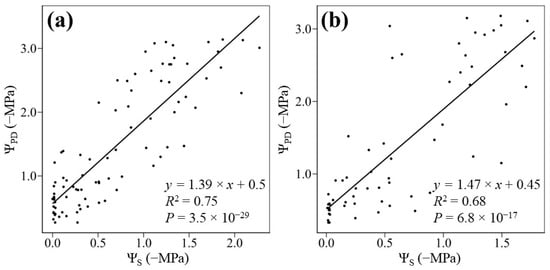
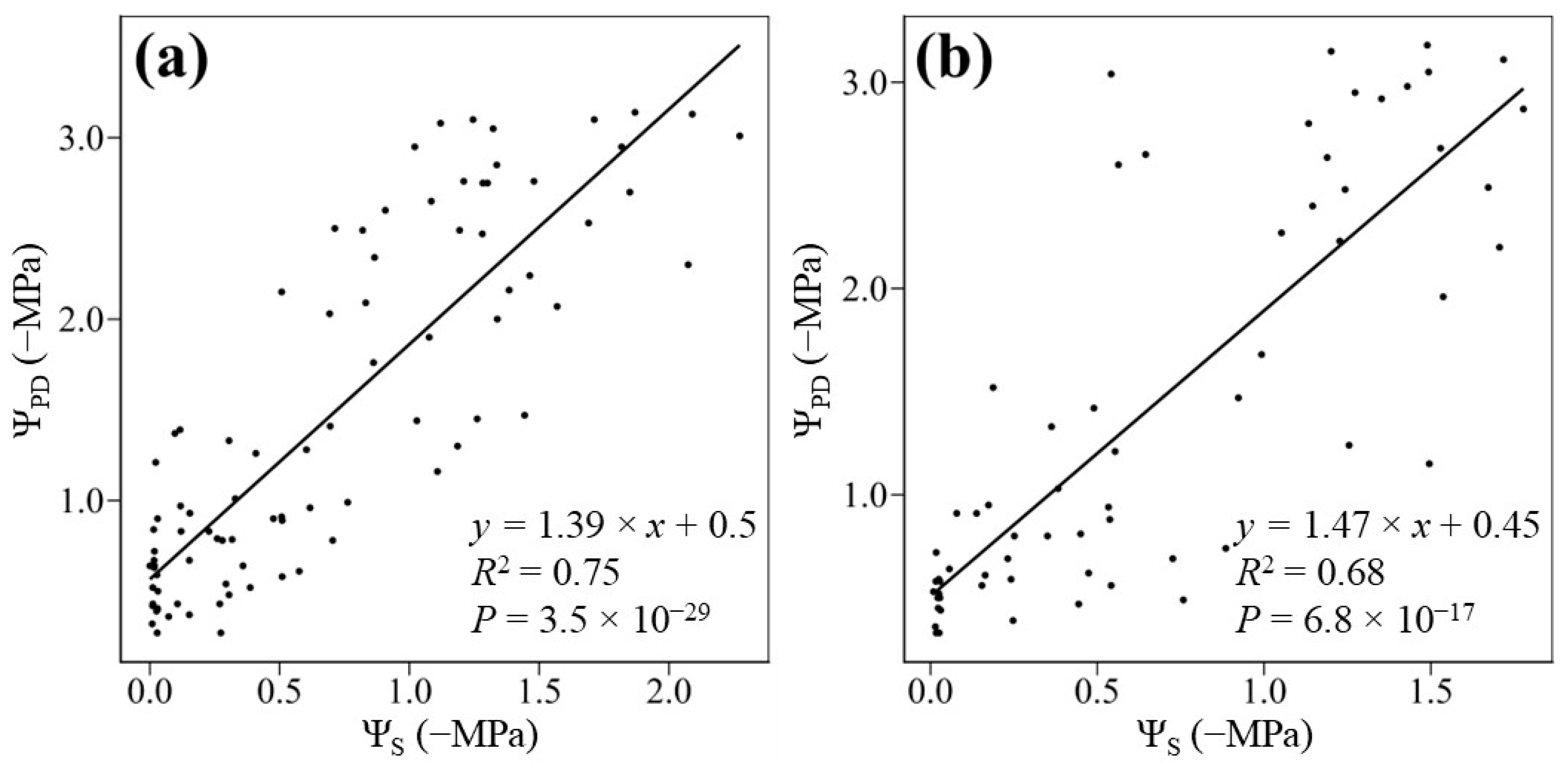
Both Quercus species showed a strong positive relationship between soil water potential (ΨS) and leaf water potential (ΨPD) measured before dawn (Figure 1). Linear mixed-effects models were fitted separately for each species and yielded high coefficients of determination with significant p-values (Figure 1). Notably, both species reached extreme ΨPD values at or near −3.2 MPa (ca., the measurement limit of the Scholander pressure chamber) on day 28 (DOY = 172). When leaf hydration was included as an additional covariate, it was only statistically significant in Q. ilex (p = 0.0013), while in Q. suber it did not significantly improve the model (p = 0.13).
Figure 1.
Relationship between predawn soil (ΨS) and plant water potentials (ΨPD) for: (a) Q. ilex (n = 88, 5 measurement days) and (b) Q. suber (n = 63, 5 measurement days).
A sensitivity analysis including the observations at the detection limit of the Scholander pressure chamber confirmed that their exclusion had negligible impact on the fitted regression models and on their interpretation. Slope estimates for Q. ilex differed by <1% (i.e., 1.39 vs. 1.38), while slopes for Q. suber were identical (i.e., 1.47). Furthermore, intercepts differed by ≤ 0.02 MPa, and all relationships remained highly significant (p < 10−16).
3.2. Soil–Plant Water Potential Disequilibrium Before Dawn (PDD)
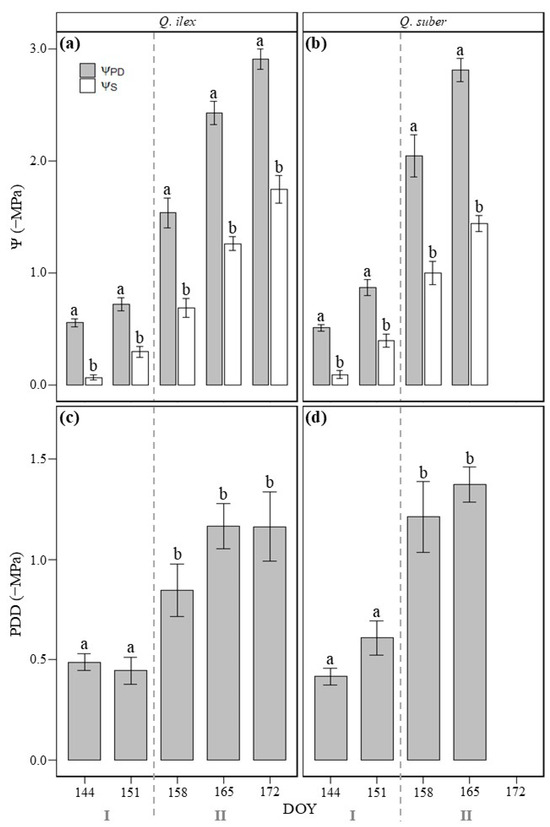
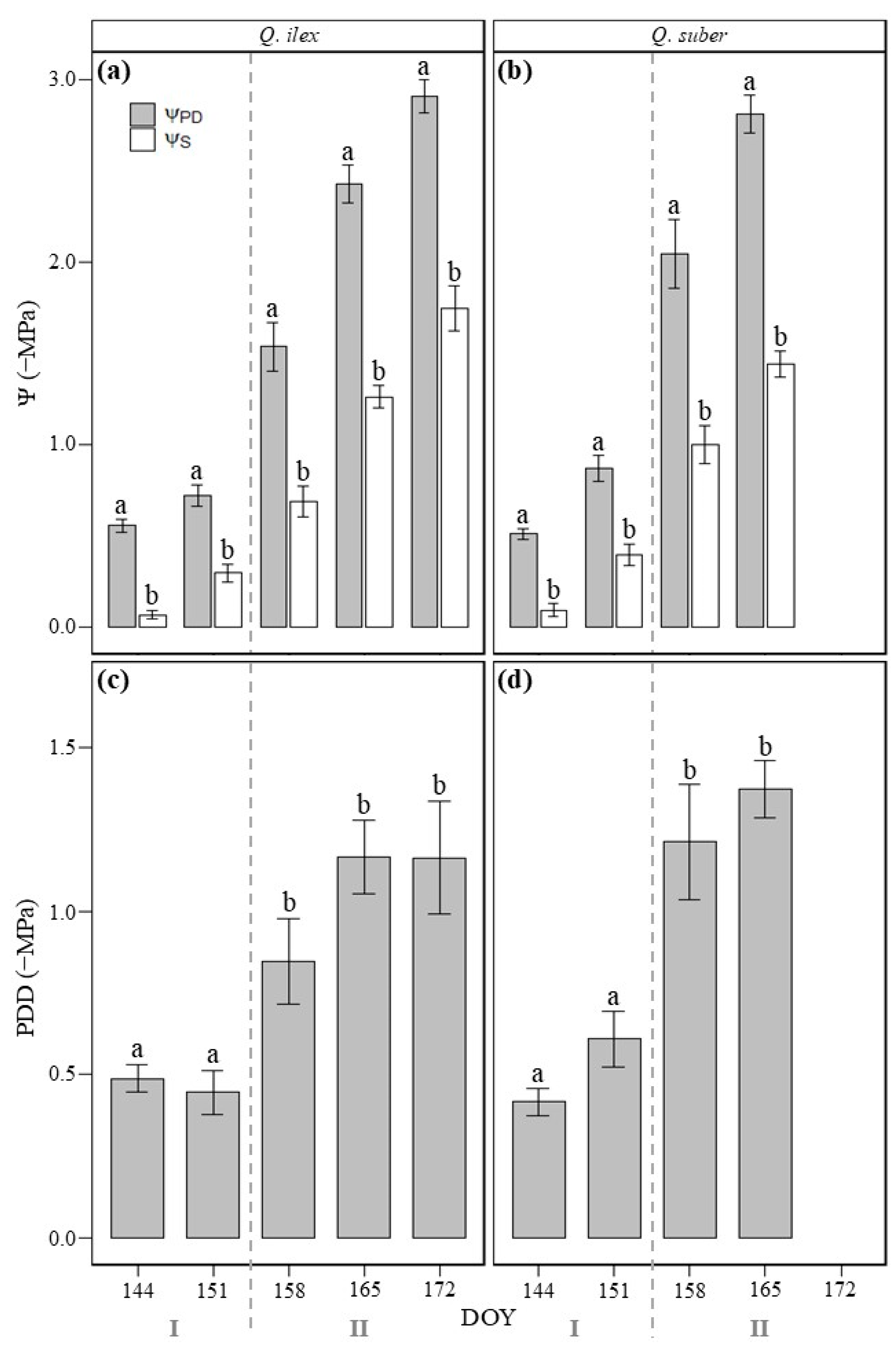
For both Quercus species, ΨPD was consistently more negative than ΨS (p ≤ 0.05), indicating the presence of a predawn disequilibrium at all plant sampling dates (Figure 2a,b). Despite always being statistically significant, the magnitude of PDD changed along the drying period. From DOY 158 onwards the values of PDD more than doubled those registered on DOY 144 and 151, revealing significant differences between the disequilibrium values registered at the beginning and at the end of the experiment, and consequently suggesting an effect of soil dryness on PDD (Figure 2c,d). Sensitivity analyses including observations at the detection limit of the Scholander pressure chamber confirmed that minor differences in PDD were observed only under the driest conditions (0.02–0.08 MPa, DOY: 165 and 172), while the overall temporal patterns and magnitude of PDD were preserved for both species. There were no differences in the evolution of PDD between species (p > 0.05), although both ΨPD and ΨS were significantly lower in Q. suber on DOY 158 and 165 (p ≤ 0.05) compared to Q. ilex, indicating higher water stress in Q. suber at those time points (Figure 2a,b).
Figure 2.
(a,b) Predawn soil and plant water potential (ΨS, ΨPD) estimates (mean ± SE), across five measurement days in Q. ilex and Q. suber. Lowercase letters indicate statistically significant differences (p ≤ 0.05) between soil ΨS and plant ΨPD, resulting from within-day pairwise comparisons for each species and indicating predawn disequilibrium (PDD). (c,d) Estimated magnitude of PDD across the five sampling dates for both Quercus species. Lowercase letters indicate statistically significant differences (p ≤ 0.05) between dates. Bars for DOY 172 in Q. suber are not represented due to a lack of living plants. The dashed line marks the transition between early (DOY: 144–151) and late drought (DOY: 158–172), corresponding to the point at which PDD begins to increase more rapidly.
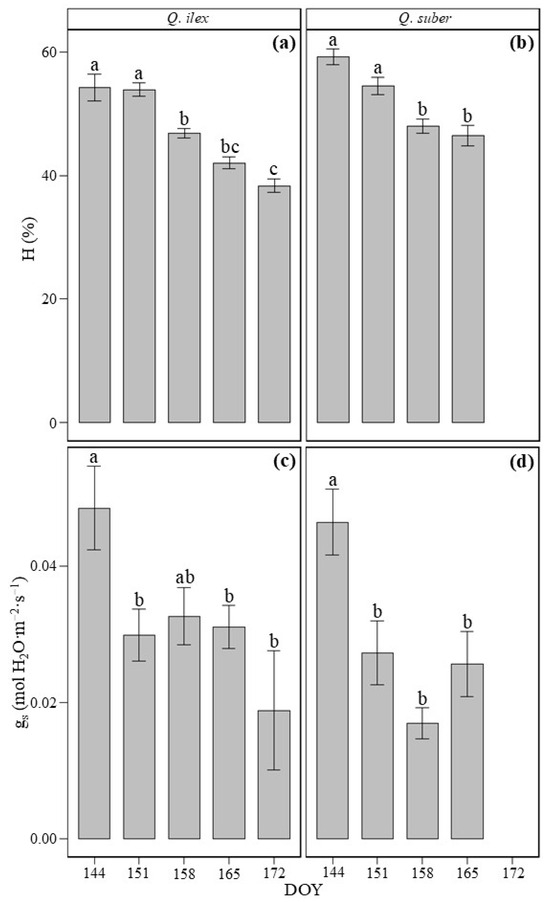
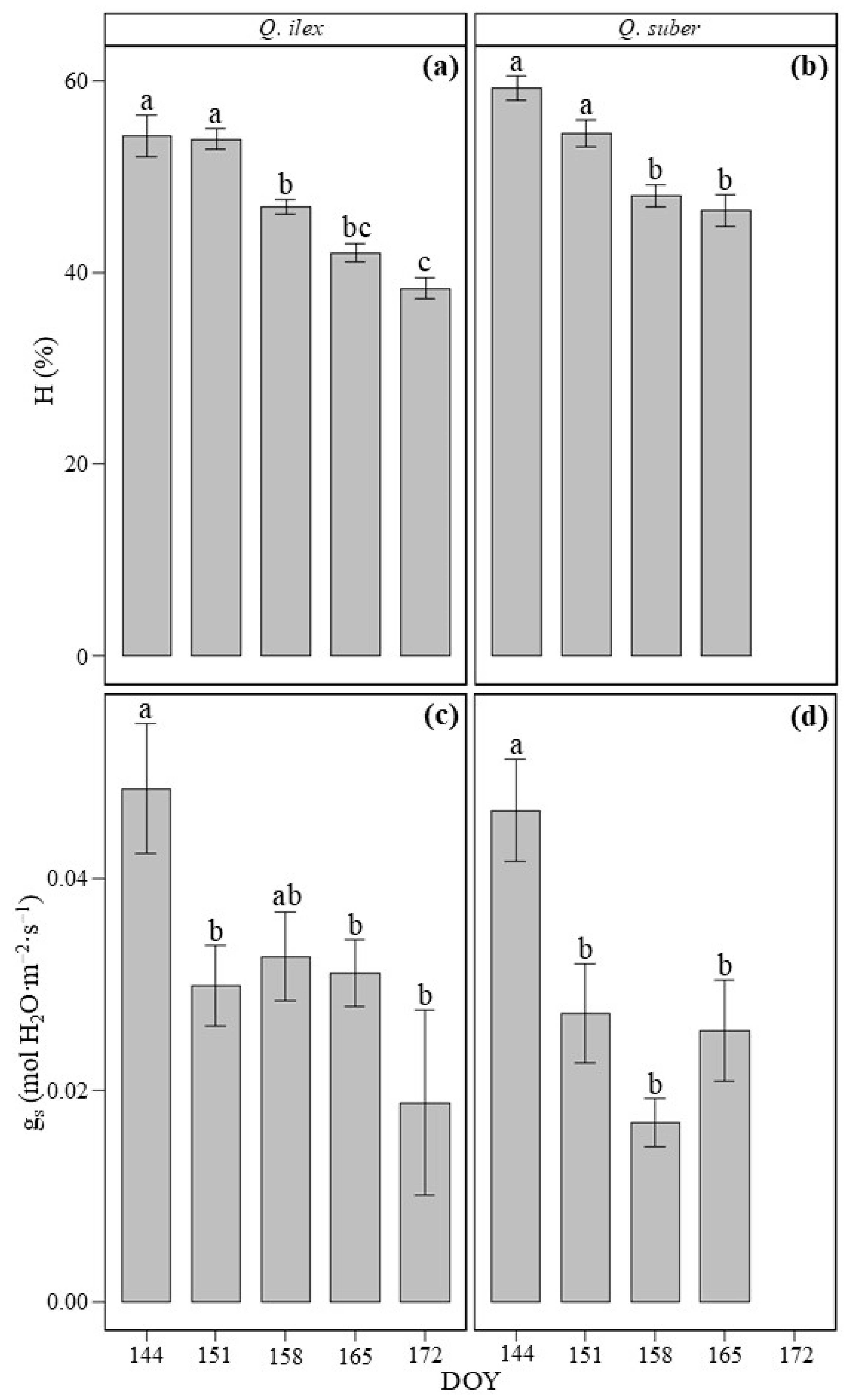
The fitted LMMs regressing PDD on the selected predictors (Table 1), revealed a significant effect of H (p ≤ 0.05) and ΨS (p ≤ 0.05) in the case of Q. ilex, while only showing a similar impact of ΨS (p ≤ 0.05) for Q. suber. The positive relationship between PDD and ΨS (−MPa), indicates an increase in the disequilibrium along with drought in both species. Conversely, an inverse trend described the impact of H on PDD in Q. ilex. This pattern in H was consistent with increasing plant stress as the drought progressed (Figure 3a,b), which was similarly reflected in the trends in stomatal conductance.
Table 1.
Best-fitting LMMs testing the effect of multiple physiological predictors on predawn disequilibrium (PDD), independently for each of the studied species (spp.). Each model includes the number of estimated parameters (N), its formula, the degrees of freedom (Df), the AIC, and the log-likelihood (logLik).
Figure 3.
Predawn plant hydration (H) (a,b) and nighttime stomatal conductance (gs) (c,d) estimates (mean ± SE) along the sampling dates for each of the tested species. Lowercase letters indicate statistically significant differences (p ≤ 0.05) among dates. The bars for Q. suber on DOY 172 are not displayed due to a lack of living plants.
When modelled independently, both predawn H and gs revealed a negative relationship with PDD in Q. suber (p ≤ 0.05). In fact, significantly higher values of gs 1 h before predawn (~0.05 mol H2O·m−2·s−1) (p ≤ 0.05) were already detected in well-irrigated conditions at the beginning of the experiment for both species, compared to the following days (Figure 3c,d).
3.3. Stomatal Conductance and Drought Tolerance
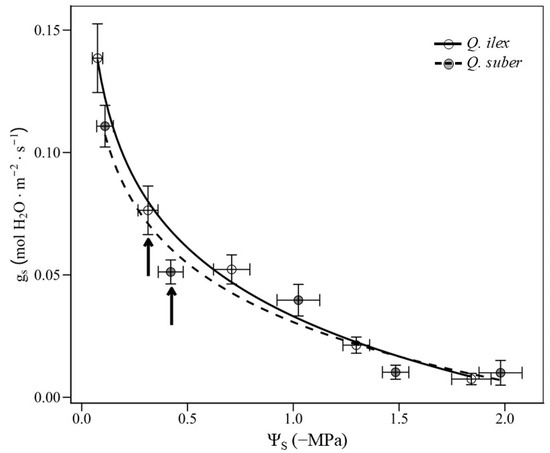
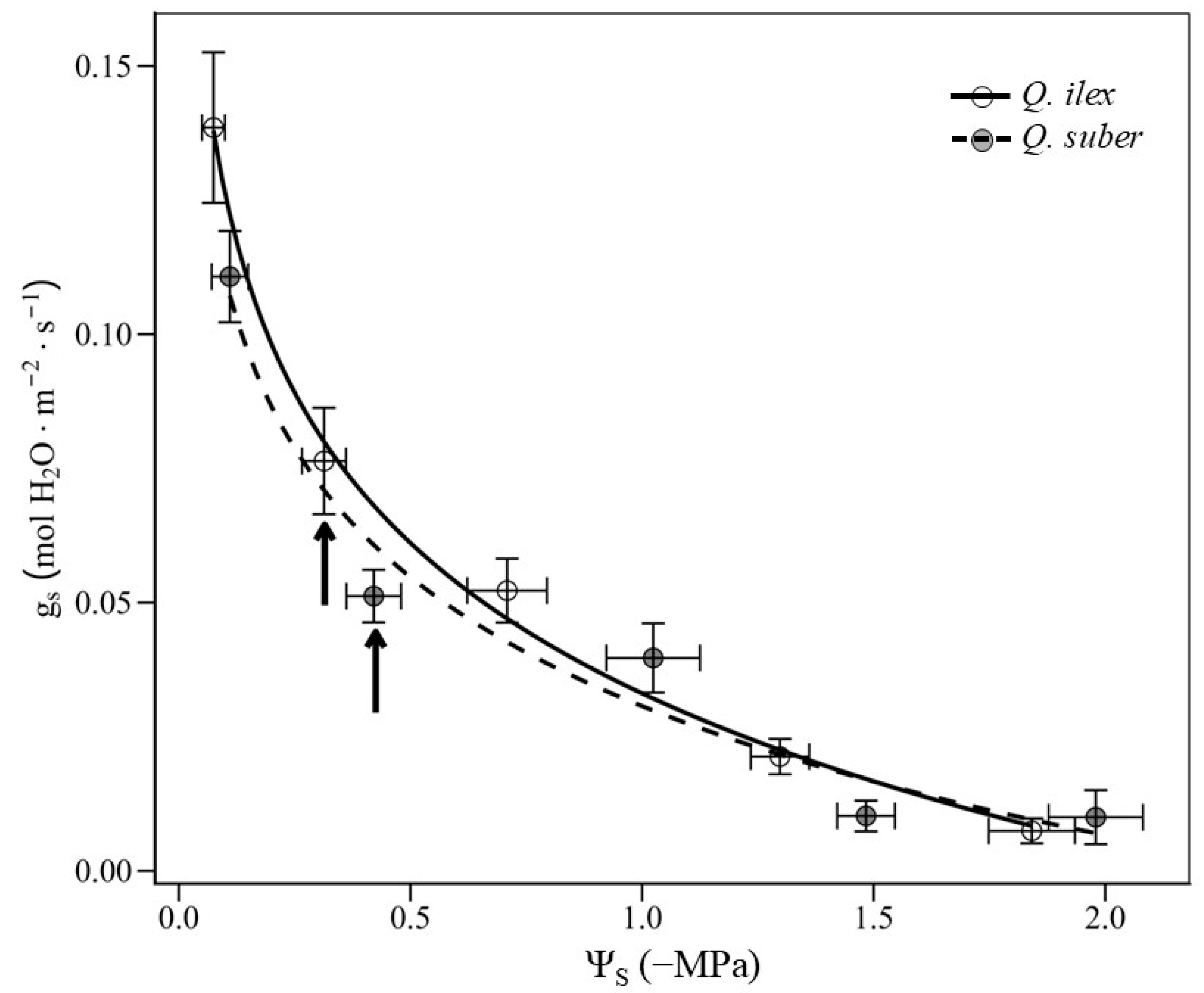
Stomatal conductance (gs) rates measured at midday (1:00 p.m. local time) exhibited a negative exponential trend along the ΨS gradient (Figure 4), revealing similar patterns for both tree species which also displayed comparable basal gs values (0.139 ± 0.063 mol H2O·m−2·s−1 for Q. ilex and 0.111 ± 0.036 mol H2O·m−2·s−1 for Q. suber) in well-irrigated conditions (ΨS ≈ 0 MPa). According to the paired t-test and the LMM, stomatal conductance experienced a significant decrease on the second measurement day (DOY 151, which is the 7th day after the 1st measurement) compared to the initial one (estimate = −0.062 ± 0.016, t(19) = −3.92, p = 0.0009 [Q. ilex]; estimate = −0.060 ± 0.008 SE, t(61.4) = −7.82, p < 0.001 [Q. suber]), when predawn ΨS reached values of −0.31 MPa and −0.42 MPa in the pots containing each Quercus species (Figure 4). After 28 days of drought imposition, there was no significant difference (p = 0.539) between the gs values of both species (predawn ΨS-Q. ilex = −1.84 MPa; predawn ΨS-Q. suber = −2.00 MPa) which had both decreased by 93% compared to control values.
Figure 4.
Evolution over time of the relationship between stomatal conductance (gs) and soil water potential (ΨS) for Q. ilex (white symbols) and Q. suber (grey symbols) during the drought imposition period. Data are means ± SE of the pots on each sampling date (Q. ilex [n144 = 20; n151 = 20; n158 = 20; n165 = 20; n172 = 20] and Q. suber [n144 = 18; n151 = 17; n158 = 17; n165 = 17; n172 = 13]) (refer to Section 2 for details). Species-specific equations for the adjusted logarithmic curves are: gs = 0.033 − 0.040 · log(ΨS); p = 0.00012; R2 = 0.996; AIC: −38.1 [Q. ilex]; gs = 0.031 − 0.035 · log(ΨS); p = 0.00309; R2 = 0.963; AIC: −29.2 [Q. suber]. Residuals of the models were checked for normality and homogeneity of variances. The arrow (↑) indicates the moment during the drought period when the decrease became statistically significant (pairwise t-test for Q. ilex, p ≤ 0.05; LMMs for Q. suber, p ≤ 0.05) compared to well-watered conditions (first point of the graph, DOY = 144).
3.4. Differential Mortality Under Drought Stress
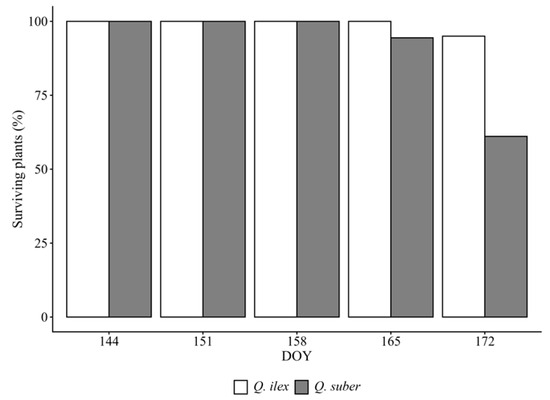
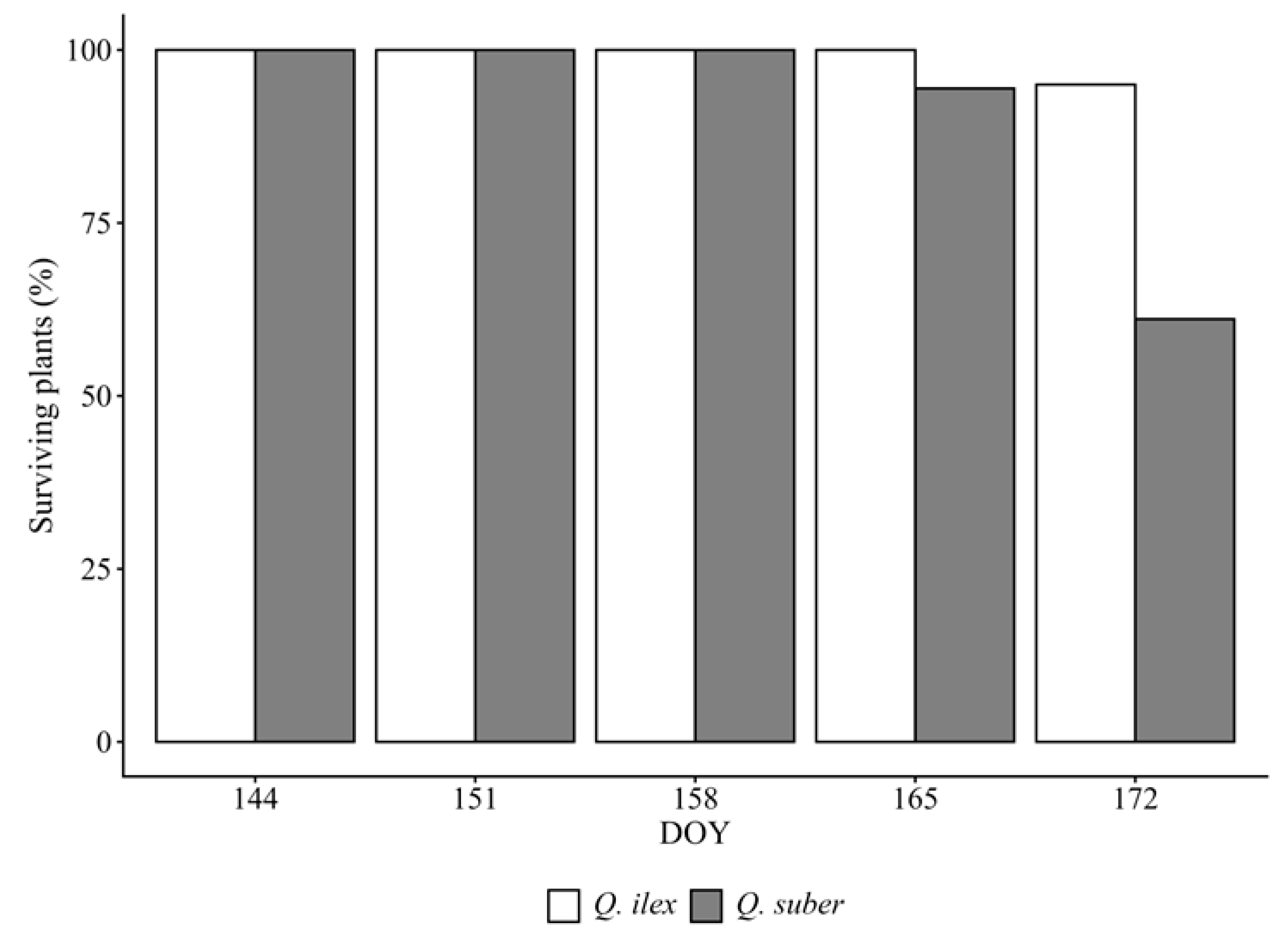
By the final measurement date, mortality in Q. suber reached 39% of the plants, compared to only 5% in Q. ilex (Figure 5). The GLMM analysis showed that survival rates during the late experimental stages (DOY: 165 and 172) were significantly lower for Q. suber compared to Q. ilex (β = −2.44 ± 0.79 SE, z = −3.11, p = 0.0019). Model-predicted survival probabilities were 0.977 (95% CI: 0.896–0.995) for Q. ilex and 0.787 (95% CI: 0.634–0.888) for Q. suber on DOY 172. These findings indicate greater drought tolerance in Q. ilex seedlings.
Figure 5.
Survival rates throughout the sampling period for each of the species tested (Q. ilex, n = 40 and Q. suber, n = 36).
4. Discussion
Differences between ΨPD and ΨS have been reported across a wide range of plant species, developmental stages and climatic conditions [36,53]. In this study, we confirmed a relationship between ΨPD and ΨS, but still we detected clear predawn disequilibrium in both Mediterranean evergreen oak species. The most extreme drought conditions may be slightly underrepresented because ΨPD measurements reaching the −3.2 MPa detection limit were excluded from the analyses. However, this limitation is restricted to a small subset of observations under the driest conditions and does not alter the overall relationship between ΨPD and ΨS or the magnitude of the observed PDD. The estimated disequilibrium magnitudes reached 0.53 MPa for Q. ilex and 0.98 MPa for Q. suber, with maximum values of up to 1.96 MPa and 2.49 MPa, respectively. These results are consistent with PDD values found in previous studies (i.e., >0.5 MPa) obtained from saplings of mesic and xeric oak tree species and halophytic shrubs grown under greenhouse conditions [30,36]. Nonetheless, substantially smaller PDD differences (0.02–0.11 MPa) have also been documented in potted saplings of live oak species adapted to contrasting regional conditions [43], indicating notable variability among species and experimental contexts. Furthermore, field-based studies conducted on natural populations of mesic and temperate oaks reported lower disequilibrium magnitudes (i.e., <0.5 MPa) [59,60]. Overall, these contrasting observations underscore the influence of species-specific traits and site conditions on the evaluated parameters, which may differ across environmental settings. In summary, our results highlight the importance of modelling the relationship between ΨPD and ΨS before using ΨPD as a proxy for ΨS when interpreting the responses of these Mediterranean oak seedlings to water stress under conditions comparable to those examined here.
The analysis of PDD along the drying period revealed a consistent and increasing disequilibrium as soil water depletion progressed. There were significant differences between the early (DOY = 144 and 151) and the later (DOY = 158, 165 and 172) stages of drought. Similar findings in arid environments have reported increased ΨS-ΨPD disequilibrium with rising aridity [61,62]. In our study, PDD was negatively correlated with predawn ΨS in both Q. ilex and Q. suber (p ≤ 0.05). This relationship was supported by the high correlation of ΨS with water-status indicators, such as ΨPD and H. Although not included in the selected models due to collinearity with ΨS, ΨPD had a significant correlation with PDD. This was particularly evident between DOY 151 and 158, when a sharp rise in PDD coincided with a marked drop in ΨPD. Similarly, H declined, indicating reduced water content in photosynthetically active tissues and reinforcing the link between plant water deficit and increasing PDD. These results highlight the role of soil water scarcity in expanding the differences between ΨPD and ΨS, probably linked to an increased hydraulic resistance in the soil-root interphase that delays the replenishment of the stem and leaf water pools by dawn, and acting especially during the most advanced stages of drought [59].
Nocturnal transpiration is widely recognised as a driver of PDD in freely transpiring plants, particularly in arid environments where low relative humidity may increase nighttime E when stomata remain partially open [39]. However, according to our results, neither VPD at 5:00 a.m. (with values ranging from 0.18 to 0.51 kPa), nor estimated E at the same hour (used here as a proxy for nocturnal transpiration), showed any significant relationship with PDD. These findings contrast with reports on cold-desert shrubs and trees from cool temperate and tropical regions, where both greenhouse and field studies have shown strong correlations between PDD and atmospheric drought, with substantial contributions of nighttime gs and E to the disequilibrium [31,35,53]. This discrepancy may reflect methodological differences among experiments. Previous studies quantified nocturnal transpiration over the entire night period (i.e., 23:00 p.m.–6:00 a.m.), whereas our approach relied on a single-hour estimate, likely biassing cumulative nighttime water loss. Moreover, nocturnal transpiration is strongly modulated by both VPD and soil moisture availability [63]. As opposed to the aforementioned studies, we did not keep a high soil water availability during the experiment. Given the imposed soil drought and the tight stomatal control observed in the studied plants, soil-moisture depletion may have constrained gs sufficiently to diminish the effect of VPD on nocturnal transpiration and consequently on PDD (Figure 3c,d).
Interestingly, De Dios et al. [64] demonstrated that nocturnal stomatal regulation in some crop species arises from interactions between exogenous and endogenous processes, each acting predominantly within specific nocturnal intervals. Early-night gs and E (~23:00 p.m.–3:00 a.m.) are strongly regulated by temperature and VPD, whereas late-night values (i.e., after 3:00 a.m.) are largely independent of environmental variation and are primarily governed by internal drivers. The absence of significant relationships between VPD or E and PDD in our models may reflect insufficient representation of early-night processes. Conversely, incorporating environmental factors measured late at night may be biologically unjustified if stomatal responses during this phase are primarily driven by internal processes. Although endogenous mechanisms shaping nocturnal stomatal behaviour in higher plants have yet to be examined, the widespread influence of circadian control in this group suggests a plausible role. This could explain the relatively high gs observed at 5:00 a.m. under well-irrigated conditions (ΨS ≈ 0 MPa; Figure 3c,d) and minimal VPD (0.18 kPa) [65]. These gs values fall within the range associated with meaningful nighttime water loss [35,61] and are likely driven by stomatal rather than cuticular conductance (i.e., 0.004–0.020 mol H2O·m−2·s−1) [42,66]. Supporting this, adult Q. ilex in Prades forests (Catalonia, NE Spain) exhibited increased hourly sap flow between 3:00 a.m. and dawn from spring to autumn, potentially reflecting premature stomatal opening that may enhance water-use efficiency [45]. Nighttime stem sap flow can also account for up to 20% of daily water flux in non-stressed individuals of the Mediterranean Q. douglasii [41]. To better quantify the contribution of nocturnal transpiration to PDD in the studied species, future research should incorporate continuous measurements of stem sap flow and gas exchange on both exposed and covered leaves or plants throughout the whole night (i.e., 23:00 p.m.–6:00 a.m.) [34], particularly under conditions of uniform soil moisture.
Overall, our results align with previous studies that have highlighted the differential contribution of several mechanisms affecting PDD under varying soil water availability [36]. While nocturnal transpiration, driven either by exogenous or endogenous mechanisms, may dominate under uniformly moist conditions [39], root-soil discontinuity, xylem cavitation [67,68] and water vapour leakiness following stomatal closure become more relevant under soil moisture deficit [59,69]. In Quercus species, drought often reduces hydraulic conductance, primarily due to increased resistance at the soil-root interface when surface layers dry [70,71], hindering root water uptake and lowering leaf water potential [67]. This effect may be further modulated by soil texture. In coarse-textured substrates, such as the peat mixture used in this experiment, larger pore sizes and reduced soil-root contact during drying increase resistance to water uptake in the roots. In contrast, finer-textured soils maintain closer and more persistent contact with roots, enabling water uptake to continue at lower ΨS values and potentially modifying the magnitude and dynamics of PDD compared to those observed here [50]. The negative relationship between ΨS, ΨPD, and PDD supports this mechanism, which is likely to be amplified by the developmental stage of the plants and their potted condition, which deprived them of access to deeper moist layers [72]. Some xylem embolisms towards the end of the experiment may have impaired water transport further [68], disrupting the equilibrium of soil-leaf water potential during predawn. Although ΨPD reached −3.2 MPa, which is less negative than the reported xylem water potentials that cause a 50% loss of hydraulic conductivity (Ψxyl,50PLC, %) in Q. ilex and Q. suber seedlings (~−5.6 MPa and −5 MPa, respectively [73,74]), these values may underestimate true stress due to measurement limitations. Based on the aforementioned studies’ published xylem vulnerability curves, we calculate a loss of hydraulic conductivity of up to a ~10%, though its contribution to PDD likely occurred only in the final drought phase.
Both Quercus species displayed similar basal values of midday gs under well-watered conditions at the beginning of the experiment (see the first point of the graphs in Figure 4), consistent with previous reports on seedlings of the same species [74,75] or slightly lower [48]. Stomatal conductance declined exponentially with decreasing water potential, with similar trends observed for both oaks, and matching the results obtained in studies using the same or other drought-adapted tree species [17,27]. The first significant reduction in gs compared to well-watered conditions was identified after seven days coinciding with soil water potential values of −0.31 MPa for Q. ilex and −0.42 MPa for Q. suber. These values confirm the efficient stomatal control of both species through which they mitigate water loss [34,68]. Thereafter, there were steep decreases in gs well before reaching the aforementioned Ψxyl,50PLC of −5.6 MPa and −5 MPa for Q. ilex and Q. suber, respectively [73,74]. The mean midday gs values at this point were 0.076 ± 0.044 mol H2O·m−2·s−1 and 0.051 ± 0.020 mol H2O·m−2·s−1, respectively, still higher than those registered under complete stomatal closure (i.e., <0.030 mol H2O·m−2·s−1) [76]. This significant decrease in gs compared to the control or irrigated condition, can be interpreted as the onset of stomatal closure. For Q. ilex this has been previously defined at slightly more negative soil matric potential values (~−0.5 MPa) [17]. Overall, these preliminary results highlight the importance of integrating plant physiological responses with environmental variables to optimise the management of these species (i.e., irrigation planning) under conditions of limited water availability.
Despite exhibiting similar physiological responses to drought, Q. suber showed higher mortality than Q. ilex by the end of the experiment, with a survival probability difference of approximately 19% between the two species. Both species share key drought-adaptive traits, such as diffuse-porous wood, evergreen sclerophyllous leaves, and deep rooting systems, which help to maintain leaf water status and protect xylem integrity [16,77]. Their behaviour in our study is consistent with a water-saving strategy characterised by tight stomatal regulation, reduced transpiration, and enhanced drought resistance [2,29]. Considering the high cavitation safety margins reported for both species at the seedling stage, and given the observed ΨS values, hydraulic failure is unlikely to be the main driver of mortality [47,78]. Differences in mortality could hypothetically reflect unmeasured variation in root-shoot ratios or development of the network of mycorrhizal fungi, as greater investment in belowground structures enhances water uptake and supports favourable water status, which has been linked to higher survival in both seedlings and adult trees of Q. ilex and Q. suber [79,80]. Additionally, while not directly assessed here, previous studies suggest that Q. suber seedlings may be less effective than Q. ilex in mitigating oxidative stress during intense summer drought, with reduced photorespiration potentially increasing reactive oxygen species (ROS) formation and contributing to higher mortality [48,81]. Both mechanisms remain speculative within the context of this study, in which we only observed phenotypic differences in mortality. Future research should include measurements of root hydraulic traits, antioxidant activity, ROS content, and other physiological indicators to directly test these hypotheses and disentangle the underlying drivers of species-specific drought mortality under similar conditions.
Taken together, these findings provide insight into the water relations of Mediterranean evergreen oak seedlings under controlled drying conditions, with potential implications for the early establishment phase of tree plantations in regions increasingly exposed to drought and heat stress [82]. The greater drought resistance observed in Q. ilex relative to Q. suber under these experimental conditions is consistent with their contrasting ecological distributions [83,84], but should be interpreted in the context of seedlings grown in containers, where substrate properties, root confinement, and soil-root hydraulic continuity may have influenced the observed outcomes. Notably, both species exhibit high vulnerability to progressive water limitation at the seedling stage [85,86], highlighting the susceptibility of the early establishment phase to soil moisture depletion, especially during harsh summers [87]. This has practical relevance for nursery production and managed systems, including Q. ilex and Q. suber truffle orchards inoculated with T. melanosporum, where the successful establishment of both the host plant and the symbiotic fungus depends strongly on the frequency and volume of water provided [23,88]. However, extrapolation of hydraulic responses and mortality patterns to mature trees or natural forest ecosystems requires caution, particularly given the simplified soil conditions of this study. Further field-based research integrating soil heterogeneity, plant hydraulics, and other physiological indicators is required to validate plant-based water status proxies in orchard settings and to define critical thresholds to support improved irrigation and restoration strategies under future Mediterranean climate scenarios.
5. Conclusions
This study demonstrates that predawn disequilibrium (PDD) between leaf and soil water potential is a consistent and significant phenomenon in Quercus ilex and Quercus suber potted seedlings under progressive soil drying. The increase observed in PDD throughout the experimental period, along with its strong correlation with the greater stress, as indicated by the soil and plant water status and declining stomatal conductance, underscores the relationship between declining soil water availability and this imbalance. While both species exhibited similar water-saving strategies involving early stomatal closure in response to drought, Q. suber displayed higher mortality, likely due to species-specific responses to the imposed stress. These findings challenge the assumption that ΨPD reliably reflects ΨS in Mediterranean woody species under the conditions tested. Furthermore, these results emphasise the adjustment of soil measurements to accurately assess the extent of plant water stress under drought conditions. Such insights are critical for guiding the species selection, reforestation, and adaptive management practices in response to the foreseen harsh climatic conditions in Mediterranean ecosystems.
Supplementary Materials
The following supporting information can be downloaded at: https://www.mdpi.com/article/10.3390/f17010049/s1, Figure S1: Mean and maximum diurnal VPD (MPa) values in the experimental site from 24 May to 25 June 2023 (DOY: 144–179); Figure S2: Relationship between soil water data measured with Arduino capacitive sensors and soil water potential (ΨS, −MPa) measured with Teros-21 probes; Figure S3: Recorded Temperature (T, °C) and Relative Humidity (RH, %) values at each of the three sampling times (5:00 a.m.: 1 h. before predawn; 6:00 a.m.: predawn; 1:00 p.m.: midday) on the study days (DOY: 144–179). Solid lines correspond to T, while dashed lines correspond to RH; Figure S4: Temperature (T, °C) and Relative Humidity (RH, %) values recorded hourly along this study.
Author Contributions
Conceptualization, A.M., M.P.-L. and C.C.; methodology, M.P., C.C., M.P.-L. and A.M.; software, M.P., D.A. and A.M.; validation, M.P., D.A., A.M., M.P.-L. and C.C.; formal analysis, M.P., A.M. and D.A.; investigation, M.P. and D.A.; resources, C.C.; data curation, M.P., D.A. and A.M.; writing—original draft preparation, M.P., D.A. and A.M.; writing—review and editing, D.A., A.M., M.P.-L. and C.C.; visualisation, D.A.; supervision, C.C.; project administration, C.C.; funding acquisition, C.C. All authors have read and agreed to the published version of the manuscript.
Funding
Dalmau Albó was partially supported by a FI-SDUR Pre-Doctoral Fellowship (reference: BDNS 771000) co-funded by the Generalitat de Catalunya, Departament de Recerca i Universitats and the European Social Fund Plus (ESF+).
Data Availability Statement
Raw data can be found in CORA public repository: https://doi.org/10.34810/data2687.
Acknowledgments
We thank Luis Serrano for letting us use the porometer and for providing useful advice regarding plant water potential measurements. We thank Sandra Cervelló for the use of the greenhouse at ETSEA-FiV.
Conflicts of Interest
The authors declare no conflicts of interest.
Abbreviations
The following abbreviations are used in this manuscript:
| PDD | Predawn Disequilibrium |
| LMM | Linear Mixed-Effects Model |
| GLMM | Generalised Linear Mixed-Effects Model |
| LMA | Leaf Mass Area |
| SPAC | Soil–Plant-Atmosphere Continuum |
| RH | Relative Humidity |
| VPD | Vapour Pressure Deficit |
| DOY | Day Of the Year |
| BPD | Before Predawn |
References
- Deitch, M.J.; Sapundjieff, M.J.; Feirer, S.T. Characterizing Precipitation Variability and Trends in the World’s Mediterranean-Climate Areas. Water 2017, 9, 259. [Google Scholar] [CrossRef] [Scilit]
- Mediavilla, S.; Escudero, A. Stomatal Responses to Drought at a Mediterranean Site: Study of Co-Occurring Woody Species Differing in Leaf Longevity. Tree Physiol. 2003, 23, 987–996. [Google Scholar] [CrossRef] [Scilit]
- Sardans, J.; Peñuelas, J. Plant-Soil Interactions in Mediterranean Forest and Shrublands: Impacts of Climatic Change. Plant Soil. 2013, 365, 1–33. [Google Scholar] [CrossRef] [Scilit]
- Peguero-Pina, J.J.; Vilagrosa, A.; Alonso-Forn, D.; Ferrio, J.P.; Sancho-Knapik, D.; Gil-Pelegrín, E. Living in Drylands: Functional Adaptations of Trees and Shrubs to Cope with High Temperatures and Water Scarcity. Forests 2020, 11, 1028. [Google Scholar] [CrossRef] [Scilit]
- Padilla, F.M.; Pugnaire, F.I. Rooting Depth and Soil Moisture Control Mediterranean Woody Seedling Survival during Drought. Funct. Ecol. 2007, 21, 489–495. [Google Scholar] [CrossRef] [Scilit]
- Hernández-Santana, V.; David, T.S.; Martínez-Fernández, J. Environmental and Plant-Based Controls of Water Use in a Mediterranean Oak Stand. For. Ecol. Manag. 2008, 255, 3707–3715. [Google Scholar] [CrossRef] [Scilit]
- Corcuera, L.; Camarero, J.J.; Gil-Pelegrín, E. Functional Groups in Quercus Species Derived from the Analysis of Pressure-Volume Curves. Trees—Struct. Funct. 2002, 16, 465–472. [Google Scholar] [CrossRef] [Scilit]
- Limousin, J.M.; Misson, L.; Lavoir, A.V.; Martin, N.K.; Rambal, S. Do Photosynthetic Limitations of Evergreen Quercus ilex Leaves Change with Long-Term Increased Drought Severity? Plant Cell Environ 2010, 33, 863–875. [Google Scholar] [CrossRef] [Scilit] [PubMed]
- Peguero-Pina, J.J.; Sancho-Knapik, D.; Barrón, E.; Camarero, J.J.; Vilagrosa, A.; Gil-Pelegrín, E. Morphological and Physiological Divergences within Quercus ilex Support the Existence of Different Ecotypes Depending on Climatic Dryness. Ann. Bot. 2014, 114, 301–313. [Google Scholar] [CrossRef] [Scilit]
- Martínez-Vilalta, J.; Poyatos, R.; Aguadé, D.; Retana, J.; Mencuccini, M. A New Look at Water Transport Regulation in Plants. New Phytol. 2014, 204, 105–115. [Google Scholar] [CrossRef] [Scilit]
- Giorgi, F.; Lionello, P. Climate Change Projections for the Mediterranean Region. Glob. Planet. Chang. 2008, 63, 90–104. [Google Scholar] [CrossRef] [Scilit]
- Cramer, W.; Guiot, J.; Fader, M.; Garrabou, J.; Gattuso, J.P.; Iglesias, A.; Lange, M.A.; Lionello, P.; Llasat, M.C.; Paz, S.; et al. Climate Change and Interconnected Risks to Sustainable Development in the Mediterranean. Nat. Clim. Chang. 2018, 8, 972–980. [Google Scholar] [CrossRef] [Scilit]
- Peñuelas, J.; Sardans, J.; Filella, I.; Estiarte, M.; Llusià, J.; Ogaya, R.; Carnicer, J.; Bartrons, M.; Rivas-Ubach, A.; Grau, O.; et al. Assessment of the Impacts of Climate Change on Mediterranean Terrestrial Ecosystems Based on Data from Field Experiments and Long-Term Monitored Field Gradients in Catalonia. Environ. Exp. Bot. 2018, 152, 49–59. [Google Scholar] [CrossRef] [Scilit]
- Carnicer, J.; Coll, M.; Ninyerola, M.; Pons, X.; Sánchez, G.; Peñuelas, J. Widespread Crown Condition Decline, Food Web Disruption, and Amplified Tree Mortality with Increased Climate Change-Type Drought. Proc. Natl. Acad. Sci. USA 2011, 108, 1474–1478. [Google Scholar] [CrossRef] [Scilit] [PubMed]
- Vilà-Cabrera, A.; Coll, L.; Martínez-Vilalta, J.; Retana, J. Forest Management for Adaptation to Climate Change in the Mediterranean Basin: A Synthesis of Evidence. For. Ecol. Manag. 2018, 407, 16–22. [Google Scholar] [CrossRef] [Scilit]
- Gil-Pelegrín, E.; Saz, M.Á.; Cuadrat, J.M.; Peguero-Pina, J.J.; Sancho-Knapik, D. Oaks Under Mediterranean-Type Climates: Functional Response to Summer Aridity. In Oaks Physiological Ecology. Exploring the Functional Diversity of Genus Quercus L.; Gil-Pelegrín, E., Saz, M.Á., Cuadrat, J.M., Peguero-Pina, J.J., Sancho-Knapik, D., Eds.; Springer: New York, NY, USA, 2017; Volume 7, pp. 137–193. [Google Scholar] [CrossRef] [Scilit]
- Alonso-Forn, D.; Peguero-Pina, J.J.; Ferrio, J.P.; Mencuccini, M.; Mendoza-Herrer, Ó.; Sancho-Knapik, D.; Gil-Pelegrín, E. Contrasting Functional Strategies Following Severe Drought in Two Mediterranean Oaks with Different Leaf Habit: Quercus faginea and Quercus ilex subsp. rotundifolia. Tree Physiol. 2021, 41, 371–387. [Google Scholar] [CrossRef] [Scilit]
- Costa-e-Silva, F.; Correia, A.C.; Pinto, C.A.; David, J.S.; Hernandez-Santana, V.; David, T.S. Effects of Cork Oak Stripping on Tree Carbon and Water Fluxes. For. Ecol. Manag. 2021, 486, 118966. [Google Scholar] [CrossRef] [Scilit]
- Oliach, D.; Vidale, E.; Brenko, A.; Marois, O.; Andrighetto, N.; Stara, K.; de Aragón, J.M.; Colinas, C.; Bonet, J.A. Truffle Market Evolution: An Application of the Delphi Method. Forests 2021, 12, 1174. [Google Scholar] [CrossRef] [Scilit]
- Reyna, S.; Garcia-Barreda, S. Black Truffle Cultivation: A Global Reality. For. Syst. 2014, 23, 317–328. [Google Scholar] [CrossRef] [Scilit]
- Čejka, T.; Isaac, E.L.; Oliach, D.; Martínez-Pea, F.; Egli, S.; Thomas, P.; Trnka, M.; Büntgen, U. Risk and Reward of the Global Truffle Sector under Predicted Climate Change. Environ. Res. Lett. 2022, 17, 024001. [Google Scholar] [CrossRef] [Scilit]
- Chevalier, G.; Sourzat, P. Soils and Techniques for Cultivating Tuber melanosporum and Tuber aestivum in Europe. In Edible Ectomycorrhizal Mushrooms; Zambonelli, A., Bonito, G., Eds.; Springer: Berlin/Heidelberg, Germany, 2012; Volume 34, pp. 163–189. [Google Scholar] [CrossRef] [Scilit]
- Bonet, J.A.; Oliach, D.; Fischer, C.; Olivera, A.; Martínez de Aragón, J.M.; Colinas, C. Cultivation Methods of the Black Truffle, the Most Profitable Mediterranean Non-Wood Forest Product; A State of the Art Review. In Modelling, Valuing and Managing Mediterranean Forest Ecosystems for Non-Timber Goods and Services; Palahí, M., Birot, Y., Bravo, F., Gorriz, E., Eds.; European Forest Institute: Joensuu, Finland, 2009; pp. 57–71. ISBN 978-952-5453-27-0. [Google Scholar]
- Büntgen, U.; Egli, S.; Schneider, L.; von Arx, G.; Rigling, A.; Camarero, J.J.; Sangüesa-Barreda, G.; Fischer, C.R.; Oliach, D.; Bonet, J.A.; et al. Long-Term Irrigation Effects on Spanish Holm Oak Growth and Its Black Truffle Symbiont. Agric. Ecosyst. Environ. 2015, 202, 148–159. [Google Scholar] [CrossRef] [Scilit]
- Olivera, A.; Bonet, J.A.; Oliach, D.; Colinas, C. Time and Dose of Irrigation Impact Tuber melanosporum Ectomycorrhiza Proliferation and Growth of Quercus ilex Seedling Hosts in Young Black Truffle Orchards. Mycorrhiza 2014, 24, 73–78. [Google Scholar] [CrossRef] [Scilit]
- Jones, H.G. Irrigation Scheduling: Advantages and Pitfalls of Plant-Based Methods. J. Exp. Bot. 2004, 55, 2427–2436. [Google Scholar] [CrossRef] [Scilit] [PubMed]
- Knipfer, T.; Bambach, N.; Isabel Hernandez, M.; Bartlett, M.K.; Sinclair, G.; Duong, F.; Kluepfel, D.A.; McElrone, A.J. Predicting Stomatal Closure and Turgor Loss in Woody Plants Using Predawn and Midday Water Potential. Plant Physiol. 2020, 184, 881–894. [Google Scholar] [CrossRef] [Scilit] [PubMed]
- Bianchi, A.; Masseroni, D.; Thalheimer, M.; de Medici, L.O.; Facchi, A. Field Irrigation Management through Soil Water Potential Measurements: A Review. Ital. J. Agrometeorol. 2017, 22, 25–38. [Google Scholar] [CrossRef] [Scilit]
- Martínez-Vilalta, J.; Garcia-Forner, N. Water Potential Regulation, Stomatal Behaviour and Hydraulic Transport under Drought: Deconstructing the Iso/Anisohydric Concept. Plant Cell Environ. 2017, 40, 962–976. [Google Scholar] [CrossRef] [Scilit]
- Donovan, L.A.; Griseâ, D.J.; West, J.B.; Pappert, R.A.; Alder, N.N.; Richards, J.H. Predawn Disequilibrium between Plant and Soil Water Potentials in Two Cold-Desert Shrubs. Oecologia 1999, 120, 209–217. [Google Scholar] [CrossRef] [Scilit]
- Bucci, S.J.; Scholz, F.G.; Goldstein, G.; Meinzer, F.C.; Hinojosa, J.A.; Hoffmann, W.A.; Franco, A.C. Processes Preventing Nocturnal Equilibration between Leaf and Soil Water Potential in Tropical Savanna Woody Species. Tree Physiol. 2004, 24, 1119–1127. [Google Scholar] [CrossRef] [Scilit]
- Schulze, E.-D.; Hall, A.E. Stomatal Responses, Water Loss and CO2 Assimilation Rates of Plants in Contrasting Environments. In Physiological Plant Ecology II: Water Relations and Carbon Assimilation; Lange, O.L., Nobel, P.S., Osmond, C.B., Ziegler, H., Eds.; Springer: Berlin/Heidelberg, Germany, 1982; pp. 181–230. [Google Scholar] [CrossRef] [Scilit]
- Améglio, T.; Archer, P.; Cohen, M.; Valancogne, C.; Daudet, F.-A.; Dayau, S.; Cruiziat, P. Significance and Limits in the Use of Predawn Leaf Water Potential for Tree Irrigation. Plant Soil 1999, 207, 155–167. [Google Scholar] [CrossRef] [Scilit]
- Martínez-Vilalta, J.; Mangirón, M.; Ogaya, R.; Sauret, M.; Serrano, L.; Peñuelas, J.; Piñol, J. Sap Flow of Three Co-Occurring Mediterranean Woody Species under Varying Atmospheric and Soil Water Conditions. Tree Physiol. 2003, 23, 747–758. [Google Scholar] [CrossRef] [Scilit]
- Donovan, L.A.; Richards, J.H.; Linton, M.J. Magnitude and Mechanisms of Disequilibrium between Predawn Plant and Soil Water Potentials. Ecology 2003, 84, 463–470. [Google Scholar] [CrossRef] [Scilit]
- Donovan, L.; Linton, M.; Richards, J. Predawn Plant Water Potential Does Not Necessarily Equilibrate with Soil Water Potential under Well-Watered Conditions. Oecologia 2001, 129, 328–335. [Google Scholar] [CrossRef] [Scilit]
- Sellin, A. Does Pre-Dawn Water Potential Reflect Conditions of Equilibrium in Plant and Soil Water Status? Acta Oecol. 1999, 20, 51–59. [Google Scholar] [CrossRef] [Scilit]
- Dawson, T.E.; Burgess, S.S.O.; Tu, K.P.; Oliveira, R.S.; Santiago, L.S.; Fisher, J.B.; Simonin, K.A.; Ambrose, A.R. Nighttime Transpiration in Woody Plants from Contrasting Ecosystems. Tree Physiol. 2007, 27, 561–575. [Google Scholar] [CrossRef] [Scilit] [PubMed]
- Kangur, O.; Steppe, K.; Schreel, J.D.M.; Von Der Crone, J.S.; Sellin, A. Variation in Nocturnal Stomatal Conductance and Development of Predawn Disequilibrium between Soil and Leaf Water Potentials in Nine Temperate Deciduous Tree Species. Funct. Plant Biol. 2021, 48, 483–492. [Google Scholar] [CrossRef] [Scilit]
- Feild, T.S.; Holbrook, N.M. Xylem Sap Flow and Stem Hydraulics of the Vesselles Angiosperm Drimys granadensis (Winteraceae) in a Costa Rican Elfin Forest. Plant Cell Environ. 2000, 23, 1067–1077. [Google Scholar] [CrossRef] [Scilit]
- Fisher, J.B.; Baldocchi, D.D.; Misson, L.; Dawson, T.E.; Goldstein, A.H. What the Towers Don’t See at Night: Nocturnal Sap Flow in Trees and Shrubs at Two AmeriFlux Sites in California. Tree Physiol. 2007, 27, 597–610. [Google Scholar] [CrossRef] [Scilit]
- Caird, M.A.; Richards, J.H.; Donovan, L.A. Nighttime Stomatal Conductance and Transpiration in C3 and C4 Plants. Plant Physiol. 2007, 143, 4–10. [Google Scholar] [CrossRef] [Scilit]
- Cavender-Bares, J.; Sack, L.; Savage, J. Atmospheric and Soil Drought Reduce Nocturnal Conductance in Live Oaks. Tree Physiol. 2007, 27, 611–620. [Google Scholar] [CrossRef] [Scilit]
- David, T.S.; Henriques, M.O.; Kurz-Besson, C.; Nunes, J.; Valente, F.; Vaz, M.; Pereira, J.S.; Siegwolf, R.; Chaves, M.M.; Gazarini, L.C.; et al. Water-Use Strategies in Two Co-Occurring Mediterranean Evergreen Oaks: Surviving the Summer Drought. Tree Physiol. 2007, 27, 793–803. [Google Scholar] [CrossRef] [Scilit] [PubMed]
- Barbeta, A.; Ogaya, R.; Peñuelas, J. Comparative Study of Diurnal and Nocturnal Sap Flow of Quercus ilex and Phillyrea latifolia in a Mediterranean Holm Oak Forest in Prades (Catalonia, NE Spain). Trees—Struct. Funct. 2012, 26, 1651–1659. [Google Scholar] [CrossRef] [Scilit]
- Vaz, M.; Pereira, J.S.; Gazarini, L.C.; David, T.S.; David, J.S.; Rodrigues, A.; Maroco, J.; Chaves, M.M. Drought-Induced Photosynthetic Inhibition and Autumn Recovery in Two Mediterranean Oak Species (Quercus ilex and Quercus suber). Tree Physiol. 2010, 30, 946–956. [Google Scholar] [CrossRef] [Scilit] [PubMed]
- Pinto, C.A.; David, J.S.; Cochard, H.; Caldeira, M.C.; Henriques, M.O.; Quilhó, T.; Paço, T.A.; Pereira, J.S.; David, T.S. Drought-Induced Embolism in Current-Year Shoots of Two Mediterranean Evergreen Oaks. For. Ecol. Manag. 2012, 285, 1–10. [Google Scholar] [CrossRef] [Scilit]
- Peguero-Pina, J.J.; Sancho-Knapik, D.; Morales, F.; Flexas, J.; Gil-Pelegrin, E. Differential Photosynthetic Performance and Photoprotection Mechanisms of Three Mediterranean Evergreen Oaks under Severe Drought Stress. Funct. Plant Biol. 2009, 36, 453–462. [Google Scholar] [CrossRef] [Scilit]
- Peñuelas, J.; Sardans, J.; Filella, I.; Estiarte, M.; Llusià, J.; Ogaya, R.; Carnicer, J.; Bartrons, M.; Rivas-Ubach, A.; Grau, O.; et al. Impacts of Global Change on Mediterranean Forests and Their Services. Forests 2017, 8, 463. [Google Scholar] [CrossRef] [Scilit]
- García-Tejera, O.; López-Bernal, Á.; Orgaz, F.; Testi, L.; Villalobos, F.J. The Pitfalls of Water Potential for Irrigation Scheduling. Agric. Water Manag. 2021, 243, 106522. [Google Scholar] [CrossRef] [Scilit]
- Rundel, P.W.; Jarrell, W.M. Water in the Environment. In Plant Physiological Ecology: Field Methods and Instrumentation; Pearcy, R., Ehleringer, J., Mooney, H., Rundel, P., Eds.; Springer: Dordrecht, The Netherland; London, UK, 1989; pp. 29–56. [Google Scholar] [CrossRef] [Scilit]
- Turner, N.C. Measurement of Plant Water Status by the Pressure Chamber Technique. Irrig. Sci. 1988, 9, 289–308. [Google Scholar] [CrossRef] [Scilit]
- Kangur, O.; Kupper, P.; Sellin, A. Predawn Disequilibrium between Soil and Plant Water Potentials in Light of Climate Trends Predicted for Northern Europe. Reg. Environ. Chang. 2017, 17, 2159–2168. [Google Scholar] [CrossRef] [Scilit]
- R Core Team. R: A Language and Environment for Statistical Computing, version 2024.12.0; R Core Team: Vienna, Austria, 2024. Available online: https://www.r-project.org/ (accessed on 12 June 2025).
- Fox, J.; Weisberg, S. An R Companion to Applied Regression, 3rd ed.; SAGE Publications: Thousand Oaks, CA, USA, 2019; pp. 1–608. [Google Scholar]
- Bates, D.; Maechler, M.; Bolker, B.; Walker, S. Fitting Linear Mixed-Effects Models Using Lme4. J. Stat. Softw. 2015, 67, 1–48. [Google Scholar] [CrossRef] [Scilit]
- Hartig, F. DHARMa: Residual Diagnostics for Hierarchical (Multi-Level/Mixed) Regression Models, version 0.4.7, R Core Team: Vienna, Austria, 2024. Available online: https://CRAN.R-project.org/package=DHARMa (accessed on 20 June 2025).
- Lenth, R. emmeans: Estimated Marginal Means, Aka Least-Squares Means, version 1.10.6, R Core Team: Vienna, Austria, 2024. Available online: https://CRAN.R-project.org/package=emmeans (accessed on 12 June 2025).
- Bréda, N.; Granier, A.; Barataud, F.; Moyne, C. Soil Water Dynamics in an Oak Stand. Plant Soil 1995, 172, 17–27. [Google Scholar] [CrossRef] [Scilit]
- Gallego, H.A.; Rico, M.; Moreno, G.; Santa Regina, I. Leaf Water Potential and Stomatal Conductance in Quercus pyrenaica Willd. Forests: Vertical Gradients and Response to Environmental Factors. Tree Physiol. 1993, 14, 1039–1047. [Google Scholar] [CrossRef] [Scilit] [PubMed]
- Bucci, S.J.; Goldstein, G.; Meinzer, F.C.; Franco, A.C.; Campanello, P.; Scholz, F.G. Mechanisms Contributing to Seasonal Homeostasis of Minimum Leaf Water Potential and Predawn Disequilibrium between Soil and Plant Water Potential in Neotropical Savanna Trees. Trees—Struct. Funct. 2005, 19, 296–304. [Google Scholar] [CrossRef] [Scilit]
- Rogiers, S.Y.; Greer, D.H.; Hatfield, J.M.; Hutton, R.J.; Clarke, S.J.; Hutchinson, P.A.; Somers, A. Stomatal Response of an Anisohydric Grapevine Cultivar to Evaporative Demand, Available Soil Moisture and Abscisic Acid. Tree Physiol. 2012, 32, 249–261. [Google Scholar] [CrossRef] [Scilit]
- Zeppel, M.J.B.; Lewis, J.D.; Phillips, N.G.; Tissue, D.T. Consequences of Nocturnal Water Loss: A Synthesis of Regulating Factors and Implications for Capacitance, Embolism and Use in Models. Tree Physiol. 2014, 34, 1047–1055. [Google Scholar] [CrossRef] [Scilit]
- De Dios, V.R.; Roy, J.; Ferrio, J.P.; Alday, J.G.; Landais, D.; Milcu, A.; Gessler, A. Processes Driving Nocturnal Transpiration and Implications for Estimating Land Evapotranspiration. Sci. Rep. 2015, 5, 10975. [Google Scholar] [CrossRef] [Scilit] [PubMed]
- Resco, V.; Hartwell, J.; Hall, A. Ecological Implications of Plants’ Ability to Tell the Time. Ecol. Lett. 2009, 12, 583–592. [Google Scholar] [CrossRef] [Scilit]
- Kerstiens, G. Cuticular Water Permeability and Its Physiological Significance. J. Exp. Bot. 1996, 47, 1813–1832. [Google Scholar] [CrossRef] [Scilit]
- Nardini, A.; Tyree, M.T. Root and Shoot Hydraulic Conductance of Seven Quercus Species. Ann. For. Sci. 1999, 56, 371–377. [Google Scholar] [CrossRef] [Scilit]
- Tognetti, R.; Longobucco, A.; Raschi, A. Vulnerability of Xylem to Embolism in Relation to Plant Hydraulic Resistance in Quercus pubescens and Quercus ilex Co-Occurring in a Mediterranean Coppice Stand in Central Italy. New Phytol. 1998, 139, 437–447. [Google Scholar] [CrossRef] [Scilit]
- Brodribb, T.J.; McAdam, S.A.M.; Jordan, G.J.; Martins, S.C.V. Conifer Species Adapt to Low-Rainfall Climates by Following One of Two Divergent Pathways. Proc. Natl. Acad. Sci. USA 2014, 111, 14489–14493. [Google Scholar] [CrossRef] [Scilit] [PubMed]
- Bréda, N.; Cochard, H.; Dreyer, E.; Granier, A. Water Transfer in a Mature Oak Stand (Quercus petraea): Seasonal Evolution and Effects of a Severe Drought. Can. J. For. Res. 1993, 23, 1136–1143. [Google Scholar] [CrossRef] [Scilit]
- Cochard, H.; Bréda, N.; Granier, A. Whole Tree Hydraulic Conductance and Water Loss Regulation in Quercus during Drought: Evidence for Stomatal Control of Embolism? Ann. Sci. For. 1996, 53, 197–206. [Google Scholar] [CrossRef] [Scilit]
- Nardini, A.; Casolo, V.; Dal Borgo, A.; Savi, T.; Stenni, B.; Bertoncin, P.; Zini, L.; Mcdowell, N.G. Rooting Depth, Water Relations and Non-Structural Carbohydrate Dynamics in Three Woody Angiosperms Differentially Affected by an Extreme Summer Drought. Plant Cell Environ. 2016, 39, 618–627. [Google Scholar] [CrossRef] [Scilit]
- Corcuera, L.; Camarero, J.J.; Gil-Pelegrín, E. Effects of a Severe Drought on Quercus ilex Radial Growth and Xylem Anatomy. Trees—Struct. Funct. 2004, 18, 83–92. [Google Scholar] [CrossRef] [Scilit]
- Vaz, M.; Cochard, H.; Gazarini, L.; Graça, J.; Chaves, M.M.; Pereira, J.S. Cork Oak (Quercus suber L.) Seedlings Acclimate to Elevated CO2 and Water Stress: Photosynthesis, Growth, Wood Anatomy and Hydraulic Conductivity. Trees—Struct. Funct. 2012, 26, 1145–1157. [Google Scholar] [CrossRef] [Scilit]
- Quero, J.L.; Villar, R.; Marañón, T.; Zamora, R. Interactions of Drought and Shade Effects on Seedlings of Four Quercus Species: Physiological and Structural Leaf Responses. New Phytol. 2006, 170, 819–834. [Google Scholar] [CrossRef] [Scilit] [PubMed]
- Peguero-Pina, J.J.; Mendoza-Herrer, Ó.; Gil-Pelegrín, E.; Sancho-Knapik, D. Cavitation Limits the Recovery of Gas Exchange after Severe Drought Stress in Holm Oak (Quercus ilex L.). Forests 2018, 9, 443. [Google Scholar] [CrossRef] [Scilit]
- Galmés, J.; Medrano, H.; Flexas, J. Photosynthetic Limitations in Response to Water Stress and Recovery in Mediterranean Plants with Different Growth Forms. New Phytol. 2007, 175, 81–93. [Google Scholar] [CrossRef] [Scilit]
- Martin-StPaul, N.; Delzon, S.; Cochard, H. Plant Resistance to Drought Depends on Timely Stomatal Closure. Ecol. Lett. 2017, 20, 1437–1447. [Google Scholar] [CrossRef] [Scilit]
- Villar-Salvador, P.; Puértolas, J.; Cuesta, B.; Peñuelas, J.L.; Uscola, M.; Heredia-Guerrero, N.; Rey Benayas, J.M. Increase in Size and Nitrogen Concentration Enhances Seedling Survival in Mediterranean Plantations. Insights from an Ecophysiological Conceptual Model of Plant Survival. New For. 2012, 43, 755–770. [Google Scholar] [CrossRef] [Scilit]
- Ramírez-Valiente, J.A.; Aranda, I.; Sanchéz-Gómez, D.; Rodríguez-Calcerrada, J.; Valladares, F.; Robson, T.M. Increased Root Investment Can Explain the Higher Survival of Seedlings of “mesic” Quercus suber than “Xeric” Quercus ilex in Sandy Soils during a Summer Drought. Tree Physiol. 2018, 39, 64–75. [Google Scholar] [CrossRef] [Scilit]
- Szabó, I.; Bergantino, E.; Giacometti, G.M. Light and Oxygenic Photosynthesis: Energy Dissipation as a Protection Mechanism against Photo-Oxidation. EMBO Rep. 2005, 6, 629–634. [Google Scholar] [CrossRef] [Scilit] [PubMed]
- IPCC Sections. In Climate Change 2023: Synthesis Report. Contribution of Working Groups I, II and III to the Sixth Assessment Report of the Intergovernmental Panel on Climate Change; Core Writing Team, Lee, H., Romero, J., Eds.; IPCC: Geneva, Switzerland, 2023; pp. 35–115. [Google Scholar] [CrossRef] [Scilit]
- Kim, H.N.; Jin, H.Y.; Kwak, M.J.; Khaine, I.; You, H.N.; Lee, T.Y.; Ahn, T.H.; Woo, S.Y. Why Does Quercus suber Species Decline in Mediterranean Areas? J. Asia Pac. Biodivers. 2017, 10, 337–341. [Google Scholar] [CrossRef] [Scilit]
- Benito Garzón, M.; Sánchez De Dios, R.; Sainz Ollero, H. Effects of Climate Change on the Distribution of Iberian Tree Species. Appl. Veg. Sci. 2008, 11, 169–178. [Google Scholar] [CrossRef] [Scilit]
- Ramírez-Valiente, J.A.; Valladares, F.; Gil, L.; Aranda, I. Population Differences in Juvenile Survival under Increasing Drought Are Mediated by Seed Size in Cork Oak (Quercus suber L.). For. Ecol. Manag. 2009, 257, 1676–1683. [Google Scholar] [CrossRef] [Scilit]
- González-Rodríguez, V.; Navarro-Cerrillo, R.M.; Villar, R. Artificial Regeneration with Quercus ilex L. and Quercus suber L. by Direct Seeding and Planting in Southern Spain. Ann. For. Sci. 2011, 68, 637–646. [Google Scholar] [CrossRef] [Scilit]
- Bantis, F.; Graap, J.; Früchtenicht, E.; Bussotti, F.; Radoglou, K.; Brüggemann, W. Field Performances of Mediterranean Oaks in Replicate Common Gardens for Future Reforestation under Climate Change in Central and Southern Europe: First Results from a Four-Year Study. Forests 2021, 12, 678. [Google Scholar] [CrossRef] [Scilit]
- Olivera, A.; Fischer, C.R.; Bonet, J.A.; de Aragón, J.M.; Oliach, D.; Colinas, C. Weed Management and Irrigation Are Key Treatments in Emerging Black Truffle (Tuber melanosporum) Cultivation. New For. 2011, 42, 227–239. [Google Scholar] [CrossRef] [Scilit]

Disclaimer/Publisher’s Note: The statements, opinions and data contained in all publications are solely those of the individual author(s) and contributor(s) and not of MDPI and/or the editor(s). MDPI and/or the editor(s) disclaim responsibility for any injury to people or property resulting from any ideas, methods, instructions or products referred to in the content. |
© 2025 by the authors. Licensee MDPI, Basel, Switzerland. This article is an open access article distributed under the terms and conditions of the Creative Commons Attribution (CC BY) license.