


Abstract
In the context of global climate change, quantifying the coupling relationship between forest growth status and soil moisture (SM) remains crucial for predicting ecosystem functional changes. However, systematic analysis of their dynamic coupling mechanisms is currently lacking. To address this gap, we systematically quantified the sensitivity of forest growth status to soil moisture and revealed its spatiotemporal patterns and driving mechanisms based on NDVI, LAI, and GPP data during the growing season of Chinese forests from 2001 to 2020. Results demonstrate that Chinese forests are experiencing a significant “soil moisture desensitization” process (|r| trend < 0, p < 0.05). Although forest growth status increased significantly (p < 0.05), sensitivity to soil moisture declined across 71% of forest areas, with only 26% showing increasing trends. Moreover, the area of soil moisture deficit regions (r > 0, p < 0.05) contracted sharply from 27% to 5%, while surplus regions (r < 0, p < 0.05) expanded by 7%. Attribution analysis reveals that solar radiation (~35%), precipitation (~25%), and atmospheric CO2 concentration (~17%) represent the dominant factors driving sensitivity trends. This study provides new insights into hydrological response mechanisms of Chinese forests and holds important implications for optimizing ecological management and climate adaptation strategies.
1. Introduction
Terrestrial forest ecosystems play crucial roles in global carbon sequestration, hydrological cycles, and climate regulation. Covering approximately 31% of Earth’s land surface, they absorb substantial carbon annually, mitigating climate warming [1,2]. Forest evapotranspiration significantly regulates regional water vapor transport and energy balance, influencing regional climate and water resources [3,4]. However, forests exhibit complex responses under climate change. Elevated atmospheric CO2 concentrations enhance gross primary productivity (GPP) by approximately 20%–30% through CO2 fertilization effects [5], while extreme heat events increase tree mortality by 15%–30% [6]. In China, these responses are particularly complex, as large-scale afforestation projects drive significant forest greening while extreme climate events intensify spatiotemporal heterogeneity in ecosystem functions, creating uncertainty in forest growth status changes [7,8].
Soil moisture (SM) represents a critical limiting factor for forest growth, with dual effects on forest dynamics. Appropriate soil moisture levels promote root water and nutrient uptake, enhance photosynthesis, and increase GPP [9,10]. Under drought conditions, insufficient soil moisture triggers hydraulic failure through xylem cavitation that interrupts water transport and carbon starvation via photosynthetic limitations that deplete non-structural carbon reserves, increasing tree mortality risk and weakening carbon sink function [11,12,13,14]. Conversely, excessive soil moisture may cause root hypoxia, nutrient leaching, and pest outbreaks, indirectly inhibiting forest structure and biodiversity [15,16]. Global soil moisture changes show significant spatial heterogeneity, with arid regions experiencing 10%–20% moisture declines [17] while some Chinese regions exhibit increasing trends—humid areas increasing by 5%–15%—primarily from enhanced precipitation and vegetation–atmosphere feedback mechanisms [18,19]. However, mechanisms underlying spatiotemporal heterogeneity of soil moisture coupling with forest dynamics remain insufficiently quantified [20,21].
Current research on Chinese forest growth status responses to soil moisture changes faces several limitations: (1) Previous studies predominantly adopted static analytical perspectives, neglecting long-term dynamic evolutionary characteristics of forest–soil moisture coupling relationships; (2) Systematic quantitative analysis of mechanisms driving spatiotemporal sensitivity variability remains lacking; (3) Traditional research has overlooked forest age as a key heterogeneity factor in regulatory processes; (4) Although national-scale studies exist focusing on drought events or enhanced vegetation dependence on soil moisture [22,23], these studies often limit focus to short-term responses or specific climate extreme events, lacking comprehensive assessment of long-term dynamic sensitivity, forest age regulation, and multi-factor synergistic drivers, potentially constraining overall understanding and accurate prediction of national forest hydrological responses [24,25,26].
Despite these advances, a systematic, dynamic quantification of the sensitivity of Chinese forest growth to soil moisture—and its long-term evolutionary trends—remains lacking. To address this critical gap, we conducted a comprehensive spatiotemporal analysis of forest sensitivity to soil moisture across all stable Chinese forest pixels from 2001 to 2020, using multi-source remote sensing indicators of forest growth status (NDVI, LAI, and GPP). Here, we operationally define “soil moisture desensitization” as a statistically significant decline in the absolute strength of the monotonic relationship (|Spearman’s r|) between forest growth indicators and root-zone soil moisture over successive 5-year moving windows (Theil–Sen slope of |r| < 0, Mann–Kendall p < 0.05). The specific objectives of this study are to: (1) quantify the spatiotemporal patterns and dynamic evolution of forest growth sensitivity to soil moisture at the national scale; (2) identify the dominant environmental drivers of observed sensitivity trends through a robust sliding-window random forest and partial correlation attribution framework; and (3) elucidate the regulatory role of forest age and the broader implications for ecosystem hydrological functioning under continuing global change. This study provides new mechanistic insights into the evolving carbon–water coupling relationships in one of the world’s largest forested regions and offers a transferable analytical framework for assessing vegetation–hydrological interactions in other rapidly greening ecosystems worldwide.
2. Materials and Methods
2.1. Study Area
To avoid potential interference from land cover changes on forest trend analysis, we selected regions in China that were consistently classified as forest from 2001 to 2020 as our study area. This area was extracted based on the 1 km resolution multi-temporal land use dataset (CNLUCC) provided by the Resource and Environment Science and Data Center of the Chinese Academy of Sciences [27]. Specifically, we performed spatial intersection operations on annual forest cover layers and retained only those grid cells that were continuously classified as “forest” throughout the entire study period, ensuring the stability of the study domain and excluding the effects of dynamic changes caused by deforestation, afforestation, or other land conversions.
2.2. Data Sources
2.2.1. Soil Moisture Data
Soil moisture data were derived from the 1 km resolution SMCI 1.0 dataset (Soil Moisture of China by in situ data, version 1.0), covering the period 2000–2022 at daily temporal resolution. This dataset provides volumetric water content (units: m3 m−3) for 10 depth layers at 10 cm intervals (10–100 cm) [28]. SMCI 1.0 was generated using a Random Forest machine learning approach that fuses dense in situ observations from 1648 meteorological stations with ERA5-Land reanalysis data, while incorporating high-resolution spatial covariates including leaf area index, land cover types, topography, and soil characteristics.
We selected SMCI 1.0 over standard reanalysis products (e.g., raw ERA5-Land) specifically to address the limitations of sparse observational networks and spatial scale mismatches. By integrating observational constraints with topographic and vegetative covariates, this dataset significantly reduces biases in complex terrains and under diverse forest covers, providing a more robust hydrological baseline for national-scale sensitivity analysis [28]. In this study, we averaged the 10-layer moisture values to represent root-zone soil moisture (0–100 cm) and aggregated daily data to monthly means for the growing season (April–October).
2.2.2. Forest Growth Conditions Data
To comprehensively assess factors influencing forest sensitivity to soil moisture, we compiled multi-source environmental datasets including climate variables, soil properties, topography, forest structural attributes, and atmospheric composition.
Climate and atmospheric factors—air temperature, precipitation, solar radiation, vapor pressure deficit (VPD), and atmospheric CO2 concentration—were obtained from multiple sources. Monthly air temperature, precipitation, and solar radiation data were derived from ERA5-Land reanalysis [29] and processed via the Google Earth Engine platform [30], and the 1 km resolution monthly climate dataset for China [31]. VPD was calculated from dew point temperature and near-surface air temperature using standard vapor pressure equations [32]. Atmospheric CO2 concentration data at 1 km resolution (2003–2023) were obtained from the National Tibetan Plateau Data Center [33], with linear interpolation applied to fill temporal gaps.
Soil properties were extracted from the Harmonized World Soil Database version 2.0 (HWSD v2.0) [34], including cation exchange capacity (CEC) and sand fraction at 1 km resolution. These variables represent key edaphic controls on soil water retention and root-zone water availability.
Aboveground biomass data were derived from the European Space Agency’s Biomass Climate Change Initiative (Biomass_cci) global dataset (v3), providing aboveground biomass estimates for 2010, 2017, and 2018 (Mg/ha) [35]. We calculated the mean biomass across available years to represent forest structural conditions.
Topographic variables including elevation, slope, and aspect were derived from a 1 km resolution digital elevation model (DEM) of China [36]. Forest age data were obtained from the 2020 China forest age map at 30 m resolution [37], which classifies forests into four age categories: young (0–10 years), middle-aged (11–30 years), near-mature (31–50 years), and mature (>50 years). The aridity index (AI), defined as the ratio of potential evapotranspiration to precipitation, was obtained from the 1 km resolution annual aridity index dataset for China spanning 1901–2024 [38]. Based on AI values, regions were classified as humid (AI < 1), semi-humid (1 ≤ AI < 1.5), semi-arid (1.5 ≤ AI < 4), or arid (AI ≥ 4). Static “other factors” (OF) used as covariates in the subsequent random forest regression include mean aboveground biomass (averaged over 2010, 2017, and 2018), soil sand fraction, cation exchange capacity (CEC), soil organic carbon content, elevation, slope, and aspect.
2.3. Analytical Methods
To rigorously quantify the sensitivity of forest growth conditions to SM and identify its driving mechanisms, this study adopted a comprehensive non-parametric statistical framework. We selected this approach specifically to accommodate the characteristics of multi-source remote sensing ecological time series, which frequently violate normality assumptions and exhibit complex nonlinear monotonic relationships [39]. Accordingly, Spearman’s rank correlation coefficient (r) was employed to quantify the monotonic association strength, and the Theil–Sen slope estimator combined with the Mann–Kendall test was used for robust trend detection [40,41,42].
Based on the correlation results, we operationally defined soil moisture deficit regions as those exhibiting a significant positive correlation (r > 0, p < 0.05), indicating that forest growth is limited by insufficient moisture. Conversely, soil moisture surplus regions were defined by a significant negative correlation (r < 0, p < 0.05), suggesting growth inhibition under excessive moisture. The forest growing season was defined as April–October, consistent with Chinese forest phenology [43].
2.3.1. Forest Growth Conditions and Climate Change Trend Analysis
To quantify long-term trends in Chinese forest growth conditions and related environmental factors, we employed the Theil–Sen slope estimator combined with the Mann–Kendall (MK) nonparametric test to analyze trends in NDVI, LAI, GPP, as well as air temperature, precipitation, solar radiation, vapor pressure deficit, and CO2 concentration for each stable forest grid cell from 2001–2020, and tested for statistical significance (p < 0.05) [40,41,42]. This method makes no specific assumptions about data distribution, is robust to outliers, and has been widely applied in forest and climate time series trend detection [43,44].
2.3.2. Static Sensitivity Analysis of Forest Growth Conditions to Soil Moisture
To quantify the sensitivity of forest growth conditions (NDVI, LAI, GPP) to soil moisture (defined as Spearman’s rank correlation coefficient, r), we constructed monthly time series from 2001–2020 (totaling 140 months: 20 years × 7 months) for each forest grid cell, employed Spearman’s rank correlation coefficient to assess monotonic association strength, and evaluated significance through two-tailed tests (p < 0.05), implemented using Python SciPy library [39,45]. Ecological classification was performed based on correlation coefficient signs and significance: significant positive correlation (r > 0, p < 0.05) indicates forest growth conditions strengthen with increasing soil moisture, reflecting that forest growth in these areas is limited by insufficient soil moisture (soil water deficit), and increased soil moisture can directly promote photosynthesis and biomass accumulation [46]; significant negative correlation (r < 0, p < 0.05) indicates forest growth conditions are inhibited under high soil moisture conditions, possibly due to negative effects such as root hypoxia, nutrient leaching, or insufficient radiation characteristic of soil water surplus conditions [47,48,49,50]; non-significant correlation (p ≥ 0.05) indicates no obvious constraint relationship between forest growth conditions and soil moisture. All calculations were implemented using Python (v3.8) and SciPy (v1.5.0).
2.3.3. Dynamic Sensitivity Analysis of Forest Growth Conditions to Soil Moisture
To reveal the dynamic evolution of sensitivity, we employed a 5-year moving window approach to calculate Spearman correlation coefficients and significance (p < 0.05). Specifically, we established 16 overlapping windows (2001–2005 to 2016–2020) with a step size of 1 year, with each window analyzed based on 35 data points (5 years × 7 months) [51]. The analysis proceeded in two dimensions: First, we applied Theil–Sen + MK tests to the correlation coefficient time series for each grid cell to quantify trend slopes and significance (p < 0.05), identifying regions with increasing or decreasing sensitivity [40,41,42,43]. Second, we calculated the area proportions of soil water deficit zones (r > 0, p < 0.05) and soil water surplus zones (r < 0, p < 0.05) for each window (as percentages of total forest grid cells), revealing macroscale area change trends (based on the 36.2% baseline from the 2001–2005 window) [46,52].
2.3.4. Driving Factor Analysis
To identify and quantify factors driving Chinese forest sensitivity trends to soil moisture, we employed a comprehensive attribution framework combining Random Forest (RF) regression and Spearman partial correlation analysis. This framework aims to capture the local heterogeneous effects of climate and biophysical factors and evaluate their positive and negative contributions to sensitivity trends, where RF is used to identify local dominant factors and Spearman partial correlation is used to verify the positive and negative contributions of factors [53,54]. The Spearman partial correlation method is suitable for the nonlinear characteristics of ecological data, assessing independent contributions while controlling for other factors [39]. The framework consists of two steps: First, we employed sliding window RF models for local attribution analysis. For the Theil–Sen slope values (β) obtained from correlation trend analysis of 16 five-year windows, we established 7 × 7, 9 × 9, and 11 × 11 grid square windows (for robustness verification) and independently trained RF regression models for each window centered on the original grid cell. The model dependent variable was the sensitivity trend (β) of grid cells within the window. Independent variables were divided into two categories: (1) Climate trend factors: long-term trends (2001–2020) in air temperature, precipitation, solar radiation, VPD, and atmospheric CO2 concentration, calculated using the Theil–Sen slope estimator for each grid cell; (2) Static biophysical and topographic factors: mean aboveground biomass (averaged across 2010, 2017, 2018), soil sand content, soil organic carbon content, elevation, slope, and aspect. Other factors (OFs) were subdivided: biomass increase stabilizes sensitivity (~8%), soil properties (~5%). Within each window, after extracting and flattening all variable data, missing values were removed. Model training proceeded only when the number of effective factors ≥ 2 and effective data points ≥ 20: data were divided into 80% training and 20% testing sets, RF parameters were set (n_estimators = 200, max_depth = 10, random_state = 42), and R2 scores were calculated to assess explanatory power. After training, feature importance (feature_importances) was extracted, and the factor with highest importance was determined as the local dominant driving factor for that central grid cell [43]. Second, to further reveal relationships between sensitivity trends and key factors, we constructed scatter plot analysis and examined directional associations along the horizontal coordinate axis. The horizontal coordinate represented Theil–Sen slope values from correlation trends of 16 five-year windows (with significance testing, p < 0.05), and the vertical coordinate represented Theil–Sen slope values for five environmental variables (air temperature, precipitation, solar radiation, vapor pressure deficit, CO2) in 20-year trends (also with significance testing, p < 0.05). Data were divided into negative zones (decreasing sensitivity trends) and positive zones (increasing sensitivity trends). Linear regression was fitted separately within each zone, and R2 values and p-values of fitted lines were calculated to quantify association strength and significance. Finally, we applied Spearman partial correlation analysis to verify random forest results: for annual mean time series of forest growth conditions and environmental factors from 2001–2020, we calculated Spearman rank correlation matrices and solved for partial correlation coefficients through matrix inversion (controlling for other factor effects), evaluating the significance of each coefficient (p < 0.05). This analysis reveals the promoting (positive) or inhibiting (negative) effects of factors on sensitivity trends.
3. Results
3.1. Trends of Chinese Forest Growth Conditions
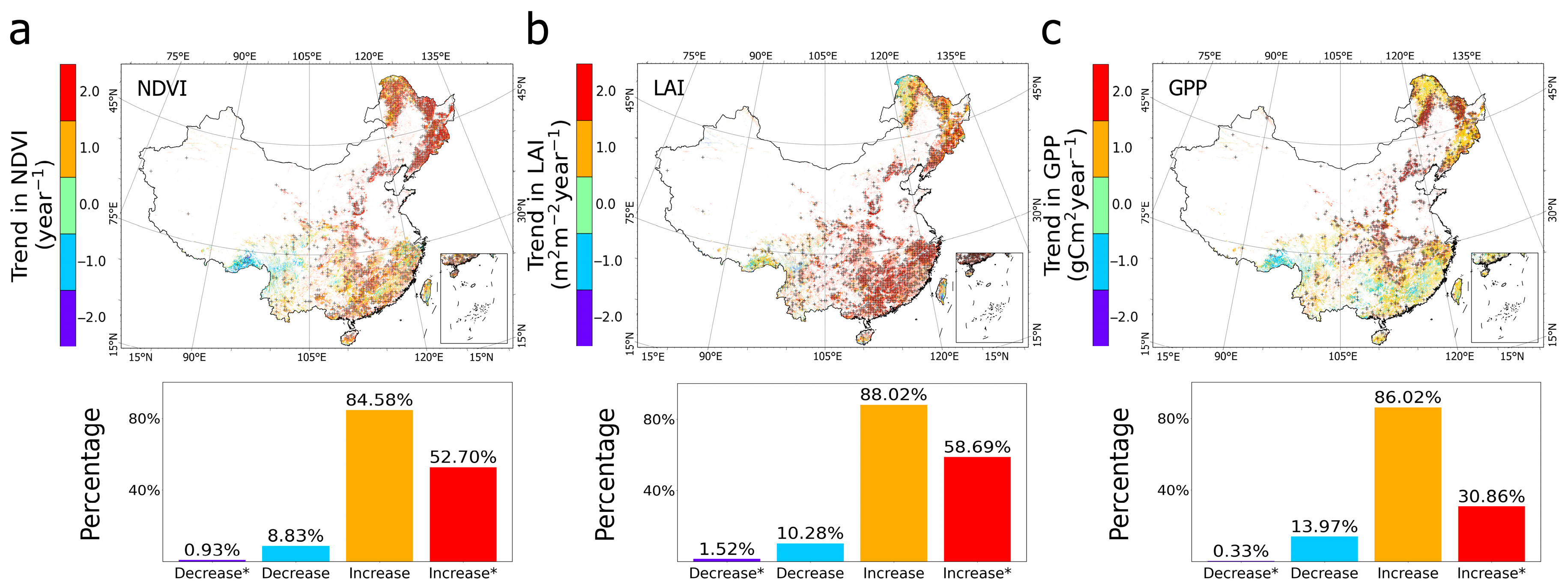
Chinese forests exhibited significant and widespread positive growth trajectories throughout the 2001–2020 period. Specifically, 84.58%, 88.02%, and 86.02% of forest grid cells showed positive changes in NDVI, LAI, and GPP, respectively. Among these, statistically significant trends (p < 0.05) were observed in 52.70%, 58.69%, and 30.86% of cells for NDVI, LAI, and GPP, respectively (Figure 1a–c). While variations existed in the intensity of these trends and their localized spatial distribution, the overall spatiotemporal patterns across NDVI, LAI, and GPP remained highly consistent.
Figure 1.
Spatiotemporal distribution patterns of Chinese forest growth condition change trends from 2001–2020. (a) NDVI; (b) LAI; (c) GPP. Black crosses indicate significant trends (p < 0.05). Bar charts represent statistics for the maps above, showing pixel proportion distributions of significant decrease (Decrease * p < 0.05), decrease, increase, and significant increase (Increase * p < 0.05).
3.2. Spatial Patterns of Static Sensitivity of Chinese Forests to Soil Moisture
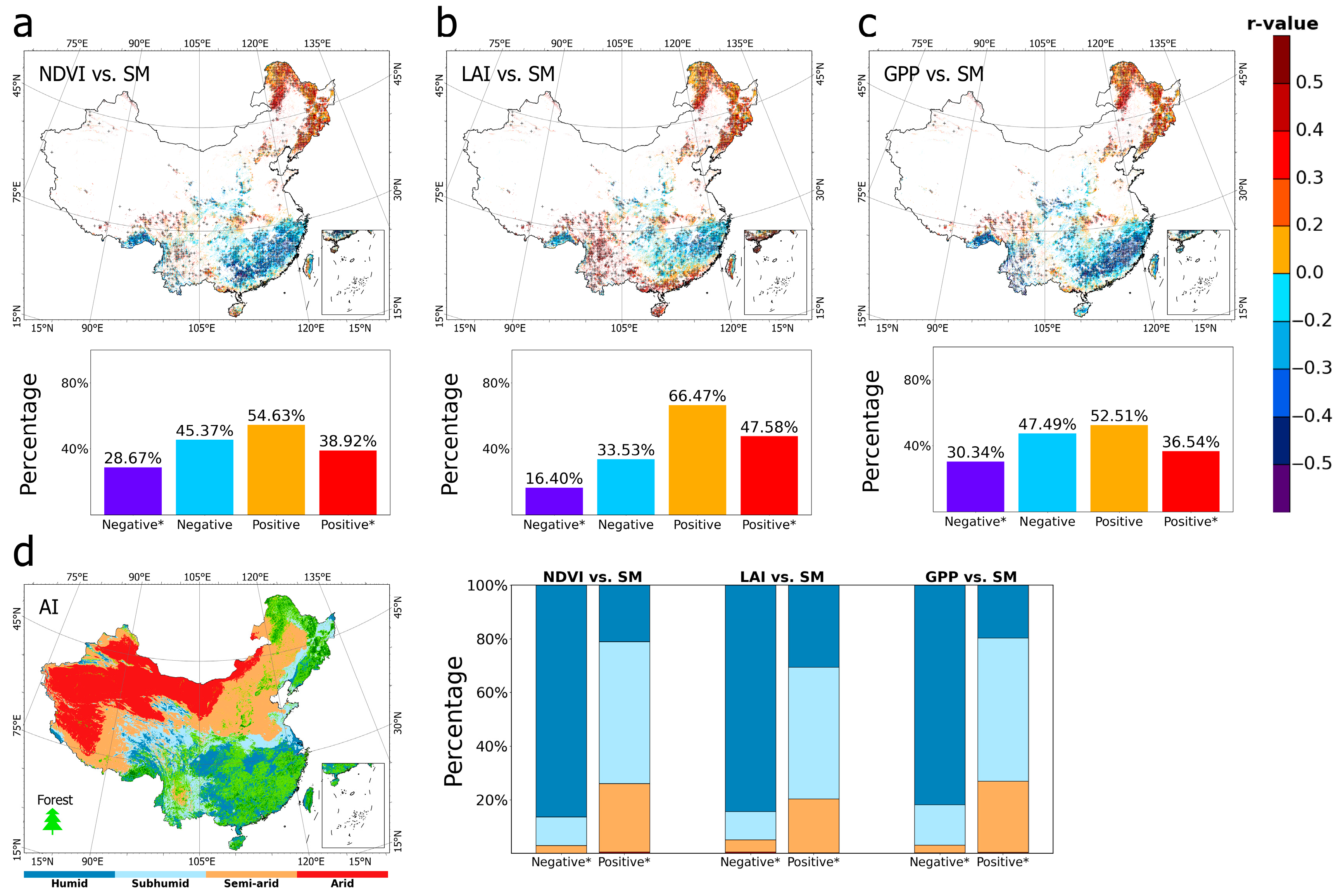
Forest growth conditions across China displayed pronounced spatial differentiation in their sensitivity to soil moisture, with over half of all forest areas experiencing moisture constraints. Positive correlations between vegetation indices NDVI, LAI, and GPP and soil moisture characterized 54.63%, 66.47%, and 52.51% of grid cells, respectively. Within these positive correlation zones, statistically significant relationships (soil moisture deficit zones, r > 0, p < 0.05) encompassed 38.92%, 47.58%, and 36.54% of cells, respectively (Figure 2a–c), signifying growth limitation by insufficient soil moisture (i.e., soil water deficit). Conversely, negative correlations dominated 45.37%, 33.53%, and 47.49% of grid cells, with significant negative relationships (soil moisture surplus zones, r < 0, p < 0.05) comprising 28.67%, 16.40%, and 30.34%, respectively (Figure 2a–c), indicating growth inhibition under excessive soil moisture conditions (i.e., soil water surplus).
Figure 2.
Spatial distribution characteristics of Chinese forest sensitivity to soil moisture from 2001–2020. (a) NDVI; (b) LAI; (c) GPP spatial distribution of Spearman’s rank correlation coefficients with soil moisture, with black crosses indicating significant correlations (p < 0.05). Bar charts represent statistics for the maps above, showing pixel proportion distributions of significant negative correlation (Negative *), negative correlation (Negative), positive correlation (Positive), and significant positive correlation (Positive *). (d) Spatial distribution of China’s arid, semi-arid, semi-humid, and humid zones based on AI, with the stacked chart on the right showing the proportion statistics of significant correlations (p < 0.05) between NDVI, LAI, GPP and SM in different humidity zones.
Geographically, positive correlation zones concentrated primarily within China’s northeastern and southwestern forest regions (Figure 2d), corresponding to semi-arid and arid climatic zones characterized by AI values ≥ 1.5 [38]. These regions contained 78.92%, 69.52%, and 80.26% of all significantly positive correlation cells. Negative correlation zones clustered predominantly along humid southeastern coastal areas (AI < 1), where 86.37%, 84.35%, and 81.75% of significantly negative correlation cells were situated (Figure 2d).
Forest age further modulates the spatial heterogeneity of soil moisture sensitivity (Supplementary Text S1 and Figure S1). In soil moisture deficit zones (significant positive correlation, r > 0, p < 0.05), mature (>50 years) and near-mature forests (31–50 years) together account for 75%–83% of pixels across NDVI, LAI, and GPP analyses. In contrast, in soil moisture surplus zones (significant negative correlation, r < 0, p < 0.05), young (0–10 years) and middle-aged forests (11–30 years) dominate, comprising 55%–63% of pixels. This age-dependent pattern likely arises from differences in root system development and hydraulic strategy between mature and younger stands: mature forests typically possess deeper and more extensive root systems that enhance access to stable subsurface water, whereas younger plantations have shallower roots and reduced tolerance to prolonged soil saturation [55,56,57,58]. Detailed age-class proportions and supporting mechanisms are provided in Supplementary Text S1 [55,59,60,61,62,63,64,65,66].
3.3. Spatiotemporal Dynamics and Trends of Forest Sensitivity to Soil Moisture
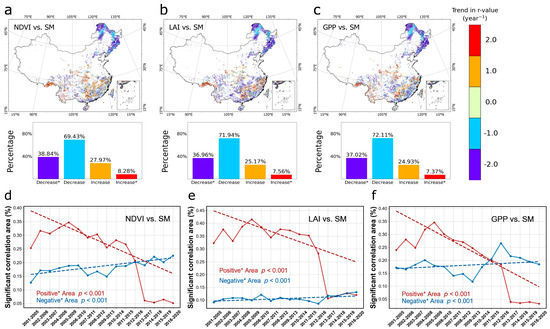
Spatial pattern analysis uncovered declining sensitivity trends across the majority of forest areas (NDVI: 69.43%, LAI: 71.94%, GPP: 72.11%), with statistically significant decreases (p < 0.05) occurring in 38.84%, 36.96%, and 37.02% of regions, respectively (Figure 3a–c). These declining zones concentrated primarily across northeastern and southeastern coastal regions. In contrast, increasing sensitivity trends characterized fewer forest areas (NDVI: 27.97%, LAI: 25.17%, GPP: 24.93%), with significant increases (p < 0.05) limited to 8.28%, 7.56%, and 7.37% of regions. Such areas clustered within central, southwestern, and southern Tibetan Plateau regions (Figure 3).
Figure 3.
Spatiotemporal trends of Chinese forest sensitivity to soil moisture from 2001–2020. (a) NDVI; (b) LAI; (c) GPP spatial distribution of Spearman correlation coefficient trends with soil moisture, with black crosses indicating significant trends (p < 0.05). Bar charts represent statistics for the maps above, showing pixel proportions of significant decrease (Decrease *, p < 0.05), decrease, increase, and significant increase (Increase *, p < 0.05), with red and blue representing soil moisture deficit (Positive *: Spearman r > 0, p < 0.05) and surplus zones (Negative *: Spearman r < 0, p < 0.05), respectively. (d–f) Time trends of NDVI, LAI, GPP correlations with SM shown as smoothed series. The x-axis denotes the 5-year moving window intervals.
Dynamic evolution of sensitivity area proportions corroborated this overall declining trajectory. Through 16 consecutive 5-year moving windows, we quantified proportional areas of soil water deficit zones (r > 0, p < 0.05) and soil water surplus zones (r < 0, p < 0.05) relative to total forest grid cells. The proportion of soil water deficit zones contracted dramatically from 27% (NDVI: 25.3%, LAI: 32.1%, GPP: 23.8%) at the study’s onset to merely 5.8% (NDVI:5.1%, LAI:10.1%, GPP:2.3%) at its conclusion—an absolute reduction of 20%. Simultaneously, soil water surplus zones expanded from approximately 12.3% (NDVI: 12.5%, LAI: 7.3%, GPP: 17.2%) to 18.6% (NDVI: 22.9%, LAI: 14.1%, GPP: 18.9%), representing a 6.7% increase (Figure 3d–f).
3.4. Key Factors and Regulatory Mechanisms Driving Changes in Chinese Forest Soil Moisture Sensitivity
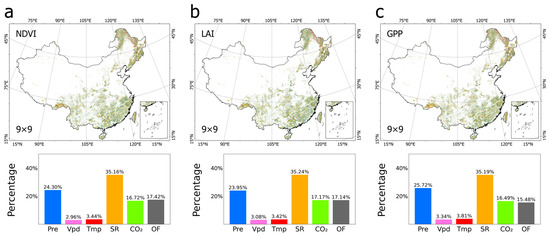
Random Forest regression was employed to assess the relative contributions of dynamic climate factors (solar radiation, precipitation, atmospheric CO2 concentration, temperature, vapor pressure deficit (VPD) and other factors (OFs) to the sensitivity trends of Chinese forests to soil moisture. Results indicated that dynamic climate factors predominantly drove sensitivity trends, with solar radiation (SR) exhibiting the highest relative importance (NDVI-SM 35.16%, LAI-SM 35.24%, GPP-SM 35.19%). Precipitation (24.30%, 23.95%, 25.72%) and atmospheric CO2 concentration (16.72%, 17.17%, 16.46%) followed in importance. Temperature (3.44%, 3.42%, 3.81%), VPD (2.96%, 3.08%, 3.34%), and other factors (OF; totaling 17.42%, 17.14%, 15.48%, with biomass contributing approximately 8% and soil properties about 5%) showed comparatively lower contributions (Figure 4a–c). High consistency across 7 × 7 and 11 × 11 moving window results (Figures S2 and S3) confirmed the robustness of the analysis. The reliability of the Random Forest models was evaluated using the coefficient of determination (R2). As shown in Supplementary Figure S2, the models achieved satisfactory explanatory power across the majority of forest areas, confirming the validity of the attribution results.
Figure 4.
Spatial distribution of dominant driving forces of Chinese forest soil moisture sensitivity trends based on 9 × 9 sliding window random forest regression analysis. (a–c) Show the relative importance of driving factors for SM sensitivity trends of Normalized Difference NDVI, LAI, and GPP, respectively. Bar charts represent statistics for the maps above, showing the average contribution of each variable, including PRE, VPD, TMP, SR, atmospheric CO2 concentration, and static factors (OFs).
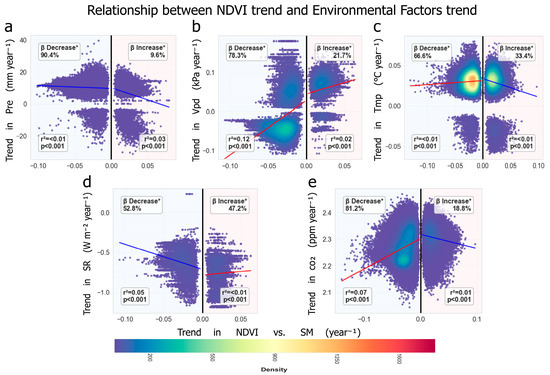
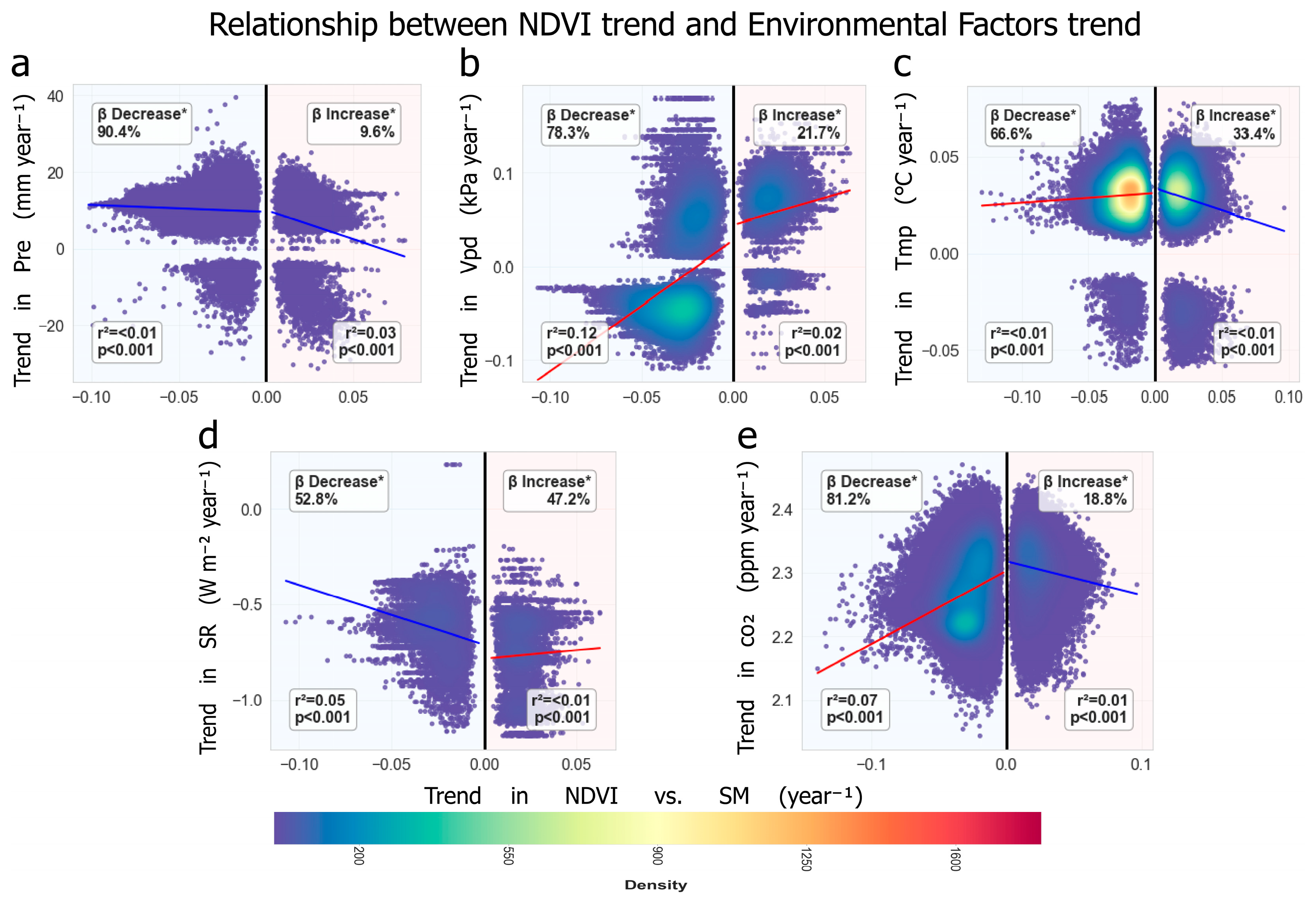
Figure 5a–e quantitatively elucidated the spatial association patterns between NDVI-SM sensitivity trends (β, Theil–Sen slope, p < 0.05) and the trends of key environmental factors. The scatter distribution of precipitation trends was highly concentrated in regions of decreasing sensitivity (Quadrants 2 and 3), where linear fitting revealed a negative slope relationship, indicating a coupled relationship between increased precipitation and decreased sensitivity. Solar radiation trends exhibited a negative slope in regions of decreasing sensitivity but a positive slope in regions of increasing sensitivity, with scatter point density clearly biased towards Quadrant 2. This corroborated that declining radiation is a significant driving mechanism for sensitivity attenuation. The scatter distribution of atmospheric CO2 concentration trends was highly polarized to Quadrant 2, and linear fitting showed a positive slope, supporting a negative feedback mechanism where elevated CO2 is associated with sensitivity attenuation. Temperature and vapor pressure deficit (VPD) trends were primarily distributed within regions of decreasing sensitivity, with their regression lines consistently showing positive slopes, though the strength of their association was comparatively weaker. Highly consistent association patterns were observed for LAI and GPP sensitivity trends to soil moisture with these environmental driving factors, as detailed in Figure S4. Spearman partial correlation analysis further quantified the independent contribution strength of each driving factor (Figure S5). In regions of decreasing sensitivity (β < 0), the negative effect stemming from elevated CO2 concentration predominated, independently explaining 45.16%, 49.47%, and 44.48% of the changes in NDVI-SM, LAI-SM, and GPP-SM sensitivity, respectively. The positive effect of declining solar radiation ranked second, with independent contribution rates reaching 21.72%, 19.50%, and 24.83%. The negative effect of increased precipitation contributed 18.44%, 17.25%, and 16.92%, respectively. The positive effects of temperature and VPD were minor, each accounting for approximately 3%. Conversely, in regions of increasing sensitivity (β > 0), the negative effect of enhanced solar radiation was dominant, independently contributing 38.27%, 41.35%, and 37.64%. The positive effect of CO2 ranked second, accounting for 25.18%, 22.93%, and 26.47%, respectively. The consistency between the scatter analysis and partial correlation results validates the robustness of our multifactor attribution framework. The physiological mechanism underlying the negative contribution of elevated CO2 originates from its systemic enhancement of forest water use efficiency (WUE). By optimizing stomatal conductance responses, this effect significantly reduces the physiological dependence of forest growth on soil moisture fluctuations, thereby driving the “desensitization” process observed in Chinese forest systems.
Figure 5.
Correlations between NDVI-SM sensitivity trends (β) and environmental driver trends. (a–e) Scatter plots of β versus trends in PRE, VPD, TMP, Rs, and CO2 (p < 0.05). (left panels): β Decrease * (significant decreasing trends (Mann–Kendall test, p < 0.05)) regions; (right panels): β Increase * (significant increasing trends (Mann–Kendall test, p < 0.05)) regions. Red/blue lines represent positive/negative correlations with R2 and p-values shown.
4. Discussion
4.1. Widespread Soil Moisture Desensitization in Chinese Forests
Our dynamic sensitivity analysis unequivocally reveals that Chinese forests underwent a pervasive and significant “soil moisture desensitization” process between 2001 and 2020. This phenomenon is characterized by a widespread reduction in the dependence of forest growth status (as indicated by NDVI, LAI, and GPP) on soil moisture availability. This finding fundamentally challenges the prevailing global narrative that vegetated ecosystems are universally experiencing intensified hydrological stress and increased reliance on soil moisture under a changing climate [52,67]. Our study demonstrates that the sensitivity of the vast majority of forest areas (over 70%) to soil moisture declined, with nearly 40% exhibiting statistically significant decreases (Figure 3a–c). This trend dramatically contracted the area classified as soil moisture deficit regions (where forest growth was significantly positively correlated with soil moisture), plummeting from approximately 27% in the 2001–2005 period to a mere ~6% by the 2016–2020 period (Figure 3d–f). Concomitantly, the extent of soil moisture surplus regions (where forest growth was significantly negatively correlated with high soil moisture levels) expanded considerably from around ~12% to ~19% (Figure 3d–f). This profound shift in the hydrological limitation regime indicates that Chinese forests are transitioning from a state primarily constrained by soil moisture scarcity to one increasingly susceptible to the inhibitory effects of excessive soil moisture, particularly in humid and semi-humid regions, potentially leading to issues such as root hypoxia and nutrient leaching [47,48].
We posit that this widespread desensitization is driven by a powerful synergistic interplay of multiple regional environmental factors. Firstly, the sustained reduction in solar radiation—a phenomenon commonly referred to as “global dimming”, driven primarily by increased anthropogenic aerosols across China—observed across China, particularly in its industrialized eastern regions [68,69], effectively curtailed the potential evapotranspiration demand of the ecosystem. This reduction in atmospheric evaporative demand directly alleviated atmospheric drought stress on forests, thereby lessening their immediate physiological reliance on soil moisture. Secondly, the enhanced precipitation driven by the East Asian Monsoon system [18,19] provided crucial replenishment to soil water reservoirs. Increased precipitation infiltration helped buffer the adverse impacts of drought events and likely contributed to elevating soil moisture levels to saturation or even supra-optimal conditions in certain areas. Thirdly, the elevated atmospheric CO2 concentration played a pivotal role through its well-documented physiological regulation effects. The CO2 fertilization effect, by optimizing stomatal conductance, significantly enhanced the intrinsic WUE of forests, enabling trees to fix more carbon per unit of water consumed [5,70]. This physiological adjustment directly reduced the sensitivity of forest growth to fluctuations in soil moisture. Our attribution analysis, highlighting solar radiation (~35%), precipitation (~25%), and atmospheric CO2 concentration (~17%) as dominant factors (Figure 4a–c), clearly demonstrates that these elements form a tightly coupled synergistic network. This network collectively shaped the observed sensitivity trends, with their combined influence substantially outweighing the contribution of any single factor.
Although our study focuses on long-term monotonic trends, extreme climatic events can transiently reverse the desensitization pattern. For example, the severe 2022 Yangtze River basin drought and the 2020–2021 extreme pluvial events in southern China caused short-term spikes in soil moisture sensitivity in affected regions, underscoring that the observed desensitization remains vulnerable to climatic extremes.
4.2. Regional Specificity and Theoretical Contributions in Global Context
The observed “desensitization” phenomenon in Chinese forests contrasts sharply with generalized global forest eco-hydrological understandings [52,67]. This divergence underscores the paramount importance of regional specificity in shaping ecosystem responses to global change. While integrated analyses at the global scale offer a macro-level framework, they often homogenize critical regional response signals, thereby overlooking localized ecological processes driven by distinct biogeographical and anthropogenic factors. The uniqueness of Chinese forest desensitization can be attributed to a confluence of specific regional conditions: Firstly, extensive anthropogenic ecological engineering initiatives, such as the “Grain for Green Program” [7,46], have fostered widespread, fast-growing artificial plantations. These managed forests may exhibit fundamentally different hydro-physiological regulation mechanisms compared to naturally regenerating forests, potentially due to species selection, density management, and genetic improvements that enhance water use efficiency and adaptive capacity. Secondly, the unique coupled pattern of declining solar radiation and increasing precipitation within the East Asian Monsoon climatic system [71,72] provides a highly conducive hydro-climatic backdrop for the observed sensitivity attenuation—a pattern not universally observed in other major global forest regions. Furthermore, the amplified expression of the CO2 fertilization effect in China’s temperate and subtropical forests [73] has enabled these ecosystems to demonstrate adaptive trajectories that deviate significantly from global average trends. This pronounced regional specificity serves as a crucial refinement and augmentation to existing global change paradigms, revealing that under specific climate-ecological engineering coupling conditions, forest ecosystems can develop complex adaptive mechanisms that significantly diverge from global average expectations. These insights hold profound implications for recalibrating and improving the predictive power of global eco-hydrological models.
4.3. Limitations and Future Prospects
While this study offers novel insights into the eco-hydrological responses of Chinese forests under climate change, several limitations warrant consideration, simultaneously delineating avenues for future research. Although we rigorously selected stable forest areas by filtering for consistent land cover classification between 2001 and 2020 (based on the CNLUCC dataset [27]) to minimize potential interference from large-scale land-use changes, localized direct anthropogenic interventions in forest soil moisture (e.g., targeted irrigation, water diversion projects, or reservoir construction for specific forest plots) were not explicitly quantified. While such intensive human interventions are typically localized and their overall impact on the national-scale patterns captured by remote sensing data is likely limited, their potential to introduce uncertainty at the local scale, particularly in arid and semi-arid regions with intensive afforestation efforts, merits further investigation. Future research should strive to integrate more granular data on anthropogenic hydrological regulation to comprehensively assess its localized impacts on forest hydrological sensitivity. Furthermore, while this study utilized root-zone averaged soil moisture, the rooting depths of different forest types and age classes exhibit significant variability. This could lead to heterogeneous utilization of soil moisture from various soil layers. Future work could leverage multi-layered soil moisture data in conjunction with root distribution models to more precisely disentangle the contributions of deeper soil moisture to forest growth dynamics. Additionally, this study primarily focused on average growing season responses, yet the instantaneous and cumulative impacts of extreme climate events (e.g., severe droughts, floods, and heatwaves) on sensitivity, alongside their intricate interactions with soil microbial communities and nutrient cycling [6,16], represent critical frontiers for in-depth exploration. Finally, integrating the findings from this study into higher-resolution Earth System Models, coupled with process-based models and advanced machine learning algorithms, promises to yield more accurate predictions of future forest ecosystem function and carbon–water cycle dynamics across China and globally. We acknowledge that utilizing root-zone averaged soil moisture (0–100 cm) simplifies the complex vertical soil water profile. However, this approach aligns with benchmark global studies [8,19,74] due to the lack of high-resolution, nationally consistent plant-available water datasets. Consequently, while higher-resolution vertical data remains a goal for future research, the current methodology provides robust insights at the national scale.
5. Conclusions
This study integrates multi-source remote sensing data with statistical analyses to reveal the “desensitization” patterns of Chinese forest sensitivity to soil moisture under climate change, characterized by a widespread weakening of forest growth dependence on soil moisture. This pattern exhibits pronounced spatial heterogeneity: forests in arid regions remain persistently constrained by soil water deficits, while those in humid regions are increasingly inhibited by excessive soil moisture. Notably, trees of different ages demonstrate significant differences in their sensitivity to soil moisture, with mature forests dominating in soil moisture deficit zones and exhibiting high sensitivity to water shortage, while young forests predominate in soil moisture surplus zones and are more susceptible to waterlogging stress. Furthermore, climate plays a crucial regulatory role in forest growth sensitivity to soil moisture. Solar radiation reduces transpiration demand, precipitation alleviates water threshold stress, and atmospheric CO2 concentrations enhance water use efficiency, synergistically driving the “desensitization” process. These results demonstrate spatiotemporal changes in forest dependence on soil moisture under global warming, highlighting the critical role of multifactor interactions. Therefore, this study provides new perspectives on Chinese forest carbon sink stability and climate responses to global greening. Future research should further investigate regional synergistic effects of water and energy to optimize precision forest management strategies tailored to different forest ages. Future research should further investigate regional synergistic effects of water and energy to optimize precision forest management strategies tailored to different forest ages and plantation types.
Supplementary Materials
The following supporting information can be downloaded at: https://www.mdpi.com/article/10.3390/f17010015/s1, Text S1: Regulatory Mechanisms of Forest Age on Soil Moisture Sensitivity; Figure S1: Spatial characteristics of forest age distribution and its soil moisture sensitivity in Chinese forests from 2001–2020; Figure S2: Correlation analysis between Chinese forest soil moisture sensitivity trends and environmental factor trends; Figure S3: Spatial distribution of dominant driving forces of Chinese forest soil moisture sensitivity trends based on 7 × 7 and 11 × 11 sliding window Random Forest regression analysis; Figure S4: Relationships between LAI/GPP soil moisture sensitivity trends and environmental factors; Figure S5: Driving mechanisms of forest–soil moisture correlation trends based on Spearman partial correlation analysis (combined with t/F test, p < 0.05 significant).
Author Contributions
Y.G.: methodology, investigation, writing—review & editing; Y.L.: supervision, funding acquisition, conceptualization, methodology, project administration, investigation, writing—review & editing; L.C.: investigation; X.P.: investigation; H.C.: investigation; Z.Z.: investigation; G.L.: investigation. All authors have read and agreed to the published version of the manuscript.
Funding
This research was funded by the National Natural Science Foundation of China (Grant No. 42271441) and the Yunnan Province Innovation Team Project (Grant No. 202305AS350003). Graduate research was supported by the Graduate Research Innovation Fund of Yunnan Normal University (Grant Nos. YJSJJ25-B144 and YJSJJ25-B154).
Data Availability Statement
All raster data are freely accessible from the following websites. Soil moisture data (SMCI 1.0): https://data.tpdc.ac.cn/ (accessed on 15 September 2024). NDVI data: https://developers.google.com/earth-engine/datasets/catalog/MODIS_061_MOD13Q1 (accessed on 20 August 2024). LAI data: https://lpdaac.usgs.gov/products/mod15a2hv061/ (accessed on 22 August 2024). GPP data: https://developers.google.com/earth-engine/datasets/catalog/MODIS_006_MOD17A2H (accessed on 25 August 2024). Monthly air temperature, precipitation, and solar radiation: https://www.geodata.cn/ (accessed on 10 October 2024) and https://cds.climate.copernicus.eu/datasets/reanalysis-era5-land-monthly-means (accessed on 12 October 2024). Dew point temperature and near-surface air temperature for VPD calculation: https://cds.climate.copernicus.eu/datasets/reanalysis-era5-land-monthly-means (accessed on 12 October 2024). Atmospheric CO2 concentration: https://data.tpdc.ac.cn/ (accessed on 15 October 2024). Soil fertility (CEC) and soil sand content: https://gaez.fao.org/pages/hwsd (accessed on 1 November 2024). Aboveground biomass: https://doi.org/10.5285/bedc59f37c9545c981a839eb552e4084. Forest age: https://doi.org/10.5194/essd-16-803-2024. Topographic data (DEM): https://www.geodata.cn/ (accessed on 5 November 2024). Aridity index: https://www.geodata.cn/ (accessed on 5 November 2024). Land cover data (CNLUCC): https://www.resdc.cn/ (accessed on 5 November 2024). Statistical analyses were performed using Python (v3.8) with SciPy (v1.5.0) and Scikit-learn (v0.24.2); All code for data processing and figure generation is available from the corresponding author upon reasonable request.
Acknowledgments
We thank the anonymous reviewers for their constructive comments.
Conflicts of Interest
The authors declare no conflicts of interest. The funders had no role in study design, data collection and analysis, decision to publish, or preparation of the manuscript.
References
- Bonan, G.B. Forests and climate change: Forcings, feedbacks, and the climate benefits of forests. Science 2008, 320, 1444–1449. [Google Scholar] [CrossRef] [Scilit] [PubMed]
- Pan, Y.; Birdsey, R.A.; Fang, J.; Houghton, R.; Kauppi, P.E.; Kurz, W.A.; Phillips, O.L.; Shvidenko, A.; Lewis, S.L.; Canadell, J.G.; et al. A large and persistent carbon sink in the world’s forests. Science 2011, 333, 988–993. [Google Scholar] [CrossRef] [Scilit]
- Fisher, J.B.; Melton, F.; Middleton, E.; Hain, C.; Anderson, M.; Allen, R.; McCabe, M.F.; Hook, S.; Baldocchi, D.; Townsend, P.A.; et al. The future of evapotranspiration: Global requirements for ecosystem functioning, carbon and climate feedbacks, agricultural management, and water resources. Water Resour. Res. 2017, 53, 2618–2626. [Google Scholar] [CrossRef] [Scilit]
- Jasechko, S.; Sharp, Z.D.; Gibson, J.J.; Birks, S.J.; Yi, Y.; Fawcett, P.J. Terrestrial water fluxes dominated by transpiration. Nature 2013, 496, 347–350. [Google Scholar] [CrossRef] [Scilit]
- Ainsworth, E.A.; Long, S.P. What have we learned from 15 years of free-air CO2 enrichment (FACE)? A meta-analytic review of the responses of photosynthesis, canopy properties and plant production to rising CO2. New Phytol. 2005, 165, 351–372. [Google Scholar] [CrossRef] [Scilit] [PubMed]
- McDowell, N.G.; Allen, C.D.; Anderson-Teixeira, K.; Aukema, B.H.; Bond-Lamberty, B.; Chini, L.; Clark, J.S.; Dietze, M.; Grossiord, C.; Hanbury-Brown, A.; et al. Pervasive shifts in forest dynamics in a changing world. Science 2020, 368, eaaz9463. [Google Scholar] [CrossRef] [Scilit] [PubMed]
- Chen, C.; Park, T.; Wang, X.; Piao, S.; Xu, B.; Chaturvedi, R.K.; Fuchs, R.; Brovkin, V.; Ciais, P.; Fensholt, R.; et al. China and India lead in greening of the world through land-use management. Nat. Sustain. 2019, 2, 122–129. [Google Scholar] [CrossRef] [Scilit]
- Liu, L.; Gudmundsson, L.; Hauser, M.; Qin, D.; Li, S.; Seneviratne, S.I. Soil moisture dominates dryness stress on ecosystem production globally. Nat. Commun. 2020, 11, 4892. [Google Scholar] [CrossRef] [Scilit]
- Anderegg, W.R.L.; Schwalm, C.; Biondi, F.; Camarero, J.J.; Koch, G.; Litvak, M.; Ogle, K.; Shaw, J.D.; Shevliakova, E.; Williams, A.P.; et al. Pervasive drought legacies in forest ecosystems and their implications for carbon cycle models. Science 2015, 349, 528–532. [Google Scholar] [CrossRef] [Scilit]
- Frank, D.; Reichstein, M.; Bahn, M.; Thonicke, K.; Frank, D.; Mahecha, M.D.; Smith, P.; van der Velde, M.; Vicca, S.; Babst, F.; et al. Effects of climate extremes on the terrestrial carbon cycle: Concepts, processes and potential future impacts. Glob. Change Biol. 2015, 21, 2861–2880. [Google Scholar] [CrossRef] [Scilit]
- McDowell, N.G.; Brodribb, T.J.; Nardini, A. Hydraulics in the 21st century. New Phytol. 2019, 224, 537–542. [Google Scholar] [CrossRef] [Scilit] [PubMed]
- Adams, H.D.; Zeppel, M.J.B.; Anderegg, W.R.L.; Hartmann, H.; Landhäusser, S.M.; Tissue, D.T.; Huxman, T.E.; Hudson, P.J.; Franz, T.E.; Allen, C.D.; et al. A multi-species synthesis of physiological mechanisms in drought-induced tree mortality. Nat. Ecol. Evol. 2017, 1, 1285–1291. [Google Scholar] [CrossRef] [Scilit] [PubMed]
- Rowland, L.; da Costa, A.C.L.; Galbraith, D.R.; Oliveira, R.S.; Binks, O.J.; Oliveira, A.A.R.; Pullen, A.M.; Doughty, C.E.; Metcalfe, D.B.; Vasconcelos, S.S.; et al. Death from drought in tropical forests is triggered by hydraulics not carbon starvation. Nature 2015, 528, 119–122. [Google Scholar] [CrossRef] [Scilit]
- Hartmann, H.; Moeller, S.; Schleiden, P.; Trumbore, S. Non-structural carbohydrate dynamics associated with drought-induced die-back in woody plant species. Front. Plant Sci. 2013, 4, 261. [Google Scholar] [CrossRef] [Scilit]
- D’Odorico, P.; Laio, F.; Porporato, A.; Ridolfi, L.; Rinaldo, A.; Rodriguez-Iturbe, I. Ecohydrology of terrestrial ecosystems. BioScience 2010, 60, 898–907. [Google Scholar] [CrossRef] [Scilit]
- Schuur, E.A.G.; McGuire, A.D.; Schädel, C.; Grosse, G.; Harden, J.W.; Hayes, D.J.; Hugelius, G.; Koven, C.D.; Kuhry, P.; Lawrence, D.M.; et al. Climate change and the permafrost carbon feedback. Nature 2015, 520, 171–179. [Google Scholar] [CrossRef] [Scilit]
- IPCC. Climate Change 2022: Impacts, Adaptation and Vulnerability. In Contribution of Working Group II to the Sixth Assessment Report of the Intergovernmental Panel on Climate Change; Pörtner, H.-O., Roberts, D.C., Tignor, M., Poloczanska, E.S., Mintenbeck, K., Alegría, A., Craig, M., Langsdorf, S., Löschke, S., Möller, V., et al., Eds.; Cambridge University Press: Cambridge, UK; New York, NY, USA, 2022. [Google Scholar]
- Wang, J.; Wang, K.; Wang, H.; Wang, S. Soil moisture variations and their driving forces in China from 1979 to 2019. Sci. Total Environ. 2023, 865, 161199. [Google Scholar] [CrossRef] [Scilit]
- Green, J.K.; Konings, A.G.; Alemohammad, S.H.; Berry, J.; Entekhabi, D.; Kolassa, J.; Lee, J.E.; Gentine, P. Regionally strong feedbacks between the atmosphere and terrestrial biosphere. Nat. Geosci. 2017, 10, 410–414. [Google Scholar] [CrossRef] [Scilit]
- Anderegg, W.R.L.; Trugman, A.T.; Badgley, G.; Konings, A.G.; Shaw, J. Divergent forest sensitivity to repeated extreme droughts. Nat. Clim. Chang. 2020, 10, 1091–1095. [Google Scholar] [CrossRef] [Scilit]
- Hartmann, H.; Bastos, A.; Das, A.J.; Esquivel-Muelbert, A.; Hammond, W.M.; Martínez-Vilalta, J.; McDowell, N.G.; Powers, J.S.; Pugh, T.A.M.; Ruthrof, K.X.; et al. Climate change risks to global forest health: Emergence of unexpected events of elevated tree mortality worldwide. Annu. Rev. Plant Biol. 2022, 73, 673–702. [Google Scholar] [CrossRef] [Scilit]
- Tong, X.; Mu, Y.; Zhang, J.; Meng, P.; Li, J. Water stress controls on carbon flux and water use efficiency in a warm-temperate mixed plantation. J. Hydrol. 2019, 571, 669–678. [Google Scholar] [CrossRef] [Scilit]
- Li, X.; Piao, S.; Wang, K.; Wang, X.; Wang, T.; Ciais, P.; Chen, A.; Lian, X.; Peng, S.; Peñuelas, J. Temporal trade-off between gymnosperm resistance and resilience increases forest sensitivity to extreme drought. Nat. Ecol. Evol. 2020, 4, 1075–1083. [Google Scholar] [CrossRef] [Scilit]
- Zhang, Y.; Pena-Arancibia, J.L.; McVicar, T.R.; Chiew, F.H.S.; Vaze, J.; Liu, C.; Lu, X.; Zheng, H.; Wang, Y.; Liu, Y.Y.; et al. Multi-decadal trends in global terrestrial evapotranspiration and its components. Sci. Rep. 2016, 6, 19124. [Google Scholar] [CrossRef] [Scilit]
- Vicente-Serrano, S.M.; Beguería, S.; López-Moreno, J.I. A multiscalar drought index sensitive to global warming: The standardized precipitation evapotranspiration index. J. Clim. 2010, 23, 1696–1718. [Google Scholar] [CrossRef] [Scilit]
- Li, J.; Wang, Z.; Lai, C.; Wu, X.; Zeng, Z.; Chen, X.; Lian, Y. Response of net primary production to land use and land cover change in mainland China since the late 1980s. Sci. Total Environ. 2018, 639, 237–247. [Google Scholar] [CrossRef] [Scilit]
- Xu, X.; Liu, J.; Zhang, S.; Li, R.; Yan, C.; Wu, S. China Multi-Period Land Use Land Cover Remote Sensing Monitoring Data Set (CNLUCC); Data Registration and Publishing System of the Resource and Environmental Science Data Center of the Chinese Academy of Sciences; Resource and Environmental Science Data Center of the Chinese Academy of Sciences: Beijing, China, 2018. [Google Scholar] [CrossRef]
- Li, Q.; Shi, G.; Shangguan, W.; Nourani, V.; Li, J.; Li, L.; Huang, F.; Zhang, Y.; Wang, C.; Wang, D.; et al. A 1 km daily soil moisture dataset over China using in situ measurement and machine learning. Earth Syst. Sci. Data 2022, 14, 5267–5286. [Google Scholar] [CrossRef] [Scilit]
- Hersbach, H.; Bell, B.; Berrisford, P.; Hirahara, S.; Horányi, A.; Muñoz-Sabater, J.; Nicolas, J.; Peubey, C.; Radu, R.; Schepers, D.; et al. The ERA5 global reanalysis. Q. J. R. Meteorol. Soc. 2020, 146, 1999–2049. [Google Scholar] [CrossRef] [Scilit]
- Gorelick, N.; Hancher, M.; Dixon, M.; Ilyushchenko, S.; Thau, D.; Moore, R. Google Earth Engine: Planetary-scale geospatial analysis for everyone. Remote Sens. Environ. 2017, 202, 18–27. [Google Scholar] [CrossRef] [Scilit]
- Peng, S.; Ding, Y.; Liu, W.; Li, Z. 1 km monthly temperature and precipitation dataset for China from 1901 to 2017. Earth Syst. Sci. Data 2019, 11, 1931–1946. [Google Scholar] [CrossRef] [Scilit]
- Allen, R.G.; Pereira, L.S.; Raes, D.; Smith, M. Crop Evapotranspiration: Guidelines for Computing Crop Water Requirements; FAO Irrigation and Drainage Paper 56; Food and Agriculture Organization of the United Nations: Rome, Italy, 1998. [Google Scholar]
- Wang, J. A 1 Km Resolution Monthly Atmospheric CO2 Concentration Dataset for China (2003–2023); National Tibetan Plateau Data Center: Beijing, China, 2025. [Google Scholar]
- Fischer, G.; Nachtergaele, F.O.; van Velthuizen, H.T.; Chiozza, F.; Francheschini, G.; Henry, M.; Muchoney, D.; Tramberend, S. Global Agro-Ecological Zones v4—Model Documentation; FAO: Rome, Italy, 2021. [Google Scholar]
- Santoro, M.; Cartus, O. ESA Biomass Climate Change Initiative (Biomass_cci): Global Datasets of Forest Above-Ground Biomass for the Years 2010, 2017 and 2018, v3; NERC EDS Centre for Environmental Data Analysis: Harwell, UK, 2021. [Google Scholar] [CrossRef]
- Kang, J. 1 Km Resolution Digital Elevation Model Dataset of China; Loess Plateau Science Data Center, National Earth System Science Data Center: Xianyang, China, 2020. [Google Scholar]
- Cheng, M.; Peng, S.; Huang, Y.; Ciais, P.; Guo, Z.; Li, X.; Wu, Y.; Yin, Y.; Yue, C.; Zeng, Z.; et al. A 30 m resolution forest age map of China. Earth Syst. Sci. Data 2024, 16, 803–819. [Google Scholar] [CrossRef] [Scilit]
- Peng, S. 1 Km Resolution Annual Aridity Index Dataset for China (1901–2024); National Tibetan Plateau Data Center: Beijing, China, 2023. [Google Scholar]
- Virtanen, P.; Gommers, R.; Oliphant, T.E.; Haberland, M.; Reddy, T.; Cournapeau, D.; Burovski, E.; Peterson, P.; Weckesser, W.; Bright, J.; et al. SciPy 1.0: Fundamental algorithms for scientific computing in Python. Nat. Methods 2020, 17, 261–272. [Google Scholar] [CrossRef] [Scilit]
- Sen, P.K. Estimates of the regression coefficient based on Kendall’s tau. J. Am. Stat. Assoc. 1968, 63, 1379–1389. [Google Scholar] [CrossRef]
- Mann, H.B. Nonparametric tests against trend. Econometrica 1945, 13, 245–259. [Google Scholar] [CrossRef] [Scilit]
- Theil, H. A rank-invariant method of linear and polynomial regression analysis. Indag. Math. 1950, 12, 85–91. [Google Scholar]
- Li, L.; Zhang, Y.; Liu, L.; Wu, J.; Wang, Z.; Li, S.; Zhang, H.; Zu, J.; Ding, M.; Paudel, B. Spatiotemporal patterns of vegetation greenness change and associated climatic and anthropogenic drivers on the Tibetan Plateau during 2000–2015. Remote Sens. 2018, 10, 1525. [Google Scholar] [CrossRef] [Scilit]
- Fensholt, R.; Proud, S.R. Evaluation of Earth Observation based global long term vegetation trends—Comparing GIMMS and MODIS global NDVI time series. Remote Sens. Environ. 2012, 119, 131–147. [Google Scholar] [CrossRef] [Scilit]
- Spearman, C. The proof and measurement of association between two things. Am. J. Psychol. 1904, 15, 72–101. [Google Scholar] [CrossRef] [Scilit]
- Piao, S.; Wang, X.; Park, T.; Chen, C.; Lian, X.; He, Y.; Bjerke, J.W.; Chen, A.; Ciais, P.; Tømmervik, H.; et al. Characteristics, drivers and feedbacks of global greening. Nat. Rev. Earth Environ. 2020, 1, 14–27. [Google Scholar] [CrossRef] [Scilit]
- Wu, X.; Liu, H.; Li, X.; Ciais, P.; Babst, F.; Guo, W.; Zhang, C.; Magliulo, V.; Pavelka, M.; Liu, S.; et al. Differentiating drought legacy effects on vegetation growth over the temperate Northern Hemisphere. Glob. Change Biol. 2018, 24, 504–516. [Google Scholar] [CrossRef] [Scilit]
- Ding, Y.; Xu, J.; Wang, X.; Peng, X.; Cai, H. Spatial and temporal effects of drought on Chinese vegetation under different coverage levels. Sci. Total Environ. 2020, 716, 137166. [Google Scholar] [CrossRef] [Scilit]
- Luo, T.; Zhou, X. The relationship between tree mortality and drought stress: A case study in subtropical forests. For. Ecol. Manag. 2006, 221, 286–294. [Google Scholar] [CrossRef] [Scilit]
- Sun, S.; Du, W.; Song, Z.; Zhang, D.; Wu, X.; Chen, B.; Wu, Y. Tree-ring-based drought reconstruction in northern North China over the past 200 years. Clim. Dyn. 2019, 52, 5441–5454. [Google Scholar]
- Running, S.W.; Hunt, E.R., Jr. Generalization of a forest ecosystem process model for other biomes, BIOME-BGC, and an application for global-scale models. In Scaling Physiological Processes: Leaf to Globe; Ehleringer, J.R., Field, C.B., Eds.; Academic Press: San Diego, CA, USA, 1993; pp. 141–158. [Google Scholar]
- Jiao, W.; Wang, L.; Smith, W.K.; Chang, Q.; Wang, H.; D’Odorico, P. Observed increasing water constraint on vegetation growth over the last three decades. Nat. Commun. 2021, 12, 3777. [Google Scholar] [CrossRef] [Scilit]
- Breiman, L. Random forests. Mach. Learn. 2001, 45, 5–32. [Google Scholar] [CrossRef] [Scilit]
- Liaw, A.; Wiener, M. Classification and regression by randomForest. R News 2002, 2, 18–22. [Google Scholar]
- Schwinning, S.; Ehleringer, J.R. Water use trade-offs and optimal adaptations to pulse-driven arid ecosystems. J. Ecol. 2001, 89, 464–480. [Google Scholar] [CrossRef] [Scilit]
- Konings, A.G.; Gentine, P. Global variations in ecosystem-scale isohydricity. Glob. Change Biol. 2017, 23, 891–905. [Google Scholar] [CrossRef] [Scilit]
- Bose, A.K.; Gessler, A.; Bolte, A.; Bottero, A.; Buras, A.; Cailleret, M.; Camarero, J.J.; Haeni, M.; Hereş, A.M.; Hevia, A.; et al. Growth and resilience responses of European tree species to extreme droughts. Glob. Change Biol. 2021, 27, 297–311. [Google Scholar] [CrossRef] [Scilit]
- Ren, R.; Zhang, W.; Wang, J.; Li, Z.; Chen, S.; Liu, Y.; Yang, L.; Ma, L.; He, K. Forest age and precipitation magnitude affected the contribution rate of rainfall to soil water. Plant Soil 2024, 512, 121–135. [Google Scholar] [CrossRef] [Scilit]
- Bose, A.K.; Nelson, A.S.; Kane, J.M.; Rigden, A.J. Tree-level growth responses to drought vary by species and size in a mixed conifer forest. For. Ecol. Manag. 2021, 479, 118610. [Google Scholar] [CrossRef] [Scilit]
- Drake, J.E.; Raetz, L.M.; Davis, S.C.; DeLucia, E.H. Hydraulic limitation not light limitation drives the evolution of leaf life span in a temperate forest. Plant Cell Environ. 2010, 33, 855–865. [Google Scholar] [CrossRef] [Scilit]
- Feng, X.; Porporato, A.; Rodriguez-Iturbe, I. Changes in rainfall seasonality in the tropics. Nat. Clim. Chang. 2013, 3, 811–815. [Google Scholar] [CrossRef] [Scilit]
- Konings, A.G.; Williams, A.P.; Gentine, P. Sensitivity of grassland productivity to aridity controlled by stomatal and xylem regulation. Nat. Geosci. 2017, 10, 284–288. [Google Scholar] [CrossRef] [Scilit]
- McDowell, N.G.; Pockman, W.T.; Allen, C.D.; Breshears, D.D.; Cobb, N.; Kolb, T.; Plaut, J.; Sperry, J.; West, A.; Williams, D.G.; et al. Mechanisms of plant survival and mortality during drought: Why do some plants survive while others succumb to drought? New Phytol. 2008, 178, 719–739. [Google Scholar] [CrossRef] [Scilit]
- Ren, Y.; Yang, H.; Liu, W.; Hu, T.; Cheng, K.; Guo, Q. Age-dependent responses of forest water use to changes in precipitation and temperature across China. Glob. Change Biol. 2024, 30, e17088. [Google Scholar] [CrossRef] [Scilit]
- Ryan, M.G.; Binkley, D.; Fownes, P.J.; Giardina, J.A. An intercomparison of the roles of photosynthesis and nutrient cycling in controlling forest production. For. Ecol. Manag. 2000, 134, 291–301. [Google Scholar]
- Zhang, Z.; Ju, W.; Zhou, Y.; Li, X.; Shen, Y. Hydraulic coupling and water use efficiency in a temperate forest of northern China. Forests 2017, 8, 363. [Google Scholar] [CrossRef] [Scilit]
- Vicente-Serrano, S.M.; Domínguez-Castro, F.; McVicar, T.R.; Tomas-Burguera, M.; Peña-Angulo, D.; Noguera, I.; López-Moreno, J.I.; Juez, C.; Azorin-Molina, C.; Kenawy, A.E.; et al. Global characterization of hydrological and meteorological droughts under future climate change: The importance of timescales, vegetation-CO2 feedbacks and changes to distribution functions. Int. J. Climatol. 2020, 40, 2557–2567. [Google Scholar] [CrossRef] [Scilit]
- Wild, M. The global energy balance as represented in CMIP6 climate models. Clim. Dyn. 2020, 55, 553–577. [Google Scholar] [CrossRef] [Scilit]
- Li, Z.; Lau, W.K.M.; Ramanathan, V.; Wu, G.; Ding, Y.; Manoj, M.G.; Liu, J.; Qian, Y.; Li, J.; Zhou, T.; et al. Aerosol and monsoon climate interactions over Asia. Rev. Geophys. 2016, 54, 866–929. [Google Scholar] [CrossRef] [Scilit]
- De Kauwe, M.G.; Medlyn, B.E.; Walker, A.P.; Zaehle, S.; Asao, S.; Guenet, B.; Harper, A.B.; Hickler, T.; Jain, A.K.; Luo, Y.; et al. Challenging terrestrial biosphere models with data from the long-term multifactor Prairie Heating and CO2 Enrichment experiment. Glob. Change Biol. 2017, 23, 3623–3645. [Google Scholar] [CrossRef] [Scilit] [PubMed]
- Ren, P.; Rossi, S.; Camarero, J.J.; Ellison, A.M.; Liang, E.; Peñuelas, J. Critical temperature and precipitation thresholds for the onset of xylogenesis of Juniperus przewalskii in a semi-arid area of the north-eastern Tibetan Plateau. Ann. Bot. 2018, 121, 617–624. [Google Scholar] [CrossRef] [Scilit]
- Zhang, Y.; Yu, G.; Yang, J.; Wimberly, M.C.; Zhang, X.; Tao, J.; Jiang, Y.; Zhu, J. Climate-driven global changes in carbon use efficiency. Glob. Ecol. Biogeogr. 2014, 23, 144–155. [Google Scholar] [CrossRef] [Scilit]
- Feng, X.; Fu, B.; Piao, S.; Wang, S.; Ciais, P.; Zeng, Z.; Lü, Y.; Zeng, Y.; Li, Y.; Jiang, X.; et al. Revegetation in China’s Loess Plateau is approaching sustainable water resource limits. Nat. Clim. Chang. 2016, 6, 1019–1022. [Google Scholar] [CrossRef] [Scilit]
- Yuan, W.; Zheng, Y.; Piao, S.; Ciais, P.; Lombardozzi, D.; Wang, Y.; Ryu, Y.; Chen, G.; Yang, Z.; Smith, W.K.; et al. Increased atmospheric vapor pressure deficit reduces global vegetation growth. Sci. Adv. 2019, 5, eaax1396. [Google Scholar] [CrossRef] [Scilit] [PubMed]
Disclaimer/Publisher’s Note: The statements, opinions and data contained in all publications are solely those of the individual author(s) and contributor(s) and not of MDPI and/or the editor(s). MDPI and/or the editor(s) disclaim responsibility for any injury to people or property resulting from any ideas, methods, instructions or products referred to in the content. |
© 2025 by the authors. Licensee MDPI, Basel, Switzerland. This article is an open access article distributed under the terms and conditions of the Creative Commons Attribution (CC BY) license.