Article

Impacts of Afforestation on Soil Organic Carbon Dynamics Along the Aridity Gradient in China

1
State Key Laboratory of Soil and Water Conservation and Desertification Control, Northwest A&F University, Yangling 712100, China
2
Key Laboratory of Surface Processes and Ecological Conservation of the Qinghai-Tibetan Plateau, College of Life Sciences, Qinghai Normal University, Xining 810008, China
*
Author to whom correspondence should be addressed.
Forests 2026, 17(1), 123; https://doi.org/10.3390/f17010123
Submission received: 9 December 2025 / Revised: 8 January 2026 / Accepted: 14 January 2026 / Published: 16 January 2026
(This article belongs to the Section Forest Soil)

Abstract

Afforestation is recognized as a highly effective strategy for enhancing ecosystem carbon sequestration. However, the changes and drivers of soil organic carbon (SOC) following afforestation are still debated due to climate differences. Clarifying these responses is critical for improving the effectiveness of afforestation-based carbon sequestration strategies. In this study, we analyzed nine 20-year-old afforestation sites (coniferous and broad-leaved) along a Chinese climatic gradient to quantify SOC and its fractional changes following farmland-to-forest conversion, and to identify the dominant factors controlling SOC sequestration across climatic gradients and forest types. The results showed that afforestation enhanced SOC (5.1%–210.5%, p < 0.05) in humid and semi-humid regions, but showed no significant effect in semi-arid regions, and it even reduced SOC in arid regions (−19%–−53.8%). Across all climatic zones, mineral-associated organic carbon was the dominant contributor to SOC accumulation throughout the entire soil profile (0–60 cm). Climatic-scale analyses based on the aridity index determined that root and litter C/N ratios were the primary drivers of SOC sequestration in coniferous forests, whereas in broad-leaved forests, they were more strongly controlled by soil physicochemical properties, particularly total nitrogen, bulk density, and soil water content. This study identified that SOC responses to afforestation are strongly mediated by climate and forest type, which is helpful for managers to take targeted measures to increase soil carbon sequestration in forest management.

1. Introduction

Soil organic carbon (SOC) represents a key component of terrestrial ecosystems. Its changes not only influence soil quality and stability of land productivity, but also affect global climate change and carbon balance [1]. Forests store approximately 45% of terrestrial ecosystem organic carbon, with over 67% sequestered in soil [2], emphasizing the strategic role of soil carbon management in achieving “carbon neutrality” targets. Notably, plantation forestry has been recognized as a significant means of improving soil carbon sequestration due to its substantial soil organic carbon sequestration and soil and water conservation functions [3,4,5]. However, there are still uncertainties regarding its mechanism of driving SOC sequestration, which seriously impedes the scientific realization of carbon neutrality goals.
Afforestation in different climatic regions had significant differences in soil organic carbon sequestration [6,7,8]. Climate exerts a primary control on soil carbon dynamics through its influence on decomposition rates, vegetation productivity, and microbial activity [9,10]. Specifically, soil organic carbon stocks (SOCs) in tropical, subtropical, and temperate regions exhibited a significant accumulation trend during the vegetation restoration cycle [11,12,13], with temperate plantation forests demonstrating particularly high SOC content [8]. However, in the Loess Plateau region, characterized by a distinct semi-arid climate, the SOC accumulation remained insignificant after 30 years of the implementation of the project of returning farmlands to forests [14]. In the short term, SOC fixed by forest land cannot fill the loss caused by soil disturbance in the early stage of afforestation [14]. In arid areas, other studies have shown that SOC increases under similar conditions [15]. Further global meta-analysis indicated that afforestation had a positive impact on temperate (61%) and arid regions (45%) [16]. These differences imply that climate zones may serve as key moderating variables. Thus, the current research pattern presents two notable characteristics. On the one hand, studies focus on the mechanism of SOC sequestration under a single climate zone [17,18,19,20]; on the other hand, in the comprehensive analyses at large spatial scales [21,22], research data originate from the literature on integration analyses. Therefore, there is no comprehensive and systematic understanding of the soil carbon sequestration effect of returning farmland to forest, and large-scale afforestation policies risk failing to achieve carbon sequestration targets.
To further understand mechanisms affecting SOC sequestration following afforestation, SOC was classified into particulate organic carbon (POC) and mineral-associated organic carbon (MAOC) based on SOC pool heterogeneity using combined physical–chemical fractionation [23,24]. This classification method provides a precise framework for analyzing the influence of SOC components on SOC sequestration. MAOC has been found to be more stable due to its mineral matrix binding properties. An increase in MAOC content indicates that the soil has a stronger long-term carbon sequestration capacity [25]. Conversely, POC, as a more volatile component, can better reflect short-term carbon input dynamics [26]. Globally, afforestation enhances the stability and carbon sequestration capacity of soil carbon pools by increasing MAOC content [21]. However, POC is the main contributor to SOC sequestration following the conversion of farmlands to forests in the Loess Plateau, reflecting that the semi-arid climate leads to long-term drying of the soil and limited microbial decomposition capacity. Litter cannot be rapidly mineralized in a drought environment because of microbial activity limitation, resulting in more temporary storage in the form of undecomposed or semi-decomposed POC [27]. Furthermore, it was also suggested that due to differences in their formation pathways, POC accumulates faster than MAOC in soils with higher organic carbon levels. When MAOC reaches its saturation point, SOC accumulates predominantly in the form of POC [28]. These findings indicate that the response of soil carbon fractions to plantation forests is subject to multiple constraints, such as climate and initial SOC content, and requires further investigation.
The stand type significantly influences SOC dynamics [29], regulating carbon transformation pathways through a combination of ‘qualitative’ (e.g., chemical composition) and ‘quantitative’ (e.g., litter production) inputs. Broad-leaved species exhibit higher biomass turnover and lower lignin/N ratio than conifers [30,31], and broad-leaved species possess greater carbon sequestration capacity than conifers within comparable climatic regions [32]. However, SOCs are generally higher in coniferous forests than in broad-leaved forests globally [8]. Consequently, the findings of extant studies remain subject to considerable uncertainty due to the complex interactions among ecosystem elements (e.g., plant–soil–microbe feedback mechanisms), in conjunction with environmental heterogeneity (e.g., drought gradients, variations in soil properties).
The implementation of the Grain for Green Project in China in 1999 has provided a large-scale experimental platform for studying the mechanism of soil carbon sequestration in plantation forests [3]. After returning farmland to forest, SOCs showed a non-linear cumulative trend with the increase in forest age: SOC decreased or increased slowly in the early stage (0–5 years), in the medium-term (5–20 years) rapid accumulation, and in the later period (20–30 years later), where carbon stock tends to be stable or the growth rate slows down [3,33,34,35]. However, due to the regulation of factors such as tree species, climate, and water, this dynamic change over time is not static. So far, although many observations have been made in local areas and relevant predictions have been made through big data, there is still no comprehensive field study on the change in SOC with aridity gradient after afforestation. Exploring the response mechanism of SOC to the Grain for Green Project plays a crucial role in the further implementation.
Based on existing studies, we propose three hypotheses: (1) SOC, POC, and MAOC contents decrease with increasing drought index post-afforestation, driven by reduced plant carbon inputs under drought relative to humid conditions. (2) Post-afforestation SOC accumulation and sequestration are primarily driven by POC, owing to its high sensitivity to environmental changes. During afforestation, plant residues and microbial metabolites increase significantly. This biomass subsequently provides the primary substrate for POC synthesis. (3) Coniferous and broad-leaved forests likely exhibit divergent post-afforestation regulatory mechanisms due to their distinct environmental adaptations and physiological traits. To test these hypotheses, the present study has sought to quantify the vegetation traits, soil properties, microbial activities, and SOCs by constructing a sample plot system covering four climatic zones from arid to humid zones. The experimental design of coniferous–broadleaved plantation forests and farmland control has been combined in order to investigate the changing patterns and mechanisms of soil carbon (e.g., SOC, POC, and MAOC) along the aridity gradient post-afforestation.

2. Materials and Methods

2.1. Study Area

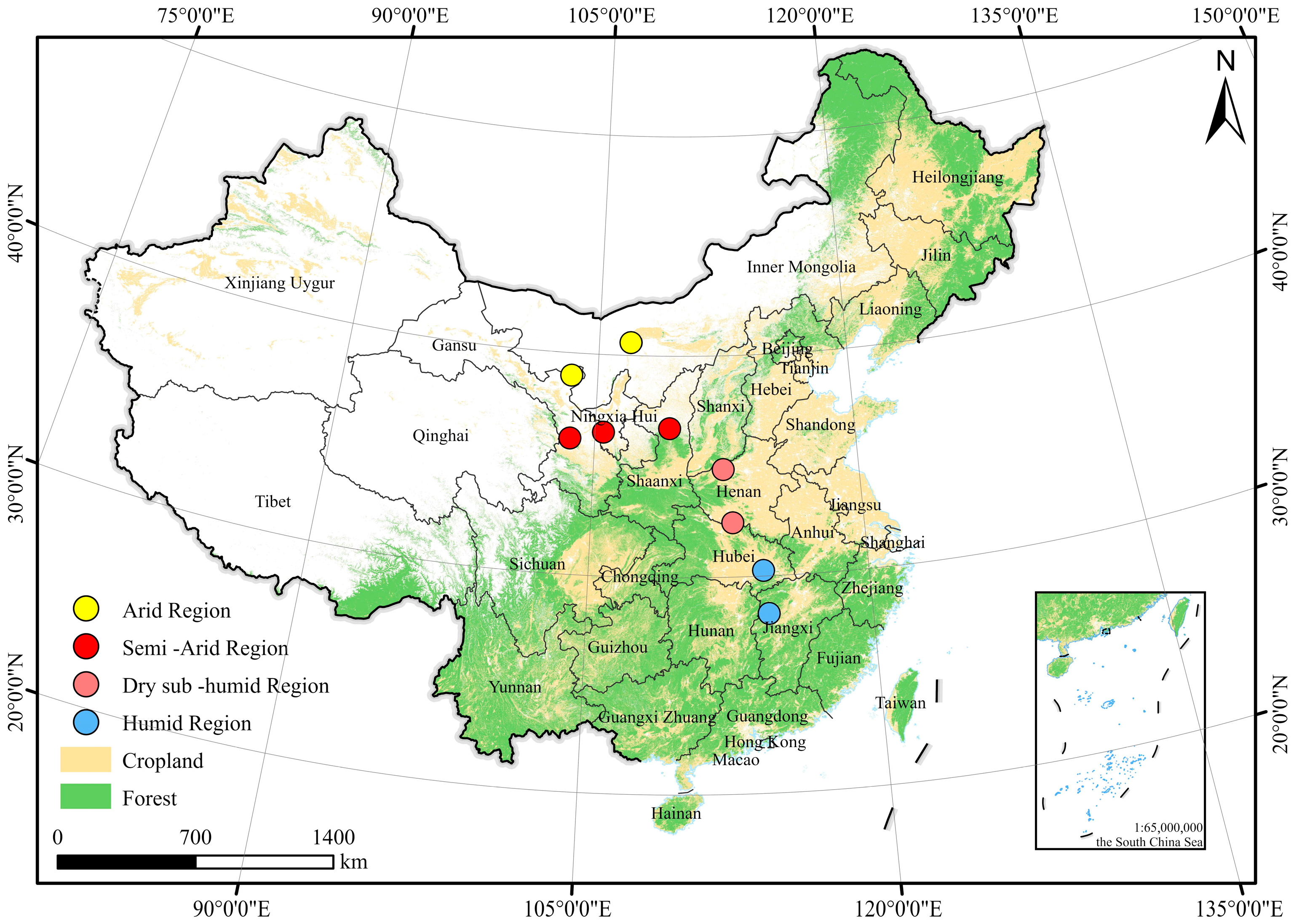
Four climate regions were divided according to the aridity index (AI) [36], which is calculated as the ratio of annual precipitation to potential evapotranspiration. The study sites in each climate region are representative regions affected by the “Grain for Green” policy implemented in 1999. Nine study sites were established across the arid zone (Dengkou County, Inner Mongolia Autonomous Region, and Minqin District, Gansu Province), semi-arid zone (Xigu District, Gansu Province, Haiyuan County, Ningxia Hui Autonomous Region, and Ansai District, Shaanxi Province), semi-humid zone (Mengjin District, Henan Province, and Tanghe County, Henan Province), and humid zone (Wanzai County, Jiangxi Province, and Jiangxia District, Hubei Province), respectively. The study subjects covered two main land-use types: returning farmland to forest land (20 years) and corn (Figure 1). The longitude ranges from 103.436° E to 114.571° E, and the latitude ranges from 28.290° N to 40.582° N; the mean annual temperature ranges from 7.0 °C to 17.6 °C; the mean annual rainfall ranges from 113.2 mm to 1742.5 mm (Table S1). The type of crop cultivation in the farmlands before afforestation was corn (Zea mays); typical coniferous and broad-leaved tree species for returning farmlands to forests were selected for each study site. Relevant tree species information and detailed descriptions of the study sites are given in Table S1.

2.2. Experimental Design and Sampling

The collection of samples occurred in September 2023. Through detailed policy interpretation and interviews with local government agencies, it is ensured that the selected sample plots are about 20 years of returning farmland to forest. At the same time, using a space-for-time substitution design, we ensured that the corn maintained the same land management practices as those applied to the farmlands 20 years ago. When sampling, we strictly adopted paired experiments. All surveyed study sites had been utilized as farmlands prior to afforestation. At each of the 9 sampling sites, three replicate plots (20 m × 20 m for forested land and agricultural land) were established per land-use type (n = 3 types), with inter-plot distances of 30–5000 m to ensure independence from spatial autocorrelation (range < 13.5 m for most soil variables [37,38]), yielding a total of 81 sample plots in the study. In each replicate sample plot, after collecting the aboveground litter, soil samples were taken from the soil layers of 0–20 cm, 20–40 cm, and 40–60 cm [39] using a soil drill with an inner diameter of 9 cm. The samples of each soil layer were then sieved through a 2-mm sieve to divide them into two sub-samples, while all fine roots in the soil samples were collected at the same time. One sub-sample was then air-dried and sieved through a 0.25 mm sieve for physicochemical analysis, while the other sub-sample was stored at 4 °C for the purpose of determining microbial activity.

2.3. Soil Physicochemical Properties Analysis

Soil pH was measured using a pH meter at a soil-to-water ratio of 1:2.5. Soil bulk density (BD) was determined using the cutting ring method; soil water content (SWC) was determined by weighing fresh soil dried at 105 °C for 24 h [40]. Soil and plant organic carbon content was determined by the dichromate oxidation method. Soil samples with pH > 7.5 were pretreated with 1 mol/L HCL to exclude the influence of carbonates [41]. Organic nitrogen content in soil and plant samples was determined using the Kjeldahl method (Kjeltec TM Sampler 8420, FOSS Analytical AB, Hillerød, Denmark) [42], and soil total P (TP) was determined by the molybdenum–antimony (Mo-Sb) colorimetric method. Soil particle classification was carried out in accordance with the soil texture standards formulated by the United States Department of Agriculture (USDA) [43]. The particle sizes of soil particles, in order from large to small, were sandy soil (0.05–2 mm), silt soil (0.002–0.05 mm), and clay (<0.002 mm), which were determined by using the Malvern 2000 laser particle size analyzer (Malvern Instruments Ltd., Malvern, UK). The soil microbial biomass carbon and microbial biomass nitrogen (MBC, MBN) were determined by fumigation extraction, analyzed by TOC (Vario TOC select, Elementar Analysensysteme GmbH, Langenselbold, Germany), and corrected using 0.45 and 0.54 as extraction efficiency factors for microbial carbon and microbial nitrogen, respectively [44].
We calculated the soil organic carbon stocks (SOCs, Mg ha−1) using the following method [45]:
S O C s = S O C × B D × D 10
where SOCs is soil organic carbon stock (Mg ha−1); SOC is the soil organic carbon content (g kg−1); BD is the soil bulk density (g cm−3); D is the soil thickness (cm).

2.4. Soil Fractions Separation

The separation of soil particles of different sizes was achieved by employing wet sieving and particle size classification methods [25,46]. This process resulted in the determination of the soil POC content (POC, >53 μm) and the mineral-associated organic carbon content (MAOC, <53 μm). Briefly, the procedure involved the weighing of 20.0 g of air-dried soil into a vial, followed by the addition of 30 mL of a sodium hexametaphosphate solution (0.5%) and shaking at 200 rpm for 18 h to disperse the soil particles. The dispersed samples were then washed through a 53 μm sieve with distilled water, after which the soil was divided into two fractions: the fraction remaining on the sieve and the fraction passing through the sieve. The portion that remained on the sieve was transferred to an aluminum box, and the two portions of the sample were dried at 60 °C. The samples were weighed separately and analyzed for organic carbon content by the dichromate oxidation method [41], which was calculated using the following formula:
M a s s   r e c o v e r y = ( M a s s P O M + M a s s M A O M ) / M a s s B u l k × 100 %
P O C ( m g   C   g 1 ) = ( M a s s P O M × O C P O M ) / M a s s B u l k × M a s s   r e c o v e r y
M A O C ( m g   C   g 1 ) = ( M a s s M A O M × O C M A O M ) / M a s s B u l k × M a s s   r e c o v e r y
where MassPOM, MassMAOM, and MassBulk represent the mass of POM, MAOM, and Bulk (20 g of naturally air-dried soil weighed), respectively, in g; and OCPOM, OCMAOM, and OCBulk represent the organic carbon content in POM, MAOM, and Bulk, respectively, in g kg−1.

2.5. Measurement of Soil Enzyme Activity

The activities of three hydrolases (BG, β-1,4-glucosidase; NAG, N-acetyl-D-glucosaminidase; and AP, acid phosphatase) were determined. NAG, BG, and AP are microbial N-acquiring, C-acquiring, and P-acquiring enzymes, respectively. Enzyme activities were quantified by the release of fluorophores from a fluorescent substrate (4-methylumbelliferone) in response to hydrolysis by the enzymes, and the fluorescence intensity was detected [47]. In short, the experimental setup comprised black 96-well microplates containing 200 μL of 50 mM acetate buffer for fluorescence analysis, with sample reaction wells (4 replicates), blank wells (2 replicates), quenching standard wells (2 replicates), negative control wells (4 replicates), and reference standard wells (4 replicates). Following incubation of the microtiter plates at 25 °C under dark conditions (4 h for BG and NAG and 0.5 h for AP), the reactions were terminated by adding 10 μL of 1.0 M NaOH per well. The fluorescence intensity was measured using a multifunctional enzyme marker (Tecan Spark, Tecan Group Ltd., Männedorf, Switzerland) at an excitation wavelength of 365 nm and an emission wavelength of 450 nm. The activities of soil extracellular enzymes were expressed in μmol h−1 g−1 (soil dry weight) after negative control correction and quenching treatment.

2.6. Statistical Analyses

Statistical analyses utilized SPSS 27.0 for hypothesis testing and Origin 2024 for graphical visualization. The Shapiro–Wilk (SPSS 27.0) was used for normality testing. The data were not distributed normally, and the Kruskal–Wallis nonparametric test (single factor ANOVA test) was employed to evaluate significant differences (p < 0.05) in SOC content, stock, and its components under different forest types in different climate zones. The median (95% CI) is used as the basis of comparison. The data used in the following analysis are calculated as the difference between forest and farmland (e.g., Difference (CF-CL) Ansai 0–20 cm = CF1 Ansai 0–20 cm—mean (CL1, CL2, CL3) Ansai 0–20 cm). The significance of each factor changes, and the zero value before and after afforestation was tested by the Wilcoxon signed-rank test. The areas subject to the Grain for Green Project had long maintained traditional cultivation practices prior to policy implementation, exhibiting high consistency with current non-converted farmland in terms of soil type, climate, crop structure, and management intensity. Thus, we defined the SOC content of farmland as the initial SOC content.
The importance of climatic factors, soil properties, leaf litter, root systems, and microbial activity on SOC sequestration was analyzed using the ‘randomForest’ package and ‘rfPermute’ package in R (4.4.2). The conventional RF model was fitted using the randomForest package with ntree = 1000 (number of trees), importance = TRUE, and proximity = TRUE. To assess the statistical significance of variable importance, we implemented the rfPermute algorithm with the following: ntree = 1000; nrep = 299; and num.cores = 2. Variable importance was quantified using Increase in Mean Squared Error (%IncMSE), which measures the relative increase in prediction error when a variable’s values are permuted. Higher %IncMSE values indicate greater importance in predicting SOC. And p-values were derived by comparing observed importance scores against the null distribution generated under permutation. Variables were considered statistically significant if p < 0.05. All models were seeded with set.Seed (123) to ensure reproducibility.
Finally, the direct and indirect effects of environmental factors on SOC and its components (POC and MAOC) were evaluated using partial least squares structural equation models (‘plspm’ and ‘vegan’ packages). In order to remove the collinearity of the data, we performed a collinearity diagnosis. The variance inflation factor of Clay (CF) ≥ 10 was removed. Subsequently, a conceptual framework was established, excluding observed variables with factor loadings below 0.7, and employing 95% bootstrap confidence intervals (Bootstrap 95% CI) to determine the significance of estimated path coefficients. Model performance was assessed using the goodness-of-fit (GOF) index.

3. Results

3.1. Variation in Soil Organic Carbon Content and Stocks After Afforestation

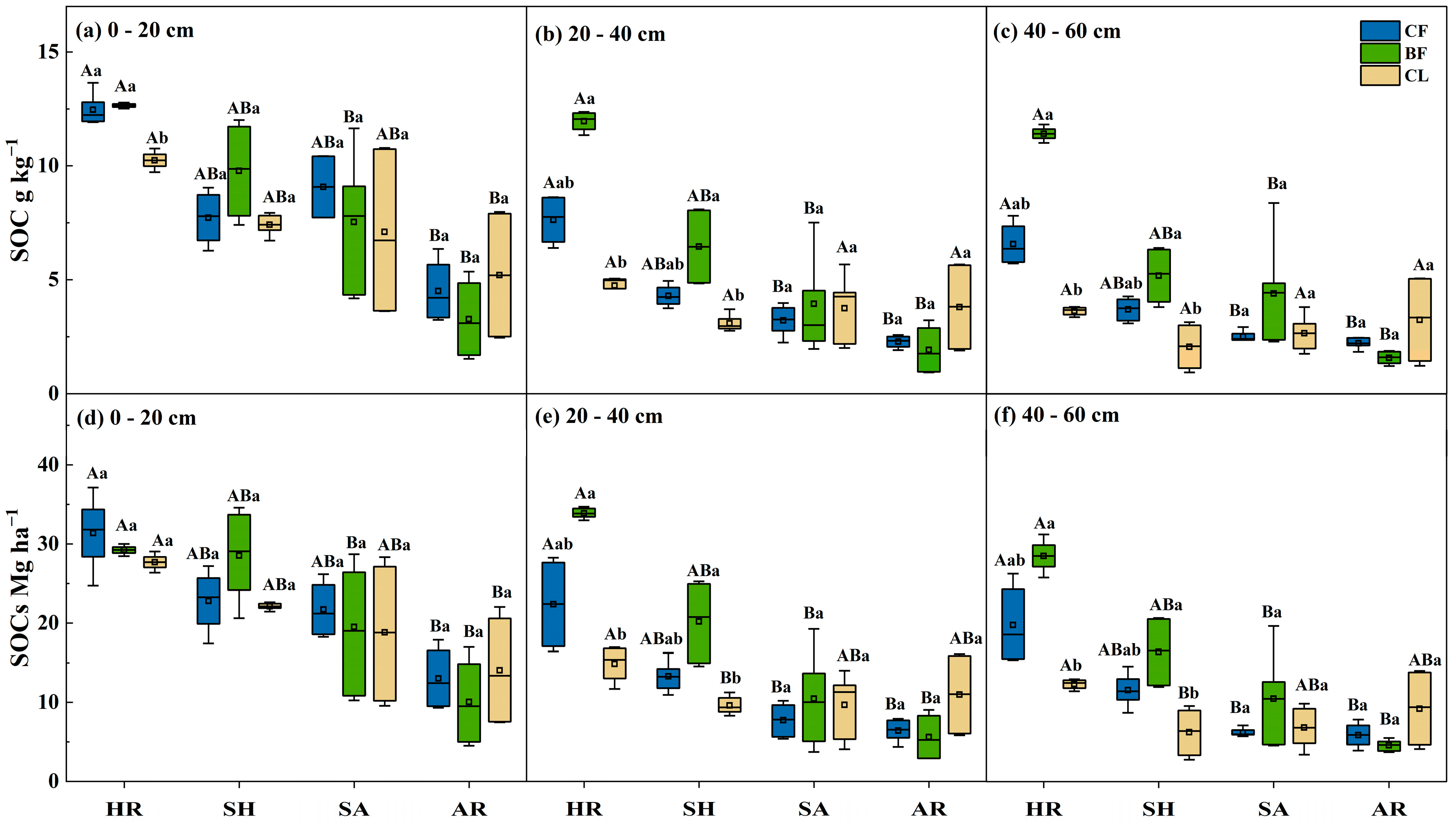
Overall, the variation ranges of SOC content and stocks across different soil layers were 1.6–12.7 g kg−1 and 4.6–33.8 Mg ha−1, respectively (Figure 2). Both SOC content and stock decreased as the drought index increased, exhibiting a consistent distribution pattern across soil layers. Compared with farmland, afforestation increased SOC (5.1%–210.5%) in humid and semi-humid regions (p < 0.05). In semi-arid areas, no significant changes were observed, whereas in arid regions, SOC in both coniferous and broad-leaved forest exhibited varying degrees of reduction (−19%–−53.8%).

3.2. Variation in Soil Organic Carbon Fractions After Afforestation

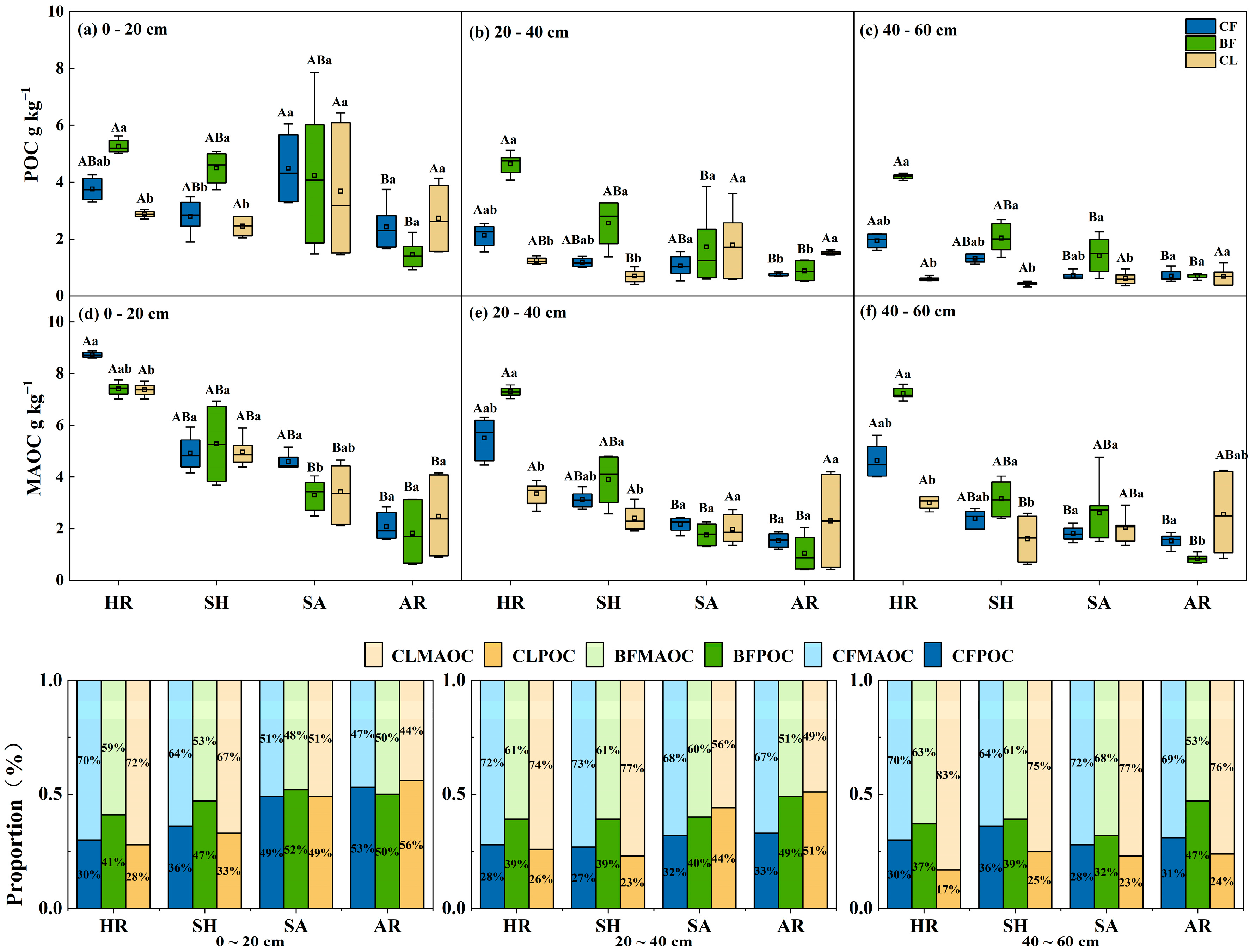
Both MAOC and POC contents show a tendency to decrease along the aridity index (Figure 3). Compared with farmland, afforestation significantly increased the contents of POC and MAOC in the semi-humid and humid zone (15.4%–622.4%, 1.0%–133.5%), whereas it reduced the contents of POC and MAOC in the arid zone (10.1%–662.4%, 19.4%–80.6%) (Figure 3). Across different forest types, MAOC consistently constituted a larger proportion of SOC than POC (Figure 3). Furthermore, analysis of the changes in SOC and its fractions revealed a significant positive correlation between these components and total SOC (Figure S1).

3.3. Drivers of Soil Organic Carbon in Different Stand Types

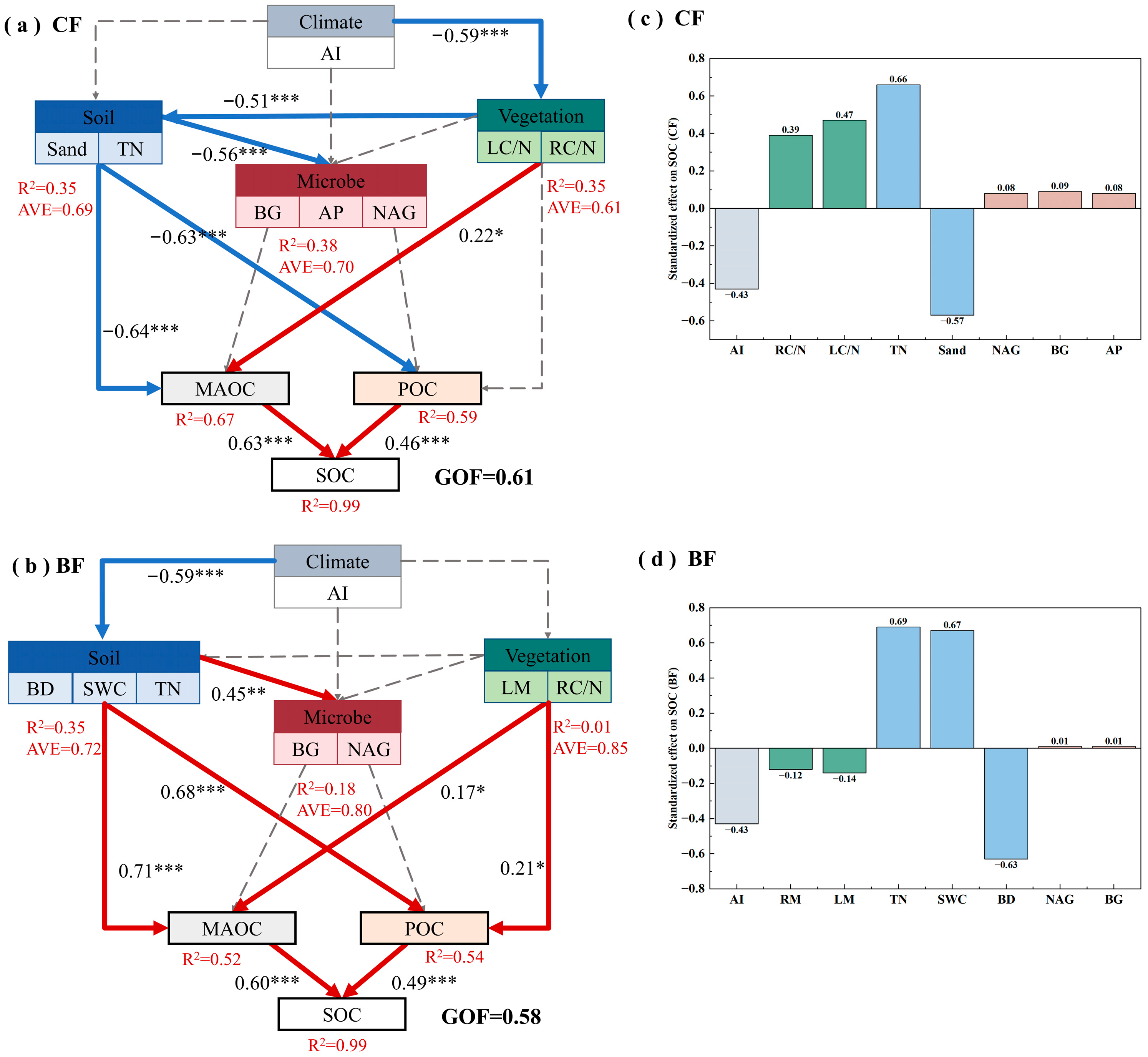
The results of random forest models demonstrated significant correlations among SOC and its components and environmental factors (Figure 4 and Figure S2, p < 0.05). Following the conversion from farmlands to forests, variations in MAOC demonstrated the strongest positive influence (0.63, 0.60) on SOC (Figure 5).
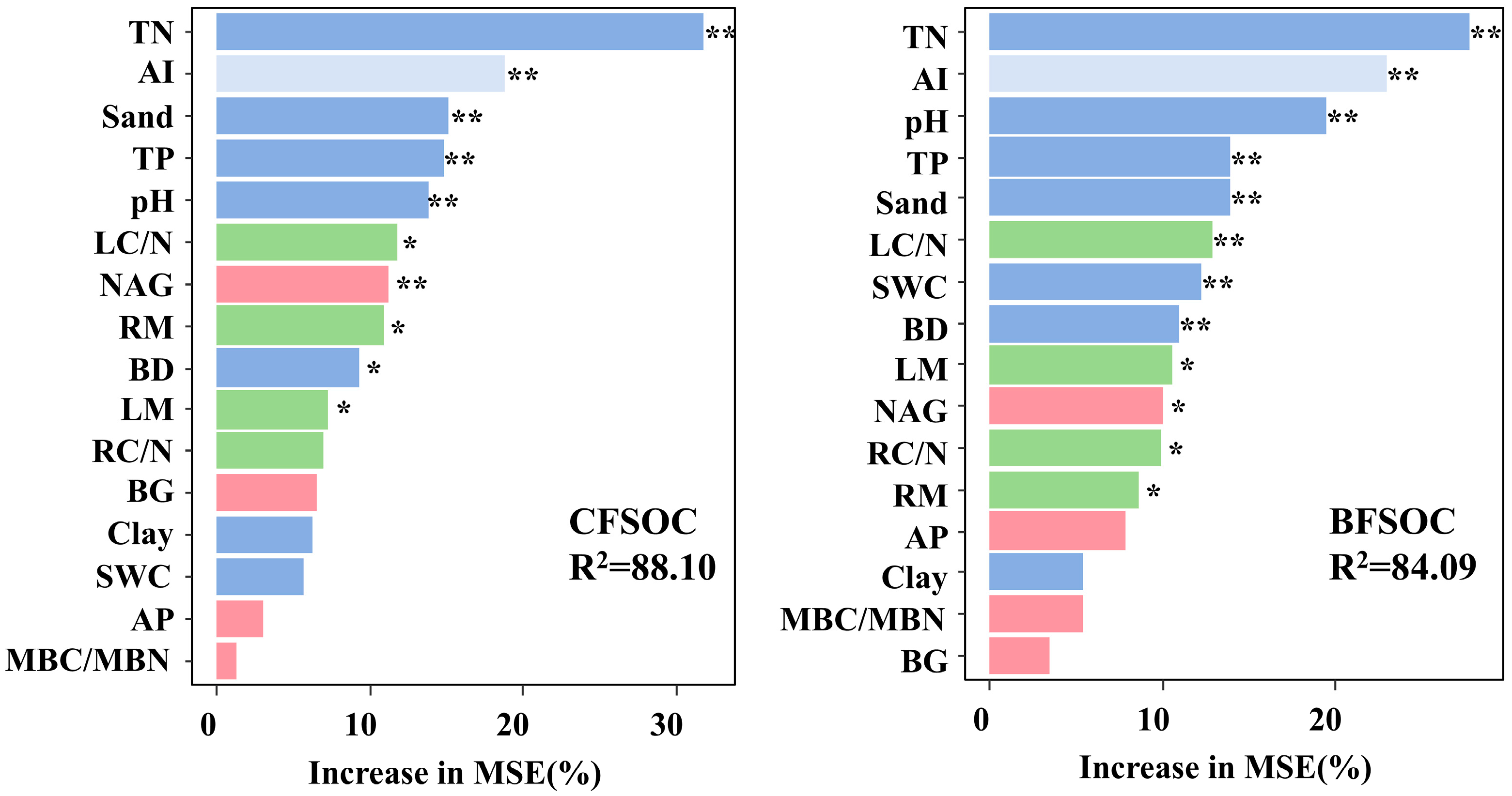
In coniferous forests, the TN had the greatest impact on SOC and its components, with a relatively high increase in mean square error (MSE), followed by AI, Sand, root C:N ratio (RC/N), and TP, all of which had significant effects (Figure 4 and Figure S2, p < 0.05). From the results of PLS-SEM (Figure 5a), climate exhibited a negative influence on vegetation (−0.59). Vegetation had a positive effect on MAOC through litter C:N ratio (LC/N) and RC/N (0.22). And it has a positive effect on SOC by affecting Sand and TN (Figure 5a,c).
In the broad-leaved forest, the TN, AI, and pH had significant effects (Figure 4 and Figure S2). From the PLS-SEM results (Figure 5b), climate showed negative effects on soil physicochemical properties (−0.59). Soil physicochemical properties (BD, SWC, and TN) and vegetation (LM and RC/N) exerted positive effects on MAOC and POC, respectively. The effect of soil physicochemical properties on SOC was much higher than that of vegetation (Figure 5d).

4. Discussion

4.1. Effects of Afforestation on Soil Organic Carbon

The impact of afforestation on SOC exhibited significant climatic differences, which were related to variations in soil carbon sequestration across regions [6]. SOC was found to decrease with increasing aridity index (Figure 2), which was mechanistically linked to climate regulation of biologically mediated processes governing vegetation productivity and organic matter cycling. Hydrothermal conditions regulate carbon input dynamics through vegetation productivity and influence SOC stabilization and mineralization by controlling microbial activity (Table S2) [48,49]. In addition, the significant increase in TN content and microbial enzyme activity after afforestation also led to an increase in soil carbon input (Table S2). In contrast, although the number of litters increased significantly, SOC did not show a significant increasing trend in the semi-arid region, which may be due to the relatively low carbon input caused by low soil moisture (Table S2) [50,51]. The accumulation and stabilization of SOC may require a longer time in these regions. In contrast, arid zones displayed significant SOC depletion. Compared with farmland, tree species may have high transpiration demand, and the sharp decline in SWC leads to an increase in soil water deficit and serious soil desertification (Table S2), which leads to the loss of SOC. Concurrently, drought stress induced a significant decrease in microbial activity (Table S2), reducing fresh carbon input (reducing litter decomposition efficiency). This dual limitation—limited carbon input and enhanced carbon loss—synergistically exacerbated the consumption of SOCs in arid environments [52]. These contrasting responses across climatic gradients empirically validate the modulatory role of regional climate regimes in afforestation-induced carbon sequestration efficacy.

4.2. MAOC Is the Main Contributor to Soil Organic Carbon Sequestration

The principal contribution of MAOC fractions to SOC sequestration in afforestation land contradicts our initial hypothesis. The formation mechanism of this phenomenon can be systematically explained from the perspective of vegetation–soil–microorganism synergy, and shows obvious climate differentiation characteristics.
Firstly, consistent with the findings of Sokol et al. [53], SOC is predominantly composed of MAOC, rather than POC. This is primarily because MAOC forms a stable complex with soil mineral particles (e.g., clay and iron–aluminum oxides) through physical adsorption, chemical bonding, or aggregate encapsulation [24]. Consequently, MAOC is protected from microbial decomposition, resulting in its long-term accumulation in the soil and occupying a major portion of the organic carbon pool.
In humid regions, the conversion of farmlands to forests enhanced the stabilization of the environment of MAOC [26,54,55]. The formation of MAOC is highly dependent on nitrogen supply [56]. The increase in TN concentration (Table S2) may drive SOC sequestration through a dual mechanism. On the one hand, this increases carbon input directly by stimulating plant productivity [57]; on the other hand, it provides a nitrogen guarantee for the enhancement of microbial synthase (BG, NAG) activity [24,58]. The increased enzyme activity promotes the decomposition and transformation of organic matter. As the main precursor of stable SOC, microbial residues are combined with mineral particles to form MAOC through physical protection and chemical adsorption [8,26].
In contrast, the MAOC response after afforestation in arid areas showed negative feedback. Zhao et al. [59] found that the most direct impact on soil stable carbon was the change in soil physical and chemical properties [60,61]. The arid climate aggravates the process of soil desertification (increased sand content, Table S2), which directly limits the effectiveness of mineral binding sites [55,62]. More importantly, the interruption of exogenous nitrogen input (e.g., agricultural fertilization) and the disturbance caused by afforestation lead to a higher soil mineralization rate in the early stage and rapid loss of soil nutrients. Moreover, the decrease in SWC and TN (Table S2) not only inhibited the carbon input efficiency of plants [57] but also seriously weakened the nitrogen metabolism ability of microorganisms [63]. At the same time, limited root carbon allocation gives prioritized survival needs to vegetation [8], resulting in insufficient substrate supply for microbial–mineral interaction. Eventually, a vicious cycle of ‘nitrogen deficiency-limited enzyme activity-weakened mineral protection’ was formed.
In addition, studies have shown that the increase in MAOC is closely related to the level of POC [54]. The nitrogen and phosphorus nutrients released during the decomposition of POC reduced the microbial demand for MAOC degradation. Microorganisms preferentially utilize simple carbon sources and nutrients derived from POC, reducing the ‘nutrient mining’ behavior of mineral-bound organic matter, thus indirectly maintaining the stability of the MAOC pool [54]. Therefore, C sequestration in soil can be maximized by strengthening the MAOC management strategy [64]. However, the effects of combining molecular-scale techniques and incorporating relevant indicators, such as soil microbial activity on the stability and transformation of POC and MAOC, may further improve our understanding of the mechanism of SOC sequestration after afforestation.

4.3. Factors Affecting Soil Organic Carbon Sequestration After Afforestation

The dynamics of SOC after afforestation exhibited distinct control pathways in coniferous forests versus broad-leaved forests. The coniferous forest carbon fixation system prioritizes plant-derived carbon stabilization pathways, while the broad-leaved forest exhibits stronger soil physical and chemical regulation (Figure 5).
In coniferous forests, vegetation traits play a key regulatory role in SOC sequestration. The decomposition and transformation of aboveground and underground plant debris constitute the primary mechanisms of SOC formation [65]. The unique litter and root characteristics of coniferous forests are closely related to SOC sequestration. First, coniferous litter species typically exhibit elevated lignin and phenolic content, which contributes to a significantly higher C/N ratio compared to broad-leaved forests [66,67]. The high C/N litter input can resist the attack of enzymes and inhibit the decomposition rate of organic matter by microorganisms, thus promoting the accumulation of refractory carbon components [68]. At the same time, the process of plant carbon input is also regulated by climatic conditions (especially water availability), and the decrease in water availability will inhibit the decomposition of litter [50,51]. Furthermore, coniferous forests exhibit substantial root biomass, with root turnover serving as a critical driver for the stabilization of soil organic matter [69]. Root-exuded organic acids and mucilaginous compounds improve soil aggregate stability while forming physical protection barriers that safeguard SOC [70,71]. These mechanisms align with the ‘plant–soil feedback’ ecological strategy theory at regional scales [72].
In contrast to coniferous forests, the SOC components of broad-leaved forests are more dependent on the direct regulation of soil physical and chemical properties (Figure 5). The litter of broad-leaved tree species had a lower carbon-nitrogen ratio, hemicellulose, and soluble compound content [73]. These chemical traits promote faster root decomposition, which is conducive to long-term SOM stability through the interaction of microbial products with minerals and metals [65,68,74]. However, the study found that vegetation traits in broad-leaved forests had no significant effect on SOC components, indicating that soil physical and chemical properties (e.g., TN, SWC, and BD) have a stronger filtering effect on carbon persistence than plant input chemistry (Figure 5). BD was negatively correlated with soil organic carbon (Figure 5d), which was due to the increase in BD, resulting in the destruction of soil structure and the decrease in soil nutrient stock capacity [54]. Additionally, the negative correlation between broad-leaved litter biomass and SOC further indicates that there is a decoupling between the magnitude of carbon input and stabilization efficiency [75,76]. This model further confirms the dominance of soil physical protection in the broad-leaved forest carbon input system.

4.4. Implications for Afforestation Carbon Management

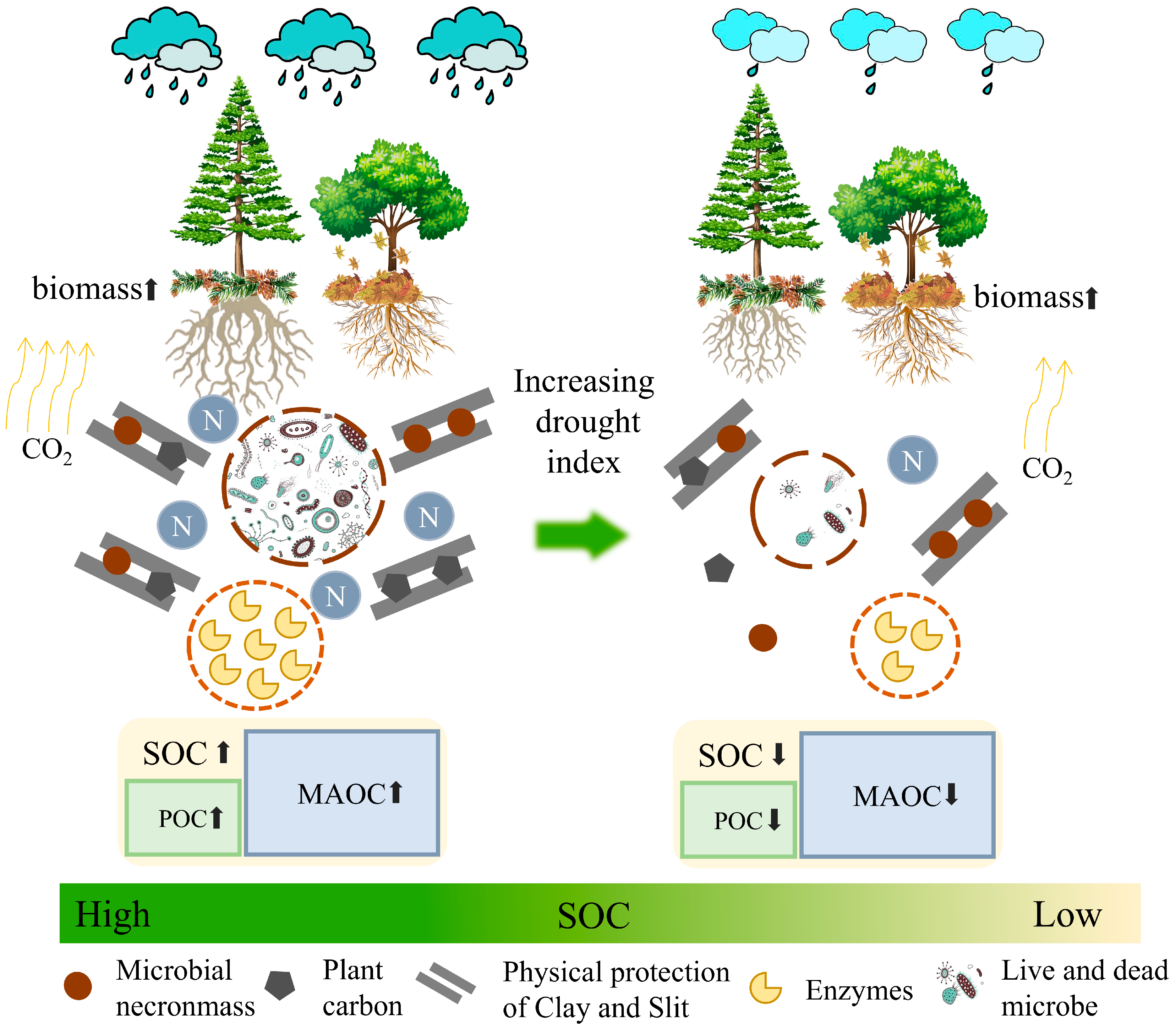
This study revealed the differential regulation mechanism and regional differentiation of SOC from the perspective of climate zoning, providing a theoretical basis for the further implementation of plantation carbon sink management at the regional scale. The results indicated that an increase in the aridity index led to a decline in SWC, clay content, and TN, which, in turn, suppressed microbial enzyme activity and ultimately reduced the SOC pool in arid regions. The humid region strengthened the carbon input mechanism by virtue of superior climate and soil conditions, realizing the double gain of POC and MAOC, and formed a positive carbon sequestration effect (Figure 5 and Figure 6). In summary, climate and vegetation types create a unique ‘carbon pump’ path. The findings suggest that the conversion of farmlands to forests should be carried out according to climatic conditions. If we ignore the crucial ecological trade-offs, it may lead to the loss of the soil organic carbon pool, thus deviating from the original intention of the Grain for Green Project. Afforestation in arid areas is not conducive to organic carbon sequestration, and human intervention should be carried out after afforestation in arid areas; priority should be given to regulating soil physical and chemical conditions (e.g., irrigation, application of N fertilizer) to mitigate the risk of carbon pool loss. However, this study is based on the limited plantation sampling site data after the conversion from farmland to forest, which may affect the universal inference of the dynamic mechanism of afforestation-driven soil organic carbon (SOC). Moreover, the carbon sequestration capacity of farmland in China exhibits an increasing trend from a long-term perspective [77]. Consequently, substituting the initial soil factors with the current level may to some extent diminish the carbon sequestration benefits of the Grain for Green Project. In the future, the integration of multi-source long-term observation and large-scale data should be pursued to more comprehensively analyze the impact pathways of vegetation restoration on SOC.

5. Conclusions

Climate exerted strong hierarchical control on SOC dynamics and fractionation following afforestation, exhibiting a sequential response gradient: humid > subhumid > semi-arid > arid regions. In humid and semi-humid regions, afforestation enhanced SOC (5.1%–210.5%), POC (15.4%–622.4%), and MAOC (1.0%–133.5%) contents. Conversely, in arid regions, it led to reductions in both total SOC and its components. MAOC serves as a sensitive indicator of SOC dynamics following afforestation interventions. Therefore, by strengthening the MAOM management strategy, the capacity for soil organic carbon sequestration can be maximized. The carbon sequestration of coniferous forest ecosystems is strongly dependent on the characteristics of vegetation litter and root systems. In contrast, the carbon sequestration of broad-leaved forests is mainly dominated by soil physical and chemical properties. Therefore, the conversion of farmlands to forests in arid areas is not conducive to SOC sequestration. Human intervention should be carried out on the land after afforestation, and priority should be given to regulating soil physical and chemical conditions (such as irrigation, application of N fertilizer, etc.) to alleviate the risk of organic carbon loss.

Supplementary Materials

The following supporting information can be downloaded at: https://www.mdpi.com/article/10.3390/f17010123/s1, Table S1. Sampling sites description. Table S2. Wilcoxon sign test changes of each factor before and after afforestation. Table S3. Distribution of soil, microbial and plant properties along climatic zones in croplands. Figure S1. Distribution patterns of SOC fraction in total SOC. Figure S2. The importance of the average variable for predicting SOC fractions (POC and MAOC) changes after afforestation from random forest analysis.

Author Contributions

Methodology, data curation, visualization, writing—original draft, J.L.; writing—review and editing, S.W., Y.D., Y.W., and Y.J.; investigation, H.Z., W.L., W.G., and R.B.; visualization, L.D.; funding acquisition and project administration, L.D. All authors have read and agreed to the published version of the manuscript.

Funding

This study was sponsored by the Natural Science Foundation of China (U2243225), the Natural Science Basic Research Program of Shaanxi (Z2024-ZYFS-0065), the Funding of Top Young Talents of Ten Thousand Talents Plan in China (2021), and the Fundamental Research Funds for the Central Universities (2452023071, 2023HHZX002). We also thank all the reviewers for their constructive comments.

Data Availability Statement

The original data presented in the study are openly available in FigShare at [https://doi.org/10.6084/m9.figshare.29605016].

Conflicts of Interest

The authors declare no conflicts of interest.

References

  1. Thomson, A.M.; César Izaurralde, R.; Smith, S.J.; Clarke, L.E. Integrated Estimates of Global Terrestrial Carbon Sequestration. Glob. Environ. Change 2008, 18, 192–203. [Google Scholar] [CrossRef]
  2. Fan, L.; Xue, Y.; Wu, D.; Xu, M.; Li, A.; Zhang, B.; Mo, J.; Zheng, M. Long-term Nitrogen and Phosphorus Addition Have Stronger Negative Effects on Microbial Residual Carbon in Subsoils than Topsoils in Subtropical Forests. Glob. Change Biol. 2024, 30, e17210. [Google Scholar] [CrossRef]
  3. Deng, L.; Liu, G.; Shangguan, Z. Land-Use Conversion and Changing Soil Carbon Stocks in China’s ‘Grain-for-Green’ Program: A Synthesis. Glob. Change Biol. 2014, 20, 3544–3556. [Google Scholar] [CrossRef]
  4. Dong, X.; Zhao, K.; Wang, J.; Gui, H.; Xiao, Y.; Chen, Z.; Miao, Y.; Han, S. Effects of Forest Types on Soil Carbon Content in Aggregate Faction under Climate Transition Zone. Front. Environ. Sci. 2023, 10, 1052175. [Google Scholar] [CrossRef]
  5. Li, W.; Bai, Z.; Jin, C.; Zhang, X.; Guan, D.; Wang, A.; Yuan, F.; Wu, J. The Influence of Tree Species on Small Scale Spatial Heterogeneity of Soil Respiration in a Temperate Mixed Forest. Sci. Total Environ. 2017, 590–591, 242–248. [Google Scholar] [CrossRef] [PubMed]
  6. Dong, L.; Liu, Y.; Wu, J.; Liao, Y.; Li, J.; Yu, J.; Wang, S.; Yu, Z.; Shangguan, Z.; Deng, L. The Distribution of Soil C and N along the Slope Is Regulated by Vegetation Type on the Loess Plateau. Catena 2023, 226, 107094. [Google Scholar] [CrossRef]
  7. Luo, Z.; Feng, W.; Luo, Y.; Baldock, J.; Wang, E. Soil Organic Carbon Dynamics Jointly Controlled by Climate, Carbon Inputs, Soil Properties and Soil Carbon Fractions. Glob. Change Biol. 2017, 23, 4430–4439. [Google Scholar] [CrossRef]
  8. Zhang, Y.; Guo, X.; Chen, L.; Kuzyakov, Y.; Wang, R.; Zhang, H.; Han, X.; Jiang, Y.; Sun, O.J. Global Pattern of Organic Carbon Pools in Forest Soils. Glob. Change Biol. 2024, 30, e17386. [Google Scholar] [CrossRef]
  9. Xu, S.; Eisenhauer, N.; Zeng, Z.; Mo, X.; Ding, Y.; Lai, D.Y.F.; Wang, J. Drivers of Soil Organic Carbon Recovery under Forest Restoration: A Global Meta-Analysis. Carbon Res. 2024, 3, 80. [Google Scholar] [CrossRef]
  10. Han, X.; Gao, G.; Li, Z.; Chang, R.; Jiao, L.; Fu, B. Effects of Plantation Age and Precipitation Gradient on Soil Carbon and Nitrogen Changes Following Afforestation in the Chinese Loess Plateau. Land Degrad. Dev. 2019, 30, 2298–2310. [Google Scholar] [CrossRef]
  11. Gong, X.; Liu, Y.; Li, Q.; Wei, X.; Guo, X.; Niu, D.; Zhang, W.; Zhang, J.; Zhang, L. Sub-Tropic Degraded Red Soil Restoration: Is Soil Organic Carbon Build-up Limited by Nutrients Supply. For. Ecol. Manag. 2013, 300, 77–87. [Google Scholar] [CrossRef]
  12. Rhoades, C.C.; Eckert, G.E.; Coleman, D.C. Soil Carbon Differences among Forest, Agriculture, and Secondary Vegetation in Lower Montane Ecuador. Ecol. Appl. 2000, 10, 497–505. [Google Scholar] [CrossRef]
  13. Su, Z.; Shangguan, Z. Nitrogen Addition Decreases the Soil Cumulative Priming Effect and Favours Soil Net Carbon Gains in Robinia Pseudoacacia Plantation Soil. Geoderma 2023, 433, 116444. [Google Scholar] [CrossRef]
  14. Vesterdal, L.; Ritter, E.; Gundersen, P. Change in Soil Organic Carbon Following Afforestation of Former Arable Land. For. Ecol. Manag. 2002, 169, 137–147. [Google Scholar] [CrossRef]
  15. Liu, X.; Yang, T.; Wang, Q.; Huang, F.; Li, L. Dynamics of Soil Carbon and Nitrogen Stocks after Afforestation in Arid and Semi-Arid Regions: A Meta-Analysis. Sci. Total Environ. 2018, 618, 1658–1664. [Google Scholar] [CrossRef] [PubMed]
  16. Wang, X.; Huang, D.; Liu, T.; Wang, C.; Ma, H.; Xu, M.; Zhang, W.; Wu, L. Dynamics and Drivers of Soil Organic Carbon Sequestration by Cropland Afforestation: A Global Meta-Analysis. Land Degrad. Dev. 2025, 1–12. [Google Scholar] [CrossRef]
  17. Bai, L.; Zhang, H.; Zhang, J.; Li, X.; Wang, B.; Miao, H.; Sial, T.A.; Dong, Q.; Fu, G.; Li, L. Long-term Vegetation Restoration Increases Carbon Sequestration of Different Soil Particles in a Semi-arid Desert. Ecosphere 2021, 12, e03848. [Google Scholar] [CrossRef]
  18. Gu, X.; Fang, X.; Xiang, W.; Zeng, Y.; Zhang, S.; Lei, P.; Peng, C.; Kuzyakov, Y. Vegetation Restoration Stimulates Soil Carbon Sequestration and Stabilization in a Subtropical Area of Southern China. Catena 2019, 181, 104098. [Google Scholar] [CrossRef]
  19. He, X.; Sheng, M.; Wang, L.; Zhang, S.; Luo, N. Effects on Soil Organic Carbon Accumulation and Mineralization of Long-Term Vegetation Restoration in Southwest China Karst. Ecol. Indic. 2022, 145, 109622. [Google Scholar] [CrossRef]
  20. Xue, Z.; Wang, S.; Wang, A.; Huang, S.; Qu, T.; Chen, Q.; Li, X.; Wang, R.; Liu, Z.; Dong, Z. Long-Term Caragana Korshinskii Restoration Enhances SOC Stability but Reduces Sequestration Efficiency over 40 Years in Degraded Loess Soils. Atmosphere 2025, 16, 662. [Google Scholar] [CrossRef]
  21. Liu, M.; Zheng, S.; Pendall, E.; Smith, P.; Liu, J.; Li, J.; Fang, C.; Li, B.; Nie, M. Unprotected Carbon Dominates Decadal Soil Carbon Increase. Nat. Commun. 2025, 16, 2008. [Google Scholar] [CrossRef]
  22. Zhang, X.; Fu, J.; Ma, P.; Diwu, G.; Li, T.; Ma, H.; Shangguan, Z.; Deng, L.; Zhong, Y.; Yan, W. Impact of Vegetation Restoration on Soil Organic Carbon Fractions: A Global Meta-Analysis. Ecol. Eng. 2025, 216, 107640. [Google Scholar] [CrossRef]
  23. Hansen, P.M.; Even, R.; King, A.E.; Lavallee, J.; Schipanski, M.; Cotrufo, M.F. Distinct, Direct and Climate-Mediated Environmental Controls on Global Particulate and Mineral-Associated Organic Carbon Storage. Glob. Change Biol. 2024, 30, e17080. [Google Scholar] [CrossRef]
  24. Lavallee, J.M.; Soong, J.L.; Cotrufo, M.F. Conceptualizing Soil Organic Matter into Particulate and Mineral-associated Forms to Address Global Change in the 21st Century. Glob. Change Biol. 2020, 26, 261–273. [Google Scholar] [CrossRef]
  25. Wu, G.; Huang, G.; Lin, S.; Huang, Z.; Cheng, H.; Su, Y. Changes in Soil Organic Carbon Stocks and Its Physical Fractions along an Elevation in a Subtropical Mountain Forest. J. Environ. Manag. 2024, 351, 119823. [Google Scholar] [CrossRef]
  26. Su, Z.; Zhong, Y.; Zhu, X.; Wu, Y.; Shen, Z.; Shangguan, Z. Vegetation Restoration Altered the Soil Organic Carbon Composition and Favoured Its Stability in a Robinia pseudoacacia Plantation. Sci. Total Environ. 2023, 899, 165665. [Google Scholar] [CrossRef] [PubMed]
  27. Ghani, M.I.; Wang, J.; Li, P.; Pathan, S.I.; Sial, T.A.; Datta, R.; Mokhtar, A.; Ali, E.F.; Rinklebe, J.; Shaheen, S.M.; et al. Variations of Soil Organic Carbon Fractions in Response to Conservative Vegetation Successions on the Loess Plateau of China. Int. Soil Water Conserv. Res. 2023, 11, 561–571. [Google Scholar] [CrossRef]
  28. Zhai, D.; Wang, Y.; Liao, C.; Men, X.; Wang, C.; Cheng, X. Soil Carbon Accumulation under Afforestation Is Driven by Contrasting Responses of Particulate and Mineral-associated Organic Carbon. Glob. Biogeochem. Cycles 2024, 38, e2024GB008116. [Google Scholar] [CrossRef]
  29. Cremer, M.; Kern, N.V.; Prietzel, J. Soil Organic Carbon and Nitrogen Stocks under Pure and Mixed Stands of European Beech, Douglas Fir and Norway Spruce. For. Ecol. Manag. 2016, 367, 30–40. [Google Scholar] [CrossRef]
  30. Angst, G.; Messinger, J.; Greiner, M.; Häusler, W.; Hertel, D.; Kirfel, K.; Kögel-Knabner, I.; Leuschner, C.; Rethemeyer, J.; Mueller, C.W. Soil Organic Carbon Stocks in Topsoil and Subsoil Controlled by Parent Material, Carbon Input in the Rhizosphere, and Microbial-Derived Compounds. Soil Biol. Biochem. 2018, 122, 19–30. [Google Scholar] [CrossRef]
  31. Newman, G.S.; Hart, S.C. Nutrient Covariance between Forest Foliage and Fine Roots. For. Ecol. Manag. 2006, 236, 136–141. [Google Scholar] [CrossRef]
  32. Zhang, Q.; Hu, Y.; Shao, M.; Jia, X.; Wei, X. Revegetation Re-Carbonizes Soil: Patterns, Mechanisms, and Challenges. Fundam. Res. 2024; in press. [Google Scholar] [CrossRef]
  33. Deng, L.; Shangguan, Z.; Sweeney, S. “Grain for Green” Driven Land Use Change and Carbon Sequestration on the Loess Plateau, China. Sci. Rep. 2014, 4, 7039. [Google Scholar] [CrossRef]
  34. Chen, H.; Zhang, S.; Ma, C.; Xiang, Y.; Wu, J. Restoring Farmland to Forest Increases Phosphorus Limitation Based on Microbial and Soil C:N:P Stoichiometry-a Synthesis across China. For. Ecol. Manag. 2024, 556, 121745. [Google Scholar] [CrossRef]
  35. Zhang, Y.; Li, C.; Wang, M. National-Scale Meta-Analysis of Soil Carbon and Nitrogen Accumulation Potential in China’s Grain for Green Program. Eurasian Soil Sci. 2020, 53, 892–901. [Google Scholar] [CrossRef]
  36. Zomer, R.J.; Xu, J.; Trabucco, A. Version 3 of the Global Aridity Index and Potential Evapotranspiration Database. Sci. Data 2022, 9, 409. [Google Scholar] [CrossRef]
  37. Yu, P.; Li, Y.; Liu, S.; Liu, J.; Ding, Z.; Ma, M.; Tang, X. Afforestation Influences Soil Organic Carbon and Its Fractions Associated with Aggregates in a Karst Region of Southwest China. Sci. Total Environ. 2022, 814, 152710. [Google Scholar] [CrossRef] [PubMed]
  38. Zhong, Z.; Han, X.; Xu, Y.; Zhang, W.; Fu, S.; Liu, W.; Ren, C.; Yang, G.; Ren, G. Effects of Land Use Change on Organic Carbon Dynamics Associated with Soil Aggregate Fractions on the Loess Plateau, China. Land Degrad. Dev. 2019, 30, 1070–1082. [Google Scholar] [CrossRef]
  39. Shi, S.; Zhang, W.; Zhang, P.; Yu, Y.; Ding, F. A Synthesis of Change in Deep Soil Organic Carbon Stores with Afforestation of Agricultural Soils. For. Ecol. Manag. 2013, 296, 53–63. [Google Scholar] [CrossRef]
  40. Bao, S.D. Soil and Agricultural Chemistry Analysis, 3rd ed.; China Agriculture Press: Beijing, China, 2000; p. 28. (In Chinese) [Google Scholar]
  41. Nelson, D.W.; Sommers, L.E. Total Carbon, Organic Carbon, and Organic Matter. In Methods of Soil Analysis, Part 2: Chemical and Microbiological Properties; Page, A.L., Miller, R.H., Keeney, D.R., Eds.; American Society of Agronomy: Madison, WI, USA, 1982; pp. 539–579. [Google Scholar]
  42. Bremner, J.M. Nitrogen-Total. In Methods of Soil Analysis, Part 3: Chemical Methods; Sparks, D.L., Ed.; Soil Science Society of America: Madison, WI, USA, 1996; pp. 1085–1121. [Google Scholar]
  43. Udden, J.A. Mechanical Composition of Clastic Sediments. Geol. Soc. Am. Bull. 1914, 25, 655–744. [Google Scholar] [CrossRef]
  44. Wu, J.; Joergensen, R.G.; Pommerening, B.; Chaussod, R.; Brookes, P.C. Measurement of Soil Microbial Biomass C by Fumigation-Extraction—An Automated Procedure. Soil Biol. Biochem. 1990, 22, 1167–1169. [Google Scholar] [CrossRef]
  45. Dong, L.; Li, J.; Liu, Y.; Hai, X.; Li, M.; Wu, J.; Wang, X.; Shangguan, Z.; Zhou, Z.; Deng, L. Forestation Delivers Significantly More Effective Results in Soil C and N Sequestrations than Natural Succession on Badly Degraded Areas: Evidence from the Central Loess Plateau Case. Catena 2022, 208, 105734. [Google Scholar] [CrossRef]
  46. Chen, Y.; Liu, X.; Hou, Y.; Zhou, S.; Zhu, B. Particulate Organic Carbon Is More Vulnerable to Nitrogen Addition than Mineral-Associated Organic Carbon in Soil of an Alpine Meadow. Plant Soil 2021, 458, 93–103. [Google Scholar] [CrossRef]
  47. Saiya-Cork, K.R.; Sinsabaugh, R.L.; Zak, D.R. The Effects of Long Term Nitrogen Deposition on Extracellular Enzyme Activity in an Acer saccharum Forest Soil. Soil Biol. Biochem. 2002, 34, 1309–1315. [Google Scholar] [CrossRef]
  48. Ahirwal, J.; Nath, A.; Brahma, B.; Deb, S.; Sahoo, U.K.; Nath, A.J. Patterns and Driving Factors of Biomass Carbon and Soil Organic Carbon Stock in the Indian Himalayan Region. Sci. Total Environ. 2021, 770, 145292. [Google Scholar] [CrossRef]
  49. Vesterdal, L.; Clarke, N.; Sigurdsson, B.D.; Gundersen, P. Do Tree Species Influence Soil Carbon Stocks in Temperate and Boreal Forests? For. Ecol. Manag. 2013, 309, 4–18. [Google Scholar] [CrossRef]
  50. Jiang, R.; Gunina, A.; Qu, D.; Kuzyakov, Y.; Yu, Y.; Hatano, R.; Frimpong, K.A.; Li, M. Afforestation of Loess Soils: Old and New Organic Carbon in Aggregates and Density Fractions. Catena 2019, 177, 49–56. [Google Scholar] [CrossRef]
  51. Li, D.; Niu, S.; Luo, Y. Global Patterns of the Dynamics of Soil Carbon and Nitrogen Stocks Following Afforestation: A Meta-Analysis. New Phytol. 2012, 195, 172–181. [Google Scholar] [CrossRef]
  52. Zheng, Y.; Ye, J.; Pei, J.; Fang, C.; Li, D.; Ke, W.; Song, X.; Sardans, J.; Peñuelas, J. Initial Soil Condition, Stand Age, and Aridity Alter the Pathways for Modifying the Soil Carbon under Afforestation. Sci. Total Environ. 2024, 946, 174448. [Google Scholar] [CrossRef]
  53. Sokol, N.W.; Whalen, E.D.; Jilling, A.; Kallenbach, C.; Pett-Ridge, J.; Georgiou, K. Global Distribution, Formation and Fate of Mineral-associated Soil Organic Matter under a Changing Climate: A Trait-based Perspective. Funct. Ecol. 2022, 36, 1411–1429. [Google Scholar] [CrossRef]
  54. Li, Y.; Zhang, X.; Wang, B.; Wu, X.; Wang, Z.; Liu, L.; Yang, H. Revegetation Promotes Soil Mineral-Associated Organic Carbon Sequestration and Soil Carbon Stability in the Tengger Desert, Northern China. Soil Biol. Biochem. 2023, 185, 109155. [Google Scholar] [CrossRef]
  55. Peng, X.; Huang, Y.; Duan, X.; Yang, H.; Liu, J. Particulate and Mineral-Associated Organic Carbon Fractions Reveal the Roles of Soil Aggregates under Different Land-Use Types in a Karst Faulted Basin of China. Catena 2023, 220, 106721. [Google Scholar] [CrossRef]
  56. Ling, J.; Dungait, J.A.J.; Delgado-Baquerizo, M.; Cui, Z.; Zhou, R.; Zhang, W.; Gao, Q.; Chen, Y.; Yue, S.; Kuzyakov, Y.; et al. Soil Organic Carbon Thresholds Control Fertilizer Effects on Carbon Accrual in Croplands Worldwide. Nat. Commun. 2025, 16, 3009. [Google Scholar] [CrossRef]
  57. Dong, X.; Tariq, A.; Graciano, C.; Zhang, Z.; Gao, Y.; Keyimu, M.; Cong, M.; Zhao, G.; Yan, J.; Wang, W.; et al. Afforestation-Driven Soil Organic Carbon Stabilization in a Hyper-Arid Desert: Nonlinear Dynamics and Microbial Drivers across a 22-Year Chronosequence. Environ. Res. 2025, 282, 121989. [Google Scholar] [CrossRef]
  58. Yu, T.; Feng, Q.; Yin, Y.; Han, T.; Chen, W.; Zhu, M.; Zhao, C.; Zhao, J. Divergent Response of Upper Layer Soil Organic and Inorganic Carbon to Biotic and Abiotic Factors in Afforestation by Aerial Seeding in Desert, China. Catena 2024, 246, 108383. [Google Scholar] [CrossRef]
  59. Zhao, G.; Tariq, A.; Zhang, Z.; Nazim, M.; Graciano, C.; Sardans, J.; Dong, X.; Gao, Y.; Peñuelas, J.; Zeng, F. Afforestation with Xerophytic Shrubs Promoted Soil Organic Carbon Stability in a Hyper-Arid Environment of Desert. Land Degrad. Dev. 2025, 36, 655–667. [Google Scholar] [CrossRef]
  60. Mao, H.-R.; Cotrufo, M.F.; Hart, S.C.; Sullivan, B.W.; Zhu, X.; Zhang, J.; Liang, C.; Zhu, M. Dual Role of Silt and Clay in the Formation and Accrual of Stabilized Soil Organic Carbon. Soil Biol. Biochem. 2024, 192, 109390. [Google Scholar] [CrossRef]
  61. Zhu, G.; Shangguan, Z.; Hu, X.; Deng, L. Effects of Land Use Changes on Soil Organic Carbon, Nitrogen and Their Losses in a Typical Watershed of the Loess Plateau, China. Ecol. Indic. 2021, 133, 108443. [Google Scholar] [CrossRef]
  62. Zhao, M.; Zhang, Z.; Li, M.; Gao, C.; Zhang, J.; He, N. Soil Mineral-Associated Organic Carbon and Its Relationship to Clay Minerals across Grassland Transects in China. Appl. Sci. 2024, 14, 2061. [Google Scholar] [CrossRef]
  63. Wang, K.; Zhang, Y.; Tang, Z.; Shangguan, Z.; Chang, F.; Jia, F.; Chen, Y.; He, X.; Shi, W.; Deng, L. Effects of Grassland Afforestation on Structure and Function of Soil Bacterial and Fungal Communities. Sci. Total Environ. 2019, 676, 396–406. [Google Scholar] [CrossRef] [PubMed]
  64. Shoumik, B.A.A.; Khan, M.Z.; Błońska, E.; Lasota, J. Dynamics of Soil Organic Carbon and Total Nitrogen in Particulate and Mineral-Associated Organic Matter Fractions under Different Continuous Land Use Patterns across Europe. Agric. Ecosyst. Environ. 2025, 381, 109411. [Google Scholar] [CrossRef]
  65. Cotrufo, M.F.; Wallenstein, M.D.; Boot, C.M.; Denef, K.; Paul, E. The Microbial Efficiency-Matrix Stabilization (MEMS) Framework Integrates Plant Litter Decomposition with Soil Organic Matter Stabilization: Do Labile Plant Inputs Form Stable Soil Organic Matter? Glob. Change Biol. 2013, 19, 988–995. [Google Scholar] [CrossRef] [PubMed]
  66. Seidel, F.; Lopez C., M.L.; Bonifacio, E.; Kurokawa, H.; Yamanaka, T.; Celi, L. Seasonal Phosphorus and Nitrogen Cycling in Four Japanese Cool-Temperate Forest Species. Plant Soil 2022, 472, 391–406. [Google Scholar] [CrossRef]
  67. Yu, L.; Li, Y. Synergy and Trade-off between Carbon Sequestration and Soil Water Balance: Impact of Revegetation Choices. Environ. Earth Sci. 2019, 78, 651. [Google Scholar] [CrossRef]
  68. Poirier, V.; Roumet, C.; Munson, A.D. The Root of the Matter: Linking Root Traits and Soil Organic Matter Stabilization Processes. Soil Biol. Biochem. 2018, 120, 246–259. [Google Scholar] [CrossRef]
  69. Lei, X.; Shen, Y.; Zhao, J.; Huang, J.; Wang, H.; Yu, Y.; Xiao, C. Root Exudates Mediate the Processes of Soil Organic Carbon Input and Efflux. Plants 2023, 12, 630. [Google Scholar] [CrossRef]
  70. Dijkstra, F.A.; Zhu, B.; Cheng, W. Root Effects on Soil Organic Carbon: A Double-edged Sword. New Phytol. 2021, 230, 60–65. [Google Scholar] [CrossRef]
  71. Yang, C.; Zhang, X.; Ni, H.; Gai, X.; Huang, Z.; Du, X.; Zhong, Z. Soil Carbon and Associated Bacterial Community Shifts Driven by Fine Root Traits along a Chronosequence of Moso Bamboo (Phyllostachys Edulis) Plantations in Subtropical China. Sci. Total Environ. 2021, 752, 142333. [Google Scholar] [CrossRef]
  72. Cheng, C.; Gundale, M.J.; Li, B.; Wu, J. Deciphering the Drivers of Plant-Soil Feedbacks and Their Context-Dependence: A Meta-Analysis. Plant Soil 2024, 486, 379–393. [Google Scholar] [CrossRef]
  73. Gao, F.; Cui, X.; Sang, Y.; Song, J. Changes in Soil Organic Carbon and Total Nitrogen as Affected by Primary Forest Conversion. For. Ecol. Manag. 2020, 463, 118013. [Google Scholar] [CrossRef]
  74. Liang, C.; Schimel, J.P.; Jastrow, J.D. The Importance of Anabolism in Microbial Control over Soil Carbon Storage. Nat. Microbiol. 2017, 2, 17105. [Google Scholar] [CrossRef]
  75. Augusto, L.; Boča, A. Tree Functional Traits, Forest Biomass, and Tree Species Diversity Interact with Site Properties to Drive Forest Soil Carbon. Nat. Commun. 2022, 13, 1097. [Google Scholar] [CrossRef] [PubMed]
  76. Liao, C.; Chang, K.; Wu, B.; Zhang, D.; Wang, C.; Cheng, X. Divergence in Soil Particulate and Mineral-Associated Organic Carbon Reshapes Carbon Stabilization along an Elevational Gradient. Catena 2024, 235, 107682. [Google Scholar] [CrossRef]
  77. Zuo, W.; Gu, B.; Zou, X.; Peng, K.; Shan, Y.; Yi, S.; Shan, Y.; Gu, C.; Bai, Y. Soil Organic Carbon Sequestration in Croplands Can Make Remarkable Contributions to China’s Carbon Neutrality. J. Clean. Prod. 2023, 382, 135268. [Google Scholar] [CrossRef]
Figure 1. The sampling sites were distributed in China. Notes: According to the CLCD (1985–2024) data of China’s 30 m resolution land cover dataset of Wuhan University, the national forest area (ha) and farmland area (ha) accounted for 25.51% and 19.94% of the total land area by 2023, respectively (https://zenodo.org/records/12779975, accessed on 1 August 2024).
Forests 17 00123 g001
Figure 2. Changes in soil organic carbon content and stock in 0–20 cm (a,d), 20–40 cm (b,e), and 40–60 cm (c,f) soil layers after afforestation. SOC, SOCs, CF, BF, CL, HR, SH, SA, and AR represent soil organic carbon content, soil organic carbon stock, the coniferous forest, broad-leaved forest, cropland, humid region, sub-humid region, semi-arid region, and arid region, respectively. The box represents the interquartile range (Q1–Q3). □ represents the average value, and “-” represents the median. The significance level is p < 0.05. Different uppercase letters in the column indicate significant differences at p < 0.05 within the same land-use type. Different lowercase letters in the column indicate significant differences at p < 0.05 within the same climatic zone.
Forests 17 00123 g002
Figure 3. Changes in soil organic carbon fractions (POC, particulate organic carbon; MAOC, mineral-associated organic carbon) and distribution of soil organic carbon fractions in 0–20 cm (a,d), 20–40 cm (b,e), and 40–60 cm (c,f) soil layers after afforestation. The box represents the interquartile range (Q1–Q3). □ represents the average value, and “-” represents the median. The significance level is p < 0.05. Different uppercase letters in the column indicate significant differences at p < 0.05 within the same land-use type. Different lowercase letters in the column indicate significant differences at p < 0.05 within the same climatic zone.
Forests 17 00123 g003
Figure 4. The importance of the average variable for predicting soil organic carbon changes after afforestation from random forest analysis. Significance levels: * p < 0.05 and ** p < 0.01. Notes: SOC = soil organic carbon; climatic factor (AI = aridity index); soil physical and chemical factors (TN = total nitrogen; pH = soil pH; BD = bulk density; Clay = Soil clay content; SWC = soil water content; and Sand = Soil sand content); vegetation factor (LM = Litter biomass; RM = Root biomass; RC/N = Root carbon nitrogen ratio; LC/N = Litter carbon nitrogen ratio); and microbial factor (MBC/MBN = microbial biomass carbon nitrogen ratio; BG = β-1,4-glucosidase; NAG = N-acetyl-β-D-glucosaminidase; AP = acid phosphatase). Different colors represent different factor types. The factor classification is the same as below.
Forests 17 00123 g004
Figure 5. Direct and indirect correlations between climate, soil, plants, microorganisms, and soil organic carbon and its fractions in coniferous forests (a) and broad-leaved forests (b) were evaluated by structural equation models. Solid red and blue arrows represent positive and negative correlations, respectively. Significance levels: * p < 0.05, ** p < 0.01, *** p < 0.001. Dashed lines indicate insignificant pathways. The numbers next to the arrows represent important standardized path coefficients. The standardized effects of variables from the PLS-SEM analysis are depicted in (c,d).
Forests 17 00123 g005
Figure 6. The conceptual diagram illustrates the SOC and its main influencing factors in different climatic regions after afforestation.
Forests 17 00123 g006
Disclaimer/Publisher’s Note: The statements, opinions and data contained in all publications are solely those of the individual author(s) and contributor(s) and not of MDPI and/or the editor(s). MDPI and/or the editor(s) disclaim responsibility for any injury to people or property resulting from any ideas, methods, instructions or products referred to in the content.