1. Introduction
Timber represents an extension of forest resource utilization. Compared to materials such as steel, concrete, and plastics, timber is classified as a renewable resource. Raw wood-based products, including logs and sawn timber, are highly favored in the market, with demand exhibiting a consistent upward trajectory in recent years. However, timber supply is heavily contingent upon a country’s forest resource endowment, and given the uneven global distribution of forest resources [
1], international trade has emerged as a critical mechanism for balancing national timber supply and demand [
2]. According to UN Comtrade statistics, between 2000 and 2024, both the scale and the number of participating entities in global timber trade demonstrated a dynamic growth trend. By 2021, the total value of global timber trade reached nearly US
$80 billion, doubling from its 1997 level. Post-2021, the Coronavirus Disease 2019 (COVID-19) pandemic induced a temporary contraction in trade volume, yet 179 countries/regions remained engaged in timber trade as of 2024.
The global timber trade network (GTTN) serves as a critical nexus linking disparities in resource endowments with fluctuations in market demand, and its dynamic evolution profoundly influences the sustainable utilization of global forest resources and the stability of international trade. In recent years, this network has undergone significant structural adjustments and flow dynamics. On one hand, the rapid ascendance of emerging economies has driven sustained growth in timber demand, altering traditional trade flows and supply-demand dynamics [
3]. On the other hand, frequent adjustments in international trade policies, heightened resource conservation awareness, and volatility in transportation costs continue to reshape the global timber trade landscape [
4]. For instance, resource-rich countries such as Russia and the European Union have implemented stricter timber export restrictions to protect domestic forests, directly impacting global supply volumes and trade flows. Macroeconomic shocks (e.g., the 2008 financial crisis) and global health emergencies (e.g., COVID-19) also propagate through trade and financial systems to influence network evolution. Meanwhile, escalating transportation costs impose greater pressure on long-distance timber trade, compelling traders to seek cost-effective logistics solutions and alternative partners. Concurrently, rising environmental standards and consumer awareness have constrained markets for illegally harvested timber, while sustainably managed forests, despite higher prices, remain in short supply. These multifaceted factors collectively drive the dynamic transformation of the GTTN.
Countries are almost exclusively seen as the primary unit of analysis in the study of international trade, and analysis of trade in wood and non-wood forest products is no exception to that rule [
5]. The research on the dynamic evolution of timber trade networks and their driving factors exhibits the following characteristics. In terms of research scope, existing literature predominantly focuses on analyzing topological structural features of timber trade networks, employing network structure indicators and their evolutionary patterns to examine statistical characteristics [
4,
5,
6]. Some researchers have also explored the formation mechanisms of timber trade patterns from perspectives such as trade policies, environmental regulations, and resource endowments [
3,
4]. However, systematic elucidation of the pathways through which cost factors influence timber trade networks remains lacking.
It is noteworthy that developing a dual-dimensional framework integrating trade and resource costs holds theoretical value: trade costs shape immediate connectivity preferences within networks [
7], whereas resource costs govern long-term evolutionary resilience. These dimensions reflect the dual drivers of economic efficiency and ecological sustainability underlying timber trade network dynamics, necessitating concurrent examination. Existing research, however, predominantly concentrates on static cost structures (e.g., transportation costs, tariff barriers) and their impacts on bilateral trade flows, while overlooking resource costs (e.g., timber prices, forest sustainability management levels). Moreover, they neglect the transmission effects, temporal accumulation effects, and interactive dynamics of different cost elements within complex networks. This research gap results in an incomplete understanding of the underlying logic behind “why” and “how” GTTN evolve.
From a methodological standpoint, existing research on timber trade networks predominantly remains confined to static analytical frameworks [
8]. However, the attributes of individual nodes and inter-nodal trade relationships within timber networks exhibit dynamic temporal evolution, encompassing processes of emergence, persistence, and dissolution. Given that network data constitutes prototypical relational data characterized by significant auto-correlation, it fails to satisfy the independence assumption required by conventional linear regression models. Consequently, traditional econometric approaches prove inadequate for analyzing the evolutionary mechanisms of relational panel data [
4,
9].
The Stochastic Actor-Oriented Model (SAOM) offers an innovative methodological solution to this analytical challenge. In contrast to traditional gravity models or Quadratic Assignment Procedure (QAP) analyses, SAOM’s distinct advantage lies in its capacity to dynamically trace the “path-dependent” characteristics of network evolution under cost-driven conditions, revealing how cost shocks propagate through strategic interactions among actors to induce systemic topological transformations in network structures [
9,
10]. For instance, when climate disasters trigger abrupt production cost escalations in major timber-exporting countries, SAOM enables simulation of how importers calibrate cost–benefit analyses to strategically balance between maintaining existing trade partnerships and developing alternative supply sources. This process subsequently drives observable alterations in network density and central node dynamics.
Based on the aforementioned context, this study employs trade data from the UN Comtrade Database and World Bank indicators to investigate the dynamic evolution mechanisms of the GTTN within a comprehensive trade–resource cost analytical framework. In addition to trade costs (distance, culture, institutions, and policy barriers) and resource costs (product price and sustainable forest management capacity), we incorporate endogenous network structural features and trade characteristics into a multidimensional analysis. Using longitudinal data from 2000 to 2024 and applying a SAOM, this research elucidates the complex drivers underlying the evolution of the GTTN.
The study yields several central findings: First, although various trade costs significantly influence the evolution of the GTTN, conventional timber price factors alone are no longer sufficient to reconfigure trade relationships. Second, structural mechanisms—particularly the Geometrically Weighted Edgewise Shared Partners (GWESP) effect, indicative of instantaneous triadic closure—play a critical role in the formation of timber trade ties. Third, a behavioral pattern termed the export expansion with import restriction phenomenon is identified among forest-rich countries, which actively expand exports while restricting imports to safeguard resource sovereignty—a phenomenon that challenges traditional comparative advantage theory. Fourth, economic development exerts an asymmetric moderating effect, reinforcing export activity in net-exporting economies while suppressing import growth in net-importing ones.
These findings provide new insights into the evolutionary mechanisms of global timber trade networks. The main contributions of this study include (1) proposing an integrated analytical framework that incorporates cost dimensions, network structure, and trade architecture; (2) employing SAOM to validate the dominant role of endogenous network mechanisms; and (3) revealing the critical influence of non-economic factors on the evolution of timber trade networks. This research offers a theoretical foundation and policy-relevant insights for promoting sustainable and equitable global timber trade governance.
The remaining sections are arranged as follows.
Section 2 reviews the impact of different cost factors on the dynamic evolution of timber trade networks and their driving mechanisms and proposes research hypotheses.
Section 3 describes the research methodology, variable selection, and data sources.
Section 4 presents the dynamic evolution process of the GTTN from 2000 to 2024 through a network structural perspective and the empirical results.
Section 5 presents the key findings and contributions of this study.
Section 6 summarizes the study’s main conclusions and details the policy implications.
2. Literature Review and Research Hypotheses
Cost refers to the expenditure incurred for utilizing resource inputs. As societies develop and technologies advance, the types and scope of factors influencing resource utilization costs have gradually expanded, thereby driving the continuous extension of cost boundaries. In the realm of international trade, from a broad perspective, trade costs encompass not only the marginal cost of producing goods but also all other expenses necessarily incurred to acquire commodities. These include, but are not limited to, transportation costs (freight and time costs), policy barriers (tariff and non-tariff barriers), information costs, contract enforcement costs, exchange rate costs, legal and regulatory costs, and local distribution costs [
11,
12]. The diversification of cost components has, to some extent, increased the complexity of cost measurement and model construction. Nevertheless, these challenges do not diminish the critical importance of trade costs [
13], nor can they overlook the impact of costs on international timber trade [
7].
According to existing literature, trade costs in international commerce entail multiple dimensions. Drawing on Anderson and van Wincoop [
14] (2004) and Beghin and Schweizer [
12] (2020), this study categorizes cost factors in timber trade into trade costs and resource costs. Trade costs are defined as all expenses borne by buyers beyond the marginal cost of producing goods during the process of transporting timber from exporters to importers. These include distance costs (freight and time costs), policy barriers (tariff and non-tariff barriers), information costs, contract enforcement costs, exchange rate costs, and legal/regulatory costs. Resource costs, conversely, refer to resource prices and factors directly influencing resource prices. Based on the practical context of timber markets, this paper selects timber prices and forest sustainable management capacity as proxy variables for resource costs. Trade costs, as defined herein, further encompass distance costs, cultural costs, policy barrier costs, and institutional costs across countries.
According to the traditional gravity model, the trade volume between two parties is inversely proportional to the geographical distance between them [
13]; that is, the greater the distance between two countries, the smaller their trade volume [
15]. The impact of geographical distance on international trade primarily stems from cost factors: on one hand, greater geographical distance implies higher transportation costs. On the other hand, long-distance transportation introduces additional risks for oceanic shipping [
12], while consumers bear extra opportunity costs from waiting, both of which hinder effective trade development. Consequently, some scholars argue that geographical distance negatively affects the establishment of trade relations [
4,
7,
16]. However, other researchers posit that advancements in science and technology, particularly improvements in infrastructure and transportation-related innovations, have gradually attenuated the influence of distance on economic behavior, suggesting that international trade may eventually escape the “tyranny of distance” [
4]. Nevertheless, for bulky and difficult-to-transport raw materials like timber, transportation costs remain a non-negligible factor in cross-country timber trade at the current stage [
1]. Based on the above analysis, the following hypothesis is proposed:
Hypothesis 1a (H1a). Distance costs influence the dynamic evolution of timber trade networks, such that countries with greater geographical distances are more inclined to avoid establishing timber trade ties.
As global economic integration deepens and digitization advances, culture plays an increasingly critical role in international trade [
17]. The extended gravity model posits that cultural distance typically exerts a significant inhibitory effect on trade flows by increasing communication costs and information asymmetry between trading partners, though the extent of this effect exhibits significant heterogeneity depending on the characteristics of trading partners, product categories, and specific cultural dimensions [
18]. Scholars have extensively examined the impact of cultural differences on trade, yielding mixed findings. For instance, Kristjánsdóttir [
19] (2019) found that cultural distance hinders trade between the UK and its major partners, though this effect is weaker than the impact of geographical distance on exports. Some researchers argue that cultural differences foster trade expansion, while others suggest a nonlinear relationship: trade volume declines with rising cultural distance, but only when differences surpass a critical threshold [
20]. Notably, consensus exists regarding the effect of cultural differences on trade relationship formation—most studies confirm their adverse impact. For example, Tian and Jiang [
21] (2012) revealed that cultural distance has dual effects on China’s trade, with varying impacts on imports and exports. Zhou et al. [
4], using paper trade as a case, demonstrated that cultural distance negatively affects bilateral trade relationships, with significant cultural disparities substantially impeding the establishment of timber trade ties between nations.
Based on prior research, this study proposes the following hypothesis:
Hypothesis 1b (H1b). Cultural costs significantly shape the dynamic evolution of timber trade networks, with culturally similar countries more likely to establish trade relationships.
Institutions have long been acknowledged as a pivotal determinant of comparative advantage in international trade [
22]. From the perspective of New Institutional Economics (NIE), institutional quality constitutes a fundamental driver of economic development, where reductions in institutional transaction costs are critical for fostering synergistic interactions between trade liberalization and domestic economic performance [
23].
Empirical studies have extensively documented institutional impacts on cross-border economic activities. The majority of scholarship has focused on institutional determinants of outward foreign direct investment and cross-border mergers and acquisitions, while a parallel strand of research emphasizes institutional effects on international trade patterns [
13,
24]. For instance, democratic governance in developing economies has been shown to enhance bilateral trade volumes by improving export product quality standards [
11]. Similarly, institutional quality metrics, particularly government administrative efficiency, have been found to directly influence export performance by modulating transaction costs [
25].
Hypothesis 1c (H1c). Institutional costs exert a significant influence on the dynamic evolution of GTTN. Specifically, countries with superior institutional frameworks demonstrate a stronger propensity to initiate and sustain timber export trade relationships.
Policy barriers denote measures adopted by a nation to safeguard its domestic enterprises or restrain foreign ones. Such measures are detrimental to free trade and simultaneously constitute policy costs that warrant significant attention in the realm of international trade. In contrast, a Free Trade Agreement (FTA) represents a legally binding pact voluntarily established by two or more countries [
26]. Its core purpose is to foster economic integration among member states, and according to the extended gravity model, FTAs promote trade through multiple channels, including reducing tariff and non-tariff barriers, enhancing trade facilitation, mitigating policy uncertainty, and strengthening institutional alignment, such as regulatory convergence [
27]. In the context of timber trade, FTAs leverage tariff policies to influence costs, directly regulate import demand, and thereby alter procurement strategies and reshape the global timber trade landscape [
4]. Furthermore, regarding non-tariff measures such as environmental regulations aimed at sustainable development—often termed “green barriers”—FTAs reshape the global timber trade network by impacting exporters’ compliance costs and market choices [
28]. Consequently, the implementation of an FTA is widely acknowledged as a pivotal factor influencing trade costs [
26,
28].
At present, scholarly research on FTA predominantly centers on the analysis of their trade impacts [
28,
29]. From diverse research angles, the consensus is that trade agreements substantially promote trade between nations [
4,
27]. Specifically, in the context of timber trade, the signing of trade agreements serves to mitigate trade policy barriers among member countries [
30]. This, in turn, facilitates the forging of timber trade relationships among them and exerts a notable influence on the dynamic evolution of the timber trade network. So, the following hypothesis is formulated:
Hypothesis 1d (H1d). Policy barriers exert a significant influence on the dynamic evolution of the timber trade network. Moreover, countries with lower policy barriers are more prone to establishing timber trade connections.
In addition to the previously mentioned trade costs, this study also underscores the impact of changes in resource costs on the dynamic evolution of the GTTN. Resource cost factors are mainly analyzed from two angles: timber prices and forest sustainable management capabilities. Timber prices are directly related to the cost of timber procurement. Variations in a country’s timber prices directly affect the import volumes of its trading partners. When price fluctuations exceed a country’s affordability threshold, it will look for alternative trading partners, thus driving the evolution of the entire timber trade network.
Forest certification acts as a market mechanism designed to promote sustainable forest management, improve product market access, and combat illegal logging [
4,
31]. As a “soft” policy instrument, the widespread adoption of forest certification has had a certain impact on timber trade. On one hand, forest certification is a market-driven initiative that incurs specific costs. On the other hand, forest certification, functioning as a green trade barrier, can enhance the market competitiveness of timber products [
31]. Certified forests enjoy three market advantages: potential market access, an enhanced public image, and product premium pricing [
4,
31]. Therefore, forest certification is also expected to influence the structure and evolution of the GTTN by affecting the legitimacy of timber supply. So, the following hypotheses are proposed:
Hypothesis 2a (H2a). Timber prices can significantly affect the dynamic evolution of the GTTN.
Hypothesis 2b (H2b). Forest certification can significantly affect the dynamic evolution of the GTTN, with countries having higher levels of forest certification tending to proactively avoid establishing timber import trade relationships.
4. Results
4.1. Analysis of the Global Network Structure Characteristics and Evolution Trends
This section constructs the GTTN using social network analysis methods. With reference to existing studies, timber products are categorized into two types: logs (HS code: 4403) and sawn wood (HS codes: 4406 and 4407). The bilateral trade volume between countries/regions for each year is calculated by aggregating the trade values of these two product categories.
To minimize the impact of minor trade relationships on the overall results, we adopt the methodology from prior research [
1]. Specifically, we rank all bilateral timber trade values in descending order for each year and retain the top transactions until the cumulative sum reaches 99% of the total trade volume, while excluding the remaining 1%. This approach ensures both representativeness and clarity in visualization [
35].
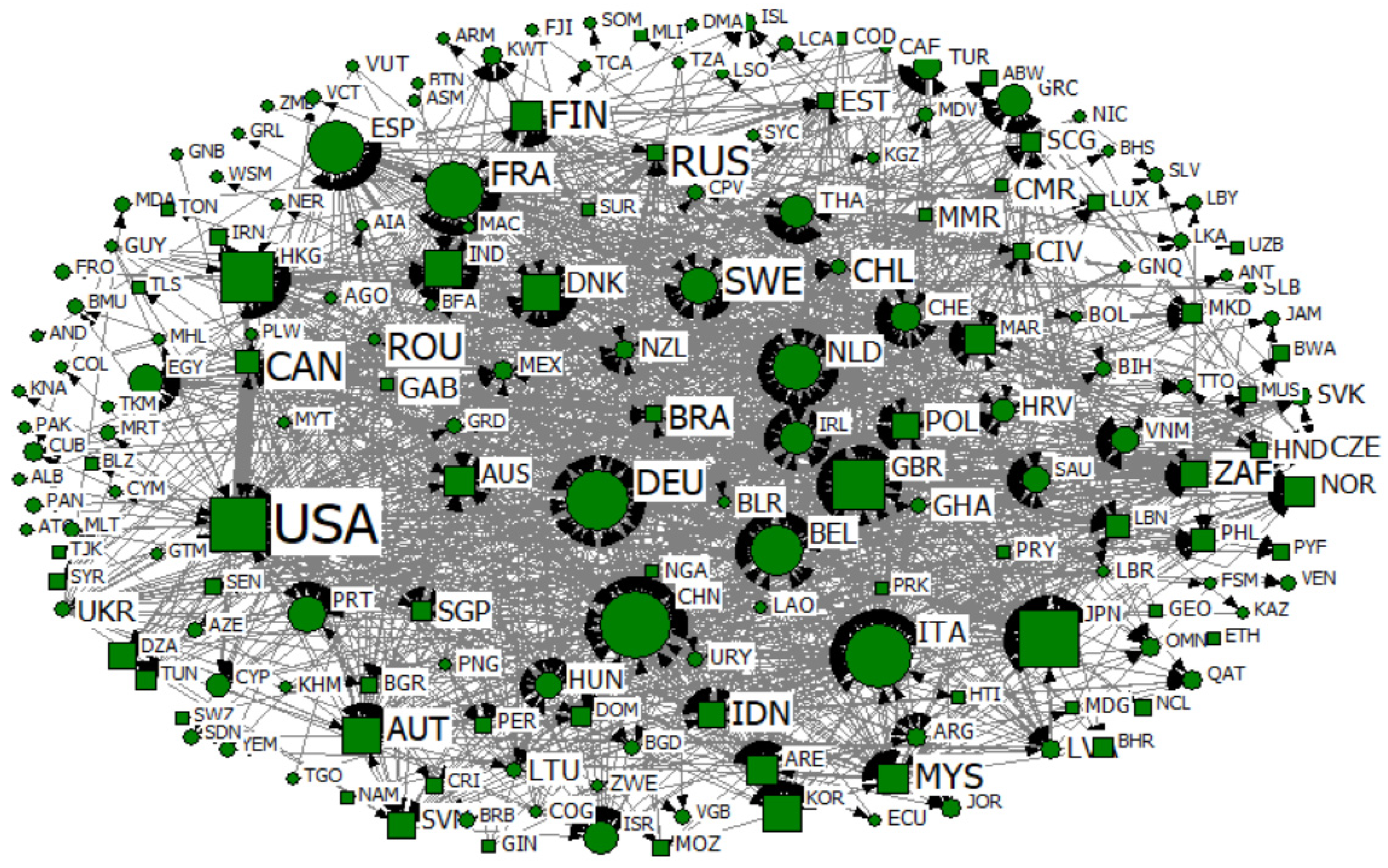
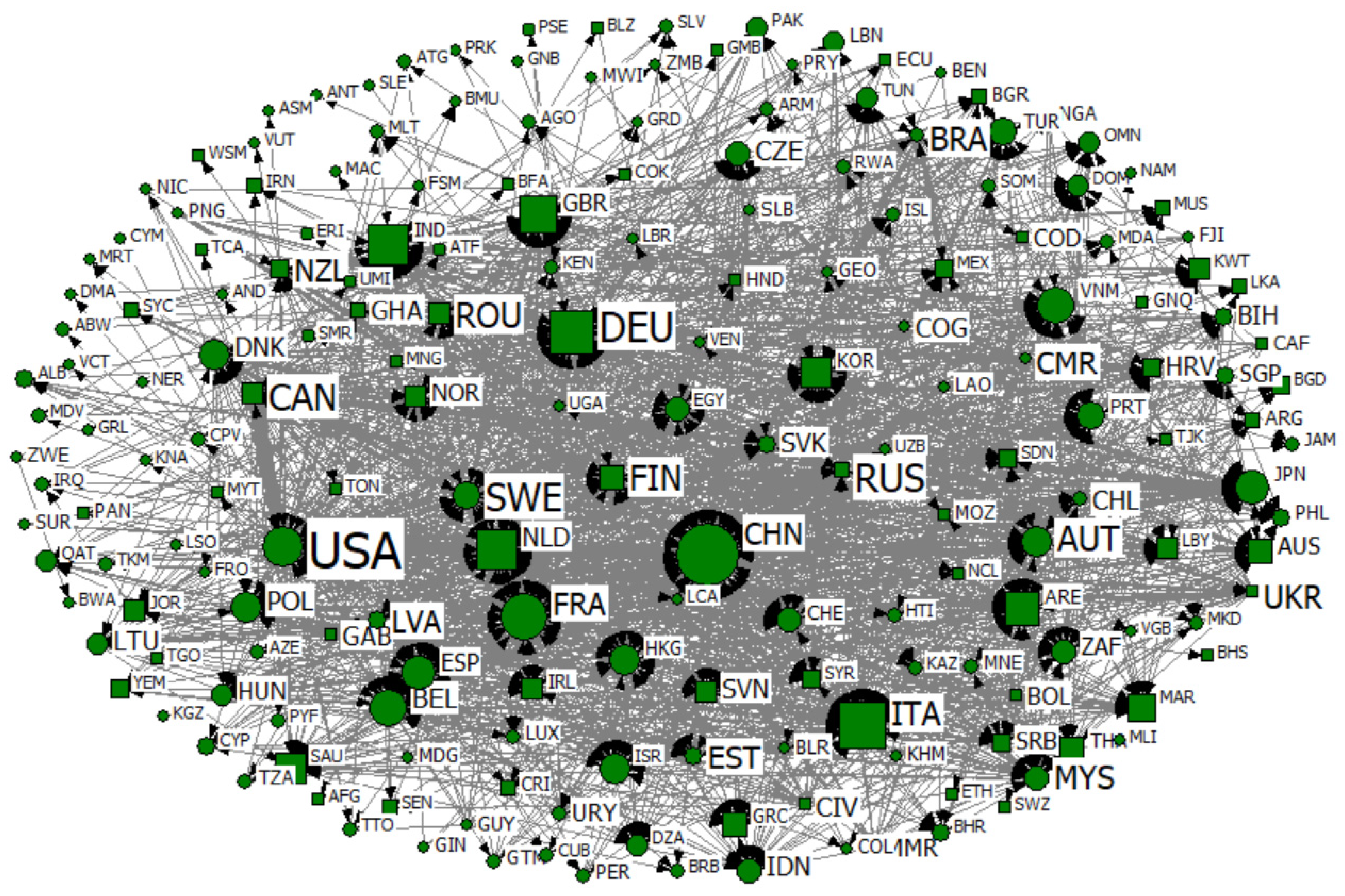
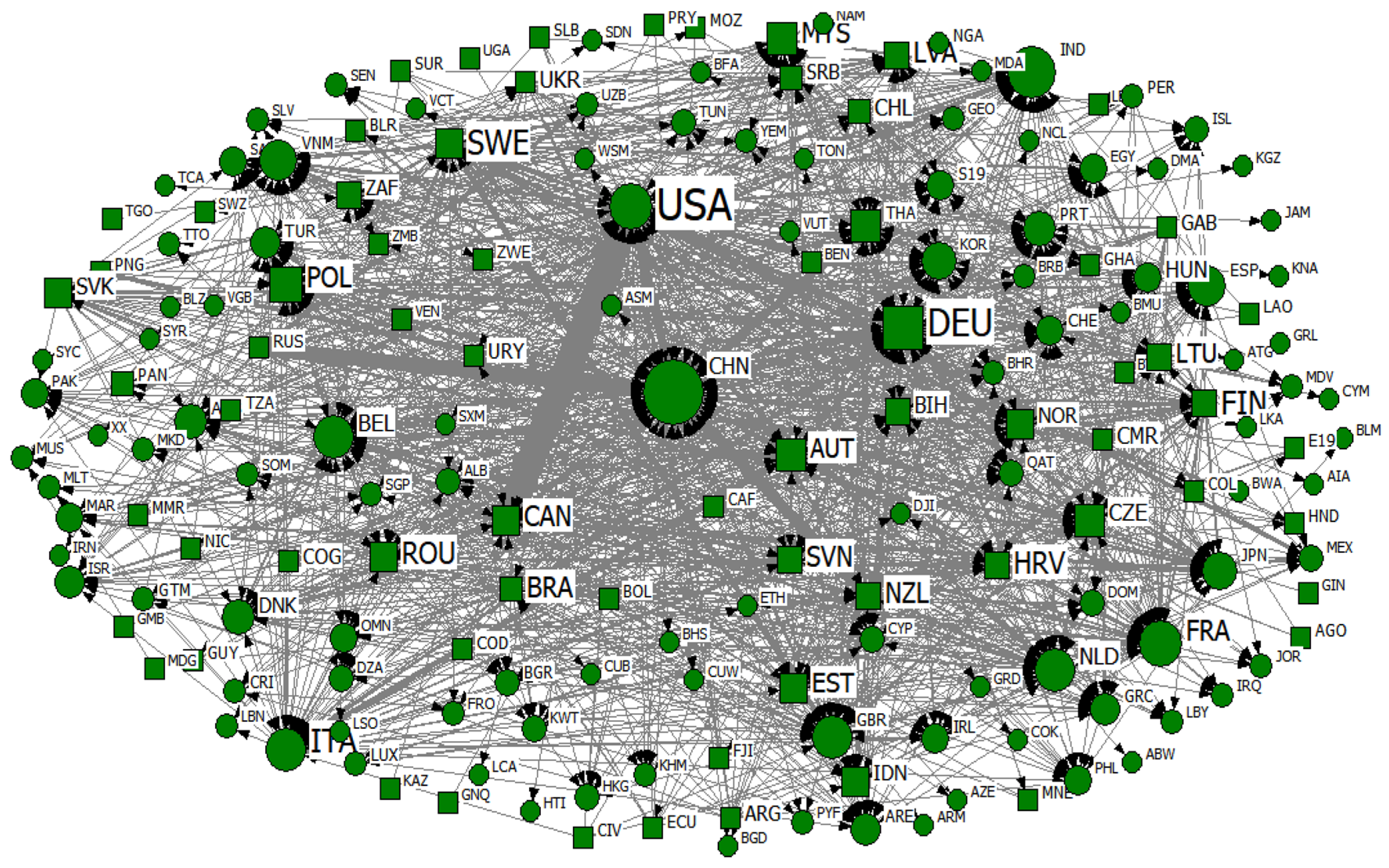
Following network construction, we employ NetDraw 2.166 network visualization software to generate trade network diagrams for 2000, 2010 and 2024 (as shown in
Figure 1,
Figure 2 and
Figure 3). In these visualizations, edge thickness is proportional to trade volume between nodes, node size corresponds to in-degree centrality, label size reflects out-degree centrality, and node shape indicates net trade status: circles denote net importers, and squares represent net exporters.
As evidenced by the network diagrams of
Figure 1,
Figure 2 and
Figure 3, the global timber trade network underwent significant structural transformations between 2000 and 2024. Key observations include the following: The figures reveal significant structural changes in the global timber trade network from 2000 to 2024. In terms of network scale, there are 182 nodes and 1419 ties in the GTTN of 2000, and in 2010, 194 countries participated in global timber trade, forming 1794 trade relationships, while by 2024, the number of trading entities decreased to 179, with trade relationships reducing to 1502; however, the average trade volume per relationship increased, indicating growth in overall timber trade scale. Regarding major trading nations, the United States, Russia, Canada, Germany and Sweden remained key exporters. The U.S. consistently ranked first in out-degree centrality, demonstrating the most extensive export partnerships. Germany’s centrality and ranking improved, while Russia’s export markets contracted following its 2010 log export ban policy.
For import markets, after 2010, China, Italy, France and the U.S. emerged as major importers. Most countries showed clear upward trends in import market numbers. China maintained the most import partners, increasing from 60 in 2000 to 92 in 2015, though this declined to 83 by 2024 due to COVID-19 impacts. The core-periphery analysis shows, the core countries included the U.S., Germany, Sweden, France and Finland in 2010, while by 2024, the core expanded to seven nations: Germany, Finland, Poland, the U.S., Sweden, Latvia and Estonia. These positional changes reflect dynamic interactions between resource endowments, economic conditions and policy factors.
As is evident from the preceding analysis, the GTTN is characterized by a distinctive structural pattern: while the overall network exhibits sparse connections, local clusters within it are marked by dense relationships. This unique structural trait can be effectively dissected and understood through the application of the core-periphery model. The core-periphery model serves as a valuable analytical tool, enabling the differentiation of nodes within a network based on their calculated coreness values, which reflect their relative importance. Traditional implementations of this model, however, have often been criticized for their oversimplification, as they typically classify nodes into just two broad categories: core and periphery. Such a binary classification fails to capture the nuanced gradations that exist within real-world networks.
To address this limitation and provide a more refined analysis, this study adopts the core-semi-periphery-periphery continuous partitioning model proposed by Borgatti and Everett [
36] (1999). By leveraging the CORR algorithm, we systematically analyze the global wood trade networks on an annual basis, shedding light on the evolving dynamics and structural shifts over time. In accordance with the classification criteria established by Zhou et al. [
1], countries are categorized into three distinct groups based on their coreness values. Specifically, countries with a coreness value of 0.2 or above are designated as core members; those with a coreness value ranging from 0.1 (inclusive) to below 0.2 are classified as semi-periphery members; and countries with a coreness value of less than 0.1 are identified as periphery members. The distribution of countries across these three categories, along with the identification of core countries for each year’s network, is presented in detail in
Table 2 below.
According to
Table 2, from 2000 to 2024, the GTTN exhibits a distinct core-semi-periphery-periphery structural characteristic. Among the networks in each year, the number of core countries is the smallest, followed by semi-periphery countries, with the vast majority of countries falling into the periphery category.
Although the size and membership of the core country group have undergone dynamic adjustments over the years, the main members have largely remained the United States, Germany, Sweden, Poland, Austria, and other countries. Specifically, the United States and Germany have consistently been part of the core country group, with their coreness consistently ranking in the top two positions. Except for 2008, Sweden has also consistently remained within the core country group. In terms of the evolution trend of coreness for each country, the United States has shown an overall spiral and slightly declining trend in its network coreness, dropping from 0.335 in 1997 to 0.218 in 2024. Germany, on the other hand, has witnessed an increase in its coreness and ranking, rising gradually from 0.269 in 2000 to 0.297 in 2021, followed by a slight decline afterward. Nevertheless, its coreness still reached 0.272 in 2024, ranking first globally. As for China, its coreness evolution has generally followed an upward-then-downward trajectory. Apart from the exceptional case in 2022, China’s coreness has remained relatively stable within the range of 0.1 to 0.2. Similarly, the coreness of other countries has also undergone dynamic adjustments, reflecting changes in their positions within the global wood trade network.
4.2. The Impact of Network Structural Characteristics on the Dynamic Evolution of GTTN
According to the previous research framework, this study employs the SAOM for empirical analysis. First, we incorporate structural indicators including out-degree effect, reciprocity, triadic closure, transitive triads, and GWESP effect to examine how endogenous network characteristics influence the dynamic evolution of the timber trade network. The results are presented in
Table 3 below.
The overall model achieved steady-state convergence after 2386 iterations, with a maximum convergence ratio of 0.1736—below the predefined threshold of 0.25 [
32]—indicating robust model performance. Additionally, Model 1 reveals significant structural transformations in the GTTN between 2010 and 2020. The evolutionary rates for Phase 1 (2010–2015) and Phase 2 (2015–2020) were 9.4742 and 8.3274, respectively, both statistically significant at the 1% level. This suggests a slight deceleration in network dynamics during 2015–2020 compared to 2010–2015.
The regression coefficient for outdegree is −3.4552 (p < 0.01), indicating that over time, countries in the network tend to avoid forming excessive timber export relationships. This aligns with the earlier finding that net timber-exporting countries are significantly fewer than importing ones. The reciprocity coefficient is 0.6934 (p < 0.01), demonstrating that trade actors increasingly favor reciprocal trade relationships, reflecting a growing prevalence of intra-industry trade among nations. The transitive ties coefficient is 0.3872 (p < 0.01), highlighting transitivity as a critical driver of network evolution, where actors embedded in transitive trade relationships are more likely to form additional timber trade links. The coefficient of 3-cycles is 0.0363 (p < 0.05), indicating that closed triadic structures modestly but significantly contribute to network cohesion. Given that the GTTN analyzed in this study is directed, GWESP manifests in two forms: forward closure and backward closure. In Model 1, the coefficients for these two GWESP effects are 1.3637 (p < 0.01) and −0.284 (p < 0.05), respectively, indicating a strong transitive closure tendency within the network, predominantly driven by forward closure.
Building upon Model 1, this study introduces two control variables per capita GDP and per capita forest stock volume to examine their effects on the evolutionary dynamics of the GTTN, while simultaneously investigating how endogenous network structural properties influence these dynamics. The estimation of Model 2 achieved steady-state convergence after 2386 iterations, with an overall maximum convergence ratio of 0.1736 (below the 0.25 threshold), indicating robust model stability. Temporal analysis reveals that the network exhibited significant structural transformations in both Phase 1 (rate = 9.876) and Phase 2 (rate = 8.7088), with both rates statistically significant at the 1% level. Notably, the rate of change declined from Phase 1 to Phase 2, suggesting decelerating network evolution. The effects of endogenous network structural variables on dynamic evolution remain broadly consistent with Model 1 findings, indicating that the influence of these structural properties on network evolution is relatively stable across model specifications.
The coefficients for per capita GDP’s alter-effect, self-effect, and similarity-effect are −0.3944, −0.1147, and 0.6591, respectively, all statistically significant at the 1% level. These findings indicate that, over time, countries with higher per capita GDP tend to avoid initiating or receiving timber trade relationships. Meanwhile, countries with similar economic development levels are more likely to establish timber trade connections. The coefficients for per capita forest stock volume’s alter-effect, self-effect, and similarity-effect are −0.3593, 0.5584, and 3.092, respectively, all significant at the 1% level. These results suggest that, over time, countries with larger per capita forest stock volumes tend to actively initiate timber trade relationships while avoiding receiving them—implying a stronger export orientation and reduced import propensity. Additionally, countries with abundant forest resources are more likely to trade timber with nations sharing similar resource endowments, potentially driven by differences in wood species that facilitate intra-industry timber trade.
4.3. The Impact of Costs on the Dynamic Evolution of the GTTN
Building on Model 2, this paper further incorporates four trade cost factors: distance cost, cultural cost, policy barrier cost, and institutional cost—to analyze their impacts on the dynamic evolution of the GTTN. The specific results are shown in
Table 4 below.
From the results of Model 3 in
Table 4, it can be seen that the model underwent 3421 iterations, with a maximum convergence ratio of 0.1934, which is less than the threshold of 0.25, indicating that the overall convergence of the model is good. Among the network structural effect variables, the out-degree effect, reciprocity, transitive triads, and GWESP effect all significantly influence the dynamic evolution of the timber trade network to varying degrees, and the research conclusions are basically consistent with the previous models. For the economic development level and forest resource endowment, the impacts of these two variables on the dynamic evolution of the network are also basically consistent with the previous results.
For the trade costs, the regression coefficient of distance cost is −0.0438, which is significant at the 1% level, indicating that geographical distance has a significant impact on the dynamic evolution of the GTTN. Specifically, countries with greater geographical distance are less likely to establish timber trade ties, and Hypothesis 1a is supported. The coefficient of cultural cost is 0.4551, which passes the significance test at the 1% level, suggesting that countries with higher cultural similarity are more inclined to establish timber trade ties, and Hypothesis 1b is supported. Trade agreements break down trade policy barriers among countries and reduce trade costs. The regression coefficient of policy barrier cost is 0.0135, which is significant at the 1% level, indicating that the trade agreement network significantly drives the dynamic evolution of the GTTN. Countries sharing more trade agreements are more likely to form timber trade ties, and Hypothesis 1c is supported. The regression coefficients of the alter effect and self-effect of institutional cost are 0.0003 and −0.0024, respectively, both of which are significant at the 5% level, indicating that institutions significantly promote the dynamic evolution of the timber trade network. Over time, countries with better institutional environments tend to receive timber trade relations while avoiding actively initiating them, and Hypothesis 1d is partially supported.
Building on Model 3, this study further incorporates two resource cost factors timber price and sustainable forest management level to analyze their impacts on the dynamic evolution of the GTTN. The results from Model 4 (
Table 4) are presented below.
Model 4 converged after 3751 iterations, with a maximum convergence ratio of 0.1662 (below the 0.25 threshold), indicating satisfactory model stability. Structural network effects, including out-degree (−3.9665, *** p < 0.01), reciprocity (0.5556, *** p < 0.01), transitive triads (0.3521, * p < 0.05), and GWESP (1.3876, *** p < 0.01), demonstrate significant and consistent impacts on network dynamics, aligning with findings from previous models. Furthermore, per capita GDP and per capita forest stock exhibit significant positive effects on the dynamic evolution of the GTTN, with their influence mechanisms aligning with prior model results. Additionally, all four trade cost factors demonstrate statistically significant impacts on network dynamics, reinforcing the robustness of our earlier conclusions regarding their roles in shaping trade patterns.
For the resource cost factors, the regression coefficient for the alter effect of forest certification level is −1.2376, which is statistically significant at the 1% level, supporting Hypothesis 2b. This suggests that, over time, countries with higher forest certification levels are less likely to proactively establish timber import trade relationships with other nations. In other words, higher forest certification levels correlate with a lower probability of forming new timber import trade ties.
For the price, Model 4 results indicate that the price factor has a regression coefficient of 0.0539, which is not statistically significant. Although price influences the dynamic evolution of the timber trade network, its effect is marginal, failing to support Hypothesis 2a.
4.4. The Impact of Trade Structure on the Dynamic Evolution of GTTN
To further investigate the mechanisms by which trade structure characteristics influence the dynamic evolution of timber trade networks, this study—building upon established research [
4,
32] introduces interaction terms between the ego effect of the Trade Imbalance Index (TII) and the alter effects of both economic development level and sustainable forest management capacity. These interaction terms are systematically incorporated into our model to examine the moderating effect of trade imbalance on the relationships between economic development, forest sustainability, and network evolution. The detailed empirical results are presented in
Table 5.
The estimation results from Model 5 indicate that the model achieved convergence after 4425 iterations, with an overall maximum convergence ratio of 0.2436—below the 0.25 threshold, demonstrating satisfactory model convergence. The regression results for rate functions, covariates, and cost factors remain consistent with previous model specifications.
Notably, the alter effect and ego effect of the TII show coefficients of −0.0406 and 0.0288, respectively, both statistically significant at the 1% level. These results suggest that countries with higher TII (indicating larger net export volumes) exhibit two behavioral tendencies over time: (1) reduced propensity to actively establish new timber import relationships with trade partners, and (2) increased likelihood of proactively forming timber export ties with other nations. Furthermore, the alter effect coefficient for per capita GDP is −0.5224, significant at the 1% level. This finding confirms that economically advanced countries demonstrate a systematic tendency to avoid initiating new timber import ties with other nations.
The interaction term between the TII ego effect and GDP alter shows a coefficient of 0.0218, statistically significant at the 1% level. This indicates that TII exerts a significant positive moderating effect on the relationship between economic development level and the dynamic evolution of the timber trade network. Specifically, greater net timber export volume amplifies the inclination of economically advanced nations to establish timber trade relationships with others. That is, countries with larger net timber exports demonstrate stronger initiative in forming timber export ties with developed economies, suggesting net timber exporters exhibit a preference for targeting relatively developed economies as export destinations.
In the behavioral evolution equation, both rate functions of TII are positive and statistically significant at the 1% level, confirming significant temporal variations in countries’ trade imbalance indices. Notably, the change rate in the first period is smaller than in the second period, validating our previous analysis of the evolutionary characteristics of trade imbalance indices.
Building upon Model 5, we further introduce an interaction term between the TII ego and the forest certification alter to examine its moderating role in the relationship between sustainable forest management capacity and timber trade network dynamics. As shown in Model 6 (
Table 5), the estimation achieves convergence after 4493 iterations with a maximum convergence ratio of 0.1861 (below the 0.25 threshold), demonstrating robust model convergence. The network structure variables maintain consistent effects on GTTN dynamics as in previous models. Regarding cost factors, all but timber price show statistically significant effects on network evolution at varying magnitudes and directions, further supporting our research hypotheses. The alter effect of forest certification level yields a coefficient of −1.3643 (significant at 1%), indicating that countries with stronger sustainable forest management capacity systematically avoid initiating new timber import ties with trade partners. However, the coefficient for the interaction term between TII ego and CER alter was −0.0014 and statistically non-significant, indicating that the ego effect of the trade imbalance index does not exert a significant moderating role in the relationship between forest certification level and the dynamic evolution of the timber trade network.
4.5. Robustness Tests
To further validate the robustness of our findings, we conducted sensitivity analyses from two perspectives. First, we performed variable substitution by replacing the forest certification rate with the number of Chain-of-Custody (CoC) certifications. FSC certification comprises both Forest Management certification and Chain-of-Custody certification. Forest Management certification evaluates forest management units through third-party audits against FSC standards system to verify sustainable or responsible management practices. CoC certification tracks wood products through the entire supply chain from raw material transportation and processing to distribution enabling consumers to trace product origins via certification labels and verify whether materials originate from sustainably managed forests. Thus, CoC certification numbers similarly reflect a country’s sustainable forest management capacity. Following established practice in the literature [
4,
37], where scholars have used CoC certification as a proxy for forest management certification in robustness checks, we adopted this alternative measure. The results are presented in Model 7 (
Table 6).
Additionally, we conducted robustness tests by substituting the dependent variable. We replaced the 2020 GTTN with 2019 data, with estimation results shown in Model 8 (
Table 6).
The results from Models 7 and 8 demonstrate strong consistency with our previous findings, indicating robust model performance and highly stable conclusions.
5. Discussion
This study employs a novel methodology and framework to enhance the understanding of how different cost factors drive the dynamic evolution of the global timber trade network, while incorporating both network structural features and trade structural characteristics into the model. The cost factors considered include trade costs (distance, culture, institutions, and policy barriers) and resource costs (product price and sustainable forest management capacity).
The findings indicate that trade costs and resource costs shape trade patterns in distinct ways. Geographical distance and cultural differences significantly inhibit the formation of timber trade ties, while geographic proximity and cultural similarity strengthen trade linkages. This conclusion further corroborates the research of Wu et al. [
16] and methodologically overcomes the limitations of previous static analyses. Policy barriers and institutional factors also play crucial roles: trade agreements effectively mitigate policy-induced obstacles, and countries with more shared agreements develop stronger trade connections—a finding consistent with Zhang and Li [
29] regarding the economic welfare effects of free trade agreements. However, this study also reveals that although sound institutions generally facilitate trade, economically advanced economies with well-developed institutions exhibit reluctance to engage in timber exports. This can be attributed to the positive correlation between institutional quality and economic development: higher development levels are often accompanied by greater environmental awareness and stricter forest conservation policies [
8]. With few exceptions, most highly developed countries restrict timber exports to prevent excessive resource outflow.
The experiment provides a new insight into the relationship between timber price and the trade relationships. Timber price is no longer the core factor influencing the establishment of trade ties. This conclusion challenges the traditional economic perspective that emphasizes price mechanisms as the primary driver of international trade [
38]. This non-significant result may stem from the complex interplay of factors at multiple levels: First, the inherent long growth cycle of forest resources creates relative inelasticity of supply and demand, cushioning the immediate impact of price fluctuations on trade decisions. Furthermore, as a global commodity, timber prices lack significant cross-country variation due to market integration [
39], thereby limiting their ability to explain specific partner selection.
Second, the central role of price is superseded by more influential structural variables and market-driven mechanisms—after controlling for economic development level, resource endowment, and trade costs, mechanisms such as forest certification, through stringent traceability and sustainability requirements, shift buyers’ focus toward long-term relationship stability and legal safeguards. This shift is reflected in their willingness to pay a premium for certified timber [
4,
31,
37], the internalization of these non-price attributes partially diminishes the sensitivity of trade decisions to mere price changes.
Finally, at the macro-structural level, powerful endogenous network effects indicate that trade decisions are significantly influenced by social construction and path dependence, where the shaping force of the existing network structure on the formation of new ties often surpasses purely economic rationality [
40]. Therefore, the non-significance of timber price carries substantial theoretical value, convincingly demonstrating that a comprehensive understanding of the evolutionary logic of global timber trade necessitates the integration of multidimensional costs and network dynamics into the analytical framework.
In contrast, sustainable forest management capacity exerted a substantial influence on trade dynamics. Countries with advanced certification systems actively avoided establishing new import relationships [
37]. This phenomenon suggests that strong domestic sustainable management capabilities enhance timber self-sufficiency [
31], reducing dependence on foreign imports. Under the assumption of product homogeneity—not accounting for specialization within intra-industry trade—nations with higher sustainable management capacities exhibit lower import demand [
1], further reinforcing structural stability in timber trade networks.
Notably, the evolution of the timber trade network is driven not only by economic factors but more significantly by endogenous structural mechanisms within the network itself. Specifically, the instantaneous triadic closure mechanism—i.e., the tendency to form ties with “friends of friends”—plays a dominant role, indicating that trade partnerships are formed both rapidly and strategically. Moreover, structural inertia, manifested as reciprocity and transitivity, exhibits explanatory power comparable to that of economic variables, further underscoring the deeply embedded nature of trade relations within network structures. This conclusion can be explained by the findings of Liu et al. [
41]: a positive correlation exists between the scale of the initial trade network and the establishment of new trade linkages. This implies that countries or regions with larger initial trade networks find it easier to expand their trade connections, resulting in a “Matthew effect” where connectivity begets further connectivity.
Empirical results show that the GWESP effect significantly outperforms simple triadic closure, confirming that countries (or regions) in the Global Timber Trade Network (GTTN) exhibit a strong propensity to establish trade ties with their partners’ partners. This finding aligns with earlier studies on network dynamics: Kinne and Bunte [
42] (2020) observed similar mechanisms in inter-state defense cooperation networks, and Balland et al. [
43] identified parallel patterns in the evolution of global video game industry clusters. Both studies affirm that triadic closure exerts a positive and statistically significant influence on network formation. This tendency facilitates the emergence of group norms, strengthens mutual trust, and curbs opportunistic behavior [
44]. The GWESP effect accurately captures this phenomenon—the propensity of indirect ties to rapidly consolidate into direct partnerships [
9], highlighting the strategic and efficiency-oriented nature of link formation within the GTTN.
Both economic development levels and forest resource endowments drive the dynamic evolution of the timber trade network. The findings indicate that countries with higher economic development exhibit greater reluctance to establish new timber import relationships, whereas countries with similar economic development levels are more likely to form trade ties. At the same time, forest-rich countries demonstrate a seemingly contradictory pattern of “proactive exporting yet cautious importing.” On the one hand, their active export strategy aligns with the factor endowment theory, which emphasizes leveraging inherent resource advantages. On the other hand, their cautious approach to importing transcends the static assumptions of this theory, reflecting deeper strategic motives to protect resource sovereignty and avoid over-reliance on imports.
This finding not only partially validates the comparative advantage theory but also provides an important supplement by showing that countries strategically intervene to mitigate risks associated with import dependency while capitalizing on their natural endowments. Furthermore, the study confirms that stronger trade connections also exist between countries with similar resource endowments, primarily driven by intra-industry trade [
1] rather than traditional inter-industry complementarity. The deepening of trade relations stems not only from comparative advantages but more importantly from intra-industry specialization (e.g., different countries specializing in specific tree species or wood products), thus offering a new theoretical framework for understanding patterns of global resource trade.
This study uncovers the critical role of trade structure in shaping network dynamics, revealing strategic export market selection by net exporters and an asymmetric moderating effect of economic development on trade evolution. Specifically, net timber exporters actively expanded into new export markets while deliberately avoiding import relationships, a pattern that reflects their strategic utilization of comparative advantages in forest resources. Moreover, the TII significantly moderated the influence of economic development on network evolution. In particular, net exporters exhibited a clear preference for targeting developed economies as their export destinations, underscoring the role of market-level strategic behavior in the global timber trade network. However, it is plausible that the moderating role of the trade imbalance index on the “forest certification level–trade network dynamics” relationship remains limited at the macro level, or that its influence operates in a more nuanced and indirect manner. Future research should employ more granular data and more robust analytical methods to further elucidate this relationship.
6. Conclusions
This study examines the driving mechanisms of cost factors behind the dynamic evolution of the GTTN through a comprehensive trade–resource cost analysis framework. To this end, a trade cost framework was developed incorporating dimensions such as distance, culture, institutions, and policy barriers, along with a resource cost framework based on product price and sustainable forest management capacity. Using longitudinal trade data from 2000 to 2024 and applying SAOM, the research assesses the influence of multiple cost factors on timber trade relationships while also accounting for the roles of network structure and trade structural features in shaping the GTTN. This approach offers a novel contribution by extending beyond conventional emphasis on product price to establish an integrated cost framework that incorporates endogenous network effects and trade structural attributes, thereby providing a more holistic understanding of timber trade dynamics—a perspective still underexplored in the current literature.
The findings indicate that although various trade costs significantly affect the evolution of the GTTN, conventional timber price factors alone are no longer sufficient to substantially reconfigure trade ties. Structural mechanisms—particularly the GWESP effect, indicative of instantaneous triadic closure—play a crucial role in the formation and evolution of timber trade relationships. Moreover, the study identifies an export expansion with import restriction phenomenon among forest-rich nations, which actively expand exports while restricting imports to safeguard resource sovereignty—a behavioral dichotomy that challenges traditional comparative advantage theory. Economic development also exhibits an asymmetric moderating effect: it strengthens export activity in net-exporting economies while curbing import growth in net-importing ones. These insights refine our understanding of strategic behavior and structural constraints in global resource trade.
6.1. Theoretical Contributions
This study introduces novel analytical approaches and offers a fresh conceptual lens for unraveling the complexities of global resource trade networks. Its theoretical contributions lie primarily in the systematic enhancement of the analytical framework for understanding the evolution of international resource trade networks across four pivotal dimensions.
Theoretical elucidation of dynamic network evolution mechanisms in timber trade. Through the incorporation of the GWESP effect, we have substantiated the instantaneous closure mechanism embodied in the principle of “a friend of a friend is a partner” within the context of timber trade network evolution. This research uniquely uncovers the preponderant influence of instantaneous triple closure, as opposed to delayed closure, in the realm of resource trade. By transcending the traditional trade theories’ overemphasis on economic determinants, we have integrated network structural parameters, including reciprocity and transitivity, as pivotal explanatory variables in the evolutionary trajectory of resource trade networks. Our results convincingly demonstrate that structural inertia exerts an independent explanatory capacity comparable to that of economic variables in shaping the dynamic evolution of these networks.
Revisiting comparative advantage theory in the context of resource trade. This study offers a refined perspective on the traditional comparative advantage theory by elucidating the nonlinear ramifications of forest resource endowments on trade patterns. Resource-rich nations exhibit a trade behavior characterized by “proactive exporting and cautious importing,” a phenomenon that not only aligns with the tenets of the factor endowment theory (exporting goods with inherent advantages) but also defies its static assumptions by strategically limiting imports to safeguard resource sovereignty. Moreover, we provide empirical evidence for the prevalence of intra-industry trade within the resource trade sector, demonstrating that the intensification of trade among countries with analogous forest resource endowments stems from intra-industry specialization (e.g., specialization in distinct tree species) rather than mere comparative advantages, thereby broadening the theoretical horizons of resource trade.
Institutional perspectives on non-economic costs in timber trade. We introduce the “institutional cost paradox,” which posits that developed countries, despite enjoying low institutional costs (marked by efficient governance frameworks), adopt a passive stance in timber exports due to an awakened environmental consciousness. This revelation challenges the conventional wisdom that institutional quality invariably fosters trade and unveils the counterintuitive and constraining impact of environmental regulations on resource trade dynamics.
Network-mediated effects on trade structure in resource markets. Our investigation reveals a “market screening” mechanism operative among net exporting countries, wherein they strategically target developed countries as preferred export destinations, thereby lending credence to the “export upgrading” hypothesis in resource trade. Furthermore, we identify an asymmetric moderating effect of economic development on trade structure: the economic prowess of high trade intensity index countries (net exporters) amplifies their export activities, whereas the economic clout of low trade intensity index countries (net importers) paradoxically dampens their import expansion.
6.2. Policy Implications
Importantly, this study provides actionable guidance for policymakers and trade practitioners as follows.
Optimize the GTTN structure. Break down trade blocs: Promote inter-regional cooperation through multilateral dialog mechanisms (e.g., FAO) to integrate emerging markets into the GTTN and reduce network centralization. Innovatively introduce “alliance access clauses” in bilateral or multilateral trade agreements, allowing existing trade partners to preferentially introduce third-party collaborators based on the triadic closure principle, and enhance the stability of triadic trade mechanisms through the establishment of international timber trade cooperation pilot zones and the implementation of policy coordination such as tariff reciprocity and mutual recognition of inspection standards. Develop a dynamic trade partner assessment system: Publish a Global Timber Trade Partner Risk Rating Guide, evaluating political stability, resource sustainability, and tariff policies to prioritize long-term agreements with high-rated countries.
Reduce Multidimensional Trade Costs. Deepen regional trade agreements: Advocate for zero tariffs on timber trade under the Regional Comprehensive Economic Partnership (RCEP) to enhance member states’ export competitiveness. Facilitate specialized negotiations with the European Union (EU) and the Association of Southeast Asian Nations (ASEAN): Streamline customs procedures (e.g., phytosanitary certificates, origin documentation) to reduce administrative burdens. Promote cross-cultural exchange: Establish Timber Trade Cultural Centers in key trading nations to provide language training and business etiquette programs, minimizing communication barriers. Harmonize technical standards: Align Chinese standards system with ISO/EU benchmarks to eliminate redundant testing and certification costs.
Enhance sustainable forest management capacity. Introduce a “Bridge Builder” incentive program within forest certification systems to cultivate key intermediary organizations that connect different certification schemes, while incorporating a “Trade Network Impact Assessment” into national forest governance systems as a prerequisite for policy formulation; Deploy AI-driven monitoring technologies utilizing drones and satellite remote sensing to track forest health, with quarterly National Forest Management Quality Reports to be published; Reform certification incentives by linking FSC/PEFC standards system with carbon tax policies and providing export tax rebates for certified timber products; Establish a global certification database through partnership with the World Bank to develop a real-time Forest Certification Transparency Platform, thereby systematically addressing information asymmetry and promoting market expansion through coordinated structural reforms and technological empowerment.
Innovate institutional frameworks. Annual audits maintain trade partner compliance and mitigate risks, while blockchain-based trade data enables supply chain finance and carbon trading services. These multidimensional dependencies strengthen network resilience. Building on this foundation, a “Negative List + Credit Supervision” model should be implemented: a clear list of prohibited timber trade practices should be established to combat illegal logging and false declarations, while a blockchain-based traceability system should be introduced, assigning unique digital identifiers to imported timber to comprehensively record full-chain data from harvesting to processing. Non-compliant enterprises will be blacklisted, and real-time data exchange between government traceability platforms, customs, and corporate systems will be achieved, ultimately constructing a closed-loop regulatory framework covering preemptive prevention, in-process monitoring, and post-event accountability across the entire chain.
6.3. Research Limitations and Future Directions
While this study offers valuable theoretical and empirical insights, it is subject to several limitations that point toward productive future research directions. First, although the SAOM effectively captures dynamic network dependencies, its reliance on country-level aggregate data may not fully capture sub-national heterogeneity or firm-level decision-making processes. Second, while the model incorporates multiple structural and economic determinants, it does not explicitly include ecological variables—such as the effects of climate change on forest resources—that could significantly influence long-term trade patterns. Finally, the exclusive focus on timber trade may limit the generalizability of the findings to other resource sectors. Comparative analyses involving other natural resources (e.g., mineral products, fisheries) would help verify and extend the applicability of the proposed network-institution-economy tripartite framework.
To address these gaps, we propose the following specific research pathways: First, to overcome the constraints of country-level aggregate data in SAOM, future studies should incorporate firm-level trade datasets to reveal micro-level decision-making mechanisms and sub-national heterogeneity in timber trade flows. Second, to account for ecological dimensions missing in the current framework, researchers could integrate dynamic environmental models assessing climate change impacts on forest resources, thereby enhancing the model’s predictive validity for long-term trade patterns. Finally, to verify the generalizability of the network-institution-economy tripartite framework, comparative analyses should be extended to other natural resource sectors—particularly fisheries and mineral trade—to test the framework’s applicability across different resource contexts. These concrete research directions will not only address the current limitations but also substantially advance our understanding of resource trade networks from micro to macro levels.
In summary, this research offers theoretical and empirical contributions to the fields of international trade and network analysis. It introduces an integrated analytical framework, delivers robust empirical validation through advanced SAOM modeling, and supplies policy-relevant insights to support the design of effective and sustainable governance mechanisms for global timber trade.




 ,
,