Article

Measurement Errors from Successive Inventories on Concentric Circular Field Plots and Their Impact on Volume and Volume Increment in Uneven-Aged Silver Fir Stands

1
Institute of Forest Inventory, Management Planning and Remote Sensing, Faculty of Forestry and Wood Technology, University of Zagreb, 10000 Zagreb, Croatia
2
Paying Agency for Agriculture, Fisheries and Rural Development (PAAFRD), 10000 Zagreb, Croatia
3
Croatian Forests Ltd., 10000 Zagreb, Croatia
*
Author to whom correspondence should be addressed.
Forests 2025, 16(12), 1810; https://doi.org/10.3390/f16121810 (registering DOI)
Submission received: 22 October 2025 / Revised: 26 November 2025 / Accepted: 28 November 2025 / Published: 2 December 2025
(This article belongs to the Special Issue Growth and Yield Models for Forests)

Abstract

Forest measurements are essential for monitoring stand dynamics and long-term trends. Errors in tree measurement can seriously affect the outcomes of a forest inventory. This study investigates measurement errors from successive measurements on permanent concentric circular plots based on data from 74 plots in Dinaric uneven-aged mixed fir–beech stands. Tree data errors were detected and corrected. Diameter increment was calculated as a difference in DBH from two successive inventories, and linear regression models were developed based on original and corrected data. Measurement errors were identified in 2.57% of trees, some having a substantial impact on tree volume. Volume discrepancies between original and corrected data were generally minor, where 93.2% of plots in the first and 70.3% in the second inventory required no corrections and volume differences in the overall levels were negligible and statistically non-significant: 0.30 m3/ha in the first inventory (p = 0.550) and 0.05 m3/ha in the second (p = 0.974). Although diameter increment models with original and corrected data differed significantly, model choice resulted in minimal impact on volume increment. Since omitting erroneous measurement data would lead to volume underestimation, data correction is preferable. However, when modeling tree increment, excluding incorrect or doubtful data remains a practical and acceptable approach.

1. Introduction

Forest inventories provide essential data about the condition of this vital resource at specific points in time and offer valuable insights into its temporal variability and long-term trends. Field measurements are regularly carried out on sample plots that can be permanent [1] (continuous forest inventory—CFI) or temporary [2]. Changes in forest stand structure based on data from temporary plots encompass not only actual differences resulting from tree growth over time but also variability arising from spatial inconsistency in sample design. On temporary plots, increment cores are extracted from a sample of trees to determine diameter growth, whereas on permanent plots, diameter growth is calculated as the difference in tree diameter at breast height (DBH) or circumference between two measurements taken at known time points, t_1 and t_2 [2].
Remeasurement on permanent plots requires locating the plot center and identifying each individual tree, making the entire measurement process noticeably more time-consuming and financially demanding [3]. This is one of the reasons why in the Republic of Croatia the volume increment in forest management plans is calculated based on the increment cores method [4]. Given that core extraction causes damage to the sampled trees, leading to deformations in the stem cross-sectional area [5,6], particularly in the butt log which is the most commercially valuable portion of the tree, a continuous forest inventory should be considered as a preferable alternative in forest inventories. Remeasurement on permanent plots enhances the understanding of forest change [3] and can be useful in the evaluation of forest growth models [7]. According to West [8], the interval between successive measurements on permanent plots should not be shorter than five years, and it can be extended up to ten years [9]. Given the negative correlation between the number of trees and stand age in even-aged forests, maintaining a consistent number of trees in a sample over time requires an expansion of the plot area. Conversely, when fixed-area plots are established in uneven-aged forest stands, the sample tends to be disproportionate, with a higher number of thinner trees and limited representation of thicker trees. To address sampling imbalance in uneven-aged forest stands, concentric circular plots were introduced, with each circle designed to measure trees within a specific DBH range [10,11]. This approach has been adopted in national forest inventories across several countries [2], including the Croatian National Forest Inventory (CRONFI) [12]. In the CRONFI methodology [12], trees are measured within three concentric circular plots, each corresponding to the specific DBH range class. Instead of assigning tree numbers, the horizontal distance and azimuth from the plot center to each tree are measured. Additionally, the DBH measurement point on each tree is marked using a timber scribe. This relatively discreet marking of the DBH measurement point is important, as it avoids different treatments of sampled plots compared to the rest of the forest population during subsequent management activities [13]. One of the constraints of concentric circular plots in the CFI approach concerns nongrowth trees—those that were above the minimum DBH (10 cm) during the first inventory but that were not measured due to concentric circle criteria and grew enough to be measured in the second inventory [12,14]. Another inherent feature of CFI with concentric circular plots is the decrease in tree expansion factors when a tree exceeds a diameter threshold and “shifts” to a larger radius plot, leading to a decrease in per hectare estimates. While this effect is methodologically expected and cancels out at larger sample scales (partially due to nongrowth trees), it impairs the consistency of repeated measurements at the plot level [15]. Furthermore, as noted by [16], the individual components of change do not necessarily sum up to the total difference observed between the two estimates. However, concentric circular plots are considered appropriate for estimating increment, as confirmed by Hébert et al. [17]. In addition to methodological considerations, errors such as tree misidentification in repeated measurements and other forms of observational inaccuracies should be anticipated. A fundamental assumption in statistical analyses is that all measurements are free from error [10]. However, as noted by Castillo et al. [18], logic and error checking during fieldwork is critically important, along with additional post-field error checking. According to Kaufmann et al. [19], mistakes are not desirable but are inevitable. However, ignorance of errors prevents improvement and correction.
This study investigates errors occurring throughout the DBH measurement process in permanent concentric circular field plots and examines their impact on volume calculation at the individual tree, plot, and overall levels, as well as volume increment in representative forest stands.

2. Materials and Methods

2.1. Field Work

The initial inventory (CRONFI1) was conducted between 2007 and 2009, and the remeasurement was carried out in 2019 on 74 CRONFI permanent concentric circular plots located in the Dinaric region of mixed silver fir (Abies alba Mill.) and common beech (Fagus sylvatica L.) forests in Croatia. Measurements were conducted on permanent concentric circular plots established under the CRONFI1, with radii of 7 m (for trees with DBH ≥ 10 cm), 13 m (DBH ≥ 30 cm), and 20 m (DBH ≥ 50 cm). For each tree included in the CRONFI1 sample, the following variables were recorded: tree species, azimuth, horizontal distance, terrain slope, total tree height, diameter at breast height (DBH), and stump diameter [12]. Tree azimuth from the plot center was measured using a Suunto KB-14 compass, while horizontal distances were determined with a Haglof Vertex IV ultrasonic hypsometer/rangefinder, which was also used to measure tree heights—both during the initial inventory and for newly recorded trees in the second inventory. DBH and stump diameter were measured using a caliper with millimeter-level precision. Throughout the remeasurement, the caliper was placed on a point permanently marked by a horizontal line (2–3 cm in length) inscribed at breast height using a timber scribe during the first inventory [12,20]. This approach ensured consistency in successive DBH measurements on the same tree [21]. Recorded values during data collection were documented in paper field forms. During the remeasurement, only basic data from the initial inventory (tree species, azimuth, horizontal distance, and slope from the plot center to the tree) were made available to the field team to ensure unbiased data collection. Throughout the remeasurement, DBH was recorded for each tree, and its sampling status was determined according to the inventory handbook [20] as follows:
  • Remeasured tree—A tree present in both the first and second inventories.
  • (2a) New sample tree (nongrowth)—A tree that exceeded the DBH threshold of 30 or 50 cm.
    (2b) Reclassified sample tree—A tree incorrectly included in the first inventory due to DBH measurement error but meeting the sampling criteria in the second inventory.
  • New sample tree (ingrowth)—A tree that exceeded the inventory DBH threshold of 10 cm.
  • Harvested tree (thinning or selection cut)—A tree sampled in the first inventory but removed through thinning or selection cutting.
  • Harvested tree (clear-cut or shelterwood cut)—A tree sampled in the first inventory but removed through clear-cutting or shelterwood cutting.
  • Dead tree—A tree sampled in the first inventory that no longer exists as a living standing tree.
  • Missing tree—A tree measured in the first inventory that could not be located, with no visible stump at the recorded position.
  • Erroneously sampled tree (excluded)—A tree incorrectly sampled in the first inventory due to horizontal distance error and excluded from the second inventory.
  • Erroneously sampled tree (included)—A tree incorrectly sampled in the first inventory due to horizontal distance error but included in the second inventory due to DBH increase.
  • Previously omitted tree—A tree mistakenly excluded from the first inventory but included in the second inventory.
Data from both inventories were entered into a single database, where a unique identifier (ID) was assigned to each individual plot and tree. A total of 1576 trees with DBH ≥ 10 cm were measured. Of these, 1090 trees were recorded in both inventories, allowing for the calculation of diameter increment at the individual tree level.

2.2. Data Processing and Analysis

For trees measured in both inventories, the periodic annual diameter increment over bark was calculated by dividing the difference in DBH between the two measurements by the time interval between them. Since the initial measurement was conducted throughout the entire calendar year, the timing of each tree’s measurement was taken into account when calculating the time interval between inventories. To standardize the time interval, the year of the first measurement was considered a full year if the measurement occurred prior to March 31. Conversely, it was excluded from consideration if the measurement was conducted after June 15, which is the estimated date by which approximately half of the annual radial increment is formed. For the second measurement, the criteria were applied in reverse: the year was counted as full if the measurement occurred after June 15 and excluded if conducted before March 31. Measurements taken between these two dates were considered to represent a half-year. The standardized time interval between the two measurements ranged from 11 to 13 years. Consequently, the estimation of the exact year attributed to the first and second measurements had a relatively minor impact on the calculation of annual diameter increment. This influence would be more pronounced in cases involving shorter intervals, such as a five-year period. To ensure consistency in data measured on permanent plots, measurements should be taken during the period of vegetation dormancy.
The volume of every individual tree was calculated using a bias-corrected, back-transformed Schumacher–Hall equation [22]:
v = a × D B H b × h c × f ,
where v denotes tree volume; DBH is diameter at breast height; h is total tree height; a, b, and c are species-specific regression parameters; and f represents Meyer’s correction factor. The values of a, b, c, and f are adopted from the CRONFI database [23]. As tree heights were not recorded during the second inventory for the trees measured in the first, their total heights were modeled to simulate the height increment. For each tree species, a height curve was modeled using data from the first inventory, capturing the relationship between total tree height and diameter at breast height (DBH). The formula used to model the height curve is the Michailoff equation [24], most commonly used in Croatia:
h = b 0 × e b 1 D B H + 1.30 ,
where h denotes modeled total tree height, b0 and b1 are model parameters, and DBH represents diameter at breast height. For each tree, the percentage deviation from the modeled height was calculated using data from the first inventory. Based on the DBH recorded during the second inventory and the previously developed height–diameter model, the tree height at the time of the second measurement was estimated. This modeled height was additionally adjusted using the individual tree’s offset value derived from the first inventory, thereby simulating height increment while accounting for tree-specific variation. This approach is conceptually supported by Sharma et al. [25], who showed that using previously measured heights can improve the accuracy of height–diameter predictions, particularly in mixed-species forests where individual and plot-level variation can significantly affect model performance. The number of trees, basal area, and volume per hectare represented by each tree were calculated by dividing the respective tree attributes by the plot area on which the tree was measured (tree expansion factor). The calculated area was further corrected based on the assessed proportion of the plot actually covered by forest vegetation [12]. Number of trees, basal area, and volume at the plot level were calculated by summing per hectare values of all individual trees in the plot.
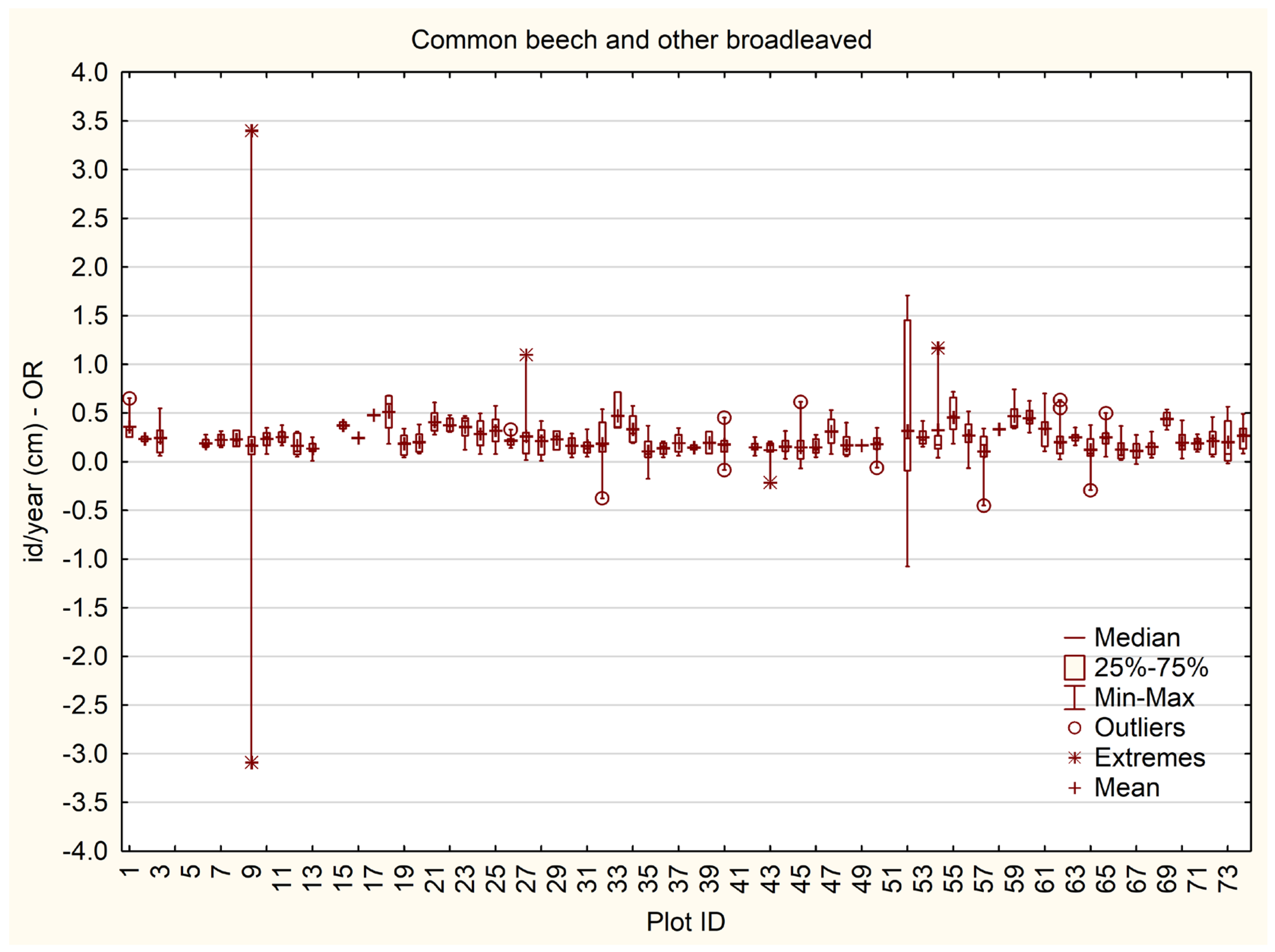
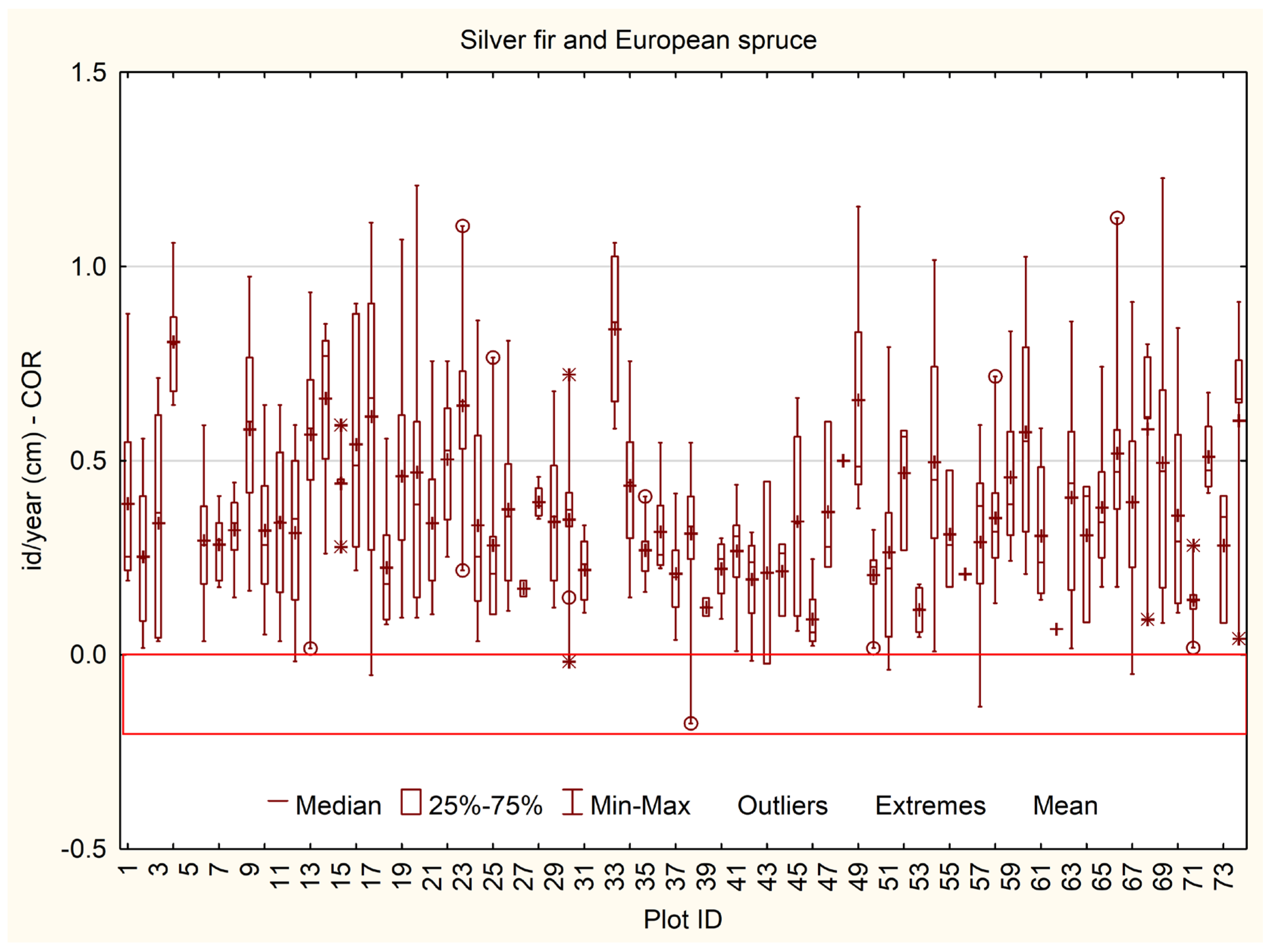
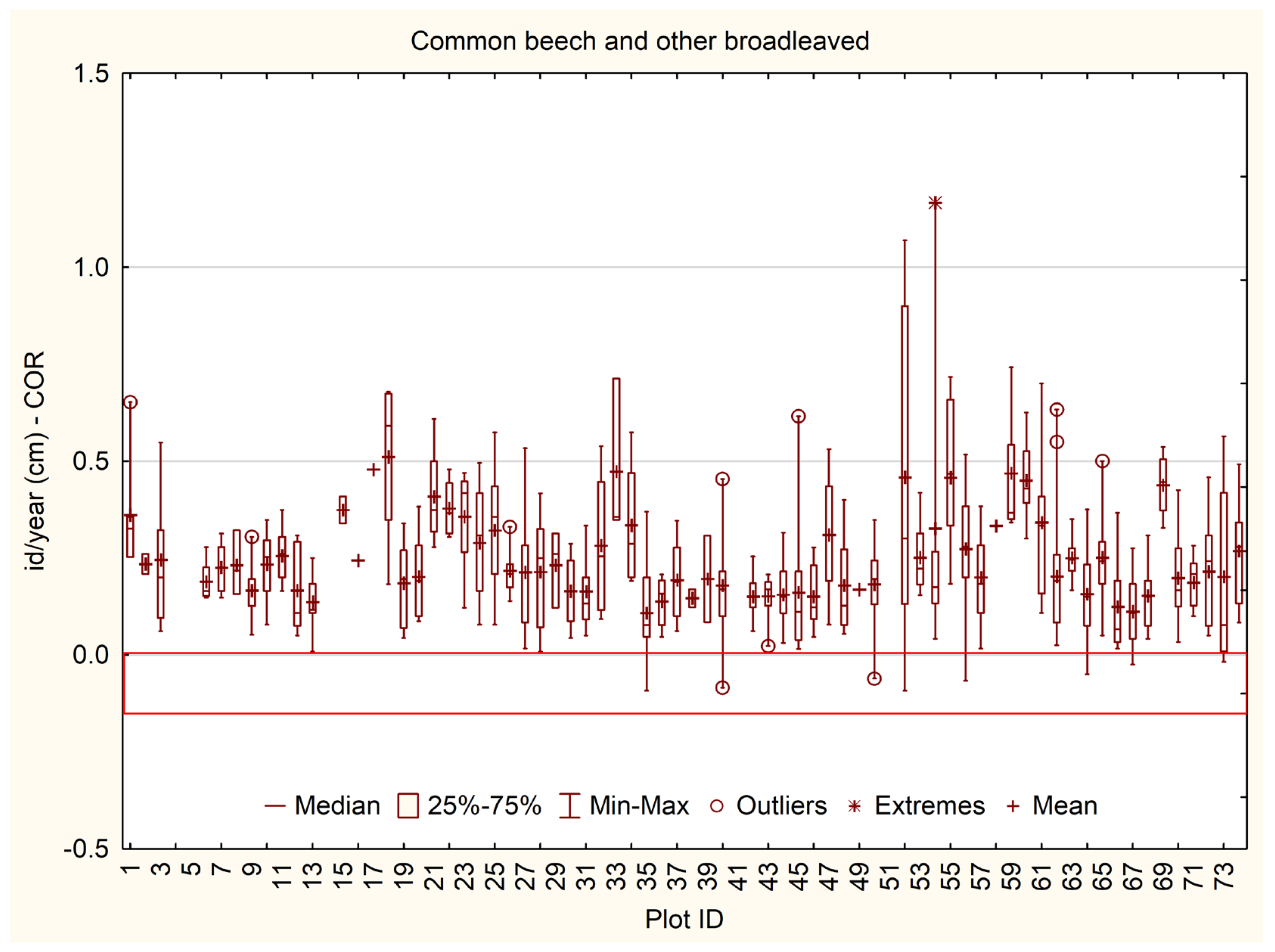
Detection of measurement errors was performed on the calculated diameter increment data by checking the field tree data of suspect increment values. Since anomalies in diameter growth are often difficult to detect from numerical data, a commonly recommended approach is to graphically compare measurements from two inventories. This method provides effective identification of gross errors regardless of whether the second measurement represents a control subset [19,20] of plots or successive measurements on the same plots [26]. Jin et al. [26] highlighted the issue of unequal time intervals between repeated measurements, which is also acknowledged in this study. When the time interval between measurements varies, graphical comparison of the data from the two measurements is not representative enough, and the data should be standardized and shown as the current annual diameter increment. In this study, the current annual diameter increment is grouped by species, with silver fir (Abies alba Mill.) and European (Norway) spruce (Picea abies Karst.) forming one group (Figure 1) and common beech (Fagus sylvatica L.) together with other broadleaved species forming the second group (Figure 2).
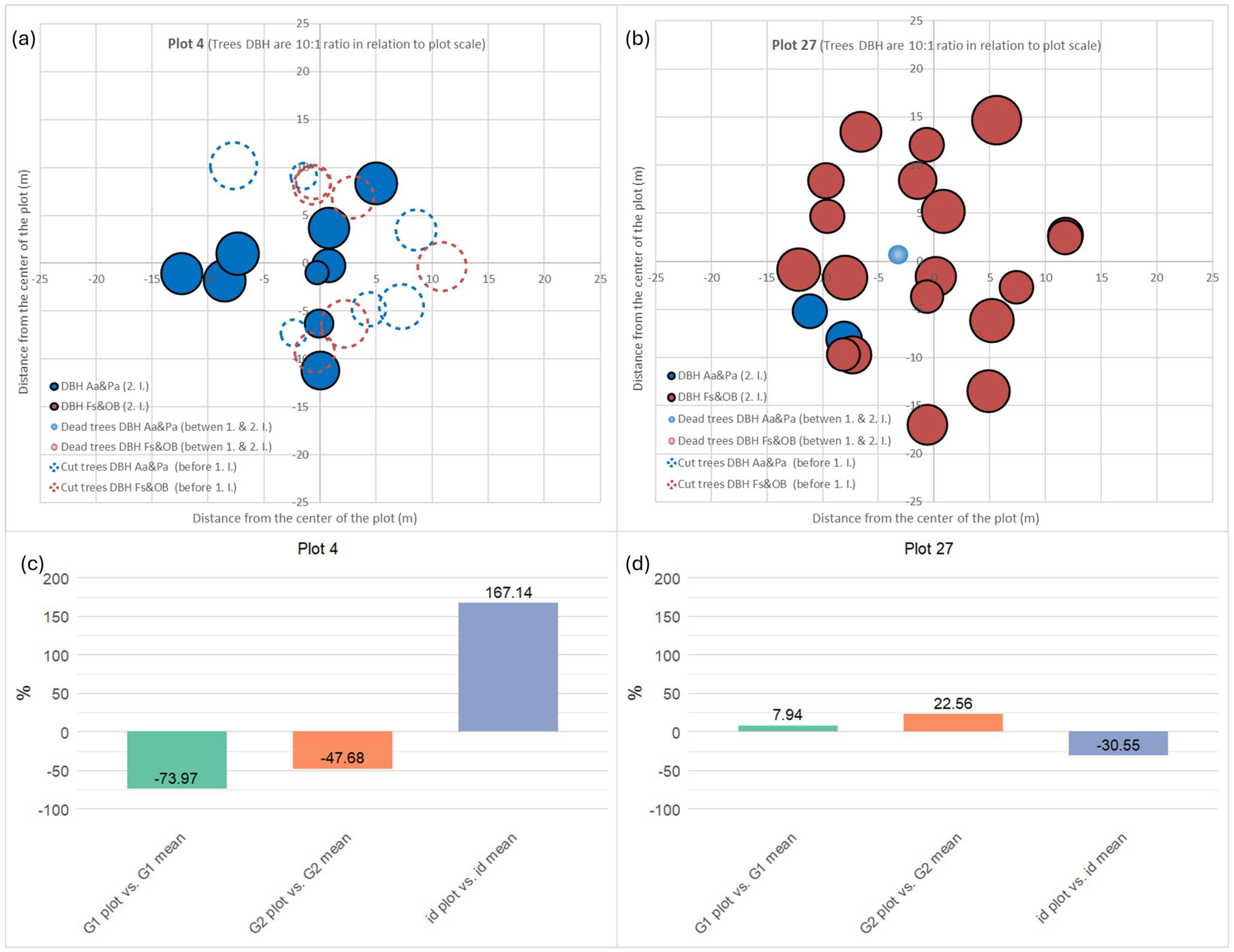
Based on Figure 1 and Figure 2, a comparison between transcribed and field data was made, with special attention paid to the plots where increment values were very high and/or impossible. At the plot level, detected anomalies were analyzed by reviewing the original field data from both measurements, which included not only DBH but also total tree height, stump diameter, and other recorded variables. Based on this information, efforts were made to reconstruct the likely causes of the errors. Tree records showing unrealistically high or implausible increment values were corrected in either the first or second inventory depending on where the error was clearly identified. Further inspection of the data revealed that in some cases, trees exhibited either higher or lower diameter increment compared with the average across other plots. This variation may be attributed to the intensity of recent cutting activities. Consequently, for plots exhibiting unexplained below- or above-average anomalies in diameter increment, tree-level data from both measurement periods were graphically displayed. Figure 3 presents a schematic spatial distribution of trees within the plot, accompanied by comparative information on plot-level diameter increment and basal area relative to the sample mean.
In plots with higher cutting intensity, such as Plot 4 in Figure 3, the basal area is below the sample average. The remaining trees likely responded to the newly opened space in the canopy layer, resulting in diameter increments that exceeded mean values. Conversely, in plots with low or no cutting activity, such as Plot 27 in Figure 3, the basal area exceeds the sample average, and limited space in the canopy layer results in diameter increments below the mean value. Both unusually large and small diameter increments were retained in the sample when no evident measurement error could be identified, and the plot structure supported the plausibility of the recorded values.
In this study, the influence of measurement errors was examined and presented separately at three levels: individual tree, plot, and overall level (aggregation of all plots from the studied area). A comparison of volume between original and corrected data at the overall level was conducted using a paired t-test, with a significance level of 0.05.
Moreover, linear regression models were developed for silver fir and for common beech to evaluate the relationship between diameter increment and DBH from the first measurement using three distinct datasets: original (OR), corrected (COR), and a version in which erroneous values were excluded rather than corrected (OR-ERR). The DBH increment predicted by the three developed models was compared using repeated measures ANOVA followed by Dunnett’s post hoc test where the model with corrected data (COR) was used as a reference value.
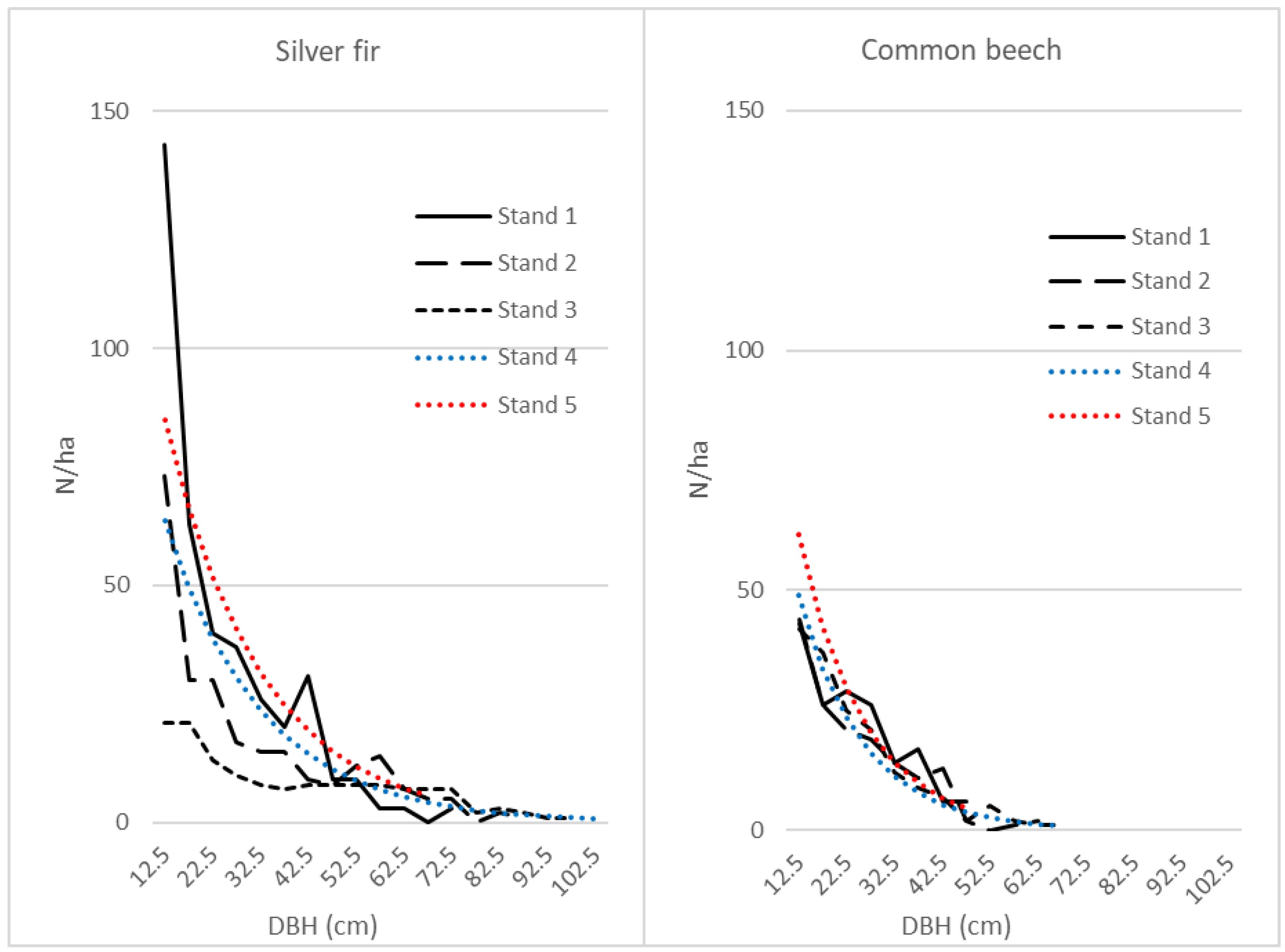
To assess the influence of these models on volume increment in representative forest stands, calculations were performed on independent data using tree diameter distributions per hectare in five stands, as presented in Figure 4. Stands 1–3 are actual forest stands from “Belevine” management unit in Gorski Kotar, Croatia. Stand 1 (Subcompartment 12a) represents an intensively managed uneven-aged stand with balanced structure. Stand 3 (Subcompartment 15a) is a non-intensively managed stand characterized by an excess of large-diameter trees and a deficit of smaller-diameter trees. Stand 2 exhibits a transitional structure between Stands 1 and 3. Stands 4 and 5 are theoretical models comprising 80% silver fir and 20% common beech by stand volume. The main difference between them lies in the predefined dimensions of cutting maturity: Stand 4 incorporates the physiological dimension of maturity, while Stand 5 applies fixed diameter thresholds—70 cm for silver fir and 50 cm for common beech. The DBH distributions for theoretical stands (4 and 5) shown in Figure 4 are adopted from Klepac’s research [27,28]. In these models, silver fir and European spruce are treated as silver fir, while common beech and other broadleaved species are grouped under common beech.
Data preparation and basic calculations were performed using Microsoft Excel, while model development and statistical analyses were conducted in Statistica 14 (TIBCO) with a significance level set at 0.05.

3. Results

Detected causes of unrealistically high or implausible increment values for individual trees were classified as follows:
  • Misidentification of adjacent trees during the second inventory.
  • Gross errors in transcription, e.g., 7.5 cm instead of 75 cm.
  • Illegible numbers in the field data forms—unclearly written or poorly corrected digits (usually a single digit).
  • Errors in caliper readings or errors caused by miscommunication between the measurer and data recorder.
  • High or low competition pressure on some plots, resulting in a below- or above-average increment of all trees on the plot, as presented in Figure 3. In these cases, data was considered as valid and retained without correction.
If detected errors were clearly identified (1–4), correction was made based on species-specific models developed from the first inventory, describing relationships between DBH and other tree variables (most commonly, total tree height or stump diameter). Following data correction, the determination coefficients of these models increased, indicating improved model fit and improvement in data quality.
After reviewing the data (Figure 1 and Figure 2), 37 of 1090 trees were checked for potential errors. The cause of errors was found and corrected for 28 (2.57%) of all trees measured in both inventories (Table 1). Approximately 30% of the corrections were related to the misidentification of trees in the second inventory. In one exceptional case, errors were identified in both inventories—in the first, a tree was replaced by an adjacent one, and in the second, one of the two was incorrectly transcribed. Trees with corrected DBH values were distributed across a total of 18 plots.
Variability in the diameter increment after DBH data correction is illustrated in Figure 5 and Figure 6, where some negative increment values still exist.
The remaining negative values of annual diameter increment are the consequence of minor measurement errors that could not be detected based on the available data. Since such measurement errors, both positive and negative, are undoubtedly present but cannot be reliably detected in the case of some other trees, excluding minor negative values would introduce bias into the dataset and subsequent statistical analysis. Accordingly, trees with minor negative increment values were left in the sample based on the assumption of normal distribution of errors with a mean value around zero [29].

3.1. Impact of Measurement Errors on Volume Calculation at Tree, Plot, and Overall Level

3.1.1. Tree Level

After data verification and correction of DBH errors at the tree level, the corresponding tree volumes were adjusted accordingly. Moreover, changes in DBH also resulted in tree expansion factor modifications, altering the number of trees per hectare represented by each individual tree. Some examples follow:
  • Tree 182 (Plot 9): Due to misidentification, the DBH was corrected from 22.8 cm to 60.1 cm, increasing the estimated tree volume from 0.4 m3 to 4.2 m3. As a consequence of this DBH adjustment, the tree’s expansion factor was recalculated based on a larger plot radius, reducing its value from 65 to 8 trees per hectare. Accordingly, volume per hectare increased from 27.2 m3/ha to 33.5 m3/ha.
  • Tree 199 (Plot 10): Second inventory DBH was corrected from 85.5 cm to 75.5 cm, reducing the estimated tree volume from 9.6 m3 to 7.3 m3. Since the tree expansion factor remained unchanged, the volume per hectare decreased from 76.2 m3/ha to 57.9 m3/ha.
  • Tree 374 (Plot 19): Due to a gross transcription error, the DBH in the second measurement was incorrectly recorded as 7.5 cm instead of 75 cm, with correction resulting in an increase in estimated tree volume from 0.0 m3 to 8.15 m3. As a consequence of the corrected DBH, the tree expansion factor increased from 0.0 to 8.0, and the volume per hectare increased from 0.0 m3/ha to 64.88 m3/ha.

3.1.2. Plot Level

Differences between original (OR) and corrected (COR) data were identified on five plots from the first inventory and on twenty-two plots from the second inventory. All plots with corrections of the first inventory data also required corrections in the second inventory data, primarily related to DBH values and tree sampling status, as previously described. Table 2 comprises results (differences) in structural elements (N, G, and V) at the plot level as a result of DBH value correction, presenting the plots with the most pronounced changes. A summary of total differences across all plots is provided in Section 3.1.3.
Changes in N, G, and V per hectare at the individual plot level (partially presented in Table 2) were primarily the result of tree dimension correction (most frequently DBH). In Plot 14, G and V changes observed in the second inventory were caused by correcting the DBH and total tree height adjustment for two trees. Specifically, an increase in DBH of one tree from the first inventory resulted in the re-estimation of total tree height in both inventories. The increased tree height led to higher G and V values, while N remained unchanged as the plot radius, and consequently, the expansion factor was not modified.
Conversely, on certain plots, observed changes in structural parameters were not attributed to the changes in tree dimensions but to the tree sampling status recorded during the second inventory. In Plot 15, one tree was included in the first inventory based on a registered horizontal distance of 19.90 m from the plot center. However, during the second inventory, the tree was classified as erroneously measured (sampling status 8), as its remeasured horizontal distance from the center of the plot exceeded the 20 m threshold. Despite the erroneous distance measurement, the tree was measured anyway during the second inventory and included in the sample, resulting in increased values of plot N, G, and V. The reason for its inclusion and the correction of sampling status are addressed in the Discussion section.
In Plot 31, DBH correction for a single tree in the second inventory significantly decreased G and V compared with the original data.
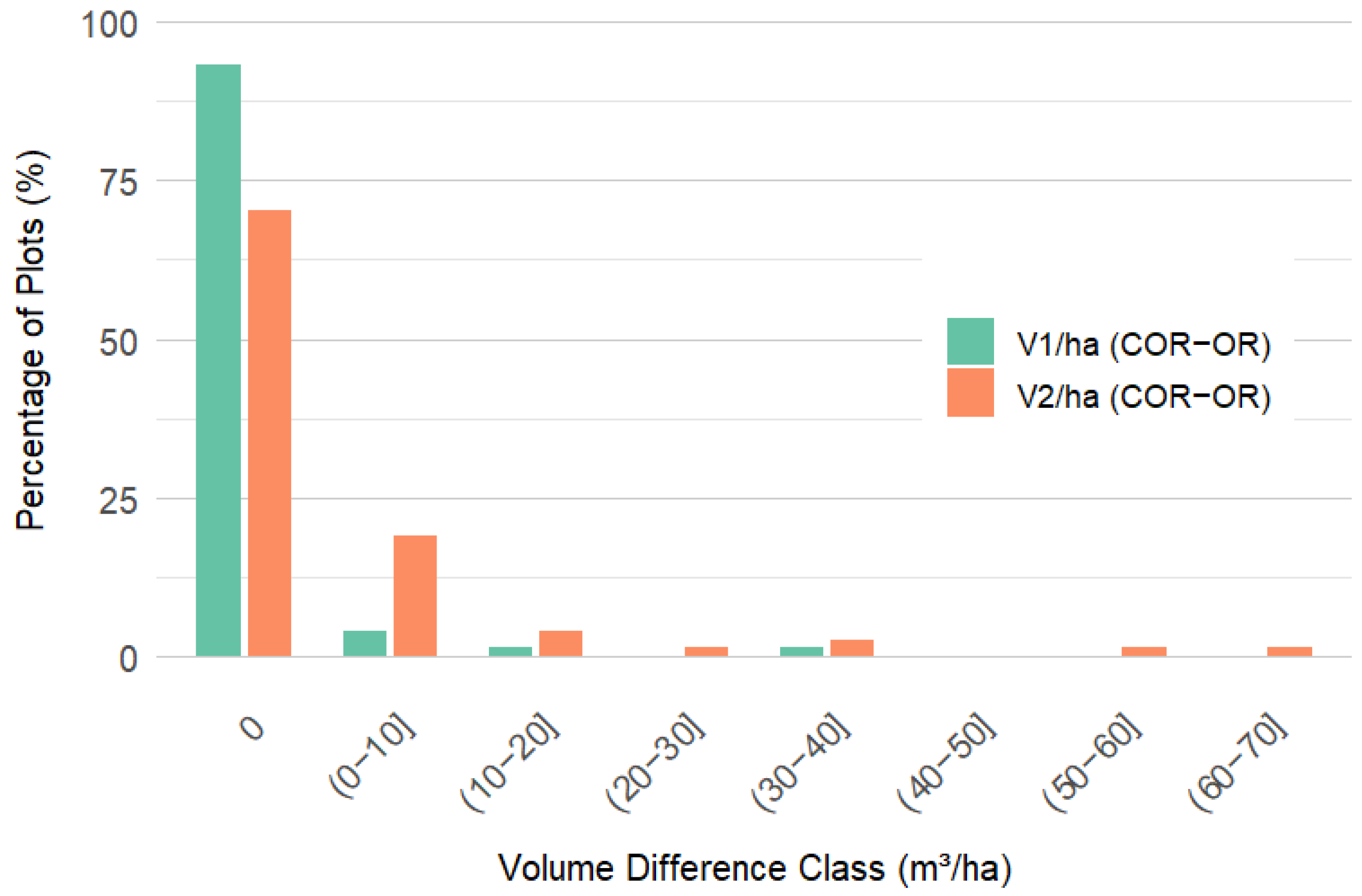
Figure 7 illustrates the frequency distribution of plot-level volume differences (expressed in percentages), between the original and corrected data for both inventories regardless of whether the corrections resulted from changes in the tree dimensions or in sampling status. On 93.2% of plots from the first inventory and 70.3% from the second inventory, the data remained unchanged, resulting in no differences in volume. On plots where differences are present, their values are minor and do not exceed 10 m3/ha. Greater volume differences (i.e., those exceeding 50 m3/ha) were less frequent, occurring in only 2.8% of plots.
A higher number of plots required corrections in the second inventory compared with the first one. The reason for this disproportion lies in the cumulative effect of multiple corrections. In the first inventory, only DBH and distances from the plot center could be corrected, whereas in the second inventory, tree misidentification errors were additionally introduced.

3.1.3. Overall Level

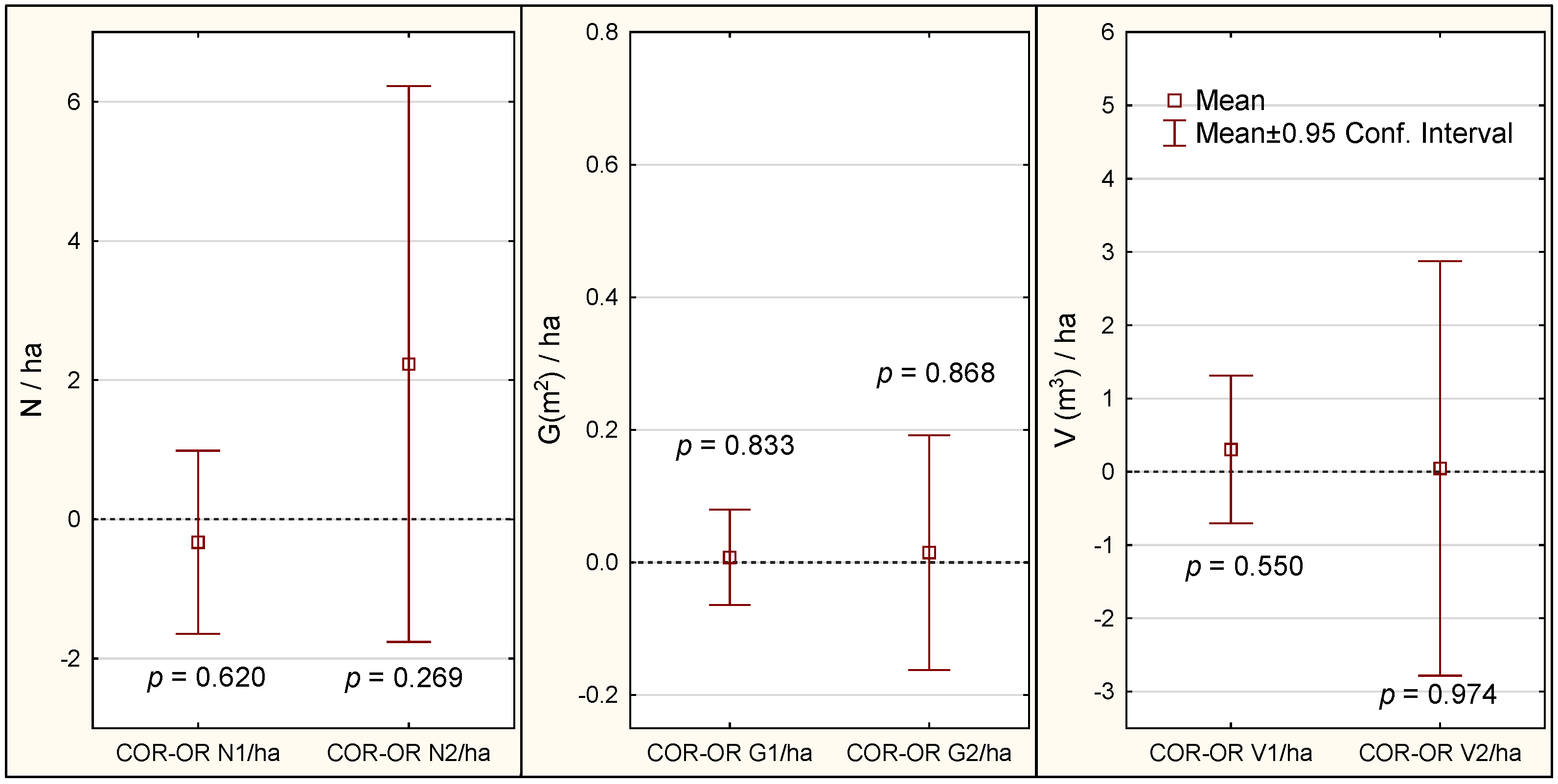
At the overall level (74 plots), differences in the N, G, and V values between the original and corrected data were negligible and not statistically significant (Figure 8). For volume, the difference was 0.30 m3/ha (0.06%) in the first inventory (p = 0.550) and 0.05 m3/ha (0.01%) in the second inventory (p = 0.974).

3.2. Aditionally Observed Ambiguities and Data Inconsistencies

Several additional ambiguities or inconsistencies were identified during the analyses, which are addressed below.
For numerous trees, the sampling status was unclear—particularly for those located near the plot boundary or DBH close to the threshold. For example, if a tree had a DBH of 56.5 cm in the second inventory and a horizontal distance of 19.95 m from the plot center and it was not measured in the first inventory, its sampling status could have been assigned as 2a—assuming that its DBH did not exceed the 50 cm threshold at the time of the first inventory. Alternatively, it could have been assigned status 10 if the DBH threshold had already been exceeded, but the horizontal distance was incorrectly measured (e.g., 20.03 m). Also, in the second inventory, on one particular plot, sampling status 1 (remeasured trees) was assigned to trees that had not been measured in the first inventory. Although these errors did not affect volume calculations in this specific case, they can have a significant impact in other analyses—particularly when only trees with specific sampling status are included [20]. Several trees that were measured in the first inventory could not be located in the second inventory—not even a stump was found (sampling status 7)—indicating other types of errors, most likely an incorrectly recorded azimuth or horizontal distance.
A total of 75 out of 1090 trees measured in both inventories (6.88%) had an increase in DBH in the second inventory that caused them to exceed the threshold dimension of the larger circle. This decreased the tree expansion factor: a tree with DBH < 30 cm represents 65.0 trees per hectare, a tree with 30 ≤ DBH < 50 cm represents 18.8 trees, and a tree with DBH ≥ 50 cm represents 8.0 trees per hectare (if the plot is fully covered with forest). A similar pattern is present for the other variables, namely G and V.
Plot 17 serves as a clear example of how changes in the expansion factor affect the volume calculation. No cutting activities were conducted on this plot, no new trees were measured, and all trees from the first measurement were alive during the second measurement. All trees had an increased DBH values without any data correction. In four out of a total of eight trees on the plot, the expansion factor decreased due to an increase in DBH, which caused their transition into a circle with a larger radius. As a result, the values of N, G, and V in the second measurement decreased compared with the first. Specifically, N/ha declined from 330 to 248, G/ha from 42.3 to 36.9 m2/ha, and V/ha from 605.2 to 541.8 m3/ha.

3.3. Diameter Increment Models and Volume Increment

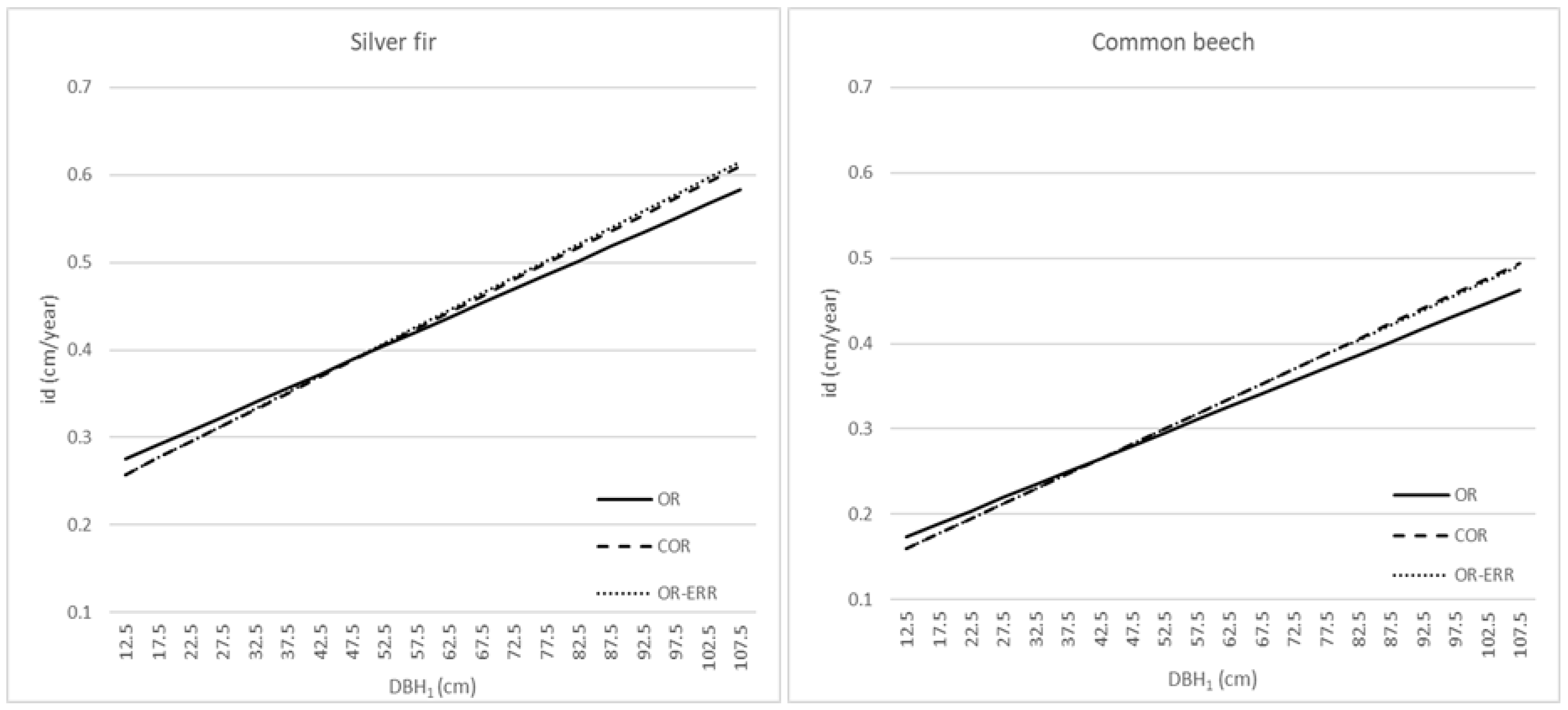
Diameter increment models as a function of DBH were developed using three datasets, original data (OR), corrected data (COR), and original data excluding illogical or incorrect values (OR-ERR), separately for silver fir and common beech (Table 3 and Figure 9).
All models proved to be statistically significant, although the coefficient of determination, R2 remained low due to substantial variability in tree increment data. The correction or exclusion of erroneous measurements led to an expected improvement in model performance, with explained variance increasing to 0.09 for fir and 0.14 for beech. Repeated measures ANOVA (RM ANOVA) indicated statistical significance between the compared models for both species. Dunnett’s post hoc test (with the COR model as a reference) proved the difference in the OR model for both species, as well as in the OR-ERR model for fir (Table 3).
Figure 9 clearly shows that the diameter increment models developed from corrected data (COR) differ significantly from the models developed from the original data (OR), and the COR models closely align with those excluding the corrected data (OR-ERR). All three models estimate similar diameter increment values for DBH of about 50 cm (silver fir) and 40 cm (common beech). The COR and COR-ERR models estimate lower diameter increment in trees with a smaller DBH, and, conversely, higher diameter increment in trees with a larger DBH when compared with the OR model.
Given that practical forest management prioritizes the influence of model differences on actual stand-level volume increment estimation, volume increments were calculated (Table 4) according to model outputs for three actual (Stands 1–3) and two theoretic stands (Stands 4–5) as previously described.
Volume increment differences in the representative forest stands resulting from the choice of applied model are relatively small, with a maximum of up to 3%. As expected, the smallest differences were observed between the corrected model (COR) and the model excluding trees with corrected measurements (OR-ERR). For silver fir, differences were slightly lower than for common beech, although variation between stands was more pronounced. Depending on the stand, the direction of the difference varied; however, in most cases (for both species), the corrected (COR) and OR-ERR models produced lower volume increment estimates compared with the original model (OR).

4. Discussion

4.1. Detected Causes of Large or Impossible Increment Values for Individual Trees

Measurement errors were identified from diameter increments outside the expected range [30], prompting a review of the measured data for trees with unusually large or impossible increment values. Analysis of individual tree increments revealed that approximately 30% of the errors were caused by misordering of trees during measurement, as also noted in previous studies [26,30]. This type of error was the primary reason for the higher number of corrections in the second inventory and for the greater differences between the corrected data and the original values, compared with the first measurement (Figure 7). The most frequent type of misidentification in this study involved trees of the same species located close to each other. This issue appeared because during the second inventory, measurers did not have access to the initial DBH (DBH1) avoid measurement bias. Consequently, misordering of trees in the second inventory occurred, especially when trees in the first inventory were not recorded in increasing azimuth order (i.e., tree ID order did not correspond to an increase in the azimuth value), and this issue was not adequately addressed during the second inventory. These instances suggest that insufficient attention was paid [31] during the second inventory and that a detailed routine data collection control [32] related to tree positioning within plots was not properly implemented. These findings also highlight the importance of clear measurement procedures, proper training of measurers, and rigorous verification of both collected data and resulting outputs.
The analysis of increment data revealed errors related to the transcription of field-form values, including digit addition or omission, decimal point misplacement, and incorrect number recording in the field forms. These errors were typically identified through excessively high or unusually low increment values if compared with expected values [30,32,33] and were confirmed through verification of the original field forms. Regarding incorrect number registration, the most frequent issue involved overwritten digits, where the newly written digit was unclear. The use of a field computer would eliminate this type of error entirely, although it may introduce some other types of constraints.
Errors resulting from poor communication between the measurer and the data recorder were notably more difficult to explain. To address them, graphical models of the relationship between tree height and DBH were used [30] as well as stump diameter and DBH models for each species within individual plots. Trees with extreme increment values deviated notably from these models and were corrected accordingly. Attributes such as tree height and stump diameter were measured only during the first inventory due to time and cost constraints [34], which represents an acceptable compromise between precision and efficiency [3]. Such errors could be reduced by using a digital caliper or by articulating each digit separately during measurement—e.g., stating 57 as “five-seven”.
Sketches of plots with tree positions would be beneficial for measurers during repeated measurements, helping to prevent misidentification of nearby trees. These analyses were conducted only for the plots where diameter increment notably differed from average values, followed by an assessment of whether the observed increments were realistic under the given conditions. Growth models for individual trees that incorporate site characteristics and stand structure would also enable such evaluations at the tree level. In structurally and site-diverse plot samples, this approach would certainly be more effective than relying on predefined threshold values, as seen in other studies [30,33].
Negative values of diameter increment also reported in other research [26,30,35] were not corrected due to the absence of a clear cause or correction method. These negative diameter increment values may be caused by multiple cumulative effects, such as minor DBH increment combined with tree ellipticity or the fact that the scribed mark on the tree is 2–3 cm wide [12], as well as other DBH measurement errors. As Božić et al. [36] elaborated, such errors include tilting the caliper jaws downward or upward during measurement, measuring diameter without touching the tree with the caliper ruler, applying excessive pressure on the sliding jaw (which can result in smaller or larger diameters than the actual one), and inconsistencies between different measurers. These minor negative increment values were not corrected because similar positive values—either underestimating or overestimating growth—may also exist but cannot be identified. Assuming a normal distribution of errors [29], excluding only such negative increments would introduce a systematic positive bias into the dataset.
The listed diameter measurement errors must be well understood and minimized as much as possible. In this study (Table 1), such errors were identified in only 2.57% trees, but similar errors have been documented in other surveys [35], where DBH2 < DBH1 occurred in 3.7% of trees, DBH3 < DBH2 in 1.9%, and DBH4 < DBH3 in 3.3% of trees. These discrepancies are attributed to misuse of the measuring device, inaccurate readings, or different individuals measuring the tree at varying points along the stem.

4.2. Influence of Errors on Volume Calculation at Tree, Plot, and Overall Level

Errors in diameter measurement affect the values of basal area and volume as well as the calculation of the tree number, basal area, and volume that each tree represents per hectare. The larger the measurement errors, the greater the discrepancies in calculated values at the individual tree level. Not correcting these errors will influence subsequent stages of data processing and analysis [30].
Differences in plot-level data calculations (Table 2) indicate that errors appear the most frequently due to the DBH measurement error, although other sources can also contribute, such as incorrectly assigned sampling status and/or distance errors. Discrepancies in horizontal distance measurements using a Vertex device occurred due to several possible causes: the transponder was not positioned along the central axis of the tree (relative to the plot center); the measurer with the instrument was not standing exactly next to the range pole representing the plot center; or the range pole was tilted during measurement. A range pole displaced or tilted from the specified plot center causes incorrect distance measurement and leads to the omission or erroneous inclusion of trees near the plot edge. In forest practice, when measuring distances on flat terrain, measurers often subconsciously lean toward the tree being measured, potentially causing a systematic positive error due to the inclusion of trees outside the plot boundary. On a steep terrain, surveyors tend to lean into the slope for stability, which can result in the exclusion of trees downslope and the inclusion of trees upslope. Given that the number of included and excluded trees on a slope is approximately equal, it can be assumed that this type of error cancels itself out. To minimize such errors, it is advisable to use a range pole with a circular bubble level. Additionally, the apparent “distancing” of trees in later measurements may result from diameter growth, as the permanently marked point for DBH measurement may no longer represent the central axis of the tree. Regardless of the cause, it is recommended that all trees near the plot edge be carefully rechecked for distance during the initial inventory. If they belong to the sample during the first measurement, their distance should not be rechecked in subsequent inventories. This checking in later inventories should apply only to ingrowth and nongrowth trees positioned at the plot edge, which are expected to be few.
For most plots, no corrections were made to either the tree sampling status or the recorded values, and corrections generally resulted in minor differences between the original and adjusted volume values.
At the overall level (74 plots), differences in N, G, and V between the original and corrected data were minor and statistically not significant (Figure 8), indicating a normal distribution of positive and negative differences in the sample. This supports the assumption of normal distribution of errors [29] and suggests the absence of systematic error during the measurement and data processing stages. The second inventory showed greater variability in the differences in all three structural parameters (Figure 8), corresponding to the higher number of corrections made—whether in tree dimensions, distance from plot the center, or sampling status.

4.3. Aditionally Observed Ambiguities and Data Inconsistencies

During repeated measurements, trees may be assigned to one of eleven sampling status categories, some of which are very similar. Therefore, measurers should thoroughly familiarize themselves with these categories prior to measurement. In certain cases, even thorough preparation is not sufficient, as demonstrated in the results where both diameter and distance were close to the threshold value. If the distance measurement procedure mentioned in the previous subsection is properly followed, sampling status category 10 should not occur. Theoretically, in the case of elliptical trees, significant asymmetric growth could cause one side of the diameter to shift closer to or farther from the plot center over time, potentially resulting in the tree “entering” or “exiting” the sample. However, the likelihood of a tree being both elliptical and located at the plot edge is extremely low. Errors related to tree sampling status categorization have also been discussed in other studies, including cases where live trees recorded during the first inventory were later classified as ingrowth trees, and a few dead trees were mistakenly “revived” [30].
Scott [16] provides an overview of various approaches taken by different authors regarding the use of expansion factors for survivor trees across measurement periods (e.g., using the expansion factor from the first measurement, assigning a unique factor for each measurement, or applying the factor from the remeasurement). Van Deusen et al. [37] use a distinct expansion factor for each inventory, which was also the approach adopted in our study. They note that this can lead to negative growth estimates for survivor trees, which was indeed observed in our research, on several trees in Plot 17. It is important to recognize that the expansion factor may decrease due to changes in tree diameter but also due to changes in plot status—specifically, if the proportion of forested area within the plot increases or decreases. In this study, no changes in plot forest cover were recorded. However, in future cases involving such changes, particular attention should be paid to accurate boundary mapping of forested areas within plots, as emphasized by Scott et al. [38].

4.4. Diameter Increment Models and Volume Increment

Forest inventory data represent a significant investment of time and financial resources and serve as a valuable foundation for developing growth estimation models [8]. However, unreliable or biased DBH increment data cannot be used as a valid basis for volume increment estimation [39].
Our results (Figure 9 and Table 4) indicate that increment models derived from original data differ from those based on corrected datasets.
The low explained variation in models due to the high data variability can be explained by site variation and uneven-aged structure. However, a stratification of the sample that would improve site-specific models was not performed because it is not considered important for our study.
The deviation of volume increment in the representative forest stands between the COR and COR-ERR models is minor for fir and negligible for beech. Differences compared with the original model (OR) are slightly larger but still below 1% for fir and below 2.5% for beech. Bigger differences between volume increment by different models can be observed in the stand with a greater share of thin trees (Figure 4 and Table 4).

4.5. Final Remarks

When dealing with partially erroneous data, best practice suggests correcting the data—if the cause is known—rather than omitting it from the sample [30,35]. Results from this study indicate that individual errors can significantly impact volume calculations at the tree and plot levels, whereas their influence at the overall level is negligible. Thus, in such cases, whether the erroneous data are corrected may not impact the overall outcomes; however, omitting these data can introduce a systematic negative bias in volume estimation.
Nearly identical models were obtained when the data were corrected or erroneous data were excluded from the sample (Table 3 and Figure 9), and this was consistently reflected by the volume increment in the representative stands (Table 4). Although the diameter increment models derived from the original and corrected datasets differ statistically significantly, their practical application for estimating stand-level volume increment shows minimal differences (Table 4). Ultimately, it is up to end users to define an acceptable tolerance threshold for these discrepancies.
Identifying and correcting measurement errors, as performed in this study, is a time-consuming and costly process. It is likely that not all errors were detected, and consequently, not all were corrected. To improve this process, specialized software for data management, computation, and analysis exists [15,40], including integrated data validation procedures, as proposed by Stierlin [32]. Such a system should incorporate increment models based on site and stand characteristics for individual tree species, enabling the identification of potential anomalies.
A program embedded in a field computer, equipped with visualization of tree positions within the plot [33], would assist in field measurements by reducing the likelihood of misidentifying neighboring trees, facilitating the registration of harvested [2] or newly included trees. The software should include a feature to lock measurement data upon completion, after which built-in algorithms would assess whether diameter changes for individual trees are plausible, flagging potential errors for immediate field verification and correction [18,41], thereby minimizing the overall error rate [3]. According to Stierlin [32], field-computer-based data validation did not detect all unreliable measurements, with many errors identified and resolved only during subsequent office-based verification.
During field measurements, it is essential to ensure that the caliper is placed at the designated measurement point, which must be periodically renewed [42], and that standardized measurement procedures are strictly followed. Failure to adhere to these protocols undoubtedly enhances the possibility of notable measurement errors [36]. As highlighted by Curtis et al. [21], photographs are a valuable tool for monitoring changes over time or tree identification during the remeasurement process [20]. Existing and new tools such as Field-Map [40], as well as remote sensing technologies [43] that are being integrated into the forest inventory, should reduce measurement errors.
During the continuous inventory, control measurement should be conducted on the randomly selected subsample—unknown to the measurers. This approach enables the detection of both random and systematic measurement errors [19,20]. Moreover, awareness of control measurement motivates the measurers to follow established measurement protocols [41]. However, since control measurements are typically conducted with a time delay, part of the observed discrepancies in DBH measurements may be attributed to the passage of time. Specifically, as the interval between two measurements (in weeks) increases, the difference in recorded DBH values tends to increase linearly [19]. Therefore, it is recommended that continuous measurements on plots be conducted outside the vegetation period.
Effective use of permanent plot data to monitor changes requires that these plots remain representative of broader forest conditions. This means that forest management practices within the plots must mirror those applied around them, particularly in surrounding stands where no plots have been established. The most reliable way to ensure representativeness is by keeping plot locations undisclosed to local foresters [35] and marking plots subtly [13], as applied in this study. However, horizontal lines on the trees made with a timber scribe indicate that measurements were conducted, which may consciously (or unconsciously) influence forest management practices [44]. In such cases, to validate the reliability and representativeness of permanent plots, it is advisable to complement data collection with data from temporary plots [44]. This dual approach helps to ensure that observed changes are not biased by plot visibility or altered management practices.
This study is based on available field data from the CRONFI which enabled an in-depth analysis of measurement errors. The aim of this paper was to point out identified errors and help in avoiding them in future and/or in similar inventories rather than to offer a methodology for identifying and correcting measurement errors.

5. Conclusions

This study shows that measurement errors occurred in only 2.57% of measured trees and 2.8% plots, with different outcomes depending on the level and purpose of inventory data. Gross errors substantially impact individual tree attributes (the maximum single-tree volume changing from 0.0 to 8.15 m3 after correction), and the stand structure at the plot level (a change in plot volume per hectare ranging from −55.28 to 62.88 m3/ha). However, positive and negative differences tend to cancel out at the overall (population) level with an increasing sample size, resulting in a minimal impact on stand structure (volume difference of up to 0.30 m3/ha). This suggests that the errors in inventory data should be corrected if the results are to be used at the tree or plot level, though it would not be necessary at the overall area level. Ignoring errors would lead to inconsistent results at the plot or tree level, while excluding erroneous data would induce negative bias.
When using data to develop increment models, it is advisable to conduct the data correction—a process that may benefit from new technological solutions (e.g., improved instruments or software). According to our results, even omission of erroneous data would be an acceptable option for modeling due to minimal differences in estimated stand volume increment between the corrected and reduced datasets (average −0.36% for silver fir and −0.11% for common beech). Even no data correction could be justified if the differences (errors) in calculated volume increment based on the original (uncorrected) data are acceptable to the final users (average −0.91% for silver fir and −2.31% for common beech).
This study showed exact outcomes of errors in studied mixed fir–beech stands and has practical utility for the CRONFI procedure, but it can also serve as a useful comparison for other inventory systems with similar (or different) procedures for identifying, quantifying, and correcting measurement errors. Given that measurement errors appearing in CRONFI are similar in other inventories worldwide, our findings could be generally useful despite the differences in measurement protocols. However, wider application of procedures used in this research would require proper adjustments and some additional assumptions. Since errors are an inevitable part of any measurement process, this topic will be relevant in future, with automated and computation tools taking on a more important role.

Author Contributions

Conceptualization, M.B. and F.Đ.; Methodology, M.B. and M.V.; Formal Analysis, M.B., F.Đ., M.V. and I.B.; Investigation, M.B., E.G., and I.B.; Data Curation, M.B.; Writing—Original Draft Preparation, M.B. and F.Đ.; Writing—Review and Editing, M.B., M.V., I.B., and E.G.; Visualization, M.B., I.B. and M.V. All authors have read and agreed to the published version of the manuscript.

Funding

This research was funded by the Croatian Science Foundation (project: The impact of management and climate change on the growth dynamics of fir trees and stands in the Dinaric region of Croatia; project number IP-2018-01-8820).

Data Availability Statement

The data presented in this study are available on request from the corresponding author.

Conflicts of Interest

Author Filip Đureta was employed by the company Croatian Forests Ltd. The remaining authors declare that the research was conducted in the absence of any commercial or financial relationships that could be construed as a potential conflict of interest.

References

  1. Holt, M.W. Data Quality Assessment of Continuous Forest Inventory on State Forest Lands in Tennessee. Master’s Thesis, University of Tennessee, Knoxville, TN, USA, 2014. [Google Scholar]
  2. Gschwantner, T.; Lanz, A.; Vidal, C.; Tomter, S.M.; Kuliešis, A.; Rondeux, J.; Alberdi, I.; Vestmanis, R.; Lawrence, M. Comparison of methods used in European National Forest Inventories for the estimation of volume increment: Towards harmonisation. Ann. For. Sci. 2016, 73, 807–821. [Google Scholar] [CrossRef]
  3. McRoberts, R.E.; Tomppo, E.O.; Czaplewski, R.L. Sampling designs for national forest assessments. In Knowledge Reference for National Forest Assessments; FAO: Rome, Italy, 2015; pp. 23–40. [Google Scholar]
  4. Pravilnik o Uređivanju Šuma. Narodne Novine; Croatian Parliament: Zagreb, Croatia, 2018; Issue 97. [Google Scholar]
  5. Schöpfer, W. Die Auswirkungen von Zuwachsbohrungen in Fichtenbeständen. Allg. Forst-und Jagdztg. 1962, 133, 43–50. [Google Scholar]
  6. Klepac, D. Rast i Prirast Šumskih Vrsta Drveća i Sastojina; Nakladni Zavod Znanje: Zagreb, Croatia, 1963; p. 144. [Google Scholar]
  7. Soares, P.; Tomé, M.; Skovsgaard, J.P.; Vanclay, J.K. Evaluating a growth model for forest management using continuous forest inventory data. For. Ecol. Manag. 1995, 71, 251–265. [Google Scholar] [CrossRef]
  8. West, P. Application of regression analysis to inventory data with measurements on successive occasions. For. Ecol. Manag. 1995, 71, 103–115. [Google Scholar] [CrossRef]
  9. Ranneby, B.; Rovainen, E. On the determination of time intervals between remeasurements of permanent plots. For. Ecol. Manag. 1995, 71, 195–202. [Google Scholar] [CrossRef]
  10. Kleinn, C.; Bhandari, N.; Fehrmann, L. Observations and measurements. In FAO National Forest Assessment: Field Manual for Sample-Based Inventory; FAO: Rome, Italy, 2006; pp. 1–9. [Google Scholar]
  11. Nanos, N.; Sjöstedt de Luna, S. Fitting diameter distribution models to data from forest inventories with concentric plot design. For. Syst. 2017, 26, e01S. [Google Scholar] [CrossRef]
  12. Čavlović, J.; Božić, M. Nacionalna Inventura Šuma u Hrvatskoj—Metode Terenskog Prikupljanja Podataka; Šumarski Fakultet Sveučilišta u Zagrebu: Zagreb, Croatia, 2008; ISBN 978-953-292-007-9. [Google Scholar]
  13. Köhl, M.; Scott, C.T.; Zingg, A. Evaluation of permanent sample surveys for growth and yield studies: A Swiss example. For. Ecol. Manag. 1995, 71, 187–194. [Google Scholar] [CrossRef]
  14. King, S.L.; Arner, S.L. Estimating Previous Diameter for Ingrowth Trees on Remeasured Horizontal Point Samples; General Technical Report NE-165; USDA Forest Service, Northeastern Forest Experiment Station: Radnor, PA, USA, 1992. [Google Scholar]
  15. Poso, S.; Waite, M.-L. Calculation and comparison of different permanent sample plot types. Silva Fennica 1995, 29, 5554. [Google Scholar] [CrossRef]
  16. Scott, C.T. An Overview of Fixed Versus Variable-Radius Plots for Successive Inventories; USDA Forest Service, Northeastern Forest Experiment Station: Radnor, PA, USA, 1989. [Google Scholar]
  17. Hébert, J.; Bourland, N.; Rondeux, J. Estimation de l’accroissement et de la production forestière à l’aide de placettes permanentes concentriques. Ann. For. Sci. 2005, 62, 229–236. [Google Scholar] [CrossRef]
  18. Castillo, P.S.B.; Reams, G.A.; Smith, W.B. Forest Inventory and Analysis Fiscal Year 2017 Business Report; Forest Service FS-1131; United States Department of Agriculture, Forest Service, Research and Development: Washington, DC, USA, 2019. [Google Scholar]
  19. Kaufmann, E.; Schwyzer, A. Control survey of the terrestrial inventory. In Swiss National Forest Inventory: Methods and Models of the Second Assessment; Brassel, P., Lischke, H., Eds.; Swiss Federal Research Institute WSL: Birmensdorf, Switzerland, 2001; pp. 114–121. [Google Scholar]
  20. Čavlović, J. Nacionalna inventura Šuma Republike Hrvatske—Priručnik za Provedbu Druge Inventure Šuma; Ministarstvo Poljoprivrede: Zagreb, Croatia, 2017; 210p. [Google Scholar]
  21. Curtis, R.O.; Marshall, D.D. Permanent-Plot Procedures for Silvicultural and Yield Research; General Technical Report PNW-GTR-634; U.S. Department of Agriculture, Forest Service, Pacific Northwest Research Station: Portland, OR, USA, 2005; 86p. [Google Scholar]
  22. Schumacher, F.X.; Hall, F.S. Logarithmic Expression of Timber-Tree Volume. J. Agric. Res. 1933, 47, 719–734. [Google Scholar]
  23. Čavlović, J.; Božić, M.; Kušan, V.; Antonić, O.; Nöthig, V. Pilot inventura šumskih resursa: Testiranje idejnog i operativnog plana nacionalne inventure šumskih resursa Republike Hrvatske; Šumarski Fakultet: Zagreb, Croatia; Ministarstvo Poljoprivrede, Šumarstva i Vodnoga Gospodarstva: Zagreb, Croatia, 2005. [Google Scholar]
  24. Michailoff, I. Zahlenmässiges Verfahren für die Ausführung der Bestandeshöhenkurven. Forstwissenschaftliches Cent. Tharandter Forstl. Jahrb. 1943, 6, 273–279. [Google Scholar]
  25. Sharma, R.P.; Vacek, Z.; Vacek, S. Nonlinear mixed effect height–diameter model for mixed species forests in the central part of the Czech Republic. J. For. Sci. 2016, 62, 470–484. [Google Scholar] [CrossRef]
  26. Jin, X.; Pukkala, T.; Li, F.; Dong, L.-H. Developing growth models for tree plantations using inadequate data—A case for Korean pine in Northeast China. Silva Fenn. 2019, 53, 10217. [Google Scholar] [CrossRef]
  27. Klepac, D. Novi Sistem Uređivanja Prebornih Šuma; Šumarski Fakultet Sveučilišta u Zagrebu: Zagreb, Croatia, 1961; Reprinted by Hrvatske Šume: Zagreb, Croatia, 1997; Available online: https://www.sumari.hr/biblio/pdf/10787.pdf (accessed on 12 November 2025).
  28. Klepac, D. Novi sistem Uređivanja Prebornih Šuma (dodatak); Poljoprivredno šumarska komora SR Hrvatske: Zagreb, Croatia, 1962. [Google Scholar]
  29. Westfall, J.A.; Patterson, P.L. Measurement variability error for estimates of volume change. Can. J. For. Res. 2007, 37, 2201–2210. [Google Scholar] [CrossRef]
  30. Bonnor, G.M.; De Jong, R.J.; Boudewyn, P.; Flewelling, J.W. Data and model validation methods used in developing the STIM growth model. Forskningsserien 1993, 3, 122–128. [Google Scholar]
  31. Magnussen, S.; Reed, D. Modelling for estimation and monitoring. In National Forest Assessments—Experiences from FAO Projects 2000–2005; FAO/IUFRO: Rome, Italy, 2004; pp. 111–136. [Google Scholar]
  32. Stierlin, H.R. Criteria and provisions for quality assurance. In Swiss National Forest Inventory: Methods and Models of the Second Assessment; Brassel, P., Lischke, H., Eds.; Swiss Federal Research Institute WSL: Birmensdorf, Switzerland, 2001; pp. 281–289. [Google Scholar]
  33. Kindermann, G.E.; Kristöfel, F.; Neumann, M.; Rössler, G.; Ledermann, T.; Schueler, S. 109 years of forest growth measurements from individual Norway spruce trees. Sci. Data 2018, 5, 180077. [Google Scholar] [CrossRef] [PubMed]
  34. Auclair, D. Measurement errors in forest biomass estimation. In Estimating Tree Biomass Regressions and Their Error, Proceedings of the Workshop on Tree Biomass Regression Functions and Their Contribution to the Error of Forest Inventory Estimates, Syracuse, NY, USA, 26–30 May 1986; USDA Forest Service, Northeastern Forest Experiment Station: Syracuse, NY, USA, 1987; pp. 133–138. [Google Scholar]
  35. Eberhardt, D.; Green, E.J. Diameter prediction for correcting continuous forest inventory data. North. J. Appl. For. 1991, 8, 76–82. [Google Scholar] [CrossRef]
  36. Božić, M.; Đureta, F.; Goršić, E.; Vedriš, M. Utjecaj mjeritelja te pogrešaka pri izmjeri na izmjereni promjer stabla. Šum. List 2020, 144, 233–245. [Google Scholar] [CrossRef]
  37. Van Deusen, P.C.; Dell, T.R.; Thomas, C.E. Volume growth estimation from permanent horizontal points. For. Sci. 1986, 32, 415–422. [Google Scholar] [CrossRef]
  38. Scott, C.T.; Bechtold, W.A. Techniques and computations for mapping plot clusters that straddle stand boundaries. For. Sci. Monogr. 1995, 31, 46–61. [Google Scholar] [CrossRef]
  39. Adlard, P.G. Myth and reality in growth estimation. In Growth and Yield Estimation from Successive Forest Inventories; Forskningscentret for Skov og Landskab: Lyngby, Denmark, 1993; pp. 1–9. [Google Scholar]
  40. Černý, M.; Apltauer, J.; Cienciala, E. Přesnost měření nadzemní biomasy stojících buků technologickou sestavou Field-Map (Accuracy of Shoot Biomass Measurement of Standing Beech Trees with Field-Map Technology). Zprávy Lesn. Výzkumu 2006, 51, 36–40. [Google Scholar]
  41. Berger, A.; Gschwantner, T.; Gabler, K.; Schadauer, K. Analysis of Tree Measurement Errors in the Austrian National Forest Inventory. Austrian J. For. Sci. 2012, 129, 153–181. [Google Scholar]
  42. Byrne, J.C. Maintaining a permanent plot data base for growth and yield research: Solutions to some recurring problems. In Growth and Yield Estimation from Successive Inventories; Vanclay, J.K., Skovsgaard, J.D., Gertner, G.Z., Eds.; Forskningscentret for Skov og Landskab: Lyngby, Denmark, 1993; pp. 10–17. [Google Scholar]
  43. Coops, N.C.; Tompalski, P.; Goodbody, T.R.H.; Achim, A.; Mulverhill, C. Framework for Near Real-Time Forest Inventory Using Multi-Source Remote Sensing Data. Forestry 2023, 96, 1–19. [Google Scholar] [CrossRef]
  44. Köhl, M. Inventory concept NFI2. In Swiss National Forest Inventory: Methods and Models of the Second Assessment; Brassel, P., Lischke, H., Eds.; Swiss Federal Research Institute WSL: Birmensdorf, Switzerland, 2001; pp. 19–44. [Google Scholar]
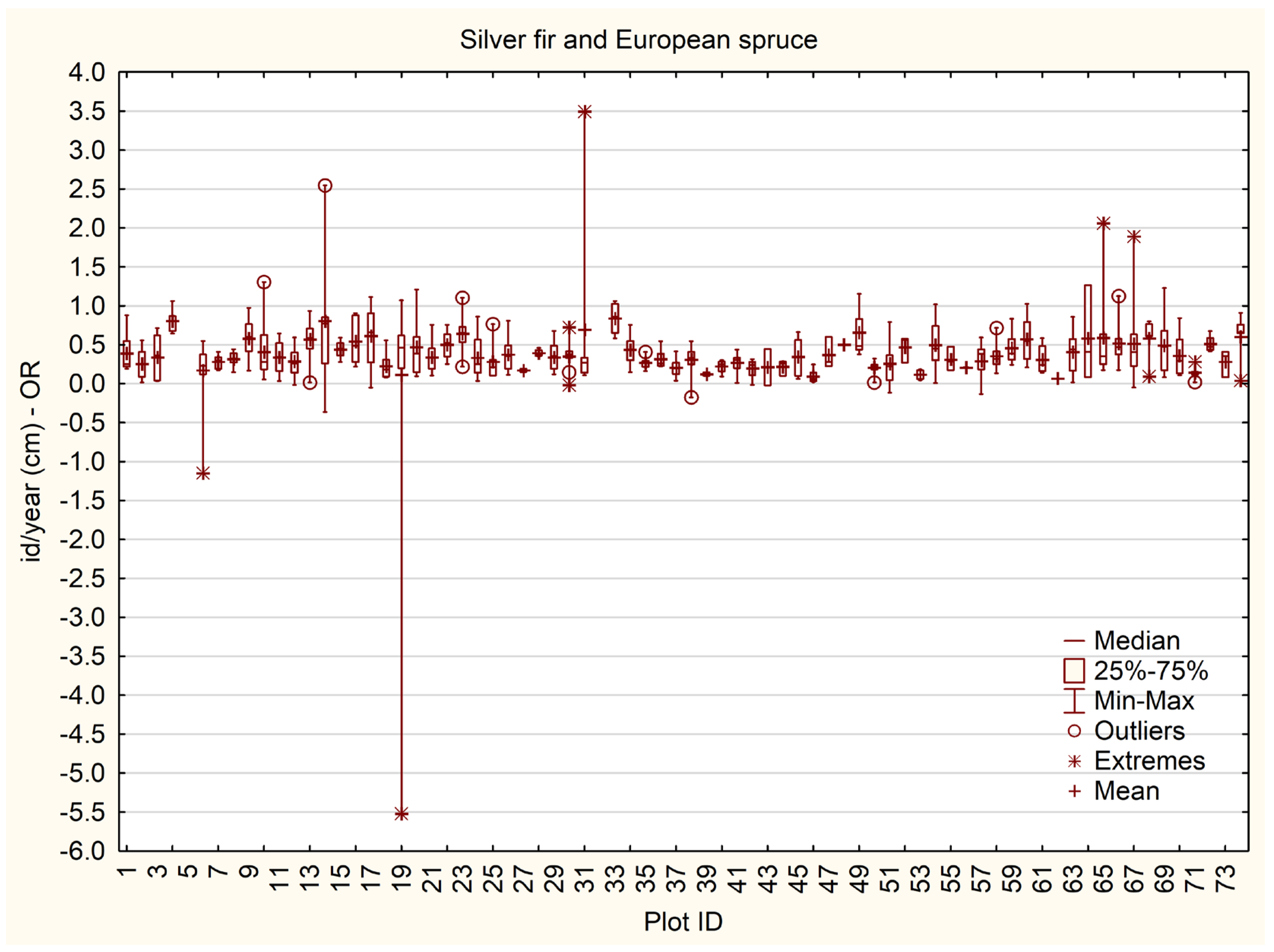
Figure 1. Annual diameter increment of silver fir and European spruce by plot, calculated from original DBH data (OR).
Forests 16 01810 g001
Figure 2. Annual diameter increment of common beech and other broadleaved (OB) species by plot, calculated from original DBH data (OR).
Forests 16 01810 g002
Figure 3. Spatial distribution of trees on (a) Plot 4 and (b) Plot 27, and comparison between plot and sample mean diameter increment and basal area on (c) Plot 4 and (d) Plot 27. Circle size represents tree DBH scaled relative to other trees within the same plot but not proportional to the plot area. Dashed circles indicate trees that were harvested. Aa—Abies alba, Pa—Picea abies, Fs—Fagus sylvatica, OB—other broadleaved.
Forests 16 01810 g003
Figure 4. Tree diameter distribution for three representative stands (1–3) and two theoretical (model) stands (4 and 5) used for volume increment calculation.
Forests 16 01810 g004
Figure 5. Annual diameter increment of silver fir and European spruce by plot, calculated after DBH data correction (COR).
Forests 16 01810 g005
Figure 6. Annual diameter increment of common beech and other broadleaved (OB) species by plot, calculated after DBH data correction (COR).
Forests 16 01810 g006
Figure 7. Frequency distribution of plot-level volume differences, expressed as percentages (%), between the original (OR) and corrected data (COR) for first (V1) and second (V2) inventory.
Forests 16 01810 g007
Figure 8. Differences in N (left), G (middle), and V (right) between original (OR) and corrected (COR) data from the first (1) and second (2) inventories. Boxes represent mean values; whiskers indicate 95% confidence intervals, and p values represent t-test probabilities.
Forests 16 01810 g008
Figure 9. Diameter increment models with the original (OR), corrected (COR), and data excluding the erroneous data (OR-ERR) for silver fir (left) and common beech (right).
Forests 16 01810 g009
Table 1. Trees whose DBH was corrected due to measurement errors.
Tree SpeciesNumber
Abies alba10/481
Fagus sylvatica4/426
Picea abies1/66
Acer pseudoplatanus3/46
Corylus avellana1/1
Ulmus glabra1/3
Tilia platyphyllos8/48
Total28/1090
Table 2. Differences between corrected (COR) and original (OR) per hectare values of number of trees (N), basal area (G), and volume (V) on selected plots for both the first and second measurements (labels 1 and 2).
Plot IDCOR-OR N1/haCOR-OR G1/haCOR-OR V1/haCOR-OR N2/haCOR-OR G2/haCOR-OR V2/ha
610.880.326.450.000.004.55
140.001.9431.160.000.793.97
150.000.000.007.962.3034.68
190.000.000.007.962.3762.88
310.000.000.000.00−3.63−55.28
480.000.000.00129.922.197.24
5210.880.627.36−10.88−1.09−9.25
Table 3. Linear regression models of diameter increment developed using original data (OR), corrected data (COR), and original data excluding erroneous values (OR-ERR).
Tree SpeciesModely
Intercept
SlopeR2Model
p
RM ANOVADunnett’s p *
F (d.f.)p
Silver firOR0.23440.00320.024<0.00112.11
(2, 940)
<0.001
COR0.21150.00370.092<0.001<0.001---
OR-ERR0.21030.00380.093<0.001 <0.001
Common beechOR0.13570.00300.053<0.001108.58
(2, 842)
<0.001
COR0.11550.00350.140<0.001<0.001---
OR-ERR0.11660.00350.137<0.001 0.816
* p-value of Dunnett’s post hoc test with COR model as reference value.
Table 4. Differences in volume increment estimates in the representative forest stands based on original, corrected, and error-excluded models.
Silver FirCommon Beech
StandCOR vs. OROR-ERR vs. OROR-ERR vs. CORCOR vs. OROR-ERR vs. OROR-ERR vs. COR
1 (12a)−2.08%−1.83%0.26%−2.54%−2.42%0.12%
2 (13a)−0.63%−0.25%0.38%−2.04%−1.95%0.09%
3 (15a)0.51%0.98%0.47%−1.87%−1.79%0.08%
4−0.74%−0.37%0.37%−2.02%−1.93%0.09%
5−1.60%−1.31%0.30%−3.06%−2.91%0.15%
Mean−0.91%−0.55%0.36%−2.31%−2.20%0.11%
SD1.00%1.08%0.08%0.49%0.46%0.03%
Min−2.08%−1.83%0.26%−3.06%−2.91%0.08%
Max0.51%0.98%0.47%−1.87%−1.79%0.15%
Disclaimer/Publisher’s Note: The statements, opinions and data contained in all publications are solely those of the individual author(s) and contributor(s) and not of MDPI and/or the editor(s). MDPI and/or the editor(s) disclaim responsibility for any injury to people or property resulting from any ideas, methods, instructions or products referred to in the content.