Article

Nitrogen–Calcium Stoichiometry Regulates Growth and Physiology in Mongolian Pine (Pinus sylvestris var. mongolica)

1
College of Land and Environment, Shenyang Agricultural University, Shenyang 110866, China
2
College of Forestry, Shenyang Agricultural University, Shenyang 110866, China
3
Liaoning Dryland Agriculture and Forestry Research Institute, Chaoyang 122000, China
4
Tree Breeding Laboratory, Liaoning Academy of Forest Sciences, No. 12 Yalu River Street, Huanggu District, Shenyang 110032, China
5
Forest Management Institute, Jilin Provincial Academy of Forestry Sciences, No.3528 Linhe Street, Nanguan District, Changchun 130033, China
*
Author to whom correspondence should be addressed.
Forests 2025, 16(12), 1809; https://doi.org/10.3390/f16121809
Submission received: 30 October 2025 / Revised: 27 November 2025 / Accepted: 27 November 2025 / Published: 2 December 2025
(This article belongs to the Section Forest Soil)

Abstract

Nitrogen and calcium are the key elements required for plant growth. Variations in calcium concentration will affect nitrogen absorption in plants, regulate photosynthetic processes, and participate in the absorption and transport of photosynthetic products. The changes of nitrogen and calcium nutrients is conducive to alleviating the decline and mortality of Mongolian pine forests, thus contributing to the preservation of regional ecological security. In this study, an investigation was conducted into the effects of seven nitrogen-to-calcium (N-Ca) ratios (1:8, 1:4, 1:2, 1:1, 2:1, 4:1, and 8:1) on the growth and physiology of Mongolian pine seedlings through pot experiments. The results of the one-way analysis of variance indicated that variations in the N-Ca ratio could significantly affect processes such as plant height, basal diameter, biomass accumulation, and photosynthesis in Mongolian pine seedlings. A low N-Ca ratio caused calcium toxicity, resulting in reduced stomatal conductance (Ci) and a lower net photosynthetic rate (Tr). Conversely, a high N-Ca ratio led to nitrogen toxicity, decreased antioxidant enzyme activity, and adversely affected the accumulation of photosynthetic pigments and photosynthetic products. At an N-Ca ratio of 2:1, Mongolian pine seedlings not only exhibited maximized biomass and photosynthetic capacity but also demonstrated significantly elevated levels of antioxidant enzymes and content of soluble substances. In conclusion, an optimal N-Ca ratio of 2:1 existed for Mongolian pine seedlings, which significantly improved their growth and physiological characteristics.

1. Introduction

Nitrogen is a macronutrient required for plant cell growth and division. It serves not only as a fundamental constituent for various enzymes and chlorophyll formation in plants, but also as a critical component of proteins. By regulating carbon assimilation processes, nitrogen thereby influences plant growth physiological activities [1,2]. Calcium, as a fundamental mineral element for plant growth, maintains cellular structural integrity, enzymes, and hormones within plants [3,4]. Nitrogen and calcium elements play critical roles throughout all developmental stages of plant growth, exhibiting significant synergistic interactions [5,6]. Nitrogen supply protects plant cell membranes from superoxide ion-induced toxicity, creates favorable conditions for calcium ion uptake, and translocation [7,8,9]. Scholars on the nitrogen-calcium interaction demonstrated the co-application of N and Ca enhanced net photosynthetic rate, stem growth, and dry matter accumulation in peanuts cultivated in red soils [10]. Weng et al. [11] reported that added different nitrogen and calcium caused changes in the transcriptome of poplar trees in the northeast region, thereby regulating their growth. Appropriate combined application of N and Ca enhanced nutrient uptake in poplar and increased chlorophyll content and dry matter accumulation in potted gerbera [12,13]. Hereby, the influence of nitrogen and calcium application on plant growth vary across different site conditions. However, the impacts of varying N-Ca ratios on the growth and physiological characteristics of Mongolian pine in Northeast China remain to be further investigated.
Mongolian pine (Pinus sylvestris var. mongolica), a Chinese endemic variety of Scots pine, that is widely planted in Northeast China due to its robust adaptability to nutrient-poor soils could enhance stress resistance and significantly restore degraded ecosystems in afforested areas [14,15,16]. Statistical data indicated that Mongolian pine plantations within China’s Three-North Shelterbelt Program covered over 30,000 hectares, effectively combating desertification. At the same time, they maintained the integrity of temperate ecosystems across Eurasia, demonstrating significant ecological potential [17,18]. Nevertheless, natural regeneration capacity in pine populations is inherently limited [19]. Meanwhile, Mongolian pine plantations showed developing ecological vulnerability with prolonged cultivation periods and the rising occurrence of extreme climate events [20]. Previous studies have documented a severe decline phenomenon in Mongolian pine plantations, primarily characterized by premature needle abscission, crown dieback, and growth suppression [19,21]. This degradation undermines the carbon sequestration capacity of the Three-North Shelterbelt Forest ecosystem and disrupts its structural integrity. It represents a key manifestation of the ecosystem’s diminished protective functionality [22,23]. The synergistic application of nitrogen and calcium effectively mitigated the decline of Mongolian pine by enhancing its antioxidant capacity and photosynthetic performance.
Previous studies demonstrated that optimal nitrogen-calcium co-application effectively enhanced crop growth by improving photosynthetic efficiency and accumulating osmoregulatory solutes, thereby alleviating physiological decline. We hypothesized that (1) an optimal nitrogen-to-calcium ratio exists, which enhances the photosynthetic characteristics of Mongolian pine seedlings and promotes the accumulation of photosynthates, growth, and biomass.; (2) imbalanced N-Ca ratios inhibit the growth and physiological activities of Mongolian pine seedlings. A low N-Ca ratio induces calcium toxicity, while a high N-Ca ratio leads to calcium deficiency, thereby impairing Mongolian pine seedling growth. The objectives of this study were to elucidate the critical role of the N-Ca ratio in the growth of Mongolian pine and to determine its optimal value. The results would provide theoretical support to mitigate the decline phenomenon, enhance stand resilience, and provide scientific foundations for counteracting plantation degradation.

2. Materials and Methods

2.1. Experimental Materials and Environment

This experiment was conducted from April to October 2021 at the Beishan Research Base of Shenyang Agricultural University, Liaoning Province, China, located at 41°49′ N, 123°34′ E. It is situated in a temperate continental monsoon climate zone, with cold and dry winters, hot and rainy summers, an average annual temperature of 7.6 °C, an average annual precipitation of 705 mm, and the frost-free period was 150–170 days. The experiment was carried out using soil culture. The tested, sandy soil was sourced from a Mongolian pine forest located in Zhanggutai, Zhangwu County, Liaoning Province, China. Soil samples were randomly obtained from 0 to 40 cm depth in a standard plot and transferred to the Shenyang Agricultural University for subsequent study. After screening to remove impurities, the sandy soil was naturally air-dried and thoroughly mixed for later use. The experimental seedlings were obtained from the same location as the tested sandy soil. All seedlings were 3-year-old and exhibited uniform growth characteristics. The mean height of the Mongolian pine seedlings was 22.09 cm, and the mean basal diameter was 6.88 mm. A total of 6 kg of well-mixed sandy soil was placed in each planting pot, and one Mongolian pine seedling was planted in each pot. After the seedlings became established, various background parameters were measured.

2.2. Experimental Design

Based on Xie’s [24] sand culture experiments, the nitrogen concentration was determined to be 100 mg·kg−1. Combined with our prior research on the optimal calcium concentration for Mongolian pine growth [25], the nitrogen-calcium treatment ratio was thereby established. Following the standard Hogland formula, the nutrient solution was formulated with ultrapure water, while its pH maintained between 5.0 and 6.0. The calcium element was sourced from anhydrous CaCl2, and the nitrogen element was supplied by a combination of KNO3 and NaNO3. The 7 nitrogen-to-calcium ratio gradients: T1, T2, T3, T4, T5, T6, and T7, were set up and represented N-Ca ratios of 1:8, 1:4, 1:2, 1:1, 2:1, 4:1, and 8:1, respectively. Each treatment had 3 replicates. The nitrogen element content was set at 100 mg·kg−1 and the calcium element content was set at 800, 400, 200, 100, 50, 25 and 12.5 mg·kg−1. The other major elements consisted of MgSO4, EDTA-Fe, and KH2PO4, while the trace elements consisted of CuSO4, H2MoO4, MnCl2, ZnSO4, and H3BO3. During the growth stage of Mongolian pine, the seedlings were watered with ultrapure water in a timely manner, and regular weeding and soil turning was carried out.

2.3. Determination of the Growth and Physiological Characteristics of Mongolian Pine Seedlings

2.3.1. Photosynthetic Parameters

After a period of growth following different N-Ca ratios, the stomatal conductance (Gs), net photosynthetic rate (Pn), transpiration rate (Tr), and other photosynthetic parameters of Mongolian pine seedlings were measured on a clear, cloudless morning, using a portable photosynthesis system (Li-6400, LI-COR Inc., Lincoln, NE, USA). All measurements were recorded at a photosynthetic photon flux density of 1000 μmol∙m−2·s−1. Three replicate measurements were taken; the most stable reading was used for subsequent analysis [26].
Based on the determination methods described by Li et al. [26], the foliage of Mongolian pine suffered a 30 min dark processing. Chlorophyll fluorescence parameters in Mongolian pine seedlings were determined by a portable pulse-modulated chlorophyll fluorometer (OS-5P+, Opti–Sciences, Inc., Hudson, NH, USA).

2.3.2. Photosynthetic Pigments

The leaves of 0.1 g Mongolian pine seedlings without veins were cut into pieces and extracted in 9 mL 95% ethanol for 72 h. Based on the Arnon [27] method and the recorded the absorbance of the test solution at wavelengths 665, 649, and 479 nm the content of chlorophyll a, chlorophyll b, and carotenoids was determined. The pigment content was calculated using the following formula [15,28]:
Chl a = (A665 − (0.36 × A649)) × Vt × n/FW
Chl b = (A649 − (0.88 × A665)) × Vt × n/FW
Car = (A665 − (0.06 × A479)) × Vt × n/FW
where Chl a, Chl b, and Car denote the content of chlorophyll a, chlorophyll b, and carotenoids, respectively. A665, A649, and A479 mean the absorbance of the pigment extract at 665, 649, and 479 nm, respectively. FW represents the fresh weight of the seedlings leaf, Vt means the total volume of the extraction solution, and n refers to the dilution factor.

2.3.3. Photosynthetic Products

The content of soluble sugar and starch in Mongolian pine were determined by a UV-8000 spectrophotometer (Yuanxi, Beijing, China). Added 80% ethanol to 50 mg plant samples (100 mesh sieve), put in 80 °C water bath, the extract was obtained by centrifugation. The extract was decolored with activated carbon and diluted to 10 mL. The soluble sugar content was quantified by redoubting the absorbance at 625 nm using anthrone colorimetry, calculated according to the standard curve. The remaining solid precipitate was added with perchloric acid to obtain the soluble starch extract. The anthrone colorimetric method was also used to determine the soluble starch content same as the soluble sugar [15]. Non-structural carbohydrates (NSC) represent the total of soluble sugars and starch.

2.3.4. Antioxidant Enzymes Activities

Fresh plant leaves stored at −80 °C were taken out and 0.4 g samples were cut. A total of 5 mL pre-chilled phosphate buffer was added to the samples, followed by grinding. The homogenized samples were centrifuged at 4 °C and 13,000 rpm for 15 min. Then, the supernatant in the centrifuge tubes was extracted for next step, with three replicates prepared per sample. The activities of the antioxidant enzymes were determined as follows: peroxidase (POD) by the guaiacol method, superoxide dismutase (SOD) by the methionine method, and catalase (CAT) by the hydrogen peroxide ultraviolet absorption method [29,30]. The soluble protein content was quantified via the Coomassie Brilliant Blue assay [15].

2.3.5. Plant Heights and Basal Diameters

The heights and basal diameters of Mongolian pine seedlings were measured before destructive harvesting. A ruler with a precision of 0.10 cm was used to measure plant heights, while the basal diameters were measured by a vernier caliper accurate to 0.01 mm.

2.3.6. Biomass

During the terminal growth stage of Mongolian pine seedlings, the plants were separated from the soil and stored according to the treatments in October 2022. The seedlings were washed and packed according to the roots, stems and leaves. Then, placed in an oven at 105 °C for 30 min to fix them, and then the temperature was controlled to 65 °C to dry to weight stability. Finally, the biomass was determined by an analytical balance accurate to 0.001 g [15,28].

2.4. Statistical Analysis

The experimental data were analyzed by Microsoft Excel 2021 and SPSS version 26.0. The Duncan method was used to analyze the differences between different treatment groups. The graphs present the results of a one-way ANOVA examining the effects of varying nitrogen-to-calcium ratios on Mongolian pine seedlings, with error bars indicating the standard error.
The membership function method allows for a comprehensive and integrated analysis of multiple indicators. A higher average membership value indicates a stronger adaptive capacity of the Mongolian pine seedlings to the environment. The average membership function was calculated using the following formula [31]:
μ(Xi) = XmaxXmin/XiXmin
where μ(Xi) represents the membership function value; Xi denotes a measured index of the seedlings; Xmax and Xmin are the maximum and minimum values of the corresponding index, respectively.

3. Results

3.1. Photosynthetic Parameters

The net photosynthetic rate, stomatal conductance, transpiration rate, and intercellular CO2 concentration of Mongolian pine seedlings demonstrated a shared pattern of initial rise followed by a decline as the N-Ca ratio increased. In the 1:8 N-Ca and 1:4 N-Ca treatments, all measured photosynthetic parameters of Mongolian pine seedlings remained at relatively low levels (Figure 1). As the N-Ca ratios increased, the values reached their highest at: 2:1 N-Ca, at 15.426 μmol·m−2·s−1, 0.137 mol·m−2·s−1, 1.320 mol·m−2·s−1 and 194.358 μmol·mol−1, respectively (Figure 1a–d). Except for the intercellular carbon dioxide concentration, there were significant differences in Pn, Gs, and Tr between 2:1 N-Ca and other treatments (Figure 1a–c). In the 4:1 N-Ca and 8:1 N-Ca treatments, the photosynthetic parameters of Mongolian pine seedlings were negatively correlated with the N-Ca ratios.

3.2. Chlorophyll Fluorescence Characteristics

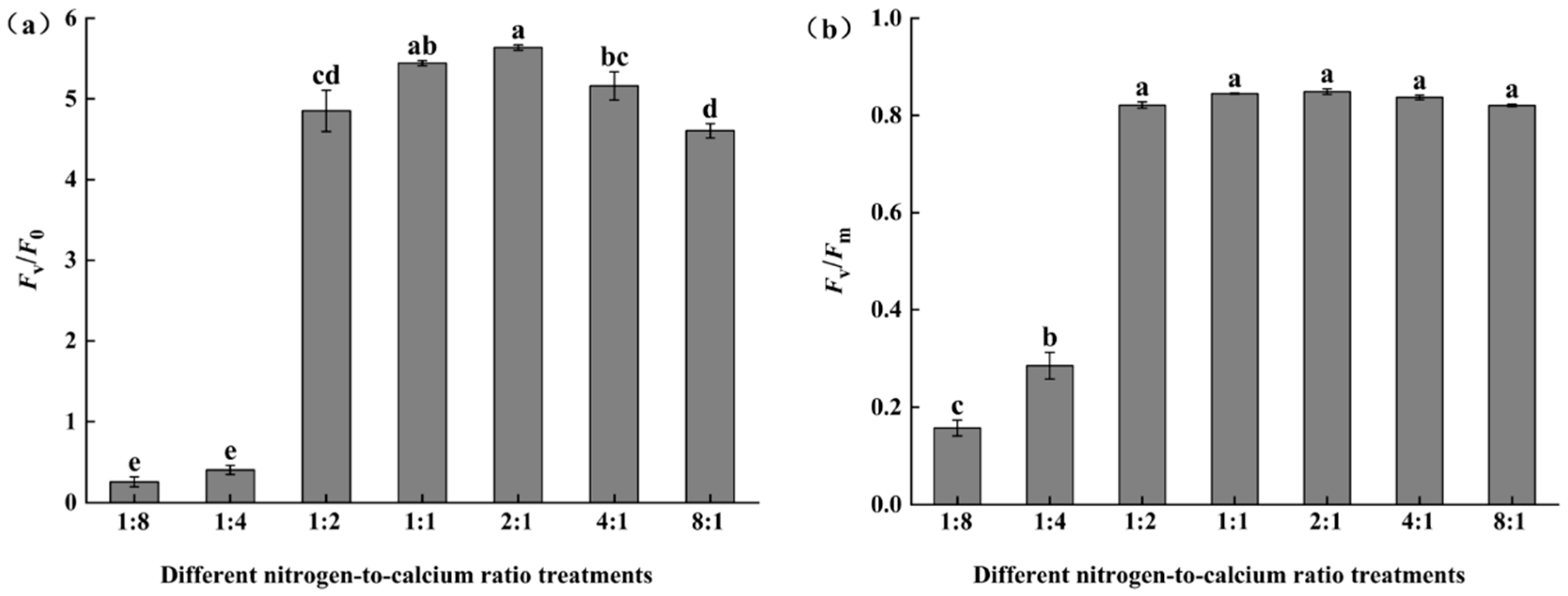
Measured data indicated that the Fv/F0 ratio in Mongolian pine seedlings exhibited a parabolic response, characterized by an initial increase followed by a decrease, in correlation with rising N-Ca ratios (Figure 2a). The Fv/Fm values were markedly reduced under 1:8 N-Ca and 1:4 N-Ca treatments relative to the other experimental conditions (Figure 2b). The maximum values of Fv/F0 and Fv/Fm in Mongolian pine seedlings occurred in the 2:1 N-Ca treatment, which were 5.64 and 0.85, respectively. The Fv/Fm under T5 treatment showed a 20-fold and 13-fold increase compared to 1:8 N-Ca and 1:4 N-Ca treatments (p < 0.05), respectively and demonstrated a pattern of initial enhancement followed by reduction as the N-Ca ratios rose. In the 4:1 N-Ca and 8:1 N-Ca treatments, the Fv/Fm of Mongolian pine seedlings showed a varying degree of decrease, which showed a marked difference compared to the T5 treatment (p < 0.05). The Fv/Fm of Mongolian pine seedlings was only at lower values in the 1:8 N-Ca and 1:4 N-Ca treatments, which were significantly different from the 2:1 N-Ca treatment (Figure 2b). There were no significant differences detected among the remaining treatment groups; however, the value peaked at 0.85 under the 2:1 N-Ca treatment.

3.3. Photosynthetic Pigments

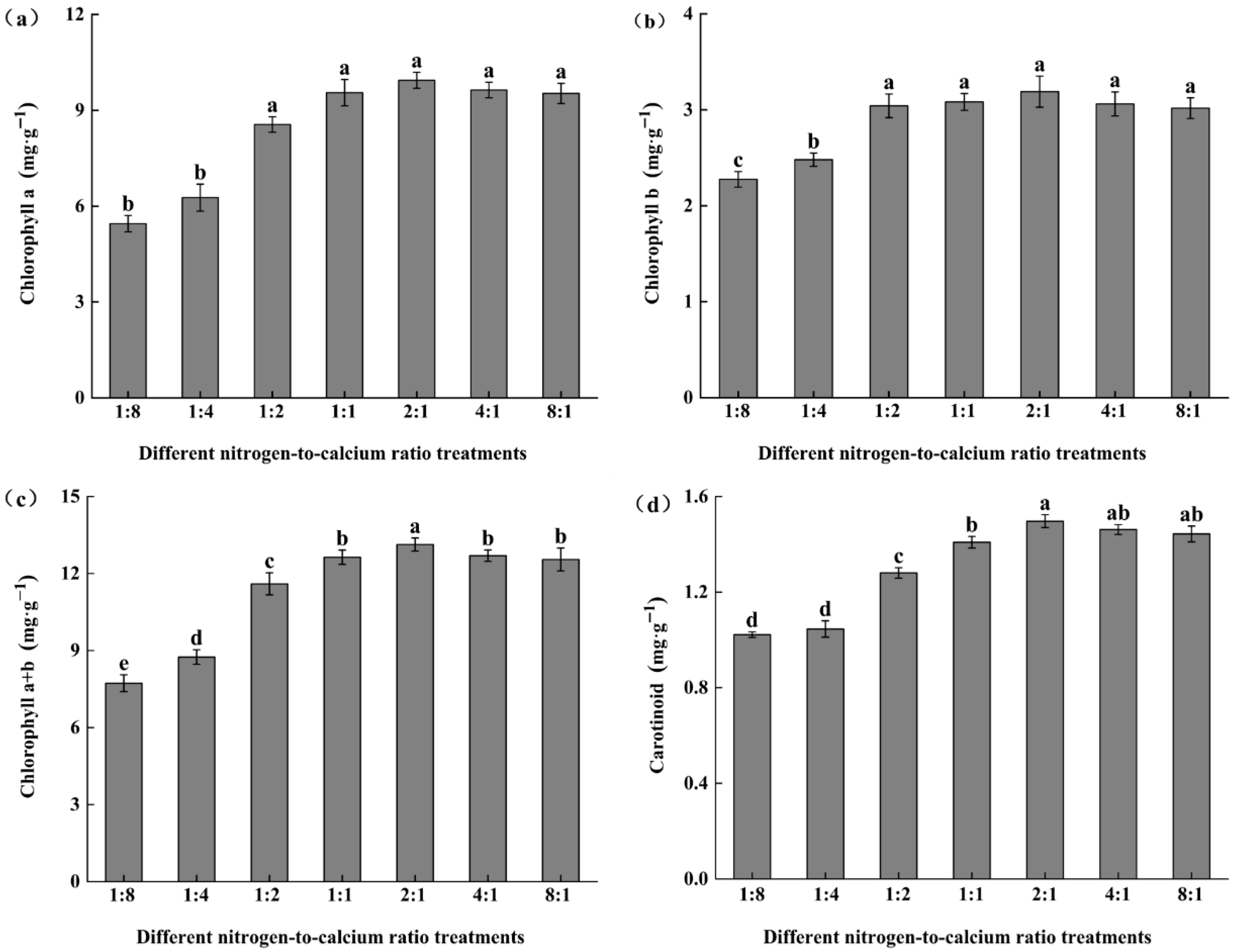
As illustrated in Figure 3, the application of different N-Ca ratios significantly influenced the concentrations of chlorophyll a, chlorophyll b, chlorophyll (a+b), and carotenoids in Mongolian pine seedlings (p < 0.05) (Figure 3). The synthesis of photosynthetic pigments in Mongolian pine seedlings initially increased and then decreased with increasing N-Ca ratios. The concentrations of chlorophyll a, chlorophyll b, chlorophyll (a+b), and carotenoids in Mongolian pine seedlings were significantly lower with lower N-Ca ratios compared to higher ratios, indicated an inhibition of photosynthetic pigment synthesis. The photosynthetic pigment indices in Mongolian pine seedlings reach their highest values of 9.94, 3.19, 13.13, and 1.5 mg·g−1 in the 2:1 N-Ca treatment, with chlorophyll a and chlorophyll (a+b) concentration increased by 82.28% and 69.89%, respectively, compared to the 1:8 N-Ca treatment (Figure 3a–d). In the presence of higher N-Ca ratios, the photosynthetic pigments of Mongolian pine seedlings showed a decreased trend, with lower concentrations as the ratio increased.

3.4. Photosynthetic Products and Allocation

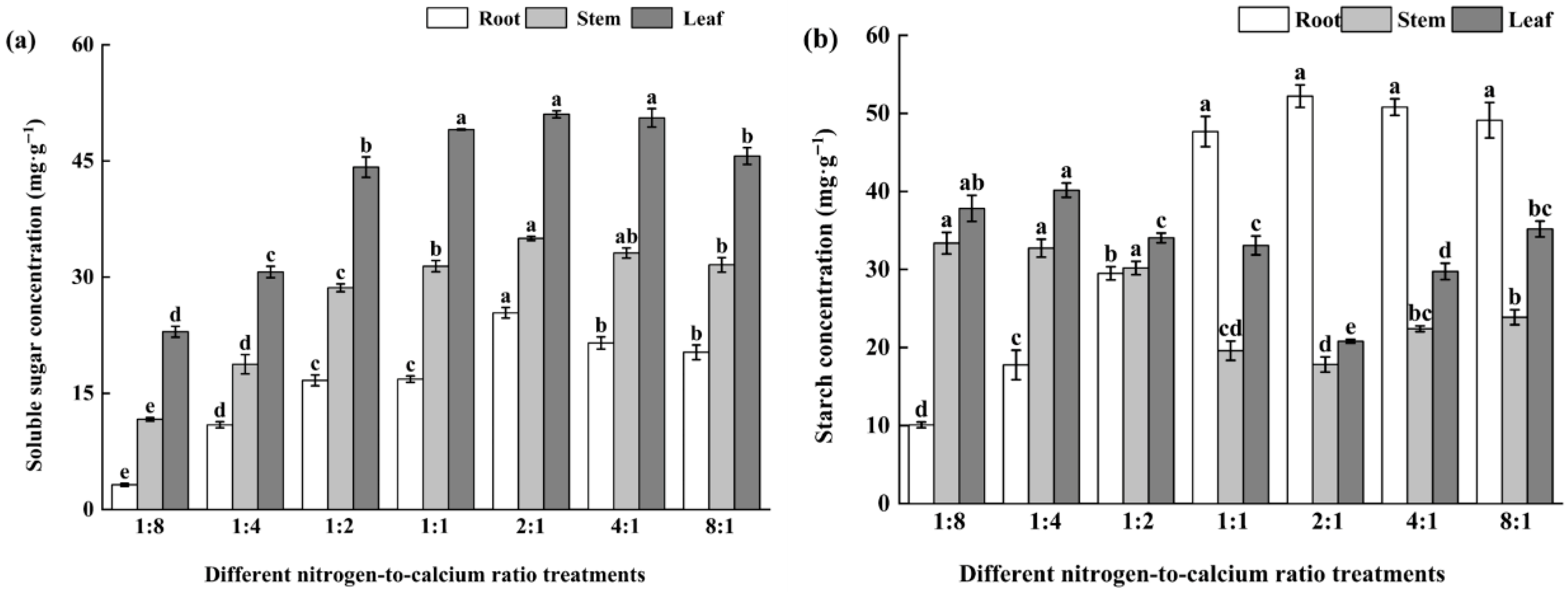
As shown in Figure 4, the soluble sugar concentrations in Mongolian pine seedlings were higher in leaves than in stems and roots. Furthermore, the soluble sugar concentration in the roots, stems, and leaves each displayed an initial increase and subsequent decline in response to rising N-Ca ratios. Under the 2:1 N-Ca treatment, the soluble sugar concentration in the leaves, stems, and roots of Mongolian pine seedlings reached the highest values, which were 51.02, 35.00, and 25.40 mg·g−1, respectively (Figure 4a,b). The starch concentration in the roots of Mongolian pine seedlings exhibited an initial increase followed by a decrease as the N-Ca ratio rose, peaking at 52.21 mg·g−1 under 2:1 N-Ca treatment—a value that showed a marked contrast to those observed in the 1:8 N-Ca to 1:2 N-Ca treatments (Figure 4a). The starch concentrations in the stems and leaves of Mongolian pine seedlings were inversely related to the starch concentration in the roots, showing a decreasing trend followed by an increasing trend (Figure 4b). Additionally, it was also observed that starch content tended to be elevated in the leaves compared to the stem tissues. For the 2:1 N-Ca treatment, the starch concentration in the stems and leaves of Mongolian pine seedlings reached the minimum values of 17.82 and 52.21 mg·g−1, respectively.
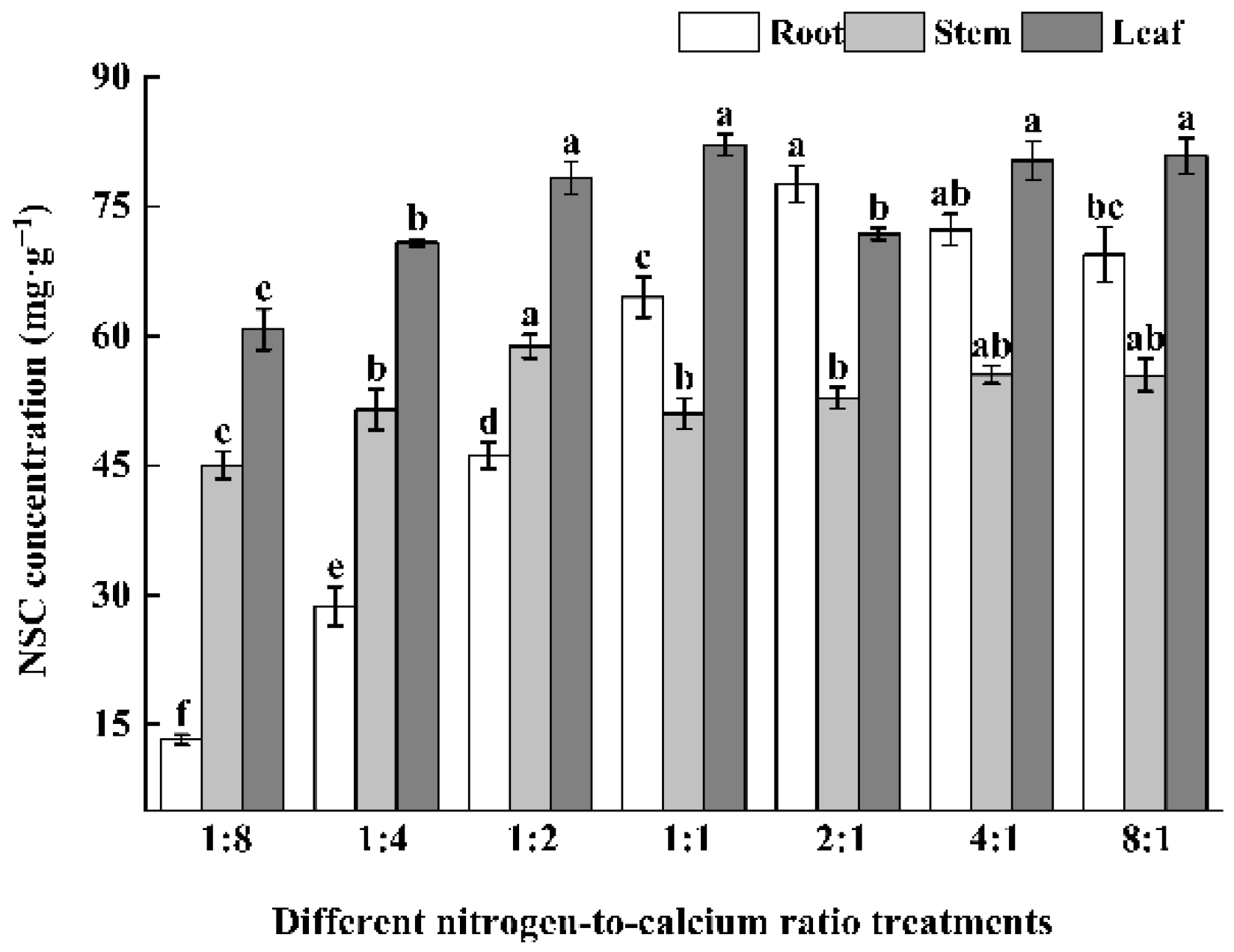
The NSC concentrations in various tissues of Mongolian pine seedlings exhibited distinct patterns in response to changing N-Ca ratios (Figure 5). Additionally, the N-Ca ratio had a significant influence on NSC levels, demonstrating a consistent pattern of highest concentration in the leaves, followed by the stems. The NSC concentration in the roots of the Mongolian pine seedlings showed the largest change amplitude, with an initial rise and a subsequent decline as N-Ca ratios increased. In the 2:1 N-Ca treatment, the NSC concentration in the roots of Mongolian pine seedlings reached a maximum value of 77.61 mg·g−1, which was 4.8 times higher than the T1 treatment. The NSC concentration in the leaves of Mongolian pine seedlings under the 2:1 N-Ca treatment was 71.82 mg·g−1, with a decrease of 12.56% compared to the 1:1 N-Ca treatment (Figure 5). Compared to the changes in NSC concentration in the roots and leaves, the NSC in the stems of Mongolian pine seedlings had a smaller change amplitude and was relatively stable.
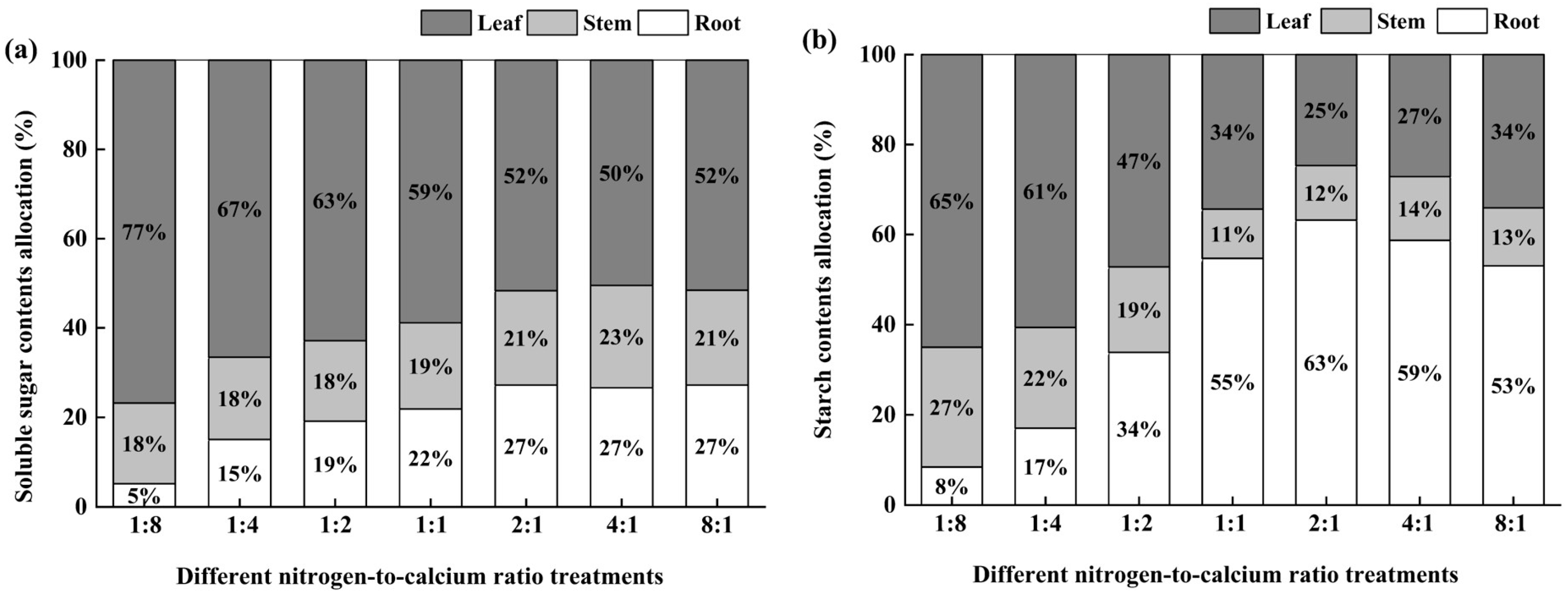
The results of soluble sugar content in Mongolian pine seedlings indicated that overall soluble sugar content in the seedlings followed the pattern of leaves > stems > roots. Under 1:8 N-Ca treatment, the proportion of soluble sugars and starch in leaves of Mongolian pine seedlings was the highest, reaching 77% and 65%, respectively, while the content in stems remain relatively stable (Figure 6a,b). The root proportions of soluble sugars and starch were merely 5% and 8%, respectively. With the increased N-Ca ratios, the soluble sugar and starch content in the leaves gradually decreased before increasing, while the root soluble sugar and starch proportion showed the opposite trend. Under 2:1 N-Ca treatment, the root soluble sugar content of Mongolian pine seedlings reached its maximum, accounting for 63% of the total content (Figure 6).
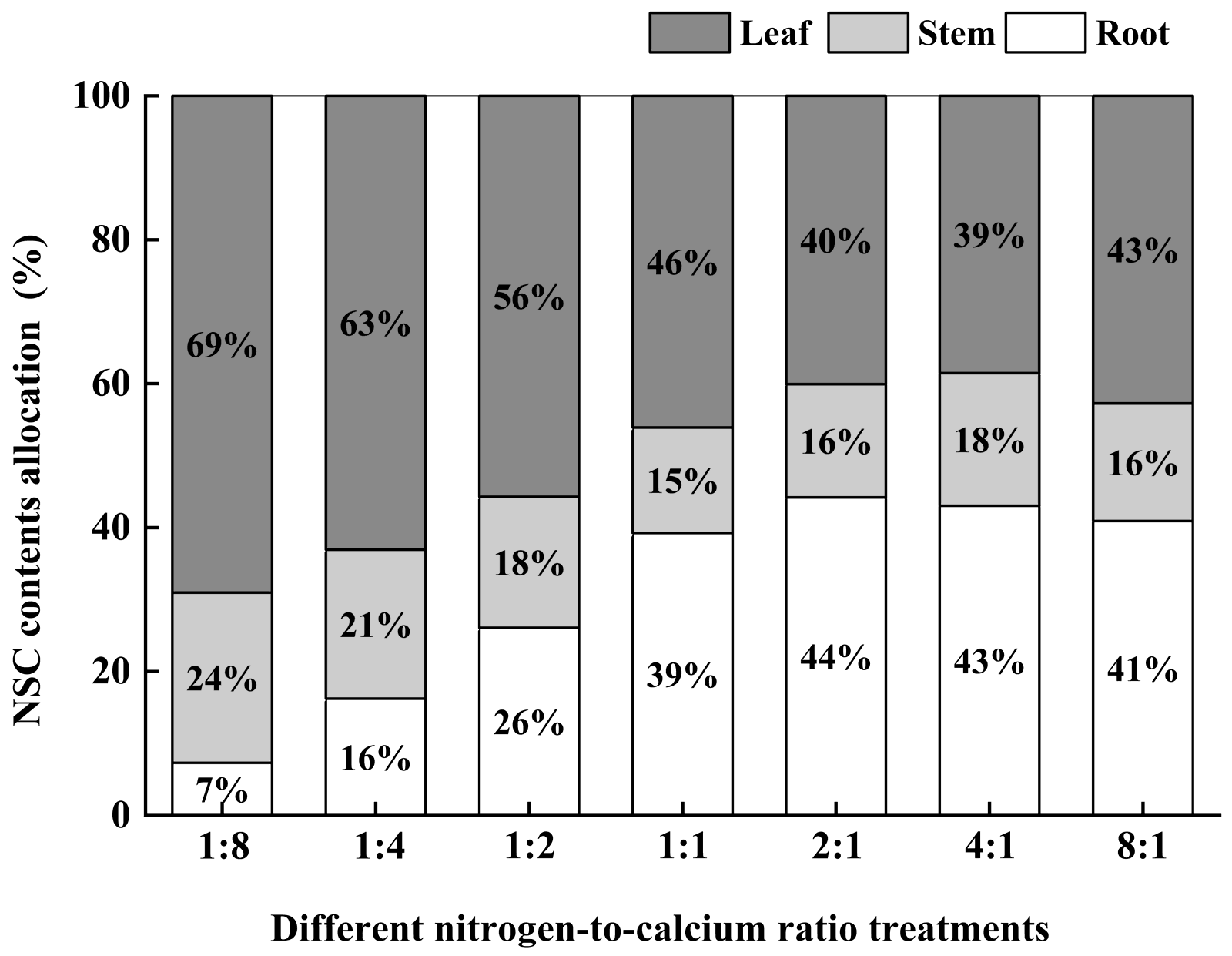
As indicated in Figure 7, the non-structural carbohydrate (NSC) content of Mongolian pine seedlings exhibited considerable variation. The distribution of NSC is consistent with the situation of soluble sugars and starch. The leaves NSC content of Mongolian pine reached its maximum value, 1024.87 mg·g−1, accounting for 40% of the whole plant NSC content, under the 2:1 N-Ca treatment. The NSC content in the stem was relatively stable with no significant differences. The NSC content in the roots reached its maximum value, 1129.99 mg·g−1, accounting for 44% of the whole plant NSC content, under the 2:1 N-Ca treatment. When the N-Ca ratios were low, the distribution pattern of NSC content in Mongolian pine seedling leaves was leaves > stem > roots; as the N-Ca ratio increased, the NSC content in the roots gradually increased. Under different N-Ca ratio treatments, the ratio of NSC content in the aboveground and belowground parts of Mongolian pine seedlings were 0.08, 0.19, 0.35, 0.59, 0.78, 0.75, and 0.69, respectively.
The NSC content ratios between aboveground and underground tissues demonstrated an initial increase followed by a decline in response to elevating N-Ca ratios.

3.5. Antioxidant Enzymes Activities

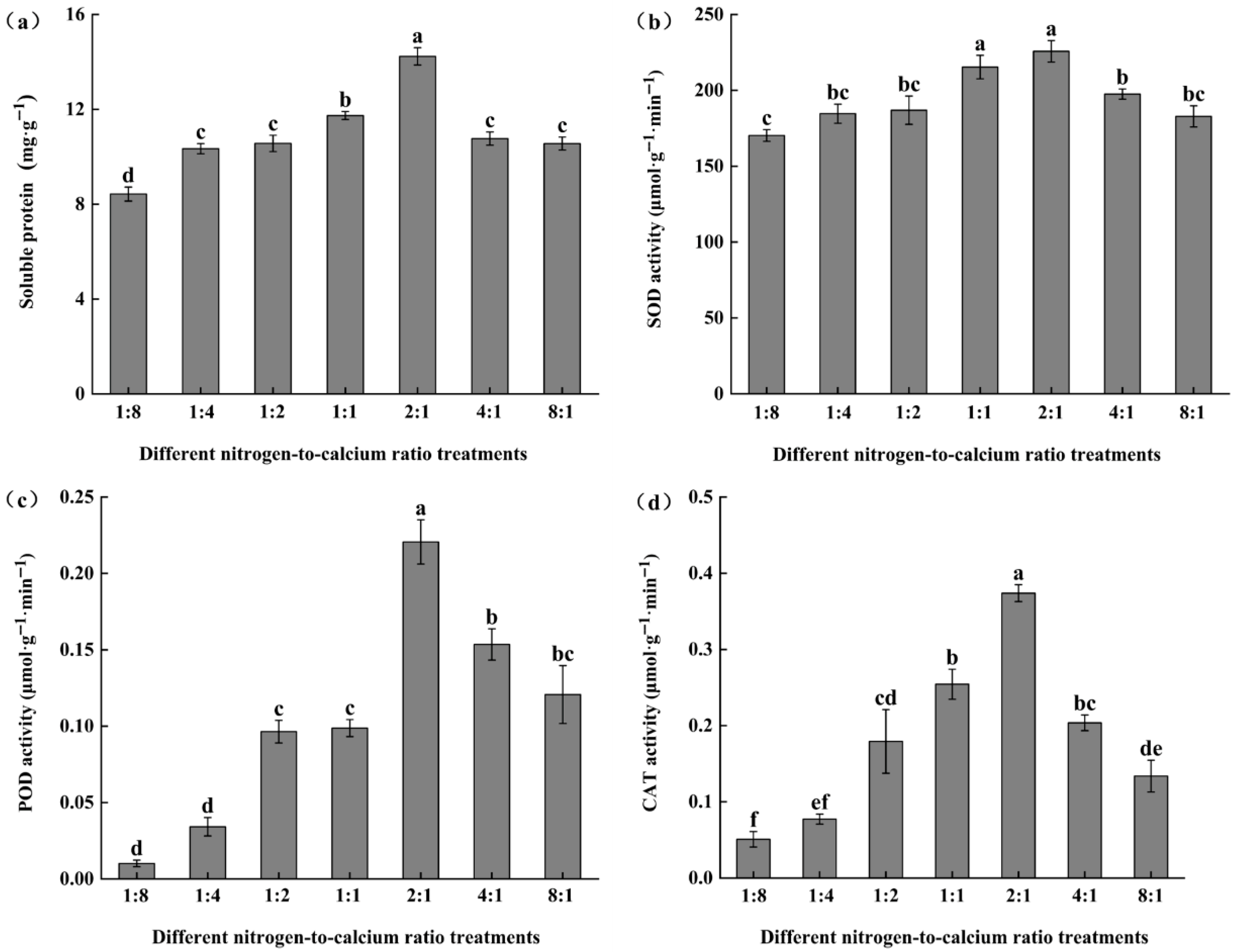
The activities of POD, SOD, CAT and soluble protein concentration in Mongolian pine seedlings demonstrated a parabolic pattern, initially rising and subsequently declining as the N-Ca ratios increased (Figure 8). At lower N-Ca ratios, a positive correlation was observed between the N-Ca ratio and the antioxidant enzyme activity in Mongolian pine seedlings. The maximum values of soluble protein, POD, SOD, and CAT activities in Mongolian pine seedlings appeared in the T5 treatment at 14.23 mg·g−1, 225.76, 0.221, and 0.374 μmol·g−1·min−1, respectively (Figure 8a–d), representing an approximately 21-fold increase in POD and a 63-fold increase in CAT compared to the T1 treatment (Figure 8c,d). However, as the N-Ca ratios continued to increase, the soluble protein, POD, SOD, and CAT activities of Mongolian pine seedlings began to decrease to varying degrees, with POD and CAT showing a larger decrease. The results indicated statistically significant variations between different N-Ca ratios (p < 0.05).

3.6. Plant Height and Basal Diameter

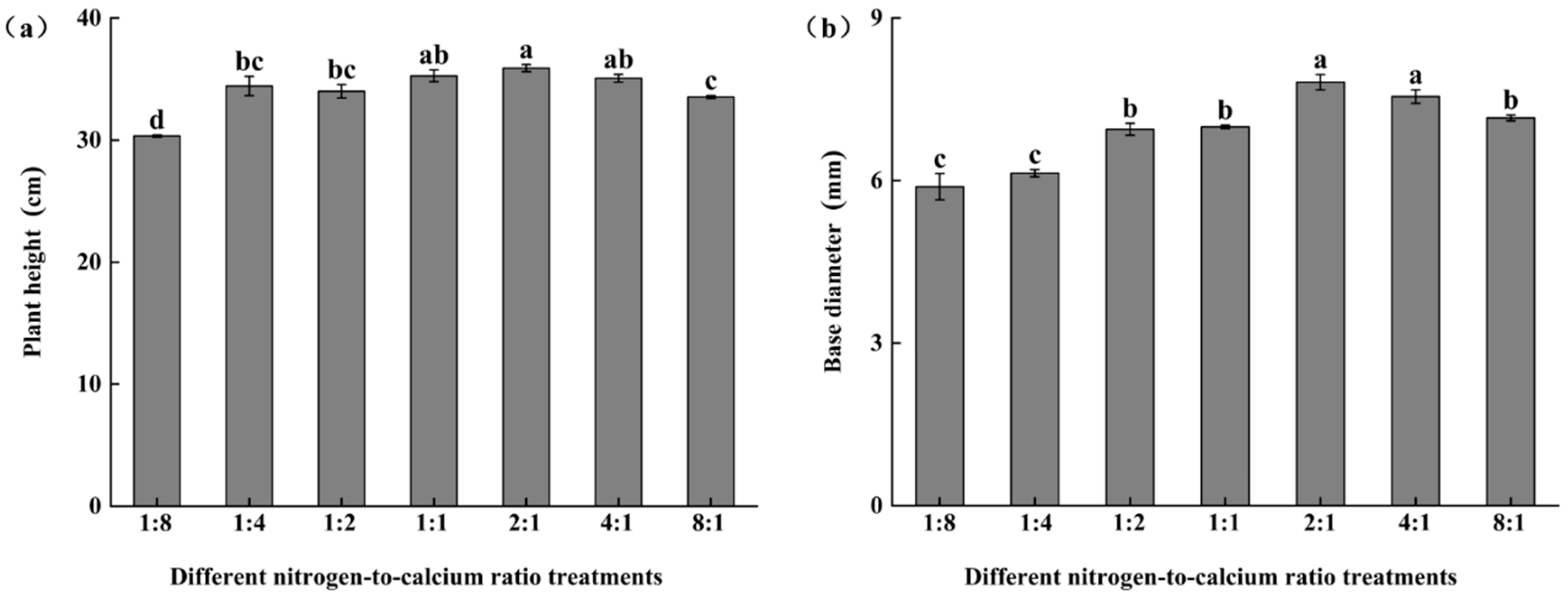
As shown in Figure 9, the variation in N-Ca ratio in this experiment affected the growth parameters of Mongolian pine seedlings. Among the various treatments, the growth increment of Mongolian pine seedlings reached its peak under 2:1 N-Ca treatment. Under different N-Ca ratios, the growth condition of Mongolian pine seedlings varied. Excessively high or low N-Ca ratios significantly inhibited the growth of Mongolian pine seedlings and even led to their death. Overall, the heights and basal diameters of Mongolian pine seedlings showed a trend of rising initially and then declining as the N-Ca ratio increased. When the N-Ca ratio was relatively low, the heights and basal diameters of Mongolian pine seedlings were positively correlated with the ratio. The heights and basal diameters of Mongolian pine seedlings reached maximum values of 35.9 cm and 7.82 mm, respectively, under the T5 treatment. These values represented increases of 18.35% and 32.79% compared to the 1:8 N-Ca treatment, with the differences being statistically significant. As the N-Ca ratios continued to increase, the growth increment of Mongolian pine seedlings began to decrease.

3.7. Biomass and Its Allocation

The biomass of Mongolian pine seedlings follows a pattern consistent with that observed in growth increment. The root, stem, leaf, and total biomass of Mongolian pine seedlings all showed a pattern of initial increase followed by a decrease as the N-Ca ratios rose. Under the 2:1 N-Ca treatment, biomass peaked at 14.27 g (root), 8.19 g (stem), 14.56 g (leaf), and 36.78 g (total) (Table 1). These values increased by 56.13%, 93.62%, 227.93%, and 122.64% compared to the 1:8 N-Ca treatment.
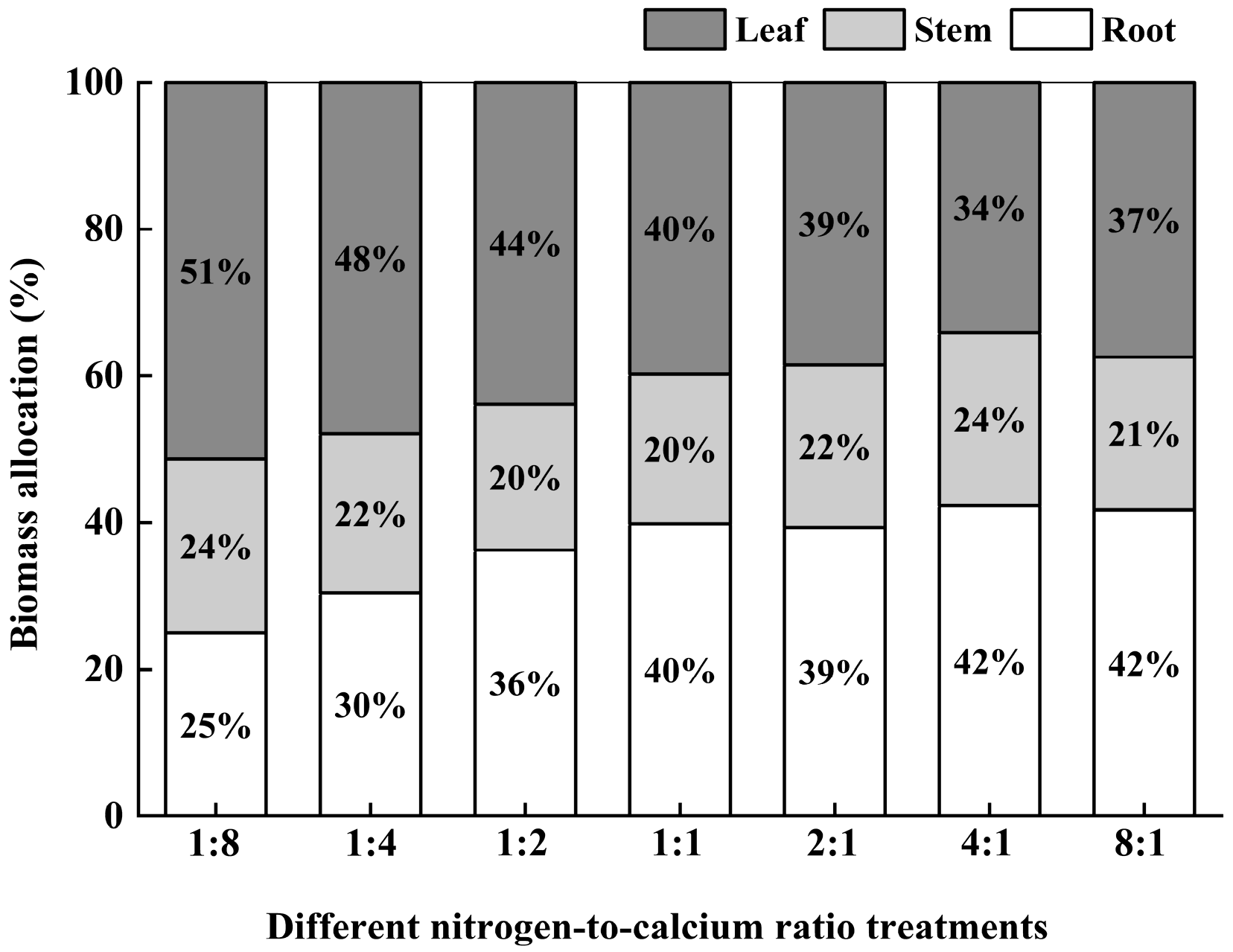
The biomass allocation of Mongolian pine seedlings under different N-Ca ratios was measured and compared. For the 1:8 N-Ca to 1:1 N-Ca, the biomass allocation trend was leaves > roots > stems (Figure 10). For the 4:1 N-Ca and 8:1 N-Ca treatments, the biomass allocation trend was roots > leaves > stems. Under the 2:1 N-Ca treatment, the biomass allocation was roots ≈ leaves > stems (Figure 10). In this condition, Mongolian pine attained its peak growth performance, accompanied by the highest recorded biomass. With an increasing N-Ca ratio, the biomass of the roots of the Mongolian pine seedlings also increased. However, the leaf biomass exhibited the opposite trend, with a decrease in allocation due to an increase N-Ca ratio, although the difference was not statistically significant.

3.8. Effects of Different N-Ca Ratios on the Average Membership Functions of Mongolian Pine Seedlings

An average membership function analysis was conducted on the growth, photosynthetic, and physiological parameters of Mongolian pine seedlings. As shown in Table 2, under different N-Ca ratios, the mean membership function values of Mongolian pine seedlings were ranked as 2:1 N-Ca (0.921) > 1:1 N-Ca (0.722) > 4:1 N-Ca (0.720) > 8:1 N-Ca (0.611) > 1:2 N-Ca (0.570) > 1:4 N-Ca (0.237) > 1:8 N-Ca (0.045). Among them, 2:1 N-Ca demonstrated the highest comprehensive ranking, followed by 1:1 N-Ca and 4:1 N-Ca, while 1:8 N-Ca exhibited the lowest value. These results demonstrated that modifying the N-Ca ratios differentially influences the growth and physiological functions of Mongolian pine seedlings, with the 2:1 N-Ca treatment yielding optimal growth performance.

4. Discussion

4.1. An Optimal Nitrogen-to-Calcium Ratio Exists for the Growth of Mongolian Pine Seedlings

Nitrogen is an essential macronutrient required for plant growth. It primarily regulates crop development through photosynthesis and chlorophyll synthesis. Calcium, functioning as a second messenger, participates in plant growth by regulating cell wall stability as well as cell division and expansion [8]. Plants primarily respond to nutrient changes by regulating growth, biomass accumulation, photosynthesis, and alleviating adverse stress conditions [32,33,34]. In this study, the growth and physiological characteristics of Mongolian pine seedlings emerged as an initial increase followed by a decrease while N-Ca ratios rose and reached maximum values at 2:1 ratio. Under this optimal ratio, seedlings achieved maximum growth metrics and biomass, while leaf and root biomass maintained a comparable proportion relative to the total biomass. These findings were consistent with previous reports that appropriate combined application of nitrogen and calcium enhanced biomass accumulation in peanut and poplar, while promoted aboveground biomass of spruce in the northeastern United States [10,11,35]. When N-Ca ratio was appropriated, calcium potentiated nitrogen uptake efficiency, thereby enhanced substrate assimilation and biosynthesis to drive plant growth [36,37]. Concurrently, appropriate N-Ca ratio proportions elevated root nutrient acquisition efficiency, stimulated its biomass accumulation, and optimized biomass partitioning patterns [38,39]. Chloroplasts serve as the primary site for photosynthetic reactions, with a substantial proportion of leaf nitrogen allocated to chloroplast compartments [27]. Calcium, conversely, primarily modulates photosynthetic electron transport in plants [8]. Alterations in nitrogen and calcium concentrations directly influence chlorophyll content, thereby regulating photon harvesting and conversion efficiency in leaves [28]. Our findings demonstrated that key photosynthetic parameters including Pn, Tr, Gs, chlorophyll content, and the photosystem II primary photochemistry efficiency (Fv/F0) reached peak values in Mongolian pine seedlings at a N-Ca ratio of 2:1. This aligns with previous studies which found that enhanced photosynthetic performance in peanut and poplar through optimized N-Ca co-application [10,11]. That may be due to optimal calcium concentrations facilitating stomatal opening, thereby driving upregulation of photosynthetic rates. Then, enhanced carbon fixation subsequently promotes the incorporation of nitrogen into photosynthetic pigments, ultimately amplifying photosynthetic efficiency [40,41,42,43]. At low N-Ca ratios, high calcium levels antagonize ammonium uptake and disrupts signaling, thereby impairing nitrogen metabolism. Conversely, high N-Ca ratios damage root cell membranes and hinder development, which collectively attenuates nitrogen absorption. The findings of this study further revealed that soluble substances and antioxidant enzyme activities (POD, SOD, CAT) in Mongolian pine seedlings peaked at an N-Ca ratio of 2:1. This quadratic pattern parallels observations by Zou et al. [44] in flue-cured tobacco, where antioxidant enzyme activities showed a similar rise-and-fall pattern under varying N-Ca fertilization regimes. These findings demonstrated that an optimal N-Ca ratio elevates antioxidant enzyme activities and soluble osmolyte production, thereby driving soluble substance accumulation [44,45]. Collectively, our results confirmed that there is a defined N-Ca stoichiometry (2:1) that maximizes growth-physiological performance in Mongolian pine.

4.2. Imbalanced Nitrogen-to-Calcium Ratios Inhibit the Growth and Physiological Activities of Mongolian Pine Seedlings

Plants synthesize organic compounds from absorbed nutrients through photosynthesis to support their growth and development. These organic compounds primarily include substances such as soluble sugars and starch [46]. Soluble photosynthesis products act as vital osmotic regulators, which can be used as a parameter to measure the adaptability of plants to the external environment [47,48]. Some studies have indicated that N-Ca co-supply modulates soluble sugar translocation and carbohydrate partitioning, thereby regulating non-structural carbon pool dynamics [10,49]. When the ratio of N-Ca < 2:1, the plant heights, basal diameters and biomass accumulation, photosynthetic rate, and chlorophyll content of Mongolian pine seedlings emerged as a rising trend while the N-Ca ratio rose in this study. Which is consistent with the conclusion that the application of N and Ca promoted soluble sugar accumulation and regulated nutrient transport in cucumbers [50,51]. Growth limitation under low N-Ca ratios arises from Ca2+ excess compromising cell wall structural integrity and functional stability, thereby constraining nitrogen acquisition and suppressing plant development [8,52]. Excessive calcium concentration in plants will inhibit roots system development, reduce the biomass of underground parts, and reduce the root-shoot ratio [26]. At N:Ca ratios of 1:8 and 1:4, PSII function was impaired (Fv/F0 < 0.8) with reduced reaction center activity. This suggests that calcium toxicity from the relative excess of calcium hindered photosynthetic electron transport. Simultaneously, calcium hyperaccumulation adversely affected stomatal function and PSII photochemistry (Fv/Fm), thereby reducing soluble sugar and starch synthesis [11,15]. Furthermore, a suboptimal N:Ca ratio also inhibited the absorption and utilization of nitrogen and reduced chlorophyll synthesis [53]. Notably, our data revealed that at N-Ca ratios below 4:1, Mongolian pine seedlings exhibited Fv/Fm < 0.8. This indicated that nitrogen excess-induced stoichiometric imbalance suppressed photochemical efficiency and physiological activity by disrupting cellular ultrastructure [8]. Conversely, when the ratio of N-Ca ratios > 2:1, Mongolian pine exhibited declining trends in growth metrics, photosynthetic performance, and antioxidant enzyme activities with increasing N-Ca supply. This response pattern aligns with prior observations of N-Ca imbalance-induced suppression of antioxidant capacity in poplar and diminished photosynthetic rates in peanut [10,28]. High N-Ca ratios led to the toxicity of excessive N accumulation, impairing cell division and reducing photosynthetic efficiency [54]. And resulting in suppressed growth, biomass accumulation, and a lower root-shoot ratio [55,56]. Nitrogen excess elevated ROS accumulation, eventually resulting in the depression of the activities of antioxidant enzymes (POD, CAT, and SOD) [57,58], destroying the photosynthetic system, and decreasing the maximum photochemical efficiency of PSII (Fv/Fm) [11] Ultimately, the synthesis and accumulation of soluble sugar and starch were reduced [49,58], while diverted photosynthetic products demonstrated preferentially toward subterranean sinks. Such carbon sink-source misallocation disrupts aboveground-belowground partitioning equilibrium [59]. Critically, an optimal N-Ca ratio could maintain plant antioxidant enzyme activity at a high level and promote the synthesis of soluble substances, which promoted the accumulation of soluble substances [44,45].

5. Conclusions

This study explored the effects of varying N-Ca ratios on the growth and physiological characteristics of three-year-old Mongolian pine seedlings in the semi-arid regions of Northeast China. Our findings revealed that exogenous N-Ca supply modulates Mongolian pine seedling development, with an optimal N-Ca ratio of 2:1 enabling simultaneous maximization of growth parameters (heights, basal diameters, biomass) and physiological performance (photosynthetic efficiency, soluble sugar accumulation, antioxidant enzyme activity). Concurrently, this ratio enhanced photosynthetic performance by elevating net photosynthetic rate (Pn), promoting chlorophyll biosynthesis, and stimulating the accumulation of soluble sugars and starch. The increased photosynthate reserves further upregulated antioxidant enzyme activity, thereby improving stress resilience and survival potential under adverse environmental conditions. The membership function analysis indicated that when the N-Ca ratio was 2:1, the growth, photosynthesis, and stress resistance indexes of Mongolian pine seedlings could reach the highest value, which significantly improved the growth ability of Mongolian pine.
In conclusion, there is an optimal N-Ca ratio of 2:1 to significantly promote the growth of Mongolian pine. Subsequently, we will establish field survey experiments across the distribution areas of Mongolian pine plantations, in order to validate the optimal nitrogen-calcium ratio thresholds for Mongolian pine growth. These results offered mechanistic insights for enhancing stand-level resilience and mitigating decline in Mongolian pine plantations, providing theoretical foundations for enhancing the ecological benefits and sustainable management of China’s Three-North Shelterbelt.

Author Contributions

H.L. and X.W. conceived the project. S.H. completed the experiment and drafted the manuscript with inputs provided by all. S.H., Y.H. and H.W. analyzed the data and visualized the results. All authors have read and agreed to the published version of the manuscript.

Funding

This work is supported by the National Natural Science Foundation of China (31700552, 41450007, 31800364, and 31400611) and the Doctoral Research Start-up Fund (880416020).

Data Availability Statement

Data are available from the corresponding author on reasonable request.

Conflicts of Interest

The authors declare no conflicts of interest.

References

  1. Ohyama, T. Nitrogen as a Major Essential Element of Plants. Nitrogen Assim. Plants. 2010, 37, 1–17. [Google Scholar]
  2. Wei, C.Z.; Yu, Q.; Bai, E.; Lü, X.T.; Li, Q.; Xia, J.Y.; Kardol, P.; Liang, W.J.; Wang, Z.W.; Han, X.G. Nitrogen Deposition Weakens Plant–Microbe Interactions in Grassland Ecosystems. Glob. Change Biol. 2013, 19, 3688–3697. [Google Scholar] [CrossRef] [PubMed]
  3. Jing, T.; Li, J.Y.; He, Y.D.; Shankar, A.; Saxena, A.; Tiwari, A.; Maturi, K.C.; Solanki, M.K.; Singh, V.; Eissa, M.A.; et al. Role of Calcium Nutrition in Plant Physiology: Advances in Research and Insights into Acidic Soil Conditions—A Comprehensive Review. Plant Physiol. Biochem. 2024, 210, 108602. [Google Scholar] [CrossRef]
  4. Naz, M.; Afzal, M.R.; Raza, M.A.; Pandey, S.; Qi, S.S.; Dai, Z.C.; Du, D.L. Calcium (Ca2+) Signaling in Plants: A Plant Stress Perspective. S. Afr. J. Bot. 2024, 169, 464–485. [Google Scholar] [CrossRef]
  5. Fernandes, M.S.; Rossiello, R.O.P. Mineral Nitrogen in Plant Physiology and Plant Nutrition. Crit. Rev. Plant Sci. 1995, 14, 111–148. [Google Scholar] [CrossRef]
  6. Weil, S.; Barker, A.V.; Zandvakili, O.R.; Etemadi, F. Plant Growth and Calcium and Potassium Accumulation in Lettuce under Different Nitrogen Regimes of Ammonium and Nitrate Nutrition. J. Plant Nutr. 2020, 44, 270–281. [Google Scholar] [CrossRef]
  7. Leghari, S.J.; Wahocho, N.A.; Laghari, G.M.; HafeezLaghari, A.; MustafaBhabhan, G.; HussainTalpur, K.; Lashari, A.A. Role of Nitrogen for Plant Growth and Development: A Review. Adv. Environ. Biol. 2016, 10, 209–219. [Google Scholar]
  8. Pandey, N. Role of Plant Nutrients in Plant Growth and Physiology. In Plant Nutrients and Abiotic Stress Tolerance; Hasanuzzaman, M., Fujita, M., Oku, H., Nahar, K., Hawrylak-Nowak, B., Eds.; Springer: Singapore, 2018. [Google Scholar]
  9. Paradisone, V.; Navarro-León, E.; Ruiz, J.M.; Esposito, S.; Blasco, B. Calcium Silicate Ameliorates Zinc Deficiency and Toxicity Symptoms in Barley Plants through Improvements in Nitrogen Metabolism and Photosynthesis. Acta Physiol Plant. 2021, 43, 154. [Google Scholar] [CrossRef]
  10. Wang, J.G.; Geng, Y.; Zhang, J.L.; Li, L.; Guo, F.; Yang, S.; Zou, J.; Wan, S.B. Increasing Calcium and Decreasing Nitrogen Fertilizers Improves Peanut Growth and Productivity by Enhancing Photosynthetic Efficiency and Nutrient Accumulation in Acidic Red Soil. Agronomy 2023, 13, 1924. [Google Scholar] [CrossRef]
  11. Weng, X.H.; Li, H.; Zhou, Y.B.; Ren, C.S.; Zhang, S.Z.; Liu, L.Y. Relative Availability of Nitrogen and Calcium Regulates the Growth of Poplar Seedlings Due to Transcriptome Changes. Forests 2023, 14, 1899. [Google Scholar] [CrossRef]
  12. Milani, M.; Pradella, E.M.; Heintze, W.; Schafer, G.; Bender, R.J. Nitrogen and Calcium Fertilization on the Growth and Development of Gerbera Cultivated in Pots for Cut Flowers. Ornam. Hortic. 2021, 27, 288–295. [Google Scholar] [CrossRef]
  13. Ozyhar, T.; Marchi, M.; Facciotto, G.; Bergante, S.; Luster, J. Combined Application of Calcium Carbonate and Npks Fertilizer Improves Early-Stage Growth of Poplar in Acid Soils. For. Ecol. Manag. 2022, 514, 120211. [Google Scholar] [CrossRef]
  14. Cao, H.Y.; Du, Y.J.; Gao, G.L.; Rao, L.Y.; Ding, G.D.; Zhang, Y. Afforestation with Pinus sylvestris Var. Mongolica Remodelled Soil Bacterial Community and Potential Metabolic Function in the Horqin Desert. Glob. Ecol. Conserv. 2021, 29, e01716. [Google Scholar]
  15. Li, H.; Huo, Y.; Weng, X.H.; Zhou, Y.B.; Sun, Y.; Zhang, G.Q.; Zhang, S.Z.; Liu, L.Y.; Pei, J.B. Regulation of the Growth of Mongolian Pine (Pinus sylvestris Var. Mongolica) by Calcium-Water Coupling in a Semiarid Region. Ecol. Indic. 2022, 137, 20220441675. [Google Scholar] [CrossRef]
  16. Zhang, Z.; Zou, J.T.; Yu, W.J.; Li, Q.; Feng, Z.D.; Zhang, H. Resilience and Community Dynamics of Understorey Vegetation in Mongolian Pine Plantations at the Southeastern Edge of the Mu Us Sandy Land, China. For. Ecol. Manag. 2024, 555, 121723. [Google Scholar] [CrossRef]
  17. Zhu, J.J.; Li, E.Q.; Xu, M.L.; Kang, H.Z.; Wu, X.Y. The Role of Ectomycorrhizal Fungi in Alleviating Pine Decline in Semiarid Sandy Soil of Northern China: An Experimental Approach. Ann. For. Sci. 2008, 65, 12. [Google Scholar] [CrossRef]
  18. Huang, L.; Zhu, P.; Xiao, T.; Cao, W.; Gong, G.L. The Sand Fixation Effects of Three-North Shelter Forest Program in Recent 35 Years. Sci. Geogr. Sin. 2018, 38, 600–609. [Google Scholar]
  19. Zhu, J.J.; Kang, H.Z.; Tan, H.; Xu, M.L. Effects of Drought Stresses Induced by Polyethylene Glycol on Germination of Pinus sylvestris Var. Mongolica Seeds from Natural and Plantation Forests on Sandy Land. J. For. Res. 2017, 11, 319–328. [Google Scholar]
  20. Li, J.T.; Xie, Y.Y.; Wulan, T.Y.; Liu, H.Y.; Wang, X.J.; Zheng, Y.; Qi, Q.G.; Gao, Z.X.; Gao, S.Y.; Shen, Z.H. Drought Resilience of Mongolian Scotch Pine (Pinus sylvestris Var. Mongolica) at the Southernmost Edge of Its Natural Distribution: A Comparison of Natural Forests and Plantations. For. Ecol. Manag. 2023, 542, 121104. [Google Scholar] [CrossRef]
  21. Song, L.N.; Zhu, J.J.; Zheng, X.; Wang, K.; Zhang, J.X.; Hao, G.Y.; Liu, J.H. Comparison of canopy transpiration between Pinus sylvestris var. mongolica and Pinus tabuliformis plantations in a semiarid sandy region of Northeast China. Agric. For. Meteorol. 2022, 314, 108784. [Google Scholar] [CrossRef]
  22. Khan, A.; Zhang, X.; Zhang, K.B.; Iqbal, A.; Ahmad, A.; Saeed, S.; Hayat, M.; Tang, X.H. Tree distribution pattern, growing stock characteristics and biomass carbon density of mongolian scots pine (Pinus sylvestris var. Mongolica) plantation of Horqin Sandy Land, China. Pak. J. Bot. 2020, 52, 995–1002. [Google Scholar]
  23. Mandal, S.; Banik, G.C. Forest Degradation and Its Impact on Soil Carbon. In Forest Degradation and Management; Shukla, G., Manohar, K., Raj Kizha, A., Panwar, A., Chakravarty, P., Eds.; Springer: Cham, Switzerland, 2025. [Google Scholar]
  24. Xie, X.M. Soil and Plant Nutrition Experiments; Zhejiang University Press: Hangzhou, China, 2014. [Google Scholar]
  25. Li, X.J.; Zhang, G.Q.; Li, H.; Sun, Y.; Huo, Y.; Huang, S.L.; Zhang, S.Z.; Liu, L.Y.; Zhou, Y.B. Effects of Exogenous Calcium on the Growth and Physiological Characteristics of Pinus sylvestris Var. Mongolica Seedlings in Sandy Land. Chin. J. Soil Sci. 2021, 52, 1095–1103. [Google Scholar]
  26. Li, H.; Huang, S.L.; Ren, C.S.; Weng, X.H.; Zhang, S.Z.; Liu, L.Y.; Pei, J.B. Optimal Exogenous Calcium Alleviates the Damage of Snow-Melting Agent to Salix matsudana Seedlings. Front. Plant Sci. 2022, 13, 928092. [Google Scholar] [CrossRef]
  27. Arnon, D.I. Copper Enzymes in Isolated Chloroplastes. Polyphenoloxidase in Beta Vulgaris. Plant Physiol. 1949, 24, 1–15. [Google Scholar] [CrossRef]
  28. Weng, X.H.; Li, H.; Ren, C.S.; Zhou, Y.B.; Zhu, W.X.; Zhang, S.Z.; Liu, L.Y. Calcium Regulates Growth and Nutrient Absorption in Poplar Seedlings. Front. Plant Sci. 2022, 13, 887098. [Google Scholar] [CrossRef]
  29. Perveen, S.; Saeed, M.; Parveen, A.; Javed, M.T.; Zafar, S.; Iqbal, N. Modulation of Growth and Key Physiobiochemical Attributes after Foliar Application of Zinc Sulphate (ZnSO4) on Wheat (Triticum aestivum L.) under Cadmium (Cd) Stress. Physiol. Mol. Biol. Plants. 2020, 26, 1787–1797. [Google Scholar] [CrossRef]
  30. Ezzat, A.; Szabó, S.; Szabó, Z.; Hegedűs, A.; Berényi, D.; Holb, I.J. Temporal Patterns and Inter-Correlations among Physical and Antioxidant Attributes and Enzyme Activities of Apricot Fruit Inoculated with Monilinia laxa under Salicylic Acid and Methyl Jasmonate Treatments under Shelf-Life Conditions. J. Fungi. 2021, 7, 341. [Google Scholar] [CrossRef]
  31. Liang, X.X.; Liang, F.; Tan, Z.Q.; Huang, X.Y.; Liang, S.Y. Effects of Fertilization with Different Nitrogen-to Calcium Ratios on Growth and Physiological Traits of Endangered Plant Excentrodendron tonkinense Seedlings. Guihaia 2025, 45, 121–132. [Google Scholar]
  32. Eckstein, R.L.; Karlsson, P.S. Above-Ground Growth and Nutrient Use by Plants in a Subarctic Environment: Effects of Habitat, Life-Form and Species. Oikos 1997, 79, 311–324. [Google Scholar] [CrossRef]
  33. Kim, S.G.; Lee, J.S.; Bae, H.H.; Kim, J.T.; Son, B.Y.; Kim, S.L.; Baek, S.B.; Shin, S.; Jeon, W.T. Physiological and Proteomic Analyses of Korean F1 Maize (Zea mays L.) Hybrids under Water-Deficit Stress during Flowering. Appl. Biol. Chem. 2019, 62, 32. [Google Scholar] [CrossRef]
  34. Farooq, T.H.; Shakoor, A.; Rashid, M.H.U.; Zhang, S.Y.; Wu, P.F.; Yan, W.D. Annual Growth Progression, Nutrient Transformation, and Carbon Storage in Tissues of Cunninghamia lanceolata Monoculture in Relation to Soil Quality Indicators Influenced by Intraspecific Competition Intensity. J. Soil Sci. Plant Nutr. 2021, 21, 3146–3158. [Google Scholar] [CrossRef]
  35. Kulmatiski, A.; Vogt, K.A.; Vogt, D.J.; Wargo, P.M.; Tilley, J.P.; Siccama, T.G.; Sigurdardottir, R.; Ludwig, D. Nitrogen and Calcium Additions Increase Forest Growth in Northeastern USA Spruce–Fir Forests. Can. J. For. Res. 2007, 37, 1574–1585. [Google Scholar] [CrossRef]
  36. Yadav, M.R.; Kumar, R.; Parihar, C.M.; Yadav, R.K.; Jat, S.L.; Ram, H.; Meena, R.K.; Singh, M.; Birbal; Verma, A.P.; et al. Strategies for Improving Nitrogen Use Efficiency: A Review. Agric. Rev. 2017, 38, 29–40. [Google Scholar] [CrossRef]
  37. Zhang, T.Z.; Li, Y.N.; Li, H.; Zhang, S.Z.; Zhou, Y.B. Optimal Soil Calcium for the Growth of Mulberry Seedlings Is Altered by Nitrogen Addition. Forests 2023, 14, 399. [Google Scholar] [CrossRef]
  38. Barłóg, P.; Grzebisz, W.; Łukowiak, R. Fertilizers and Fertilization Strategies Mitigating Soil Factors Constraining Efficiency of Nitrogen in Plant Production. Plants 2022, 11, 1855. [Google Scholar] [CrossRef] [PubMed]
  39. Zhang, P.; Wang, Y.Y.; Sheng, D.C.; Zhang, S.Y.; Gu, S.C.; Yan, Y.; Zhao, F.C.; Wang, P.; Huang, S.B. Optimizing Root System Architecture to Improve Root Anchorage Strength and Nitrogen Absorption Capacity under High Plant Density in Maize. Field Crops Res. 2023, 303, 109109. [Google Scholar] [CrossRef]
  40. Voitsekhovskaja, O.V.; Tyutereva, E.V. Chlorophyll B in Angiosperms: Functions in Photosynthesis, Signaling and Ontogenetic Regulation. J. Plant Physiol. 2015, 189, 51–64. [Google Scholar] [CrossRef]
  41. Ullah, A.; Sun, H.; Yang, X.Y.; Zhang, X.L. Drought Coping Strategies in Cotton: Increased Crop Per Drop. Plant Biotechnol. J. 2017, 15, 271–284. [Google Scholar] [CrossRef]
  42. Kaur, H.; Kohli, S.K.; Khanna, K.; Bhardwaj, R. Scrutinizing the Impact of Water Deficit in Plants: Transcriptional Regulation, Signaling, Photosynthetic Efficacy, and Management. Physiol. Plant. 2021, 172, 935–962. [Google Scholar] [CrossRef]
  43. Liu, H.; Song, S.B.; Zhang, H.; Li, Y.H.; Niu, L.J.; Zhang, J.H.; Wang, W. Signaling Transduction of Aba, Ros, and Ca2+ in Plant Stomatal Closure in Response to Drought. Int. J. Mol. Sci. 2022, 23, 14824. [Google Scholar] [CrossRef]
  44. Zou, W.T.; Chen, S.; Teng, J.C. Effects of Nitrogen and Calcium on Anti-Oxidative Enzyme System and Active Oxygen of Flue-Cured Tobacco Leaf during Fast Growing Period. J. Northwest AF Univ. 2016, 44, 97–103. [Google Scholar]
  45. Zhang, G.W.; Liu, Z.L.; Zhou, J.G.; Zhu, Y.L. Effects of Ca(NO3)2 Stress on Oxidative Damage, Antioxidant Enzymes Activities and Polyamine Contents in Roots of Grafted and Non-Grafted Tomato Plants. Plant Growth Regul. 2008, 56, 7–19. [Google Scholar] [CrossRef]
  46. Hammond, J.P.; White, P.J. Sucrose Transport in the Phloem: Integrating Root Responses to Phosphorus Starvation. J. Exp. Bot. 2007, 59, 93–109. [Google Scholar] [CrossRef]
  47. Singh, M.; Kumar, J.; Singh, S.; Singh, V.P.; Prasad, S.M. Roles of Osmoprotectants in Improving Salinity and Drought Tolerance in Plants: A Review. Rev. Environ. Sci. Bio Technol. 2015, 14, 407–426. [Google Scholar] [CrossRef]
  48. Ashraf, M.; Akram, N.A.; Al-Qurainy, F.; Foolad, M.R. Chapter Five—Drought Tolerance: Roles of Organic Osmolytes, Growth Regulators, and Mineral Nutrients. Adv. Agron. 2011, 111, 249–296. [Google Scholar]
  49. Zhang, H.; Zhao, Y.; Zhu, J.K. Thriving under Stress: How Plants Balance Growth and the Stress Response. Dev. Cell. 2020, 55, 529–543. [Google Scholar] [CrossRef] [PubMed]
  50. Matsumoto, H.; Teraoka, K. Accumulation of Sugars in Cucumber Leaves during Calcium Starvation. Plant Cell Physiol. 1980, 21, 1505–1513. [Google Scholar] [CrossRef] [PubMed]
  51. Karthika, K.S.; Rashmi, I.; Parvathi, M.S. Biological Functions, Uptake and Transport of Essential Nutrients in Relation to Plant Growth. In Plant Nutrients and Abiotic Stress Tolerance; Fujita, M., Oku, H., Nahar, K., Hawrylak-Nowak, K., Eds.; Springer: Singapore, 2018; pp. 1–49. [Google Scholar]
  52. Wolf, S.; Hématy, K.; Höfte, H. Growth Control and Cell Wall Signaling in Plants. Annu. Rev. Plant Biol. 2012, 63, 381–407. [Google Scholar] [CrossRef]
  53. López-Lefebre, L.R.; Rivero, R.M.; García, P.C.; Sanchez, E.; Ruiz, J.M.; Romero, L. Effect of Calcium on Mineral Nutrient Uptake and Growth of Tobacco. J. Sci. Food Agric. 2001, 81, 1334–1338. [Google Scholar] [CrossRef]
  54. Mu, X.H.; Chen, Y.L. The Physiological Response of Photosynthesis to Nitrogen Deficiency. Plant Physiol. Biochem. 2021, 158, 76–82. [Google Scholar] [CrossRef]
  55. Kong, L.G.; Xie, Y.Y.; Hu, L.; Si, J.S.; Wang, Z.S. Excessive Nitrogen Application Dampens Antioxidant Capacity and Grain Filling in Wheat as Revealed by Metabolic and Physiological Analyses. Sci. Rep. 2017, 7, 43363. [Google Scholar] [CrossRef] [PubMed]
  56. Fathi, A. Role of Nitrogen (N) in Plant Growth, Photosynthesis Pigments, and N Use Efficiency: A Review. Agrisost 2022, 28, 1–8. [Google Scholar]
  57. Fujita, M.; Hasanuzzaman, M. Approaches to Enhancing Antioxidant Defense in Plants. Antioxidants 2022, 11, 925. [Google Scholar] [CrossRef]
  58. Vicidomini, C.; Palumbo, R.; Moccia, M.; Roviello, G.N. Oxidative Processes and Xenobiotic Metabolism in Plants: Mechanisms of Defense and Potential Therapeutic Implications. J. Xenobiot. 2024, 14, 1541–1569. [Google Scholar] [CrossRef]
  59. Zhang, Z.H.; Tariq, A.; Zeng, F.J.; Graciano, C.; Zhang, B. Nitrogen Application Mitigates Drought-Induced Metabolic Changes in Alhagi Sparsifolia Seedlings by Regulating Nutrient and Biomass Allocation Patterns. Plant Physiol. Biochem. 2020, 155, 828–841. [Google Scholar] [CrossRef] [PubMed]
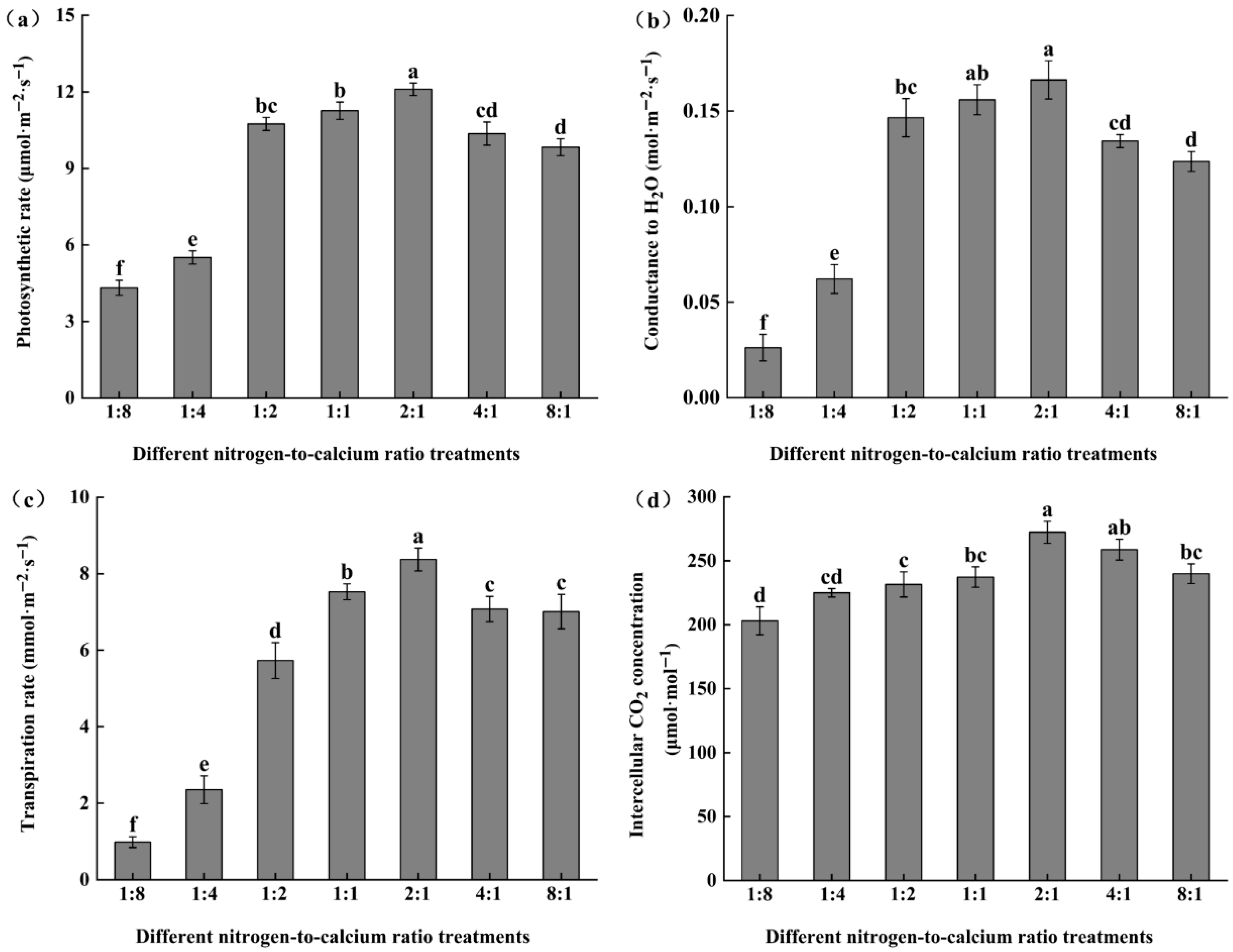
Figure 1. Effects of different N-Ca ratios on photosynthetic parameters of Mongolian pine seedlings. (a) Photosynthetic rate. (b) Conductance to H2O. (c) Transpiration rate. (d) Intercellular CO2 concentration. Note: Different letters indicate that the differences between treatments are at a significant level (p < 0.05).
Forests 16 01809 g001
Figure 2. Effects of different N-Ca ratios on chlorophyll fluorescence characteristics of Mongolian pine seedlings. (a) Fv/F0. (b) Fv/Fm. Note: Different letters indicate that the differences between treatments are at a significant level (p < 0.05); same below.
Forests 16 01809 g002
Figure 3. Effects of different N-Ca ratios on photosynthetic pigments of Mongolian pine seedlings. (a) Chlorophyll a. (b) Chlorophyll b. (c) Chlorophyll (a+b). (d) Carotenoids. Note: Different letters indicate that the differences between treatments are at a significant level (p < 0.05); same below.
Forests 16 01809 g003
Figure 4. Effects of different N-Ca ratios on photosynthetic products of Mongolian pine seedlings. (a) Soluble sugar concentration. (b) Starch concentration. Note: Different letters indicate that the differences between treatments are at a significant level (p < 0.05).
Forests 16 01809 g004
Figure 5. Effects of exogenous N-Ca ratios on non-structural carbohydrates of Mongolian pine seedlings. Note: Different letters indicate that the differences between treatments are at a significant level (p < 0.05).
Forests 16 01809 g005
Figure 6. Effects of exogenous N-Ca ratios on photosynthetic products allocation of Mongolian pine seedlings. (a) Soluble sugar contents allocation. (b) Starch contents allocation.
Forests 16 01809 g006
Figure 7. Effects of different N-Ca ratios on non-structural carbohydrates allocation of Mongolian pine seedlings.
Forests 16 01809 g007
Figure 8. Effects of exogenous nitrogen and calcium on antioxidant enzyme activity of Mongolian pine seedlings. (a) Soluble protein. (b) SOD activity. (c) POD activity. (d) CAT activity. Note: Different letters indicate that the differences between treatments are at a significant level (p < 0.05).
Forests 16 01809 g008
Figure 9. Effects of different N-Ca ratios on (a) plant height and (b) base diameter of Mongolian pine seedlings. Each column represents the mean ± SE, N = 3; different letters indicate that the differences between treatments are at a significant level (p < 0.05).
Forests 16 01809 g009
Figure 10. Effects of different N-Ca ratios on biomass allocation of Mongolian pine seedlings.
Forests 16 01809 g010
Table 1. Effects of different N-Ca ratios on leaf, stem, root and total biomass of Mongolian pine seedlings.
N-CaLeaf Biomass (g)Stem Biomass (g)Root Biomass (g)Total Biomass (g)
1:89.14 ± 0.328 e4.23 ± 0.632 d4.44 ± 0.344 f16.52 ± 0.329 f
1:410.98 ± 0.409 cd4.96 ± 0.675 cd6.97 ± 0.817 e22.92 ± 0.437 e
1:211.55 ± 0.379 bc5.23 ± 0.322 bcd9.55 ± 0.347 d25.74 ± 0.909 d
1:112.10 ± 0.134 b6.19 ± 0.900 b13.12 ± 0.312 b30.29 ± 0.535 c
2:114.27 ± 0.826 a8.19 ± 0.484 a14.56 ± 0.726 a36.78 ± 1.283 a
4:110.65 ± 0.456 d7.38 ± 1.067 a13.21 ± 0.169 b33.55 ± 0.448 b
8:110.54 ± 1.039 d5.87 ± 0.512 bc11.74 ± 0.131 c30.21 ± 0.512 c
Different letters indicate that the differences between treatments are at a significant level (p < 0.05); same below.
Table 2. Effects of different N-Ca ratios on the average membership functions of Mongolian pine seedlings.
Parameter1:81:41:21:12:14:18:1
Plant height0.022 0.683 0.613 0.817 0.919 0.785 0.538
Base diameter0.046 0.154 0.505 0.525 0.882 0.766 0.596
Fv/Fm0.045 0.221 0.960 0.993 0.999 0.982 0.960
Fv/F00.021 0.047 0.847 0.954 0.988 0.903 0.803
Chlorophyll a0.118 0.249 0.671 0.777 0.840 0.791 0.768
Chlorophyll b0.059 0.235 0.718 0.753 0.845 0.734 0.697
Chlorophyll a+b0.009 0.193 0.705 0.892 0.980 0.902 0.876
Carotinoid0.037 0.082 0.531 0.776 0.945 0.878 0.843
Photosynthetic rate0.068 0.206 0.815 0.875 0.973 0.771 0.709
Conductance to H2O0.050 0.275 0.804 0.862 0.928 0.727 0.660
Transpiration rate0.035 0.211 0.646 0.877 0.986 0.819 0.811
Intercellular CO2 concentration 0.020 0.275 0.351 0.418 0.825 0.667 0.449
Soluble sugar0.01 0.21 0.48 0.65 0.97 0.70 0.56
Starch0.04 0.30 0.44 0.85 0.92 0.86 0.77
NSC0.02 0.25 0.46 0.73 0.95 0.76 0.64
Soluble protein0.056 0.333 0.364 0.535 0.895 0.394 0.364
POD activity0.017 0.120 0.387 0.397 0.919 0.631 0.490
CAT activity0.043 0.117 0.402 0.612 0.946 0.470 0.275
SOD activity0.059 0.267 0.300 0.711 0.861 0.453 0.241
Average membership function value0.0450.2370.5700.7220.9210.7200.611
Comprehensive sorting7652134
Disclaimer/Publisher’s Note: The statements, opinions and data contained in all publications are solely those of the individual author(s) and contributor(s) and not of MDPI and/or the editor(s). MDPI and/or the editor(s) disclaim responsibility for any injury to people or property resulting from any ideas, methods, instructions or products referred to in the content.