Article

Determinants of Deadwood Biomass under the Background of Nitrogen and Water Addition in Warm Temperate Forests


1
College of Mathematics and Statistics, Xinyang Normal University, Xinyang 464000, China
2
Research Institute of Forest Resource Information Techniques, Chinese Academy of Forestry, Beijing 100091, China
3
College of Geography and Environmental Science, Henan University, Kaifeng 475004, China
4
Henan Dabieshan National Field Observation & Research Station of Forest Ecosystem, Zhengzhou 450046, China
5
Xinyang Academy of Ecological Research, Xinyang 464000, China
6
Jigongshan National Nature Reserve, Xinyang 464039, China
*
Authors to whom correspondence should be addressed.
Forests 2024, 15(8), 1464; https://doi.org/10.3390/f15081464
Submission received: 20 May 2024 / Revised: 20 July 2024 / Accepted: 14 August 2024 / Published: 20 August 2024

Abstract

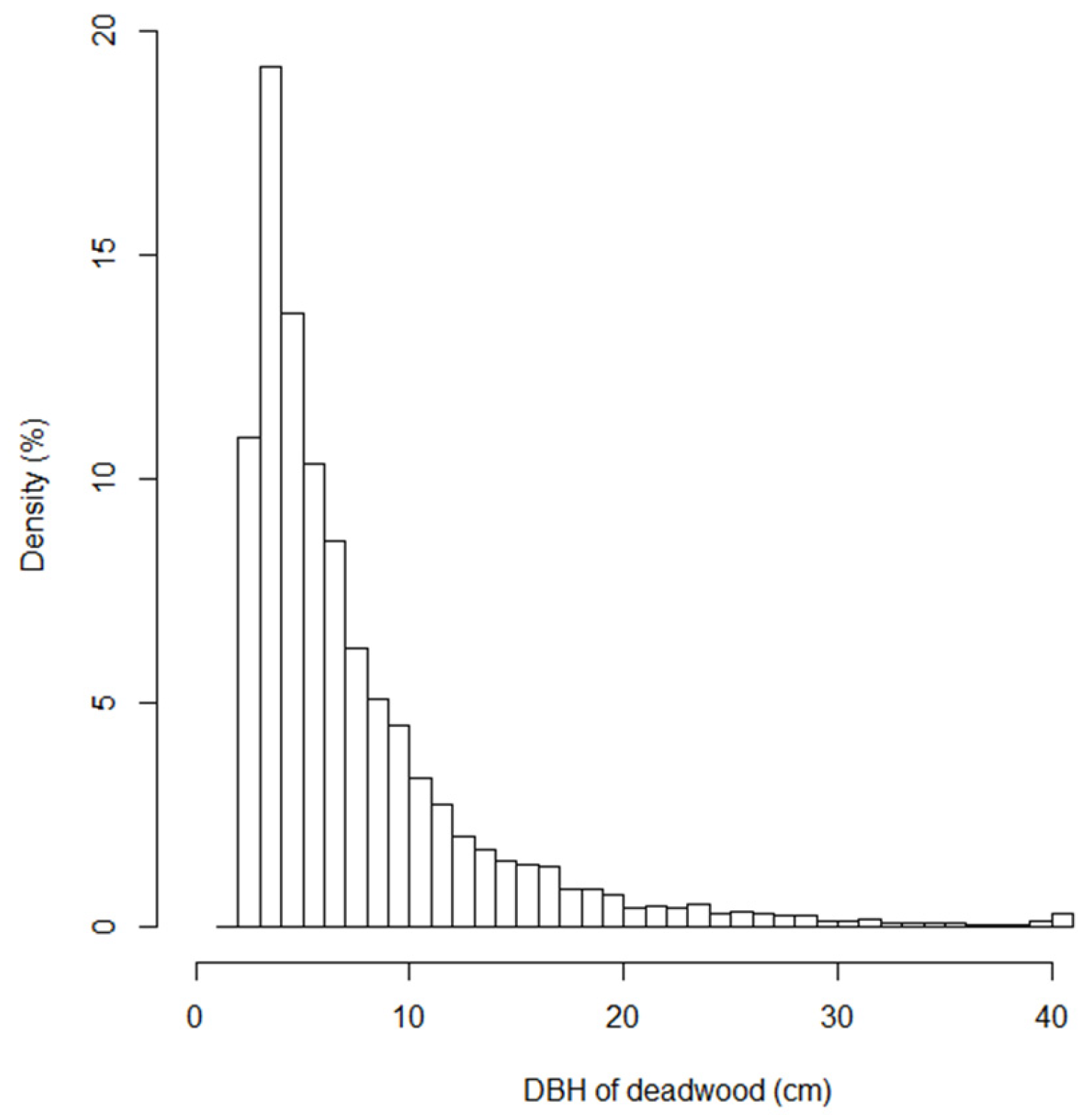
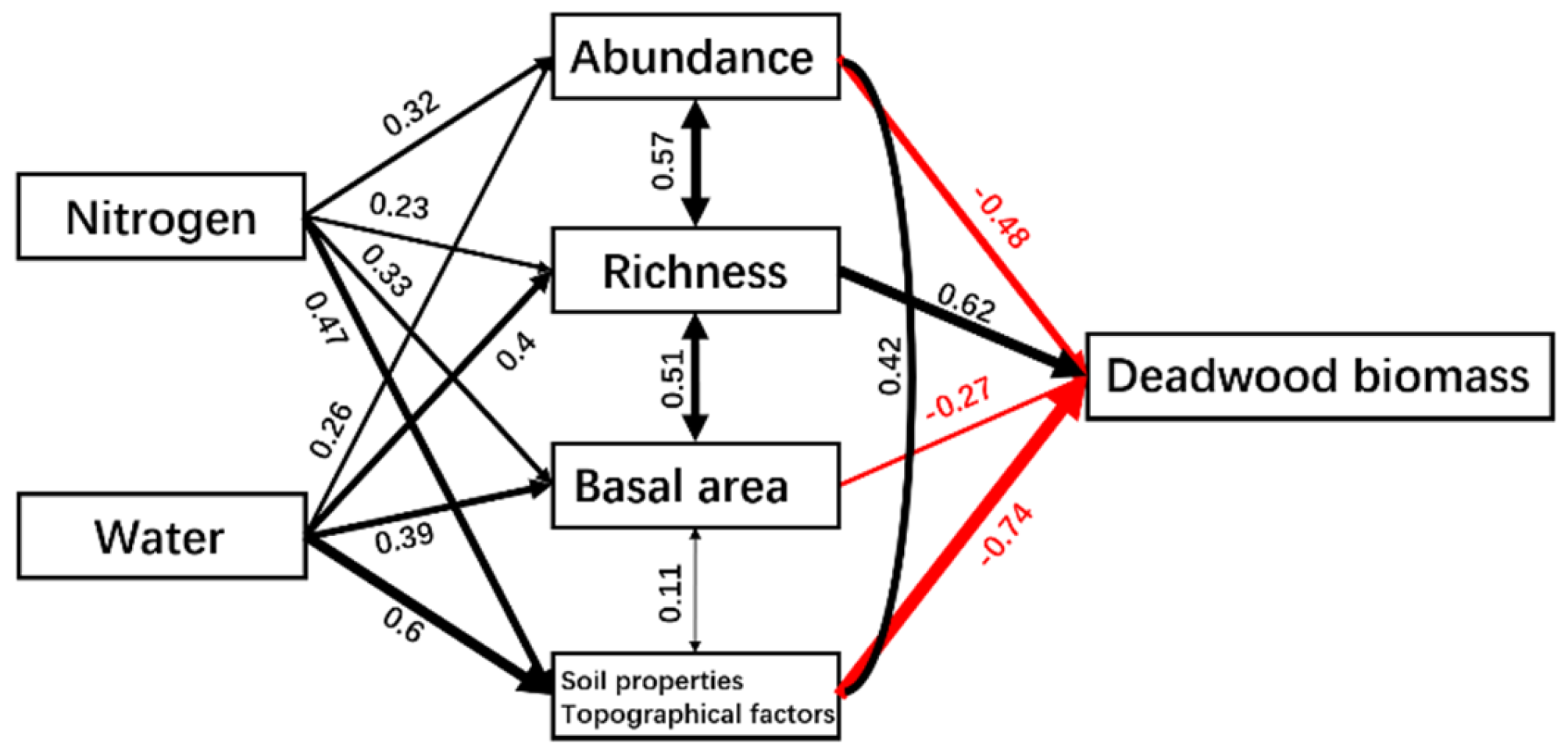
Climate change is exacerbating the vulnerability of temperate forests to severe disturbances, potentially increasing tree mortality rates. Despite the significance of this issue, there has been a lack of comprehensive research on tree survival across extensive forest areas under the background of global climate change. To fill this gap, we conducted a detailed analysis of tree survival within a canopy nitrogen and water addition experimental platform in central China, utilizing data from two censuses and evaluating contributing factors. Our findings revealed 283 dead trees within the plots, predominantly of very small diameters (1–10 cm). The distribution of these dead trees varied among subplots, influenced by both biotic and abiotic factors. Notably, three dominant tree species were responsible for 64.8% of the deadwood biomass. The study determined that both the breast diameter and the quantity of dead trees, affected by surrounding trees and environmental conditions, played a critical role in deadwood biomass accumulation. This research offers an in-depth examination of deadwood biomass patterns in a temperate forest, highlighting the need to consider both experiment treatments and abiotic elements like topography in studies of forest ecosystem carbon. The insights gained from this study enhance our understanding of warm temperate forests’ role in the global carbon cycle and offer valuable guidance for forest conservation and management strategies.
Keywords: canopy nitrogen addition; canopy water addition; abiotic and biotic factors; temperate forest; tree survival canopy nitrogen addition; canopy water addition; abiotic and biotic factors; temperate forest; tree survival