Rubber-Tracked Forwarders—Productivity and Cost Efficiency Potentials



Abstract
1. Introduction
2. Materials and Methods
2.1. Stand Data
2.2. Time Consumption
2.3. Costs
2.4. Parameter Variation
2.5. Model Implementation
3. Results
3.1. Controlled Conditions
3.2. Case Study with Stand Data
3.3. Potential Forwarding on Soft Terrain
4. Discussion
Future Research
5. Conclusions
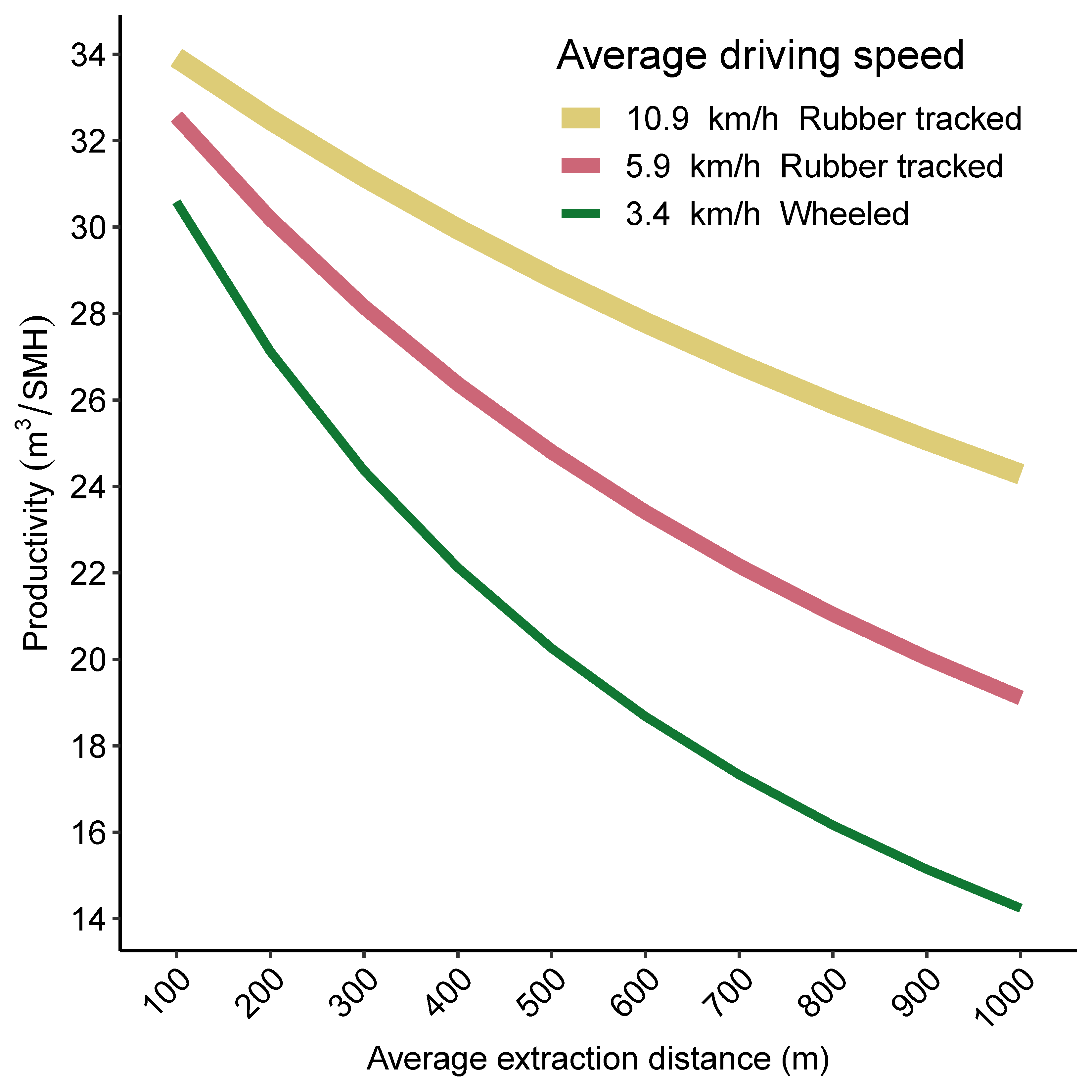
- Rubber-tracked forwarders have the potential to increase productivity by between 10 and 60% depending on the level of increased driving speed and extraction distance.
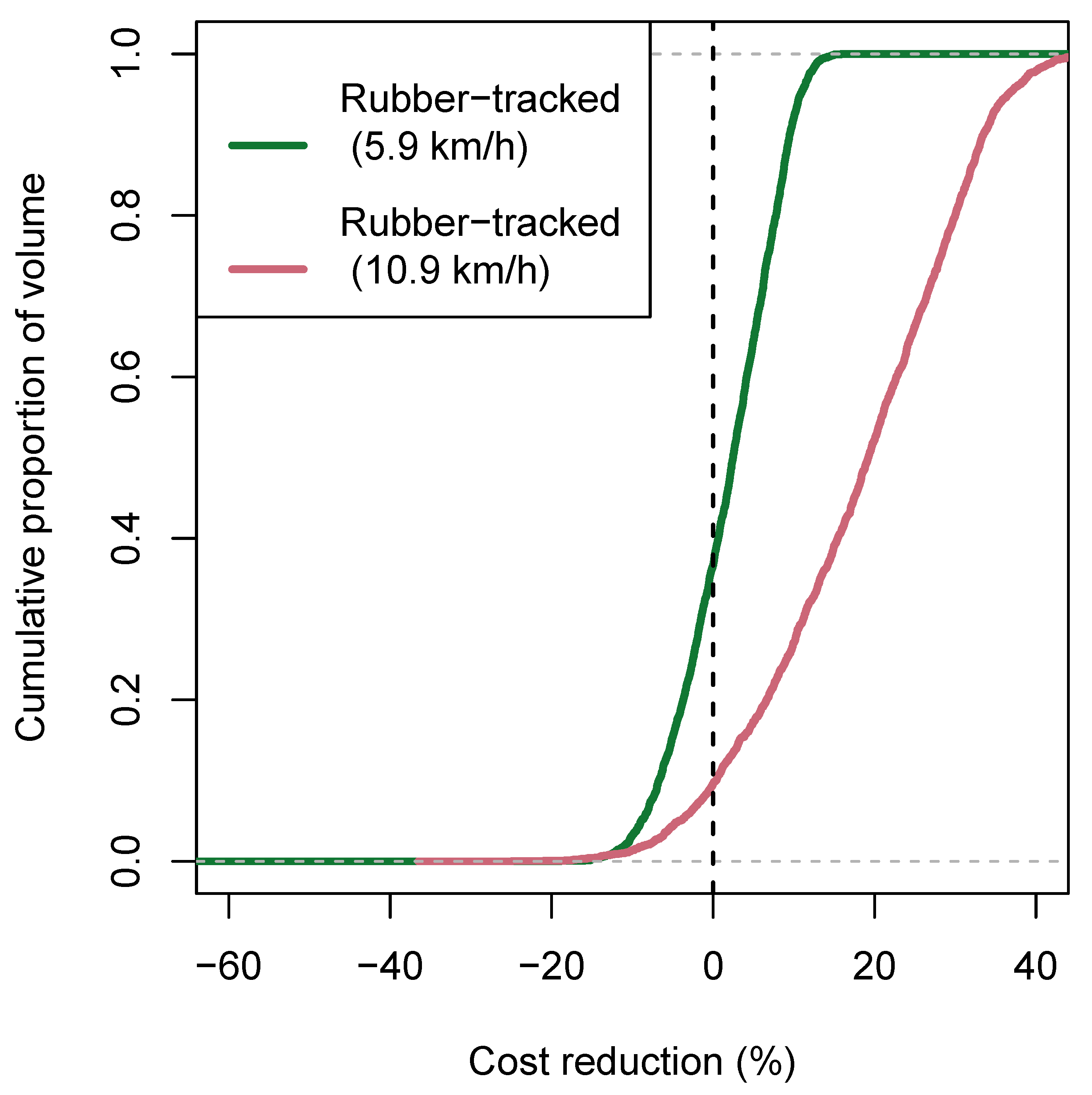
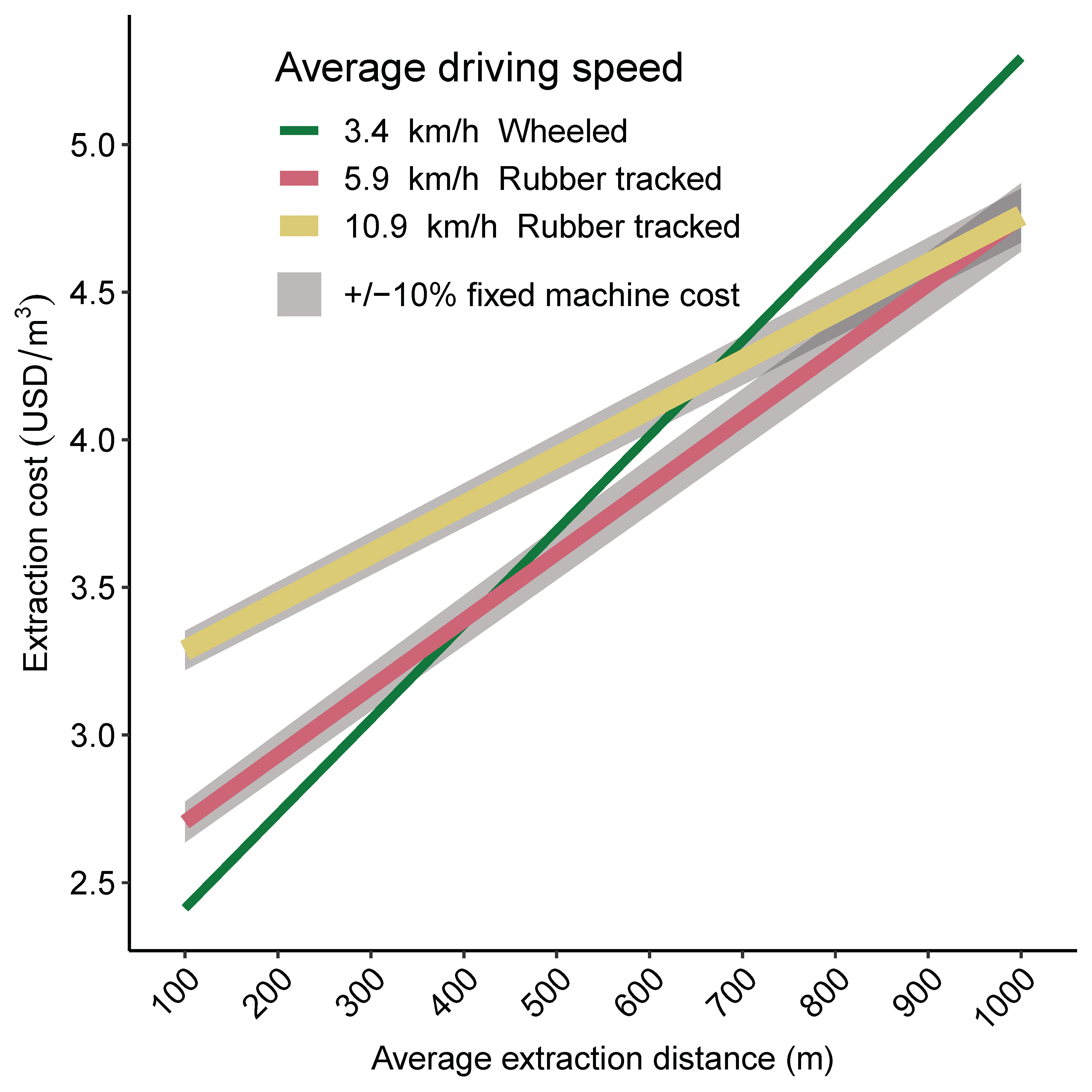
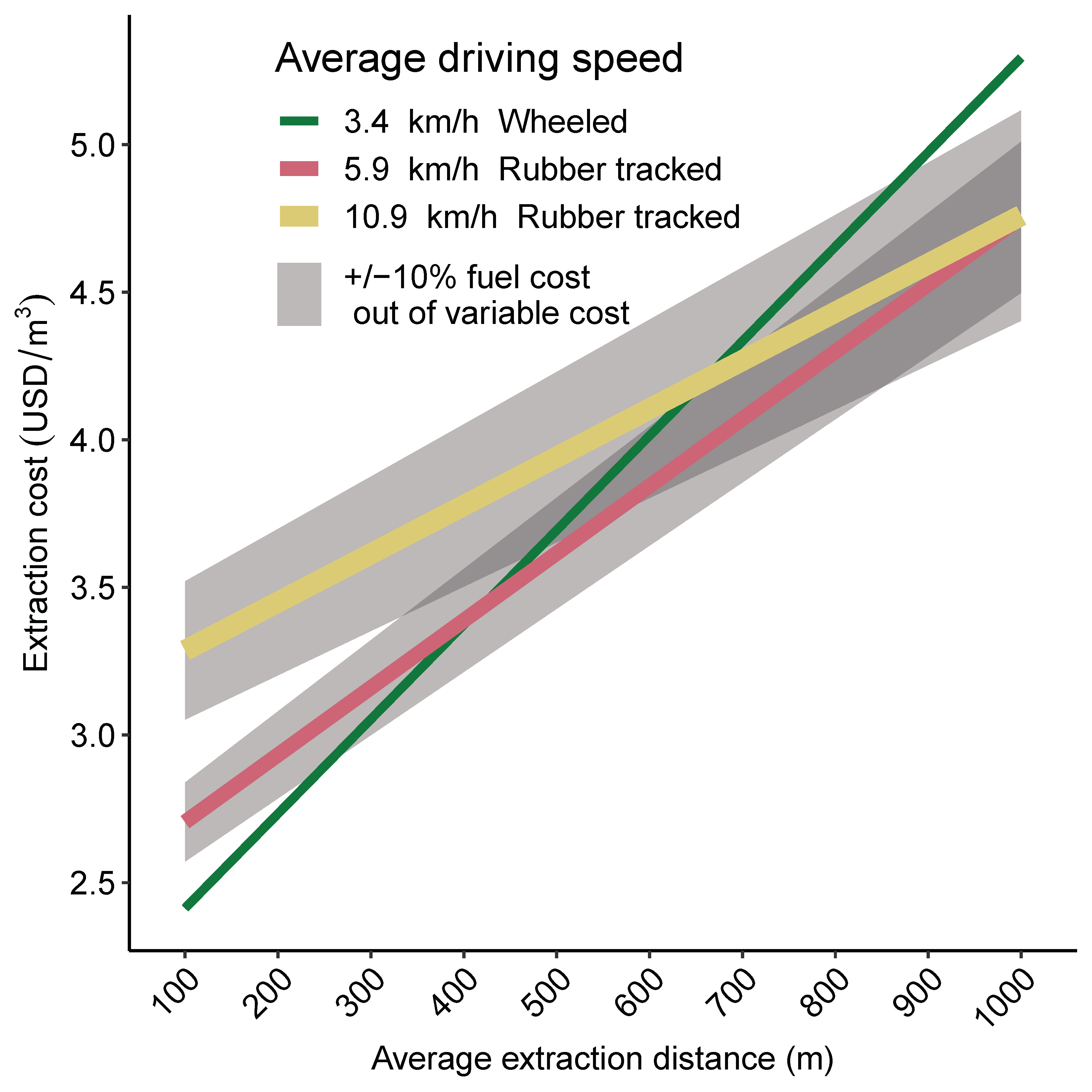
- Rubber-tracked forwarders have the potential to reduce extraction costs by about 40% and 10% of the volume for moderate and fast speed scenarios, respectively.
- The results of this study indicate that there is a price to pay in extraction costs for increased accessibility, despite increased driving speed. The size of the change in price is case-dependent and also depends on particular cost parameters and levels of speed increase.
Author Contributions
Funding
Data Availability Statement
Conflicts of Interest
References
- FAO. The Global Forest Resources Assessment 2020. In The Global Forest Resources Assessment; FAO: Rome, Italy, 2020. [Google Scholar]
- Houghton, R. Aboveground forest biomass and the global carbon balance. Glob. Chang. Biol. 2005, 11, 945–958. [Google Scholar] [CrossRef] [Scilit]
- Marchi, E.; Chung, W.; Visser, R.; Abbas, D.; Nordfjell, T.; Mederski, P.S.; McEwan, A.; Brink, M.; Laschi, A. Sustainable Forest Operations (SFO): A new paradigm in a changing world and climate. Sci. Total Environ. 2018, 634, 1385–1397. [Google Scholar] [CrossRef] [Scilit] [PubMed]
- Eriksson, M. Developing Client-Supplier Alignment in Swedish Wood Supply: From Efficiency Engineering to Managing Performance. Ph.D. Thesis, Swedish University of Agricultural Sciences, Umeå, Sweden, 2016. [Google Scholar]
- Silversides, C.R. Broadaxe to Flying Shear; National Museum of Science and Technology: Ottawa, ON, Canada, 1997. [Google Scholar]
- Ager, B. Skogsarbetets Humanisering och Rationalisering Från 1900 och Framåt: In Swedish. Ph.D. Thesis, Luleå School of Technology, Luleå, Sweden, 2014. [Google Scholar]
- Häggström, C.; Lindroos, O. Human, technology, organization and environment—A human factors perspective on performance in forest harvesting. Int. J. For. Eng. 2016, 27, 67–78. [Google Scholar] [CrossRef] [Scilit]
- Hartmann, M.; Howes, C.G.; VanInsberghe, D.; Yu, H.; Bachar, D.; Christen, R.; Henrik Nilsson, R.; Hallam, S.J.; Mohn, W.W. Significant and persistent impact of timber harvesting on soil microbial communities in Northern coniferous forests. ISME J. 2012, 6, 2199–2218. [Google Scholar] [CrossRef] [Scilit] [PubMed]
- Cambi, M.; Certini, G.; Neri, F.; Marchi, E. The impact of heavy traffic on forest soils: A review. For. Ecol. Manag. 2015, 338, 124–138. [Google Scholar] [CrossRef] [Scilit]
- Marra, E.; Wictorsson, R.; Bohlin, J.; Marchi, E.; Nordfjell, T. Remote measuring of the depth of wheel ruts in forest terrain using a drone. Int. J. For. Eng. 2021, 32, 224–234. [Google Scholar] [CrossRef] [Scilit]
- Picchio, R.; Mederski, P.S.; Tavankar, F. How and How Much, Do Harvesting Activities Affect Forest Soil, Regeneration and Stands? Curr. For. Rep. 2020, 6, 115–128. [Google Scholar] [CrossRef] [Scilit]
- Goltsev, V.; Lopatin, E. The impact of climate change on the technical accessibility of forests in the Tikhvin District of the Leningrad Region of Russia. Int. J. For. Eng. 2013, 24, 148–160. [Google Scholar] [CrossRef] [Scilit]
- Johansson, M.; Erlandsson, E.; Kronholm, T.; Lindroos, O. The need for flexibility in forest harvesting services–a case study on contractors’ workflow variations. Int. J. For. Eng. 2022, 34, 13–25. [Google Scholar] [CrossRef] [Scilit]
- Müller, F.; Jaeger, D.; Hanewinkel, M. Digitization in wood supply–A review on how Industry 4.0 will change the forest value chain. Comput. Electron. Agric. 2019, 162, 206–218. [Google Scholar] [CrossRef] [Scilit]
- Flisberg, P.; Rönnqvist, M.; Willén, E.; Frisk, M.; Friberg, G. Spatial optimization of ground-based primary extraction routes using the BestWay decision support system. Can. J. For. Res. 2020, 51, 675–691. [Google Scholar] [CrossRef] [Scilit]
- Hosseini, A.; Lindroos, O.; Wadbro, E. A holistic optimization framework for forest machine trail network design accounting for multiple objectives and machines. Can. J. For. Res. 2019, 49, 111–120. [Google Scholar] [CrossRef] [Scilit]
- Sakai, H.; Nordfjell, T.; Suadicani, K.; Talbot, B.; Bøllehuus, E. Soil compaction on forest soils from different kinds of tires and tracks and possibility of accurate estimate. Croat. J. For. Eng. J. Theory Appl. For. Eng. 2008, 29, 15–27. [Google Scholar]
- Ala-Ilomäki, J.; Högnäs, T.; Lamminen, S.; Sirén, M. Equipping a conventional wheeled forwarder for peatland operations. Int. J. For. Eng. 2013, 22, 7–13. [Google Scholar] [CrossRef] [Scilit]
- Fjeld, D.; Østby-Berntsen, Ø. The effects of an auxiliary axle on forwarder rut development—A Norwegian field study. Int. J. For. Eng. 2020, 31, 192–196. [Google Scholar] [CrossRef] [Scilit]
- Spinelli, R.; de Arruda Moura, A.C. Decreasing the fuel consumption and CO2 emissions of excavator-based harvesters with a machine control system. Forests 2019, 10, 43. [Google Scholar] [CrossRef] [Scilit]
- Visser, R.; Stampfer, K. Expanding Ground-based Harvesting onto Steep Terrain: A Review. Croat. J. For. Eng. 2015, 36, 321–331. [Google Scholar]
- Lundbäck, M.; Persson, H.; Häggström, C.; Nordfjell, T. Global analysis of the slope of forest land. For. Int. J. For. Res. 2021, 94, 54–69. [Google Scholar] [CrossRef] [Scilit]
- Ala-Ilomäki, J.; Lindeman, H.; Mola-Yudego, B.; Prinz, R.; Väätäinen, K.; Talbot, B.; Routa, J. The effect of bogie track and forwarder design on rut formation in a peatland. Int. J. For. Eng. 2021, 32, 12–19. [Google Scholar] [CrossRef] [Scilit]
- Gelin, O.; Björheden, R. Concept evaluations of three novel forwarders for gentler forest operations. J. Terramechanics 2020, 90, 49–57. [Google Scholar] [CrossRef] [Scilit]
- Zemánek, T.; Neruda, J. Impact on the operation of a forwarder with the wheeled, tracked-wheel or tracked chassis on the soil surface. Forests 2021, 12, 336. [Google Scholar] [CrossRef] [Scilit]
- Keskitalo, E.C.H.; Bergh, J.; Felton, A.; Björkman, C.; Berlin, M.; Axelsson, P.; Ring, E.; Ågren, A.; Roberge, J.-M.; Klapwijk, M.J. Adaptation to climate change in Swedish forestry. Forests 2016, 7, 28. [Google Scholar] [CrossRef] [Scilit]
- Komatsu Forest Press Release, Svensk Skogsnäring Utvecklar Framtidens Hållbara Skogsmaskin. Available online: https://www.komatsuforest.se/media/nyhetsrum/centipede-press-release# (accessed on 29 January 2024).
- Samset, I. Loven om den sprangvise utvikling (The law of discontinuous evolution). Nor. Skogbr. 1966, 12, 737–741. (In Norwegian) [Google Scholar]
- Jonsson, R. Strategic Technology Decision-Making in Swedish Large-Scale Forestry. Ph.D. Thesis, Swedish University of Agricultural Sciences, Umeå, Sweden, 2022. [Google Scholar]
- Lindroos, O. Evaluation of technical and organizational approaches for directly loading logs in mechanized cut-to-length harvesting. For. Sci. 2012, 58, 326–341. [Google Scholar] [CrossRef] [Scilit]
- Berg, S. Terrain Classification System for Forestry Work; Forskningsstiftelsen Skogsarbeten: Kista, Sweden, 1992. [Google Scholar]
- Nurminen, T.; Korpunen, H.; Uusitalo, J. Time consumption analysis of the mechanized cut-to-length harvesting system. Silva Fenn. 2006, 40, 336–363. [Google Scholar] [CrossRef] [Scilit]
- Lundbäck, M.; Häggström, C.; Fjeld, D.; Lindroos, O.; Nordfjell, T. The economic potential of semi-automated tele-extraction of roundwood in Sweden. Int. J. For. Eng. 2022, 33, 271–288. [Google Scholar] [CrossRef] [Scilit]
- Lindroos, O.; Wästerlund, I. Theoretical potentials of forwarder trailers with and without axle load restrictions. Croat. J. For. Eng. J. Theory Appl. For. Eng. 2014, 35, 211–219. [Google Scholar]
- Ackerman, P.; Belbo, H.; Eliasson, L.; de Jong, A.; Lazdins, A.; Lyons, J. The COST model for calculation of forest operations costs. Int. J. For. Eng. 2014, 25, 75–81. [Google Scholar] [CrossRef] [Scilit]
- Manner, J.; Palmroth, L.; Nordfjell, T.; Lindroos, O. Load level forwarding work element analysis based on automatic follow-up data. Silva Fenn. 2016, 50, 1546. [Google Scholar] [CrossRef] [Scilit]
- Chołodowski, J.; Dudziński, P.A.; Ketting, M. A method for predicting the internal motion resistance of rubber-tracked undercarriages, Pt. 3. A research on bending resistance of rubber tracks. J. Terramechanics 2021, 97, 71–103. [Google Scholar] [CrossRef] [Scilit]
- R Core Team. R: A Language and Environment for Statistical Computing; R Foundation for Statistical Computing: Vienna, Austria, 2018. [Google Scholar]
- Wickham, H. ggplot2: Elegant Graphics for Data Analysis; Springer: New York, NY, USA, 2016. [Google Scholar]
- Uusitalo, J. Introduction to Forest Operations and Technology; JVP Forest Systems: Tampere, Finland, 2010. [Google Scholar]
- Eriksson, M.; Lindroos, O. Productivity of harvesters and forwarders in CTL operations in northern Sweden based on large follow-up datasets. Int. J. For. Eng. 2014, 25, 179–200. [Google Scholar] [CrossRef] [Scilit]
- Berg, S.; Ersson, B.T.; Manner, J. Distance driven and driving speed when forwarding during final felling in Central Sweden. J. For. Sci. 2019, 65, 183–194. [Google Scholar] [CrossRef] [Scilit]





| Variable | Average | Std Dev | Min | Max |
|---|---|---|---|---|
| Total volume (m3) | 1232 | 1151 | 100 | 12,059 |
| Harvested volume (m3/ha) | 232 | 95 | 10 | 681 |
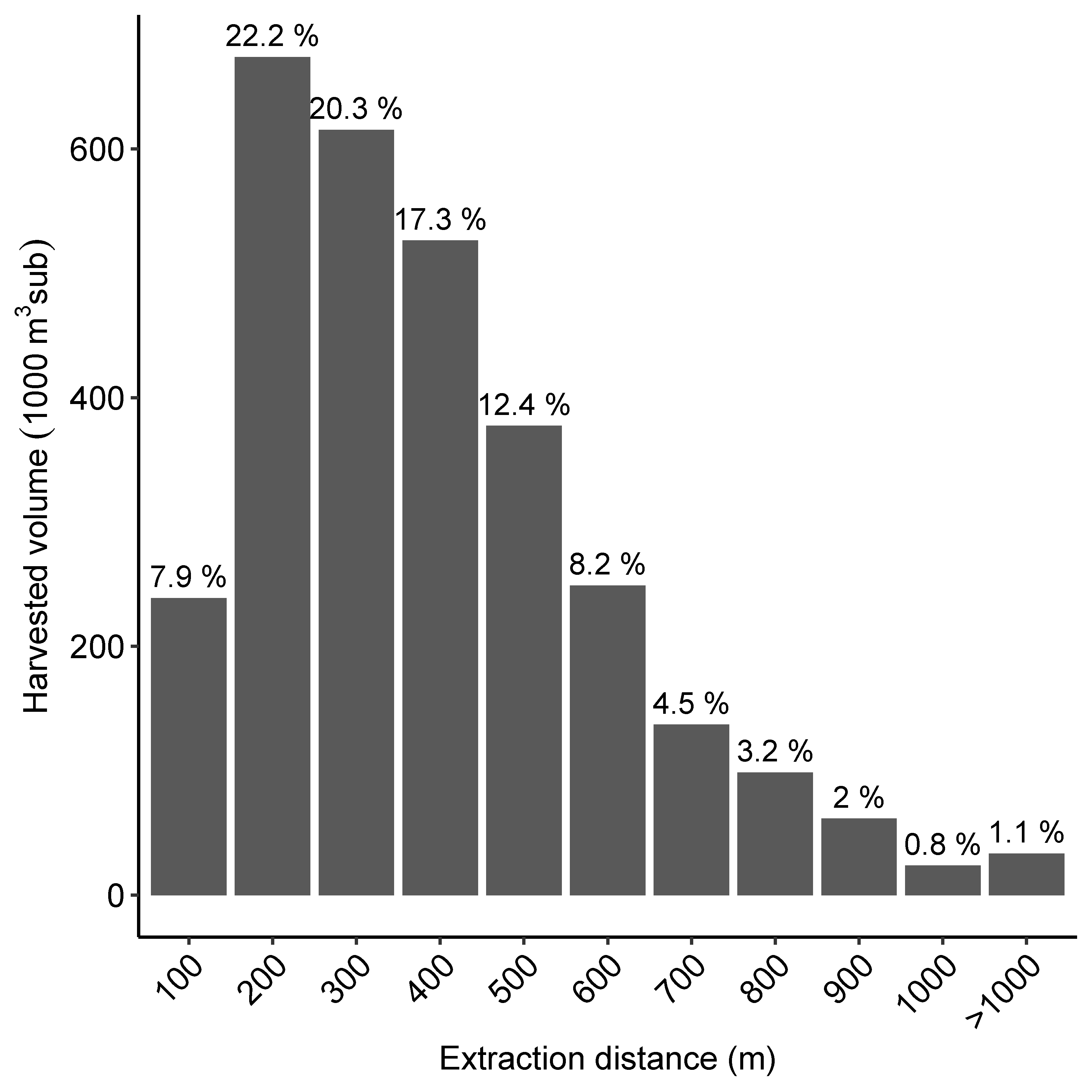
| Extraction distance (m) | 356 | 225 | 30 | 1900 |
| Parameter | Value | Source * |
|---|---|---|
| Baseline driving empty speed () (wheeled machine) | 56.67 m/min (3.4 km/h) | 1 |
| Speed driving loaded () | 85% of (2.8 km/h) | 1, 2 |
| Speed driving while loading () | 35 m/min (2.1 km/h) | 1 |
| Unloading time (TU) | 8.8 min/load | 1 |
| Delays (TO) | 6.5 min/load | 1 |
| Exchange rate | 0.089 SEK/USD | 3 |
| Fixed machine cost (wheeled) | 21.72 USD/PMH | 4, 6 |
| Fixed machine cost (rubber-tracked) | 24.12 USD/PMH | 2 |
| Variable machine cost (wheeled) | 32.57 USD/PMH | 4, 6 |
| Variable machine cost (rubber-tracked, moderate) | 48.15 USD/PMH | 2 |
| Variable machine cost (rubber-tracked, fast) | 79.30 USD/PMH | 2 |
| Operator cost (wheeled and tracked) | 33.91 USD/PMH | 4, 6 |
| Extraction trail spacing (DTS) | 13 m | 5 |
| Baseline load size (LS) (based on 900 kg/m3 wood and 14 tons load weight) | 15.6 m3 | 2 |
| Total plot volume (where not stand-specific) | 814 m3 | 7 |
| Harvested volume per ha (where not stand-specific) | 239 m3/ha | 7 |
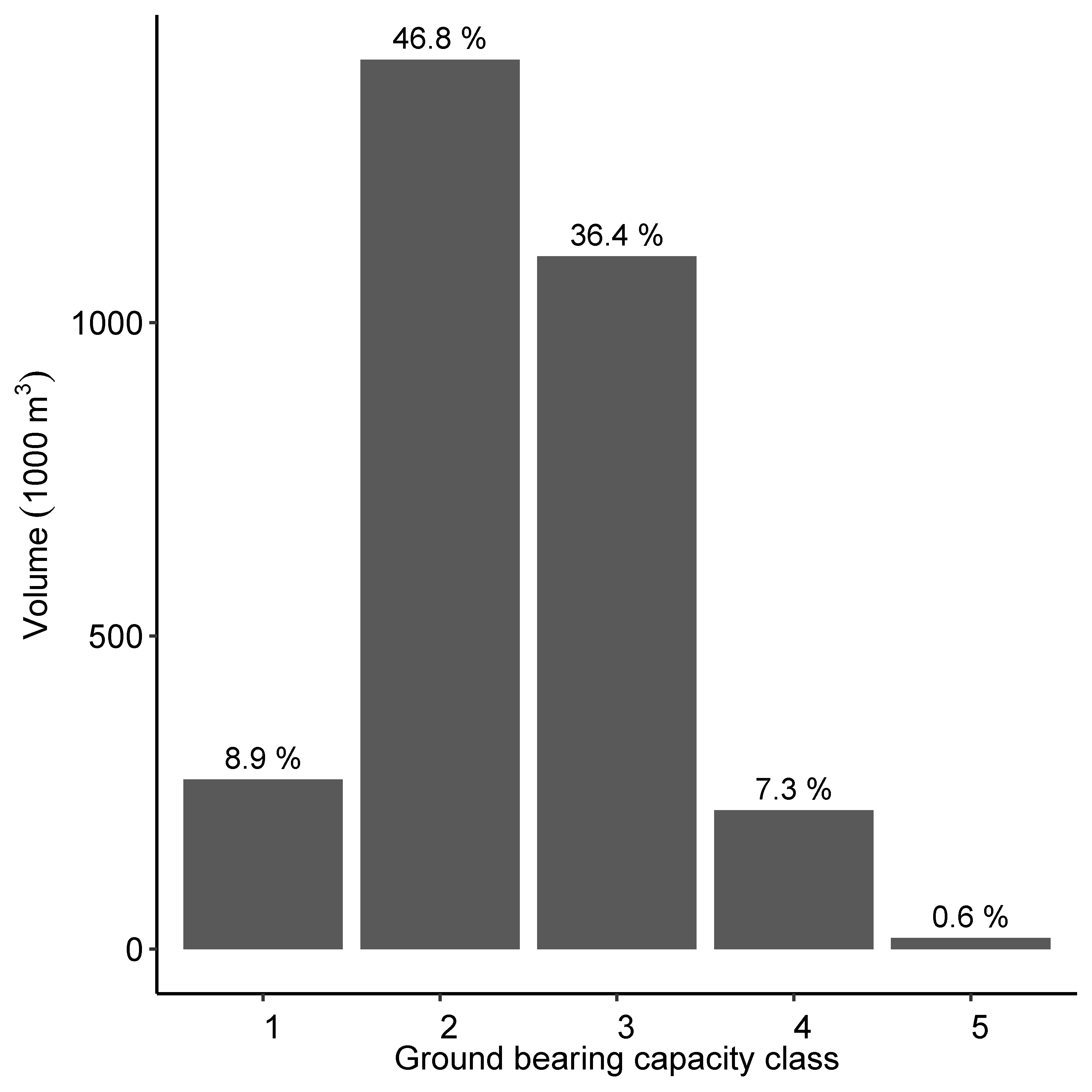
| Driving Speed (km/h) | Machine Configuration | Estimated Nominal Ground Pressure (kPa) | Ground Bearing Capacity Classes Accessible All Year |
|---|---|---|---|
| 3.4 | Wheeled (baseline) | 75 | 1 |
| 5.9 | Rubber-tracked moderate | 50 | 1–3 |
| 10.9 | Rubber-tracked fast | 50 | 1–3 |
| Machine Configuration | Average Cost (USD/m3) | Relative Cost (%) | Proportion Accessible Year Around (%) |
|---|---|---|---|
| Wheeled (baseline) | 3.45 | 0 | 9 |
| Rubber-tracked moderate | 3.48 | +0.8 | 92 |
| Rubber-tracked fast | 3.99 | +15.7 | 92 |
Disclaimer/Publisher’s Note: The statements, opinions and data contained in all publications are solely those of the individual author(s) and contributor(s) and not of MDPI and/or the editor(s). MDPI and/or the editor(s) disclaim responsibility for any injury to people or property resulting from any ideas, methods, instructions or products referred to in the content. |
© 2024 by the authors. Licensee MDPI, Basel, Switzerland. This article is an open access article distributed under the terms and conditions of the Creative Commons Attribution (CC BY) license (https://creativecommons.org/licenses/by/4.0/).
Share and Cite
Lundbäck, M.; Lindroos, O.; Servin, M. Rubber-Tracked Forwarders—Productivity and Cost Efficiency Potentials. Forests 2024, 15, 284. https://doi.org/10.3390/f15020284
Lundbäck M, Lindroos O, Servin M. Rubber-Tracked Forwarders—Productivity and Cost Efficiency Potentials. Forests. 2024; 15(2):284. https://doi.org/10.3390/f15020284
Chicago/Turabian StyleLundbäck, Mikael, Ola Lindroos, and Martin Servin. 2024. "Rubber-Tracked Forwarders—Productivity and Cost Efficiency Potentials" Forests 15, no. 2: 284. https://doi.org/10.3390/f15020284
APA StyleLundbäck, M., Lindroos, O., & Servin, M. (2024). Rubber-Tracked Forwarders—Productivity and Cost Efficiency Potentials. Forests, 15(2), 284. https://doi.org/10.3390/f15020284