1. Introduction
Climate change is one of the major challenges facing the world today and has the potential to cause extreme global hazards. Excess carbon dioxide in the air is a major contributor to the greenhouse effect [
1]. The latest Greenhouse Gas Bulletin issued by the World Meteorological Organization in November 2022 states that the increase in atmospheric carbon dioxide concentration in 2021 was greater than the average annual growth rate of the past decade. The 2015 Paris Agreement proposed achieving net-zero global emissions by 2080, limiting the global average temperature rise to less than 2 °C and working to limit it to 1.5 °C [
2]. To achieve net-zero global emissions, it is necessary not only to use scientific methods to improve energy efficiency and reduce energy consumption to reduce carbon dioxide emissions but also to implement practical carbon sequestration solutions [
3].
Scientific studies have shown that during forest growth, trees can absorb carbon dioxide from the air and convert it into biomass through photosynthesis [
4], with an average of approximately 1.83 tons of carbon dioxide absorbed and 1.62 tons of oxygen released for each cubic meter of forest growth. This shows a great potential to reduce the carbon dioxide content in the atmosphere. For this reason, forests play an irreplaceable role in developing a low-carbon economy and mitigating global warming [
5,
6]. In terrestrial ecosystems, forests are the largest reservoir of organic carbon, accounting for 56% of the entire terrestrial carbon pool. In terms of forest area, China ranks fifth in the world with 230 million hectares, and first in the world for planted forests with 87.6 million hectares, playing an important role in natural carbon sequestration. Rational management and utilization of China’s forest resources is important for sustainable development strategies.
Currently, many countries have proposed their carbon neutrality targets; for example, China plans to achieve carbon neutrality by 2060. As an important resource for carbon sequestration, learning how to manage forests to enhance carbon sequestration capacity has become an important task for forestry managers. Nevertheless, there is some controversy about this in current studies and the media. One proposed strategy is to reduce harvesting, increase forest retention, and thus increase forest carbon stocks; another is to increase the harvesting of mature trees to produce forest products that are more conducive to carbon sequestration. The results of an online survey indicated that the second strategy has more supporters [
7]. In addition, a study by Jernej pointed out that harvesting properly but keeping the harvest rate low is beneficial to increasing the carbon stock of the forest, while harvesting at a high intensity is not beneficial to increasing the carbon stock [
3]. Moreover, studies have shown that the service life of some forest products far exceeds the growth life of trees, which prolongs the carbon dioxide sequestration time. Thus, the rational harvesting of forests for production of forest products is conducive to increasing carbon sequestration in forests [
8].
Meanwhile, the value of forests is multifaceted; a scientific forest management plan can bring not only ecological benefits but also significant economic and social benefits [
1]. Shi has pointed out that the various functions of forestry play an important role in many aspects of society and classified the comprehensive benefits of forests into three categories: ecological benefits, economic benefits and social benefits [
9]. Salamanca [
10] argued that forests can provide both economic and social benefits in terms of landscaping. With a rational cutting strategy, both the economic benefits and the ecological benefits of carbon sequestration can be achieved [
11,
12,
13]. The oil palm tree is a well-known cash crop in Malaysia that produces oil as a renewable energy source, bringing high economic returns while absorbing large amounts of carbon dioxide. Based on real data, Noryanti developed a mathematical model to find the optimal cutting rate to maximize oil production and carbon sequestration [
14].
Studies of forest carbon sequestration have found that the carbon dioxide absorption capacity of forests is closely related to the age and species of the trees [
4,
15,
16]. Generally, forests can be divided into young, middle-aged, near-mature, and mature forests according to their ages, among which young forests have the greatest rate of carbon accumulation, while mature forests have a basic balance of carbon uptake and release because their biomass has largely stopped growing. For example, Sedat described the cumulative carbon dioxide uptake of the Turkish pine over 40 years of growth, with an extremely slow increase in carbon dioxide uptake after about 30 years [
17]. In addition, the net present value of the forest was assessed, taking into account the benefits of timber production and carbon dioxide sequestration, which reached a maximum value at about 30 years and then declined [
17]. The results of Sedat’s study suggest that mature trees should be harvested, both from an economic perspective and for the ecological benefits of carbon sequestration.
The above research results all indicate that harvesting is beneficial for enhancing the carbon sequestration and economic benefits of forests, but the use of mathematical models to determine the optimal cutting rate with carbon sequestration benefits as the goal is just beginning. In this paper, the annual carbon sequestration of five major tree species in Xiaoxing’anling were analyzed based on the differences in the carbon sequestration capacity of various tree species at different age stages. To achieve the maximum annual carbon sequestration, the optimal cutting rates of the five tree species were calculated and the maximum carbon sequestration was compared according to the uniform and differential distribution of each tree age group. Taking three tree species as an example, the optimal cutting rate over 10 years was calculated and analyzed to give the trend of the maximum carbon sequestration and predict the carbon dioxide uptake in 100 years. The cutting rate under the economic target and the effect of temperature change on the cutting rate were further analyzed.
2. The Proposed Mathematical Model
Recently, Aino Assmuth built a continuous model to analyze the management strategies of single-species even- and uneven-aged forests to achieve optimal carbon storage [
18]. However, the conditions of the model did not set the cutting of mature trees followed by the planting of young trees, which is not in line with either sustainable development or the realities of the forest. Subsequently, Noryanti established a continuous model based on economic benefits and carbon sink maximization to analyze the optimal cutting of oil palm [
14]. They divided oil palm into young and mature groups, and considered cutting down mature oil palm trees and replanting new oil palm trees. The conversion rate from young to mature palm oil trees was also discussed. However, since forest cutting is generally seasonal and the cutting rate does not change continuously with time, it is more reasonable to use a discrete model than a continuous model. Relevant studies have shown that the net carbon dioxide uptake of trees at different growth stages is different [
19]. Since the carbon sequestration capacity of young stands is the strongest and that of mature stands is the weakest, and mature trees have higher commercial value than young trees, cutting down mature stands and planting young stands can improve the carbon sequestration capacity of forests and achieve a win–win situation for both the ecological environment and economic benefits.
In this study, five tree species were assumed to be planted on 100 ha of Xiaoxing’anling with planting rates of ai, i = 1,2,3,4,5. In addition, the proportions of the four age groups (young, intermediate, near-mature, and mature) for each species were aij, i = 1,2,3,4,5; j = 1,2,3,4. The number of trees within each age group was assumed to be uniformly distributed according to the length of the corresponding age group. Based on the maximum annual carbon sequestration and economic benefits, the following forest management strategy was developed: in early March each year, only mature trees were harvested, and then an equal amount of young trees were planted.
2.1. Optimal Cutting Rate in the Forest Management Plan
In this section, we develop a mathematical model of annual forest carbon sequestration, derive the formula for calculating the optimal cutting rates for five different tree species, and compare the effects of cutting and no cutting on forest carbon sequestration as a way to develop the best plan for forest management. The mathematical notations used in the model are listed in
Table 1 and used in the subsequent equations.
2.1.1. Data Search
Based on reported results in the literature [
19],
Table 2 presents five typical tree species in Xiaoxing’anling divided into four age groups according to their growth period (in years): young, middle-aged, near-mature and mature.
Table 3 shows the annual sequestration (Total carbon sequestration by tree biomass, other vegetation and soil) of four age groups of five forest species planted in Xiaoxing’anling with an area of 1 ha [
19].
2.1.2. Establishment of model
First, we use the example of a Pinus koraiensis forest to illustrate the meaning of the uniform distribution of trees by age at the same age stage. If the number of young trees is 1, and since for the first 60 years of growth the Pinus koraiensis forest is young as given in
Table 2, 1/60th of the trees of each age will be of the same age, i.e., after one year, 1/60th of the young stands will grow into the middle-aged stage. Similarly, 1/40 of the middle-aged trees will grow into the near-mature stage and 1/20 of the near-mature trees will grow into the mature stage after one year. Furthermore, it is assumed that the cutting amount in the mature period is equal to the planting amount in the young stage. The iterative equations for the proportion of the
nth year and (
n−1)
th year for four age groups of stands of five tree species can be obtained as follows:
According to the annual carbon sequestration of different tree species in different periods listed in
Table 3, using the above iterative Equations (1)–(4), the expressions for the carbon sequestration in the
nth year of a forest planted with five typical tree species on an area of S (in hectares) can be obtained as follows:
When
b(n−1)I = 0 (i = 1,2,3,4,5), Equation (5) is simplified to the annual carbon sequestration without cutting. Take
S = 100 ha, and assume the same planting ratio of 5 tree species, i.e.,
ai = 0.2, as
Let
aij(
n−1) =
pij, and the following relationship between the proportion of age distribution and the cutting rate of the five tree species in year
n-1 can be found using MATLAB software programming.
The maximum annual carbon sequestration rate can be obtained by substituting Equations (7)–(11) into Equation (6).
Table 4 presents a comparison of the maximum annual carbon sequestration for uniform and differential age distributions, which shows that different age distribution ratios result in different optimal cutting rates as well as maximum annual carbon sequestration. In addition, the carbon sequestration under the cutting strategy are larger than those when no cutting occurs.
2.2. Optimal Long-Term Cutting Rate in Forest Management Plans
2.2.1. Establishment of the Model
In this section, we discuss the implementation strategies for the long-term cutting rate. Based on the results of Part 2.1, the optimal cutting rates of the five tree species are not related to each other, so in the following study, we will focus on three tree species. The research methods of the other two tree species are similar and will not be repeated. We assumed that only either Pinus koraiensis forest, Larix gmelinil forest, or Pinus sylvestris var. mongolica forests are planted on 100 ha under the conditions of uniform and uneven distribution of the initial four age groups. We calculated the 10-year harvest rate bni (n = 1,2,...,10; i = 1,2,3) and predicted the cutting rate for 100 years. Furthermore, we discuss the maximum carbon sequestration of three tree species. We assumed that the initial ratios aij(0) = pij = 0.25, (i = 1,2,3; j=1,2,3,4) for uniform distribution and , (i = 1,2,3) for uneven distribution.
We calculated the 10-year harvest rate
bni (
n = 1,2,...,10; i = 1,2,3), and predicted the cutting rate for 100 years. According to Equations (1)–(4), the annual carbon sequestration of the Pinus koraiensis forest is as follows:
The annual carbon sequestration of the Larix gmelinil forest is as follows:
The annual carbon sequestration of the Pinus sylvestris var. mongolica forest is as follows:
2.2.2. Analysis of Forest Carbon Sequestration over Ten Years
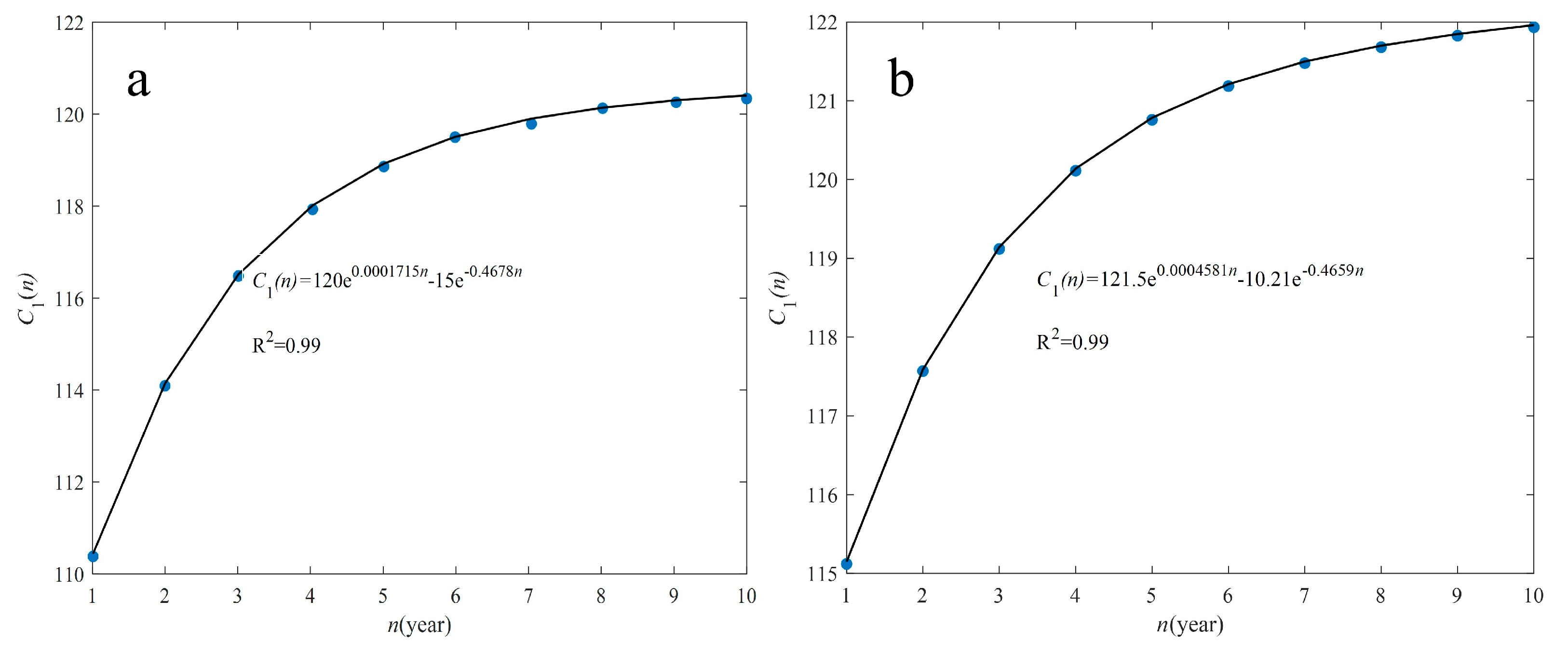
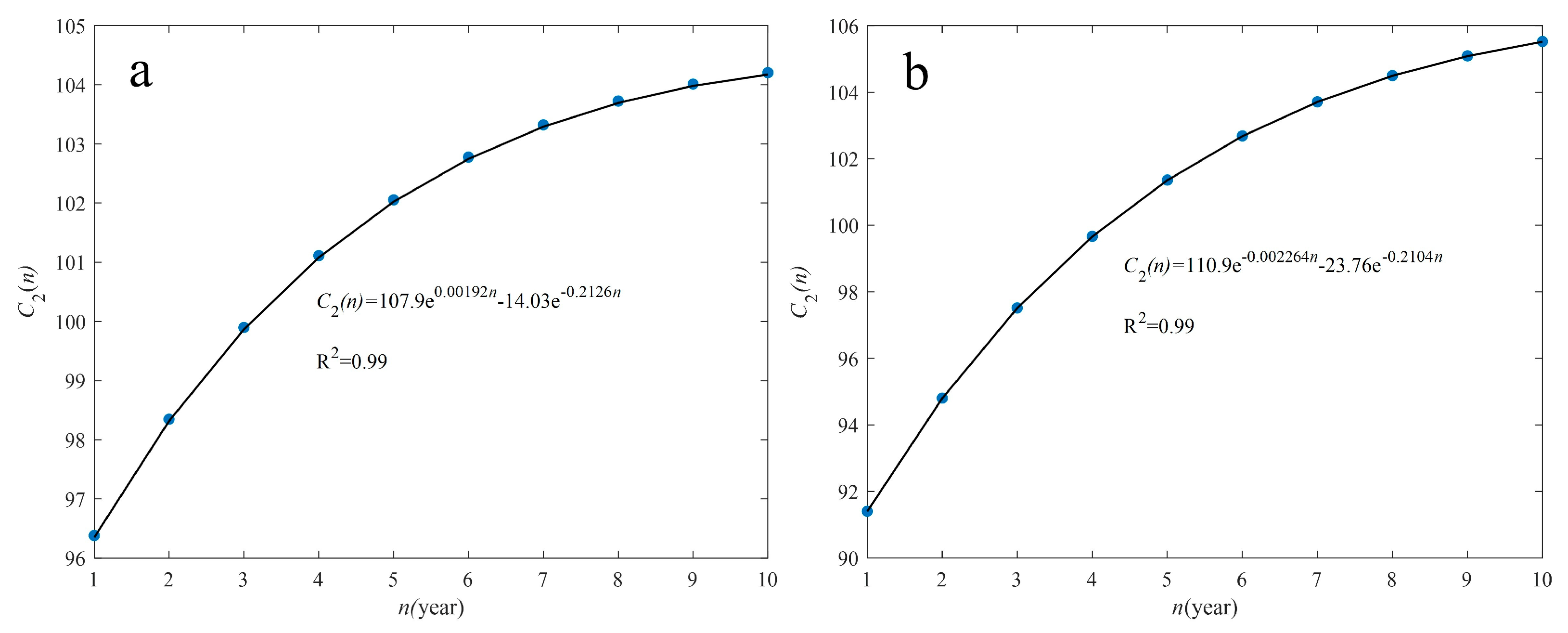
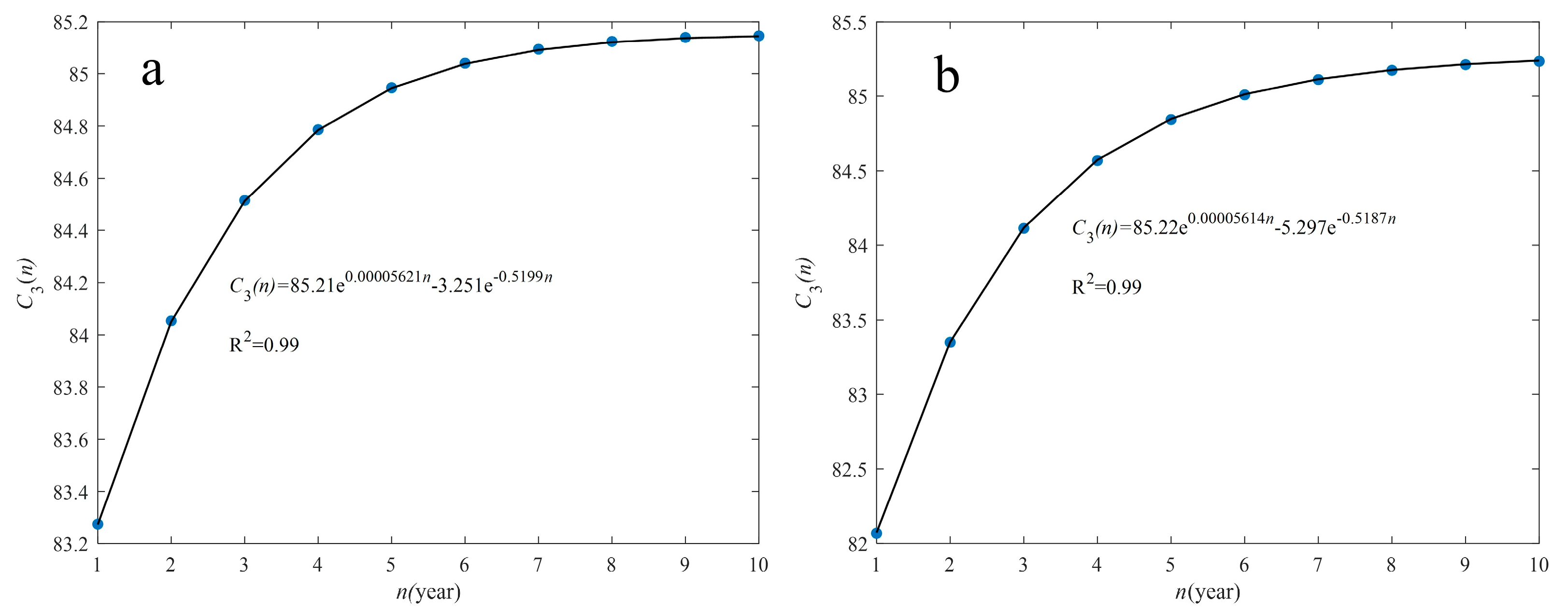
According to Equations (12)–(14), the maximum carbon sequestration of a forest in ten years under two conditions of uniform and uneven distribution of the initial four age groups can be obtained. The values can be fitted, as shown in
Figure 1,
Figure 2 and
Figure 3. The fitting results show that the change in forest carbon uptake with time complies with the double exponential growth model (
). The fitting parameters and errors are shown in
Table 5,
Table 6 and
Table 7.
2.2.3. Analysis of the Forest Cutting Rate over Ten Years
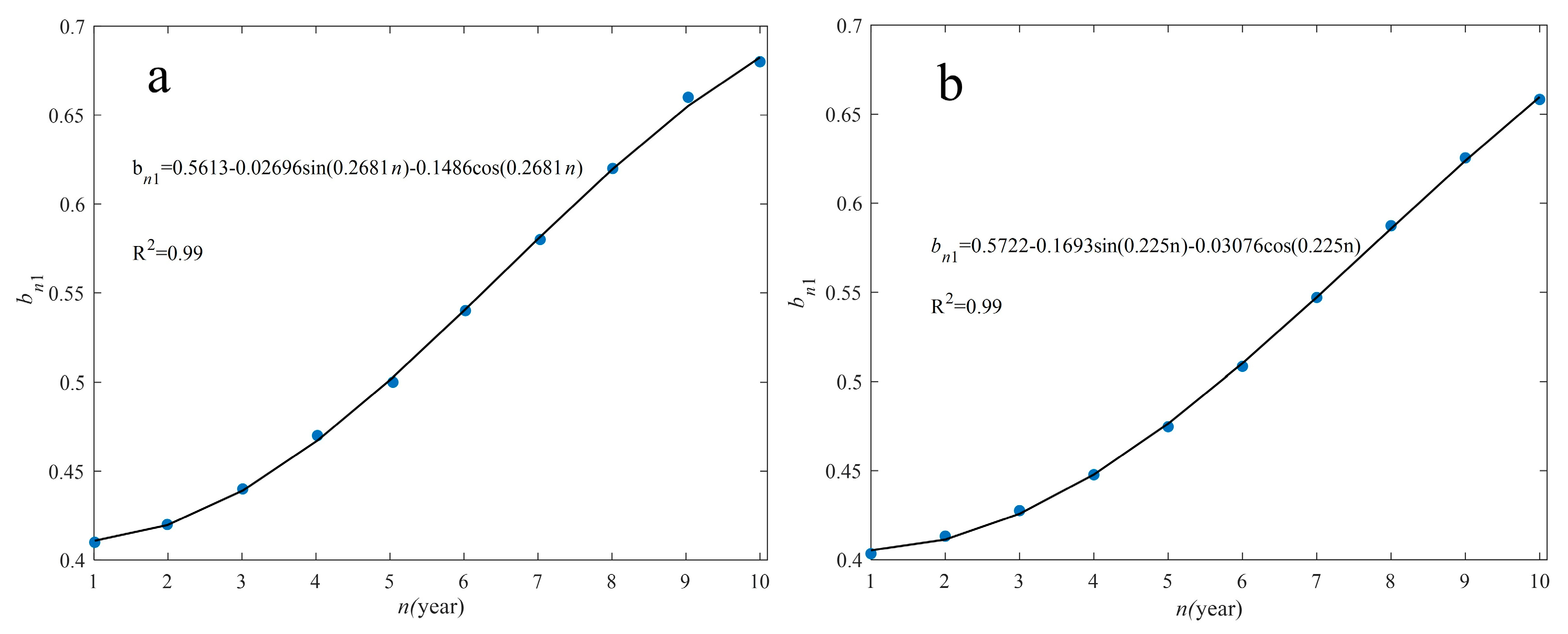
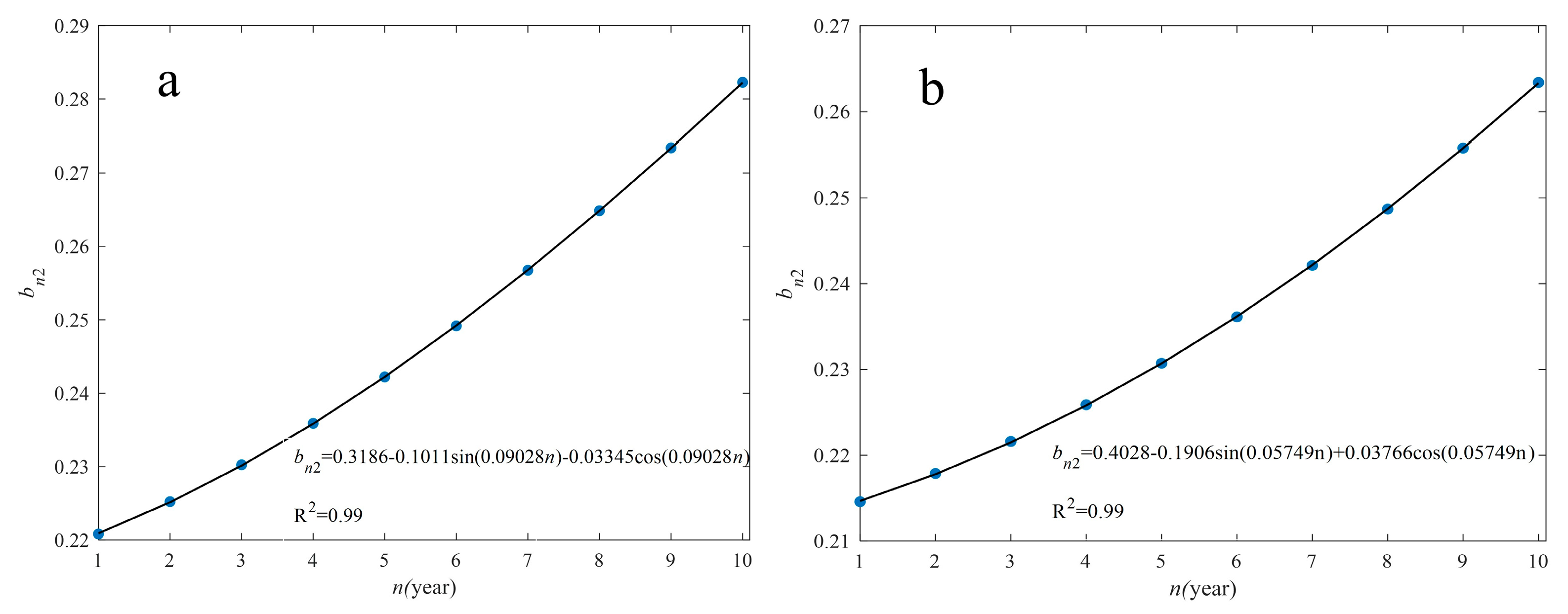
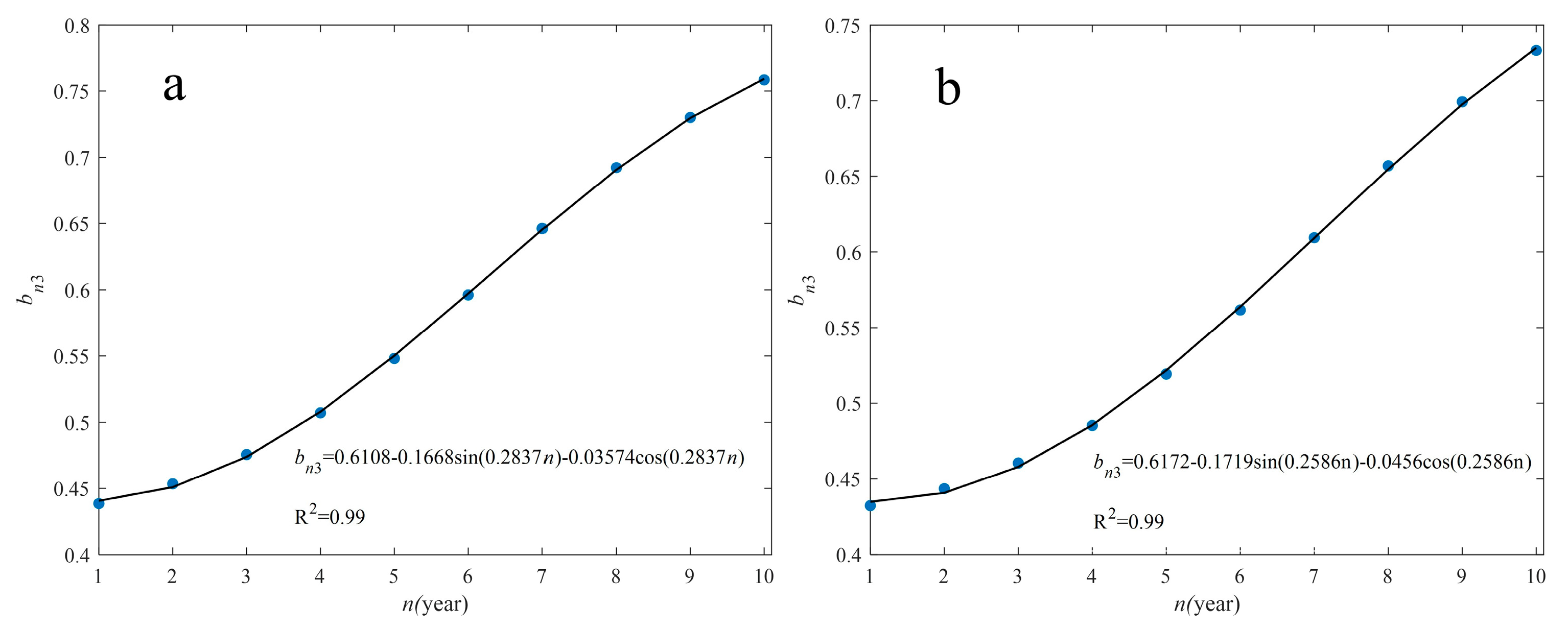
According to the calculation Equations (1)–(4) and (7)–(9), the optimal harvesting rate of mature trees in 10 years under two conditions of uniform and uneven distribution of the initial four age groups can be obtained by year-by-year recurrence. The fitting results are shown in
Figure 4,
Figure 5 and
Figure 6, which indicates that the optimal cutting rate complies with the double trigonometric model (
). Using the fitted equation, the optimal cutting rate in the 100th year,
b100,i (i = 1,2,3) can be predicted. In practical management, forest operators can refer to the calculation results in the figure to cut and plant young trees at the appropriate rate, or modify the model to meet the actual needs of other tree species with specific data. The fitting parameters, errors and the optimal cutting rate in the 100th year are shown in
Table 8,
Table 9 and
Table 10.
2.3. Comprehensive Economic Benefit Model of Harvesting
Due to the interaction between forest ecosystems and social-ecological systems at present, the optimal solution for carbon sequestration benefits alone would face complex obstacles in practice. Therefore, based on the carbon sequestration benefit model, we quantified the value of carbon sequestration and oxygen released from forest management, quantified the market value of harvested mature trees in terms of the market value of logs, and measured the merits of forest management strategies with the sum of the final economic values generated. The ecological benefits of carbon sequestration and oxygen release generated by forest management were converted into quantifiable monetary benefits and added to the direct income from the sale of harvested logs as a basis for forest managers to develop forest management plans. When trees are harvested for forest products, a certain amount of biomass is burned or decays, such as leaves, twigs, roots or bark, which are of lesser economic value, and thus release their stored carbon into the environment. In the model development, we set the proportion corresponding to this fraction of re-released carbon dioxide biomass to ci, proportion of forest products of the ith tree species lost due to burning.
The process of calculating the comprehensive economic value of the forest is as follows: for harvested trees, the weight of the forest product output is calculated according to the biomass corresponding to the carbon sequestration, while the economic value of the wood is calculated at the current market price. The value of carbon sequestration can be calculated based on the authoritative Swedish carbon tax rate, while the value of oxygen release was calculated based on the price of oxygen. For convenience, we chose only to calculate the economic value of the first tree species examined. Assume that the initial planting ratio
a1j(0) = 0.25, j = 1,2,3,4, for four age stages of Pinus koraiensis forest. Substitute the results of the recursive formula at n = 1 into the following equation:
Based on iterative Equations (1)–(4) at
i = 1, the following formula is obtained:
Letting
, we obtain the following optimal cutting rate and maximum economical value:
There are different burn loss rates when harvesting trees for forest products. According to our calculations, if forest managers want to better balance ecological and monetary benefits, they can consider harvesting 52.6% of mature trees per year to obtain maximum economic value.
2.4. Relationship between Temperature and Carbon Sequestration
Temperature has an important influence on forest carbon sequestration benefits [
20]. As the latitude of a forest site changes, there are large differences in the ambient temperature, which in turn affects the amount of carbon sequestered in the forest. Thus, it is particularly important to study the effect of temperature on carbon sequestration under forest harvesting strategies.
2.4.1. Relationship Analysis
The rate of net CO
2 uptake by boreal forest trees is related to dark respiration and temperature as follows [
21]:
Since the forest carbon sequestration is proportional to the net CO
2 uptake, let the proportional factor be m
ij and let λ
ij = m
ijR
ij, then
The annual average temperature in the Xiaoxing’an Mountains is approximately 0 °C. To make our research more universal, we calculated the average annual carbon sequestration of five tree species at four age stages and obtained the following results:
2.4.2. Effect of Temperature on Carbon Sequestration
Based on the initial uniform distribution
a1j(0) = 0.25, the relationship between the proportion of the distribution of the four age stages and the cutting rate in the Pinus koraiensis forest is as follows:
According to Equation (21), the following model of carbon sequestration versus temperature is proposed:
The extreme value of C is obtained when
b11=0.40149, and the relationship between it and temperature is as follows:
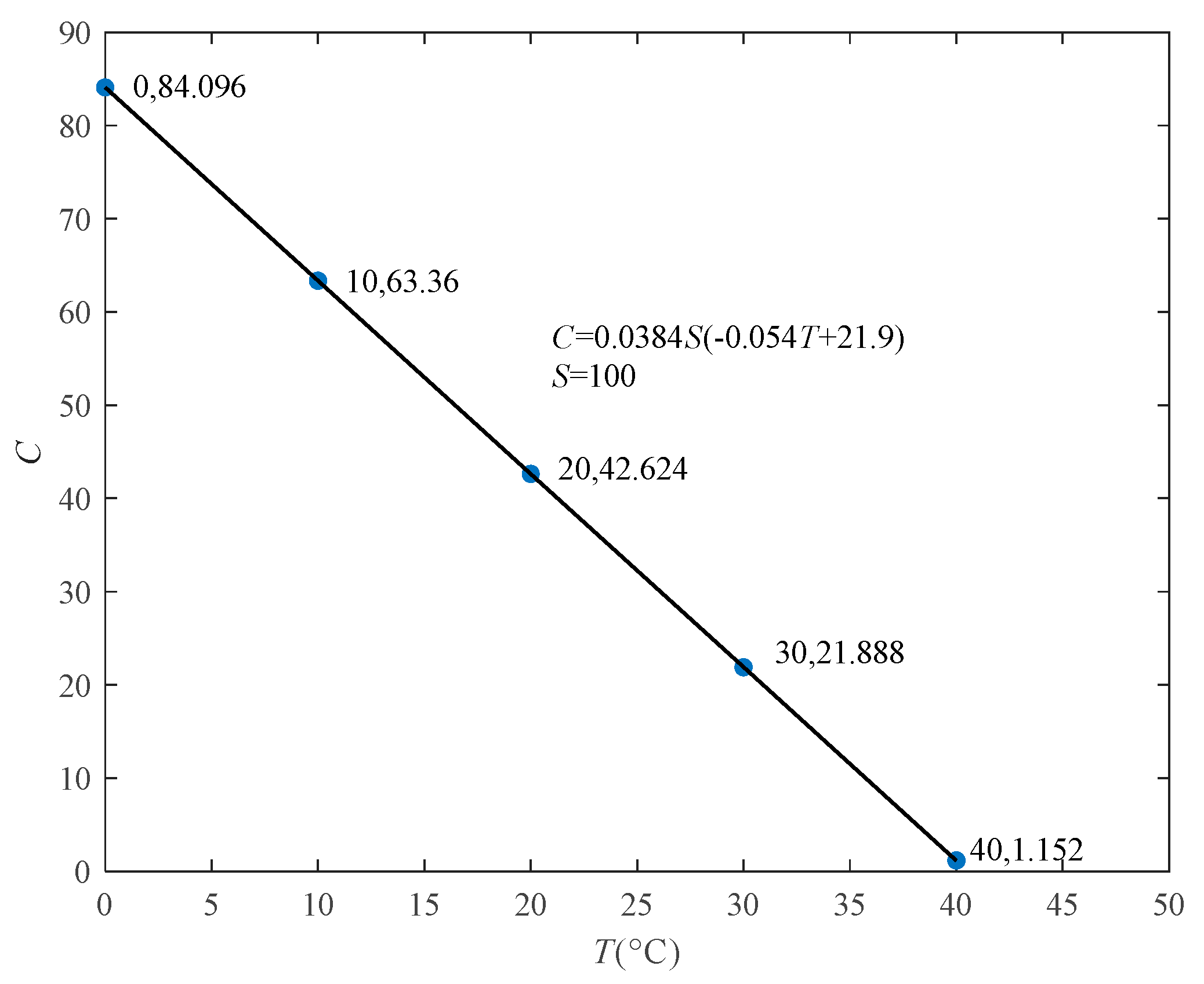
The variation in the carbon sequestration at five different temperatures is presented in
Figure 7, and it is obvious that carbon sequestration gradually decreases with increasing temperature. This conclusion is consistent with the results of the literature [
16]. Regardless of the temperature increase caused by spatial spanning or the increase in the Earth’s temperature caused by future warming, the amount of carbon dioxide released by trees will increase significantly and reduce carbon sequestration due to the dual influence of enhanced internal transpiration and respiration. Therefore, it is necessary to analyze the effect of temperature on forest vegetation.