Article

α Diversity of Desert Shrub Communities and Its Relationship with Climatic Factors in Xinjiang

1
College of Ecology and Environment, Xinjiang University, Urumqi 830017, China
2
Bayinbuluk Grassland Ecosystem Research Station, Xinjiang Institute of Ecology and Geography, Chinese Academy of Sciences, Bayingolin Mongolian Autonomous Prefecture 841314, China
3
CAS Research Center for Ecology and Environment of Central Asia, Urumqi 830011, China
*
Author to whom correspondence should be addressed.
Forests 2023, 14(2), 178; https://doi.org/10.3390/f14020178
Submission received: 22 November 2022 / Revised: 14 January 2023 / Accepted: 17 January 2023 / Published: 18 January 2023
(This article belongs to the Special Issue Plant Adaptation to Extreme Environments in Drylands)

Abstract

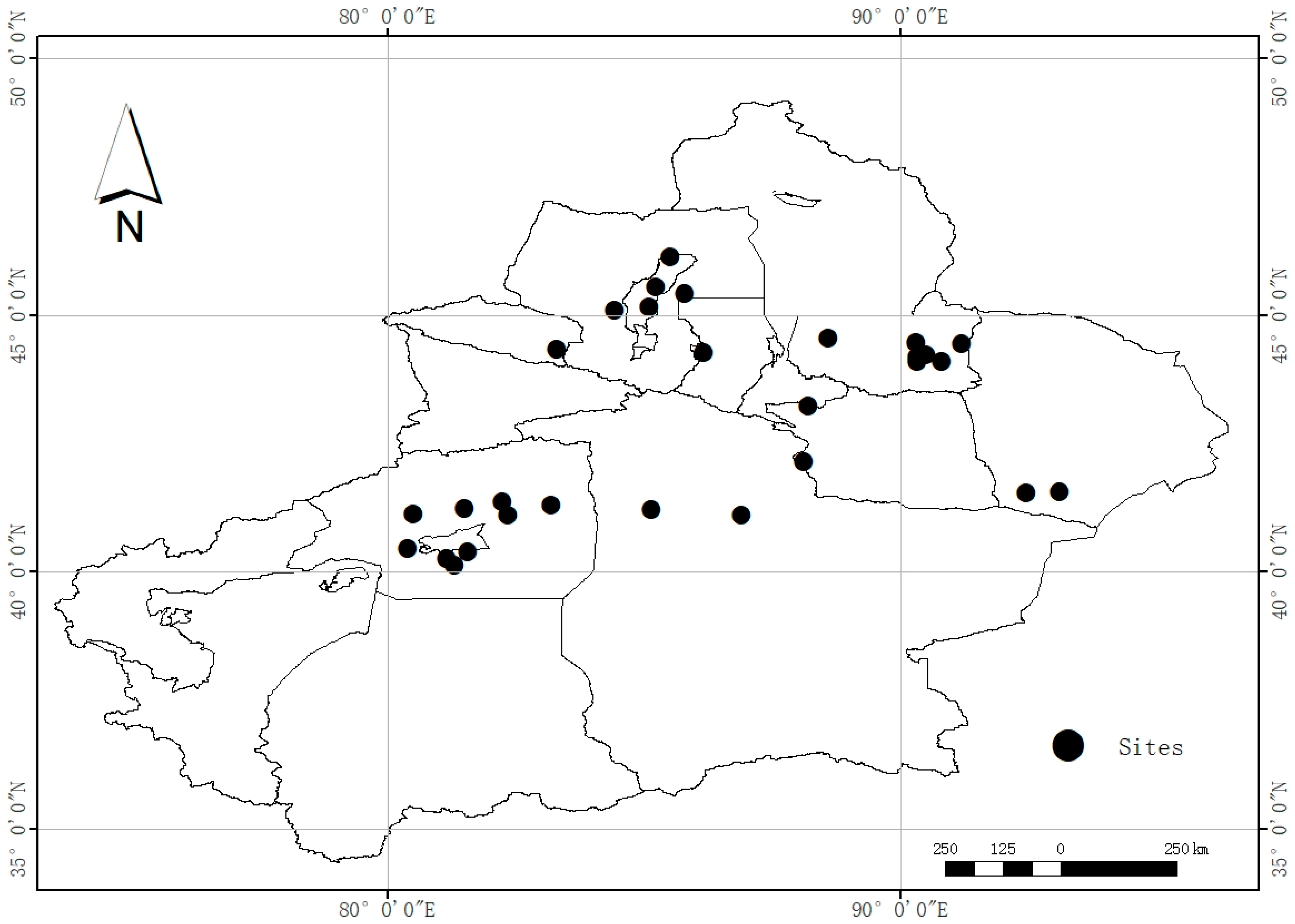
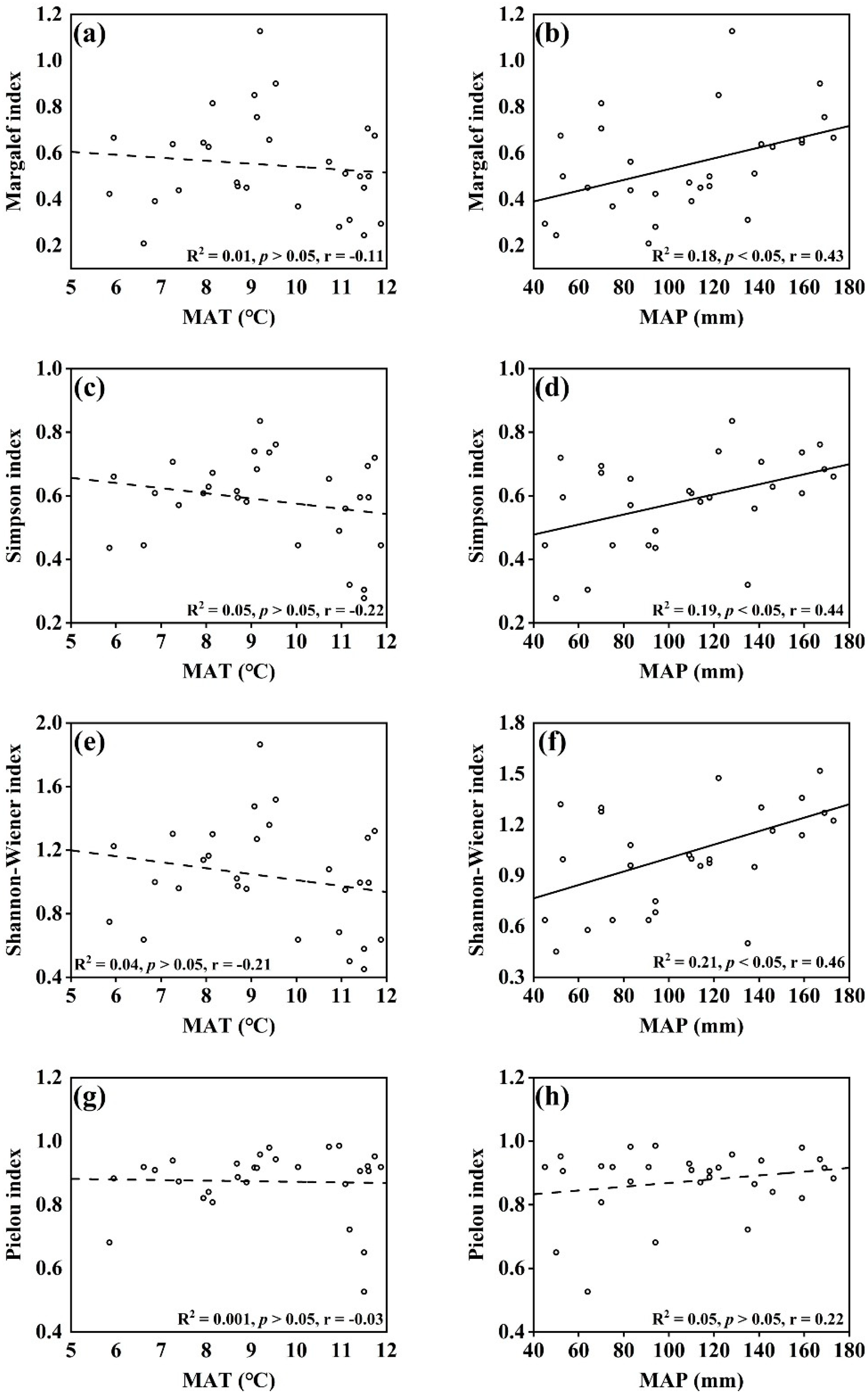
In the past 30 years, Northwest China has experienced a warm and humid climate increase trend. How this climate change will affect the species diversity of plant communities is a hot issue in ecological research. In this study, four α diversity indexes were applied in 29 shrub communities at desert sites in Xinjiang, including the Margalef index, Simpson index, Shannon–Wiener index, and Pielou index, to explore the relationship between the α diversity of the desert shrub communities and climate factors (mean annual temperature (MAT) and mean annual precipitation (MAP)). The species diversity indexes varied across these different desert shrub communities. Tamarix ramosissima communities had the highest Margalef index, while the Krascheninnikovia ewersmannia communities had the lowest Margalef index; T. ramosissima communities also showed the highest Simpson index and Shannon–Wiener index, but Alhagi sparsifolia communities showed the lowest Simpson index and Shannon–Wiener index. The Ephedra przewalskii communities and Karelinia caspica communities showed the highest and the lowest Pielou index, respectively. The α diversity indexes (except the Pielou index) of desert shrub communities had a significantly positive correlation with MAP (p < 0.05) but a non-significantly correlation with MAT (p > 0.05). These results indicate that, compared with temperature, water conditions are still a more vital climatic factor affecting the species diversity of desert shrub communities in Xinjiang, and thus, the recent “warm and humid” climate trend in Xinjiang affects the α diversity of desert shrub communities.
Keywords: desert plants; shrub community; biodiversity; climate change; arid region desert plants; shrub community; biodiversity; climate change; arid region