Communication

Exploring the Potential to Improve the Estimation of Boreal Tree Structural Attributes with Simple Height- and Distance-Based Competition Index

1
Hyytiälä Forestry Field Station, Faculty of Agriculture and Forestry, University of Helsinki, Hyytiäläntie 124, FI-35500 Korkeakoski, Finland
2
Institute for Atmospheric and Earth System Research/Physics, Faculty of Science, University of Helsinki, P.O. Box 64, FI-00014 Helsinki, Finland
3
Institute for Atmospheric and Earth System Research/Forest Sciences, Faculty of Agriculture and Forestry, University of Helsinki, P.O. Box 27, FI-00014 Helsinki, Finland
*
Author to whom correspondence should be addressed.
Forests 2021, 12(3), 324; https://doi.org/10.3390/f12030324
Submission received: 10 February 2021 / Revised: 1 March 2021 / Accepted: 8 March 2021 / Published: 10 March 2021
(This article belongs to the Section Forest Ecology and Management)

Abstract

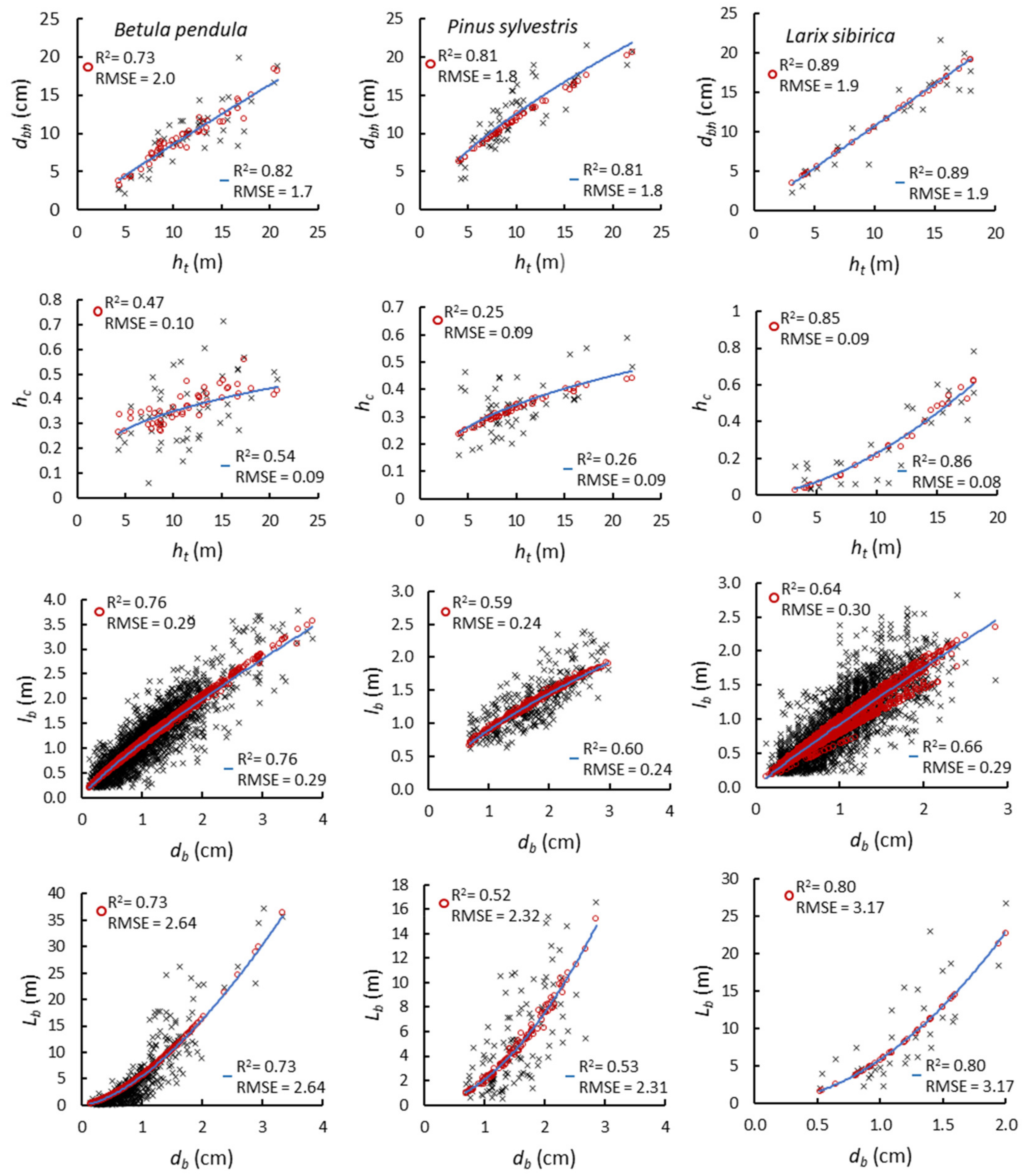
In many cases, the traditional ground-based estimates of competition between trees are not directly applicable with modern aerial inventories, due to incompatible measurements. Moreover, many former studies of competition consider extreme stand densities, hence the effect of competition under the density range in managed stands remains less explored. Here we explored the utility of a simple tree height- and distance-based competition index that provides compatibility with data produced by modern inventory methods. The index was used for the prediction of structural tree attributes in three boreal tree species growing in low to moderate densities within mixed stands. In silver birch, allometric models predicting tree diameter, crown height, and branch length all showed improvement when the effect of between-tree competition was included. A similar but non-significant trend was also present in a proxy for branch biomass. In Siberian larch, only the prediction of branch length was affected. In Scots pine, there was no improvement. The results suggest that quantification of competitive interactions based on individual tree heights and locations alone has potential to improve the prediction of tree attributes, although the outcomes can be species-specific.
Keywords: allometry; competition; forest inventory; model; tree structure allometry; competition; forest inventory; model; tree structure