Article

Aboveground Biomass Response to Release Treatments in a Young Ponderosa Pine Plantation


USDA Forest Service, Pacific Southwest Research Station, 3644 Avtech Parkway, Redding, CA 96002, USA
*
Author to whom correspondence should be addressed.
Forests 2019, 10(9), 795; https://doi.org/10.3390/f10090795
Submission received: 8 August 2019 / Revised: 5 September 2019 / Accepted: 10 September 2019 / Published: 12 September 2019

Abstract

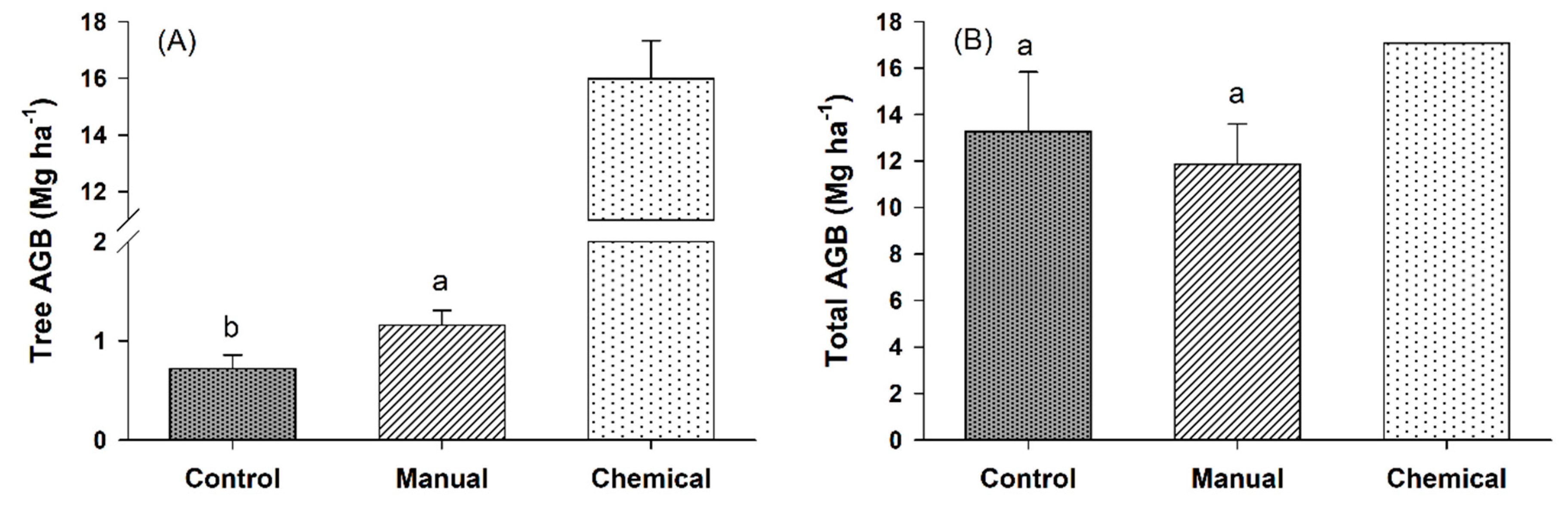
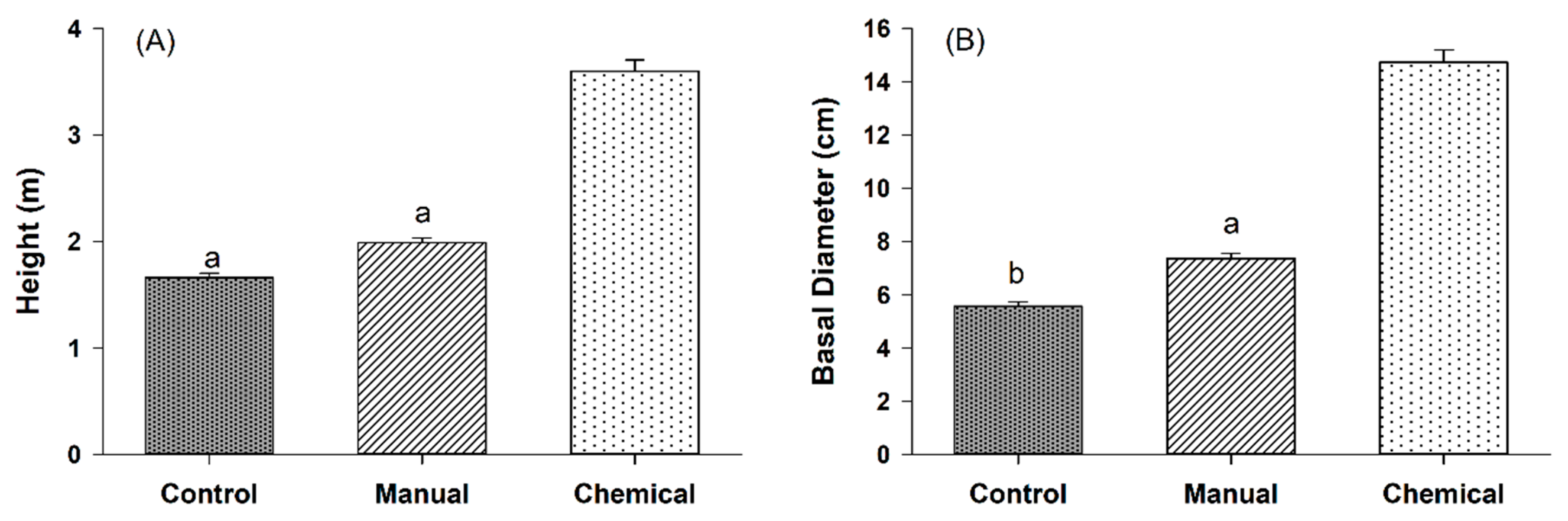
Controlling competing vegetation is vital for early plantation establishment and growth. Aboveground biomass (AGB) response to manual grubbing release from shrub competition was compared with no release control in a twelve-year-old ponderosa pine (Pinus ponderosa Lawson & C. Lawson) plantation established after a wildfire in northeastern California. In addition, response to chemical release followed by precommercial thinning in an adjacent plantation was also examined as a growth potential from a more intensively managed regime, where shrub competition was virtually eliminated. We measured AGB in both planted trees and competing woody shrubs to partition the biomass pools in the plantation. The results showed a significant grubbing treatment effect on basal diameter (BD) at 10 cm aboveground (p = 0.02), but not on tree height (p = 0.055). Height and BD were 2.0 m and 7.4 cm in the manual release, respectively, compared to 1.7 m and 5.6 cm in the control. However, chemical release produced much greater rates of tree growth with a height of 3.6 m and BD of 14.7 cm, respectively. Tree AGB was 60% higher with the manual release of shrubs (1.2 Mg ha−1) than with control (0.7 Mg ha−1) (p < 0.05). The planted area without shrub competition yielded a much higher green tree biomass (16.0 Mg ha−1). When woody shrub biomass was included, the total AGB (trees and woody shrubs) appeared slightly higher, but non-significant in the no release control (13.3 Mg ha−1) than in the manual release (11.9 Mg ha−1) (p = 0.66); the chemical release had 17.1 Mg ha−1. Clearly, shrub biomass dominated this young plantation when understory shrubs were not completely controlled. Although the manual release did increase targeted tree growth to some degree, the cost may limit this practice to a smaller scale and the remaining shrub dominance may create long-term reductions in growth and a persistent fuels problem in these fire-prone ecosystems.
Keywords: chemical release; manual release; shrub biomass chemical release; manual release; shrub biomass