

The Impacts of Large Language Model Addiction on University Students’ Mental Health: Gender as a Moderator


Abstract
1. Introduction
2. Theoretical Background and Hypothesis Development
3. Methods
4. Results
4.1. Tier One: Measurement Model Evaluation
4.2. Tier-Two: Hypothesis Testing
5. Discussion and Implications
6. Conclusions
7. Limitations and Future Research
Author Contributions
Funding
Institutional Review Board Statement
Data Availability Statement
Conflicts of Interest
References
- Dwivedi, Y.K.; Hughes, L.; Baabdullah, A.M.; Rana, N.P. The Impact of Generative Artificial Intelligence on Higher Education: Opportunities and Challenges. Int. J. Inf. Manag. 2024, 75, 102789. [Google Scholar]
- Jogezai, N.A.; Koroleva, D.; Ivanov, I. Generative Artificial Intelligence in Higher Education: Challenges, Opportunities and Future Course of Actions to Achieve Sustainable Development Goals. Int. J. Educ. Manag. 2025, 1–25. [Google Scholar] [CrossRef] [Scilit]
- Kuss, D.J.; Griffiths, M.D. Social Networking Sites and Addiction: Ten Lessons Learned. Int. J. Environ. Res. Public Health 2017, 14, 311. [Google Scholar] [CrossRef] [Scilit] [PubMed]
- Banjanin, N.; Banjanin, N.; Dimitrijevic, I.; Pantic, I. Relationship between Internet Use and Depression: Focus on Physiological Mood Oscillations, Social Networking and Online Addictive Behavior. Comput. Hum. Behav. 2015, 43, 308–312. [Google Scholar] [CrossRef] [Scilit]
- Naseem, A.; Hashmi, Z.; Arif, S.; Razzaq, T.; Shahzadi, N. Correlation of Internet Addiction with Academic Performance and General Health in Undergraduate Physiotherapy Students: Internet Addiction with Academic Performance and General Health. Pak. Biomed. J. 2021, 4, 224–228. [Google Scholar] [CrossRef] [Scilit]
- Dichev, C.; Dicheva, D. Gamifying Education: What Is Known, What Is Believed and What Remains Uncertain: A Critical Review. Int. J. Educ. Technol. High. Educ. 2017, 14, 9. [Google Scholar] [CrossRef] [Scilit]
- Hamari, J.; Koivisto, J.; Sarsa, H. Does Gamification Work?–A Literature Review of Empirical Studies on Gamification. In Proceedings of the 2014 47th Hawaii International Conference on System Sciences, Waikoloa, HI, USA, 6–9 January 2014; IEEE: New York, NY, USA, 2014; pp. 3025–3034. [Google Scholar]
- Sailer, M.; Hense, J.; Mandl, H.; Klevers, M. Psychological Perspectives on Motivation through Gamification. Interact. Des. Arch. 2013, 28–37. [Google Scholar] [CrossRef] [Scilit]
- Kroczek, L.O.; May, A.; Hettenkofer, S.; Ruider, A.; Ludwig, B.; Mühlberger, A. The Influence of Persona and Conversational Task on Social Interactions with a LLM-Controlled Embodied Conversational Agent. Comput. Hum. Behav. 2025, 172, 108759. [Google Scholar] [CrossRef] [Scilit]
- Zhang, X.; Li, H.; Yin, M.; Zhang, M.; Li, Z.; Chen, Z. Investigating AI Chatbot Dependence: Associations with Internet and Smartphone Dependence, Mental Health Outcomes, and the Moderating Role of Usage Purposes. Int. J. Hum. Comput. Interact. 2025, 1–13. [Google Scholar] [CrossRef] [Scilit]
- Taha, M.H.; Shehzad, K.; Alamro, A.S.; Wadi, M. Internet Use and Addiction among Medical Students in Qassim University, Saudi Arabia. Sultan Qaboos Univ. Med. J. 2019, 19, e142. [Google Scholar] [CrossRef] [Scilit]
- Griffiths, M.D. The Evolution of the’components Model of Addiction’and the Need for a Confirmatory Approach in Conceptualizing Behavioral Addictions. Düşünen Adam J. Psychiatry Neurol. Sci. 2019, 32, 179–184. [Google Scholar]
- Katz, E.; Blumler, J.G.; Gurevitch, M. Uses and Gratifications Research. Public Opin. Q. 1973, 37, 509–523. [Google Scholar] [CrossRef] [Scilit]
- Griffiths, M. A ‘Components’ Model of Addiction within a Biopsychosocial Framework. J. Subst. Use 2005, 10, 191–197. [Google Scholar] [CrossRef] [Scilit]
- Dibben, G.O.; Martin, A.; Shore, C.B.; Johnstone, A.; McMellon, C.; Palmer, V.; Pugmire, J.; Riddell, J.; Skivington, K.; Wells, V.; et al. Adolescents’ Interactive Electronic Device Use, Sleep and Mental Health: A Systematic Review of Prospective Studies. J. Sleep Res. 2023, 32, e13899. [Google Scholar] [CrossRef] [Scilit]
- Yang, X.; Liu, R.-D.; Ding, Y.; Hong, W.; Ding, Z. Interpersonal Relationships Moderate the Relation between Academic Stress and Mobile Phone Addiction via Depression among Chinese Adolescents: A Three-Wave Longitudinal Study. Curr. Psychol. 2023, 42, 19076–19086. [Google Scholar] [CrossRef] [Scilit]
- Mukarromah, L.A.; Hakim, G.R.U. The Influence of Time Management and Social Media Addiction on Academic Procrastination in Undergraduate Students. J. Sains Psikol. 2023, 12, 302. [Google Scholar] [CrossRef] [Scilit]
- Misra, R.; McKean, M. College Students’ Academic Stress and Its Relation to Their Anxiety, Time Management, and Leisure Satisfaction. Am. J. Health Stud. 2000, 16, 41. [Google Scholar]
- Liu, F.; Xu, Y.; Yang, T.; Li, Z.; Dong, Y.; Chen, L.; Sun, X. The Mediating Roles of Time Management and Learning Strategic Approach in the Relationship Between Smartphone Addiction and Academic Procrastination. Psychol. Res. Behav. Manag. 2022, 15, 2639–2648. [Google Scholar] [CrossRef] [Scilit]
- Wei, Z.; Hassan, N.C.; Hassan, S.A.; Ismail, N.; Gu, X.; Dong, J. The Relationship between Internet Addiction and Academic Burnout in Undergraduates: A Chain Mediation Model. BMC Public Health 2025, 25, 1523. [Google Scholar] [CrossRef] [Scilit]
- Hobfoll, S.E. Conservation of Resources: A New Attempt at Conceptualizing Stress. Am. Psychol. 1989, 44, 513. [Google Scholar] [CrossRef]
- Aziz, N.; Khan, S.F.; Qatoon, S.S.; Siddiqui, M. Zainab Associations between Internet Addiction, Grit, Perceived Stress and Academic Performance in Medical Students. Int. J. Res. Med. Sci. 2024, 12, 4152–4156. [Google Scholar] [CrossRef] [Scilit]
- Aziz, M.; Chemnad, K.; Al-Harahsheh, S.; Abdelmoneium, A.O.; Baghdady, A.; Ali, R. Depression, Stress, and Anxiety versus Internet Addiction in Early and Middle Adolescent Groups: The Mediating Roles of Family and School Environments. BMC Psychol. 2024, 12, 184. [Google Scholar] [CrossRef] [Scilit] [PubMed]
- LaRose, R.; Lin, C.A.; Eastin, M.S. Unregulated Internet Usage: Addiction, Habit, or Deficient Self-Regulation? Media Psychol. 2003, 5, 225–253. [Google Scholar] [CrossRef] [Scilit]
- Salmela-Aro, K.; Upadyaya, K.; Hakkarainen, K.; Lonka, K.; Alho, K. The Dark Side of Internet Use: Two Longitudinal Studies of Excessive Internet Use, Depressive Symptoms, School Burnout and Engagement Among Finnish Early and Late Adolescents. J. Youth Adolesc. 2017, 46, 343–357. [Google Scholar] [CrossRef] [Scilit]
- Yu, Y.; Zhang, L.; Su, X.; Zhang, X.; Deng, X. Association between Internet Addiction and Insomnia among College Freshmen: The Chain Mediation Effect of Emotion Regulation and Anxiety and the Moderating Role of Gender. BMC Psychiatry 2025, 25, 326. [Google Scholar] [CrossRef] [Scilit]
- Lu, X.; Zhang, M.; Zhang, J. The Relationship between Social Support and Internet Addiction among Chinese College Freshmen: A Mediated Moderation Model. Front. Psychol. 2023, 13, 1031566. [Google Scholar] [CrossRef] [Scilit]
- Alosaimi, F.D.; Alyahya, H.; Alshahwan, H.; Al Mahyijari, N.; Shaik, S.A. Smartphone Addiction among University Students in Riyadh, Saudi Arabia. Saudi Med. J. 2016, 37, 675. [Google Scholar] [CrossRef] [Scilit]
- Kardefelt-Winther, D. A Conceptual and Methodological Critique of Internet Addiction Research: Towards a Model of Compensatory Internet Use. Comput. Hum. Behav. 2014, 31, 351–354. [Google Scholar] [CrossRef] [Scilit]
- Caplan, S.E. Preference for Online Social Interaction: A Theory of Problematic Internet Use and Psychosocial Well-Being. Commun. Res. 2003, 30, 625–648. [Google Scholar] [CrossRef] [Scilit]
- Liu, S.; Zhang, D.; Tian, Y.; Xu, B.; Wu, X. Gender Differences in Symptom Structure of Adolescent Problematic Internet Use: A Network Analysis. Child. Adolesc. Psychiatry Ment. Health 2023, 17, 49. [Google Scholar] [CrossRef] [Scilit]
- Wang, Z.; Yang, H.; Elhai, J.D. Are There Gender Differences in Comorbidity Symptoms Networks of Problematic Social Media Use, Anxiety and Depression Symptoms? Evidence from Network Analysis. Personal. Individ. Differ. 2022, 195, 111705. [Google Scholar] [CrossRef] [Scilit]
- Saad, S.K.; Elshaer, I.A. Organizational Politics and Validity of Layoff Decisions: Mediating Role of Distributive Justice of Performance Appraisal. J. Hosp. Mark. Manag. 2017, 26, 805–828. [Google Scholar] [CrossRef] [Scilit]
- Hou, J.; Huang, Z.; Li, H.; Liu, M.; Zhang, W.; Ma, N.; Yang, L.; Gu, F.; Liu, Y.; Jin, S. Is the Excessive Use of Microblogs an Internet Addiction? Developing a Scale for Assessing the Excessive Use of Microblogs in Chinese College Students. PLoS ONE 2014, 9, e110960. [Google Scholar] [CrossRef] [Scilit] [PubMed]
- Lovibond, P.F.; Lovibond, S.H. The Structure of Negative Emotional States: Comparison of the Depression Anxiety Stress Scales (DASS) with the Beck Depression and Anxiety Inventories. Behav. Res. Ther. 1995, 33, 335–343. [Google Scholar] [CrossRef] [Scilit]
- Henry, J.D.; Crawford, J.R. The Short-form Version of the Depression Anxiety Stress Scales (DASS-21): Construct Validity and Normative Data in a Large Non-clinical Sample. Br. J. Clin. Psychol. 2005, 44, 227–239. [Google Scholar] [CrossRef] [Scilit]
- Chen, I.-H.; Chen, C.-Y.; Liao, X.; Chen, X.; Zheng, X.; Tsai, Y.-C.; Lin, C.-Y.; Griffiths, M.D.; Pakpour, A.H. Psychometric Properties of the Depression, Anxiety, and Stress Scale (DASS-21) among Different Chinese Populations: A Cross-Sectional and Longitudinal Analysis. Acta Psychol. 2023, 240, 104042. [Google Scholar] [CrossRef] [Scilit]
- Cao, C.-H.; Liao, X.-L.; Jiang, X.-Y.; Li, X.-D.; Chen, I.-H.; Lin, C.-Y. Psychometric Evaluation of the Depression, Anxiety, and Stress Scale-21 (DASS-21) among Chinese Primary and Middle School Teachers. BMC Psychol. 2023, 11, 209. [Google Scholar] [CrossRef] [Scilit]
- Henseler, J.; Sarstedt, M. Goodness-of-Fit Indices for Partial Least Squares Path Modeling. Comput. Stat. 2013, 28, 565–580. [Google Scholar] [CrossRef] [Scilit]
- Sarstedt, M.; Ringle, C.M.; Hair, J.F. Partial Least Squares Structural Equation Modeling. In Handbook of Market Research; Homburg, C., Klarmann, M., Vomberg, A., Eds.; Springer International Publishing: Cham, Switzerland, 2022; pp. 587–632. ISBN 978-3-319-57413-4. [Google Scholar]
- Chin, W.W. The Partial Least Squares Approach to Structural Equation Modeling. Mod. Methods Bus. Res. 1998, 295, 295–336. [Google Scholar]
- Hair, J.F., Jr.; Sarstedt, M.; Ringle, C.M.; Gudergan, S.P. Advanced Issues in Partial Least Squares Structural Equation Modeling; Sage Publications: London, UK, 2017. [Google Scholar]
- Leguina, A. A Primer on Partial Least Squares Structural Equation Modeling (PLS-SEM). Int. J. Res. Method. Educ. 2015, 38, 220–221. [Google Scholar] [CrossRef] [Scilit]
- Henseler, J.; Ringle, C.M.; Sarstedt, M. A New Criterion for Assessing Discriminant Validity in Variance-Based Structural Equation Modeling. J. Acad. Mark. Sci. 2015, 43, 115–135. [Google Scholar] [CrossRef] [Scilit]
- Sarstedt, M.; Hair, J.F.; Cheah, J.-H.; Becker, J.-M.; Ringle, C.M. How to Specify, Estimate, and Validate Higher-Order Constructs in PLS-SEM. Australas. Mark. J. 2019, 27, 197–211. [Google Scholar] [CrossRef] [Scilit]
- Schermelleh-Engel, K.; Moosbrugger, H.; Müller, H. Evaluating the Fit of Structural Equation Models: Tests of Significance and Descriptive Goodness-of-Fit Measures. Methods Psychol. Res. Online 2003, 8, 23–74. [Google Scholar]
- Monecke, A.; Leisch, F. semPLS: Structural Equation Modeling Using Partial Least Squares. J. Stat. Softw. 2012, 48, 1–32. [Google Scholar] [CrossRef] [Scilit]
- Shen, X.; Wang, C.; Chen, C.; Wang, Y.; Wang, Z.; Zheng, Y.; Liu, H. Stress and Internet Addiction: Mediated by Anxiety and Moderated by Self-Control. Psychol. Res. Behav. Manag. 2023, 16, 1975–1986. [Google Scholar] [CrossRef] [Scilit]
- Gavurova, B.; Khouri, S.; Ivankova, V.; Rigelsky, M.; Mudarri, T. Internet Addiction, Symptoms of Anxiety, Depressive Symptoms, Stress among Higher Education Students during the COVID-19 Pandemic. Front. Public Health 2022, 10, 893845. [Google Scholar] [CrossRef] [Scilit]
- Panisoara, I.O.; Lazar, I.; Panisoara, G.; Chirca, R.; Ursu, A.S. Motivation and Continuance Intention towards Online Instruction among Teachers during the COVID-19 Pandemic: The Mediating Effect of Burnout and Technostress. Int. J. Environ. Res. Public Health 2020, 17, 8002. [Google Scholar] [CrossRef] [Scilit]
- Elhai, J.D.; Dvorak, R.D.; Levine, J.C.; Hall, B.J. Problematic Smartphone Use: A Conceptual Overview and Systematic Review of Relations with Anxiety and Depression Psychopathology. J. Affect. Disord. 2017, 207, 251–259. [Google Scholar] [CrossRef] [Scilit]
- Kraut, R.; Patterson, M.; Lundmark, V.; Kiesler, S.; Mukophadhyay, T.; Scherlis, W. Internet Paradox: A Social Technology That Reduces Social Involvement and Psychological Well-Being? Am. Psychol. 1998, 53, 1017–1031. [Google Scholar] [CrossRef]
- Twenge, J.M.; Campbell, W.K. Associations between Screen Time and Lower Psychological Well-Being among Children and Adolescents: Evidence from a Population-Based Study. Prev. Med. Rep. 2018, 12, 271–283. [Google Scholar] [CrossRef] [Scilit]
- Jin, Y.; Liu, J.; Li, P.; Wang, B.; Yan, Y.; Zhang, H.; Ni, C.; Wang, J.; Li, Y.; Bu, Y. The Applications of Large Language Models in Mental Health: Scoping Review. J. Med. Internet Res. 2025, 27, e69284. [Google Scholar] [CrossRef] [Scilit] [PubMed]
- Shiferaw, B.D.; Tang, J.; Wang, Y.; Wang, Y.; Wang, Y.; Mackay, L.E.; Luo, Y.; Yan, N.; Shen, X.; Zhou, T. Impact of Digital Addiction on Youth Health: A Systematic Review and Meta-Analysis. J. Behav. Addict. 2025, 14, 1129–1158. [Google Scholar] [CrossRef] [Scilit] [PubMed]
- Adedia, D.; Konlan, K.D.; Tsogbe, D.; Kugbey, N.; Kale, E.R.; Gmayinaam, V.U.; Anaman, J.; Ayanore, M. Digital Addiction and Emotional Exhaustion as Mediators between Problematic Internet Use and Mental Well-Being in University Students. SSRN 2025. [Google Scholar] [CrossRef]
- Błachnio, A.; Przepiórka, A. Facebook Intrusion, Fear of Missing out, Narcissism, and Life Satisfaction: A Cross-Sectional Study. Psychiatry Res. 2018, 259, 514–519. [Google Scholar] [CrossRef] [Scilit]
- Lopez-Fernandez, O.; Kuss, D.J.; Griffiths, M.D.; Billieux, J. The Conceptualization and Assessment of Problematic Mobile Phone Use. Encycl. Mob. Phone Behav. 2015, 591–606. [Google Scholar]
- Matud, M.P. Gender Differences in Stress and Coping Styles. Personal. Individ. Differ. 2004, 37, 1401–1415. [Google Scholar] [CrossRef] [Scilit]
- Derks, D.; Van Duin, D.; Tims, M.; Bakker, A.B. Smartphone Use and Work–Home Interference: The Moderating Role of Social Norms and Employee Work Engagement. J. Occup. Organ. Psychol. 2015, 88, 155–177. [Google Scholar] [CrossRef] [Scilit]
- Primack, B.A.; Shensa, A.; Sidani, J.E.; Whaite, E.O.; Lin, L.Y.; Rosen, D.; Colditz, J.B.; Radovic, A.; Miller, E. Social Media Use and Perceived Social Isolation Among Young Adults in the U.S. Am. J. Prev. Med. 2017, 53, 1–8. [Google Scholar] [CrossRef] [Scilit]
- Nolen-Hoeksema, S. Emotion Regulation and Psychopathology: The Role of Gender. Annu. Rev. Clin. Psychol. 2012, 8, 161–187. [Google Scholar] [CrossRef] [Scilit]
- Rozgonjuk, D.; Blinka, L.; Löchner, N.; Faltýnková, A.; Husarova, D.; Montag, C. Differences between Problematic Internet and Smartphone Use and Their Psychological Risk Factors in Boys and Girls: A Network Analysis. Child. Adolesc. Psychiatry Ment. Health 2023, 17, 69. [Google Scholar] [CrossRef] [Scilit]
- Selim, R.; Basu, A.; Anto, A.; Foscht, T.; Eisingerich, A.B. Effects of Large Language Model–Based Offerings on the Well-Being of Students: Qualitative Study. JMIR Form. Res. 2024, 8, e64081. [Google Scholar] [CrossRef] [Scilit]
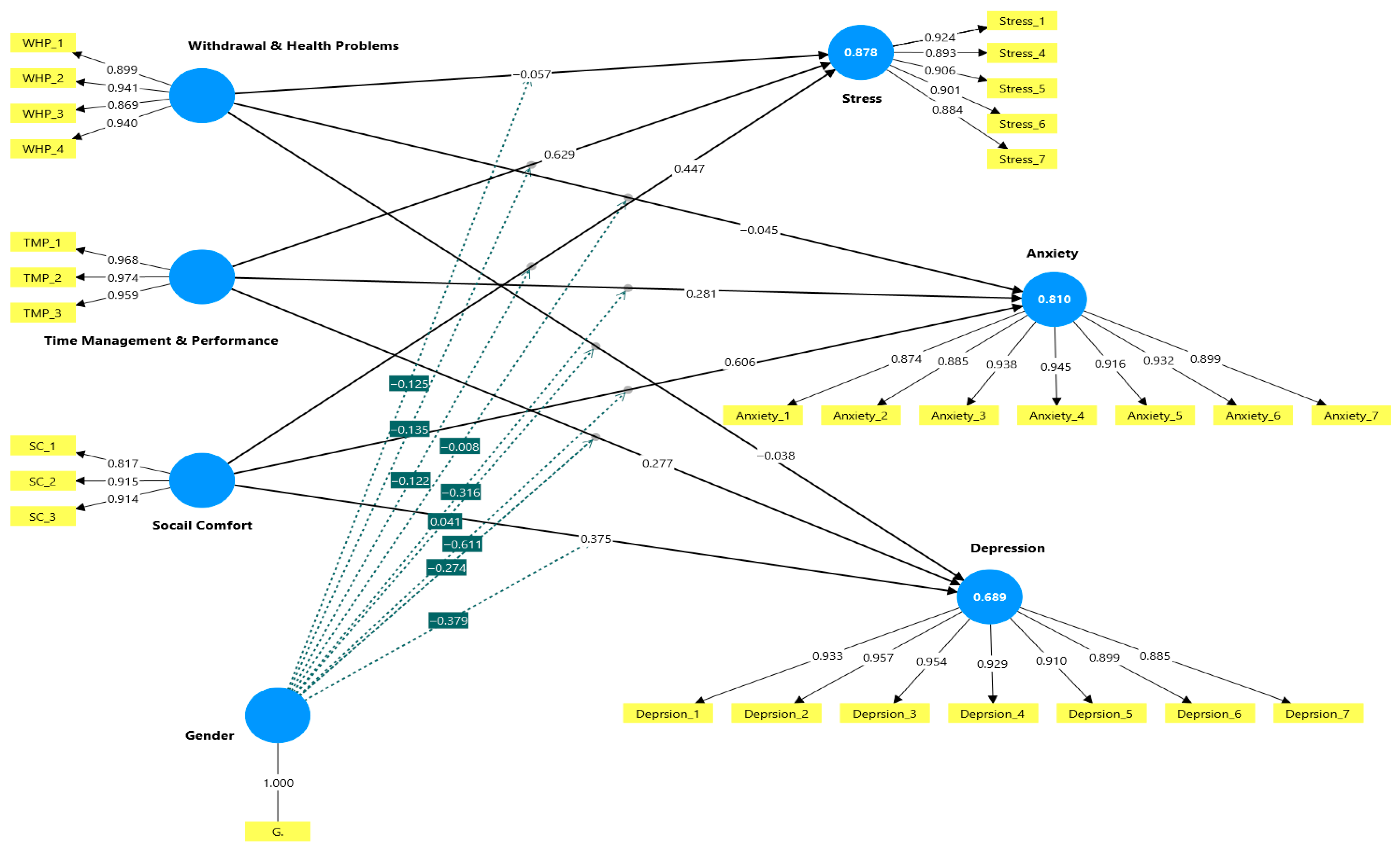
 direct effects;
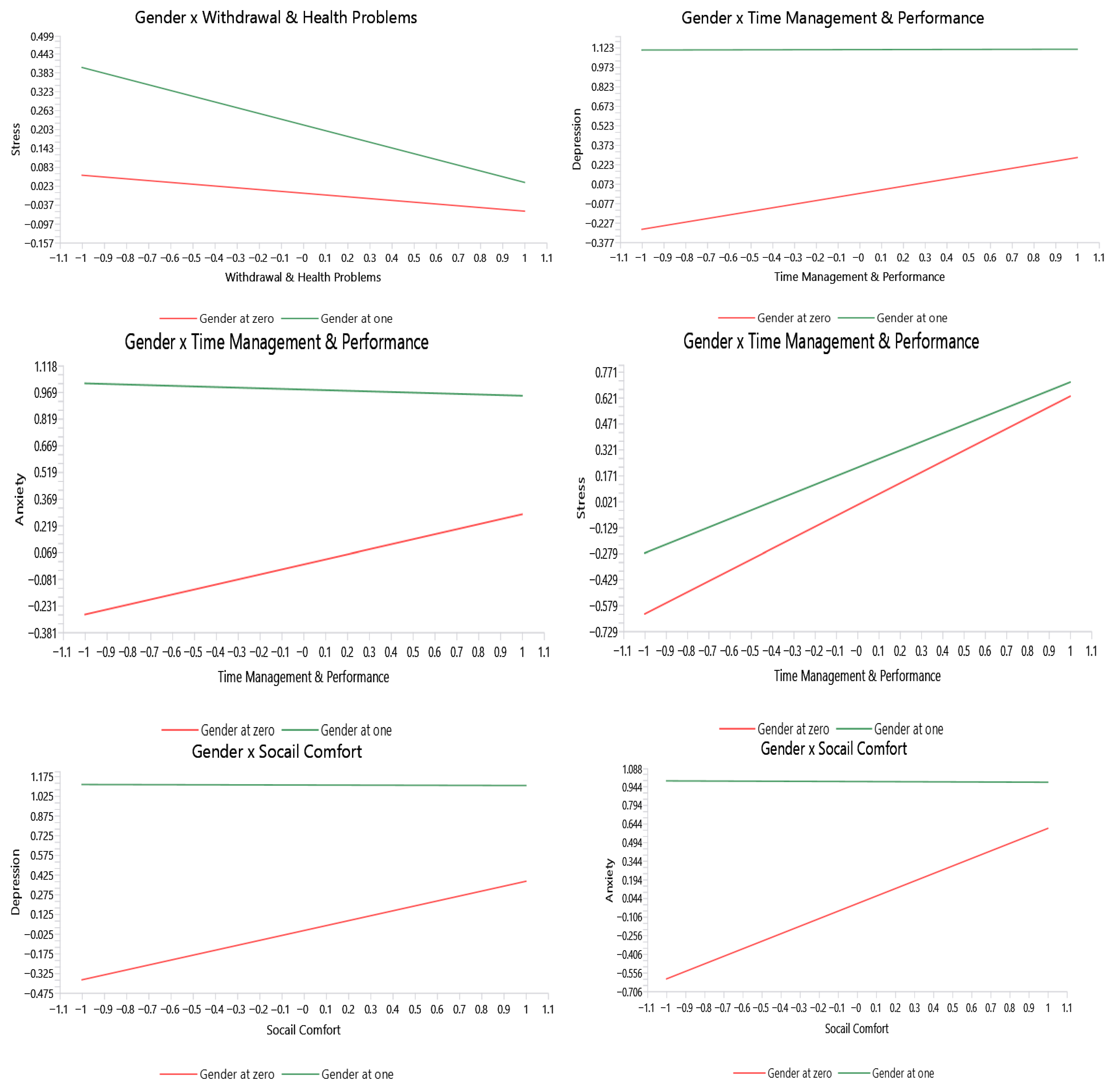
  moderating effects.
direct effects; moderating effects.
moderating effects.
direct effects; moderating effects.


| Measure | Variable | Loading | Cronbach’s a | CR | AVE | VIF |
|---|---|---|---|---|---|---|
| Anxiety | 0.967 | 0.967 | 0.834 | |||
| Anxiety_1 | 0.874 | 3.526 | ||||
| Anxiety_2 | 0.885 | 3.990 | ||||
| Anxiety_3 | 0.938 | 2.085 | ||||
| Anxiety_4 | 0.945 | 3.506 | ||||
| Anxiety_5 | 0.916 | 1.877 | ||||
| Anxiety_6 | 0.932 | 3.232 | ||||
| Anxiety_7 | 0.899 | 3.097 | ||||
| Depression | 0.971 | 0.973 | 0.854 | |||
| Deprsion_1 | 0.933 | 2.591 | ||||
| Deprsion_2 | 0.957 | 1.859 | ||||
| Deprsion_3 | 0.954 | 1.926 | ||||
| Deprsion_4 | 0.929 | 1.386 | ||||
| Deprsion_5 | 0.910 | 1.019 | ||||
| Deprsion_6 | 0.899 | 2.482 | ||||
| Deprsion_7 | 0.885 | 3.912 | ||||
| Social comfort | 0.858 | 0.860 | 0.780 | |||
| SC_1 | 0.817 | 1.461 | ||||
| SC_2 | 0.915 | 2.873 | ||||
| SC_3 | 0.914 | 3.848 | ||||
| Stress | 0.960 | 0.961 | 0.805 | |||
| Stress_1 | 0.878 | 2.805 | ||||
| Stress_2 | 0.924 | 3.377 | ||||
| Stress_3 | 0.893 | 2.080 | ||||
| Stress_4 | 0.893 | 2.387 | ||||
| Stress_5 | 0.906 | 1.248 | ||||
| Stress_6 | 0.901 | 1.662 | ||||
| Stress_7 | 0.884 | 3.864 | ||||
| Time management and performance | 0.965 | 0.965 | 0.935 | |||
| TMP_1 | 0.968 | 2.623 | ||||
| TMP_2 | 0.974 | 2.675 | ||||
| TMP_3 | 0.959 | 2.787 | ||||
| Withdrawal and health problems | 0.933 | 0.935 | 0.833 | |||
| WHP_1 | 0.899 | 3.127 | ||||
| WHP_2 | 0.941 | 1.312 | ||||
| WHP_3 | 0.869 | 2.700 | ||||
| WHP_4 | 0.940 | 1.244 | ||||
| Anxiety | Depression | Stress | TM&P | W&HP | |
|---|---|---|---|---|---|
| Anxiety | |||||
| Depression | 0.681 | ||||
| Social Comfort | 0.634 | 0.642 | |||
| Stress | 0.664 | 0.670 | |||
| TM&P | 0.501 | 0.676 | 0.647 | ||
| W&HP | 0.662 | 0.608 | 0.621 | 0.603 |
| Anxiety | Depression | Social Comfort | Stress | TM&P | W&HP | |
|---|---|---|---|---|---|---|
| Anxiety | 0.913 | |||||
| Depression | 0.654 | 0.924 | ||||
| Social Comfort | 0.724 | 0.734 | ||||
| Stress | 0.604 | 0.719 | 0.883 | |||
| TM&P | 0.771 | 0.653 | 0.610 | 0.897 | 0.967 | |
| W&HP | 0.639 | 0.589 | 0.746 | 0.675 | 0.407 | 0.913 |
| β | T-Statistics | p-Values | Results | |
|---|---|---|---|---|
| Withdrawal and Health Problems −> Stress | −0.057 | 4.513 | 0.000 | H1a Rejected |
| Withdrawal and Health Problems −> Depression | −0.038 | 1.360 | 0.174 | H1b Rejected |
| Withdrawal and Health Problems −> Anxiety | −0.045 | 1.780 | 0.075 | H1c Rejected |
| Time Management and Performance −> Stress | 0.629 | 15.008 | 0.000 | H2a Supported |
| Time Management and Performance −> Depression | 0.277 | 4.337 | 0.000 | H2b Supported |
| Time Management and Performance −> Anxiety | 0.281 | 6.509 | 0.000 | H2c Supported |
| Social Comfort −> Stress | 0.447 | 12.150 | 0.000 | H3a Supported |
| Social Comfort −> Depression | 0.375 | 5.820 | 0.000 | H3b Supported |
| Social Comfort −> Anxiety | 0.606 | 15.768 | 0.000 | H3c Supported |
| Moderation impacts | ||||
| Gender x Withdrawal and Health Problems −> Stress | −0.125 | 2.485 | 0.013 | H4 Supported |
| Gender x Withdrawal and Health Problems −> Depression | 0.041 | 0.594 | 0.553 | H5 Rejected |
| Gender x Withdrawal and Health Problems −> Anxiety | −0.008 | 0.159 | 0.873 | H6 Rejected |
| Gender x Time Management and Performance −> Stress | −0.135 | 2.194 | 0.028 | H7 Supported |
| Gender x Time Management and Performance −> Depression | −0.274 | 3.459 | 0.001 | H8 Supported |
| Gender x Time Management and Performance −> Anxiety | −0.316 | 6.188 | 0.000 | H9 Supported |
| Gender x Social Comfort −> Stress | −0.122 | 1.638 | 0.101 | H10 Rejected |
| Gender x Social Comfort −> Depression | −0.379 | 4.070 | 0.000 | H11 Supported |
| Gender x Social Comfort −> Anxiety | −0.611 | 10.934 | 0.000 | H12 Supported |
Disclaimer/Publisher’s Note: The statements, opinions and data contained in all publications are solely those of the individual author(s) and contributor(s) and not of MDPI and/or the editor(s). MDPI and/or the editor(s) disclaim responsibility for any injury to people or property resulting from any ideas, methods, instructions or products referred to in the content. |
© 2025 by the authors. Licensee MDPI, Basel, Switzerland. This article is an open access article distributed under the terms and conditions of the Creative Commons Attribution (CC BY) license (https://creativecommons.org/licenses/by/4.0/).
Share and Cite
Elshaer, I.A.; Azazz, A.M.S.A. The Impacts of Large Language Model Addiction on University Students’ Mental Health: Gender as a Moderator. Algorithms 2025, 18, 789. https://doi.org/10.3390/a18120789
Elshaer IA, Azazz AMSA. The Impacts of Large Language Model Addiction on University Students’ Mental Health: Gender as a Moderator. Algorithms. 2025; 18(12):789. https://doi.org/10.3390/a18120789
Chicago/Turabian StyleElshaer, Ibrahim A., and Alaa M. S. A. Azazz. 2025. "The Impacts of Large Language Model Addiction on University Students’ Mental Health: Gender as a Moderator" Algorithms 18, no. 12: 789. https://doi.org/10.3390/a18120789
APA StyleElshaer, I. A., & Azazz, A. M. S. A. (2025). The Impacts of Large Language Model Addiction on University Students’ Mental Health: Gender as a Moderator. Algorithms, 18(12), 789. https://doi.org/10.3390/a18120789